
A English
Mix Examples - Surface Areas and Volumes Questions in English
Class 9 Mathematics · Surface Areas and Volumes · Mix Examples - Surface Areas and Volumes
210+
Questions
English
Language
100%
With Solutions
Showing 50 of 210 questions in English
1
MediumMCQ
In a cylinder,if the radius is halved and the height is doubled,the volume will be
A
halved
B
same
C
doubled
D
four times
Solution
(A) The volume of a cylinder is given by the formula $V = \pi r^2 h$,where $r$ is the radius and $h$ is the height.
Let the initial radius be $r$ and the initial height be $h$. The initial volume is $V_1 = \pi r^2 h$.
According to the problem,the new radius $r' = \frac{r}{2}$ and the new height $h' = 2h$.
The new volume $V_2$ is calculated as:
$V_2 = \pi (r')^2 (h')$
$V_2 = \pi (\frac{r}{2})^2 (2h)$
$V_2 = \pi (\frac{r^2}{4}) (2h)$
$V_2 = \frac{2}{4} \pi r^2 h$
$V_2 = \frac{1}{2} \pi r^2 h$
Since $V_1 = \pi r^2 h$,we have $V_2 = \frac{1}{2} V_1$.
Therefore,the volume is halved.
Let the initial radius be $r$ and the initial height be $h$. The initial volume is $V_1 = \pi r^2 h$.
According to the problem,the new radius $r' = \frac{r}{2}$ and the new height $h' = 2h$.
The new volume $V_2$ is calculated as:
$V_2 = \pi (r')^2 (h')$
$V_2 = \pi (\frac{r}{2})^2 (2h)$
$V_2 = \pi (\frac{r^2}{4}) (2h)$
$V_2 = \frac{2}{4} \pi r^2 h$
$V_2 = \frac{1}{2} \pi r^2 h$
Since $V_1 = \pi r^2 h$,we have $V_2 = \frac{1}{2} V_1$.
Therefore,the volume is halved.
0 likes
View Solution2
EasyMCQ
The radius of a sphere is $2r$,then its volume will be
A
$\frac{4}{3} \pi r^{3}$
B
$\frac{32}{3} \pi r^{3}$
C
$\frac{8 \pi r^{3}}{3}$
D
$4 \pi r^{3}$
Solution
(B) The formula for the volume of a sphere with radius $R$ is $V = \frac{4}{3} \pi R^{3}$.
Given that the radius of the sphere is $R = 2r$.
Substituting this value into the formula:
$V = \frac{4}{3} \pi (2r)^{3}$
$V = \frac{4}{3} \pi (8r^{3})$
$V = \frac{32}{3} \pi r^{3}$
Given that the radius of the sphere is $R = 2r$.
Substituting this value into the formula:
$V = \frac{4}{3} \pi (2r)^{3}$
$V = \frac{4}{3} \pi (8r^{3})$
$V = \frac{32}{3} \pi r^{3}$
0 likes
View Solution3
EasyMCQ
The total surface area of a cube is $96 \, cm^2$. The volume of the cube is (in $cm^3$)
A
$8$
B
$512$
C
$64$
D
$27$
Solution
(C) The total surface area of a cube is given by the formula $6 \times (\text{edge})^2$.
Given that the total surface area is $96 \, cm^2$, we have $6 \times (\text{edge})^2 = 96$.
Dividing both sides by $6$, we get $(\text{edge})^2 = 16$.
Taking the square root of both sides, the edge length is $\text{edge} = \sqrt{16} = 4 \, cm$.
The volume of a cube is given by the formula $(\text{edge})^3$.
Therefore, the volume $= (4)^3 = 64 \, cm^3$.
Given that the total surface area is $96 \, cm^2$, we have $6 \times (\text{edge})^2 = 96$.
Dividing both sides by $6$, we get $(\text{edge})^2 = 16$.
Taking the square root of both sides, the edge length is $\text{edge} = \sqrt{16} = 4 \, cm$.
The volume of a cube is given by the formula $(\text{edge})^3$.
Therefore, the volume $= (4)^3 = 64 \, cm^3$.
0 likes
View Solution4
DifficultMCQ
$A$ cone is $8.4 \, cm$ high and the radius of its base is $2.1 \, cm$. It is melted and recast into a sphere. The radius of the sphere is (in $cm$):
A
$4.2$
B
$2.4$
C
$1.6$
D
$2.1$
Solution
(D) The volume of a cone is given by the formula $V = \frac{1}{3} \pi r^2 h$.
Given,radius $r = 2.1 \, cm$ and height $h = 8.4 \, cm$.
Volume of cone $= \frac{1}{3} \pi (2.1)^2 \times 8.4$.
When the cone is melted and recast into a sphere,the volume remains constant.
Let the radius of the sphere be $R$. The volume of a sphere is $V = \frac{4}{3} \pi R^3$.
Equating the volumes: $\frac{4}{3} \pi R^3 = \frac{1}{3} \pi (2.1)^2 \times 8.4$.
Dividing both sides by $\frac{1}{3} \pi$: $4 R^3 = (2.1)^2 \times 8.4$.
$R^3 = \frac{(2.1)^2 \times 8.4}{4} = (2.1)^2 \times 2.1 = (2.1)^3$.
Taking the cube root on both sides,$R = 2.1 \, cm$.
Thus,the radius of the sphere is $2.1 \, cm$.
Given,radius $r = 2.1 \, cm$ and height $h = 8.4 \, cm$.
Volume of cone $= \frac{1}{3} \pi (2.1)^2 \times 8.4$.
When the cone is melted and recast into a sphere,the volume remains constant.
Let the radius of the sphere be $R$. The volume of a sphere is $V = \frac{4}{3} \pi R^3$.
Equating the volumes: $\frac{4}{3} \pi R^3 = \frac{1}{3} \pi (2.1)^2 \times 8.4$.
Dividing both sides by $\frac{1}{3} \pi$: $4 R^3 = (2.1)^2 \times 8.4$.
$R^3 = \frac{(2.1)^2 \times 8.4}{4} = (2.1)^2 \times 2.1 = (2.1)^3$.
Taking the cube root on both sides,$R = 2.1 \, cm$.
Thus,the radius of the sphere is $2.1 \, cm$.
0 likes
View Solution5
MediumMCQ
In a cylinder,if the radius is doubled and the height is halved,the curved surface area will be:
A
same
B
halved
C
doubled
D
four times
Solution
(A) The formula for the curved surface area $(CSA)$ of a cylinder is $CSA = 2 \pi r h$,where $r$ is the radius and $h$ is the height.
When the radius is doubled $(r' = 2r)$ and the height is halved $(h' = h/2)$,the new curved surface area $(CSA')$ becomes:
$CSA' = 2 \pi (2r) \times (h/2)$
$CSA' = 2 \pi r h$
Since the new curved surface area is equal to the original curved surface area,the curved surface area remains the same.
When the radius is doubled $(r' = 2r)$ and the height is halved $(h' = h/2)$,the new curved surface area $(CSA')$ becomes:
$CSA' = 2 \pi (2r) \times (h/2)$
$CSA' = 2 \pi r h$
Since the new curved surface area is equal to the original curved surface area,the curved surface area remains the same.
0 likes
View Solution6
EasyMCQ
The total surface area of a cone whose radius is $\frac{r}{2}$ and slant height is $2l$ is
A
$2 \pi r(l+r)$
B
$\pi r(l+\frac{r}{4})$
C
$\pi r(l+r)$
D
$2 \pi r l$
Solution
(B) The total surface area of a cone is given by the formula: $\text{Total Surface Area} = \text{Area of the base} + \text{Curved surface area}$.
Given,radius $R = \frac{r}{2}$ and slant height $L = 2l$.
$\text{Total Surface Area} = \pi R^2 + \pi RL$
Substituting the values:
$= \pi \left(\frac{r}{2}\right)^2 + \pi \left(\frac{r}{2}\right) \times (2l)$
$= \pi \left(\frac{r^2}{4}\right) + \pi rl$
$= \pi r \left(\frac{r}{4} + l\right)$
$= \pi r \left(l + \frac{r}{4}\right)$.
Given,radius $R = \frac{r}{2}$ and slant height $L = 2l$.
$\text{Total Surface Area} = \pi R^2 + \pi RL$
Substituting the values:
$= \pi \left(\frac{r}{2}\right)^2 + \pi \left(\frac{r}{2}\right) \times (2l)$
$= \pi \left(\frac{r^2}{4}\right) + \pi rl$
$= \pi r \left(\frac{r}{4} + l\right)$
$= \pi r \left(l + \frac{r}{4}\right)$.
0 likes
View Solution7
MediumMCQ
The radii of two cylinders are in the ratio of $2:3$ and their heights are in the ratio of $5:3$. The ratio of their volumes is
A
$10:17$
B
$17:27$
C
$20:27$
D
$20:37$
Solution
(C) Let the radii of the two cylinders be $r_1 = 2r$ and $r_2 = 3r$,and their heights be $h_1 = 5h$ and $h_2 = 3h$.
The volume of a cylinder is given by the formula $V = \pi r^2 h$.
Therefore,the ratio of their volumes is:
$\frac{V_1}{V_2} = \frac{\pi r_1^2 h_1}{\pi r_2^2 h_2} = \frac{\pi (2r)^2 (5h)}{\pi (3r)^2 (3h)}$
$\frac{V_1}{V_2} = \frac{4r^2 \times 5h}{9r^2 \times 3h} = \frac{20r^2h}{27r^2h} = \frac{20}{27}$
Thus,the ratio of their volumes is $20:27$.
The volume of a cylinder is given by the formula $V = \pi r^2 h$.
Therefore,the ratio of their volumes is:
$\frac{V_1}{V_2} = \frac{\pi r_1^2 h_1}{\pi r_2^2 h_2} = \frac{\pi (2r)^2 (5h)}{\pi (3r)^2 (3h)}$
$\frac{V_1}{V_2} = \frac{4r^2 \times 5h}{9r^2 \times 3h} = \frac{20r^2h}{27r^2h} = \frac{20}{27}$
Thus,the ratio of their volumes is $20:27$.
0 likes
View Solution8
EasyMCQ
The lateral surface area of a cube is $256 \, m^2$. The volume of the cube is (in $m^3$)
A
$64$
B
$216$
C
$256$
D
$512$
Solution
(D) The lateral surface area of a cube is given by the formula: $4 \times (\text{edge})^2$.
Given that the lateral surface area is $256 \, m^2$,we have:
$4 \times (\text{edge})^2 = 256$
$(\text{edge})^2 = 256 \div 4 = 64$
$\text{edge} = \sqrt{64} = 8 \, m$.
The volume of a cube is given by the formula: $(\text{edge})^3$.
Therefore,the volume $= (8)^3 = 512 \, m^3$.
Given that the lateral surface area is $256 \, m^2$,we have:
$4 \times (\text{edge})^2 = 256$
$(\text{edge})^2 = 256 \div 4 = 64$
$\text{edge} = \sqrt{64} = 8 \, m$.
The volume of a cube is given by the formula: $(\text{edge})^3$.
Therefore,the volume $= (8)^3 = 512 \, m^3$.
0 likes
View Solution9
EasyMCQ
The number of planks of dimensions $(4 \,m \times 50 \,cm \times 20 \,cm)$ that can be stored in a pit which is $16 \,m$ long,$12 \,m$ wide,and $4 \,m$ deep is:
A
$1920$
B
$1900$
C
$1800$
D
$1840$
Solution
(A) First,convert all dimensions to the same unit (meters).
Dimensions of the plank: $4 \,m$,$50 \,cm = 0.5 \,m$,and $20 \,cm = 0.2 \,m$.
Volume of the pit $= 16 \,m \times 12 \,m \times 4 \,m = 768 \,m^3$.
Volume of one plank $= 4 \,m \times 0.5 \,m \times 0.2 \,m = 0.4 \,m^3$.
Number of planks $= \frac{\text{Volume of pit}}{\text{Volume of one plank}} = \frac{768}{0.4} = 1920$.
Dimensions of the plank: $4 \,m$,$50 \,cm = 0.5 \,m$,and $20 \,cm = 0.2 \,m$.
Volume of the pit $= 16 \,m \times 12 \,m \times 4 \,m = 768 \,m^3$.
Volume of one plank $= 4 \,m \times 0.5 \,m \times 0.2 \,m = 0.4 \,m^3$.
Number of planks $= \frac{\text{Volume of pit}}{\text{Volume of one plank}} = \frac{768}{0.4} = 1920$.
0 likes
View Solution10
EasyMCQ
The length of the longest pole that can be placed in a room of dimensions $(10 \text{ m} \times 10 \text{ m} \times 5 \text{ m})$ is (in $\text{m}$):
A
$16$
B
$15$
C
$10$
D
$12$
Solution
(B) The longest pole that can be placed in a room is equal to the length of the space diagonal of the cuboid.
The formula for the space diagonal of a cuboid with dimensions $l$,$b$,and $h$ is given by $\sqrt{l^2 + b^2 + h^2}$.
Given dimensions are $l = 10 \text{ m}$,$b = 10 \text{ m}$,and $h = 5 \text{ m}$.
Substituting these values into the formula:
$\text{Length} = \sqrt{10^2 + 10^2 + 5^2}$
$= \sqrt{100 + 100 + 25}$
$= \sqrt{225}$
$= 15 \text{ m}$.
The formula for the space diagonal of a cuboid with dimensions $l$,$b$,and $h$ is given by $\sqrt{l^2 + b^2 + h^2}$.
Given dimensions are $l = 10 \text{ m}$,$b = 10 \text{ m}$,and $h = 5 \text{ m}$.
Substituting these values into the formula:
$\text{Length} = \sqrt{10^2 + 10^2 + 5^2}$
$= \sqrt{100 + 100 + 25}$
$= \sqrt{225}$
$= 15 \text{ m}$.
0 likes
View Solution11
EasyMCQ
The radius of a hemispherical balloon increases from $6\,cm$ to $12\,cm$ as air is being pumped into it. The ratio of the surface areas of the balloon in the two cases is
A
$2:3$
B
$1:3$
C
$1:4$
D
$2:1$
Solution
(C) The balloon is hemispherical in shape.
The surface area of a hemispherical balloon with radius $r$ is given by the formula $S = 3\pi r^2$.
Let $r_1 = 6\,cm$ and $r_2 = 12\,cm$ be the radii in the two cases.
The ratio of the surface areas is $\frac{S_1}{S_2} = \frac{3\pi r_1^2}{3\pi r_2^2} = \frac{r_1^2}{r_2^2}$.
Substituting the values,we get $\frac{S_1}{S_2} = \frac{6^2}{12^2} = \frac{36}{144} = \frac{1}{4}$.
Therefore,the ratio of the surface areas of the two balloons is $1:4$.
The surface area of a hemispherical balloon with radius $r$ is given by the formula $S = 3\pi r^2$.
Let $r_1 = 6\,cm$ and $r_2 = 12\,cm$ be the radii in the two cases.
The ratio of the surface areas is $\frac{S_1}{S_2} = \frac{3\pi r_1^2}{3\pi r_2^2} = \frac{r_1^2}{r_2^2}$.
Substituting the values,we get $\frac{S_1}{S_2} = \frac{6^2}{12^2} = \frac{36}{144} = \frac{1}{4}$.
Therefore,the ratio of the surface areas of the two balloons is $1:4$.
0 likes
View Solution12
Medium
Write True or False and justify your answer.
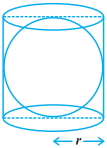
$A$ right circular cylinder just encloses a sphere of radius $r$ as shown in the figure. The surface area of the sphere is equal to the curved surface area of the cylinder.
$A$ right circular cylinder just encloses a sphere of radius $r$ as shown in the figure. The surface area of the sphere is equal to the curved surface area of the cylinder.
Solution
(TRUE) True.
Here,the radius of the sphere $=$ radius of the cylinder $= r$.
The diameter of the sphere $=$ height of the cylinder $= 2r$.
The surface area of the sphere $= 4 \pi r^2$.
The curved surface area of the cylinder $= 2 \pi r h = 2 \pi r (2r) = 4 \pi r^2$.
Since both areas are equal to $4 \pi r^2$,the statement is true.
Here,the radius of the sphere $=$ radius of the cylinder $= r$.
The diameter of the sphere $=$ height of the cylinder $= 2r$.
The surface area of the sphere $= 4 \pi r^2$.
The curved surface area of the cylinder $= 2 \pi r h = 2 \pi r (2r) = 4 \pi r^2$.
Since both areas are equal to $4 \pi r^2$,the statement is true.
0 likes
View Solution13
Easy
Write True or False and justify your answer.
An edge of a cube measures $r \, cm$. If the largest possible right circular cone is cut out of this cube,then the volume of the cone (in $cm^3$) is $\frac{1}{6} \pi r^3$.
An edge of a cube measures $r \, cm$. If the largest possible right circular cone is cut out of this cube,then the volume of the cone (in $cm^3$) is $\frac{1}{6} \pi r^3$.
Solution
(B) False.
For the largest possible right circular cone cut out of a cube of edge $r$,the height of the cone $(h)$ must be equal to the edge of the cube,so $h = r \, cm$.
The diameter of the base of the cone must be equal to the edge of the cube,so the radius of the base $(R)$ is $\frac{r}{2} \, cm$.
The volume of a cone is given by the formula $V = \frac{1}{3} \pi R^2 h$.
Substituting the values: $V = \frac{1}{3} \pi \left(\frac{r}{2}\right)^2 \cdot r = \frac{1}{3} \pi \left(\frac{r^2}{4}\right) \cdot r = \frac{1}{12} \pi r^3 \, cm^3$.
Since $\frac{1}{12} \pi r^3 \neq \frac{1}{6} \pi r^3$,the given statement is False.
For the largest possible right circular cone cut out of a cube of edge $r$,the height of the cone $(h)$ must be equal to the edge of the cube,so $h = r \, cm$.
The diameter of the base of the cone must be equal to the edge of the cube,so the radius of the base $(R)$ is $\frac{r}{2} \, cm$.
The volume of a cone is given by the formula $V = \frac{1}{3} \pi R^2 h$.
Substituting the values: $V = \frac{1}{3} \pi \left(\frac{r}{2}\right)^2 \cdot r = \frac{1}{3} \pi \left(\frac{r^2}{4}\right) \cdot r = \frac{1}{12} \pi r^3 \, cm^3$.
Since $\frac{1}{12} \pi r^3 \neq \frac{1}{6} \pi r^3$,the given statement is False.
0 likes
View Solution14
Easy
Write True or False and justify your answer: The volume of a sphere is equal to two-thirds of the volume of a cylinder whose height and diameter are equal to the diameter of the sphere.
Solution
(A) Let the radius of the sphere be $r$.
Given that the height and diameter of the cylinder are equal to the diameter of the sphere.
Since the diameter of the sphere is $2r$,the height of the cylinder $h = 2r$ and the diameter of the cylinder is $2r$.
Therefore,the radius of the cylinder is $r$.
Volume of the sphere $= \frac{4}{3} \pi r^3$.
Volume of the cylinder $= \pi r^2 h = \pi r^2 (2r) = 2 \pi r^3$.
Two-thirds of the volume of the cylinder $= \frac{2}{3} \times (2 \pi r^3) = \frac{4}{3} \pi r^3$.
Since the volume of the sphere is equal to $\frac{4}{3} \pi r^3$,the statement is True.
Given that the height and diameter of the cylinder are equal to the diameter of the sphere.
Since the diameter of the sphere is $2r$,the height of the cylinder $h = 2r$ and the diameter of the cylinder is $2r$.
Therefore,the radius of the cylinder is $r$.
Volume of the sphere $= \frac{4}{3} \pi r^3$.
Volume of the cylinder $= \pi r^2 h = \pi r^2 (2r) = 2 \pi r^3$.
Two-thirds of the volume of the cylinder $= \frac{2}{3} \times (2 \pi r^3) = \frac{4}{3} \pi r^3$.
Since the volume of the sphere is equal to $\frac{4}{3} \pi r^3$,the statement is True.
0 likes
View Solution15
Medium
Write True or False and justify your answer in each of the following: If the radius of a right circular cone is halved and height is doubled,the volume will remain unchanged.
Solution
(FALSE) Let the original radius of the cone be $r$ and the original height be $h$.
The volume of the original cone is $V_1 = \frac{1}{3} \pi r^{2} h$.
Now,the new radius $r' = \frac{r}{2}$ and the new height $h' = 2h$.
The new volume $V_2 = \frac{1}{3} \pi (r')^{2} h' = \frac{1}{3} \pi \left(\frac{r}{2}\right)^{2} (2h)$.
Simplifying this,$V_2 = \frac{1}{3} \pi \left(\frac{r^2}{4}\right) (2h) = \frac{1}{2} \left(\frac{1}{3} \pi r^{2} h\right) = \frac{1}{2} V_1$.
Since the new volume is half of the original volume,the statement is False.
The volume of the original cone is $V_1 = \frac{1}{3} \pi r^{2} h$.
Now,the new radius $r' = \frac{r}{2}$ and the new height $h' = 2h$.
The new volume $V_2 = \frac{1}{3} \pi (r')^{2} h' = \frac{1}{3} \pi \left(\frac{r}{2}\right)^{2} (2h)$.
Simplifying this,$V_2 = \frac{1}{3} \pi \left(\frac{r^2}{4}\right) (2h) = \frac{1}{2} \left(\frac{1}{3} \pi r^{2} h\right) = \frac{1}{2} V_1$.
Since the new volume is half of the original volume,the statement is False.
0 likes
View Solution16
Medium
State whether the following statement is True or False and justify your answer: In a right circular cone,the height,radius,and slant height do not always form the sides of a right triangle.
Solution
(B) In a right circular cone,the height $(h)$,radius $(r)$,and slant height $(l)$ always form the sides of a right-angled triangle where the slant height is the hypotenuse.
According to the Pythagorean theorem,the relationship is $l^{2} = h^{2} + r^{2}$.
Since this relationship holds true for all right circular cones,the given statement is False.
According to the Pythagorean theorem,the relationship is $l^{2} = h^{2} + r^{2}$.
Since this relationship holds true for all right circular cones,the given statement is False.
0 likes
View Solution17
Easy
Write True or False and justify your answer in each of the following:
If the radius of a cylinder is doubled and its curved surface area is not changed,the height must be halved.
If the radius of a cylinder is doubled and its curved surface area is not changed,the height must be halved.
Solution
(A) Let $r$ be the radius and $h$ be the height of the cylinder.
The formula for the curved surface area $(CSA)$ of a cylinder is $CSA = 2 \pi r h$.
According to the problem,the new radius $r' = 2r$ and the new height $h' = h/2$.
Calculating the new curved surface area $(CSA')$:
$CSA' = 2 \pi r' h' = 2 \pi (2r) (h/2) = 2 \pi r h$.
Since $CSA' = CSA$,the curved surface area remains unchanged when the radius is doubled and the height is halved.
Therefore,the given statement is True.
The formula for the curved surface area $(CSA)$ of a cylinder is $CSA = 2 \pi r h$.
According to the problem,the new radius $r' = 2r$ and the new height $h' = h/2$.
Calculating the new curved surface area $(CSA')$:
$CSA' = 2 \pi r' h' = 2 \pi (2r) (h/2) = 2 \pi r h$.
Since $CSA' = CSA$,the curved surface area remains unchanged when the radius is doubled and the height is halved.
Therefore,the given statement is True.
0 likes
View Solution18
Easy
Write True or False and justify your answer in each of the following:
The volume of the largest right circular cone that can be fitted in a cube whose edge is $2r$ is equal to the volume of a hemisphere of radius $r$.
The volume of the largest right circular cone that can be fitted in a cube whose edge is $2r$ is equal to the volume of a hemisphere of radius $r$.
Solution
(A) The edge of the cube is $2r$. The largest right circular cone that can be fitted inside this cube will have a height $h = 2r$ and a base diameter equal to the edge of the cube,so the radius of the cone is $R = r$.
The volume of this cone is given by $V_{cone} = \frac{1}{3} \pi R^2 h = \frac{1}{3} \pi (r)^2 (2r) = \frac{2}{3} \pi r^3$.
The volume of a hemisphere of radius $r$ is given by $V_{hemisphere} = \frac{2}{3} \pi r^3$.
Since the volume of the cone is $\frac{2}{3} \pi r^3$ and the volume of the hemisphere is $\frac{2}{3} \pi r^3$,the volumes are equal.
Hence,the given statement is True.
The volume of this cone is given by $V_{cone} = \frac{1}{3} \pi R^2 h = \frac{1}{3} \pi (r)^2 (2r) = \frac{2}{3} \pi r^3$.
The volume of a hemisphere of radius $r$ is given by $V_{hemisphere} = \frac{2}{3} \pi r^3$.
Since the volume of the cone is $\frac{2}{3} \pi r^3$ and the volume of the hemisphere is $\frac{2}{3} \pi r^3$,the volumes are equal.
Hence,the given statement is True.
0 likes
View Solution19
Medium
Write True or False and justify your answer in each of the following: $A$ cylinder and a right circular cone have the same base and the same height. The volume of the cylinder is three times the volume of the cone.
Solution
(TRUE) Let $r$ be the radius and $h$ be the height of both the cylinder and the right circular cone.
The volume of a cylinder is given by the formula $V_{cylinder} = \pi r^{2} h$.
The volume of a right circular cone is given by the formula $V_{cone} = \frac{1}{3} \pi r^{2} h$.
Comparing the two volumes,we can see that $V_{cylinder} = 3 \times (\frac{1}{3} \pi r^{2} h) = 3 \times V_{cone}$.
Therefore,the volume of the cylinder is indeed three times the volume of the cone.
Hence,the given statement is True.
The volume of a cylinder is given by the formula $V_{cylinder} = \pi r^{2} h$.
The volume of a right circular cone is given by the formula $V_{cone} = \frac{1}{3} \pi r^{2} h$.
Comparing the two volumes,we can see that $V_{cylinder} = 3 \times (\frac{1}{3} \pi r^{2} h) = 3 \times V_{cone}$.
Therefore,the volume of the cylinder is indeed three times the volume of the cone.
Hence,the given statement is True.
0 likes
View Solution20
Medium
State whether the following statement is True or False and justify your answer:
$A$ cone,a hemisphere,and a cylinder stand on equal bases and have the same height. The ratio of their volumes is $1: 2: 3$.
$A$ cone,a hemisphere,and a cylinder stand on equal bases and have the same height. The ratio of their volumes is $1: 2: 3$.
Solution
(TRUE) Let the radius of the base of the cone,hemisphere,and cylinder be $r$. Since they stand on equal bases,their radii are equal.
Given that they have the same height,and the height of a hemisphere is equal to its radius $(r)$,the height of the cone and the cylinder must also be $r$.
$1$. Volume of the cone $(V_1)$: $V_1 = \frac{1}{3} \pi r^2 h = \frac{1}{3} \pi r^2 (r) = \frac{1}{3} \pi r^3$.
$2$. Volume of the hemisphere $(V_2)$: $V_2 = \frac{2}{3} \pi r^3$.
$3$. Volume of the cylinder $(V_3)$: $V_3 = \pi r^2 h = \pi r^2 (r) = \pi r^3 = \frac{3}{3} \pi r^3$.
Comparing the volumes: $V_1 : V_2 : V_3 = \frac{1}{3} \pi r^3 : \frac{2}{3} \pi r^3 : \frac{3}{3} \pi r^3 = 1 : 2 : 3$.
Thus,the ratio of their volumes is $1 : 2 : 3$. The statement is True.
Given that they have the same height,and the height of a hemisphere is equal to its radius $(r)$,the height of the cone and the cylinder must also be $r$.
$1$. Volume of the cone $(V_1)$: $V_1 = \frac{1}{3} \pi r^2 h = \frac{1}{3} \pi r^2 (r) = \frac{1}{3} \pi r^3$.
$2$. Volume of the hemisphere $(V_2)$: $V_2 = \frac{2}{3} \pi r^3$.
$3$. Volume of the cylinder $(V_3)$: $V_3 = \pi r^2 h = \pi r^2 (r) = \pi r^3 = \frac{3}{3} \pi r^3$.
Comparing the volumes: $V_1 : V_2 : V_3 = \frac{1}{3} \pi r^3 : \frac{2}{3} \pi r^3 : \frac{3}{3} \pi r^3 = 1 : 2 : 3$.
Thus,the ratio of their volumes is $1 : 2 : 3$. The statement is True.
0 likes
View Solution21
Medium
Write True or False and justify your answer in each of the following: If the length of the diagonal of a cube is $6 \sqrt{3} \, \text{cm}$,then the length of the edge of the cube is $3 \, \text{cm}$.
Solution
(B) Let the length of the edge of the cube be $a$.
The formula for the length of the diagonal of a cube is $\sqrt{3} a$.
Given that the length of the diagonal of the cube is $6 \sqrt{3} \, \text{cm}$.
Equating the two,we get $\sqrt{3} a = 6 \sqrt{3}$.
Dividing both sides by $\sqrt{3}$,we get $a = 6 \, \text{cm}$.
Therefore,the length of the edge of the cube is $6 \, \text{cm}$,not $3 \, \text{cm}$.
Hence,the given statement is False.
The formula for the length of the diagonal of a cube is $\sqrt{3} a$.
Given that the length of the diagonal of the cube is $6 \sqrt{3} \, \text{cm}$.
Equating the two,we get $\sqrt{3} a = 6 \sqrt{3}$.
Dividing both sides by $\sqrt{3}$,we get $a = 6 \, \text{cm}$.
Therefore,the length of the edge of the cube is $6 \, \text{cm}$,not $3 \, \text{cm}$.
Hence,the given statement is False.
0 likes
View Solution22
Medium
Write True or False and justify your answer in each of the following: If a sphere is inscribed in a cube,then the ratio of the volume of the cube to the volume of the sphere will be $6: \pi$.
Solution
(A) Let $a$ be the edge length of the cube.
Since the sphere is inscribed in the cube,the diameter of the sphere is equal to the edge length of the cube,$a$. Therefore,the radius of the sphere is $r = \frac{a}{2}$.
Volume of the cube $(V_1)$ = $(\text{edge})^3 = a^3$.
Volume of the sphere $(V_2)$ = $\frac{4}{3} \pi r^3 = \frac{4}{3} \pi (\frac{a}{2})^3 = \frac{4}{3} \pi (\frac{a^3}{8}) = \frac{\pi a^3}{6}$.
Ratio of the volume of the cube to the volume of the sphere = $\frac{V_1}{V_2} = \frac{a^3}{\frac{\pi a^3}{6}} = \frac{6}{\pi}$.
Thus,the ratio is $6: \pi$.
Hence,the given statement is true.
Since the sphere is inscribed in the cube,the diameter of the sphere is equal to the edge length of the cube,$a$. Therefore,the radius of the sphere is $r = \frac{a}{2}$.
Volume of the cube $(V_1)$ = $(\text{edge})^3 = a^3$.
Volume of the sphere $(V_2)$ = $\frac{4}{3} \pi r^3 = \frac{4}{3} \pi (\frac{a}{2})^3 = \frac{4}{3} \pi (\frac{a^3}{8}) = \frac{\pi a^3}{6}$.
Ratio of the volume of the cube to the volume of the sphere = $\frac{V_1}{V_2} = \frac{a^3}{\frac{\pi a^3}{6}} = \frac{6}{\pi}$.
Thus,the ratio is $6: \pi$.
Hence,the given statement is true.
0 likes
View Solution23
Easy
State whether the following statement is True or False and justify your answer: If the radius of a cylinder is doubled and its height is halved,the volume will be doubled.
Solution
(TRUE) Let $r$ be the radius and $h$ be the height of the cylinder.
The original volume of the cylinder is given by $V_{1} = \pi r^{2} h$.
When the radius is doubled,the new radius becomes $2r$. When the height is halved,the new height becomes $\frac{h}{2}$.
The new volume $V_{2}$ is calculated as:
$V_{2} = \pi (2r)^{2} \times \left(\frac{h}{2}\right)$
$V_{2} = \pi (4r^{2}) \times \left(\frac{h}{2}\right)$
$V_{2} = 2 \pi r^{2} h$
$V_{2} = 2 V_{1}$
Since the new volume is twice the original volume,the statement is True.
The original volume of the cylinder is given by $V_{1} = \pi r^{2} h$.
When the radius is doubled,the new radius becomes $2r$. When the height is halved,the new height becomes $\frac{h}{2}$.
The new volume $V_{2}$ is calculated as:
$V_{2} = \pi (2r)^{2} \times \left(\frac{h}{2}\right)$
$V_{2} = \pi (4r^{2}) \times \left(\frac{h}{2}\right)$
$V_{2} = 2 \pi r^{2} h$
$V_{2} = 2 V_{1}$
Since the new volume is twice the original volume,the statement is True.
0 likes
View Solution24
Difficult
The surface area of a sphere with a radius of $5 \, cm$ is five times the curved surface area of a cone with a radius of $4 \, cm$. Find the height and volume of the cone (take $\pi = \frac{22}{7}$).
Solution
(N/A) Surface area of the sphere $= 4\pi r^2 = 4 \times \pi \times 5^2 = 100\pi \, cm^2$.
Curved surface area of the cone $= \pi rl = \pi \times 4 \times l = 4\pi l \, cm^2$,where $l$ is the slant height of the cone.
According to the problem,the surface area of the sphere $= 5 \times$ curved surface area of the cone.
$100\pi = 5 \times 4\pi l$
$100\pi = 20\pi l$
$l = \frac{100}{20} = 5 \, cm$.
To find the height $h$ of the cone,use the formula $l^2 = h^2 + r^2$:
$5^2 = h^2 + 4^2$
$25 = h^2 + 16$
$h^2 = 25 - 16 = 9$
$h = 3 \, cm$.
Volume of the cone $= \frac{1}{3} \pi r^2 h = \frac{1}{3} \times \frac{22}{7} \times 4^2 \times 3$
$= \frac{22}{7} \times 16 = \frac{352}{7} \approx 50.29 \, cm^3$.
Curved surface area of the cone $= \pi rl = \pi \times 4 \times l = 4\pi l \, cm^2$,where $l$ is the slant height of the cone.
According to the problem,the surface area of the sphere $= 5 \times$ curved surface area of the cone.
$100\pi = 5 \times 4\pi l$
$100\pi = 20\pi l$
$l = \frac{100}{20} = 5 \, cm$.
To find the height $h$ of the cone,use the formula $l^2 = h^2 + r^2$:
$5^2 = h^2 + 4^2$
$25 = h^2 + 16$
$h^2 = 25 - 16 = 9$
$h = 3 \, cm$.
Volume of the cone $= \frac{1}{3} \pi r^2 h = \frac{1}{3} \times \frac{22}{7} \times 4^2 \times 3$
$= \frac{22}{7} \times 16 = \frac{352}{7} \approx 50.29 \, cm^3$.
0 likes
View Solution25
Medium
The radius of a sphere is increased by $10 \%$. Prove that the volume will be increased by $33.1 \%$ approximately.
Solution
(N/A) The volume of a sphere $V = \frac{4}{3} \pi r^{3}$.
Let the initial radius be $r$. If the radius is increased by $10 \%$,the new radius $r'$ becomes $r + 0.1r = 1.1r$.
The new volume $V'$ is given by $V' = \frac{4}{3} \pi (r')^{3} = \frac{4}{3} \pi (1.1r)^{3}$.
Calculating $(1.1)^{3} = 1.331$,so $V' = 1.331 \times (\frac{4}{3} \pi r^{3}) = 1.331V$.
The increase in volume is $\Delta V = V' - V = 1.331V - V = 0.331V$.
The percentage increase in volume is $\frac{\Delta V}{V} \times 100 = \frac{0.331V}{V} \times 100 = 33.1 \%$.
Thus,the volume increases by $33.1 \%$.
Let the initial radius be $r$. If the radius is increased by $10 \%$,the new radius $r'$ becomes $r + 0.1r = 1.1r$.
The new volume $V'$ is given by $V' = \frac{4}{3} \pi (r')^{3} = \frac{4}{3} \pi (1.1r)^{3}$.
Calculating $(1.1)^{3} = 1.331$,so $V' = 1.331 \times (\frac{4}{3} \pi r^{3}) = 1.331V$.
The increase in volume is $\Delta V = V' - V = 1.331V - V = 0.331V$.
The percentage increase in volume is $\frac{\Delta V}{V} \times 100 = \frac{0.331V}{V} \times 100 = 33.1 \%$.
Thus,the volume increases by $33.1 \%$.
0 likes
View Solution26
MediumMCQ
Metal spheres,each of radius $2 \, cm$,are packed into a rectangular box of internal dimensions $16 \, cm \times 8 \, cm \times 8 \, cm$. When $16$ spheres are packed,the box is filled with preservative liquid. Find the volume of this liquid. Give your answer to the nearest integer. [Use $\pi = 3.14$] (in $cm^3$)
A
$480$
B
$488$
C
$562$
D
$866$
Solution
(B) The internal volume of the rectangular box is calculated as: $V_{\text{box}} = 16 \, cm \times 8 \, cm \times 8 \, cm = 1024 \, cm^3$.
The volume of a single sphere with radius $r = 2 \, cm$ is given by the formula $V_{\text{sphere}} = \frac{4}{3} \pi r^3$.
Substituting the values: $V_{\text{sphere}} = \frac{4}{3} \times 3.14 \times (2)^3 = \frac{4}{3} \times 3.14 \times 8 = \frac{100.48}{3} \approx 33.4933 \, cm^3$.
The total volume occupied by $16$ such spheres is: $V_{\text{total spheres}} = 16 \times 33.4933 = 535.8933 \, cm^3$.
The volume of the preservative liquid is the remaining space in the box: $V_{\text{liquid}} = V_{\text{box}} - V_{\text{total spheres}} = 1024 - 535.8933 = 488.1067 \, cm^3$.
Rounding to the nearest integer,we get $488 \, cm^3$.
The volume of a single sphere with radius $r = 2 \, cm$ is given by the formula $V_{\text{sphere}} = \frac{4}{3} \pi r^3$.
Substituting the values: $V_{\text{sphere}} = \frac{4}{3} \times 3.14 \times (2)^3 = \frac{4}{3} \times 3.14 \times 8 = \frac{100.48}{3} \approx 33.4933 \, cm^3$.
The total volume occupied by $16$ such spheres is: $V_{\text{total spheres}} = 16 \times 33.4933 = 535.8933 \, cm^3$.
The volume of the preservative liquid is the remaining space in the box: $V_{\text{liquid}} = V_{\text{box}} - V_{\text{total spheres}} = 1024 - 535.8933 = 488.1067 \, cm^3$.
Rounding to the nearest integer,we get $488 \, cm^3$.
0 likes
View Solution27
MediumMCQ
$A$ storage tank is in the form of a cube. When it is full of water,the volume of water is $15.625 \, m^3$. If the present depth of water is $1.3 \, m$,find the volume of water already used from the tank (in $m^3$).
A
$6.7$
B
$6.5$
C
$7.5$
D
$4.3$
Solution
(C) Let the edge of the cube be $x \, m$.
Since the volume of the cube is $x^3$,we have $x^3 = 15.625 \, m^3$.
Taking the cube root,$x = \sqrt[3]{15.625} = 2.5 \, m$.
The total capacity of the tank is $15.625 \, m^3$ with a height of $2.5 \, m$.
The volume of water currently in the tank with depth $1.3 \, m$ is calculated as: $\text{Volume} = \text{length} \times \text{width} \times \text{depth} = 2.5 \times 2.5 \times 1.3 = 8.125 \, m^3$.
The volume of water already used is the difference between the total capacity and the current volume: $15.625 \, m^3 - 8.125 \, m^3 = 7.5 \, m^3$.
Since the volume of the cube is $x^3$,we have $x^3 = 15.625 \, m^3$.
Taking the cube root,$x = \sqrt[3]{15.625} = 2.5 \, m$.
The total capacity of the tank is $15.625 \, m^3$ with a height of $2.5 \, m$.
The volume of water currently in the tank with depth $1.3 \, m$ is calculated as: $\text{Volume} = \text{length} \times \text{width} \times \text{depth} = 2.5 \times 2.5 \times 1.3 = 8.125 \, m^3$.
The volume of water already used is the difference between the total capacity and the current volume: $15.625 \, m^3 - 8.125 \, m^3 = 7.5 \, m^3$.
0 likes
View Solution28
MediumMCQ
Find the amount of water displaced by a solid spherical ball of diameter $4.2 \, cm$,when it is completely immersed in water. (in $, cm^3$)
A
$28.808$
B
$38.746$
C
$37.813$
D
$38.808$
Solution
(D) The amount of water displaced by a solid spherical ball is equal to the volume of the solid spherical ball.
The diameter of the ball is $d = 4.2 \, cm$,so the radius is $r = \frac{d}{2} = \frac{4.2}{2} = 2.1 \, cm$.
The volume of a sphere is given by the formula $V = \frac{4}{3} \pi r^3$.
Substituting the values: $V = \frac{4}{3} \times \frac{22}{7} \times (2.1)^3$.
$V = \frac{4}{3} \times \frac{22}{7} \times 2.1 \times 2.1 \times 2.1$.
$V = 4 \times \frac{22}{7} \times 0.7 \times 2.1 \times 2.1$.
$V = 4 \times 22 \times 0.1 \times 2.1 \times 2.1 = 88 \times 0.1 \times 4.41 = 8.8 \times 4.41 = 38.808 \, cm^3$.
Thus,the amount of water displaced is $38.808 \, cm^3$.
The diameter of the ball is $d = 4.2 \, cm$,so the radius is $r = \frac{d}{2} = \frac{4.2}{2} = 2.1 \, cm$.
The volume of a sphere is given by the formula $V = \frac{4}{3} \pi r^3$.
Substituting the values: $V = \frac{4}{3} \times \frac{22}{7} \times (2.1)^3$.
$V = \frac{4}{3} \times \frac{22}{7} \times 2.1 \times 2.1 \times 2.1$.
$V = 4 \times \frac{22}{7} \times 0.7 \times 2.1 \times 2.1$.
$V = 4 \times 22 \times 0.1 \times 2.1 \times 2.1 = 88 \times 0.1 \times 4.41 = 8.8 \times 4.41 = 38.808 \, cm^3$.
Thus,the amount of water displaced is $38.808 \, cm^3$.
0 likes
View Solution29
EasyMCQ
How many square metres of canvas is required for a conical tent whose height is $3.5 \, m$ and the radius of the base is $12 \, m$ (in $, m^{2}$)?
A
$471.42$
B
$441.12$
C
$571.22$
D
$615.32$
Solution
(A) The area of canvas required for a conical tent is equal to its curved surface area,which is given by the formula $\pi r l$.
First,we calculate the slant height $(l)$ using the formula $l = \sqrt{r^{2} + h^{2}}$,where $r = 12 \, m$ and $h = 3.5 \, m$.
$l = \sqrt{(12)^{2} + (3.5)^{2}} = \sqrt{144 + 12.25} = \sqrt{156.25} = 12.5 \, m$.
Now,calculate the curved surface area:
Area $= \pi r l = \frac{22}{7} \times 12 \times 12.5$.
Area $= \frac{22 \times 150}{7} \approx 471.428 \, m^{2}$.
Rounding to two decimal places,the area required is $471.42 \, m^{2}$.
First,we calculate the slant height $(l)$ using the formula $l = \sqrt{r^{2} + h^{2}}$,where $r = 12 \, m$ and $h = 3.5 \, m$.
$l = \sqrt{(12)^{2} + (3.5)^{2}} = \sqrt{144 + 12.25} = \sqrt{156.25} = 12.5 \, m$.
Now,calculate the curved surface area:
Area $= \pi r l = \frac{22}{7} \times 12 \times 12.5$.
Area $= \frac{22 \times 150}{7} \approx 471.428 \, m^{2}$.
Rounding to two decimal places,the area required is $471.42 \, m^{2}$.
0 likes
View Solution30
MediumMCQ
Two solid spheres made of the same metal have weights $5920 \, g$ and $740 \, g$ respectively. Determine the radius of the larger sphere,if the diameter of the smaller one is $5 \, cm$. (in $cm$)
A
$9$
B
$10$
C
$7$
D
$5$
Solution
(D) Since both spheres are made of the same metal,their density $\rho$ is the same.
Weight $W = \text{Volume} \times \text{Density} \times g = \frac{4}{3} \pi r^3 \rho g$.
Therefore,the ratio of the weights is equal to the ratio of the volumes: $\frac{W_1}{W_2} = \frac{r_1^3}{r_2^3}$.
Given $W_1 = 5920 \, g$,$W_2 = 740 \, g$,and diameter of the smaller sphere $d_2 = 5 \, cm$,so $r_2 = 2.5 \, cm$.
$\frac{5920}{740} = \frac{r_1^3}{(2.5)^3}$.
$8 = \frac{r_1^3}{15.625}$.
$r_1^3 = 8 \times 15.625 = 125$.
$r_1 = \sqrt[3]{125} = 5 \, cm$.
Weight $W = \text{Volume} \times \text{Density} \times g = \frac{4}{3} \pi r^3 \rho g$.
Therefore,the ratio of the weights is equal to the ratio of the volumes: $\frac{W_1}{W_2} = \frac{r_1^3}{r_2^3}$.
Given $W_1 = 5920 \, g$,$W_2 = 740 \, g$,and diameter of the smaller sphere $d_2 = 5 \, cm$,so $r_2 = 2.5 \, cm$.
$\frac{5920}{740} = \frac{r_1^3}{(2.5)^3}$.
$8 = \frac{r_1^3}{15.625}$.
$r_1^3 = 8 \times 15.625 = 125$.
$r_1 = \sqrt[3]{125} = 5 \, cm$.
0 likes
View Solution31
MediumMCQ
$A$ school provides milk to the students daily in cylindrical glasses of diameter $7 \, cm$. If the glass is filled with milk up to a height of $12 \, cm$, find how many litres of milk is needed to serve $1600$ students.
A
$745.8$ litres.
B
$719.4$ litres.
C
$739.2$ litres.
D
$649.2$ litres.
Solution
$(C)$ The radius of the cylindrical glass $r = \text{diameter} \div 2 = 7 \div 2 = 3.5 \, cm$.
The height of the milk in the glass $h = 12 \, cm$.
The volume of milk in one glass $V = \pi r^2 h = \frac{22}{7} \times (3.5)^2 \times 12$.
$V = \frac{22}{7} \times 12.25 \times 12 = 22 \times 1.75 \times 12 = 462 \, cm^3$.
Since $1000 \, cm^3 = 1 \, \text{litre}$, the volume of milk in one glass is $462 \div 1000 = 0.462 \, \text{litres}$.
Total milk needed for $1600$ students $= 1600 \times 0.462 \, \text{litres} = 739.2 \, \text{litres}$.
The height of the milk in the glass $h = 12 \, cm$.
The volume of milk in one glass $V = \pi r^2 h = \frac{22}{7} \times (3.5)^2 \times 12$.
$V = \frac{22}{7} \times 12.25 \times 12 = 22 \times 1.75 \times 12 = 462 \, cm^3$.
Since $1000 \, cm^3 = 1 \, \text{litre}$, the volume of milk in one glass is $462 \div 1000 = 0.462 \, \text{litres}$.
Total milk needed for $1600$ students $= 1600 \times 0.462 \, \text{litres} = 739.2 \, \text{litres}$.
0 likes
View Solution32
MediumMCQ
$A$ cylindrical roller $2.5\, m$ in length and $1.75\, m$ in radius,when rolled on a road,was found to cover an area of $5500\, m^{2}$. How many revolutions did it make?
A
$200$
B
$150$
C
$300$
D
$250$
Solution
(A) The length (height) of the cylindrical roller is $h = 2.5\, m$ and the radius is $r = 1.75\, m$.
The area covered by the roller in one revolution is equal to its lateral surface area (curved surface area).
Lateral Surface Area $= 2\pi rh = 2 \times \frac{22}{7} \times 1.75 \times 2.5$.
$= 2 \times \frac{22}{7} \times \frac{175}{100} \times 2.5 = 2 \times 22 \times 0.25 \times 2.5 = 44 \times 0.625 = 27.5\, m^{2}$.
The total area covered on the road is $5500\, m^{2}$.
Number of revolutions $= \frac{\text{Total area covered}}{\text{Area covered in one revolution}}$.
Number of revolutions $= \frac{5500}{27.5} = 200$ revolutions.
The area covered by the roller in one revolution is equal to its lateral surface area (curved surface area).
Lateral Surface Area $= 2\pi rh = 2 \times \frac{22}{7} \times 1.75 \times 2.5$.
$= 2 \times \frac{22}{7} \times \frac{175}{100} \times 2.5 = 2 \times 22 \times 0.25 \times 2.5 = 44 \times 0.625 = 27.5\, m^{2}$.
The total area covered on the road is $5500\, m^{2}$.
Number of revolutions $= \frac{\text{Total area covered}}{\text{Area covered in one revolution}}$.
Number of revolutions $= \frac{5500}{27.5} = 200$ revolutions.
0 likes
View Solution33
MediumMCQ
$A$ small village,having a population of $5000$,requires $75$ litres of water per head per day. The village has an overhead tank of measurement $40 \, m \times 25 \, m \times 15 \, m$. For how many days will the water of this tank last?
A
$45$
B
$40$
C
$55$
D
$64$
Solution
(B) The volume of the overhead tank is $V = 40 \, m \times 25 \, m \times 15 \, m = 15,000 \, m^3$.
Since $1 \, m^3 = 1,000$ litres,the total capacity of the tank in litres is $15,000 \times 1,000 = 15,000,000$ litres.
The daily water requirement for the village is $5,000 \times 75 = 375,000$ litres.
The number of days the water will last is given by the total capacity divided by the daily requirement:
$\text{Number of days} = \frac{15,000,000}{375,000} = \frac{15,000}{375} = 40$ days.
Since $1 \, m^3 = 1,000$ litres,the total capacity of the tank in litres is $15,000 \times 1,000 = 15,000,000$ litres.
The daily water requirement for the village is $5,000 \times 75 = 375,000$ litres.
The number of days the water will last is given by the total capacity divided by the daily requirement:
$\text{Number of days} = \frac{15,000,000}{375,000} = \frac{15,000}{375} = 40$ days.
0 likes
View Solution34
MediumMCQ
$A$ shopkeeper has one spherical laddoo of radius $5 \, cm$. With the same amount of material,how many laddoos of radius $2.5 \, cm$ can be made?
A
$4$
B
$2$
C
$8$
D
$12$
Solution
(C) The volume of a sphere is given by the formula $V = \frac{4}{3} \pi r^3$.
Let the radius of the large laddoo be $R = 5 \, cm$ and the radius of the smaller laddoos be $r = 2.5 \, cm$.
Since the total amount of material remains the same,the total volume of the smaller laddoos must equal the volume of the large laddoo.
Let $n$ be the number of smaller laddoos.
$n \times (\frac{4}{3} \pi r^3) = \frac{4}{3} \pi R^3$
$n = \frac{R^3}{r^3} = (\frac{R}{r})^3$
$n = (\frac{5}{2.5})^3 = (2)^3 = 8$.
Therefore,$8$ laddoos of radius $2.5 \, cm$ can be made.
Let the radius of the large laddoo be $R = 5 \, cm$ and the radius of the smaller laddoos be $r = 2.5 \, cm$.
Since the total amount of material remains the same,the total volume of the smaller laddoos must equal the volume of the large laddoo.
Let $n$ be the number of smaller laddoos.
$n \times (\frac{4}{3} \pi r^3) = \frac{4}{3} \pi R^3$
$n = \frac{R^3}{r^3} = (\frac{R}{r})^3$
$n = (\frac{5}{2.5})^3 = (2)^3 = 8$.
Therefore,$8$ laddoos of radius $2.5 \, cm$ can be made.
0 likes
View Solution35
MediumMCQ
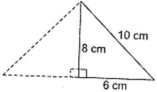
$A$ right triangle with sides $6 \, cm$,$8 \, cm$,and $10 \, cm$ is revolved about the side $8 \, cm$. Find the curved surface area of the solid so formed (in $cm^2$). (in $, cm^2$)
A
$168.47$
B
$180.17$
C
$176.47$
D
$188.57$
Solution
(D) When a right triangle is revolved about one of its sides (containing the right angle),a cone is formed.
Here,the side about which the triangle is revolved becomes the height $(h)$ of the cone,and the other side becomes the radius $(r)$ of the base.
Given:
Height $(h) = 8 \, cm$
Radius $(r) = 6 \, cm$
Slant height $(l) = 10 \, cm$
The curved surface area of a cone is given by the formula: $\text{CSA} = \pi r l$
Substituting the values:
$\text{CSA} = \frac{22}{7} \times 6 \times 10$
$\text{CSA} = \frac{1320}{7} \approx 188.57 \, cm^2$
Thus,the curved surface area of the solid formed is $188.57 \, cm^2$.
Here,the side about which the triangle is revolved becomes the height $(h)$ of the cone,and the other side becomes the radius $(r)$ of the base.
Given:
Height $(h) = 8 \, cm$
Radius $(r) = 6 \, cm$
Slant height $(l) = 10 \, cm$
The curved surface area of a cone is given by the formula: $\text{CSA} = \pi r l$
Substituting the values:
$\text{CSA} = \frac{22}{7} \times 6 \times 10$
$\text{CSA} = \frac{1320}{7} \approx 188.57 \, cm^2$
Thus,the curved surface area of the solid formed is $188.57 \, cm^2$.
0 likes
View Solution36
MediumMCQ
Rain water which falls on a flat rectangular surface of length $6\, m$ and breadth $4\, m$ is transferred into a cylindrical vessel of internal radius $20\, cm$. What will be the height of water in the cylindrical vessel if the rainfall is $1\, cm$? Give your answer to the nearest integer. (Take $\pi = 3.14$) (in $cm$)
A
$191$
B
$185$
C
$164$
D
$199$
Solution
(A) Length of the rectangular surface $= 6\, m = 600\, cm$.
Breadth of the rectangular surface $= 4\, m = 400\, cm$.
Depth (rainfall) $= 1\, cm$.
Volume of rain water collected $= \text{Length} \times \text{Breadth} \times \text{Depth} = 600 \times 400 \times 1 = 240,000\, cm^3$.
Let the height of the water in the cylindrical vessel be $h\, cm$.
The internal radius of the cylindrical vessel $r = 20\, cm$.
Volume of water in the cylindrical vessel $= \pi r^2 h = 3.14 \times (20)^2 \times h = 3.14 \times 400 \times h = 1256h\, cm^3$.
Equating the volumes: $1256h = 240,000$.
$h = \frac{240,000}{1256} \approx 191.08\, cm$.
Rounding to the nearest integer,the height is $191\, cm$.
Breadth of the rectangular surface $= 4\, m = 400\, cm$.
Depth (rainfall) $= 1\, cm$.
Volume of rain water collected $= \text{Length} \times \text{Breadth} \times \text{Depth} = 600 \times 400 \times 1 = 240,000\, cm^3$.
Let the height of the water in the cylindrical vessel be $h\, cm$.
The internal radius of the cylindrical vessel $r = 20\, cm$.
Volume of water in the cylindrical vessel $= \pi r^2 h = 3.14 \times (20)^2 \times h = 3.14 \times 400 \times h = 1256h\, cm^3$.
Equating the volumes: $1256h = 240,000$.
$h = \frac{240,000}{1256} \approx 191.08\, cm$.
Rounding to the nearest integer,the height is $191\, cm$.
0 likes
View Solution37
MediumMCQ
$A$ cylindrical tube open at both ends is made of an iron sheet which is $2 \, cm$ thick. If the outer diameter is $16 \, cm$ and its length is $100 \, cm$, find how many cubic centimeters of iron have been used in making the tube? (in $cm^3$)
A
$8600$
B
$8800$
C
$8452$
D
$9800$
Solution
(B) The tube is a hollow cylinder.
Outer diameter $= 16 \, cm$, so outer radius $(R) = 16 / 2 = 8 \, cm$.
Thickness of the iron sheet $= 2 \, cm$.
Inner radius $(r) = R - \text{thickness} = 8 \, cm - 2 \, cm = 6 \, cm$.
Length (height) of the cylinder $(h) = 100 \, cm$.
The volume of iron used is the difference between the outer volume and the inner volume of the cylinder.
Volume $= \pi (R^2 - r^2) h$
Volume $= \frac{22}{7} \times (8^2 - 6^2) \times 100$
Volume $= \frac{22}{7} \times (64 - 36) \times 100$
Volume $= \frac{22}{7} \times 28 \times 100$
Volume $= 22 \times 4 \times 100 = 8800 \, cm^3$.
Outer diameter $= 16 \, cm$, so outer radius $(R) = 16 / 2 = 8 \, cm$.
Thickness of the iron sheet $= 2 \, cm$.
Inner radius $(r) = R - \text{thickness} = 8 \, cm - 2 \, cm = 6 \, cm$.
Length (height) of the cylinder $(h) = 100 \, cm$.
The volume of iron used is the difference between the outer volume and the inner volume of the cylinder.
Volume $= \pi (R^2 - r^2) h$
Volume $= \frac{22}{7} \times (8^2 - 6^2) \times 100$
Volume $= \frac{22}{7} \times (64 - 36) \times 100$
Volume $= \frac{22}{7} \times 28 \times 100$
Volume $= 22 \times 4 \times 100 = 8800 \, cm^3$.
0 likes
View Solution38
MediumMCQ
$A$ semi-circular sheet of metal of diameter $28 \, cm$ is bent to form an open conical cup. Find the capacity of the cup. (in $, cm^3$)
A
$622.16$
B
$658.26$
C
$462.36$
D
$522.46$
Solution
(A) The diameter of the semi-circular sheet is $28 \, cm$,so its radius $R = 14 \, cm$. When this sheet is bent to form an open conical cup,the radius of the sheet becomes the slant height $(l)$ of the cone.
Therefore,$l = 14 \, cm$.
The circumference of the semi-circular arc becomes the circumference of the base of the cone. The length of the semi-circular arc is $\pi R = \pi \times 14$.
Let $r$ be the radius of the base of the cone. Then,$2 \pi r = 14 \pi$,which gives $r = 7 \, cm$.
Now,we find the height $(h)$ of the cone using the relation $l^2 = r^2 + h^2$:
$h = \sqrt{l^2 - r^2} = \sqrt{14^2 - 7^2} = \sqrt{196 - 49} = \sqrt{147} \approx 12.124 \, cm$.
The capacity (volume) of the conical cup is $V = \frac{1}{3} \pi r^2 h$.
$V = \frac{1}{3} \times \frac{22}{7} \times 7 \times 7 \times 12.124 \approx 622.38 \, cm^3$. Given the options,the closest value is $622.16 \, cm^3$.
Therefore,$l = 14 \, cm$.
The circumference of the semi-circular arc becomes the circumference of the base of the cone. The length of the semi-circular arc is $\pi R = \pi \times 14$.
Let $r$ be the radius of the base of the cone. Then,$2 \pi r = 14 \pi$,which gives $r = 7 \, cm$.
Now,we find the height $(h)$ of the cone using the relation $l^2 = r^2 + h^2$:
$h = \sqrt{l^2 - r^2} = \sqrt{14^2 - 7^2} = \sqrt{196 - 49} = \sqrt{147} \approx 12.124 \, cm$.
The capacity (volume) of the conical cup is $V = \frac{1}{3} \pi r^2 h$.
$V = \frac{1}{3} \times \frac{22}{7} \times 7 \times 7 \times 12.124 \approx 622.38 \, cm^3$. Given the options,the closest value is $622.16 \, cm^3$.
0 likes
View Solution39
DifficultMCQ
$A$ conical tent is made from a piece of cloth with an area of $165 \, m^{2}$. The radius of the base of the tent is $5 \, m$.
$(i)$ If one student occupies an average of $\frac{5}{7} \, m^{2}$ of ground area,how many students can sit in the tent?
$(ii)$ Find the volume of the cone.
$(i)$ If one student occupies an average of $\frac{5}{7} \, m^{2}$ of ground area,how many students can sit in the tent?
$(ii)$ Find the volume of the cone.
A
$110$
B
$120$
C
$100$
D
$130$
Solution
(A) $(i)$ The area of the ground covered by the tent is the area of the circular base:
$\text{Area} = \pi r^{2} = \frac{22}{7} \times 5^{2} = \frac{550}{7} \, m^{2}$.
Number of students $= \frac{\text{Total ground area}}{\text{Area per student}} = \frac{550/7}{5/7} = \frac{550}{5} = 110$.
$(ii)$ The curved surface area of the cone is $165 \, m^{2}$.
$\pi r l = 165 \Rightarrow \frac{22}{7} \times 5 \times l = 165$.
$l = \frac{165 \times 7}{110} = 10.5 \, m$.
Using $l^{2} = r^{2} + h^{2}$,we find the height $h$:
$h = \sqrt{l^{2} - r^{2}} = \sqrt{(10.5)^{2} - 5^{2}} = \sqrt{110.25 - 25} = \sqrt{85.25} \approx 9.233 \, m$.
Volume of the cone $= \frac{1}{3} \pi r^{2} h = \frac{1}{3} \times \frac{22}{7} \times 25 \times 9.233 \approx 242.1 \, m^{3}$.
$\text{Area} = \pi r^{2} = \frac{22}{7} \times 5^{2} = \frac{550}{7} \, m^{2}$.
Number of students $= \frac{\text{Total ground area}}{\text{Area per student}} = \frac{550/7}{5/7} = \frac{550}{5} = 110$.
$(ii)$ The curved surface area of the cone is $165 \, m^{2}$.
$\pi r l = 165 \Rightarrow \frac{22}{7} \times 5 \times l = 165$.
$l = \frac{165 \times 7}{110} = 10.5 \, m$.
Using $l^{2} = r^{2} + h^{2}$,we find the height $h$:
$h = \sqrt{l^{2} - r^{2}} = \sqrt{(10.5)^{2} - 5^{2}} = \sqrt{110.25 - 25} = \sqrt{85.25} \approx 9.233 \, m$.
Volume of the cone $= \frac{1}{3} \pi r^{2} h = \frac{1}{3} \times \frac{22}{7} \times 25 \times 9.233 \approx 242.1 \, m^{3}$.
0 likes
View Solution40
MediumMCQ
The water for a factory is stored in a hemispherical tank whose internal diameter is $14\, m$. The tank contains $50$ kilolitres of water. Water is pumped into the tank to fill it to its capacity. Calculate the volume of water pumped into the tank. (in $, m^{3}$)
A
$416.86$
B
$467.78$
C
$668.66$
D
$688.46$
Solution
(C) Internal diameter of the hemispherical tank $= 14\, m$.
Internal radius $(r)$ of the hemispherical tank $= 14\, m / 2 = 7\, m$.
Volume of the hemispherical tank $= \frac{2}{3} \pi r^{3} = \frac{2}{3} \times \frac{22}{7} \times (7)^{3} = \frac{2}{3} \times 22 \times 49 = \frac{2156}{3} \approx 718.66\, m^{3}$.
The tank already contains $50$ kilolitres of water. Since $1\, m^{3} = 1000$ litres,$50$ kilolitres $= 50,000$ litres $= 50\, m^{3}$.
Volume of water to be pumped into the tank $= \text{Total capacity} - \text{Existing volume} = 718.66\, m^{3} - 50\, m^{3} = 668.66\, m^{3}$.
Internal radius $(r)$ of the hemispherical tank $= 14\, m / 2 = 7\, m$.
Volume of the hemispherical tank $= \frac{2}{3} \pi r^{3} = \frac{2}{3} \times \frac{22}{7} \times (7)^{3} = \frac{2}{3} \times 22 \times 49 = \frac{2156}{3} \approx 718.66\, m^{3}$.
The tank already contains $50$ kilolitres of water. Since $1\, m^{3} = 1000$ litres,$50$ kilolitres $= 50,000$ litres $= 50\, m^{3}$.
Volume of water to be pumped into the tank $= \text{Total capacity} - \text{Existing volume} = 718.66\, m^{3} - 50\, m^{3} = 668.66\, m^{3}$.
0 likes
View Solution41
DifficultMCQ
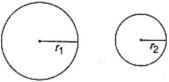
The volumes of two spheres are in the ratio $64: 27$. Find the ratio of their surface areas.
A
$16: 9$
B
$9: 16$
C
$4: 3$
D
$3: 4$
Solution
(A) Let $V_{1}$ and $V_{2}$ be the volumes of two spheres.
$\therefore \frac{V_{1}}{V_{2}} = \frac{64}{27}$
$\Rightarrow \frac{\frac{4}{3} \pi r_{1}^{3}}{\frac{4}{3} \pi r_{2}^{3}} = \frac{64}{27}$
$\Rightarrow \frac{r_{1}^{3}}{r_{2}^{3}} = \frac{64}{27}$
$\Rightarrow \left(\frac{r_{1}}{r_{2}}\right)^{3} = \left(\frac{4}{3}\right)^{3}$
$\Rightarrow \frac{r_{1}}{r_{2}} = \frac{4}{3} \quad ...(1)$
Now,let $SA_{1}$ and $SA_{2}$ be the surface areas of the two spheres.
$\therefore \frac{SA_{1}}{SA_{2}} = \frac{4 \pi r_{1}^{2}}{4 \pi r_{2}^{2}}$
$\Rightarrow \frac{SA_{1}}{SA_{2}} = \left(\frac{r_{1}}{r_{2}}\right)^{2}$
$\Rightarrow \frac{SA_{1}}{SA_{2}} = \left(\frac{4}{3}\right)^{2} \quad [\text{Using } (1)]$
$\Rightarrow \frac{SA_{1}}{SA_{2}} = \frac{16}{9}$
$\therefore SA_{1} : SA_{2} = 16 : 9$
Thus,the ratio of the surface areas of the two spheres is $16 : 9$.
$\therefore \frac{V_{1}}{V_{2}} = \frac{64}{27}$
$\Rightarrow \frac{\frac{4}{3} \pi r_{1}^{3}}{\frac{4}{3} \pi r_{2}^{3}} = \frac{64}{27}$
$\Rightarrow \frac{r_{1}^{3}}{r_{2}^{3}} = \frac{64}{27}$
$\Rightarrow \left(\frac{r_{1}}{r_{2}}\right)^{3} = \left(\frac{4}{3}\right)^{3}$
$\Rightarrow \frac{r_{1}}{r_{2}} = \frac{4}{3} \quad ...(1)$
Now,let $SA_{1}$ and $SA_{2}$ be the surface areas of the two spheres.
$\therefore \frac{SA_{1}}{SA_{2}} = \frac{4 \pi r_{1}^{2}}{4 \pi r_{2}^{2}}$
$\Rightarrow \frac{SA_{1}}{SA_{2}} = \left(\frac{r_{1}}{r_{2}}\right)^{2}$
$\Rightarrow \frac{SA_{1}}{SA_{2}} = \left(\frac{4}{3}\right)^{2} \quad [\text{Using } (1)]$
$\Rightarrow \frac{SA_{1}}{SA_{2}} = \frac{16}{9}$
$\therefore SA_{1} : SA_{2} = 16 : 9$
Thus,the ratio of the surface areas of the two spheres is $16 : 9$.
0 likes
View Solution42
MediumMCQ
$A$ cube of side $4 \, cm$ contains a sphere touching its sides. Find the volume of the gap in between. (in $, cm^3$)
A
$20.58$
B
$30.48$
C
$36.22$
D
$40.46$
Solution
(B) Side of the cube $a = 4 \, cm$.
Volume of the cube $V_{cube} = a^3 = (4)^3 = 64 \, cm^3$.
Since the sphere touches the sides of the cube,the diameter of the sphere is equal to the side of the cube,$d = 4 \, cm$.
Radius of the sphere $r = d / 2 = 4 / 2 = 2 \, cm$.
Volume of the sphere $V_{sphere} = \frac{4}{3} \pi r^3 = \frac{4}{3} \times \frac{22}{7} \times (2)^3$.
$V_{sphere} = \frac{4}{3} \times \frac{22}{7} \times 8 = \frac{704}{21} \approx 33.52 \, cm^3$.
Volume of the gap = $V_{cube} - V_{sphere} = 64 - 33.52 = 30.48 \, cm^3$.
Volume of the cube $V_{cube} = a^3 = (4)^3 = 64 \, cm^3$.
Since the sphere touches the sides of the cube,the diameter of the sphere is equal to the side of the cube,$d = 4 \, cm$.
Radius of the sphere $r = d / 2 = 4 / 2 = 2 \, cm$.
Volume of the sphere $V_{sphere} = \frac{4}{3} \pi r^3 = \frac{4}{3} \times \frac{22}{7} \times (2)^3$.
$V_{sphere} = \frac{4}{3} \times \frac{22}{7} \times 8 = \frac{704}{21} \approx 33.52 \, cm^3$.
Volume of the gap = $V_{cube} - V_{sphere} = 64 - 33.52 = 30.48 \, cm^3$.
0 likes
View Solution43
MediumMCQ
$A$ sphere and a right circular cylinder of the same radius have equal volumes. By what percentage does the diameter of the cylinder exceed its height?
A
$40$
B
$45$
C
$50$
D
$55$
Solution
(C) Volume of a sphere is given by $V_s = \frac{4}{3} \pi r^3$.
Volume of a right circular cylinder is given by $V_c = \pi r^2 h$.
Given that the volumes are equal,we have $\frac{4}{3} \pi r^3 = \pi r^2 h$.
Simplifying this,we get $h = \frac{4}{3} r$.
The diameter of the cylinder is $d = 2r$.
The difference between the diameter and the height is $d - h = 2r - \frac{4}{3} r = \frac{2}{3} r$.
The percentage by which the diameter exceeds the height is $\frac{d - h}{h} \times 100 = \frac{\frac{2}{3} r}{\frac{4}{3} r} \times 100 = \frac{2}{4} \times 100 = 50 \%$.
Volume of a right circular cylinder is given by $V_c = \pi r^2 h$.
Given that the volumes are equal,we have $\frac{4}{3} \pi r^3 = \pi r^2 h$.
Simplifying this,we get $h = \frac{4}{3} r$.
The diameter of the cylinder is $d = 2r$.
The difference between the diameter and the height is $d - h = 2r - \frac{4}{3} r = \frac{2}{3} r$.
The percentage by which the diameter exceeds the height is $\frac{d - h}{h} \times 100 = \frac{\frac{2}{3} r}{\frac{4}{3} r} \times 100 = \frac{2}{4} \times 100 = 50 \%$.
0 likes
View Solution44
Medium
$30$ circular plates,each of radius $14\,cm$ and thickness $3\,cm$,are placed one above the other to form a cylindrical solid. Find:
$(i)$ the total surface area
$(ii)$ the volume of the cylinder so formed.
$(i)$ the total surface area
$(ii)$ the volume of the cylinder so formed.
Solution
(N/A) Radius of one circular plate $(r)$ $= 14\,cm$.
Thickness of one circular plate $= 3\,cm$.
As the plates are placed one above the other,the height $(h)$ of the cylinder formed by $30$ plates $= 30 \times 3 = 90\,cm$.
$(i)$ Total surface area of the cylinder $= 2\pi r(r + h) = 2 \times \frac{22}{7} \times 14 \times (14 + 90) = 44 \times 2 \times 104 = 88 \times 104 = 9152\,cm^2$.
$(ii)$ Volume of the cylinder $= \pi r^2 h = \frac{22}{7} \times 14 \times 14 \times 90 = 22 \times 2 \times 14 \times 90 = 44 \times 1260 = 55440\,cm^3$.
Thickness of one circular plate $= 3\,cm$.
As the plates are placed one above the other,the height $(h)$ of the cylinder formed by $30$ plates $= 30 \times 3 = 90\,cm$.
$(i)$ Total surface area of the cylinder $= 2\pi r(r + h) = 2 \times \frac{22}{7} \times 14 \times (14 + 90) = 44 \times 2 \times 104 = 88 \times 104 = 9152\,cm^2$.
$(ii)$ Volume of the cylinder $= \pi r^2 h = \frac{22}{7} \times 14 \times 14 \times 90 = 22 \times 2 \times 14 \times 90 = 44 \times 1260 = 55440\,cm^3$.
0 likes
View Solution45
MediumMCQ
The length,breadth,and height of a cuboidal box are $25 \, cm$,$20 \, cm$,and $10 \, cm$ respectively. Find its total surface area in $cm^2$.
A
$1900$
B
$2000$
C
$2100$
D
$1950$
Solution
(A) For a given cuboidal box:
Length $(l) = 25 \, cm$
Breadth $(b) = 20 \, cm$
Height $(h) = 10 \, cm$
The formula for the total surface area of a cuboid is:
Total Surface Area $= 2(lb + bh + hl)$
Substituting the given values:
$= 2(25 \times 20 + 20 \times 10 + 10 \times 25) \, cm^2$
$= 2(500 + 200 + 250) \, cm^2$
$= 2(950) \, cm^2$
$= 1900 \, cm^2$
Thus,the total surface area of the cuboidal box is $1900 \, cm^2$.
Length $(l) = 25 \, cm$
Breadth $(b) = 20 \, cm$
Height $(h) = 10 \, cm$
The formula for the total surface area of a cuboid is:
Total Surface Area $= 2(lb + bh + hl)$
Substituting the given values:
$= 2(25 \times 20 + 20 \times 10 + 10 \times 25) \, cm^2$
$= 2(500 + 200 + 250) \, cm^2$
$= 2(950) \, cm^2$
$= 1900 \, cm^2$
Thus,the total surface area of the cuboidal box is $1900 \, cm^2$.
0 likes
View Solution46
EasyMCQ
The edge of a cube is $16\, cm$. Find the total surface area of the cube (in $cm^2$).
A
$1436$
B
$1536$
C
$1396$
D
$2536$
Solution
(B) Given that the edge length of the cube is $a = 16\, cm$.
The formula for the total surface area of a cube is $6a^2$.
Substituting the value of $a$ into the formula:
Total Surface Area $= 6 \times (16)^2\, cm^2$
$= 6 \times 256\, cm^2$
$= 1536\, cm^2$.
Therefore,the total surface area of the cube is $1536\, cm^2$.
The formula for the total surface area of a cube is $6a^2$.
Substituting the value of $a$ into the formula:
Total Surface Area $= 6 \times (16)^2\, cm^2$
$= 6 \times 256\, cm^2$
$= 1536\, cm^2$.
Therefore,the total surface area of the cube is $1536\, cm^2$.
0 likes
View Solution47
DifficultMCQ
There are two boxes of metal sheet. The length,width,and height of a cuboidal box are $30 \, cm$,$25 \, cm$,and $20 \, cm$ respectively. $A$ cubical box has each edge of $25 \, cm$. Find out which box requires more metal sheet and by how many $cm^2$?
A
$3700$
B
$3750$
C
$50$
D
$3800$
Solution
(C) For the cuboidal box: length $(l) = 30 \, cm$,breadth $(b) = 25 \, cm$,and height $(h) = 20 \, cm$.
Total surface area of the cuboidal box $= 2(lb + bh + hl) = 2(30 \times 25 + 25 \times 20 + 20 \times 30) \, cm^2 = 2(750 + 500 + 600) \, cm^2 = 2(1850) \, cm^2 = 3700 \, cm^2$.
For the cubical box: edge $(a) = 25 \, cm$.
Total surface area of the cubical box $= 6a^2 = 6(25)^2 \, cm^2 = 6(625) \, cm^2 = 3750 \, cm^2$.
Comparing the two,the cubical box requires more metal sheet.
The difference in the area is $3750 \, cm^2 - 3700 \, cm^2 = 50 \, cm^2$.
Thus,the cubical box uses $50 \, cm^2$ more metal sheet.
Total surface area of the cuboidal box $= 2(lb + bh + hl) = 2(30 \times 25 + 25 \times 20 + 20 \times 30) \, cm^2 = 2(750 + 500 + 600) \, cm^2 = 2(1850) \, cm^2 = 3700 \, cm^2$.
For the cubical box: edge $(a) = 25 \, cm$.
Total surface area of the cubical box $= 6a^2 = 6(25)^2 \, cm^2 = 6(625) \, cm^2 = 3750 \, cm^2$.
Comparing the two,the cubical box requires more metal sheet.
The difference in the area is $3750 \, cm^2 - 3700 \, cm^2 = 50 \, cm^2$.
Thus,the cubical box uses $50 \, cm^2$ more metal sheet.
0 likes
View Solution48
DifficultMCQ
$A$ cuboidal water tank is $2\, m$ long,$1\, m$ wide,and $80\, cm$ deep (height). Its remaining five surfaces,excluding the base,are covered with square tiles of size $20\, cm \times 20\, cm$. Find the number of tiles required.
A
$100$
B
$120$
C
$140$
D
$170$
Solution
(D) Given: Length $(l) = 2\, m = 200\, cm$,breadth $(b) = 1\, m = 100\, cm$,and height $(h) = 80\, cm$.
The tank has five surfaces to be covered: two sides of $(l \times h)$,two sides of $(b \times h)$,and one top surface of $(l \times b)$.
Area of one square tile $= 20\, cm \times 20\, cm = 400\, cm^2$.
$1$. Tiles for two surfaces of $(l \times h) = 2 \times \frac{200 \times 80}{400} = 2 \times \frac{16000}{400} = 2 \times 40 = 80$.
$2$. Tiles for two surfaces of $(b \times h) = 2 \times \frac{100 \times 80}{400} = 2 \times \frac{8000}{400} = 2 \times 20 = 40$.
$3$. Tiles for the top surface of $(l \times b) = \frac{200 \times 100}{400} = \frac{20000}{400} = 50$.
Total number of tiles $= 80 + 40 + 50 = 170$.
The tank has five surfaces to be covered: two sides of $(l \times h)$,two sides of $(b \times h)$,and one top surface of $(l \times b)$.
Area of one square tile $= 20\, cm \times 20\, cm = 400\, cm^2$.
$1$. Tiles for two surfaces of $(l \times h) = 2 \times \frac{200 \times 80}{400} = 2 \times \frac{16000}{400} = 2 \times 40 = 80$.
$2$. Tiles for two surfaces of $(b \times h) = 2 \times \frac{100 \times 80}{400} = 2 \times \frac{8000}{400} = 2 \times 20 = 40$.
$3$. Tiles for the top surface of $(l \times b) = \frac{200 \times 100}{400} = \frac{20000}{400} = 50$.
Total number of tiles $= 80 + 40 + 50 = 170$.
0 likes
View Solution49
MediumMCQ
The length,breadth,and height of a cuboid are $20\, cm$,$15\, cm$,and $12\, cm$ respectively. Find its total surface area (in $cm^2$).
A
$1440$
B
$1540$
C
$1340$
D
$1640$
Solution
(A) The formula for the total surface area of a cuboid is $2(lb + bh + lh)$,where $l$ is the length,$b$ is the breadth,and $h$ is the height.
Given: $l = 20\, cm$,$b = 15\, cm$,$h = 12\, cm$.
Substituting the values into the formula:
Total Surface Area $= 2(20 \times 15 + 15 \times 12 + 20 \times 12)$
$= 2(300 + 180 + 240)$
$= 2(720)$
$= 1440\, cm^2$.
Given: $l = 20\, cm$,$b = 15\, cm$,$h = 12\, cm$.
Substituting the values into the formula:
Total Surface Area $= 2(20 \times 15 + 15 \times 12 + 20 \times 12)$
$= 2(300 + 180 + 240)$
$= 2(720)$
$= 1440\, cm^2$.
0 likes
View Solution50
EasyMCQ
The edge of a cube is $35\, cm$. Find the total surface area of the cube (in $cm^2$).
A
$7300$
B
$7350$
C
$5400$
D
$735$
Solution
(B) The formula for the total surface area of a cube is $6a^2$,where $a$ is the length of the edge of the cube.
Given,$a = 35\, cm$.
Total surface area $= 6 \times (35)^2$
$= 6 \times 1225$
$= 7350\, cm^2$.
Therefore,the correct option is $B$.
Given,$a = 35\, cm$.
Total surface area $= 6 \times (35)^2$
$= 6 \times 1225$
$= 7350\, cm^2$.
Therefore,the correct option is $B$.
0 likes
View SolutionSurface Areas and Volumes — Mix Examples - Surface Areas and Volumes · Frequently Asked Questions
1Are these Surface Areas and Volumes questions useful for JEE and NEET?
Yes. All questions in this section are mapped to JEE Main and NEET exam patterns. Previous year questions from JEE Main, NEET, GUJCET and state-level exams are included with full solutions.
2Can I switch to Hindi or Gujarati for these questions?
Yes. Use the language tabs in the hero section or the sidebar to view the same questions and solutions in English, Hindi or Gujarati.
3How do I generate a question paper from this subtopic?
Use the Vedclass Exam Paper Generator — select the chapter and subtopic, set difficulty, and generate Sets A, B, C, D automatically. First 3 chapters of every subject are free.
Vedclass Products
For Students
Vedclass Test Series
Mock tests in real JEE/NEET style with performance analysis. 5-day free trial.
Start Free TrialFor Teachers
Exam Paper Generator
Generate Set A/B/C/D papers from this chapter in 2 minutes. 3 chapters free.
Try FreeFor Institutes
Online Exam Module
Live online exams with unlimited students, 360° analytics & white-label branding.
See DemoFor Teachers & Institutes
Generate a Surface Areas and Volumes Exam Paper in 2 Minutes
Select subtopic & difficulty — Sets A, B, C, D auto-generated with No Repeat logic.
First 3 chapters of every subject are free — no payment required.