
A English
Textbook - Surface Areas and Volumes Questions in English
Class 9 Mathematics · Surface Areas and Volumes · Textbook - Surface Areas and Volumes
116+
Questions
English
Language
100%
With Solutions
Showing 50 of 116 questions in English
1
MediumMCQ
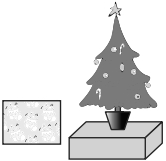
Mary wants to decorate her Christmas tree. She wants to place the tree on a wooden box covered with coloured paper with a picture of Santa Claus on it (see figure). She must know the exact quantity of paper to buy for this purpose. If the box has length,breadth,and height as $80 \, cm$,$40 \, cm$,and $20 \, cm$ respectively,how many square sheets of paper of side $40 \, cm$ would she require?
A
$7$
B
$6$
C
$5$
D
$4$
Solution
(A) Since Mary wants to paste the paper on the outer surface of the box,the quantity of paper required is equal to the total surface area of the box,which is in the shape of a cuboid.
The dimensions of the box are: Length $(l)$ = $80 \, cm$,Breadth $(b)$ = $40 \, cm$,Height $(h)$ = $20 \, cm$.
The total surface area of the cuboid = $2(lb + bh + hl)$.
Surface area = $2[(80 \times 40) + (40 \times 20) + (20 \times 80)] \, cm^2$.
Surface area = $2[3200 + 800 + 1600] \, cm^2$.
Surface area = $2 \times 5600 \, cm^2 = 11200 \, cm^2$.
The area of each square sheet of paper = side $\times$ side = $40 \, cm \times 40 \, cm = 1600 \, cm^2$.
The number of sheets required = (Total surface area of the box) / (Area of one sheet of paper).
Number of sheets = $11200 / 1600 = 7$.
Therefore,she would require $7$ sheets.
The dimensions of the box are: Length $(l)$ = $80 \, cm$,Breadth $(b)$ = $40 \, cm$,Height $(h)$ = $20 \, cm$.
The total surface area of the cuboid = $2(lb + bh + hl)$.
Surface area = $2[(80 \times 40) + (40 \times 20) + (20 \times 80)] \, cm^2$.
Surface area = $2[3200 + 800 + 1600] \, cm^2$.
Surface area = $2 \times 5600 \, cm^2 = 11200 \, cm^2$.
The area of each square sheet of paper = side $\times$ side = $40 \, cm \times 40 \, cm = 1600 \, cm^2$.
The number of sheets required = (Total surface area of the box) / (Area of one sheet of paper).
Number of sheets = $11200 / 1600 = 7$.
Therefore,she would require $7$ sheets.
0 likes
View Solution2
MediumMCQ
Hameed has built a cubical water tank with a lid for his house,with each outer edge $1.5\, m$ long. He gets the outer surface of the tank,excluding the base,covered with square tiles of side $25\, cm$ (see figure). Find how much he would spend on the tiles,if the cost of the tiles is $Rs. 360$ per dozen.

A
$Rs. 5500$
B
$Rs. 5400$
C
$Rs. 4500$
D
$Rs. 4600$
Solution
(B) Since Hameed is getting the five outer faces of the tank covered with tiles,he needs to calculate the surface area of these five faces to determine the number of tiles required.
Edge of the cubical tank $(a)$ $= 1.5\, m = 150\, cm$.
Surface area of the five faces $= 5 \times a^2 = 5 \times 150 \times 150\, cm^2 = 112500\, cm^2$.
Area of each square tile $= 25\, cm \times 25\, cm = 625\, cm^2$.
Number of tiles required $= \frac{\text{Total surface area}}{\text{Area of one tile}} = \frac{112500}{625} = 180$.
Cost of $1$ dozen $(12)$ tiles $= Rs. 360$.
Cost of $1$ tile $= \frac{360}{12} = Rs. 30$.
Total cost for $180$ tiles $= 180 \times 30 = Rs. 5400$.
Edge of the cubical tank $(a)$ $= 1.5\, m = 150\, cm$.
Surface area of the five faces $= 5 \times a^2 = 5 \times 150 \times 150\, cm^2 = 112500\, cm^2$.
Area of each square tile $= 25\, cm \times 25\, cm = 625\, cm^2$.
Number of tiles required $= \frac{\text{Total surface area}}{\text{Area of one tile}} = \frac{112500}{625} = 180$.
Cost of $1$ dozen $(12)$ tiles $= Rs. 360$.
Cost of $1$ tile $= \frac{360}{12} = Rs. 30$.
Total cost for $180$ tiles $= 180 \times 30 = Rs. 5400$.
0 likes
View Solution3
Difficult
$A$ plastic box $1.5\, m$ long,$1.25\, m$ wide,and $65\, cm$ deep is to be made. It is opened at the top. Ignoring the thickness of the plastic sheet,determine:
$(i)$ The area of the sheet required for making the box.
$(ii)$ The cost of the sheet for it,if a sheet measuring $1\, m^2$ costs $Rs. 20$.
$(i)$ The area of the sheet required for making the box.
$(ii)$ The cost of the sheet for it,if a sheet measuring $1\, m^2$ costs $Rs. 20$.
Solution
(109) Given:
Length $(l) = 1.5\, m$
Breadth $(b) = 1.25\, m$
Depth $(h) = 65\, cm = 0.65\, m$
$(i)$ Since the box is open at the top,the area of the sheet required is the sum of the area of the four walls and the base:
Area $= 2lh + 2bh + lb$
$= [2 \times 1.5 \times 0.65 + 2 \times 1.25 \times 0.65 + 1.5 \times 1.25]\, m^2$
$= (1.95 + 1.625 + 1.875)\, m^2 = 5.45\, m^2$
$(ii)$ Cost of sheet per $m^2 = Rs. 20$
Total cost for $5.45\, m^2 = 5.45 \times 20 = Rs. 109$
Length $(l) = 1.5\, m$
Breadth $(b) = 1.25\, m$
Depth $(h) = 65\, cm = 0.65\, m$
$(i)$ Since the box is open at the top,the area of the sheet required is the sum of the area of the four walls and the base:
Area $= 2lh + 2bh + lb$
$= [2 \times 1.5 \times 0.65 + 2 \times 1.25 \times 0.65 + 1.5 \times 1.25]\, m^2$
$= (1.95 + 1.625 + 1.875)\, m^2 = 5.45\, m^2$
$(ii)$ Cost of sheet per $m^2 = Rs. 20$
Total cost for $5.45\, m^2 = 5.45 \times 20 = Rs. 109$
0 likes
View Solution4
MediumMCQ
The length,breadth,and height of a room are $5\, m$,$4\, m$,and $3\, m$ respectively. Find the cost of whitewashing the walls of the room and the ceiling at the rate of $Rs. 7.50$ per $m^2$.
A
$222$
B
$333$
C
$444$
D
$555$
Solution
(D) Given: Length $(l) = 5\, m$,Breadth $(b) = 4\, m$,Height $(h) = 3\, m$.
We need to whitewash the four walls and the ceiling.
Area to be whitewashed = Area of four walls + Area of ceiling
$= 2(l + b)h + (l \times b)$
$= 2(5 + 4) \times 3 + (5 \times 4)$
$= 2(9) \times 3 + 20$
$= 54 + 20 = 74\, m^2$.
Cost of whitewashing per $m^2 = Rs. 7.50$.
Total cost = $74 \times 7.50 = Rs. 555$.
We need to whitewash the four walls and the ceiling.
Area to be whitewashed = Area of four walls + Area of ceiling
$= 2(l + b)h + (l \times b)$
$= 2(5 + 4) \times 3 + (5 \times 4)$
$= 2(9) \times 3 + 20$
$= 54 + 20 = 74\, m^2$.
Cost of whitewashing per $m^2 = Rs. 7.50$.
Total cost = $74 \times 7.50 = Rs. 555$.
0 likes
View Solution5
MediumMCQ
The floor of a rectangular hall has a perimeter of $250\, m$. If the cost of painting the four walls at the rate of $10$ per $m^2$ is $Rs. 15000$,find the height of the hall. (in $, m$)
A
$6$
B
$5$
C
$4$
D
$3$
Solution
(A) Let the length,breadth,and height of the rectangular hall be $l\, m, b\, m,$ and $h\, m$ respectively.
The area of the four walls is given by the formula: $\text{Area} = 2lh + 2bh = 2(l + b)h$.
The perimeter of the floor of the hall is $2(l + b) = 250\, m$.
Substituting the perimeter into the area formula,we get: $\text{Area of four walls} = 250 \times h = 250h\, m^2$.
The cost of painting is given as $Rs. 10$ per $m^2$.
Total cost of painting = $\text{Area} \times \text{Rate} = 250h \times 10 = 2500h$.
Given that the total cost is $Rs. 15000$,we set up the equation: $2500h = 15000$.
Solving for $h$: $h = \frac{15000}{2500} = 6\, m$.
Therefore,the height of the hall is $6\, m$.
The area of the four walls is given by the formula: $\text{Area} = 2lh + 2bh = 2(l + b)h$.
The perimeter of the floor of the hall is $2(l + b) = 250\, m$.
Substituting the perimeter into the area formula,we get: $\text{Area of four walls} = 250 \times h = 250h\, m^2$.
The cost of painting is given as $Rs. 10$ per $m^2$.
Total cost of painting = $\text{Area} \times \text{Rate} = 250h \times 10 = 2500h$.
Given that the total cost is $Rs. 15000$,we set up the equation: $2500h = 15000$.
Solving for $h$: $h = \frac{15000}{2500} = 6\, m$.
Therefore,the height of the hall is $6\, m$.
0 likes
View Solution6
MediumMCQ
The paint in a certain container is sufficient to paint an area equal to $9.375 \,m^2$. How many bricks of dimensions $22.5 \,cm \times 10 \,cm \times 7.5 \,cm$ can be painted out of this container?
A
$200$
B
$100$
C
$300$
D
$400$
Solution
(B) The total surface area of one brick is given by the formula $2(lb + bh + lh)$.
Substituting the given dimensions: $l = 22.5 \,cm$,$b = 10 \,cm$,$h = 7.5 \,cm$.
Surface area of one brick $= 2(22.5 \times 10 + 10 \times 7.5 + 22.5 \times 7.5) \,cm^2$.
$= 2(225 + 75 + 168.75) \,cm^2 = 2(468.75) \,cm^2 = 937.5 \,cm^2$.
Convert the total paintable area from $m^2$ to $cm^2$: $9.375 \,m^2 = 9.375 \times 10000 \,cm^2 = 93750 \,cm^2$.
Let $n$ be the number of bricks that can be painted.
$n \times 937.5 = 93750$.
$n = \frac{93750}{937.5} = 100$.
Thus,$100$ bricks can be painted.
Substituting the given dimensions: $l = 22.5 \,cm$,$b = 10 \,cm$,$h = 7.5 \,cm$.
Surface area of one brick $= 2(22.5 \times 10 + 10 \times 7.5 + 22.5 \times 7.5) \,cm^2$.
$= 2(225 + 75 + 168.75) \,cm^2 = 2(468.75) \,cm^2 = 937.5 \,cm^2$.
Convert the total paintable area from $m^2$ to $cm^2$: $9.375 \,m^2 = 9.375 \times 10000 \,cm^2 = 93750 \,cm^2$.
Let $n$ be the number of bricks that can be painted.
$n \times 937.5 = 93750$.
$n = \frac{93750}{937.5} = 100$.
Thus,$100$ bricks can be painted.
0 likes
View Solution7
DifficultMCQ
$A$ cubical box has each edge $10\, cm$ and another cuboidal box is $12.5\, cm$ long,$10\, cm$ wide and $8\, cm$ high. Which box has the greater lateral surface area and by how much (in $, cm^2$)?
A
$30$
B
$50$
C
$40$
D
$90$
Solution
(C) Lateral surface area of a cube $= 4 \times (\text{edge})^2$.
Given edge of the cube $= 10\, cm$.
Lateral surface area of the cubical box $= 4 \times (10\, cm)^2 = 4 \times 100\, cm^2 = 400\, cm^2$.
Lateral surface area of a cuboid $= 2 \times h \times (l + b)$.
Given length $(l) = 12.5\, cm$,breadth $(b) = 10\, cm$,and height $(h) = 8\, cm$.
Lateral surface area of the cuboidal box $= 2 \times 8\, cm \times (12.5\, cm + 10\, cm) = 16\, cm \times 22.5\, cm = 360\, cm^2$.
Comparing the two areas,$400\, cm^2 > 360\, cm^2$.
The cubical box has a greater lateral surface area.
The difference is $400\, cm^2 - 360\, cm^2 = 40\, cm^2$.
Given edge of the cube $= 10\, cm$.
Lateral surface area of the cubical box $= 4 \times (10\, cm)^2 = 4 \times 100\, cm^2 = 400\, cm^2$.
Lateral surface area of a cuboid $= 2 \times h \times (l + b)$.
Given length $(l) = 12.5\, cm$,breadth $(b) = 10\, cm$,and height $(h) = 8\, cm$.
Lateral surface area of the cuboidal box $= 2 \times 8\, cm \times (12.5\, cm + 10\, cm) = 16\, cm \times 22.5\, cm = 360\, cm^2$.
Comparing the two areas,$400\, cm^2 > 360\, cm^2$.
The cubical box has a greater lateral surface area.
The difference is $400\, cm^2 - 360\, cm^2 = 40\, cm^2$.
0 likes
View Solution8
DifficultMCQ
$A$ cubical box has each edge $10\, cm$ and another cuboidal box is $12.5\, cm$ long, $10\, cm$ wide and $8\, cm$ high. Which box has the smaller total surface area and by how much (in $ cm^2$)?
A
$25$
B
$20$
C
$15$
D
$10$
Solution
(D) Total surface area of the cubical box $= 6 \times (\text{edge})^2 = 6 \times (10\, cm)^2 = 600\, cm^2$.
Total surface area of the cuboidal box $= 2(lh + bh + lb) = 2(12.5 \times 8 + 10 \times 8 + 12.5 \times 10) = 2(100 + 80 + 125) = 2(305) = 610\, cm^2$.
Comparing the two, the total surface area of the cubical box $(600\, cm^2)$ is smaller than that of the cuboidal box $(610\, cm^2)$.
The difference in surface area $= 610\, cm^2 - 600\, cm^2 = 10\, cm^2$.
Thus, the cubical box has a smaller total surface area by $10\, cm^2$.
Total surface area of the cuboidal box $= 2(lh + bh + lb) = 2(12.5 \times 8 + 10 \times 8 + 12.5 \times 10) = 2(100 + 80 + 125) = 2(305) = 610\, cm^2$.
Comparing the two, the total surface area of the cubical box $(600\, cm^2)$ is smaller than that of the cuboidal box $(610\, cm^2)$.
The difference in surface area $= 610\, cm^2 - 600\, cm^2 = 10\, cm^2$.
Thus, the cubical box has a smaller total surface area by $10\, cm^2$.
0 likes
View Solution9
MediumMCQ
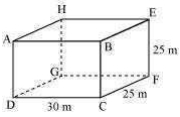
$A$ small indoor greenhouse (herbarium) is made entirely of glass panes (including base) held together with tape. It is $30 \, cm$ long,$25 \, cm$ wide and $25 \, cm$ high. What is the area of the glass (in $, cm^2$)?
A
$4250$
B
$5050$
C
$4800$
D
$4340$
Solution
(A) The greenhouse is in the shape of a cuboid.
Length $(l) = 30 \, cm$
Breadth $(b) = 25 \, cm$
Height $(h) = 25 \, cm$
The total surface area of the glass is equal to the total surface area of the cuboid.
Total Surface Area $= 2(lb + lh + bh)$
$= 2(30 \times 25 + 30 \times 25 + 25 \times 25) \, cm^2$
$= 2(750 + 750 + 625) \, cm^2$
$= 2(2125) \, cm^2$
$= 4250 \, cm^2$
Thus,the total area of the glass is $4250 \, cm^2$.
Length $(l) = 30 \, cm$
Breadth $(b) = 25 \, cm$
Height $(h) = 25 \, cm$
The total surface area of the glass is equal to the total surface area of the cuboid.
Total Surface Area $= 2(lb + lh + bh)$
$= 2(30 \times 25 + 30 \times 25 + 25 \times 25) \, cm^2$
$= 2(750 + 750 + 625) \, cm^2$
$= 2(2125) \, cm^2$
$= 4250 \, cm^2$
Thus,the total area of the glass is $4250 \, cm^2$.
0 likes
View Solution10
MediumMCQ
$A$ small indoor greenhouse (herbarium) is made entirely of glass panes (including base) held together with tape. It is $30 \, cm$ long,$25 \, cm$ wide,and $25 \, cm$ high. How much tape is needed for all the $12$ edges (in $, cm$)?
A
$220$
B
$320$
C
$420$
D
$520$
Solution
(B) cuboid has $12$ edges,consisting of $4$ lengths $(l)$,$4$ widths $(b)$,and $4$ heights $(h)$.
Given dimensions are length $(l)$ = $30 \, cm$,width $(b)$ = $25 \, cm$,and height $(h)$ = $25 \, cm$.
The total length of tape required for all $12$ edges is given by the formula:
Total length $= 4(l + b + h)$
$= 4(30 + 25 + 25) \, cm$
$= 4(80) \, cm$
$= 320 \, cm$
Therefore,$320 \, cm$ of tape is required.
Given dimensions are length $(l)$ = $30 \, cm$,width $(b)$ = $25 \, cm$,and height $(h)$ = $25 \, cm$.
The total length of tape required for all $12$ edges is given by the formula:
Total length $= 4(l + b + h)$
$= 4(30 + 25 + 25) \, cm$
$= 4(80) \, cm$
$= 320 \, cm$
Therefore,$320 \, cm$ of tape is required.
0 likes
View Solution11
DifficultMCQ
Shanti Sweets Stall was placing an order for making cardboard boxes for packing their sweets. Two sizes of boxes were required. The bigger of dimensions $25 \,cm \times 20 \,cm \times 5 \,cm$ and the smaller of dimensions $15 \,cm \times 12 \,cm \times 5 \,cm$. For all the overlaps,$5\%$ of the total surface area is required extra. If the cost of the cardboard is $Rs. 4$ for $1000 \,cm^2$,find the cost of cardboard required for supplying $250$ boxes of each kind.
A
$Rs. 2252$
B
$Rs. 2196$
C
$Rs. 2184$
D
$Rs. 2122$
Solution
(C) Length $(l_1)$ of bigger box $= 25 \,cm$,Breadth $(b_1) = 20 \,cm$,Height $(h_1) = 5 \,cm$.
Total surface area of bigger box $= 2(l_1b_1 + l_1h_1 + b_1h_1) = 2(25 \times 20 + 25 \times 5 + 20 \times 5) \,cm^2 = 2(500 + 125 + 100) \,cm^2 = 1450 \,cm^2$.
Extra area for overlaps $= 5\% \text{ of } 1450 \,cm^2 = (1450 \times 0.05) \,cm^2 = 72.5 \,cm^2$.
Total area for $1$ bigger box $= 1450 + 72.5 = 1522.5 \,cm^2$.
Area for $250$ bigger boxes $= 250 \times 1522.5 = 380625 \,cm^2$.
Length $(l_2) = 15 \,cm$,Breadth $(b_2) = 12 \,cm$,Height $(h_2) = 5 \,cm$.
Total surface area of smaller box $= 2(15 \times 12 + 15 \times 5 + 12 \times 5) \,cm^2 = 2(180 + 75 + 60) \,cm^2 = 630 \,cm^2$.
Extra area for overlaps $= 5\% \text{ of } 630 \,cm^2 = (630 \times 0.05) \,cm^2 = 31.5 \,cm^2$.
Total area for $1$ smaller box $= 630 + 31.5 = 661.5 \,cm^2$.
Area for $250$ smaller boxes $= 250 \times 661.5 = 165375 \,cm^2$.
Total cardboard area $= 380625 + 165375 = 546000 \,cm^2$.
Cost $= (546000 / 1000) \times 4 = 546 \times 4 = Rs. 2184$.
Total surface area of bigger box $= 2(l_1b_1 + l_1h_1 + b_1h_1) = 2(25 \times 20 + 25 \times 5 + 20 \times 5) \,cm^2 = 2(500 + 125 + 100) \,cm^2 = 1450 \,cm^2$.
Extra area for overlaps $= 5\% \text{ of } 1450 \,cm^2 = (1450 \times 0.05) \,cm^2 = 72.5 \,cm^2$.
Total area for $1$ bigger box $= 1450 + 72.5 = 1522.5 \,cm^2$.
Area for $250$ bigger boxes $= 250 \times 1522.5 = 380625 \,cm^2$.
Length $(l_2) = 15 \,cm$,Breadth $(b_2) = 12 \,cm$,Height $(h_2) = 5 \,cm$.
Total surface area of smaller box $= 2(15 \times 12 + 15 \times 5 + 12 \times 5) \,cm^2 = 2(180 + 75 + 60) \,cm^2 = 630 \,cm^2$.
Extra area for overlaps $= 5\% \text{ of } 630 \,cm^2 = (630 \times 0.05) \,cm^2 = 31.5 \,cm^2$.
Total area for $1$ smaller box $= 630 + 31.5 = 661.5 \,cm^2$.
Area for $250$ smaller boxes $= 250 \times 661.5 = 165375 \,cm^2$.
Total cardboard area $= 380625 + 165375 = 546000 \,cm^2$.
Cost $= (546000 / 1000) \times 4 = 546 \times 4 = Rs. 2184$.
0 likes
View Solution12
MediumMCQ
Parveen wanted to make a temporary shelter for her car by making a box-like structure with tarpaulin that covers all the four sides and the top of the car (with the front face as a flap which can be rolled up). Assuming that the stitching margins are very small,and therefore negligible,how much tarpaulin would be required to make the shelter of height $2.5 \, m$,with base dimensions $4 \, m \times 3 \, m$ (in $m^2$)?
A
$87$
B
$80$
C
$50$
D
$47$
Solution
(D) The shelter is a cuboidal structure without a base.
Length $(l) = 4 \, m$,Breadth $(b) = 3 \, m$,and Height $(h) = 2.5 \, m$.
The tarpaulin is required for the four walls and the top.
Area of tarpaulin required $= \text{Lateral Surface Area} + \text{Area of the top}$
$= 2(lh + bh) + (l \times b)$
$= [2(4 \times 2.5 + 3 \times 2.5) + (4 \times 3)] \, m^2$
$= [2(10 + 7.5) + 12] \, m^2$
$= [2(17.5) + 12] \, m^2$
$= (35 + 12) \, m^2 = 47 \, m^2$.
Thus,$47 \, m^2$ of tarpaulin is required.
Length $(l) = 4 \, m$,Breadth $(b) = 3 \, m$,and Height $(h) = 2.5 \, m$.
The tarpaulin is required for the four walls and the top.
Area of tarpaulin required $= \text{Lateral Surface Area} + \text{Area of the top}$
$= 2(lh + bh) + (l \times b)$
$= [2(4 \times 2.5 + 3 \times 2.5) + (4 \times 3)] \, m^2$
$= [2(10 + 7.5) + 12] \, m^2$
$= [2(17.5) + 12] \, m^2$
$= (35 + 12) \, m^2 = 47 \, m^2$.
Thus,$47 \, m^2$ of tarpaulin is required.
0 likes
View Solution13
MediumMCQ
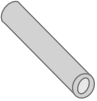
Savitri had to make a model of a cylindrical kaleidoscope for her science project. She wanted to use chart paper to make the curved surface of the kaleidoscope (see figure). What would be the area of chart paper required by her,if she wanted to make a kaleidoscope of length $25\, cm$ with a $3.5\, cm$ radius (in $, cm^{2}$)? You may take $\pi=\frac{22}{7}$.
A
$550$
B
$660$
C
$577$
D
$870$
Solution
(A) The kaleidoscope is cylindrical in shape.
Radius of the base of the cylinder $(r) = 3.5\, cm$.
Height (length) of the cylinder $(h) = 25\, cm$.
The area of the chart paper required is equal to the curved surface area of the cylinder.
Curved Surface Area $= 2\pi rh$
$= 2 \times \frac{22}{7} \times 3.5 \times 25\, cm^{2}$
$= 2 \times 22 \times 0.5 \times 25\, cm^{2}$
$= 44 \times 12.5\, cm^{2}$
$= 550\, cm^{2}$
Radius of the base of the cylinder $(r) = 3.5\, cm$.
Height (length) of the cylinder $(h) = 25\, cm$.
The area of the chart paper required is equal to the curved surface area of the cylinder.
Curved Surface Area $= 2\pi rh$
$= 2 \times \frac{22}{7} \times 3.5 \times 25\, cm^{2}$
$= 2 \times 22 \times 0.5 \times 25\, cm^{2}$
$= 44 \times 12.5\, cm^{2}$
$= 550\, cm^{2}$
0 likes
View Solution14
EasyMCQ
The curved surface area of a right circular cylinder of height $14\, cm$ is $88\, cm^2$. Find the diameter of the base of the cylinder.
Assume $\pi = \frac{22}{7}$ unless stated otherwise. (in $, cm$)
Assume $\pi = \frac{22}{7}$ unless stated otherwise. (in $, cm$)
A
$1$
B
$2$
C
$3$
D
$5$
Solution
(B) Given:
Height $(h) = 14\, cm$
Curved surface area $(CSA) = 88\, cm^2$
Let the radius of the base be $r$ and the diameter be $d = 2r$.
The formula for the curved surface area of a cylinder is $CSA = 2\pi rh$.
Since $d = 2r$,we can write $CSA = \pi dh$.
Substituting the given values:
$88 = \frac{22}{7} \times d \times 14$
$88 = 22 \times d \times 2$
$88 = 44 \times d$
$d = \frac{88}{44} = 2\, cm$.
Thus,the diameter of the base of the cylinder is $2\, cm$.
Height $(h) = 14\, cm$
Curved surface area $(CSA) = 88\, cm^2$
Let the radius of the base be $r$ and the diameter be $d = 2r$.
The formula for the curved surface area of a cylinder is $CSA = 2\pi rh$.
Since $d = 2r$,we can write $CSA = \pi dh$.
Substituting the given values:
$88 = \frac{22}{7} \times d \times 14$
$88 = 22 \times d \times 2$
$88 = 44 \times d$
$d = \frac{88}{44} = 2\, cm$.
Thus,the diameter of the base of the cylinder is $2\, cm$.
0 likes
View Solution15
MediumMCQ
It is required to make a closed cylindrical tank of height $1 \,m$ and base diameter $140 \,cm$ from a metal sheet. How many square metres of the sheet are required for the same (in $,m^2$)? Assume $\pi = \frac{22}{7}$.
A
$2.48$
B
$9.48$
C
$7.48$
D
$8.96$
Solution
(C) The height $(h)$ of the cylindrical tank is $1 \,m$.
The base diameter is $140 \,cm$,so the base radius $(r)$ is $\frac{140}{2} \,cm = 70 \,cm = 0.7 \,m$.
The area of the sheet required is equal to the total surface area of the closed cylindrical tank,which is given by the formula $2\pi r(r + h)$.
Substituting the values: $\text{Area} = 2 \times \frac{22}{7} \times 0.7 \times (0.7 + 1) \,m^2$.
$\text{Area} = 2 \times 22 \times 0.1 \times 1.7 \,m^2$.
$\text{Area} = 4.4 \times 1.7 \,m^2 = 7.48 \,m^2$.
Thus,$7.48 \,m^2$ of the metal sheet is required.
The base diameter is $140 \,cm$,so the base radius $(r)$ is $\frac{140}{2} \,cm = 70 \,cm = 0.7 \,m$.
The area of the sheet required is equal to the total surface area of the closed cylindrical tank,which is given by the formula $2\pi r(r + h)$.
Substituting the values: $\text{Area} = 2 \times \frac{22}{7} \times 0.7 \times (0.7 + 1) \,m^2$.
$\text{Area} = 2 \times 22 \times 0.1 \times 1.7 \,m^2$.
$\text{Area} = 4.4 \times 1.7 \,m^2 = 7.48 \,m^2$.
Thus,$7.48 \,m^2$ of the metal sheet is required.
0 likes
View Solution16
MediumMCQ
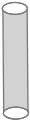
$A$ metal pipe is $77\, cm$ long. The inner diameter of a cross section is $4\, cm$,and the outer diameter is $4.4\, cm$. Find its inner curved surface area. (in $, cm^{2}$)
A
$908$
B
$698$
C
$808$
D
$968$
Solution
(D) Given:
Length (height) of the cylindrical pipe,$h = 77\, cm$.
Inner diameter,$d_{1} = 4\, cm$.
Inner radius,$r_{1} = \frac{d_{1}}{2} = \frac{4}{2} = 2\, cm$.
The formula for the curved surface area $(CSA)$ of a cylinder is $2\pi rh$.
Inner curved surface area $= 2 \times \pi \times r_{1} \times h$
$= 2 \times \frac{22}{7} \times 2 \times 77$
$= 2 \times 22 \times 2 \times 11$
$= 968\, cm^{2}$.
Thus,the inner curved surface area of the metal pipe is $968\, cm^{2}$.
Length (height) of the cylindrical pipe,$h = 77\, cm$.
Inner diameter,$d_{1} = 4\, cm$.
Inner radius,$r_{1} = \frac{d_{1}}{2} = \frac{4}{2} = 2\, cm$.
The formula for the curved surface area $(CSA)$ of a cylinder is $2\pi rh$.
Inner curved surface area $= 2 \times \pi \times r_{1} \times h$
$= 2 \times \frac{22}{7} \times 2 \times 77$
$= 2 \times 22 \times 2 \times 11$
$= 968\, cm^{2}$.
Thus,the inner curved surface area of the metal pipe is $968\, cm^{2}$.
0 likes
View Solution17
MediumMCQ
$A$ metal pipe is $77 \,cm$ long. The inner diameter of a cross section is $4 \,cm$ and the outer diameter is $4.4 \,cm$. Find its outer curved surface area. (in $,cm^{2}$)
A
$1064.8$
B
$1504.8$
C
$1456.8$
D
$6264.9$
Solution
(A) Given: Length of the pipe $(h)$ $= 77 \,cm$.
Outer diameter $(D)$ $= 4.4 \,cm$.
Outer radius $(R)$ $= \frac{D}{2} = \frac{4.4}{2} = 2.2 \,cm$.
The outer curved surface area of a cylinder is given by the formula $2 \pi R h$.
Outer curved surface area $= 2 \times \frac{22}{7} \times 2.2 \times 77 \,cm^{2}$.
$= 2 \times 22 \times 2.2 \times 11 \,cm^{2}$.
$= 44 \times 24.2 \,cm^{2}$.
$= 1064.8 \,cm^{2}$.
Outer diameter $(D)$ $= 4.4 \,cm$.
Outer radius $(R)$ $= \frac{D}{2} = \frac{4.4}{2} = 2.2 \,cm$.
The outer curved surface area of a cylinder is given by the formula $2 \pi R h$.
Outer curved surface area $= 2 \times \frac{22}{7} \times 2.2 \times 77 \,cm^{2}$.
$= 2 \times 22 \times 2.2 \times 11 \,cm^{2}$.
$= 44 \times 24.2 \,cm^{2}$.
$= 1064.8 \,cm^{2}$.
0 likes
View Solution18
MediumMCQ
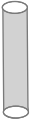
$A$ metal pipe is $77 \, cm$ long. The inner diameter of a cross section is $4 \, cm$ and the outer diameter is $4.4 \, cm$ (see Fig.). Find its total surface area. (in $, cm^2$)

A
$3088.08$
B
$2038.08$
C
$29652.08$
D
$2526.08$
Solution
(B) Given:
Length of the pipe $(h)$ = $77 \, cm$
Inner diameter $(d_1)$ = $4 \, cm$,so inner radius $(r_1)$ = $2 \, cm$
Outer diameter $(d_2)$ = $4.4 \, cm$,so outer radius $(r_2)$ = $2.2 \, cm$
Total surface area of the pipe = (Inner curved surface area) + (Outer curved surface area) + (Area of two circular rings at the ends)
Inner curved surface area = $2 \pi r_1 h = 2 \times \frac{22}{7} \times 2 \times 77 = 2 \times 22 \times 2 \times 11 = 968 \, cm^2$
Outer curved surface area = $2 \pi r_2 h = 2 \times \frac{22}{7} \times 2.2 \times 77 = 2 \times 22 \times 2.2 \times 11 = 1064.8 \, cm^2$
Area of two circular rings = $2 \times \pi (r_2^2 - r_1^2) = 2 \times \frac{22}{7} \times (2.2^2 - 2^2) = 2 \times \frac{22}{7} \times (4.84 - 4) = 2 \times \frac{22}{7} \times 0.84 = 2 \times 22 \times 0.12 = 5.28 \, cm^2$
Total surface area = $968 + 1064.8 + 5.28 = 2038.08 \, cm^2$.
Length of the pipe $(h)$ = $77 \, cm$
Inner diameter $(d_1)$ = $4 \, cm$,so inner radius $(r_1)$ = $2 \, cm$
Outer diameter $(d_2)$ = $4.4 \, cm$,so outer radius $(r_2)$ = $2.2 \, cm$
Total surface area of the pipe = (Inner curved surface area) + (Outer curved surface area) + (Area of two circular rings at the ends)
Inner curved surface area = $2 \pi r_1 h = 2 \times \frac{22}{7} \times 2 \times 77 = 2 \times 22 \times 2 \times 11 = 968 \, cm^2$
Outer curved surface area = $2 \pi r_2 h = 2 \times \frac{22}{7} \times 2.2 \times 77 = 2 \times 22 \times 2.2 \times 11 = 1064.8 \, cm^2$
Area of two circular rings = $2 \times \pi (r_2^2 - r_1^2) = 2 \times \frac{22}{7} \times (2.2^2 - 2^2) = 2 \times \frac{22}{7} \times (4.84 - 4) = 2 \times \frac{22}{7} \times 0.84 = 2 \times 22 \times 0.12 = 5.28 \, cm^2$
Total surface area = $968 + 1064.8 + 5.28 = 2038.08 \, cm^2$.
0 likes
View Solution19
MediumMCQ
The diameter of a roller is $84\, cm$ and its length is $120\, cm$. It takes $500$ complete revolutions to move once over to level a playground. Find the area of the playground in $m^2$. $\left[\text{Assume } \pi = \frac{22}{7}\right]$ (in $, m^2$)
A
$1504$
B
$9684$
C
$1584$
D
$1824$
Solution
(C) The roller is cylindrical in shape.
Height $(h)$ of the cylindrical roller = Length of the roller = $120\, cm$.
Radius $(r)$ of the circular end of the roller = $\frac{84}{2}\, cm = 42\, cm$.
Curved Surface Area $(CSA)$ of the roller = $2\pi rh$.
$CSA = 2 \times \frac{22}{7} \times 42 \times 120\, cm^2$.
$CSA = 2 \times 22 \times 6 \times 120\, cm^2 = 31680\, cm^2$.
The area of the playground is equal to the total area covered in $500$ revolutions.
Area of the playground = $500 \times CSA$ of the roller.
Area = $500 \times 31680\, cm^2 = 15840000\, cm^2$.
Since $1\, m^2 = 10000\, cm^2$,we convert the area to $m^2$:
Area = $\frac{15840000}{10000}\, m^2 = 1584\, m^2$.
Height $(h)$ of the cylindrical roller = Length of the roller = $120\, cm$.
Radius $(r)$ of the circular end of the roller = $\frac{84}{2}\, cm = 42\, cm$.
Curved Surface Area $(CSA)$ of the roller = $2\pi rh$.
$CSA = 2 \times \frac{22}{7} \times 42 \times 120\, cm^2$.
$CSA = 2 \times 22 \times 6 \times 120\, cm^2 = 31680\, cm^2$.
The area of the playground is equal to the total area covered in $500$ revolutions.
Area of the playground = $500 \times CSA$ of the roller.
Area = $500 \times 31680\, cm^2 = 15840000\, cm^2$.
Since $1\, m^2 = 10000\, cm^2$,we convert the area to $m^2$:
Area = $\frac{15840000}{10000}\, m^2 = 1584\, m^2$.
0 likes
View Solution20
MediumMCQ
$A$ cylindrical pillar is $50 \, cm$ in diameter and $3.5 \, m$ in height. Find the cost of painting the curved surface of the pillar at the rate of $Rs. \, 12.50$ per $m^2$. $\left[ \text{Assume } \pi = \frac{22}{7} \right]$
A
$Rs. \, 40.78$
B
$Rs. \, 65.80$
C
$Rs. \, 70.75$
D
$Rs. \, 68.75$
Solution
(D) Given: Diameter of the cylindrical pillar $= 50 \, cm = 0.5 \, m$.
Radius $(r) = \frac{0.5}{2} = 0.25 \, m$.
Height $(h) = 3.5 \, m$.
Curved Surface Area $(CSA)$ of the cylinder $= 2 \pi rh$.
$CSA = 2 \times \frac{22}{7} \times 0.25 \times 3.5 \, m^2$.
$CSA = 2 \times \frac{22}{7} \times 0.25 \times \frac{35}{10} = 2 \times 22 \times 0.25 \times 0.5 = 5.5 \, m^2$.
Cost of painting per $m^2 = Rs. \, 12.50$.
Total cost of painting $= 5.5 \times 12.50 = Rs. \, 68.75$.
Radius $(r) = \frac{0.5}{2} = 0.25 \, m$.
Height $(h) = 3.5 \, m$.
Curved Surface Area $(CSA)$ of the cylinder $= 2 \pi rh$.
$CSA = 2 \times \frac{22}{7} \times 0.25 \times 3.5 \, m^2$.
$CSA = 2 \times \frac{22}{7} \times 0.25 \times \frac{35}{10} = 2 \times 22 \times 0.25 \times 0.5 = 5.5 \, m^2$.
Cost of painting per $m^2 = Rs. \, 12.50$.
Total cost of painting $= 5.5 \times 12.50 = Rs. \, 68.75$.
0 likes
View Solution21
MediumMCQ
Curved surface area of a right circular cylinder is $4.4 \, m^2$. If the radius of the base of the cylinder is $0.7 \, m$,find its height. (Take $\pi = \frac{22}{7}$) (in $, m$)
A
$1$
B
$2$
C
$3$
D
$5$
Solution
(A) Let the height of the right circular cylinder be $h$.
The radius $(r)$ of the base of the cylinder is given as $0.7 \, m$.
The curved surface area $(CSA)$ of the cylinder is given as $4.4 \, m^2$.
The formula for the curved surface area of a cylinder is $CSA = 2 \pi r h$.
Substituting the given values into the formula:
$2 \times \frac{22}{7} \times 0.7 \times h = 4.4$
Simplify the expression:
$2 \times 22 \times 0.1 \times h = 4.4$
$4.4 \times h = 4.4$
Solving for $h$:
$h = \frac{4.4}{4.4} = 1 \, m$.
Therefore,the height of the cylinder is $1 \, m$.
The radius $(r)$ of the base of the cylinder is given as $0.7 \, m$.
The curved surface area $(CSA)$ of the cylinder is given as $4.4 \, m^2$.
The formula for the curved surface area of a cylinder is $CSA = 2 \pi r h$.
Substituting the given values into the formula:
$2 \times \frac{22}{7} \times 0.7 \times h = 4.4$
Simplify the expression:
$2 \times 22 \times 0.1 \times h = 4.4$
$4.4 \times h = 4.4$
Solving for $h$:
$h = \frac{4.4}{4.4} = 1 \, m$.
Therefore,the height of the cylinder is $1 \, m$.
0 likes
View Solution22
EasyMCQ
The inner diameter of a circular well is $3.5 \, m$. It is $10 \, m$ deep. Find its inner curved surface area. [Assume $\pi = \frac{22}{7}$] (in $, m^2$)
A
$150$
B
$110$
C
$210$
D
$280$
Solution
(B) The inner diameter of the circular well is $d = 3.5 \, m$.
The inner radius $(r)$ is given by $r = \frac{d}{2} = \frac{3.5}{2} \, m = 1.75 \, m$.
The depth $(h)$ of the circular well is $10 \, m$.
The inner curved surface area of a cylinder is given by the formula $2 \pi r h$.
Substituting the values,we get:
Inner curved surface area $= 2 \times \frac{22}{7} \times 1.75 \times 10 \, m^2$.
$= 2 \times \frac{22}{7} \times \frac{175}{100} \times 10 \, m^2$.
$= 2 \times 22 \times \frac{1}{7} \times \frac{7}{4} \times 10 \, m^2$.
$= 44 \times 0.25 \times 10 \, m^2 = 110 \, m^2$.
Thus,the inner curved surface area of the circular well is $110 \, m^2$.
The inner radius $(r)$ is given by $r = \frac{d}{2} = \frac{3.5}{2} \, m = 1.75 \, m$.
The depth $(h)$ of the circular well is $10 \, m$.
The inner curved surface area of a cylinder is given by the formula $2 \pi r h$.
Substituting the values,we get:
Inner curved surface area $= 2 \times \frac{22}{7} \times 1.75 \times 10 \, m^2$.
$= 2 \times \frac{22}{7} \times \frac{175}{100} \times 10 \, m^2$.
$= 2 \times 22 \times \frac{1}{7} \times \frac{7}{4} \times 10 \, m^2$.
$= 44 \times 0.25 \times 10 \, m^2 = 110 \, m^2$.
Thus,the inner curved surface area of the circular well is $110 \, m^2$.
0 likes
View Solution23
EasyMCQ
The inner diameter of a circular well is $3.5\, m$. It is $10\, m$ deep. Find the cost of plastering this curved surface at the rate of $Rs. 40$ per $m^2$.
A
$Rs. 7700$
B
$Rs. 6600$
C
$Rs. 4400$
D
$Rs. 5500$
Solution
$(C)$ Given: Diameter of the well $(d)$ $= 3.5\, m$, Depth $(h)$ $= 10\, m$.
Radius $(r)$ $= d/2 = 3.5/2 = 1.75\, m$.
The curved surface area $(CSA)$ of the cylindrical well $= 2\pi rh$.
$CSA = 2 \times (22/7) \times 1.75 \times 10$.
$CSA = 2 \times (22/7) \times 17.5 = 44 \times 2.5 = 110\, m^2$.
Cost of plastering $= \text{Area} \times \text{Rate} = 110\, m^2 \times Rs. 40/m^2 = Rs. 4400$.
Radius $(r)$ $= d/2 = 3.5/2 = 1.75\, m$.
The curved surface area $(CSA)$ of the cylindrical well $= 2\pi rh$.
$CSA = 2 \times (22/7) \times 1.75 \times 10$.
$CSA = 2 \times (22/7) \times 17.5 = 44 \times 2.5 = 110\, m^2$.
Cost of plastering $= \text{Area} \times \text{Rate} = 110\, m^2 \times Rs. 40/m^2 = Rs. 4400$.
0 likes
View Solution24
MediumMCQ
In a hot water heating system,there is a cylindrical pipe of length $28 \, m$ and diameter $5 \, cm$. Find the total radiating surface in the system. $\left[ \text{Assume } \pi = \frac{22}{7} \right]$ (in $, m^2$)
A
$7.7$
B
$6.6$
C
$5.5$
D
$4.4$
Solution
(D) The height $(h)$ of the cylindrical pipe is equal to its length,so $h = 28 \, m$.
The radius $(r)$ of the circular end of the pipe is half of the diameter,so $r = \frac{5}{2} \, cm = 2.5 \, cm$.
To maintain consistent units,convert the radius into meters: $r = \frac{2.5}{100} \, m = 0.025 \, m$.
The total radiating surface of the pipe is its Curved Surface Area $(CSA)$,which is given by the formula $CSA = 2 \pi r h$.
Substituting the values: $CSA = 2 \times \frac{22}{7} \times 0.025 \times 28$.
$CSA = 2 \times 22 \times 0.025 \times 4 = 44 \times 0.1 = 4.4 \, m^2$.
Thus,the total radiating surface in the system is $4.4 \, m^2$.
The radius $(r)$ of the circular end of the pipe is half of the diameter,so $r = \frac{5}{2} \, cm = 2.5 \, cm$.
To maintain consistent units,convert the radius into meters: $r = \frac{2.5}{100} \, m = 0.025 \, m$.
The total radiating surface of the pipe is its Curved Surface Area $(CSA)$,which is given by the formula $CSA = 2 \pi r h$.
Substituting the values: $CSA = 2 \times \frac{22}{7} \times 0.025 \times 28$.
$CSA = 2 \times 22 \times 0.025 \times 4 = 44 \times 0.1 = 4.4 \, m^2$.
Thus,the total radiating surface in the system is $4.4 \, m^2$.
0 likes
View Solution25
MediumMCQ
Find the lateral or curved surface area of a closed cylindrical petrol storage tank that is $4.2\, m$ in diameter and $4.5\, m$ high. $\left[\text{Assume } \pi = \frac{22}{7}\right]$ (in $, m^2$)
A
$59.4$
B
$60.4$
C
$57.3$
D
$45.4$
Solution
(A) Height $(h)$ of the cylindrical tank $= 4.5\, m$.
Radius $(r)$ of the circular end of the cylindrical tank $= \frac{4.2}{2}\, m = 2.1\, m$.
Lateral or curved surface area $(CSA)$ of the cylinder is given by the formula $2\pi rh$.
Substituting the values: $CSA = 2 \times \frac{22}{7} \times 2.1 \times 4.5\, m^2$.
$CSA = 2 \times 22 \times 0.3 \times 4.5\, m^2$.
$CSA = 44 \times 1.35\, m^2$.
$CSA = 59.4\, m^2$.
Therefore,the lateral or curved surface area of the tank is $59.4\, m^2$.
Radius $(r)$ of the circular end of the cylindrical tank $= \frac{4.2}{2}\, m = 2.1\, m$.
Lateral or curved surface area $(CSA)$ of the cylinder is given by the formula $2\pi rh$.
Substituting the values: $CSA = 2 \times \frac{22}{7} \times 2.1 \times 4.5\, m^2$.
$CSA = 2 \times 22 \times 0.3 \times 4.5\, m^2$.
$CSA = 44 \times 1.35\, m^2$.
$CSA = 59.4\, m^2$.
Therefore,the lateral or curved surface area of the tank is $59.4\, m^2$.
0 likes
View Solution26
MediumMCQ
Find how much steel was actually used to make a closed cylindrical tank (radius $2.1 \text{ m}$, height $4.5 \text{ m}$), if $1/12$ of the steel actually used was wasted in making the tank. [Assume $\pi = 22/7$] (in $\text{ m}^2$)
A
$55.04$
B
$95.04$
C
$55.41$
D
$96.36$
Solution
(B) First, calculate the Total Surface Area $(TSA)$ of the closed cylindrical tank:
$TSA = 2\pi r(r + h)$
Given $r = 2.1 \text{ m}$ and $h = 4.5 \text{ m}$,
$TSA = 2 \times \frac{22}{7} \times 2.1 \times (2.1 + 4.5) = 2 \times \frac{22}{7} \times 2.1 \times 6.6 = 87.12 \text{ m}^2$.
Let $A$ be the actual steel used. Since $1/12$ of the steel was wasted, the steel used for the tank is $A - \frac{1}{12}A = \frac{11}{12}A$.
Equating this to the surface area of the tank:
$\frac{11}{12}A = 87.12$
$A = \frac{87.12 \times 12}{11} = 7.92 \times 12 = 95.04 \text{ m}^2$.
Thus, the actual steel used is $95.04 \text{ m}^2$.
$TSA = 2\pi r(r + h)$
Given $r = 2.1 \text{ m}$ and $h = 4.5 \text{ m}$,
$TSA = 2 \times \frac{22}{7} \times 2.1 \times (2.1 + 4.5) = 2 \times \frac{22}{7} \times 2.1 \times 6.6 = 87.12 \text{ m}^2$.
Let $A$ be the actual steel used. Since $1/12$ of the steel was wasted, the steel used for the tank is $A - \frac{1}{12}A = \frac{11}{12}A$.
Equating this to the surface area of the tank:
$\frac{11}{12}A = 87.12$
$A = \frac{87.12 \times 12}{11} = 7.92 \times 12 = 95.04 \text{ m}^2$.
Thus, the actual steel used is $95.04 \text{ m}^2$.
0 likes
View Solution27
MediumMCQ
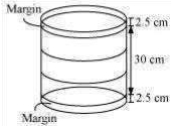
In the figure,you see the frame of a lampshade. It is to be covered with a decorative cloth. The frame has a base diameter of $20 \, cm$ and a height of $30 \, cm$. $A$ margin of $2.5 \, cm$ is to be given for folding it over the top and bottom of the frame. Find how much cloth is required for covering the lampshade. $\left[ \text{Assume } \pi = \frac{22}{7} \right]$ (in $, cm^2$)

A
$8800$
B
$5500$
C
$2200$
D
$4400$
Solution
(C) The frame of the lampshade is cylindrical in shape.
Given:
Diameter of the base $= 20 \, cm$,so the radius $(r) = \frac{20}{2} = 10 \, cm$.
Height of the frame $= 30 \, cm$.
Margin for folding at the top and bottom $= 2.5 \, cm$ each.
Total height $(h)$ of the cloth required $= 30 \, cm + 2.5 \, cm + 2.5 \, cm = 35 \, cm$.
The cloth required to cover the lampshade is equal to the curved surface area of the cylinder.
Curved Surface Area $= 2 \pi rh$
$= 2 \times \frac{22}{7} \times 10 \times 35 \, cm^2$
$= 2 \times 22 \times 10 \times 5 \, cm^2$
$= 2200 \, cm^2$.
Thus,$2200 \, cm^2$ of cloth is required to cover the lampshade.
Given:
Diameter of the base $= 20 \, cm$,so the radius $(r) = \frac{20}{2} = 10 \, cm$.
Height of the frame $= 30 \, cm$.
Margin for folding at the top and bottom $= 2.5 \, cm$ each.
Total height $(h)$ of the cloth required $= 30 \, cm + 2.5 \, cm + 2.5 \, cm = 35 \, cm$.
The cloth required to cover the lampshade is equal to the curved surface area of the cylinder.
Curved Surface Area $= 2 \pi rh$
$= 2 \times \frac{22}{7} \times 10 \times 35 \, cm^2$
$= 2 \times 22 \times 10 \times 5 \, cm^2$
$= 2200 \, cm^2$.
Thus,$2200 \, cm^2$ of cloth is required to cover the lampshade.
0 likes
View Solution28
DifficultMCQ
The students of a Vidyalaya were asked to participate in a competition for making and decorating penholders in the shape of a cylinder with a base,using cardboard. Each penholder was to be of radius $3 \,cm$ and height $10.5 \,cm$. The Vidyalaya was to supply the competitors with cardboard. If there were $35$ competitors,how much cardboard was required to be bought for the competition (in $,cm^2$)? $\left[\text{Assume } \pi = \frac{22}{7}\right]$
A
$1120$
B
$8560$
C
$9920$
D
$7920$
Solution
(D) The penholder is a cylinder with a base,so its surface area is the sum of the curved surface area and the area of the circular base.
Radius $(r) = 3 \,cm$
Height $(h) = 10.5 \,cm$
Surface area of $1$ penholder $= 2\pi rh + \pi r^2 = \pi r(2h + r)$
$= \frac{22}{7} \times 3 \times (2 \times 10.5 + 3) \,cm^2$
$= \frac{22}{7} \times 3 \times (21 + 3) \,cm^2$
$= \frac{22}{7} \times 3 \times 24 \,cm^2 = \frac{1584}{7} \,cm^2$
Total cardboard required for $35$ competitors $= 35 \times \left(\frac{1584}{7}\right) \,cm^2$
$= 5 \times 1584 \,cm^2 = 7920 \,cm^2$
Thus,$7920 \,cm^2$ of cardboard is required.
Radius $(r) = 3 \,cm$
Height $(h) = 10.5 \,cm$
Surface area of $1$ penholder $= 2\pi rh + \pi r^2 = \pi r(2h + r)$
$= \frac{22}{7} \times 3 \times (2 \times 10.5 + 3) \,cm^2$
$= \frac{22}{7} \times 3 \times (21 + 3) \,cm^2$
$= \frac{22}{7} \times 3 \times 24 \,cm^2 = \frac{1584}{7} \,cm^2$
Total cardboard required for $35$ competitors $= 35 \times \left(\frac{1584}{7}\right) \,cm^2$
$= 5 \times 1584 \,cm^2 = 7920 \,cm^2$
Thus,$7920 \,cm^2$ of cardboard is required.
0 likes
View Solution29
EasyMCQ
Find the curved surface area of a right circular cone whose slant height is $10\, cm$ and base radius is $7\, cm$. (in $, cm^{2}$)
A
$220$
B
$110$
C
$360$
D
$698$
Solution
(A) The formula for the curved surface area of a right circular cone is given by $CSA = \pi r l$,where $r$ is the base radius and $l$ is the slant height.
Given:
Base radius $r = 7\, cm$
Slant height $l = 10\, cm$
Substituting the values into the formula:
$CSA = \frac{22}{7} \times 7 \times 10\, cm^{2}$
$CSA = 22 \times 10\, cm^{2}$
$CSA = 220\, cm^{2}$
Given:
Base radius $r = 7\, cm$
Slant height $l = 10\, cm$
Substituting the values into the formula:
$CSA = \frac{22}{7} \times 7 \times 10\, cm^{2}$
$CSA = 22 \times 10\, cm^{2}$
$CSA = 220\, cm^{2}$
0 likes
View Solution30
MediumMCQ
The height of a cone is $16 \, cm$ and its base radius is $12 \, cm$. Find the curved surface area and the total surface area of the cone (Use $\pi = 3.14$). (in $, cm^2$)
A
$1350.76$
B
$1205.76$
C
$1285.76$
D
$1247.76$
Solution
(B) Given: height $h = 16 \, cm$ and radius $r = 12 \, cm$.
First,calculate the slant height $l$ using the formula $l = \sqrt{h^2 + r^2}$.
$l = \sqrt{16^2 + 12^2} = \sqrt{256 + 144} = \sqrt{400} = 20 \, cm$.
Curved surface area of the cone $= \pi rl = 3.14 \times 12 \times 20 = 753.6 \, cm^2$.
Total surface area of the cone $= \pi rl + \pi r^2 = \pi r(l + r) = 3.14 \times 12 \times (20 + 12) = 3.14 \times 12 \times 32 = 1205.76 \, cm^2$.
First,calculate the slant height $l$ using the formula $l = \sqrt{h^2 + r^2}$.
$l = \sqrt{16^2 + 12^2} = \sqrt{256 + 144} = \sqrt{400} = 20 \, cm$.
Curved surface area of the cone $= \pi rl = 3.14 \times 12 \times 20 = 753.6 \, cm^2$.
Total surface area of the cone $= \pi rl + \pi r^2 = \pi r(l + r) = 3.14 \times 12 \times (20 + 12) = 3.14 \times 12 \times 32 = 1205.76 \, cm^2$.
0 likes
View Solution31
MediumMCQ
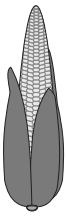
$A$ corn cob (see figure),shaped somewhat like a cone,has the radius of its broadest end as $2.1\, cm$ and length (height) as $20\, cm$. If each $1\, cm^2$ of the surface of the cob carries an average of four grains,find how many grains you would find on the entire cob.
A
$170$
B
$430$
C
$531$
D
$963$
Solution
(C) Since the grains of corn are found only on the curved surface of the corn cob,we need to calculate the curved surface area of the cone.
Given:
Radius $(r)$ = $2.1\, cm$
Height $(h)$ = $20\, cm$
First,we find the slant height $(l)$:
$l = \sqrt{r^2 + h^2} = \sqrt{(2.1)^2 + (20)^2} = \sqrt{4.41 + 400} = \sqrt{404.41} \approx 20.11\, cm$
Curved Surface Area of the cone = $\pi rl$
$= \frac{22}{7} \times 2.1 \times 20.11 = 22 \times 0.3 \times 20.11 = 6.6 \times 20.11 = 132.726\, cm^2$
Given that there are $4$ grains per $1\, cm^2$:
Total number of grains = $132.726 \times 4 = 530.904$
Rounding to the nearest whole number,we get $531$ grains.
Given:
Radius $(r)$ = $2.1\, cm$
Height $(h)$ = $20\, cm$
First,we find the slant height $(l)$:
$l = \sqrt{r^2 + h^2} = \sqrt{(2.1)^2 + (20)^2} = \sqrt{4.41 + 400} = \sqrt{404.41} \approx 20.11\, cm$
Curved Surface Area of the cone = $\pi rl$
$= \frac{22}{7} \times 2.1 \times 20.11 = 22 \times 0.3 \times 20.11 = 6.6 \times 20.11 = 132.726\, cm^2$
Given that there are $4$ grains per $1\, cm^2$:
Total number of grains = $132.726 \times 4 = 530.904$
Rounding to the nearest whole number,we get $531$ grains.
0 likes
View Solution32
EasyMCQ
Diameter of the base of a cone is $10.5\, cm$ and its slant height is $10\, cm$. Find its curved surface area. Assume $\pi = \frac{22}{7}$. (in $, cm^2$)
A
$165$
B
$170$
C
$190$
D
$200$
Solution
(A) Given,diameter of the base of the cone $= 10.5\, cm$.
Radius $(r) = \frac{10.5}{2}\, cm = 5.25\, cm$.
Slant height $(l) = 10\, cm$.
The formula for the curved surface area of a cone is $CSA = \pi rl$.
Substituting the values:
$CSA = \frac{22}{7} \times \frac{10.5}{2} \times 10\, cm^2$.
$CSA = \frac{22}{7} \times 5.25 \times 10\, cm^2$.
$CSA = \frac{22}{7} \times 52.5\, cm^2$.
$CSA = 22 \times 7.5\, cm^2 = 165\, cm^2$.
Therefore,the curved surface area of the cone is $165\, cm^2$.
Radius $(r) = \frac{10.5}{2}\, cm = 5.25\, cm$.
Slant height $(l) = 10\, cm$.
The formula for the curved surface area of a cone is $CSA = \pi rl$.
Substituting the values:
$CSA = \frac{22}{7} \times \frac{10.5}{2} \times 10\, cm^2$.
$CSA = \frac{22}{7} \times 5.25 \times 10\, cm^2$.
$CSA = \frac{22}{7} \times 52.5\, cm^2$.
$CSA = 22 \times 7.5\, cm^2 = 165\, cm^2$.
Therefore,the curved surface area of the cone is $165\, cm^2$.
0 likes
View Solution33
MediumMCQ
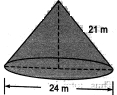
Find the total surface area of a cone,if its slant height is $21 \, m$ and diameter of its base is $24 \, m$. (Take $\pi = \frac{22}{7}$) (in $, m^2$)
A
$5684.57$
B
$1244.57$
C
$1564.57$
D
$4455.57$
Solution
(B) Given:
Diameter of the base $(d) = 24 \, m$
Radius of the base $(r) = \frac{d}{2} = \frac{24}{2} = 12 \, m$
Slant height $(l) = 21 \, m$
The formula for the total surface area of a cone is given by:
Total Surface Area $= \pi r(r + l)$
Substituting the values:
Total Surface Area $= \frac{22}{7} \times 12 \times (12 + 21) \, m^2$
$= \frac{22}{7} \times 12 \times 33 \, m^2$
$= \frac{8712}{7} \, m^2$
$\approx 1244.57 \, m^2$
Diameter of the base $(d) = 24 \, m$
Radius of the base $(r) = \frac{d}{2} = \frac{24}{2} = 12 \, m$
Slant height $(l) = 21 \, m$
The formula for the total surface area of a cone is given by:
Total Surface Area $= \pi r(r + l)$
Substituting the values:
Total Surface Area $= \frac{22}{7} \times 12 \times (12 + 21) \, m^2$
$= \frac{22}{7} \times 12 \times 33 \, m^2$
$= \frac{8712}{7} \, m^2$
$\approx 1244.57 \, m^2$
0 likes
View Solution34
Difficult
Curved surface area of a cone is $308 \, cm^2$ and its slant height is $14 \, cm$. Find $(i)$ radius of the base and $(ii)$ total surface area of the cone.
Solution
(N/A) Given: Curved surface area $= 308 \, cm^2$,Slant height $(l) = 14 \, cm$.
$(i)$ Let the radius of the base be $r \, cm$.
We know that the curved surface area of a cone is given by $\pi r l$.
$\therefore \pi r l = 308$
$\Rightarrow \frac{22}{7} \times r \times 14 = 308$
$\Rightarrow 44 \times r = 308$
$\Rightarrow r = \frac{308}{44} = 7 \, cm$.
Thus,the radius of the base is $7 \, cm$.
$(ii)$ Total surface area of a cone $= \text{Curved surface area} + \text{Base area}$.
Base area $= \pi r^2 = \frac{22}{7} \times 7^2 = 154 \, cm^2$.
Total surface area $= 308 \, cm^2 + 154 \, cm^2 = 462 \, cm^2$.
$(i)$ Let the radius of the base be $r \, cm$.
We know that the curved surface area of a cone is given by $\pi r l$.
$\therefore \pi r l = 308$
$\Rightarrow \frac{22}{7} \times r \times 14 = 308$
$\Rightarrow 44 \times r = 308$
$\Rightarrow r = \frac{308}{44} = 7 \, cm$.
Thus,the radius of the base is $7 \, cm$.
$(ii)$ Total surface area of a cone $= \text{Curved surface area} + \text{Base area}$.
Base area $= \pi r^2 = \frac{22}{7} \times 7^2 = 154 \, cm^2$.
Total surface area $= 308 \, cm^2 + 154 \, cm^2 = 462 \, cm^2$.
0 likes
View Solution35
EasyMCQ
$A$ conical tent is $10 \, m$ high and the radius of its base is $24 \, m$. Find the slant height of the tent. (in $, m$)
A
$89$
B
$55$
C
$31$
D
$26$
Solution
(D) Given:
Height of the tent $(h) = 10 \, m$
Radius of the base $(r) = 24 \, m$
The slant height $(l)$ of a cone is given by the formula:
$l = \sqrt{h^2 + r^2}$
Substituting the given values:
$l = \sqrt{10^2 + 24^2} \, m$
$l = \sqrt{100 + 576} \, m$
$l = \sqrt{676} \, m$
$l = 26 \, m$
Thus,the slant height of the tent is $26 \, m$.
Height of the tent $(h) = 10 \, m$
Radius of the base $(r) = 24 \, m$
The slant height $(l)$ of a cone is given by the formula:
$l = \sqrt{h^2 + r^2}$
Substituting the given values:
$l = \sqrt{10^2 + 24^2} \, m$
$l = \sqrt{100 + 576} \, m$
$l = \sqrt{676} \, m$
$l = 26 \, m$
Thus,the slant height of the tent is $26 \, m$.
0 likes
View Solution36
MediumMCQ
$A$ conical tent is $10 \, m$ high and the radius of its base is $24 \, m$. Find the cost of the canvas required to make the tent,if the cost of $1 \, m^2$ canvas is $Rs. 70$.
A
$Rs. 137280$
B
$Rs. 555280$
C
$Rs. 138250$
D
$Rs. 131635$
Solution
(A) Given: Height of the cone $(h) = 10 \, m$,Radius of the base $(r) = 24 \, m$.
First,calculate the slant height $(l)$ of the cone using the formula $l = \sqrt{r^2 + h^2}$.
$l = \sqrt{24^2 + 10^2} = \sqrt{576 + 100} = \sqrt{676} = 26 \, m$.
The curved surface area of the cone is given by $\pi r l$.
Area of the canvas required $= \frac{22}{7} \times 24 \times 26 \, m^2 = \frac{13728}{7} \, m^2$.
The cost of $1 \, m^2$ canvas is $Rs. 70$.
Total cost of the canvas $= \text{Area} \times \text{Rate} = \frac{13728}{7} \times 70 = 13728 \times 10 = Rs. 137280$.
First,calculate the slant height $(l)$ of the cone using the formula $l = \sqrt{r^2 + h^2}$.
$l = \sqrt{24^2 + 10^2} = \sqrt{576 + 100} = \sqrt{676} = 26 \, m$.
The curved surface area of the cone is given by $\pi r l$.
Area of the canvas required $= \frac{22}{7} \times 24 \times 26 \, m^2 = \frac{13728}{7} \, m^2$.
The cost of $1 \, m^2$ canvas is $Rs. 70$.
Total cost of the canvas $= \text{Area} \times \text{Rate} = \frac{13728}{7} \times 70 = 13728 \times 10 = Rs. 137280$.
0 likes
View Solution37
MediumMCQ
What length of tarpaulin $3\, m$ wide will be required to make a conical tent of height $8\, m$ and base radius $6\, m$ (in $, m$)? Assume that the extra length of material that will be required for stitching margins and wastage in cutting is approximately $20\, cm$ (Use $\pi = 3.14$).
A
$96.0$
B
$63.0$
C
$90.0$
D
$100.0$
Solution
(B) Given: Base radius $(r) = 6\, m$,Height $(h) = 8\, m$.
Slant height $(l) = \sqrt{r^2 + h^2} = \sqrt{6^2 + 8^2} = \sqrt{36 + 64} = \sqrt{100} = 10\, m$.
Curved surface area of the tent $= \pi rl = 3.14 \times 6 \times 10 = 188.4\, m^2$.
Let the length of the tarpaulin be $L$. Since the width is $3\, m$,the area is $L \times 3 = 188.4\, m^2$.
$L = \frac{188.4}{3} = 62.8\, m$.
Extra length for margins and wastage $= 20\, cm = 0.2\, m$.
Total length required $= 62.8\, m + 0.2\, m = 63.0\, m$.
Slant height $(l) = \sqrt{r^2 + h^2} = \sqrt{6^2 + 8^2} = \sqrt{36 + 64} = \sqrt{100} = 10\, m$.
Curved surface area of the tent $= \pi rl = 3.14 \times 6 \times 10 = 188.4\, m^2$.
Let the length of the tarpaulin be $L$. Since the width is $3\, m$,the area is $L \times 3 = 188.4\, m^2$.
$L = \frac{188.4}{3} = 62.8\, m$.
Extra length for margins and wastage $= 20\, cm = 0.2\, m$.
Total length required $= 62.8\, m + 0.2\, m = 63.0\, m$.
0 likes
View Solution38
MediumMCQ
The slant height and base diameter of a conical tomb are $25 \, m$ and $14 \, m$ respectively. Find the cost of white-washing its curved surface at the rate of $Rs. 210$ per $100 \, m^2$.
A
$Rs. 1155$
B
$Rs. 1055$
C
$Rs. 9555$
D
$Rs. 6655$
Solution
(A) Given: Slant height $(l) = 25 \, m$ and base diameter $(d) = 14 \, m$.
First,calculate the radius $(r)$ of the base:
$r = \frac{d}{2} = \frac{14}{2} = 7 \, m$.
Next,calculate the curved surface area $(CSA)$ of the conical tomb:
$CSA = \pi r l = \frac{22}{7} \times 7 \times 25 = 22 \times 25 = 550 \, m^2$.
The rate of white-washing is $Rs. 210$ per $100 \, m^2$.
Therefore,the total cost of white-washing is:
$\text{Cost} = \left( \frac{210}{100} \right) \times 550 = 2.1 \times 550 = Rs. 1155$.
First,calculate the radius $(r)$ of the base:
$r = \frac{d}{2} = \frac{14}{2} = 7 \, m$.
Next,calculate the curved surface area $(CSA)$ of the conical tomb:
$CSA = \pi r l = \frac{22}{7} \times 7 \times 25 = 22 \times 25 = 550 \, m^2$.
The rate of white-washing is $Rs. 210$ per $100 \, m^2$.
Therefore,the total cost of white-washing is:
$\text{Cost} = \left( \frac{210}{100} \right) \times 550 = 2.1 \times 550 = Rs. 1155$.
0 likes
View Solution39
MediumMCQ
$A$ joker's cap is in the form of a right circular cone of base radius $7\, cm$ and height $24\, cm$. Find the area of the sheet required to make $10$ such caps. (in $, cm^2$)
A
$6600$
B
$5500$
C
$7700$
D
$8800$
Solution
(B) Given: Radius of the base $(r) = 7\, cm$ and height $(h) = 24\, cm$.
First,calculate the slant height $(l)$ of the cone using the formula $l = \sqrt{r^2 + h^2}$.
$l = \sqrt{7^2 + 24^2} = \sqrt{49 + 576} = \sqrt{625} = 25\, cm$.
The lateral surface area of one cone is given by $\pi rl$.
Lateral surface area $= \frac{22}{7} \times 7 \times 25 = 550\, cm^2$.
To find the area of the sheet required for $10$ such caps,multiply the area of one cap by $10$.
Total area $= 10 \times 550 = 5500\, cm^2$.
First,calculate the slant height $(l)$ of the cone using the formula $l = \sqrt{r^2 + h^2}$.
$l = \sqrt{7^2 + 24^2} = \sqrt{49 + 576} = \sqrt{625} = 25\, cm$.
The lateral surface area of one cone is given by $\pi rl$.
Lateral surface area $= \frac{22}{7} \times 7 \times 25 = 550\, cm^2$.
To find the area of the sheet required for $10$ such caps,multiply the area of one cap by $10$.
Total area $= 10 \times 550 = 5500\, cm^2$.
0 likes
View Solution40
DifficultMCQ
$A$ bus stop is barricaded from the remaining part of the road by using $50$ hollow cones made of recycled cardboard. Each cone has a base diameter of $40 \, cm$ and height $1 \, m$. If the outer side of each of the cones is to be painted and the cost of painting is $Rs. 12$ per $m^2$,what will be the cost of painting all these cones? (Use $\pi = 3.14$ and take $\sqrt{1.04} = 1.02$)
A
$Rs. 404.34$
B
$Rs. 810.85$
C
$Rs. 384.34$
D
$Rs. 504.34$
Solution
(C) Given:
Diameter of the base $= 40 \, cm$
Radius $(r) = \frac{40}{2} \, cm = 20 \, cm = 0.2 \, m$
Height $(h) = 1 \, m$
Slant height $(l) = \sqrt{r^2 + h^2} = \sqrt{(0.2)^2 + (1)^2} \, m = \sqrt{0.04 + 1} \, m = \sqrt{1.04} \, m = 1.02 \, m$
Curved surface area of one cone $= \pi r l = 3.14 \times 0.2 \times 1.02 \, m^2$
Curved surface area of $50$ cones $= 50 \times 3.14 \times 0.2 \times 1.02 \, m^2$
$= 50 \times 0.2 \times 3.14 \times 1.02 \, m^2 = 10 \times 3.14 \times 1.02 \, m^2 = 32.028 \, m^2$
Cost of painting $= \text{Total Area} \times \text{Rate} = 32.028 \times 12 = Rs. 384.336$
Rounding to two decimal places,the cost is $Rs. 384.34$.
Diameter of the base $= 40 \, cm$
Radius $(r) = \frac{40}{2} \, cm = 20 \, cm = 0.2 \, m$
Height $(h) = 1 \, m$
Slant height $(l) = \sqrt{r^2 + h^2} = \sqrt{(0.2)^2 + (1)^2} \, m = \sqrt{0.04 + 1} \, m = \sqrt{1.04} \, m = 1.02 \, m$
Curved surface area of one cone $= \pi r l = 3.14 \times 0.2 \times 1.02 \, m^2$
Curved surface area of $50$ cones $= 50 \times 3.14 \times 0.2 \times 1.02 \, m^2$
$= 50 \times 0.2 \times 3.14 \times 1.02 \, m^2 = 10 \times 3.14 \times 1.02 \, m^2 = 32.028 \, m^2$
Cost of painting $= \text{Total Area} \times \text{Rate} = 32.028 \times 12 = Rs. 384.336$
Rounding to two decimal places,the cost is $Rs. 384.34$.
0 likes
View Solution41
EasyMCQ
Find the surface area of a sphere of radius $7 \, cm$. (in $, cm^{2}$)
A
$616$
B
$757$
C
$645$
D
$630$
Solution
(A) The surface area of a sphere is given by the formula $4 \pi r^{2}$.
Given the radius $r = 7 \, cm$.
Substituting the value of $r$ in the formula:
Surface Area $= 4 \times \frac{22}{7} \times (7 \, cm)^{2}$
$= 4 \times \frac{22}{7} \times 49 \, cm^{2}$
$= 4 \times 22 \times 7 \, cm^{2}$
$= 88 \times 7 \, cm^{2}$
$= 616 \, cm^{2}$.
Given the radius $r = 7 \, cm$.
Substituting the value of $r$ in the formula:
Surface Area $= 4 \times \frac{22}{7} \times (7 \, cm)^{2}$
$= 4 \times \frac{22}{7} \times 49 \, cm^{2}$
$= 4 \times 22 \times 7 \, cm^{2}$
$= 88 \times 7 \, cm^{2}$
$= 616 \, cm^{2}$.
0 likes
View Solution42
EasyMCQ
Find $(i)$ the curved surface area and $(ii)$ the total surface area of a hemisphere of radius $21\, cm$.
A
$3572, 5198\, cm^2$
B
$2772, 4158\, cm^2$
C
$2780, 3625\, cm^2$
D
$2552, 2135\, cm^2$
Solution
(B) Given radius $r = 21\, cm$.
$(i)$ The curved surface area of a hemisphere is given by the formula $2\pi r^2$.
$= 2 \times \frac{22}{7} \times 21 \times 21\, cm^2$
$= 2 \times 22 \times 3 \times 21\, cm^2 = 2772\, cm^2$.
$(ii)$ The total surface area of a hemisphere is given by the formula $3\pi r^2$.
$= 3 \times \frac{22}{7} \times 21 \times 21\, cm^2$
$= 3 \times 22 \times 3 \times 21\, cm^2 = 4158\, cm^2$.
$(i)$ The curved surface area of a hemisphere is given by the formula $2\pi r^2$.
$= 2 \times \frac{22}{7} \times 21 \times 21\, cm^2$
$= 2 \times 22 \times 3 \times 21\, cm^2 = 2772\, cm^2$.
$(ii)$ The total surface area of a hemisphere is given by the formula $3\pi r^2$.
$= 3 \times \frac{22}{7} \times 21 \times 21\, cm^2$
$= 3 \times 22 \times 3 \times 21\, cm^2 = 4158\, cm^2$.
0 likes
View Solution43
EasyMCQ
The hollow sphere,in which the circus motorcyclist performs his stunts,has a diameter of $7 \,m$. Find the area available to the motorcyclist for riding. (in $,m^2$)
A
$987$
B
$964$
C
$154$
D
$524$
Solution
(C) The diameter of the hollow sphere is $d = 7 \,m$.
The radius $r$ of the sphere is given by $r = \frac{d}{2} = \frac{7}{2} = 3.5 \,m$.
The area available to the motorcyclist for riding is the surface area of the sphere,which is calculated using the formula $A = 4 \pi r^2$.
Substituting the values:
$A = 4 \times \frac{22}{7} \times 3.5 \times 3.5$
$A = 4 \times \frac{22}{7} \times \frac{7}{2} \times \frac{7}{2}$
$A = 4 \times 22 \times \frac{7}{4}$
$A = 22 \times 7 = 154 \,m^2$.
Thus,the area available for riding is $154 \,m^2$.
The radius $r$ of the sphere is given by $r = \frac{d}{2} = \frac{7}{2} = 3.5 \,m$.
The area available to the motorcyclist for riding is the surface area of the sphere,which is calculated using the formula $A = 4 \pi r^2$.
Substituting the values:
$A = 4 \times \frac{22}{7} \times 3.5 \times 3.5$
$A = 4 \times \frac{22}{7} \times \frac{7}{2} \times \frac{7}{2}$
$A = 4 \times 22 \times \frac{7}{4}$
$A = 22 \times 7 = 154 \,m^2$.
Thus,the area available for riding is $154 \,m^2$.
0 likes
View Solution44
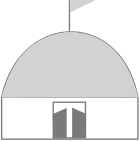
MediumMCQ
$A$ hemispherical dome of a building needs to be painted. If the circumference of the base of the dome is $17.6 \, m$,find the cost of painting it,given the cost of painting is $Rs. 5$ per $100 \, cm^2$.
A
$Rs. 30000$
B
$Rs. 24958$
C
$Rs. 24000$
D
$Rs. 24640$
Solution
(D) Since only the rounded surface of the dome is to be painted,we need to find the curved surface area of the hemisphere.
Circumference of the base of the dome $= 17.6 \, m$.
Let the radius be $r$. Then,$2\pi r = 17.6$.
$r = \frac{17.6}{2 \times \pi} = \frac{17.6 \times 7}{2 \times 22} = 0.8 \times 3.5 = 2.8 \, m$.
Curved surface area of the hemisphere $= 2\pi r^2 = 2 \times \frac{22}{7} \times 2.8 \times 2.8 = 49.28 \, m^2$.
Cost of painting $100 \, cm^2 = Rs. 5$.
Since $1 \, m^2 = 10000 \, cm^2$,the cost of painting $1 \, m^2 = \frac{5}{100} \times 10000 = Rs. 500$.
Total cost of painting $= 49.28 \times 500 = Rs. 24640$.
Circumference of the base of the dome $= 17.6 \, m$.
Let the radius be $r$. Then,$2\pi r = 17.6$.
$r = \frac{17.6}{2 \times \pi} = \frac{17.6 \times 7}{2 \times 22} = 0.8 \times 3.5 = 2.8 \, m$.
Curved surface area of the hemisphere $= 2\pi r^2 = 2 \times \frac{22}{7} \times 2.8 \times 2.8 = 49.28 \, m^2$.
Cost of painting $100 \, cm^2 = Rs. 5$.
Since $1 \, m^2 = 10000 \, cm^2$,the cost of painting $1 \, m^2 = \frac{5}{100} \times 10000 = Rs. 500$.
Total cost of painting $= 49.28 \times 500 = Rs. 24640$.
0 likes
View Solution45
EasyMCQ
Find the surface area of a sphere of radius $10.5 \, cm$.
Assume $\pi = \frac{22}{7}$. (in $, cm^{2}$)
Assume $\pi = \frac{22}{7}$. (in $, cm^{2}$)
A
$1386$
B
$1006$
C
$1300$
D
$9686$
Solution
(A) The radius $(r)$ of the sphere is $10.5 \, cm$.
The formula for the surface area of a sphere is $4 \pi r^{2}$.
Substituting the given values:
Surface area $= 4 \times \frac{22}{7} \times (10.5)^{2} \, cm^{2}$
$= 4 \times \frac{22}{7} \times 10.5 \times 10.5 \, cm^{2}$
$= 4 \times 22 \times 1.5 \times 10.5 \, cm^{2}$
$= 88 \times 15.75 \, cm^{2}$
$= 1386 \, cm^{2}$
Therefore,the surface area of the sphere is $1386 \, cm^{2}$.
The formula for the surface area of a sphere is $4 \pi r^{2}$.
Substituting the given values:
Surface area $= 4 \times \frac{22}{7} \times (10.5)^{2} \, cm^{2}$
$= 4 \times \frac{22}{7} \times 10.5 \times 10.5 \, cm^{2}$
$= 4 \times 22 \times 1.5 \times 10.5 \, cm^{2}$
$= 88 \times 15.75 \, cm^{2}$
$= 1386 \, cm^{2}$
Therefore,the surface area of the sphere is $1386 \, cm^{2}$.
0 likes
View Solution46
EasyMCQ
Find the surface area of a sphere of radius $5.6 \, cm$.
Assume $\pi = \frac{22}{7}$. (in $, cm^{2}$)
Assume $\pi = \frac{22}{7}$. (in $, cm^{2}$)
A
$3265.24$
B
$394.24$
C
$850.24$
D
$300.24$
Solution
(B) The radius $(r)$ of the sphere is $5.6 \, cm$.
The formula for the surface area of a sphere is $4 \pi r^{2}$.
Substituting the given values:
Surface area $= 4 \times \frac{22}{7} \times (5.6)^{2} \, cm^{2}$
$= 4 \times \frac{22}{7} \times 5.6 \times 5.6 \, cm^{2}$
$= 4 \times 22 \times 0.8 \times 5.6 \, cm^{2}$
$= 88 \times 4.48 \, cm^{2}$
$= 394.24 \, cm^{2}$.
Therefore,the surface area of the sphere is $394.24 \, cm^{2}$.
The formula for the surface area of a sphere is $4 \pi r^{2}$.
Substituting the given values:
Surface area $= 4 \times \frac{22}{7} \times (5.6)^{2} \, cm^{2}$
$= 4 \times \frac{22}{7} \times 5.6 \times 5.6 \, cm^{2}$
$= 4 \times 22 \times 0.8 \times 5.6 \, cm^{2}$
$= 88 \times 4.48 \, cm^{2}$
$= 394.24 \, cm^{2}$.
Therefore,the surface area of the sphere is $394.24 \, cm^{2}$.
0 likes
View Solution47
EasyMCQ
Find the surface area of a sphere of radius $14 \, cm$.
Assume $\pi = \frac{22}{7}$. (in $, cm^2$)
Assume $\pi = \frac{22}{7}$. (in $, cm^2$)
A
$4464$
B
$21004$
C
$2464$
D
$2469$
Solution
(C) The radius $(r)$ of the sphere is $14 \, cm$.
The formula for the surface area of a sphere is $4 \pi r^2$.
Substituting the given values:
Surface area $= 4 \times \frac{22}{7} \times (14)^2 \, cm^2$
$= 4 \times \frac{22}{7} \times 14 \times 14 \, cm^2$
$= 4 \times 22 \times 2 \times 14 \, cm^2$
$= 88 \times 28 \, cm^2$
$= 2464 \, cm^2$.
Therefore,the surface area of the sphere is $2464 \, cm^2$.
The formula for the surface area of a sphere is $4 \pi r^2$.
Substituting the given values:
Surface area $= 4 \times \frac{22}{7} \times (14)^2 \, cm^2$
$= 4 \times \frac{22}{7} \times 14 \times 14 \, cm^2$
$= 4 \times 22 \times 2 \times 14 \, cm^2$
$= 88 \times 28 \, cm^2$
$= 2464 \, cm^2$.
Therefore,the surface area of the sphere is $2464 \, cm^2$.
0 likes
View Solution48
EasyMCQ
Find the surface area of a sphere of diameter $14 \, cm$.
Assume $\pi = \frac{22}{7}$. (in $, cm^2$)
Assume $\pi = \frac{22}{7}$. (in $, cm^2$)
A
$706$
B
$536$
C
$600$
D
$616$
Solution
(D) The radius $(r)$ of the sphere is given by:
$r = \frac{\text{Diameter}}{2} = \frac{14 \, cm}{2} = 7 \, cm$.
The formula for the surface area of a sphere is $4 \pi r^2$.
Substituting the values:
Surface Area $= 4 \times \frac{22}{7} \times (7 \, cm)^2$
$= 4 \times \frac{22}{7} \times 49 \, cm^2$
$= 4 \times 22 \times 7 \, cm^2$
$= 88 \times 7 \, cm^2$
$= 616 \, cm^2$.
Therefore,the surface area of the sphere is $616 \, cm^2$.
$r = \frac{\text{Diameter}}{2} = \frac{14 \, cm}{2} = 7 \, cm$.
The formula for the surface area of a sphere is $4 \pi r^2$.
Substituting the values:
Surface Area $= 4 \times \frac{22}{7} \times (7 \, cm)^2$
$= 4 \times \frac{22}{7} \times 49 \, cm^2$
$= 4 \times 22 \times 7 \, cm^2$
$= 88 \times 7 \, cm^2$
$= 616 \, cm^2$.
Therefore,the surface area of the sphere is $616 \, cm^2$.
0 likes
View Solution49
EasyMCQ
Find the surface area of a sphere of diameter $21 \, cm$. Assume $\pi = \frac{22}{7}$. (in $, cm^{2}$)
A
$1386$
B
$1006$
C
$1300$
D
$1315$
Solution
(A) Given,diameter of the sphere $d = 21 \, cm$.
Radius $(r) = \frac{d}{2} = \frac{21}{2} \, cm = 10.5 \, cm$.
The surface area of a sphere is given by the formula $4 \pi r^{2}$.
Substituting the values: $\text{Surface Area} = 4 \times \frac{22}{7} \times (10.5)^{2} \, cm^{2}$.
$= 4 \times \frac{22}{7} \times 10.5 \times 10.5 \, cm^{2}$.
$= 4 \times \frac{22}{7} \times \frac{21}{2} \times \frac{21}{2} \, cm^{2}$.
$= 22 \times 3 \times 21 \, cm^{2} = 1386 \, cm^{2}$.
Thus,the surface area of the sphere is $1386 \, cm^{2}$.
Radius $(r) = \frac{d}{2} = \frac{21}{2} \, cm = 10.5 \, cm$.
The surface area of a sphere is given by the formula $4 \pi r^{2}$.
Substituting the values: $\text{Surface Area} = 4 \times \frac{22}{7} \times (10.5)^{2} \, cm^{2}$.
$= 4 \times \frac{22}{7} \times 10.5 \times 10.5 \, cm^{2}$.
$= 4 \times \frac{22}{7} \times \frac{21}{2} \times \frac{21}{2} \, cm^{2}$.
$= 22 \times 3 \times 21 \, cm^{2} = 1386 \, cm^{2}$.
Thus,the surface area of the sphere is $1386 \, cm^{2}$.
0 likes
View Solution50
EasyMCQ
Find the surface area of a sphere with a diameter of $3.5 \, cm$. Assume $\pi = \frac{22}{7}$. (in $, cm^2$)
A
$40.5$
B
$38.5$
C
$96.5$
D
$49.5$
Solution
(B) Given: Diameter $(d) = 3.5 \, cm$.
Radius $(r) = \frac{d}{2} = \frac{3.5}{2} = 1.75 \, cm$.
The surface area of a sphere is given by the formula: $A = 4 \pi r^2$.
Substituting the values: $A = 4 \times \frac{22}{7} \times (1.75)^2$.
$A = 4 \times \frac{22}{7} \times 1.75 \times 1.75$.
$A = 4 \times \frac{22}{7} \times \frac{7}{4} \times 1.75$.
$A = 22 \times 1.75 = 38.5 \, cm^2$.
Thus,the surface area of the sphere is $38.5 \, cm^2$.
Radius $(r) = \frac{d}{2} = \frac{3.5}{2} = 1.75 \, cm$.
The surface area of a sphere is given by the formula: $A = 4 \pi r^2$.
Substituting the values: $A = 4 \times \frac{22}{7} \times (1.75)^2$.
$A = 4 \times \frac{22}{7} \times 1.75 \times 1.75$.
$A = 4 \times \frac{22}{7} \times \frac{7}{4} \times 1.75$.
$A = 22 \times 1.75 = 38.5 \, cm^2$.
Thus,the surface area of the sphere is $38.5 \, cm^2$.
0 likes
View SolutionSurface Areas and Volumes — Textbook - Surface Areas and Volumes · Frequently Asked Questions
1Are these Surface Areas and Volumes questions useful for JEE and NEET?
Yes. All questions in this section are mapped to JEE Main and NEET exam patterns. Previous year questions from JEE Main, NEET, GUJCET and state-level exams are included with full solutions.
2Can I switch to Hindi or Gujarati for these questions?
Yes. Use the language tabs in the hero section or the sidebar to view the same questions and solutions in English, Hindi or Gujarati.
3How do I generate a question paper from this subtopic?
Use the Vedclass Exam Paper Generator — select the chapter and subtopic, set difficulty, and generate Sets A, B, C, D automatically. First 3 chapters of every subject are free.
Vedclass Products
For Students
Vedclass Test Series
Mock tests in real JEE/NEET style with performance analysis. 5-day free trial.
Start Free TrialFor Teachers
Exam Paper Generator
Generate Set A/B/C/D papers from this chapter in 2 minutes. 3 chapters free.
Try FreeFor Institutes
Online Exam Module
Live online exams with unlimited students, 360° analytics & white-label branding.
See DemoFor Teachers & Institutes
Generate a Surface Areas and Volumes Exam Paper in 2 Minutes
Select subtopic & difficulty — Sets A, B, C, D auto-generated with No Repeat logic.
First 3 chapters of every subject are free — no payment required.