
A English
Mix Examples - Surface Areas and Volumes Questions in English
Class 9 Mathematics · Surface Areas and Volumes · Mix Examples - Surface Areas and Volumes
210+
Questions
English
Language
100%
With Solutions
Showing 50 of 210 questions in English
101
DifficultMCQ
The radii of three out of four spheres are $33 \, cm$,$44 \, cm$,and $48 \, cm$ respectively. If the surface area of the fourth sphere is equal to the sum of the surface areas of the first three spheres,find the radius of the fourth sphere (in $cm$).
A
$43$
B
$33$
C
$53$
D
$73$
Solution
(D) The surface area of a sphere is given by the formula $S = 4 \pi r^2$.
Let the radii of the three spheres be $r_1 = 33 \, cm$,$r_2 = 44 \, cm$,and $r_3 = 48 \, cm$.
Let the radius of the fourth sphere be $R$.
According to the problem,the surface area of the fourth sphere is equal to the sum of the surface areas of the first three spheres:
$4 \pi R^2 = 4 \pi r_1^2 + 4 \pi r_2^2 + 4 \pi r_3^2$
Dividing both sides by $4 \pi$,we get:
$R^2 = r_1^2 + r_2^2 + r_3^2$
$R^2 = (33)^2 + (44)^2 + (48)^2$
$R^2 = 1089 + 1936 + 2304$
$R^2 = 5329$
Taking the square root of both sides:
$R = \sqrt{5329} = 73 \, cm$.
Thus,the radius of the fourth sphere is $73 \, cm$.
Let the radii of the three spheres be $r_1 = 33 \, cm$,$r_2 = 44 \, cm$,and $r_3 = 48 \, cm$.
Let the radius of the fourth sphere be $R$.
According to the problem,the surface area of the fourth sphere is equal to the sum of the surface areas of the first three spheres:
$4 \pi R^2 = 4 \pi r_1^2 + 4 \pi r_2^2 + 4 \pi r_3^2$
Dividing both sides by $4 \pi$,we get:
$R^2 = r_1^2 + r_2^2 + r_3^2$
$R^2 = (33)^2 + (44)^2 + (48)^2$
$R^2 = 1089 + 1936 + 2304$
$R^2 = 5329$
Taking the square root of both sides:
$R = \sqrt{5329} = 73 \, cm$.
Thus,the radius of the fourth sphere is $73 \, cm$.
0 likes
View Solution102
MediumMCQ
The dimensions of each iron hollow box are $30 \, cm \times 15 \, cm \times 10 \, cm$. What is the volume of a carton containing $60$ such boxes? (in $m^3$)
A
$0.27$
B
$0.37$
C
$0.47$
D
$0.55$
Solution
(A) For a single iron hollow box: length $(l) = 30 \, cm$,breadth $(b) = 15 \, cm$,and height $(h) = 10 \, cm$.
The volume of each cuboid $= l \times b \times h$.
$= 30 \times 15 \times 10 \, cm^3 = 4500 \, cm^3$.
Therefore,the volume of a carton containing $60$ such iron boxes $= 60 \times 4500 \, cm^3$.
$= 2,70,000 \, cm^3$.
Since $1 \, m^3 = 1,000,000 \, cm^3$,we convert the volume to cubic meters:
$= \frac{2,70,000}{1,000,000} \, m^3 = 0.27 \, m^3$.
The volume of each cuboid $= l \times b \times h$.
$= 30 \times 15 \times 10 \, cm^3 = 4500 \, cm^3$.
Therefore,the volume of a carton containing $60$ such iron boxes $= 60 \times 4500 \, cm^3$.
$= 2,70,000 \, cm^3$.
Since $1 \, m^3 = 1,000,000 \, cm^3$,we convert the volume to cubic meters:
$= \frac{2,70,000}{1,000,000} \, m^3 = 0.27 \, m^3$.
0 likes
View Solution103
MediumMCQ
The edge of a cube is $6 \, cm$. Find the total surface area of the cube and the volume of the cube.
A
$216 \, cm^2, 216 \, cm^3$
B
$144 \, cm^2, 216 \, cm^3$
C
$216 \, cm^2, 144 \, cm^3$
D
$108 \, cm^2, 108 \, cm^3$
Solution
(A) Given,the edge of the cube is $a = 6 \, cm$.
$1$. Total Surface Area of the cube:
Formula: $TSA = 6a^2$
$TSA = 6 \times (6)^2 = 6 \times 36 = 216 \, cm^2$.
$2$. Volume of the cube:
Formula: $V = a^3$
$V = (6)^3 = 6 \times 6 \times 6 = 216 \, cm^3$.
$1$. Total Surface Area of the cube:
Formula: $TSA = 6a^2$
$TSA = 6 \times (6)^2 = 6 \times 36 = 216 \, cm^2$.
$2$. Volume of the cube:
Formula: $V = a^3$
$V = (6)^3 = 6 \times 6 \times 6 = 216 \, cm^3$.
0 likes
View Solution104
MediumMCQ
$A$ room without a ceiling is $12 \, m$ long,$4 \, m$ wide,and $3 \, m$ high. Find the length of the longest rod that can be placed in that room. (in $m$)
A
$12$
B
$11$
C
$13$
D
$14$
Solution
(C) For a given room,the dimensions are: length $(l) = 12 \, m$,width $(b) = 4 \, m$,and height $(h) = 3 \, m$.
The longest rod that can be placed in a rectangular room corresponds to the space diagonal of the cuboid.
The formula for the length of the diagonal is $d = \sqrt{l^2 + b^2 + h^2}$.
Substituting the given values:
$d = \sqrt{12^2 + 4^2 + 3^2} \, m$
$d = \sqrt{144 + 16 + 9} \, m$
$d = \sqrt{169} \, m$
$d = 13 \, m$.
Thus,the length of the longest rod is $13 \, m$.
The longest rod that can be placed in a rectangular room corresponds to the space diagonal of the cuboid.
The formula for the length of the diagonal is $d = \sqrt{l^2 + b^2 + h^2}$.
Substituting the given values:
$d = \sqrt{12^2 + 4^2 + 3^2} \, m$
$d = \sqrt{144 + 16 + 9} \, m$
$d = \sqrt{169} \, m$
$d = 13 \, m$.
Thus,the length of the longest rod is $13 \, m$.
0 likes
View Solution105
Difficult
The areas of the three surfaces meeting at one vertex of a cuboid are $700 \, cm^2$,$300 \, cm^2$,and $525 \, cm^2$ respectively. Find the dimensions and volume of the cuboid.
Solution
(N/A) Let the length,breadth,and height of the cuboid be $l \, cm$,$b \, cm$,and $h \, cm$ respectively.
The areas of the three adjacent faces meeting at a vertex are given by $lb$,$bh$,and $hl$.
Given:
$lb = 700 \, cm^2$ --- $(i)$
$bh = 300 \, cm^2$ --- $(ii)$
$hl = 525 \, cm^2$ --- $(iii)$
Multiplying $(i)$,$(ii)$,and $(iii)$:
$(lb) \times (bh) \times (hl) = 700 \times 300 \times 525$
$l^2 b^2 h^2 = 110,250,000$
$(lbh)^2 = (10,500)^2$
$lbh = 10,500 \, cm^3$ (This is the volume of the cuboid).
To find the dimensions:
From $(i)$ and $(iii)$,$lb = 700$ and $hl = 525$. Dividing $(i)$ by $(iii)$ gives $b/h = 700/525 = 4/3$,so $b = 4h/3$.
Substitute $b$ into $(ii)$:
$(4h/3) \times h = 300$
$h^2 = 300 \times 3 / 4 = 225$
$h = 15 \, cm$.
Now,$b = 4(15)/3 = 20 \, cm$.
And $l = 700/20 = 35 \, cm$.
Thus,the dimensions are $35 \, cm$,$20 \, cm$,and $15 \, cm$,and the volume is $10,500 \, cm^3$.
The areas of the three adjacent faces meeting at a vertex are given by $lb$,$bh$,and $hl$.
Given:
$lb = 700 \, cm^2$ --- $(i)$
$bh = 300 \, cm^2$ --- $(ii)$
$hl = 525 \, cm^2$ --- $(iii)$
Multiplying $(i)$,$(ii)$,and $(iii)$:
$(lb) \times (bh) \times (hl) = 700 \times 300 \times 525$
$l^2 b^2 h^2 = 110,250,000$
$(lbh)^2 = (10,500)^2$
$lbh = 10,500 \, cm^3$ (This is the volume of the cuboid).
To find the dimensions:
From $(i)$ and $(iii)$,$lb = 700$ and $hl = 525$. Dividing $(i)$ by $(iii)$ gives $b/h = 700/525 = 4/3$,so $b = 4h/3$.
Substitute $b$ into $(ii)$:
$(4h/3) \times h = 300$
$h^2 = 300 \times 3 / 4 = 225$
$h = 15 \, cm$.
Now,$b = 4(15)/3 = 20 \, cm$.
And $l = 700/20 = 35 \, cm$.
Thus,the dimensions are $35 \, cm$,$20 \, cm$,and $15 \, cm$,and the volume is $10,500 \, cm^3$.
0 likes
View Solution106
MediumMCQ
The capacity of a cuboidal water tank is $60,000$ litres. If its length is $5$ m and breadth is $4$ m, find its height in meters.
A
$3$
B
$2$
C
$3.5$
D
$4$
Solution
(A) Given, capacity of the tank = $60,000$ litres.
Since $1$ m$^3 = 1,000$ litres, the volume of the tank in cubic meters is $60,000 / 1,000 = 60$ m$^3$.
The formula for the volume of a cuboid is $V = \text{length} \times \text{breadth} \times \text{height}$.
Substituting the given values: $60 = 5 \times 4 \times h$.
$60 = 20 \times h$.
$h = 60 / 20 = 3$ m.
Therefore, the height of the tank is $3$ m.
Since $1$ m$^3 = 1,000$ litres, the volume of the tank in cubic meters is $60,000 / 1,000 = 60$ m$^3$.
The formula for the volume of a cuboid is $V = \text{length} \times \text{breadth} \times \text{height}$.
Substituting the given values: $60 = 5 \times 4 \times h$.
$60 = 20 \times h$.
$h = 60 / 20 = 3$ m.
Therefore, the height of the tank is $3$ m.
0 likes
View Solution107
DifficultMCQ
$A$ small village, having a population of $5000$, requires $130\, \text{litres}$ of water per head per day. The village has an overhead cuboidal tank measuring $20\, \text{m} \times 13\, \text{m} \times 10\, \text{m}$. For how many days will the water of this tank last?
A
$3$
B
$4$
C
$5$
D
$6$
Solution
(B) $1$. Calculate the total volume of the tank: $V = \text{length} \times \text{breadth} \times \text{height} = 20\, \text{m} \times 13\, \text{m} \times 10\, \text{m} = 2600\, \text{m}^3$.
$2$. Convert the volume into litres: Since $1\, \text{m}^3 = 1000\, \text{litres}$, the total capacity is $2600 \times 1000 = 2,600,000\, \text{litres}$.
$3$. Calculate the daily water requirement for the village: $5000 \times 130\, \text{litres/day} = 650,000\, \text{litres/day}$.
$4$. Calculate the number of days the water will last: $\frac{2,600,000}{650,000} = 4\, \text{days}$.
$2$. Convert the volume into litres: Since $1\, \text{m}^3 = 1000\, \text{litres}$, the total capacity is $2600 \times 1000 = 2,600,000\, \text{litres}$.
$3$. Calculate the daily water requirement for the village: $5000 \times 130\, \text{litres/day} = 650,000\, \text{litres/day}$.
$4$. Calculate the number of days the water will last: $\frac{2,600,000}{650,000} = 4\, \text{days}$.
0 likes
View Solution108
Medium
The volume of a cube is $3375\, cm^{3}$. Find its edge and total surface area.
Solution
(N/A) Let the edge of the cube be $a$. The volume of a cube is given by $V = a^{3}$.
Given $a^{3} = 3375\, cm^{3}$.
Taking the cube root of both sides,$a = \sqrt[3]{3375} = 15\, cm$.
The total surface area of a cube is given by $TSA = 6a^{2}$.
$TSA = 6 \times (15)^{2} = 6 \times 225 = 1350\, cm^{2}$.
Thus,the edge is $15\, cm$ and the total surface area is $1350\, cm^{2}$.
Given $a^{3} = 3375\, cm^{3}$.
Taking the cube root of both sides,$a = \sqrt[3]{3375} = 15\, cm$.
The total surface area of a cube is given by $TSA = 6a^{2}$.
$TSA = 6 \times (15)^{2} = 6 \times 225 = 1350\, cm^{2}$.
Thus,the edge is $15\, cm$ and the total surface area is $1350\, cm^{2}$.
0 likes
View Solution109
Medium
The length and breadth of a cuboid are $30\, cm$ and $25\, cm$. If the total surface area of the cuboid is double the lateral surface area of the cuboid,find its height and volume.
Solution
(N/A) Let the length $l = 30\, cm$,breadth $b = 25\, cm$,and height be $h\, cm$.
The lateral surface area $(LSA)$ of a cuboid is given by $2h(l + b) = 2h(30 + 25) = 110h\, cm^2$.
The total surface area $(TSA)$ of a cuboid is given by $2(lb + bh + lh) = 2(30 \times 25 + 25h + 30h) = 2(750 + 55h) = 1500 + 110h\, cm^2$.
According to the problem,$TSA = 2 \times LSA$.
$1500 + 110h = 2(110h)$.
$1500 + 110h = 220h$.
$110h = 1500$.
$h = \frac{1500}{110} = \frac{150}{11}\, cm$.
The volume $V = l \times b \times h = 30 \times 25 \times \frac{150}{11} = 750 \times \frac{150}{11} = \frac{112500}{11}\, cm^3$.
The lateral surface area $(LSA)$ of a cuboid is given by $2h(l + b) = 2h(30 + 25) = 110h\, cm^2$.
The total surface area $(TSA)$ of a cuboid is given by $2(lb + bh + lh) = 2(30 \times 25 + 25h + 30h) = 2(750 + 55h) = 1500 + 110h\, cm^2$.
According to the problem,$TSA = 2 \times LSA$.
$1500 + 110h = 2(110h)$.
$1500 + 110h = 220h$.
$110h = 1500$.
$h = \frac{1500}{110} = \frac{150}{11}\, cm$.
The volume $V = l \times b \times h = 30 \times 25 \times \frac{150}{11} = 750 \times \frac{150}{11} = \frac{112500}{11}\, cm^3$.
0 likes
View Solution110
Medium
If $V$ is the volume of a cuboid of dimensions $a, b, c$ and $S$ is its total surface area,then prove that $\frac{1}{V} = \frac{2}{S} \left( \frac{1}{a} + \frac{1}{b} + \frac{1}{c} \right)$.
Solution
(N/A) The volume $V$ of a cuboid with dimensions $a, b, c$ is given by $V = abc$.
The total surface area $S$ of the cuboid is given by $S = 2(ab + bc + ca)$.
Now,consider the right-hand side $(RHS)$ of the expression:
$RHS = \frac{2}{S} \left( \frac{1}{a} + \frac{1}{b} + \frac{1}{c} \right)$
Substitute the expression for $S$:
$RHS = \frac{2}{2(ab + bc + ca)} \left( \frac{bc + ac + ab}{abc} \right)$
Simplify the expression:
$RHS = \frac{1}{ab + bc + ca} \cdot \frac{ab + bc + ca}{abc}$
Cancel the common term $(ab + bc + ca)$:
$RHS = \frac{1}{abc}$
Since $V = abc$,we have:
$RHS = \frac{1}{V}$
Thus,$\frac{1}{V} = \frac{2}{S} \left( \frac{1}{a} + \frac{1}{b} + \frac{1}{c} \right)$ is proved.
The total surface area $S$ of the cuboid is given by $S = 2(ab + bc + ca)$.
Now,consider the right-hand side $(RHS)$ of the expression:
$RHS = \frac{2}{S} \left( \frac{1}{a} + \frac{1}{b} + \frac{1}{c} \right)$
Substitute the expression for $S$:
$RHS = \frac{2}{2(ab + bc + ca)} \left( \frac{bc + ac + ab}{abc} \right)$
Simplify the expression:
$RHS = \frac{1}{ab + bc + ca} \cdot \frac{ab + bc + ca}{abc}$
Cancel the common term $(ab + bc + ca)$:
$RHS = \frac{1}{abc}$
Since $V = abc$,we have:
$RHS = \frac{1}{V}$
Thus,$\frac{1}{V} = \frac{2}{S} \left( \frac{1}{a} + \frac{1}{b} + \frac{1}{c} \right)$ is proved.
0 likes
View Solution111
Medium
The areas of the three adjacent faces meeting at one vertex of a cuboid are $4000 \, cm^2$,$2000 \, cm^2$,and $3200 \, cm^2$ respectively. Find the dimensions and the volume of the cuboid.
Solution
(A) Let the dimensions of the cuboid be $l, b,$ and $h$. The areas of the three adjacent faces are given by $lb = 4000$,$bh = 2000$,and $hl = 3200$.
Multiplying these three equations: $(lb)(bh)(hl) = 4000 \times 2000 \times 3200$.
$(lbh)^2 = 25,600,000,000$.
$lbh = \sqrt{25,600,000,000} = 160,000 \, cm^3$.
Now,to find the dimensions:
$l = (lbh) / (bh) = 160,000 / 2000 = 80 \, cm$.
$b = (lbh) / (hl) = 160,000 / 3200 = 50 \, cm$.
$h = (lbh) / (lb) = 160,000 / 4000 = 40 \, cm$.
Thus,the dimensions are $80 \, cm, 50 \, cm, 40 \, cm$ and the volume is $160,000 \, cm^3$.
Multiplying these three equations: $(lb)(bh)(hl) = 4000 \times 2000 \times 3200$.
$(lbh)^2 = 25,600,000,000$.
$lbh = \sqrt{25,600,000,000} = 160,000 \, cm^3$.
Now,to find the dimensions:
$l = (lbh) / (bh) = 160,000 / 2000 = 80 \, cm$.
$b = (lbh) / (hl) = 160,000 / 3200 = 50 \, cm$.
$h = (lbh) / (lb) = 160,000 / 4000 = 40 \, cm$.
Thus,the dimensions are $80 \, cm, 50 \, cm, 40 \, cm$ and the volume is $160,000 \, cm^3$.
0 likes
View Solution112
MediumMCQ
The dimensions of a cuboid are in the ratio of $4: 3: 1$. If its total surface area is $3800 \, cm^{2}$,then find its volume in $cm^{3}$.
A
$10000$
B
$11000$
C
$12000$
D
$12500$
Solution
(C) Let the dimensions of the cuboid be $4x$,$3x$,and $1x$.
The total surface area of a cuboid is given by the formula: $TSA = 2(lb + bh + lh)$.
Substituting the given values: $3800 = 2((4x)(3x) + (3x)(x) + (4x)(x))$.
$3800 = 2(12x^{2} + 3x^{2} + 4x^{2})$.
$3800 = 2(19x^{2})$.
$3800 = 38x^{2}$.
$x^{2} = 100$,which implies $x = 10 \, cm$.
The dimensions are $4(10) = 40 \, cm$,$3(10) = 30 \, cm$,and $1(10) = 10 \, cm$.
The volume of the cuboid is $V = l \times b \times h = 40 \times 30 \times 10 = 12,000 \, cm^{3}$.
The total surface area of a cuboid is given by the formula: $TSA = 2(lb + bh + lh)$.
Substituting the given values: $3800 = 2((4x)(3x) + (3x)(x) + (4x)(x))$.
$3800 = 2(12x^{2} + 3x^{2} + 4x^{2})$.
$3800 = 2(19x^{2})$.
$3800 = 38x^{2}$.
$x^{2} = 100$,which implies $x = 10 \, cm$.
The dimensions are $4(10) = 40 \, cm$,$3(10) = 30 \, cm$,and $1(10) = 10 \, cm$.
The volume of the cuboid is $V = l \times b \times h = 40 \times 30 \times 10 = 12,000 \, cm^{3}$.
0 likes
View Solution113
MediumMCQ
How many cubes of $1 \,cm$ edge can be cut from a wooden cuboid measuring $5 \,cm \times 4 \,cm \times 3 \,cm$? Find the ratio of the total surface area of the cuboid to the total surface area of all the cubes.
A
$60, 47:180$
B
$60, 180:47$
C
$20, 47:180$
D
$60, 94:180$
Solution
(A) $1$. Volume of the cuboid = $length \times breadth \times height = 5 \,cm \times 4 \,cm \times 3 \,cm = 60 \,cm^3$.
$2$. Volume of one cube = $(side)^3 = (1 \,cm)^3 = 1 \,cm^3$.
$3$. Number of cubes = $\frac{\text{Volume of cuboid}}{\text{Volume of one cube}} = \frac{60 \,cm^3}{1 \,cm^3} = 60$.
$4$. Total surface area of the cuboid = $2(lb + bh + lh) = 2(5 \times 4 + 4 \times 3 + 3 \times 5) = 2(20 + 12 + 15) = 2(47) = 94 \,cm^2$.
$5$. Total surface area of one cube = $6(side)^2 = 6(1)^2 = 6 \,cm^2$.
$6$. Total surface area of $60$ cubes = $60 \times 6 \,cm^2 = 360 \,cm^2$.
$7$. Ratio = $\frac{94}{360} = \frac{47}{180}$ or $47:180$.
$2$. Volume of one cube = $(side)^3 = (1 \,cm)^3 = 1 \,cm^3$.
$3$. Number of cubes = $\frac{\text{Volume of cuboid}}{\text{Volume of one cube}} = \frac{60 \,cm^3}{1 \,cm^3} = 60$.
$4$. Total surface area of the cuboid = $2(lb + bh + lh) = 2(5 \times 4 + 4 \times 3 + 3 \times 5) = 2(20 + 12 + 15) = 2(47) = 94 \,cm^2$.
$5$. Total surface area of one cube = $6(side)^2 = 6(1)^2 = 6 \,cm^2$.
$6$. Total surface area of $60$ cubes = $60 \times 6 \,cm^2 = 360 \,cm^2$.
$7$. Ratio = $\frac{94}{360} = \frac{47}{180}$ or $47:180$.
0 likes
View Solution114
MediumMCQ
The length,breadth,and height of a metallic cuboid are $10\, cm$,$6\, cm$,and $4\, cm$ respectively. If the density of the metal is $7.8\, g/cm^3$,find the mass of the cuboid (in $g$).
A
$1872$
B
$1972$
C
$2072$
D
$2172$
Solution
(A) Given:
Length $(l)$ = $10\, cm$
Breadth $(b)$ = $6\, cm$
Height $(h)$ = $4\, cm$
Density $( ho)$ = $7.8\, g/cm^3$
Step $1$: Calculate the volume $(V)$ of the cuboid.
$V = l \times b \times h$
$V = 10\, cm \times 6\, cm \times 4\, cm = 240\, cm^3$
Step $2$: Calculate the mass $(m)$ of the cuboid.
Mass = Density $\times$ Volume
$m = 7.8\, g/cm^3 \times 240\, cm^3$
$m = 1872\, g$
Therefore,the mass of the cuboid is $1872\, g$.
Length $(l)$ = $10\, cm$
Breadth $(b)$ = $6\, cm$
Height $(h)$ = $4\, cm$
Density $( ho)$ = $7.8\, g/cm^3$
Step $1$: Calculate the volume $(V)$ of the cuboid.
$V = l \times b \times h$
$V = 10\, cm \times 6\, cm \times 4\, cm = 240\, cm^3$
Step $2$: Calculate the mass $(m)$ of the cuboid.
Mass = Density $\times$ Volume
$m = 7.8\, g/cm^3 \times 240\, cm^3$
$m = 1872\, g$
Therefore,the mass of the cuboid is $1872\, g$.
0 likes
View Solution115
DifficultMCQ
The edges of three of the four cubes are $1\, cm, 9\, cm$ and $10\, cm$ respectively. If the total volume of two cubes with $9\, cm$ edge and $10\, cm$ edge is equal to the volume of the remaining two cubes,find the edge of the fourth cube in $cm$.
A
$11$
B
$12$
C
$13$
D
$14$
Solution
(B) Let the edge of the fourth cube be $x\, cm$.
The volume of a cube with edge $a$ is given by $V = a^3$.
The volumes of the given cubes are $1^3 = 1\, cm^3$,$9^3 = 729\, cm^3$,and $10^3 = 1000\, cm^3$.
According to the problem,the sum of the volumes of the cubes with edges $9\, cm$ and $10\, cm$ is equal to the sum of the volumes of the cubes with edges $1\, cm$ and $x\, cm$.
So,$9^3 + 10^3 = 1^3 + x^3$.
$729 + 1000 = 1 + x^3$.
$1729 = 1 + x^3$.
$x^3 = 1728$.
Taking the cube root on both sides,$x = \sqrt[3]{1728} = 12\, cm$.
Thus,the edge of the fourth cube is $12\, cm$.
The volume of a cube with edge $a$ is given by $V = a^3$.
The volumes of the given cubes are $1^3 = 1\, cm^3$,$9^3 = 729\, cm^3$,and $10^3 = 1000\, cm^3$.
According to the problem,the sum of the volumes of the cubes with edges $9\, cm$ and $10\, cm$ is equal to the sum of the volumes of the cubes with edges $1\, cm$ and $x\, cm$.
So,$9^3 + 10^3 = 1^3 + x^3$.
$729 + 1000 = 1 + x^3$.
$1729 = 1 + x^3$.
$x^3 = 1728$.
Taking the cube root on both sides,$x = \sqrt[3]{1728} = 12\, cm$.
Thus,the edge of the fourth cube is $12\, cm$.
0 likes
View Solution116
EasyMCQ
The volume of a solid cylinder is $4620 \, cm^{3}$ and its radius is $7 \, cm$. Find its height in $cm$.
A
$46$
B
$20.5$
C
$30$
D
$40$
Solution
(C) Given for a solid cylinder:
Radius $(r) = 7 \, cm$
Volume $(V) = 4620 \, cm^{3}$
The formula for the volume of a cylinder is $V = \pi r^{2} h$.
Substituting the given values:
$4620 = \frac{22}{7} \times (7)^{2} \times h$
$4620 = \frac{22}{7} \times 49 \times h$
$4620 = 22 \times 7 \times h$
$4620 = 154 \times h$
Solving for height $(h)$:
$h = \frac{4620}{154}$
$h = 30 \, cm$
Thus,the height of the cylinder is $30 \, cm$.
Radius $(r) = 7 \, cm$
Volume $(V) = 4620 \, cm^{3}$
The formula for the volume of a cylinder is $V = \pi r^{2} h$.
Substituting the given values:
$4620 = \frac{22}{7} \times (7)^{2} \times h$
$4620 = \frac{22}{7} \times 49 \times h$
$4620 = 22 \times 7 \times h$
$4620 = 154 \times h$
Solving for height $(h)$:
$h = \frac{4620}{154}$
$h = 30 \, cm$
Thus,the height of the cylinder is $30 \, cm$.
0 likes
View Solution117
MediumMCQ
The curved surface area of a cylinder is $4400 \, cm^2$ and its base has a radius of $14 \, cm$. Find the volume of the cylinder in $cm^3$.
A
$39800$
B
$32400$
C
$31500$
D
$30800$
Solution
(D) Given for a cylinder: radius $(r) = 14 \, cm$ and curved surface area $(CSA) = 4400 \, cm^2$.
The formula for the curved surface area of a cylinder is $CSA = 2 \pi r h$.
Substituting the given values: $4400 = 2 \times \frac{22}{7} \times 14 \times h$.
Simplifying the equation: $4400 = 2 \times 22 \times 2 \times h = 88 \times h$.
Therefore,$h = \frac{4400}{88} = 50 \, cm$.
The formula for the volume of a cylinder is $V = \pi r^2 h$.
Substituting the values: $V = \frac{22}{7} \times 14 \times 14 \times 50$.
$V = 22 \times 2 \times 14 \times 50 = 44 \times 700 = 30800 \, cm^3$.
The formula for the curved surface area of a cylinder is $CSA = 2 \pi r h$.
Substituting the given values: $4400 = 2 \times \frac{22}{7} \times 14 \times h$.
Simplifying the equation: $4400 = 2 \times 22 \times 2 \times h = 88 \times h$.
Therefore,$h = \frac{4400}{88} = 50 \, cm$.
The formula for the volume of a cylinder is $V = \pi r^2 h$.
Substituting the values: $V = \frac{22}{7} \times 14 \times 14 \times 50$.
$V = 22 \times 2 \times 14 \times 50 = 44 \times 700 = 30800 \, cm^3$.
0 likes
View Solution118
Medium
The curved surface area of a cylinder is $3960 \, cm^{2}$ and its volume is $41580 \, cm^{3}$. Find the radius and height of the cylinder.
Solution
(N/A) Given for a cylinder:
Curved surface area $(CSA)$ $= 3960 \, cm^{2}$
Volume $(V)$ $= 41580 \, cm^{3}$
We know that:
$CSA = 2 \pi r h = 3960 \, cm^{2}$ --- $(1)$
$V = \pi r^{2} h = 41580 \, cm^{3}$ --- $(2)$
Dividing equation $(2)$ by equation $(1)$:
$\frac{V}{CSA} = \frac{\pi r^{2} h}{2 \pi r h} = \frac{41580}{3960}$
$\frac{r}{2} = 10.5$
$r = 21 \, cm$
Now,substitute $r = 21 \, cm$ in equation $(1)$:
$2 \times \frac{22}{7} \times 21 \times h = 3960$
$2 \times 22 \times 3 \times h = 3960$
$132 \times h = 3960$
$h = \frac{3960}{132} = 30 \, cm$
Thus,the radius is $21 \, cm$ and the height is $30 \, cm$.
Curved surface area $(CSA)$ $= 3960 \, cm^{2}$
Volume $(V)$ $= 41580 \, cm^{3}$
We know that:
$CSA = 2 \pi r h = 3960 \, cm^{2}$ --- $(1)$
$V = \pi r^{2} h = 41580 \, cm^{3}$ --- $(2)$
Dividing equation $(2)$ by equation $(1)$:
$\frac{V}{CSA} = \frac{\pi r^{2} h}{2 \pi r h} = \frac{41580}{3960}$
$\frac{r}{2} = 10.5$
$r = 21 \, cm$
Now,substitute $r = 21 \, cm$ in equation $(1)$:
$2 \times \frac{22}{7} \times 21 \times h = 3960$
$2 \times 22 \times 3 \times h = 3960$
$132 \times h = 3960$
$h = \frac{3960}{132} = 30 \, cm$
Thus,the radius is $21 \, cm$ and the height is $30 \, cm$.
0 likes
View Solution119
MediumMCQ
The radius and height of a cylindrical coin are $1.4 \, cm$ and $0.1 \, cm$ respectively. $60$ such coins are stacked up to make a larger cylindrical pillar. Find the volume of this larger cylinder (in $cm^3$).
A
$35$
B
$36.96$
C
$45.56$
D
$12.23$
Solution
(B) For a single cylindrical coin:
Radius $(r) = 1.4 \, cm = \frac{14}{10} \, cm$
Height $(h) = 0.1 \, cm = \frac{1}{10} \, cm$
Volume of one coin $= \pi r^2 h = \frac{22}{7} \times (\frac{14}{10})^2 \times \frac{1}{10} \, cm^3$
$= \frac{22}{7} \times \frac{196}{100} \times \frac{1}{10} = \frac{22 \times 28}{1000} = \frac{616}{1000} \, cm^3 = 0.616 \, cm^3$
Since $60$ such coins are stacked to form a larger cylinder,the total volume is:
Total Volume $= 60 \times 0.616 \, cm^3 = 36.96 \, cm^3$.
Radius $(r) = 1.4 \, cm = \frac{14}{10} \, cm$
Height $(h) = 0.1 \, cm = \frac{1}{10} \, cm$
Volume of one coin $= \pi r^2 h = \frac{22}{7} \times (\frac{14}{10})^2 \times \frac{1}{10} \, cm^3$
$= \frac{22}{7} \times \frac{196}{100} \times \frac{1}{10} = \frac{22 \times 28}{1000} = \frac{616}{1000} \, cm^3 = 0.616 \, cm^3$
Since $60$ such coins are stacked to form a larger cylinder,the total volume is:
Total Volume $= 60 \times 0.616 \, cm^3 = 36.96 \, cm^3$.
0 likes
View Solution120
EasyMCQ
The radius and height of a cylinder are $10 \, cm$ and $20 \, cm$ respectively. Find the volume of the cylinder. $(\pi = 3.14)$ (in $cm^3$)
A
$6180$
B
$6000$
C
$6280$
D
$6540$
Solution
(C) The formula for the volume of a cylinder is $V = \pi r^2 h$.
Given:
Radius $(r) = 10 \, cm$
Height $(h) = 20 \, cm$
$\pi = 3.14$
Substituting the values into the formula:
$V = 3.14 \times (10)^2 \times 20$
$V = 3.14 \times 100 \times 20$
$V = 314 \times 20$
$V = 6280 \, cm^3$
Therefore,the volume of the cylinder is $6280 \, cm^3$.
Given:
Radius $(r) = 10 \, cm$
Height $(h) = 20 \, cm$
$\pi = 3.14$
Substituting the values into the formula:
$V = 3.14 \times (10)^2 \times 20$
$V = 3.14 \times 100 \times 20$
$V = 314 \times 20$
$V = 6280 \, cm^3$
Therefore,the volume of the cylinder is $6280 \, cm^3$.
0 likes
View Solution121
EasyMCQ
The radius and volume of a cylinder are $3.5\,cm$ and $2310\,cm^3$ respectively. Find its height in $cm$.
A
$60$
B
$40$
C
$50$
D
$30$
Solution
(A) The volume $V$ of a cylinder is given by the formula $V = \pi r^2 h$,where $r$ is the radius and $h$ is the height.
Given: $r = 3.5\,cm = \frac{7}{2}\,cm$ and $V = 2310\,cm^3$.
Substituting the values into the formula:
$2310 = \frac{22}{7} \times (\frac{7}{2})^2 \times h$
$2310 = \frac{22}{7} \times \frac{49}{4} \times h$
$2310 = \frac{11 \times 7}{2} \times h$
$2310 = 38.5 \times h$
$h = \frac{2310}{38.5} = 60\,cm$.
Therefore,the height of the cylinder is $60\,cm$.
Given: $r = 3.5\,cm = \frac{7}{2}\,cm$ and $V = 2310\,cm^3$.
Substituting the values into the formula:
$2310 = \frac{22}{7} \times (\frac{7}{2})^2 \times h$
$2310 = \frac{22}{7} \times \frac{49}{4} \times h$
$2310 = \frac{11 \times 7}{2} \times h$
$2310 = 38.5 \times h$
$h = \frac{2310}{38.5} = 60\,cm$.
Therefore,the height of the cylinder is $60\,cm$.
0 likes
View Solution122
EasyMCQ
The radius and height of a cylindrical cistern are $70 \,cm$ and $1.5 \,m$ respectively. How many litres of water can it hold?
A
$2100$
B
$2310$
C
$2350$
D
$2390$
Solution
(B) Given: Radius $r = 70 \,cm = 0.7 \,m$ and height $h = 1.5 \,m$.
The volume $V$ of a cylinder is given by the formula $V = \pi r^2 h$.
Substituting the values: $V = \frac{22}{7} \times (0.7)^2 \times 1.5$.
$V = \frac{22}{7} \times 0.49 \times 1.5 = 22 \times 0.07 \times 1.5 = 1.54 \times 1.5 = 2.31 \,m^3$.
Since $1 \,m^3 = 1000 \,litres$,the capacity is $2.31 \times 1000 = 2310 \,litres$.
The volume $V$ of a cylinder is given by the formula $V = \pi r^2 h$.
Substituting the values: $V = \frac{22}{7} \times (0.7)^2 \times 1.5$.
$V = \frac{22}{7} \times 0.49 \times 1.5 = 22 \times 0.07 \times 1.5 = 1.54 \times 1.5 = 2.31 \,m^3$.
Since $1 \,m^3 = 1000 \,litres$,the capacity is $2.31 \times 1000 = 2310 \,litres$.
0 likes
View Solution123
MediumMCQ
The curved surface area of a cylinder is $8800 \, cm^2$. If the radius of the cylinder is $28 \, cm$,find its volume in $cm^3$.
A
$123400$
B
$223200$
C
$123200$
D
$133300$
Solution
(C) Given:
Curved Surface Area $(CSA)$ of the cylinder = $8800 \, cm^2$
Radius $(r)$ = $28 \, cm$
Formula for $CSA$ of a cylinder = $2 \pi r h$
$2 \times \frac{22}{7} \times 28 \times h = 8800$
$2 \times 22 \times 4 \times h = 8800$
$176 \times h = 8800$
$h = \frac{8800}{176} = 50 \, cm$
Now,Volume of the cylinder = $\pi r^2 h$
Volume = $\frac{22}{7} \times 28 \times 28 \times 50$
Volume = $22 \times 4 \times 28 \times 50$
Volume = $88 \times 1400 = 1,23,200 \, cm^3$.
Curved Surface Area $(CSA)$ of the cylinder = $8800 \, cm^2$
Radius $(r)$ = $28 \, cm$
Formula for $CSA$ of a cylinder = $2 \pi r h$
$2 \times \frac{22}{7} \times 28 \times h = 8800$
$2 \times 22 \times 4 \times h = 8800$
$176 \times h = 8800$
$h = \frac{8800}{176} = 50 \, cm$
Now,Volume of the cylinder = $\pi r^2 h$
Volume = $\frac{22}{7} \times 28 \times 28 \times 50$
Volume = $22 \times 4 \times 28 \times 50$
Volume = $88 \times 1400 = 1,23,200 \, cm^3$.
0 likes
View Solution124
MediumMCQ
$A$ cylindrical container of radius $14\, cm$ is partially filled with water. $A$ solid cuboid of iron with dimensions $22\, cm \times 16\, cm \times 7\, cm$ is submerged in it. Find the rise in the level of the water when the solid is completely submerged. (in $cm$)
A
$1$
B
$2$
C
$3$
D
$4$
Solution
(D) The volume of the submerged cuboid is $V = 22\, cm \times 16\, cm \times 7\, cm = 2464\, cm^3$.
When the cuboid is submerged,the volume of water displaced is equal to the volume of the cuboid.
Let the rise in the water level be $h\, cm$.
The volume of the displaced water in the cylindrical container is given by $\pi r^2 h$,where $r = 14\, cm$.
So,$\pi r^2 h = 2464$.
Using $\pi = \frac{22}{7}$,we have $\frac{22}{7} \times 14 \times 14 \times h = 2464$.
$22 \times 2 \times 14 \times h = 2464$.
$616 \times h = 2464$.
$h = \frac{2464}{616} = 4\, cm$.
Therefore,the rise in the water level is $4\, cm$.
When the cuboid is submerged,the volume of water displaced is equal to the volume of the cuboid.
Let the rise in the water level be $h\, cm$.
The volume of the displaced water in the cylindrical container is given by $\pi r^2 h$,where $r = 14\, cm$.
So,$\pi r^2 h = 2464$.
Using $\pi = \frac{22}{7}$,we have $\frac{22}{7} \times 14 \times 14 \times h = 2464$.
$22 \times 2 \times 14 \times h = 2464$.
$616 \times h = 2464$.
$h = \frac{2464}{616} = 4\, cm$.
Therefore,the rise in the water level is $4\, cm$.
0 likes
View Solution125
DifficultMCQ
$A$ square sheet of paper,$44 \, cm$ long,is rolled along its length to form a cylinder. Find the volume of the cylinder so formed. (in $cm^3$)
A
$6776$
B
$5645$
C
$3245$
D
$5612$
Solution
(A) Given that the sheet is a square with side length $s = 44 \, cm$.
When it is rolled along its length to form a cylinder,the length of the sheet becomes the circumference of the base of the cylinder.
Therefore,the circumference $C = 2 \pi r = 44 \, cm$.
Using $\pi = 22/7$,we have $2 \times (22/7) \times r = 44$.
This simplifies to $(44/7) \times r = 44$,which gives $r = 7 \, cm$.
The height $h$ of the cylinder is equal to the side of the square,so $h = 44 \, cm$.
The volume $V$ of the cylinder is given by $V = \pi r^2 h$.
$V = (22/7) \times (7)^2 \times 44$.
$V = (22/7) \times 49 \times 44 = 22 \times 7 \times 44$.
$V = 154 \times 44 = 6776 \, cm^3$.
When it is rolled along its length to form a cylinder,the length of the sheet becomes the circumference of the base of the cylinder.
Therefore,the circumference $C = 2 \pi r = 44 \, cm$.
Using $\pi = 22/7$,we have $2 \times (22/7) \times r = 44$.
This simplifies to $(44/7) \times r = 44$,which gives $r = 7 \, cm$.
The height $h$ of the cylinder is equal to the side of the square,so $h = 44 \, cm$.
The volume $V$ of the cylinder is given by $V = \pi r^2 h$.
$V = (22/7) \times (7)^2 \times 44$.
$V = (22/7) \times 49 \times 44 = 22 \times 7 \times 44$.
$V = 154 \times 44 = 6776 \, cm^3$.
0 likes
View Solution126
EasyMCQ
The circumference of the base of a cylindrical vessel is $440\, cm$ and its height is $80\, cm$. Find the volume of the cylinder in $m^3$.
A
$2.432$
B
$1.232$
C
$3.242$
D
$4.234$
Solution
(B) Given: Circumference of the base $(C)$ = $440\, cm$,Height $(h)$ = $80\, cm$.
Step $1$: Find the radius $(r)$ using $C = 2\pi r$.
$440 = 2 \times (22/7) \times r$
$r = (440 \times 7) / 44 = 70\, cm$.
Step $2$: Convert dimensions to meters $(m)$: $r = 0.7\, m$,$h = 0.8\, m$.
Step $3$: Calculate volume $(V)$ using $V = \pi r^2 h$.
$V = (22/7) \times (0.7)^2 \times 0.8$
$V = (22/7) \times 0.49 \times 0.8$
$V = 22 \times 0.07 \times 0.8 = 1.232\, m^3$.
Step $1$: Find the radius $(r)$ using $C = 2\pi r$.
$440 = 2 \times (22/7) \times r$
$r = (440 \times 7) / 44 = 70\, cm$.
Step $2$: Convert dimensions to meters $(m)$: $r = 0.7\, m$,$h = 0.8\, m$.
Step $3$: Calculate volume $(V)$ using $V = \pi r^2 h$.
$V = (22/7) \times (0.7)^2 \times 0.8$
$V = (22/7) \times 0.49 \times 0.8$
$V = 22 \times 0.07 \times 0.8 = 1.232\, m^3$.
0 likes
View Solution127
MediumMCQ
The thickness of a metallic tube is $5 \, mm$ and the inner diameter of the tube is $10 \, cm$. Find the mass of a $70 \, cm$ long tube,if the density of the metal is $8 \, g/cm^3$. (in $g$)
A
$8240$
B
$7240$
C
$9240$
D
$6440$
Solution
(C) Given: Thickness of the tube = $5 \, mm = 0.5 \, cm$. Inner radius $(r)$ = $10 \, cm / 2 = 5 \, cm$. Length $(h)$ = $70 \, cm$. Outer radius $(R)$ = $r + \text{thickness} = 5 \, cm + 0.5 \, cm = 5.5 \, cm$. Volume of the metal = $\pi(R^2 - r^2)h = \frac{22}{7} \times ((5.5)^2 - (5)^2) \times 70 = 22 \times (30.25 - 25) \times 10 = 22 \times 5.25 \times 10 = 1155 \, cm^3$. Mass = $\text{Volume} \times \text{Density} = 1155 \, cm^3 \times 8 \, g/cm^3 = 9240 \, g$.
0 likes
View Solution128
MediumMCQ
$A$ well with $14\, m$ inside diameter is dug $50\, m$ deep. Earth taken out of it is spread all around a rectangular field of length $110\, m$ and width $100\, m$. Find the increase in the height of the field (in $cm$).
A
$40$
B
$50$
C
$60$
D
$70$
Solution
(D) $1$. The volume of the earth taken out from the well is equal to the volume of the cylinder: $V = \pi r^2 h$.
$2$. Given diameter $d = 14\, m$,so radius $r = 7\, m$. Depth $h = 50\, m$.
$3$. $V = \frac{22}{7} \times 7 \times 7 \times 50 = 22 \times 7 \times 50 = 7700\, m^3$.
$4$. This earth is spread over a rectangular field of area $A = 110\, m \times 100\, m = 11000\, m^2$.
$5$. Let the increase in height be $H$. Then,$V = A \times H$.
$6$. $7700 = 11000 \times H$.
$7$. $H = \frac{7700}{11000} = 0.7\, m$.
$8$. Converting to $cm$: $0.7 \times 100 = 70\, cm$.
$2$. Given diameter $d = 14\, m$,so radius $r = 7\, m$. Depth $h = 50\, m$.
$3$. $V = \frac{22}{7} \times 7 \times 7 \times 50 = 22 \times 7 \times 50 = 7700\, m^3$.
$4$. This earth is spread over a rectangular field of area $A = 110\, m \times 100\, m = 11000\, m^2$.
$5$. Let the increase in height be $H$. Then,$V = A \times H$.
$6$. $7700 = 11000 \times H$.
$7$. $H = \frac{7700}{11000} = 0.7\, m$.
$8$. Converting to $cm$: $0.7 \times 100 = 70\, cm$.
0 likes
View Solution129
MediumMCQ
The radius of the base of a cone is $10 \, cm$ and its slant height is $26 \, cm$. Find the volume of the cone. $(\pi = 3.14)$ (in $cm^3$)
A
$2512$
B
$2412$
C
$2322$
D
$2645$
Solution
(A) For a given cone:
Radius $(r) = 10 \, cm$ and slant height $(l) = 26 \, cm$.
Using the relation $l^2 = r^2 + h^2$,we find the height $(h)$:
$h^2 = l^2 - r^2$
$h^2 = (26)^2 - (10)^2$
$h^2 = 676 - 100 = 576$
$h = \sqrt{576} = 24 \, cm$.
The volume of a cone is given by the formula $V = \frac{1}{3} \pi r^2 h$.
$V = \frac{1}{3} \times 3.14 \times (10)^2 \times 24$
$V = 3.14 \times 100 \times 8$
$V = 314 \times 8 = 2512 \, cm^3$.
Radius $(r) = 10 \, cm$ and slant height $(l) = 26 \, cm$.
Using the relation $l^2 = r^2 + h^2$,we find the height $(h)$:
$h^2 = l^2 - r^2$
$h^2 = (26)^2 - (10)^2$
$h^2 = 676 - 100 = 576$
$h = \sqrt{576} = 24 \, cm$.
The volume of a cone is given by the formula $V = \frac{1}{3} \pi r^2 h$.
$V = \frac{1}{3} \times 3.14 \times (10)^2 \times 24$
$V = 3.14 \times 100 \times 8$
$V = 314 \times 8 = 2512 \, cm^3$.
0 likes
View Solution130
MediumMCQ
The curved surface area of a cone is $550 \, cm^2$. If the radius of the cone is $7 \, cm$,find its volume in $cm^3$.
A
$1200$
B
$1232$
C
$1423$
D
$1632$
Solution
(B) Given for a cone: radius $(r) = 7 \, cm$ and curved surface area $= 550 \, cm^2$.
The formula for the curved surface area of a cone is $\pi r l$.
Therefore,$550 = \frac{22}{7} \times 7 \times l$.
$550 = 22 \times l \implies l = \frac{550}{22} = 25 \, cm$.
Using the relation $l^2 = r^2 + h^2$,we find the height $(h)$:
$h^2 = l^2 - r^2 = (25)^2 - (7)^2 = 625 - 49 = 576$.
$h = \sqrt{576} = 24 \, cm$.
The volume of a cone is given by $V = \frac{1}{3} \pi r^2 h$.
$V = \frac{1}{3} \times \frac{22}{7} \times 7 \times 7 \times 24$.
$V = 22 \times 7 \times 8 = 1232 \, cm^3$.
The formula for the curved surface area of a cone is $\pi r l$.
Therefore,$550 = \frac{22}{7} \times 7 \times l$.
$550 = 22 \times l \implies l = \frac{550}{22} = 25 \, cm$.
Using the relation $l^2 = r^2 + h^2$,we find the height $(h)$:
$h^2 = l^2 - r^2 = (25)^2 - (7)^2 = 625 - 49 = 576$.
$h = \sqrt{576} = 24 \, cm$.
The volume of a cone is given by $V = \frac{1}{3} \pi r^2 h$.
$V = \frac{1}{3} \times \frac{22}{7} \times 7 \times 7 \times 24$.
$V = 22 \times 7 \times 8 = 1232 \, cm^3$.
0 likes
View Solution131
DifficultMCQ
The ratio of the radius and slant height of a cone is $3:5$ and its curved surface area is $423.9 \, cm^2$. Find its volume. $(\pi = 3.14)$ (in $cm^3$)
A
$2365.48$
B
$1562.36$
C
$1017.36$
D
$2027.36$
Solution
(C) For a given cone,the curved surface area $= 423.9 \, cm^2$.
Radius : slant height $= 3:5$.
Let the radius be $r = 3x \, cm$ and the slant height be $l = 5x \, cm$.
The curved surface area of a cone is given by $\pi rl$.
Therefore,$423.9 = 3.14 \times 3x \times 5x$.
$423.9 = 3.14 \times 15x^2$.
$x^2 = \frac{423.9}{47.1} = 9$.
So,$x = 3$.
Thus,radius $r = 3(3) = 9 \, cm$ and slant height $l = 5(3) = 15 \, cm$.
Using the relation $l^2 = h^2 + r^2$,we find the height $h$:
$h^2 = l^2 - r^2 = 15^2 - 9^2 = 225 - 81 = 144$.
$h = \sqrt{144} = 12 \, cm$.
The volume of a cone is $V = \frac{1}{3} \pi r^2 h$.
$V = \frac{1}{3} \times 3.14 \times 9^2 \times 12$.
$V = 3.14 \times 81 \times 4 = 1017.36 \, cm^3$.
Radius : slant height $= 3:5$.
Let the radius be $r = 3x \, cm$ and the slant height be $l = 5x \, cm$.
The curved surface area of a cone is given by $\pi rl$.
Therefore,$423.9 = 3.14 \times 3x \times 5x$.
$423.9 = 3.14 \times 15x^2$.
$x^2 = \frac{423.9}{47.1} = 9$.
So,$x = 3$.
Thus,radius $r = 3(3) = 9 \, cm$ and slant height $l = 5(3) = 15 \, cm$.
Using the relation $l^2 = h^2 + r^2$,we find the height $h$:
$h^2 = l^2 - r^2 = 15^2 - 9^2 = 225 - 81 = 144$.
$h = \sqrt{144} = 12 \, cm$.
The volume of a cone is $V = \frac{1}{3} \pi r^2 h$.
$V = \frac{1}{3} \times 3.14 \times 9^2 \times 12$.
$V = 3.14 \times 81 \times 4 = 1017.36 \, cm^3$.
0 likes
View Solution132
EasyMCQ
The radius of the base of a cone is $14 \, cm$ and its slant height is $50 \, cm$. Find the volume of the cone (in $cm^3$).
A
$8123$
B
$5656$
C
$9776$
D
$9856$
Solution
(D) Given: Radius of the base $(r)$ = $14 \, cm$,Slant height $(l)$ = $50 \, cm$.
First,we find the vertical height $(h)$ of the cone using the relation $r^2 + h^2 = l^2$.
$14^2 + h^2 = 50^2$
$196 + h^2 = 2500$
$h^2 = 2500 - 196 = 2304$
$h = \sqrt{2304} = 48 \, cm$.
The volume of a cone is given by the formula $V = \frac{1}{3} \pi r^2 h$.
$V = \frac{1}{3} \times \frac{22}{7} \times 14 \times 14 \times 48$
$V = \frac{1}{3} \times 22 \times 2 \times 14 \times 48$
$V = 22 \times 2 \times 14 \times 16$
$V = 9856 \, cm^3$.
Therefore,the volume of the cone is $9856 \, cm^3$.
First,we find the vertical height $(h)$ of the cone using the relation $r^2 + h^2 = l^2$.
$14^2 + h^2 = 50^2$
$196 + h^2 = 2500$
$h^2 = 2500 - 196 = 2304$
$h = \sqrt{2304} = 48 \, cm$.
The volume of a cone is given by the formula $V = \frac{1}{3} \pi r^2 h$.
$V = \frac{1}{3} \times \frac{22}{7} \times 14 \times 14 \times 48$
$V = \frac{1}{3} \times 22 \times 2 \times 14 \times 48$
$V = 22 \times 2 \times 14 \times 16$
$V = 9856 \, cm^3$.
Therefore,the volume of the cone is $9856 \, cm^3$.
0 likes
View Solution133
MediumMCQ
The height of a cone is $9 \, cm$. The area of the base is $1386 \, cm^2$. Find its volume (in $cm^3$).
A
$4158$
B
$5158$
C
$4145$
D
$6541$
Solution
(A) The formula for the volume of a cone is given by $V = \frac{1}{3} \pi r^2 h$,where $\pi r^2$ is the area of the base.
Given,the area of the base $(A)$ = $1386 \, cm^2$ and the height $(h)$ = $9 \, cm$.
Substituting these values into the formula:
$V = \frac{1}{3} \times A \times h$
$V = \frac{1}{3} \times 1386 \times 9$
$V = 1386 \times 3$
$V = 4158 \, cm^3$.
Therefore,the volume of the cone is $4158 \, cm^3$.
Given,the area of the base $(A)$ = $1386 \, cm^2$ and the height $(h)$ = $9 \, cm$.
Substituting these values into the formula:
$V = \frac{1}{3} \times A \times h$
$V = \frac{1}{3} \times 1386 \times 9$
$V = 1386 \times 3$
$V = 4158 \, cm^3$.
Therefore,the volume of the cone is $4158 \, cm^3$.
0 likes
View Solution134
EasyMCQ
The radius and slant height of a conical vessel are $7 \, cm$ and $25 \, cm$ respectively. What is its capacity in litres?
A
$2.432$
B
$1.232$
C
$4.332$
D
$6.432$
Solution
(B) Given: Radius $(r) = 7 \, cm$, Slant height $(l) = 25 \, cm$.
First, find the vertical height $(h)$ using the relation $l^2 = r^2 + h^2$.
$h^2 = l^2 - r^2 = 25^2 - 7^2 = 625 - 49 = 576$.
$h = \sqrt{576} = 24 \, cm$.
The volume $(V)$ of the cone is given by $V = \frac{1}{3} \pi r^2 h$.
$V = \frac{1}{3} \times \frac{22}{7} \times 7 \times 7 \times 24 = 22 \times 7 \times 8 = 1232 \, cm^3$.
Since $1000 \, cm^3 = 1 \, litre$, the capacity is $\frac{1232}{1000} = 1.232 \, litres$.
First, find the vertical height $(h)$ using the relation $l^2 = r^2 + h^2$.
$h^2 = l^2 - r^2 = 25^2 - 7^2 = 625 - 49 = 576$.
$h = \sqrt{576} = 24 \, cm$.
The volume $(V)$ of the cone is given by $V = \frac{1}{3} \pi r^2 h$.
$V = \frac{1}{3} \times \frac{22}{7} \times 7 \times 7 \times 24 = 22 \times 7 \times 8 = 1232 \, cm^3$.
Since $1000 \, cm^3 = 1 \, litre$, the capacity is $\frac{1232}{1000} = 1.232 \, litres$.
0 likes
View Solution135
MediumMCQ
The radius and slant height of a conical vessel are $21 \,cm$ and $29 \,cm$ respectively. What is its capacity in litres?
A
$8.321$
B
$7.456$
C
$9.240$
D
$4.751$
Solution
(C) Given: Radius $(r)$ = $21 \,cm$,Slant height $(l)$ = $29 \,cm$.
First,find the height $(h)$ of the cone using the relation $l^2 = r^2 + h^2$.
$h^2 = l^2 - r^2 = 29^2 - 21^2 = 841 - 441 = 400$.
$h = \sqrt{400} = 20 \,cm$.
The volume $(V)$ of a cone is given by $V = \frac{1}{3} \pi r^2 h$.
$V = \frac{1}{3} \times \frac{22}{7} \times 21 \times 21 \times 20 = 22 \times 3 \times 7 \times 20 = 9240 \,cm^3$.
Since $1000 \,cm^3 = 1 \,litre$,the capacity is $9240 / 1000 = 9.240 \,litres$.
First,find the height $(h)$ of the cone using the relation $l^2 = r^2 + h^2$.
$h^2 = l^2 - r^2 = 29^2 - 21^2 = 841 - 441 = 400$.
$h = \sqrt{400} = 20 \,cm$.
The volume $(V)$ of a cone is given by $V = \frac{1}{3} \pi r^2 h$.
$V = \frac{1}{3} \times \frac{22}{7} \times 21 \times 21 \times 20 = 22 \times 3 \times 7 \times 20 = 9240 \,cm^3$.
Since $1000 \,cm^3 = 1 \,litre$,the capacity is $9240 / 1000 = 9.240 \,litres$.
0 likes
View Solution136
MediumMCQ
The radius and slant height of a cone are in the ratio of $5:13$. If its curved surface area is $1836.9 \, cm^2$,find its volume. (Use $\pi = 3.14$) (in $cm^3$)
A
$2348$
B
$6578$
C
$9578$
D
$8478$
Solution
(D) Let the radius $r = 5x$ and slant height $l = 13x$.
The curved surface area $(CSA)$ of a cone is given by $\pi rl = 1836.9 \, cm^2$.
Substituting the values: $3.14 \times 5x \times 13x = 1836.9$.
$3.14 \times 65x^2 = 1836.9$.
$204.1x^2 = 1836.9$.
$x^2 = \frac{1836.9}{204.1} = 9$.
$x = 3$.
So,$r = 5 \times 3 = 15 \, cm$ and $l = 13 \times 3 = 39 \, cm$.
The height $h$ of the cone is $\sqrt{l^2 - r^2} = \sqrt{39^2 - 15^2} = \sqrt{1521 - 225} = \sqrt{1296} = 36 \, cm$.
The volume $V$ of the cone is $\frac{1}{3} \pi r^2 h = \frac{1}{3} \times 3.14 \times 15^2 \times 36$.
$V = 3.14 \times 225 \times 12 = 3.14 \times 2700 = 8478 \, cm^3$.
The curved surface area $(CSA)$ of a cone is given by $\pi rl = 1836.9 \, cm^2$.
Substituting the values: $3.14 \times 5x \times 13x = 1836.9$.
$3.14 \times 65x^2 = 1836.9$.
$204.1x^2 = 1836.9$.
$x^2 = \frac{1836.9}{204.1} = 9$.
$x = 3$.
So,$r = 5 \times 3 = 15 \, cm$ and $l = 13 \times 3 = 39 \, cm$.
The height $h$ of the cone is $\sqrt{l^2 - r^2} = \sqrt{39^2 - 15^2} = \sqrt{1521 - 225} = \sqrt{1296} = 36 \, cm$.
The volume $V$ of the cone is $\frac{1}{3} \pi r^2 h = \frac{1}{3} \times 3.14 \times 15^2 \times 36$.
$V = 3.14 \times 225 \times 12 = 3.14 \times 2700 = 8478 \, cm^3$.
0 likes
View Solution137
MediumMCQ
The radius and slant height of a conical vessel are $35 \,cm$ and $91 \,cm$ respectively. What is its capacity in litres (in $.8$)?
A
$107$
B
$207$
C
$357$
D
$485$
Solution
(A) Given: Radius $(r)$ = $35 \,cm$,Slant height $(l)$ = $91 \,cm$.
First,find the vertical height $(h)$ using the relation $l^2 = r^2 + h^2$.
$h = \sqrt{l^2 - r^2} = \sqrt{91^2 - 35^2} = \sqrt{(91 - 35)(91 + 35)} = \sqrt{56 \times 126} = \sqrt{7056} = 84 \,cm$.
The volume $(V)$ of the cone is given by $V = \frac{1}{3} \pi r^2 h$.
$V = \frac{1}{3} \times \frac{22}{7} \times 35 \times 35 \times 84 = 22 \times 35 \times 5 \times 84 / 3 = 22 \times 35 \times 5 \times 28 = 107800 \,cm^3$.
Since $1000 \,cm^3 = 1 \,litre$,the capacity is $107800 / 1000 = 107.8 \,litres$.
First,find the vertical height $(h)$ using the relation $l^2 = r^2 + h^2$.
$h = \sqrt{l^2 - r^2} = \sqrt{91^2 - 35^2} = \sqrt{(91 - 35)(91 + 35)} = \sqrt{56 \times 126} = \sqrt{7056} = 84 \,cm$.
The volume $(V)$ of the cone is given by $V = \frac{1}{3} \pi r^2 h$.
$V = \frac{1}{3} \times \frac{22}{7} \times 35 \times 35 \times 84 = 22 \times 35 \times 5 \times 84 / 3 = 22 \times 35 \times 5 \times 28 = 107800 \,cm^3$.
Since $1000 \,cm^3 = 1 \,litre$,the capacity is $107800 / 1000 = 107.8 \,litres$.
0 likes
View Solution138
Difficult
In $\Delta ABC$,$\angle B = 90^{\circ}$,$AB = 6.3 \, cm$,and $BC = 8.4 \, cm$. If the triangle is revolved about the side $AB$,find the volume of the cone so obtained. Similarly,if the triangle $ABC$ is revolved about the side $BC$,find the volume of the cone so obtained.
Solution
(N/A) When $\Delta ABC$ is revolved about side $AB$,the height of the cone $h = AB = 6.3 \, cm$ and the radius $r = BC = 8.4 \, cm$. The volume $V_1 = \frac{1}{3} \pi r^2 h = \frac{1}{3} \times \frac{22}{7} \times (8.4)^2 \times 6.3 = 465.696 \, cm^3$. When $\Delta ABC$ is revolved about side $BC$,the height of the cone $h = BC = 8.4 \, cm$ and the radius $r = AB = 6.3 \, cm$. The volume $V_2 = \frac{1}{3} \pi r^2 h = \frac{1}{3} \times \frac{22}{7} \times (6.3)^2 \times 8.4 = 349.272 \, cm^3$.
0 likes
View Solution139
EasyMCQ
Find the volume of a sphere of radius $2.1 \, cm$. (in $cm^3$)
A
$14.858$
B
$84.412$
C
$38.808$
D
$48.808$
Solution
(C) For a given sphere,the radius $(r) = 2.1 \, cm = \frac{21}{10} \, cm$.
The formula for the volume of a sphere is $V = \frac{4}{3} \pi r^3$.
Substituting the values:
$V = \frac{4}{3} \times \frac{22}{7} \times \left(\frac{21}{10}\right)^3 \, cm^3$
$V = \frac{4}{3} \times \frac{22}{7} \times \frac{21}{10} \times \frac{21}{10} \times \frac{21}{10} \, cm^3$
$V = 4 \times 22 \times \frac{1}{1} \times \frac{1}{1} \times \frac{0.1}{1} \times 2.1 \times 2.1 \, cm^3$ (simplifying $3 \times 7 = 21$ with one $21$ in the numerator)
$V = 88 \times 0.1 \times 4.41 \, cm^3$
$V = 8.8 \times 4.41 \, cm^3 = 38.808 \, cm^3$.
The formula for the volume of a sphere is $V = \frac{4}{3} \pi r^3$.
Substituting the values:
$V = \frac{4}{3} \times \frac{22}{7} \times \left(\frac{21}{10}\right)^3 \, cm^3$
$V = \frac{4}{3} \times \frac{22}{7} \times \frac{21}{10} \times \frac{21}{10} \times \frac{21}{10} \, cm^3$
$V = 4 \times 22 \times \frac{1}{1} \times \frac{1}{1} \times \frac{0.1}{1} \times 2.1 \times 2.1 \, cm^3$ (simplifying $3 \times 7 = 21$ with one $21$ in the numerator)
$V = 88 \times 0.1 \times 4.41 \, cm^3$
$V = 8.8 \times 4.41 \, cm^3 = 38.808 \, cm^3$.
0 likes
View Solution140
EasyMCQ
Find the volume of a hemisphere with a diameter of $12 \, cm$. (Use $\pi = 3.14$) (in $cm^3$) (in $.16$)
A
$123$
B
$632$
C
$952$
D
$452$
Solution
(D) For a given hemisphere:
Radius $(r) = \frac{\text{diameter}}{2} = \frac{12}{2} = 6 \, cm$.
Volume of the hemisphere $= \frac{2}{3} \pi r^3$.
Substituting the values:
Volume $= \frac{2}{3} \times 3.14 \times (6)^3 \, cm^3$.
Volume $= \frac{2}{3} \times 3.14 \times 216 \, cm^3$.
Volume $= 2 \times 3.14 \times 72 \, cm^3$.
Volume $= 452.16 \, cm^3$.
Radius $(r) = \frac{\text{diameter}}{2} = \frac{12}{2} = 6 \, cm$.
Volume of the hemisphere $= \frac{2}{3} \pi r^3$.
Substituting the values:
Volume $= \frac{2}{3} \times 3.14 \times (6)^3 \, cm^3$.
Volume $= \frac{2}{3} \times 3.14 \times 216 \, cm^3$.
Volume $= 2 \times 3.14 \times 72 \, cm^3$.
Volume $= 452.16 \, cm^3$.
0 likes
View Solution141
MediumMCQ
The radius of a sphere is $6\, cm$. It is melted and drawn into a wire of diameter $1\, cm$. Find the length of the wire (in $m$).
A
$11.52$
B
$15.56$
C
$18.23$
D
$19.62$
Solution
(A) For the given sphere,radius $(r) = 6\, cm$.
For the given cylindrical wire,the diameter is $1\, cm$,so the radius $(R) = \frac{1}{2}\, cm$.
Let the length of the wire be $H\, cm$.
Since the volume remains constant when the sphere is melted and recast into a wire:
Volume of cylinder = Volume of sphere
$\pi R^2 H = \frac{4}{3} \pi r^3$
Substituting the values:
$R^2 H = \frac{4}{3} r^3$
$(\frac{1}{2})^2 \times H = \frac{4}{3} \times (6)^3$
$\frac{1}{4} \times H = \frac{4}{3} \times 216$
$\frac{1}{4} \times H = 4 \times 72$
$\frac{1}{4} \times H = 288$
$H = 288 \times 4 = 1152\, cm$.
To convert the length into meters:
$H = \frac{1152}{100} = 11.52\, m$.
Thus,the length of the wire is $11.52\, m$.
For the given cylindrical wire,the diameter is $1\, cm$,so the radius $(R) = \frac{1}{2}\, cm$.
Let the length of the wire be $H\, cm$.
Since the volume remains constant when the sphere is melted and recast into a wire:
Volume of cylinder = Volume of sphere
$\pi R^2 H = \frac{4}{3} \pi r^3$
Substituting the values:
$R^2 H = \frac{4}{3} r^3$
$(\frac{1}{2})^2 \times H = \frac{4}{3} \times (6)^3$
$\frac{1}{4} \times H = \frac{4}{3} \times 216$
$\frac{1}{4} \times H = 4 \times 72$
$\frac{1}{4} \times H = 288$
$H = 288 \times 4 = 1152\, cm$.
To convert the length into meters:
$H = \frac{1152}{100} = 11.52\, m$.
Thus,the length of the wire is $11.52\, m$.
0 likes
View Solution142
Difficult
The front compound wall of a house is decorated by wooden spheres of diameter $21\, cm,$ placed on small supports as shown in the figure. Eight such spheres are used for this purpose,and are to be painted silver. Each support is a cylinder of radius $1.5\, cm$ and height $7\, cm$ and is to be painted black. Find the cost of paint required if silver paint costs $25$ paise per $cm^{2}$ and black paint costs $5$ paise per $cm^{2}.$
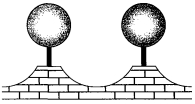
Solution
(D) $1$. Radius of a wooden sphere $(R) = \frac{21}{2} = 10.5\, cm$.
$2$. Surface area of one sphere $= 4\pi R^2 = 4 \times \frac{22}{7} \times 10.5 \times 10.5 = 1386\, cm^2$.
$3$. Area covered by the cylindrical support on the sphere $= \pi r^2 = \frac{22}{7} \times 1.5 \times 1.5 \approx 7.07\, cm^2$.
$4$. Surface area to be painted silver for one sphere $= 1386 - 7.07 = 1378.93\, cm^2$.
$5$. Total area for $8$ spheres $= 8 \times 1378.93 = 11031.44\, cm^2$.
$6$. Cost of silver paint $= 11031.44 \times 0.25 = ₹ 2757.86$.
$7$. Curved surface area of one cylindrical support $= 2\pi rh = 2 \times \frac{22}{7} \times 1.5 \times 7 = 66\, cm^2$.
$8$. Total area to be painted black for $8$ supports $= 8 \times 66 = 528\, cm^2$.
$9$. Cost of black paint $= 528 \times 0.05 = ₹ 26.40$.
$10$. Total cost $= 2757.86 + 26.40 = ₹ 2784.26$.
$2$. Surface area of one sphere $= 4\pi R^2 = 4 \times \frac{22}{7} \times 10.5 \times 10.5 = 1386\, cm^2$.
$3$. Area covered by the cylindrical support on the sphere $= \pi r^2 = \frac{22}{7} \times 1.5 \times 1.5 \approx 7.07\, cm^2$.
$4$. Surface area to be painted silver for one sphere $= 1386 - 7.07 = 1378.93\, cm^2$.
$5$. Total area for $8$ spheres $= 8 \times 1378.93 = 11031.44\, cm^2$.
$6$. Cost of silver paint $= 11031.44 \times 0.25 = ₹ 2757.86$.
$7$. Curved surface area of one cylindrical support $= 2\pi rh = 2 \times \frac{22}{7} \times 1.5 \times 7 = 66\, cm^2$.
$8$. Total area to be painted black for $8$ supports $= 8 \times 66 = 528\, cm^2$.
$9$. Cost of black paint $= 528 \times 0.05 = ₹ 26.40$.
$10$. Total cost $= 2757.86 + 26.40 = ₹ 2784.26$.
0 likes
View Solution143
MediumMCQ
Find the surface area and volume of a sphere of diameter $28 \, cm$.
A
$2464 \, cm^2, 11498.67 \, cm^3$
B
$2464 \, cm^2, 11498 \frac{2}{3} \, cm^3$
C
$1232 \, cm^2, 5749 \frac{1}{3} \, cm^3$
D
$2464 \, cm^2, 11500 \, cm^3$
Solution
(B) Given diameter $d = 28 \, cm$,so radius $r = \frac{d}{2} = 14 \, cm$.
Surface area of a sphere $= 4 \pi r^2 = 4 \times \frac{22}{7} \times 14 \times 14 = 88 \times 28 = 2464 \, cm^2$.
Volume of a sphere $= \frac{4}{3} \pi r^3 = \frac{4}{3} \times \frac{22}{7} \times 14 \times 14 \times 14 = \frac{4}{3} \times 22 \times 2 \times 14 \times 14 = \frac{34496}{3} = 11498 \frac{2}{3} \, cm^3$.
Surface area of a sphere $= 4 \pi r^2 = 4 \times \frac{22}{7} \times 14 \times 14 = 88 \times 28 = 2464 \, cm^2$.
Volume of a sphere $= \frac{4}{3} \pi r^3 = \frac{4}{3} \times \frac{22}{7} \times 14 \times 14 \times 14 = \frac{4}{3} \times 22 \times 2 \times 14 \times 14 = \frac{34496}{3} = 11498 \frac{2}{3} \, cm^3$.
0 likes
View Solution144
Medium
Find the curved surface area,total surface area and volume of a hemisphere of diameter $42\, cm$.
Solution
(N/A) Given: Diameter $d = 42\, cm$,so radius $r = \frac{42}{2} = 21\, cm$.
$1$. Curved Surface Area $(CSA)$ of a hemisphere $= 2\pi r^2$
$= 2 \times \frac{22}{7} \times 21 \times 21 = 2 \times 22 \times 3 \times 21 = 2772\, cm^2$.
$2$. Total Surface Area $(TSA)$ of a hemisphere $= 3\pi r^2$
$= 3 \times \frac{22}{7} \times 21 \times 21 = 3 \times 22 \times 3 \times 21 = 4158\, cm^2$.
$3$. Volume of a hemisphere $= \frac{2}{3}\pi r^3$
$= \frac{2}{3} \times \frac{22}{7} \times 21 \times 21 \times 21 = 2 \times 22 \times 21 \times 21 = 19404\, cm^3$.
$1$. Curved Surface Area $(CSA)$ of a hemisphere $= 2\pi r^2$
$= 2 \times \frac{22}{7} \times 21 \times 21 = 2 \times 22 \times 3 \times 21 = 2772\, cm^2$.
$2$. Total Surface Area $(TSA)$ of a hemisphere $= 3\pi r^2$
$= 3 \times \frac{22}{7} \times 21 \times 21 = 3 \times 22 \times 3 \times 21 = 4158\, cm^2$.
$3$. Volume of a hemisphere $= \frac{2}{3}\pi r^3$
$= \frac{2}{3} \times \frac{22}{7} \times 21 \times 21 \times 21 = 2 \times 22 \times 21 \times 21 = 19404\, cm^3$.
0 likes
View Solution145
MediumMCQ
The surface area of a sphere is $5544 \, cm^2$. Find its volume in $cm^3$.
A
$38808$
B
$48808$
C
$58808$
D
$95808$
Solution
(A) The surface area of a sphere is given by the formula $A = 4 \pi r^2$.
Given $A = 5544 \, cm^2$,we have $4 \times \frac{22}{7} \times r^2 = 5544$.
$r^2 = \frac{5544 \times 7}{4 \times 22} = \frac{5544 \times 7}{88} = 63 \times 7 = 441$.
Thus,$r = \sqrt{441} = 21 \, cm$.
The volume of a sphere is given by $V = \frac{4}{3} \pi r^3$.
$V = \frac{4}{3} \times \frac{22}{7} \times (21)^3 = \frac{4}{3} \times \frac{22}{7} \times 21 \times 21 \times 21$.
$V = 4 \times 22 \times 21 \times 21 = 88 \times 441 = 38808 \, cm^3$.
Given $A = 5544 \, cm^2$,we have $4 \times \frac{22}{7} \times r^2 = 5544$.
$r^2 = \frac{5544 \times 7}{4 \times 22} = \frac{5544 \times 7}{88} = 63 \times 7 = 441$.
Thus,$r = \sqrt{441} = 21 \, cm$.
The volume of a sphere is given by $V = \frac{4}{3} \pi r^3$.
$V = \frac{4}{3} \times \frac{22}{7} \times (21)^3 = \frac{4}{3} \times \frac{22}{7} \times 21 \times 21 \times 21$.
$V = 4 \times 22 \times 21 \times 21 = 88 \times 441 = 38808 \, cm^3$.
0 likes
View Solution146
MediumMCQ
The surface area of a sphere and the curved surface area of a hemisphere are equal. Find the ratio of their radii.
A
$2: \sqrt{2}$
B
$1: \sqrt{2}$
C
$3: \sqrt{2}$
D
$4: \sqrt{3}$
Solution
(B) Let the radius of the sphere be $r_1$ and the radius of the hemisphere be $r_2$.
The surface area of a sphere is given by $4\pi r_1^2$.
The curved surface area of a hemisphere is given by $2\pi r_2^2$.
According to the problem,the surface areas are equal:
$4\pi r_1^2 = 2\pi r_2^2$
Dividing both sides by $2\pi$,we get:
$2r_1^2 = r_2^2$
Taking the square root on both sides:
$\sqrt{2}r_1 = r_2$
Therefore,the ratio of their radii is:
$\frac{r_1}{r_2} = \frac{1}{\sqrt{2}}$
Thus,the ratio is $1: \sqrt{2}$.
The surface area of a sphere is given by $4\pi r_1^2$.
The curved surface area of a hemisphere is given by $2\pi r_2^2$.
According to the problem,the surface areas are equal:
$4\pi r_1^2 = 2\pi r_2^2$
Dividing both sides by $2\pi$,we get:
$2r_1^2 = r_2^2$
Taking the square root on both sides:
$\sqrt{2}r_1 = r_2$
Therefore,the ratio of their radii is:
$\frac{r_1}{r_2} = \frac{1}{\sqrt{2}}$
Thus,the ratio is $1: \sqrt{2}$.
0 likes
View Solution147
DifficultMCQ
$A$ metal sphere of radius $20\, cm$ is melted and then cast into small hemispheres each of radius $5\, cm$. Find the number of hemispheres thus obtained (in balls).
A
$108$
B
$118$
C
$128$
D
$138$
Solution
(C) The volume of the large sphere of radius $R = 20\, cm$ is given by $V_s = \frac{4}{3} \pi R^3 = \frac{4}{3} \pi (20)^3 = \frac{4}{3} \pi (8000)\, cm^3$.
The volume of one small hemisphere of radius $r = 5\, cm$ is given by $V_h = \frac{2}{3} \pi r^3 = \frac{2}{3} \pi (5)^3 = \frac{2}{3} \pi (125)\, cm^3$.
The number of hemispheres $n$ is given by the ratio of the volume of the sphere to the volume of one hemisphere:
$n = \frac{V_s}{V_h} = \frac{\frac{4}{3} \pi (8000)}{\frac{2}{3} \pi (125)} = \frac{4 \times 8000}{2 \times 125} = \frac{32000}{250} = 128$.
Thus,the total number of hemispheres obtained is $128$.
The volume of one small hemisphere of radius $r = 5\, cm$ is given by $V_h = \frac{2}{3} \pi r^3 = \frac{2}{3} \pi (5)^3 = \frac{2}{3} \pi (125)\, cm^3$.
The number of hemispheres $n$ is given by the ratio of the volume of the sphere to the volume of one hemisphere:
$n = \frac{V_s}{V_h} = \frac{\frac{4}{3} \pi (8000)}{\frac{2}{3} \pi (125)} = \frac{4 \times 8000}{2 \times 125} = \frac{32000}{250} = 128$.
Thus,the total number of hemispheres obtained is $128$.
0 likes
View Solution148
DifficultMCQ
The radii of three metal spheres are $3 \,cm, 4 \,cm$ and $5 \,cm$ respectively. They are melted into a single solid sphere. Find the radius of the new solid sphere (in $cm$).
A
$3$
B
$4$
C
$5$
D
$6$
Solution
(D) The volume of a sphere is given by the formula $V = \frac{4}{3} \pi r^3$.
Let the radii of the three spheres be $r_1 = 3 \,cm, r_2 = 4 \,cm$,and $r_3 = 5 \,cm$.
The total volume of the three spheres is $V_{total} = \frac{4}{3} \pi (r_1^3 + r_2^3 + r_3^3)$.
$V_{total} = \frac{4}{3} \pi (3^3 + 4^3 + 5^3) = \frac{4}{3} \pi (27 + 64 + 125) = \frac{4}{3} \pi (216)$.
Let the radius of the new sphere be $R$. Its volume is $V_{new} = \frac{4}{3} \pi R^3$.
Since the volume remains conserved,$V_{new} = V_{total}$.
$\frac{4}{3} \pi R^3 = \frac{4}{3} \pi (216)$.
$R^3 = 216$.
$R = \sqrt[3]{216} = 6 \,cm$.
Let the radii of the three spheres be $r_1 = 3 \,cm, r_2 = 4 \,cm$,and $r_3 = 5 \,cm$.
The total volume of the three spheres is $V_{total} = \frac{4}{3} \pi (r_1^3 + r_2^3 + r_3^3)$.
$V_{total} = \frac{4}{3} \pi (3^3 + 4^3 + 5^3) = \frac{4}{3} \pi (27 + 64 + 125) = \frac{4}{3} \pi (216)$.
Let the radius of the new sphere be $R$. Its volume is $V_{new} = \frac{4}{3} \pi R^3$.
Since the volume remains conserved,$V_{new} = V_{total}$.
$\frac{4}{3} \pi R^3 = \frac{4}{3} \pi (216)$.
$R^3 = 216$.
$R = \sqrt[3]{216} = 6 \,cm$.
0 likes
View Solution149
MediumMCQ
$A$ hemispherical bowl of radius $18\, cm$ is completely filled with medicine. This medicine is to be filled in cylindrical bottles of radius $2\, cm$ and height $4\, cm$. How many bottles are required to empty the bowl?
A
$243$
B
$143$
C
$193$
D
$456$
Solution
(A) The volume of the hemispherical bowl is given by $V_h = \frac{2}{3} \pi r^3$,where $r = 18\, cm$.
$V_h = \frac{2}{3} \times \pi \times (18)^3 = \frac{2}{3} \times \pi \times 5832 = 3888\pi\, cm^3$.
The volume of one cylindrical bottle is given by $V_c = \pi R^2 h$,where $R = 2\, cm$ and $h = 4\, cm$.
$V_c = \pi \times (2)^2 \times 4 = \pi \times 4 \times 4 = 16\pi\, cm^3$.
The number of bottles required is $n = \frac{V_h}{V_c} = \frac{3888\pi}{16\pi} = 243$.
Therefore,$243$ bottles are required.
$V_h = \frac{2}{3} \times \pi \times (18)^3 = \frac{2}{3} \times \pi \times 5832 = 3888\pi\, cm^3$.
The volume of one cylindrical bottle is given by $V_c = \pi R^2 h$,where $R = 2\, cm$ and $h = 4\, cm$.
$V_c = \pi \times (2)^2 \times 4 = \pi \times 4 \times 4 = 16\pi\, cm^3$.
The number of bottles required is $n = \frac{V_h}{V_c} = \frac{3888\pi}{16\pi} = 243$.
Therefore,$243$ bottles are required.
0 likes
View Solution150
DifficultMCQ
$A$ metallic ball of radius $9 \,cm$ is melted and recast into three metallic balls. If the radii of two balls are $1 \,cm$ and $6 \,cm$,find the radius of the third ball (in $cm$).
A
$1$
B
$8$
C
$16$
D
$64$
Solution
(B) The volume of a sphere is given by the formula $V = \frac{4}{3} \pi r^3$.
Let the radius of the original ball be $R = 9 \,cm$.
Let the radii of the three smaller balls be $r_1 = 1 \,cm$,$r_2 = 6 \,cm$,and $r_3$ (the unknown radius).
Since the volume remains conserved during melting and recasting,the volume of the original ball equals the sum of the volumes of the three smaller balls:
$\frac{4}{3} \pi R^3 = \frac{4}{3} \pi r_1^3 + \frac{4}{3} \pi r_2^3 + \frac{4}{3} \pi r_3^3$
Dividing both sides by $\frac{4}{3} \pi$,we get:
$R^3 = r_1^3 + r_2^3 + r_3^3$
Substituting the given values:
$9^3 = 1^3 + 6^3 + r_3^3$
$729 = 1 + 216 + r_3^3$
$729 = 217 + r_3^3$
$r_3^3 = 729 - 217$
$r_3^3 = 512$
Taking the cube root on both sides:
$r_3 = \sqrt[3]{512} = 8 \,cm$.
Thus,the radius of the third ball is $8 \,cm$.
Let the radius of the original ball be $R = 9 \,cm$.
Let the radii of the three smaller balls be $r_1 = 1 \,cm$,$r_2 = 6 \,cm$,and $r_3$ (the unknown radius).
Since the volume remains conserved during melting and recasting,the volume of the original ball equals the sum of the volumes of the three smaller balls:
$\frac{4}{3} \pi R^3 = \frac{4}{3} \pi r_1^3 + \frac{4}{3} \pi r_2^3 + \frac{4}{3} \pi r_3^3$
Dividing both sides by $\frac{4}{3} \pi$,we get:
$R^3 = r_1^3 + r_2^3 + r_3^3$
Substituting the given values:
$9^3 = 1^3 + 6^3 + r_3^3$
$729 = 1 + 216 + r_3^3$
$729 = 217 + r_3^3$
$r_3^3 = 729 - 217$
$r_3^3 = 512$
Taking the cube root on both sides:
$r_3 = \sqrt[3]{512} = 8 \,cm$.
Thus,the radius of the third ball is $8 \,cm$.
0 likes
View SolutionSurface Areas and Volumes — Mix Examples - Surface Areas and Volumes · Frequently Asked Questions
1Are these Surface Areas and Volumes questions useful for JEE and NEET?
Yes. All questions in this section are mapped to JEE Main and NEET exam patterns. Previous year questions from JEE Main, NEET, GUJCET and state-level exams are included with full solutions.
2Can I switch to Hindi or Gujarati for these questions?
Yes. Use the language tabs in the hero section or the sidebar to view the same questions and solutions in English, Hindi or Gujarati.
3How do I generate a question paper from this subtopic?
Use the Vedclass Exam Paper Generator — select the chapter and subtopic, set difficulty, and generate Sets A, B, C, D automatically. First 3 chapters of every subject are free.
Vedclass Products
For Students
Vedclass Test Series
Mock tests in real JEE/NEET style with performance analysis. 5-day free trial.
Start Free TrialFor Teachers
Exam Paper Generator
Generate Set A/B/C/D papers from this chapter in 2 minutes. 3 chapters free.
Try FreeFor Institutes
Online Exam Module
Live online exams with unlimited students, 360° analytics & white-label branding.
See DemoFor Teachers & Institutes
Generate a Surface Areas and Volumes Exam Paper in 2 Minutes
Select subtopic & difficulty — Sets A, B, C, D auto-generated with No Repeat logic.
First 3 chapters of every subject are free — no payment required.