
A English
Resolving power-Human eye, Microscopes and Telescopes Questions in English
Class 12 Physics · Wave Optics · Resolving power-Human eye, Microscopes and Telescopes
115+
Questions
English
Language
100%
With Solutions
Showing 14 of 115 questions in English
101
DifficultMCQ
Two-point white dots are $2 \,mm$ apart on a black paper. They are viewed by an eye of pupil diameter $3 \,mm$. What is the maximum distance at which these dots can be resolved by the eye (in $\,m$)? $(\lambda = 500 \,nm)$
A
$5$
B
$1$
C
$6$
D
$10$
Solution
(D) The distance between the two point dots is $x = 2 \,mm = 2 \times 10^{-3} \,m$.
The diameter of the pupil is $d = 3 \,mm = 3 \times 10^{-3} \,m$.
The wavelength of light is $\lambda = 500 \,nm = 5 \times 10^{-7} \,m$.
According to the Rayleigh criterion for the resolution of two points, the angular separation $\theta$ is given by $\theta = \frac{1.22 \lambda}{d}$.
Also, the angular separation can be expressed as $\theta = \frac{x}{D}$, where $D$ is the maximum distance.
Equating the two expressions: $\frac{x}{D} = \frac{1.22 \lambda}{d}$.
Rearranging for $D$: $D = \frac{x d}{1.22 \lambda}$.
Substituting the values: $D = \frac{(2 \times 10^{-3} \,m) \times (3 \times 10^{-3} \,m)}{1.22 \times (5 \times 10^{-7} \,m)}$.
$D = \frac{6 \times 10^{-6}}{6.1 \times 10^{-7}} = \frac{60}{6.1} \approx 9.836 \,m$.
Rounding to the nearest integer, we get $D \approx 10 \,m$.
The diameter of the pupil is $d = 3 \,mm = 3 \times 10^{-3} \,m$.
The wavelength of light is $\lambda = 500 \,nm = 5 \times 10^{-7} \,m$.
According to the Rayleigh criterion for the resolution of two points, the angular separation $\theta$ is given by $\theta = \frac{1.22 \lambda}{d}$.
Also, the angular separation can be expressed as $\theta = \frac{x}{D}$, where $D$ is the maximum distance.
Equating the two expressions: $\frac{x}{D} = \frac{1.22 \lambda}{d}$.
Rearranging for $D$: $D = \frac{x d}{1.22 \lambda}$.
Substituting the values: $D = \frac{(2 \times 10^{-3} \,m) \times (3 \times 10^{-3} \,m)}{1.22 \times (5 \times 10^{-7} \,m)}$.
$D = \frac{6 \times 10^{-6}}{6.1 \times 10^{-7}} = \frac{60}{6.1} \approx 9.836 \,m$.
Rounding to the nearest integer, we get $D \approx 10 \,m$.
0 likes
View Solution102
MediumMCQ
If a microscope is placed in air,the minimum separation of two objects seen as distinct is $6 \mu m$. If the same is placed in a medium of refractive index $1.5$,then the minimum separation of the two objects to be seen as distinct is: (in $\mu m$)
A
$4$
B
$6$
C
$3$
D
$9$
Solution
(A) The resolving power of a microscope is given by $R = \frac{1}{d} = \frac{2n \sin \beta}{1.22 \lambda}$,where $d$ is the minimum separation between two objects.
Thus,the minimum separation $d$ is inversely proportional to the refractive index $n$ of the medium $(d \propto \frac{1}{n})$.
Given for air $(n_1 = 1)$,$d_1 = 6 \mu m$.
For a medium with refractive index $n_2 = 1.5$,the new minimum separation $d_2$ is calculated as:
$d_2 = \frac{d_1 \times n_1}{n_2} = \frac{6 \mu m \times 1}{1.5} = 4 \mu m$.
Therefore,the minimum separation is $4 \mu m$.
Thus,the minimum separation $d$ is inversely proportional to the refractive index $n$ of the medium $(d \propto \frac{1}{n})$.
Given for air $(n_1 = 1)$,$d_1 = 6 \mu m$.
For a medium with refractive index $n_2 = 1.5$,the new minimum separation $d_2$ is calculated as:
$d_2 = \frac{d_1 \times n_1}{n_2} = \frac{6 \mu m \times 1}{1.5} = 4 \mu m$.
Therefore,the minimum separation is $4 \mu m$.
0 likes
View Solution103
EasyMCQ
$A$ monochromatic light of wavelength $6000 \text{ \AA}$ coming from a star is detected in a $100 \text{ inch}$ telescope. The limit of resolution of the telescope is approximately
A
$3.4 \times 10^{-7} \text{ rad}$
B
$6.7 \times 10^{-7} \text{ rad}$
C
$2.9 \times 10^{-7} \text{ rad}$
D
$1.54 \times 10^{-7} \text{ rad}$
Solution
(C) The limit of resolution $(\theta_R)$ for a telescope is given by the formula:
$\theta_R = \frac{1.22 \lambda}{a}$
Given:
$\lambda = 6000 \text{ \AA} = 6000 \times 10^{-10} \text{ m} = 6 \times 10^{-7} \text{ m}$
$a = 100 \text{ inch} = 100 \times 2.54 \text{ cm} = 254 \text{ cm} = 2.54 \text{ m}$
Substituting the values into the formula:
$\theta_R = \frac{1.22 \times 6 \times 10^{-7}}{2.54}$
$\theta_R \approx \frac{7.32 \times 10^{-7}}{2.54} \approx 2.88 \times 10^{-7} \text{ rad}$
Rounding to two significant figures, we get:
$\theta_R \approx 2.9 \times 10^{-7} \text{ rad}$
$\theta_R = \frac{1.22 \lambda}{a}$
Given:
$\lambda = 6000 \text{ \AA} = 6000 \times 10^{-10} \text{ m} = 6 \times 10^{-7} \text{ m}$
$a = 100 \text{ inch} = 100 \times 2.54 \text{ cm} = 254 \text{ cm} = 2.54 \text{ m}$
Substituting the values into the formula:
$\theta_R = \frac{1.22 \times 6 \times 10^{-7}}{2.54}$
$\theta_R \approx \frac{7.32 \times 10^{-7}}{2.54} \approx 2.88 \times 10^{-7} \text{ rad}$
Rounding to two significant figures, we get:
$\theta_R \approx 2.9 \times 10^{-7} \text{ rad}$
0 likes
View Solution104
MediumMCQ
The limit of resolution of an oil immersion objective microscope of numerical aperture $0.8$ for light of wavelength $0.6 \mu m$ is
A
$\frac{1.5}{8} \mu m$
B
$\frac{3}{8} \mu m$
C
$\frac{5}{8} \mu m$
D
$\frac{7}{8} \mu m$
Solution
(B) The formula for the limit of resolution of a microscope is given by $d = \frac{\lambda}{2 NA}$.
Given:
Numerical aperture,$NA = 0.8$
Wavelength,$\lambda = 0.6 \mu m$
Substituting these values into the formula:
$d = \frac{0.6}{2 \times 0.8}$
$d = \frac{0.6}{1.6}$
$d = \frac{6}{16} \mu m$
$d = \frac{3}{8} \mu m$
Therefore,the correct option is $B$.
Given:
Numerical aperture,$NA = 0.8$
Wavelength,$\lambda = 0.6 \mu m$
Substituting these values into the formula:
$d = \frac{0.6}{2 \times 0.8}$
$d = \frac{0.6}{1.6}$
$d = \frac{6}{16} \mu m$
$d = \frac{3}{8} \mu m$
Therefore,the correct option is $B$.
0 likes
View Solution105
EasyMCQ
$A$ microscope has an objective of aperture $8 \text{ mm}$ and focal length of $5 \text{ cm}$. The minimum separation between two objects to be just resolved by the microscope is (wavelength of light used $= 5500 \text{ Å}$) (in $\mu\text{m}$)
A
$2.2$
B
$3.4$
C
$4.2$
D
$3.6$
Solution
(C) The minimum separation $(d_{\min})$ between two objects that can be just resolved by a microscope is given by the formula:
$d_{\min} = \frac{1.22 f \lambda}{D}$
Given:
$f = 5 \text{ cm} = 5 \times 10^{-2} \text{ m}$
$\lambda = 5500 \text{ Å} = 5500 \times 10^{-10} \text{ m}$
$D = 8 \text{ mm} = 8 \times 10^{-3} \text{ m}$
Substituting the values:
$d_{\min} = \frac{1.22 \times 5 \times 10^{-2} \times 5500 \times 10^{-10}}{8 \times 10^{-3}}$
$d_{\min} = \frac{1.22 \times 5 \times 5500 \times 10^{-12}}{8 \times 10^{-3}}$
$d_{\min} = \frac{33550 \times 10^{-12}}{8 \times 10^{-3}}$
$d_{\min} = 4193.75 \times 10^{-9} \text{ m} \approx 4.19 \times 10^{-6} \text{ m}$
$d_{\min} \approx 4.2 \mu\text{m}$
$d_{\min} = \frac{1.22 f \lambda}{D}$
Given:
$f = 5 \text{ cm} = 5 \times 10^{-2} \text{ m}$
$\lambda = 5500 \text{ Å} = 5500 \times 10^{-10} \text{ m}$
$D = 8 \text{ mm} = 8 \times 10^{-3} \text{ m}$
Substituting the values:
$d_{\min} = \frac{1.22 \times 5 \times 10^{-2} \times 5500 \times 10^{-10}}{8 \times 10^{-3}}$
$d_{\min} = \frac{1.22 \times 5 \times 5500 \times 10^{-12}}{8 \times 10^{-3}}$
$d_{\min} = \frac{33550 \times 10^{-12}}{8 \times 10^{-3}}$
$d_{\min} = 4193.75 \times 10^{-9} \text{ m} \approx 4.19 \times 10^{-6} \text{ m}$
$d_{\min} \approx 4.2 \mu\text{m}$
0 likes
View Solution106
MediumMCQ
What minimum separation between two objects a human eye would be able to resolve, if the eye pupil diameter is $2 \,mm$ and the two objects are $20 \,m$ away from the eye (in $\,mm$)?
(Assume, human eye to be equivalent to a convex lens and consider the average wavelength of light as $600 \,nm$.)
(Assume, human eye to be equivalent to a convex lens and consider the average wavelength of light as $600 \,nm$.)
A
$7.32$
B
$8.72$
C
$6.2$
D
$4.71$
Solution
(A) Given: Diameter of pupil, $d = 2 \,mm = 2 \times 10^{-3} \,m$. Distance of objects, $D = 20 \,m$. Wavelength of light, $\lambda = 600 \,nm = 6 \times 10^{-7} \,m$.
The limit of resolution for a circular aperture (like the pupil of an eye) is given by the Rayleigh criterion:
$\theta = \frac{1.22 \lambda}{d}$
The minimum separation $y$ between two objects at distance $D$ is given by $y = \theta \times D$.
Substituting the values:
$y = \frac{1.22 \times 6 \times 10^{-7} \times 20}{2 \times 10^{-3}}$
$y = 1.22 \times 6 \times 10^{-4} \times 10 = 7.32 \times 10^{-3} \,m$
$y = 7.32 \,mm$.
Thus, the minimum separation the human eye can resolve is $7.32 \,mm$.
The limit of resolution for a circular aperture (like the pupil of an eye) is given by the Rayleigh criterion:
$\theta = \frac{1.22 \lambda}{d}$
The minimum separation $y$ between two objects at distance $D$ is given by $y = \theta \times D$.
Substituting the values:
$y = \frac{1.22 \times 6 \times 10^{-7} \times 20}{2 \times 10^{-3}}$
$y = 1.22 \times 6 \times 10^{-4} \times 10 = 7.32 \times 10^{-3} \,m$
$y = 7.32 \,mm$.
Thus, the minimum separation the human eye can resolve is $7.32 \,mm$.
0 likes
View Solution107
MediumMCQ
The diameter of the objective of a telescope is $3.6 \ m$. The limit of resolution of the telescope for a light of wavelength $540 \ nm$ is
A
$1.22 \times 10^{-7} \ rad$
B
$1.83 \times 10^{-7} \ rad$
C
$0.61 \times 10^{-7} \ rad$
D
$3.76 \times 10^{-7} \ rad$
Solution
(B) Given:
Diameter of the objective,$d = 3.6 \ m$
Wavelength of light,$\lambda = 540 \ nm = 540 \times 10^{-9} \ m$
The limit of resolution $(d\theta)$ of a telescope is given by the formula:
$d\theta = \frac{1.22 \lambda}{d}$
Substituting the values:
$d\theta = \frac{1.22 \times 540 \times 10^{-9} \ m}{3.6 \ m}$
$d\theta = \frac{658.8 \times 10^{-9}}{3.6} \ rad$
$d\theta = 183 \times 10^{-9} \ rad$
$d\theta = 1.83 \times 10^{-7} \ rad$
Diameter of the objective,$d = 3.6 \ m$
Wavelength of light,$\lambda = 540 \ nm = 540 \times 10^{-9} \ m$
The limit of resolution $(d\theta)$ of a telescope is given by the formula:
$d\theta = \frac{1.22 \lambda}{d}$
Substituting the values:
$d\theta = \frac{1.22 \times 540 \times 10^{-9} \ m}{3.6 \ m}$
$d\theta = \frac{658.8 \times 10^{-9}}{3.6} \ rad$
$d\theta = 183 \times 10^{-9} \ rad$
$d\theta = 1.83 \times 10^{-7} \ rad$
0 likes
View Solution108
EasyMCQ
The limit of resolution of a telescope is $3.0 \times 10^{-7} \text{ rad}$. Assuming that it is used to see the light of wavelength $525 \text{ nm}$ from a star, what should be the diameter of the objective (in $\text{ m}$)?
A
$2.1$
B
$2.0$
C
$1.8$
D
$1.9$
Solution
(A) The limit of resolution or angular resolution for a telescope is given by the formula: $\alpha_{\min} = \frac{1.22 \lambda}{D}$.
Given values are:
$\alpha_{\min} = 3.0 \times 10^{-7} \text{ rad}$
$\lambda = 525 \text{ nm} = 525 \times 10^{-9} \text{ m}$
Rearranging the formula to solve for the diameter of the objective lens $(D)$:
$D = \frac{1.22 \lambda}{\alpha_{\min}}$
Substituting the values:
$D = \frac{1.22 \times 525 \times 10^{-9}}{3.0 \times 10^{-7}}$
$D = \frac{640.5 \times 10^{-9}}{3.0 \times 10^{-7}}$
$D = 213.5 \times 10^{-2} \text{ m} = 2.135 \text{ m}$.
Rounding to the nearest given option, we get $D = 2.1 \text{ m}$.
Given values are:
$\alpha_{\min} = 3.0 \times 10^{-7} \text{ rad}$
$\lambda = 525 \text{ nm} = 525 \times 10^{-9} \text{ m}$
Rearranging the formula to solve for the diameter of the objective lens $(D)$:
$D = \frac{1.22 \lambda}{\alpha_{\min}}$
Substituting the values:
$D = \frac{1.22 \times 525 \times 10^{-9}}{3.0 \times 10^{-7}}$
$D = \frac{640.5 \times 10^{-9}}{3.0 \times 10^{-7}}$
$D = 213.5 \times 10^{-2} \text{ m} = 2.135 \text{ m}$.
Rounding to the nearest given option, we get $D = 2.1 \text{ m}$.
0 likes
View Solution109
EasyMCQ
The limit of resolution of a telescope is $2.5 \times 10^{-7} \text{ rad}$. If the telescope is used to detect light of wavelength $500 \text{ nm}$ coming from a star, the diameter of the objective lens used by the telescope is: (in $\text{ cm}$)
A
$244$
B
$258$
C
$228$
D
$264$
Solution
(A) The limit of resolution of a telescope is given by the formula: $\alpha = \frac{1.22 \lambda}{a}$, where $\alpha$ is the angular resolution, $\lambda$ is the wavelength of light, and $a$ is the diameter of the objective lens.
Given values are $\alpha = 2.5 \times 10^{-7} \text{ rad}$ and $\lambda = 500 \text{ nm} = 500 \times 10^{-9} \text{ m}$.
Rearranging the formula for $a$: $a = \frac{1.22 \lambda}{\alpha}$.
Substituting the values: $a = \frac{1.22 \times 500 \times 10^{-9}}{2.5 \times 10^{-7}}$.
$a = \frac{610 \times 10^{-9}}{2.5 \times 10^{-7}} = 244 \times 10^{-2} \text{ m} = 2.44 \text{ m}$.
Converting to centimeters: $2.44 \text{ m} = 244 \text{ cm}$.
Thus, the diameter of the objective lens is $244 \text{ cm}$.
Given values are $\alpha = 2.5 \times 10^{-7} \text{ rad}$ and $\lambda = 500 \text{ nm} = 500 \times 10^{-9} \text{ m}$.
Rearranging the formula for $a$: $a = \frac{1.22 \lambda}{\alpha}$.
Substituting the values: $a = \frac{1.22 \times 500 \times 10^{-9}}{2.5 \times 10^{-7}}$.
$a = \frac{610 \times 10^{-9}}{2.5 \times 10^{-7}} = 244 \times 10^{-2} \text{ m} = 2.44 \text{ m}$.
Converting to centimeters: $2.44 \text{ m} = 244 \text{ cm}$.
Thus, the diameter of the objective lens is $244 \text{ cm}$.
0 likes
View Solution110
EasyMCQ
With the help of a telescope that has an objective of diameter $200 \,cm$, it is proved that light of wavelengths of the order of $6400 \text{ Å}$ coming from a star can be easily resolved. Then, the limit of resolution is
A
$3.9 \times 10^{-7} \,rad$
B
$3.9 \times 10^{-8} \,rad$
C
$1.95 \times 10^{-7} \,rad$
D
$1.95 \times 10^{-8} \,rad$
Solution
(A) The limit of resolution of a telescope is given by the formula:
$\theta = \frac{1.22 \lambda}{d}$
where $\lambda$ is the wavelength of light and $d$ is the diameter of the objective lens.
Given:
$\lambda = 6400 \text{ Å} = 6400 \times 10^{-10} \,m = 6.4 \times 10^{-7} \,m$
$d = 200 \,cm = 2 \,m$
Substituting these values into the formula:
$\theta = \frac{1.22 \times 6.4 \times 10^{-7}}{2}$
$\theta = 1.22 \times 3.2 \times 10^{-7}$
$\theta = 3.904 \times 10^{-7} \,rad$
Rounding to the nearest significant value, we get $\theta \approx 3.9 \times 10^{-7} \,rad$.
$\theta = \frac{1.22 \lambda}{d}$
where $\lambda$ is the wavelength of light and $d$ is the diameter of the objective lens.
Given:
$\lambda = 6400 \text{ Å} = 6400 \times 10^{-10} \,m = 6.4 \times 10^{-7} \,m$
$d = 200 \,cm = 2 \,m$
Substituting these values into the formula:
$\theta = \frac{1.22 \times 6.4 \times 10^{-7}}{2}$
$\theta = 1.22 \times 3.2 \times 10^{-7}$
$\theta = 3.904 \times 10^{-7} \,rad$
Rounding to the nearest significant value, we get $\theta \approx 3.9 \times 10^{-7} \,rad$.
0 likes
View Solution111
DifficultMCQ
The diameter of the objective of a telescope is $1 \ m$. Its resolving limit for light of wavelength $4538 \ \text{Å}$ will be:
A
$5.54 \times 10^{-7} \ \text{rad}$
B
$2.54 \times 10^{-4} \ \text{rad}$
C
$6.54 \times 10^{-7} \ \text{rad}$
D
None of these
Solution
(A) The resolving limit $(d\theta)$ of a telescope is given by the formula:
$d\theta = \frac{1.22 \lambda}{a}$
where $\lambda$ is the wavelength of light and $a$ is the diameter of the objective lens.
Given:
$\lambda = 4538 \ \text{Å} = 4538 \times 10^{-10} \ \text{m}$
$a = 1 \ \text{m}$
Substituting the values:
$d\theta = \frac{1.22 \times 4538 \times 10^{-10}}{1}$
$d\theta = 5536.36 \times 10^{-10} \ \text{rad}$
$d\theta \approx 5.54 \times 10^{-7} \ \text{rad}$
$d\theta = \frac{1.22 \lambda}{a}$
where $\lambda$ is the wavelength of light and $a$ is the diameter of the objective lens.
Given:
$\lambda = 4538 \ \text{Å} = 4538 \times 10^{-10} \ \text{m}$
$a = 1 \ \text{m}$
Substituting the values:
$d\theta = \frac{1.22 \times 4538 \times 10^{-10}}{1}$
$d\theta = 5536.36 \times 10^{-10} \ \text{rad}$
$d\theta \approx 5.54 \times 10^{-7} \ \text{rad}$
0 likes
View Solution112
MediumMCQ
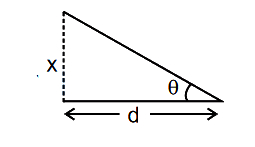
The human eye has an approximate angular resolution of $\theta = 5.8 \times 10^{-4} \text{ rad}$ and a typical photo printer prints a minimum of $300 \text{ dpi}$ (dots per inch, $1 \text{ inch} = 2.54 \text{ cm}$). At what minimal distance $d$ should a printed page be held so that one does not see the individual dots (in $\text{ cm}$)?
A
$20.32$
B
$29.50$
C
$14.59$
D
$6.85$
Solution
(C) The angular resolution $\theta$ is given by the ratio of the distance between two dots $x$ to the distance $d$ from the eye, i.e., $\theta = \frac{x}{d}$.
Given that the printer prints $300 \text{ dots per inch}$, the distance between two adjacent dots $x$ is $x = \frac{1 \text{ inch}}{300} = \frac{2.54 \text{ cm}}{300}$.
Substituting the values into the formula: $5.8 \times 10^{-4} = \frac{2.54 \text{ cm} / 300}{d}$.
Rearranging for $d$: $d = \frac{2.54}{300 \times 5.8 \times 10^{-4}} \text{ cm}$.
$d = \frac{2.54}{0.174} \text{ cm} \approx 14.597 \text{ cm}$.
Thus, the minimal distance is approximately $14.59 \text{ cm}$.
Given that the printer prints $300 \text{ dots per inch}$, the distance between two adjacent dots $x$ is $x = \frac{1 \text{ inch}}{300} = \frac{2.54 \text{ cm}}{300}$.
Substituting the values into the formula: $5.8 \times 10^{-4} = \frac{2.54 \text{ cm} / 300}{d}$.
Rearranging for $d$: $d = \frac{2.54}{300 \times 5.8 \times 10^{-4}} \text{ cm}$.
$d = \frac{2.54}{0.174} \text{ cm} \approx 14.597 \text{ cm}$.
Thus, the minimal distance is approximately $14.59 \text{ cm}$.
0 likes
View Solution113
DifficultMCQ
$A$ telescope with objective diameter $R$ is used to observe a distant star emitting light of wavelength $500 \text{ nm}$,at a resolution of $5 \times 10^{-7} \text{ radian}$. The value of $R$ is . . . . . . $\text{cm}$.
A
$61$
B
$122$
C
$244$
D
$305$
Solution
(B) The angular resolution of a telescope is given by the formula $\theta = 1.22 \frac{\lambda}{R}$.
Given:
$\theta = 5 \times 10^{-7} \text{ rad}$
$\lambda = 500 \text{ nm} = 500 \times 10^{-9} \text{ m}$
Substituting these values into the formula:
$5 \times 10^{-7} = 1.22 \times \frac{500 \times 10^{-9}}{R}$
Rearranging for $R$:
$R = \frac{1.22 \times 500 \times 10^{-9}}{5 \times 10^{-7}}$
$R = 1.22 \times 100 \times 10^{-2}$
$R = 1.22 \text{ m}$
Converting to centimeters:
$R = 1.22 \times 100 \text{ cm} = 122 \text{ cm}$.
Given:
$\theta = 5 \times 10^{-7} \text{ rad}$
$\lambda = 500 \text{ nm} = 500 \times 10^{-9} \text{ m}$
Substituting these values into the formula:
$5 \times 10^{-7} = 1.22 \times \frac{500 \times 10^{-9}}{R}$
Rearranging for $R$:
$R = \frac{1.22 \times 500 \times 10^{-9}}{5 \times 10^{-7}}$
$R = 1.22 \times 100 \times 10^{-2}$
$R = 1.22 \text{ m}$
Converting to centimeters:
$R = 1.22 \times 100 \text{ cm} = 122 \text{ cm}$.
0 likes
View Solution114
DifficultMCQ
Some distant star is to be observed by a telescope with an objective lens diameter of $a$,at an angular resolution of $3.0 \times 10^{-7}$ radian. If the wavelength of light from the star reaching the telescope is $500$ nm,the minimum diameter of the objective lens of the telescope is . . . . . . cm. (nearest integer)
A
$18$
B
$20$
C
$25$
D
$30$
Solution
(D) The angular resolution $\theta$ of a telescope is given by the formula $\theta = 1.22 \frac{\lambda}{a}$,where $\lambda$ is the wavelength of light and $a$ is the diameter of the objective lens.
Given: $\theta = 3.0 \times 10^{-7}$ radian,$\lambda = 500 \text{ nm} = 500 \times 10^{-9} \text{ m}$.
Rearranging the formula to solve for $a$: $a = \frac{1.22 \lambda}{\theta}$.
Substituting the values: $a = \frac{1.22 \times 500 \times 10^{-9}}{3.0 \times 10^{-7}} = \frac{610 \times 10^{-9}}{3.0 \times 10^{-7}} = 203.33 \times 10^{-2} \text{ m} = 2.0333 \text{ m}$.
Converting to centimeters: $2.0333 \text{ m} = 203.33 \text{ cm}$.
The nearest integer is $203 \text{ cm}$. Note: Given the provided options,there appears to be a discrepancy in the question's expected range; however,based on the physics formula,the calculated value is $203 \text{ cm}$.
Given: $\theta = 3.0 \times 10^{-7}$ radian,$\lambda = 500 \text{ nm} = 500 \times 10^{-9} \text{ m}$.
Rearranging the formula to solve for $a$: $a = \frac{1.22 \lambda}{\theta}$.
Substituting the values: $a = \frac{1.22 \times 500 \times 10^{-9}}{3.0 \times 10^{-7}} = \frac{610 \times 10^{-9}}{3.0 \times 10^{-7}} = 203.33 \times 10^{-2} \text{ m} = 2.0333 \text{ m}$.
Converting to centimeters: $2.0333 \text{ m} = 203.33 \text{ cm}$.
The nearest integer is $203 \text{ cm}$. Note: Given the provided options,there appears to be a discrepancy in the question's expected range; however,based on the physics formula,the calculated value is $203 \text{ cm}$.
0 likes
View SolutionWave Optics — Resolving power-Human eye, Microscopes and Telescopes · Frequently Asked Questions
1Are these Wave Optics questions useful for JEE and NEET?
Yes. All questions in this section are mapped to JEE Main and NEET exam patterns. Previous year questions from JEE Main, NEET, GUJCET and state-level exams are included with full solutions.
2Can I switch to Hindi or Gujarati for these questions?
Yes. Use the language tabs in the hero section or the sidebar to view the same questions and solutions in English, Hindi or Gujarati.
3How do I generate a question paper from this subtopic?
Use the Vedclass Exam Paper Generator — select the chapter and subtopic, set difficulty, and generate Sets A, B, C, D automatically. First 3 chapters of every subject are free.
Vedclass Products
For Students
Vedclass Test Series
Mock tests in real JEE/NEET style with performance analysis. 5-day free trial.
Start Free TrialFor Teachers
Exam Paper Generator
Generate Set A/B/C/D papers from this chapter in 2 minutes. 3 chapters free.
Try FreeFor Institutes
Online Exam Module
Live online exams with unlimited students, 360° analytics & white-label branding.
See DemoFor Teachers & Institutes
Generate a Wave Optics Exam Paper in 2 Minutes
Select subtopic & difficulty — Sets A, B, C, D auto-generated with No Repeat logic.
First 3 chapters of every subject are free — no payment required.