
A English
Law of Radioactivity by Rutherford and Soddy and Half Life and Mean Life Questions in English
Class 12 Physics · Nuclei · Law of Radioactivity by Rutherford and Soddy and Half Life and Mean Life
573+
Questions
English
Language
100%
With Solutions
Showing 20 of 573 questions in English
551
MediumMCQ
An alloy is composed of two radioactive materials $A$ and $B$ having equal weight. The half-lives of $A$ and $B$ are $10 \ yrs$ and $20 \ yrs$ respectively. After time $t$,the alloy was found to consist of $(1/e) \ kg$ of $A$ and $1 \ kg$ of $B$. If the atomic weights of $A$ and $B$ are the same,then the value of $t$ is (Assume $\ln 2 = 0.7$):
A
$\left(\frac{200}{7}\right) \ yrs$
B
$\left(\frac{10}{7}\right) \ yrs$
C
$7 \ yrs$
D
$70 \ yrs$
Solution
(A) Let the initial mass of both radioactive elements $A$ and $B$ be $M_0$. Since their atomic weights are the same,the initial number of atoms $(N_0)_A = (N_0)_B = N_0$.
For element $A$,the amount remaining after time $t$ is $N_A = N_0 \left(\frac{1}{2}\right)^{t/10} = \frac{1}{e}$.
For element $B$,the amount remaining after time $t$ is $N_B = N_0 \left(\frac{1}{2}\right)^{t/20} = 1$.
Dividing the two equations:
$\frac{N_A}{N_B} = \frac{1/e}{1} = \frac{N_0 (1/2)^{t/10}}{N_0 (1/2)^{t/20}}$
$\frac{1}{e} = \left(\frac{1}{2}\right)^{t/10 - t/20} = \left(\frac{1}{2}\right)^{t/20}$.
Taking natural logarithm on both sides:
$\ln(e^{-1}) = \frac{t}{20} \ln(1/2)$
$-1 = \frac{t}{20} (-\ln 2)$
$1 = \frac{t}{20} (0.7)$
$t = \frac{20}{0.7} = \frac{200}{7} \ yrs$.
For element $A$,the amount remaining after time $t$ is $N_A = N_0 \left(\frac{1}{2}\right)^{t/10} = \frac{1}{e}$.
For element $B$,the amount remaining after time $t$ is $N_B = N_0 \left(\frac{1}{2}\right)^{t/20} = 1$.
Dividing the two equations:
$\frac{N_A}{N_B} = \frac{1/e}{1} = \frac{N_0 (1/2)^{t/10}}{N_0 (1/2)^{t/20}}$
$\frac{1}{e} = \left(\frac{1}{2}\right)^{t/10 - t/20} = \left(\frac{1}{2}\right)^{t/20}$.
Taking natural logarithm on both sides:
$\ln(e^{-1}) = \frac{t}{20} \ln(1/2)$
$-1 = \frac{t}{20} (-\ln 2)$
$1 = \frac{t}{20} (0.7)$
$t = \frac{20}{0.7} = \frac{200}{7} \ yrs$.
0 likes
View Solution552
MediumMCQ
$A$ radioactive nucleus can decay in two different processes with half-lives of $0.7 \ hr$ and $0.3 \ hr$. The effective average life of the nucleus in minutes is approximately (value of $\ln 2 = 0.7$):
A
$14$
B
$18$
C
$24$
D
$26$
Solution
(B) The decay constant $\lambda$ for a process is given by $\lambda = \frac{\ln 2}{T_{1/2}}$.
For two parallel decay processes,the effective decay constant is $\lambda_{\text{eff}} = \lambda_1 + \lambda_2$.
Given $T_1 = 0.7 \ hr$ and $T_2 = 0.3 \ hr$,and $\ln 2 = 0.7$.
Then $\lambda_1 = \frac{0.7}{0.7} = 1 \ hr^{-1}$ and $\lambda_2 = \frac{0.7}{0.3} = \frac{7}{3} \ hr^{-1}$.
Effective decay constant $\lambda_{\text{eff}} = 1 + \frac{7}{3} = \frac{10}{3} \ hr^{-1}$.
The effective average life $\tau_{\text{eff}}$ is the reciprocal of the effective decay constant:
$\tau_{\text{eff}} = \frac{1}{\lambda_{\text{eff}}} = \frac{1}{10/3} = 0.3 \ hr$.
Converting to minutes: $\tau_{\text{eff}} = 0.3 \times 60 \ min = 18 \ min$.
For two parallel decay processes,the effective decay constant is $\lambda_{\text{eff}} = \lambda_1 + \lambda_2$.
Given $T_1 = 0.7 \ hr$ and $T_2 = 0.3 \ hr$,and $\ln 2 = 0.7$.
Then $\lambda_1 = \frac{0.7}{0.7} = 1 \ hr^{-1}$ and $\lambda_2 = \frac{0.7}{0.3} = \frac{7}{3} \ hr^{-1}$.
Effective decay constant $\lambda_{\text{eff}} = 1 + \frac{7}{3} = \frac{10}{3} \ hr^{-1}$.
The effective average life $\tau_{\text{eff}}$ is the reciprocal of the effective decay constant:
$\tau_{\text{eff}} = \frac{1}{\lambda_{\text{eff}}} = \frac{1}{10/3} = 0.3 \ hr$.
Converting to minutes: $\tau_{\text{eff}} = 0.3 \times 60 \ min = 18 \ min$.
0 likes
View Solution553
MediumMCQ
The half-life of a neutron is $693 \ s$. What fraction of neutrons will decay when a beam of neutrons,having kinetic energy of $0.084 \ eV$,travels a distance of $1 \ km$? (mass of neutron $= 1.68 \times 10^{-27} \ kg$,and $\ln 2 = 0.693$)
A
$0.25 \times 10^{-5}$
B
$0.5 \times 10^{-5}$
C
$0.8 \times 10^{-5}$
D
$10^{-5}$
Solution
(A) Given,half-life $t_{1/2} = 693 \ s$. Kinetic energy $K = 0.084 \ eV = 0.084 \times 1.6 \times 10^{-19} \ J$.
Using $K = \frac{1}{2}mv^2$,we find velocity $v = \sqrt{\frac{2K}{m}} = \sqrt{\frac{2 \times 0.084 \times 1.6 \times 10^{-19}}{1.68 \times 10^{-27}}} = \sqrt{0.16 \times 10^8} = 0.4 \times 10^4 \ m/s$.
Time taken to travel $d = 1000 \ m$ is $t = \frac{d}{v} = \frac{1000}{0.4 \times 10^4} = 0.25 \ s$.
Using the decay law $N = N_0 e^{-\lambda t}$,the fraction decayed is $\frac{N_0 - N}{N_0} = 1 - e^{-\lambda t}$.
Since $\lambda t = \frac{\ln 2}{t_{1/2}} \times t$ is very small,$1 - e^{-\lambda t} \approx \lambda t = \frac{\ln 2 \times t}{t_{1/2}}$.
Fraction decayed $= \frac{0.693 \times 0.25}{693} = 0.25 \times 10^{-3} \times 10^{-2} = 0.25 \times 10^{-5}$.
Using $K = \frac{1}{2}mv^2$,we find velocity $v = \sqrt{\frac{2K}{m}} = \sqrt{\frac{2 \times 0.084 \times 1.6 \times 10^{-19}}{1.68 \times 10^{-27}}} = \sqrt{0.16 \times 10^8} = 0.4 \times 10^4 \ m/s$.
Time taken to travel $d = 1000 \ m$ is $t = \frac{d}{v} = \frac{1000}{0.4 \times 10^4} = 0.25 \ s$.
Using the decay law $N = N_0 e^{-\lambda t}$,the fraction decayed is $\frac{N_0 - N}{N_0} = 1 - e^{-\lambda t}$.
Since $\lambda t = \frac{\ln 2}{t_{1/2}} \times t$ is very small,$1 - e^{-\lambda t} \approx \lambda t = \frac{\ln 2 \times t}{t_{1/2}}$.
Fraction decayed $= \frac{0.693 \times 0.25}{693} = 0.25 \times 10^{-3} \times 10^{-2} = 0.25 \times 10^{-5}$.
0 likes
View Solution554
MediumMCQ
Two radioactive materials $R_1$ and $R_2$ have decay constants $6 \lambda$ and $\lambda$, respectively. The half-life of $R_2$ is $1.4 \times 10^{17} \,s$. Initially, they contain the same number of nuclei. The time at which the ratio of the remaining nuclei of $R_2$ to that of $R_1$ will be $e$ is (Let $\ln 2 = 0.7$):
A
$2 \times 10^{16} \,s$
B
$4 \times 10^{16} \,s$
C
$3 \times 10^{16} \,s$
D
$5 \times 10^{16} \,s$
Solution
(B) Given decay constants are $\lambda_1 = 6\lambda$ and $\lambda_2 = \lambda$.
The half-life of $R_2$ is $(t_{1/2})_2 = 1.4 \times 10^{17} \,s$.
The number of nuclei remaining at time $t$ is given by $N = N_0 e^{-\lambda t}$.
For $R_1$: $N_1 = N_0 e^{-\lambda_1 t} = N_0 e^{-6\lambda t}$.
For $R_2$: $N_2 = N_0 e^{-\lambda_2 t} = N_0 e^{-\lambda t}$.
Given the ratio $\frac{N_2}{N_1} = e$.
$\frac{N_0 e^{-\lambda t}}{N_0 e^{-6\lambda t}} = e$.
$e^{-\lambda t + 6\lambda t} = e^1$.
$e^{5\lambda t} = e^1$.
Comparing the exponents: $5\lambda t = 1$, so $t = \frac{1}{5\lambda}$.
We know $\lambda = \frac{\ln 2}{(t_{1/2})_2} = \frac{0.7}{1.4 \times 10^{17}} = 0.5 \times 10^{-17} \,s^{-1}$.
Substituting $\lambda$ into the expression for $t$:
$t = \frac{1}{5 \times 0.5 \times 10^{-17}} = \frac{1}{2.5 \times 10^{-17}} = 0.4 \times 10^{17} \,s = 4 \times 10^{16} \,s$.
The half-life of $R_2$ is $(t_{1/2})_2 = 1.4 \times 10^{17} \,s$.
The number of nuclei remaining at time $t$ is given by $N = N_0 e^{-\lambda t}$.
For $R_1$: $N_1 = N_0 e^{-\lambda_1 t} = N_0 e^{-6\lambda t}$.
For $R_2$: $N_2 = N_0 e^{-\lambda_2 t} = N_0 e^{-\lambda t}$.
Given the ratio $\frac{N_2}{N_1} = e$.
$\frac{N_0 e^{-\lambda t}}{N_0 e^{-6\lambda t}} = e$.
$e^{-\lambda t + 6\lambda t} = e^1$.
$e^{5\lambda t} = e^1$.
Comparing the exponents: $5\lambda t = 1$, so $t = \frac{1}{5\lambda}$.
We know $\lambda = \frac{\ln 2}{(t_{1/2})_2} = \frac{0.7}{1.4 \times 10^{17}} = 0.5 \times 10^{-17} \,s^{-1}$.
Substituting $\lambda$ into the expression for $t$:
$t = \frac{1}{5 \times 0.5 \times 10^{-17}} = \frac{1}{2.5 \times 10^{-17}} = 0.4 \times 10^{17} \,s = 4 \times 10^{16} \,s$.
0 likes
View Solution555
MediumMCQ
An active nucleus decays to one-third $\left(\frac{1}{3}\right)$ of its initial activity in $20 \text{ hours}$. The fraction of original activity remaining after $80 \text{ hours}$ is:
A
$\frac{1}{16}$
B
$\frac{1}{81}$
C
$\frac{1}{36}$
D
$\frac{1}{54}$
Solution
(B) The activity of a radioactive sample at time $t$ is given by $A = A_0 \left(\frac{1}{2}\right)^{t/T_{1/2}}$,where $T_{1/2}$ is the half-life.
Alternatively,using the general decay law $A = A_0 \left(\frac{1}{n}\right)^{t/t_0}$,where the activity becomes $\frac{1}{n}$ of its initial value in time $t_0$.
Given that the activity becomes $\frac{1}{3}$ of its initial value in $t_0 = 20 \text{ hours}$,we have $\frac{A}{A_0} = \left(\frac{1}{3}\right)^{t/t_0}$.
For $t = 80 \text{ hours}$,the fraction remaining is $\frac{A}{A_0} = \left(\frac{1}{3}\right)^{80/20}$.
$\frac{A}{A_0} = \left(\frac{1}{3}\right)^4 = \frac{1}{81}$.
Alternatively,using the general decay law $A = A_0 \left(\frac{1}{n}\right)^{t/t_0}$,where the activity becomes $\frac{1}{n}$ of its initial value in time $t_0$.
Given that the activity becomes $\frac{1}{3}$ of its initial value in $t_0 = 20 \text{ hours}$,we have $\frac{A}{A_0} = \left(\frac{1}{3}\right)^{t/t_0}$.
For $t = 80 \text{ hours}$,the fraction remaining is $\frac{A}{A_0} = \left(\frac{1}{3}\right)^{80/20}$.
$\frac{A}{A_0} = \left(\frac{1}{3}\right)^4 = \frac{1}{81}$.
0 likes
View Solution556
EasyMCQ
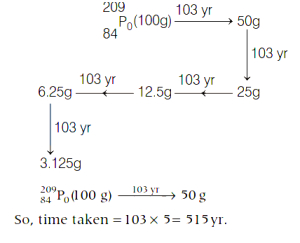
The half-life of ${ }_{84}^{209} Po$ is $103 \text{ years}$. The time it takes for a $100 \text{ g}$ sample of ${ }_{84}^{209} Po$ to decay to $3.125 \text{ g}$ is
A
$3296 \text{ years}$
B
$103 \sqrt{2} \text{ years}$
C
$1648 \text{ years}$
D
$515 \text{ years}$
Solution
(D) The initial amount of the sample is $N_0 = 100 \text{ g}$.
The final amount of the sample is $N = 3.125 \text{ g}$.
The half-life $T_{1/2} = 103 \text{ years}$.
Using the radioactive decay formula: $N = N_0 \left( \frac{1}{2} \right)^n$,where $n$ is the number of half-lives.
$3.125 = 100 \left( \frac{1}{2} \right)^n$
$\left( \frac{1}{2} \right)^n = \frac{3.125}{100} = \frac{1}{32}$
Since $\frac{1}{32} = \left( \frac{1}{2} \right)^5$,we have $n = 5$.
The total time taken is $t = n \times T_{1/2} = 5 \times 103 \text{ years} = 515 \text{ years}$.
The final amount of the sample is $N = 3.125 \text{ g}$.
The half-life $T_{1/2} = 103 \text{ years}$.
Using the radioactive decay formula: $N = N_0 \left( \frac{1}{2} \right)^n$,where $n$ is the number of half-lives.
$3.125 = 100 \left( \frac{1}{2} \right)^n$
$\left( \frac{1}{2} \right)^n = \frac{3.125}{100} = \frac{1}{32}$
Since $\frac{1}{32} = \left( \frac{1}{2} \right)^5$,we have $n = 5$.
The total time taken is $t = n \times T_{1/2} = 5 \times 103 \text{ years} = 515 \text{ years}$.
0 likes
View Solution557
MediumMCQ
Consider a radioactive nuclide which follows the decay rate given by $A(t) = A_0 2^{-(t/t_0)}$,where $A(t)$ is the fraction of radioactive material remaining after time $t$ from the initial $A_0$ at zero time. Let $A_1$ be the fraction of original activity which remains after $120 \ h$. Likewise,$A_2$ is the fraction of original activity remaining after $200 \ h$. If $A_1/A_2 = 16$,then the half-life $(t_0)$ will be: (in $h$)
A
$10$
B
$20$
C
$40$
D
$60$
Solution
(B) Given the decay rate formula: $A(t) = A_0 2^{-(t/t_0)}$,where $t_0$ is the half-life.
We are given $A_1$ at $t_1 = 120 \ h$ and $A_2$ at $t_2 = 200 \ h$.
The ratio is given as $\frac{A_1}{A_2} = 16$.
Substituting the expressions for $A_1$ and $A_2$:
$\frac{A_0 2^{-(120/t_0)}}{A_0 2^{-(200/t_0)}} = 16$
$2^{-(120/t_0) + (200/t_0)} = 2^4$
$2^{(80/t_0)} = 2^4$
Equating the exponents:
$\frac{80}{t_0} = 4$
$t_0 = \frac{80}{4} = 20 \ h$.
Thus,the half-life is $20 \ h$.
We are given $A_1$ at $t_1 = 120 \ h$ and $A_2$ at $t_2 = 200 \ h$.
The ratio is given as $\frac{A_1}{A_2} = 16$.
Substituting the expressions for $A_1$ and $A_2$:
$\frac{A_0 2^{-(120/t_0)}}{A_0 2^{-(200/t_0)}} = 16$
$2^{-(120/t_0) + (200/t_0)} = 2^4$
$2^{(80/t_0)} = 2^4$
Equating the exponents:
$\frac{80}{t_0} = 4$
$t_0 = \frac{80}{4} = 20 \ h$.
Thus,the half-life is $20 \ h$.
0 likes
View Solution558
EasyMCQ
$A$ certain radioactive element disintegrates with a decay constant of $7.9 \times 10^{-10} / s$. At a given instant of time,if the activity of the sample is equal to $55.3 \times 10^{11}$ disintegration/second,then the number of nuclei at that instant of time is:
A
$7.0 \times 10^{21}$
B
$4.27 \times 10^{13}$
C
$4.27 \times 10^3$
D
$6 \times 10^{23}$
Solution
(A) Given decay constant,$\lambda = 7.9 \times 10^{-10} / s$.
Activity of the sample,$A = 55.3 \times 10^{11} \text{ disintegration/second}$.
We know that the relationship between activity $A$ and the number of nuclei $N$ is given by the formula:
$A = \lambda N$
To find the number of nuclei $N$,we rearrange the formula:
$N = \frac{A}{\lambda}$
Substituting the given values:
$N = \frac{55.3 \times 10^{11}}{7.9 \times 10^{-10}}$
$N = 7.0 \times 10^{21}$
Therefore,the number of nuclei at that instant is $7.0 \times 10^{21}$.
Activity of the sample,$A = 55.3 \times 10^{11} \text{ disintegration/second}$.
We know that the relationship between activity $A$ and the number of nuclei $N$ is given by the formula:
$A = \lambda N$
To find the number of nuclei $N$,we rearrange the formula:
$N = \frac{A}{\lambda}$
Substituting the given values:
$N = \frac{55.3 \times 10^{11}}{7.9 \times 10^{-10}}$
$N = 7.0 \times 10^{21}$
Therefore,the number of nuclei at that instant is $7.0 \times 10^{21}$.
0 likes
View Solution559
MediumMCQ
$A$ radioactive nucleus can decay by two different processes. The half-lives of the first and second decay processes are $5 \times 10^3$ years and $10^5$ years respectively. Then,the effective half-life of the nucleus is
A
$105 \times 10^5 \text{ yr}$
B
$4762 \text{ yr}$
C
$10^4 \text{ yr}$
D
$47.6 \text{ yr}$
Solution
(B) The decay constant for the first process is $\lambda_1 = \frac{\ln 2}{T_1}$ and for the second process is $\lambda_2 = \frac{\ln 2}{T_2}$.
Since the nucleus decays by two processes,the effective decay constant is $\lambda = \lambda_1 + \lambda_2$.
Substituting the expressions for decay constants,we get $\frac{\ln 2}{T} = \frac{\ln 2}{T_1} + \frac{\ln 2}{T_2}$,which simplifies to $\frac{1}{T} = \frac{1}{T_1} + \frac{1}{T_2}$.
Thus,the effective half-life $T$ is given by $T = \frac{T_1 T_2}{T_1 + T_2}$.
Given $T_1 = 5 \times 10^3 \text{ yr}$ and $T_2 = 10^5 \text{ yr} = 100 \times 10^3 \text{ yr}$.
$T = \frac{(5 \times 10^3) \times (100 \times 10^3)}{5 \times 10^3 + 100 \times 10^3} = \frac{500 \times 10^6}{105 \times 10^3} = \frac{500000}{105} \approx 4761.9 \text{ yr}$.
Rounding to the nearest integer,we get $4762 \text{ yr}$.
Since the nucleus decays by two processes,the effective decay constant is $\lambda = \lambda_1 + \lambda_2$.
Substituting the expressions for decay constants,we get $\frac{\ln 2}{T} = \frac{\ln 2}{T_1} + \frac{\ln 2}{T_2}$,which simplifies to $\frac{1}{T} = \frac{1}{T_1} + \frac{1}{T_2}$.
Thus,the effective half-life $T$ is given by $T = \frac{T_1 T_2}{T_1 + T_2}$.
Given $T_1 = 5 \times 10^3 \text{ yr}$ and $T_2 = 10^5 \text{ yr} = 100 \times 10^3 \text{ yr}$.
$T = \frac{(5 \times 10^3) \times (100 \times 10^3)}{5 \times 10^3 + 100 \times 10^3} = \frac{500 \times 10^6}{105 \times 10^3} = \frac{500000}{105} \approx 4761.9 \text{ yr}$.
Rounding to the nearest integer,we get $4762 \text{ yr}$.
0 likes
View Solution560
MediumMCQ
The half-life of a radioactive element is $10 \ h$. The fraction of initial radioactivity of the element that will remain after $40 \ h$ is
A
$\frac{1}{2}$
B
$\frac{1}{16}$
C
$\frac{1}{8}$
D
$\frac{1}{4}$
Solution
(B) The number of half-lives $n$ is given by $n = \frac{t}{T_{1/2}}$.
Given $t = 40 \ h$ and $T_{1/2} = 10 \ h$,we have $n = \frac{40}{10} = 4$.
The remaining fraction of the initial radioactivity is given by $\frac{N}{N_0} = (\frac{1}{2})^n$.
Substituting $n = 4$,we get $\frac{N}{N_0} = (\frac{1}{2})^4 = \frac{1}{16}$.
Given $t = 40 \ h$ and $T_{1/2} = 10 \ h$,we have $n = \frac{40}{10} = 4$.
The remaining fraction of the initial radioactivity is given by $\frac{N}{N_0} = (\frac{1}{2})^n$.
Substituting $n = 4$,we get $\frac{N}{N_0} = (\frac{1}{2})^4 = \frac{1}{16}$.
0 likes
View Solution561
DifficultMCQ
The half-life of $Ra^{226}$ is $1620$ years. Calculate the number of atoms that decay in one second in $1 \ g$ of radium (Avogadro number $= 6.023 \times 10^{23}$).
A
$4.23 \times 10^9$
B
$3.16 \times 10^{10}$
C
$3.61 \times 10^{10}$
D
$2.16 \times 10^{10}$
Solution
(C) The rate of decay is given by $\frac{dN}{dt} = \lambda N$,where $\lambda = \frac{0.693}{T_{1/2}}$.
First,convert the half-life $T_{1/2} = 1620$ years into seconds:
$T_{1/2} = 1620 \times 365 \times 24 \times 3600 \approx 5.11 \times 10^{10} \ s$.
Next,calculate the number of atoms $N$ in $1 \ g$ of $Ra^{226}$:
$N = \frac{\text{mass}}{\text{molar mass}} \times N_A = \frac{1}{226} \times 6.023 \times 10^{23} \approx 2.665 \times 10^{21}$ atoms.
Now,calculate the activity $\frac{dN}{dt} = \frac{0.693}{T_{1/2}} \times N$:
$\frac{dN}{dt} = \frac{0.693}{5.11 \times 10^{10}} \times 2.665 \times 10^{21} \approx 3.61 \times 10^{10}$ decays per second.
First,convert the half-life $T_{1/2} = 1620$ years into seconds:
$T_{1/2} = 1620 \times 365 \times 24 \times 3600 \approx 5.11 \times 10^{10} \ s$.
Next,calculate the number of atoms $N$ in $1 \ g$ of $Ra^{226}$:
$N = \frac{\text{mass}}{\text{molar mass}} \times N_A = \frac{1}{226} \times 6.023 \times 10^{23} \approx 2.665 \times 10^{21}$ atoms.
Now,calculate the activity $\frac{dN}{dt} = \frac{0.693}{T_{1/2}} \times N$:
$\frac{dN}{dt} = \frac{0.693}{5.11 \times 10^{10}} \times 2.665 \times 10^{21} \approx 3.61 \times 10^{10}$ decays per second.
0 likes
View Solution562
EasyMCQ
Two radioactive materials $X_1$ and $X_2$ have decay constants $10 \lambda$ and $\lambda$ respectively. If initially they have the same number of nuclei,then the ratio of the number of nuclei of $X_1$ to that of $X_2$ will be $1 / e$ after a time:
A
$1 / (10 \lambda)$
B
$1 / (11 \lambda)$
C
$11 / (10 \lambda)$
D
$1 / (9 \lambda)$
Solution
(D) The number of nuclei remaining at time $t$ is given by the radioactive decay law: $N(t) = N_0 e^{-\lambda t}$.
For material $X_1$ with decay constant $10 \lambda$: $N_1 = N_0 e^{-10 \lambda t}$.
For material $X_2$ with decay constant $\lambda$: $N_2 = N_0 e^{-\lambda t}$.
Given that the ratio $N_1 / N_2 = 1 / e$ at time $t$:
$\frac{N_1}{N_2} = \frac{N_0 e^{-10 \lambda t}}{N_0 e^{-\lambda t}} = e^{-10 \lambda t + \lambda t} = e^{-9 \lambda t}$.
We are given $\frac{N_1}{N_2} = e^{-1}$.
Equating the exponents: $-9 \lambda t = -1$.
Therefore,$t = \frac{1}{9 \lambda}$.
For material $X_1$ with decay constant $10 \lambda$: $N_1 = N_0 e^{-10 \lambda t}$.
For material $X_2$ with decay constant $\lambda$: $N_2 = N_0 e^{-\lambda t}$.
Given that the ratio $N_1 / N_2 = 1 / e$ at time $t$:
$\frac{N_1}{N_2} = \frac{N_0 e^{-10 \lambda t}}{N_0 e^{-\lambda t}} = e^{-10 \lambda t + \lambda t} = e^{-9 \lambda t}$.
We are given $\frac{N_1}{N_2} = e^{-1}$.
Equating the exponents: $-9 \lambda t = -1$.
Therefore,$t = \frac{1}{9 \lambda}$.
0 likes
View Solution563
MediumMCQ
In one average lifetime of a radioactive nucleus,
A
more than half the active nuclei decay
B
half the active nuclei decay
C
less than half the active nuclei decay
D
all the nuclei decay
Solution
(A) The number of radioactive nuclei remaining at time $t$ is given by $N(t) = N_0 e^{-\lambda t}$.
Average life $\tau$ is defined as $\tau = 1/\lambda$.
At time $t = \tau$,the number of remaining nuclei is $N(\tau) = N_0 e^{-\lambda(1/\lambda)} = N_0 e^{-1} \approx N_0 / 2.718 \approx 0.368 N_0$.
The number of nuclei that have decayed is $N_{decayed} = N_0 - N(\tau) = N_0 - 0.368 N_0 = 0.632 N_0$.
Since $0.632 N_0 > 0.5 N_0$,more than half of the active nuclei decay in one average lifetime.
Average life $\tau$ is defined as $\tau = 1/\lambda$.
At time $t = \tau$,the number of remaining nuclei is $N(\tau) = N_0 e^{-\lambda(1/\lambda)} = N_0 e^{-1} \approx N_0 / 2.718 \approx 0.368 N_0$.
The number of nuclei that have decayed is $N_{decayed} = N_0 - N(\tau) = N_0 - 0.368 N_0 = 0.632 N_0$.
Since $0.632 N_0 > 0.5 N_0$,more than half of the active nuclei decay in one average lifetime.
0 likes
View Solution564
EasyMCQ
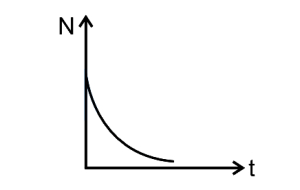
The number of undecayed nuclei $N$ in a sample of radioactive material as a function of time $t$ is shown in the figure. Which of the following graphs correctly shows the relationship between $N$ and the activity $A$?
A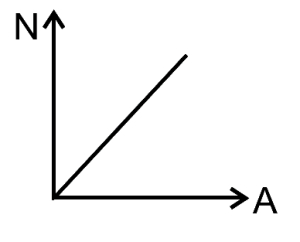
B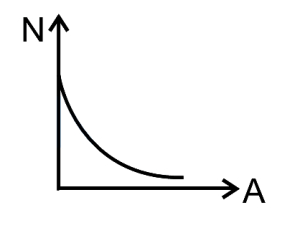
C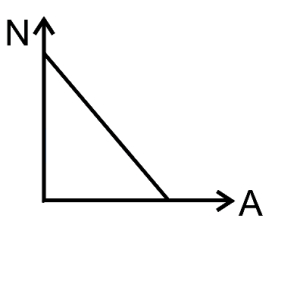
D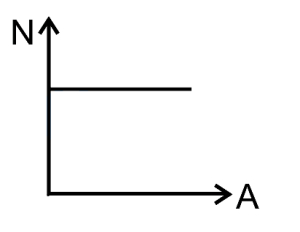
Solution
(A) The law of radioactive decay is given by $N = N_0 e^{-\lambda t}$.
Activity $A$ is defined as the rate of decay of nuclei,given by $A = -\frac{dN}{dt}$.
Differentiating $N$ with respect to $t$,we get:
$\frac{dN}{dt} = -\lambda N_0 e^{-\lambda t} = -\lambda N$.
Therefore,the magnitude of activity is $A = |-\frac{dN}{dt}| = \lambda N$.
This equation $A = \lambda N$ represents a linear relationship between $N$ and $A$,where $\lambda$ is the decay constant.
Since $A$ is directly proportional to $N$ $(A \propto N)$,the graph of $N$ versus $A$ will be a straight line passing through the origin. Thus,option $A$ is correct.
Activity $A$ is defined as the rate of decay of nuclei,given by $A = -\frac{dN}{dt}$.
Differentiating $N$ with respect to $t$,we get:
$\frac{dN}{dt} = -\lambda N_0 e^{-\lambda t} = -\lambda N$.
Therefore,the magnitude of activity is $A = |-\frac{dN}{dt}| = \lambda N$.
This equation $A = \lambda N$ represents a linear relationship between $N$ and $A$,where $\lambda$ is the decay constant.
Since $A$ is directly proportional to $N$ $(A \propto N)$,the graph of $N$ versus $A$ will be a straight line passing through the origin. Thus,option $A$ is correct.
0 likes
View Solution565
MediumMCQ
$A$ parent nucleus $X$ undergoes $\alpha$-decay with a half-life of $75000 \text{ yrs}$. The daughter nucleus $Y$ undergoes $\beta$-decay with a half-life of $9 \text{ months}$. In a particular sample,it is found that the rate of emission of $\beta$-particles is nearly constant (over several months) at $10^{7} / \text{h}$. What will be the number of $\alpha$-particles emitted in an hour?
A
$10^{2}$
B
$10^{7}$
C
$10^{12}$
D
$10^{14}$
Solution
(B) The decay process is $X \xrightarrow{\alpha} Y \xrightarrow{\beta} Z$.
Let $N_X$ and $N_Y$ be the number of nuclei of $X$ and $Y$ present at any time $t$.
The rate of change of the number of daughter nuclei $Y$ is given by: $\frac{dN_Y}{dt} = \lambda_X N_X - \lambda_Y N_Y$.
Since the rate of emission of $\beta$-particles $(\lambda_Y N_Y)$ is constant over several months,we have $\frac{dN_Y}{dt} \approx 0$.
This implies $\lambda_X N_X = \lambda_Y N_Y$.
The rate of emission of $\alpha$-particles is $\lambda_X N_X$,and the rate of emission of $\beta$-particles is $\lambda_Y N_Y$.
Given that the rate of $\beta$-emission is $10^{7} / \text{h}$,the rate of $\alpha$-emission must also be $10^{7} / \text{h}$.
Therefore,the number of $\alpha$-particles emitted in one hour is $10^{7}$.
Let $N_X$ and $N_Y$ be the number of nuclei of $X$ and $Y$ present at any time $t$.
The rate of change of the number of daughter nuclei $Y$ is given by: $\frac{dN_Y}{dt} = \lambda_X N_X - \lambda_Y N_Y$.
Since the rate of emission of $\beta$-particles $(\lambda_Y N_Y)$ is constant over several months,we have $\frac{dN_Y}{dt} \approx 0$.
This implies $\lambda_X N_X = \lambda_Y N_Y$.
The rate of emission of $\alpha$-particles is $\lambda_X N_X$,and the rate of emission of $\beta$-particles is $\lambda_Y N_Y$.
Given that the rate of $\beta$-emission is $10^{7} / \text{h}$,the rate of $\alpha$-emission must also be $10^{7} / \text{h}$.
Therefore,the number of $\alpha$-particles emitted in one hour is $10^{7}$.
0 likes
View Solution566
MediumMCQ
If the half-life of a radioactive nucleus is $3$ days,nearly what fraction of the initial number of nuclei will decay on the third day? (Given,$\sqrt[3]{0.25} \approx 0.63$)
A
$0.63$
B
$0.5$
C
$0.37$
D
$0.13$
Solution
(D) Given,half-life $t_{1/2} = 3$ days.
Number of active nuclei remaining after time $t$ is given by $N(t) = N_0 (1/2)^{t/t_{1/2}}$.
At the start of the third day ($t = 2$ days),the number of nuclei remaining is $N_1 = N_0 (1/2)^{2/3} = N_0 / (2^{2/3}) = N_0 / (4^{1/3})$.
Given $\sqrt[3]{0.25} \approx 0.63$,we have $N_1 = N_0 \times 0.63$.
At the end of the third day ($t = 3$ days),the number of nuclei remaining is $N_2 = N_0 (1/2)^{3/3} = 0.5 N_0$.
The number of nuclei that decay during the third day is the difference between the nuclei present at the start and end of the day:
$\Delta N = N_1 - N_2 = 0.63 N_0 - 0.5 N_0 = 0.13 N_0$.
Thus,the fraction of the initial nuclei that decay on the third day is $0.13$.
Number of active nuclei remaining after time $t$ is given by $N(t) = N_0 (1/2)^{t/t_{1/2}}$.
At the start of the third day ($t = 2$ days),the number of nuclei remaining is $N_1 = N_0 (1/2)^{2/3} = N_0 / (2^{2/3}) = N_0 / (4^{1/3})$.
Given $\sqrt[3]{0.25} \approx 0.63$,we have $N_1 = N_0 \times 0.63$.
At the end of the third day ($t = 3$ days),the number of nuclei remaining is $N_2 = N_0 (1/2)^{3/3} = 0.5 N_0$.
The number of nuclei that decay during the third day is the difference between the nuclei present at the start and end of the day:
$\Delta N = N_1 - N_2 = 0.63 N_0 - 0.5 N_0 = 0.13 N_0$.
Thus,the fraction of the initial nuclei that decay on the third day is $0.13$.
0 likes
View Solution567
EasyMCQ
Radon-$222$ has a half-life of $3.8$ days. If one starts with $0.064 \ kg$ of radon-$222$,the quantity of radon-$222$ left after $19$ days will be (in $kg$)
A
$0.002$
B
$0.062$
C
$0.032$
D
$0.024$
Solution
(A) The half-life of Radon-$222$ is $T_{1/2} = 3.8 \text{ days}$.
Total time elapsed is $t = 19 \text{ days}$.
The number of half-lives $n$ is given by $n = \frac{t}{T_{1/2}} = \frac{19}{3.8} = 5$.
The remaining quantity $N$ is given by the formula $N = N_0 \left(\frac{1}{2}\right)^n$,where $N_0$ is the initial amount.
Given $N_0 = 0.064 \ kg$ and $n = 5$,we have:
$N = 0.064 \times \left(\frac{1}{2}\right)^5$
$N = 0.064 \times \frac{1}{32}$
$N = 0.002 \ kg$.
Thus,the quantity of Radon-$222$ left after $19$ days is $0.002 \ kg$.
Total time elapsed is $t = 19 \text{ days}$.
The number of half-lives $n$ is given by $n = \frac{t}{T_{1/2}} = \frac{19}{3.8} = 5$.
The remaining quantity $N$ is given by the formula $N = N_0 \left(\frac{1}{2}\right)^n$,where $N_0$ is the initial amount.
Given $N_0 = 0.064 \ kg$ and $n = 5$,we have:
$N = 0.064 \times \left(\frac{1}{2}\right)^5$
$N = 0.064 \times \frac{1}{32}$
$N = 0.002 \ kg$.
Thus,the quantity of Radon-$222$ left after $19$ days is $0.002 \ kg$.
0 likes
View Solution568
MediumMCQ
The number of atoms of a radioactive substance of half-life $T$ is $N_{0}$ at $t=0$. The time necessary to decay from $N_{0} / 2$ atoms to $N_{0} / 10$ atoms will be
A
$T \frac{\log 5}{\log 2}$
B
$T \log 5$
C
$T \log \left[\frac{5}{2}\right]$
D
$\frac{T}{2} \log 5$
Solution
(A) The radioactive decay law is given by $N(t) = N_{0} e^{-\lambda t}$,where $\lambda = \frac{\ln 2}{T}$.
Let $t_{1}$ be the time when the number of atoms is $N_{0}/2$ and $t_{2}$ be the time when the number of atoms is $N_{0}/10$.
For $N(t_{1}) = N_{0}/2$,we have $\frac{N_{0}}{2} = N_{0} e^{-\lambda t_{1}} \Rightarrow e^{\lambda t_{1}} = 2 \Rightarrow \lambda t_{1} = \ln 2$.
For $N(t_{2}) = N_{0}/10$,we have $\frac{N_{0}}{10} = N_{0} e^{-\lambda t_{2}} \Rightarrow e^{\lambda t_{2}} = 10 \Rightarrow \lambda t_{2} = \ln 10$.
The time interval required is $\Delta t = t_{2} - t_{1} = \frac{\ln 10 - \ln 2}{\lambda} = \frac{\ln(10/2)}{\lambda} = \frac{\ln 5}{\lambda}$.
Since $\lambda = \frac{\ln 2}{T}$,we substitute $\lambda$ to get $\Delta t = \frac{\ln 5}{(\ln 2 / T)} = T \frac{\ln 5}{\ln 2} = T \log_{2} 5$.
Let $t_{1}$ be the time when the number of atoms is $N_{0}/2$ and $t_{2}$ be the time when the number of atoms is $N_{0}/10$.
For $N(t_{1}) = N_{0}/2$,we have $\frac{N_{0}}{2} = N_{0} e^{-\lambda t_{1}} \Rightarrow e^{\lambda t_{1}} = 2 \Rightarrow \lambda t_{1} = \ln 2$.
For $N(t_{2}) = N_{0}/10$,we have $\frac{N_{0}}{10} = N_{0} e^{-\lambda t_{2}} \Rightarrow e^{\lambda t_{2}} = 10 \Rightarrow \lambda t_{2} = \ln 10$.
The time interval required is $\Delta t = t_{2} - t_{1} = \frac{\ln 10 - \ln 2}{\lambda} = \frac{\ln(10/2)}{\lambda} = \frac{\ln 5}{\lambda}$.
Since $\lambda = \frac{\ln 2}{T}$,we substitute $\lambda$ to get $\Delta t = \frac{\ln 5}{(\ln 2 / T)} = T \frac{\ln 5}{\ln 2} = T \log_{2} 5$.
0 likes
View Solution569
MediumMCQ
Two radioactive substances $A$ and $B$ have decay constants $5 \lambda$ and $\lambda$ respectively. At $t=0$,they have the same number of nuclei. The ratio of the number of nuclei of $A$ to that of $B$ will be $(1/e)^2$ after a time interval of:
A
$\frac{1}{\lambda}$
B
$\frac{1}{2 \lambda}$
C
$\frac{1}{3 \lambda}$
D
$\frac{1}{4 \lambda}$
Solution
(B) The number of nuclei remaining at time $t$ is given by $N(t) = N_0 e^{-\lambda t}$.
For substance $A$,$N_A = N_0 e^{-5 \lambda t}$.
For substance $B$,$N_B = N_0 e^{-\lambda t}$.
Given the ratio $\frac{N_A}{N_B} = (1/e)^2 = e^{-2}$.
Substituting the expressions:
$\frac{N_0 e^{-5 \lambda t}}{N_0 e^{-\lambda t}} = e^{-2}$
$e^{-5 \lambda t + \lambda t} = e^{-2}$
$e^{-4 \lambda t} = e^{-2}$
Equating the exponents:
$-4 \lambda t = -2$
$t = \frac{2}{4 \lambda} = \frac{1}{2 \lambda}$.
For substance $A$,$N_A = N_0 e^{-5 \lambda t}$.
For substance $B$,$N_B = N_0 e^{-\lambda t}$.
Given the ratio $\frac{N_A}{N_B} = (1/e)^2 = e^{-2}$.
Substituting the expressions:
$\frac{N_0 e^{-5 \lambda t}}{N_0 e^{-\lambda t}} = e^{-2}$
$e^{-5 \lambda t + \lambda t} = e^{-2}$
$e^{-4 \lambda t} = e^{-2}$
Equating the exponents:
$-4 \lambda t = -2$
$t = \frac{2}{4 \lambda} = \frac{1}{2 \lambda}$.
0 likes
View Solution570
MediumMCQ
Half-life of a radioactive substance is $20 \text{ min}$. The time between $20 \%$ and $80 \%$ decay will be: (in $\text{ min}$)
A
$20$
B
$30$
C
$40$
D
$25$
Solution
(C) The radioactive decay law is given by $N(t) = N_0 e^{-\lambda t}$, where $N(t)$ is the amount remaining at time $t$.
For $20 \%$ decay, the amount remaining is $N_1 = 80 \% \text{ of } N_0 = 0.8 N_0$. Thus, $0.8 N_0 = N_0 e^{-\lambda t_1} \Rightarrow e^{-\lambda t_1} = 0.8$.
For $80 \%$ decay, the amount remaining is $N_2 = 20 \% \text{ of } N_0 = 0.2 N_0$. Thus, $0.2 N_0 = N_0 e^{-\lambda t_2} \Rightarrow e^{-\lambda t_2} = 0.2$.
Dividing the two equations: $\frac{e^{-\lambda t_1}}{e^{-\lambda t_2}} = \frac{0.8}{0.2} = 4$.
This simplifies to $e^{\lambda(t_2 - t_1)} = 4$.
Taking the natural logarithm on both sides: $\lambda(t_2 - t_1) = \ln(4) = 2 \ln(2)$.
Since $\lambda = \frac{\ln 2}{T_{1/2}}$, we have $\frac{\ln 2}{T_{1/2}}(t_2 - t_1) = 2 \ln 2$.
Therefore, $t_2 - t_1 = 2 \times T_{1/2} = 2 \times 20 \text{ min} = 40 \text{ min}$.
For $20 \%$ decay, the amount remaining is $N_1 = 80 \% \text{ of } N_0 = 0.8 N_0$. Thus, $0.8 N_0 = N_0 e^{-\lambda t_1} \Rightarrow e^{-\lambda t_1} = 0.8$.
For $80 \%$ decay, the amount remaining is $N_2 = 20 \% \text{ of } N_0 = 0.2 N_0$. Thus, $0.2 N_0 = N_0 e^{-\lambda t_2} \Rightarrow e^{-\lambda t_2} = 0.2$.
Dividing the two equations: $\frac{e^{-\lambda t_1}}{e^{-\lambda t_2}} = \frac{0.8}{0.2} = 4$.
This simplifies to $e^{\lambda(t_2 - t_1)} = 4$.
Taking the natural logarithm on both sides: $\lambda(t_2 - t_1) = \ln(4) = 2 \ln(2)$.
Since $\lambda = \frac{\ln 2}{T_{1/2}}$, we have $\frac{\ln 2}{T_{1/2}}(t_2 - t_1) = 2 \ln 2$.
Therefore, $t_2 - t_1 = 2 \times T_{1/2} = 2 \times 20 \text{ min} = 40 \text{ min}$.
0 likes
View SolutionNuclei — Law of Radioactivity by Rutherford and Soddy and Half Life and Mean Life · Frequently Asked Questions
1Are these Nuclei questions useful for JEE and NEET?
Yes. All questions in this section are mapped to JEE Main and NEET exam patterns. Previous year questions from JEE Main, NEET, GUJCET and state-level exams are included with full solutions.
2Can I switch to Hindi or Gujarati for these questions?
Yes. Use the language tabs in the hero section or the sidebar to view the same questions and solutions in English, Hindi or Gujarati.
3How do I generate a question paper from this subtopic?
Use the Vedclass Exam Paper Generator — select the chapter and subtopic, set difficulty, and generate Sets A, B, C, D automatically. First 3 chapters of every subject are free.
Vedclass Products
For Students
Vedclass Test Series
Mock tests in real JEE/NEET style with performance analysis. 5-day free trial.
Start Free TrialFor Teachers
Exam Paper Generator
Generate Set A/B/C/D papers from this chapter in 2 minutes. 3 chapters free.
Try FreeFor Institutes
Online Exam Module
Live online exams with unlimited students, 360° analytics & white-label branding.
See DemoFor Teachers & Institutes
Generate a Nuclei Exam Paper in 2 Minutes
Select subtopic & difficulty — Sets A, B, C, D auto-generated with No Repeat logic.
First 3 chapters of every subject are free — no payment required.