
A English
Static EMI (Time Varying Magnetic Field) Questions in English
Class 12 Physics · Electromagnetic Induction · Static EMI (Time Varying Magnetic Field)
55+
Questions
English
Language
100%
With Solutions
Showing 5 of 55 questions in English
51
MediumMCQ
$A$ magnetic field at a distance $r$ from the $z$-axis is given by $\vec{B} = B_0 r t \hat{k}$,where $B_0$ is a constant and $t$ is time. The magnitude of the induced electric field at a distance $r$ from the $z$-axis is:
A
$\frac{B_0 r^3}{3}$
B
$\frac{2 \pi B_0 r}{3}$
C
$\frac{B_0 r^2}{2 \pi}$
D
$\frac{B_0 r^2}{3}$
Solution
(D) The magnetic field is given by $\vec{B} = B_0 r t \hat{k}$.
According to Faraday's law of induction in integral form,$\oint \vec{E} \cdot d\vec{l} = -\frac{d\phi_B}{dt}$.
For a circular path of radius $r$ centered on the $z$-axis,the line integral of the electric field is $E(2\pi r)$.
The magnetic flux $\phi_B$ through the circular area of radius $r$ is $\int_0^r B(r') (2\pi r') dr'$.
Substituting $B(r') = B_0 r' t$,we get $\phi_B = \int_0^r (B_0 r' t) (2\pi r') dr' = 2\pi B_0 t \int_0^r r'^2 dr' = 2\pi B_0 t \frac{r^3}{3}$.
Now,differentiating with respect to time $t$: $\frac{d\phi_B}{dt} = \frac{d}{dt} \left( \frac{2\pi B_0 t r^3}{3} \right) = \frac{2\pi B_0 r^3}{3}$.
Equating the magnitudes: $E(2\pi r) = \frac{2\pi B_0 r^3}{3}$.
Solving for $E$,we get $E = \frac{B_0 r^2}{3}$.
According to Faraday's law of induction in integral form,$\oint \vec{E} \cdot d\vec{l} = -\frac{d\phi_B}{dt}$.
For a circular path of radius $r$ centered on the $z$-axis,the line integral of the electric field is $E(2\pi r)$.
The magnetic flux $\phi_B$ through the circular area of radius $r$ is $\int_0^r B(r') (2\pi r') dr'$.
Substituting $B(r') = B_0 r' t$,we get $\phi_B = \int_0^r (B_0 r' t) (2\pi r') dr' = 2\pi B_0 t \int_0^r r'^2 dr' = 2\pi B_0 t \frac{r^3}{3}$.
Now,differentiating with respect to time $t$: $\frac{d\phi_B}{dt} = \frac{d}{dt} \left( \frac{2\pi B_0 t r^3}{3} \right) = \frac{2\pi B_0 r^3}{3}$.
Equating the magnitudes: $E(2\pi r) = \frac{2\pi B_0 r^3}{3}$.
Solving for $E$,we get $E = \frac{B_0 r^2}{3}$.
0 likes
View Solution52
EasyMCQ
$A$ long straight solenoid with a cross-sectional radius $a$ and number of turns per unit length $n$ has a current varying with time as $I = I_0 \sin(\omega t)$ (or simply $dI/dt = I$). The magnitude of the electric field as a function of distance $r$ from the solenoid axis is,
A
$\frac{n \mu_0 a^2 \dot{I}}{2 r}$
B
$\frac{\mu_0 \dot{I} n}{2 a}$
C
$\frac{n a^2 \dot{I}}{2 \mu_0 r}$
D
$\frac{\mu_0 \dot{I} a}{2 n}$
Solution
(A) According to Faraday's law of electromagnetic induction,the line integral of the electric field is equal to the negative rate of change of magnetic flux: $\oint \vec{E} \cdot d\vec{l} = -\frac{d\phi}{dt}$.
For a long solenoid,the magnetic field inside is $B = \mu_0 n I$. The magnetic flux through a circular loop of radius $r$ is $\phi = B \cdot A$.
Case $1$: For $r < a$,the flux is $\phi = (\mu_0 n I)(\pi r^2)$.
Applying Faraday's law: $E(2 \pi r) = -\frac{d}{dt}(\mu_0 n I \pi r^2) = -\mu_0 n \pi r^2 \frac{dI}{dt}$.
Thus,$E = -\frac{\mu_0 n r}{2} \frac{dI}{dt}$. The magnitude is $|E| = \frac{\mu_0 n r \dot{I}}{2}$.
Case $2$: For $r > a$,the flux is only through the cross-section of the solenoid,so $\phi = (\mu_0 n I)(\pi a^2)$.
Applying Faraday's law: $E(2 \pi r) = -\frac{d}{dt}(\mu_0 n I \pi a^2) = -\mu_0 n \pi a^2 \frac{dI}{dt}$.
Thus,$E = -\frac{\mu_0 n a^2}{2 r} \frac{dI}{dt}$. The magnitude is $|E| = \frac{\mu_0 n a^2 \dot{I}}{2 r}$.
For a long solenoid,the magnetic field inside is $B = \mu_0 n I$. The magnetic flux through a circular loop of radius $r$ is $\phi = B \cdot A$.
Case $1$: For $r < a$,the flux is $\phi = (\mu_0 n I)(\pi r^2)$.
Applying Faraday's law: $E(2 \pi r) = -\frac{d}{dt}(\mu_0 n I \pi r^2) = -\mu_0 n \pi r^2 \frac{dI}{dt}$.
Thus,$E = -\frac{\mu_0 n r}{2} \frac{dI}{dt}$. The magnitude is $|E| = \frac{\mu_0 n r \dot{I}}{2}$.
Case $2$: For $r > a$,the flux is only through the cross-section of the solenoid,so $\phi = (\mu_0 n I)(\pi a^2)$.
Applying Faraday's law: $E(2 \pi r) = -\frac{d}{dt}(\mu_0 n I \pi a^2) = -\mu_0 n \pi a^2 \frac{dI}{dt}$.
Thus,$E = -\frac{\mu_0 n a^2}{2 r} \frac{dI}{dt}$. The magnitude is $|E| = \frac{\mu_0 n a^2 \dot{I}}{2 r}$.
0 likes
View Solution53
DifficultMCQ
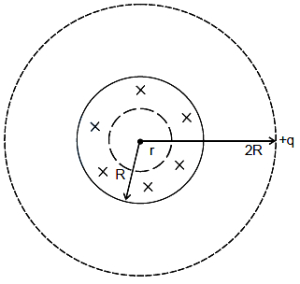
$A$ charged particle of charge $q$ and mass $m$ is placed at a distance $2R$ from the centre of a vertical cylindrical region of radius $R$ where the magnetic field varies as $\vec{B} = (4t^2 - 2t + 6) \hat{k}$,where $t$ is time. Then which of the following statement$(s)$ is/are true?
A
Induced electric field lines form closed loops
B
Electric field varies linearly with $r$ if $r < R$,where $r$ is the radial distance from the centerline of the cylinder
C
The charged particle will move in a clockwise direction when viewed from the top
D
Acceleration of the charged particle is $\frac{7qR}{2m}$ when $t = 2 \text{ s}$
Solution
(A, B, C, D) For $r < R$,using Faraday's law of induction: $\oint \vec{E} \cdot d\vec{l} = -\frac{d\phi_B}{dt}$.
$E(2\pi r) = \frac{d}{dt}[(4t^2 - 2t + 6) \pi r^2] = (8t - 2) \pi r^2$.
Thus,$E = \frac{(8t - 2)r}{2} = (4t - 1)r$. Since $E \propto r$,the electric field varies linearly with $r$ for $r < R$.
For $r > R$,the magnetic flux is confined to the region $r \le R$: $\oint \vec{E} \cdot d\vec{l} = -\frac{d}{dt}[B \cdot \pi R^2]$.
$E(2\pi r) = (8t - 2) \pi R^2 \implies E = \frac{(8t - 2)R^2}{2r}$.
At $r = 2R$ and $t = 2 \text{ s}$:
$E = \frac{(8(2) - 2)R^2}{2(2R)} = \frac{14R^2}{4R} = \frac{7R}{2}$.
The acceleration $a = \frac{Eq}{m} = \frac{7qR}{2m}$.
Induced electric fields are non-conservative and form closed loops. By Lenz's law,since $\vec{B}$ is increasing for $t > 0.25 \text{ s}$,the induced field opposes the change,resulting in a clockwise direction for a positive charge.
$E(2\pi r) = \frac{d}{dt}[(4t^2 - 2t + 6) \pi r^2] = (8t - 2) \pi r^2$.
Thus,$E = \frac{(8t - 2)r}{2} = (4t - 1)r$. Since $E \propto r$,the electric field varies linearly with $r$ for $r < R$.
For $r > R$,the magnetic flux is confined to the region $r \le R$: $\oint \vec{E} \cdot d\vec{l} = -\frac{d}{dt}[B \cdot \pi R^2]$.
$E(2\pi r) = (8t - 2) \pi R^2 \implies E = \frac{(8t - 2)R^2}{2r}$.
At $r = 2R$ and $t = 2 \text{ s}$:
$E = \frac{(8(2) - 2)R^2}{2(2R)} = \frac{14R^2}{4R} = \frac{7R}{2}$.
The acceleration $a = \frac{Eq}{m} = \frac{7qR}{2m}$.
Induced electric fields are non-conservative and form closed loops. By Lenz's law,since $\vec{B}$ is increasing for $t > 0.25 \text{ s}$,the induced field opposes the change,resulting in a clockwise direction for a positive charge.
0 likes
View Solution54
DifficultMCQ
$A$ square loop of side $2 \text{ cm}$ is placed in a time-varying magnetic field with magnitude $B = 0.4 \sin(300t) \text{ T}$. The normal to the plane of the loop makes an angle of $60^{\circ}$ with the field. The maximum induced emf produced in the loop is . . . . . . $\text{mV}$.
A
$12$
B
$18$
C
$21$
D
$24$
Solution
(D) The magnetic flux $\Phi$ through the loop is given by $\Phi = B A \cos \theta$.
Here,$A = (2 \text{ cm})^2 = (0.02 \text{ m})^2 = 4 \times 10^{-4} \text{ m}^2$ and $\theta = 60^{\circ}$.
Substituting the values: $\Phi = (0.4 \sin(300t)) \times (4 \times 10^{-4}) \times \cos(60^{\circ})$.
Since $\cos(60^{\circ}) = 0.5$,we get $\Phi = 0.4 \times 4 \times 10^{-4} \times 0.5 \times \sin(300t) = 0.8 \times 10^{-4} \sin(300t) \text{ Wb}$.
The induced emf $\epsilon$ is given by Faraday's law: $\epsilon = -\frac{d\Phi}{dt}$.
$\epsilon = -\frac{d}{dt} [0.8 \times 10^{-4} \sin(300t)] = -0.8 \times 10^{-4} \times 300 \times \cos(300t) = -0.024 \cos(300t) \text{ V}$.
The maximum induced emf is the amplitude of this expression,which is $\epsilon_{max} = 0.024 \text{ V}$.
Converting to millivolts: $0.024 \text{ V} = 24 \text{ mV}$.
Here,$A = (2 \text{ cm})^2 = (0.02 \text{ m})^2 = 4 \times 10^{-4} \text{ m}^2$ and $\theta = 60^{\circ}$.
Substituting the values: $\Phi = (0.4 \sin(300t)) \times (4 \times 10^{-4}) \times \cos(60^{\circ})$.
Since $\cos(60^{\circ}) = 0.5$,we get $\Phi = 0.4 \times 4 \times 10^{-4} \times 0.5 \times \sin(300t) = 0.8 \times 10^{-4} \sin(300t) \text{ Wb}$.
The induced emf $\epsilon$ is given by Faraday's law: $\epsilon = -\frac{d\Phi}{dt}$.
$\epsilon = -\frac{d}{dt} [0.8 \times 10^{-4} \sin(300t)] = -0.8 \times 10^{-4} \times 300 \times \cos(300t) = -0.024 \cos(300t) \text{ V}$.
The maximum induced emf is the amplitude of this expression,which is $\epsilon_{max} = 0.024 \text{ V}$.
Converting to millivolts: $0.024 \text{ V} = 24 \text{ mV}$.
0 likes
View Solution55
DifficultMCQ
$A$ circular loop of radius $20 \text{ cm}$ and resistance $2 \text{ } \Omega$ is placed in a time-varying magnetic field $\vec{B} = (2t^2 + 2t + 3) \text{ T}$. The plane of the loop is perpendicular to the magnetic field. The induced current in the loop at $t = 3 \text{ s}$ is $\frac{\alpha}{50} \text{ A}$. The value of $\alpha$ is . . . . . . .
A
$44$
B
$88$
C
$176$
D
$200$
Solution
(A) The magnetic flux $\phi$ through the loop is given by $\phi = B \cdot A = (2t^2 + 2t + 3) \cdot \pi r^2$.
Given $r = 20 \text{ cm} = 0.2 \text{ m}$,so $A = \pi (0.2)^2 = 0.04\pi \text{ m}^2$.
Thus,$\phi = 0.04\pi (2t^2 + 2t + 3) \text{ Wb}$.
The induced emf $\varepsilon$ is given by Faraday's law: $\varepsilon = |-\frac{d\phi}{dt}|$.
$\frac{d\phi}{dt} = 0.04\pi (4t + 2)$.
At $t = 3 \text{ s}$,$\frac{d\phi}{dt} = 0.04\pi (4(3) + 2) = 0.04\pi (14) = 0.56\pi \text{ V}$.
The induced current $I$ is $I = \frac{\varepsilon}{R} = \frac{0.56\pi}{2} = 0.28\pi \text{ A}$.
Using $\pi \approx \frac{22}{7}$,$I = 0.28 \times \frac{22}{7} = 0.04 \times 22 = 0.88 \text{ A}$.
Given $I = \frac{\alpha}{50}$,we have $0.88 = \frac{\alpha}{50}$.
Therefore,$\alpha = 0.88 \times 50 = 44$.
Given $r = 20 \text{ cm} = 0.2 \text{ m}$,so $A = \pi (0.2)^2 = 0.04\pi \text{ m}^2$.
Thus,$\phi = 0.04\pi (2t^2 + 2t + 3) \text{ Wb}$.
The induced emf $\varepsilon$ is given by Faraday's law: $\varepsilon = |-\frac{d\phi}{dt}|$.
$\frac{d\phi}{dt} = 0.04\pi (4t + 2)$.
At $t = 3 \text{ s}$,$\frac{d\phi}{dt} = 0.04\pi (4(3) + 2) = 0.04\pi (14) = 0.56\pi \text{ V}$.
The induced current $I$ is $I = \frac{\varepsilon}{R} = \frac{0.56\pi}{2} = 0.28\pi \text{ A}$.
Using $\pi \approx \frac{22}{7}$,$I = 0.28 \times \frac{22}{7} = 0.04 \times 22 = 0.88 \text{ A}$.
Given $I = \frac{\alpha}{50}$,we have $0.88 = \frac{\alpha}{50}$.
Therefore,$\alpha = 0.88 \times 50 = 44$.
0 likes
View SolutionElectromagnetic Induction — Static EMI (Time Varying Magnetic Field) · Frequently Asked Questions
1Are these Electromagnetic Induction questions useful for JEE and NEET?
Yes. All questions in this section are mapped to JEE Main and NEET exam patterns. Previous year questions from JEE Main, NEET, GUJCET and state-level exams are included with full solutions.
2Can I switch to Hindi or Gujarati for these questions?
Yes. Use the language tabs in the hero section or the sidebar to view the same questions and solutions in English, Hindi or Gujarati.
3How do I generate a question paper from this subtopic?
Use the Vedclass Exam Paper Generator — select the chapter and subtopic, set difficulty, and generate Sets A, B, C, D automatically. First 3 chapters of every subject are free.
Vedclass Products
For Students
Vedclass Test Series
Mock tests in real JEE/NEET style with performance analysis. 5-day free trial.
Start Free TrialFor Teachers
Exam Paper Generator
Generate Set A/B/C/D papers from this chapter in 2 minutes. 3 chapters free.
Try FreeFor Institutes
Online Exam Module
Live online exams with unlimited students, 360° analytics & white-label branding.
See DemoFor Teachers & Institutes
Generate a Electromagnetic Induction Exam Paper in 2 Minutes
Select subtopic & difficulty — Sets A, B, C, D auto-generated with No Repeat logic.
First 3 chapters of every subject are free — no payment required.