
A English
Motional EMI (Induced Parameter) Questions in English
Class 12 Physics · Electromagnetic Induction · Motional EMI (Induced Parameter)
355+
Questions
English
Language
100%
With Solutions
Showing 5 of 355 questions in English
351
MediumMCQ
$A$ $20 \ m$ long uniform copper wire held horizontally is allowed to fall under gravity $(g = 10 \ m/s^2)$ through a uniform horizontal magnetic field of $0.5 \ Gauss$ perpendicular to the length of the wire. The induced $EMF$ across the wire after it travels a vertical distance of $200 \ m$ is . . . . . . $mV$.
A
$0.2 \sqrt{10}$
B
$20 \sqrt{10}$
C
$2 \sqrt{10}$
D
$200 \sqrt{10}$
Solution
(B) The induced $EMF$ $(\varepsilon)$ in a conductor moving through a magnetic field is given by $\varepsilon = Bv\ell$.
First, calculate the velocity $(v)$ of the wire after falling a distance $(h = 200 \ m)$ under gravity using the equation $v^2 = u^2 + 2gh$. Since the initial velocity $(u = 0)$, $v = \sqrt{2gh} = \sqrt{2 \times 10 \times 200} = \sqrt{4000} = 20\sqrt{10} \ m/s$.
The magnetic field $(B)$ is $0.5 \ Gauss = 0.5 \times 10^{-4} \ T$.
The length of the wire $(\ell)$ is $20 \ m$.
Substituting these values into the $EMF$ formula: $\varepsilon = (0.5 \times 10^{-4} \ T) \times (20\sqrt{10} \ m/s) \times (20 \ m)$.
$\varepsilon = 20\sqrt{10} \times 10^{-4} \times 10 = 20\sqrt{10} \times 10^{-3} \ V$.
Since $1 \ V = 1000 \ mV$, the induced $EMF$ is $20\sqrt{10} \ mV$.
First, calculate the velocity $(v)$ of the wire after falling a distance $(h = 200 \ m)$ under gravity using the equation $v^2 = u^2 + 2gh$. Since the initial velocity $(u = 0)$, $v = \sqrt{2gh} = \sqrt{2 \times 10 \times 200} = \sqrt{4000} = 20\sqrt{10} \ m/s$.
The magnetic field $(B)$ is $0.5 \ Gauss = 0.5 \times 10^{-4} \ T$.
The length of the wire $(\ell)$ is $20 \ m$.
Substituting these values into the $EMF$ formula: $\varepsilon = (0.5 \times 10^{-4} \ T) \times (20\sqrt{10} \ m/s) \times (20 \ m)$.
$\varepsilon = 20\sqrt{10} \times 10^{-4} \times 10 = 20\sqrt{10} \times 10^{-3} \ V$.
Since $1 \ V = 1000 \ mV$, the induced $EMF$ is $20\sqrt{10} \ mV$.
0 likes
View Solution352
DifficultMCQ
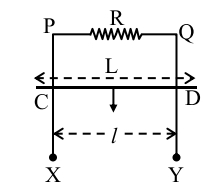
$XPQY$ is a vertical smooth long loop having a total resistance $R$,where $PX$ is parallel to $QY$ and the separation between them is $l$. $A$ constant magnetic field $B$ perpendicular to the plane of the loop exists in the entire space. $A$ rod $CD$ of length $L$ $(L > l)$ and mass $m$ is made to slide down from rest under gravity as shown in the figure. The terminal speed acquired by the rod is . . . . . . $m/s$. ($g$ = acceleration due to gravity)
A
$ \frac{2mgR}{B^{2}l^{2}} $
B
$ \frac{8mgR}{B^{2}l^{2}} $
C
$ \frac{2mgR}{B^{2}L^{2}} $
D
$ \frac{mgR}{B^{2}l^{2}} $
Solution
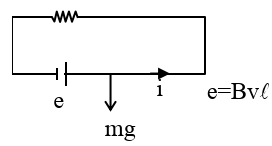
(D) When the rod moves with a terminal velocity $v$,the induced electromotive force $(EMF)$ in the rod is $e = Bvl$.
Since the rod is part of a closed circuit with resistance $R$,the induced current is $i = \frac{e}{R} = \frac{Bvl}{R}$.
The magnetic force acting on the rod is $F_m = ilB = (\frac{Bvl}{R})lB = \frac{B^{2}l^{2}v}{R}$,which acts upwards.
At terminal velocity,the gravitational force $mg$ is balanced by the magnetic force $F_m$.
Therefore,$mg = F_m = \frac{B^{2}l^{2}v}{R}$.
Solving for $v$,we get $v = \frac{mgR}{B^{2}l^{2}}$.
Since the rod is part of a closed circuit with resistance $R$,the induced current is $i = \frac{e}{R} = \frac{Bvl}{R}$.
The magnetic force acting on the rod is $F_m = ilB = (\frac{Bvl}{R})lB = \frac{B^{2}l^{2}v}{R}$,which acts upwards.
At terminal velocity,the gravitational force $mg$ is balanced by the magnetic force $F_m$.
Therefore,$mg = F_m = \frac{B^{2}l^{2}v}{R}$.
Solving for $v$,we get $v = \frac{mgR}{B^{2}l^{2}}$.
0 likes
View Solution353
MediumMCQ
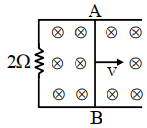
$A$ $1 \ m$ long metal rod $AB$ completes the circuit as shown in the figure. The area of the circuit is perpendicular to the magnetic field of $0.10 \ T$. If the resistance of the total circuit is $2 \ \Omega$,then the force needed to move the rod towards the right with a constant speed $(v)$ of $1.5 \ m/s$ is . . . . . . $N$.
A
$7.5 \times 10^{-2}$
B
$5.7 \times 10^{-3}$
C
$5.7 \times 10^{-2}$
D
$7.5 \times 10^{-3}$
Solution
(D) The motional electromotive force $(EMF)$ induced in the rod is given by $\varepsilon = B l v$.
Given: $B = 0.10 \ T$,$l = 1 \ m$,$v = 1.5 \ m/s$,and $R = 2 \ \Omega$.
The induced current in the circuit is $I = \frac{\varepsilon}{R} = \frac{B l v}{R}$.
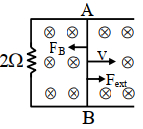
The magnetic force acting on the rod is $F_B = I l B = \left( \frac{B l v}{R} \right) l B = \frac{B^2 l^2 v}{R}$.
To move the rod with a constant speed,the external force $F_{ext}$ must be equal and opposite to the magnetic force $F_B$.
$F_{ext} = F_B = \frac{B^2 l^2 v}{R}$.
Substituting the values:
$F_{ext} = \frac{(0.1)^2 \times (1)^2 \times 1.5}{2} = \frac{0.01 \times 1 \times 1.5}{2} = \frac{0.015}{2} = 0.0075 \ N$.
$F_{ext} = 7.5 \times 10^{-3} \ N$.
Given: $B = 0.10 \ T$,$l = 1 \ m$,$v = 1.5 \ m/s$,and $R = 2 \ \Omega$.
The induced current in the circuit is $I = \frac{\varepsilon}{R} = \frac{B l v}{R}$.
The magnetic force acting on the rod is $F_B = I l B = \left( \frac{B l v}{R} \right) l B = \frac{B^2 l^2 v}{R}$.
To move the rod with a constant speed,the external force $F_{ext}$ must be equal and opposite to the magnetic force $F_B$.
$F_{ext} = F_B = \frac{B^2 l^2 v}{R}$.
Substituting the values:
$F_{ext} = \frac{(0.1)^2 \times (1)^2 \times 1.5}{2} = \frac{0.01 \times 1 \times 1.5}{2} = \frac{0.015}{2} = 0.0075 \ N$.
$F_{ext} = 7.5 \times 10^{-3} \ N$.
0 likes
View Solution354
DifficultMCQ
$A$ metal rod of length $L$ rotates about one end at origin with a uniform angular velocity $\omega$. The magnetic field radially falls off as $B(r) = B_0 e^{-\lambda r}$; $\lambda$ being a positive constant. The emf induced (neglecting the centripetal force on electrons in the rod) is :
A
$B_0 \omega [\frac{1}{\lambda^2} - e^{-\lambda L} (\frac{1}{\lambda^2} + \frac{L}{\lambda})]$
B
$B_0 \omega [\frac{1}{\lambda^2} + e^{-\lambda L} (\frac{1}{\lambda^2} + \frac{L}{\lambda})]$
C
$B_0 \omega [\frac{4}{\lambda^2} - e^{-2\lambda L} (\frac{1}{\lambda^2} + \frac{2L}{\lambda})]$
D
$B_0 \omega [\frac{3}{\lambda^2} - e^{-3\lambda L} (\frac{3}{\lambda^2} + \frac{L}{\lambda})]$
Solution
(A) The motional emf $d\varepsilon$ induced in a small element $dr$ at distance $r$ is $d\varepsilon = (v) B(r) dr$,where $v = \omega r$.
Thus,$d\varepsilon = (\omega r) (B_0 e^{-\lambda r}) dr$.
Integrating from $r=0$ to $L$: $\varepsilon = \int_0^L \omega B_0 r e^{-\lambda r} dr$.
Using integration by parts $\int r e^{-\lambda r} dr = -\frac{r}{\lambda} e^{-\lambda r} - \frac{1}{\lambda^2} e^{-\lambda r}$.
Evaluating from $0$ to $L$: $\varepsilon = \omega B_0 [(-\frac{L}{\lambda} e^{-\lambda L} - \frac{1}{\lambda^2} e^{-\lambda L}) - (0 - \frac{1}{\lambda^2})]$.
Simplifying the expression: $\varepsilon = B_0 \omega [\frac{1}{\lambda^2} - e^{-\lambda L} (\frac{1}{\lambda^2} + \frac{L}{\lambda})]$.
Thus,$d\varepsilon = (\omega r) (B_0 e^{-\lambda r}) dr$.
Integrating from $r=0$ to $L$: $\varepsilon = \int_0^L \omega B_0 r e^{-\lambda r} dr$.
Using integration by parts $\int r e^{-\lambda r} dr = -\frac{r}{\lambda} e^{-\lambda r} - \frac{1}{\lambda^2} e^{-\lambda r}$.
Evaluating from $0$ to $L$: $\varepsilon = \omega B_0 [(-\frac{L}{\lambda} e^{-\lambda L} - \frac{1}{\lambda^2} e^{-\lambda L}) - (0 - \frac{1}{\lambda^2})]$.
Simplifying the expression: $\varepsilon = B_0 \omega [\frac{1}{\lambda^2} - e^{-\lambda L} (\frac{1}{\lambda^2} + \frac{L}{\lambda})]$.
0 likes
View Solution355
DifficultMCQ
$A$ rectangular wire loop of sides $8 \text{ cm}$ and $3 \text{ cm}$ with a small cut is moving out of a region of uniform magnetic field of magnitude $0.3 \text{ T}$ directed normal to the plane of the loop. The emf developed across the cut,if the velocity of the loop is $2 \text{ cm s}^{-1}$ in a direction normal to the shorter side of the loop,will be:
A
$1.8 \times 10^{-4} \text{ V}$
B
$1.3 \times 10^{-4} \text{ V}$
C
$1.2 \times 10^{-4} \text{ V}$
D
$4.8 \times 10^{-4} \text{ V}$
Solution
(A) The motional electromotive force (emf) induced in a conductor moving through a magnetic field is given by the formula $\varepsilon = B l v$,where $B$ is the magnetic field strength,$l$ is the length of the conductor moving perpendicular to the field,and $v$ is the velocity of the conductor.
Given values are: $B = 0.3 \text{ T}$,$l = 3 \text{ cm} = 0.03 \text{ m}$ (since the velocity is normal to the shorter side,the length of the side cutting the field lines is $3 \text{ cm}$),and $v = 2 \text{ cm s}^{-1} = 0.02 \text{ m s}^{-1}$.
Substituting these values into the formula:
$\varepsilon = 0.3 \text{ T} \times 0.03 \text{ m} \times 0.02 \text{ m s}^{-1}$
$\varepsilon = 0.00018 \text{ V} = 1.8 \times 10^{-4} \text{ V}$.
Therefore,the correct option is $A$.
Given values are: $B = 0.3 \text{ T}$,$l = 3 \text{ cm} = 0.03 \text{ m}$ (since the velocity is normal to the shorter side,the length of the side cutting the field lines is $3 \text{ cm}$),and $v = 2 \text{ cm s}^{-1} = 0.02 \text{ m s}^{-1}$.
Substituting these values into the formula:
$\varepsilon = 0.3 \text{ T} \times 0.03 \text{ m} \times 0.02 \text{ m s}^{-1}$
$\varepsilon = 0.00018 \text{ V} = 1.8 \times 10^{-4} \text{ V}$.
Therefore,the correct option is $A$.
0 likes
View SolutionElectromagnetic Induction — Motional EMI (Induced Parameter) · Frequently Asked Questions
1Are these Electromagnetic Induction questions useful for JEE and NEET?
Yes. All questions in this section are mapped to JEE Main and NEET exam patterns. Previous year questions from JEE Main, NEET, GUJCET and state-level exams are included with full solutions.
2Can I switch to Hindi or Gujarati for these questions?
Yes. Use the language tabs in the hero section or the sidebar to view the same questions and solutions in English, Hindi or Gujarati.
3How do I generate a question paper from this subtopic?
Use the Vedclass Exam Paper Generator — select the chapter and subtopic, set difficulty, and generate Sets A, B, C, D automatically. First 3 chapters of every subject are free.
Vedclass Products
For Students
Vedclass Test Series
Mock tests in real JEE/NEET style with performance analysis. 5-day free trial.
Start Free TrialFor Teachers
Exam Paper Generator
Generate Set A/B/C/D papers from this chapter in 2 minutes. 3 chapters free.
Try FreeFor Institutes
Online Exam Module
Live online exams with unlimited students, 360° analytics & white-label branding.
See DemoFor Teachers & Institutes
Generate a Electromagnetic Induction Exam Paper in 2 Minutes
Select subtopic & difficulty — Sets A, B, C, D auto-generated with No Repeat logic.
First 3 chapters of every subject are free — no payment required.