
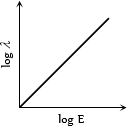
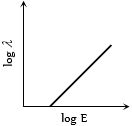
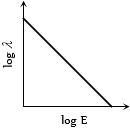
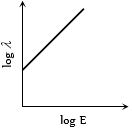
The $log-log$ graph between the energy $E$ of an electron and its de-Broglie wavelength $\lambda$ will be
- A
- B
- C
- D
Explore More
Similar Questions
The de Broglie wavelengths of an electron $(e)$,proton $(p)$,neutron $(n)$,and $\alpha$-particle are $\lambda_e, \lambda_p, \lambda_n$,and $\lambda_\alpha$ respectively. All have the same kinetic energy of $1 \ MeV$. Which of the following represents the correct increasing order of their wavelengths?
Medium
View SolutionThe wavelength associated with an electron accelerated through a potential difference of $100 \ V$ is nearly .............. $ \mathring A $
Medium
View SolutionIf $E_p$ and $E_e$ represent the kinetic energy of a photon and an electron respectively. If the de-Broglie wavelength $\lambda_p$ of a photon is twice the de-Broglie wavelength $\lambda_e$ of an electron,then $E_e / E_p$ is (Speed of electron $= C/100$,where $C$ is the velocity of light).
How much energy is imparted to an electron so that its de-Broglie wavelength reduces from $10^{-10} \ m$ to $0.5 \times 10^{-10} \ m$? (Let $E$ be the initial energy of the electron).
An electron microscope uses electrons accelerated by a voltage of $50\; kV$. Determine the de Broglie wavelength associated with the electrons. If other factors (such as numerical aperture,etc.) are taken to be roughly the same,how does the resolving power of an electron microscope compare with that of an optical microscope which uses yellow light?
Medium
View SolutionVedclass Products
For Students
Vedclass Test Series
Mock tests in real JEE/NEET style with performance analysis. 5-day free trial.
Start Free TrialFor Teachers
Exam Paper Generator
Generate Set A/B/C/D exam papers from 7.5L+ questions in 2 minutes. 3 chapters free.
Try FreeFor Institutes
Online Exam Module
Live online exams with unlimited students, 360° analytics & white-label branding.
See Demo