
A English
Meter Bridge Questions in English
Class 12 Physics · Current Electricity · Meter Bridge
120+
Questions
English
Language
100%
With Solutions
Showing 14 of 120 questions in English
101
DifficultMCQ
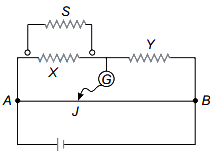
In the meter bridge experiment,the length $AB$ of the wire is $1 \ m$. The resistors $X$ and $Y$ have values $5 \ \Omega$ and $2 \ \Omega$ respectively. When a shunt resistance $S$ is connected in parallel to $X$,the balancing point is found to be $0.625 \ m$ from $A$. Then,the resistance of the shunt $S$ is (in $Omega$)
A
$5$
B
$10$
C
$7.5$
D
$12.5$
Solution
(B) Let $X'$ be the equivalent resistance of $X$ and $S$ connected in parallel.
$X' = \frac{X \cdot S}{X + S} = \frac{5S}{5 + S}$.
In a meter bridge,the balancing condition is given by $\frac{X'}{Y} = \frac{l_1}{l_2}$,where $l_1 = 0.625 \ m$ and $l_2 = 1 - 0.625 = 0.375 \ m$.
Substituting the values:
$\frac{5S / (5 + S)}{2} = \frac{0.625}{0.375}$
$\frac{5S}{2(5 + S)} = \frac{625}{375} = \frac{5}{3}$
$15S = 10(5 + S)$
$15S = 50 + 10S$
$5S = 50$
$S = 10 \ \Omega$.
$X' = \frac{X \cdot S}{X + S} = \frac{5S}{5 + S}$.
In a meter bridge,the balancing condition is given by $\frac{X'}{Y} = \frac{l_1}{l_2}$,where $l_1 = 0.625 \ m$ and $l_2 = 1 - 0.625 = 0.375 \ m$.
Substituting the values:
$\frac{5S / (5 + S)}{2} = \frac{0.625}{0.375}$
$\frac{5S}{2(5 + S)} = \frac{625}{375} = \frac{5}{3}$
$15S = 10(5 + S)$
$15S = 50 + 10S$
$5S = 50$
$S = 10 \ \Omega$.
0 likes
View Solution102
MediumMCQ
When the right gap of a meter bridge consists of two equal resistors in series,the balancing point is at $50 \ cm$. When one of the resistors in the right gap is removed and is connected in parallel to the resistor in the left gap,the balancing point is at: (in $cm$)
A
$60$
B
$33.3$
C
$25$
D
$40$
Solution
(D) Let the resistance in the left gap be $R_L$ and the resistance in the right gap be $R_R$.
In the first case,the right gap has two equal resistors $r$ in series,so $R_R = r + r = 2r$.
The balancing point is at $l_1 = 50 \ cm$.
Using the meter bridge formula: $\frac{R_L}{R_R} = \frac{l_1}{100 - l_1} \implies \frac{R_L}{2r} = \frac{50}{50} = 1 \implies R_L = 2r$.
In the second case,one resistor $r$ is removed from the right gap,so the new right resistance is $R_R' = r$.
This removed resistor $r$ is connected in parallel to $R_L$.
The new left resistance is $R_L' = \frac{R_L \cdot r}{R_L + r} = \frac{2r \cdot r}{2r + r} = \frac{2r^2}{3r} = \frac{2}{3}r$.
Let the new balancing point be $l_2$.
Then $\frac{R_L'}{R_R'} = \frac{l_2}{100 - l_2} \implies \frac{(2/3)r}{r} = \frac{l_2}{100 - l_2} \implies \frac{2}{3} = \frac{l_2}{100 - l_2}$.
$2(100 - l_2) = 3l_2 \implies 200 - 2l_2 = 3l_2 \implies 5l_2 = 200 \implies l_2 = 40 \ cm$.
In the first case,the right gap has two equal resistors $r$ in series,so $R_R = r + r = 2r$.
The balancing point is at $l_1 = 50 \ cm$.
Using the meter bridge formula: $\frac{R_L}{R_R} = \frac{l_1}{100 - l_1} \implies \frac{R_L}{2r} = \frac{50}{50} = 1 \implies R_L = 2r$.
In the second case,one resistor $r$ is removed from the right gap,so the new right resistance is $R_R' = r$.
This removed resistor $r$ is connected in parallel to $R_L$.
The new left resistance is $R_L' = \frac{R_L \cdot r}{R_L + r} = \frac{2r \cdot r}{2r + r} = \frac{2r^2}{3r} = \frac{2}{3}r$.
Let the new balancing point be $l_2$.
Then $\frac{R_L'}{R_R'} = \frac{l_2}{100 - l_2} \implies \frac{(2/3)r}{r} = \frac{l_2}{100 - l_2} \implies \frac{2}{3} = \frac{l_2}{100 - l_2}$.
$2(100 - l_2) = 3l_2 \implies 200 - 2l_2 = 3l_2 \implies 5l_2 = 200 \implies l_2 = 40 \ cm$.
0 likes
View Solution103
DifficultMCQ
In a meter bridge experiment,the ratio of the left gap resistance to the right gap resistance is $2:3$. The balance length from the left end is (in $\,cm$)
A
$20$
B
$60$
C
$50$
D
$40$
Solution
(D) In a meter bridge,the principle is given by the formula $\frac{R}{S} = \frac{l_1}{100 - l_1}$,where $R$ is the resistance in the left gap and $S$ is the resistance in the right gap.
Given the ratio $\frac{R}{S} = \frac{2}{3}$.
Substituting the values into the formula: $\frac{2}{3} = \frac{l_1}{100 - l_1}$.
Cross-multiplying gives: $2(100 - l_1) = 3l_1$.
$200 - 2l_1 = 3l_1$.
$200 = 5l_1$.
$l_1 = \frac{200}{5} = 40 \,cm$.
Therefore,the balance length from the left end is $40 \,cm$.
Given the ratio $\frac{R}{S} = \frac{2}{3}$.
Substituting the values into the formula: $\frac{2}{3} = \frac{l_1}{100 - l_1}$.
Cross-multiplying gives: $2(100 - l_1) = 3l_1$.
$200 - 2l_1 = 3l_1$.
$200 = 5l_1$.
$l_1 = \frac{200}{5} = 40 \,cm$.
Therefore,the balance length from the left end is $40 \,cm$.
0 likes
View Solution104
EasyMCQ
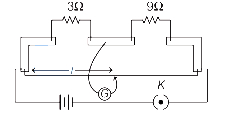
In a meter bridge,two gaps in the metallic strip are connected by $3 \Omega$ and $9 \Omega$ resistors. What should be the value of the shunt that needs to be added in parallel to the $9 \Omega$ resistor to shift the balancing point by $25 \text{ cm}$ (in $Omega$)?
A
$3.0$
B
$3.5$
C
$4.5$
D
$5.0$
Solution
(C) Let the initial balancing length be $l_1$ from the left end. The resistances in the gaps are $R_1 = 3 \Omega$ and $R_2 = 9 \Omega$.
In the initial balanced condition: $\frac{R_1}{R_2} = \frac{l_1}{100 - l_1} \Rightarrow \frac{3}{9} = \frac{l_1}{100 - l_1} \Rightarrow \frac{1}{3} = \frac{l_1}{100 - l_1}$.
$100 - l_1 = 3l_1 \Rightarrow 4l_1 = 100 \Rightarrow l_1 = 25 \text{ cm}$.
When a shunt $S$ is connected in parallel to the $9 \Omega$ resistor,the new resistance in the right gap becomes $R_2' = \frac{9S}{9+S}$.
The balancing point shifts by $25 \text{ cm}$. Since $R_2' < R_2$,the balancing point must shift towards the left. Thus,the new balancing length $l_2 = 25 - 25 = 0$ is not possible,so the shift must be towards the right,$l_2 = 25 + 25 = 50 \text{ cm}$.
For the new balance condition: $\frac{R_1}{R_2'} = \frac{l_2}{100 - l_2} \Rightarrow \frac{3}{R_2'} = \frac{50}{100 - 50} = 1$.
Therefore,$R_2' = 3 \Omega$.
Substituting $R_2' = \frac{9S}{9+S} = 3 \Rightarrow 9S = 27 + 3S \Rightarrow 6S = 27 \Rightarrow S = 4.5 \Omega$.
In the initial balanced condition: $\frac{R_1}{R_2} = \frac{l_1}{100 - l_1} \Rightarrow \frac{3}{9} = \frac{l_1}{100 - l_1} \Rightarrow \frac{1}{3} = \frac{l_1}{100 - l_1}$.
$100 - l_1 = 3l_1 \Rightarrow 4l_1 = 100 \Rightarrow l_1 = 25 \text{ cm}$.
When a shunt $S$ is connected in parallel to the $9 \Omega$ resistor,the new resistance in the right gap becomes $R_2' = \frac{9S}{9+S}$.
The balancing point shifts by $25 \text{ cm}$. Since $R_2' < R_2$,the balancing point must shift towards the left. Thus,the new balancing length $l_2 = 25 - 25 = 0$ is not possible,so the shift must be towards the right,$l_2 = 25 + 25 = 50 \text{ cm}$.
For the new balance condition: $\frac{R_1}{R_2'} = \frac{l_2}{100 - l_2} \Rightarrow \frac{3}{R_2'} = \frac{50}{100 - 50} = 1$.
Therefore,$R_2' = 3 \Omega$.
Substituting $R_2' = \frac{9S}{9+S} = 3 \Rightarrow 9S = 27 + 3S \Rightarrow 6S = 27 \Rightarrow S = 4.5 \Omega$.
0 likes
View Solution105
DifficultMCQ
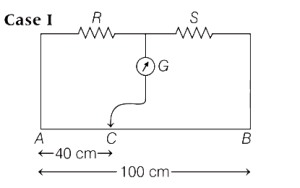
In a meter bridge,the resistances $R$ and $S$ are such that the null point is found at a distance of $40 \text{ cm}$ from one end. If a resistance of $10 \Omega$ is connected in parallel with shunt $S$,then the null point occurs at $90 \text{ cm}$ from the same end. The values of the two resistances $R$ and $S$ respectively are:
A
$83.33 \Omega$ and $125 \Omega$
B
$125 \Omega$ and $83.33 \Omega$
C
$73.33 \Omega$ and $150 \Omega$
D
$150 \Omega$ and $73.33 \Omega$
Solution
(A) Case $I$: For a balanced meter bridge,the ratio of resistances is equal to the ratio of the lengths of the wire segments.
$\frac{R}{S} = \frac{40}{100-40} = \frac{40}{60} = \frac{2}{3}$
$S = \frac{3R}{2} \quad \dots (i)$
Case $II$: When a resistance of $10 \Omega$ is connected in parallel with $S$,the new resistance $S'$ is given by:
$S' = \frac{10S}{10+S}$
The new null point is at $90 \text{ cm}$.
$\frac{R}{S'} = \frac{90}{100-90} = \frac{90}{10} = 9$
$\frac{R(10+S)}{10S} = 9 \Rightarrow R(10+S) = 90S \quad \dots (ii)$
Substitute $S = \frac{3R}{2}$ from Eq. $(i)$ into Eq. $(ii)$:
$R(10 + \frac{3R}{2}) = 90(\frac{3R}{2})$
$10 + \frac{3R}{2} = 135$
$\frac{3R}{2} = 125$
$R = \frac{250}{3} \approx 83.33 \Omega$
Now,find $S$ using Eq. $(i)$:
$S = \frac{3}{2} \times \frac{250}{3} = 125 \Omega$
Thus,$R = 83.33 \Omega$ and $S = 125 \Omega$.
$\frac{R}{S} = \frac{40}{100-40} = \frac{40}{60} = \frac{2}{3}$
$S = \frac{3R}{2} \quad \dots (i)$
Case $II$: When a resistance of $10 \Omega$ is connected in parallel with $S$,the new resistance $S'$ is given by:
$S' = \frac{10S}{10+S}$
The new null point is at $90 \text{ cm}$.
$\frac{R}{S'} = \frac{90}{100-90} = \frac{90}{10} = 9$
$\frac{R(10+S)}{10S} = 9 \Rightarrow R(10+S) = 90S \quad \dots (ii)$
Substitute $S = \frac{3R}{2}$ from Eq. $(i)$ into Eq. $(ii)$:
$R(10 + \frac{3R}{2}) = 90(\frac{3R}{2})$
$10 + \frac{3R}{2} = 135$
$\frac{3R}{2} = 125$
$R = \frac{250}{3} \approx 83.33 \Omega$
Now,find $S$ using Eq. $(i)$:
$S = \frac{3}{2} \times \frac{250}{3} = 125 \Omega$
Thus,$R = 83.33 \Omega$ and $S = 125 \Omega$.
0 likes
View Solution106
EasyMCQ
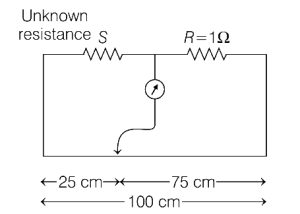
In a meter bridge,the balancing length from the left end is found to be $25 \ cm$. The value of the unknown resistance is (assume,standard resistance of $1 \ \Omega$ is in the right gap). (in $Omega$)
A
$0.25$
B
$0.33$
C
$0.20$
D
$0.50$
Solution
(B) In a meter bridge,the unknown resistance $S$ is connected in the left gap and a known resistance $R$ is connected in the right gap.
According to the principle of the Wheatstone bridge,at the balanced condition:
$\frac{S}{R} = \frac{l_1}{l_2}$
where $l_1$ is the balancing length from the left end and $l_2 = (100 - l_1)$ is the remaining length.
Given: $l_1 = 25 \ cm$,$R = 1 \ \Omega$.
Therefore,$l_2 = 100 - 25 = 75 \ cm$.
Substituting the values:
$\frac{S}{1} = \frac{25}{75}$
$S = \frac{1}{3} \ \Omega \approx 0.33 \ \Omega$.
According to the principle of the Wheatstone bridge,at the balanced condition:
$\frac{S}{R} = \frac{l_1}{l_2}$
where $l_1$ is the balancing length from the left end and $l_2 = (100 - l_1)$ is the remaining length.
Given: $l_1 = 25 \ cm$,$R = 1 \ \Omega$.
Therefore,$l_2 = 100 - 25 = 75 \ cm$.
Substituting the values:
$\frac{S}{1} = \frac{25}{75}$
$S = \frac{1}{3} \ \Omega \approx 0.33 \ \Omega$.
0 likes
View Solution107
MediumMCQ
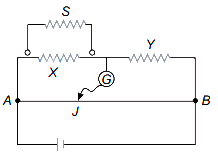
In the meter bridge experiment, the length $AB$ of the wire is $1 \, m$. The resistors $X$ and $Y$ have values $5 \, \Omega$ and $2 \, \Omega$ respectively. When a shunt resistance $S$ is connected in parallel to $X$, the balancing point is found to be $0.625 \, m$ from $A$. Then, the resistance of the shunt $S$ is
A
$5 \, \Omega$
B
$10 \, \Omega$
C
$7.5 \, \Omega$
D
$12.5 \, \Omega$
Solution
(B) Let $X'$ be the equivalent resistance of $X$ and $S$ connected in parallel.
$X' = \frac{X \cdot S}{X + S} = \frac{5S}{5 + S}$.
In a meter bridge, the balancing condition is given by $\frac{X'}{Y} = \frac{l_1}{l_2}$, where $l_1 = 0.625 \, m$ and $l_2 = 1 - 0.625 = 0.375 \, m$.
Substituting the values: $\frac{5S / (5 + S)}{2} = \frac{0.625}{0.375}$.
$\frac{5S}{2(5 + S)} = \frac{625}{375} = \frac{5}{3}$.
$15S = 10(5 + S)$.
$15S = 50 + 10S$.
$5S = 50$.
$S = 10 \, \Omega$.
$X' = \frac{X \cdot S}{X + S} = \frac{5S}{5 + S}$.
In a meter bridge, the balancing condition is given by $\frac{X'}{Y} = \frac{l_1}{l_2}$, where $l_1 = 0.625 \, m$ and $l_2 = 1 - 0.625 = 0.375 \, m$.
Substituting the values: $\frac{5S / (5 + S)}{2} = \frac{0.625}{0.375}$.
$\frac{5S}{2(5 + S)} = \frac{625}{375} = \frac{5}{3}$.
$15S = 10(5 + S)$.
$15S = 50 + 10S$.
$5S = 50$.
$S = 10 \, \Omega$.
0 likes
View Solution108
MediumMCQ
In a metre bridge experiment,the ratio of the left gap resistance to the right gap resistance is $2:3$. The balance point from the left is: (in $cm$)
A
$60$
B
$50$
C
$40$
D
$20$
Solution
(C) In a metre bridge,the condition for the balance point is given by the formula: $\frac{P}{Q} = \frac{l}{100-l}$,where $P$ is the resistance in the left gap,$Q$ is the resistance in the right gap,and $l$ is the balance length from the left end.
Given the ratio $\frac{P}{Q} = \frac{2}{3}$.
Substituting the values into the formula:
$\frac{2}{3} = \frac{l}{100-l}$
Cross-multiplying gives:
$2(100-l) = 3l$
$200 - 2l = 3l$
$200 = 5l$
$l = \frac{200}{5} = 40 \ cm$.
Therefore,the balance point from the left is $40 \ cm$.
Given the ratio $\frac{P}{Q} = \frac{2}{3}$.
Substituting the values into the formula:
$\frac{2}{3} = \frac{l}{100-l}$
Cross-multiplying gives:
$2(100-l) = 3l$
$200 - 2l = 3l$
$200 = 5l$
$l = \frac{200}{5} = 40 \ cm$.
Therefore,the balance point from the left is $40 \ cm$.
0 likes
View Solution109
DifficultMCQ
In a meter bridge,a $30 \Omega$ resistance is connected in the left gap and a pair of resistances $P$ and $Q$ in the right gap. Measured from the left,the balance point is $37.5 \text{ cm}$ when $P$ and $Q$ are in series,and $71.4 \text{ cm}$ when they are in parallel. The values of $P$ and $Q$ (in $\Omega$) are:
A
$40$,$10$
B
$35$,$15$
C
$30$,$20$
D
$25$,$25$
Solution
(C) For a meter bridge,the balance condition is given by $\frac{R_1}{R_2} = \frac{l}{100-l}$,where $R_1$ is the resistance in the left gap and $R_2$ is the resistance in the right gap.
Case $I$: $P$ and $Q$ are in series,so $R_2 = P + Q$.
$\frac{30}{P+Q} = \frac{37.5}{100-37.5} = \frac{37.5}{62.5} = 0.6$
$P+Q = \frac{30}{0.6} = 50 \Omega$ ... $(i)$
Case $II$: $P$ and $Q$ are in parallel,so $R_2 = \frac{PQ}{P+Q}$.
$\frac{30}{\frac{PQ}{P+Q}} = \frac{71.4}{100-71.4} = \frac{71.4}{28.6} \approx 2.5$
$\frac{30(P+Q)}{PQ} = 2.5$
Since $P+Q = 50$,we have $\frac{30 \times 50}{PQ} = 2.5$
$PQ = \frac{1500}{2.5} = 600 \Omega^2$ ... $(ii)$
From $(i)$ and $(ii)$,we have a quadratic equation $x^2 - 50x + 600 = 0$.
$(x-30)(x-20) = 0$.
Thus,the values are $30 \Omega$ and $20 \Omega$.
Case $I$: $P$ and $Q$ are in series,so $R_2 = P + Q$.
$\frac{30}{P+Q} = \frac{37.5}{100-37.5} = \frac{37.5}{62.5} = 0.6$
$P+Q = \frac{30}{0.6} = 50 \Omega$ ... $(i)$
Case $II$: $P$ and $Q$ are in parallel,so $R_2 = \frac{PQ}{P+Q}$.
$\frac{30}{\frac{PQ}{P+Q}} = \frac{71.4}{100-71.4} = \frac{71.4}{28.6} \approx 2.5$
$\frac{30(P+Q)}{PQ} = 2.5$
Since $P+Q = 50$,we have $\frac{30 \times 50}{PQ} = 2.5$
$PQ = \frac{1500}{2.5} = 600 \Omega^2$ ... $(ii)$
From $(i)$ and $(ii)$,we have a quadratic equation $x^2 - 50x + 600 = 0$.
$(x-30)(x-20) = 0$.
Thus,the values are $30 \Omega$ and $20 \Omega$.

0 likes
View Solution110
EasyMCQ
In a meter bridge experiment,the balance point from the left is $37.5 \ cm$. The ratio of the right gap resistance to the left gap resistance is
A
$\frac{5}{3}$
B
$\frac{8}{5}$
C
$\frac{4}{5}$
D
$\frac{3}{2}$
Solution
(A) The meter bridge works on the principle of a balanced Wheatstone bridge.
Let $R_L$ be the resistance in the left gap and $R_R$ be the resistance in the right gap.
The balance point is at $l = 37.5 \ cm$ from the left.
The length of the wire in the right gap is $100 - l = 100 - 37.5 = 62.5 \ cm$.
According to the Wheatstone bridge principle,$\frac{R_L}{R_R} = \frac{l}{100-l}$.
Substituting the values,$\frac{R_L}{R_R} = \frac{37.5}{62.5} = \frac{3}{5}$.
The question asks for the ratio of the right gap resistance to the left gap resistance,which is $\frac{R_R}{R_L}$.
Therefore,$\frac{R_R}{R_L} = \frac{62.5}{37.5} = \frac{5}{3}$.
Let $R_L$ be the resistance in the left gap and $R_R$ be the resistance in the right gap.
The balance point is at $l = 37.5 \ cm$ from the left.
The length of the wire in the right gap is $100 - l = 100 - 37.5 = 62.5 \ cm$.
According to the Wheatstone bridge principle,$\frac{R_L}{R_R} = \frac{l}{100-l}$.
Substituting the values,$\frac{R_L}{R_R} = \frac{37.5}{62.5} = \frac{3}{5}$.
The question asks for the ratio of the right gap resistance to the left gap resistance,which is $\frac{R_R}{R_L}$.
Therefore,$\frac{R_R}{R_L} = \frac{62.5}{37.5} = \frac{5}{3}$.
0 likes
View Solution111
DifficultMCQ
In a meter bridge experiment to determine the value of an unknown resistance,first the resistances $2 \Omega$ and $3 \Omega$ are connected in the left and right gaps of the bridge and the null point is obtained at a distance $l \ cm$ from the left. Now when an unknown resistance $x \ \Omega$ is connected in parallel to $3 \ \Omega$ resistance,the null point is shifted by $10 \ cm$ to the right of the wire. The value of unknown resistance $x$ is . . . . . . $\Omega$.
A
$3$
B
$9$
C
$6$
D
$12$
Solution
(C) In case $I$,the resistances are $R_1 = 2 \ \Omega$ and $R_2 = 3 \ \Omega$. The null point is at $l$. Using the meter bridge formula: $\frac{R_1}{R_2} = \frac{l}{100-l} \implies \frac{2}{3} = \frac{l}{100-l}$.
Solving this,$200 - 2l = 3l \implies 5l = 200 \implies l = 40 \ cm$.
In case $II$,the resistance in the right gap becomes $R_2' = \frac{3x}{3+x}$ because $x$ is connected in parallel to $3 \ \Omega$. The null point shifts by $10 \ cm$ to the right,so the new position is $l' = 40 + 10 = 50 \ cm$.
Using the formula: $\frac{R_1}{R_2'} = \frac{l'}{100-l'} \implies \frac{2}{\frac{3x}{3+x}} = \frac{50}{100-50} = \frac{50}{50} = 1$.
Therefore,$\frac{2(3+x)}{3x} = 1 \implies 6 + 2x = 3x \implies x = 6 \ \Omega$.
Solving this,$200 - 2l = 3l \implies 5l = 200 \implies l = 40 \ cm$.
In case $II$,the resistance in the right gap becomes $R_2' = \frac{3x}{3+x}$ because $x$ is connected in parallel to $3 \ \Omega$. The null point shifts by $10 \ cm$ to the right,so the new position is $l' = 40 + 10 = 50 \ cm$.
Using the formula: $\frac{R_1}{R_2'} = \frac{l'}{100-l'} \implies \frac{2}{\frac{3x}{3+x}} = \frac{50}{100-50} = \frac{50}{50} = 1$.
Therefore,$\frac{2(3+x)}{3x} = 1 \implies 6 + 2x = 3x \implies x = 6 \ \Omega$.
0 likes
View Solution112
MediumMCQ
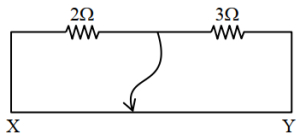
Two resistors $2 \Omega$ and $3 \Omega$ are connected in the gaps of a meter bridge as shown in the figure. The null point is obtained with the contact of the jockey at some point on the wire $XY$. When an unknown resistor $R$ is connected in parallel with the $3 \Omega$ resistor,the null point is shifted by $22.5 \text{ cm}$ toward $Y$. The resistance of the unknown resistor $R$ is . . . . . . $\Omega$.
A
$3$
B
$2$
C
$4$
D
$1$
Solution
(B) Initially,for a meter bridge,the balance condition is given by $\frac{P}{Q} = \frac{l}{100-l}$.
Given $P = 2 \Omega$ and $Q = 3 \Omega$,we have $\frac{2}{3} = \frac{l}{100-l}$.
$2(100-l) = 3l \Rightarrow 200 - 2l = 3l \Rightarrow 5l = 200 \Rightarrow l = 40 \text{ cm}$.
When an unknown resistor $R$ is connected in parallel with $3 \Omega$,the new resistance $Q'$ becomes $\frac{3R}{3+R}$.
The null point shifts by $22.5 \text{ cm}$ toward $Y$,so the new length $l' = 40 + 22.5 = 62.5 \text{ cm}$.
The new balance condition is $\frac{2}{Q'} = \frac{62.5}{100-62.5} = \frac{62.5}{37.5} = \frac{5}{3}$.
Substituting $Q'$,we get $\frac{2}{\frac{3R}{3+R}} = \frac{5}{3} \Rightarrow \frac{2(3+R)}{3R} = \frac{5}{3}$.
$6(3+R) = 15R \Rightarrow 18 + 6R = 15R \Rightarrow 9R = 18 \Rightarrow R = 2 \Omega$.
Given $P = 2 \Omega$ and $Q = 3 \Omega$,we have $\frac{2}{3} = \frac{l}{100-l}$.
$2(100-l) = 3l \Rightarrow 200 - 2l = 3l \Rightarrow 5l = 200 \Rightarrow l = 40 \text{ cm}$.
When an unknown resistor $R$ is connected in parallel with $3 \Omega$,the new resistance $Q'$ becomes $\frac{3R}{3+R}$.
The null point shifts by $22.5 \text{ cm}$ toward $Y$,so the new length $l' = 40 + 22.5 = 62.5 \text{ cm}$.
The new balance condition is $\frac{2}{Q'} = \frac{62.5}{100-62.5} = \frac{62.5}{37.5} = \frac{5}{3}$.
Substituting $Q'$,we get $\frac{2}{\frac{3R}{3+R}} = \frac{5}{3} \Rightarrow \frac{2(3+R)}{3R} = \frac{5}{3}$.
$6(3+R) = 15R \Rightarrow 18 + 6R = 15R \Rightarrow 9R = 18 \Rightarrow R = 2 \Omega$.
0 likes
View Solution113
DifficultMCQ
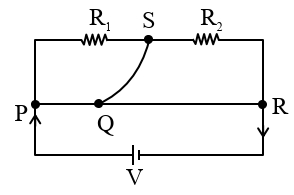
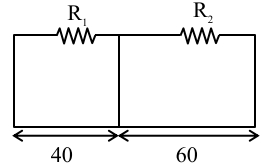
$A$ meter bridge with two resistances $R_{1}$ and $R_{2}$ as shown in the figure was balanced (null point) at $40 \text{ cm}$ from the point $P$. The null point changed to $50 \text{ cm}$ from the point $P$,when a $16 \ \Omega$ resistance is connected in parallel to $R_{2}$. The values of resistances $R_{1}$ and $R_{2}$ are . . . . . . .
A
$R_{2}=16 \ \Omega, R_{1}=\frac{16}{3} \ \Omega$
B
$R_{2}=4 \ \Omega, R_{1}=\frac{4}{3} \ \Omega$
C
$R_{2}=8 \ \Omega, R_{1}=\frac{16}{3} \ \Omega$
D
$R_{2}=12 \ \Omega, R_{1}=\frac{12}{3} \ \Omega$
Solution
(C) For a meter bridge,the balancing condition is given by $\frac{R_{1}}{R_{2}} = \frac{l}{100-l}$.
Initially,the null point is at $40 \text{ cm}$,so $l = 40 \text{ cm}$:
$\frac{R_{1}}{R_{2}} = \frac{40}{60} = \frac{2}{3} \implies R_{1} = \frac{2}{3}R_{2} \quad ... (1)$
When a $16 \ \Omega$ resistance is connected in parallel to $R_{2}$,the new equivalent resistance $R_{2}'$ is $\frac{R_{2} \times 16}{R_{2} + 16}$.
The new null point is at $50 \text{ cm}$,so $l = 50 \text{ cm}$:
$\frac{R_{1}}{R_{2}'} = \frac{50}{50} = 1 \implies R_{1} = R_{2}' = \frac{16R_{2}}{R_{2} + 16} \quad ... (2)$
Equating $(1)$ and $(2)$:
$\frac{2}{3}R_{2} = \frac{16R_{2}}{R_{2} + 16}$
$\frac{1}{3} = \frac{8}{R_{2} + 16} \implies R_{2} + 16 = 24 \implies R_{2} = 8 \ \Omega$.
Substituting $R_{2} = 8 \ \Omega$ into equation $(1)$:
$R_{1} = \frac{2}{3} \times 8 = \frac{16}{3} \ \Omega$.
Initially,the null point is at $40 \text{ cm}$,so $l = 40 \text{ cm}$:
$\frac{R_{1}}{R_{2}} = \frac{40}{60} = \frac{2}{3} \implies R_{1} = \frac{2}{3}R_{2} \quad ... (1)$
When a $16 \ \Omega$ resistance is connected in parallel to $R_{2}$,the new equivalent resistance $R_{2}'$ is $\frac{R_{2} \times 16}{R_{2} + 16}$.
The new null point is at $50 \text{ cm}$,so $l = 50 \text{ cm}$:
$\frac{R_{1}}{R_{2}'} = \frac{50}{50} = 1 \implies R_{1} = R_{2}' = \frac{16R_{2}}{R_{2} + 16} \quad ... (2)$
Equating $(1)$ and $(2)$:
$\frac{2}{3}R_{2} = \frac{16R_{2}}{R_{2} + 16}$
$\frac{1}{3} = \frac{8}{R_{2} + 16} \implies R_{2} + 16 = 24 \implies R_{2} = 8 \ \Omega$.
Substituting $R_{2} = 8 \ \Omega$ into equation $(1)$:
$R_{1} = \frac{2}{3} \times 8 = \frac{16}{3} \ \Omega$.
0 likes
View Solution114
MediumMCQ
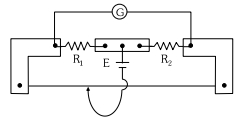
In a metre bridge experiment (see figure),the positions of the cell,$E$,and galvanometer,$G$,are interchanged. We shall observe in the galvanometer:
A
Only the right-sided deflection
B
Only the left-sided deflection
C
There will be no deflection irrespective of the position of the jockey
D
Both right-sided and left-sided deflection and at balance point,no deflection
Solution
(D) In a Wheatstone bridge (of which the metre bridge is a form),the galvanometer and the cell (battery) are conjugate branches.
According to the reciprocity theorem,interchanging the positions of the battery and the galvanometer does not change the condition of the bridge balance.
If it was balanced,it remains balanced; if it was unbalanced,the deflection might change in magnitude or direction,but it will still show a balance point.
Therefore,both deflections can be observed depending on the jockey position,and null deflection will still occur at the balance point.
Thus,option $D$ is correct.
According to the reciprocity theorem,interchanging the positions of the battery and the galvanometer does not change the condition of the bridge balance.
If it was balanced,it remains balanced; if it was unbalanced,the deflection might change in magnitude or direction,but it will still show a balance point.
Therefore,both deflections can be observed depending on the jockey position,and null deflection will still occur at the balance point.
Thus,option $D$ is correct.
0 likes
View SolutionCurrent Electricity — Meter Bridge · Frequently Asked Questions
1Are these Current Electricity questions useful for JEE and NEET?
Yes. All questions in this section are mapped to JEE Main and NEET exam patterns. Previous year questions from JEE Main, NEET, GUJCET and state-level exams are included with full solutions.
2Can I switch to Hindi or Gujarati for these questions?
Yes. Use the language tabs in the hero section or the sidebar to view the same questions and solutions in English, Hindi or Gujarati.
3How do I generate a question paper from this subtopic?
Use the Vedclass Exam Paper Generator — select the chapter and subtopic, set difficulty, and generate Sets A, B, C, D automatically. First 3 chapters of every subject are free.
Vedclass Products
For Students
Vedclass Test Series
Mock tests in real JEE/NEET style with performance analysis. 5-day free trial.
Start Free TrialFor Teachers
Exam Paper Generator
Generate Set A/B/C/D papers from this chapter in 2 minutes. 3 chapters free.
Try FreeFor Institutes
Online Exam Module
Live online exams with unlimited students, 360° analytics & white-label branding.
See DemoFor Teachers & Institutes
Generate a Current Electricity Exam Paper in 2 Minutes
Select subtopic & difficulty — Sets A, B, C, D auto-generated with No Repeat logic.
First 3 chapters of every subject are free — no payment required.