
A English
Word problem of Linear programming Questions in English
Class 12 Mathematics · Linear Programming · Word problem of Linear programming
131+
Questions
English
Language
100%
With Solutions
Showing 49 of 131 questions in English
51
DifficultMCQ
The objective function $z=x_1+x_2$,subject to $x_1+x_2 \leq 10, -2x_1+3x_2 \leq 15, x_1 \leq 6, x_1, x_2 \geq 0$,has a maximum value at:
A
at only one point
B
at only two points
C
at every point of the segment joining two points
D
at every point of the line joining two points
Solution
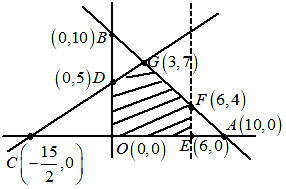
(C) The feasible region is determined by the constraints $x_1+x_2 \leq 10$,$-2x_1+3x_2 \leq 15$,$x_1 \leq 6$,and $x_1, x_2 \geq 0$. The corner points of the feasible region are $O(0,0)$,$E(6,0)$,$F(6,4)$,$G(3,7)$,and $D(0,5)$.
We evaluate the objective function $z=x_1+x_2$ at these corner points:
$z(O) = 0+0 = 0$
$z(E) = 6+0 = 6$
$z(F) = 6+4 = 10$
$z(G) = 3+7 = 10$
$z(D) = 0+5 = 5$
The maximum value of $z$ is $10$,which occurs at both corner points $F(6,4)$ and $G(3,7)$.
Since the objective function is maximized at two distinct corner points,it will have the same maximum value at every point on the line segment joining these two points.
We evaluate the objective function $z=x_1+x_2$ at these corner points:
$z(O) = 0+0 = 0$
$z(E) = 6+0 = 6$
$z(F) = 6+4 = 10$
$z(G) = 3+7 = 10$
$z(D) = 0+5 = 5$
The maximum value of $z$ is $10$,which occurs at both corner points $F(6,4)$ and $G(3,7)$.
Since the objective function is maximized at two distinct corner points,it will have the same maximum value at every point on the line segment joining these two points.
0 likes
View Solution52
MediumMCQ
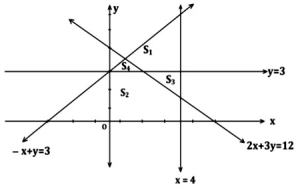
The feasible region represented by the given constraints $2x + 3y \geqslant 12$,$-x + y \leqslant 3$,$x \leqslant 4$,$y \geqslant 3$ is denoted by
A
$S_1$
B
$S_2$
C
$S_3$
D
$S_4$
Solution
(D) To find the feasible region,we analyze the given constraints:
$1$. $2x + 3y \geqslant 12$: The region is on or above the line $2x + 3y = 12$.
$2$. $-x + y \leqslant 3$: The region is on or below the line $-x + y = 3$.
$3$. $x \leqslant 4$: The region is to the left of the line $x = 4$.
$4$. $y \geqslant 3$: The region is on or above the line $y = 3$.
By observing the graph and testing the constraints:
- The region $S_1$ is above $y=3$,to the left of $x=4$,above $2x+3y=12$,and above $-x+y=3$. This does not satisfy the constraints.
- The region $S_4$ is bounded by $y=3$,$x=4$,$-x+y=3$,and $2x+3y=12$. Checking a point in $S_4$,say $(1, 4)$:
- $2(1) + 3(4) = 14 \geqslant 12$ (True)
- $-(1) + 4 = 3 \leqslant 3$ (True)
- $1 \leqslant 4$ (True)
- $4 \geqslant 3$ (True)
All constraints are satisfied in region $S_4$.
$1$. $2x + 3y \geqslant 12$: The region is on or above the line $2x + 3y = 12$.
$2$. $-x + y \leqslant 3$: The region is on or below the line $-x + y = 3$.
$3$. $x \leqslant 4$: The region is to the left of the line $x = 4$.
$4$. $y \geqslant 3$: The region is on or above the line $y = 3$.
By observing the graph and testing the constraints:
- The region $S_1$ is above $y=3$,to the left of $x=4$,above $2x+3y=12$,and above $-x+y=3$. This does not satisfy the constraints.
- The region $S_4$ is bounded by $y=3$,$x=4$,$-x+y=3$,and $2x+3y=12$. Checking a point in $S_4$,say $(1, 4)$:
- $2(1) + 3(4) = 14 \geqslant 12$ (True)
- $-(1) + 4 = 3 \leqslant 3$ (True)
- $1 \leqslant 4$ (True)
- $4 \geqslant 3$ (True)
All constraints are satisfied in region $S_4$.
0 likes
View Solution53
EasyMCQ
The feasible region for the constraints $x-2 \leqslant y$,$x \geqslant y-1$,$x \geqslant 2$,$y \leqslant 4$,$x, y \geqslant 0$ is represented by:
A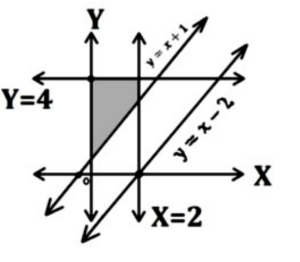
B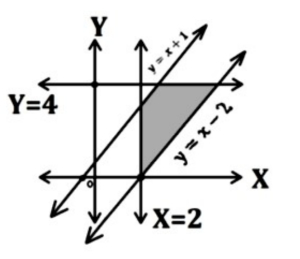
C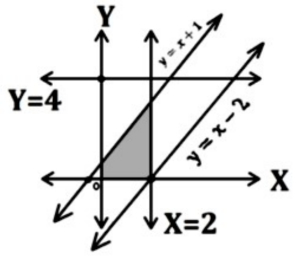
D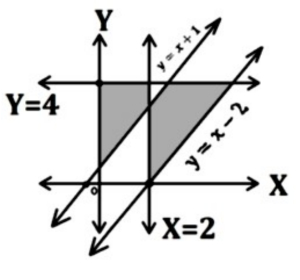
Solution
(B) The given constraints are:
$1$) $x - 2 \leqslant y \implies y \geqslant x - 2$
$2$) $x \geqslant y - 1 \implies y \leqslant x + 1$
$3$) $x \geqslant 2$
$4$) $y \leqslant 4$
$5$) $x, y \geqslant 0$
Analyzing these inequalities:
- The line $y = x - 2$ passes through $(2, 0)$ and $(4, 2)$. The region $y \geqslant x - 2$ is above this line.
- The line $y = x + 1$ passes through $(0, 1)$ and $(3, 4)$. The region $y \leqslant x + 1$ is below this line.
- The constraint $x \geqslant 2$ restricts the region to the right of the vertical line $x = 2$.
- The constraint $y \leqslant 4$ restricts the region below the horizontal line $y = 4$.
Combining these,the feasible region is bounded by $x = 2$,$y = x - 2$,$y = x + 1$,and $y = 4$. This corresponds to the shaded region in option $B$.
$1$) $x - 2 \leqslant y \implies y \geqslant x - 2$
$2$) $x \geqslant y - 1 \implies y \leqslant x + 1$
$3$) $x \geqslant 2$
$4$) $y \leqslant 4$
$5$) $x, y \geqslant 0$
Analyzing these inequalities:
- The line $y = x - 2$ passes through $(2, 0)$ and $(4, 2)$. The region $y \geqslant x - 2$ is above this line.
- The line $y = x + 1$ passes through $(0, 1)$ and $(3, 4)$. The region $y \leqslant x + 1$ is below this line.
- The constraint $x \geqslant 2$ restricts the region to the right of the vertical line $x = 2$.
- The constraint $y \leqslant 4$ restricts the region below the horizontal line $y = 4$.
Combining these,the feasible region is bounded by $x = 2$,$y = x - 2$,$y = x + 1$,and $y = 4$. This corresponds to the shaded region in option $B$.
0 likes
View Solution54
MediumMCQ
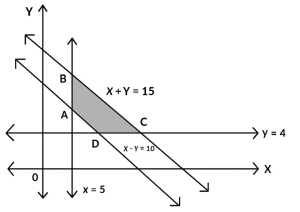
$A$ scholarship amount is given by $z = 550x + 300y$ and is to be distributed among $x$ boys and $y$ girls. From the graph given below,the maximum amount of scholarship is . . . . . . .
A
$7250$
B
$9250$
C
$4250$
D
$5750$
Solution
(A) The feasible region is bounded by the vertices $A, B, C$.
From the graph,the lines are $x = 5$,$y = 4$,$x + y = 15$,and $x - y = 10$.
$1$. Vertex $A$ is the intersection of $x = 5$ and $x - y = 10$. Substituting $x = 5$,we get $5 - y = 10$,so $y = -5$. However,the region is in the first quadrant,so we look at the intersection of $x = 5$ and $x + y = 15$,which is $(5, 10)$.
$2$. Vertex $B$ is the intersection of $x = 5$ and $x + y = 15$,which is $(5, 10)$.
$3$. Vertex $C$ is the intersection of $y = 4$ and $x + y = 15$,which is $(11, 4)$.
$4$. Vertex $D$ is the intersection of $y = 4$ and $x - y = 10$,which is $(14, 4)$.
Wait,looking at the shaded region,the vertices are $A(5, 5)$,$B(5, 10)$,and $C(11, 4)$.
- At $A(5, 5)$: $z = 550(5) + 300(5) = 2750 + 1500 = 4250$.
- At $B(5, 10)$: $z = 550(5) + 300(10) = 2750 + 3000 = 5750$.
- At $C(11, 4)$: $z = 550(11) + 300(4) = 6050 + 1200 = 7250$.
The maximum value is $7250$.
From the graph,the lines are $x = 5$,$y = 4$,$x + y = 15$,and $x - y = 10$.
$1$. Vertex $A$ is the intersection of $x = 5$ and $x - y = 10$. Substituting $x = 5$,we get $5 - y = 10$,so $y = -5$. However,the region is in the first quadrant,so we look at the intersection of $x = 5$ and $x + y = 15$,which is $(5, 10)$.
$2$. Vertex $B$ is the intersection of $x = 5$ and $x + y = 15$,which is $(5, 10)$.
$3$. Vertex $C$ is the intersection of $y = 4$ and $x + y = 15$,which is $(11, 4)$.
$4$. Vertex $D$ is the intersection of $y = 4$ and $x - y = 10$,which is $(14, 4)$.
Wait,looking at the shaded region,the vertices are $A(5, 5)$,$B(5, 10)$,and $C(11, 4)$.
- At $A(5, 5)$: $z = 550(5) + 300(5) = 2750 + 1500 = 4250$.
- At $B(5, 10)$: $z = 550(5) + 300(10) = 2750 + 3000 = 5750$.
- At $C(11, 4)$: $z = 550(11) + 300(4) = 6050 + 1200 = 7250$.
The maximum value is $7250$.
0 likes
View Solution55
MediumMCQ
The Linear Programming Problem ($L$.$P$.$P$.) to minimize $z = 30x + 20y$ subject to the constraints $x + y \leqslant 8$,$x + 2y \geqslant 4$,$6x + 4y \geqslant 12$,$x \geqslant 0$,and $y \geqslant 0$ has:
A
a unique solution
B
infinitely many solutions
C
minimum value at $(4, 0)$
D
no feasible solution
Solution
(B) To solve the $L$.$P$.$P$.,we identify the feasible region defined by the constraints:
$1$. $x + y \leqslant 8$
$2$. $x + 2y \geqslant 4$
$3$. $6x + 4y \geqslant 12$ (or $3x + 2y \geqslant 6$)
$4$. $x \geqslant 0, y \geqslant 0$
The corner points of the feasible region are determined by the intersection of these lines:
- Intersection of $x + 2y = 4$ and $3x + 2y = 6$: Subtracting gives $2x = 2$,so $x = 1$. Then $1 + 2y = 4 \implies y = 1.5$. Point: $(1, 1.5)$.
- Intersection of $x + y = 8$ and $x + 2y = 4$: $y = -4$,which is outside the first quadrant.
- Intersection of $x + y = 8$ and $3x + 2y = 6$: $y = -18$,outside the first quadrant.
- Boundary points on axes: $(0, 3)$ from $3x + 2y = 6$,$(0, 2)$ from $x + 2y = 4$,$(8, 0)$ from $x + y = 8$,$(2, 0)$ from $3x + 2y = 6$.
Evaluating $z = 30x + 20y$ at corner points:
- At $(0, 3)$,$z = 30(0) + 20(3) = 60$.
- At $(1, 1.5)$,$z = 30(1) + 20(1.5) = 30 + 30 = 60$.
- At $(8, 0)$,$z = 30(8) + 20(0) = 240$.
- At $(2, 0)$,$z = 30(2) + 20(0) = 60$.
Since the objective function $z$ takes the same minimum value of $60$ at multiple points on the line segment connecting $(0, 3)$ and $(2, 0)$ (specifically,the segment between $(0, 3)$ and $(1, 1.5)$ and $(1, 1.5)$ and $(2, 0)$),the $L$.$P$.$P$. has infinitely many solutions.
$1$. $x + y \leqslant 8$
$2$. $x + 2y \geqslant 4$
$3$. $6x + 4y \geqslant 12$ (or $3x + 2y \geqslant 6$)
$4$. $x \geqslant 0, y \geqslant 0$
The corner points of the feasible region are determined by the intersection of these lines:
- Intersection of $x + 2y = 4$ and $3x + 2y = 6$: Subtracting gives $2x = 2$,so $x = 1$. Then $1 + 2y = 4 \implies y = 1.5$. Point: $(1, 1.5)$.
- Intersection of $x + y = 8$ and $x + 2y = 4$: $y = -4$,which is outside the first quadrant.
- Intersection of $x + y = 8$ and $3x + 2y = 6$: $y = -18$,outside the first quadrant.
- Boundary points on axes: $(0, 3)$ from $3x + 2y = 6$,$(0, 2)$ from $x + 2y = 4$,$(8, 0)$ from $x + y = 8$,$(2, 0)$ from $3x + 2y = 6$.
Evaluating $z = 30x + 20y$ at corner points:
- At $(0, 3)$,$z = 30(0) + 20(3) = 60$.
- At $(1, 1.5)$,$z = 30(1) + 20(1.5) = 30 + 30 = 60$.
- At $(8, 0)$,$z = 30(8) + 20(0) = 240$.
- At $(2, 0)$,$z = 30(2) + 20(0) = 60$.
Since the objective function $z$ takes the same minimum value of $60$ at multiple points on the line segment connecting $(0, 3)$ and $(2, 0)$ (specifically,the segment between $(0, 3)$ and $(1, 1.5)$ and $(1, 1.5)$ and $(2, 0)$),the $L$.$P$.$P$. has infinitely many solutions.
0 likes
View Solution56
MediumMCQ
The solution set for minimizing the function $z = x + y$ with constraints $x + y \geqslant 2$,$x + 2y \leqslant 8$,$y \leqslant 3$,$x, y \geqslant 0$ contains
A
$x = 0, y = 3$
B
$x = 8, y = 0$
C
infinitely many points
D
$x = 2, y = 3$
Solution
(C) To minimize $z = x + y$ subject to the constraints:
$1$) $x + y \geqslant 2$
$2$) $x + 2y \leqslant 8$
$3$) $y \leqslant 3$
$4$) $x, y \geqslant 0$
First,we identify the feasible region by plotting the lines:
- $x + y = 2$ passes through $(2, 0)$ and $(0, 2)$.
- $x + 2y = 8$ passes through $(8, 0)$ and $(0, 4)$.
- $y = 3$ is a horizontal line.
The vertices of the feasible region are found by the intersection of these lines:
- Intersection of $x + y = 2$ and $x = 0$ is $(0, 2)$.
- Intersection of $x + y = 2$ and $y = 0$ is $(2, 0)$.
- Intersection of $x + 2y = 8$ and $y = 0$ is $(8, 0)$ (but this is outside the region $y \leqslant 3$ and $x+y \geqslant 2$ constraints).
- Intersection of $x + 2y = 8$ and $y = 3$ is $x + 6 = 8 \implies x = 2$,so $(2, 3)$.
- Intersection of $x = 0$ and $y = 3$ is $(0, 3)$.
The corner points of the feasible region are $(0, 2), (2, 0), (2, 3), (0, 3)$.
Evaluating $z = x + y$ at these points:
- At $(0, 2)$,$z = 0 + 2 = 2$.
- At $(2, 0)$,$z = 2 + 0 = 2$.
- At $(2, 3)$,$z = 2 + 3 = 5$.
- At $(0, 3)$,$z = 0 + 3 = 3$.
The minimum value is $2$,which occurs at all points on the line segment connecting $(0, 2)$ and $(2, 0)$. Since a line segment contains infinitely many points,the solution set contains infinitely many points.
$1$) $x + y \geqslant 2$
$2$) $x + 2y \leqslant 8$
$3$) $y \leqslant 3$
$4$) $x, y \geqslant 0$
First,we identify the feasible region by plotting the lines:
- $x + y = 2$ passes through $(2, 0)$ and $(0, 2)$.
- $x + 2y = 8$ passes through $(8, 0)$ and $(0, 4)$.
- $y = 3$ is a horizontal line.
The vertices of the feasible region are found by the intersection of these lines:
- Intersection of $x + y = 2$ and $x = 0$ is $(0, 2)$.
- Intersection of $x + y = 2$ and $y = 0$ is $(2, 0)$.
- Intersection of $x + 2y = 8$ and $y = 0$ is $(8, 0)$ (but this is outside the region $y \leqslant 3$ and $x+y \geqslant 2$ constraints).
- Intersection of $x + 2y = 8$ and $y = 3$ is $x + 6 = 8 \implies x = 2$,so $(2, 3)$.
- Intersection of $x = 0$ and $y = 3$ is $(0, 3)$.
The corner points of the feasible region are $(0, 2), (2, 0), (2, 3), (0, 3)$.
Evaluating $z = x + y$ at these points:
- At $(0, 2)$,$z = 0 + 2 = 2$.
- At $(2, 0)$,$z = 2 + 0 = 2$.
- At $(2, 3)$,$z = 2 + 3 = 5$.
- At $(0, 3)$,$z = 0 + 3 = 3$.
The minimum value is $2$,which occurs at all points on the line segment connecting $(0, 2)$ and $(2, 0)$. Since a line segment contains infinitely many points,the solution set contains infinitely many points.
0 likes
View Solution57
MediumMCQ
If the difference between the maximum and minimum values of the objective function $z = 7x - 8y$ subject to the constraints $x + y \leqslant 20$,$y \geqslant 5$,$x, y \geqslant 0$ is $5k + 200$,then the value of $k$ is
A
$3$
B
$4$
C
$5$
D
$6$
Solution
(C) The constraints are $x + y \leqslant 20$,$y \geqslant 5$,and $x \geqslant 0$.
The feasible region is a triangle with vertices determined by the intersection of these lines:
$1$. Intersection of $y = 5$ and $x = 0$: $(0, 5)$.
$2$. Intersection of $x + y = 20$ and $y = 5$: $(15, 5)$.
$3$. Intersection of $x + y = 20$ and $x = 0$: $(0, 20)$.
Now,evaluate $z = 7x - 8y$ at these vertices:
At $(0, 5)$: $z = 7(0) - 8(5) = -40$.
At $(15, 5)$: $z = 7(15) - 8(5) = 105 - 40 = 65$.
At $(0, 20)$: $z = 7(0) - 8(20) = -160$.
The maximum value is $65$ and the minimum value is $-160$.
The difference is $65 - (-160) = 65 + 160 = 225$.
Given the difference is $5k + 200$,we have $5k + 200 = 225$.
$5k = 25$,so $k = 5$.
The feasible region is a triangle with vertices determined by the intersection of these lines:
$1$. Intersection of $y = 5$ and $x = 0$: $(0, 5)$.
$2$. Intersection of $x + y = 20$ and $y = 5$: $(15, 5)$.
$3$. Intersection of $x + y = 20$ and $x = 0$: $(0, 20)$.
Now,evaluate $z = 7x - 8y$ at these vertices:
At $(0, 5)$: $z = 7(0) - 8(5) = -40$.
At $(15, 5)$: $z = 7(15) - 8(5) = 105 - 40 = 65$.
At $(0, 20)$: $z = 7(0) - 8(20) = -160$.
The maximum value is $65$ and the minimum value is $-160$.
The difference is $65 - (-160) = 65 + 160 = 225$.
Given the difference is $5k + 200$,we have $5k + 200 = 225$.
$5k = 25$,so $k = 5$.
0 likes
View Solution58
MediumMCQ
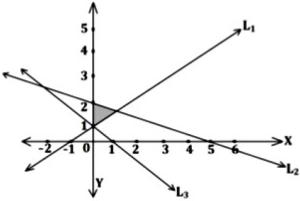
The correct constraints for the given feasible region are:
A
$y-x \geqslant 1, x+5 y \leqslant 10, x+y \geqslant 2, \quad x, y \geqslant 0$
B
$y-x \leqslant 1, 2 x+5 y \leqslant 10, x+y \geqslant 1, x, y \geqslant 0$
C
$y-x \geqslant 1, 2 x+5 y \leqslant 10, x+y \geqslant 1, x, y \geqslant 0$
D
$x-y \leqslant 1, 2 x+5 y \geqslant 10, x+y \leqslant 1, x, y \geqslant 0$
Solution
(C) To find the constraints,we identify the equations of the lines $L_1, L_2, L_3$ from the graph.
$1$. Line $L_1$ passes through $(-1, 0)$ and $(0, 1)$. The equation is $\frac{x}{-1} + \frac{y}{1} = 1 \Rightarrow y-x = 1$. Since the feasible region is above this line,the constraint is $y-x \geqslant 1$.
$2$. Line $L_2$ passes through $(0, 2)$ and $(5, 0)$. The equation is $\frac{x}{5} + \frac{y}{2} = 1 \Rightarrow 2x+5y = 10$. Since the region is below this line,the constraint is $2x+5y \leqslant 10$.
$3$. Line $L_3$ passes through $(0, 1)$ and $(1, 0)$. The equation is $\frac{x}{1} + \frac{y}{1} = 1 \Rightarrow x+y = 1$. Since the region is above this line,the constraint is $x+y \geqslant 1$.
Combining these with non-negativity constraints $x, y \geqslant 0$,we get the system: $y-x \geqslant 1, 2x+5y \leqslant 10, x+y \geqslant 1, x, y \geqslant 0$. This matches option $C$.
$1$. Line $L_1$ passes through $(-1, 0)$ and $(0, 1)$. The equation is $\frac{x}{-1} + \frac{y}{1} = 1 \Rightarrow y-x = 1$. Since the feasible region is above this line,the constraint is $y-x \geqslant 1$.
$2$. Line $L_2$ passes through $(0, 2)$ and $(5, 0)$. The equation is $\frac{x}{5} + \frac{y}{2} = 1 \Rightarrow 2x+5y = 10$. Since the region is below this line,the constraint is $2x+5y \leqslant 10$.
$3$. Line $L_3$ passes through $(0, 1)$ and $(1, 0)$. The equation is $\frac{x}{1} + \frac{y}{1} = 1 \Rightarrow x+y = 1$. Since the region is above this line,the constraint is $x+y \geqslant 1$.
Combining these with non-negativity constraints $x, y \geqslant 0$,we get the system: $y-x \geqslant 1, 2x+5y \leqslant 10, x+y \geqslant 1, x, y \geqslant 0$. This matches option $C$.
0 likes
View Solution59
EasyMCQ
The graph with the correct feasible region of the $L.P.P.$ for the constraints $2x + y \leqslant 10$,$y \leqslant x$,$y \leqslant 2$,$x, y \geqslant 0$ is $\ldots$
A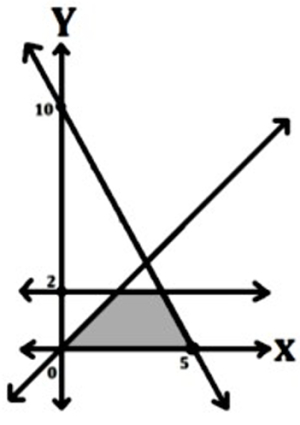
B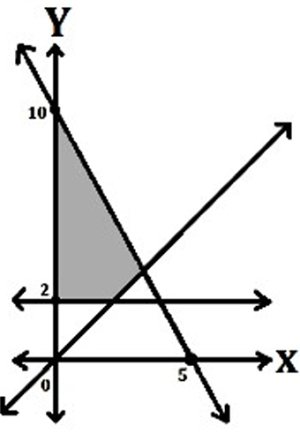
C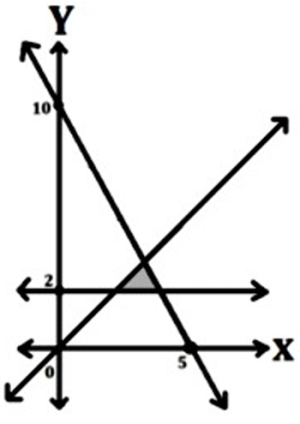
D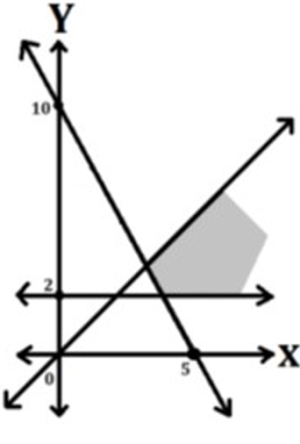
Solution
(C) To find the feasible region,we analyze the given constraints:
$1. 2x + y \leqslant 10$: The line passes through $(0, 10)$ and $(5, 0)$. The region is towards the origin.
$2. y \leqslant x$: The line passes through $(0, 0)$ and $(2, 2)$. The region is below the line.
$3. y \leqslant 2$: The region is below the horizontal line $y = 2$.
$4. x, y \geqslant 0$: The region is in the first quadrant.
Intersection points:
- For $y = 2$ and $y = x$,we get $x = 2$. Point is $(2, 2)$.
- For $y = 2$ and $2x + y = 10$,we get $2x + 2 = 10 \Rightarrow 2x = 8 \Rightarrow x = 4$. Point is $(4, 2)$.
- For $y = x$ and $2x + y = 10$,we get $2x + x = 10 \Rightarrow 3x = 10 \Rightarrow x = 10/3$. Point is $(10/3, 10/3)$.
The feasible region is bounded by the vertices $(0, 0)$,$(2, 2)$,$(4, 2)$,and the $x$-axis segment. Looking at the provided options,the graph that correctly represents the region bounded by these lines is shown in option $C$.
$1. 2x + y \leqslant 10$: The line passes through $(0, 10)$ and $(5, 0)$. The region is towards the origin.
$2. y \leqslant x$: The line passes through $(0, 0)$ and $(2, 2)$. The region is below the line.
$3. y \leqslant 2$: The region is below the horizontal line $y = 2$.
$4. x, y \geqslant 0$: The region is in the first quadrant.
Intersection points:
- For $y = 2$ and $y = x$,we get $x = 2$. Point is $(2, 2)$.
- For $y = 2$ and $2x + y = 10$,we get $2x + 2 = 10 \Rightarrow 2x = 8 \Rightarrow x = 4$. Point is $(4, 2)$.
- For $y = x$ and $2x + y = 10$,we get $2x + x = 10 \Rightarrow 3x = 10 \Rightarrow x = 10/3$. Point is $(10/3, 10/3)$.
The feasible region is bounded by the vertices $(0, 0)$,$(2, 2)$,$(4, 2)$,and the $x$-axis segment. Looking at the provided options,the graph that correctly represents the region bounded by these lines is shown in option $C$.
0 likes
View Solution60
MediumMCQ
The difference between the maximum value and minimum value of the objective function $z = 3x + 5y$ subject to the constraints $x + 3y \leqslant 60$,$x + y \geqslant 10$,$x - y = 0$,and $x, y \geqslant 0$ is:
A
$60$
B
$20$
C
$40$
D
$80$
Solution
(D) The constraints are $x + 3y \leqslant 60$,$x + y \geqslant 10$,$x = y$,and $x, y \geqslant 0$.
Substituting $x = y$ into the constraints:
$1$) $x + 3x \leqslant 60 \implies 4x \leqslant 60 \implies x \leqslant 15$.
$2$) $x + x \geqslant 10 \implies 2x \geqslant 10 \implies x \geqslant 5$.
Since $x = y$,the feasible region is the line segment from $(5, 5)$ to $(15, 15)$.
The objective function is $z = 3x + 5y$.
Substituting $y = x$ into $z$,we get $z = 3x + 5x = 8x$.
At $(5, 5)$,$z = 8(5) = 40$.
At $(15, 15)$,$z = 8(15) = 120$.
The maximum value is $120$ and the minimum value is $40$.
The difference is $120 - 40 = 80$.
Substituting $x = y$ into the constraints:
$1$) $x + 3x \leqslant 60 \implies 4x \leqslant 60 \implies x \leqslant 15$.
$2$) $x + x \geqslant 10 \implies 2x \geqslant 10 \implies x \geqslant 5$.
Since $x = y$,the feasible region is the line segment from $(5, 5)$ to $(15, 15)$.
The objective function is $z = 3x + 5y$.
Substituting $y = x$ into $z$,we get $z = 3x + 5x = 8x$.
At $(5, 5)$,$z = 8(5) = 40$.
At $(15, 15)$,$z = 8(15) = 120$.
The maximum value is $120$ and the minimum value is $40$.
The difference is $120 - 40 = 80$.
0 likes
View Solution61
MediumMCQ
In $L.P.P.$,the maximum value of the objective function $Z = 6x + 3y$ subject to the constraints $x + y \leq 5$,$x + 2y \geq 4$,$4x + y \leq 12$,$x, y \geq 0$ is:
A
$\frac{132}{7}$
B
$22$
C
$15$
D
$\frac{122}{7}$
Solution
(B) To find the maximum value of $Z = 6x + 3y$,we first identify the feasible region defined by the constraints:
$1) x + y = 5$
$2) x + 2y = 4$
$3) 4x + y = 12$
$4) x \geq 0, y \geq 0$
Finding the intersection points of the lines:
- Intersection of $x + y = 5$ and $4x + y = 12$: Subtracting gives $3x = 7 \implies x = 7/3$. Then $y = 5 - 7/3 = 8/3$. Point: $(7/3, 8/3)$.
- Intersection of $x + 2y = 4$ and $x + y = 5$: Subtracting gives $y = -1$,which is outside the first quadrant.
- Intersection of $x + 2y = 4$ and $4x + y = 12$: $x = 4 - 2y$. Substituting: $4(4 - 2y) + y = 12 \implies 16 - 8y + y = 12 \implies 7y = 4 \implies y = 4/7$. Then $x = 4 - 8/7 = 20/7$. Point: $(20/7, 4/7)$.
- Boundary points on axes: $(3, 0)$ from $4x+y=12$,$(4, 0)$ from $x+2y=4$,$(0, 2)$ from $x+2y=4$,$(0, 5)$ from $x+y=5$.
Evaluating $Z = 6x + 3y$ at vertices of the feasible region:
- At $(3, 0): Z = 6(3) + 3(0) = 18$
- At $(7/3, 8/3): Z = 6(7/3) + 3(8/3) = 14 + 8 = 22$
- At $(20/7, 4/7): Z = 6(20/7) + 3(4/7) = (120 + 12)/7 = 132/7 \approx 18.85$
- At $(0, 2): Z = 6(0) + 3(2) = 6$
The maximum value is $22$.
$1) x + y = 5$
$2) x + 2y = 4$
$3) 4x + y = 12$
$4) x \geq 0, y \geq 0$
Finding the intersection points of the lines:
- Intersection of $x + y = 5$ and $4x + y = 12$: Subtracting gives $3x = 7 \implies x = 7/3$. Then $y = 5 - 7/3 = 8/3$. Point: $(7/3, 8/3)$.
- Intersection of $x + 2y = 4$ and $x + y = 5$: Subtracting gives $y = -1$,which is outside the first quadrant.
- Intersection of $x + 2y = 4$ and $4x + y = 12$: $x = 4 - 2y$. Substituting: $4(4 - 2y) + y = 12 \implies 16 - 8y + y = 12 \implies 7y = 4 \implies y = 4/7$. Then $x = 4 - 8/7 = 20/7$. Point: $(20/7, 4/7)$.
- Boundary points on axes: $(3, 0)$ from $4x+y=12$,$(4, 0)$ from $x+2y=4$,$(0, 2)$ from $x+2y=4$,$(0, 5)$ from $x+y=5$.
Evaluating $Z = 6x + 3y$ at vertices of the feasible region:
- At $(3, 0): Z = 6(3) + 3(0) = 18$
- At $(7/3, 8/3): Z = 6(7/3) + 3(8/3) = 14 + 8 = 22$
- At $(20/7, 4/7): Z = 6(20/7) + 3(4/7) = (120 + 12)/7 = 132/7 \approx 18.85$
- At $(0, 2): Z = 6(0) + 3(2) = 6$
The maximum value is $22$.
0 likes
View Solution62
EasyMCQ
$A$ manufacturing company produces two items,$A$ and $B$. Each item must be processed by two machines,$I$ and $II$. Machine $I$ can be operated for a maximum of $10$ hours $40$ minutes ($640$ minutes). It takes $20$ minutes for an item $A$ and $15$ minutes for an item $B$. Machine $II$ can be operated for a maximum of $8$ hours $20$ minutes ($500$ minutes). It takes $5$ minutes for an item $A$ and $8$ minutes for an item $B$. The profit per item of $A$ is ₹ $25$ and per item of $B$ is ₹ $18$. The formulation of an $L.P.P.$ to maximize the profit (where $x$ is the number of items $A$ and $y$ is the number of items $B$) is . . . . . . .
A
Maximize $z=25x+18y$ subject to $20x+15y \leqslant 640, 5x+8y \geqslant 500, x, y \geqslant 0$
B
Maximize $z=25x+18y$ subject to $20x+15y \leqslant 640, 5x+8y \leqslant 500, x, y \geqslant 0$
C
Maximize $z=25x+18y$ subject to $20x+5y \leqslant 8, 5x+8y \leqslant 10, x, y \geqslant 0$
D
Maximize $z=25x+18y$ subject to $4x+3y \leqslant 128, 5x+8y \geqslant 500, x, y \geqslant 0$
Solution
(B) Let $x$ be the number of items $A$ and $y$ be the number of items $B$.
The profit function to be maximized is $z = 25x + 18y$.
Machine $I$ constraint: $20x + 15y \leqslant 640$ (since $10$ hours $40$ minutes $= 640$ minutes).
Machine $II$ constraint: $5x + 8y \leqslant 500$ (since $8$ hours $20$ minutes $= 500$ minutes).
Non-negativity constraints: $x \geqslant 0, y \geqslant 0$.
Thus,the correct formulation is: Maximize $z = 25x + 18y$ subject to $20x + 15y \leqslant 640, 5x + 8y \leqslant 500, x, y \geqslant 0$.
The profit function to be maximized is $z = 25x + 18y$.
Machine $I$ constraint: $20x + 15y \leqslant 640$ (since $10$ hours $40$ minutes $= 640$ minutes).
Machine $II$ constraint: $5x + 8y \leqslant 500$ (since $8$ hours $20$ minutes $= 500$ minutes).
Non-negativity constraints: $x \geqslant 0, y \geqslant 0$.
Thus,the correct formulation is: Maximize $z = 25x + 18y$ subject to $20x + 15y \leqslant 640, 5x + 8y \leqslant 500, x, y \geqslant 0$.
0 likes
View Solution63
DifficultMCQ
The difference between the maximum and minimum values of the objective function $Z = 3x + 5y$,subject to the constraints $x + 3y \leqslant 60$,$x + y \geqslant 10$,$x - y \leqslant 0$,$x \geqslant 0$,$y \geqslant 0$ is
A
$80$
B
$120$
C
$150$
D
$180$
Solution
(A) The feasible region is determined by the constraints $x + 3y \leqslant 60$,$x + y \geqslant 10$,$x - y \leqslant 0$,$x \geqslant 0$,and $y \geqslant 0$.
First,we find the vertices of the feasible region by solving the intersection points of the boundary lines:
$1$. Intersection of $x - y = 0$ and $x + y = 10$: $2x = 10 \implies x = 5, y = 5$. Vertex: $(5, 5)$.
$2$. Intersection of $x - y = 0$ and $x + 3y = 60$: $4y = 60 \implies y = 15, x = 15$. Vertex: $(15, 15)$.
$3$. Intersection of $x + y = 10$ and $x = 0$: $y = 10$. Vertex: $(0, 10)$.
$4$. Intersection of $x + 3y = 60$ and $x = 0$: $3y = 60 \implies y = 20$. Vertex: $(0, 20)$.
Now,we evaluate $Z = 3x + 5y$ at each vertex:
- At $(5, 5)$: $Z = 3(5) + 5(5) = 15 + 25 = 40$.
- At $(15, 15)$: $Z = 3(15) + 5(15) = 45 + 75 = 120$.
- At $(0, 10)$: $Z = 3(0) + 5(10) = 50$.
- At $(0, 20)$: $Z = 3(0) + 5(20) = 100$.
The maximum value is $120$ and the minimum value is $40$.
The difference is $120 - 40 = 80$.
First,we find the vertices of the feasible region by solving the intersection points of the boundary lines:
$1$. Intersection of $x - y = 0$ and $x + y = 10$: $2x = 10 \implies x = 5, y = 5$. Vertex: $(5, 5)$.
$2$. Intersection of $x - y = 0$ and $x + 3y = 60$: $4y = 60 \implies y = 15, x = 15$. Vertex: $(15, 15)$.
$3$. Intersection of $x + y = 10$ and $x = 0$: $y = 10$. Vertex: $(0, 10)$.
$4$. Intersection of $x + 3y = 60$ and $x = 0$: $3y = 60 \implies y = 20$. Vertex: $(0, 20)$.
Now,we evaluate $Z = 3x + 5y$ at each vertex:
- At $(5, 5)$: $Z = 3(5) + 5(5) = 15 + 25 = 40$.
- At $(15, 15)$: $Z = 3(15) + 5(15) = 45 + 75 = 120$.
- At $(0, 10)$: $Z = 3(0) + 5(10) = 50$.
- At $(0, 20)$: $Z = 3(0) + 5(20) = 100$.
The maximum value is $120$ and the minimum value is $40$.
The difference is $120 - 40 = 80$.
0 likes
View Solution64
EasyMCQ
The feasible region for the constraints $x-y \geqslant 0$,$x-5y \leqslant -5$,$x \geqslant 0$,$y \geqslant 0$ is shown by the figure:
A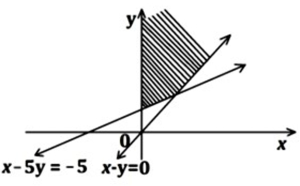
B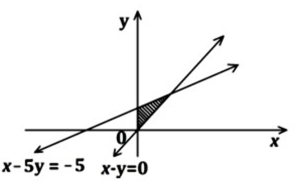
C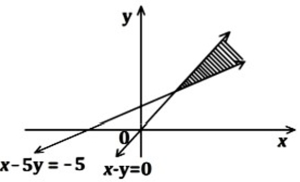
D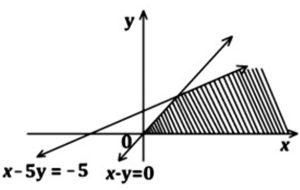
Solution
(B) To find the feasible region,we analyze the given constraints:
$1$. $x - y \geqslant 0 \implies y \leqslant x$. This represents the region on or below the line $y = x$.
$2$. $x - 5y \leqslant -5 \implies 5y \geqslant x + 5 \implies y \geqslant \frac{1}{5}x + 1$. This represents the region on or above the line $y = \frac{1}{5}x + 1$.
$3$. $x \geqslant 0$ and $y \geqslant 0$ restrict the region to the first quadrant.
Combining these,we look for the region that is below $y = x$,above $y = \frac{1}{5}x + 1$,and in the first quadrant.
Solving for the intersection point: $x = \frac{1}{5}x + 1 \implies \frac{4}{5}x = 1 \implies x = 1.25$. Then $y = 1.25$. The intersection is at $(1.25, 1.25)$.
The region bounded by these lines in the first quadrant is a triangular region. Looking at the provided options,the figure corresponding to the region bounded by these inequalities is represented in option $B$.
$1$. $x - y \geqslant 0 \implies y \leqslant x$. This represents the region on or below the line $y = x$.
$2$. $x - 5y \leqslant -5 \implies 5y \geqslant x + 5 \implies y \geqslant \frac{1}{5}x + 1$. This represents the region on or above the line $y = \frac{1}{5}x + 1$.
$3$. $x \geqslant 0$ and $y \geqslant 0$ restrict the region to the first quadrant.
Combining these,we look for the region that is below $y = x$,above $y = \frac{1}{5}x + 1$,and in the first quadrant.
Solving for the intersection point: $x = \frac{1}{5}x + 1 \implies \frac{4}{5}x = 1 \implies x = 1.25$. Then $y = 1.25$. The intersection is at $(1.25, 1.25)$.
The region bounded by these lines in the first quadrant is a triangular region. Looking at the provided options,the figure corresponding to the region bounded by these inequalities is represented in option $B$.
0 likes
View Solution65
DifficultMCQ
The point,at which the maximum value of $10x + 6y$ subject to the constraints $x + y \leq 12$,$2x + y \leq 20$,$x \geq 0$,$y \geq 0$ occurs,is
A
$(10, 0)$
B
$(8, 4)$
C
$(0, 12)$
D
$(12, 0)$
Solution
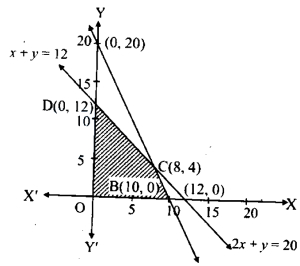
(B) The feasible region lies on the origin side of the lines $x + y = 12$ and $2x + y = 20$ and is in the first quadrant.
The corner points of the feasible region are $O(0, 0)$,$B(10, 0)$,$C(8, 4)$,and $D(0, 12)$.
We evaluate the objective function $z = 10x + 6y$ at each corner point:
At $O(0, 0)$,$z = 10(0) + 6(0) = 0$.
At $B(10, 0)$,$z = 10(10) + 6(0) = 100$.
At $C(8, 4)$,$z = 10(8) + 6(4) = 80 + 24 = 104$.
At $D(0, 12)$,$z = 10(0) + 6(12) = 72$.
Therefore,the maximum value of $z$ is $104$,which occurs at the point $C(8, 4)$.
The corner points of the feasible region are $O(0, 0)$,$B(10, 0)$,$C(8, 4)$,and $D(0, 12)$.
We evaluate the objective function $z = 10x + 6y$ at each corner point:
At $O(0, 0)$,$z = 10(0) + 6(0) = 0$.
At $B(10, 0)$,$z = 10(10) + 6(0) = 100$.
At $C(8, 4)$,$z = 10(8) + 6(4) = 80 + 24 = 104$.
At $D(0, 12)$,$z = 10(0) + 6(12) = 72$.
Therefore,the maximum value of $z$ is $104$,which occurs at the point $C(8, 4)$.
0 likes
View Solution66
EasyMCQ
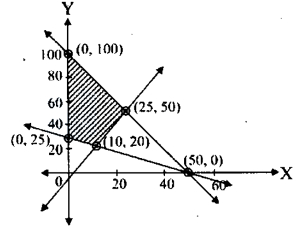
The shaded region in the following figure is the solution set of the inequations:
A
$x+2y \geq 50, 2x+y \leq 100, 2x-y \leq 0, x, y \geq 0$
B
$x+2y \leq 50, 2x+y \leq 100, 2x-y \leq 0, x, y \geq 0$
C
$x+2y \geq 50, 2x+y \geq 100, 2x-y \leq 0, x, y \geq 0$
D
$x+2y \leq 50, 2x+y \geq 100, 2x-y \leq 0, x, y \geq 0$
Solution
(A) To determine the system of linear inequalities,we identify the boundary lines of the shaded region:
$1$. The line passing through $(0, 25)$ and $(50, 0)$ has the equation $\frac{x}{50} + \frac{y}{25} = 1$,which simplifies to $x + 2y = 50$. Since the shaded region is above this line,the inequality is $x + 2y \geq 50$.
$2$. The line passing through $(0, 100)$ and $(50, 0)$ has the equation $\frac{x}{50} + \frac{y}{100} = 1$,which simplifies to $2x + y = 100$. Since the shaded region is below this line,the inequality is $2x + y \leq 100$.
$3$. The line passing through $(0, 0)$ and $(10, 20)$ has the equation $y = 2x$,which simplifies to $2x - y = 0$. Since the shaded region is to the left of this line (e.g.,test point $(0, 10)$ gives $2(0) - 10 = -10 \leq 0$),the inequality is $2x - y \leq 0$.
$4$. The region is in the first quadrant,so $x, y \geq 0$.
Thus,the correct set of inequalities is $x + 2y \geq 50, 2x + y \leq 100, 2x - y \leq 0, x, y \geq 0$.
$1$. The line passing through $(0, 25)$ and $(50, 0)$ has the equation $\frac{x}{50} + \frac{y}{25} = 1$,which simplifies to $x + 2y = 50$. Since the shaded region is above this line,the inequality is $x + 2y \geq 50$.
$2$. The line passing through $(0, 100)$ and $(50, 0)$ has the equation $\frac{x}{50} + \frac{y}{100} = 1$,which simplifies to $2x + y = 100$. Since the shaded region is below this line,the inequality is $2x + y \leq 100$.
$3$. The line passing through $(0, 0)$ and $(10, 20)$ has the equation $y = 2x$,which simplifies to $2x - y = 0$. Since the shaded region is to the left of this line (e.g.,test point $(0, 10)$ gives $2(0) - 10 = -10 \leq 0$),the inequality is $2x - y \leq 0$.
$4$. The region is in the first quadrant,so $x, y \geq 0$.
Thus,the correct set of inequalities is $x + 2y \geq 50, 2x + y \leq 100, 2x - y \leq 0, x, y \geq 0$.
0 likes
View Solution67
EasyMCQ
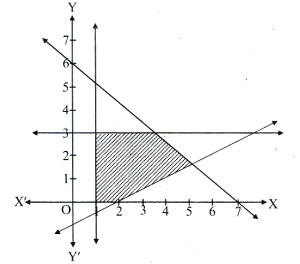
The shaded area in the figure below is the solution set for a certain linear programming problem. Then the linear constraints are given by:
A
$x \geqslant 1, y \leqslant 3, x-2y \geqslant 2, 6x+7y \leqslant 42, x \geqslant 0, y \geqslant 0$
B
$x \geqslant 1, y \leqslant 3, x-2y \geqslant 2, 6x+7y \geqslant 42, x \geqslant 0, y \geqslant 0$
C
$x \leqslant 1, y \geqslant 3, x-2y \leqslant 2, 6x+7y \leqslant 42, x \geqslant 0, y \geqslant 0$
D
$x \geqslant 1, y \leqslant 3, x-2y \leqslant 2, 6x+7y \leqslant 42, x \geqslant 0, y \geqslant 0$
Solution
(D) To determine the linear constraints,we analyze the boundaries of the shaded region:
$1$. The vertical line passing through $x=1$ with the shaded region to the right gives the constraint $x \geqslant 1$.
$2$. The horizontal line passing through $y=3$ with the shaded region below it gives the constraint $y \leqslant 3$.
$3$. The line passing through $(2, 0)$ and $(0, -1)$ has the equation $\frac{x}{2} - \frac{y}{1} = 1$,which simplifies to $x - 2y = 2$. Since the shaded region is above this line (e.g.,testing point $(3, 1)$ gives $3 - 2(1) = 1 \leqslant 2$),the constraint is $x - 2y \leqslant 2$.
$4$. The line passing through $(7, 0)$ and $(0, 6)$ has the equation $\frac{x}{7} + \frac{y}{6} = 1$,which simplifies to $6x + 7y = 42$. Since the shaded region is below this line (e.g.,testing point $(1, 1)$ gives $6(1) + 7(1) = 13 \leqslant 42$),the constraint is $6x + 7y \leqslant 42$.
$5$. The non-negativity constraints are $x \geqslant 0$ and $y \geqslant 0$.
Combining these,the correct set of constraints is $x \geqslant 1, y \leqslant 3, x-2y \leqslant 2, 6x+7y \leqslant 42, x \geqslant 0, y \geqslant 0$.
$1$. The vertical line passing through $x=1$ with the shaded region to the right gives the constraint $x \geqslant 1$.
$2$. The horizontal line passing through $y=3$ with the shaded region below it gives the constraint $y \leqslant 3$.
$3$. The line passing through $(2, 0)$ and $(0, -1)$ has the equation $\frac{x}{2} - \frac{y}{1} = 1$,which simplifies to $x - 2y = 2$. Since the shaded region is above this line (e.g.,testing point $(3, 1)$ gives $3 - 2(1) = 1 \leqslant 2$),the constraint is $x - 2y \leqslant 2$.
$4$. The line passing through $(7, 0)$ and $(0, 6)$ has the equation $\frac{x}{7} + \frac{y}{6} = 1$,which simplifies to $6x + 7y = 42$. Since the shaded region is below this line (e.g.,testing point $(1, 1)$ gives $6(1) + 7(1) = 13 \leqslant 42$),the constraint is $6x + 7y \leqslant 42$.
$5$. The non-negativity constraints are $x \geqslant 0$ and $y \geqslant 0$.
Combining these,the correct set of constraints is $x \geqslant 1, y \leqslant 3, x-2y \leqslant 2, 6x+7y \leqslant 42, x \geqslant 0, y \geqslant 0$.
0 likes
View Solution68
EasyMCQ
The maximum value of the objective function $z=4x+6y$ subject to the constraints $3x+2y \leq 12$,$x+y \geq 4$,$x, y \geq 0$ is
A
$24$
B
$46$
C
$56$
D
$36$
Solution
(D) The constraints are $3x+2y \leq 12$,$x+y \geq 4$,and $x, y \geq 0$.
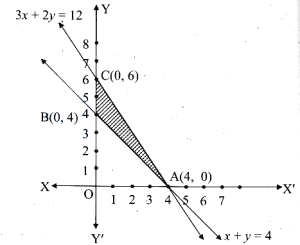
To find the feasible region,we plot the lines $3x+2y=12$ and $x+y=4$.
The intersection points of the lines with the axes are:
For $3x+2y=12$: $(4,0)$ and $(0,6)$.
For $x+y=4$: $(4,0)$ and $(0,4)$.
The feasible region is the triangle with vertices $A(4,0)$,$B(0,4)$,and $C(0,6)$.
We evaluate the objective function $z=4x+6y$ at these corner points:
At $A(4,0)$: $z = 4(4) + 6(0) = 16$.
At $B(0,4)$: $z = 4(0) + 6(4) = 24$.
At $C(0,6)$: $z = 4(0) + 6(6) = 36$.
Comparing these values,the maximum value of $z$ is $36$,which occurs at point $C(0,6)$.
To find the feasible region,we plot the lines $3x+2y=12$ and $x+y=4$.
The intersection points of the lines with the axes are:
For $3x+2y=12$: $(4,0)$ and $(0,6)$.
For $x+y=4$: $(4,0)$ and $(0,4)$.
The feasible region is the triangle with vertices $A(4,0)$,$B(0,4)$,and $C(0,6)$.
We evaluate the objective function $z=4x+6y$ at these corner points:
At $A(4,0)$: $z = 4(4) + 6(0) = 16$.
At $B(0,4)$: $z = 4(0) + 6(4) = 24$.
At $C(0,6)$: $z = 4(0) + 6(6) = 36$.
Comparing these values,the maximum value of $z$ is $36$,which occurs at point $C(0,6)$.
0 likes
View Solution69
EasyMCQ
The maximum value of $z=x+y$,subjected to $x+y \leq 10, 5x+3y \geq 15, x \leq 6, x, y \geq 0$,
A
occurs only at a unique point.
B
occurs only at two distinct points.
C
occurs at infinitely many points.
D
does not exist.
Solution
(C) The feasible region is bounded by the lines $x+y=10$,$5x+3y=15$,$x=6$,and the axes $x=0, y=0$.
The corner points of the feasible region are $A(0,5)$,$B(0,10)$,$C(6,4)$,and $E(3,0)$.
We evaluate the objective function $z=x+y$ at these corner points:
At $A(0,5)$,$z = 0+5 = 5$.
At $B(0,10)$,$z = 0+10 = 10$.
At $C(6,4)$,$z = 6+4 = 10$.
At $E(3,0)$,$z = 3+0 = 3$.
The maximum value of $z$ is $10$,which occurs at both points $B(0,10)$ and $C(6,4)$.
Since the maximum value occurs at two corner points,it occurs at all points on the line segment joining $B$ and $C$.
Therefore,the maximum value occurs at infinitely many points.
The corner points of the feasible region are $A(0,5)$,$B(0,10)$,$C(6,4)$,and $E(3,0)$.
We evaluate the objective function $z=x+y$ at these corner points:
At $A(0,5)$,$z = 0+5 = 5$.
At $B(0,10)$,$z = 0+10 = 10$.
At $C(6,4)$,$z = 6+4 = 10$.
At $E(3,0)$,$z = 3+0 = 3$.
The maximum value of $z$ is $10$,which occurs at both points $B(0,10)$ and $C(6,4)$.
Since the maximum value occurs at two corner points,it occurs at all points on the line segment joining $B$ and $C$.
Therefore,the maximum value occurs at infinitely many points.
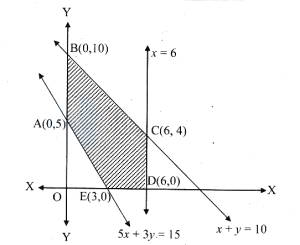
0 likes
View Solution70
EasyMCQ
The maximum value of $z=4x+2y$,subject to the constraints $3x+4y \geqslant 12$,$x+y \leqslant 5$,$x, y \geqslant 0$ is
A
$8$
B
$20$
C
$24$
D
$16$
Solution
(B) The feasible region is bounded by the lines $3x+4y=12$,$x+y=5$,and the axes in the first quadrant.
To find the corner points,we identify the vertices of the shaded region:
$1$. Intersection of $3x+4y=12$ and the $x$-axis $(y=0)$: $3x=12 \implies x=4$. Point is $A(4, 0)$.
$2$. Intersection of $x+y=5$ and the $x$-axis $(y=0)$: $x=5$. Point is $B(5, 0)$.
$3$. Intersection of $x+y=5$ and the $y$-axis $(x=0)$: $y=5$. Point is $C(0, 5)$.
$4$. Intersection of $3x+4y=12$ and the $y$-axis $(x=0)$: $4y=12 \implies y=3$. Point is $D(0, 3)$.
Now,we evaluate $z=4x+2y$ at each corner point:
- At $A(4, 0): z = 4(4) + 2(0) = 16$
- At $B(5, 0): z = 4(5) + 2(0) = 20$
- At $C(0, 5): z = 4(0) + 2(5) = 10$
- At $D(0, 3): z = 4(0) + 2(3) = 6$
The maximum value of $z$ is $20$ at point $B(5, 0)$.
To find the corner points,we identify the vertices of the shaded region:
$1$. Intersection of $3x+4y=12$ and the $x$-axis $(y=0)$: $3x=12 \implies x=4$. Point is $A(4, 0)$.
$2$. Intersection of $x+y=5$ and the $x$-axis $(y=0)$: $x=5$. Point is $B(5, 0)$.
$3$. Intersection of $x+y=5$ and the $y$-axis $(x=0)$: $y=5$. Point is $C(0, 5)$.
$4$. Intersection of $3x+4y=12$ and the $y$-axis $(x=0)$: $4y=12 \implies y=3$. Point is $D(0, 3)$.
Now,we evaluate $z=4x+2y$ at each corner point:
- At $A(4, 0): z = 4(4) + 2(0) = 16$
- At $B(5, 0): z = 4(5) + 2(0) = 20$
- At $C(0, 5): z = 4(0) + 2(5) = 10$
- At $D(0, 3): z = 4(0) + 2(3) = 6$
The maximum value of $z$ is $20$ at point $B(5, 0)$.
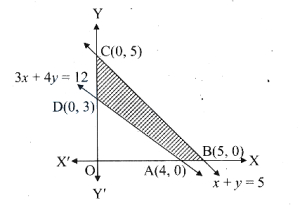
0 likes
View Solution71
EasyMCQ
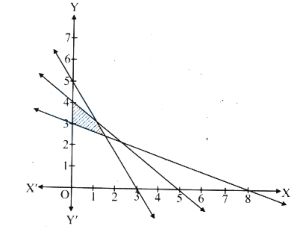
The function to be maximized is given by $Z=3x+2y$. The feasible region for this function is the shaded region shown in the figure. The linear constraints for this region are given by:
A
$3x+8y \leq 24, 4x+5y \leq 20, 5x+3y \geq 15, x \geq 0, y \geq 0$
B
$3x+8y \geq 24, 4x+5y \geq 20, 5x+3y \leq 15, x \geq 0, y \geq 0$
C
$3x+8y \leq 24, 4x+5y \geq 20, 5x+3y \geq 15, x \geq 0, y \geq 0$
D
$3x+8y \geq 24, 4x+5y \leq 20, 5x+3y \leq 15, x \geq 0, y \geq 0$
Solution
(D) To find the linear constraints,we identify the equations of the three lines forming the boundary of the shaded region:
$1$. Line passing through $(0, 3)$ and $(8, 0)$: The intercept form is $\frac{x}{8} + \frac{y}{3} = 1$,which simplifies to $3x + 8y = 24$. Since the shaded region is above this line (away from the origin),the constraint is $3x + 8y \geq 24$.
$2$. Line passing through $(0, 4)$ and $(5, 0)$: The intercept form is $\frac{x}{5} + \frac{y}{4} = 1$,which simplifies to $4x + 5y = 20$. Since the shaded region is below this line (towards the origin),the constraint is $4x + 5y \leq 20$.
$3$. Line passing through $(0, 5)$ and $(3, 0)$: The intercept form is $\frac{x}{3} + \frac{y}{5} = 1$,which simplifies to $5x + 3y = 15$. Since the shaded region is below this line (towards the origin),the constraint is $5x + 3y \leq 15$.
Combining these with the non-negativity constraints $x \geq 0, y \geq 0$,we get the system: $3x + 8y \geq 24, 4x + 5y \leq 20, 5x + 3y \leq 15, x \geq 0, y \geq 0$. Thus,option $D$ is correct.
$1$. Line passing through $(0, 3)$ and $(8, 0)$: The intercept form is $\frac{x}{8} + \frac{y}{3} = 1$,which simplifies to $3x + 8y = 24$. Since the shaded region is above this line (away from the origin),the constraint is $3x + 8y \geq 24$.
$2$. Line passing through $(0, 4)$ and $(5, 0)$: The intercept form is $\frac{x}{5} + \frac{y}{4} = 1$,which simplifies to $4x + 5y = 20$. Since the shaded region is below this line (towards the origin),the constraint is $4x + 5y \leq 20$.
$3$. Line passing through $(0, 5)$ and $(3, 0)$: The intercept form is $\frac{x}{3} + \frac{y}{5} = 1$,which simplifies to $5x + 3y = 15$. Since the shaded region is below this line (towards the origin),the constraint is $5x + 3y \leq 15$.
Combining these with the non-negativity constraints $x \geq 0, y \geq 0$,we get the system: $3x + 8y \geq 24, 4x + 5y \leq 20, 5x + 3y \leq 15, x \geq 0, y \geq 0$. Thus,option $D$ is correct.
0 likes
View Solution72
EasyMCQ
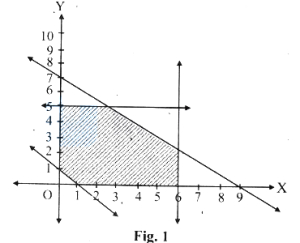
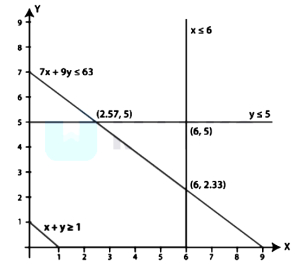
The graphical solution set of the system of inequations $x+y \geq 1$,$7x+9y \leq 63$,$y \leq 5$,$x \leq 6$,$x \geq 0$,$y \geq 0$ is represented by:
A
Fig. $1$
B
Fig. $2$
C
Fig. $3$
D
Fig. $4$
Solution
(B) To find the graphical solution set,we analyze the given system of inequations: $x+y \geq 1$,$7x+9y \leq 63$,$y \leq 5$,$x \leq 6$,$x \geq 0$,$y \geq 0$.
$1$. For $x+y \geq 1$: The line passes through $(1, 0)$ and $(0, 1)$. The region is away from the origin.
$2$. For $7x+9y \leq 63$: The line passes through $(9, 0)$ and $(0, 7)$. The region is towards the origin.
$3$. For $x \leq 6$ and $y \leq 5$: These represent the region bounded by the lines $x=6$ and $y=5$ in the first quadrant.
$4$. The intersection of all these regions gives the feasible region. By plotting these lines,we observe that the region is bounded by the vertices $(0, 1), (0, 7), (2.57, 5), (6, 5), (6, 2.33)$ and $(1, 0)$.
Comparing this with the provided figures,the correct graphical representation is Fig. $2$.
$1$. For $x+y \geq 1$: The line passes through $(1, 0)$ and $(0, 1)$. The region is away from the origin.
$2$. For $7x+9y \leq 63$: The line passes through $(9, 0)$ and $(0, 7)$. The region is towards the origin.
$3$. For $x \leq 6$ and $y \leq 5$: These represent the region bounded by the lines $x=6$ and $y=5$ in the first quadrant.
$4$. The intersection of all these regions gives the feasible region. By plotting these lines,we observe that the region is bounded by the vertices $(0, 1), (0, 7), (2.57, 5), (6, 5), (6, 2.33)$ and $(1, 0)$.
Comparing this with the provided figures,the correct graphical representation is Fig. $2$.
0 likes
View Solution73
EasyMCQ
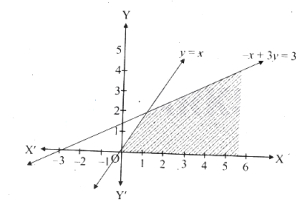
For the following shaded region,the linear constraints are:
A
$x-y \leq 0, -x+3y \leq 3, x \geq 0, y \geq 0$
B
$x-y \geq 0, -x+3y \geq 3, x \geq 0, y \geq 0$
C
$x-y \geq 0, -x+3y \leq 3, x \geq 0, y \geq 0$
D
$x-y \leq 0, -x+3y = 3, x \geq 0, y \geq 0$
Solution
(C) Let's analyze the shaded region and its linear constraints:
$1$. Looking at the graph,the region is bounded by the lines $y=x$ and $-x+3y=3$,along with the axes $x=0$ and $y=0$.
$2$. The shaded region is situated below the line $-x+3y=3$. Testing the origin $(0,0)$,we get $-0+3(0) = 0 \leq 3$,which satisfies the inequality. Thus,the constraint is $-x+3y \leq 3$.
$3$. The region is situated to the right of the line $y=x$ (or below the line $y=x$ in terms of $y$-values for a fixed $x$). Testing a point in the region,such as $(2, 0)$,we have $x-y = 2-0 = 2 \geq 0$. Wait,let's re-evaluate: for the region to the right of $y=x$,we have $x \geq y$,which means $x-y \geq 0$.
$4$. Re-checking the graph: The shaded region is bounded by $y=x$ on the left and $-x+3y=3$ on the top. For points in the region,$x \geq y$ (so $x-y \geq 0$) and $-x+3y \leq 3$.
$5$. Comparing with the options,option $(C)$ matches these conditions: $x-y \geq 0, -x+3y \leq 3, x \geq 0, y \geq 0$.
$1$. Looking at the graph,the region is bounded by the lines $y=x$ and $-x+3y=3$,along with the axes $x=0$ and $y=0$.
$2$. The shaded region is situated below the line $-x+3y=3$. Testing the origin $(0,0)$,we get $-0+3(0) = 0 \leq 3$,which satisfies the inequality. Thus,the constraint is $-x+3y \leq 3$.
$3$. The region is situated to the right of the line $y=x$ (or below the line $y=x$ in terms of $y$-values for a fixed $x$). Testing a point in the region,such as $(2, 0)$,we have $x-y = 2-0 = 2 \geq 0$. Wait,let's re-evaluate: for the region to the right of $y=x$,we have $x \geq y$,which means $x-y \geq 0$.
$4$. Re-checking the graph: The shaded region is bounded by $y=x$ on the left and $-x+3y=3$ on the top. For points in the region,$x \geq y$ (so $x-y \geq 0$) and $-x+3y \leq 3$.
$5$. Comparing with the options,option $(C)$ matches these conditions: $x-y \geq 0, -x+3y \leq 3, x \geq 0, y \geq 0$.
0 likes
View Solution74
DifficultMCQ
$A$ production unit makes a special type of metal chip by combining copper and brass. The standard weight of the chip must be at least $5 \text{ gms}$. The basic ingredients,i.e.,copper and brass,cost $₹8$ and $₹5$ per $\text{gm}$ respectively. Durability considerations dictate that the metal chip must not contain more than $4 \text{ gms}$ of brass and should contain a minimum of $2 \text{ gms}$ of copper. Then,the minimum cost of the metal chip satisfying the above conditions is:
A
₹ $36$
B
₹ $31$
C
₹ $30$
D
₹ $40$
Solution
(B) Let $x$ and $y$ denote the quantity of copper and brass in grams,respectively.
The objective function to minimize is the cost: $z = 8x + 5y$.
The constraints based on the problem are:
$1) \ x + y \geq 5$ (Total weight at least $5 \text{ gms}$)
$2) \ x \geq 2$ (Minimum $2 \text{ gms}$ of copper)
$3) \ y \leq 4$ (Maximum $4 \text{ gms}$ of brass)
$4) \ x \geq 0, y \geq 0$ (Non-negativity constraints)
The feasible region is determined by these inequalities. The corner points of the feasible region are found by the intersection of the boundary lines:
- Point $A$: Intersection of $x = 2$ and $y = 4$,so $A = (2, 4)$.
- Point $B$: Intersection of $x = 2$ and $x + y = 5$,so $B = (2, 3)$.
- Point $C$: Intersection of $x + y = 5$ and $y = 0$,so $C = (5, 0)$.
Now,evaluate the objective function $z = 8x + 5y$ at these corner points:
- At $A(2, 4): z = 8(2) + 5(4) = 16 + 20 = 36$.
- At $B(2, 3): z = 8(2) + 5(3) = 16 + 15 = 31$.
- At $C(5, 0): z = 8(5) + 5(0) = 40 + 0 = 40$.
The minimum value of $z$ is $31$.
Therefore,the minimum cost is $₹ 31$.
The objective function to minimize is the cost: $z = 8x + 5y$.
The constraints based on the problem are:
$1) \ x + y \geq 5$ (Total weight at least $5 \text{ gms}$)
$2) \ x \geq 2$ (Minimum $2 \text{ gms}$ of copper)
$3) \ y \leq 4$ (Maximum $4 \text{ gms}$ of brass)
$4) \ x \geq 0, y \geq 0$ (Non-negativity constraints)
The feasible region is determined by these inequalities. The corner points of the feasible region are found by the intersection of the boundary lines:
- Point $A$: Intersection of $x = 2$ and $y = 4$,so $A = (2, 4)$.
- Point $B$: Intersection of $x = 2$ and $x + y = 5$,so $B = (2, 3)$.
- Point $C$: Intersection of $x + y = 5$ and $y = 0$,so $C = (5, 0)$.
Now,evaluate the objective function $z = 8x + 5y$ at these corner points:
- At $A(2, 4): z = 8(2) + 5(4) = 16 + 20 = 36$.
- At $B(2, 3): z = 8(2) + 5(3) = 16 + 15 = 31$.
- At $C(5, 0): z = 8(5) + 5(0) = 40 + 0 = 40$.
The minimum value of $z$ is $31$.
Therefore,the minimum cost is $₹ 31$.
0 likes
View Solution75
EasyMCQ
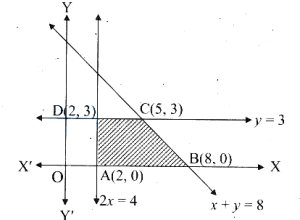
Maximum value of $Z=100 x+70 y$ subject to $2 x \geq 4, y \leq 3, x+y \leq 8, x, y \geq 0$ is
A
$800$
B
$940$
C
$400$
D
$710$
Solution
(A) The constraints are $2x \geq 4$ (or $x \geq 2$),$y \leq 3$,$x+y \leq 8$,and $x, y \geq 0$.
The feasible region is bounded by the lines $x=2, y=3, x+y=8$ and the $x$-axis $(y=0)$.
The corner points of the feasible region are determined by the intersection of these lines:
$A(2, 0)$ (intersection of $x=2$ and $y=0$)
$B(8, 0)$ (intersection of $x+y=8$ and $y=0$)
$C(5, 3)$ (intersection of $x+y=8$ and $y=3$)
$D(2, 3)$ (intersection of $x=2$ and $y=3$)
Now,we evaluate $Z=100x+70y$ at each corner point:
At $A(2, 0): Z = 100(2) + 70(0) = 200$
At $B(8, 0): Z = 100(8) + 70(0) = 800$
At $C(5, 3): Z = 100(5) + 70(3) = 500 + 210 = 710$
At $D(2, 3): Z = 100(2) + 70(3) = 200 + 210 = 410$
The maximum value of $Z$ is $800$ at point $B(8, 0)$.
The feasible region is bounded by the lines $x=2, y=3, x+y=8$ and the $x$-axis $(y=0)$.
The corner points of the feasible region are determined by the intersection of these lines:
$A(2, 0)$ (intersection of $x=2$ and $y=0$)
$B(8, 0)$ (intersection of $x+y=8$ and $y=0$)
$C(5, 3)$ (intersection of $x+y=8$ and $y=3$)
$D(2, 3)$ (intersection of $x=2$ and $y=3$)
Now,we evaluate $Z=100x+70y$ at each corner point:
At $A(2, 0): Z = 100(2) + 70(0) = 200$
At $B(8, 0): Z = 100(8) + 70(0) = 800$
At $C(5, 3): Z = 100(5) + 70(3) = 500 + 210 = 710$
At $D(2, 3): Z = 100(2) + 70(3) = 200 + 210 = 410$
The maximum value of $Z$ is $800$ at point $B(8, 0)$.
0 likes
View Solution76
EasyMCQ
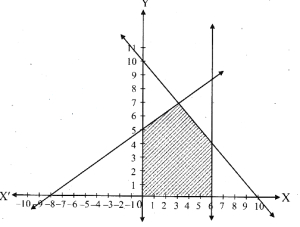
The shaded area in the given figure is a solution set for some system of inequalities. The maximum value of the function $z=4x+3y$ subject to linear constraints given by the system is
A
$38$
B
$36$
C
$33$
D
$34$
Solution
(B) The corner points of the feasible region are $O(0,0)$,$A(6,0)$,$B(6,4)$,$C(3,7)$,and $D(0,5)$.
We evaluate the objective function $z=4x+3y$ at each corner point:
At $O(0,0)$,$z=4(0)+3(0)=0$
At $A(6,0)$,$z=4(6)+3(0)=24$
At $B(6,4)$,$z=4(6)+3(4)=24+12=36$
At $C(3,7)$,$z=4(3)+3(7)=12+21=33$
At $D(0,5)$,$z=4(0)+3(5)=15$
Comparing these values,the maximum value of $z$ is $36$.
We evaluate the objective function $z=4x+3y$ at each corner point:
At $O(0,0)$,$z=4(0)+3(0)=0$
At $A(6,0)$,$z=4(6)+3(0)=24$
At $B(6,4)$,$z=4(6)+3(4)=24+12=36$
At $C(3,7)$,$z=4(3)+3(7)=12+21=33$
At $D(0,5)$,$z=4(0)+3(5)=15$
Comparing these values,the maximum value of $z$ is $36$.
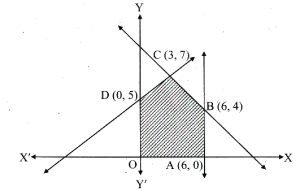
0 likes
View Solution77
EasyMCQ
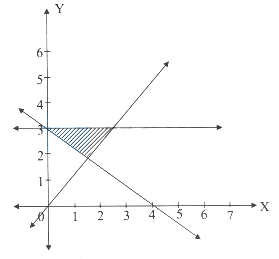
If the feasible region is as shown in the figure,then the related inequalities are:
A
$3x + 4y \geq 12, y - x \geq 0, y \leq 3, x, y \geq 0$
B
$3x + 4y \leq 12, y - x \leq 0, y \geq 3, x, y \geq 0$
C
$3x + 4y \leq 12, y - x \geq 0, y \leq 3, x, y \geq 0$
D
$3x + 4y \geq 12, y - x \leq 0, y \geq 3, x, y \geq 0$
Solution
(C) The shaded region is bounded by three lines and the axes in the first quadrant:
$1$. The line passing through $(0, 3)$ and $(4, 0)$ is given by $\frac{x}{4} + \frac{y}{3} = 1$,which simplifies to $3x + 4y = 12$. Since the shaded region is towards the origin side,the inequality is $3x + 4y \leq 12$.
$2$. The line passing through $(0, 0)$ and $(3, 3)$ is $y = x$,which is $y - x = 0$. The shaded region is above this line,so the inequality is $y \geq x$ or $y - x \geq 0$.
$3$. The horizontal line passing through $(0, 3)$ is $y = 3$. The shaded region is below this line,so the inequality is $y \leq 3$.
$4$. Since the region is in the first quadrant,$x \geq 0$ and $y \geq 0$.
Combining these,the inequalities are $3x + 4y \leq 12, y - x \geq 0, y \leq 3, x, y \geq 0$.
$1$. The line passing through $(0, 3)$ and $(4, 0)$ is given by $\frac{x}{4} + \frac{y}{3} = 1$,which simplifies to $3x + 4y = 12$. Since the shaded region is towards the origin side,the inequality is $3x + 4y \leq 12$.
$2$. The line passing through $(0, 0)$ and $(3, 3)$ is $y = x$,which is $y - x = 0$. The shaded region is above this line,so the inequality is $y \geq x$ or $y - x \geq 0$.
$3$. The horizontal line passing through $(0, 3)$ is $y = 3$. The shaded region is below this line,so the inequality is $y \leq 3$.
$4$. Since the region is in the first quadrant,$x \geq 0$ and $y \geq 0$.
Combining these,the inequalities are $3x + 4y \leq 12, y - x \geq 0, y \leq 3, x, y \geq 0$.
0 likes
View Solution78
EasyMCQ
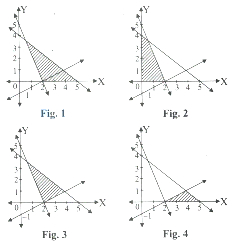
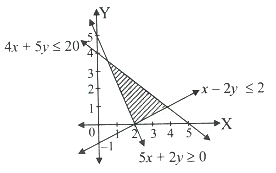
The graphical solution set for the system of inequations $x-2y \leq 2$,$5x+2y \geq 10$,$4x+5y \leq 20$,$x \geq 0$,$y \geq 0$ is given by
A
Fig. $2$
B
Fig. $4$
C
Fig. $1$
D
Fig. $3$
Solution
(D) To find the feasible region,we analyze the given inequations in the $1^{\text{st}}$ quadrant $(x \geq 0, y \geq 0)$:
$1$. For $x-2y \leq 2$: The line passes through $(2, 0)$ and $(0, -1)$. Testing $(0, 0)$,$0-0 \leq 2$ is true,so the region is towards the origin side.
$2$. For $5x+2y \geq 10$: The line passes through $(2, 0)$ and $(0, 5)$. Testing $(0, 0)$,$0+0 \geq 10$ is false,so the region is away from the origin side.
$3$. For $4x+5y \leq 20$: The line passes through $(5, 0)$ and $(0, 4)$. Testing $(0, 0)$,$0+0 \leq 20$ is true,so the region is towards the origin side.
Combining these,the feasible region is the triangular area bounded by these lines in the $1^{\text{st}}$ quadrant,which corresponds to Fig. $3$.
$1$. For $x-2y \leq 2$: The line passes through $(2, 0)$ and $(0, -1)$. Testing $(0, 0)$,$0-0 \leq 2$ is true,so the region is towards the origin side.
$2$. For $5x+2y \geq 10$: The line passes through $(2, 0)$ and $(0, 5)$. Testing $(0, 0)$,$0+0 \geq 10$ is false,so the region is away from the origin side.
$3$. For $4x+5y \leq 20$: The line passes through $(5, 0)$ and $(0, 4)$. Testing $(0, 0)$,$0+0 \leq 20$ is true,so the region is towards the origin side.
Combining these,the feasible region is the triangular area bounded by these lines in the $1^{\text{st}}$ quadrant,which corresponds to Fig. $3$.
0 likes
View Solution79
EasyMCQ
For the following shaded area,the linear constraints except $x, y \geq 0$ are
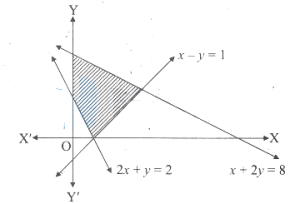
A
$2 x+y \leq 2, x-y \leq 1, x+2 y \leq 8$
B
$2 x+y \geq 2, x-y \leq 1, x+2 y \leq 8$
C
$2 x+y \geq 2, x-y \geq 1, x+2 y \leq 8$
D
$2 x+y \geq 2, x-y \geq 1, x+2 y \geq 8$
Solution
(B) To determine the linear constraints for the shaded region,we analyze the position of the region relative to each line:
$1$. For the line $2x + y = 2$,the shaded region lies on the side away from the origin (non-origin side). Testing the point $(1, 1)$,we get $2(1) + 1 = 3 \geq 2$. Thus,the constraint is $2x + y \geq 2$.
$2$. For the line $x - y = 1$,the shaded region lies on the side containing the origin. Testing the point $(0, 0)$,we get $0 - 0 = 0 \leq 1$. Thus,the constraint is $x - y \leq 1$.
$3$. For the line $x + 2y = 8$,the shaded region lies on the side containing the origin. Testing the point $(0, 0)$,we get $0 + 2(0) = 0 \leq 8$. Thus,the constraint is $x + 2y \leq 8$.
Therefore,the required linear constraints are $2x + y \geq 2, x - y \leq 1, x + 2y \leq 8$.
$1$. For the line $2x + y = 2$,the shaded region lies on the side away from the origin (non-origin side). Testing the point $(1, 1)$,we get $2(1) + 1 = 3 \geq 2$. Thus,the constraint is $2x + y \geq 2$.
$2$. For the line $x - y = 1$,the shaded region lies on the side containing the origin. Testing the point $(0, 0)$,we get $0 - 0 = 0 \leq 1$. Thus,the constraint is $x - y \leq 1$.
$3$. For the line $x + 2y = 8$,the shaded region lies on the side containing the origin. Testing the point $(0, 0)$,we get $0 + 2(0) = 0 \leq 8$. Thus,the constraint is $x + 2y \leq 8$.
Therefore,the required linear constraints are $2x + y \geq 2, x - y \leq 1, x + 2y \leq 8$.
0 likes
View Solution80
MediumMCQ
The maximum value of $z = 3x + 5y$ subject to the constraints $3x + 2y \leq 18$,$x \leq 4$,$y \leq 6$,$x, y \geq 0$,is
A
$27$
B
$36$
C
$42$
D
$30$
Solution
(B) The objective function is $z = 3x + 5y$.
The constraints are $3x + 2y \leq 18$,$x \leq 4$,$y \leq 6$,and $x, y \geq 0$.
The feasible region is a polygon with corner points $O(0, 0)$,$A(4, 0)$,$B(4, 3)$,$C(2, 6)$,and $D(0, 6)$.
We evaluate $z$ at each corner point:
At $O(0, 0)$: $z = 3(0) + 5(0) = 0$
At $A(4, 0)$: $z = 3(4) + 5(0) = 12$
At $B(4, 3)$: $z = 3(4) + 5(3) = 12 + 15 = 27$
At $C(2, 6)$: $z = 3(2) + 5(6) = 6 + 30 = 36$
At $D(0, 6)$: $z = 3(0) + 5(6) = 30$
The maximum value of $z$ is $36$ at the point $(2, 6)$.
The constraints are $3x + 2y \leq 18$,$x \leq 4$,$y \leq 6$,and $x, y \geq 0$.
The feasible region is a polygon with corner points $O(0, 0)$,$A(4, 0)$,$B(4, 3)$,$C(2, 6)$,and $D(0, 6)$.
We evaluate $z$ at each corner point:
At $O(0, 0)$: $z = 3(0) + 5(0) = 0$
At $A(4, 0)$: $z = 3(4) + 5(0) = 12$
At $B(4, 3)$: $z = 3(4) + 5(3) = 12 + 15 = 27$
At $C(2, 6)$: $z = 3(2) + 5(6) = 6 + 30 = 36$
At $D(0, 6)$: $z = 3(0) + 5(6) = 30$
The maximum value of $z$ is $36$ at the point $(2, 6)$.
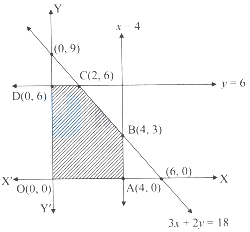
0 likes
View Solution81
MediumMCQ
For the feasible region $OCDBO$ shown in the figure,the maximum value of the objective function $z = 3x + 4y$ is:
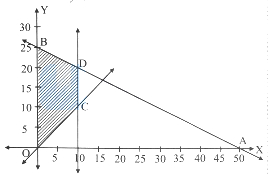
A
$70$
B
$100$
C
$110$
D
$130$
Solution
(C) The corner points of the given feasible region $OCDBO$ are $O(0, 0)$,$C(10, 10)$,$D(10, 20)$,and $B(0, 25)$.
We evaluate the objective function $z = 3x + 4y$ at each corner point:
$1$. At $O(0, 0)$: $z = 3(0) + 4(0) = 0$
$2$. At $C(10, 10)$: $z = 3(10) + 4(10) = 30 + 40 = 70$
$3$. At $D(10, 20)$: $z = 3(10) + 4(20) = 30 + 80 = 110$
$4$. At $B(0, 25)$: $z = 3(0) + 4(25) = 0 + 100 = 100$
Comparing the values $0, 70, 110,$ and $100$,the maximum value of $z$ is $110$.
We evaluate the objective function $z = 3x + 4y$ at each corner point:
$1$. At $O(0, 0)$: $z = 3(0) + 4(0) = 0$
$2$. At $C(10, 10)$: $z = 3(10) + 4(10) = 30 + 40 = 70$
$3$. At $D(10, 20)$: $z = 3(10) + 4(20) = 30 + 80 = 110$
$4$. At $B(0, 25)$: $z = 3(0) + 4(25) = 0 + 100 = 100$
Comparing the values $0, 70, 110,$ and $100$,the maximum value of $z$ is $110$.
0 likes
View Solution82
MediumMCQ
The maximum value of $z=7x+8y$ subject to the constraints $x+y \leq 20, y \geq 5, x \leq 10, x \geq 0, y \geq 0$ is
A
$150$
B
$160$
C
$110$
D
$180$
Solution
(B) The feasible region is determined by the constraints $x+y \leq 20, y \geq 5, x \leq 10, x \geq 0, y \geq 0$.
The corner points of the feasible region are $A(0, 5), B(10, 5), C(10, 10),$ and $D(0, 20)$.
We evaluate the objective function $z = 7x + 8y$ at each corner point:
At $A(0, 5): z = 7(0) + 8(5) = 40$
At $B(10, 5): z = 7(10) + 8(5) = 70 + 40 = 110$
At $C(10, 10): z = 7(10) + 8(10) = 70 + 80 = 150$
At $D(0, 20): z = 7(0) + 8(20) = 160$
The maximum value of $z$ is $160$.
The corner points of the feasible region are $A(0, 5), B(10, 5), C(10, 10),$ and $D(0, 20)$.
We evaluate the objective function $z = 7x + 8y$ at each corner point:
At $A(0, 5): z = 7(0) + 8(5) = 40$
At $B(10, 5): z = 7(10) + 8(5) = 70 + 40 = 110$
At $C(10, 10): z = 7(10) + 8(10) = 70 + 80 = 150$
At $D(0, 20): z = 7(0) + 8(20) = 160$
The maximum value of $z$ is $160$.
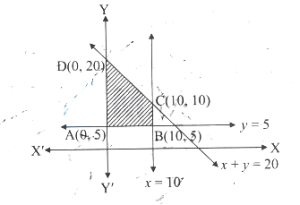
0 likes
View Solution83
MediumMCQ
If the feasible region is as shown in the figure,then the related inequalities are:
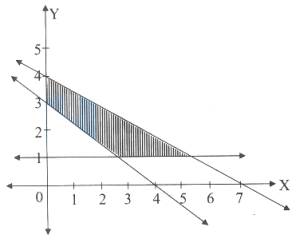
A
$3x + 4y \geq 12, 4x + 7y \leq 28, y \leq 1, x \geq 0, y \geq 0$
B
$3x + 4y \geq 12, 4x + 7y \leq 28, y \geq 1, x \geq 0, y \geq 0$
C
$3x + 4y \leq 12, 4x + 7y \leq 28, y \leq 1, x \geq 0, y \geq 0$
D
$3x + 4y \leq 12, 4x + 7y \geq 28, y \geq 1, x \geq 0, y \geq 0$
Solution
(B) $1$. Identify the lines bounding the region: The lines are $3x + 4y = 12$ (intercepts $(4,0)$ and $(0,3)$),$4x + 7y = 28$ (intercepts $(7,0)$ and $(0,4)$),and $y = 1$.
$2$. Analyze the inequalities:
- For the line $3x + 4y = 12$,the shaded region is away from the origin,so the inequality is $3x + 4y \geq 12$.
- For the line $4x + 7y = 28$,the shaded region is towards the origin,so the inequality is $4x + 7y \leq 28$.
- For the line $y = 1$,the shaded region is above the line,so the inequality is $y \geq 1$.
- Since the region is in the first quadrant,we have $x \geq 0$ and $y \geq 0$.
$3$. Combining these,the system of inequalities is $3x + 4y \geq 12, 4x + 7y \leq 28, y \geq 1, x \geq 0, y \geq 0$.
$2$. Analyze the inequalities:
- For the line $3x + 4y = 12$,the shaded region is away from the origin,so the inequality is $3x + 4y \geq 12$.
- For the line $4x + 7y = 28$,the shaded region is towards the origin,so the inequality is $4x + 7y \leq 28$.
- For the line $y = 1$,the shaded region is above the line,so the inequality is $y \geq 1$.
- Since the region is in the first quadrant,we have $x \geq 0$ and $y \geq 0$.
$3$. Combining these,the system of inequalities is $3x + 4y \geq 12, 4x + 7y \leq 28, y \geq 1, x \geq 0, y \geq 0$.
0 likes
View Solution84
MediumMCQ
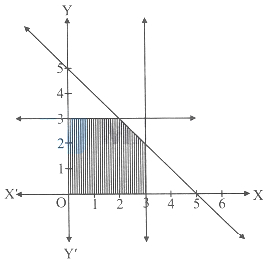
The shaded area in the given figure is a solution set for some system of inequations. The maximum value of the function $z=10x+25y$ subject to the linear constraints given by the system is
A
$80$
B
$100$
C
$95$
D
$105$
Solution
(C) The feasible region is a polygon with vertices $(0,0)$,$(3,0)$,$(3,2)$,$(2,3)$,and $(0,3)$.
We evaluate the objective function $z=10x+25y$ at each vertex:
At $(0,0)$,$z=10(0)+25(0)=0$
At $(3,0)$,$z=10(3)+25(0)=30$
At $(3,2)$,$z=10(3)+25(2)=30+50=80$
At $(2,3)$,$z=10(2)+25(3)=20+75=95$
At $(0,3)$,$z=10(0)+25(3)=75$
Comparing these values,the maximum value of $z$ is $95$.
We evaluate the objective function $z=10x+25y$ at each vertex:
At $(0,0)$,$z=10(0)+25(0)=0$
At $(3,0)$,$z=10(3)+25(0)=30$
At $(3,2)$,$z=10(3)+25(2)=30+50=80$
At $(2,3)$,$z=10(2)+25(3)=20+75=95$
At $(0,3)$,$z=10(0)+25(3)=75$
Comparing these values,the maximum value of $z$ is $95$.
0 likes
View Solution85
DifficultMCQ
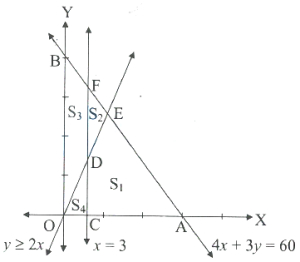
The solution set of the inequalities $4x + 3y \leq 60$,$y \geq 2x$,$x \geq 3$,$x, y \geq 0$ is represented by which region?
A
$S_2$ region
B
$S_1$ region
C
$S_3$ region
D
$S_4$ region
Solution
(A) To find the feasible region,we analyze the given inequalities:
$1$. $4x + 3y \leq 60$: This represents the region on or below the line passing through $(15, 0)$ and $(0, 20)$.
$2$. $y \geq 2x$: This represents the region on or above the line passing through $(0, 0)$ and $(3, 6)$.
$3$. $x \geq 3$: This represents the region to the right of the vertical line $x = 3$.
$4$. $x, y \geq 0$: This represents the first quadrant.
By testing a point $(4, 10)$ which lies in the $S_2$ region:
- $4(4) + 3(10) = 16 + 30 = 46 \leq 60$ (True)
- $10 \geq 2(4) = 8$ (True)
- $4 \geq 3$ (True)
- $4, 10 \geq 0$ (True)
Since all conditions are satisfied,the solution set is represented by the $S_2$ region.
$1$. $4x + 3y \leq 60$: This represents the region on or below the line passing through $(15, 0)$ and $(0, 20)$.
$2$. $y \geq 2x$: This represents the region on or above the line passing through $(0, 0)$ and $(3, 6)$.
$3$. $x \geq 3$: This represents the region to the right of the vertical line $x = 3$.
$4$. $x, y \geq 0$: This represents the first quadrant.
By testing a point $(4, 10)$ which lies in the $S_2$ region:
- $4(4) + 3(10) = 16 + 30 = 46 \leq 60$ (True)
- $10 \geq 2(4) = 8$ (True)
- $4 \geq 3$ (True)
- $4, 10 \geq 0$ (True)
Since all conditions are satisfied,the solution set is represented by the $S_2$ region.
0 likes
View Solution86
MediumMCQ
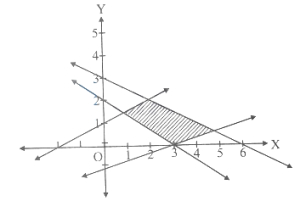
The shaded region in the following figure represents the solution set for a certain linear programming problem. The linear constraints for this region are given by:
A
$2x + 3y \geq 6, -x + 2y \geq 2, 3x + 6y \leq 18, x - 3y \geq 3, x \geq 0, y \geq 0$
B
$2x + 3y \geq 6, -x + 2y \leq 2, x - 3y \leq 3, x + 2y \geq 18, x \geq 0, y \geq 0$
C
$2x + 3y \leq 6, -x + 2y \geq 2, 3x + 6y \leq 18, x - 3y \leq 3, x \geq 0, y \geq 0$
D
$2x + 3y \geq 6, 3x + 6y \leq 18, x - 3y \leq 3, -x + 2y \leq 2, x \geq 0, y \geq 0$
Solution
(D) To determine the linear constraints,we analyze the boundary lines of the shaded region:
$1$. The line passing through $(3, 0)$ and $(0, 2)$ is $2x + 3y = 6$. Since the shaded region is away from the origin,the constraint is $2x + 3y \geq 6$.
$2$. The line passing through $(0, 3)$ and $(6, 0)$ is $3x + 6y = 18$. Since the shaded region is towards the origin,the constraint is $3x + 6y \leq 18$.
$3$. The line passing through $(3, 0)$ and $(0, -1)$ is $x - 3y = 3$. Since the shaded region is towards the origin,the constraint is $x - 3y \leq 3$.
$4$. The line passing through $(0, 1)$ and $(2, 2)$ is $-x + 2y = 2$. Since the shaded region is towards the origin,the constraint is $-x + 2y \leq 2$.
$5$. Since the region is in the first quadrant,$x \geq 0$ and $y \geq 0$.
Thus,the correct constraints are $2x + 3y \geq 6, 3x + 6y \leq 18, x - 3y \leq 3, -x + 2y \leq 2, x \geq 0, y \geq 0$.
$1$. The line passing through $(3, 0)$ and $(0, 2)$ is $2x + 3y = 6$. Since the shaded region is away from the origin,the constraint is $2x + 3y \geq 6$.
$2$. The line passing through $(0, 3)$ and $(6, 0)$ is $3x + 6y = 18$. Since the shaded region is towards the origin,the constraint is $3x + 6y \leq 18$.
$3$. The line passing through $(3, 0)$ and $(0, -1)$ is $x - 3y = 3$. Since the shaded region is towards the origin,the constraint is $x - 3y \leq 3$.
$4$. The line passing through $(0, 1)$ and $(2, 2)$ is $-x + 2y = 2$. Since the shaded region is towards the origin,the constraint is $-x + 2y \leq 2$.
$5$. Since the region is in the first quadrant,$x \geq 0$ and $y \geq 0$.
Thus,the correct constraints are $2x + 3y \geq 6, 3x + 6y \leq 18, x - 3y \leq 3, -x + 2y \leq 2, x \geq 0, y \geq 0$.
0 likes
View Solution87
EasyMCQ
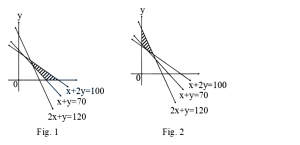
The graphical solution set of the system of in-equations $x+y \leq 70, x+2y \leq 100, 2x+y \leq 120, x \geq 0, y \geq 0$ is given by:
A
Fig. $2$
B
Fig. $1$
C
Fig. $4$
D
Fig. $3$
Solution
(D) The given system of in-equations is:
$x+y \leq 70$
$x+2y \leq 100$
$2x+y \leq 120$
$x \geq 0, y \geq 0$
Since all the inequalities $x+y \leq 70$,$x+2y \leq 100$,and $2x+y \leq 120$ are satisfied by the origin $(0,0)$ (as $0+0 \leq 70$,$0+0 \leq 100$,and $0+0 \leq 120$ are all true),the feasible region must lie towards the origin in the first quadrant.
By analyzing the lines and the constraints $x \geq 0, y \geq 0$,the common shaded region that satisfies all these conditions is represented by Fig. $3$.
$x+y \leq 70$
$x+2y \leq 100$
$2x+y \leq 120$
$x \geq 0, y \geq 0$
Since all the inequalities $x+y \leq 70$,$x+2y \leq 100$,and $2x+y \leq 120$ are satisfied by the origin $(0,0)$ (as $0+0 \leq 70$,$0+0 \leq 100$,and $0+0 \leq 120$ are all true),the feasible region must lie towards the origin in the first quadrant.
By analyzing the lines and the constraints $x \geq 0, y \geq 0$,the common shaded region that satisfies all these conditions is represented by Fig. $3$.
0 likes
View Solution88
EasyMCQ
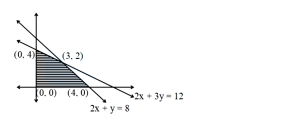
The maximum value of the objective function $z=4x+5y$ subject to the constraints $2x+3y \leq 12$,$2x+y \leq 8$ and $x \geq 0, y \geq 0$ is:
A
$24$
B
$23$
C
$22$
D
$21$
Solution
(C) The feasible region is determined by the constraints $2x+3y \leq 12$,$2x+y \leq 8$,$x \geq 0$,and $y \geq 0$. The corner points of the feasible region are $(0, 0)$,$(4, 0)$,$(3, 2)$,and $(0, 4)$.
We evaluate the objective function $z=4x+5y$ at these corner points:
At $(0, 0)$: $z = 4(0) + 5(0) = 0$
At $(4, 0)$: $z = 4(4) + 5(0) = 16$
At $(3, 2)$: $z = 4(3) + 5(2) = 12 + 10 = 22$
At $(0, 4)$: $z = 4(0) + 5(4) = 20$
The maximum value of $z$ is $22$ at the point $(3, 2)$.
We evaluate the objective function $z=4x+5y$ at these corner points:
At $(0, 0)$: $z = 4(0) + 5(0) = 0$
At $(4, 0)$: $z = 4(4) + 5(0) = 16$
At $(3, 2)$: $z = 4(3) + 5(2) = 12 + 10 = 22$
At $(0, 4)$: $z = 4(0) + 5(4) = 20$
The maximum value of $z$ is $22$ at the point $(3, 2)$.
0 likes
View Solution89
EasyMCQ
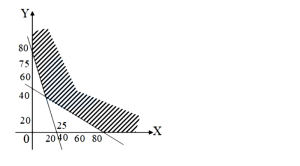
The cost function $Z$ is given by $Z = 4x + 6y$. It is to be minimized. The feasible region for this function $Z$ is the shaded region represented in the following figure. Then the minimum value of $Z$ is and occurs at the point:
A
$260, (20, 30)$
B
$240, (0, 40)$
C
$100, (25, 0)$
D
$254, (14, 33)$
Solution
(D) The feasible region is bounded by the corner points $(0, 80)$,$(14, 33)$,and $(80, 0)$.
We evaluate the objective function $Z = 4x + 6y$ at each corner point:
$1$. At $(0, 80)$: $Z = 4(0) + 6(80) = 480$
$2$. At $(14, 33)$: $Z = 4(14) + 6(33) = 56 + 198 = 254$
$3$. At $(80, 0)$: $Z = 4(80) + 6(0) = 320$
Comparing these values,the minimum value of $Z$ is $254$,which occurs at the point $(14, 33)$.
We evaluate the objective function $Z = 4x + 6y$ at each corner point:
$1$. At $(0, 80)$: $Z = 4(0) + 6(80) = 480$
$2$. At $(14, 33)$: $Z = 4(14) + 6(33) = 56 + 198 = 254$
$3$. At $(80, 0)$: $Z = 4(80) + 6(0) = 320$
Comparing these values,the minimum value of $Z$ is $254$,which occurs at the point $(14, 33)$.
0 likes
View Solution90
DifficultMCQ
The maximum value of $Z = 5x + 2y$,subject to the constraints $2x - y \geq 2$,$x + 2y \leq 8$,and $x, y \geq 0$,is:
A
$40$
B
$25.6$
C
$20$
D
$17.6$
Solution
(A) To find the maximum value of $Z = 5x + 2y$,we identify the feasible region defined by the constraints:
$1$. $2x - y \geq 2$
$2$. $x + 2y \leq 8$
$3$. $x, y \geq 0$
The boundary lines are $2x - y = 2$ and $x + 2y = 8$.
- For $2x - y = 2$,the intercepts are $(1, 0)$ and $(0, -2)$.
- For $x + 2y = 8$,the intercepts are $(8, 0)$ and $(0, 4)$.
To find the intersection point of $2x - y = 2$ and $x + 2y = 8$:
Multiply the first equation by $2$: $4x - 2y = 4$.
Adding this to $x + 2y = 8$,we get $5x = 12$,so $x = 2.4$.
Substituting $x = 2.4$ into $2x - y = 2$: $2(2.4) - y = 2 \implies 4.8 - y = 2 \implies y = 2.8$.
The vertices of the feasible region are $(1, 0)$,$(8, 0)$,and $(2.4, 2.8)$.
Now,evaluate $Z = 5x + 2y$ at these vertices:
- At $(1, 0)$: $Z = 5(1) + 2(0) = 5$
- At $(8, 0)$: $Z = 5(8) + 2(0) = 40$
- At $(2.4, 2.8)$: $Z = 5(2.4) + 2(2.8) = 12 + 5.6 = 17.6$
Comparing these values,the maximum value is $40$ at $(8, 0)$.
$1$. $2x - y \geq 2$
$2$. $x + 2y \leq 8$
$3$. $x, y \geq 0$
The boundary lines are $2x - y = 2$ and $x + 2y = 8$.
- For $2x - y = 2$,the intercepts are $(1, 0)$ and $(0, -2)$.
- For $x + 2y = 8$,the intercepts are $(8, 0)$ and $(0, 4)$.
To find the intersection point of $2x - y = 2$ and $x + 2y = 8$:
Multiply the first equation by $2$: $4x - 2y = 4$.
Adding this to $x + 2y = 8$,we get $5x = 12$,so $x = 2.4$.
Substituting $x = 2.4$ into $2x - y = 2$: $2(2.4) - y = 2 \implies 4.8 - y = 2 \implies y = 2.8$.
The vertices of the feasible region are $(1, 0)$,$(8, 0)$,and $(2.4, 2.8)$.
Now,evaluate $Z = 5x + 2y$ at these vertices:
- At $(1, 0)$: $Z = 5(1) + 2(0) = 5$
- At $(8, 0)$: $Z = 5(8) + 2(0) = 40$
- At $(2.4, 2.8)$: $Z = 5(2.4) + 2(2.8) = 12 + 5.6 = 17.6$
Comparing these values,the maximum value is $40$ at $(8, 0)$.
0 likes
View Solution91
EasyMCQ
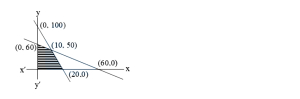
The maximum value of $z=50x+15y$ subject to the constraints $x+y \leq 60$,$5x+y \leq 100$,$x \geq 0$,$y \geq 0$ is at the point:
A
$2650$ at $(50, 10)$
B
$1000$ at $(20, 0)$
C
$900$ at $(0, 60)$
D
$1250$ at $(10, 50)$
Solution
(D) To find the maximum value of $z=50x+15y$,we evaluate the objective function at the corner points of the feasible region.
The corner points of the feasible region are $(0, 0)$,$(20, 0)$,$(10, 50)$,and $(0, 60)$.
Evaluating $z$ at each point:
$1$. At $(0, 0)$: $z = 50(0) + 15(0) = 0$
$2$. At $(20, 0)$: $z = 50(20) + 15(0) = 1000$
$3$. At $(10, 50)$: $z = 50(10) + 15(50) = 500 + 750 = 1250$
$4$. At $(0, 60)$: $z = 50(0) + 15(60) = 900$
The maximum value is $1250$,which occurs at the point $(10, 50)$.
The corner points of the feasible region are $(0, 0)$,$(20, 0)$,$(10, 50)$,and $(0, 60)$.
Evaluating $z$ at each point:
$1$. At $(0, 0)$: $z = 50(0) + 15(0) = 0$
$2$. At $(20, 0)$: $z = 50(20) + 15(0) = 1000$
$3$. At $(10, 50)$: $z = 50(10) + 15(50) = 500 + 750 = 1250$
$4$. At $(0, 60)$: $z = 50(0) + 15(60) = 900$
The maximum value is $1250$,which occurs at the point $(10, 50)$.
0 likes
View Solution92
EasyMCQ
For the following shaded region,the linear constraints are:
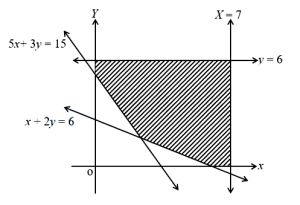
A
$x+2 y \leq 6, 5 x+3 y \leq 15, x \leq 7, y \leq 6, x, y \geq 0$
B
$x+2 y \leq 6, 5 x+3 y \geq 15, x \leq 7, y \leq 6, x, y \geq 0$
C
$x+2 y \geq 6, 5 x+3 y \leq 15, x \leq 7, y \leq 6, x, y \geq 0$
D
$x+2 y \geq 6, 5 x+3 y \geq 15, x \leq 7, y \leq 6, x, y \geq 0$
Solution
(D) To determine the linear constraints for the shaded region,we analyze each boundary line:
$1$. The line $x+2y=6$ has the shaded region on the side away from the origin (since the point $(7, 6)$ satisfies $7+12=19 \geq 6$). Thus,the constraint is $x+2y \geq 6$.
$2$. The line $5x+3y=15$ has the shaded region on the side away from the origin (since the point $(7, 6)$ satisfies $35+18=53 \geq 15$). Thus,the constraint is $5x+3y \geq 15$.
$3$. The vertical line $x=7$ has the shaded region to its left,so $x \leq 7$.
$4$. The horizontal line $y=6$ has the shaded region below it,so $y \leq 6$.
$5$. The region is in the first quadrant,so $x, y \geq 0$.
Combining these,the constraints are $x+2y \geq 6, 5x+3y \geq 15, x \leq 7, y \leq 6, x, y \geq 0$.
$1$. The line $x+2y=6$ has the shaded region on the side away from the origin (since the point $(7, 6)$ satisfies $7+12=19 \geq 6$). Thus,the constraint is $x+2y \geq 6$.
$2$. The line $5x+3y=15$ has the shaded region on the side away from the origin (since the point $(7, 6)$ satisfies $35+18=53 \geq 15$). Thus,the constraint is $5x+3y \geq 15$.
$3$. The vertical line $x=7$ has the shaded region to its left,so $x \leq 7$.
$4$. The horizontal line $y=6$ has the shaded region below it,so $y \leq 6$.
$5$. The region is in the first quadrant,so $x, y \geq 0$.
Combining these,the constraints are $x+2y \geq 6, 5x+3y \geq 15, x \leq 7, y \leq 6, x, y \geq 0$.
0 likes
View Solution93
EasyMCQ
The function to be maximized is given by $Z=2x+y$. The feasible region for this function $Z$ is the shaded region shown in the figure. The maximum value of $Z$ is . . . . . . and occurs at the point . . . . . . .
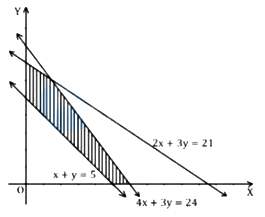
A
$10, (5,0)$
B
$12, (6,0)$
C
$9, (1.5, 6)$
D
$21, (0.5, 0)$
Solution
(B) The feasible region is bounded by the lines $x+y=5$,$4x+3y=24$,$x=0$,and $y=0$.
To find the corner points,we identify the vertices of the shaded region:
$1$. The intersection of $x=0$ and $4x+3y=24$ gives $(0, 8)$.
$2$. The intersection of $x=0$ and $x+y=5$ gives $(0, 5)$.
$3$. The intersection of $x+y=5$ and $4x+3y=24$ is found by solving the system: $y=5-x \implies 4x+3(5-x)=24 \implies x=9, y=-4$ (Not in the first quadrant).
Looking at the graph,the vertices are $(0, 5)$,$(0, 8)$,and the intersection of $4x+3y=24$ with the $x$-axis $(6, 0)$ and $x+y=5$ with the $x$-axis $(5, 0)$.
Evaluating $Z=2x+y$ at the corner points:
At $(0, 5)$,$Z = 2(0) + 5 = 5$.
At $(0, 8)$,$Z = 2(0) + 8 = 8$.
At $(5, 0)$,$Z = 2(5) + 0 = 10$.
At $(6, 0)$,$Z = 2(6) + 0 = 12$.
The maximum value is $12$ at the point $(6, 0)$.
To find the corner points,we identify the vertices of the shaded region:
$1$. The intersection of $x=0$ and $4x+3y=24$ gives $(0, 8)$.
$2$. The intersection of $x=0$ and $x+y=5$ gives $(0, 5)$.
$3$. The intersection of $x+y=5$ and $4x+3y=24$ is found by solving the system: $y=5-x \implies 4x+3(5-x)=24 \implies x=9, y=-4$ (Not in the first quadrant).
Looking at the graph,the vertices are $(0, 5)$,$(0, 8)$,and the intersection of $4x+3y=24$ with the $x$-axis $(6, 0)$ and $x+y=5$ with the $x$-axis $(5, 0)$.
Evaluating $Z=2x+y$ at the corner points:
At $(0, 5)$,$Z = 2(0) + 5 = 5$.
At $(0, 8)$,$Z = 2(0) + 8 = 8$.
At $(5, 0)$,$Z = 2(5) + 0 = 10$.
At $(6, 0)$,$Z = 2(6) + 0 = 12$.
The maximum value is $12$ at the point $(6, 0)$.
0 likes
View Solution94
EasyMCQ
For the inequalities $x+y \leq 3$,$2x+5y \geq 10$,$x \geq 0$,$y \geq 0$,which of the following points lies in the feasible region?
A
$(2,2)$
B
$(4,2)$
C
$(1,2)$
D
$(2,1)$
Solution
(C) To find the point in the feasible region,we must check which point satisfies all the given inequalities:
$1$) $x+y \leq 3$
$2$) $2x+5y \geq 10$
$3$) $x \geq 0, y \geq 0$
Let us test the given options:
For option $(A)$ $(2,2)$: $2+2 = 4 \not\leq 3$. (False)
For option $(B)$ $(4,2)$: $4+2 = 6 \not\leq 3$. (False)
For option $(C)$ $(1,2)$: $1+2 = 3 \leq 3$ (True),$2(1)+5(2) = 2+10 = 12 \geq 10$ (True),and $1 \geq 0, 2 \geq 0$ (True). (True)
For option $(D)$ $(2,1)$: $2(2)+5(1) = 4+5 = 9 \not\geq 10$. (False)
Thus,the point $(1,2)$ satisfies all the inequalities and lies in the feasible region.
$1$) $x+y \leq 3$
$2$) $2x+5y \geq 10$
$3$) $x \geq 0, y \geq 0$
Let us test the given options:
For option $(A)$ $(2,2)$: $2+2 = 4 \not\leq 3$. (False)
For option $(B)$ $(4,2)$: $4+2 = 6 \not\leq 3$. (False)
For option $(C)$ $(1,2)$: $1+2 = 3 \leq 3$ (True),$2(1)+5(2) = 2+10 = 12 \geq 10$ (True),and $1 \geq 0, 2 \geq 0$ (True). (True)
For option $(D)$ $(2,1)$: $2(2)+5(1) = 4+5 = 9 \not\geq 10$. (False)
Thus,the point $(1,2)$ satisfies all the inequalities and lies in the feasible region.
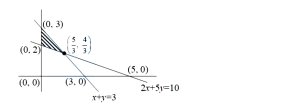
0 likes
View Solution95
EasyMCQ
The shaded area in the figure below is the solution set for a certain linear programming problem. The linear constraints are given by:
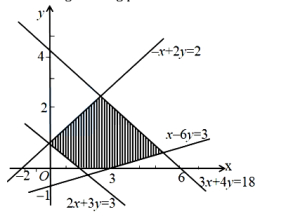
A
$3x + 4y \leq 18, 2x + 3y \geq 3, x - 6y \geq 3, -x + 2y \leq 2, x \geq 0, y \geq 0$
B
$3x + 4y \leq 18, 2x + 3y \geq 3, x - 6y \leq 3, -x + 2y \leq 2, x \geq 0, y \geq 0$
C
$3x + 4y \leq 18, 2x + 3y \geq 3, x - 6y \geq 3, -x + 2y \geq 2, x \geq 0, y \geq 0$
D
$3x + 4y \leq 18, 2x + 3y \leq 3, x - 6y \geq 3, -x + 2y \leq 2, x \geq 0, y \geq 0$
Solution
(B) To determine the linear constraints,we analyze the half-planes defined by each line for the shaded region:
$1$. For the line $3x + 4y = 18$,the origin $(0,0)$ satisfies $3(0) + 4(0) = 0 \leq 18$. Since the shaded region contains the origin relative to this line,the constraint is $3x + 4y \leq 18$.
$2$. For the line $2x + 3y = 3$,the origin $(0,0)$ gives $2(0) + 3(0) = 0 \leq 3$. Since the shaded region is on the side away from the origin,the constraint is $2x + 3y \geq 3$.
$3$. For the line $x - 6y = 3$,the origin $(0,0)$ gives $0 - 0 = 0 \leq 3$. Since the shaded region is on the side containing the origin,the constraint is $x - 6y \leq 3$.
$4$. For the line $-x + 2y = 2$,the origin $(0,0)$ gives $0 + 0 = 0 \leq 2$. Since the shaded region is on the side containing the origin,the constraint is $-x + 2y \leq 2$.
$5$. The region is in the first quadrant,so $x \geq 0$ and $y \geq 0$.
Thus,the correct set of constraints is $3x + 4y \leq 18, 2x + 3y \geq 3, x - 6y \leq 3, -x + 2y \leq 2, x \geq 0, y \geq 0$.
$1$. For the line $3x + 4y = 18$,the origin $(0,0)$ satisfies $3(0) + 4(0) = 0 \leq 18$. Since the shaded region contains the origin relative to this line,the constraint is $3x + 4y \leq 18$.
$2$. For the line $2x + 3y = 3$,the origin $(0,0)$ gives $2(0) + 3(0) = 0 \leq 3$. Since the shaded region is on the side away from the origin,the constraint is $2x + 3y \geq 3$.
$3$. For the line $x - 6y = 3$,the origin $(0,0)$ gives $0 - 0 = 0 \leq 3$. Since the shaded region is on the side containing the origin,the constraint is $x - 6y \leq 3$.
$4$. For the line $-x + 2y = 2$,the origin $(0,0)$ gives $0 + 0 = 0 \leq 2$. Since the shaded region is on the side containing the origin,the constraint is $-x + 2y \leq 2$.
$5$. The region is in the first quadrant,so $x \geq 0$ and $y \geq 0$.
Thus,the correct set of constraints is $3x + 4y \leq 18, 2x + 3y \geq 3, x - 6y \leq 3, -x + 2y \leq 2, x \geq 0, y \geq 0$.
0 likes
View Solution96
EasyMCQ
The shaded part of the given figure indicates the feasible region. Then the constraints are
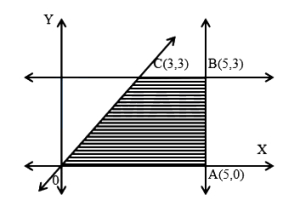
A
$x, y \geq 0 ; x-y \geq 0 ; x \leq 5 ; y \leq 3$
B
$x, y \geq 0 ; x-y \geq 0 ; x \leq 5 ; y \geq 3$
C
$x, y \geq 0 ; x+y \geq 0 ; x \geq 5 ; y \leq 3$
D
$x, y \geq 0 ; x-y \geq 0 ; x \geq 5 ; y \leq 3$
Solution
(A) $1$. The shaded region is bounded by the lines $x=0$ ($Y$-axis),$y=0$ ($X$-axis),$x=5$,$y=3$,and the line passing through $(0,0)$ and $(3,3)$.
$2$. The line passing through $(0,0)$ and $(3,3)$ has the equation $y=x$,which can be written as $x-y=0$. Since the shaded region lies below this line,the constraint is $x-y \geq 0$.
$3$. The vertical line $x=5$ bounds the region on the right,so $x \leq 5$.
$4$. The horizontal line $y=3$ bounds the region on the top,so $y \leq 3$.
$5$. Since the region is in the first quadrant,$x \geq 0$ and $y \geq 0$.
$6$. Combining these,the constraints are $x, y \geq 0, x-y \geq 0, x \leq 5, y \leq 3$.
$2$. The line passing through $(0,0)$ and $(3,3)$ has the equation $y=x$,which can be written as $x-y=0$. Since the shaded region lies below this line,the constraint is $x-y \geq 0$.
$3$. The vertical line $x=5$ bounds the region on the right,so $x \leq 5$.
$4$. The horizontal line $y=3$ bounds the region on the top,so $y \leq 3$.
$5$. Since the region is in the first quadrant,$x \geq 0$ and $y \geq 0$.
$6$. Combining these,the constraints are $x, y \geq 0, x-y \geq 0, x \leq 5, y \leq 3$.
0 likes
View Solution97
MediumMCQ
The objective function $z = 4x + 5y$ subject to the constraints $2x + y \geq 7$,$2x + 3y \leq 15$,$y \leq 3$,$x \geq 0$,and $y \geq 0$ has a minimum value at which point?
A
on the line $2x + 3y = 15$
B
on the $X$-axis
C
on the $Y$-axis
D
at the origin
Solution
(B) The constraints are $2x + y \geq 7$,$2x + 3y \leq 15$,$y \leq 3$,$x \geq 0$,and $y \geq 0$.
From the graph,the vertices of the feasible region are $A(3.5, 0)$,$B(7.5, 0)$,$C(3, 3)$,and $D(2, 3)$.
We evaluate the objective function $z = 4x + 5y$ at these vertices:
$z(A) = 4(3.5) + 5(0) = 14 + 0 = 14$
$z(B) = 4(7.5) + 5(0) = 30 + 0 = 30$
$z(C) = 4(3) + 5(3) = 12 + 15 = 27$
$z(D) = 4(2) + 5(3) = 8 + 15 = 23$
The minimum value is $14$,which occurs at point $A(3.5, 0)$. Since point $A$ lies on the $X$-axis,the minimum value occurs on the $X$-axis.
From the graph,the vertices of the feasible region are $A(3.5, 0)$,$B(7.5, 0)$,$C(3, 3)$,and $D(2, 3)$.
We evaluate the objective function $z = 4x + 5y$ at these vertices:
$z(A) = 4(3.5) + 5(0) = 14 + 0 = 14$
$z(B) = 4(7.5) + 5(0) = 30 + 0 = 30$
$z(C) = 4(3) + 5(3) = 12 + 15 = 27$
$z(D) = 4(2) + 5(3) = 8 + 15 = 23$
The minimum value is $14$,which occurs at point $A(3.5, 0)$. Since point $A$ lies on the $X$-axis,the minimum value occurs on the $X$-axis.
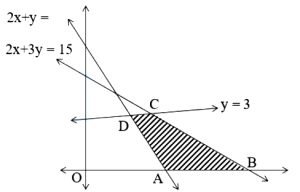
0 likes
View Solution98
EasyMCQ
The maximum value of $Z = 10x + 25y$ subject to $0 \leq x \leq 3$,$0 \leq y \leq 3$,and $x + y \leq 5$ occurs at the point:
A
$(3, 2)$
B
$(2, 3)$
C
$(4, 3)$
D
$(5, 4)$
Solution
(B) The feasible region is determined by the constraints $0 \leq x \leq 3$,$0 \leq y \leq 3$,and $x + y \leq 5$.
The vertices of the feasible region are:
$O(0, 0)$,$A(3, 0)$,$B(3, 2)$,$C(2, 3)$,and $D(0, 3)$.
We evaluate the objective function $Z = 10x + 25y$ at each vertex:
Comparing the values,the maximum value of $Z$ is $95$,which occurs at the point $(2, 3)$.
The vertices of the feasible region are:
$O(0, 0)$,$A(3, 0)$,$B(3, 2)$,$C(2, 3)$,and $D(0, 3)$.
We evaluate the objective function $Z = 10x + 25y$ at each vertex:
| Vertex | $Z = 10x + 25y$ |
| $O(0, 0)$ | $10(0) + 25(0) = 0$ |
| $A(3, 0)$ | $10(3) + 25(0) = 30$ |
| $B(3, 2)$ | $10(3) + 25(2) = 30 + 50 = 80$ |
| $C(2, 3)$ | $10(2) + 25(3) = 20 + 75 = 95$ |
| $D(0, 3)$ | $10(0) + 25(3) = 75$ |
Comparing the values,the maximum value of $Z$ is $95$,which occurs at the point $(2, 3)$.
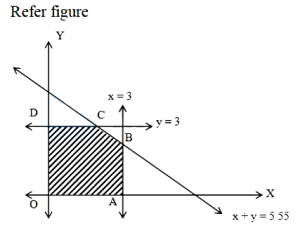
0 likes
View Solution99
MediumMCQ
The maximum value of the objective function $z=2x+3y$ subject to the constraints $x+y \leq 5$,$2x+y \geq 4$,$x \geq 0$,and $y \geq 0$ is
A
$15$
B
$10$
C
$20$
D
$25$
Solution
(A) The feasible region is determined by the constraints $x+y \leq 5$,$2x+y \geq 4$,$x \geq 0$,and $y \geq 0$.
From the graph,the vertices of the feasible region are $A(0, 4)$,$B(2, 0)$,$C(5, 0)$,and $D(0, 5)$.
We evaluate the objective function $z = 2x + 3y$ at each vertex:
At $A(0, 4)$: $z = 2(0) + 3(4) = 12$.
At $B(2, 0)$: $z = 2(2) + 3(0) = 4$.
At $C(5, 0)$: $z = 2(5) + 3(0) = 10$.
At $D(0, 5)$: $z = 2(0) + 3(5) = 15$.
The maximum value of $z$ is $15$ at point $D(0, 5)$.
From the graph,the vertices of the feasible region are $A(0, 4)$,$B(2, 0)$,$C(5, 0)$,and $D(0, 5)$.
We evaluate the objective function $z = 2x + 3y$ at each vertex:
At $A(0, 4)$: $z = 2(0) + 3(4) = 12$.
At $B(2, 0)$: $z = 2(2) + 3(0) = 4$.
At $C(5, 0)$: $z = 2(5) + 3(0) = 10$.
At $D(0, 5)$: $z = 2(0) + 3(5) = 15$.
The maximum value of $z$ is $15$ at point $D(0, 5)$.
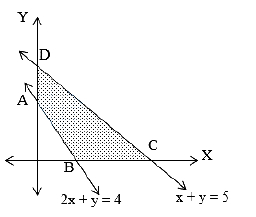
0 likes
View SolutionLinear Programming — Word problem of Linear programming · Frequently Asked Questions
1Are these Linear Programming questions useful for JEE and NEET?
Yes. All questions in this section are mapped to JEE Main and NEET exam patterns. Previous year questions from JEE Main, NEET, GUJCET and state-level exams are included with full solutions.
2Can I switch to Hindi or Gujarati for these questions?
Yes. Use the language tabs in the hero section or the sidebar to view the same questions and solutions in English, Hindi or Gujarati.
3How do I generate a question paper from this subtopic?
Use the Vedclass Exam Paper Generator — select the chapter and subtopic, set difficulty, and generate Sets A, B, C, D automatically. First 3 chapters of every subject are free.
Vedclass Products
For Students
Vedclass Test Series
Mock tests in real JEE/NEET style with performance analysis. 5-day free trial.
Start Free TrialFor Teachers
Exam Paper Generator
Generate Set A/B/C/D papers from this chapter in 2 minutes. 3 chapters free.
Try FreeFor Institutes
Online Exam Module
Live online exams with unlimited students, 360° analytics & white-label branding.
See DemoFor Teachers & Institutes
Generate a Linear Programming Exam Paper in 2 Minutes
Select subtopic & difficulty — Sets A, B, C, D auto-generated with No Repeat logic.
First 3 chapters of every subject are free — no payment required.