
A English
Word problem of Linear programming Questions in English
Class 12 Mathematics · Linear Programming · Word problem of Linear programming
131+
Questions
English
Language
100%
With Solutions
Showing 31 of 131 questions in English
101
EasyMCQ
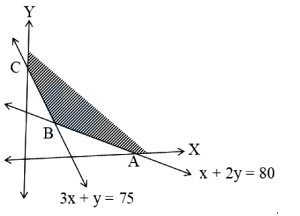
The minimum value of the objective function $z = 4x + 6y$ subject to the constraints $x + 2y \geq 80$,$3x + y \geq 75$,and $x, y \geq 0$ is:
A
$324$
B
$250$
C
$320$
D
$254$
Solution
(D) To find the minimum value of the objective function $z = 4x + 6y$,we first identify the feasible region defined by the constraints $x + 2y \geq 80$,$3x + y \geq 75$,and $x, y \geq 0$.
$1$. Find the vertices of the feasible region:
- The line $x + 2y = 80$ intersects the $x$-axis at $(80, 0)$ and the $y$-axis at $(0, 40)$.
- The line $3x + y = 75$ intersects the $x$-axis at $(25, 0)$ and the $y$-axis at $(0, 75)$.
- The intersection point $B$ of $x + 2y = 80$ and $3x + y = 75$ is found by solving the system:
$x = 80 - 2y$
$3(80 - 2y) + y = 75 \implies 240 - 6y + y = 75 \implies 5y = 165 \implies y = 33$.
$x = 80 - 2(33) = 80 - 66 = 14$.
So,$B = (14, 33)$.
$2$. The vertices of the unbounded feasible region are $A(80, 0)$,$B(14, 33)$,and $C(0, 75)$.
$3$. Evaluate $z = 4x + 6y$ at these vertices:
- At $A(80, 0)$: $z = 4(80) + 6(0) = 320$.
- At $B(14, 33)$: $z = 4(14) + 6(33) = 56 + 198 = 254$.
- At $C(0, 75)$: $z = 4(0) + 6(75) = 450$.
The minimum value is $254$.
$1$. Find the vertices of the feasible region:
- The line $x + 2y = 80$ intersects the $x$-axis at $(80, 0)$ and the $y$-axis at $(0, 40)$.
- The line $3x + y = 75$ intersects the $x$-axis at $(25, 0)$ and the $y$-axis at $(0, 75)$.
- The intersection point $B$ of $x + 2y = 80$ and $3x + y = 75$ is found by solving the system:
$x = 80 - 2y$
$3(80 - 2y) + y = 75 \implies 240 - 6y + y = 75 \implies 5y = 165 \implies y = 33$.
$x = 80 - 2(33) = 80 - 66 = 14$.
So,$B = (14, 33)$.
$2$. The vertices of the unbounded feasible region are $A(80, 0)$,$B(14, 33)$,and $C(0, 75)$.
$3$. Evaluate $z = 4x + 6y$ at these vertices:
- At $A(80, 0)$: $z = 4(80) + 6(0) = 320$.
- At $B(14, 33)$: $z = 4(14) + 6(33) = 56 + 198 = 254$.
- At $C(0, 75)$: $z = 4(0) + 6(75) = 450$.
The minimum value is $254$.
0 likes
View Solution102
MediumMCQ
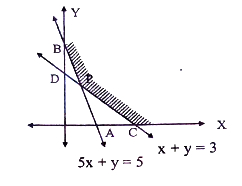
If $Z = 7x + y$ subject to $5x + y \geq 5$,$x + y \geq 3$,$x \geq 0$,$y \geq 0$,then the minimum value of $Z$ is
A
$2$
B
$5$
C
$6$
D
$3$
Solution
(B) The feasible region is the unbounded region defined by the constraints $5x + y \geq 5$,$x + y \geq 3$,$x \geq 0$,and $y \geq 0$.
To find the corner points,we solve the equations of the lines:
$1$) $5x + y = 5$ and $x + y = 3$. Subtracting the second from the first gives $4x = 2$,so $x = 0.5$. Substituting into $x + y = 3$ gives $y = 2.5$. Thus,point $P = (0.5, 2.5)$.
$2$) The intersection of $x + y = 3$ with the $x$-axis $(y=0)$ is $C = (3, 0)$.
$3$) The intersection of $5x + y = 5$ with the $y$-axis $(x=0)$ is $B = (0, 5)$.
We evaluate $Z = 7x + y$ at these corner points:
At $C(3, 0)$: $Z = 7(3) + 0 = 21$.
At $P(0.5, 2.5)$: $Z = 7(0.5) + 2.5 = 3.5 + 2.5 = 6$.
At $B(0, 5)$: $Z = 7(0) + 5 = 5$.
Since the feasible region is unbounded,we check if the minimum value $5$ is attained. The value $5$ is the minimum among the corner points. Testing a point in the region,e.g.,$(1, 3)$,$Z = 7(1) + 3 = 10 > 5$. Thus,the minimum value is $5$.
To find the corner points,we solve the equations of the lines:
$1$) $5x + y = 5$ and $x + y = 3$. Subtracting the second from the first gives $4x = 2$,so $x = 0.5$. Substituting into $x + y = 3$ gives $y = 2.5$. Thus,point $P = (0.5, 2.5)$.
$2$) The intersection of $x + y = 3$ with the $x$-axis $(y=0)$ is $C = (3, 0)$.
$3$) The intersection of $5x + y = 5$ with the $y$-axis $(x=0)$ is $B = (0, 5)$.
We evaluate $Z = 7x + y$ at these corner points:
At $C(3, 0)$: $Z = 7(3) + 0 = 21$.
At $P(0.5, 2.5)$: $Z = 7(0.5) + 2.5 = 3.5 + 2.5 = 6$.
At $B(0, 5)$: $Z = 7(0) + 5 = 5$.
Since the feasible region is unbounded,we check if the minimum value $5$ is attained. The value $5$ is the minimum among the corner points. Testing a point in the region,e.g.,$(1, 3)$,$Z = 7(1) + 3 = 10 > 5$. Thus,the minimum value is $5$.
0 likes
View Solution103
MediumMCQ
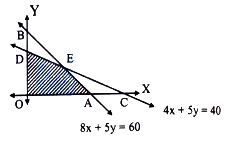
The feasible region of the $L$.$P$.$P$. (Linear Programming Problem) to maximize $z = 70x + 50y$ subject to the constraints $8x + 5y \leq 60$,$4x + 5y \leq 40$ and $x \geq 0, y \geq 0$ is:
A
a triangle
B
a square
C
a pentagon
D
a quadrilateral
Solution
(D) To find the feasible region,we first determine the intercepts of the boundary lines:
Solving the equations $8x + 5y = 60$ and $4x + 5y = 40$ simultaneously:
Subtracting the second from the first: $(8x - 4x) = 60 - 40 \Rightarrow 4x = 20 \Rightarrow x = 5$.
Substituting $x = 5$ into $4x + 5y = 40$: $4(5) + 5y = 40 \Rightarrow 20 + 5y = 40 \Rightarrow 5y = 20 \Rightarrow y = 4$.
So,the intersection point is $E(5, 4)$.
The constraints $x \geq 0, y \geq 0$ restrict the region to the first quadrant.
The feasible region is bounded by the vertices $O(0, 0)$,$A(7.5, 0)$,$E(5, 4)$,and $D(0, 8)$.
Since there are four vertices,the feasible region is a quadrilateral.
| $\text{Line}$ | $\text{Intercepts}$ |
| $8x + 5y = 60$ | $A(7.5, 0), B(0, 12)$ |
| $4x + 5y = 40$ | $C(10, 0), D(0, 8)$ |
Solving the equations $8x + 5y = 60$ and $4x + 5y = 40$ simultaneously:
Subtracting the second from the first: $(8x - 4x) = 60 - 40 \Rightarrow 4x = 20 \Rightarrow x = 5$.
Substituting $x = 5$ into $4x + 5y = 40$: $4(5) + 5y = 40 \Rightarrow 20 + 5y = 40 \Rightarrow 5y = 20 \Rightarrow y = 4$.
So,the intersection point is $E(5, 4)$.
The constraints $x \geq 0, y \geq 0$ restrict the region to the first quadrant.
The feasible region is bounded by the vertices $O(0, 0)$,$A(7.5, 0)$,$E(5, 4)$,and $D(0, 8)$.
Since there are four vertices,the feasible region is a quadrilateral.
0 likes
View Solution104
EasyMCQ
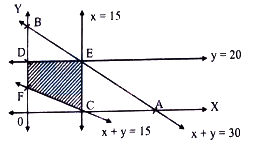
The $L$.$P$.$P$. to maximize $z=x+y$,subject to $x+y \leq 30, x \leq 15, y \leq 20, x+y \geq 15$,and $x, y \geq 0$ has
A
no solution.
B
a unique solution.
C
infinite solutions.
D
unbounded solutions.
Solution
(B) To find the solution,we first identify the feasible region defined by the constraints:
$1$. $x+y \leq 30$
$2$. $x \leq 15$
$3$. $y \leq 20$
$4$. $x+y \geq 15$
$5$. $x, y \geq 0$
The vertices of the feasible region are determined by the intersection of these lines:
- Intersection of $x=15$ and $y=20$ is $E(15, 20)$.
- Intersection of $x=0$ and $y=20$ is $D(0, 20)$.
- Intersection of $x=0$ and $x+y=15$ is $F(0, 15)$.
- Intersection of $x=15$ and $x+y=15$ is $C(15, 0)$.
The feasible region is the quadrilateral $CDEF$.
We evaluate the objective function $z=x+y$ at these vertices:
- At $C(15, 0): z = 15+0 = 15$
- At $D(0, 20): z = 0+20 = 20$
- At $E(15, 20): z = 15+20 = 35$
- At $F(0, 15): z = 0+15 = 15$
The maximum value of $z$ is $35$,which occurs at the unique vertex $E(15, 20)$. Therefore,the $L$.$P$.$P$. has a unique solution.
$1$. $x+y \leq 30$
$2$. $x \leq 15$
$3$. $y \leq 20$
$4$. $x+y \geq 15$
$5$. $x, y \geq 0$
The vertices of the feasible region are determined by the intersection of these lines:
- Intersection of $x=15$ and $y=20$ is $E(15, 20)$.
- Intersection of $x=0$ and $y=20$ is $D(0, 20)$.
- Intersection of $x=0$ and $x+y=15$ is $F(0, 15)$.
- Intersection of $x=15$ and $x+y=15$ is $C(15, 0)$.
The feasible region is the quadrilateral $CDEF$.
We evaluate the objective function $z=x+y$ at these vertices:
- At $C(15, 0): z = 15+0 = 15$
- At $D(0, 20): z = 0+20 = 20$
- At $E(15, 20): z = 15+20 = 35$
- At $F(0, 15): z = 0+15 = 15$
The maximum value of $z$ is $35$,which occurs at the unique vertex $E(15, 20)$. Therefore,the $L$.$P$.$P$. has a unique solution.
0 likes
View Solution105
EasyMCQ
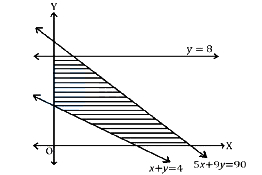
For the following shaded region,the linear constraints are:
A
$5x + 9y \leq 90, x + y \geq 4, y \geq 8, x, y \geq 0$
B
$5x + 9y \geq 90, x + y \leq 4, y \leq 8, x, y \geq 0$
C
$5x + 9y \geq 90, x + y \geq 4, y \geq 8, x, y \geq 0$
D
$5x + 9y \leq 90, x + y \geq 4, y \leq 8, x, y \geq 0$
Solution
(D) $1$. The line $5x + 9y = 90$ passes through $(18, 0)$ and $(0, 10)$. The shaded region is towards the origin,so the constraint is $5x + 9y \leq 90$.
$2$. The line $x + y = 4$ passes through $(4, 0)$ and $(0, 4)$. The shaded region is away from the origin,so the constraint is $x + y \geq 4$.
$3$. The line $y = 8$ is a horizontal line. The shaded region is below this line,so the constraint is $y \leq 8$.
$4$. Since the region is in the first quadrant,$x \geq 0$ and $y \geq 0$.
Combining these,the constraints are $5x + 9y \leq 90, x + y \geq 4, y \leq 8, x, y \geq 0$.
$2$. The line $x + y = 4$ passes through $(4, 0)$ and $(0, 4)$. The shaded region is away from the origin,so the constraint is $x + y \geq 4$.
$3$. The line $y = 8$ is a horizontal line. The shaded region is below this line,so the constraint is $y \leq 8$.
$4$. Since the region is in the first quadrant,$x \geq 0$ and $y \geq 0$.
Combining these,the constraints are $5x + 9y \leq 90, x + y \geq 4, y \leq 8, x, y \geq 0$.
0 likes
View Solution106
EasyMCQ
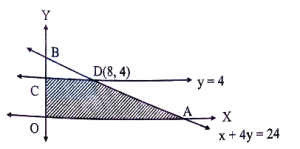
The maximum value of $Z=3x+5y$,subject to the constraints $x+4y \leq 24$,$y \leq 4$,$x \geq 0$,$y \geq 0$ is:
A
$20$
B
$120$
C
$72$
D
$44$
Solution
(C) To find the maximum value of $Z=3x+5y$,we first identify the feasible region defined by the constraints $x+4y \leq 24$,$y \leq 4$,$x \geq 0$,and $y \geq 0$.
The vertices of the feasible region are $O(0,0)$,$A(24,0)$,$D(8,4)$,and $C(0,4)$.
We evaluate the objective function $Z=3x+5y$ at each vertex:
$1$. At $O(0,0)$: $Z = 3(0) + 5(0) = 0$
$2$. At $A(24,0)$: $Z = 3(24) + 5(0) = 72$
$3$. At $D(8,4)$: $Z = 3(8) + 5(4) = 24 + 20 = 44$
$4$. At $C(0,4)$: $Z = 3(0) + 5(4) = 20$
Comparing these values,the maximum value of $Z$ is $72$ at point $A(24,0)$.
The vertices of the feasible region are $O(0,0)$,$A(24,0)$,$D(8,4)$,and $C(0,4)$.
We evaluate the objective function $Z=3x+5y$ at each vertex:
$1$. At $O(0,0)$: $Z = 3(0) + 5(0) = 0$
$2$. At $A(24,0)$: $Z = 3(24) + 5(0) = 72$
$3$. At $D(8,4)$: $Z = 3(8) + 5(4) = 24 + 20 = 44$
$4$. At $C(0,4)$: $Z = 3(0) + 5(4) = 20$
Comparing these values,the maximum value of $Z$ is $72$ at point $A(24,0)$.
0 likes
View Solution107
EasyMCQ
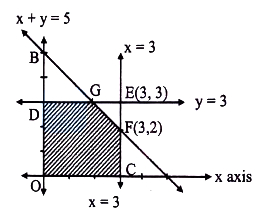
The maximum value of $Z=10 x+25 y$ subject to $0 \leq x \leq 3, 0 \leq y \leq 3, x+y \leq 5, x \geq 0, y \geq 0$ is
A
$110$
B
$100$
C
$120$
D
$95$
Solution
(D) Given the objective function $Z=10 x+25 y$ subject to the constraints $0 \leq x \leq 3, 0 \leq y \leq 3, x+y \leq 5, x \geq 0, y \geq 0$.
The feasible region is bounded by the vertices $O(0,0), C(3,0), F(3,2), G(2,3), D(0,3)$.
We evaluate $Z$ at each corner point:
$1$. At $O(0,0): Z = 10(0) + 25(0) = 0$
$2$. At $C(3,0): Z = 10(3) + 25(0) = 30$
$3$. At $F(3,2): Z = 10(3) + 25(2) = 30 + 50 = 80$
$4$. At $G(2,3): Z = 10(2) + 25(3) = 20 + 75 = 95$
$5$. At $D(0,3): Z = 10(0) + 25(3) = 75$
The maximum value of $Z$ is $95$ at the point $(2,3)$.
The feasible region is bounded by the vertices $O(0,0), C(3,0), F(3,2), G(2,3), D(0,3)$.
We evaluate $Z$ at each corner point:
$1$. At $O(0,0): Z = 10(0) + 25(0) = 0$
$2$. At $C(3,0): Z = 10(3) + 25(0) = 30$
$3$. At $F(3,2): Z = 10(3) + 25(2) = 30 + 50 = 80$
$4$. At $G(2,3): Z = 10(2) + 25(3) = 20 + 75 = 95$
$5$. At $D(0,3): Z = 10(0) + 25(3) = 75$
The maximum value of $Z$ is $95$ at the point $(2,3)$.
0 likes
View Solution108
MediumMCQ
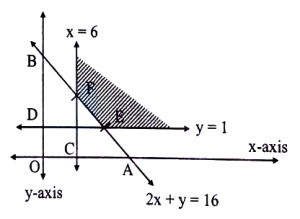
The minimum value for the $LPP$ $Z = 6x + 2y$,subject to $2x + y \geq 16$,$x \geq 6$,$y \geq 1$ is
A
$44$
B
$47$
C
$24$
D
$34$
Solution
(A) The feasible region is determined by the constraints $2x + y \geq 16$,$x \geq 6$,and $y \geq 1$.
The corner points of the feasible region are found by the intersection of these lines:
$1$. Intersection of $x = 6$ and $y = 1$ is $(6, 1)$,but this point does not satisfy $2x + y \geq 16$ $(12 + 1 = 13 < 16)$.
$2$. Intersection of $2x + y = 16$ and $y = 1$: $2x + 1 = 16 \implies 2x = 15 \implies x = 7.5$. So,point $E = (7.5, 1)$.
$3$. Intersection of $2x + y = 16$ and $x = 6$: $2(6) + y = 16 \implies 12 + y = 16 \implies y = 4$. So,point $F = (6, 4)$.
Since the region is unbounded,we check the values of $Z$ at the corner points:
$Z(E) = Z(7.5, 1) = 6(7.5) + 2(1) = 45 + 2 = 47$.
$Z(F) = Z(6, 4) = 6(6) + 2(4) = 36 + 8 = 44$.
Comparing the values,the minimum value is $44$.
The corner points of the feasible region are found by the intersection of these lines:
$1$. Intersection of $x = 6$ and $y = 1$ is $(6, 1)$,but this point does not satisfy $2x + y \geq 16$ $(12 + 1 = 13 < 16)$.
$2$. Intersection of $2x + y = 16$ and $y = 1$: $2x + 1 = 16 \implies 2x = 15 \implies x = 7.5$. So,point $E = (7.5, 1)$.
$3$. Intersection of $2x + y = 16$ and $x = 6$: $2(6) + y = 16 \implies 12 + y = 16 \implies y = 4$. So,point $F = (6, 4)$.
Since the region is unbounded,we check the values of $Z$ at the corner points:
$Z(E) = Z(7.5, 1) = 6(7.5) + 2(1) = 45 + 2 = 47$.
$Z(F) = Z(6, 4) = 6(6) + 2(4) = 36 + 8 = 44$.
Comparing the values,the minimum value is $44$.
0 likes
View Solution109
EasyMCQ
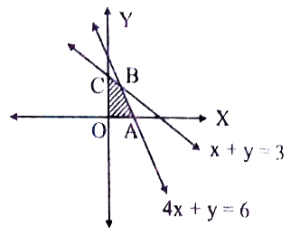
The optimal solution of the $L$.$P$.$P$. Maximize $Z = 8x + 3y$ subject to the constraints $x + y \leq 3, 4x + y \leq 6, x \geq 0, y \geq 0$ is
A
$x = 0, y = 3$
B
$x = 0, y = 0$
C
$x = \frac{3}{2}, y = 0$
D
$x = 1, y = 2$
Solution
(D) The feasible region is determined by the constraints $x + y \leq 3$,$4x + y \leq 6$,$x \geq 0$,and $y \geq 0$.
The corner points of the feasible region are $O(0, 0)$,$A(1.5, 0)$,$B(1, 2)$,and $C(0, 3)$.
We evaluate the objective function $Z = 8x + 3y$ at each corner point:
$1$. At $O(0, 0)$,$Z = 8(0) + 3(0) = 0$.
$2$. At $A(1.5, 0)$,$Z = 8(1.5) + 3(0) = 12$.
$3$. At $B(1, 2)$,$Z = 8(1) + 3(2) = 8 + 6 = 14$.
$4$. At $C(0, 3)$,$Z = 8(0) + 3(3) = 9$.
The maximum value of $Z$ is $14$,which occurs at the point $(1, 2)$.
Therefore,the optimal solution is $x = 1, y = 2$.
The corner points of the feasible region are $O(0, 0)$,$A(1.5, 0)$,$B(1, 2)$,and $C(0, 3)$.
We evaluate the objective function $Z = 8x + 3y$ at each corner point:
$1$. At $O(0, 0)$,$Z = 8(0) + 3(0) = 0$.
$2$. At $A(1.5, 0)$,$Z = 8(1.5) + 3(0) = 12$.
$3$. At $B(1, 2)$,$Z = 8(1) + 3(2) = 8 + 6 = 14$.
$4$. At $C(0, 3)$,$Z = 8(0) + 3(3) = 9$.
The maximum value of $Z$ is $14$,which occurs at the point $(1, 2)$.
Therefore,the optimal solution is $x = 1, y = 2$.
0 likes
View Solution110
MediumMCQ
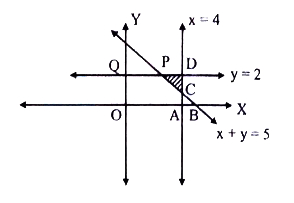
The minimum value of $Z = 5x + 8y$ subject to the constraints $x + y \geq 5$,$0 \leq x \leq 4$,$y \geq 2$ is:
A
$40$
B
$36$
C
$31$
D
$28$
Solution
(C) The constraints are $x + y \geq 5$,$0 \leq x \leq 4$,and $y \geq 2$.
From the graph,the feasible region is the triangle formed by the intersection of the lines $x + y = 5$,$x = 4$,and $y = 2$.
To find the vertices of the feasible region:
$1$. Intersection of $x + y = 5$ and $y = 2$: Substituting $y = 2$ into $x + y = 5$,we get $x = 3$. So,vertex $P = (3, 2)$.
$2$. Intersection of $x + y = 5$ and $x = 4$: Substituting $x = 4$ into $x + y = 5$,we get $y = 1$. However,the constraint is $y \geq 2$. Looking at the graph,the vertex is at $x = 4$ and $y = 2$,which is point $D = (4, 2)$.
$3$. The third vertex is the intersection of $x = 4$ and $x + y = 5$,which is $C = (4, 1)$. But since $y \geq 2$,the region is bounded by $P(3, 2)$,$D(4, 2)$,and the point where $x=4$ meets $x+y=5$ is $(4, 1)$,which is outside the feasible region $y \geq 2$.
Re-evaluating the vertices from the graph: The vertices of the shaded region are $P(3, 2)$,$D(4, 2)$,and the point where $x=4$ intersects $x+y=5$ is $(4, 1)$,but the region is bounded by $y \geq 2$. The vertices are $P(3, 2)$ and $D(4, 2)$. The line $x+y=5$ passes through $(3, 2)$ and $(4, 1)$. The feasible region is the triangle with vertices $(3, 2)$,$(4, 2)$,and $(4, 1)$ is incorrect. The region is bounded by $x+y \geq 5$,$x \leq 4$,$y \geq 2$. The vertices are $P(3, 2)$ and $D(4, 2)$. The line $x+y=5$ intersects $x=4$ at $(4, 1)$. The region is the triangle with vertices $(3, 2)$,$(4, 2)$,and $(4, 1)$ is not possible as $y \geq 2$. The vertices are $P(3, 2)$ and $D(4, 2)$ and the line $x+y=5$ segment. The vertices are $P(3, 2)$ and $D(4, 2)$. Evaluating $Z = 5x + 8y$ at these points:
$Z(P) = 5(3) + 8(2) = 15 + 16 = 31$.
$Z(D) = 5(4) + 8(2) = 20 + 16 = 36$.
The minimum value is $31$.
From the graph,the feasible region is the triangle formed by the intersection of the lines $x + y = 5$,$x = 4$,and $y = 2$.
To find the vertices of the feasible region:
$1$. Intersection of $x + y = 5$ and $y = 2$: Substituting $y = 2$ into $x + y = 5$,we get $x = 3$. So,vertex $P = (3, 2)$.
$2$. Intersection of $x + y = 5$ and $x = 4$: Substituting $x = 4$ into $x + y = 5$,we get $y = 1$. However,the constraint is $y \geq 2$. Looking at the graph,the vertex is at $x = 4$ and $y = 2$,which is point $D = (4, 2)$.
$3$. The third vertex is the intersection of $x = 4$ and $x + y = 5$,which is $C = (4, 1)$. But since $y \geq 2$,the region is bounded by $P(3, 2)$,$D(4, 2)$,and the point where $x=4$ meets $x+y=5$ is $(4, 1)$,which is outside the feasible region $y \geq 2$.
Re-evaluating the vertices from the graph: The vertices of the shaded region are $P(3, 2)$,$D(4, 2)$,and the point where $x=4$ intersects $x+y=5$ is $(4, 1)$,but the region is bounded by $y \geq 2$. The vertices are $P(3, 2)$ and $D(4, 2)$. The line $x+y=5$ passes through $(3, 2)$ and $(4, 1)$. The feasible region is the triangle with vertices $(3, 2)$,$(4, 2)$,and $(4, 1)$ is incorrect. The region is bounded by $x+y \geq 5$,$x \leq 4$,$y \geq 2$. The vertices are $P(3, 2)$ and $D(4, 2)$. The line $x+y=5$ intersects $x=4$ at $(4, 1)$. The region is the triangle with vertices $(3, 2)$,$(4, 2)$,and $(4, 1)$ is not possible as $y \geq 2$. The vertices are $P(3, 2)$ and $D(4, 2)$ and the line $x+y=5$ segment. The vertices are $P(3, 2)$ and $D(4, 2)$. Evaluating $Z = 5x + 8y$ at these points:
$Z(P) = 5(3) + 8(2) = 15 + 16 = 31$.
$Z(D) = 5(4) + 8(2) = 20 + 16 = 36$.
The minimum value is $31$.
0 likes
View Solution111
EasyMCQ
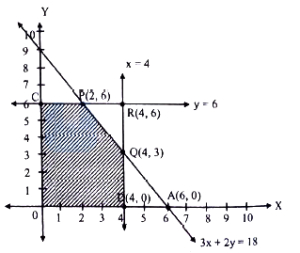
The maximum value of $Z=3x+5y$,subject to the constraints $3x+2y \leq 18$,$x \leq 4$,$y \leq 6$,and $x, y \geq 0$ is
A
$30$
B
$27$
C
$36$
D
$32$
Solution
(C) The feasible region is determined by the constraints $3x+2y \leq 18$,$x \leq 4$,$y \leq 6$,and $x, y \geq 0$. The vertices of the feasible region are $O(0,0)$,$D(4,0)$,$Q(4,3)$,$P(2,6)$,and $C(0,6)$.
We evaluate the objective function $Z=3x+5y$ at each vertex:
At $O(0,0)$: $Z = 3(0) + 5(0) = 0$
At $D(4,0)$: $Z = 3(4) + 5(0) = 12$
At $Q(4,3)$: $Z = 3(4) + 5(3) = 12 + 15 = 27$
At $P(2,6)$: $Z = 3(2) + 5(6) = 6 + 30 = 36$
At $C(0,6)$: $Z = 3(0) + 5(6) = 30$
Comparing these values,the maximum value of $Z$ is $36$ at the point $(2,6)$.
We evaluate the objective function $Z=3x+5y$ at each vertex:
At $O(0,0)$: $Z = 3(0) + 5(0) = 0$
At $D(4,0)$: $Z = 3(4) + 5(0) = 12$
At $Q(4,3)$: $Z = 3(4) + 5(3) = 12 + 15 = 27$
At $P(2,6)$: $Z = 3(2) + 5(6) = 6 + 30 = 36$
At $C(0,6)$: $Z = 3(0) + 5(6) = 30$
Comparing these values,the maximum value of $Z$ is $36$ at the point $(2,6)$.
0 likes
View Solution112
MediumMCQ
If $Z=10x+25y$ subject to $0 \leq x \leq 3, 0 \leq y \leq 3, x+y \leq 5, x \geq 0, y \geq 0$,then $Z$ is maximum at the point:
A
$(2,4)$
B
$(1,6)$
C
$(2,3)$
D
$(4,3)$
Solution
(C) The constraints are $x \leq 3, y \leq 3, x+y \leq 5, x \geq 0, y \geq 0$.
We identify the vertices of the feasible region by finding the intersection points of the boundary lines:
$1$. $x=0, y=0 \Rightarrow O(0,0)$
$2$. $x=3, y=0 \Rightarrow A(3,0)$
$3$. $x=3, x+y=5 \Rightarrow P(3,2)$
$4$. $x+y=5, y=3 \Rightarrow Q(2,3)$
$5$. $x=0, y=3 \Rightarrow D(0,3)$
Now,we evaluate the objective function $Z=10x+25y$ at each vertex:
- At $O(0,0): Z = 10(0) + 25(0) = 0$
- At $A(3,0): Z = 10(3) + 25(0) = 30$
- At $P(3,2): Z = 10(3) + 25(2) = 30 + 50 = 80$
- At $Q(2,3): Z = 10(2) + 25(3) = 20 + 75 = 95$
- At $D(0,3): Z = 10(0) + 25(3) = 0 + 75 = 75$
The maximum value of $Z$ is $95$,which occurs at the point $(2,3)$.
Therefore,the correct option is $C$.
We identify the vertices of the feasible region by finding the intersection points of the boundary lines:
$1$. $x=0, y=0 \Rightarrow O(0,0)$
$2$. $x=3, y=0 \Rightarrow A(3,0)$
$3$. $x=3, x+y=5 \Rightarrow P(3,2)$
$4$. $x+y=5, y=3 \Rightarrow Q(2,3)$
$5$. $x=0, y=3 \Rightarrow D(0,3)$
Now,we evaluate the objective function $Z=10x+25y$ at each vertex:
- At $O(0,0): Z = 10(0) + 25(0) = 0$
- At $A(3,0): Z = 10(3) + 25(0) = 30$
- At $P(3,2): Z = 10(3) + 25(2) = 30 + 50 = 80$
- At $Q(2,3): Z = 10(2) + 25(3) = 20 + 75 = 95$
- At $D(0,3): Z = 10(0) + 25(3) = 0 + 75 = 75$
The maximum value of $Z$ is $95$,which occurs at the point $(2,3)$.
Therefore,the correct option is $C$.

0 likes
View Solution113
MediumMCQ
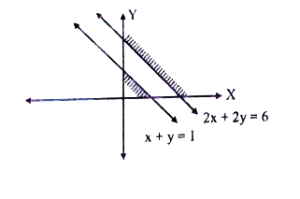
The $L$.$P$.$P$. to maximize $Z = x + y$,subject to $x + y \leq 1$,$2x + 2y \geq 6$,$x \geq 0$,$y \geq 0$ has
A
no solution.
B
infinite solutions.
C
one solution.
D
two solutions.
Solution
(A) The given constraints are:
$1$) $x + y \leq 1$
$2$) $2x + 2y \geq 6 \implies x + y \geq 3$
$3$) $x \geq 0, y \geq 0$
From the first constraint,the region is towards the origin for the line $x + y = 1$.
From the second constraint,the region is away from the origin for the line $x + y = 3$.
Since there is no point $(x, y)$ that satisfies both $x + y \leq 1$ and $x + y \geq 3$ simultaneously,there is no common feasible region.
Therefore,the given $L$.$P$.$P$. has no solution.
$1$) $x + y \leq 1$
$2$) $2x + 2y \geq 6 \implies x + y \geq 3$
$3$) $x \geq 0, y \geq 0$
From the first constraint,the region is towards the origin for the line $x + y = 1$.
From the second constraint,the region is away from the origin for the line $x + y = 3$.
Since there is no point $(x, y)$ that satisfies both $x + y \leq 1$ and $x + y \geq 3$ simultaneously,there is no common feasible region.
Therefore,the given $L$.$P$.$P$. has no solution.
0 likes
View Solution114
MediumMCQ
The minimum value of the objective function $Z = 5x + 8y$,subject to the constraints $x + y \geq 5$,$x \leq 4$,$y \leq 2$,$x \geq 0$,and $y \geq 0$,occurs at the point:
A
$(5, 0)$
B
$(0, 5)$
C
$(4, 2)$
D
$(4, 1)$
Solution
(D) The constraints are $x + y \geq 5$,$x \leq 4$,$y \leq 2$,$x \geq 0$,and $y \geq 0$.
To find the feasible region,we identify the intersection points of the lines:
$1$. $x + y = 5$ and $x = 4$ gives $4 + y = 5 \implies y = 1$. Point: $(4, 1)$.
$2$. $x + y = 5$ and $y = 2$ gives $x + 2 = 5 \implies x = 3$. Point: $(3, 2)$.
$3$. $x = 4$ and $y = 2$ gives the point $(4, 2)$.
The vertices of the feasible region are $(4, 1)$,$(4, 2)$,and $(3, 2)$.
Now,evaluate the objective function $Z = 5x + 8y$ at these vertices:
- At $(4, 1)$: $Z = 5(4) + 8(1) = 20 + 8 = 28$.
- At $(4, 2)$: $Z = 5(4) + 8(2) = 20 + 16 = 36$.
- At $(3, 2)$: $Z = 5(3) + 8(2) = 15 + 16 = 31$.
The minimum value is $28$,which occurs at the point $(4, 1)$.
To find the feasible region,we identify the intersection points of the lines:
$1$. $x + y = 5$ and $x = 4$ gives $4 + y = 5 \implies y = 1$. Point: $(4, 1)$.
$2$. $x + y = 5$ and $y = 2$ gives $x + 2 = 5 \implies x = 3$. Point: $(3, 2)$.
$3$. $x = 4$ and $y = 2$ gives the point $(4, 2)$.
The vertices of the feasible region are $(4, 1)$,$(4, 2)$,and $(3, 2)$.
Now,evaluate the objective function $Z = 5x + 8y$ at these vertices:
- At $(4, 1)$: $Z = 5(4) + 8(1) = 20 + 8 = 28$.
- At $(4, 2)$: $Z = 5(4) + 8(2) = 20 + 16 = 36$.
- At $(3, 2)$: $Z = 5(3) + 8(2) = 15 + 16 = 31$.
The minimum value is $28$,which occurs at the point $(4, 1)$.
0 likes
View Solution115
EasyMCQ
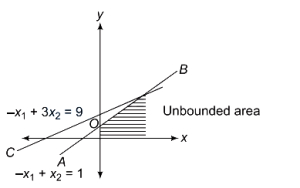
The constraints $-x_{1} + x_{2} \leq 1$,$-x_{1} + 3x_{2} \leq 9$,$x_{1}, x_{2} \geq 0$ define:
A
bounded feasible space
B
unbounded feasible space
C
both bounded and unbounded feasible space
D
None of the above
Solution
(B) To determine the nature of the feasible region,we analyze the given constraints:
$1$) $-x_{1} + x_{2} \leq 1$
$2$) $-x_{1} + 3x_{2} \leq 9$
$3$) $x_{1}, x_{2} \geq 0$
Plotting these lines on the Cartesian plane:
- For $-x_{1} + x_{2} = 1$,the intercepts are $(0, 1)$ and $(-1, 0)$.
- For $-x_{1} + 3x_{2} = 9$,the intercepts are $(0, 3)$ and $(-9, 0)$.
The non-negativity constraints $x_{1}, x_{2} \geq 0$ restrict the region to the first quadrant.
By observing the intersection of the half-planes defined by the inequalities,we find that the region extends infinitely in the direction of increasing $x_{1}$.
Therefore,the feasible region is an unbounded feasible space.
$1$) $-x_{1} + x_{2} \leq 1$
$2$) $-x_{1} + 3x_{2} \leq 9$
$3$) $x_{1}, x_{2} \geq 0$
Plotting these lines on the Cartesian plane:
- For $-x_{1} + x_{2} = 1$,the intercepts are $(0, 1)$ and $(-1, 0)$.
- For $-x_{1} + 3x_{2} = 9$,the intercepts are $(0, 3)$ and $(-9, 0)$.
The non-negativity constraints $x_{1}, x_{2} \geq 0$ restrict the region to the first quadrant.
By observing the intersection of the half-planes defined by the inequalities,we find that the region extends infinitely in the direction of increasing $x_{1}$.
Therefore,the feasible region is an unbounded feasible space.
0 likes
View Solution116
MediumMCQ
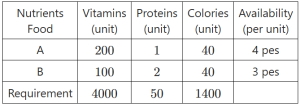
$A$ diet of a sick person must contain at least $4000$ units of vitamins,$50$ units of proteins,and $1400$ calories. Two foods $A$ and $B$ are available at a cost of ₹ $4$ and ₹ $3$ per unit respectively. If one unit of $A$ contains $200$ units of vitamins,$1$ unit of protein,and $40$ calories,while one unit of food $B$ contains $100$ units of vitamins,$2$ units of protein,and $40$ calories,formulate the problem so that the diet is the cheapest.
A
$200x + 100y \geq 4000, x + 2y \geq 50, 40x + 40y \geq 1400, x \geq 0, y \geq 0, \text{Minimize } z = 4x + 3y$
B
$400x + 200y \geq 100, x + 2y \geq 50, 40x + 40y \geq 1400, x \geq 0, y \geq 0, \text{Minimize } z = 4x + 3y$
C
$100x + 200y \geq 4000, x + 2y \geq 50, 40x + 40y \geq 1400, x \geq 0, y \geq 0, \text{Minimize } z = 4x + 3y$
D
None of the above
Solution
(A) Let $x$ and $y$ be the number of units of food $A$ and food $B$ respectively.
The objective is to minimize the cost $z = 4x + 3y$.
Subject to the constraints based on the nutrients:
$1$. Vitamins: $200x + 100y \geq 4000$
$2$. Proteins: $x + 2y \geq 50$
$3$. Calories: $40x + 40y \geq 1400$
$4$. Non-negativity: $x \geq 0, y \geq 0$
Comparing these with the given options,option $A$ matches the formulated constraints and objective function.
The objective is to minimize the cost $z = 4x + 3y$.
Subject to the constraints based on the nutrients:
$1$. Vitamins: $200x + 100y \geq 4000$
$2$. Proteins: $x + 2y \geq 50$
$3$. Calories: $40x + 40y \geq 1400$
$4$. Non-negativity: $x \geq 0, y \geq 0$
Comparing these with the given options,option $A$ matches the formulated constraints and objective function.
0 likes
View Solution117
MediumMCQ
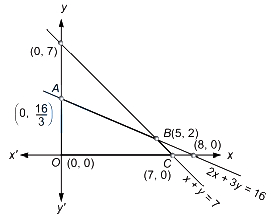
The maximum value of the objective function $Z = 3x + 2y$ for the linear constraints $x + y \leq 7$,$2x + 3y \leq 16$,$x \geq 0$,$y \geq 0$ is
A
$16$
B
$21$
C
$25$
D
$28$
Solution
(B) The feasible region is determined by the constraints $x + y \leq 7$,$2x + 3y \leq 16$,$x \geq 0$,and $y \geq 0$. The vertices of the feasible region are $O(0, 0)$,$A(0, 16/3)$,$B(5, 2)$,and $C(7, 0)$.
We evaluate the objective function $Z = 3x + 2y$ at each vertex:
At $O(0, 0): Z = 3(0) + 2(0) = 0$
At $A(0, 16/3): Z = 3(0) + 2(16/3) = 32/3 \approx 10.67$
At $B(5, 2): Z = 3(5) + 2(2) = 15 + 4 = 19$
At $C(7, 0): Z = 3(7) + 2(0) = 21$
Comparing these values,the maximum value of $Z$ is $21$ at point $C(7, 0)$.
We evaluate the objective function $Z = 3x + 2y$ at each vertex:
At $O(0, 0): Z = 3(0) + 2(0) = 0$
At $A(0, 16/3): Z = 3(0) + 2(16/3) = 32/3 \approx 10.67$
At $B(5, 2): Z = 3(5) + 2(2) = 15 + 4 = 19$
At $C(7, 0): Z = 3(7) + 2(0) = 21$
Comparing these values,the maximum value of $Z$ is $21$ at point $C(7, 0)$.
0 likes
View Solution118
EasyMCQ
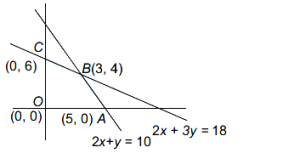
The maximum value of $z = 9x + 13y$ subject to the constraints $2x + 3y \leq 18$,$2x + y \leq 10$,$x \geq 0$,$y \geq 0$ is:
A
$130$
B
$81$
C
$79$
D
$99$
Solution
(C) The feasible region is determined by the constraints $2x + 3y \leq 18$,$2x + y \leq 10$,$x \geq 0$,and $y \geq 0$. The vertices of the feasible region are $O(0, 0)$,$A(5, 0)$,$B(3, 4)$,and $C(0, 6)$.
We evaluate the objective function $z = 9x + 13y$ at each vertex:
$1$. At $O(0, 0)$: $z = 9(0) + 13(0) = 0$
$2$. At $A(5, 0)$: $z = 9(5) + 13(0) = 45$
$3$. At $B(3, 4)$: $z = 9(3) + 13(4) = 27 + 52 = 79$
$4$. At $C(0, 6)$: $z = 9(0) + 13(6) = 78$
Comparing these values,the maximum value of $z$ is $79$.
We evaluate the objective function $z = 9x + 13y$ at each vertex:
$1$. At $O(0, 0)$: $z = 9(0) + 13(0) = 0$
$2$. At $A(5, 0)$: $z = 9(5) + 13(0) = 45$
$3$. At $B(3, 4)$: $z = 9(3) + 13(4) = 27 + 52 = 79$
$4$. At $C(0, 6)$: $z = 9(0) + 13(6) = 78$
Comparing these values,the maximum value of $z$ is $79$.
0 likes
View Solution119
MediumMCQ
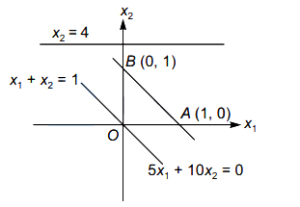
For the $LPP$,minimize $z = x_{1} + x_{2}$ subject to the constraints $5x_{1} + 10x_{2} \geq 0$,$x_{1} + x_{2} \leq 1$,$x_{2} \leq 4$ and $x_{1}, x_{2} \geq 0$.
A
There is a bounded solution
B
There is no solution
C
There are infinite solutions
D
None of the above
Solution
(A) The constraints are $5x_{1} + 10x_{2} \geq 0$,$x_{1} + x_{2} \leq 1$,$x_{2} \leq 4$,and $x_{1}, x_{2} \geq 0$.
Since $x_{1}, x_{2} \geq 0$,the constraint $5x_{1} + 10x_{2} \geq 0$ is always satisfied in the first quadrant.
The feasible region is defined by the intersection of $x_{1} + x_{2} \leq 1$ and $x_{1}, x_{2} \geq 0$.
This region is a triangle with vertices at $(0, 0)$,$(1, 0)$,and $(0, 1)$.
Since the feasible region is a closed and bounded polygon,the $LPP$ has a bounded solution.
Since $x_{1}, x_{2} \geq 0$,the constraint $5x_{1} + 10x_{2} \geq 0$ is always satisfied in the first quadrant.
The feasible region is defined by the intersection of $x_{1} + x_{2} \leq 1$ and $x_{1}, x_{2} \geq 0$.
This region is a triangle with vertices at $(0, 0)$,$(1, 0)$,and $(0, 1)$.
Since the feasible region is a closed and bounded polygon,the $LPP$ has a bounded solution.
0 likes
View Solution120
MediumMCQ
$A$ wholesale merchant wants to start a cereal business with $Rs \ 24000$. Wheat costs $Rs \ 400$ per quintal and rice costs $Rs \ 600$ per quintal. He has a storage capacity of $200$ quintals of cereal. He earns a profit of $Rs \ 25$ per quintal on wheat and $Rs \ 40$ per quintal on rice. If he stores $x$ quintals of rice and $y$ quintals of wheat,then for maximum profit,the objective function is:
A
$25x + 40y$
B
$40x + 25y$
C
$400x + 600y$
D
$\frac{400}{40}x + \frac{600}{25}y$
Solution
(B) The merchant earns a profit of $Rs \ 40$ per quintal on rice and $Rs \ 25$ per quintal on wheat.
Given that he stores $x$ quintals of rice and $y$ quintals of wheat.
The total profit $Z$ is given by the sum of the profit from rice and wheat.
Therefore,the objective function is $Z = 40x + 25y$.
Given that he stores $x$ quintals of rice and $y$ quintals of wheat.
The total profit $Z$ is given by the sum of the profit from rice and wheat.
Therefore,the objective function is $Z = 40x + 25y$.
0 likes
View Solution121
EasyMCQ
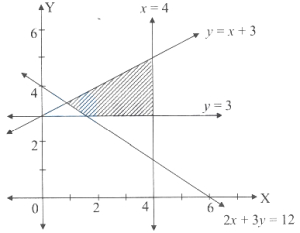
The shaded area in the figure given below is a solution set of a system of inequations. The minimum value of the objective function $Z = 3x + 5y$,subject to the linear constraints given by this system of inequations,is:
A
$19.5$
B
$2$
C
$195$
D
$19.8$
Solution
(A) The corner points of the feasible region are $A, B, C, D$.
From the graph,the lines are $y = 3$,$x = 4$,$y = x + 3$,and $2x + 3y = 12$.
$1$. Point $A$ is the intersection of $y = 3$ and $2x + 3y = 12$:
$2x + 3(3) = 12 \implies 2x = 3 \implies x = 1.5$. So,$A = (1.5, 3)$.
$2$. Point $B$ is the intersection of $y = 3$ and $x = 4$. So,$B = (4, 3)$.
$3$. Point $C$ is the intersection of $x = 4$ and $y = x + 3$:
$y = 4 + 3 = 7$. So,$C = (4, 7)$.
$4$. Point $D$ is the intersection of $y = x + 3$ and $2x + 3y = 12$:
$2x + 3(x + 3) = 12 \implies 5x + 9 = 12 \implies 5x = 3 \implies x = 0.6$.
$y = 0.6 + 3 = 3.6$. So,$D = (0.6, 3.6)$.
Now,evaluate $Z = 3x + 5y$ at these points:
$Z(A) = 3(1.5) + 5(3) = 4.5 + 15 = 19.5$.
$Z(B) = 3(4) + 5(3) = 12 + 15 = 27$.
$Z(C) = 3(4) + 5(7) = 12 + 35 = 47$.
$Z(D) = 3(0.6) + 5(3.6) = 1.8 + 18 = 19.8$.
The minimum value of $Z$ is $19.5$.
From the graph,the lines are $y = 3$,$x = 4$,$y = x + 3$,and $2x + 3y = 12$.
$1$. Point $A$ is the intersection of $y = 3$ and $2x + 3y = 12$:
$2x + 3(3) = 12 \implies 2x = 3 \implies x = 1.5$. So,$A = (1.5, 3)$.
$2$. Point $B$ is the intersection of $y = 3$ and $x = 4$. So,$B = (4, 3)$.
$3$. Point $C$ is the intersection of $x = 4$ and $y = x + 3$:
$y = 4 + 3 = 7$. So,$C = (4, 7)$.
$4$. Point $D$ is the intersection of $y = x + 3$ and $2x + 3y = 12$:
$2x + 3(x + 3) = 12 \implies 5x + 9 = 12 \implies 5x = 3 \implies x = 0.6$.
$y = 0.6 + 3 = 3.6$. So,$D = (0.6, 3.6)$.
Now,evaluate $Z = 3x + 5y$ at these points:
$Z(A) = 3(1.5) + 5(3) = 4.5 + 15 = 19.5$.
$Z(B) = 3(4) + 5(3) = 12 + 15 = 27$.
$Z(C) = 3(4) + 5(7) = 12 + 35 = 47$.
$Z(D) = 3(0.6) + 5(3.6) = 1.8 + 18 = 19.8$.
The minimum value of $Z$ is $19.5$.
0 likes
View Solution122
DifficultMCQ
The maximum value of $z=6x+8y$ subject to the constraints $x-y \geq 0$,$x+3y \leq 12$,$x \geq 0$,$y \geq 0$ is:
A
$72$
B
$42$
C
$96$
D
$24$
Solution
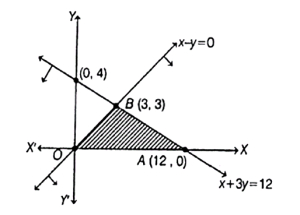
(B) The objective function is $z=6x+8y$. The constraints are $x-y \geq 0$,$x+3y \leq 12$,$x \geq 0$,and $y \geq 0$.
To find the feasible region,we plot the lines $x-y=0$ and $x+3y=12$.
The intersection point of $x-y=0$ and $x+3y=12$ is found by substituting $x=y$ into $x+3y=12$,which gives $4y=12$,so $y=3$ and $x=3$. Thus,the intersection point is $B(3, 3)$.
The feasible region is a triangle with vertices $O(0, 0)$,$A(0, 4)$ (from $x+3y=12$ when $x=0$),and $B(3, 3)$.
Evaluating $z=6x+8y$ at these corner points:
At $O(0, 0)$: $z = 6(0) + 8(0) = 0$.
At $A(0, 4)$: $z = 6(0) + 8(4) = 32$.
At $B(3, 3)$: $z = 6(3) + 8(3) = 18 + 24 = 42$.
The maximum value is $42$.
To find the feasible region,we plot the lines $x-y=0$ and $x+3y=12$.
The intersection point of $x-y=0$ and $x+3y=12$ is found by substituting $x=y$ into $x+3y=12$,which gives $4y=12$,so $y=3$ and $x=3$. Thus,the intersection point is $B(3, 3)$.
The feasible region is a triangle with vertices $O(0, 0)$,$A(0, 4)$ (from $x+3y=12$ when $x=0$),and $B(3, 3)$.
Evaluating $z=6x+8y$ at these corner points:
At $O(0, 0)$: $z = 6(0) + 8(0) = 0$.
At $A(0, 4)$: $z = 6(0) + 8(4) = 32$.
At $B(3, 3)$: $z = 6(3) + 8(3) = 18 + 24 = 42$.
The maximum value is $42$.
0 likes
View Solution123
EasyMCQ
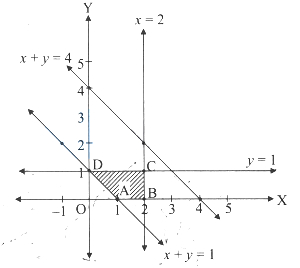
The vertices of the feasible region for the constraints $x+y \leq 4$,$x \leq 2$,$y \leq 1$,$x+y \geq 1$,$x, y \geq 0$ are
A
$(1,0), (2,0), (2,1), (0,4)$
B
$(0,1), (4,0), (0,4), (1,0)$
C
$(1,0), (2,0), (2,1), (0,1)$
D
$(1,0), (4,0), (2,1), (0,4)$
Solution
(C) The constraints are $x+y \leq 4$,$x \leq 2$,$y \leq 1$,$x+y \geq 1$,and $x, y \geq 0$.
To find the vertices,we solve the intersection points of the boundary lines:
$1$. Intersection of $x+y=1$ and $y=0$ gives $A(1,0)$.
$2$. Intersection of $x=2$ and $y=0$ gives $B(2,0)$.
$3$. Intersection of $x=2$ and $y=1$ gives $C(2,1)$.
$4$. Intersection of $x+y=1$ and $x=0$ gives $D(0,1)$.
Thus,the vertices of the feasible region are $(1,0), (2,0), (2,1), (0,1)$.
To find the vertices,we solve the intersection points of the boundary lines:
$1$. Intersection of $x+y=1$ and $y=0$ gives $A(1,0)$.
$2$. Intersection of $x=2$ and $y=0$ gives $B(2,0)$.
$3$. Intersection of $x=2$ and $y=1$ gives $C(2,1)$.
$4$. Intersection of $x+y=1$ and $x=0$ gives $D(0,1)$.
Thus,the vertices of the feasible region are $(1,0), (2,0), (2,1), (0,1)$.
0 likes
View Solution124
EasyMCQ
The minimum value of $t = 7x + 3y$ subject to constraints $x + y < 5$,$x + y < 10$,$x > 0$,$y > 0$ is . . . . . .
A
$0$
B
$15$
C
$70$
D
The feasible region is not bounded,therefore the minimum value does not exist.
Solution
(D) The given constraints are $x + y < 5$,$x + y < 10$,$x > 0$,and $y > 0$.
Since $x + y < 5$ is a subset of $x + y < 10$,the effective constraint is $x + y < 5$ in the first quadrant $(x > 0, y > 0)$.
The feasible region is an open triangular region with vertices approaching $(0,0)$,$(5,0)$,and $(0,5)$.
Since the region is open and does not include the boundary points (due to the strict inequality $<$),the minimum value of the objective function $t = 7x + 3y$ cannot be attained at any specific point within the region.
As $x$ and $y$ approach $0$,the value of $t$ approaches $0$,but since $x > 0$ and $y > 0$,$t$ is always greater than $0$.
Thus,the minimum value does not exist.
Since $x + y < 5$ is a subset of $x + y < 10$,the effective constraint is $x + y < 5$ in the first quadrant $(x > 0, y > 0)$.
The feasible region is an open triangular region with vertices approaching $(0,0)$,$(5,0)$,and $(0,5)$.
Since the region is open and does not include the boundary points (due to the strict inequality $<$),the minimum value of the objective function $t = 7x + 3y$ cannot be attained at any specific point within the region.
As $x$ and $y$ approach $0$,the value of $t$ approaches $0$,but since $x > 0$ and $y > 0$,$t$ is always greater than $0$.
Thus,the minimum value does not exist.
0 likes
View Solution125
EasyMCQ
Minimize the objective function $Z = 3x + 2y$ subject to the constraints: $x + y \geq 8$,$x + y \leq 5$,$x \geq 0$,$y \geq 0$.
A
$15$
B
$6$
C
$24$
D
Feasible region is not possible.
Solution
(D) The given constraints are:
$1) x + y \geq 8$
$2) x + y \leq 5$
$3) x \geq 0, y \geq 0$
Observe the first two inequalities: $x + y \geq 8$ and $x + y \leq 5$.
These two inequalities represent regions that do not overlap.
If $x + y$ is greater than or equal to $8$,it cannot simultaneously be less than or equal to $5$.
Therefore,there is no set of points $(x, y)$ that satisfies all the given constraints simultaneously.
Since there is no common region,the feasible region is empty (null set).
Thus,the objective function cannot be minimized as no feasible solution exists.
$1) x + y \geq 8$
$2) x + y \leq 5$
$3) x \geq 0, y \geq 0$
Observe the first two inequalities: $x + y \geq 8$ and $x + y \leq 5$.
These two inequalities represent regions that do not overlap.
If $x + y$ is greater than or equal to $8$,it cannot simultaneously be less than or equal to $5$.
Therefore,there is no set of points $(x, y)$ that satisfies all the given constraints simultaneously.
Since there is no common region,the feasible region is empty (null set).
Thus,the objective function cannot be minimized as no feasible solution exists.
0 likes
View Solution126
MediumMCQ
The maximum value of $z=3x+4y$,subject to the constraints $x+y \leq 40$,$x+2y \leq 60$ and $x, y \geq 0$ is
A
$130$
B
$120$
C
$140$
D
$40$
Solution
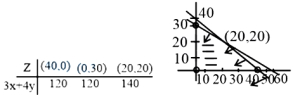
(C) To find the maximum value of the objective function $z=3x+4y$,we identify the feasible region defined by the constraints:
$1$. $x+y \leq 40$
$2$. $x+2y \leq 60$
$3$. $x, y \geq 0$
The corner points of the feasible region are determined by the intersection of these lines and the axes:
- Intersection of $x+y=40$ and $x+2y=60$: Subtracting the first from the second gives $y=20$,which implies $x=20$. Point: $(20, 20)$.
- Intersection of $x+y=40$ with the $x$-axis $(y=0)$: Point $(40, 0)$.
- Intersection of $x+2y=60$ with the $y$-axis $(x=0)$: Point $(0, 30)$.
- The origin $(0, 0)$ is also a corner point.
Now,evaluate $z=3x+4y$ at each corner point:
- At $(0, 0)$: $z = 3(0) + 4(0) = 0$
- At $(40, 0)$: $z = 3(40) + 4(0) = 120$
- At $(0, 30)$: $z = 3(0) + 4(30) = 120$
- At $(20, 20)$: $z = 3(20) + 4(20) = 60 + 80 = 140$
The maximum value is $140$ at the point $(20, 20)$.
$1$. $x+y \leq 40$
$2$. $x+2y \leq 60$
$3$. $x, y \geq 0$
The corner points of the feasible region are determined by the intersection of these lines and the axes:
- Intersection of $x+y=40$ and $x+2y=60$: Subtracting the first from the second gives $y=20$,which implies $x=20$. Point: $(20, 20)$.
- Intersection of $x+y=40$ with the $x$-axis $(y=0)$: Point $(40, 0)$.
- Intersection of $x+2y=60$ with the $y$-axis $(x=0)$: Point $(0, 30)$.
- The origin $(0, 0)$ is also a corner point.
Now,evaluate $z=3x+4y$ at each corner point:
- At $(0, 0)$: $z = 3(0) + 4(0) = 0$
- At $(40, 0)$: $z = 3(40) + 4(0) = 120$
- At $(0, 30)$: $z = 3(0) + 4(30) = 120$
- At $(20, 20)$: $z = 3(20) + 4(20) = 60 + 80 = 140$
The maximum value is $140$ at the point $(20, 20)$.
0 likes
View Solution127
DifficultMCQ
$A$ dietician has to develop a special diet using two foods $X$ and $Y$. Each packet (containing $30 \ g$) of food $X$ contains $12$ units of calcium,$4$ units of iron,$6$ units of cholesterol and $6$ units of vitamin $A$. Each packet of the same quantity of food $Y$ contains $3$ units of calcium,$20$ units of iron,$4$ units of cholesterol and $3$ units of vitamin $A$. The diet requires at least $240$ units of calcium,at least $460$ units of iron and at most $300$ units of cholesterol. The corner points of the feasible region are:
A
$(2,72), (40,15), (15,20)$
B
$(2,72), (15,20), (0,23)$
C
$(0,23), (40,15), (2,72)$
D
$(2,72), (40,15), (115,0)$
Solution
(A) Let $x$ and $y$ be the number of packets of food $X$ and $Y$ respectively. The constraints are given by:
$12x + 3y \geq 240 \Rightarrow 4x + y \geq 80$
$4x + 20y \geq 460 \Rightarrow x + 5y \geq 115$
$6x + 4y \leq 300 \Rightarrow 3x + 2y \leq 150$
$x \geq 0, y \geq 0$
To find the corner points,we find the intersection of these lines:
$1$. Intersection of $4x + y = 80$ and $x + 5y = 115$: Solving these,we get $x = 15, y = 20$.
$2$. Intersection of $4x + y = 80$ and $3x + 2y = 150$: Solving these,we get $x = 2, y = 72$.
$3$. Intersection of $x + 5y = 115$ and $3x + 2y = 150$: Solving these,we get $x = 40, y = 15$.
Thus,the corner points of the feasible region are $(2,72), (40,15), (15,20)$.
$12x + 3y \geq 240 \Rightarrow 4x + y \geq 80$
$4x + 20y \geq 460 \Rightarrow x + 5y \geq 115$
$6x + 4y \leq 300 \Rightarrow 3x + 2y \leq 150$
$x \geq 0, y \geq 0$
To find the corner points,we find the intersection of these lines:
$1$. Intersection of $4x + y = 80$ and $x + 5y = 115$: Solving these,we get $x = 15, y = 20$.
$2$. Intersection of $4x + y = 80$ and $3x + 2y = 150$: Solving these,we get $x = 2, y = 72$.
$3$. Intersection of $x + 5y = 115$ and $3x + 2y = 150$: Solving these,we get $x = 40, y = 15$.
Thus,the corner points of the feasible region are $(2,72), (40,15), (15,20)$.
0 likes
View Solution128
EasyMCQ
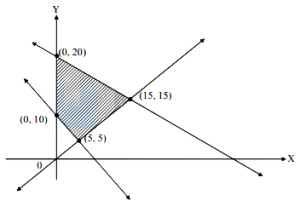
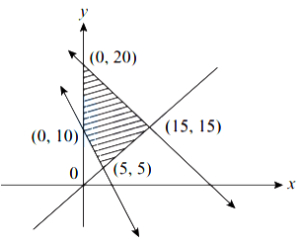
The feasible region of an $LPP$ is shown in the figure. If $z = 3x + 9y$,then the minimum value of $z$ occurs at
A
$(5, 5)$
B
$(0, 10)$
C
$(0, 20)$
D
$(15, 15)$
Solution
(A) The feasible region is a polygon with vertices at $(5, 5)$,$(0, 10)$,$(0, 20)$,and $(15, 15)$.
We evaluate the objective function $z = 3x + 9y$ at each vertex:
At $(5, 5)$: $z = 3(5) + 9(5) = 15 + 45 = 60$
At $(0, 10)$: $z = 3(0) + 9(10) = 0 + 90 = 90$
At $(0, 20)$: $z = 3(0) + 9(20) = 0 + 180 = 180$
At $(15, 15)$: $z = 3(15) + 9(15) = 45 + 135 = 180$
Comparing these values,the minimum value of $z$ is $60$,which occurs at the point $(5, 5)$.
We evaluate the objective function $z = 3x + 9y$ at each vertex:
At $(5, 5)$: $z = 3(5) + 9(5) = 15 + 45 = 60$
At $(0, 10)$: $z = 3(0) + 9(10) = 0 + 90 = 90$
At $(0, 20)$: $z = 3(0) + 9(20) = 0 + 180 = 180$
At $(15, 15)$: $z = 3(15) + 9(15) = 45 + 135 = 180$
Comparing these values,the minimum value of $z$ is $60$,which occurs at the point $(5, 5)$.
0 likes
View Solution129
MediumMCQ
For the $LPP$,maximize $z=x+4y$ subject to the constraints $x+2y \leq 2$,$x+2y \geq 8$,$x, y \geq 0$.
A
$Z_{\max}=4$
B
$Z_{\max}=8$
C
$Z_{\max}=16$
D
Has no feasible solution
Solution
(D) Given the objective function $z=x+4y$ and the constraints:
$1) x+2y \leq 2$
$2) x+2y \geq 8$
$3) x, y \geq 0$
Analyzing the constraints:
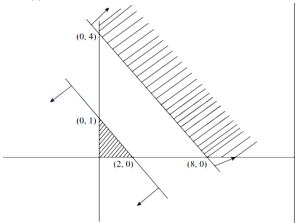
Constraint $(1)$ represents the region on or below the line $x+2y=2$,which passes through $(2,0)$ and $(0,1)$. Since $0+2(0) \leq 2$ is true,the region includes the origin.
Constraint $(2)$ represents the region on or above the line $x+2y=8$,which passes through $(8,0)$ and $(0,4)$. Since $0+2(0) \geq 8$ is false,the region does not include the origin.
Constraint $(3)$ restricts the solution to the first quadrant.
Comparing the regions defined by $(1)$ and $(2)$,we observe that the region satisfying $x+2y \leq 2$ and the region satisfying $x+2y \geq 8$ are disjoint. There is no point $(x, y)$ that satisfies both inequalities simultaneously.
Therefore,the $LPP$ has no feasible solution.
$1) x+2y \leq 2$
$2) x+2y \geq 8$
$3) x, y \geq 0$
Analyzing the constraints:
Constraint $(1)$ represents the region on or below the line $x+2y=2$,which passes through $(2,0)$ and $(0,1)$. Since $0+2(0) \leq 2$ is true,the region includes the origin.
Constraint $(2)$ represents the region on or above the line $x+2y=8$,which passes through $(8,0)$ and $(0,4)$. Since $0+2(0) \geq 8$ is false,the region does not include the origin.
Constraint $(3)$ restricts the solution to the first quadrant.
Comparing the regions defined by $(1)$ and $(2)$,we observe that the region satisfying $x+2y \leq 2$ and the region satisfying $x+2y \geq 8$ are disjoint. There is no point $(x, y)$ that satisfies both inequalities simultaneously.
Therefore,the $LPP$ has no feasible solution.
0 likes
View Solution130
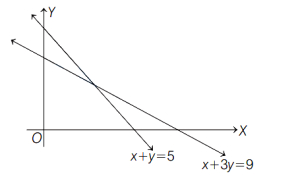
MediumMCQ
The feasible region of an $LPP$ is shown in the figure. If $z=11x+7y$,then the maximum value of $z$ occurs at
A
$(0,5)$
B
$(3,3)$
C
$(5,0)$
D
$(3,2)$
Solution
(D) Given,maximize $z=11x+7y$.
The corner points of the feasible region are determined by the intersection of the lines and the axes.
$1$. The intersection of $x+y=5$ and $x+3y=9$ is found by subtracting the equations: $(x+3y)-(x+y) = 9-5 \Rightarrow 2y=4 \Rightarrow y=2$. Substituting $y=2$ into $x+y=5$ gives $x=3$. So,point $B$ is $(3,2)$.
$2$. The intersection of $x+3y=9$ with the $y$-axis $(x=0)$ is $(0,3)$. So,point $A$ is $(0,3)$.
$3$. The intersection of $x+y=5$ with the $y$-axis $(x=0)$ is $(0,5)$. So,point $C$ is $(0,5)$.
Now,we evaluate $z=11x+7y$ at these corner points:
At $A(0,3): z = 11(0) + 7(3) = 21$.
At $B(3,2): z = 11(3) + 7(2) = 33 + 14 = 47$.
At $C(0,5): z = 11(0) + 7(5) = 35$.
Comparing these values,the maximum value of $z$ is $47$,which occurs at $(3,2)$.
The corner points of the feasible region are determined by the intersection of the lines and the axes.
$1$. The intersection of $x+y=5$ and $x+3y=9$ is found by subtracting the equations: $(x+3y)-(x+y) = 9-5 \Rightarrow 2y=4 \Rightarrow y=2$. Substituting $y=2$ into $x+y=5$ gives $x=3$. So,point $B$ is $(3,2)$.
$2$. The intersection of $x+3y=9$ with the $y$-axis $(x=0)$ is $(0,3)$. So,point $A$ is $(0,3)$.
$3$. The intersection of $x+y=5$ with the $y$-axis $(x=0)$ is $(0,5)$. So,point $C$ is $(0,5)$.
Now,we evaluate $z=11x+7y$ at these corner points:
At $A(0,3): z = 11(0) + 7(3) = 21$.
At $B(3,2): z = 11(3) + 7(2) = 33 + 14 = 47$.
At $C(0,5): z = 11(0) + 7(5) = 35$.
Comparing these values,the maximum value of $z$ is $47$,which occurs at $(3,2)$.
0 likes
View Solution131
DifficultMCQ
The maximum value of $z = 5x + 3y$ subject to constraints $3x + 5y \leq 15, x \geq 0, y \geq 0$ is :
A
$10$
B
$25$
C
$0$
D
$9$
Solution
(B) The feasible region is determined by the constraints $3x + 5y \leq 15, x \geq 0, y \geq 0$.
First,find the intercepts of the line $3x + 5y = 15$:
If $x = 0$,then $5y = 15 \implies y = 3$. So,the point is $(0, 3)$.
If $y = 0$,then $3x = 15 \implies x = 5$. So,the point is $(5, 0)$.
The corner points of the feasible region are $(0, 0), (5, 0),$ and $(0, 3)$.
Now,evaluate $z = 5x + 3y$ at each corner point:
At $(0, 0): z = 5(0) + 3(0) = 0$.
At $(5, 0): z = 5(5) + 3(0) = 25$.
At $(0, 3): z = 5(0) + 3(3) = 9$.
The maximum value of $z$ is $25$.
First,find the intercepts of the line $3x + 5y = 15$:
If $x = 0$,then $5y = 15 \implies y = 3$. So,the point is $(0, 3)$.
If $y = 0$,then $3x = 15 \implies x = 5$. So,the point is $(5, 0)$.
The corner points of the feasible region are $(0, 0), (5, 0),$ and $(0, 3)$.
Now,evaluate $z = 5x + 3y$ at each corner point:
At $(0, 0): z = 5(0) + 3(0) = 0$.
At $(5, 0): z = 5(5) + 3(0) = 25$.
At $(0, 3): z = 5(0) + 3(3) = 9$.
The maximum value of $z$ is $25$.
0 likes
View SolutionLinear Programming — Word problem of Linear programming · Frequently Asked Questions
1Are these Linear Programming questions useful for JEE and NEET?
Yes. All questions in this section are mapped to JEE Main and NEET exam patterns. Previous year questions from JEE Main, NEET, GUJCET and state-level exams are included with full solutions.
2Can I switch to Hindi or Gujarati for these questions?
Yes. Use the language tabs in the hero section or the sidebar to view the same questions and solutions in English, Hindi or Gujarati.
3How do I generate a question paper from this subtopic?
Use the Vedclass Exam Paper Generator — select the chapter and subtopic, set difficulty, and generate Sets A, B, C, D automatically. First 3 chapters of every subject are free.
Vedclass Products
For Students
Vedclass Test Series
Mock tests in real JEE/NEET style with performance analysis. 5-day free trial.
Start Free TrialFor Teachers
Exam Paper Generator
Generate Set A/B/C/D papers from this chapter in 2 minutes. 3 chapters free.
Try FreeFor Institutes
Online Exam Module
Live online exams with unlimited students, 360° analytics & white-label branding.
See DemoFor Teachers & Institutes
Generate a Linear Programming Exam Paper in 2 Minutes
Select subtopic & difficulty — Sets A, B, C, D auto-generated with No Repeat logic.
First 3 chapters of every subject are free — no payment required.