
A English
Word problem of Linear programming Questions in English
Class 12 Mathematics · Linear Programming · Word problem of Linear programming
131+
Questions
English
Language
100%
With Solutions
Showing 50 of 131 questions in English
1
MediumMCQ
Solve the following linear programming problem graphically:
Maximise $Z = 4x + y$......$(1)$
subject to the constraints:
${x + y \leqslant 50}$.......$(2)$
${3x + y \leqslant 90}$......$(3)$
${x \geqslant 0, y \geqslant 0}$......$(4)$
Maximise $Z = 4x + y$......$(1)$
subject to the constraints:
${x + y \leqslant 50}$.......$(2)$
${3x + y \leqslant 90}$......$(3)$
${x \geqslant 0, y \geqslant 0}$......$(4)$
A
$120$
B
$110$
C
$50$
D
$0$
Solution
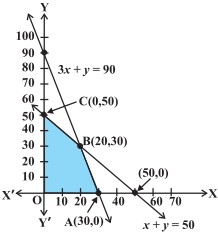
(A) The shaded region in the figure is the feasible region determined by the system of constraints $(2)$ to $(4)$. We observe that the feasible region $OABC$ is bounded. So,we now use the Corner Point Method to determine the maximum value of $Z$.
The coordinates of the corner points $O, A, B$ and $C$ are $(0, 0), (30, 0), (20, 30)$ and $(0, 50)$ respectively. Now we evaluate $Z$ at each corner point.
Hence,the maximum value of $Z$ is $120$ at the point $(30, 0)$.
The coordinates of the corner points $O, A, B$ and $C$ are $(0, 0), (30, 0), (20, 30)$ and $(0, 50)$ respectively. Now we evaluate $Z$ at each corner point.
| Corner Point | Corresponding value of $Z = 4x + y$ |
| $(0, 0)$ | $4(0) + 0 = 0$ |
| $(30, 0)$ | $4(30) + 0 = 120$ |
| $(20, 30)$ | $4(20) + 30 = 110$ |
| $(0, 50)$ | $4(0) + 50 = 50$ |
Hence,the maximum value of $Z$ is $120$ at the point $(30, 0)$.
0 likes
View Solution2
Difficult
$A$ dietician wishes to mix two types of foods in such a way that vitamin contents of the mixture contain at least $8$ $units$ of vitamin $A$ and $10$ $units$ of vitamin $C$. Food $'I'$ contains $2$ $units/kg$ of vitamin $A$ and $1$ $unit/kg$ of vitamin $C$. Food $'II'$ contains $1$ $unit/kg$ of vitamin $A$ and $2$ $units/kg$ of vitamin $C$. It costs Rs $50$ per $kg$ to purchase Food $'I'$ and Rs $70$ per $kg$ to purchase Food $'II'$. Formulate this problem as a linear programming problem to minimise the cost of such a mixture.
Solution
(B) Let the mixture contain $x$ $kg$ of Food $'I'$ and $y$ $kg$ of Food $'II'$. Clearly,$x \geq 0, y \geq 0$.
We make the following table from the given data:
Since the mixture must contain at least $8$ units of vitamin $A$ and $10$ units of vitamin $C$,we have the constraints:
$2x + y \geq 8$
$x + 2y \geq 10$
Total cost $Z$ of purchasing $x$ $kg$ of food $'I'$ and $y$ $kg$ of Food $'II'$ is $Z = 50x + 70y$.
Hence,the mathematical formulation of the problem is:
Minimize $Z = 50x + 70y$ subject to the constraints:
$2x + y \geq 8$
$x + 2y \geq 10$
$x, y \geq 0$
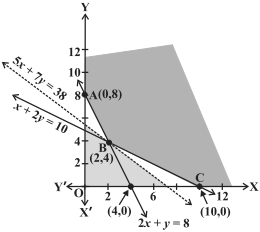
Let us graph the inequalities. The feasible region is unbounded. Let us evaluate $Z$ at the corner points $A(0, 8)$,$B(2, 4)$,and $C(10, 0)$.
The smallest value of $Z$ is $380$ at the point $(2, 4)$. Since the feasible region is unbounded,we check the inequality $50x + 70y < 380$ or $5x + 7y < 38$. As this region has no common points with the feasible region,the minimum value is indeed $380$.
Thus,the optimal mixing strategy is to mix $2$ $kg$ of Food $'I'$ and $4$ $kg$ of Food $'II'$,with a minimum cost of Rs $380$.
We make the following table from the given data:
| Resources | Food $I$ $(x)$ | Food $II$ $(y)$ | Minimum Requirement |
|---|---|---|---|
| Vitamin $A$ (units/kg) | $2$ | $1$ | $8$ |
| Vitamin $C$ (units/kg) | $1$ | $2$ | $10$ |
| Cost (Rs/kg) | $50$ | $70$ | Minimize $Z$ |
Since the mixture must contain at least $8$ units of vitamin $A$ and $10$ units of vitamin $C$,we have the constraints:
$2x + y \geq 8$
$x + 2y \geq 10$
Total cost $Z$ of purchasing $x$ $kg$ of food $'I'$ and $y$ $kg$ of Food $'II'$ is $Z = 50x + 70y$.
Hence,the mathematical formulation of the problem is:
Minimize $Z = 50x + 70y$ subject to the constraints:
$2x + y \geq 8$
$x + 2y \geq 10$
$x, y \geq 0$
Let us graph the inequalities. The feasible region is unbounded. Let us evaluate $Z$ at the corner points $A(0, 8)$,$B(2, 4)$,and $C(10, 0)$.
| Corner point | $Z = 50x + 70y$ |
|---|---|
| $(0, 8)$ | $560$ |
| $(2, 4)$ | $380$ (Minimum) |
| $(10, 0)$ | $500$ |
The smallest value of $Z$ is $380$ at the point $(2, 4)$. Since the feasible region is unbounded,we check the inequality $50x + 70y < 380$ or $5x + 7y < 38$. As this region has no common points with the feasible region,the minimum value is indeed $380$.
Thus,the optimal mixing strategy is to mix $2$ $kg$ of Food $'I'$ and $4$ $kg$ of Food $'II'$,with a minimum cost of Rs $380$.
0 likes
View Solution3
DifficultMCQ
$A$ cooperative society of farmers has $50$ hectares of land to grow two crops $X$ and $Y$. The profit from crops $X$ and $Y$ per hectare are estimated as Rs $10,500$ and Rs $9,000$ respectively. To control weeds,a liquid herbicide has to be used for crops $X$ and $Y$ at rates of $20$ litres and $10$ litres per hectare. Further,no more than $800$ litres of herbicide should be used in order to protect fish and wildlife using a pond which collects drainage from this land. How much land should be allocated to each crop so as to maximise the total profit of the society?
A
$30$ hectares for crop $X$ and $20$ hectares for crop $Y$
B
$20$ hectares for crop $X$ and $30$ hectares for crop $Y$
C
$40$ hectares for crop $X$ and $10$ hectares for crop $Y$
D
$10$ hectares for crop $X$ and $40$ hectares for crop $Y$
Solution
(A) Let $x$ hectares of land be allocated to crop $X$ and $y$ hectares to crop $Y$.
Obviously,$x \geq 0, y \geq 0.$
Profit per hectare on crop $X = \text{Rs } 10,500$
Profit per hectare on crop $Y = \text{Rs } 9,000$
Therefore,total profit $Z = 10,500x + 9,000y$
The mathematical formulation of the problem is as follows:
Maximise $Z = 10,500x + 9,000y$
Subject to the constraints:
$x + y \leq 50$ (constraint related to land) $... (1)$
$20x + 10y \leq 800$ (constraint related to use of herbicide)
i.e.,$2x + y \leq 80$ $... (2)$
$x \geq 0, y \geq 0$ (non-negative constraint) $... (3)$
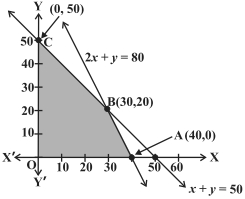
The feasible region $OABC$ is bounded by the vertices $O(0,0), A(40,0), B(30,20),$ and $C(0,50)$.
Evaluating the objective function $Z = 10,500x + 9,000y$ at these vertices:
Hence,the society will get the maximum profit of Rs $4,95,000$ by allocating $30$ hectares for crop $X$ and $20$ hectares for crop $Y$.
Obviously,$x \geq 0, y \geq 0.$
Profit per hectare on crop $X = \text{Rs } 10,500$
Profit per hectare on crop $Y = \text{Rs } 9,000$
Therefore,total profit $Z = 10,500x + 9,000y$
The mathematical formulation of the problem is as follows:
Maximise $Z = 10,500x + 9,000y$
Subject to the constraints:
$x + y \leq 50$ (constraint related to land) $... (1)$
$20x + 10y \leq 800$ (constraint related to use of herbicide)
i.e.,$2x + y \leq 80$ $... (2)$
$x \geq 0, y \geq 0$ (non-negative constraint) $... (3)$
The feasible region $OABC$ is bounded by the vertices $O(0,0), A(40,0), B(30,20),$ and $C(0,50)$.
Evaluating the objective function $Z = 10,500x + 9,000y$ at these vertices:
| Corner Point | $Z = 10,500x + 9,000y$ |
| $O(0,0)$ | $0$ |
| $A(40,0)$ | $4,20,000$ |
| $B(30,20)$ | $10,500(30) + 9,000(20) = 3,15,000 + 1,80,000 = 4,95,000$ (Maximum) |
| $C(0,50)$ | $4,50,000$ |
Hence,the society will get the maximum profit of Rs $4,95,000$ by allocating $30$ hectares for crop $X$ and $20$ hectares for crop $Y$.
0 likes
View Solution4
DifficultMCQ
$A$ manufacturing company makes two models $A$ and $B$ of a product. Each piece of Model $A$ requires $9$ labour hours for fabricating and $1$ labour hour for finishing. Each piece of Model $B$ requires $12$ labour hours for fabricating and $3$ labour hours for finishing. For fabricating and finishing,the maximum labour hours available are $180$ and $30$ respectively. The company makes a profit of Rs $8000$ on each piece of model $A$ and Rs $12000$ on each piece of Model $B$. How many pieces of Model $A$ and Model $B$ should be manufactured per week to realise a maximum profit? What is the maximum profit per week?
A
$12$ pieces of $A$,$6$ pieces of $B$; Max Profit = Rs $1,68,000$
B
$6$ pieces of $A$,$12$ pieces of $B$; Max Profit = Rs $1,68,000$
C
$10$ pieces of $A$,$10$ pieces of $B$; Max Profit = Rs $2,00,000$
D
$20$ pieces of $A$,$0$ pieces of $B$; Max Profit = Rs $1,60,000$
Solution
(A) Let $x$ be the number of pieces of Model $A$ and $y$ be the number of pieces of Model $B$.
The objective function is to maximize profit $Z = 8000x + 12000y$.
The constraints based on labour hours are:
$9x + 12y \leq 180 \implies 3x + 4y \leq 60$ (Fabricating)
$x + 3y \leq 30$ (Finishing)
$x \geq 0, y \geq 0$ (Non-negativity)
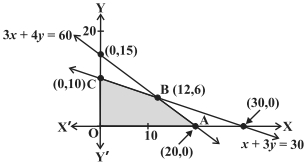
The corner points of the feasible region are $O(0,0)$,$A(20,0)$,$B(12,6)$,and $C(0,10)$.
Evaluating $Z$ at corner points:
The maximum profit is Rs $1,68,000$ at $x=12$ and $y=6$.
The objective function is to maximize profit $Z = 8000x + 12000y$.
The constraints based on labour hours are:
$9x + 12y \leq 180 \implies 3x + 4y \leq 60$ (Fabricating)
$x + 3y \leq 30$ (Finishing)
$x \geq 0, y \geq 0$ (Non-negativity)
The corner points of the feasible region are $O(0,0)$,$A(20,0)$,$B(12,6)$,and $C(0,10)$.
Evaluating $Z$ at corner points:
| Corner Point | $Z = 8000x + 12000y$ |
| $O(0,0)$ | $0$ |
| $A(20,0)$ | $8000(20) + 0 = 1,60,000$ |
| $B(12,6)$ | $8000(12) + 12000(6) = 96000 + 72000 = 1,68,000$ |
| $C(0,10)$ | $8000(0) + 12000(10) = 1,20,000$ |
The maximum profit is Rs $1,68,000$ at $x=12$ and $y=6$.
0 likes
View Solution5
Difficult
Reshma wishes to mix two types of food $P$ and $Q$ in such a way that the vitamin contents of the mixture contain at least $8$ $units$ of vitamin $A$ and $11$ $units$ of vitamin $B$. Food $P$ costs Rs $60/kg$ and Food $Q$ costs Rs $80/kg$. Food $P$ contains $3$ $units/kg$ of Vitamin $A$ and $5$ $units/kg$ of Vitamin $B$ while food $Q$ contains $4$ $units/kg$ of Vitamin $A$ and $2$ $units/kg$ of vitamin $B$. Determine the minimum cost of the mixture. Let the mixture contain $x$ kg of food $P$ and $y$ kg of food $Q$. Therefore,$x \geq 0$ and $y \geq 0$. The given information can be compiled in a table as follows:
Solution
(A) Let the mixture contain $x$ kg of food $P$ and $y$ kg of food $Q$. Therefore,$x \geq 0$ and $y \geq 0$. The given information is compiled in the table below:
The constraints are:
$3x + 4y \geq 8$
$5x + 2y \geq 11$
$x, y \geq 0$
Objective function to minimize: $Z = 60x + 80y$.
The corner points of the feasible region are $A(\frac{8}{3}, 0)$,$B(2, \frac{1}{2})$,and $C(0, \frac{11}{2})$.
Evaluating $Z$ at corner points:
Since the feasible region is unbounded,we check if $60x + 80y < 160$ has any common points with the feasible region. The line $3x + 4y < 8$ does not intersect the feasible region. Thus,the minimum cost is Rs $160$ at any point on the line segment joining $A$ and $B$.
| Food | Vitamin $A$ (units/kg) | Vitamin $B$ (units/kg) | Cost (Rs/kg) |
| $P$ | $3$ | $5$ | $60$ |
| $Q$ | $4$ | $2$ | $80$ |
| Requirement | $8$ | $11$ | - |
The constraints are:
$3x + 4y \geq 8$
$5x + 2y \geq 11$
$x, y \geq 0$
Objective function to minimize: $Z = 60x + 80y$.
The corner points of the feasible region are $A(\frac{8}{3}, 0)$,$B(2, \frac{1}{2})$,and $C(0, \frac{11}{2})$.
Evaluating $Z$ at corner points:
| Corner Point | $Z = 60x + 80y$ |
| $A(\frac{8}{3}, 0)$ | $60(\frac{8}{3}) + 80(0) = 160$ |
| $B(2, \frac{1}{2})$ | $60(2) + 80(\frac{1}{2}) = 120 + 40 = 160$ |
| $C(0, \frac{11}{2})$ | $60(0) + 80(\frac{11}{2}) = 440$ |
Since the feasible region is unbounded,we check if $60x + 80y < 160$ has any common points with the feasible region. The line $3x + 4y < 8$ does not intersect the feasible region. Thus,the minimum cost is Rs $160$ at any point on the line segment joining $A$ and $B$.
0 likes
View Solution6
Difficult
One kind of cake requires $200 \,g$ of flour and $25 \,g$ of fat,and another kind of cake requires $100 \,g$ of flour and $50 \,g$ of fat. Find the maximum number of cakes which can be made from $5 \,kg$ of flour and $1 \,kg$ of fat,assuming that there is no shortage of the other ingredients used in making the cakes.
Solution
(30) Let $x$ be the number of cakes of the first kind and $y$ be the number of cakes of the second kind.
Therefore,$x \geq 0$ and $y \geq 0$.
The given information can be summarized in the following table:
Constraints:
$200x + 100y \leq 5000 \Rightarrow 2x + y \leq 50$
$25x + 50y \leq 1000 \Rightarrow x + 2y \leq 40$
Objective function: Maximize $Z = x + y$.
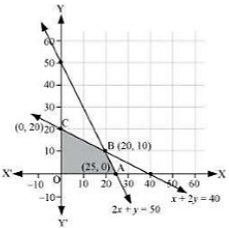
The feasible region is determined by the constraints $2x + y \leq 50$,$x + 2y \leq 40$,$x \geq 0$,and $y \geq 0$. The corner points of the feasible region are $O(0, 0)$,$A(25, 0)$,$B(20, 10)$,and $C(0, 20)$.
Evaluating $Z = x + y$ at corner points:
Thus,the maximum number of cakes that can be made is $30$ ($20$ of the first kind and $10$ of the second kind).
Therefore,$x \geq 0$ and $y \geq 0$.
The given information can be summarized in the following table:
| Type of Cake | Flour $(g)$ | Fat $(g)$ |
| First kind $(x)$ | $200$ | $25$ |
| Second kind $(y)$ | $100$ | $50$ |
| Availability | $5000$ | $1000$ |
Constraints:
$200x + 100y \leq 5000 \Rightarrow 2x + y \leq 50$
$25x + 50y \leq 1000 \Rightarrow x + 2y \leq 40$
Objective function: Maximize $Z = x + y$.
The feasible region is determined by the constraints $2x + y \leq 50$,$x + 2y \leq 40$,$x \geq 0$,and $y \geq 0$. The corner points of the feasible region are $O(0, 0)$,$A(25, 0)$,$B(20, 10)$,and $C(0, 20)$.
Evaluating $Z = x + y$ at corner points:
| Corner Point | $Z = x + y$ |
| $O(0, 0)$ | $0$ |
| $A(25, 0)$ | $25$ |
| $B(20, 10)$ | $30$ (Maximum) |
| $C(0, 20)$ | $20$ |
Thus,the maximum number of cakes that can be made is $30$ ($20$ of the first kind and $10$ of the second kind).
0 likes
View Solution7
DifficultMCQ
$A$ factory makes tennis rackets and cricket bats. $A$ tennis racket takes $1.5\, \text{hours}$ of machine time and $3\, \text{hours}$ of craftsman's time in its making, while a cricket bat takes $3\, \text{hours}$ of machine time and $1\, \text{hour}$ of craftsman's time. In a day, the factory has the availability of not more than $42\, \text{hours}$ of machine time and $24\, \text{hours}$ of craftsman's time. What number of rackets and bats must be made if the factory is to work at full capacity?
A
$x=4, y=12$
B
$x=6, y=10$
C
$x=8, y=6$
D
$x=10, y=4$
Solution
(A) Let the number of tennis rackets be $x$ and the number of cricket bats be $y$.
The machine time constraint is $1.5x + 3y \leq 42$.
The craftsman's time constraint is $3x + y \leq 24$.
Since the factory works at full capacity, we equate these to the maximum available time:
$1.5x + 3y = 42$ --- $(1)$
$3x + y = 24$ --- $(2)$
From equation $(2)$, we get $y = 24 - 3x$.
Substitute this into equation $(1)$:
$1.5x + 3(24 - 3x) = 42$
$1.5x + 72 - 9x = 42$
$-7.5x = 42 - 72$
$-7.5x = -30$
$x = \frac{30}{7.5} = 4$
Now, substitute $x = 4$ into $y = 24 - 3x$:
$y = 24 - 3(4) = 24 - 12 = 12$.
Therefore, the factory must make $4$ tennis rackets and $12$ cricket bats.
The machine time constraint is $1.5x + 3y \leq 42$.
The craftsman's time constraint is $3x + y \leq 24$.
Since the factory works at full capacity, we equate these to the maximum available time:
$1.5x + 3y = 42$ --- $(1)$
$3x + y = 24$ --- $(2)$
From equation $(2)$, we get $y = 24 - 3x$.
Substitute this into equation $(1)$:
$1.5x + 3(24 - 3x) = 42$
$1.5x + 72 - 9x = 42$
$-7.5x = 42 - 72$
$-7.5x = -30$
$x = \frac{30}{7.5} = 4$
Now, substitute $x = 4$ into $y = 24 - 3x$:
$y = 24 - 3(4) = 24 - 12 = 12$.
Therefore, the factory must make $4$ tennis rackets and $12$ cricket bats.
0 likes
View Solution8
DifficultMCQ
$A$ factory makes tennis rackets and cricket bats. $A$ tennis racket takes $1.5 \text{ hours}$ of machine time and $3 \text{ hours}$ of craftsman's time in its making,while a cricket bat takes $3 \text{ hours}$ of machine time and $1 \text{ hour}$ of craftsman's time. In a day,the factory has the availability of not more than $42 \text{ hours}$ of machine time and $24 \text{ hours}$ of craftsman's time. If the profit on a racket and on a bat is $Rs. 20$ and $Rs. 10$ respectively,find the maximum profit of the factory when it works at full capacity.
A
$200$
B
$250$
C
$180$
D
$220$
Solution
(A) The given information can be compiled in a table as follows:
Let $x$ be the number of tennis rackets and $y$ be the number of cricket bats produced.
The constraints are:
$1.5x + 3y \leq 42$
$3x + y \leq 24$
$x, y \geq 0$
The objective function is to maximize profit $Z = 20x + 10y$.
Solving the intersection of lines $1.5x + 3y = 42$ and $3x + y = 24$:
From $3x + y = 24$,we get $y = 24 - 3x$.
Substituting into $1.5x + 3(24 - 3x) = 42$:
$1.5x + 72 - 9x = 42$
$-7.5x = -30$
$x = 4$
Then $y = 24 - 3(4) = 12$.
The corner points of the feasible region are $(0, 0), (8, 0), (4, 12), (0, 14)$.
Evaluating $Z = 20x + 10y$ at these points:
- At $(0, 0): Z = 0$
- At $(8, 0): Z = 20(8) + 10(0) = 160$
- At $(4, 12): Z = 20(4) + 10(12) = 80 + 120 = 200$
- At $(0, 14): Z = 20(0) + 10(14) = 140$
The maximum profit is $Rs. 200$.
| Item | Tennis Racket $(x)$ | Cricket Bat $(y)$ | Availability |
| Machine Time $(h)$ | $1.5$ | $3$ | $42$ |
| Craftsman's Time $(h)$ | $3$ | $1$ | $24$ |
Let $x$ be the number of tennis rackets and $y$ be the number of cricket bats produced.
The constraints are:
$1.5x + 3y \leq 42$
$3x + y \leq 24$
$x, y \geq 0$
The objective function is to maximize profit $Z = 20x + 10y$.
Solving the intersection of lines $1.5x + 3y = 42$ and $3x + y = 24$:
From $3x + y = 24$,we get $y = 24 - 3x$.
Substituting into $1.5x + 3(24 - 3x) = 42$:
$1.5x + 72 - 9x = 42$
$-7.5x = -30$
$x = 4$
Then $y = 24 - 3(4) = 12$.
The corner points of the feasible region are $(0, 0), (8, 0), (4, 12), (0, 14)$.
Evaluating $Z = 20x + 10y$ at these points:
- At $(0, 0): Z = 0$
- At $(8, 0): Z = 20(8) + 10(0) = 160$
- At $(4, 12): Z = 20(4) + 10(12) = 80 + 120 = 200$
- At $(0, 14): Z = 20(0) + 10(14) = 140$
The maximum profit is $Rs. 200$.
0 likes
View Solution9
Difficult
$A$ manufacturer produces nuts and bolts. It takes $1\, hour$ of work on machine $A$ and $3\, hours$ on machine $B$ to produce a package of nuts. It takes $3\, hours$ on machine $A$ and $1\, hour$ on machine $B$ to produce a package of bolts. He earns a profit of $Rs.\,17.50$ per package on nuts and $Rs.\,7$ per package on bolts. How many packages of each should be produced each day so as to maximise his profit,if he operates his machines for at the most $12\, hours$ a day?
Solution
(B) Let the manufacturer produce $x$ packages of nuts and $y$ packages of bolts.
Therefore,$x \geq 0$ and $y \geq 0$.
The given information can be compiled in a table as follows:
The profit on a package of nuts is $Rs.\,17.50$ and on a package of bolts is $Rs.\,7$. Therefore,the constraints are:
$x + 3y \leq 12$
$3x + y \leq 12$
Total profit,$Z = 17.5x + 7y$.
The mathematical formulation of the given problem is:
Maximise $Z = 17.5x + 7y$ subject to the constraints:
$x + 3y \leq 12$
$3x + y \leq 12$
$x, y \geq 0$
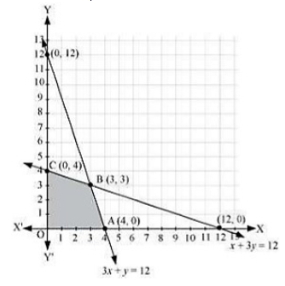
The feasible region determined by the system of constraints has corner points $O(0,0)$,$A(4,0)$,$B(3,3)$,and $C(0,4)$.
The values of $Z$ at these corner points are as follows:
The maximum value of $Z$ is $Rs.\,73.50$ at $(3,3)$.
Thus,$3$ packages of nuts and $3$ packages of bolts should be produced each day to get the maximum profit of $Rs.\,73.50$.
Therefore,$x \geq 0$ and $y \geq 0$.
The given information can be compiled in a table as follows:
| Machine | Nuts | Bolts | Availability |
| Machine $A$ $(h)$ | $1$ | $3$ | $12$ |
| Machine $B$ $(h)$ | $3$ | $1$ | $12$ |
The profit on a package of nuts is $Rs.\,17.50$ and on a package of bolts is $Rs.\,7$. Therefore,the constraints are:
$x + 3y \leq 12$
$3x + y \leq 12$
Total profit,$Z = 17.5x + 7y$.
The mathematical formulation of the given problem is:
Maximise $Z = 17.5x + 7y$ subject to the constraints:
$x + 3y \leq 12$
$3x + y \leq 12$
$x, y \geq 0$
The feasible region determined by the system of constraints has corner points $O(0,0)$,$A(4,0)$,$B(3,3)$,and $C(0,4)$.
The values of $Z$ at these corner points are as follows:
| Corner point | $Z = 17.5x + 7y$ |
| $O(0,0)$ | $0$ |
| $A(4,0)$ | $70$ |
| $B(3,3)$ | $73.5$ (Maximum) |
| $C(0,4)$ | $28$ |
The maximum value of $Z$ is $Rs.\,73.50$ at $(3,3)$.
Thus,$3$ packages of nuts and $3$ packages of bolts should be produced each day to get the maximum profit of $Rs.\,73.50$.
0 likes
View Solution10
DifficultMCQ
$A$ factory manufactures two types of screws, $A$ and $B$. Each type of screw requires the use of two machines, an automatic and a hand-operated one. It takes $4 \, \text{minutes}$ on the automatic and $6 \, \text{minutes}$ on the hand-operated machine to manufacture a package of screws $A$, while it takes $6 \, \text{minutes}$ on the automatic and $3 \, \text{minutes}$ on the hand-operated machine to manufacture a package of screws $B$. Each machine is available for at most $4 \, \text{hours}$ on any day. The manufacturer can sell a package of screws $A$ at a profit of $Rs. \, 7$ and screws $B$ at a profit of $Rs. \, 10$. Assuming that he can sell all the screws he manufactures, how many packages of each type should the factory owner produce in a day in order to maximize his profit? Determine the maximum profit.
A
$Rs. \, 410$
B
$Rs. \, 400$
C
$Rs. \, 280$
D
$Rs. \, 350$
Solution
(A) Let the factory manufacture $x$ packages of screws $A$ and $y$ packages of screws $B$ each day.
The given information can be summarized in the following table:
The objective is to maximize profit $Z = 7x + 10y$.
Subject to constraints:
$4x + 6y \leq 240 \implies 2x + 3y \leq 120$
$6x + 3y \leq 240 \implies 2x + y \leq 80$
$x, y \geq 0$
The corner points of the feasible region are $O(0,0)$, $A(40,0)$, $B(30,20)$, and $C(0,40)$.
Evaluating $Z$ at corner points:
The maximum profit is $Rs. \, 410$ at $x = 30$ and $y = 20$.
The given information can be summarized in the following table:
| Machine | Screw $A$ (min) | Screw $B$ (min) | Availability (min) |
| Automatic | $4$ | $6$ | $240$ |
| Hand-operated | $6$ | $3$ | $240$ |
The objective is to maximize profit $Z = 7x + 10y$.
Subject to constraints:
$4x + 6y \leq 240 \implies 2x + 3y \leq 120$
$6x + 3y \leq 240 \implies 2x + y \leq 80$
$x, y \geq 0$
The corner points of the feasible region are $O(0,0)$, $A(40,0)$, $B(30,20)$, and $C(0,40)$.
Evaluating $Z$ at corner points:
| Corner Point | $Z = 7x + 10y$ |
| $O(0,0)$ | $0$ |
| $A(40,0)$ | $7(40) + 10(0) = 280$ |
| $B(30,20)$ | $7(30) + 10(20) = 210 + 200 = 410$ |
| $C(0,40)$ | $7(0) + 10(40) = 400$ |
The maximum profit is $Rs. \, 410$ at $x = 30$ and $y = 20$.
0 likes
View Solution11
DifficultMCQ
$A$ cottage industry manufactures pedestal lamps and wooden shades,each requiring the use of a grinding/cutting machine and a sprayer. It takes $2 \text{ hours}$ on the grinding/cutting machine and $3 \text{ hours}$ on the sprayer to manufacture a pedestal lamp. It takes $1 \text{ hour}$ on the grinding/cutting machine and $2 \text{ hours}$ on the sprayer to manufacture a shade. On any day,the sprayer is available for at most $20 \text{ hours}$ and the grinding/cutting machine for at most $12 \text{ hours}$. The profit from the sale of a lamp is $Rs. 5$ and that from a shade is $Rs. 3$. Assuming that the manufacturer can sell all the lamps and shades that he produces,how should he schedule his daily production in order to maximise his profit?
A
$4$ lamps and $4$ shades
B
$6$ lamps and $0$ shades
C
$0$ lamps and $10$ shades
D
$5$ lamps and $2$ shades
Solution
(A) Let the cottage industry manufacture $x$ pedestal lamps and $y$ wooden shades.
Therefore,$x \geq 0$ and $y \geq 0$.
The given information can be compiled in a table as follows:
The profit on a lamp is $Rs. 5$ and on a shade is $Rs. 3$.
Therefore,the constraints are:
$2x + y \leq 12$
$3x + 2y \leq 20$
Total profit,$Z = 5x + 3y$.
The mathematical formulation of the problem is:
Maximize $Z = 5x + 3y$ subject to:
$2x + y \leq 12$
$3x + 2y \leq 20$
$x, y \geq 0$
The feasible region is determined by the intersection of these constraints. The corner points of the feasible region are $O(0,0)$,$A(6,0)$,$B(4,4)$,and $C(0,10)$.
The values of $Z$ at these corner points are:
The maximum value of $Z$ is $32$ at point $B(4,4)$.
Thus,the manufacturer should produce $4$ pedestal lamps and $4$ wooden shades to maximize his profit.
Therefore,$x \geq 0$ and $y \geq 0$.
The given information can be compiled in a table as follows:
| Item | Lamps $(x)$ | Shades $(y)$ | Availability |
| Grinding/cutting machine $(h)$ | $2$ | $1$ | $12$ |
| Sprayer $(h)$ | $3$ | $2$ | $20$ |
The profit on a lamp is $Rs. 5$ and on a shade is $Rs. 3$.
Therefore,the constraints are:
$2x + y \leq 12$
$3x + 2y \leq 20$
Total profit,$Z = 5x + 3y$.
The mathematical formulation of the problem is:
Maximize $Z = 5x + 3y$ subject to:
$2x + y \leq 12$
$3x + 2y \leq 20$
$x, y \geq 0$
The feasible region is determined by the intersection of these constraints. The corner points of the feasible region are $O(0,0)$,$A(6,0)$,$B(4,4)$,and $C(0,10)$.
The values of $Z$ at these corner points are:
| Corner point | $Z = 5x + 3y$ |
| $O(0,0)$ | $0$ |
| $A(6,0)$ | $5(6) + 3(0) = 30$ |
| $B(4,4)$ | $5(4) + 3(4) = 20 + 12 = 32$ |
| $C(0,10)$ | $5(0) + 3(10) = 30$ |
The maximum value of $Z$ is $32$ at point $B(4,4)$.
Thus,the manufacturer should produce $4$ pedestal lamps and $4$ wooden shades to maximize his profit.
0 likes
View Solution12
DifficultMCQ
$A$ company manufactures two types of novelty souvenirs made of plywood. Souvenirs of type $A$ require $5 \text{ minutes}$ each for cutting and $10 \text{ minutes}$ each for assembling. Souvenirs of type $B$ require $8 \text{ minutes}$ each for cutting and $8 \text{ minutes}$ each for assembling. There are $3 \text{ hours } 20 \text{ minutes}$ available for cutting and $4 \text{ hours}$ for assembling. The profit is $Rs. 5$ each for type $A$ and $Rs. 6$ each for type $B$ souvenirs. How many souvenirs of each type should the company manufacture in order to maximise the profit?
A
$8$ of type $A$ and $20$ of type $B$
B
$20$ of type $A$ and $8$ of type $B$
C
$10$ of type $A$ and $15$ of type $B$
D
$15$ of type $A$ and $10$ of type $B$
Solution
(A) Let the company manufacture $x$ souvenirs of type $A$ and $y$ souvenirs of type $B$.
The given information can be compiled in a table as follows:
The constraints are:
$5x + 8y \leq 200$
$10x + 8y \leq 240 \implies 5x + 4y \leq 120$
$x, y \geq 0$
Objective function to maximize profit $Z = 5x + 6y$.
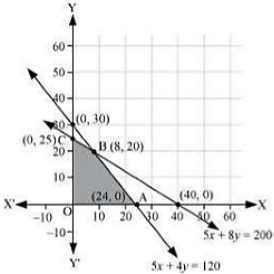
The feasible region is bounded by the corner points $O(0,0)$,$A(24,0)$,$B(8,20)$,and $C(0,25)$.
Evaluating $Z$ at corner points:
The maximum profit is $Rs. 160$ at $(8, 20)$. Thus,the company should manufacture $8$ souvenirs of type $A$ and $20$ souvenirs of type $B$.
The given information can be compiled in a table as follows:
| Process | Type $A$ | Type $B$ | Availability |
| Cutting (min) | $5$ | $8$ | $200$ |
| Assembling (min) | $10$ | $8$ | $240$ |
The constraints are:
$5x + 8y \leq 200$
$10x + 8y \leq 240 \implies 5x + 4y \leq 120$
$x, y \geq 0$
Objective function to maximize profit $Z = 5x + 6y$.
The feasible region is bounded by the corner points $O(0,0)$,$A(24,0)$,$B(8,20)$,and $C(0,25)$.
Evaluating $Z$ at corner points:
| Corner Point | $Z = 5x + 6y$ |
| $A(24,0)$ | $5(24) + 6(0) = 120$ |
| $B(8,20)$ | $5(8) + 6(20) = 40 + 120 = 160$ |
| $C(0,25)$ | $5(0) + 6(25) = 150$ |
The maximum profit is $Rs. 160$ at $(8, 20)$. Thus,the company should manufacture $8$ souvenirs of type $A$ and $20$ souvenirs of type $B$.
0 likes
View Solution13
DifficultMCQ
$A$ merchant plans to sell two types of personal computers - a desktop model and a portable model that will cost $Rs.\,25000$ and $Rs.\,40000$ respectively. He estimates that the total monthly demand of computers will not exceed $250$ units. Determine the number of units of each type of computers which the merchant should stock to get maximum profit if he does not want to invest more than $Rs.\,70$ lakhs and if his profit on the desktop model is $Rs.\,4500$ and on portable model is $Rs.\,5000$.
A
$200$ desktop,$50$ portable
B
$150$ desktop,$100$ portable
C
$100$ desktop,$150$ portable
D
$50$ desktop,$200$ portable
Solution
(A) Let the merchant stock $x$ desktop models and $y$ portable models.
The cost of a desktop model is $Rs.\,25000$ and of a portable model is $Rs.\,40000$.
Given that the merchant can invest a maximum of $Rs.\,70$ lakhs $(Rs.\,70,00,000)$:
$25000x + 40000y \leq 7000000$
Dividing by $5000$,we get:
$5x + 8y \leq 1400$ ... $(1)$
The total monthly demand of computers will not exceed $250$ units:
$x + y \leq 250$ ... $(2)$
Also,$x \geq 0$ and $y \geq 0$ ... $(3)$
The profit function to be maximized is:
$Z = 4500x + 5000y$
We find the corner points of the feasible region by solving the equations $5x + 8y = 1400$ and $x + y = 250$:
From $x + y = 250$,$y = 250 - x$. Substituting in $(1)$:
$5x + 8(250 - x) = 1400$
$5x + 2000 - 8x = 1400$
$-3x = -600 \implies x = 200$
$y = 250 - 200 = 50$
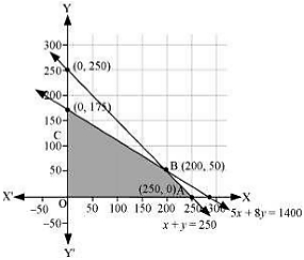
The corner points of the feasible region are $(0, 0)$,$(250, 0)$,$(200, 50)$,and $(0, 175)$.
Evaluating $Z$ at these points:
The maximum profit is $Rs.\,1150000$ at $(200, 50)$.
Thus,the merchant should stock $200$ desktop models and $50$ portable models.
The cost of a desktop model is $Rs.\,25000$ and of a portable model is $Rs.\,40000$.
Given that the merchant can invest a maximum of $Rs.\,70$ lakhs $(Rs.\,70,00,000)$:
$25000x + 40000y \leq 7000000$
Dividing by $5000$,we get:
$5x + 8y \leq 1400$ ... $(1)$
The total monthly demand of computers will not exceed $250$ units:
$x + y \leq 250$ ... $(2)$
Also,$x \geq 0$ and $y \geq 0$ ... $(3)$
The profit function to be maximized is:
$Z = 4500x + 5000y$
We find the corner points of the feasible region by solving the equations $5x + 8y = 1400$ and $x + y = 250$:
From $x + y = 250$,$y = 250 - x$. Substituting in $(1)$:
$5x + 8(250 - x) = 1400$
$5x + 2000 - 8x = 1400$
$-3x = -600 \implies x = 200$
$y = 250 - 200 = 50$
The corner points of the feasible region are $(0, 0)$,$(250, 0)$,$(200, 50)$,and $(0, 175)$.
Evaluating $Z$ at these points:
| Corner Point | $Z = 4500x + 5000y$ |
| $(0, 0)$ | $0$ |
| $(250, 0)$ | $4500(250) = 1125000$ |
| $(200, 50)$ | $4500(200) + 5000(50) = 900000 + 250000 = 1150000$ |
| $(0, 175)$ | $5000(175) = 875000$ |
The maximum profit is $Rs.\,1150000$ at $(200, 50)$.
Thus,the merchant should stock $200$ desktop models and $50$ portable models.
0 likes
View Solution14
DifficultMCQ
$A$ diet is to contain at least $80$ units of vitamin $A$ and $100$ units of minerals. Two foods $F_{1}$ and $F_{2}$ are available. Food $F_{1}$ costs $Rs. 4$ per unit and food $F_{2}$ costs $Rs. 6$ per unit. One unit of food $F_{1}$ contains $3$ units of vitamin $A$ and $4$ units of minerals. One unit of food $F_{2}$ contains $6$ units of vitamin $A$ and $3$ units of minerals. Formulate this as a linear programming problem. Find the minimum cost for a diet that consists of a mixture of these two foods and also meets the minimal nutritional requirements.
A
$104$
B
$106$
C
$108$
D
$110$
Solution
(A) Let the diet contain $x$ units of food $F_{1}$ and $y$ units of food $F_{2}$.
The given information can be compiled in a table as follows:
The mathematical formulation is:
Minimize $Z = 4x + 6y$ subject to:
$3x + 6y \geq 80$
$4x + 3y \geq 100$
$x, y \geq 0$
The corner points of the feasible region are $A(\frac{80}{3}, 0)$,$B(24, \frac{4}{3})$,and $C(0, \frac{100}{3})$.
Evaluating $Z$ at corner points:
- At $A(\frac{80}{3}, 0)$,$Z = 4(\frac{80}{3}) + 6(0) = \frac{320}{3} \approx 106.67$
- At $B(24, \frac{4}{3})$,$Z = 4(24) + 6(\frac{4}{3}) = 96 + 8 = 104$
- At $C(0, \frac{100}{3})$,$Z = 4(0) + 6(\frac{100}{3}) = 200$
Since the feasible region is unbounded,we check if $4x + 6y < 104$ has any common points with the feasible region. The line $4x + 6y = 104$ (or $2x + 3y = 52$) does not intersect the feasible region. Thus,the minimum cost is $Rs. 104$.
The given information can be compiled in a table as follows:
| Food | Vitamin $A$ (units) | Minerals (units) | Cost (Rs) |
| $F_{1} (x)$ | $3$ | $4$ | $4$ |
| $F_{2} (y)$ | $6$ | $3$ | $6$ |
| Requirement | $80$ | $100$ | - |
The mathematical formulation is:
Minimize $Z = 4x + 6y$ subject to:
$3x + 6y \geq 80$
$4x + 3y \geq 100$
$x, y \geq 0$
The corner points of the feasible region are $A(\frac{80}{3}, 0)$,$B(24, \frac{4}{3})$,and $C(0, \frac{100}{3})$.
Evaluating $Z$ at corner points:
- At $A(\frac{80}{3}, 0)$,$Z = 4(\frac{80}{3}) + 6(0) = \frac{320}{3} \approx 106.67$
- At $B(24, \frac{4}{3})$,$Z = 4(24) + 6(\frac{4}{3}) = 96 + 8 = 104$
- At $C(0, \frac{100}{3})$,$Z = 4(0) + 6(\frac{100}{3}) = 200$
Since the feasible region is unbounded,we check if $4x + 6y < 104$ has any common points with the feasible region. The line $4x + 6y = 104$ (or $2x + 3y = 52$) does not intersect the feasible region. Thus,the minimum cost is $Rs. 104$.
0 likes
View Solution15
DifficultMCQ
There are two types of fertilisers $F_{1}$ and $F_{2}$. $F_{1}$ consists of $10\%$ nitrogen and $6\%$ phosphoric acid,and $F_{2}$ consists of $5\%$ nitrogen and $10\%$ phosphoric acid. After testing the soil conditions,a farmer finds that she needs at least $14\,kg$ of nitrogen and $14\,kg$ of phosphoric acid for her crop. If $F_{1}$ costs $Rs\,6/kg$ and $F_{2}$ costs $Rs\,5/kg$,determine how much of each type of fertiliser should be used so that nutrient requirements are met at a minimum cost. What is the minimum cost?
A
$1000$
B
$1100$
C
$1200$
D
$1300$
Solution
(A) Let the farmer buy $x\,kg$ of fertilizer $F_{1}$ and $y\,kg$ of fertilizer $F_{2}$.
Constraints:
$1$. Nitrogen requirement: $0.10x + 0.05y \geq 14 \implies 10x + 5y \geq 1400 \implies 2x + y \geq 280$.
$2$. Phosphoric acid requirement: $0.06x + 0.10y \geq 14 \implies 6x + 10y \geq 1400 \implies 3x + 5y \geq 700$.
$3$. Non-negativity: $x \geq 0, y \geq 0$.
Objective function to minimize: $Z = 6x + 5y$.
Finding corner points of the feasible region:
- Intersection of $2x + y = 280$ and $3x + 5y = 700$:
Multiply first by $5$: $10x + 5y = 1400$.
Subtract second: $(10x - 3x) = 1400 - 700 \implies 7x = 700 \implies x = 100$.
Substitute $x=100$ in $2x + y = 280 \implies 200 + y = 280 \implies y = 80$.
Corner point $B(100, 80)$.
- Intersection with axes:
For $2x + y = 280$,intercepts are $(140, 0)$ and $(0, 280)$.
For $3x + 5y = 700$,intercepts are $(700/3, 0)$ and $(0, 140)$.
The feasible region is unbounded with corner points $A(700/3, 0)$,$B(100, 80)$,and $C(0, 280)$.
Evaluating $Z$ at corner points:
- $Z(A) = 6(700/3) + 5(0) = 1400$.
- $Z(B) = 6(100) + 5(80) = 600 + 400 = 1000$.
- $Z(C) = 6(0) + 5(280) = 1400$.
Since the region is unbounded,we check $6x + 5y < 1000$. The line $6x + 5y = 1000$ does not intersect the interior of the feasible region. Thus,the minimum cost is $Rs\,1000$ at $x=100, y=80$.
Constraints:
$1$. Nitrogen requirement: $0.10x + 0.05y \geq 14 \implies 10x + 5y \geq 1400 \implies 2x + y \geq 280$.
$2$. Phosphoric acid requirement: $0.06x + 0.10y \geq 14 \implies 6x + 10y \geq 1400 \implies 3x + 5y \geq 700$.
$3$. Non-negativity: $x \geq 0, y \geq 0$.
Objective function to minimize: $Z = 6x + 5y$.
Finding corner points of the feasible region:
- Intersection of $2x + y = 280$ and $3x + 5y = 700$:
Multiply first by $5$: $10x + 5y = 1400$.
Subtract second: $(10x - 3x) = 1400 - 700 \implies 7x = 700 \implies x = 100$.
Substitute $x=100$ in $2x + y = 280 \implies 200 + y = 280 \implies y = 80$.
Corner point $B(100, 80)$.
- Intersection with axes:
For $2x + y = 280$,intercepts are $(140, 0)$ and $(0, 280)$.
For $3x + 5y = 700$,intercepts are $(700/3, 0)$ and $(0, 140)$.
The feasible region is unbounded with corner points $A(700/3, 0)$,$B(100, 80)$,and $C(0, 280)$.
Evaluating $Z$ at corner points:
- $Z(A) = 6(700/3) + 5(0) = 1400$.
- $Z(B) = 6(100) + 5(80) = 600 + 400 = 1000$.
- $Z(C) = 6(0) + 5(280) = 1400$.
Since the region is unbounded,we check $6x + 5y < 1000$. The line $6x + 5y = 1000$ does not intersect the interior of the feasible region. Thus,the minimum cost is $Rs\,1000$ at $x=100, y=80$.
0 likes
View Solution16
DifficultMCQ
$A$ dietician has to develop a special diet using two foods $P$ and $Q$. Each packet (containing $30 \, g$) of food $P$ contains $12$ units of calcium,$4$ units of iron,$6$ units of cholesterol and $6$ units of vitamin $A$. Each packet of the same quantity of food $Q$ contains $3$ units of calcium,$20$ units of iron,$4$ units of cholesterol and $3$ units of vitamin $A$. The diet requires at least $240$ units of calcium,at least $460$ units of iron and at most $300$ units of cholesterol. How many packets of each food should be used to minimise the amount of vitamin $A$ in the diet? What is the minimum amount of vitamin $A$?
A
$15$ packets of $P$,$20$ packets of $Q$; Minimum vitamin $A = 150$ units
B
$20$ packets of $P$,$15$ packets of $Q$; Minimum vitamin $A = 165$ units
C
$10$ packets of $P$,$25$ packets of $Q$; Minimum vitamin $A = 135$ units
D
$25$ packets of $P$,$10$ packets of $Q$; Minimum vitamin $A = 180$ units
Solution
(A) Let $x$ and $y$ be the number of packets of food $P$ and $Q$ respectively. The objective is to minimise $Z = 6x + 3y$ (vitamin $A$).
Constraints are:
$12x + 3y \geq 240 \implies 4x + y \geq 80$
$4x + 20y \geq 460 \implies x + 5y \geq 115$
$6x + 4y \leq 300 \implies 3x + 2y \leq 150$
$x, y \geq 0$
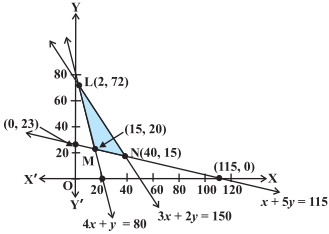
The feasible region is bounded by the corner points $L(2, 72)$,$M(15, 20)$,and $N(40, 15)$.
The minimum value of $Z$ is $150$ at point $(15, 20)$. Thus,$15$ packets of food $P$ and $20$ packets of food $Q$ should be used.
Constraints are:
$12x + 3y \geq 240 \implies 4x + y \geq 80$
$4x + 20y \geq 460 \implies x + 5y \geq 115$
$6x + 4y \leq 300 \implies 3x + 2y \leq 150$
$x, y \geq 0$
The feasible region is bounded by the corner points $L(2, 72)$,$M(15, 20)$,and $N(40, 15)$.
| Corner Point | $Z = 6x + 3y$ |
| $L(2, 72)$ | $6(2) + 3(72) = 12 + 216 = 228$ |
| $M(15, 20)$ | $6(15) + 3(20) = 90 + 60 = 150$ |
| $N(40, 15)$ | $6(40) + 3(15) = 240 + 45 = 285$ |
The minimum value of $Z$ is $150$ at point $(15, 20)$. Thus,$15$ packets of food $P$ and $20$ packets of food $Q$ should be used.
0 likes
View Solution17
DifficultMCQ
$A$ manufacturer has three machines $I, II$ and $III$ installed in his factory. Machines $I$ and $II$ are capable of being operated for at most $12 \, hours$ whereas machine $III$ must be operated for at least $5 \, hours$ a day. She produces only two items $M$ and $N$ each requiring the use of all the three machines. The number of hours required for producing $1$ unit of each of $M$ and $N$ on the three machines are given in the following table:
She makes a profit of $Rs. \, 600$ and $Rs. \, 400$ on items $M$ and $N$ respectively. How many of each item should she produce so as to maximise her profit assuming that she can sell all the items that she produced? What will be the maximum profit?
| Items | Machine $I$ | Machine $II$ | Machine $III$ |
|---|---|---|---|
| $M$ | $1$ | $2$ | $1$ |
| $N$ | $2$ | $1$ | $1.25$ |
She makes a profit of $Rs. \, 600$ and $Rs. \, 400$ on items $M$ and $N$ respectively. How many of each item should she produce so as to maximise her profit assuming that she can sell all the items that she produced? What will be the maximum profit?
A
$4$ units of $M$ and $4$ units of $N$,Maximum Profit $= Rs. \, 4000$
B
$6$ units of $M$ and $0$ units of $N$,Maximum Profit $= Rs. \, 3600$
C
$0$ units of $M$ and $6$ units of $N$,Maximum Profit $= Rs. \, 2400$
D
$5$ units of $M$ and $0$ units of $N$,Maximum Profit $= Rs. \, 3000$
Solution
(A) Let $x$ and $y$ be the number of items $M$ and $N$ produced respectively.
Total profit $Z = 600x + 400y$.
Constraints:
$x + 2y \leq 12$ (Machine $I$)
$2x + y \leq 12$ (Machine $II$)
$x + 1.25y \geq 5$ (Machine $III$)
$x, y \geq 0$
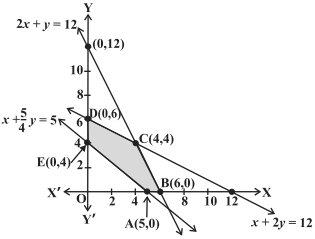
Solving the system of inequalities,the feasible region is bounded by the vertices $(5, 0), (6, 0), (4, 4), (0, 6), (0, 4)$.
Evaluating $Z$ at corner points:
At $(5, 0): Z = 600(5) + 400(0) = 3000$
At $(6, 0): Z = 600(6) + 400(0) = 3600$
At $(4, 4): Z = 600(4) + 400(4) = 2400 + 1600 = 4000$
At $(0, 6): Z = 600(0) + 400(6) = 2400$
At $(0, 4): Z = 600(0) + 400(4) = 1600$
The maximum profit is $Rs. \, 4000$ at $x = 4, y = 4$.
Total profit $Z = 600x + 400y$.
Constraints:
$x + 2y \leq 12$ (Machine $I$)
$2x + y \leq 12$ (Machine $II$)
$x + 1.25y \geq 5$ (Machine $III$)
$x, y \geq 0$
Solving the system of inequalities,the feasible region is bounded by the vertices $(5, 0), (6, 0), (4, 4), (0, 6), (0, 4)$.
Evaluating $Z$ at corner points:
At $(5, 0): Z = 600(5) + 400(0) = 3000$
At $(6, 0): Z = 600(6) + 400(0) = 3600$
At $(4, 4): Z = 600(4) + 400(4) = 2400 + 1600 = 4000$
At $(0, 6): Z = 600(0) + 400(6) = 2400$
At $(0, 4): Z = 600(0) + 400(4) = 1600$
The maximum profit is $Rs. \, 4000$ at $x = 4, y = 4$.
0 likes
View Solution18
DifficultMCQ
There are two factories located at place $P$ and place $Q$. From these locations,a certain commodity is to be delivered to each of the three depots situated at $A, B$ and $C$. The weekly requirements of the depots are $5, 5$ and $4$ units respectively,while the production capacities of the factories at $P$ and $Q$ are $8$ and $6$ units respectively. The cost of transportation per unit is given below:
How many units should be transported from each factory to each depot in order that the transportation cost is minimum? What will be the minimum transportation cost?
| From/To | $A$ | $B$ | $C$ |
| $P$ | $160$ | $100$ | $150$ |
| $Q$ | $100$ | $120$ | $100$ |
How many units should be transported from each factory to each depot in order that the transportation cost is minimum? What will be the minimum transportation cost?
A
$1550$
B
$1600$
C
$1650$
D
$1700$
Solution
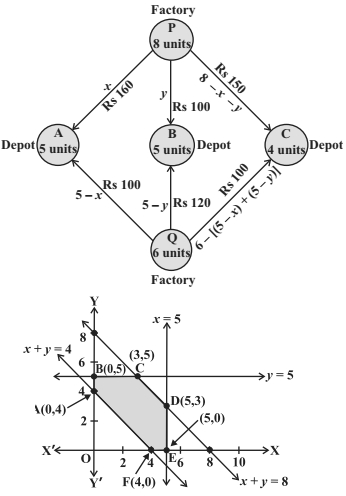
(A) Let $x$ and $y$ be the units transported from factory $P$ to depots $A$ and $B$ respectively. Then,$8-x-y$ units are transported from $P$ to $C$.
The units transported from $Q$ are:
To $A$: $5-x$
To $B$: $5-y$
To $C$: $6-(5-x)-(5-y) = x+y-4$
The constraints are:
$x \geq 0, y \geq 0$
$x \leq 5, y \leq 5$
$x+y \leq 8$
$x+y \geq 4$
The total cost function $Z$ is:
$Z = 160x + 100y + 150(8-x-y) + 100(5-x) + 120(5-y) + 100(x+y-4)$
$Z = 160x + 100y + 1200 - 150x - 150y + 500 - 100x + 600 - 120y + 100x + 100y - 400$
$Z = 10x - 70y + 1900 = 10(x - 7y + 190)$
Evaluating $Z$ at corner points of the feasible region:
$(0,4): Z = 10(0 - 28 + 190) = 1620$
$(0,5): Z = 10(0 - 35 + 190) = 1550$
$(3,5): Z = 10(3 - 35 + 190) = 1580$
$(5,3): Z = 10(5 - 21 + 190) = 1740$
$(5,0): Z = 10(5 - 0 + 190) = 1950$
$(4,0): Z = 10(4 - 0 + 190) = 1940$
The minimum cost is $1550$ at $(0,5)$.
The units transported from $Q$ are:
To $A$: $5-x$
To $B$: $5-y$
To $C$: $6-(5-x)-(5-y) = x+y-4$
The constraints are:
$x \geq 0, y \geq 0$
$x \leq 5, y \leq 5$
$x+y \leq 8$
$x+y \geq 4$
The total cost function $Z$ is:
$Z = 160x + 100y + 150(8-x-y) + 100(5-x) + 120(5-y) + 100(x+y-4)$
$Z = 160x + 100y + 1200 - 150x - 150y + 500 - 100x + 600 - 120y + 100x + 100y - 400$
$Z = 10x - 70y + 1900 = 10(x - 7y + 190)$
Evaluating $Z$ at corner points of the feasible region:
$(0,4): Z = 10(0 - 28 + 190) = 1620$
$(0,5): Z = 10(0 - 35 + 190) = 1550$
$(3,5): Z = 10(3 - 35 + 190) = 1580$
$(5,3): Z = 10(5 - 21 + 190) = 1740$
$(5,0): Z = 10(5 - 0 + 190) = 1950$
$(4,0): Z = 10(4 - 0 + 190) = 1940$
The minimum cost is $1550$ at $(0,5)$.
0 likes
View Solution19
DifficultMCQ
$A$ dietician has to develop a special diet using two foods $P$ and $Q$. Each packet (containing $30 \, g$) of food $P$ contains $12$ units of calcium,$4$ units of iron,$6$ units of cholesterol,and $6$ units of vitamin $A$. Each packet of the same quantity of food $Q$ contains $3$ units of calcium,$20$ units of iron,$4$ units of cholesterol,and $3$ units of vitamin $A$. The diet requires at least $240$ units of calcium,at least $460$ units of iron,and at most $300$ units of cholesterol. How many packets of each food should be used to maximize the amount of vitamin $A$ in the diet? What is the maximum amount of vitamin $A$ in the diet?
A
$40$ packets of $P$ and $15$ packets of $Q$; Maximum vitamin $A = 285$ units
B
$15$ packets of $P$ and $40$ packets of $Q$; Maximum vitamin $A = 210$ units
C
$20$ packets of $P$ and $40$ packets of $Q$; Maximum vitamin $A = 240$ units
D
$10$ packets of $P$ and $50$ packets of $Q$; Maximum vitamin $A = 210$ units
Solution
(A) Let the diet contain $x$ and $y$ packets of foods $P$ and $Q$ respectively. The objective is to maximize $Z = 6x + 3y$. The constraints are:
$12x + 3y \geq 240 \implies 4x + y \geq 80$
$4x + 20y \geq 460 \implies x + 5y \geq 115$
$6x + 4y \leq 300 \implies 3x + 2y \leq 150$
$x, y \geq 0$.
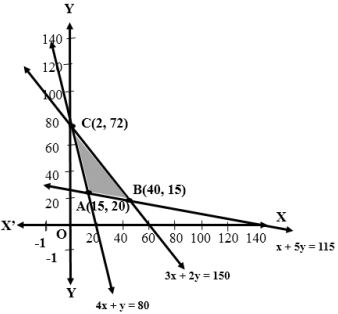
Solving the intersection points of the lines:
$4x + y = 80$ and $x + 5y = 115$ gives $A(15, 20)$.
$4x + y = 80$ and $3x + 2y = 150$ gives $B(2, 72)$.
$x + 5y = 115$ and $3x + 2y = 150$ gives $C(40, 15)$.
Evaluating $Z = 6x + 3y$ at corner points:
The maximum value is $285$ at $(40, 15)$. Thus,$40$ packets of $P$ and $15$ packets of $Q$ are required.
$12x + 3y \geq 240 \implies 4x + y \geq 80$
$4x + 20y \geq 460 \implies x + 5y \geq 115$
$6x + 4y \leq 300 \implies 3x + 2y \leq 150$
$x, y \geq 0$.
Solving the intersection points of the lines:
$4x + y = 80$ and $x + 5y = 115$ gives $A(15, 20)$.
$4x + y = 80$ and $3x + 2y = 150$ gives $B(2, 72)$.
$x + 5y = 115$ and $3x + 2y = 150$ gives $C(40, 15)$.
Evaluating $Z = 6x + 3y$ at corner points:
| Corner Point | $Z = 6x + 3y$ |
| $A(15, 20)$ | $6(15) + 3(20) = 150$ |
| $B(2, 72)$ | $6(2) + 3(72) = 228$ |
| $C(40, 15)$ | $6(40) + 3(15) = 285$ |
The maximum value is $285$ at $(40, 15)$. Thus,$40$ packets of $P$ and $15$ packets of $Q$ are required.
0 likes
View Solution20
DifficultMCQ
$A$ farmer mixes two brands $P$ and $Q$ of cattle feed. Brand $P$,costing $Rs. 250$ per bag,contains $3$ units of nutritional element $A$,$2.5$ units of element $B$ and $2$ units of element $C$. Brand $Q$ costing $Rs. 200$ per bag contains $1.5$ units of nutritional element $A$,$11.25$ units of element $B$,and $3$ units of element $C$. The minimum requirements of nutrients $A$,$B$ and $C$ are $18$ units,$45$ units and $24$ units respectively. Determine the number of bags of each brand which should be mixed in order to produce a mixture having a minimum cost per bag? What is the minimum cost of the mixture per bag?
A
$3$ bags of $P$ and $6$ bags of $Q$,Minimum cost $= Rs. 1950$
B
$6$ bags of $P$ and $3$ bags of $Q$,Minimum cost $= Rs. 2100$
C
$4$ bags of $P$ and $5$ bags of $Q$,Minimum cost $= Rs. 2000$
D
$2$ bags of $P$ and $7$ bags of $Q$,Minimum cost $= Rs. 1900$
Solution
(A) Let the farmer mix $x$ bags of brand $P$ and $y$ bags of brand $Q$.
The objective is to minimize the cost $Z = 250x + 200y$.
Subject to the constraints:
$3x + 1.5y \geq 18$ (Nutrient $A$)
$2.5x + 11.25y \geq 45$ (Nutrient $B$)
$2x + 3y \geq 24$ (Nutrient $C$)
$x, y \geq 0$
Solving the intersection points of the lines:
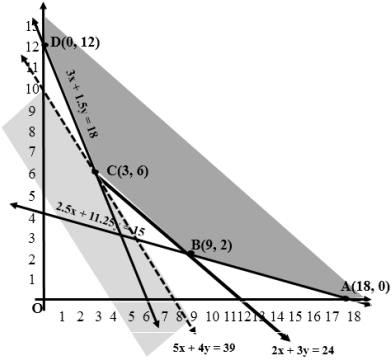
$1$. $3x + 1.5y = 18$ and $2x + 3y = 24$ intersect at $(3, 6)$.
$2$. $2.5x + 11.25y = 45$ and $2x + 3y = 24$ intersect at $(9, 2)$.
$3$. The boundary lines intersect the axes at $(18, 0)$ and $(0, 12)$.
The corner points of the feasible region are $(18, 0), (9, 2), (3, 6), (0, 12)$.
Evaluating $Z = 250x + 200y$ at these points:
- At $(18, 0): Z = 250(18) + 200(0) = 4500$
- At $(9, 2): Z = 250(9) + 200(2) = 2250 + 400 = 2650$
- At $(3, 6): Z = 250(3) + 200(6) = 750 + 1200 = 1950$
- At $(0, 12): Z = 250(0) + 200(12) = 2400$
Since the feasible region is unbounded,we check if $250x + 200y < 1950$ has any common points with the feasible region. The line $250x + 200y = 1950$ (or $5x + 4y = 39$) does not intersect the feasible region except at $(3, 6)$. Thus,the minimum cost is $Rs. 1950$ at $x=3, y=6$.
The objective is to minimize the cost $Z = 250x + 200y$.
Subject to the constraints:
$3x + 1.5y \geq 18$ (Nutrient $A$)
$2.5x + 11.25y \geq 45$ (Nutrient $B$)
$2x + 3y \geq 24$ (Nutrient $C$)
$x, y \geq 0$
Solving the intersection points of the lines:
$1$. $3x + 1.5y = 18$ and $2x + 3y = 24$ intersect at $(3, 6)$.
$2$. $2.5x + 11.25y = 45$ and $2x + 3y = 24$ intersect at $(9, 2)$.
$3$. The boundary lines intersect the axes at $(18, 0)$ and $(0, 12)$.
The corner points of the feasible region are $(18, 0), (9, 2), (3, 6), (0, 12)$.
Evaluating $Z = 250x + 200y$ at these points:
- At $(18, 0): Z = 250(18) + 200(0) = 4500$
- At $(9, 2): Z = 250(9) + 200(2) = 2250 + 400 = 2650$
- At $(3, 6): Z = 250(3) + 200(6) = 750 + 1200 = 1950$
- At $(0, 12): Z = 250(0) + 200(12) = 2400$
Since the feasible region is unbounded,we check if $250x + 200y < 1950$ has any common points with the feasible region. The line $250x + 200y = 1950$ (or $5x + 4y = 39$) does not intersect the feasible region except at $(3, 6)$. Thus,the minimum cost is $Rs. 1950$ at $x=3, y=6$.
0 likes
View Solution21
DifficultMCQ
$A$ dietician wishes to mix together two kinds of food $X$ and $Y$ in such a way that the mixture contains at least $10$ units of vitamin $A$,$12$ units of vitamin $B$,and $8$ units of vitamin $C$. The vitamin contents of one $kg$ of food are given below:
One $kg$ of food $X$ costs $Rs. 16$ and one $kg$ of food $Y$ costs $Rs. 20$. Find the least cost of the mixture which will produce the required diet?
| Food | Vitamin $A$ | Vitamin $B$ | Vitamin $C$ |
| $X$ | $1$ | $2$ | $3$ |
| $Y$ | $2$ | $2$ | $1$ |
One $kg$ of food $X$ costs $Rs. 16$ and one $kg$ of food $Y$ costs $Rs. 20$. Find the least cost of the mixture which will produce the required diet?
A
$112$
B
$120$
C
$130$
D
$140$
Solution
(A) Let the mixture contain $x$ $kg$ of food $X$ and $y$ $kg$ of food $Y$.
The mathematical formulation of the given problem is as follows:
Minimize $Z = 16x + 20y$ ... $(1)$
Subject to the constraints:
$x + 2y \geq 10$ ... $(2)$
$2x + 2y \geq 12$ (which simplifies to $x + y \geq 6$) ... $(3)$
$3x + y \geq 8$ ... $(4)$
$x, y \geq 0$ ... $(5)$
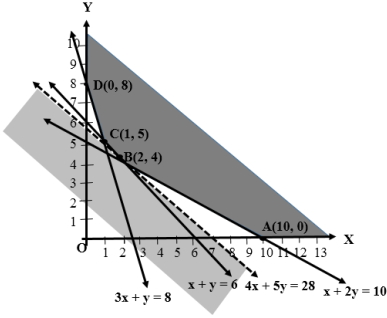
The feasible region determined by the system of constraints is unbounded.
The corner points of the feasible region are $A(10, 0)$,$B(2, 4)$,$C(1, 5)$,and $D(0, 8)$.
The values of $Z$ at these corner points are as follows:
As the feasible region is unbounded,we check if $16x + 20y < 112$ has any common points with the feasible region.
Since the line $16x + 20y = 112$ does not pass through the interior of the feasible region,the minimum value is $112$ at $(2, 4)$.
Thus,the least cost of the mixture is $Rs. 112$.
The mathematical formulation of the given problem is as follows:
Minimize $Z = 16x + 20y$ ... $(1)$
Subject to the constraints:
$x + 2y \geq 10$ ... $(2)$
$2x + 2y \geq 12$ (which simplifies to $x + y \geq 6$) ... $(3)$
$3x + y \geq 8$ ... $(4)$
$x, y \geq 0$ ... $(5)$
The feasible region determined by the system of constraints is unbounded.
The corner points of the feasible region are $A(10, 0)$,$B(2, 4)$,$C(1, 5)$,and $D(0, 8)$.
The values of $Z$ at these corner points are as follows:
| Corner point | $Z = 16x + 20y$ |
| $A(10, 0)$ | $160$ |
| $B(2, 4)$ | $112$ |
| $C(1, 5)$ | $116$ |
| $D(0, 8)$ | $160$ |
As the feasible region is unbounded,we check if $16x + 20y < 112$ has any common points with the feasible region.
Since the line $16x + 20y = 112$ does not pass through the interior of the feasible region,the minimum value is $112$ at $(2, 4)$.
Thus,the least cost of the mixture is $Rs. 112$.
0 likes
View Solution22
DifficultMCQ
$A$ manufacturer makes two types of toys $A$ and $B$. Three machines are needed for this purpose and the time (in $minutes$) required for each toy on the machines is given below:
Each machine is available for a maximum of $6 \, hours$ $(360 \, minutes)$ per day. If the profit on each toy of type $A$ is $Rs. \, 7.50$ and that on each toy of type $B$ is $Rs. \, 5$,find the number of toys of each type that should be manufactured in a day to get maximum profit.
| Types of Toys | Machine-$I$ | Machine-$II$ | Machine-$III$ |
| $A$ | $12$ | $18$ | $6$ |
| $B$ | $6$ | $0$ | $9$ |
Each machine is available for a maximum of $6 \, hours$ $(360 \, minutes)$ per day. If the profit on each toy of type $A$ is $Rs. \, 7.50$ and that on each toy of type $B$ is $Rs. \, 5$,find the number of toys of each type that should be manufactured in a day to get maximum profit.
A
$15 \, \text{toys of type } A, 30 \, \text{toys of type } B$
B
$20 \, \text{toys of type } A, 20 \, \text{toys of type } B$
C
$10 \, \text{toys of type } A, 40 \, \text{toys of type } B$
D
$30 \, \text{toys of type } A, 15 \, \text{toys of type } B$
Solution
(A) Let $x$ and $y$ be the number of toys of type $A$ and type $B$ manufactured in a day,respectively.
The constraints based on machine time (in minutes) are:
Machine $I$: $12x + 6y \leq 360 \implies 2x + y \leq 60$
Machine $II$: $18x + 0y \leq 360 \implies x \leq 20$
Machine $III$: $6x + 9y \leq 360 \implies 2x + 3y \leq 120$
Non-negativity: $x, y \geq 0$
Objective function to maximize profit: $Z = 7.5x + 5y$
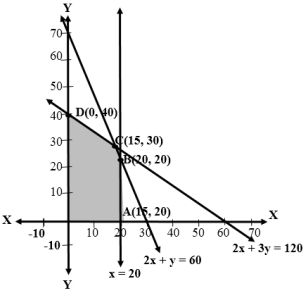
The feasible region is bounded by the vertices $(0, 0), (20, 0), (20, 20), (15, 30), (0, 40)$.
Evaluating $Z$ at corner points:
$1$. At $(0, 0): Z = 0$
$2$. At $(20, 0): Z = 7.5(20) + 5(0) = 150$
$3$. At $(20, 20): Z = 7.5(20) + 5(20) = 150 + 100 = 250$
$4$. At $(15, 30): Z = 7.5(15) + 5(30) = 112.5 + 150 = 262.5$
$5$. At $(0, 40): Z = 7.5(0) + 5(40) = 200$
The maximum profit is $Rs. \, 262.5$ at $(15, 30)$. Thus,$15$ toys of type $A$ and $30$ toys of type $B$ should be manufactured.
The constraints based on machine time (in minutes) are:
Machine $I$: $12x + 6y \leq 360 \implies 2x + y \leq 60$
Machine $II$: $18x + 0y \leq 360 \implies x \leq 20$
Machine $III$: $6x + 9y \leq 360 \implies 2x + 3y \leq 120$
Non-negativity: $x, y \geq 0$
Objective function to maximize profit: $Z = 7.5x + 5y$
The feasible region is bounded by the vertices $(0, 0), (20, 0), (20, 20), (15, 30), (0, 40)$.
Evaluating $Z$ at corner points:
$1$. At $(0, 0): Z = 0$
$2$. At $(20, 0): Z = 7.5(20) + 5(0) = 150$
$3$. At $(20, 20): Z = 7.5(20) + 5(20) = 150 + 100 = 250$
$4$. At $(15, 30): Z = 7.5(15) + 5(30) = 112.5 + 150 = 262.5$
$5$. At $(0, 40): Z = 7.5(0) + 5(40) = 200$
The maximum profit is $Rs. \, 262.5$ at $(15, 30)$. Thus,$15$ toys of type $A$ and $30$ toys of type $B$ should be manufactured.
0 likes
View Solution23
Difficult
Two godowns $A$ and $B$ have grain capacity of $100$ quintals and $50$ quintals respectively. They supply to $3$ ration shops,$D$,$E$ and $F$ whose requirements are $60, 50$ and $40$ quintals respectively. The cost of transportation per quintal from the godowns to the shops are given in the following table:
How should the supplies be transported in order that the transportation cost is minimum? What is the minimum cost?
| Transportation cost per quintal (in $Rs$) |
|---|
| From/To $A$ $B$ |
| $D$ $6$ $4$ |
| $E$ $3$ $2$ |
| $F$ $2.50$ $3$ |
How should the supplies be transported in order that the transportation cost is minimum? What is the minimum cost?
Solution
(D) Let godown $A$ supply $x$ and $y$ quintals of grain to the shops $D$ and $E$ respectively. Then,$(100-x-y)$ will be supplied to shop $F$.
The requirement at shop $D$ is $60$ quintals. Since $x$ quintals are transported from godown $A$,the remaining $(60-x)$ quintals will be transported from godown $B$.
Similarly,$(50-y)$ quintals and $40-(100-x-y) = (x+y-60)$ quintals will be transported from godown $B$ to shop $E$ and $F$ respectively.
Total transportation cost $z$ is given by:
$z = 6x + 3y + 2.5(100-x-y) + 4(60-x) + 2(50-y) + 3(x+y-60)$
$z = 6x + 3y + 250 - 2.5x - 2.5y + 240 - 4x + 100 - 2y + 3x + 3y - 180$
$z = 2.5x + 1.5y + 410$
The problem is to minimize $z = 2.5x + 1.5y + 410$ subject to:
$x+y \leq 100, x \leq 60, y \leq 50, x+y \geq 60, x, y \geq 0$.
The corner points of the feasible region are $A(60, 0), B(60, 40), C(50, 50),$ and $D(10, 50)$.
The minimum value of $z$ is $510$ at $(10, 50)$.
Thus,the amount of grain transported from $A$ to $D, E, F$ is $10, 50, 40$ quintals respectively,and from $B$ to $D, E, F$ is $50, 0, 0$ quintals respectively.
The requirement at shop $D$ is $60$ quintals. Since $x$ quintals are transported from godown $A$,the remaining $(60-x)$ quintals will be transported from godown $B$.
Similarly,$(50-y)$ quintals and $40-(100-x-y) = (x+y-60)$ quintals will be transported from godown $B$ to shop $E$ and $F$ respectively.
Total transportation cost $z$ is given by:
$z = 6x + 3y + 2.5(100-x-y) + 4(60-x) + 2(50-y) + 3(x+y-60)$
$z = 6x + 3y + 250 - 2.5x - 2.5y + 240 - 4x + 100 - 2y + 3x + 3y - 180$
$z = 2.5x + 1.5y + 410$
The problem is to minimize $z = 2.5x + 1.5y + 410$ subject to:
$x+y \leq 100, x \leq 60, y \leq 50, x+y \geq 60, x, y \geq 0$.
The corner points of the feasible region are $A(60, 0), B(60, 40), C(50, 50),$ and $D(10, 50)$.
| Corner point | $z = 2.5x + 1.5y + 410$ |
|---|---|
| $A(60, 0)$ | $560$ |
| $B(60, 40)$ | $620$ |
| $C(50, 50)$ | $610$ |
| $D(10, 50)$ | $510$ (Minimum) |
The minimum value of $z$ is $510$ at $(10, 50)$.
Thus,the amount of grain transported from $A$ to $D, E, F$ is $10, 50, 40$ quintals respectively,and from $B$ to $D, E, F$ is $50, 0, 0$ quintals respectively.
0 likes
View Solution24
DifficultMCQ
$A$ fruit grower can use two types of fertilizer in his garden,brand $P$ and brand $Q$. The amounts (in $kg$) of nitrogen,phosphoric acid,potash,and chlorine in a bag of each brand are given in the table. Tests indicate that the garden needs at least $240 \, kg$ of phosphoric acid,at least $270 \, kg$ of potash,and at most $310 \, kg$ of chlorine.
If the grower wants to maximize the amount of nitrogen added to the garden,how many bags of each brand should be added? What is the maximum amount of nitrogen added?
If the grower wants to maximize the amount of nitrogen added to the garden,how many bags of each brand should be added? What is the maximum amount of nitrogen added?
| Brand $P$ ($kg$ per bag) | Brand $Q$ ($kg$ per bag) | |
| Nitrogen | $3$ | $3.5$ |
| Phosphoric acid | $1$ | $2$ |
| Potash | $3$ | $1.5$ |
| Chlorine | $1.5$ | $2$ |
A
$140$ bags of $P$ and $50$ bags of $Q$; Maximum nitrogen = $595 \, kg$
B
$50$ bags of $P$ and $140$ bags of $Q$; Maximum nitrogen = $640 \, kg$
C
$100$ bags of $P$ and $40$ bags of $Q$; Maximum nitrogen = $440 \, kg$
D
$20$ bags of $P$ and $140$ bags of $Q$; Maximum nitrogen = $550 \, kg$
Solution
(A) Let the fruit grower use $x$ bags of brand $P$ and $y$ bags of brand $Q$.
The objective function is to maximize nitrogen: $Z = 3x + 3.5y$.
Constraints based on the table:
$1$. Phosphoric acid: $x + 2y \geq 240$
$2$. Potash: $3x + 1.5y \geq 270 \implies 2x + y \geq 180$
$3$. Chlorine: $1.5x + 2y \leq 310$
$4$. Non-negativity: $x, y \geq 0$
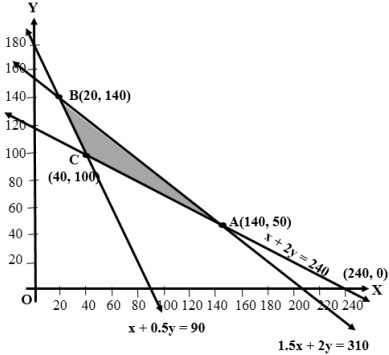
Solving the system of inequalities,the feasible region is bounded by the corner points $A(140, 50)$,$B(20, 140)$,and $C(40, 100)$.
Evaluating $Z = 3x + 3.5y$ at corner points:
- At $A(140, 50): Z = 3(140) + 3.5(50) = 420 + 175 = 595$
- At $B(20, 140): Z = 3(20) + 3.5(140) = 60 + 490 = 550$
- At $C(40, 100): Z = 3(40) + 3.5(100) = 120 + 350 = 470$
The maximum nitrogen is $595 \, kg$ at $x = 140$ and $y = 50$.
The objective function is to maximize nitrogen: $Z = 3x + 3.5y$.
Constraints based on the table:
$1$. Phosphoric acid: $x + 2y \geq 240$
$2$. Potash: $3x + 1.5y \geq 270 \implies 2x + y \geq 180$
$3$. Chlorine: $1.5x + 2y \leq 310$
$4$. Non-negativity: $x, y \geq 0$
Solving the system of inequalities,the feasible region is bounded by the corner points $A(140, 50)$,$B(20, 140)$,and $C(40, 100)$.
Evaluating $Z = 3x + 3.5y$ at corner points:
- At $A(140, 50): Z = 3(140) + 3.5(50) = 420 + 175 = 595$
- At $B(20, 140): Z = 3(20) + 3.5(140) = 60 + 490 = 550$
- At $C(40, 100): Z = 3(40) + 3.5(100) = 120 + 350 = 470$
The maximum nitrogen is $595 \, kg$ at $x = 140$ and $y = 50$.
0 likes
View Solution25
DifficultMCQ
$A$ toy company manufactures two types of dolls,$A$ and $B$. Market research and available resources have indicated that the combined production level should not exceed $1200$ dolls per week and the demand for dolls of type $B$ is at most half of that for dolls of type $A$. Further,the production level of dolls of type $A$ can exceed three times the production of dolls of type $B$ by at most $600$ units. If the company makes a profit of $Rs. 12$ and $Rs. 16$ per doll respectively on dolls $A$ and $B$,how many of each should be produced weekly in order to maximize the profit?
A
$800$ dolls of type $A$ and $400$ dolls of type $B$
B
$600$ dolls of type $A$ and $0$ dolls of type $B$
C
$1050$ dolls of type $A$ and $150$ dolls of type $B$
D
$900$ dolls of type $A$ and $300$ dolls of type $B$
Solution
(A) Let $x$ and $y$ be the number of dolls of type $A$ and $B$ respectively that are produced per week.
The given problem can be formulated as follows:
Maximize $z = 12x + 16y$ .....$(1)$
Subject to the constraints:
$x + y \leq 1200$ .....$(2)$
$y \leq \frac{x}{2} \Rightarrow x \geq 2y$ .....$(3)$
$x - 3y \leq 600$ .....$(4)$
$x, y \geq 0$ .....$(5)$
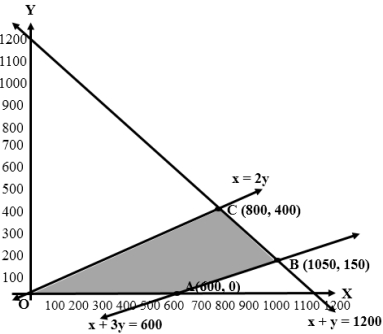
The feasible region is determined by the system of constraints. The corner points of the feasible region are $O(0,0)$,$A(600,0)$,$B(1050,150)$,and $C(800,400)$.
The values of $z$ at these corner points are as follows:
The maximum value of $z$ is $16000$ at $(800, 400)$.
Thus,$800$ dolls of type $A$ and $400$ dolls of type $B$ should be produced weekly to maximize the profit.
The given problem can be formulated as follows:
Maximize $z = 12x + 16y$ .....$(1)$
Subject to the constraints:
$x + y \leq 1200$ .....$(2)$
$y \leq \frac{x}{2} \Rightarrow x \geq 2y$ .....$(3)$
$x - 3y \leq 600$ .....$(4)$
$x, y \geq 0$ .....$(5)$
The feasible region is determined by the system of constraints. The corner points of the feasible region are $O(0,0)$,$A(600,0)$,$B(1050,150)$,and $C(800,400)$.
The values of $z$ at these corner points are as follows:
| Corner point | $z = 12x + 16y$ |
|---|---|
| $O(0,0)$ | $0$ |
| $A(600,0)$ | $7200$ |
| $B(1050,150)$ | $12(1050) + 16(150) = 12600 + 2400 = 15000$ |
| $C(800,400)$ | $12(800) + 16(400) = 9600 + 6400 = 16000$ |
The maximum value of $z$ is $16000$ at $(800, 400)$.
Thus,$800$ dolls of type $A$ and $400$ dolls of type $B$ should be produced weekly to maximize the profit.
0 likes
View Solution26
Difficult
$A$ manufacturer of electronic circuits has a stock of $200$ resistors,$120$ transistors and $150$ capacitors and is required to produce two types of circuits $A$ and $B$. Type $A$ requires $20$ resistors,$10$ transistors and $10$ capacitors. Type $B$ requires $10$ resistors,$20$ transistors and $30$ capacitors. If the profit on type $A$ circuit is $Rs. 50$ and that on type $B$ circuit is $Rs. 60$,formulate this problem as a $LPP$ so that the manufacturer can maximize his profit.
Solution
Let the manufacturer produce $x$ units of type $A$ circuits and $y$ units of type $B$ circuits.
From the given information,we have the following corresponding constraint table:
Thus,the objective function for profit is $Z = 50x + 60y$.
Now,we have the following mathematical model for the given problem:
Maximize $Z = 50x + 60y$
Subject to the constraints:
$20x + 10y \leq 200$ (Resistors constraint) $\Rightarrow 2x + y \leq 20$
$10x + 20y \leq 120$ (Transistors constraint) $\Rightarrow x + 2y \leq 12$
$10x + 30y \leq 150$ (Capacitors constraint) $\Rightarrow x + 3y \leq 15$
$x \geq 0, y \geq 0$ (Non-negativity constraints)
So,the $LPP$ is to maximize $Z = 50x + 60y$ subject to $2x + y \leq 20, x + 2y \leq 12, x + 3y \leq 15, x \geq 0, y \geq 0$.
From the given information,we have the following corresponding constraint table:
| Component | Type $A$ $(x)$ | Type $B$ $(y)$ | Maximum Stock |
| Resistors | $20$ | $10$ | $200$ |
| Transistors | $10$ | $20$ | $120$ |
| Capacitors | $10$ | $30$ | $150$ |
| Profit | $Rs. 50$ | $Rs. 60$ | - |
Thus,the objective function for profit is $Z = 50x + 60y$.
Now,we have the following mathematical model for the given problem:
Maximize $Z = 50x + 60y$
Subject to the constraints:
$20x + 10y \leq 200$ (Resistors constraint) $\Rightarrow 2x + y \leq 20$
$10x + 20y \leq 120$ (Transistors constraint) $\Rightarrow x + 2y \leq 12$
$10x + 30y \leq 150$ (Capacitors constraint) $\Rightarrow x + 3y \leq 15$
$x \geq 0, y \geq 0$ (Non-negativity constraints)
So,the $LPP$ is to maximize $Z = 50x + 60y$ subject to $2x + y \leq 20, x + 2y \leq 12, x + 3y \leq 15, x \geq 0, y \geq 0$.
0 likes
View Solution27
Difficult
$A$ firm has to transport $1200$ packages using large vans which can carry $200$ packages each and small vans which can take $80$ packages each. The cost for engaging each large van is $Rs. 400$ and each small van is $Rs. 200$. Not more than $Rs. 3000$ is to be spent on the job and the number of large vans cannot exceed the number of small vans. Formulate this problem as an $LPP$ given that the objective is to minimize cost.
Solution
(A) Let $x$ be the number of large vans and $y$ be the number of small vans.
The objective is to minimize the total cost $Z$. The cost of one large van is $Rs. 400$ and one small van is $Rs. 200$. Thus,the objective function is $Z = 400x + 200y$.
Constraints:
$1$. Total packages to be transported is at least $1200$: $200x + 80y \geq 1200$,which simplifies to $5x + 2y \geq 30$.
$2$. Total cost cannot exceed $Rs. 3000$: $400x + 200y \leq 3000$,which simplifies to $2x + y \leq 15$.
$3$. Number of large vans cannot exceed the number of small vans: $x \leq y$.
$4$. Non-negativity constraints: $x \geq 0, y \geq 0$.
Thus,the $LPP$ is:
Minimize $Z = 400x + 200y$
Subject to:
$5x + 2y \geq 30$
$2x + y \leq 15$
$x \leq y$
$x, y \geq 0$
The objective is to minimize the total cost $Z$. The cost of one large van is $Rs. 400$ and one small van is $Rs. 200$. Thus,the objective function is $Z = 400x + 200y$.
Constraints:
$1$. Total packages to be transported is at least $1200$: $200x + 80y \geq 1200$,which simplifies to $5x + 2y \geq 30$.
$2$. Total cost cannot exceed $Rs. 3000$: $400x + 200y \leq 3000$,which simplifies to $2x + y \leq 15$.
$3$. Number of large vans cannot exceed the number of small vans: $x \leq y$.
$4$. Non-negativity constraints: $x \geq 0, y \geq 0$.
Thus,the $LPP$ is:
Minimize $Z = 400x + 200y$
Subject to:
$5x + 2y \geq 30$
$2x + y \leq 15$
$x \leq y$
$x, y \geq 0$
0 likes
View Solution28
Difficult
$A$ company manufactures two types of sweaters: type $A$ and type $B.$ It costs $Rs. 360$ to make a type $A$ sweater and $Rs. 120$ to make a type $B$ sweater. The company can make at most $300$ sweaters and spend at most $Rs. 72000$ a day. The number of sweaters of type $B$ cannot exceed the number of sweaters of type $A$ by more than $100.$ The company makes a profit of $Rs. 200$ for each sweater of type $A$ and $Rs. 120$ for every sweater of type $B.$ Formulate this problem as a $LPP$ to maximize the profit to the company.
Solution
(A) Let the company manufacture $x$ number of type $A$ sweaters and $y$ number of type $B$ sweaters.
The company spends at most $Rs. 72000$ a day. Therefore,$360x + 120y \leq 72000$.
Dividing by $120$,we get $3x + y \leq 600 \dots (i)$.
The company can make at most $300$ sweaters in total. Therefore,$x + y \leq 300 \dots (ii)$.
The number of sweaters of type $B$ cannot exceed the number of sweaters of type $A$ by more than $100$. This means $y - x \leq 100$,which can be written as $-x + y \leq 100 \dots (iii)$.
The company makes a profit of $Rs. 200$ for each type $A$ sweater and $Rs. 120$ for each type $B$ sweater. The objective function to maximize profit is $Z = 200x + 120y$.
Thus,the $LPP$ formulation is:
Maximize $Z = 200x + 120y$
Subject to constraints:
$3x + y \leq 600$
$x + y \leq 300$
$-x + y \leq 100$
$x \geq 0, y \geq 0$
The company spends at most $Rs. 72000$ a day. Therefore,$360x + 120y \leq 72000$.
Dividing by $120$,we get $3x + y \leq 600 \dots (i)$.
The company can make at most $300$ sweaters in total. Therefore,$x + y \leq 300 \dots (ii)$.
The number of sweaters of type $B$ cannot exceed the number of sweaters of type $A$ by more than $100$. This means $y - x \leq 100$,which can be written as $-x + y \leq 100 \dots (iii)$.
The company makes a profit of $Rs. 200$ for each type $A$ sweater and $Rs. 120$ for each type $B$ sweater. The objective function to maximize profit is $Z = 200x + 120y$.
Thus,the $LPP$ formulation is:
Maximize $Z = 200x + 120y$
Subject to constraints:
$3x + y \leq 600$
$x + y \leq 300$
$-x + y \leq 100$
$x \geq 0, y \geq 0$
0 likes
View Solution29
Difficult
$A$ man rides his motorcycle at the speed of $50 \, km/h$. He has to spend $Rs. \, 2$ per $km$ on petrol. If he rides it at a faster speed of $80 \, km/h$,the petrol cost increases to $Rs. \, 3$ per $km$. He has at most $Rs. \, 120$ to spend on petrol and one hour's time. He wishes to find the maximum distance that he can travel. Express this problem as a linear programming problem.
Solution
(A) Let the man ride his motorcycle for a distance $x \, km$ at the speed of $50 \, km/h$ and for a distance $y \, km$ at the speed of $80 \, km/h$.
The cost of petrol for distance $x$ is $2x$ and for distance $y$ is $3y$. Since he has at most $Rs. \, 120$ to spend,the cost constraint is $2x + 3y \leq 120$.
The time taken to travel distance $x$ is $\frac{x}{50}$ hours and for distance $y$ is $\frac{y}{80}$ hours. Since he has at most $1$ hour,the time constraint is $\frac{x}{50} + \frac{y}{80} \leq 1$,which simplifies to $8x + 5y \leq 400$.
Since distance cannot be negative,$x \geq 0$ and $y \geq 0$.
The objective is to maximize the total distance $Z = x + y$.
Thus,the linear programming problem is:
Maximize $Z = x + y$
Subject to:
$2x + 3y \leq 120$
$8x + 5y \leq 400$
$x, y \geq 0$
The cost of petrol for distance $x$ is $2x$ and for distance $y$ is $3y$. Since he has at most $Rs. \, 120$ to spend,the cost constraint is $2x + 3y \leq 120$.
The time taken to travel distance $x$ is $\frac{x}{50}$ hours and for distance $y$ is $\frac{y}{80}$ hours. Since he has at most $1$ hour,the time constraint is $\frac{x}{50} + \frac{y}{80} \leq 1$,which simplifies to $8x + 5y \leq 400$.
Since distance cannot be negative,$x \geq 0$ and $y \geq 0$.
The objective is to maximize the total distance $Z = x + y$.
Thus,the linear programming problem is:
Maximize $Z = x + y$
Subject to:
$2x + 3y \leq 120$
$8x + 5y \leq 400$
$x, y \geq 0$
0 likes
View Solution30
Difficult
$A$ manufacturer produces two models of bikes: Model $X$ and Model $Y$. Model $X$ takes $6$ man-hours to make per unit,while Model $Y$ takes $10$ man-hours per unit. There is a total of $450$ man-hours available per week. Handling and marketing costs are $Rs. 2000$ and $Rs. 1000$ per unit for Models $X$ and $Y$ respectively. The total funds available for these purposes are $Rs. 80,000$ per week. Profits per unit for Models $X$ and $Y$ are $Rs. 1000$ and $Rs. 500$ respectively. How many bikes of each model should the manufacturer produce so as to yield a maximum profit? Find the maximum profit.
Solution
(A) Let the manufacturer produce $x$ number of Model $X$ bikes and $y$ number of Model $Y$ bikes.
Model $X$ takes $6$ man-hours and Model $Y$ takes $10$ man-hours per unit. Total man-hours available per week is $450$.
$\therefore 6x + 10y \leq 450 \Rightarrow 3x + 5y \leq 225$
Handling and marketing costs are $Rs. 2000$ and $Rs. 1000$ per unit respectively,with total funds of $Rs. 80,000$ per week.
$\therefore 2000x + 1000y \leq 80000 \Rightarrow 2x + y \leq 80$
Also,$x \geq 0, y \geq 0$.
We need to maximize the profit function $Z = 1000x + 500y$ subject to the constraints:
$3x + 5y \leq 225$
$2x + y \leq 80$
$x \geq 0, y \geq 0$
The feasible region is determined by the corner points $(0,0), (40,0), (25,30),$ and $(0,45)$.
The maximum profit is $Rs. 40,000$. This occurs at any point on the line segment joining $(40,0)$ and $(25,30)$. Thus,the manufacturer can produce $40$ units of Model $X$ and $0$ units of Model $Y$,or $25$ units of Model $X$ and $30$ units of Model $Y$ to achieve the maximum profit.
Model $X$ takes $6$ man-hours and Model $Y$ takes $10$ man-hours per unit. Total man-hours available per week is $450$.
$\therefore 6x + 10y \leq 450 \Rightarrow 3x + 5y \leq 225$
Handling and marketing costs are $Rs. 2000$ and $Rs. 1000$ per unit respectively,with total funds of $Rs. 80,000$ per week.
$\therefore 2000x + 1000y \leq 80000 \Rightarrow 2x + y \leq 80$
Also,$x \geq 0, y \geq 0$.
We need to maximize the profit function $Z = 1000x + 500y$ subject to the constraints:
$3x + 5y \leq 225$
$2x + y \leq 80$
$x \geq 0, y \geq 0$
The feasible region is determined by the corner points $(0,0), (40,0), (25,30),$ and $(0,45)$.
| Corner Points | Value of $Z = 1000x + 500y$ |
| $(0,0)$ | $0$ |
| $(40,0)$ | $1000(40) + 500(0) = 40000$ |
| $(25,30)$ | $1000(25) + 500(30) = 25000 + 15000 = 40000$ |
| $(0,45)$ | $1000(0) + 500(45) = 22500$ |
The maximum profit is $Rs. 40,000$. This occurs at any point on the line segment joining $(40,0)$ and $(25,30)$. Thus,the manufacturer can produce $40$ units of Model $X$ and $0$ units of Model $Y$,or $25$ units of Model $X$ and $30$ units of Model $Y$ to achieve the maximum profit.
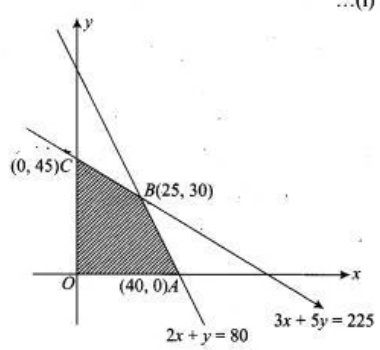
0 likes
View Solution31
Difficult
In order to supplement daily diet,a person wishes to take some $X$ and some $Y$ tablets. The contents of iron,calcium and vitamins in $X$ and $Y$ (in milligrams per tablet) are given as below:
The person needs at least $18$ milligrams of iron,$21$ milligrams of calcium and $16$ milligrams of vitamins. The price of each tablet of $X$ and $Y$ is $Rs. 2$ and $Rs. 1$ respectively. How many tablets of each should the person take in order to satisfy the above requirement at the minimum cost?
| Tablets | Iron | Calcium | Vitamin |
|---|---|---|---|
| $X$ | $6$ | $3$ | $2$ |
| $Y$ | $2$ | $3$ | $4$ |
The person needs at least $18$ milligrams of iron,$21$ milligrams of calcium and $16$ milligrams of vitamins. The price of each tablet of $X$ and $Y$ is $Rs. 2$ and $Rs. 1$ respectively. How many tablets of each should the person take in order to satisfy the above requirement at the minimum cost?
Solution
(C) Let the person take $x$ units of tablet $X$ and $y$ units of tablet $Y$.
From the given tabulated information,we have the following constraints:
$6x + 2y \geq 18 \Rightarrow 3x + y \geq 9$
$3x + 3y \geq 21 \Rightarrow x + y \geq 7$
$2x + 4y \geq 16 \Rightarrow x + 2y \geq 8$
Also,$x \geq 0, y \geq 0$.
The objective is to minimize the cost $Z = 2x + y$.
Plotting the inequalities,the feasible region is unbounded with corner points $A(8, 0)$,$B(3, 4)$,$C(1, 6)$,and $D(0, 9)$.
Since the feasible region is unbounded,we check the inequality $2x + y < 8$. The open half-plane defined by $2x + y < 8$ has no common points with the feasible region. Therefore,the minimum value of $Z$ is $8$ at the point $(1, 6)$.
Thus,the person should take $1$ unit of tablet $X$ and $6$ units of tablet $Y$ to satisfy the requirements at the minimum cost of $Rs. 8$.
From the given tabulated information,we have the following constraints:
$6x + 2y \geq 18 \Rightarrow 3x + y \geq 9$
$3x + 3y \geq 21 \Rightarrow x + y \geq 7$
$2x + 4y \geq 16 \Rightarrow x + 2y \geq 8$
Also,$x \geq 0, y \geq 0$.
The objective is to minimize the cost $Z = 2x + y$.
Plotting the inequalities,the feasible region is unbounded with corner points $A(8, 0)$,$B(3, 4)$,$C(1, 6)$,and $D(0, 9)$.
| Corner points | Corresponding value of $Z = 2x + y$ |
|---|---|
| $(8, 0)$ | $16$ |
| $(3, 4)$ | $10$ |
| $(1, 6)$ | $8$ (Minimum) |
| $(0, 9)$ | $9$ |
Since the feasible region is unbounded,we check the inequality $2x + y < 8$. The open half-plane defined by $2x + y < 8$ has no common points with the feasible region. Therefore,the minimum value of $Z$ is $8$ at the point $(1, 6)$.
Thus,the person should take $1$ unit of tablet $X$ and $6$ units of tablet $Y$ to satisfy the requirements at the minimum cost of $Rs. 8$.
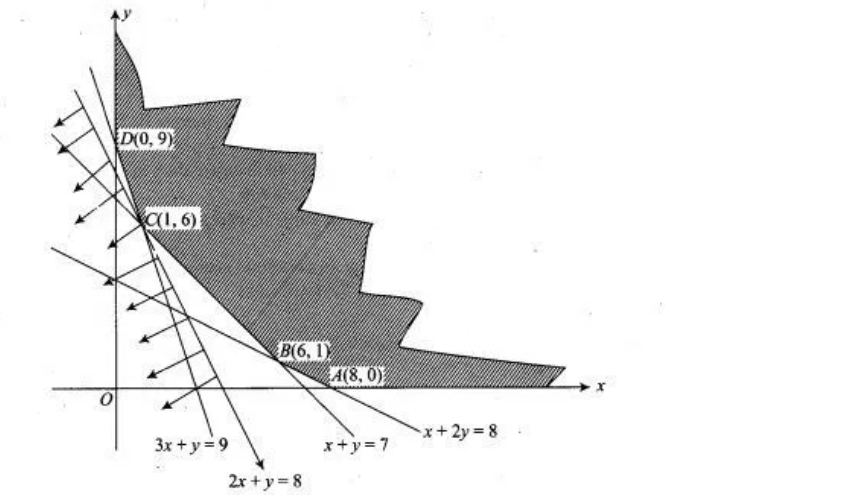
0 likes
View Solution32
Difficult
$A$ company makes $3$ models of calculators: $A, B$ and $C$ at factory $I$ and factory $II.$ The company has orders for at least $6400$ calculators of model $A, 4000$ calculators of model $B$ and $4800$ calculators of model $C.$ At factory $I, 50$ calculators of model $A, 50$ of model $B$ and $30$ of model $C$ are made every day; at factory $II, 40$ calculators of model $A, 20$ of model $B$ and $40$ of model $C$ are made every day. It costs $Rs. 12000$ and $Rs. 15000$ each day to operate factory $I$ and $II,$ respectively. Find the number of days each factory should operate to minimize the operating costs and still meet the demand.
Solution
(B) Let factory $I$ operate for $x$ days and factory $II$ operate for $y$ days.
At factory $I, 50$ calculators of model $A$ and at factory $II, 40$ calculators of model $A$ are made every day. The company has orders for at least $6400$ calculators of model $A$.
$\therefore 50x + 40y \geq 6400 \Rightarrow 5x + 4y \geq 640$
At factory $I, 50$ calculators of model $B$ and at factory $II, 20$ calculators of model $B$ are made every day. The company has orders for at least $4000$ calculators of model $B$.
$\therefore 50x + 20y \geq 4000 \Rightarrow 5x + 2y \geq 400$
At factory $I, 30$ calculators of model $C$ and at factory $II, 40$ calculators of model $C$ are made every day. The company has orders for at least $4800$ calculators of model $C$.
$\therefore 30x + 40y \geq 4800 \Rightarrow 3x + 4y \geq 480$
Also,$x \geq 0, y \geq 0.$
We have to minimize the cost $Z = 12000x + 15000y$ subject to the constraints:
$5x + 4y \geq 640$
$5x + 2y \geq 400$
$3x + 4y \geq 480$
$x, y \geq 0$
The feasible region is unbounded with corner points $A(160, 0), B(80, 60), C(32, 120),$ and $D(0, 200).$
To verify the minimum,we plot $12000x + 15000y < 1860000$ or $4x + 5y < 620.$ As shown in the figure,there are no common points with the feasible region,so the minimum value is $1860000.$
Thus,factory $I$ should operate for $80$ days and factory $II$ should operate for $60$ days.
At factory $I, 50$ calculators of model $A$ and at factory $II, 40$ calculators of model $A$ are made every day. The company has orders for at least $6400$ calculators of model $A$.
$\therefore 50x + 40y \geq 6400 \Rightarrow 5x + 4y \geq 640$
At factory $I, 50$ calculators of model $B$ and at factory $II, 20$ calculators of model $B$ are made every day. The company has orders for at least $4000$ calculators of model $B$.
$\therefore 50x + 20y \geq 4000 \Rightarrow 5x + 2y \geq 400$
At factory $I, 30$ calculators of model $C$ and at factory $II, 40$ calculators of model $C$ are made every day. The company has orders for at least $4800$ calculators of model $C$.
$\therefore 30x + 40y \geq 4800 \Rightarrow 3x + 4y \geq 480$
Also,$x \geq 0, y \geq 0.$
We have to minimize the cost $Z = 12000x + 15000y$ subject to the constraints:
$5x + 4y \geq 640$
$5x + 2y \geq 400$
$3x + 4y \geq 480$
$x, y \geq 0$
The feasible region is unbounded with corner points $A(160, 0), B(80, 60), C(32, 120),$ and $D(0, 200).$
| Corner points | Value of $Z = 12000x + 15000y$ |
| $(160, 0)$ | $1920000$ |
| $(80, 60)$ | $1860000$ (Minimum) |
| $(32, 120)$ | $2184000$ |
| $(0, 200)$ | $3000000$ |
To verify the minimum,we plot $12000x + 15000y < 1860000$ or $4x + 5y < 620.$ As shown in the figure,there are no common points with the feasible region,so the minimum value is $1860000.$
Thus,factory $I$ should operate for $80$ days and factory $II$ should operate for $60$ days.
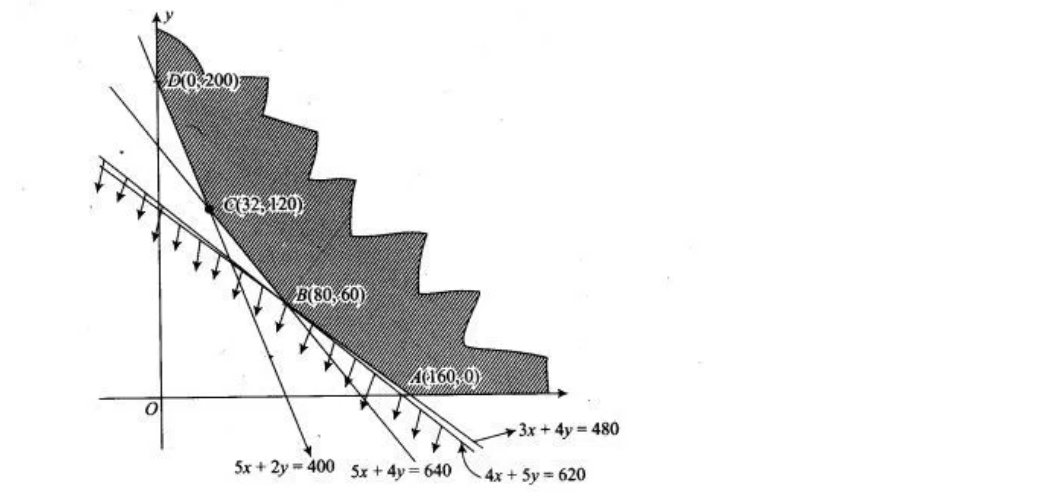
0 likes
View Solution33
MediumMCQ
Find the maximum value of $z = 2x + 6y$ subject to the constraints $-x + y \leq 1$,$2x + y \leq 2$,$x \geq 0$,and $y \geq 0$.
A
$4/3$
B
$1/3$
C
$26/3$
D
$0$
Solution
(C) The given constraints are:
$1$) $-x + y \leq 1$
$2$) $2x + y \leq 2$
$3$) $x \geq 0, y \geq 0$
To find the feasible region,we plot the lines:
- For $-x + y = 1$,the intercepts are $(0, 1)$ and $(-1, 0)$.
- For $2x + y = 2$,the intercepts are $(0, 2)$ and $(1, 0)$.
The intersection point of $-x + y = 1$ and $2x + y = 2$ is found by subtracting the equations:
$(2x + y) - (-x + y) = 2 - 1 \implies 3x = 1 \implies x = 1/3$.
Substituting $x = 1/3$ into $2x + y = 2$:
$2(1/3) + y = 2 \implies y = 2 - 2/3 = 4/3$.
So,the intersection point is $(1/3, 4/3)$.
The corner points of the feasible region are $(0, 0)$,$(1, 0)$,and $(1/3, 4/3)$.
Now,evaluate $z = 2x + 6y$ at these points:
- At $(0, 0)$: $z = 2(0) + 6(0) = 0$.
- At $(1, 0)$: $z = 2(1) + 6(0) = 2$.
- At $(1/3, 4/3)$: $z = 2(1/3) + 6(4/3) = 2/3 + 24/3 = 26/3$.
The maximum value is $26/3$.
$1$) $-x + y \leq 1$
$2$) $2x + y \leq 2$
$3$) $x \geq 0, y \geq 0$
To find the feasible region,we plot the lines:
- For $-x + y = 1$,the intercepts are $(0, 1)$ and $(-1, 0)$.
- For $2x + y = 2$,the intercepts are $(0, 2)$ and $(1, 0)$.
The intersection point of $-x + y = 1$ and $2x + y = 2$ is found by subtracting the equations:
$(2x + y) - (-x + y) = 2 - 1 \implies 3x = 1 \implies x = 1/3$.
Substituting $x = 1/3$ into $2x + y = 2$:
$2(1/3) + y = 2 \implies y = 2 - 2/3 = 4/3$.
So,the intersection point is $(1/3, 4/3)$.
The corner points of the feasible region are $(0, 0)$,$(1, 0)$,and $(1/3, 4/3)$.
Now,evaluate $z = 2x + 6y$ at these points:
- At $(0, 0)$: $z = 2(0) + 6(0) = 0$.
- At $(1, 0)$: $z = 2(1) + 6(0) = 2$.
- At $(1/3, 4/3)$: $z = 2(1/3) + 6(4/3) = 2/3 + 24/3 = 26/3$.
The maximum value is $26/3$.
0 likes
View Solution34
MediumMCQ
Solution of the following $LP$ problem
Minimize $z = -3x + 2y$
subject to $0 \leq x \leq 4, 1 \leq y \leq 6, x + y \leq 5$ is $.....$
Minimize $z = -3x + 2y$
subject to $0 \leq x \leq 4, 1 \leq y \leq 6, x + y \leq 5$ is $.....$
A
$-10$
B
$00$
C
$02$
D
$10$
Solution
(A) The feasible region is determined by the constraints:
$1) 0 \leq x \leq 4$
$2) 1 \leq y \leq 6$
$3) x + y \leq 5$
To find the vertices of the feasible region,we solve the intersection points of the boundary lines:
- Intersection of $x = 0$ and $y = 1$ is $(0, 1)$.
- Intersection of $x = 0$ and $x + y = 5$ is $(0, 5)$.
- Intersection of $y = 1$ and $x + y = 5$ is $(4, 1)$.
- Intersection of $x = 4$ and $y = 1$ is $(4, 1)$ (same as above).
- Intersection of $x = 4$ and $x + y = 5$ is $(4, 1)$.
The vertices of the feasible region are $(0, 1), (0, 5),$ and $(4, 1)$.
Now,evaluate $z = -3x + 2y$ at each vertex:
- At $(0, 1): z = -3(0) + 2(1) = 2$
- At $(0, 5): z = -3(0) + 2(5) = 10$
- At $(4, 1): z = -3(4) + 2(1) = -12 + 2 = -10$
The minimum value of $z$ is $-10$ at the point $(4, 1)$.
$1) 0 \leq x \leq 4$
$2) 1 \leq y \leq 6$
$3) x + y \leq 5$
To find the vertices of the feasible region,we solve the intersection points of the boundary lines:
- Intersection of $x = 0$ and $y = 1$ is $(0, 1)$.
- Intersection of $x = 0$ and $x + y = 5$ is $(0, 5)$.
- Intersection of $y = 1$ and $x + y = 5$ is $(4, 1)$.
- Intersection of $x = 4$ and $y = 1$ is $(4, 1)$ (same as above).
- Intersection of $x = 4$ and $x + y = 5$ is $(4, 1)$.
The vertices of the feasible region are $(0, 1), (0, 5),$ and $(4, 1)$.
Now,evaluate $z = -3x + 2y$ at each vertex:
- At $(0, 1): z = -3(0) + 2(1) = 2$
- At $(0, 5): z = -3(0) + 2(5) = 10$
- At $(4, 1): z = -3(4) + 2(1) = -12 + 2 = -10$
The minimum value of $z$ is $-10$ at the point $(4, 1)$.
0 likes
View Solution35
MediumMCQ
Cake-$A$ requires $200\, g$ of flour and $25\, g$ of fat. Cake-$B$ requires $100\, g$ of flour and $50\, g$ of fat. Find the maximum number of cakes which can be made from $5\, kg$ of flour and $1\, kg$ of fat. The mathematical form of this $LPP$ is $.....$
A
$Z=x+y, 2x+y \leq 50, x+2y \leq 40, x \geq 0, y \geq 0$
B
$Z=x+y, 2x+y \leq 5, x+2y \leq 1, x \geq 0, y \geq 0$
C
$Z=x+y, 200x+100y \leq 5, 25x+50y \leq 1, x \geq 0, y \geq 0$
D
$Z=x+y, 200x+100y \geq 5, 25x+50y \geq 1, x \geq 0, y \geq 0$
Solution
(A) Let the number of cake $A$ be $x$ and the number of cake $B$ be $y$.
Constraints for flour: $200x + 100y \leq 5000$. Dividing by $100$,we get $2x + y \leq 50$.
Constraints for fat: $25x + 50y \leq 1000$. Dividing by $25$,we get $x + 2y \leq 40$.
Non-negativity constraints: $x \geq 0, y \geq 0$.
Objective function to maximize total cakes: $Z = x + y$.
Thus,the mathematical form is $Z = x + y, 2x + y \leq 50, x + 2y \leq 40, x \geq 0, y \geq 0$.
| Ingredient | Cake $A$ $(g)$ | Cake $B$ $(g)$ | Total Available $(g)$ |
| Flour | $200$ | $100$ | $5000$ |
| Fat | $25$ | $50$ | $1000$ |
Constraints for flour: $200x + 100y \leq 5000$. Dividing by $100$,we get $2x + y \leq 50$.
Constraints for fat: $25x + 50y \leq 1000$. Dividing by $25$,we get $x + 2y \leq 40$.
Non-negativity constraints: $x \geq 0, y \geq 0$.
Objective function to maximize total cakes: $Z = x + y$.
Thus,the mathematical form is $Z = x + y, 2x + y \leq 50, x + 2y \leq 40, x \geq 0, y \geq 0$.
0 likes
View Solution36
DifficultMCQ
The solution of the linear programming problem,maximize $Z = 3x_{1} + 5x_{2}$ subject to $3x_{1} + 2x_{2} \leq 18$,$x_{1} \leq 4$,$x_{2} \leq 6$,$x_{1} \geq 0$,$x_{2} \geq 0$ is:
A
$x_{1} = 2, x_{2} = 0, Z = 6$
B
$x_{1} = 2, x_{2} = 6, Z = 36$
C
$x_{1} = 4, x_{2} = 3, Z = 27$
D
$x_{1} = 4, x_{2} = 6, Z = 42$
Solution
(B) To find the maximum value of $Z = 3x_{1} + 5x_{2}$,we evaluate the objective function at the corner points of the feasible region defined by the constraints:
$1$. $3x_{1} + 2x_{2} \leq 18$
$2$. $x_{1} \leq 4$
$3$. $x_{2} \leq 6$
$4$. $x_{1} \geq 0, x_{2} \geq 0$
The corner points are found by the intersection of these lines:
- Intersection of $x_{1} = 0$ and $x_{2} = 0$ is $(0, 0)$. $Z = 0$.
- Intersection of $x_{1} = 4$ and $x_{2} = 0$ is $(4, 0)$. $Z = 3(4) + 5(0) = 12$.
- Intersection of $x_{1} = 4$ and $3x_{1} + 2x_{2} = 18$ gives $3(4) + 2x_{2} = 18 \Rightarrow 2x_{2} = 6 \Rightarrow x_{2} = 3$. Point is $(4, 3)$. $Z = 3(4) + 5(3) = 12 + 15 = 27$.
- Intersection of $3x_{1} + 2x_{2} = 18$ and $x_{2} = 6$ gives $3x_{1} + 2(6) = 18 \Rightarrow 3x_{1} = 6 \Rightarrow x_{1} = 2$. Point is $(2, 6)$. $Z = 3(2) + 5(6) = 6 + 30 = 36$.
- Intersection of $x_{1} = 0$ and $x_{2} = 6$ is $(0, 6)$. $Z = 3(0) + 5(6) = 30$.
Comparing the values of $Z$ at all corner points,the maximum value is $36$ at $(2, 6)$.
$1$. $3x_{1} + 2x_{2} \leq 18$
$2$. $x_{1} \leq 4$
$3$. $x_{2} \leq 6$
$4$. $x_{1} \geq 0, x_{2} \geq 0$
The corner points are found by the intersection of these lines:
- Intersection of $x_{1} = 0$ and $x_{2} = 0$ is $(0, 0)$. $Z = 0$.
- Intersection of $x_{1} = 4$ and $x_{2} = 0$ is $(4, 0)$. $Z = 3(4) + 5(0) = 12$.
- Intersection of $x_{1} = 4$ and $3x_{1} + 2x_{2} = 18$ gives $3(4) + 2x_{2} = 18 \Rightarrow 2x_{2} = 6 \Rightarrow x_{2} = 3$. Point is $(4, 3)$. $Z = 3(4) + 5(3) = 12 + 15 = 27$.
- Intersection of $3x_{1} + 2x_{2} = 18$ and $x_{2} = 6$ gives $3x_{1} + 2(6) = 18 \Rightarrow 3x_{1} = 6 \Rightarrow x_{1} = 2$. Point is $(2, 6)$. $Z = 3(2) + 5(6) = 6 + 30 = 36$.
- Intersection of $x_{1} = 0$ and $x_{2} = 6$ is $(0, 6)$. $Z = 3(0) + 5(6) = 30$.
Comparing the values of $Z$ at all corner points,the maximum value is $36$ at $(2, 6)$.
0 likes
View Solution37
DifficultMCQ
The solution set of the constraints $x+2y \leq 2000$,$x+y \leq 1500$,$y \leq 600$ and $x \geq 0$ does not include the point
A
$(1000, 0)$
B
$(0, 500)$
C
$(2, 0)$
D
$(2000, 0)$
Solution
(D) To determine which point is not in the solution set,we test each point against the given constraints: $x+2y \leq 2000$,$x+y \leq 1500$,$y \leq 600$,and $x \geq 0$.
For $(1000, 0)$:
$1000 + 2(0) = 1000 \leq 2000$ (True)
$1000 + 0 = 1000 \leq 1500$ (True)
$0 \leq 600$ (True)
$1000 \geq 0$ (True)
This point is in the region.
For $(0, 500)$:
$0 + 2(500) = 1000 \leq 2000$ (True)
$0 + 500 = 500 \leq 1500$ (True)
$500 \leq 600$ (True)
$0 \geq 0$ (True)
This point is in the region.
For $(2, 0)$:
$2 + 2(0) = 2 \leq 2000$ (True)
$2 + 0 = 2 \leq 1500$ (True)
$0 \leq 600$ (True)
$2 \geq 0$ (True)
This point is in the region.
For $(2000, 0)$:
$2000 + 2(0) = 2000 \leq 2000$ (True)
$2000 + 0 = 2000 \leq 1500$ (False)
Since the condition $x+y \leq 1500$ is violated,the point $(2000, 0)$ is not in the solution set.
For $(1000, 0)$:
$1000 + 2(0) = 1000 \leq 2000$ (True)
$1000 + 0 = 1000 \leq 1500$ (True)
$0 \leq 600$ (True)
$1000 \geq 0$ (True)
This point is in the region.
For $(0, 500)$:
$0 + 2(500) = 1000 \leq 2000$ (True)
$0 + 500 = 500 \leq 1500$ (True)
$500 \leq 600$ (True)
$0 \geq 0$ (True)
This point is in the region.
For $(2, 0)$:
$2 + 2(0) = 2 \leq 2000$ (True)
$2 + 0 = 2 \leq 1500$ (True)
$0 \leq 600$ (True)
$2 \geq 0$ (True)
This point is in the region.
For $(2000, 0)$:
$2000 + 2(0) = 2000 \leq 2000$ (True)
$2000 + 0 = 2000 \leq 1500$ (False)
Since the condition $x+y \leq 1500$ is violated,the point $(2000, 0)$ is not in the solution set.
0 likes
View Solution38
EasyMCQ
The solution set of the constraints $2x + 3y \leq 6$,$x + 4y \leq 4$,$x \geq 0$,and $y \geq 0$ includes the point $\ldots$ as a corner point.
A
$(1, 0)$
B
$(1, 1)$
C
$(\frac{12}{5}, \frac{2}{5})$
D
$(\frac{2}{5}, \frac{12}{5})$
Solution
(C) The constraints are given by:
$1$) $2x + 3y \leq 6$
$2$) $x + 4y \leq 4$
$3$) $x \geq 0, y \geq 0$
To find the corner points of the feasible region,we identify the intersection points of the boundary lines:
- The line $2x + 3y = 6$ intersects the axes at $(3, 0)$ and $(0, 2)$.
- The line $x + 4y = 4$ intersects the axes at $(4, 0)$ and $(0, 1)$.
Solving the system of equations $2x + 3y = 6$ and $x + 4y = 4$:
From the second equation,$x = 4 - 4y$.
Substitute into the first: $2(4 - 4y) + 3y = 6 \implies 8 - 8y + 3y = 6 \implies -5y = -2 \implies y = \frac{2}{5}$.
Then $x = 4 - 4(\frac{2}{5}) = 4 - \frac{8}{5} = \frac{12}{5}$.
The corner points of the feasible region are $(0, 0)$,$(3, 0)$,$(0, 1)$,and $(\frac{12}{5}, \frac{2}{5})$.
Comparing these with the given options,the point $(\frac{12}{5}, \frac{2}{5})$ is a corner point.
$1$) $2x + 3y \leq 6$
$2$) $x + 4y \leq 4$
$3$) $x \geq 0, y \geq 0$
To find the corner points of the feasible region,we identify the intersection points of the boundary lines:
- The line $2x + 3y = 6$ intersects the axes at $(3, 0)$ and $(0, 2)$.
- The line $x + 4y = 4$ intersects the axes at $(4, 0)$ and $(0, 1)$.
Solving the system of equations $2x + 3y = 6$ and $x + 4y = 4$:
From the second equation,$x = 4 - 4y$.
Substitute into the first: $2(4 - 4y) + 3y = 6 \implies 8 - 8y + 3y = 6 \implies -5y = -2 \implies y = \frac{2}{5}$.
Then $x = 4 - 4(\frac{2}{5}) = 4 - \frac{8}{5} = \frac{12}{5}$.
The corner points of the feasible region are $(0, 0)$,$(3, 0)$,$(0, 1)$,and $(\frac{12}{5}, \frac{2}{5})$.
Comparing these with the given options,the point $(\frac{12}{5}, \frac{2}{5})$ is a corner point.
0 likes
View Solution39
MediumMCQ
$A$ wholesale dealer wants to start a business with $Rs. 2,40,000$. The cost price of a quintal of wheat is $Rs. 2000$ and the cost price of a quintal of rice is $Rs. 3000$. He has space capacity for $200$ quintals of grain. The profit from the sale of one quintal of wheat is $Rs. 125$ and that from one quintal of rice is $Rs. 200$. If he has $x$ quintals of rice and $y$ quintals of wheat,then the objective function for the maximum profit is $....$
A
$125x + 200y$
B
$200x + 125y$
C
$2000x + 3000y$
D
$\frac{2000}{200}x + \frac{3000}{125}y$
Solution
(B) To determine the objective function for maximum profit,we consider the profit earned per unit of each commodity.
Let $x$ be the quantity of rice in quintals and $y$ be the quantity of wheat in quintals.
Profit from $x$ quintals of rice = $200 \times x = 200x$.
Profit from $y$ quintals of wheat = $125 \times y = 125y$.
The total profit $Z$ is the sum of the profits from rice and wheat.
Therefore,the objective function is $Z = 200x + 125y$.
Let $x$ be the quantity of rice in quintals and $y$ be the quantity of wheat in quintals.
Profit from $x$ quintals of rice = $200 \times x = 200x$.
Profit from $y$ quintals of wheat = $125 \times y = 125y$.
The total profit $Z$ is the sum of the profits from rice and wheat.
Therefore,the objective function is $Z = 200x + 125y$.
0 likes
View Solution40
MediumMCQ
The production of item $A$ is $x$ and the production of item $B$ is $y$. If the corner points of the bounded feasible region are $(1,0), (2,0), (0,2)$ and $(0,1)$,then the maximum profit $z = 2000x + 5000y$ is $\ldots \ldots$
A
$20000$
B
$5000$
C
$4000$
D
$10000$
Solution
(D) To find the maximum profit,we evaluate the objective function $z = 2000x + 5000y$ at each corner point of the feasible region:
Comparing the values,the maximum profit is $10000$.
| Corner Point $(x, y)$ | Value of $z = 2000x + 5000y$ |
|---|---|
| $(1, 0)$ | $z = 2000(1) + 5000(0) = 2000$ |
| $(2, 0)$ | $z = 2000(2) + 5000(0) = 4000$ |
| $(0, 2)$ | $z = 2000(0) + 5000(2) = 10000$ (Maximum) |
| $(0, 1)$ | $z = 2000(0) + 5000(1) = 5000$ |
Comparing the values,the maximum profit is $10000$.
0 likes
View Solution41
MediumMCQ
The minimum value of $z = 2x + 4y$ subject to constraints $x + 2y \geq 10$,$3x + y \geq 10$,$x \geq 0$,$y \geq 0$ is $....$
A
$20$
B
$40$
C
Not Exist
D
$30$
Solution
(A) To find the minimum value of $z = 2x + 4y$,we first identify the feasible region defined by the constraints:
$1$) $x + 2y \geq 10$
$2$) $3x + y \geq 10$
$3$) $x \geq 0, y \geq 0$
Find the intersection points of the boundary lines:
- For $x + 2y = 10$ and $3x + y = 10$:
Multiply the second equation by $2$: $6x + 2y = 20$.
Subtract the first equation: $(6x + 2y) - (x + 2y) = 20 - 10 \implies 5x = 10 \implies x = 2$.
Substitute $x = 2$ into $x + 2y = 10$: $2 + 2y = 10 \implies 2y = 8 \implies y = 4$.
Intersection point: $(2, 4)$.
- Intercepts for $x + 2y = 10$: $(10, 0)$ and $(0, 5)$.
- Intercepts for $3x + y = 10$: $(10/3, 0)$ and $(0, 10)$.
The corner points of the unbounded feasible region are $(0, 10)$,$(2, 4)$,and $(10, 0)$.
Evaluate $z = 2x + 4y$ at these corner points:
- At $(0, 10)$: $z = 2(0) + 4(10) = 40$.
- At $(2, 4)$: $z = 2(2) + 4(4) = 4 + 16 = 20$.
- At $(10, 0)$: $z = 2(10) + 4(0) = 20$.
Since the feasible region is unbounded,we check if $z < 20$ is possible. The line $2x + 4y = 20$ (or $x + 2y = 10$) is a boundary line. The minimum value is $20$.
$1$) $x + 2y \geq 10$
$2$) $3x + y \geq 10$
$3$) $x \geq 0, y \geq 0$
Find the intersection points of the boundary lines:
- For $x + 2y = 10$ and $3x + y = 10$:
Multiply the second equation by $2$: $6x + 2y = 20$.
Subtract the first equation: $(6x + 2y) - (x + 2y) = 20 - 10 \implies 5x = 10 \implies x = 2$.
Substitute $x = 2$ into $x + 2y = 10$: $2 + 2y = 10 \implies 2y = 8 \implies y = 4$.
Intersection point: $(2, 4)$.
- Intercepts for $x + 2y = 10$: $(10, 0)$ and $(0, 5)$.
- Intercepts for $3x + y = 10$: $(10/3, 0)$ and $(0, 10)$.
The corner points of the unbounded feasible region are $(0, 10)$,$(2, 4)$,and $(10, 0)$.
Evaluate $z = 2x + 4y$ at these corner points:
- At $(0, 10)$: $z = 2(0) + 4(10) = 40$.
- At $(2, 4)$: $z = 2(2) + 4(4) = 4 + 16 = 20$.
- At $(10, 0)$: $z = 2(10) + 4(0) = 20$.
Since the feasible region is unbounded,we check if $z < 20$ is possible. The line $2x + 4y = 20$ (or $x + 2y = 10$) is a boundary line. The minimum value is $20$.
0 likes
View Solution42
DifficultMCQ
Corner points of the feasible region for an $\operatorname{LPP}$ are $(0,2), (3,0), (6,0), (6,8)$ and $(0,5)$. Let $F = 4x + 6y$ be the objective function. The minimum value of $F$ occurs at $....$
A
only $(0,2)$
B
only $(3,0)$
C
the mid-point of the line segment joining the points $(0,2)$ and $(3,0)$ only
D
any point on the line segment joining the points $(0,2)$ and $(3,0)$
Solution
(D) To find the minimum value of the objective function $F = 4x + 6y$,we evaluate $F$ at each corner point of the feasible region:
The minimum value of $F$ is $12$,which occurs at both corner points $(0, 2)$ and $(3, 0)$.
According to the property of linear programming,if the objective function has the same minimum value at two corner points,then it has the same minimum value at every point on the line segment joining these two points.
Therefore,the minimum value of $F$ occurs at any point on the line segment joining $(0, 2)$ and $(3, 0)$.
| Corner Point $(x, y)$ | Objective Function $F = 4x + 6y$ |
|---|---|
| $(0, 2)$ | $F = 4(0) + 6(2) = 12$ |
| $(3, 0)$ | $F = 4(3) + 6(0) = 12$ |
| $(6, 0)$ | $F = 4(6) + 6(0) = 24$ |
| $(6, 8)$ | $F = 4(6) + 6(8) = 72$ |
| $(0, 5)$ | $F = 4(0) + 6(5) = 30$ |
The minimum value of $F$ is $12$,which occurs at both corner points $(0, 2)$ and $(3, 0)$.
According to the property of linear programming,if the objective function has the same minimum value at two corner points,then it has the same minimum value at every point on the line segment joining these two points.
Therefore,the minimum value of $F$ occurs at any point on the line segment joining $(0, 2)$ and $(3, 0)$.
0 likes
View Solution43
DifficultMCQ
The maximum value of $z$ in the following equation $z=6xy+y^2$,subject to the constraints $3x+4y \leq 100$,$4x+3y \leq 75$,$x \geq 0$,and $y \geq 0$ is:
A
$904$
B
$846$
C
$952$
D
$882$
Solution
(A) The objective function is $z = 6xy + y^2$. The constraints are $3x + 4y \leq 100$,$4x + 3y \leq 75$,$x \geq 0$,and $y \geq 0$.
From the constraints,the feasible region is a polygon with vertices $(0, 0)$,$(18.75, 0)$,and $(0, 25)$.
Evaluating $z$ at the vertices:
At $(0, 0)$,$z = 6(0)(0) + 0^2 = 0$.
At $(18.75, 0)$,$z = 6(18.75)(0) + 0^2 = 0$.
At $(0, 25)$,$z = 6(0)(25) + 25^2 = 625$.
However,since $z$ is not a linear function,we check the boundary $4x + 3y = 75$,which implies $x = \frac{75-3y}{4}$.
Substituting this into $z$: $z = 6y(\frac{75-3y}{4}) + y^2 = \frac{3y(75-3y)}{2} + y^2 = \frac{225y - 9y^2 + 2y^2}{2} = \frac{225y - 7y^2}{2}$.
To find the maximum,take the derivative with respect to $y$ and set to $0$: $\frac{dz}{dy} = \frac{225 - 14y}{2} = 0 \implies y = \frac{225}{14} \approx 16.07$.
Then $x = \frac{75 - 3(225/14)}{4} = \frac{1050 - 675}{56} = \frac{375}{56} \approx 6.7$.
Substituting these values into $z$: $z = \frac{225(225/14) - 7(225/14)^2}{2} = \frac{50625/14 - 354375/196}{2} = \frac{708750 - 354375}{392} = \frac{354375}{392} \approx 904.0178$.
The maximum value is approximately $904$.
From the constraints,the feasible region is a polygon with vertices $(0, 0)$,$(18.75, 0)$,and $(0, 25)$.
Evaluating $z$ at the vertices:
At $(0, 0)$,$z = 6(0)(0) + 0^2 = 0$.
At $(18.75, 0)$,$z = 6(18.75)(0) + 0^2 = 0$.
At $(0, 25)$,$z = 6(0)(25) + 25^2 = 625$.
However,since $z$ is not a linear function,we check the boundary $4x + 3y = 75$,which implies $x = \frac{75-3y}{4}$.
Substituting this into $z$: $z = 6y(\frac{75-3y}{4}) + y^2 = \frac{3y(75-3y)}{2} + y^2 = \frac{225y - 9y^2 + 2y^2}{2} = \frac{225y - 7y^2}{2}$.
To find the maximum,take the derivative with respect to $y$ and set to $0$: $\frac{dz}{dy} = \frac{225 - 14y}{2} = 0 \implies y = \frac{225}{14} \approx 16.07$.
Then $x = \frac{75 - 3(225/14)}{4} = \frac{1050 - 675}{56} = \frac{375}{56} \approx 6.7$.
Substituting these values into $z$: $z = \frac{225(225/14) - 7(225/14)^2}{2} = \frac{50625/14 - 354375/196}{2} = \frac{708750 - 354375}{392} = \frac{354375}{392} \approx 904.0178$.
The maximum value is approximately $904$.
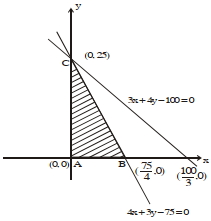
0 likes
View Solution44
DifficultMCQ
The maximum value of $Z=5x+4y$,subject to the constraints $y \leq 2x$,$x \leq 2y$,$x+y \leq 3$,$x \geq 0$,$y \geq 0$ is:
A
$14$
B
$12$
C
$13$
D
$18$
Solution
(A) We are given the objective function $Z = 5x + 4y$ subject to the constraints $y \leq 2x$,$x \leq 2y$,$x+y \leq 3$,$x \geq 0$,and $y \geq 0$.
First,we identify the feasible region by plotting the lines $y = 2x$,$x = 2y$,and $x+y = 3$.
$1$. The intersection of $y = 2x$ and $x+y = 3$: Substituting $y=2x$ into $x+y=3$ gives $x+2x=3$,so $3x=3$,which means $x=1$. Then $y=2(1)=2$. So,the point is $A(1, 2)$.
$2$. The intersection of $x = 2y$ and $x+y = 3$: Substituting $x=2y$ into $x+y=3$ gives $2y+y=3$,so $3y=3$,which means $y=1$. Then $x=2(1)=2$. So,the point is $B(2, 1)$.
$3$. The origin $O(0, 0)$ is also a corner point.
The feasible region is the triangle $OAB$. We evaluate $Z$ at the corner points:
Thus,the maximum value of $Z$ is $14$ at point $B(2, 1)$.
First,we identify the feasible region by plotting the lines $y = 2x$,$x = 2y$,and $x+y = 3$.
$1$. The intersection of $y = 2x$ and $x+y = 3$: Substituting $y=2x$ into $x+y=3$ gives $x+2x=3$,so $3x=3$,which means $x=1$. Then $y=2(1)=2$. So,the point is $A(1, 2)$.
$2$. The intersection of $x = 2y$ and $x+y = 3$: Substituting $x=2y$ into $x+y=3$ gives $2y+y=3$,so $3y=3$,which means $y=1$. Then $x=2(1)=2$. So,the point is $B(2, 1)$.
$3$. The origin $O(0, 0)$ is also a corner point.
The feasible region is the triangle $OAB$. We evaluate $Z$ at the corner points:
| Corner Point | $Z = 5x + 4y$ |
|---|---|
| $O(0, 0)$ | $5(0) + 4(0) = 0$ |
| $A(1, 2)$ | $5(1) + 4(2) = 5 + 8 = 13$ |
| $B(2, 1)$ | $5(2) + 4(1) = 10 + 4 = 14$ |
Thus,the maximum value of $Z$ is $14$ at point $B(2, 1)$.
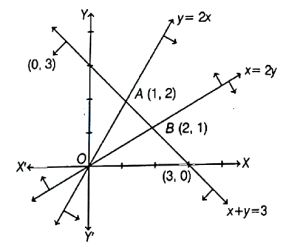
0 likes
View Solution45
DifficultMCQ
If $z = ax + by$ where $a, b > 0$ subject to the constraints $x \leq 2, y \leq 2, x + y \geq 3, x \geq 0, y \geq 0$ has a minimum value at $(2, 1)$ only,then...
A
$a > b$
B
$a = b$
C
$a < b$
D
$a = 1 + b$
Solution
(C) The objective function is $z = ax + by$ with $a, b > 0$. The constraints are $x \leq 2, y \leq 2, x + y \geq 3, x \geq 0, y \geq 0$.
Plotting these constraints,we identify the feasible region as the triangle with vertices $A(2, 1)$,$B(1, 2)$,and $C(2, 2)$.
Since the minimum value of $z$ occurs only at $(2, 1)$,the value of $z$ at $(2, 1)$ must be strictly less than the value of $z$ at the other corner points.
Comparing $z$ at $A(2, 1)$ and $B(1, 2)$:
$z(2, 1) = 2a + b$
$z(1, 2) = a + 2b$
For the minimum to be at $(2, 1)$,we must have $z(2, 1) < z(1, 2)$.
$2a + b < a + 2b$
$2a - a < 2b - b$
$a < b$
Thus,the correct condition is $a < b$.
Plotting these constraints,we identify the feasible region as the triangle with vertices $A(2, 1)$,$B(1, 2)$,and $C(2, 2)$.
Since the minimum value of $z$ occurs only at $(2, 1)$,the value of $z$ at $(2, 1)$ must be strictly less than the value of $z$ at the other corner points.
Comparing $z$ at $A(2, 1)$ and $B(1, 2)$:
$z(2, 1) = 2a + b$
$z(1, 2) = a + 2b$
For the minimum to be at $(2, 1)$,we must have $z(2, 1) < z(1, 2)$.
$2a + b < a + 2b$
$2a - a < 2b - b$
$a < b$
Thus,the correct condition is $a < b$.
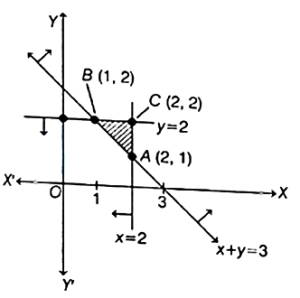
0 likes
View Solution46
DifficultMCQ
For the Linear Programming Problem ($L$.$P$.$P$.),maximize $z = 4x_1 + 2x_2$ subject to the constraints $3x_1 + 2x_2 \geq 9$,$x_1 - x_2 \leq 3$,$x_1 \geq 0$,$x_2 \geq 0$,the problem has:
A
Infinite number of optimal solutions
B
Unbounded solution
C
No solution
D
One optimal solution
Solution
(B) We are given the objective function: Maximize $z = 4x_1 + 2x_2$.
Subject to the constraints:
$1) 3x_1 + 2x_2 \geq 9$
$2) x_1 - x_2 \leq 3$
$3) x_1 \geq 0, x_2 \geq 0$
By plotting these lines on the coordinate plane:
For $3x_1 + 2x_2 = 9$,the intercepts are $(3, 0)$ and $(0, 4.5)$. The region is away from the origin.
For $x_1 - x_2 = 3$,the intercepts are $(3, 0)$ and $(0, -3)$. The region is towards the origin.
Upon analyzing the feasible region,we observe that the region is unbounded in the first quadrant. For an unbounded feasible region,if the objective function increases indefinitely as we move along the boundary,the $L$.$P$.$P$. has an unbounded solution. Here,as $x_1$ and $x_2$ increase,$z = 4x_1 + 2x_2$ can take arbitrarily large values within the feasible region. Therefore,the $L$.$P$.$P$. has an unbounded solution.
Subject to the constraints:
$1) 3x_1 + 2x_2 \geq 9$
$2) x_1 - x_2 \leq 3$
$3) x_1 \geq 0, x_2 \geq 0$
By plotting these lines on the coordinate plane:
For $3x_1 + 2x_2 = 9$,the intercepts are $(3, 0)$ and $(0, 4.5)$. The region is away from the origin.
For $x_1 - x_2 = 3$,the intercepts are $(3, 0)$ and $(0, -3)$. The region is towards the origin.
Upon analyzing the feasible region,we observe that the region is unbounded in the first quadrant. For an unbounded feasible region,if the objective function increases indefinitely as we move along the boundary,the $L$.$P$.$P$. has an unbounded solution. Here,as $x_1$ and $x_2$ increase,$z = 4x_1 + 2x_2$ can take arbitrarily large values within the feasible region. Therefore,the $L$.$P$.$P$. has an unbounded solution.
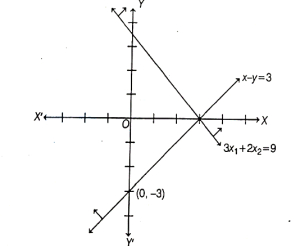
0 likes
View Solution47
DifficultMCQ
The minimum value of $z = 10x + 25y$ subject to the constraints $0 \leq x \leq 3$,$0 \leq y \leq 3$,and $x + y \geq 5$ is:
A
$80$
B
$95$
C
$105$
D
$30$
Solution
(A) To find the minimum value of the objective function $z = 10x + 25y$,we first identify the feasible region defined by the constraints $0 \leq x \leq 3$,$0 \leq y \leq 3$,and $x + y \geq 5$.
The vertices of the feasible region are determined by the intersection of the lines:
$1$. Intersection of $x = 3$ and $x + y = 5$ gives $y = 2$,so the point is $(3, 2)$.
$2$. Intersection of $x = 3$ and $y = 3$ gives the point $(3, 3)$.
$3$. Intersection of $y = 3$ and $x + y = 5$ gives $x = 2$,so the point is $(2, 3)$.
Now,we evaluate $z = 10x + 25y$ at these corner points:
- At $(3, 2)$: $z = 10(3) + 25(2) = 30 + 50 = 80$.
- At $(3, 3)$: $z = 10(3) + 25(3) = 30 + 75 = 105$.
- At $(2, 3)$: $z = 10(2) + 25(3) = 20 + 75 = 95$.
Comparing these values,the minimum value is $80$.
The vertices of the feasible region are determined by the intersection of the lines:
$1$. Intersection of $x = 3$ and $x + y = 5$ gives $y = 2$,so the point is $(3, 2)$.
$2$. Intersection of $x = 3$ and $y = 3$ gives the point $(3, 3)$.
$3$. Intersection of $y = 3$ and $x + y = 5$ gives $x = 2$,so the point is $(2, 3)$.
Now,we evaluate $z = 10x + 25y$ at these corner points:
- At $(3, 2)$: $z = 10(3) + 25(2) = 30 + 50 = 80$.
- At $(3, 3)$: $z = 10(3) + 25(3) = 30 + 75 = 105$.
- At $(2, 3)$: $z = 10(2) + 25(3) = 20 + 75 = 95$.
Comparing these values,the minimum value is $80$.
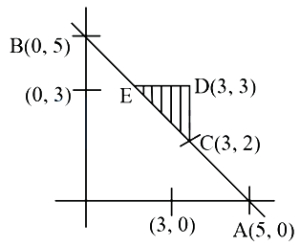
0 likes
View Solution48
DifficultMCQ
The maximum value of $z=9x+11y$ subject to $3x+2y \leq 12$,$2x+3y \leq 12$,$x \geq 0$,$y \geq 0$ is . . . . . . .
A
$44$
B
$54$
C
$36$
D
$48$
Solution
(D) The given constraints are $3x+2y \leq 12$,$2x+3y \leq 12$,$x \geq 0$,and $y \geq 0$.
To find the feasible region,we identify the corner points of the region bounded by these inequalities.
The lines are $L_1: 3x+2y=12$ and $L_2: 2x+3y=12$.
The intersection point $E$ of $L_1$ and $L_2$ is found by solving the system:
$3x+2y=12$ (multiply by $3$) $\Rightarrow 9x+6y=36$
$2x+3y=12$ (multiply by $2$) $\Rightarrow 4x+6y=24$
Subtracting gives $5x=12$,so $x=2.4$.
Substituting $x=2.4$ into $3(2.4)+2y=12$ gives $7.2+2y=12$,so $2y=4.8$,$y=2.4$.
The corner points of the feasible region are $(0,0)$,$(4,0)$,$(0,4)$,and $(2.4, 2.4)$.
Now evaluate $z=9x+11y$ at these points:
$z(0,0) = 9(0)+11(0) = 0$
$z(4,0) = 9(4)+11(0) = 36$
$z(0,4) = 9(0)+11(4) = 44$
$z(2.4, 2.4) = 9(2.4)+11(2.4) = 21.6+26.4 = 48$
The maximum value is $48$.
To find the feasible region,we identify the corner points of the region bounded by these inequalities.
The lines are $L_1: 3x+2y=12$ and $L_2: 2x+3y=12$.
The intersection point $E$ of $L_1$ and $L_2$ is found by solving the system:
$3x+2y=12$ (multiply by $3$) $\Rightarrow 9x+6y=36$
$2x+3y=12$ (multiply by $2$) $\Rightarrow 4x+6y=24$
Subtracting gives $5x=12$,so $x=2.4$.
Substituting $x=2.4$ into $3(2.4)+2y=12$ gives $7.2+2y=12$,so $2y=4.8$,$y=2.4$.
The corner points of the feasible region are $(0,0)$,$(4,0)$,$(0,4)$,and $(2.4, 2.4)$.
Now evaluate $z=9x+11y$ at these points:
$z(0,0) = 9(0)+11(0) = 0$
$z(4,0) = 9(4)+11(0) = 36$
$z(0,4) = 9(0)+11(4) = 44$
$z(2.4, 2.4) = 9(2.4)+11(2.4) = 21.6+26.4 = 48$
The maximum value is $48$.
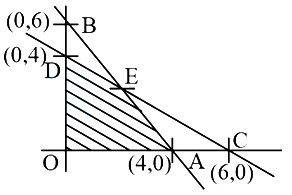
0 likes
View Solution49
DifficultMCQ
The maximum value of $2x + y$ subject to $3x + 5y \leq 26$ and $5x + 3y \leq 30, x \geq 0, y \geq 0$ is
A
$12$
B
$11.5$
C
$10$
D
$17.33$
Solution
(A) To find the maximum value of $Z = 2x + y$,we identify the corner points of the feasible region defined by the constraints $3x + 5y \leq 26$,$5x + 3y \leq 30$,$x \geq 0$,and $y \geq 0$.
$1$. Find the intersection of the lines $3x + 5y = 26$ and $5x + 3y = 30$:
Multiply the first equation by $5$ and the second by $3$:
$15x + 25y = 130$
$15x + 9y = 90$
Subtracting the equations: $16y = 40 \implies y = \frac{40}{16} = 2.5$.
Substitute $y = 2.5$ into $3x + 5(2.5) = 26 \implies 3x + 12.5 = 26 \implies 3x = 13.5 \implies x = 4.5$.
So,point $B$ is $(4.5, 2.5)$.
$2$. The corner points of the feasible region are $(0, 0)$,$(6, 0)$,$(4.5, 2.5)$,and $(0, 5.2)$.
$3$. Evaluate $Z = 2x + y$ at each corner point:
At $(0, 0): Z = 2(0) + 0 = 0$
At $(6, 0): Z = 2(6) + 0 = 12$
At $(4.5, 2.5): Z = 2(4.5) + 2.5 = 9 + 2.5 = 11.5$
At $(0, 5.2): Z = 2(0) + 5.2 = 5.2$
The maximum value is $12$ at the point $(6, 0)$.
$1$. Find the intersection of the lines $3x + 5y = 26$ and $5x + 3y = 30$:
Multiply the first equation by $5$ and the second by $3$:
$15x + 25y = 130$
$15x + 9y = 90$
Subtracting the equations: $16y = 40 \implies y = \frac{40}{16} = 2.5$.
Substitute $y = 2.5$ into $3x + 5(2.5) = 26 \implies 3x + 12.5 = 26 \implies 3x = 13.5 \implies x = 4.5$.
So,point $B$ is $(4.5, 2.5)$.
$2$. The corner points of the feasible region are $(0, 0)$,$(6, 0)$,$(4.5, 2.5)$,and $(0, 5.2)$.
$3$. Evaluate $Z = 2x + y$ at each corner point:
At $(0, 0): Z = 2(0) + 0 = 0$
At $(6, 0): Z = 2(6) + 0 = 12$
At $(4.5, 2.5): Z = 2(4.5) + 2.5 = 9 + 2.5 = 11.5$
At $(0, 5.2): Z = 2(0) + 5.2 = 5.2$
The maximum value is $12$ at the point $(6, 0)$.
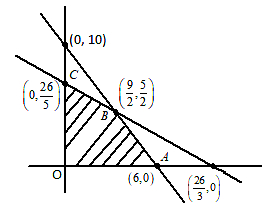
0 likes
View Solution50
DifficultMCQ
The objective function $Z = 4 x_1 + 5 x_2$,subject to $2 x_1 + x_2 \geq 7$,$2 x_1 + 3 x_2 \leq 15$,$x_2 \leq 3$,$x_1, x_2 \geq 0$ has minimum value at the point
A
On $x_1$-axis
B
On $x_2$-axis
C
At the origin
D
On the line parallel to $x_1$-axis
Solution
(A) The objective function is $Z = 4 x_1 + 5 x_2$.
The constraints are:
$1) 2 x_1 + x_2 \geq 7$
$2) 2 x_1 + 3 x_2 \leq 15$
$3) x_2 \leq 3$
$4) x_1, x_2 \geq 0$
To find the feasible region,we determine the intersection points of the boundary lines:
For $2 x_1 + x_2 = 7$,the intercepts are $(3.5, 0)$ and $(0, 7)$.
For $2 x_1 + 3 x_2 = 15$,the intercepts are $(7.5, 0)$ and $(0, 5)$.
The line $x_2 = 3$ is a horizontal line.
Solving for intersection points of the feasible region:
- Intersection of $2 x_1 + x_2 = 7$ and $x_2 = 3$: $2 x_1 + 3 = 7 \implies 2 x_1 = 4 \implies x_1 = 2$. Point: $(2, 3)$.
- Intersection of $2 x_1 + 3 x_2 = 15$ and $x_2 = 3$: $2 x_1 + 9 = 15 \implies 2 x_1 = 6 \implies x_1 = 3$. Point: $(3, 3)$.
- The $x_1$-intercepts are $(3.5, 0)$ and $(7.5, 0)$.
The corner points of the feasible region are $(3.5, 0), (7.5, 0), (3, 3), (2, 3)$.
Evaluating $Z = 4 x_1 + 5 x_2$ at these points:
The minimum value of $Z$ is $14$,which occurs at the point $(3.5, 0)$. Since the $x_2$-coordinate is $0$,this point lies on the $x_1$-axis.
The constraints are:
$1) 2 x_1 + x_2 \geq 7$
$2) 2 x_1 + 3 x_2 \leq 15$
$3) x_2 \leq 3$
$4) x_1, x_2 \geq 0$
To find the feasible region,we determine the intersection points of the boundary lines:
For $2 x_1 + x_2 = 7$,the intercepts are $(3.5, 0)$ and $(0, 7)$.
For $2 x_1 + 3 x_2 = 15$,the intercepts are $(7.5, 0)$ and $(0, 5)$.
The line $x_2 = 3$ is a horizontal line.
Solving for intersection points of the feasible region:
- Intersection of $2 x_1 + x_2 = 7$ and $x_2 = 3$: $2 x_1 + 3 = 7 \implies 2 x_1 = 4 \implies x_1 = 2$. Point: $(2, 3)$.
- Intersection of $2 x_1 + 3 x_2 = 15$ and $x_2 = 3$: $2 x_1 + 9 = 15 \implies 2 x_1 = 6 \implies x_1 = 3$. Point: $(3, 3)$.
- The $x_1$-intercepts are $(3.5, 0)$ and $(7.5, 0)$.
The corner points of the feasible region are $(3.5, 0), (7.5, 0), (3, 3), (2, 3)$.
Evaluating $Z = 4 x_1 + 5 x_2$ at these points:
| Corner Point | $Z = 4 x_1 + 5 x_2$ |
| $(3.5, 0)$ | $4(3.5) + 5(0) = 14$ |
| $(7.5, 0)$ | $4(7.5) + 5(0) = 30$ |
| $(3, 3)$ | $4(3) + 5(3) = 12 + 15 = 27$ |
| $(2, 3)$ | $4(2) + 5(3) = 8 + 15 = 23$ |
The minimum value of $Z$ is $14$,which occurs at the point $(3.5, 0)$. Since the $x_2$-coordinate is $0$,this point lies on the $x_1$-axis.
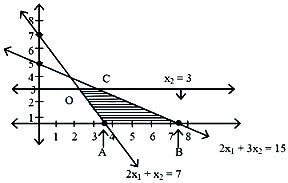
0 likes
View SolutionLinear Programming — Word problem of Linear programming · Frequently Asked Questions
1Are these Linear Programming questions useful for JEE and NEET?
Yes. All questions in this section are mapped to JEE Main and NEET exam patterns. Previous year questions from JEE Main, NEET, GUJCET and state-level exams are included with full solutions.
2Can I switch to Hindi or Gujarati for these questions?
Yes. Use the language tabs in the hero section or the sidebar to view the same questions and solutions in English, Hindi or Gujarati.
3How do I generate a question paper from this subtopic?
Use the Vedclass Exam Paper Generator — select the chapter and subtopic, set difficulty, and generate Sets A, B, C, D automatically. First 3 chapters of every subject are free.
Vedclass Products
For Students
Vedclass Test Series
Mock tests in real JEE/NEET style with performance analysis. 5-day free trial.
Start Free TrialFor Teachers
Exam Paper Generator
Generate Set A/B/C/D papers from this chapter in 2 minutes. 3 chapters free.
Try FreeFor Institutes
Online Exam Module
Live online exams with unlimited students, 360° analytics & white-label branding.
See DemoFor Teachers & Institutes
Generate a Linear Programming Exam Paper in 2 Minutes
Select subtopic & difficulty — Sets A, B, C, D auto-generated with No Repeat logic.
First 3 chapters of every subject are free — no payment required.