
A English
Maxima and Minima Questions in English
Class 12 Mathematics · Applications of Derivatives · Maxima and Minima
760+
Questions
English
Language
100%
With Solutions
Showing 50 of 760 questions in English
401
AdvancedMCQ
Let $f(x)=3^{(x^{2}-2)^{3}+4}, x \in R$. Then which of the following statements are true?
$P: x=0$ is a point of local minima of $f$
$Q: x=\sqrt{2}$ is a point of inflection of $f$
$R: f^{\prime}$ is increasing for $x>\sqrt{2}$
$P: x=0$ is a point of local minima of $f$
$Q: x=\sqrt{2}$ is a point of inflection of $f$
$R: f^{\prime}$ is increasing for $x>\sqrt{2}$
A
Only $P$ and $Q$
B
Only $P$ and $R$
C
Only $Q$ and $R$
D
All,$P, Q$ and $R$
Solution
(D) Given $f(x) = 3^{(x^2-2)^3+4} = 81 \cdot 3^{(x^2-2)^3}$.
First derivative: $f'(x) = 81 \cdot 3^{(x^2-2)^3} \cdot \ln 3 \cdot 3(x^2-2)^2 \cdot 2x = (486 \ln 3) \cdot 3^{(x^2-2)^3} \cdot x(x^2-2)^2$.
For $P$: $f'(x) = 0$ at $x=0$ and $x=\pm \sqrt{2}$. For $x$ near $0$,$x(x^2-2)^2$ changes sign from negative to positive,so $x=0$ is a point of local minima. Thus,$P$ is true.
For $Q$: $f''(x) = 0$ at $x=\sqrt{2}$. Since $f''(x)$ changes sign at $x=\sqrt{2}$ (as $(x^2-2)$ is a factor),$x=\sqrt{2}$ is a point of inflection. Thus,$Q$ is true.
For $R$: For $x > \sqrt{2}$,$f'(x) > 0$. Analyzing $f''(x)$,for $x > \sqrt{2}$,$f''(x) > 0$,which implies $f'(x)$ is increasing. Thus,$R$ is true.
Therefore,all statements $P, Q,$ and $R$ are true.
First derivative: $f'(x) = 81 \cdot 3^{(x^2-2)^3} \cdot \ln 3 \cdot 3(x^2-2)^2 \cdot 2x = (486 \ln 3) \cdot 3^{(x^2-2)^3} \cdot x(x^2-2)^2$.
For $P$: $f'(x) = 0$ at $x=0$ and $x=\pm \sqrt{2}$. For $x$ near $0$,$x(x^2-2)^2$ changes sign from negative to positive,so $x=0$ is a point of local minima. Thus,$P$ is true.
For $Q$: $f''(x) = 0$ at $x=\sqrt{2}$. Since $f''(x)$ changes sign at $x=\sqrt{2}$ (as $(x^2-2)$ is a factor),$x=\sqrt{2}$ is a point of inflection. Thus,$Q$ is true.
For $R$: For $x > \sqrt{2}$,$f'(x) > 0$. Analyzing $f''(x)$,for $x > \sqrt{2}$,$f''(x) > 0$,which implies $f'(x)$ is increasing. Thus,$R$ is true.
Therefore,all statements $P, Q,$ and $R$ are true.
0 likes
View Solution402
DifficultMCQ
The maximum value of the function $f(x)=e^x+x \ln x$ on the interval $1 \leq x \leq 2$ is
A
$e^2+\ln 2+1$
B
$e^2+2 \ln 2$
C
$e^{\pi / 2}+\frac{\pi}{2} \ln \frac{\pi}{2}$
D
$e^{3 / 2}+\frac{3}{2} \ln \frac{3}{2}$
Solution
(B) Given the function $f(x) = e^x + x \ln x$ on the interval $[1, 2]$.
First,we find the derivative of the function:
$f'(x) = \frac{d}{dx}(e^x + x \ln x) = e^x + (1 \cdot \ln x + x \cdot \frac{1}{x}) = e^x + \ln x + 1$.
For $x \in [1, 2]$,we observe that $e^x > 0$,$\ln x \geq 0$,and $1 > 0$. Thus,$f'(x) > 0$ for all $x \in [1, 2]$.
Since the derivative $f'(x)$ is always positive on the interval,the function $f(x)$ is strictly increasing on $[1, 2]$.
Therefore,the maximum value occurs at the right endpoint of the interval,which is $x = 2$.
Calculating $f(2)$:
$f(2) = e^2 + 2 \ln 2$.
Thus,the correct option is $B$.
First,we find the derivative of the function:
$f'(x) = \frac{d}{dx}(e^x + x \ln x) = e^x + (1 \cdot \ln x + x \cdot \frac{1}{x}) = e^x + \ln x + 1$.
For $x \in [1, 2]$,we observe that $e^x > 0$,$\ln x \geq 0$,and $1 > 0$. Thus,$f'(x) > 0$ for all $x \in [1, 2]$.
Since the derivative $f'(x)$ is always positive on the interval,the function $f(x)$ is strictly increasing on $[1, 2]$.
Therefore,the maximum value occurs at the right endpoint of the interval,which is $x = 2$.
Calculating $f(2)$:
$f(2) = e^2 + 2 \ln 2$.
Thus,the correct option is $B$.
0 likes
View Solution403
AdvancedMCQ
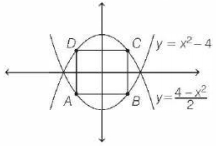
$A$ rectangle with its sides parallel to the $X$-axis and $Y$-axis is inscribed in the region bounded by the curves $y=x^2-4$ and $y=\frac{4-x^2}{2}$. The maximum possible area of such a rectangle is closest to the integer.
A
$10$
B
$9$
C
$8$
D
$7$
Solution
(B) The curves are $y_1 = x^2-4$ and $y_2 = \frac{4-x^2}{2}$.
Let the vertices of the rectangle be $C(h, y_2)$ and $D(-h, y_2)$ on the upper curve,and $B(h, y_1)$ and $A(-h, y_1)$ on the lower curve,where $h > 0$.
The width of the rectangle is $2h$ and the height is $y_2 - y_1 = \frac{4-x^2}{2} - (x^2-4) = 2 - \frac{x^2}{2} - x^2 + 4 = 6 - \frac{3x^2}{2}$.
Substituting $h$ for $x$,the area $A(h) = 2h \times (6 - \frac{3h^2}{2}) = 12h - 3h^3$.
To find the maximum area,differentiate with respect to $h$: $\frac{dA}{dh} = 12 - 9h^2$.
Setting $\frac{dA}{dh} = 0$,we get $9h^2 = 12$,so $h^2 = \frac{4}{3}$,which means $h = \frac{2}{\sqrt{3}}$.
The maximum area is $A = 12(\frac{2}{\sqrt{3}}) - 3(\frac{2}{\sqrt{3}})^3 = \frac{24}{\sqrt{3}} - 3(\frac{8}{3\sqrt{3}}) = \frac{24}{\sqrt{3}} - \frac{8}{\sqrt{3}} = \frac{16}{\sqrt{3}} = \frac{16\sqrt{3}}{3}$.
Using $\sqrt{3} \approx 1.732$,$A \approx \frac{16 \times 1.732}{3} \approx 9.237$.
The integer closest to $9.237$ is $9$.
Let the vertices of the rectangle be $C(h, y_2)$ and $D(-h, y_2)$ on the upper curve,and $B(h, y_1)$ and $A(-h, y_1)$ on the lower curve,where $h > 0$.
The width of the rectangle is $2h$ and the height is $y_2 - y_1 = \frac{4-x^2}{2} - (x^2-4) = 2 - \frac{x^2}{2} - x^2 + 4 = 6 - \frac{3x^2}{2}$.
Substituting $h$ for $x$,the area $A(h) = 2h \times (6 - \frac{3h^2}{2}) = 12h - 3h^3$.
To find the maximum area,differentiate with respect to $h$: $\frac{dA}{dh} = 12 - 9h^2$.
Setting $\frac{dA}{dh} = 0$,we get $9h^2 = 12$,so $h^2 = \frac{4}{3}$,which means $h = \frac{2}{\sqrt{3}}$.
The maximum area is $A = 12(\frac{2}{\sqrt{3}}) - 3(\frac{2}{\sqrt{3}})^3 = \frac{24}{\sqrt{3}} - 3(\frac{8}{3\sqrt{3}}) = \frac{24}{\sqrt{3}} - \frac{8}{\sqrt{3}} = \frac{16}{\sqrt{3}} = \frac{16\sqrt{3}}{3}$.
Using $\sqrt{3} \approx 1.732$,$A \approx \frac{16 \times 1.732}{3} \approx 9.237$.
The integer closest to $9.237$ is $9$.
0 likes
View Solution404
AdvancedMCQ
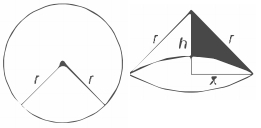
$A$ sector is removed from a metallic disc and the remaining region is bent into the shape of a circular conical funnel with volume $2 \sqrt{3} \pi$. The least possible diameter of the disc is
A
$4$
B
$6$
C
$8$
D
$12$
Solution
(B) Let the radius of the metallic disc be $R$. When a sector is removed and the remaining part is bent to form a cone,the radius $R$ of the disc becomes the slant height $l$ of the cone.
Let the radius of the base of the cone be $x$ and its height be $h$.
We have the relation $R^2 = x^2 + h^2$,where $R = l$.
The volume of the cone is given by $V = \frac{1}{3} \pi x^2 h = 2 \sqrt{3} \pi$.
Thus,$x^2 h = 6 \sqrt{3}$,which implies $x^2 = \frac{6 \sqrt{3}}{h}$.
Substituting this into the expression for $R^2$:
$R^2 = \frac{6 \sqrt{3}}{h} + h^2$.
To find the minimum diameter,we minimize $R^2$ with respect to $h$:
$\frac{d(R^2)}{dh} = -\frac{6 \sqrt{3}}{h^2} + 2h$.
Setting $\frac{d(R^2)}{dh} = 0$,we get $2h = \frac{6 \sqrt{3}}{h^2}$,so $h^3 = 3 \sqrt{3}$.
This gives $h = \sqrt{3}$.
Then $x^2 = \frac{6 \sqrt{3}}{\sqrt{3}} = 6$.
Therefore,$R^2 = 6 + (\sqrt{3})^2 = 6 + 3 = 9$,so $R = 3$.
The diameter of the disc is $2R = 2 \times 3 = 6$.
Let the radius of the base of the cone be $x$ and its height be $h$.
We have the relation $R^2 = x^2 + h^2$,where $R = l$.
The volume of the cone is given by $V = \frac{1}{3} \pi x^2 h = 2 \sqrt{3} \pi$.
Thus,$x^2 h = 6 \sqrt{3}$,which implies $x^2 = \frac{6 \sqrt{3}}{h}$.
Substituting this into the expression for $R^2$:
$R^2 = \frac{6 \sqrt{3}}{h} + h^2$.
To find the minimum diameter,we minimize $R^2$ with respect to $h$:
$\frac{d(R^2)}{dh} = -\frac{6 \sqrt{3}}{h^2} + 2h$.
Setting $\frac{d(R^2)}{dh} = 0$,we get $2h = \frac{6 \sqrt{3}}{h^2}$,so $h^3 = 3 \sqrt{3}$.
This gives $h = \sqrt{3}$.
Then $x^2 = \frac{6 \sqrt{3}}{\sqrt{3}} = 6$.
Therefore,$R^2 = 6 + (\sqrt{3})^2 = 6 + 3 = 9$,so $R = 3$.
The diameter of the disc is $2R = 2 \times 3 = 6$.
0 likes
View Solution405
AdvancedMCQ
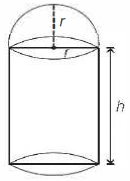
$A$ solid hemisphere is mounted on a solid cylinder,both having equal radii. If the whole solid is to have a fixed surface area and the maximum possible volume,then the ratio of the height of the cylinder to the common radius is
A
$1: 1$
B
$1: 2$
C
$2: 1$
D
$\sqrt{2}: 1$
Solution
(A) Let $r$ be the common radius and $h$ be the height of the cylinder.
The total surface area $S$ of the solid is the sum of the curved surface area of the hemisphere $(2\pi r^2)$,the curved surface area of the cylinder $(2\pi rh)$,and the base area of the cylinder $(\pi r^2)$.
$S = 2\pi r^2 + 2\pi rh + \pi r^2 = 3\pi r^2 + 2\pi rh$
From this,we can express $h$ in terms of $S$ and $r$:
$h = \frac{S - 3\pi r^2}{2\pi r}$
The volume $V$ of the solid is the sum of the volume of the hemisphere $(\frac{2}{3}\pi r^3)$ and the volume of the cylinder $(\pi r^2 h)$:
$V = \pi r^2 h + \frac{2}{3}\pi r^3$
Substituting the expression for $h$:
$V = \pi r^2 \left( \frac{S - 3\pi r^2}{2\pi r} \right) + \frac{2}{3}\pi r^3$
$V = \frac{1}{2} (Sr - 3\pi r^3) + \frac{2}{3}\pi r^3 = \frac{1}{2} Sr - \frac{3}{2}\pi r^3 + \frac{2}{3}\pi r^3 = \frac{1}{2} Sr - \frac{5}{6}\pi r^3$
To find the maximum volume,differentiate $V$ with respect to $r$ and set it to $0$:
$\frac{dV}{dr} = \frac{S}{2} - \frac{5}{2}\pi r^2 = 0$
$S = 5\pi r^2$
Now,substitute $S = 5\pi r^2$ back into the expression for $h$:
$h = \frac{5\pi r^2 - 3\pi r^2}{2\pi r} = \frac{2\pi r^2}{2\pi r} = r$
Thus,the ratio of the height of the cylinder to the common radius is $h:r = 1:1$.
The total surface area $S$ of the solid is the sum of the curved surface area of the hemisphere $(2\pi r^2)$,the curved surface area of the cylinder $(2\pi rh)$,and the base area of the cylinder $(\pi r^2)$.
$S = 2\pi r^2 + 2\pi rh + \pi r^2 = 3\pi r^2 + 2\pi rh$
From this,we can express $h$ in terms of $S$ and $r$:
$h = \frac{S - 3\pi r^2}{2\pi r}$
The volume $V$ of the solid is the sum of the volume of the hemisphere $(\frac{2}{3}\pi r^3)$ and the volume of the cylinder $(\pi r^2 h)$:
$V = \pi r^2 h + \frac{2}{3}\pi r^3$
Substituting the expression for $h$:
$V = \pi r^2 \left( \frac{S - 3\pi r^2}{2\pi r} \right) + \frac{2}{3}\pi r^3$
$V = \frac{1}{2} (Sr - 3\pi r^3) + \frac{2}{3}\pi r^3 = \frac{1}{2} Sr - \frac{3}{2}\pi r^3 + \frac{2}{3}\pi r^3 = \frac{1}{2} Sr - \frac{5}{6}\pi r^3$
To find the maximum volume,differentiate $V$ with respect to $r$ and set it to $0$:
$\frac{dV}{dr} = \frac{S}{2} - \frac{5}{2}\pi r^2 = 0$
$S = 5\pi r^2$
Now,substitute $S = 5\pi r^2$ back into the expression for $h$:
$h = \frac{5\pi r^2 - 3\pi r^2}{2\pi r} = \frac{2\pi r^2}{2\pi r} = r$
Thus,the ratio of the height of the cylinder to the common radius is $h:r = 1:1$.
0 likes
View Solution406
AdvancedMCQ
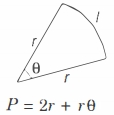
Among all sectors of a fixed perimeter,choose the one with maximum area. Then,the angle at the centre of this sector (i.e.,the angle between the bounding radii) is
A
$\frac{\pi}{3}$
B
$\frac{3}{2}$
C
$\sqrt{3}$
D
$2$
Solution
(D) Let the radius of the sector be $r$ and the angle subtended by the radii at the centre be $\theta$ (in radians).
The length of the arc is $l = r\theta$.
The perimeter of the sector is $P = 2r + l = 2r + r\theta = r(2 + \theta)$.
From this,we can express the radius as $r = \frac{P}{2 + \theta}$.
The area of the sector is $A = \frac{1}{2}r^2\theta$.
Substituting the expression for $r$ in terms of $P$ and $\theta$:
$A = \frac{1}{2} \left(\frac{P}{2 + \theta}\right)^2 \theta = \frac{P^2}{2} \cdot \frac{\theta}{(2 + \theta)^2}$.
To find the maximum area,we differentiate $A$ with respect to $\theta$ and set it to zero:
$\frac{dA}{d\theta} = \frac{P^2}{2} \cdot \frac{(2 + \theta)^2(1) - \theta(2)(2 + \theta)}{(2 + \theta)^4} = 0$.
This simplifies to:
$(2 + \theta)^2 - 2\theta(2 + \theta) = 0$.
Factoring out $(2 + \theta)$:
$(2 + \theta)(2 + \theta - 2\theta) = 0$.
$(2 + \theta)(2 - \theta) = 0$.
Since $\theta > 0$,we have $\theta = 2$ radians.
Thus,the angle at the centre for maximum area is $2$ radians.
The length of the arc is $l = r\theta$.
The perimeter of the sector is $P = 2r + l = 2r + r\theta = r(2 + \theta)$.
From this,we can express the radius as $r = \frac{P}{2 + \theta}$.
The area of the sector is $A = \frac{1}{2}r^2\theta$.
Substituting the expression for $r$ in terms of $P$ and $\theta$:
$A = \frac{1}{2} \left(\frac{P}{2 + \theta}\right)^2 \theta = \frac{P^2}{2} \cdot \frac{\theta}{(2 + \theta)^2}$.
To find the maximum area,we differentiate $A$ with respect to $\theta$ and set it to zero:
$\frac{dA}{d\theta} = \frac{P^2}{2} \cdot \frac{(2 + \theta)^2(1) - \theta(2)(2 + \theta)}{(2 + \theta)^4} = 0$.
This simplifies to:
$(2 + \theta)^2 - 2\theta(2 + \theta) = 0$.
Factoring out $(2 + \theta)$:
$(2 + \theta)(2 + \theta - 2\theta) = 0$.
$(2 + \theta)(2 - \theta) = 0$.
Since $\theta > 0$,we have $\theta = 2$ radians.
Thus,the angle at the centre for maximum area is $2$ radians.
0 likes
View Solution407
AdvancedMCQ
Let $f(x) = \alpha x^2 - 2 + \frac{1}{x}$,where $\alpha$ is a real constant. The smallest $\alpha$ for which $f(x) \geq 0$ for all $x > 0$ is
A
$\frac{2^2}{3^3}$
B
$\frac{2^3}{3^3}$
C
$\frac{2^4}{3^3}$
D
$\frac{2^5}{3^3}$
Solution
(D) Given $f(x) = \alpha x^2 - 2 + \frac{1}{x} = \frac{\alpha x^3 - 2x + 1}{x}$.
For $f(x) \geq 0$ and $x > 0$,we must have $g(x) = \alpha x^3 - 2x + 1 \geq 0$ for all $x > 0$.
To find the minimum of $g(x)$,we calculate $g'(x) = 3\alpha x^2 - 2$.
Setting $g'(x) = 0$,we get $x^2 = \frac{2}{3\alpha}$,so $x = \sqrt{\frac{2}{3\alpha}}$ (since $x > 0$).
The second derivative $g''(x) = 6\alpha x > 0$ at this point,confirming a local minimum.
Substituting $x = \sqrt{\frac{2}{3\alpha}}$ into $g(x)$:
$g\left(\sqrt{\frac{2}{3\alpha}}\right) = \alpha \left(\frac{2}{3\alpha}\right) \sqrt{\frac{2}{3\alpha}} - 2\sqrt{\frac{2}{3\alpha}} + 1 \geq 0$.
$\sqrt{\frac{2}{3\alpha}} \left( \frac{2}{3} - 2 \right) + 1 \geq 0$.
$1 - \frac{4}{3} \sqrt{\frac{2}{3\alpha}} \geq 0 \Rightarrow 1 \geq \frac{4}{3} \sqrt{\frac{2}{3\alpha}}$.
$\frac{3}{4} \geq \sqrt{\frac{2}{3\alpha}} \Rightarrow \frac{9}{16} \geq \frac{2}{3\alpha}$.
$27\alpha \geq 32 \Rightarrow \alpha \geq \frac{32}{27} = \frac{2^5}{3^3}$.
Thus,the smallest value is $\frac{2^5}{3^3}$.
For $f(x) \geq 0$ and $x > 0$,we must have $g(x) = \alpha x^3 - 2x + 1 \geq 0$ for all $x > 0$.
To find the minimum of $g(x)$,we calculate $g'(x) = 3\alpha x^2 - 2$.
Setting $g'(x) = 0$,we get $x^2 = \frac{2}{3\alpha}$,so $x = \sqrt{\frac{2}{3\alpha}}$ (since $x > 0$).
The second derivative $g''(x) = 6\alpha x > 0$ at this point,confirming a local minimum.
Substituting $x = \sqrt{\frac{2}{3\alpha}}$ into $g(x)$:
$g\left(\sqrt{\frac{2}{3\alpha}}\right) = \alpha \left(\frac{2}{3\alpha}\right) \sqrt{\frac{2}{3\alpha}} - 2\sqrt{\frac{2}{3\alpha}} + 1 \geq 0$.
$\sqrt{\frac{2}{3\alpha}} \left( \frac{2}{3} - 2 \right) + 1 \geq 0$.
$1 - \frac{4}{3} \sqrt{\frac{2}{3\alpha}} \geq 0 \Rightarrow 1 \geq \frac{4}{3} \sqrt{\frac{2}{3\alpha}}$.
$\frac{3}{4} \geq \sqrt{\frac{2}{3\alpha}} \Rightarrow \frac{9}{16} \geq \frac{2}{3\alpha}$.
$27\alpha \geq 32 \Rightarrow \alpha \geq \frac{32}{27} = \frac{2^5}{3^3}$.
Thus,the smallest value is $\frac{2^5}{3^3}$.
0 likes
View Solution408
AdvancedMCQ
The number of integers $n$ for which $3x^3-25x+n=0$ has three real roots is
A
$1$
B
$25$
C
$55$
D
infinite
Solution
(C) Let $f(x) = 3x^3 - 25x + n$.
For the cubic equation to have three real roots,the local maximum and local minimum must have opposite signs.
$f'(x) = 9x^2 - 25$.
Setting $f'(x) = 0$,we get $x^2 = \frac{25}{9}$,so $x = \pm \frac{5}{3}$.
Let $x_1 = -\frac{5}{3}$ and $x_2 = \frac{5}{3}$.
$f(x_1) = 3(-\frac{125}{27}) - 25(-\frac{5}{3}) + n = -\frac{125}{9} + \frac{125}{3} + n = n + \frac{250}{9}$.
$f(x_2) = 3(\frac{125}{27}) - 25(\frac{5}{3}) + n = \frac{125}{9} - \frac{125}{3} + n = n - \frac{250}{9}$.
For three real roots,$f(x_1) \cdot f(x_2) < 0$,so $(n + \frac{250}{9})(n - \frac{250}{9}) < 0$.
This implies $-\frac{250}{9} < n < \frac{250}{9}$.
Since $\frac{250}{9} \approx 27.77$,the integers $n$ range from $-27$ to $27$.
The number of such integers is $27 - (-27) + 1 = 55$.
For the cubic equation to have three real roots,the local maximum and local minimum must have opposite signs.
$f'(x) = 9x^2 - 25$.
Setting $f'(x) = 0$,we get $x^2 = \frac{25}{9}$,so $x = \pm \frac{5}{3}$.
Let $x_1 = -\frac{5}{3}$ and $x_2 = \frac{5}{3}$.
$f(x_1) = 3(-\frac{125}{27}) - 25(-\frac{5}{3}) + n = -\frac{125}{9} + \frac{125}{3} + n = n + \frac{250}{9}$.
$f(x_2) = 3(\frac{125}{27}) - 25(\frac{5}{3}) + n = \frac{125}{9} - \frac{125}{3} + n = n - \frac{250}{9}$.
For three real roots,$f(x_1) \cdot f(x_2) < 0$,so $(n + \frac{250}{9})(n - \frac{250}{9}) < 0$.
This implies $-\frac{250}{9} < n < \frac{250}{9}$.
Since $\frac{250}{9} \approx 27.77$,the integers $n$ range from $-27$ to $27$.
The number of such integers is $27 - (-27) + 1 = 55$.
0 likes
View Solution409
AdvancedMCQ
Let $f(x)=1+\frac{x}{1 !}+\frac{x^2}{2 !}+\frac{x^3}{3 !}+\frac{x^4}{4 !}$. The number of real roots of $f(x)=0$ is
A
$0$
B
$1$
C
$2$
D
$4$
Solution
(A) We have $f(x) = 1 + x + \frac{x^2}{2!} + \frac{x^3}{3!} + \frac{x^4}{4!}$.
Note that $f'(x) = 1 + x + \frac{x^2}{2!} + \frac{x^3}{3!} = f(x) - \frac{x^4}{4!}$.
Also,$f''(x) = 1 + x + \frac{x^2}{2} = \frac{1}{2}(x^2 + 2x + 1) + \frac{1}{2} = \frac{1}{2}(x+1)^2 + \frac{1}{2} > 0$ for all $x \in \mathbb{R}$.
Since $f''(x) > 0$,$f'(x)$ is a strictly increasing function.
As $x \to -\infty$,$f'(x) \to -\infty$ and as $x \to \infty$,$f'(x) \to \infty$. Thus,$f'(x) = 0$ has exactly one real root,say $x_0$.
Since $f'(x)$ is increasing,$f(x)$ has a global minimum at $x = x_0$.
We observe $f'(x) = 1 + x + \frac{x^2}{2} + \frac{x^3}{6}$.
$f'(-2) = 1 - 2 + 2 - \frac{8}{6} = 1 - 1.33 = -0.33 < 0$.
$f'(-1) = 1 - 1 + \frac{1}{2} - \frac{1}{6} = \frac{1}{3} > 0$.
So,$x_0 \in (-2, -1)$.
At the minimum $x_0$,$f(x_0) = 1 + x_0 + \frac{x_0^2}{2} + \frac{x_0^3}{6} + \frac{x_0^4}{24}$.
Since $f'(x_0) = 0$,we have $1 + x_0 + \frac{x_0^2}{2} + \frac{x_0^3}{6} = 0$,which implies $1 + x_0 + \frac{x_0^2}{2} + \frac{x_0^3}{6} = -\frac{x_0^4}{24}$.
Substituting this into $f(x_0)$,we get $f(x_0) = -\frac{x_0^4}{24} + \frac{x_0^4}{24} + \dots$ wait,$f(x_0) = (1 + x_0 + \frac{x_0^2}{2} + \frac{x_0^3}{6}) + \frac{x_0^4}{24} = 0 + \frac{x_0^4}{24} = \frac{x_0^4}{24}$.
Since $x_0 \neq 0$,$f(x_0) = \frac{x_0^4}{24} > 0$.
Since the global minimum of $f(x)$ is positive,$f(x) = 0$ has no real roots.
Note that $f'(x) = 1 + x + \frac{x^2}{2!} + \frac{x^3}{3!} = f(x) - \frac{x^4}{4!}$.
Also,$f''(x) = 1 + x + \frac{x^2}{2} = \frac{1}{2}(x^2 + 2x + 1) + \frac{1}{2} = \frac{1}{2}(x+1)^2 + \frac{1}{2} > 0$ for all $x \in \mathbb{R}$.
Since $f''(x) > 0$,$f'(x)$ is a strictly increasing function.
As $x \to -\infty$,$f'(x) \to -\infty$ and as $x \to \infty$,$f'(x) \to \infty$. Thus,$f'(x) = 0$ has exactly one real root,say $x_0$.
Since $f'(x)$ is increasing,$f(x)$ has a global minimum at $x = x_0$.
We observe $f'(x) = 1 + x + \frac{x^2}{2} + \frac{x^3}{6}$.
$f'(-2) = 1 - 2 + 2 - \frac{8}{6} = 1 - 1.33 = -0.33 < 0$.
$f'(-1) = 1 - 1 + \frac{1}{2} - \frac{1}{6} = \frac{1}{3} > 0$.
So,$x_0 \in (-2, -1)$.
At the minimum $x_0$,$f(x_0) = 1 + x_0 + \frac{x_0^2}{2} + \frac{x_0^3}{6} + \frac{x_0^4}{24}$.
Since $f'(x_0) = 0$,we have $1 + x_0 + \frac{x_0^2}{2} + \frac{x_0^3}{6} = 0$,which implies $1 + x_0 + \frac{x_0^2}{2} + \frac{x_0^3}{6} = -\frac{x_0^4}{24}$.
Substituting this into $f(x_0)$,we get $f(x_0) = -\frac{x_0^4}{24} + \frac{x_0^4}{24} + \dots$ wait,$f(x_0) = (1 + x_0 + \frac{x_0^2}{2} + \frac{x_0^3}{6}) + \frac{x_0^4}{24} = 0 + \frac{x_0^4}{24} = \frac{x_0^4}{24}$.
Since $x_0 \neq 0$,$f(x_0) = \frac{x_0^4}{24} > 0$.
Since the global minimum of $f(x)$ is positive,$f(x) = 0$ has no real roots.
0 likes
View Solution410
AdvancedMCQ
The maximum value $M$ of $f(x) = 3^x + 5^x - 9^x + 15^x - 25^x$,as $x$ varies over all real numbers,satisfies:
A
$3 < M < 5$
B
$0 < M < 2$
C
$9 < M < 25$
D
$5 < M < 9$
Solution
(B) Let $f(x) = 3^x + 5^x - (3^x)^2 + (3^x)(5^x) - (5^x)^2$.
Let $a = 3^x$ and $b = 5^x$,where $a, b > 0$.
Then $f(x) = a + b - a^2 + ab - b^2$.
We can rewrite this as $f(x) = a + b - (a^2 - ab + b^2)$.
To find the maximum,consider the expression $-(a^2 - ab + b^2) = -(a - b/2)^2 - 3b^2/4$.
Alternatively,complete the square: $f(x) = -(a^2 - a(1+b) + b^2 + b) = -[(a - \frac{1+b}{2})^2 - \frac{(1+b)^2}{4} + b^2 + b]$.
$f(x) = -(a - \frac{1+b}{2})^2 + \frac{1 + 2b + b^2 - 4b^2 - 4b}{4} = -(a - \frac{1+b}{2})^2 + \frac{1 - 2b - 3b^2}{4}$.
The maximum value for a fixed $b$ occurs at $a = \frac{1+b}{2}$,giving $f_{max}(b) = \frac{1 - 2b - 3b^2}{4}$.
Since $b = 5^x > 0$,the function $g(b) = \frac{1 - 2b - 3b^2}{4}$ is decreasing for $b > 0$.
The maximum value of $g(b)$ as $b \to 0^+$ is $1/4$.
However,checking $x=0$: $f(0) = 3^0 + 5^0 - 9^0 + 15^0 - 25^0 = 1 + 1 - 1 + 1 - 1 = 1$.
Since $1$ is the value at $x=0$,and $0 < 1 < 2$,the condition $0 < M < 2$ is satisfied.
Let $a = 3^x$ and $b = 5^x$,where $a, b > 0$.
Then $f(x) = a + b - a^2 + ab - b^2$.
We can rewrite this as $f(x) = a + b - (a^2 - ab + b^2)$.
To find the maximum,consider the expression $-(a^2 - ab + b^2) = -(a - b/2)^2 - 3b^2/4$.
Alternatively,complete the square: $f(x) = -(a^2 - a(1+b) + b^2 + b) = -[(a - \frac{1+b}{2})^2 - \frac{(1+b)^2}{4} + b^2 + b]$.
$f(x) = -(a - \frac{1+b}{2})^2 + \frac{1 + 2b + b^2 - 4b^2 - 4b}{4} = -(a - \frac{1+b}{2})^2 + \frac{1 - 2b - 3b^2}{4}$.
The maximum value for a fixed $b$ occurs at $a = \frac{1+b}{2}$,giving $f_{max}(b) = \frac{1 - 2b - 3b^2}{4}$.
Since $b = 5^x > 0$,the function $g(b) = \frac{1 - 2b - 3b^2}{4}$ is decreasing for $b > 0$.
The maximum value of $g(b)$ as $b \to 0^+$ is $1/4$.
However,checking $x=0$: $f(0) = 3^0 + 5^0 - 9^0 + 15^0 - 25^0 = 1 + 1 - 1 + 1 - 1 = 1$.
Since $1$ is the value at $x=0$,and $0 < 1 < 2$,the condition $0 < M < 2$ is satisfied.
0 likes
View Solution411
AdvancedMCQ
The minimum distance between a point on the curve $y=e^x$ and a point on the curve $y=\log_e x$ is
A
$\frac{1}{\sqrt{2}}$
B
$\sqrt{2}$
C
$\sqrt{3}$
D
$2\sqrt{2}$
Solution
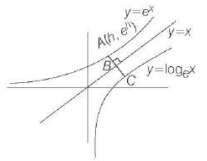
(B) The curves $y=e^x$ and $y=\log_e x$ are inverse functions of each other,meaning they are symmetric about the line $y=x$.
Let $A$ be a point on $y=e^x$ with coordinates $(h, e^h)$. The distance from point $A$ to the line $y=x$ (or $x-y=0$) is given by $AB = \frac{|h-e^h|}{\sqrt{1^2+(-1)^2}} = \frac{|h-e^h|}{\sqrt{2}}$.
Since the curves are symmetric about $y=x$,the minimum distance between the two curves is $AC = 2AB$,where $B$ is the projection of $A$ onto the line $y=x$.
To minimize $AB$,we minimize $f(h) = e^h - h$ (since $e^h > h$ for all $h$).
$f'(h) = e^h - 1$. Setting $f'(h) = 0$ gives $e^h = 1$,so $h=0$.
At $h=0$,the minimum distance $AB = \frac{|0-e^0|}{\sqrt{2}} = \frac{1}{\sqrt{2}}$.
Therefore,the minimum distance between the curves is $AC = 2 \times \frac{1}{\sqrt{2}} = \sqrt{2}$.
Let $A$ be a point on $y=e^x$ with coordinates $(h, e^h)$. The distance from point $A$ to the line $y=x$ (or $x-y=0$) is given by $AB = \frac{|h-e^h|}{\sqrt{1^2+(-1)^2}} = \frac{|h-e^h|}{\sqrt{2}}$.
Since the curves are symmetric about $y=x$,the minimum distance between the two curves is $AC = 2AB$,where $B$ is the projection of $A$ onto the line $y=x$.
To minimize $AB$,we minimize $f(h) = e^h - h$ (since $e^h > h$ for all $h$).
$f'(h) = e^h - 1$. Setting $f'(h) = 0$ gives $e^h = 1$,so $h=0$.
At $h=0$,the minimum distance $AB = \frac{|0-e^0|}{\sqrt{2}} = \frac{1}{\sqrt{2}}$.
Therefore,the minimum distance between the curves is $AC = 2 \times \frac{1}{\sqrt{2}} = \sqrt{2}$.
0 likes
View Solution412
AdvancedMCQ
Let $f(x) = x^3 + ax^2 + bx + c$ where $a, b, c$ are real numbers. If $f(x)$ has a local minimum at $x = 1$ and a local maximum at $x = -\frac{1}{3}$ and $f(2) = 0$,then $\int_{-1}^1 f(x) dx$ equals
A
$\frac{14}{3}$
B
$\frac{-14}{3}$
C
$\frac{7}{3}$
D
$\frac{-7}{3}$
Solution
(B) Given $f(x) = x^3 + ax^2 + bx + c$.
Since $f(2) = 0$,we have $8 + 4a + 2b + c = 0$ ... $(i)$.
The derivative is $f'(x) = 3x^2 + 2ax + b$.
Since $f(x)$ has critical points at $x = 1$ and $x = -\frac{1}{3}$,$f'(1) = 0$ and $f'(-\frac{1}{3}) = 0$.
$f'(1) = 3 + 2a + b = 0$ ... (ii).
$f'(-\frac{1}{3}) = 3(-\frac{1}{3})^2 + 2a(-\frac{1}{3}) + b = \frac{1}{3} - \frac{2a}{3} + b = 0$,which implies $1 - 2a + 3b = 0$ ... (iii).
Solving (ii) and (iii): $b = -2a - 3$. Substituting into (iii): $1 - 2a + 3(-2a - 3) = 0 \Rightarrow 1 - 2a - 6a - 9 = 0 \Rightarrow -8a = 8 \Rightarrow a = -1$.
Then $b = -2(-1) - 3 = -1$.
From $(i)$,$8 + 4(-1) + 2(-1) + c = 0 \Rightarrow 8 - 4 - 2 + c = 0 \Rightarrow c = -2$.
Thus,$f(x) = x^3 - x^2 - x - 2$.
We need to evaluate $\int_{-1}^1 (x^3 - x^2 - x - 2) dx$.
Since $x^3$ and $-x$ are odd functions,their integral over $[-1, 1]$ is $0$.
So,$\int_{-1}^1 f(x) dx = \int_{-1}^1 (-x^2 - 2) dx = -2 \int_0^1 (x^2 + 2) dx$.
$= -2 [\frac{x^3}{3} + 2x]_0^1 = -2 (\frac{1}{3} + 2) = -2 (\frac{7}{3}) = -\frac{14}{3}$.
Since $f(2) = 0$,we have $8 + 4a + 2b + c = 0$ ... $(i)$.
The derivative is $f'(x) = 3x^2 + 2ax + b$.
Since $f(x)$ has critical points at $x = 1$ and $x = -\frac{1}{3}$,$f'(1) = 0$ and $f'(-\frac{1}{3}) = 0$.
$f'(1) = 3 + 2a + b = 0$ ... (ii).
$f'(-\frac{1}{3}) = 3(-\frac{1}{3})^2 + 2a(-\frac{1}{3}) + b = \frac{1}{3} - \frac{2a}{3} + b = 0$,which implies $1 - 2a + 3b = 0$ ... (iii).
Solving (ii) and (iii): $b = -2a - 3$. Substituting into (iii): $1 - 2a + 3(-2a - 3) = 0 \Rightarrow 1 - 2a - 6a - 9 = 0 \Rightarrow -8a = 8 \Rightarrow a = -1$.
Then $b = -2(-1) - 3 = -1$.
From $(i)$,$8 + 4(-1) + 2(-1) + c = 0 \Rightarrow 8 - 4 - 2 + c = 0 \Rightarrow c = -2$.
Thus,$f(x) = x^3 - x^2 - x - 2$.
We need to evaluate $\int_{-1}^1 (x^3 - x^2 - x - 2) dx$.
Since $x^3$ and $-x$ are odd functions,their integral over $[-1, 1]$ is $0$.
So,$\int_{-1}^1 f(x) dx = \int_{-1}^1 (-x^2 - 2) dx = -2 \int_0^1 (x^2 + 2) dx$.
$= -2 [\frac{x^3}{3} + 2x]_0^1 = -2 (\frac{1}{3} + 2) = -2 (\frac{7}{3}) = -\frac{14}{3}$.
0 likes
View Solution413
AdvancedMCQ
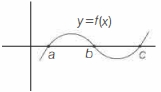
The figure shown below is the graph of the derivative of some function $y=f(x)$. Then,
A
$f$ has local minima at $x=a, b$ and a local maximum at $x=c$
B
$f$ has local minima at $x=b, c$ and a local maximum at $x=a$
C
$f$ has local minima at $x=a, c$ and a local maximum at $x=b$
D
the given figure is insufficient to conclude anything about the local minima and local maxima of $f$
Solution
(C) From the given graph of $f'(x)$,we observe the points where $f'(x) = 0$ are $x=a, b, c$.
$1$. At $x=a$: The derivative $f'(x)$ changes sign from negative to positive (as it crosses the x-axis from below to above). Thus,$f(x)$ has a local minimum at $x=a$.
$2$. At $x=b$: The derivative $f'(x)$ changes sign from positive to negative (as it crosses the x-axis from above to below). Thus,$f(x)$ has a local maximum at $x=b$.
$3$. At $x=c$: The derivative $f'(x)$ changes sign from negative to positive (as it crosses the x-axis from below to above). Thus,$f(x)$ has a local minimum at $x=c$.
Therefore,$f(x)$ has local minima at $x=a, c$ and a local maximum at $x=b$. The correct option is $C$.
$1$. At $x=a$: The derivative $f'(x)$ changes sign from negative to positive (as it crosses the x-axis from below to above). Thus,$f(x)$ has a local minimum at $x=a$.
$2$. At $x=b$: The derivative $f'(x)$ changes sign from positive to negative (as it crosses the x-axis from above to below). Thus,$f(x)$ has a local maximum at $x=b$.
$3$. At $x=c$: The derivative $f'(x)$ changes sign from negative to positive (as it crosses the x-axis from below to above). Thus,$f(x)$ has a local minimum at $x=c$.
Therefore,$f(x)$ has local minima at $x=a, c$ and a local maximum at $x=b$. The correct option is $C$.
0 likes
View Solution414
DifficultMCQ
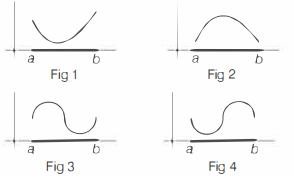
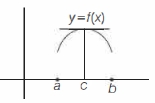
The following figure shows the graph of a differentiable function $y=f(x)$ on the interval $[a, b]$ (not containing $0$). Let $g(x)=\frac{f(x)}{x}$. Which of the following is a possible graph of $y=g(x)$?
A
Fig $1$
B
Fig $2$
C
Fig $3$
D
Fig $4$
Solution
(B) Given $g(x) = \frac{f(x)}{x}$.
Taking the derivative with respect to $x$,we get:
$g'(x) = \frac{x f'(x) - f(x)}{x^2}$.
From the given graph of $f(x)$,we observe that $f(x)$ is a concave downward function with a maximum at $x=c$ where $a < c < b$. Thus,$f'(c) = 0$.
At $x=c$,$g'(c) = \frac{c f'(c) - f(c)}{c^2} = \frac{c(0) - f(c)}{c^2} = -\frac{f(c)}{c^2}$.
Since $f(c) > 0$ and $c > 0$ (as the interval does not contain $0$),$g'(c) < 0$.
This implies that the function $g(x)$ is decreasing at $x=c$. Looking at the provided options,Fig $2$ represents a curve that is concave downward and consistent with the behavior of $g(x) = \frac{f(x)}{x}$ for a positive $f(x)$ and $x > 0$. Therefore,option $(b)$ is correct.
Taking the derivative with respect to $x$,we get:
$g'(x) = \frac{x f'(x) - f(x)}{x^2}$.
From the given graph of $f(x)$,we observe that $f(x)$ is a concave downward function with a maximum at $x=c$ where $a < c < b$. Thus,$f'(c) = 0$.
At $x=c$,$g'(c) = \frac{c f'(c) - f(c)}{c^2} = \frac{c(0) - f(c)}{c^2} = -\frac{f(c)}{c^2}$.
Since $f(c) > 0$ and $c > 0$ (as the interval does not contain $0$),$g'(c) < 0$.
This implies that the function $g(x)$ is decreasing at $x=c$. Looking at the provided options,Fig $2$ represents a curve that is concave downward and consistent with the behavior of $g(x) = \frac{f(x)}{x}$ for a positive $f(x)$ and $x > 0$. Therefore,option $(b)$ is correct.
0 likes
View Solution415
AdvancedMCQ
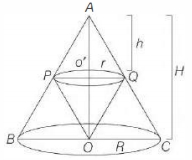
Let $V_1$ be the volume of a given right circular cone with $O$ as the centre of the base and $A$ as its apex. Let $V_2$ be the maximum volume of the right circular cone inscribed in the given cone whose apex is $O$ and whose base is parallel to the base of the given cone. Then,the ratio $V_2 / V_1$ is
A
$\frac{3}{25}$
B
$\frac{4}{9}$
C
$\frac{4}{27}$
D
$\frac{8}{27}$
Solution
(C) Let $H$ be the height and $R$ be the radius of the given cone $V_1$. The volume is $V_1 = \frac{1}{3} \pi R^2 H$.
Let the inscribed cone $V_2$ have height $h$ and radius $r$. The apex of this cone is at $O$ and its base is at a distance $h$ from $O$. The height of the base of the inscribed cone from the apex $A$ is $H-h$.
By similar triangles,$\frac{r}{R} = \frac{H-h}{H} = 1 - \frac{h}{H}$.
Thus,$\frac{h}{H} = 1 - \frac{r}{R} \Rightarrow h = H(1 - \frac{r}{R})$.
The volume of the inscribed cone is $V_2 = \frac{1}{3} \pi r^2 h = \frac{1}{3} \pi r^2 H(1 - \frac{r}{R}) = \frac{\pi H}{3} (r^2 - \frac{r^3}{R})$.
To maximize $V_2$,we differentiate with respect to $r$: $\frac{dV_2}{dr} = \frac{\pi H}{3} (2r - \frac{3r^2}{R}) = 0$.
This gives $r(2 - \frac{3r}{R}) = 0$. Since $r \neq 0$,we have $r = \frac{2R}{3}$.
Substituting $r = \frac{2R}{3}$ into the expression for $h$: $h = H(1 - \frac{2R/3}{R}) = H(1 - \frac{2}{3}) = \frac{H}{3}$.
Now,$V_2 = \frac{1}{3} \pi (\frac{2R}{3})^2 (\frac{H}{3}) = \frac{1}{3} \pi (\frac{4R^2}{9}) (\frac{H}{3}) = \frac{4}{27} (\frac{1}{3} \pi R^2 H) = \frac{4}{27} V_1$.
Therefore,the ratio $\frac{V_2}{V_1} = \frac{4}{27}$.
Let the inscribed cone $V_2$ have height $h$ and radius $r$. The apex of this cone is at $O$ and its base is at a distance $h$ from $O$. The height of the base of the inscribed cone from the apex $A$ is $H-h$.
By similar triangles,$\frac{r}{R} = \frac{H-h}{H} = 1 - \frac{h}{H}$.
Thus,$\frac{h}{H} = 1 - \frac{r}{R} \Rightarrow h = H(1 - \frac{r}{R})$.
The volume of the inscribed cone is $V_2 = \frac{1}{3} \pi r^2 h = \frac{1}{3} \pi r^2 H(1 - \frac{r}{R}) = \frac{\pi H}{3} (r^2 - \frac{r^3}{R})$.
To maximize $V_2$,we differentiate with respect to $r$: $\frac{dV_2}{dr} = \frac{\pi H}{3} (2r - \frac{3r^2}{R}) = 0$.
This gives $r(2 - \frac{3r}{R}) = 0$. Since $r \neq 0$,we have $r = \frac{2R}{3}$.
Substituting $r = \frac{2R}{3}$ into the expression for $h$: $h = H(1 - \frac{2R/3}{R}) = H(1 - \frac{2}{3}) = \frac{H}{3}$.
Now,$V_2 = \frac{1}{3} \pi (\frac{2R}{3})^2 (\frac{H}{3}) = \frac{1}{3} \pi (\frac{4R^2}{9}) (\frac{H}{3}) = \frac{4}{27} (\frac{1}{3} \pi R^2 H) = \frac{4}{27} V_1$.
Therefore,the ratio $\frac{V_2}{V_1} = \frac{4}{27}$.
0 likes
View Solution416
AdvancedMCQ
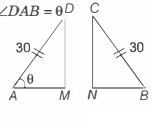
In an isosceles trapezium,the length of one of the parallel sides and the lengths of the non-parallel sides are all equal to $30$. In order to maximize the area of the trapezium,the smallest angle should be:
A
$\frac{\pi}{6}$
B
$\frac{\pi}{4}$
C
$\frac{\pi}{3}$
D
$\frac{\pi}{2}$
Solution
(C) Let the parallel sides be $a = 30$ and $b = 30 + 2(30 \cos \theta) = 30 + 60 \cos \theta$. The height of the trapezium is $h = 30 \sin \theta$.
The area $A$ of the trapezium is given by:
$A = \frac{1}{2}(a + b)h = \frac{1}{2}(30 + 30 + 60 \cos \theta)(30 \sin \theta)$
$A = \frac{1}{2}(60 + 60 \cos \theta)(30 \sin \theta) = 900(1 + \cos \theta) \sin \theta = 900(\sin \theta + \sin \theta \cos \theta) = 900(\sin \theta + \frac{1}{2} \sin 2\theta)$.
To maximize the area,differentiate with respect to $\theta$ and set to $0$:
$\frac{dA}{d\theta} = 900(\cos \theta + \cos 2\theta) = 0$.
Since $\cos 2\theta = 2 \cos^2 \theta - 1$,we have:
$2 \cos^2 \theta + \cos \theta - 1 = 0$.
$(2 \cos \theta - 1)(\cos \theta + 1) = 0$.
This gives $\cos \theta = \frac{1}{2}$ or $\cos \theta = -1$.
Since $\theta$ is an angle in a triangle,$\theta = \frac{\pi}{3}$ (as $\theta = \pi$ is not possible).
Thus,the smallest angle is $\frac{\pi}{3}$.
The area $A$ of the trapezium is given by:
$A = \frac{1}{2}(a + b)h = \frac{1}{2}(30 + 30 + 60 \cos \theta)(30 \sin \theta)$
$A = \frac{1}{2}(60 + 60 \cos \theta)(30 \sin \theta) = 900(1 + \cos \theta) \sin \theta = 900(\sin \theta + \sin \theta \cos \theta) = 900(\sin \theta + \frac{1}{2} \sin 2\theta)$.
To maximize the area,differentiate with respect to $\theta$ and set to $0$:
$\frac{dA}{d\theta} = 900(\cos \theta + \cos 2\theta) = 0$.
Since $\cos 2\theta = 2 \cos^2 \theta - 1$,we have:
$2 \cos^2 \theta + \cos \theta - 1 = 0$.
$(2 \cos \theta - 1)(\cos \theta + 1) = 0$.
This gives $\cos \theta = \frac{1}{2}$ or $\cos \theta = -1$.
Since $\theta$ is an angle in a triangle,$\theta = \frac{\pi}{3}$ (as $\theta = \pi$ is not possible).
Thus,the smallest angle is $\frac{\pi}{3}$.
0 likes
View Solution417
DifficultMCQ
The minimum value of the function $f(x) = \int \limits_0^2 e^{|x-t|} dt$ is
A
$2(e-1)$
B
$2e - 1$
C
$2$
D
$e(e-1)$
Solution
(A) For $x \leq 0$,$f(x) = \int \limits_0^2 e^{t-x} dt = e^{-x}(e^2-1)$.
For $0 < x < 2$,$f(x) = \int \limits_0^x e^{x-t} dt + \int \limits_x^2 e^{t-x} dt = (e^x - 1) + (e^{2-x} - 1) = e^x + e^{2-x} - 2$.
For $x \geq 2$,$f(x) = \int \limits_0^2 e^{x-t} dt = e^{x-2}(e^2-1)$.
For $x \leq 0$,$f(x)$ is decreasing and for $x \geq 2$,$f(x)$ is increasing.
Therefore,the minimum value of $f(x)$ lies in the interval $x \in (0, 2)$.
In the interval $(0, 2)$,$f(x) = e^x + e^{2-x} - 2$.
Using the Arithmetic Mean-Geometric Mean inequality $(AM \geq GM)$:
$e^x + e^{2-x} \geq 2 \sqrt{e^x \cdot e^{2-x}} = 2 \sqrt{e^2} = 2e$.
Thus,the minimum value of $f(x)$ is $2e - 2 = 2(e-1)$.
For $0 < x < 2$,$f(x) = \int \limits_0^x e^{x-t} dt + \int \limits_x^2 e^{t-x} dt = (e^x - 1) + (e^{2-x} - 1) = e^x + e^{2-x} - 2$.
For $x \geq 2$,$f(x) = \int \limits_0^2 e^{x-t} dt = e^{x-2}(e^2-1)$.
For $x \leq 0$,$f(x)$ is decreasing and for $x \geq 2$,$f(x)$ is increasing.
Therefore,the minimum value of $f(x)$ lies in the interval $x \in (0, 2)$.
In the interval $(0, 2)$,$f(x) = e^x + e^{2-x} - 2$.
Using the Arithmetic Mean-Geometric Mean inequality $(AM \geq GM)$:
$e^x + e^{2-x} \geq 2 \sqrt{e^x \cdot e^{2-x}} = 2 \sqrt{e^2} = 2e$.
Thus,the minimum value of $f(x)$ is $2e - 2 = 2(e-1)$.
2 likes
View Solution418
DifficultMCQ
Let $x=2$ be a local minima of the function $f(x)=2x^4-18x^2+8x+12$,$x \in (-4,4)$. If $M$ is the local maximum value of the function $f$ in $(-4,4)$,then $M =$
A
$12\sqrt{6}-\frac{33}{2}$
B
$12\sqrt{6}-\frac{31}{2}$
C
$18\sqrt{6}-\frac{33}{2}$
D
$18\sqrt{6}-\frac{31}{2}$
Solution
(A) Given $f(x) = 2x^4 - 18x^2 + 8x + 12$.
First,find the derivative $f'(x) = 8x^3 - 36x + 8$.
Setting $f'(x) = 0$,we get $8x^3 - 36x + 8 = 0$,which simplifies to $2x^3 - 9x + 2 = 0$.
We are given that $x=2$ is a local minimum,so $(x-2)$ is a factor of $2x^3 - 9x + 2$.
Dividing $2x^3 - 9x + 2$ by $(x-2)$,we get $(x-2)(2x^2 + 4x - 1) = 0$.
The roots are $x=2$ and $x = \frac{-4 \pm \sqrt{16 - 4(2)(-1)}}{2(2)} = \frac{-4 \pm \sqrt{24}}{4} = -1 \pm \frac{\sqrt{6}}{2}$.
The critical points are $x=2$,$x = -1 + \frac{\sqrt{6}}{2}$,and $x = -1 - \frac{\sqrt{6}}{2}$.
Using the second derivative test $f''(x) = 24x^2 - 36$:
For $x=2$,$f''(2) = 24(4) - 36 = 60 > 0$ (Local Minima).
For $x = -1 - \frac{\sqrt{6}}{2}$,$f''(x) > 0$ (Local Minima).
For $x = -1 + \frac{\sqrt{6}}{2}$,$f''(x) < 0$ (Local Maxima).
Thus,the local maximum occurs at $x = \frac{\sqrt{6}-2}{2}$.
Substituting $x = \frac{\sqrt{6}-2}{2}$ into $f(x)$,we calculate $M = f\left(\frac{\sqrt{6}-2}{2}\right) = 12\sqrt{6} - \frac{33}{2}$.
First,find the derivative $f'(x) = 8x^3 - 36x + 8$.
Setting $f'(x) = 0$,we get $8x^3 - 36x + 8 = 0$,which simplifies to $2x^3 - 9x + 2 = 0$.
We are given that $x=2$ is a local minimum,so $(x-2)$ is a factor of $2x^3 - 9x + 2$.
Dividing $2x^3 - 9x + 2$ by $(x-2)$,we get $(x-2)(2x^2 + 4x - 1) = 0$.
The roots are $x=2$ and $x = \frac{-4 \pm \sqrt{16 - 4(2)(-1)}}{2(2)} = \frac{-4 \pm \sqrt{24}}{4} = -1 \pm \frac{\sqrt{6}}{2}$.
The critical points are $x=2$,$x = -1 + \frac{\sqrt{6}}{2}$,and $x = -1 - \frac{\sqrt{6}}{2}$.
Using the second derivative test $f''(x) = 24x^2 - 36$:
For $x=2$,$f''(2) = 24(4) - 36 = 60 > 0$ (Local Minima).
For $x = -1 - \frac{\sqrt{6}}{2}$,$f''(x) > 0$ (Local Minima).
For $x = -1 + \frac{\sqrt{6}}{2}$,$f''(x) < 0$ (Local Maxima).
Thus,the local maximum occurs at $x = \frac{\sqrt{6}-2}{2}$.
Substituting $x = \frac{\sqrt{6}-2}{2}$ into $f(x)$,we calculate $M = f\left(\frac{\sqrt{6}-2}{2}\right) = 12\sqrt{6} - \frac{33}{2}$.
0 likes
View Solution419
DifficultMCQ
Let the function $f(x)=2 x^3+(2 p-7) x^2+3(2 p-9) x-6$ have a maxima for some value of $x < 0$ and a minima for some value of $x > 0$. Then,the set of all values of $p$ is $......$
A
$\left(\frac{9}{2}, \infty\right)$
B
$\left(0, \frac{9}{2}\right)$
C
$\left(-\infty, \frac{9}{2}\right)$
D
$\left(-\frac{9}{2}, \frac{9}{2}\right)$
Solution
(C) Given the function $f(x)=2 x^3+(2 p-7) x^2+3(2 p-9) x-6$.
First,find the derivative $f'(x) = 6x^2 + 2(2p-7)x + 3(2p-9)$.
For the function to have a local maximum at $x < 0$ and a local minimum at $x > 0$,the quadratic equation $f'(x) = 0$ must have two distinct real roots,one negative and one positive.
Let the roots be $\alpha$ and $\beta$ such that $\alpha < 0 < \beta$.
For a quadratic $ax^2 + bx + c = 0$ to have roots of opposite signs,the product of the roots must be negative,i.e.,$\frac{c}{a} < 0$.
Here,$a = 6$ and $c = 3(2p-9)$.
Thus,$\frac{3(2p-9)}{6} < 0$,which simplifies to $\frac{2p-9}{2} < 0$.
This implies $2p - 9 < 0$,or $p < \frac{9}{2}$.
Therefore,the set of all values of $p$ is $\left(-\infty, \frac{9}{2}\right)$.
First,find the derivative $f'(x) = 6x^2 + 2(2p-7)x + 3(2p-9)$.
For the function to have a local maximum at $x < 0$ and a local minimum at $x > 0$,the quadratic equation $f'(x) = 0$ must have two distinct real roots,one negative and one positive.
Let the roots be $\alpha$ and $\beta$ such that $\alpha < 0 < \beta$.
For a quadratic $ax^2 + bx + c = 0$ to have roots of opposite signs,the product of the roots must be negative,i.e.,$\frac{c}{a} < 0$.
Here,$a = 6$ and $c = 3(2p-9)$.
Thus,$\frac{3(2p-9)}{6} < 0$,which simplifies to $\frac{2p-9}{2} < 0$.
This implies $2p - 9 < 0$,or $p < \frac{9}{2}$.
Therefore,the set of all values of $p$ is $\left(-\infty, \frac{9}{2}\right)$.
0 likes
View Solution420
DifficultMCQ
If the functions $f(x) = \frac{x^3}{3} + 2bx + \frac{ax^2}{2}$ and $g(x) = \frac{x^3}{3} + ax + bx^2$,where $a \neq 2b$,have a common extreme point,then $a + 2b + 7$ is equal to
A
$4$
B
$\frac{3}{2}$
C
$3$
D
$6$
Solution
(D) For a function to have an extreme point,its derivative must be zero at that point.
$f'(x) = x^2 + ax + 2b$
$g'(x) = x^2 + 2bx + a$
Let $x_0$ be the common extreme point. Then $f'(x_0) = 0$ and $g'(x_0) = 0$.
$x_0^2 + ax_0 + 2b = 0$ ---$(1)$
$x_0^2 + 2bx_0 + a = 0$ ---$(2)$
Subtracting equation $(2)$ from $(1)$:
$(a - 2b)x_0 + (2b - a) = 0$
$(a - 2b)x_0 - (a - 2b) = 0$
$(a - 2b)(x_0 - 1) = 0$
Since $a \neq 2b$,we must have $x_0 - 1 = 0$,which implies $x_0 = 1$.
Substituting $x_0 = 1$ into equation $(1)$:
$1^2 + a(1) + 2b = 0$
$1 + a + 2b = 0$
$a + 2b = -1$
We need to find the value of $a + 2b + 7$.
Substituting $a + 2b = -1$ into the expression:
$-1 + 7 = 6$.
$f'(x) = x^2 + ax + 2b$
$g'(x) = x^2 + 2bx + a$
Let $x_0$ be the common extreme point. Then $f'(x_0) = 0$ and $g'(x_0) = 0$.
$x_0^2 + ax_0 + 2b = 0$ ---$(1)$
$x_0^2 + 2bx_0 + a = 0$ ---$(2)$
Subtracting equation $(2)$ from $(1)$:
$(a - 2b)x_0 + (2b - a) = 0$
$(a - 2b)x_0 - (a - 2b) = 0$
$(a - 2b)(x_0 - 1) = 0$
Since $a \neq 2b$,we must have $x_0 - 1 = 0$,which implies $x_0 = 1$.
Substituting $x_0 = 1$ into equation $(1)$:
$1^2 + a(1) + 2b = 0$
$1 + a + 2b = 0$
$a + 2b = -1$
We need to find the value of $a + 2b + 7$.
Substituting $a + 2b = -1$ into the expression:
$-1 + 7 = 6$.
0 likes
View Solution421
DifficultMCQ
$A$ wire of length $20 \ m$ is to be cut into two pieces. $A$ piece of length $\ell_1$ is bent to make a square of area $A_1$ and the other piece of length $\ell_2$ is made into a circle of area $A_2$. If $2A_1 + 3A_2$ is minimum,then $(\pi \ell_1) : \ell_2$ is equal to:
A
$6:1$
B
$3:1$
C
$1:6$
D
$4:1$
Solution
(A) Given the total length of the wire is $\ell_1 + \ell_2 = 20$.
The side of the square formed by $\ell_1$ is $s = \frac{\ell_1}{4}$,so the area $A_1 = (\frac{\ell_1}{4})^2 = \frac{\ell_1^2}{16}$.
The radius of the circle formed by $\ell_2$ is $r = \frac{\ell_2}{2\pi}$,so the area $A_2 = \pi(\frac{\ell_2}{2\pi})^2 = \frac{\ell_2^2}{4\pi}$.
Let $S = 2A_1 + 3A_2 = 2(\frac{\ell_1^2}{16}) + 3(\frac{\ell_2^2}{4\pi}) = \frac{\ell_1^2}{8} + \frac{3\ell_2^2}{4\pi}$.
Substitute $\ell_2 = 20 - \ell_1$,then $S = \frac{\ell_1^2}{8} + \frac{3(20 - \ell_1)^2}{4\pi}$.
To find the minimum,differentiate with respect to $\ell_1$ and set to zero: $\frac{dS}{d\ell_1} = \frac{2\ell_1}{8} + \frac{6(20 - \ell_1)(-1)}{4\pi} = 0$.
$\frac{\ell_1}{4} = \frac{6(20 - \ell_1)}{4\pi} = \frac{6\ell_2}{4\pi}$.
$\frac{\pi \ell_1}{4} = \frac{6\ell_2}{4} \Rightarrow \frac{\pi \ell_1}{\ell_2} = 6$.
The side of the square formed by $\ell_1$ is $s = \frac{\ell_1}{4}$,so the area $A_1 = (\frac{\ell_1}{4})^2 = \frac{\ell_1^2}{16}$.
The radius of the circle formed by $\ell_2$ is $r = \frac{\ell_2}{2\pi}$,so the area $A_2 = \pi(\frac{\ell_2}{2\pi})^2 = \frac{\ell_2^2}{4\pi}$.
Let $S = 2A_1 + 3A_2 = 2(\frac{\ell_1^2}{16}) + 3(\frac{\ell_2^2}{4\pi}) = \frac{\ell_1^2}{8} + \frac{3\ell_2^2}{4\pi}$.
Substitute $\ell_2 = 20 - \ell_1$,then $S = \frac{\ell_1^2}{8} + \frac{3(20 - \ell_1)^2}{4\pi}$.
To find the minimum,differentiate with respect to $\ell_1$ and set to zero: $\frac{dS}{d\ell_1} = \frac{2\ell_1}{8} + \frac{6(20 - \ell_1)(-1)}{4\pi} = 0$.
$\frac{\ell_1}{4} = \frac{6(20 - \ell_1)}{4\pi} = \frac{6\ell_2}{4\pi}$.
$\frac{\pi \ell_1}{4} = \frac{6\ell_2}{4} \Rightarrow \frac{\pi \ell_1}{\ell_2} = 6$.
0 likes
View Solution422
DifficultMCQ
The absolute minimum value of the function $f(x) = |x^2 - x + 1| + [x^2 - x + 1]$,where $[t]$ denotes the greatest integer function,in the interval $[-1, 2]$,is:
A
$\frac{3}{4}$
B
$\frac{3}{2}$
C
$\frac{1}{4}$
D
$\frac{5}{4}$
Solution
(A) Let $g(x) = x^2 - x + 1 = (x - \frac{1}{2})^2 + \frac{3}{4}$.
For $x \in [-1, 2]$,the range of $g(x)$ is $[\frac{3}{4}, 3]$.
Since $g(x) \ge \frac{3}{4}$,we have $|g(x)| = g(x)$.
Thus,$f(x) = g(x) + [g(x)]$.
To minimize $f(x)$,we consider the values of $g(x)$ in its range $[\frac{3}{4}, 3]$.
If $\frac{3}{4} \le g(x) < 1$,then $[g(x)] = 0$,so $f(x) = g(x) + 0 = g(x)$. The minimum value in this sub-interval is $\frac{3}{4}$.
If $1 \le g(x) < 2$,then $[g(x)] = 1$,so $f(x) = g(x) + 1$. The minimum value is $1 + 1 = 2$.
If $2 \le g(x) \le 3$,then $[g(x)] = 2$,so $f(x) = g(x) + 2$. The minimum value is $2 + 2 = 4$.
Comparing these,the absolute minimum value is $\frac{3}{4}$.
For $x \in [-1, 2]$,the range of $g(x)$ is $[\frac{3}{4}, 3]$.
Since $g(x) \ge \frac{3}{4}$,we have $|g(x)| = g(x)$.
Thus,$f(x) = g(x) + [g(x)]$.
To minimize $f(x)$,we consider the values of $g(x)$ in its range $[\frac{3}{4}, 3]$.
If $\frac{3}{4} \le g(x) < 1$,then $[g(x)] = 0$,so $f(x) = g(x) + 0 = g(x)$. The minimum value in this sub-interval is $\frac{3}{4}$.
If $1 \le g(x) < 2$,then $[g(x)] = 1$,so $f(x) = g(x) + 1$. The minimum value is $1 + 1 = 2$.
If $2 \le g(x) \le 3$,then $[g(x)] = 2$,so $f(x) = g(x) + 2$. The minimum value is $2 + 2 = 4$.
Comparing these,the absolute minimum value is $\frac{3}{4}$.
0 likes
View Solution423
DifficultMCQ
The sum of the absolute maximum and minimum values of the function $f(x) = |x^2 - 5x + 6| - 3x + 2$ in the interval $[-1, 3]$ is equal to:
A
$10$
B
$12$
C
$13$
D
$24$
Solution
(A) Given $f(x) = |x^2 - 5x + 6| - 3x + 2$. The roots of $x^2 - 5x + 6 = 0$ are $x = 2$ and $x = 3$.
For $x \in [-1, 2]$,$x^2 - 5x + 6 \ge 0$,so $f(x) = x^2 - 5x + 6 - 3x + 2 = x^2 - 8x + 8$.
For $x \in [2, 3]$,$x^2 - 5x + 6 \le 0$,so $f(x) = -(x^2 - 5x + 6) - 3x + 2 = -x^2 + 2x - 4$.
Now,check critical points and endpoints:
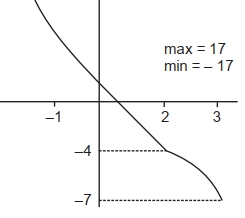
$1$. For $x \in [-1, 2]$,$f'(x) = 2x - 8$. Setting $f'(x) = 0$ gives $x = 4$,which is outside the interval. Thus,check endpoints: $f(-1) = (-1)^2 - 8(-1) + 8 = 1 + 8 + 8 = 17$ and $f(2) = 2^2 - 8(2) + 8 = 4 - 16 + 8 = -4$.
$2$. For $x \in [2, 3]$,$f'(x) = -2x + 2$. Setting $f'(x) = 0$ gives $x = 1$,which is outside the interval. Thus,check endpoints: $f(2) = -4$ and $f(3) = -(3)^2 + 2(3) - 4 = -9 + 6 - 4 = -7$.
The absolute maximum value is $17$ and the absolute minimum value is $-7$.
The sum of the absolute maximum and minimum values is $17 + (-7) = 10$.
For $x \in [-1, 2]$,$x^2 - 5x + 6 \ge 0$,so $f(x) = x^2 - 5x + 6 - 3x + 2 = x^2 - 8x + 8$.
For $x \in [2, 3]$,$x^2 - 5x + 6 \le 0$,so $f(x) = -(x^2 - 5x + 6) - 3x + 2 = -x^2 + 2x - 4$.
Now,check critical points and endpoints:
$1$. For $x \in [-1, 2]$,$f'(x) = 2x - 8$. Setting $f'(x) = 0$ gives $x = 4$,which is outside the interval. Thus,check endpoints: $f(-1) = (-1)^2 - 8(-1) + 8 = 1 + 8 + 8 = 17$ and $f(2) = 2^2 - 8(2) + 8 = 4 - 16 + 8 = -4$.
$2$. For $x \in [2, 3]$,$f'(x) = -2x + 2$. Setting $f'(x) = 0$ gives $x = 1$,which is outside the interval. Thus,check endpoints: $f(2) = -4$ and $f(3) = -(3)^2 + 2(3) - 4 = -9 + 6 - 4 = -7$.
The absolute maximum value is $17$ and the absolute minimum value is $-7$.
The sum of the absolute maximum and minimum values is $17 + (-7) = 10$.
0 likes
View Solution424
AdvancedMCQ
The number of points where the curve $y=x^5-20x^3+50x+2$ crosses the $x$-axis is $............$.
A
$4$
B
$3$
C
$5$
D
$1$
Solution
(C) Let $f(x) = x^5-20x^3+50x+2$.
To find the number of points where the curve crosses the $x$-axis,we analyze the local maxima and minima by finding the derivative:
$f'(x) = 5x^4-60x^2+50 = 5(x^4-12x^2+10)$.
Setting $f'(x) = 0$,we get $x^4-12x^2+10 = 0$.
Using the quadratic formula for $x^2$:
$x^2 = \frac{12 \pm \sqrt{144-40}}{2} = 6 \pm \sqrt{26} \approx 6 \pm 5.1$.
So,$x^2 \approx 11.1$ or $x^2 \approx 0.9$.
This gives critical points at $x \approx \pm 3.3$ and $x \approx \pm 0.95$.
Evaluating the function at these points:
$f(-3.3) \approx -100 < 0$
$f(-0.95) \approx -28 < 0$
$f(0.95) \approx 32 > 0$
$f(3.3) \approx 104 > 0$
Also,$f(-4) < 0$,$f(-2) > 0$,$f(0) = 2$,$f(2) = -14$,$f(4) > 0$.
By the Intermediate Value Theorem,the function changes sign between $(-4, -2)$,$(-2, 0)$,$(0, 2)$,and $(2, 4)$.
Thus,there are $5$ points where the curve crosses the $x$-axis.
To find the number of points where the curve crosses the $x$-axis,we analyze the local maxima and minima by finding the derivative:
$f'(x) = 5x^4-60x^2+50 = 5(x^4-12x^2+10)$.
Setting $f'(x) = 0$,we get $x^4-12x^2+10 = 0$.
Using the quadratic formula for $x^2$:
$x^2 = \frac{12 \pm \sqrt{144-40}}{2} = 6 \pm \sqrt{26} \approx 6 \pm 5.1$.
So,$x^2 \approx 11.1$ or $x^2 \approx 0.9$.
This gives critical points at $x \approx \pm 3.3$ and $x \approx \pm 0.95$.
Evaluating the function at these points:
$f(-3.3) \approx -100 < 0$
$f(-0.95) \approx -28 < 0$
$f(0.95) \approx 32 > 0$
$f(3.3) \approx 104 > 0$
Also,$f(-4) < 0$,$f(-2) > 0$,$f(0) = 2$,$f(2) = -14$,$f(4) > 0$.
By the Intermediate Value Theorem,the function changes sign between $(-4, -2)$,$(-2, 0)$,$(0, 2)$,and $(2, 4)$.
Thus,there are $5$ points where the curve crosses the $x$-axis.
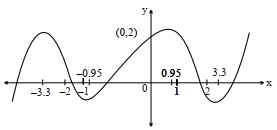
0 likes
View Solution425
AdvancedMCQ
If $a_n$ is the greatest term in the sequence $a_n = \frac{n^3}{n^4+147}$,$n = 1, 2, 3, \ldots$,then $n$ is equal to $..........$.
A
$4$
B
$5$
C
$3$
D
$6$
Solution
(B) Let $f(x) = \frac{x^3}{x^4+147}$.
To find the maximum value,we calculate the derivative $f'(x)$:
$f'(x) = \frac{(x^4+147)(3x^2) - (x^3)(4x^3)}{(x^4+147)^2}$
$f'(x) = \frac{3x^6 + 441x^2 - 4x^6}{(x^4+147)^2} = \frac{441x^2 - x^6}{(x^4+147)^2} = \frac{x^2(441 - x^4)}{(x^4+147)^2}$.
Setting $f'(x) = 0$,we get $x^2 = 0$ or $x^4 = 441$,which implies $x^2 = 21$ (since $x > 0$),so $x = \sqrt{21} \approx 4.58$.
Since $f(x)$ increases for $x < \sqrt{21}$ and decreases for $x > \sqrt{21}$,the maximum term in the sequence $a_n$ occurs at $n$ values closest to $\sqrt{21}$.
We compare $a_4$ and $a_5$:
$a_4 = \frac{4^3}{4^4+147} = \frac{64}{256+147} = \frac{64}{403} \approx 0.1588$.
$a_5 = \frac{5^3}{5^4+147} = \frac{125}{625+147} = \frac{125}{772} \approx 0.1619$.
Since $a_5 > a_4$,the greatest term is at $n = 5$.
To find the maximum value,we calculate the derivative $f'(x)$:
$f'(x) = \frac{(x^4+147)(3x^2) - (x^3)(4x^3)}{(x^4+147)^2}$
$f'(x) = \frac{3x^6 + 441x^2 - 4x^6}{(x^4+147)^2} = \frac{441x^2 - x^6}{(x^4+147)^2} = \frac{x^2(441 - x^4)}{(x^4+147)^2}$.
Setting $f'(x) = 0$,we get $x^2 = 0$ or $x^4 = 441$,which implies $x^2 = 21$ (since $x > 0$),so $x = \sqrt{21} \approx 4.58$.
Since $f(x)$ increases for $x < \sqrt{21}$ and decreases for $x > \sqrt{21}$,the maximum term in the sequence $a_n$ occurs at $n$ values closest to $\sqrt{21}$.
We compare $a_4$ and $a_5$:
$a_4 = \frac{4^3}{4^4+147} = \frac{64}{256+147} = \frac{64}{403} \approx 0.1588$.
$a_5 = \frac{5^3}{5^4+147} = \frac{125}{625+147} = \frac{125}{772} \approx 0.1619$.
Since $a_5 > a_4$,the greatest term is at $n = 5$.
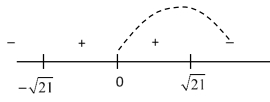
0 likes
View Solution426
DifficultMCQ
$A$ square piece of tin of side $30\,cm$ is to be made into a box without a top by cutting a square of side $x$ from each corner and folding up the flaps to form a box. If the volume of the box is maximum,then its surface area (in $cm^2$) is equal to $............$.
A
$675$
B
$1025$
C
$800$
D
$900$
Solution
(C) Let the side of the square cut from each corner be $x\,cm$.
The dimensions of the resulting box will be length $= (30-2x)\,cm$,width $= (30-2x)\,cm$,and height $= x\,cm$.
The volume $V$ of the box is given by $V = x(30-2x)^2$.
To find the maximum volume,we differentiate $V$ with respect to $x$:
$V = x(900 - 120x + 4x^2) = 4x^3 - 120x^2 + 900x$.
$\frac{dV}{dx} = 12x^2 - 240x + 900$.
Setting $\frac{dV}{dx} = 0$ for critical points:
$12(x^2 - 20x + 75) = 0$
$12(x-5)(x-15) = 0$.
Thus,$x = 5$ or $x = 15$. Since $x=15$ would result in a side length of $0$,we take $x = 5\,cm$.
The surface area $S$ of the open box is the area of the original square minus the area of the four cut-out squares:
$S = (30)^2 - 4x^2 = 900 - 4(5)^2 = 900 - 100 = 800\,cm^2$.
The dimensions of the resulting box will be length $= (30-2x)\,cm$,width $= (30-2x)\,cm$,and height $= x\,cm$.
The volume $V$ of the box is given by $V = x(30-2x)^2$.
To find the maximum volume,we differentiate $V$ with respect to $x$:
$V = x(900 - 120x + 4x^2) = 4x^3 - 120x^2 + 900x$.
$\frac{dV}{dx} = 12x^2 - 240x + 900$.
Setting $\frac{dV}{dx} = 0$ for critical points:
$12(x^2 - 20x + 75) = 0$
$12(x-5)(x-15) = 0$.
Thus,$x = 5$ or $x = 15$. Since $x=15$ would result in a side length of $0$,we take $x = 5\,cm$.
The surface area $S$ of the open box is the area of the original square minus the area of the four cut-out squares:
$S = (30)^2 - 4x^2 = 900 - 4(5)^2 = 900 - 100 = 800\,cm^2$.
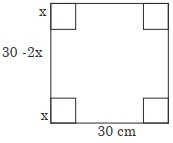
0 likes
View Solution427
AdvancedMCQ
Let $f :[2,4] \rightarrow R$ be a differentiable function such that $(x \ln x) f'(x) + (\ln x + 1) f(x) \geq 1$ for all $x \in [2,4]$,with $f(2) = \frac{1}{2}$ and $f(4) = \frac{1}{4}$. Consider the following two statements:
$(A): f(x) \leq 1$ for all $x \in [2,4]$
$(B): f(x) \geq \frac{1}{8}$ for all $x \in [2,4]$
Then,
$(A): f(x) \leq 1$ for all $x \in [2,4]$
$(B): f(x) \geq \frac{1}{8}$ for all $x \in [2,4]$
Then,
A
Only statement $(B)$ is true
B
Neither statement $(A)$ nor statement $(B)$ is true
C
Both the statements $(A)$ and $(B)$ are true
D
Only statement $(A)$ is true
Solution
(C) Given the inequality: $(x \ln x) f'(x) + (\ln x + 1) f(x) \geq 1$.
This can be written as $\frac{d}{dx} (x \ln x \cdot f(x)) \geq 1$.
Let $g(x) = x \ln x \cdot f(x) - x$. Then $g'(x) = \frac{d}{dx} (x \ln x \cdot f(x)) - 1 \geq 0$.
Thus,$g(x)$ is a non-decreasing function on $[2,4]$.
Calculating values at endpoints:
$g(2) = 2 \ln 2 \cdot f(2) - 2 = 2 \ln 2 \cdot \frac{1}{2} - 2 = \ln 2 - 2$.
$g(4) = 4 \ln 4 \cdot f(4) - 4 = 4 \ln 4 \cdot \frac{1}{4} - 4 = \ln 4 - 4 = 2 \ln 2 - 4$.
Since $g(x)$ is non-decreasing,$g(2) \leq g(x) \leq g(4)$ for $x \in [2,4]$.
$\ln 2 - 2 \leq x \ln x \cdot f(x) - x \leq 2 \ln 2 - 4$.
Adding $x$ and dividing by $x \ln x$ gives:
$\frac{\ln 2 - 2}{x \ln x} + \frac{1}{\ln x} \leq f(x) \leq \frac{2 \ln 2 - 4}{x \ln x} + \frac{1}{\ln x}$.
For $x \in [2,4]$,the upper bound is $\leq \frac{2 \ln 2 - 4}{2 \ln 2} + \frac{1}{\ln 2} = 1 - \frac{2}{\ln 2} + \frac{1}{\ln 2} = 1 - \frac{1}{\ln 2} < 1$. Thus,$(A)$ is true.
For $x \in [2,4]$,the lower bound is $\geq \frac{\ln 2 - 2}{4 \ln 4} + \frac{1}{\ln 4} = \frac{\ln 2 - 2}{8 \ln 2} + \frac{1}{2 \ln 2} = \frac{\ln 2 - 2 + 4}{8 \ln 2} = \frac{\ln 2 + 2}{8 \ln 2} = \frac{1}{8} + \frac{1}{4 \ln 2} > \frac{1}{8}$. Thus,$(B)$ is true.
This can be written as $\frac{d}{dx} (x \ln x \cdot f(x)) \geq 1$.
Let $g(x) = x \ln x \cdot f(x) - x$. Then $g'(x) = \frac{d}{dx} (x \ln x \cdot f(x)) - 1 \geq 0$.
Thus,$g(x)$ is a non-decreasing function on $[2,4]$.
Calculating values at endpoints:
$g(2) = 2 \ln 2 \cdot f(2) - 2 = 2 \ln 2 \cdot \frac{1}{2} - 2 = \ln 2 - 2$.
$g(4) = 4 \ln 4 \cdot f(4) - 4 = 4 \ln 4 \cdot \frac{1}{4} - 4 = \ln 4 - 4 = 2 \ln 2 - 4$.
Since $g(x)$ is non-decreasing,$g(2) \leq g(x) \leq g(4)$ for $x \in [2,4]$.
$\ln 2 - 2 \leq x \ln x \cdot f(x) - x \leq 2 \ln 2 - 4$.
Adding $x$ and dividing by $x \ln x$ gives:
$\frac{\ln 2 - 2}{x \ln x} + \frac{1}{\ln x} \leq f(x) \leq \frac{2 \ln 2 - 4}{x \ln x} + \frac{1}{\ln x}$.
For $x \in [2,4]$,the upper bound is $\leq \frac{2 \ln 2 - 4}{2 \ln 2} + \frac{1}{\ln 2} = 1 - \frac{2}{\ln 2} + \frac{1}{\ln 2} = 1 - \frac{1}{\ln 2} < 1$. Thus,$(A)$ is true.
For $x \in [2,4]$,the lower bound is $\geq \frac{\ln 2 - 2}{4 \ln 4} + \frac{1}{\ln 4} = \frac{\ln 2 - 2}{8 \ln 2} + \frac{1}{2 \ln 2} = \frac{\ln 2 - 2 + 4}{8 \ln 2} = \frac{\ln 2 + 2}{8 \ln 2} = \frac{1}{8} + \frac{1}{4 \ln 2} > \frac{1}{8}$. Thus,$(B)$ is true.
0 likes
View Solution428
DifficultMCQ
If the local maximum value of the function $f(x)=\left(\frac{\sqrt{3 e}}{2 \sin x}\right)^{\sin ^2 x}, \quad x \in\left(0, \frac{\pi}{2}\right)$,is $\frac{k}{e}$,then $\left(\frac{ k }{ e }\right)^8+\frac{ k ^8}{ e ^5}+ k ^8$ is equal to
A
$e^5+e^6+e^{11}$
B
$e^3+e^5+e^{11}$
C
$e^3+e^6+e^{11}$
D
$e^3+e^6+e^{10}$
Solution
(C) Let $y=\left(\frac{\sqrt{3 e}}{2 \sin x}\right)^{\sin ^2 x}$.
Taking natural logarithm on both sides: $\ln y = \sin^2 x \cdot \ln \left(\frac{\sqrt{3 e}}{2 \sin x}\right)$.
Differentiating with respect to $x$: $\frac{1}{y} \frac{dy}{dx} = 2 \sin x \cos x \ln \left(\frac{\sqrt{3 e}}{2 \sin x}\right) + \sin^2 x \cdot \frac{2 \sin x}{\sqrt{3 e}} \cdot \frac{\sqrt{3 e}}{2} \cdot (-\csc x \cot x)$.
Simplifying the derivative: $\frac{1}{y} \frac{dy}{dx} = \sin x \cos x \left[ 2 \ln \left(\frac{\sqrt{3 e}}{2 \sin x}\right) - 1 \right]$.
Setting $\frac{dy}{dx} = 0$,we get $2 \ln \left(\frac{\sqrt{3 e}}{2 \sin x}\right) = 1$,which implies $\ln \left(\frac{3 e}{4 \sin^2 x}\right) = 1$.
Thus,$\frac{3 e}{4 \sin^2 x} = e$,so $\sin^2 x = \frac{3}{4}$.
Since $x \in (0, \frac{\pi}{2})$,$\sin x = \frac{\sqrt{3}}{2}$.
The local maximum value is $f(x) = \left(\frac{\sqrt{3 e}}{2 \cdot \frac{\sqrt{3}}{2}}\right)^{3/4} = (\sqrt{e})^{3/4} = e^{3/8}$.
Given $e^{3/8} = \frac{k}{e}$,we have $k = e^{1 + 3/8} = e^{11/8}$.
Then $k^8 = (e^{11/8})^8 = e^{11}$.
Substituting these values: $\left(\frac{k}{e}\right)^8 + \frac{k^8}{e^5} + k^8 = (e^{3/8})^8 + \frac{e^{11}}{e^5} + e^{11} = e^3 + e^6 + e^{11}$.
Taking natural logarithm on both sides: $\ln y = \sin^2 x \cdot \ln \left(\frac{\sqrt{3 e}}{2 \sin x}\right)$.
Differentiating with respect to $x$: $\frac{1}{y} \frac{dy}{dx} = 2 \sin x \cos x \ln \left(\frac{\sqrt{3 e}}{2 \sin x}\right) + \sin^2 x \cdot \frac{2 \sin x}{\sqrt{3 e}} \cdot \frac{\sqrt{3 e}}{2} \cdot (-\csc x \cot x)$.
Simplifying the derivative: $\frac{1}{y} \frac{dy}{dx} = \sin x \cos x \left[ 2 \ln \left(\frac{\sqrt{3 e}}{2 \sin x}\right) - 1 \right]$.
Setting $\frac{dy}{dx} = 0$,we get $2 \ln \left(\frac{\sqrt{3 e}}{2 \sin x}\right) = 1$,which implies $\ln \left(\frac{3 e}{4 \sin^2 x}\right) = 1$.
Thus,$\frac{3 e}{4 \sin^2 x} = e$,so $\sin^2 x = \frac{3}{4}$.
Since $x \in (0, \frac{\pi}{2})$,$\sin x = \frac{\sqrt{3}}{2}$.
The local maximum value is $f(x) = \left(\frac{\sqrt{3 e}}{2 \cdot \frac{\sqrt{3}}{2}}\right)^{3/4} = (\sqrt{e})^{3/4} = e^{3/8}$.
Given $e^{3/8} = \frac{k}{e}$,we have $k = e^{1 + 3/8} = e^{11/8}$.
Then $k^8 = (e^{11/8})^8 = e^{11}$.
Substituting these values: $\left(\frac{k}{e}\right)^8 + \frac{k^8}{e^5} + k^8 = (e^{3/8})^8 + \frac{e^{11}}{e^5} + e^{11} = e^3 + e^6 + e^{11}$.
0 likes
View Solution429
DifficultMCQ
$\max _{0 \leq x \leq \pi}\left\{x-2 \sin x \cos x+\frac{1}{3} \sin 3 x\right\}=$
A
$\frac{5 \pi+2+3 \sqrt{3}}{6}$
B
$\frac{\pi+2-3 \sqrt{3}}{6}$
C
$\pi$
D
$0$
Solution
(A) Let $f(x) = x - 2 \sin x \cos x + \frac{1}{3} \sin 3x = x - \sin 2x + \frac{1}{3} \sin 3x$.
To find the maximum,we differentiate $f(x)$ with respect to $x$:
$f'(x) = 1 - 2 \cos 2x + \cos 3x$.
Setting $f'(x) = 0$:
$1 - 2(2 \cos^2 x - 1) + (4 \cos^3 x - 3 \cos x) = 0$
$1 - 4 \cos^2 x + 2 + 4 \cos^3 x - 3 \cos x = 0$
$4 \cos^3 x - 4 \cos^2 x - 3 \cos x + 3 = 0$
$4 \cos^2 x (\cos x - 1) - 3 (\cos x - 1) = 0$
$(4 \cos^2 x - 3)(\cos x - 1) = 0$.
This gives $\cos x = 1$ or $\cos x = \pm \frac{\sqrt{3}}{2}$.
For $x \in [0, \pi]$,$x = 0, \frac{\pi}{6}, \frac{5\pi}{6}, \pi$.
Evaluating $f(x)$ at these points:
$f(0) = 0 - 0 + 0 = 0$.
$f(\pi) = \pi - 0 + 0 = \pi$.
$f(\frac{\pi}{6}) = \frac{\pi}{6} - \sin(\frac{\pi}{3}) + \frac{1}{3} \sin(\frac{\pi}{2}) = \frac{\pi}{6} - \frac{\sqrt{3}}{2} + \frac{1}{3} = \frac{\pi + 2 - 3\sqrt{3}}{6}$.
$f(\frac{5\pi}{6}) = \frac{5\pi}{6} - \sin(\frac{5\pi}{3}) + \frac{1}{3} \sin(\frac{5\pi}{2}) = \frac{5\pi}{6} - (-\frac{\sqrt{3}}{2}) + \frac{1}{3}(1) = \frac{5\pi + 3\sqrt{3} + 2}{6}$.
Comparing the values,the maximum value is $\frac{5\pi + 2 + 3\sqrt{3}}{6}$.
To find the maximum,we differentiate $f(x)$ with respect to $x$:
$f'(x) = 1 - 2 \cos 2x + \cos 3x$.
Setting $f'(x) = 0$:
$1 - 2(2 \cos^2 x - 1) + (4 \cos^3 x - 3 \cos x) = 0$
$1 - 4 \cos^2 x + 2 + 4 \cos^3 x - 3 \cos x = 0$
$4 \cos^3 x - 4 \cos^2 x - 3 \cos x + 3 = 0$
$4 \cos^2 x (\cos x - 1) - 3 (\cos x - 1) = 0$
$(4 \cos^2 x - 3)(\cos x - 1) = 0$.
This gives $\cos x = 1$ or $\cos x = \pm \frac{\sqrt{3}}{2}$.
For $x \in [0, \pi]$,$x = 0, \frac{\pi}{6}, \frac{5\pi}{6}, \pi$.
Evaluating $f(x)$ at these points:
$f(0) = 0 - 0 + 0 = 0$.
$f(\pi) = \pi - 0 + 0 = \pi$.
$f(\frac{\pi}{6}) = \frac{\pi}{6} - \sin(\frac{\pi}{3}) + \frac{1}{3} \sin(\frac{\pi}{2}) = \frac{\pi}{6} - \frac{\sqrt{3}}{2} + \frac{1}{3} = \frac{\pi + 2 - 3\sqrt{3}}{6}$.
$f(\frac{5\pi}{6}) = \frac{5\pi}{6} - \sin(\frac{5\pi}{3}) + \frac{1}{3} \sin(\frac{5\pi}{2}) = \frac{5\pi}{6} - (-\frac{\sqrt{3}}{2}) + \frac{1}{3}(1) = \frac{5\pi + 3\sqrt{3} + 2}{6}$.
Comparing the values,the maximum value is $\frac{5\pi + 2 + 3\sqrt{3}}{6}$.
0 likes
View Solution430
MediumMCQ
The function $f(x) = 2x + 3x^{\frac{2}{3}}, x \in R$,has
A
exactly one point of local minima and no point of local maxima
B
exactly one point of local maxima and no point of local minima
C
exactly one point of local maxima and exactly one point of local minima
D
exactly two points of local maxima and exactly one point of local minima
Solution
(C) Given function is $f(x) = 2x + 3x^{\frac{2}{3}}$.
First,find the derivative $f'(x)$:
$f'(x) = 2 + 3 \cdot \frac{2}{3} x^{\frac{2}{3} - 1} = 2 + 2x^{-\frac{1}{3}} = 2 + \frac{2}{x^{\frac{1}{3}}} = 2 \left( \frac{x^{\frac{1}{3}} + 1}{x^{\frac{1}{3}}} \right)$.
Critical points occur where $f'(x) = 0$ or $f'(x)$ is undefined.
$f'(x) = 0 \implies x^{\frac{1}{3}} + 1 = 0 \implies x = -1$.
$f'(x)$ is undefined at $x = 0$.
Now,check the sign of $f'(x)$ around these points:
For $x < -1$,$f'(x) > 0$.
For $-1 < x < 0$,$f'(x) < 0$.
For $x > 0$,$f'(x) > 0$.
Since $f'(x)$ changes from positive to negative at $x = -1$,there is a local maximum at $x = -1$.
Since $f'(x)$ changes from negative to positive at $x = 0$,there is a local minimum at $x = 0$.
Thus,the function has exactly one point of local maxima and exactly one point of local minima.
First,find the derivative $f'(x)$:
$f'(x) = 2 + 3 \cdot \frac{2}{3} x^{\frac{2}{3} - 1} = 2 + 2x^{-\frac{1}{3}} = 2 + \frac{2}{x^{\frac{1}{3}}} = 2 \left( \frac{x^{\frac{1}{3}} + 1}{x^{\frac{1}{3}}} \right)$.
Critical points occur where $f'(x) = 0$ or $f'(x)$ is undefined.
$f'(x) = 0 \implies x^{\frac{1}{3}} + 1 = 0 \implies x = -1$.
$f'(x)$ is undefined at $x = 0$.
Now,check the sign of $f'(x)$ around these points:
For $x < -1$,$f'(x) > 0$.
For $-1 < x < 0$,$f'(x) < 0$.
For $x > 0$,$f'(x) > 0$.
Since $f'(x)$ changes from positive to negative at $x = -1$,there is a local maximum at $x = -1$.
Since $f'(x)$ changes from negative to positive at $x = 0$,there is a local minimum at $x = 0$.
Thus,the function has exactly one point of local maxima and exactly one point of local minima.
0 likes
View Solution431
DifficultMCQ
The maximum area of a triangle whose one vertex is at $(0,0)$ and the other two vertices lie on the curve $y = -2x^2 + 54$ at points $(x, y)$ and $(-x, y)$ where $y > 0$ is:
A
$88$
B
$122$
C
$92$
D
$108$
Solution
(D) The vertices of the triangle are $(0,0)$,$(x, y)$,and $(-x, y)$.
The area of the triangle is given by the determinant formula:
$\text{Area} = \frac{1}{2} |0(y - y) + x(y - 0) + (-x)(0 - y)|$
$\text{Area} = \frac{1}{2} |xy + xy| = |xy|$
Given the curve $y = -2x^2 + 54$,we substitute $y$ into the area expression:
$A(x) = |x(-2x^2 + 54)| = |-2x^3 + 54x|$
Since $y > 0$,we have $-2x^2 + 54 > 0$,which implies $x^2 < 27$,so $x \in (-\sqrt{27}, \sqrt{27})$.
For $x > 0$,$A(x) = -2x^3 + 54x$.
To find the maximum area,we differentiate $A(x)$ with respect to $x$:
$\frac{dA}{dx} = -6x^2 + 54$
Setting $\frac{dA}{dx} = 0$:
$-6x^2 + 54 = 0 \Rightarrow x^2 = 9 \Rightarrow x = 3$ (since $x > 0$).
Now,calculate the maximum area at $x = 3$:
$A(3) = |3(-2(3)^2 + 54)| = |3(-18 + 54)| = |3(36)| = 108$.
Thus,the maximum area of the triangle is $108$.
The area of the triangle is given by the determinant formula:
$\text{Area} = \frac{1}{2} |0(y - y) + x(y - 0) + (-x)(0 - y)|$
$\text{Area} = \frac{1}{2} |xy + xy| = |xy|$
Given the curve $y = -2x^2 + 54$,we substitute $y$ into the area expression:
$A(x) = |x(-2x^2 + 54)| = |-2x^3 + 54x|$
Since $y > 0$,we have $-2x^2 + 54 > 0$,which implies $x^2 < 27$,so $x \in (-\sqrt{27}, \sqrt{27})$.
For $x > 0$,$A(x) = -2x^3 + 54x$.
To find the maximum area,we differentiate $A(x)$ with respect to $x$:
$\frac{dA}{dx} = -6x^2 + 54$
Setting $\frac{dA}{dx} = 0$:
$-6x^2 + 54 = 0 \Rightarrow x^2 = 9 \Rightarrow x = 3$ (since $x > 0$).
Now,calculate the maximum area at $x = 3$:
$A(3) = |3(-2(3)^2 + 54)| = |3(-18 + 54)| = |3(36)| = 108$.
Thus,the maximum area of the triangle is $108$.
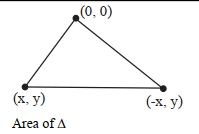
0 likes
View Solution432
DifficultMCQ
Let $f(x)=(x+3)^2(x-2)^3$ for $x \in [-4,4]$. If $M$ and $m$ are the maximum and minimum values of $f$ respectively in $[-4,4]$,then the value of $M-m$ is:
A
$600$
B
$392$
C
$608$
D
$108$
Solution
(C) Given $f(x)=(x+3)^2(x-2)^3$.
To find the critical points,we differentiate $f(x)$ with respect to $x$:
$f^{\prime}(x) = \frac{d}{dx}[(x+3)^2(x-2)^3]$
$f^{\prime}(x) = 2(x+3)(x-2)^3 + 3(x-2)^2(x+3)^2$
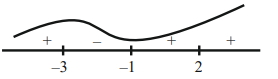
$f^{\prime}(x) = (x+3)(x-2)^2 [2(x-2) + 3(x+3)]$
$f^{\prime}(x) = (x+3)(x-2)^2 [2x - 4 + 3x + 9]$
$f^{\prime}(x) = (x+3)(x-2)^2 (5x + 5)$
$f^{\prime}(x) = 5(x+3)(x-2)^2 (x+1)$
Setting $f^{\prime}(x) = 0$,we get critical points $x = -3, -1, 2$.
Now,we evaluate $f(x)$ at the critical points and the endpoints of the interval $[-4, 4]$:
$f(-4) = (-4+3)^2(-4-2)^3 = (-1)^2(-6)^3 = 1 \times (-216) = -216$
$f(-3) = (-3+3)^2(-3-2)^3 = 0$
$f(-1) = (-1+3)^2(-1-2)^3 = (2)^2(-3)^3 = 4 \times (-27) = -108$
$f(2) = (2+3)^2(2-2)^3 = 0$
$f(4) = (4+3)^2(4-2)^3 = (7)^2(2)^3 = 49 \times 8 = 392$
Comparing these values,the maximum value $M = 392$ and the minimum value $m = -216$.
Therefore,$M - m = 392 - (-216) = 392 + 216 = 608$.
To find the critical points,we differentiate $f(x)$ with respect to $x$:
$f^{\prime}(x) = \frac{d}{dx}[(x+3)^2(x-2)^3]$
$f^{\prime}(x) = 2(x+3)(x-2)^3 + 3(x-2)^2(x+3)^2$
$f^{\prime}(x) = (x+3)(x-2)^2 [2(x-2) + 3(x+3)]$
$f^{\prime}(x) = (x+3)(x-2)^2 [2x - 4 + 3x + 9]$
$f^{\prime}(x) = (x+3)(x-2)^2 (5x + 5)$
$f^{\prime}(x) = 5(x+3)(x-2)^2 (x+1)$
Setting $f^{\prime}(x) = 0$,we get critical points $x = -3, -1, 2$.
Now,we evaluate $f(x)$ at the critical points and the endpoints of the interval $[-4, 4]$:
$f(-4) = (-4+3)^2(-4-2)^3 = (-1)^2(-6)^3 = 1 \times (-216) = -216$
$f(-3) = (-3+3)^2(-3-2)^3 = 0$
$f(-1) = (-1+3)^2(-1-2)^3 = (2)^2(-3)^3 = 4 \times (-27) = -108$
$f(2) = (2+3)^2(2-2)^3 = 0$
$f(4) = (4+3)^2(4-2)^3 = (7)^2(2)^3 = 49 \times 8 = 392$
Comparing these values,the maximum value $M = 392$ and the minimum value $m = -216$.
Therefore,$M - m = 392 - (-216) = 392 + 216 = 608$.
0 likes
View Solution433
DifficultMCQ
Let $S=(-1, \infty)$ and $f: S \rightarrow R$ be defined as $f(x)=\int_{-1}^x (e^t-1)^{11}(2t-1)^5(t-2)^7(t-3)^{12}(2t-10)^{61} dt$. Let $p$ be the sum of the squares of the values of $x$ where $f(x)$ attains local maxima on $S$,and $q$ be the sum of the values of $x$ where $f(x)$ attains local minima on $S$. Then,the value of $p^2+2q$ is
A
$28$
B
$27$
C
$25$
D
$24$
Solution
(B) By the Fundamental Theorem of Calculus,$f'(x) = (e^x-1)^{11}(2x-1)^5(x-2)^7(x-3)^{12}(2x-10)^{61}$.
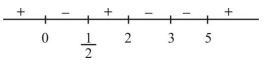
To find critical points,set $f'(x) = 0$,which gives $x = 0, \frac{1}{2}, 2, 3, 5$.
We analyze the sign of $f'(x)$ around these points:
- At $x=0$: $f'(x)$ changes from $+$ to $-$,so $f(x)$ has a local maximum at $x=0$.
- At $x=\frac{1}{2}$: $f'(x)$ changes from $-$ to $+$,so $f(x)$ has a local minimum at $x=\frac{1}{2}$.
- At $x=2$: $f'(x)$ changes from $+$ to $-$,so $f(x)$ has a local maximum at $x=2$.
- At $x=3$: $f'(x)$ does not change sign (power is $12$),so it is a point of inflection.
- At $x=5$: $f'(x)$ changes from $-$ to $+$,so $f(x)$ has a local minimum at $x=5$.
Local maxima occur at $x=0$ and $x=2$. Thus,$p = 0^2 + 2^2 = 4$.
Local minima occur at $x=\frac{1}{2}$ and $x=5$. Thus,$q = \frac{1}{2} + 5 = \frac{11}{2}$.
Finally,$p^2 + 2q = 4^2 + 2(\frac{11}{2}) = 16 + 11 = 27$.
To find critical points,set $f'(x) = 0$,which gives $x = 0, \frac{1}{2}, 2, 3, 5$.
We analyze the sign of $f'(x)$ around these points:
- At $x=0$: $f'(x)$ changes from $+$ to $-$,so $f(x)$ has a local maximum at $x=0$.
- At $x=\frac{1}{2}$: $f'(x)$ changes from $-$ to $+$,so $f(x)$ has a local minimum at $x=\frac{1}{2}$.
- At $x=2$: $f'(x)$ changes from $+$ to $-$,so $f(x)$ has a local maximum at $x=2$.
- At $x=3$: $f'(x)$ does not change sign (power is $12$),so it is a point of inflection.
- At $x=5$: $f'(x)$ changes from $-$ to $+$,so $f(x)$ has a local minimum at $x=5$.
Local maxima occur at $x=0$ and $x=2$. Thus,$p = 0^2 + 2^2 = 4$.
Local minima occur at $x=\frac{1}{2}$ and $x=5$. Thus,$q = \frac{1}{2} + 5 = \frac{11}{2}$.
Finally,$p^2 + 2q = 4^2 + 2(\frac{11}{2}) = 16 + 11 = 27$.
0 likes
View Solution434
DifficultMCQ
Let the sum of the maximum and the minimum values of the function $f(x) = \frac{2x^2 - 3x + 8}{2x^2 + 3x + 8}$ be $\frac{m}{n}$,where $\gcd(m, n) = 1$. Then $m + n$ is equal to :
A
$182$
B
$217$
C
$195$
D
$201$
Solution
(D) Let $y = \frac{2x^2 - 3x + 8}{2x^2 + 3x + 8}$.
Rearranging the terms,we get $y(2x^2 + 3x + 8) = 2x^2 - 3x + 8$.
$x^2(2y - 2) + x(3y + 3) + 8y - 8 = 0$.
For $x$ to be real,the discriminant $D \geq 0$.
$D = (3y + 3)^2 - 4(2y - 2)(8y - 8) \geq 0$.
$9(y + 1)^2 - 4 \cdot 2(y - 1) \cdot 8(y - 1) \geq 0$.
$9(y^2 + 2y + 1) - 64(y^2 - 2y + 1) \geq 0$.
$9y^2 + 18y + 9 - 64y^2 + 128y - 64 \geq 0$.
$-55y^2 + 146y - 55 \geq 0$.
$55y^2 - 146y + 55 \leq 0$.
Solving the quadratic equation $55y^2 - 146y + 55 = 0$ using the quadratic formula $y = \frac{-b \pm \sqrt{b^2 - 4ac}}{2a}$:
$y = \frac{146 \pm \sqrt{21316 - 12100}}{110} = \frac{146 \pm \sqrt{9216}}{110} = \frac{146 \pm 96}{110}$.
$y_1 = \frac{242}{110} = \frac{11}{5}$ and $y_2 = \frac{50}{110} = \frac{5}{11}$.
Thus,the range is $[\frac{5}{11}, \frac{11}{5}]$.
The maximum value is $\frac{11}{5}$ and the minimum value is $\frac{5}{11}$.
Sum $= \frac{11}{5} + \frac{5}{11} = \frac{121 + 25}{55} = \frac{146}{55}$.
Here $m = 146$ and $n = 55$. Since $\gcd(146, 55) = 1$,$m + n = 146 + 55 = 201$.
Rearranging the terms,we get $y(2x^2 + 3x + 8) = 2x^2 - 3x + 8$.
$x^2(2y - 2) + x(3y + 3) + 8y - 8 = 0$.
For $x$ to be real,the discriminant $D \geq 0$.
$D = (3y + 3)^2 - 4(2y - 2)(8y - 8) \geq 0$.
$9(y + 1)^2 - 4 \cdot 2(y - 1) \cdot 8(y - 1) \geq 0$.
$9(y^2 + 2y + 1) - 64(y^2 - 2y + 1) \geq 0$.
$9y^2 + 18y + 9 - 64y^2 + 128y - 64 \geq 0$.
$-55y^2 + 146y - 55 \geq 0$.
$55y^2 - 146y + 55 \leq 0$.
Solving the quadratic equation $55y^2 - 146y + 55 = 0$ using the quadratic formula $y = \frac{-b \pm \sqrt{b^2 - 4ac}}{2a}$:
$y = \frac{146 \pm \sqrt{21316 - 12100}}{110} = \frac{146 \pm \sqrt{9216}}{110} = \frac{146 \pm 96}{110}$.
$y_1 = \frac{242}{110} = \frac{11}{5}$ and $y_2 = \frac{50}{110} = \frac{5}{11}$.
Thus,the range is $[\frac{5}{11}, \frac{11}{5}]$.
The maximum value is $\frac{11}{5}$ and the minimum value is $\frac{5}{11}$.
Sum $= \frac{11}{5} + \frac{5}{11} = \frac{121 + 25}{55} = \frac{146}{55}$.
Here $m = 146$ and $n = 55$. Since $\gcd(146, 55) = 1$,$m + n = 146 + 55 = 201$.
0 likes
View Solution435
DifficultMCQ
Let $f(x)=3 \sqrt{x-2}+\sqrt{4-x}$ be a real-valued function. If $\alpha$ and $\beta$ are respectively the minimum and the maximum values of $f$,then $\alpha^2+2 \beta^2$ is equal to
A
$44$
B
$42$
C
$24$
D
$38$
Solution
(B) Given the function $f(x)=3 \sqrt{x-2}+\sqrt{4-x}$.
The domain of the function is determined by $x-2 \geq 0$ and $4-x \geq 0$,which implies $x \in [2, 4]$.
To find the range,we use the Cauchy-Schwarz inequality or trigonometric substitution. Let $u = \sqrt{x-2}$ and $v = \sqrt{4-x}$. Then $u^2 + v^2 = (x-2) + (4-x) = 2$.
The function is $f(x) = 3u + v$. By the Cauchy-Schwarz inequality,$(3u + v)^2 \leq (3^2 + 1^2)(u^2 + v^2) = (9+1)(2) = 20$.
Thus,$f(x)^2 \leq 20$,so $f(x) \leq \sqrt{20} = \beta$.
At the boundaries of the domain:
If $x=2$,$f(2) = 3(0) + \sqrt{2} = \sqrt{2}$.
If $x=4$,$f(4) = 3\sqrt{2} + 0 = 3\sqrt{2} = \sqrt{18}$.
Since $\sqrt{2} < \sqrt{18} < \sqrt{20}$,the minimum value $\alpha = \sqrt{2}$.
Therefore,$\alpha^2 + 2\beta^2 = (\sqrt{2})^2 + 2(\sqrt{20})^2 = 2 + 2(20) = 2 + 40 = 42$.
The domain of the function is determined by $x-2 \geq 0$ and $4-x \geq 0$,which implies $x \in [2, 4]$.
To find the range,we use the Cauchy-Schwarz inequality or trigonometric substitution. Let $u = \sqrt{x-2}$ and $v = \sqrt{4-x}$. Then $u^2 + v^2 = (x-2) + (4-x) = 2$.
The function is $f(x) = 3u + v$. By the Cauchy-Schwarz inequality,$(3u + v)^2 \leq (3^2 + 1^2)(u^2 + v^2) = (9+1)(2) = 20$.
Thus,$f(x)^2 \leq 20$,so $f(x) \leq \sqrt{20} = \beta$.
At the boundaries of the domain:
If $x=2$,$f(2) = 3(0) + \sqrt{2} = \sqrt{2}$.
If $x=4$,$f(4) = 3\sqrt{2} + 0 = 3\sqrt{2} = \sqrt{18}$.
Since $\sqrt{2} < \sqrt{18} < \sqrt{20}$,the minimum value $\alpha = \sqrt{2}$.
Therefore,$\alpha^2 + 2\beta^2 = (\sqrt{2})^2 + 2(\sqrt{20})^2 = 2 + 2(20) = 2 + 40 = 42$.
0 likes
View Solution436
DifficultMCQ
Let a rectangle $ABCD$ of sides $2$ and $4$ be inscribed in another rectangle $PQRS$ such that the vertices of the rectangle $ABCD$ lie on the sides of the rectangle $PQRS$. Let $a$ and $b$ be the sides of the rectangle $PQRS$ when its area is maximum. Then $(a+b)^2$ is equal to :
A
$72$
B
$60$
C
$80$
D
$64$
Solution
(A) Let $\theta$ be the angle that the side $AB$ of the rectangle $ABCD$ makes with the side $PQ$ of the rectangle $PQRS$.
From the geometry of the figure,the sides of the rectangle $PQRS$ are $a = 4 \cos \theta + 2 \sin \theta$ and $b = 4 \sin \theta + 2 \cos \theta$.
The area of the rectangle $PQRS$ is $A = a \times b = (4 \cos \theta + 2 \sin \theta)(4 \sin \theta + 2 \cos \theta)$.
Expanding this,we get $A = 16 \sin \theta \cos \theta + 8 \cos^2 \theta + 8 \sin^2 \theta + 4 \sin \theta \cos \theta = 8(\sin^2 \theta + \cos^2 \theta) + 20 \sin \theta \cos \theta$.
Using trigonometric identities,$A = 8 + 10 \sin 2\theta$.
The area is maximum when $\sin 2\theta = 1$,which occurs at $\theta = 45^{\circ}$.
At $\theta = 45^{\circ}$,the sides are $a = 4(\frac{1}{\sqrt{2}}) + 2(\frac{1}{\sqrt{2}}) = \frac{6}{\sqrt{2}} = 3\sqrt{2}$ and $b = 4(\frac{1}{\sqrt{2}}) + 2(\frac{1}{\sqrt{2}}) = 3\sqrt{2}$.
Then $(a+b)^2 = (3\sqrt{2} + 3\sqrt{2})^2 = (6\sqrt{2})^2 = 36 \times 2 = 72$.
From the geometry of the figure,the sides of the rectangle $PQRS$ are $a = 4 \cos \theta + 2 \sin \theta$ and $b = 4 \sin \theta + 2 \cos \theta$.
The area of the rectangle $PQRS$ is $A = a \times b = (4 \cos \theta + 2 \sin \theta)(4 \sin \theta + 2 \cos \theta)$.
Expanding this,we get $A = 16 \sin \theta \cos \theta + 8 \cos^2 \theta + 8 \sin^2 \theta + 4 \sin \theta \cos \theta = 8(\sin^2 \theta + \cos^2 \theta) + 20 \sin \theta \cos \theta$.
Using trigonometric identities,$A = 8 + 10 \sin 2\theta$.
The area is maximum when $\sin 2\theta = 1$,which occurs at $\theta = 45^{\circ}$.
At $\theta = 45^{\circ}$,the sides are $a = 4(\frac{1}{\sqrt{2}}) + 2(\frac{1}{\sqrt{2}}) = \frac{6}{\sqrt{2}} = 3\sqrt{2}$ and $b = 4(\frac{1}{\sqrt{2}}) + 2(\frac{1}{\sqrt{2}}) = 3\sqrt{2}$.
Then $(a+b)^2 = (3\sqrt{2} + 3\sqrt{2})^2 = (6\sqrt{2})^2 = 36 \times 2 = 72$.
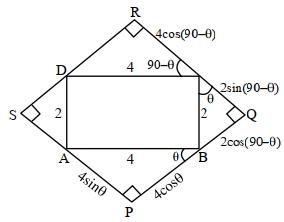
0 likes
View Solution437
DifficultMCQ
If the function $f(x) = (\frac{1}{x})^{2x}$ for $x > 0$ attains the maximum value at $x = \frac{1}{e}$,then:
A
$e^\pi < \pi^e$
B
$e^{2\pi} < (2\pi)^e$
C
$e^\pi > \pi^e$
D
$(2e)^\pi > \pi^{(2e)}$
Solution
(C) Let $f(x) = (\frac{1}{x})^{2x}$.
Taking the natural logarithm on both sides,we get $\ln(f(x)) = 2x \ln(\frac{1}{x}) = -2x \ln(x)$.
To find the critical points,we differentiate with respect to $x$:
$\frac{f'(x)}{f(x)} = -2(1 \cdot \ln(x) + x \cdot \frac{1}{x}) = -2(\ln(x) + 1)$.
Setting $f'(x) = 0$,we get $\ln(x) = -1$,which implies $x = \frac{1}{e}$.
Since $f'(x) > 0$ for $x < \frac{1}{e}$ and $f'(x) < 0$ for $x > \frac{1}{e}$,the function attains its maximum value at $x = \frac{1}{e}$.
Thus,$f(x) \leq f(\frac{1}{e})$ for all $x > 0$.
$f(\frac{1}{e}) = (\frac{1}{1/e})^{2(1/e)} = e^{2/e}$.
For any $x$,$(\frac{1}{x})^{2x} \leq e^{2/e}$.
Taking $x = \frac{1}{\pi}$,we have $(\frac{1}{1/\pi})^{2(1/\pi)} \leq e^{2/e}$.
$\pi^{2/\pi} \leq e^{2/e}$.
Raising both sides to the power of $\frac{\pi e}{2}$,we get $(\pi^{2/\pi})^{\pi e/2} \leq (e^{2/e})^{\pi e/2}$.
$\pi^e \leq e^\pi$.
Since $\pi \neq e$,we have $e^\pi > \pi^e$.
Taking the natural logarithm on both sides,we get $\ln(f(x)) = 2x \ln(\frac{1}{x}) = -2x \ln(x)$.
To find the critical points,we differentiate with respect to $x$:
$\frac{f'(x)}{f(x)} = -2(1 \cdot \ln(x) + x \cdot \frac{1}{x}) = -2(\ln(x) + 1)$.
Setting $f'(x) = 0$,we get $\ln(x) = -1$,which implies $x = \frac{1}{e}$.
Since $f'(x) > 0$ for $x < \frac{1}{e}$ and $f'(x) < 0$ for $x > \frac{1}{e}$,the function attains its maximum value at $x = \frac{1}{e}$.
Thus,$f(x) \leq f(\frac{1}{e})$ for all $x > 0$.
$f(\frac{1}{e}) = (\frac{1}{1/e})^{2(1/e)} = e^{2/e}$.
For any $x$,$(\frac{1}{x})^{2x} \leq e^{2/e}$.
Taking $x = \frac{1}{\pi}$,we have $(\frac{1}{1/\pi})^{2(1/\pi)} \leq e^{2/e}$.
$\pi^{2/\pi} \leq e^{2/e}$.
Raising both sides to the power of $\frac{\pi e}{2}$,we get $(\pi^{2/\pi})^{\pi e/2} \leq (e^{2/e})^{\pi e/2}$.
$\pi^e \leq e^\pi$.
Since $\pi \neq e$,we have $e^\pi > \pi^e$.
0 likes
View Solution438
DifficultMCQ
The number of critical points of the function $f(x)=(x-2)^{2/3}(2x+1)$ is:
A
$2$
B
$0$
C
$1$
D
$3$
Solution
(A) Given function: $f(x) = (x-2)^{2/3}(2x+1)$.
To find the critical points,we calculate the derivative $f'(x)$ using the product rule:
$f'(x) = \frac{d}{dx}[(x-2)^{2/3}] \cdot (2x+1) + (x-2)^{2/3} \cdot \frac{d}{dx}[2x+1]$
$f'(x) = \frac{2}{3}(x-2)^{-1/3}(2x+1) + 2(x-2)^{2/3}$
Factor out $2(x-2)^{-1/3}$:
$f'(x) = 2(x-2)^{-1/3} [\frac{1}{3}(2x+1) + (x-2)]$
$f'(x) = \frac{2}{3(x-2)^{1/3}} [2x + 1 + 3x - 6]$
$f'(x) = \frac{2(5x-5)}{3(x-2)^{1/3}} = \frac{10(x-1)}{3(x-2)^{1/3}}$
Critical points occur where $f'(x) = 0$ or $f'(x)$ is undefined.
$f'(x) = 0 \implies x-1 = 0 \implies x = 1$.
$f'(x)$ is undefined when the denominator is zero,i.e.,$x-2 = 0 \implies x = 2$.
Thus,the critical points are $x=1$ and $x=2$.
There are $2$ critical points.
To find the critical points,we calculate the derivative $f'(x)$ using the product rule:
$f'(x) = \frac{d}{dx}[(x-2)^{2/3}] \cdot (2x+1) + (x-2)^{2/3} \cdot \frac{d}{dx}[2x+1]$
$f'(x) = \frac{2}{3}(x-2)^{-1/3}(2x+1) + 2(x-2)^{2/3}$
Factor out $2(x-2)^{-1/3}$:
$f'(x) = 2(x-2)^{-1/3} [\frac{1}{3}(2x+1) + (x-2)]$
$f'(x) = \frac{2}{3(x-2)^{1/3}} [2x + 1 + 3x - 6]$
$f'(x) = \frac{2(5x-5)}{3(x-2)^{1/3}} = \frac{10(x-1)}{3(x-2)^{1/3}}$
Critical points occur where $f'(x) = 0$ or $f'(x)$ is undefined.
$f'(x) = 0 \implies x-1 = 0 \implies x = 1$.
$f'(x)$ is undefined when the denominator is zero,i.e.,$x-2 = 0 \implies x = 2$.
Thus,the critical points are $x=1$ and $x=2$.
There are $2$ critical points.
0 likes
View Solution439
DifficultMCQ
Let $f(x)=4 \cos ^3 x+3 \sqrt{3} \cos ^2 x-10$. The number of points of local maxima of $f$ in the interval $(0, 2 \pi)$ is:
A
$1$
B
$2$
C
$3$
D
$4$
Solution
(B) Given $f(x)=4 \cos ^3 x+3 \sqrt{3} \cos ^2 x-10$ for $x \in(0, 2 \pi)$.
First,find the derivative $f^{\prime}(x)$:
$f^{\prime}(x) = 4(3 \cos ^2 x)(-\sin x) + 3 \sqrt{3}(2 \cos x)(-\sin x)$
$f^{\prime}(x) = -12 \cos ^2 x \sin x - 6 \sqrt{3} \cos x \sin x$
$f^{\prime}(x) = -6 \sin x \cos x (2 \cos x + \sqrt{3})$
$f^{\prime}(x) = -3 \sin(2x) (2 \cos x + \sqrt{3})$
To find critical points,set $f^{\prime}(x) = 0$:
$-3 \sin(2x) = 0 \Rightarrow 2x = 0, \pi, 2\pi, 3\pi, 4\pi \Rightarrow x = 0, \frac{\pi}{2}, \pi, \frac{3\pi}{2}, 2\pi$
$2 \cos x + \sqrt{3} = 0 \Rightarrow \cos x = -\frac{\sqrt{3}}{2} \Rightarrow x = \frac{5\pi}{6}, \frac{7\pi}{6}$
Critical points in $(0, 2\pi)$ are $\frac{\pi}{2}, \frac{5\pi}{6}, \pi, \frac{7\pi}{6}, \frac{3\pi}{2}$.
Analyzing the sign of $f^{\prime}(x)$:
For $x \in (0, \frac{\pi}{2})$,$f^{\prime}(x) < 0$.
For $x \in (\frac{\pi}{2}, \frac{5\pi}{6})$,$f^{\prime}(x) > 0$.
For $x \in (\frac{5\pi}{6}, \pi)$,$f^{\prime}(x) < 0$.
For $x \in (\pi, \frac{7\pi}{6})$,$f^{\prime}(x) > 0$.
For $x \in (\frac{7\pi}{6}, \frac{3\pi}{2})$,$f^{\prime}(x) < 0$.
For $x \in (\frac{3\pi}{2}, 2\pi)$,$f^{\prime}(x) > 0$.
Local maxima occur where $f^{\prime}(x)$ changes from positive to negative. This happens at $x = \frac{5\pi}{6}$ and $x = \frac{3\pi}{2}$.
Thus,there are $2$ points of local maxima.
First,find the derivative $f^{\prime}(x)$:
$f^{\prime}(x) = 4(3 \cos ^2 x)(-\sin x) + 3 \sqrt{3}(2 \cos x)(-\sin x)$
$f^{\prime}(x) = -12 \cos ^2 x \sin x - 6 \sqrt{3} \cos x \sin x$
$f^{\prime}(x) = -6 \sin x \cos x (2 \cos x + \sqrt{3})$
$f^{\prime}(x) = -3 \sin(2x) (2 \cos x + \sqrt{3})$
To find critical points,set $f^{\prime}(x) = 0$:
$-3 \sin(2x) = 0 \Rightarrow 2x = 0, \pi, 2\pi, 3\pi, 4\pi \Rightarrow x = 0, \frac{\pi}{2}, \pi, \frac{3\pi}{2}, 2\pi$
$2 \cos x + \sqrt{3} = 0 \Rightarrow \cos x = -\frac{\sqrt{3}}{2} \Rightarrow x = \frac{5\pi}{6}, \frac{7\pi}{6}$
Critical points in $(0, 2\pi)$ are $\frac{\pi}{2}, \frac{5\pi}{6}, \pi, \frac{7\pi}{6}, \frac{3\pi}{2}$.
Analyzing the sign of $f^{\prime}(x)$:
For $x \in (0, \frac{\pi}{2})$,$f^{\prime}(x) < 0$.
For $x \in (\frac{\pi}{2}, \frac{5\pi}{6})$,$f^{\prime}(x) > 0$.
For $x \in (\frac{5\pi}{6}, \pi)$,$f^{\prime}(x) < 0$.
For $x \in (\pi, \frac{7\pi}{6})$,$f^{\prime}(x) > 0$.
For $x \in (\frac{7\pi}{6}, \frac{3\pi}{2})$,$f^{\prime}(x) < 0$.
For $x \in (\frac{3\pi}{2}, 2\pi)$,$f^{\prime}(x) > 0$.
Local maxima occur where $f^{\prime}(x)$ changes from positive to negative. This happens at $x = \frac{5\pi}{6}$ and $x = \frac{3\pi}{2}$.
Thus,there are $2$ points of local maxima.
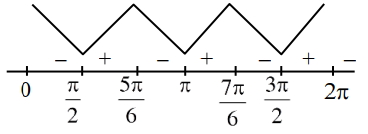
0 likes
View Solution440
DifficultMCQ
If the function $f(x)=2x^3-9ax^2+12a^2x+1, a>0$ has a local maximum at $x=\alpha$ and a local minimum at $x=\alpha^2$,then $\alpha$ and $\alpha^2$ are the roots of the equation:
A
$x^2-6x+8=0$
B
$8x^2+6x-8=0$
C
$8x^2-6x+1=0$
D
$x^2+6x+8=0$
Solution
(A) Given $f(x)=2x^3-9ax^2+12a^2x+1$.
Find the derivative: $f'(x)=6x^2-18ax+12a^2$.
For local extrema,set $f'(x)=0$,so $6(x^2-3ax+2a^2)=0$,which factors to $6(x-a)(x-2a)=0$.
The roots are $x=a$ and $x=2a$.
Given the local maximum at $x=\alpha$ and local minimum at $x=\alpha^2$,we have two cases:
Case $1$: $\alpha=a$ and $\alpha^2=2a$. Then $a^2=2a \Rightarrow a(a-2)=0$. Since $a>0$,$a=2$.
If $a=2$,the roots are $\alpha=2$ and $\alpha^2=4$. The equation is $(x-2)(x-4)=x^2-6x+8=0$.
Case $2$: $\alpha=2a$ and $\alpha^2=a$. Then $(2a)^2=a \Rightarrow 4a^2-a=0 \Rightarrow a(4a-1)=0$. Since $a>0$,$a=1/4$.
If $a=1/4$,the roots are $\alpha=1/2$ and $\alpha^2=1/4$. The equation is $(x-1/2)(x-1/4)=x^2-(3/4)x+1/8=0$,or $8x^2-6x+1=0$.
Checking the second derivative $f''(x)=12x-18a$:
For $a=2$,$f''(2)=24-36=-12 < 0$ (max) and $f''(4)=48-36=12 > 0$ (min). This matches.
For $a=1/4$,$f''(1/2)=6-18(1/4)=1.5 > 0$ (min) and $f''(1/4)=3-18(1/4)=-1.5 < 0$ (max). This contradicts the problem statement.
Thus,the correct equation is $x^2-6x+8=0$.
Find the derivative: $f'(x)=6x^2-18ax+12a^2$.
For local extrema,set $f'(x)=0$,so $6(x^2-3ax+2a^2)=0$,which factors to $6(x-a)(x-2a)=0$.
The roots are $x=a$ and $x=2a$.
Given the local maximum at $x=\alpha$ and local minimum at $x=\alpha^2$,we have two cases:
Case $1$: $\alpha=a$ and $\alpha^2=2a$. Then $a^2=2a \Rightarrow a(a-2)=0$. Since $a>0$,$a=2$.
If $a=2$,the roots are $\alpha=2$ and $\alpha^2=4$. The equation is $(x-2)(x-4)=x^2-6x+8=0$.
Case $2$: $\alpha=2a$ and $\alpha^2=a$. Then $(2a)^2=a \Rightarrow 4a^2-a=0 \Rightarrow a(4a-1)=0$. Since $a>0$,$a=1/4$.
If $a=1/4$,the roots are $\alpha=1/2$ and $\alpha^2=1/4$. The equation is $(x-1/2)(x-1/4)=x^2-(3/4)x+1/8=0$,or $8x^2-6x+1=0$.
Checking the second derivative $f''(x)=12x-18a$:
For $a=2$,$f''(2)=24-36=-12 < 0$ (max) and $f''(4)=48-36=12 > 0$ (min). This matches.
For $a=1/4$,$f''(1/2)=6-18(1/4)=1.5 > 0$ (min) and $f''(1/4)=3-18(1/4)=-1.5 < 0$ (max). This contradicts the problem statement.
Thus,the correct equation is $x^2-6x+8=0$.
0 likes
View Solution441
DifficultMCQ
Let $A$ be the region enclosed by the parabola $y^2=2x$ and the line $x=24$. Then the maximum area of the rectangle inscribed in the region $A$ is ..................
A
$128$
B
$129$
C
$130$
D
$178$
Solution
(A) Let the rectangle have vertices at $(x, b)$,$(24, b)$,$(24, -b)$,and $(x, -b)$.
Since the vertex $(x, b)$ lies on the parabola $y^2=2x$,we have $b^2=2x$,which implies $x = \frac{b^2}{2}$.
The width of the rectangle is $(24 - x) = (24 - \frac{b^2}{2})$ and the height is $2b$.
The area $A$ of the rectangle is given by $A = 2b(24 - \frac{b^2}{2}) = 48b - b^3$.
To find the maximum area,we differentiate $A$ with respect to $b$:
$\frac{dA}{db} = 48 - 3b^2$.
Setting $\frac{dA}{db} = 0$,we get $3b^2 = 48$,so $b^2 = 16$,which gives $b = 4$ (since $b > 0$).
The maximum area is $A = 48(4) - (4)^3 = 192 - 64 = 128$.
Since the vertex $(x, b)$ lies on the parabola $y^2=2x$,we have $b^2=2x$,which implies $x = \frac{b^2}{2}$.
The width of the rectangle is $(24 - x) = (24 - \frac{b^2}{2})$ and the height is $2b$.
The area $A$ of the rectangle is given by $A = 2b(24 - \frac{b^2}{2}) = 48b - b^3$.
To find the maximum area,we differentiate $A$ with respect to $b$:
$\frac{dA}{db} = 48 - 3b^2$.
Setting $\frac{dA}{db} = 0$,we get $3b^2 = 48$,so $b^2 = 16$,which gives $b = 4$ (since $b > 0$).
The maximum area is $A = 48(4) - (4)^3 = 192 - 64 = 128$.
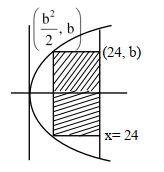
0 likes
View Solution442
DifficultMCQ
Let the set of all positive values of $\lambda$,for which the point of local minimum of the function $f(x) = 1 + x(\lambda^2 - x^2)$ satisfies $\frac{x^2+x+2}{x^2+5x+6} < 0$,be $(\alpha, \beta)$. Then $\alpha^2 + \beta^2$ is equal to:
A
$13$
B
$40$
C
$39$
D
$50$
Solution
(C) First,solve the inequality $\frac{x^2+x+2}{x^2+5x+6} < 0$.
Since the numerator $x^2+x+2$ has a discriminant $D = 1^2 - 4(1)(2) = -7 < 0$,it is always positive for all real $x$.
Thus,the inequality reduces to $\frac{1}{(x+2)(x+3)} < 0$,which implies $(x+2)(x+3) < 0$.
This gives $x \in (-3, -2)$.
Next,consider the function $f(x) = 1 + x\lambda^2 - x^3$.
Find the derivative: $f'(x) = \lambda^2 - 3x^2$.
Set $f'(x) = 0$ to find critical points: $3x^2 = \lambda^2 \Rightarrow x = \pm \frac{\lambda}{\sqrt{3}}$.
Using the second derivative test: $f''(x) = -6x$.
For local minimum,$f''(x) > 0$,so $-6x > 0 \Rightarrow x < 0$.
Thus,the point of local minimum is $x = -\frac{\lambda}{\sqrt{3}}$.
Given that this point must satisfy $x \in (-3, -2)$,we have:
$-3 < -\frac{\lambda}{\sqrt{3}} < -2$
Multiplying by $-1$ reverses the inequality:
$2 < \frac{\lambda}{\sqrt{3}} < 3$
$2\sqrt{3} < \lambda < 3\sqrt{3}$.
So,$\alpha = 2\sqrt{3}$ and $\beta = 3\sqrt{3}$.
Then $\alpha^2 + \beta^2 = (2\sqrt{3})^2 + (3\sqrt{3})^2 = 12 + 27 = 39$.
Since the numerator $x^2+x+2$ has a discriminant $D = 1^2 - 4(1)(2) = -7 < 0$,it is always positive for all real $x$.
Thus,the inequality reduces to $\frac{1}{(x+2)(x+3)} < 0$,which implies $(x+2)(x+3) < 0$.
This gives $x \in (-3, -2)$.
Next,consider the function $f(x) = 1 + x\lambda^2 - x^3$.
Find the derivative: $f'(x) = \lambda^2 - 3x^2$.
Set $f'(x) = 0$ to find critical points: $3x^2 = \lambda^2 \Rightarrow x = \pm \frac{\lambda}{\sqrt{3}}$.
Using the second derivative test: $f''(x) = -6x$.
For local minimum,$f''(x) > 0$,so $-6x > 0 \Rightarrow x < 0$.
Thus,the point of local minimum is $x = -\frac{\lambda}{\sqrt{3}}$.
Given that this point must satisfy $x \in (-3, -2)$,we have:
$-3 < -\frac{\lambda}{\sqrt{3}} < -2$
Multiplying by $-1$ reverses the inequality:
$2 < \frac{\lambda}{\sqrt{3}} < 3$
$2\sqrt{3} < \lambda < 3\sqrt{3}$.
So,$\alpha = 2\sqrt{3}$ and $\beta = 3\sqrt{3}$.
Then $\alpha^2 + \beta^2 = (2\sqrt{3})^2 + (3\sqrt{3})^2 = 12 + 27 = 39$.
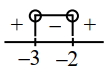
1 likes
View Solution443
DifficultMCQ
Let the set of all values of $p$,for which $f(x) = (p^2 - 6p + 8)(\sin^2 2x - \cos^2 2x) + 2(2 - p)x + 7$ does not have any critical point,be the interval $(a, b)$. Then $16ab$ is equal to ..........
A
$180$
B
$252$
C
$754$
D
$254$
Solution
(B) Given $f(x) = (p^2 - 6p + 8)(\sin^2 2x - \cos^2 2x) + 2(2 - p)x + 7$.
Using $\cos 4x = \cos^2 2x - \sin^2 2x$,we have $f(x) = -(p^2 - 6p + 8)\cos 4x + 2(2 - p)x + 7$.
For $f(x)$ to have no critical points,$f'(x) \neq 0$ for all $x \in \mathbb{R}$.
$f'(x) = 4(p^2 - 6p + 8)\sin 4x + 2(2 - p)$.
Setting $f'(x) = 0$,we get $4(p - 4)(p - 2)\sin 4x = 2(p - 2)$.
If $p = 2$,$f'(x) = 0$ for all $x$,so $p \neq 2$.
For $p \neq 2$,$\sin 4x = \frac{2(p - 2)}{4(p - 4)(p - 2)} = \frac{1}{2(p - 4)}$.
For no critical points,the equation $\sin 4x = \frac{1}{2(p - 4)}$ must have no solution.
This happens if $\left| \frac{1}{2(p - 4)} \right| > 1$.
$|2(p - 4)| < 1 \implies -1 < 2p - 8 < 1 \implies 7 < 2p < 9 \implies p \in (3.5, 4.5)$.
Thus,$a = 3.5 = \frac{7}{2}$ and $b = 4.5 = \frac{9}{2}$.
$16ab = 16 \times \frac{7}{2} \times \frac{9}{2} = 4 \times 7 \times 9 = 252$.
Using $\cos 4x = \cos^2 2x - \sin^2 2x$,we have $f(x) = -(p^2 - 6p + 8)\cos 4x + 2(2 - p)x + 7$.
For $f(x)$ to have no critical points,$f'(x) \neq 0$ for all $x \in \mathbb{R}$.
$f'(x) = 4(p^2 - 6p + 8)\sin 4x + 2(2 - p)$.
Setting $f'(x) = 0$,we get $4(p - 4)(p - 2)\sin 4x = 2(p - 2)$.
If $p = 2$,$f'(x) = 0$ for all $x$,so $p \neq 2$.
For $p \neq 2$,$\sin 4x = \frac{2(p - 2)}{4(p - 4)(p - 2)} = \frac{1}{2(p - 4)}$.
For no critical points,the equation $\sin 4x = \frac{1}{2(p - 4)}$ must have no solution.
This happens if $\left| \frac{1}{2(p - 4)} \right| > 1$.
$|2(p - 4)| < 1 \implies -1 < 2p - 8 < 1 \implies 7 < 2p < 9 \implies p \in (3.5, 4.5)$.
Thus,$a = 3.5 = \frac{7}{2}$ and $b = 4.5 = \frac{9}{2}$.
$16ab = 16 \times \frac{7}{2} \times \frac{9}{2} = 4 \times 7 \times 9 = 252$.
0 likes
View Solution444
DifficultMCQ
If a continuous function $f$ defined on the real line $R$ assumes positive and negative values in $R$,then the equation $f(x)=0$ has a root in $R$. For example,if it is known that a continuous function $f$ on $R$ is positive at some point and its minimum value is negative,then the equation $f(x)=0$ has a root in $R$.
Consider $f(x)=k e^x-x$ for all real $x$,where $k$ is a real constant.
$1.$ The line $y=x$ meets $y=k e^x$ for $k \leq 0$ at
$(A)$ no point $(B)$ one point $(C)$ two points $(D)$ more than two points
$2.$ The positive value of $k$ for which $k e^x-x=0$ has only one root is
$(A)$ $1/e$ $(B)$ $1$ $(C)$ $e$ $(D)$ $\log_e 2$
$3.$ For $k>0$,the set of all values of $k$ for which $k e^x-x=0$ has two distinct roots is
$(A)$ $(0, 1/e)$ $(B)$ $(1/e, 1)$ $(C)$ $(1/e, \infty)$ $(D)$ $(0, 1)$
Give the answer for questions $1, 2$ and $3$.
Consider $f(x)=k e^x-x$ for all real $x$,where $k$ is a real constant.
$1.$ The line $y=x$ meets $y=k e^x$ for $k \leq 0$ at
$(A)$ no point $(B)$ one point $(C)$ two points $(D)$ more than two points
$2.$ The positive value of $k$ for which $k e^x-x=0$ has only one root is
$(A)$ $1/e$ $(B)$ $1$ $(C)$ $e$ $(D)$ $\log_e 2$
$3.$ For $k>0$,the set of all values of $k$ for which $k e^x-x=0$ has two distinct roots is
$(A)$ $(0, 1/e)$ $(B)$ $(1/e, 1)$ $(C)$ $(1/e, \infty)$ $(D)$ $(0, 1)$
Give the answer for questions $1, 2$ and $3$.
A
$C, B, A$
B
$B, A, A$
C
$D, A, D$
D
$C, A, B$
Solution
(B, A, A) $1.$ For $k \leq 0$,let $g(x) = ke^x - x$. Since $k \leq 0$,$g'(x) = ke^x - 1 < 0$ for all $x \in R$. Thus,$g(x)$ is a strictly decreasing function. As $x \to -\infty$,$g(x) \to \infty$,and as $x \to \infty$,$g(x) \to -\infty$. By the Intermediate Value Theorem,$g(x)=0$ has exactly one root. Thus,the line $y=x$ meets $y=ke^x$ at one point. Correct option is $(B)$.
$2.$ Let $f(x) = ke^x - x$. For $k>0$,$f'(x) = ke^x - 1$. Setting $f'(x)=0$ gives $e^x = 1/k$,so $x = -\ln k$. The minimum value is $f(-\ln k) = k(1/k) - (-\ln k) = 1 + \ln k$. For exactly one root,the minimum value must be $0$. Thus,$1 + \ln k = 0 \Rightarrow \ln k = -1 \Rightarrow k = 1/e$. Correct option is $(A)$.
$3.$ For two distinct roots,the minimum value must be negative,i.e.,$1 + \ln k < 0$. This implies $\ln k < -1$,so $k < 1/e$. Since $k>0$,the set of values is $(0, 1/e)$. Correct option is $(A)$.
$2.$ Let $f(x) = ke^x - x$. For $k>0$,$f'(x) = ke^x - 1$. Setting $f'(x)=0$ gives $e^x = 1/k$,so $x = -\ln k$. The minimum value is $f(-\ln k) = k(1/k) - (-\ln k) = 1 + \ln k$. For exactly one root,the minimum value must be $0$. Thus,$1 + \ln k = 0 \Rightarrow \ln k = -1 \Rightarrow k = 1/e$. Correct option is $(A)$.
$3.$ For two distinct roots,the minimum value must be negative,i.e.,$1 + \ln k < 0$. This implies $\ln k < -1$,so $k < 1/e$. Since $k>0$,the set of values is $(0, 1/e)$. Correct option is $(A)$.
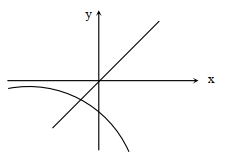
0 likes
View Solution445
AdvancedMCQ
Find the total number of local maxima and local minima of the function $f(x) = \begin{cases} (2+x)^3, & -3 < x \leq -1 \\ x^{2/3}, & -1 < x < 2 \end{cases}$
A
$0$
B
$1$
C
$2$
D
$3$
Solution
(C) To find the local maxima and local minima,we analyze the function $f(x)$ in its given intervals:
$1$. For $-3 < x \leq -1$,$f(x) = (2+x)^3$. The derivative is $f'(x) = 3(2+x)^2$. Since $f'(x) \geq 0$,the function is increasing on $(-3, -1]$. At $x = -1$,$f(-1) = (2-1)^3 = 1$. Since the function is increasing up to $x = -1$,this point acts as a local maximum.
$2$. For $-1 < x < 2$,$f(x) = x^{2/3}$. The derivative is $f'(x) = \frac{2}{3}x^{-1/3} = \frac{2}{3\sqrt[3]{x}}$.
$3$. At $x = 0$,$f'(x)$ is undefined. For $x < 0$,$f'(x) < 0$ (decreasing),and for $x > 0$,$f'(x) > 0$ (increasing). Thus,$x = 0$ is a local minimum with $f(0) = 0$.
$4$. Comparing the values,we have a local maximum at $x = -1$ and a local minimum at $x = 0$.
Therefore,the total number of local maxima and local minima is $2$.
$1$. For $-3 < x \leq -1$,$f(x) = (2+x)^3$. The derivative is $f'(x) = 3(2+x)^2$. Since $f'(x) \geq 0$,the function is increasing on $(-3, -1]$. At $x = -1$,$f(-1) = (2-1)^3 = 1$. Since the function is increasing up to $x = -1$,this point acts as a local maximum.
$2$. For $-1 < x < 2$,$f(x) = x^{2/3}$. The derivative is $f'(x) = \frac{2}{3}x^{-1/3} = \frac{2}{3\sqrt[3]{x}}$.
$3$. At $x = 0$,$f'(x)$ is undefined. For $x < 0$,$f'(x) < 0$ (decreasing),and for $x > 0$,$f'(x) > 0$ (increasing). Thus,$x = 0$ is a local minimum with $f(0) = 0$.
$4$. Comparing the values,we have a local maximum at $x = -1$ and a local minimum at $x = 0$.
Therefore,the total number of local maxima and local minima is $2$.
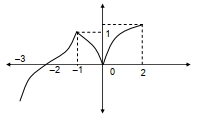
0 likes
View Solution446
AdvancedMCQ
The least value of $\alpha \in R$ for which $4 \alpha x^2 + \frac{1}{x} \geq 1$,for all $x > 0$,is
A
$\frac{1}{64}$
B
$\frac{1}{32}$
C
$\frac{1}{27}$
D
$\frac{1}{25}$
Solution
(C) Let $f(x) = 4 \alpha x^2 + \frac{1}{x}$ for $x > 0$.
To find the minimum value of $f(x)$,we differentiate with respect to $x$:
$f'(x) = 8 \alpha x - \frac{1}{x^2}$.
Setting $f'(x) = 0$ for critical points:
$8 \alpha x = \frac{1}{x^2}$ $\Rightarrow x^3 = \frac{1}{8 \alpha}$ $\Rightarrow x = \frac{1}{2 \alpha^{1/3}}$.
Substituting this value into $f(x)$ to find the minimum:
$f\left(\frac{1}{2 \alpha^{1/3}}\right) = 4 \alpha \left(\frac{1}{4 \alpha^{2/3}}\right) + \frac{1}{1/(2 \alpha^{1/3})} = \alpha^{1/3} + 2 \alpha^{1/3} = 3 \alpha^{1/3}$.
Given $f(x) \geq 1$ for all $x > 0$,the minimum value must be at least $1$:
$3 \alpha^{1/3} \geq 1$ $\Rightarrow \alpha^{1/3} \geq \frac{1}{3}$ $\Rightarrow \alpha \geq \frac{1}{27}$.
Thus,the least value of $\alpha$ is $\frac{1}{27}$.
To find the minimum value of $f(x)$,we differentiate with respect to $x$:
$f'(x) = 8 \alpha x - \frac{1}{x^2}$.
Setting $f'(x) = 0$ for critical points:
$8 \alpha x = \frac{1}{x^2}$ $\Rightarrow x^3 = \frac{1}{8 \alpha}$ $\Rightarrow x = \frac{1}{2 \alpha^{1/3}}$.
Substituting this value into $f(x)$ to find the minimum:
$f\left(\frac{1}{2 \alpha^{1/3}}\right) = 4 \alpha \left(\frac{1}{4 \alpha^{2/3}}\right) + \frac{1}{1/(2 \alpha^{1/3})} = \alpha^{1/3} + 2 \alpha^{1/3} = 3 \alpha^{1/3}$.
Given $f(x) \geq 1$ for all $x > 0$,the minimum value must be at least $1$:
$3 \alpha^{1/3} \geq 1$ $\Rightarrow \alpha^{1/3} \geq \frac{1}{3}$ $\Rightarrow \alpha \geq \frac{1}{27}$.
Thus,the least value of $\alpha$ is $\frac{1}{27}$.
0 likes
View Solution447
AdvancedMCQ
Let $S$ be the set of all twice differentiable functions $f$ from $R$ to $R$ such that $\frac{d^2 f}{d x^2}(x) > 0$ for all $x \in (-1, 1)$. For $f \in S$,let $X_f$ be the number of points $x \in (-1, 1)$ for which $f(x) = x$. Then which of the following statements is(are) true?
$(A)$ There exists a function $f \in S$ such that $X_f = 0$
$(B)$ For every function $f \in S$,we have $X_f \leq 2$
$(C)$ There exists a function $f \in S$ such that $X_f = 2$
$(D)$ There does $NOT$ exist any function $f$ in $S$ such that $X_f = 1$
$(A)$ There exists a function $f \in S$ such that $X_f = 0$
$(B)$ For every function $f \in S$,we have $X_f \leq 2$
$(C)$ There exists a function $f \in S$ such that $X_f = 2$
$(D)$ There does $NOT$ exist any function $f$ in $S$ such that $X_f = 1$
A
$A, B, C$
B
$A, B$
C
$A, C$
D
$B, C$
Solution
(A) Let $S$ be the set of all twice differentiable functions $f: R \rightarrow R$ such that $\frac{d^2 f}{dx^2} > 0$ for all $x \in (-1, 1)$.
This implies that the graph of $f$ is strictly concave upward (convex) on the interval $(-1, 1)$.
Let $\phi(x) = f(x) - x$. Then $\phi''(x) = f''(x) - 0 = f''(x) > 0$ for all $x \in (-1, 1)$.
Since $\phi''(x) > 0$,the function $\phi(x)$ is strictly convex.
$A$ strictly convex function can intersect the $x$-axis at most at two points.
Therefore,the equation $\phi(x) = 0$,which is equivalent to $f(x) = x$,can have at most two solutions in the interval $(-1, 1)$.
Thus,$X_f \leq 2$ for every $f \in S$,which makes statement $(B)$ true.
By choosing appropriate convex functions,we can construct examples where $X_f = 0$ (e.g.,$f(x) = x^2 + 2$),$X_f = 1$ (e.g.,$f(x) = x^2 + x + 0.1$),and $X_f = 2$ (e.g.,$f(x) = x^2 + 0.1$).
Since $X_f$ can be $0, 1,$ or $2$,statement $(A)$ is true,statement $(C)$ is true,and statement $(D)$ is false.
Therefore,the correct statements are $(A)$,$(B)$,and $(C)$.
This implies that the graph of $f$ is strictly concave upward (convex) on the interval $(-1, 1)$.
Let $\phi(x) = f(x) - x$. Then $\phi''(x) = f''(x) - 0 = f''(x) > 0$ for all $x \in (-1, 1)$.
Since $\phi''(x) > 0$,the function $\phi(x)$ is strictly convex.
$A$ strictly convex function can intersect the $x$-axis at most at two points.
Therefore,the equation $\phi(x) = 0$,which is equivalent to $f(x) = x$,can have at most two solutions in the interval $(-1, 1)$.
Thus,$X_f \leq 2$ for every $f \in S$,which makes statement $(B)$ true.
By choosing appropriate convex functions,we can construct examples where $X_f = 0$ (e.g.,$f(x) = x^2 + 2$),$X_f = 1$ (e.g.,$f(x) = x^2 + x + 0.1$),and $X_f = 2$ (e.g.,$f(x) = x^2 + 0.1$).
Since $X_f$ can be $0, 1,$ or $2$,statement $(A)$ is true,statement $(C)$ is true,and statement $(D)$ is false.
Therefore,the correct statements are $(A)$,$(B)$,and $(C)$.
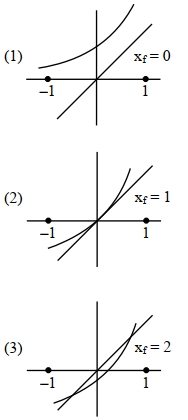
0 likes
View Solution448
DifficultMCQ
For the function $f(x) = x \cos \frac{1}{x}, \quad x \geq 1$,consider the following statements:
$(A)$ For at least one $x$ in the interval $[1, \infty), f(x+2)-f(x) < 2$
$(B)$ $\lim _{x \rightarrow \infty} f^{\prime}(x) = 1$
$(C)$ For all $x$ in the interval $[1, \infty), f(x+2)-f(x) > 2$
$(D)$ $f^{\prime}(x)$ is strictly decreasing in the interval $[1, \infty)$
Which of the following combinations of statements is correct?
$(A)$ For at least one $x$ in the interval $[1, \infty), f(x+2)-f(x) < 2$
$(B)$ $\lim _{x \rightarrow \infty} f^{\prime}(x) = 1$
$(C)$ For all $x$ in the interval $[1, \infty), f(x+2)-f(x) > 2$
$(D)$ $f^{\prime}(x)$ is strictly decreasing in the interval $[1, \infty)$
Which of the following combinations of statements is correct?
A
$(B, C, D)$
B
$(A, C, D)$
C
$(A, B, D)$
D
$(A, B, C)$
Solution
(A) Given $f(x) = x \cos \frac{1}{x}$ for $x \geq 1$.
First,find the derivative $f^{\prime}(x)$:
$f^{\prime}(x) = \cos \frac{1}{x} + x \left( -\sin \frac{1}{x} \right) \left( -\frac{1}{x^2} \right) = \cos \frac{1}{x} + \frac{1}{x} \sin \frac{1}{x}$.
Now,evaluate $\lim _{x \rightarrow \infty} f^{\prime}(x)$:
$\lim _{x \rightarrow \infty} \left( \cos \frac{1}{x} + \frac{1}{x} \sin \frac{1}{x} \right) = \cos(0) + 0 \cdot \sin(0) = 1 + 0 = 1$. Thus,statement $(B)$ is correct.
Next,find the second derivative $f^{\prime \prime}(x)$:
$f^{\prime \prime}(x) = -\sin \frac{1}{x} \left( -\frac{1}{x^2} \right) + \left( -\frac{1}{x^2} \right) \sin \frac{1}{x} + \frac{1}{x} \cos \frac{1}{x} \left( -\frac{1}{x^2} \right) = \frac{1}{x^2} \sin \frac{1}{x} - \frac{1}{x^2} \sin \frac{1}{x} - \frac{1}{x^3} \cos \frac{1}{x} = -\frac{1}{x^3} \cos \frac{1}{x}$.
For $x \in [1, \infty)$,$\frac{1}{x} \in (0, 1]$. Since $\cos \theta > 0$ for $\theta \in (0, 1]$,$f^{\prime \prime}(x) = -\frac{1}{x^3} \cos \frac{1}{x} < 0$. Thus,$f^{\prime}(x)$ is strictly decreasing,so statement $(D)$ is correct.
By the Mean Value Theorem $(LMVT)$ on $[x, x+2]$,there exists $c \in (x, x+2)$ such that $\frac{f(x+2)-f(x)}{2} = f^{\prime}(c)$.
Since $f^{\prime}(x)$ is strictly decreasing and $\lim _{x \rightarrow \infty} f^{\prime}(x) = 1$,we have $f^{\prime}(x) > 1$ for all $x \in [1, \infty)$.
Therefore,$f^{\prime}(c) > 1$,which implies $\frac{f(x+2)-f(x)}{2} > 1$,or $f(x+2)-f(x) > 2$. Thus,statement $(C)$ is correct and $(A)$ is incorrect.
The correct combination is $(B, C, D)$.
First,find the derivative $f^{\prime}(x)$:
$f^{\prime}(x) = \cos \frac{1}{x} + x \left( -\sin \frac{1}{x} \right) \left( -\frac{1}{x^2} \right) = \cos \frac{1}{x} + \frac{1}{x} \sin \frac{1}{x}$.
Now,evaluate $\lim _{x \rightarrow \infty} f^{\prime}(x)$:
$\lim _{x \rightarrow \infty} \left( \cos \frac{1}{x} + \frac{1}{x} \sin \frac{1}{x} \right) = \cos(0) + 0 \cdot \sin(0) = 1 + 0 = 1$. Thus,statement $(B)$ is correct.
Next,find the second derivative $f^{\prime \prime}(x)$:
$f^{\prime \prime}(x) = -\sin \frac{1}{x} \left( -\frac{1}{x^2} \right) + \left( -\frac{1}{x^2} \right) \sin \frac{1}{x} + \frac{1}{x} \cos \frac{1}{x} \left( -\frac{1}{x^2} \right) = \frac{1}{x^2} \sin \frac{1}{x} - \frac{1}{x^2} \sin \frac{1}{x} - \frac{1}{x^3} \cos \frac{1}{x} = -\frac{1}{x^3} \cos \frac{1}{x}$.
For $x \in [1, \infty)$,$\frac{1}{x} \in (0, 1]$. Since $\cos \theta > 0$ for $\theta \in (0, 1]$,$f^{\prime \prime}(x) = -\frac{1}{x^3} \cos \frac{1}{x} < 0$. Thus,$f^{\prime}(x)$ is strictly decreasing,so statement $(D)$ is correct.
By the Mean Value Theorem $(LMVT)$ on $[x, x+2]$,there exists $c \in (x, x+2)$ such that $\frac{f(x+2)-f(x)}{2} = f^{\prime}(c)$.
Since $f^{\prime}(x)$ is strictly decreasing and $\lim _{x \rightarrow \infty} f^{\prime}(x) = 1$,we have $f^{\prime}(x) > 1$ for all $x \in [1, \infty)$.
Therefore,$f^{\prime}(c) > 1$,which implies $\frac{f(x+2)-f(x)}{2} > 1$,or $f(x+2)-f(x) > 2$. Thus,statement $(C)$ is correct and $(A)$ is incorrect.
The correct combination is $(B, C, D)$.
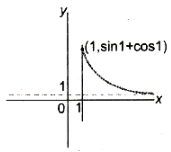
0 likes
View Solution449
DifficultMCQ
The maximum value of the function $f(x)=2x^3-15x^2+36x-48$ on the set $A=\{x \mid x^2+20 \leq 9x\}$ is
A
$6$
B
$7$
C
$5$
D
$4$
Solution
(B) Given the set $A = \{x \mid x^2+20 \leq 9x\}$.
Solving the inequality $x^2-9x+20 \leq 0$:
$(x-4)(x-5) \leq 0$,which implies $x \in [4, 5]$.
Now,consider the function $f(x) = 2x^3-15x^2+36x-48$.
Find the derivative $f'(x) = 6x^2-30x+36 = 6(x^2-5x+6) = 6(x-2)(x-3)$.
For $x \in [4, 5]$,$f'(x) > 0$ because both $(x-2)$ and $(x-3)$ are positive in this interval.
Since $f'(x) > 0$ for all $x \in [4, 5]$,the function $f(x)$ is strictly increasing on the interval $[4, 5]$.
Therefore,the maximum value occurs at the right endpoint $x = 5$.
$f(5) = 2(5)^3 - 15(5)^2 + 36(5) - 48$
$f(5) = 2(125) - 15(25) + 180 - 48$
$f(5) = 250 - 375 + 180 - 48 = 7$.
Solving the inequality $x^2-9x+20 \leq 0$:
$(x-4)(x-5) \leq 0$,which implies $x \in [4, 5]$.
Now,consider the function $f(x) = 2x^3-15x^2+36x-48$.
Find the derivative $f'(x) = 6x^2-30x+36 = 6(x^2-5x+6) = 6(x-2)(x-3)$.
For $x \in [4, 5]$,$f'(x) > 0$ because both $(x-2)$ and $(x-3)$ are positive in this interval.
Since $f'(x) > 0$ for all $x \in [4, 5]$,the function $f(x)$ is strictly increasing on the interval $[4, 5]$.
Therefore,the maximum value occurs at the right endpoint $x = 5$.
$f(5) = 2(5)^3 - 15(5)^2 + 36(5) - 48$
$f(5) = 2(125) - 15(25) + 180 - 48$
$f(5) = 250 - 375 + 180 - 48 = 7$.
0 likes
View Solution450
DifficultMCQ
Let $p(x)$ be a polynomial of degree $4$ having extrema at $x=1$ and $x=2$,and $\lim_{x \rightarrow 0} \left(1+\frac{p(x)}{x^2}\right) = 2$. Then the value of $p(2)$ is
A
$5$
B
$0$
C
$2$
D
$9$
Solution
(B) Let $p(x) = ax^4 + bx^3 + cx^2 + dx + e$.
Since $\lim_{x \rightarrow 0} (1 + \frac{p(x)}{x^2}) = 2$,we have $\lim_{x \rightarrow 0} \frac{p(x)}{x^2} = 1$. This implies $e = 0$ and $d = 0$,and $c = 1$.
Thus,$p(x) = ax^4 + bx^3 + x^2$.
The derivative is $p'(x) = 4ax^3 + 3bx^2 + 2x$.
Given extrema at $x=1$ and $x=2$,$p'(1) = 0$ and $p'(2) = 0$.
$p'(1) = 4a + 3b + 2 = 0 \implies 4a + 3b = -2$ (Equation $1$).
$p'(2) = 4a(8) + 3b(4) + 2(2) = 32a + 12b + 4 = 0 \implies 8a + 3b = -1$ (Equation $2$).
Subtracting Equation $1$ from Equation $2$: $(8a - 4a) = -1 - (-2) \implies 4a = 1 \implies a = \frac{1}{4}$.
Substituting $a = \frac{1}{4}$ into Equation $1$: $4(\frac{1}{4}) + 3b = -2 \implies 1 + 3b = -2 \implies 3b = -3 \implies b = -1$.
So,$p(x) = \frac{1}{4}x^4 - x^3 + x^2$.
Calculating $p(2)$: $p(2) = \frac{1}{4}(16) - (8) + (4) = 4 - 8 + 4 = 0$.
Since $\lim_{x \rightarrow 0} (1 + \frac{p(x)}{x^2}) = 2$,we have $\lim_{x \rightarrow 0} \frac{p(x)}{x^2} = 1$. This implies $e = 0$ and $d = 0$,and $c = 1$.
Thus,$p(x) = ax^4 + bx^3 + x^2$.
The derivative is $p'(x) = 4ax^3 + 3bx^2 + 2x$.
Given extrema at $x=1$ and $x=2$,$p'(1) = 0$ and $p'(2) = 0$.
$p'(1) = 4a + 3b + 2 = 0 \implies 4a + 3b = -2$ (Equation $1$).
$p'(2) = 4a(8) + 3b(4) + 2(2) = 32a + 12b + 4 = 0 \implies 8a + 3b = -1$ (Equation $2$).
Subtracting Equation $1$ from Equation $2$: $(8a - 4a) = -1 - (-2) \implies 4a = 1 \implies a = \frac{1}{4}$.
Substituting $a = \frac{1}{4}$ into Equation $1$: $4(\frac{1}{4}) + 3b = -2 \implies 1 + 3b = -2 \implies 3b = -3 \implies b = -1$.
So,$p(x) = \frac{1}{4}x^4 - x^3 + x^2$.
Calculating $p(2)$: $p(2) = \frac{1}{4}(16) - (8) + (4) = 4 - 8 + 4 = 0$.
0 likes
View SolutionApplications of Derivatives — Maxima and Minima · Frequently Asked Questions
1Are these Applications of Derivatives questions useful for JEE and NEET?
Yes. All questions in this section are mapped to JEE Main and NEET exam patterns. Previous year questions from JEE Main, NEET, GUJCET and state-level exams are included with full solutions.
2Can I switch to Hindi or Gujarati for these questions?
Yes. Use the language tabs in the hero section or the sidebar to view the same questions and solutions in English, Hindi or Gujarati.
3How do I generate a question paper from this subtopic?
Use the Vedclass Exam Paper Generator — select the chapter and subtopic, set difficulty, and generate Sets A, B, C, D automatically. First 3 chapters of every subject are free.
Vedclass Products
For Students
Vedclass Test Series
Mock tests in real JEE/NEET style with performance analysis. 5-day free trial.
Start Free TrialFor Teachers
Exam Paper Generator
Generate Set A/B/C/D papers from this chapter in 2 minutes. 3 chapters free.
Try FreeFor Institutes
Online Exam Module
Live online exams with unlimited students, 360° analytics & white-label branding.
See DemoFor Teachers & Institutes
Generate a Applications of Derivatives Exam Paper in 2 Minutes
Select subtopic & difficulty — Sets A, B, C, D auto-generated with No Repeat logic.
First 3 chapters of every subject are free — no payment required.