
A English
Maxima and Minima Questions in English
Class 12 Mathematics · Applications of Derivatives · Maxima and Minima
760+
Questions
English
Language
100%
With Solutions
Showing 50 of 760 questions in English
301
MediumMCQ
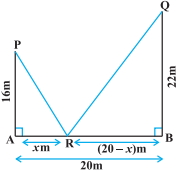
Let $AP$ and $BQ$ be two vertical poles at points $A$ and $B$,respectively. If $AP=16 \, m, BQ=22 \, m$ and $AB=20 \, m,$ then find the distance of a point $R$ on $AB$ from the point $A$ such that $RP^2 + RQ^2$ is minimum. (in $, m$)
A
$8$
B
$10$
C
$12$
D
$14$
Solution
(B) Let $R$ be a point on $AB$ such that $AR=x \, m.$
Then $RB=(20-x) \, m$ (as $AB=20 \, m$).
From the geometry of the problem,we have right-angled triangles $\triangle PAR$ and $\triangle QBR$.
$RP^2 = AR^2 + AP^2 = x^2 + 16^2 = x^2 + 256$
$RQ^2 = RB^2 + BQ^2 = (20-x)^2 + 22^2 = (400 - 40x + x^2) + 484 = x^2 - 40x + 884$
Let $S(x) = RP^2 + RQ^2 = (x^2 + 256) + (x^2 - 40x + 884) = 2x^2 - 40x + 1140.$
To find the minimum,we differentiate $S(x)$ with respect to $x$:
$S'(x) = 4x - 40.$
Setting $S'(x) = 0$ gives $4x - 40 = 0 \implies x = 10.$
Now,we check the second derivative: $S''(x) = 4.$
Since $S''(10) = 4 > 0,$ the function $S(x)$ has a local minimum at $x = 10.$
Thus,the distance of point $R$ from $A$ is $10 \, m.$
Then $RB=(20-x) \, m$ (as $AB=20 \, m$).
From the geometry of the problem,we have right-angled triangles $\triangle PAR$ and $\triangle QBR$.
$RP^2 = AR^2 + AP^2 = x^2 + 16^2 = x^2 + 256$
$RQ^2 = RB^2 + BQ^2 = (20-x)^2 + 22^2 = (400 - 40x + x^2) + 484 = x^2 - 40x + 884$
Let $S(x) = RP^2 + RQ^2 = (x^2 + 256) + (x^2 - 40x + 884) = 2x^2 - 40x + 1140.$
To find the minimum,we differentiate $S(x)$ with respect to $x$:
$S'(x) = 4x - 40.$
Setting $S'(x) = 0$ gives $4x - 40 = 0 \implies x = 10.$
Now,we check the second derivative: $S''(x) = 4.$
Since $S''(10) = 4 > 0,$ the function $S(x)$ has a local minimum at $x = 10.$
Thus,the distance of point $R$ from $A$ is $10 \, m.$
0 likes
View Solution302
DifficultMCQ
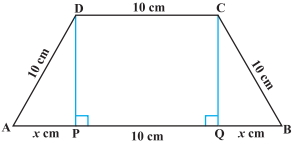
If the lengths of three sides of a trapezium other than the base are equal to $10 \ cm$,find the maximum area of the trapezium.
A
$75\sqrt{3} \ cm^2$
B
$50\sqrt{3} \ cm^2$
C
$25\sqrt{3} \ cm^2$
D
$100\sqrt{3} \ cm^2$
Solution
(A) Let the trapezium be $ABCD$ where $AD = DC = CB = 10 \ cm$. Draw perpendiculars $DP$ and $CQ$ on the base $AB$. Let $AP = x \ cm$. Since the trapezium is isosceles,$QB = x \ cm$. The length $PQ = DC = 10 \ cm$. Thus,the base $AB = x + 10 + x = 2x + 10 \ cm$.
By the Pythagorean theorem in $\Delta APD$,the height $h = DP = \sqrt{10^2 - x^2} = \sqrt{100 - x^2}$.
The area $A$ of the trapezium is given by $A = \frac{1}{2} \times (\text{sum of parallel sides}) \times \text{height}$.
$A(x) = \frac{1}{2} (AB + DC) \times h = \frac{1}{2} (2x + 10 + 10) \sqrt{100 - x^2} = (x + 10) \sqrt{100 - x^2}$.
To find the maximum area,we find the derivative $A'(x)$:
$A'(x) = (1) \sqrt{100 - x^2} + (x + 10) \frac{-2x}{2\sqrt{100 - x^2}} = \frac{100 - x^2 - x^2 - 10x}{\sqrt{100 - x^2}} = \frac{100 - 10x - 2x^2}{\sqrt{100 - x^2}}$.
Setting $A'(x) = 0$,we get $2x^2 + 10x - 100 = 0 \implies x^2 + 5x - 50 = 0 \implies (x + 10)(x - 5) = 0$.
Since $x$ is a length,$x = 5 \ cm$.
The second derivative test confirms this is a maximum.
Substituting $x = 5$ into the area formula:
$A(5) = (5 + 10) \sqrt{100 - 5^2} = 15 \sqrt{75} = 15 \times 5\sqrt{3} = 75\sqrt{3} \ cm^2$.
By the Pythagorean theorem in $\Delta APD$,the height $h = DP = \sqrt{10^2 - x^2} = \sqrt{100 - x^2}$.
The area $A$ of the trapezium is given by $A = \frac{1}{2} \times (\text{sum of parallel sides}) \times \text{height}$.
$A(x) = \frac{1}{2} (AB + DC) \times h = \frac{1}{2} (2x + 10 + 10) \sqrt{100 - x^2} = (x + 10) \sqrt{100 - x^2}$.
To find the maximum area,we find the derivative $A'(x)$:
$A'(x) = (1) \sqrt{100 - x^2} + (x + 10) \frac{-2x}{2\sqrt{100 - x^2}} = \frac{100 - x^2 - x^2 - 10x}{\sqrt{100 - x^2}} = \frac{100 - 10x - 2x^2}{\sqrt{100 - x^2}}$.
Setting $A'(x) = 0$,we get $2x^2 + 10x - 100 = 0 \implies x^2 + 5x - 50 = 0 \implies (x + 10)(x - 5) = 0$.
Since $x$ is a length,$x = 5 \ cm$.
The second derivative test confirms this is a maximum.
Substituting $x = 5$ into the area formula:
$A(5) = (5 + 10) \sqrt{100 - 5^2} = 15 \sqrt{75} = 15 \times 5\sqrt{3} = 75\sqrt{3} \ cm^2$.
0 likes
View Solution303
Difficult
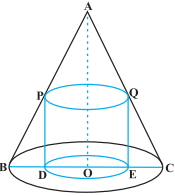
Prove that the radius of the right circular cylinder of greatest curved surface area which can be inscribed in a given cone is half of that of the cone.
Solution
(N/A) Let $OC = r$ be the radius of the cone and $OA = h$ be its height. Let a cylinder with radius $OE = x$ be inscribed in the given cone. The height $QE$ of the cylinder is given by:
$\frac{QE}{OA} = \frac{EC}{OC}$ (since $\Delta QEC \sim \Delta AOC$)
$\frac{QE}{h} = \frac{r - x}{r}$
$QE = \frac{h(r - x)}{r}$
Let $S$ be the curved surface area of the cylinder. Then:
$S(x) = 2 \pi x \cdot QE = 2 \pi x \cdot \frac{h(r - x)}{r} = \frac{2 \pi h}{r}(rx - x^2)$
To find the maximum surface area,we find the derivative $S'(x)$:
$S'(x) = \frac{2 \pi h}{r}(r - 2x)$
Setting $S'(x) = 0$ gives $r - 2x = 0$,so $x = \frac{r}{2}$.
Now,find the second derivative $S''(x)$:
$S''(x) = \frac{2 \pi h}{r}(-2) = -\frac{4 \pi h}{r}$
Since $S''(x) < 0$ for all $x$,the function $S(x)$ has a maximum at $x = \frac{r}{2}$.
Thus,the radius of the cylinder of greatest curved surface area is half of the radius of the cone.
$\frac{QE}{OA} = \frac{EC}{OC}$ (since $\Delta QEC \sim \Delta AOC$)
$\frac{QE}{h} = \frac{r - x}{r}$
$QE = \frac{h(r - x)}{r}$
Let $S$ be the curved surface area of the cylinder. Then:
$S(x) = 2 \pi x \cdot QE = 2 \pi x \cdot \frac{h(r - x)}{r} = \frac{2 \pi h}{r}(rx - x^2)$
To find the maximum surface area,we find the derivative $S'(x)$:
$S'(x) = \frac{2 \pi h}{r}(r - 2x)$
Setting $S'(x) = 0$ gives $r - 2x = 0$,so $x = \frac{r}{2}$.
Now,find the second derivative $S''(x)$:
$S''(x) = \frac{2 \pi h}{r}(-2) = -\frac{4 \pi h}{r}$
Since $S''(x) < 0$ for all $x$,the function $S(x)$ has a maximum at $x = \frac{r}{2}$.
Thus,the radius of the cylinder of greatest curved surface area is half of the radius of the cone.
0 likes
View Solution304
Medium
Find the absolute maximum and minimum values of a function $f$ given by $f(x) = 2x^{3} - 15x^{2} + 36x + 1$ on the interval $[1, 5]$.
Solution
(A) We have $f(x) = 2x^{3} - 15x^{2} + 36x + 1$.
Taking the derivative,we get $f'(x) = 6x^{2} - 30x + 36 = 6(x - 2)(x - 3)$.
Setting $f'(x) = 0$ gives the critical points $x = 2$ and $x = 3$.
We evaluate the function at the critical points and the endpoints of the interval $[1, 5]$:
$f(1) = 2(1)^{3} - 15(1)^{2} + 36(1) + 1 = 2 - 15 + 36 + 1 = 24$.
$f(2) = 2(2)^{3} - 15(2)^{2} + 36(2) + 1 = 16 - 60 + 72 + 1 = 29$.
$f(3) = 2(3)^{3} - 15(3)^{2} + 36(3) + 1 = 54 - 135 + 108 + 1 = 28$.
$f(5) = 2(5)^{3} - 15(5)^{2} + 36(5) + 1 = 250 - 375 + 180 + 1 = 56$.
Comparing these values,the absolute maximum value is $56$ at $x = 5$ and the absolute minimum value is $24$ at $x = 1$.
Taking the derivative,we get $f'(x) = 6x^{2} - 30x + 36 = 6(x - 2)(x - 3)$.
Setting $f'(x) = 0$ gives the critical points $x = 2$ and $x = 3$.
We evaluate the function at the critical points and the endpoints of the interval $[1, 5]$:
$f(1) = 2(1)^{3} - 15(1)^{2} + 36(1) + 1 = 2 - 15 + 36 + 1 = 24$.
$f(2) = 2(2)^{3} - 15(2)^{2} + 36(2) + 1 = 16 - 60 + 72 + 1 = 29$.
$f(3) = 2(3)^{3} - 15(3)^{2} + 36(3) + 1 = 54 - 135 + 108 + 1 = 28$.
$f(5) = 2(5)^{3} - 15(5)^{2} + 36(5) + 1 = 250 - 375 + 180 + 1 = 56$.
Comparing these values,the absolute maximum value is $56$ at $x = 5$ and the absolute minimum value is $24$ at $x = 1$.
0 likes
View Solution305
Medium
Find the absolute maximum and minimum values of the function $f$ given by $f(x) = 12x^{\frac{4}{3}} - 6x^{\frac{1}{3}}$ for $x \in [-1, 1]$.
Solution
(N/A) We have $f(x) = 12x^{\frac{4}{3}} - 6x^{\frac{1}{3}}$.
First,we find the derivative $f'(x)$:
$f'(x) = 12 \cdot \frac{4}{3}x^{\frac{1}{3}} - 6 \cdot \frac{1}{3}x^{-\frac{2}{3}} = 16x^{\frac{1}{3}} - \frac{2}{x^{\frac{2}{3}}} = \frac{16x - 2}{x^{\frac{2}{3}}} = \frac{2(8x - 1)}{x^{\frac{2}{3}}}$.
Setting $f'(x) = 0$ gives $8x - 1 = 0$,so $x = \frac{1}{8}$.
Also,$f'(x)$ is undefined at $x = 0$. Thus,the critical points are $x = 0$ and $x = \frac{1}{8}$.
Now,we evaluate $f(x)$ at the critical points and the endpoints $x = -1$ and $x = 1$:
$f(-1) = 12(-1)^{\frac{4}{3}} - 6(-1)^{\frac{1}{3}} = 12(1) - 6(-1) = 12 + 6 = 18$.
$f(0) = 12(0)^{\frac{4}{3}} - 6(0)^{\frac{1}{3}} = 0$.
$f(\frac{1}{8}) = 12(\frac{1}{8})^{\frac{4}{3}} - 6(\frac{1}{8})^{\frac{1}{3}} = 12(\frac{1}{16}) - 6(\frac{1}{2}) = \frac{3}{4} - 3 = \frac{3 - 12}{4} = -\frac{9}{4}$.
$f(1) = 12(1)^{\frac{4}{3}} - 6(1)^{\frac{1}{3}} = 12 - 6 = 6$.
Comparing these values,the absolute maximum value is $18$ at $x = -1$ and the absolute minimum value is $-\frac{9}{4}$ at $x = \frac{1}{8}$.
First,we find the derivative $f'(x)$:
$f'(x) = 12 \cdot \frac{4}{3}x^{\frac{1}{3}} - 6 \cdot \frac{1}{3}x^{-\frac{2}{3}} = 16x^{\frac{1}{3}} - \frac{2}{x^{\frac{2}{3}}} = \frac{16x - 2}{x^{\frac{2}{3}}} = \frac{2(8x - 1)}{x^{\frac{2}{3}}}$.
Setting $f'(x) = 0$ gives $8x - 1 = 0$,so $x = \frac{1}{8}$.
Also,$f'(x)$ is undefined at $x = 0$. Thus,the critical points are $x = 0$ and $x = \frac{1}{8}$.
Now,we evaluate $f(x)$ at the critical points and the endpoints $x = -1$ and $x = 1$:
$f(-1) = 12(-1)^{\frac{4}{3}} - 6(-1)^{\frac{1}{3}} = 12(1) - 6(-1) = 12 + 6 = 18$.
$f(0) = 12(0)^{\frac{4}{3}} - 6(0)^{\frac{1}{3}} = 0$.
$f(\frac{1}{8}) = 12(\frac{1}{8})^{\frac{4}{3}} - 6(\frac{1}{8})^{\frac{1}{3}} = 12(\frac{1}{16}) - 6(\frac{1}{2}) = \frac{3}{4} - 3 = \frac{3 - 12}{4} = -\frac{9}{4}$.
$f(1) = 12(1)^{\frac{4}{3}} - 6(1)^{\frac{1}{3}} = 12 - 6 = 6$.
Comparing these values,the absolute maximum value is $18$ at $x = -1$ and the absolute minimum value is $-\frac{9}{4}$ at $x = \frac{1}{8}$.
0 likes
View Solution306
DifficultMCQ
An enemy Apache helicopter is flying along the curve given by $y = x^{2} + 7$. $A$ soldier,placed at $(3, 7)$,wants to shoot down the helicopter when it is nearest to him. Find the nearest distance.
A
$\sqrt{5}$
B
$\sqrt{6}$
C
$\sqrt{7}$
D
$\sqrt{8}$
Solution
(A) For each value of $x$,the helicopter's position is at point $(x, x^{2} + 7)$.
Therefore,the distance $d$ between the helicopter and the soldier at $(3, 7)$ is given by $d = \sqrt{(x - 3)^{2} + (x^{2} + 7 - 7)^{2}} = \sqrt{(x - 3)^{2} + x^{4}}$.
Let $f(x) = (x - 3)^{2} + x^{4}$. To minimize the distance,we minimize $f(x)$.
Taking the derivative,$f'(x) = 2(x - 3) + 4x^{3} = 2(x - 1)(2x^{2} + 2x + 3)$.
Setting $f'(x) = 0$,we get $x = 1$ (since $2x^{2} + 2x + 3 = 0$ has no real roots as its discriminant $D = 4 - 24 = -20 < 0$).
The value of $f(x)$ at $x = 1$ is $f(1) = (1 - 3)^{2} + (1)^{4} = 4 + 1 = 5$.
Thus,the minimum distance is $\sqrt{f(1)} = \sqrt{5}$.
Therefore,the distance $d$ between the helicopter and the soldier at $(3, 7)$ is given by $d = \sqrt{(x - 3)^{2} + (x^{2} + 7 - 7)^{2}} = \sqrt{(x - 3)^{2} + x^{4}}$.
Let $f(x) = (x - 3)^{2} + x^{4}$. To minimize the distance,we minimize $f(x)$.
Taking the derivative,$f'(x) = 2(x - 3) + 4x^{3} = 2(x - 1)(2x^{2} + 2x + 3)$.
Setting $f'(x) = 0$,we get $x = 1$ (since $2x^{2} + 2x + 3 = 0$ has no real roots as its discriminant $D = 4 - 24 = -20 < 0$).
The value of $f(x)$ at $x = 1$ is $f(1) = (1 - 3)^{2} + (1)^{4} = 4 + 1 = 5$.
Thus,the minimum distance is $\sqrt{f(1)} = \sqrt{5}$.
0 likes
View Solution307
DifficultMCQ
Find the maximum and minimum values of the function $f(x)=(2x-1)^{2}+3$.
A
Maximum value is $3$,minimum value does not exist.
B
Minimum value is $3$,maximum value does not exist.
C
Maximum value is $0$,minimum value is $3$.
D
Maximum value is $3$,minimum value is $0$.
Solution
(B) The given function is $f(x)=(2x-1)^{2}+3$.
It is known that for any real number $x$,the square of a real number is always non-negative,i.e.,$(2x-1)^{2} \geq 0$.
Adding $3$ to both sides,we get $(2x-1)^{2}+3 \geq 0+3$,which means $f(x) \geq 3$ for all $x \in \mathbb{R}$.
The minimum value of $f(x)$ is attained when $(2x-1)^{2} = 0$.
Setting $2x-1 = 0$,we get $x = \frac{1}{2}$.
Thus,the minimum value is $f\left(\frac{1}{2}\right) = (2 \cdot \frac{1}{2} - 1)^{2} + 3 = 0 + 3 = 3$.
Since the function $(2x-1)^{2}$ increases indefinitely as $x \to \infty$ or $x \to -\infty$,the function $f(x)$ does not have a maximum value.
It is known that for any real number $x$,the square of a real number is always non-negative,i.e.,$(2x-1)^{2} \geq 0$.
Adding $3$ to both sides,we get $(2x-1)^{2}+3 \geq 0+3$,which means $f(x) \geq 3$ for all $x \in \mathbb{R}$.
The minimum value of $f(x)$ is attained when $(2x-1)^{2} = 0$.
Setting $2x-1 = 0$,we get $x = \frac{1}{2}$.
Thus,the minimum value is $f\left(\frac{1}{2}\right) = (2 \cdot \frac{1}{2} - 1)^{2} + 3 = 0 + 3 = 3$.
Since the function $(2x-1)^{2}$ increases indefinitely as $x \to \infty$ or $x \to -\infty$,the function $f(x)$ does not have a maximum value.
0 likes
View Solution308
MediumMCQ
Find the maximum and minimum values of the function given by $f(x) = -(x-1)^{2} + 10$.
A
Maximum value is $10$,minimum value does not exist.
B
Maximum value does not exist,minimum value is $10$.
C
Maximum value is $10$,minimum value is $0$.
D
Neither maximum nor minimum value exists.
Solution
(A) The given function is $f(x) = -(x-1)^{2} + 10$.
We know that for any real number $x$,$(x-1)^{2} \geq 0$.
Multiplying by $-1$,we get $-(x-1)^{2} \leq 0$.
Adding $10$ to both sides,we get $-(x-1)^{2} + 10 \leq 10$.
Thus,$f(x) \leq 10$ for all $x \in R$.
The maximum value is attained when $(x-1)^{2} = 0$,which implies $x = 1$.
Therefore,the maximum value is $f(1) = -(1-1)^{2} + 10 = 10$.
Since the function $f(x) = -(x-1)^{2} + 10$ is a downward-opening parabola,as $x \to \infty$ or $x \to -\infty$,$f(x) \to -\infty$.
Hence,the function does not have a minimum value.
We know that for any real number $x$,$(x-1)^{2} \geq 0$.
Multiplying by $-1$,we get $-(x-1)^{2} \leq 0$.
Adding $10$ to both sides,we get $-(x-1)^{2} + 10 \leq 10$.
Thus,$f(x) \leq 10$ for all $x \in R$.
The maximum value is attained when $(x-1)^{2} = 0$,which implies $x = 1$.
Therefore,the maximum value is $f(1) = -(1-1)^{2} + 10 = 10$.
Since the function $f(x) = -(x-1)^{2} + 10$ is a downward-opening parabola,as $x \to \infty$ or $x \to -\infty$,$f(x) \to -\infty$.
Hence,the function does not have a minimum value.
0 likes
View Solution309
Medium
Find the maximum and minimum values of the function given by $g(x) = x^{3} + 1$.
Solution
(NONE) The given function is $g(x) = x^{3} + 1$.
To find the critical points,we find the first derivative: $g'(x) = 3x^{2}$.
Setting $g'(x) = 0$,we get $3x^{2} = 0$,which implies $x = 0$.
For $x < 0$,$g'(x) > 0$ and for $x > 0$,$g'(x) > 0$.
Since the sign of $g'(x)$ does not change as $x$ passes through $0$,$x = 0$ is a point of inflection.
As $x \to \infty$,$g(x) \to \infty$ and as $x \to -\infty$,$g(x) \to -\infty$.
Therefore,the function $g(x) = x^{3} + 1$ has neither a local maximum nor a local minimum value.
To find the critical points,we find the first derivative: $g'(x) = 3x^{2}$.
Setting $g'(x) = 0$,we get $3x^{2} = 0$,which implies $x = 0$.
For $x < 0$,$g'(x) > 0$ and for $x > 0$,$g'(x) > 0$.
Since the sign of $g'(x)$ does not change as $x$ passes through $0$,$x = 0$ is a point of inflection.
As $x \to \infty$,$g(x) \to \infty$ and as $x \to -\infty$,$g(x) \to -\infty$.
Therefore,the function $g(x) = x^{3} + 1$ has neither a local maximum nor a local minimum value.
0 likes
View Solution310
Medium
Find the maximum and minimum values of the function given by $f(x) = |x + 2| - 1$.
Solution
(N/A) Given the function $f(x) = |x + 2| - 1$.
We know that the absolute value function $|x + 2| \geq 0$ for every $x \in \mathbb{R}$.
Therefore,$f(x) = |x + 2| - 1 \geq -1$ for every $x \in \mathbb{R}$.
The minimum value of $f$ is attained when $|x + 2| = 0$.
Setting $|x + 2| = 0$,we get $x = -2$.
The minimum value of $f$ is $f(-2) = |-2 + 2| - 1 = 0 - 1 = -1$.
Since $|x + 2|$ can take arbitrarily large positive values as $x \to \infty$ or $x \to -\infty$,the function $f(x)$ does not have a maximum value.
We know that the absolute value function $|x + 2| \geq 0$ for every $x \in \mathbb{R}$.
Therefore,$f(x) = |x + 2| - 1 \geq -1$ for every $x \in \mathbb{R}$.
The minimum value of $f$ is attained when $|x + 2| = 0$.
Setting $|x + 2| = 0$,we get $x = -2$.
The minimum value of $f$ is $f(-2) = |-2 + 2| - 1 = 0 - 1 = -1$.
Since $|x + 2|$ can take arbitrarily large positive values as $x \to \infty$ or $x \to -\infty$,the function $f(x)$ does not have a maximum value.
0 likes
View Solution311
MediumMCQ
Find the maximum and minimum values for the function given by $g(x)=-|x+1|+3$.
A
Maximum value is $3$,minimum value does not exist.
B
Maximum value does not exist,minimum value is $3$.
C
Maximum value is $3$,minimum value is $0$.
D
Neither maximum nor minimum value exists.
Solution
(A) Given the function $g(x)=-|x+1|+3$.
We know that the absolute value function $|x+1| \geq 0$ for all $x \in \mathbb{R}$.
Multiplying by $-1$,we get $-|x+1| \leq 0$ for all $x \in \mathbb{R}$.
Adding $3$ to both sides,we get $g(x) = -|x+1|+3 \leq 3$ for all $x \in \mathbb{R}$.
The maximum value of $g(x)$ is $3$,which occurs when $|x+1|=0$,i.e.,at $x=-1$.
Since the range of the absolute value function $|x+1|$ is $[0, \infty)$,the range of $-|x+1|$ is $(-\infty, 0]$.
Therefore,the range of $g(x) = -|x+1|+3$ is $(-\infty, 3]$.
Since the function decreases without bound as $x \to \infty$ or $x \to -\infty$,it does not have a minimum value.
Thus,the maximum value is $3$ and the minimum value does not exist.
We know that the absolute value function $|x+1| \geq 0$ for all $x \in \mathbb{R}$.
Multiplying by $-1$,we get $-|x+1| \leq 0$ for all $x \in \mathbb{R}$.
Adding $3$ to both sides,we get $g(x) = -|x+1|+3 \leq 3$ for all $x \in \mathbb{R}$.
The maximum value of $g(x)$ is $3$,which occurs when $|x+1|=0$,i.e.,at $x=-1$.
Since the range of the absolute value function $|x+1|$ is $[0, \infty)$,the range of $-|x+1|$ is $(-\infty, 0]$.
Therefore,the range of $g(x) = -|x+1|+3$ is $(-\infty, 3]$.
Since the function decreases without bound as $x \to \infty$ or $x \to -\infty$,it does not have a minimum value.
Thus,the maximum value is $3$ and the minimum value does not exist.
0 likes
View Solution312
Easy
Find the maximum and minimum values of the function given by $h(x) = x + 1, x \in (-1, 1)$.
Solution
(NONE) The given function is $h(x) = x + 1$ defined on the open interval $(-1, 1)$.
For any $x \in (-1, 1)$,we have $-1 < x < 1$.
Adding $1$ to all parts of the inequality,we get $-1 + 1 < x + 1 < 1 + 1$,which simplifies to $0 < h(x) < 2$.
As $x$ approaches $-1$ from the right,$h(x)$ approaches $0$,but $h(x)$ is never equal to $0$ because $-1$ is not included in the domain.
As $x$ approaches $1$ from the left,$h(x)$ approaches $2$,but $h(x)$ is never equal to $2$ because $1$ is not included in the domain.
Since the function is strictly increasing and the interval is open,there is no point $c \in (-1, 1)$ such that $h(c)$ is the maximum or minimum value.
Therefore,the function $h(x)$ has neither a maximum nor a minimum value in the interval $(-1, 1)$.
For any $x \in (-1, 1)$,we have $-1 < x < 1$.
Adding $1$ to all parts of the inequality,we get $-1 + 1 < x + 1 < 1 + 1$,which simplifies to $0 < h(x) < 2$.
As $x$ approaches $-1$ from the right,$h(x)$ approaches $0$,but $h(x)$ is never equal to $0$ because $-1$ is not included in the domain.
As $x$ approaches $1$ from the left,$h(x)$ approaches $2$,but $h(x)$ is never equal to $2$ because $1$ is not included in the domain.
Since the function is strictly increasing and the interval is open,there is no point $c \in (-1, 1)$ such that $h(c)$ is the maximum or minimum value.
Therefore,the function $h(x)$ has neither a maximum nor a minimum value in the interval $(-1, 1)$.
0 likes
View Solution313
Medium
Find the local maximum and local minimum values for the function given by $f(x) = x^{2}$.
Solution
(N/A) $f(x) = x^{2}$
$\therefore f'(x) = 2x$
Now,set $f'(x) = 0$ to find the critical points:
$2x = 0 \Rightarrow x = 0$
Thus,$x = 0$ is the only critical point.
We calculate the second derivative: $f''(x) = 2$.
Since $f''(0) = 2 > 0$,by the second derivative test,$x = 0$ is a point of local minima.
The local minimum value of $f$ at $x = 0$ is $f(0) = (0)^{2} = 0$.
There is no local maximum value for this function as $f(x) \to \infty$ as $x \to \pm \infty$.
$\therefore f'(x) = 2x$
Now,set $f'(x) = 0$ to find the critical points:
$2x = 0 \Rightarrow x = 0$
Thus,$x = 0$ is the only critical point.
We calculate the second derivative: $f''(x) = 2$.
Since $f''(0) = 2 > 0$,by the second derivative test,$x = 0$ is a point of local minima.
The local minimum value of $f$ at $x = 0$ is $f(0) = (0)^{2} = 0$.
There is no local maximum value for this function as $f(x) \to \infty$ as $x \to \pm \infty$.
0 likes
View Solution314
Medium
Find the local maximum and local minimum values for the function given by $g(x) = x^{3} - 3x$.
Solution
(A) Given function: $g(x) = x^{3} - 3x$.
First,find the derivative: $g'(x) = 3x^{2} - 3$.
To find critical points,set $g'(x) = 0$:
$3x^{2} - 3 = 0 \Rightarrow 3(x^{2} - 1) = 0 \Rightarrow x^{2} = 1 \Rightarrow x = \pm 1$.
Now,find the second derivative: $g''(x) = 6x$.
Apply the second derivative test:
For $x = 1$: $g''(1) = 6(1) = 6 > 0$. Since $g''(1) > 0$,$x = 1$ is a point of local minima.
The local minimum value is $g(1) = (1)^{3} - 3(1) = 1 - 3 = -2$.
For $x = -1$: $g''(-1) = 6(-1) = -6 < 0$. Since $g''(-1) < 0$,$x = -1$ is a point of local maxima.
The local maximum value is $g(-1) = (-1)^{3} - 3(-1) = -1 + 3 = 2$.
First,find the derivative: $g'(x) = 3x^{2} - 3$.
To find critical points,set $g'(x) = 0$:
$3x^{2} - 3 = 0 \Rightarrow 3(x^{2} - 1) = 0 \Rightarrow x^{2} = 1 \Rightarrow x = \pm 1$.
Now,find the second derivative: $g''(x) = 6x$.
Apply the second derivative test:
For $x = 1$: $g''(1) = 6(1) = 6 > 0$. Since $g''(1) > 0$,$x = 1$ is a point of local minima.
The local minimum value is $g(1) = (1)^{3} - 3(1) = 1 - 3 = -2$.
For $x = -1$: $g''(-1) = 6(-1) = -6 < 0$. Since $g''(-1) < 0$,$x = -1$ is a point of local maxima.
The local maximum value is $g(-1) = (-1)^{3} - 3(-1) = -1 + 3 = 2$.
0 likes
View Solution315
MediumMCQ
Find the local maximum and local minimum values for the function $h(x) = \sin x + \cos x$ in the interval $0 < x < \frac{\pi}{2}$.
A
Local maximum value is $\sqrt{2}$ and no local minimum value exists.
B
Local minimum value is $\sqrt{2}$ and no local maximum value exists.
C
Local maximum value is $1$ and local minimum value is $0$.
D
Local maximum value is $\sqrt{2}$ and local minimum value is $1$.
Solution
(A) Given function: $h(x) = \sin x + \cos x$ for $x \in (0, \frac{\pi}{2})$.
First,find the derivative: $h'(x) = \cos x - \sin x$.
Set $h'(x) = 0$ to find critical points:
$\cos x - \sin x = 0 \Rightarrow \sin x = \cos x \Rightarrow \tan x = 1 \Rightarrow x = \frac{\pi}{4}$.
Find the second derivative: $h''(x) = -\sin x - \cos x$.
Evaluate $h''(x)$ at $x = \frac{\pi}{4}$:
$h''(\frac{\pi}{4}) = -\sin(\frac{\pi}{4}) - \cos(\frac{\pi}{4}) = -\frac{1}{\sqrt{2}} - \frac{1}{\sqrt{2}} = -\frac{2}{\sqrt{2}} = -\sqrt{2}$.
Since $h''(\frac{\pi}{4}) < 0$,$x = \frac{\pi}{4}$ is a point of local maxima.
The local maximum value is $h(\frac{\pi}{4}) = \sin(\frac{\pi}{4}) + \cos(\frac{\pi}{4}) = \frac{1}{\sqrt{2}} + \frac{1}{\sqrt{2}} = \sqrt{2}$.
Since the function is strictly concave down on the interval $(0, \frac{\pi}{2})$,there is no local minimum value in the given open interval.
First,find the derivative: $h'(x) = \cos x - \sin x$.
Set $h'(x) = 0$ to find critical points:
$\cos x - \sin x = 0 \Rightarrow \sin x = \cos x \Rightarrow \tan x = 1 \Rightarrow x = \frac{\pi}{4}$.
Find the second derivative: $h''(x) = -\sin x - \cos x$.
Evaluate $h''(x)$ at $x = \frac{\pi}{4}$:
$h''(\frac{\pi}{4}) = -\sin(\frac{\pi}{4}) - \cos(\frac{\pi}{4}) = -\frac{1}{\sqrt{2}} - \frac{1}{\sqrt{2}} = -\frac{2}{\sqrt{2}} = -\sqrt{2}$.
Since $h''(\frac{\pi}{4}) < 0$,$x = \frac{\pi}{4}$ is a point of local maxima.
The local maximum value is $h(\frac{\pi}{4}) = \sin(\frac{\pi}{4}) + \cos(\frac{\pi}{4}) = \frac{1}{\sqrt{2}} + \frac{1}{\sqrt{2}} = \sqrt{2}$.
Since the function is strictly concave down on the interval $(0, \frac{\pi}{2})$,there is no local minimum value in the given open interval.
0 likes
View Solution316
Difficult
Find the local maximum and local minimum values for the function $f(x) = \sin x - \cos x$ where $0 < x < 2\pi$.
Solution
Given $f(x) = \sin x - \cos x$ for $0 < x < 2\pi$.
First,find the derivative $f'(x) = \cos x + \sin x$.
Set $f'(x) = 0$ to find critical points: $\cos x + \sin x = 0 \Rightarrow \tan x = -1$.
In the interval $(0, 2\pi)$,$\tan x = -1$ at $x = \frac{3\pi}{4}$ and $x = \frac{7\pi}{4}$.
Now,find the second derivative $f''(x) = -\sin x + \cos x$.
Evaluate at $x = \frac{3\pi}{4}$: $f''(\frac{3\pi}{4}) = -\sin(\frac{3\pi}{4}) + \cos(\frac{3\pi}{4}) = -\frac{1}{\sqrt{2}} - \frac{1}{\sqrt{2}} = -\sqrt{2} < 0$. Thus,$x = \frac{3\pi}{4}$ is a point of local maxima.
The local maximum value is $f(\frac{3\pi}{4}) = \sin(\frac{3\pi}{4}) - \cos(\frac{3\pi}{4}) = \frac{1}{\sqrt{2}} - (-\frac{1}{\sqrt{2}}) = \sqrt{2}$.
Evaluate at $x = \frac{7\pi}{4}$: $f''(\frac{7\pi}{4}) = -\sin(\frac{7\pi}{4}) + \cos(\frac{7\pi}{4}) = -(-\frac{1}{\sqrt{2}}) + \frac{1}{\sqrt{2}} = \sqrt{2} > 0$. Thus,$x = \frac{7\pi}{4}$ is a point of local minima.
The local minimum value is $f(\frac{7\pi}{4}) = \sin(\frac{7\pi}{4}) - \cos(\frac{7\pi}{4}) = -\frac{1}{\sqrt{2}} - \frac{1}{\sqrt{2}} = -\sqrt{2}$.
First,find the derivative $f'(x) = \cos x + \sin x$.
Set $f'(x) = 0$ to find critical points: $\cos x + \sin x = 0 \Rightarrow \tan x = -1$.
In the interval $(0, 2\pi)$,$\tan x = -1$ at $x = \frac{3\pi}{4}$ and $x = \frac{7\pi}{4}$.
Now,find the second derivative $f''(x) = -\sin x + \cos x$.
Evaluate at $x = \frac{3\pi}{4}$: $f''(\frac{3\pi}{4}) = -\sin(\frac{3\pi}{4}) + \cos(\frac{3\pi}{4}) = -\frac{1}{\sqrt{2}} - \frac{1}{\sqrt{2}} = -\sqrt{2} < 0$. Thus,$x = \frac{3\pi}{4}$ is a point of local maxima.
The local maximum value is $f(\frac{3\pi}{4}) = \sin(\frac{3\pi}{4}) - \cos(\frac{3\pi}{4}) = \frac{1}{\sqrt{2}} - (-\frac{1}{\sqrt{2}}) = \sqrt{2}$.
Evaluate at $x = \frac{7\pi}{4}$: $f''(\frac{7\pi}{4}) = -\sin(\frac{7\pi}{4}) + \cos(\frac{7\pi}{4}) = -(-\frac{1}{\sqrt{2}}) + \frac{1}{\sqrt{2}} = \sqrt{2} > 0$. Thus,$x = \frac{7\pi}{4}$ is a point of local minima.
The local minimum value is $f(\frac{7\pi}{4}) = \sin(\frac{7\pi}{4}) - \cos(\frac{7\pi}{4}) = -\frac{1}{\sqrt{2}} - \frac{1}{\sqrt{2}} = -\sqrt{2}$.
0 likes
View Solution317
Medium
Find the local maximum and local minimum values of the function given by $f(x) = x^{3} - 6x^{2} + 9x + 15$.
Solution
(N/A) Given $f(x) = x^{3} - 6x^{2} + 9x + 15$.
First,find the derivative $f^{\prime}(x) = 3x^{2} - 12x + 9$.
Set $f^{\prime}(x) = 0$ to find critical points: $3(x^{2} - 4x + 3) = 0 \Rightarrow 3(x - 1)(x - 3) = 0$.
Thus,the critical points are $x = 1$ and $x = 3$.
Now,find the second derivative $f^{\prime \prime}(x) = 6x - 12 = 6(x - 2)$.
For $x = 1$,$f^{\prime \prime}(1) = 6(1 - 2) = -6 < 0$. Since the second derivative is negative,$x = 1$ is a point of local maxima.
The local maximum value is $f(1) = (1)^{3} - 6(1)^{2} + 9(1) + 15 = 1 - 6 + 9 + 15 = 19$.
For $x = 3$,$f^{\prime \prime}(3) = 6(3 - 2) = 6 > 0$. Since the second derivative is positive,$x = 3$ is a point of local minima.
The local minimum value is $f(3) = (3)^{3} - 6(3)^{2} + 9(3) + 15 = 27 - 54 + 27 + 15 = 15$.
First,find the derivative $f^{\prime}(x) = 3x^{2} - 12x + 9$.
Set $f^{\prime}(x) = 0$ to find critical points: $3(x^{2} - 4x + 3) = 0 \Rightarrow 3(x - 1)(x - 3) = 0$.
Thus,the critical points are $x = 1$ and $x = 3$.
Now,find the second derivative $f^{\prime \prime}(x) = 6x - 12 = 6(x - 2)$.
For $x = 1$,$f^{\prime \prime}(1) = 6(1 - 2) = -6 < 0$. Since the second derivative is negative,$x = 1$ is a point of local maxima.
The local maximum value is $f(1) = (1)^{3} - 6(1)^{2} + 9(1) + 15 = 1 - 6 + 9 + 15 = 19$.
For $x = 3$,$f^{\prime \prime}(3) = 6(3 - 2) = 6 > 0$. Since the second derivative is positive,$x = 3$ is a point of local minima.
The local minimum value is $f(3) = (3)^{3} - 6(3)^{2} + 9(3) + 15 = 27 - 54 + 27 + 15 = 15$.
0 likes
View Solution318
Medium
Find the local maximum and local minimum values for the function given by $g(x) = \frac{x}{2} + \frac{2}{x}, \quad x > 0$.
Solution
(A) Given $g(x) = \frac{x}{2} + \frac{2}{x}$ for $x > 0$.
First,find the derivative $g'(x)$:
$g'(x) = \frac{1}{2} - \frac{2}{x^2}$.
To find the critical points,set $g'(x) = 0$:
$\frac{1}{2} - \frac{2}{x^2} = 0 \implies \frac{2}{x^2} = \frac{1}{2} \implies x^2 = 4$.
Since $x > 0$,we have $x = 2$.
Now,find the second derivative $g''(x)$:
$g''(x) = \frac{d}{dx}(\frac{1}{2} - 2x^{-2}) = 0 - 2(-2)x^{-3} = \frac{4}{x^3}$.
Evaluate $g''(x)$ at $x = 2$:
$g''(2) = \frac{4}{2^3} = \frac{4}{8} = \frac{1}{2}$.
Since $g''(2) > 0$,by the second derivative test,$x = 2$ is a point of local minima.
The local minimum value is $g(2) = \frac{2}{2} + \frac{2}{2} = 1 + 1 = 2$.
There is no local maximum value for this function as $x > 0$.
First,find the derivative $g'(x)$:
$g'(x) = \frac{1}{2} - \frac{2}{x^2}$.
To find the critical points,set $g'(x) = 0$:
$\frac{1}{2} - \frac{2}{x^2} = 0 \implies \frac{2}{x^2} = \frac{1}{2} \implies x^2 = 4$.
Since $x > 0$,we have $x = 2$.
Now,find the second derivative $g''(x)$:
$g''(x) = \frac{d}{dx}(\frac{1}{2} - 2x^{-2}) = 0 - 2(-2)x^{-3} = \frac{4}{x^3}$.
Evaluate $g''(x)$ at $x = 2$:
$g''(2) = \frac{4}{2^3} = \frac{4}{8} = \frac{1}{2}$.
Since $g''(2) > 0$,by the second derivative test,$x = 2$ is a point of local minima.
The local minimum value is $g(2) = \frac{2}{2} + \frac{2}{2} = 1 + 1 = 2$.
There is no local maximum value for this function as $x > 0$.
0 likes
View Solution319
Difficult
Find the local maximum and local minimum values for the function $g(x) = \frac{1}{x^{2}+2}$.
Solution
(A) Given function: $g(x) = \frac{1}{x^{2}+2}$.
To find the critical points,we find the derivative $g'(x)$ using the chain rule:
$g'(x) = \frac{d}{dx}(x^{2}+2)^{-1} = -1(x^{2}+2)^{-2} \cdot (2x) = \frac{-2x}{(x^{2}+2)^{2}}$.
Set $g'(x) = 0$:
$\frac{-2x}{(x^{2}+2)^{2}} = 0 \Rightarrow -2x = 0 \Rightarrow x = 0$.
Now,we apply the first derivative test:
For $x < 0$,let $x = -1$: $g'(-1) = \frac{-2(-1)}{((-1)^{2}+2)^{2}} = \frac{2}{9} > 0$.
For $x > 0$,let $x = 1$: $g'(1) = \frac{-2(1)}{(1^{2}+2)^{2}} = \frac{-2}{9} < 0$.
Since $g'(x)$ changes from positive to negative at $x = 0$,$x = 0$ is a point of local maxima.
The local maximum value is $g(0) = \frac{1}{0^{2}+2} = \frac{1}{2}$.
Since the denominator $(x^{2}+2)^{2}$ is always positive and the numerator $-2x$ does not change sign in a way that creates a local minimum,there is no local minimum value for this function.
To find the critical points,we find the derivative $g'(x)$ using the chain rule:
$g'(x) = \frac{d}{dx}(x^{2}+2)^{-1} = -1(x^{2}+2)^{-2} \cdot (2x) = \frac{-2x}{(x^{2}+2)^{2}}$.
Set $g'(x) = 0$:
$\frac{-2x}{(x^{2}+2)^{2}} = 0 \Rightarrow -2x = 0 \Rightarrow x = 0$.
Now,we apply the first derivative test:
For $x < 0$,let $x = -1$: $g'(-1) = \frac{-2(-1)}{((-1)^{2}+2)^{2}} = \frac{2}{9} > 0$.
For $x > 0$,let $x = 1$: $g'(1) = \frac{-2(1)}{(1^{2}+2)^{2}} = \frac{-2}{9} < 0$.
Since $g'(x)$ changes from positive to negative at $x = 0$,$x = 0$ is a point of local maxima.
The local maximum value is $g(0) = \frac{1}{0^{2}+2} = \frac{1}{2}$.
Since the denominator $(x^{2}+2)^{2}$ is always positive and the numerator $-2x$ does not change sign in a way that creates a local minimum,there is no local minimum value for this function.
0 likes
View Solution320
Difficult
Find the local maximum and local minimum values for the function $f(x) = x\sqrt{1 - x}$ where $0 < x < 1$.
Solution
(N/A) Given $f(x) = x\sqrt{1 - x}$ for $0 < x < 1$.
Using the product rule,$f'(x) = (1)\sqrt{1 - x} + x \cdot \frac{1}{2\sqrt{1 - x}}(-1) = \sqrt{1 - x} - \frac{x}{2\sqrt{1 - x}}$.
Simplifying,$f'(x) = \frac{2(1 - x) - x}{2\sqrt{1 - x}} = \frac{2 - 3x}{2\sqrt{1 - x}}$.
Setting $f'(x) = 0$,we get $2 - 3x = 0$,which implies $x = \frac{2}{3}$.
Now,find the second derivative $f''(x) = \frac{d}{dx} \left( \frac{2 - 3x}{2(1 - x)^{1/2}} \right)$.
Using the quotient rule,$f''(x) = \frac{1}{2} \left[ \frac{-3(1 - x)^{1/2} - (2 - 3x) \cdot \frac{1}{2}(1 - x)^{-1/2}(-1)}{1 - x} \right] = \frac{-6(1 - x) + (2 - 3x)}{4(1 - x)^{3/2}} = \frac{3x - 4}{4(1 - x)^{3/2}}$.
At $x = \frac{2}{3}$,$f''\left(\frac{2}{3}\right) = \frac{3(2/3) - 4}{4(1 - 2/3)^{3/2}} = \frac{2 - 4}{4(1/3)^{3/2}} = \frac{-2}{4(1/3)^{3/2}} < 0$.
Since $f''\left(\frac{2}{3}\right) < 0$,$x = \frac{2}{3}$ is a point of local maxima.
The local maximum value is $f\left(\frac{2}{3}\right) = \frac{2}{3}\sqrt{1 - \frac{2}{3}} = \frac{2}{3}\sqrt{\frac{1}{3}} = \frac{2}{3\sqrt{3}} = \frac{2\sqrt{3}}{9}$.
There is no local minimum value in the interval $(0, 1)$.
Using the product rule,$f'(x) = (1)\sqrt{1 - x} + x \cdot \frac{1}{2\sqrt{1 - x}}(-1) = \sqrt{1 - x} - \frac{x}{2\sqrt{1 - x}}$.
Simplifying,$f'(x) = \frac{2(1 - x) - x}{2\sqrt{1 - x}} = \frac{2 - 3x}{2\sqrt{1 - x}}$.
Setting $f'(x) = 0$,we get $2 - 3x = 0$,which implies $x = \frac{2}{3}$.
Now,find the second derivative $f''(x) = \frac{d}{dx} \left( \frac{2 - 3x}{2(1 - x)^{1/2}} \right)$.
Using the quotient rule,$f''(x) = \frac{1}{2} \left[ \frac{-3(1 - x)^{1/2} - (2 - 3x) \cdot \frac{1}{2}(1 - x)^{-1/2}(-1)}{1 - x} \right] = \frac{-6(1 - x) + (2 - 3x)}{4(1 - x)^{3/2}} = \frac{3x - 4}{4(1 - x)^{3/2}}$.
At $x = \frac{2}{3}$,$f''\left(\frac{2}{3}\right) = \frac{3(2/3) - 4}{4(1 - 2/3)^{3/2}} = \frac{2 - 4}{4(1/3)^{3/2}} = \frac{-2}{4(1/3)^{3/2}} < 0$.
Since $f''\left(\frac{2}{3}\right) < 0$,$x = \frac{2}{3}$ is a point of local maxima.
The local maximum value is $f\left(\frac{2}{3}\right) = \frac{2}{3}\sqrt{1 - \frac{2}{3}} = \frac{2}{3}\sqrt{\frac{1}{3}} = \frac{2}{3\sqrt{3}} = \frac{2\sqrt{3}}{9}$.
There is no local minimum value in the interval $(0, 1)$.
0 likes
View Solution321
Easy
Prove that the function $f(x) = e^{x}$ does not have any maxima or minima.
Solution
(N/A) Given the function $f(x) = e^{x}$.
First,we find the derivative of the function with respect to $x$:
$f^{\prime}(x) = \frac{d}{dx}(e^{x}) = e^{x}$.
For a function to have local maxima or minima,the first derivative $f^{\prime}(x)$ must be equal to $0$ at some point $c$ in the domain.
Setting $f^{\prime}(x) = 0$,we get:
$e^{x} = 0$.
However,the exponential function $e^{x}$ is strictly positive for all real values of $x$ ($e^{x} > 0$ for all $x \in \mathbb{R}$).
Since $e^{x}$ can never be equal to $0$,there exists no value $c \in \mathbb{R}$ such that $f^{\prime}(c) = 0$.
Therefore,the function $f(x) = e^{x}$ does not have any points of local maxima or local minima.
First,we find the derivative of the function with respect to $x$:
$f^{\prime}(x) = \frac{d}{dx}(e^{x}) = e^{x}$.
For a function to have local maxima or minima,the first derivative $f^{\prime}(x)$ must be equal to $0$ at some point $c$ in the domain.
Setting $f^{\prime}(x) = 0$,we get:
$e^{x} = 0$.
However,the exponential function $e^{x}$ is strictly positive for all real values of $x$ ($e^{x} > 0$ for all $x \in \mathbb{R}$).
Since $e^{x}$ can never be equal to $0$,there exists no value $c \in \mathbb{R}$ such that $f^{\prime}(c) = 0$.
Therefore,the function $f(x) = e^{x}$ does not have any points of local maxima or local minima.
0 likes
View Solution322
Easy
Prove that the function $g(x) = \log x$ does not have any maxima or minima.
Solution
(N/A) Given the function $g(x) = \log x$.
First,we find the derivative of the function with respect to $x$:
$g'(x) = \frac{d}{dx}(\log x) = \frac{1}{x}$.
Since the domain of the logarithmic function $g(x) = \log x$ is $x > 0$,the derivative $g'(x) = \frac{1}{x}$ is always positive for all $x$ in its domain ($g'(x) > 0$ for all $x > 0$).
For a function to have a local maximum or minimum,there must exist a point $c$ in the domain such that $g'(c) = 0$ or $g'(c)$ does not exist.
In this case,$\frac{1}{x}$ is never equal to $0$ for any real value of $x$.
Since $g'(x) \neq 0$ for any $x$ in the domain,the function $g(x) = \log x$ does not have any points of local maxima or local minima.
First,we find the derivative of the function with respect to $x$:
$g'(x) = \frac{d}{dx}(\log x) = \frac{1}{x}$.
Since the domain of the logarithmic function $g(x) = \log x$ is $x > 0$,the derivative $g'(x) = \frac{1}{x}$ is always positive for all $x$ in its domain ($g'(x) > 0$ for all $x > 0$).
For a function to have a local maximum or minimum,there must exist a point $c$ in the domain such that $g'(c) = 0$ or $g'(c)$ does not exist.
In this case,$\frac{1}{x}$ is never equal to $0$ for any real value of $x$.
Since $g'(x) \neq 0$ for any $x$ in the domain,the function $g(x) = \log x$ does not have any points of local maxima or local minima.
0 likes
View Solution323
Easy
Prove that the function $h(x) = x^{3} + x^{2} + x + 1$ does not have any local maxima or local minima.
Solution
(N/A) Given the function $h(x) = x^{3} + x^{2} + x + 1$.
First,we find the derivative of the function with respect to $x$:
$h'(x) = \frac{d}{dx}(x^{3} + x^{2} + x + 1) = 3x^{2} + 2x + 1$.
To find the critical points,we set $h'(x) = 0$:
$3x^{2} + 2x + 1 = 0$.
For this quadratic equation $ax^{2} + bx + c = 0$,the discriminant $D$ is given by $D = b^{2} - 4ac$.
Here,$a = 3$,$b = 2$,and $c = 1$.
$D = (2)^{2} - 4(3)(1) = 4 - 12 = -8$.
Since the discriminant $D < 0$,the equation $3x^{2} + 2x + 1 = 0$ has no real roots.
This implies that $h'(x)$ is always positive (since the coefficient of $x^{2}$ is positive) for all $x \in \mathbb{R}$.
Since $h'(x) \neq 0$ for any $x \in \mathbb{R}$,the function $h(x)$ does not have any local maxima or local minima.
First,we find the derivative of the function with respect to $x$:
$h'(x) = \frac{d}{dx}(x^{3} + x^{2} + x + 1) = 3x^{2} + 2x + 1$.
To find the critical points,we set $h'(x) = 0$:
$3x^{2} + 2x + 1 = 0$.
For this quadratic equation $ax^{2} + bx + c = 0$,the discriminant $D$ is given by $D = b^{2} - 4ac$.
Here,$a = 3$,$b = 2$,and $c = 1$.
$D = (2)^{2} - 4(3)(1) = 4 - 12 = -8$.
Since the discriminant $D < 0$,the equation $3x^{2} + 2x + 1 = 0$ has no real roots.
This implies that $h'(x)$ is always positive (since the coefficient of $x^{2}$ is positive) for all $x \in \mathbb{R}$.
Since $h'(x) \neq 0$ for any $x \in \mathbb{R}$,the function $h(x)$ does not have any local maxima or local minima.
0 likes
View Solution324
EasyMCQ
Find the absolute maximum value and the absolute minimum value of the function given by $f(x) = x^{3}, x \in [-2, 2]$.
A
Absolute maximum value is $8$ and absolute minimum value is $-8$.
B
Absolute maximum value is $0$ and absolute minimum value is $-8$.
C
Absolute maximum value is $8$ and absolute minimum value is $0$.
D
Absolute maximum value is $4$ and absolute minimum value is $-4$.
Solution
(A) The given function is $f(x) = x^{3}$.
$\therefore f^{\prime}(x) = 3x^{2}$.
Now,setting $f^{\prime}(x) = 0$ gives $3x^{2} = 0$,which implies $x = 0$.
We evaluate the value of $f$ at the critical point $x = 0$ and at the endpoints of the interval $[-2, 2]$:
$f(0) = 0^{3} = 0$.
$f(-2) = (-2)^{3} = -8$.
$f(2) = (2)^{3} = 8$.
Comparing these values,the absolute maximum value of $f$ on $[-2, 2]$ is $8$ (at $x = 2$) and the absolute minimum value of $f$ on $[-2, 2]$ is $-8$ (at $x = -2$).
$\therefore f^{\prime}(x) = 3x^{2}$.
Now,setting $f^{\prime}(x) = 0$ gives $3x^{2} = 0$,which implies $x = 0$.
We evaluate the value of $f$ at the critical point $x = 0$ and at the endpoints of the interval $[-2, 2]$:
$f(0) = 0^{3} = 0$.
$f(-2) = (-2)^{3} = -8$.
$f(2) = (2)^{3} = 8$.
Comparing these values,the absolute maximum value of $f$ on $[-2, 2]$ is $8$ (at $x = 2$) and the absolute minimum value of $f$ on $[-2, 2]$ is $-8$ (at $x = -2$).
0 likes
View Solution325
DifficultMCQ
Find the absolute maximum value and the absolute minimum value of the function given by $f(x) = \sin x + \cos x$ for $x \in [0, \pi]$.
A
Absolute maximum: $\sqrt{2}$,Absolute minimum: $-1$
B
Absolute maximum: $1$,Absolute minimum: $-1$
C
Absolute maximum: $\sqrt{2}$,Absolute minimum: $1$
D
Absolute maximum: $1$,Absolute minimum: $0$
Solution
(A) The given function is $f(x) = \sin x + \cos x$.
First,we find the derivative: $f'(x) = \cos x - \sin x$.
To find the critical points,set $f'(x) = 0$:
$\cos x - \sin x = 0 \Rightarrow \sin x = \cos x \Rightarrow \tan x = 1$.
Since $x \in [0, \pi]$,the only critical point is $x = \frac{\pi}{4}$.
Now,we evaluate $f(x)$ at the critical point and the endpoints of the interval $[0, \pi]$:
$f\left(\frac{\pi}{4}\right) = \sin\left(\frac{\pi}{4}\right) + \cos\left(\frac{\pi}{4}\right) = \frac{1}{\sqrt{2}} + \frac{1}{\sqrt{2}} = \sqrt{2}$.
$f(0) = \sin(0) + \cos(0) = 0 + 1 = 1$.
$f(\pi) = \sin(\pi) + \cos(\pi) = 0 - 1 = -1$.
Comparing these values,the absolute maximum value is $\sqrt{2}$ at $x = \frac{\pi}{4}$ and the absolute minimum value is $-1$ at $x = \pi$.
First,we find the derivative: $f'(x) = \cos x - \sin x$.
To find the critical points,set $f'(x) = 0$:
$\cos x - \sin x = 0 \Rightarrow \sin x = \cos x \Rightarrow \tan x = 1$.
Since $x \in [0, \pi]$,the only critical point is $x = \frac{\pi}{4}$.
Now,we evaluate $f(x)$ at the critical point and the endpoints of the interval $[0, \pi]$:
$f\left(\frac{\pi}{4}\right) = \sin\left(\frac{\pi}{4}\right) + \cos\left(\frac{\pi}{4}\right) = \frac{1}{\sqrt{2}} + \frac{1}{\sqrt{2}} = \sqrt{2}$.
$f(0) = \sin(0) + \cos(0) = 0 + 1 = 1$.
$f(\pi) = \sin(\pi) + \cos(\pi) = 0 - 1 = -1$.
Comparing these values,the absolute maximum value is $\sqrt{2}$ at $x = \frac{\pi}{4}$ and the absolute minimum value is $-1$ at $x = \pi$.
0 likes
View Solution326
Easy
Find the absolute maximum value and the absolute minimum value of the function given by $f(x) = 4x - \frac{1}{2}x^2$ for $x \in \left[-2, \frac{9}{2}\right]$.
Solution
(N/A) The given function is $f(x) = 4x - \frac{1}{2}x^2$.
First,we find the derivative of the function:
$f'(x) = \frac{d}{dx}(4x - \frac{1}{2}x^2) = 4 - x$.
To find the critical points,we set $f'(x) = 0$:
$4 - x = 0 \implies x = 4$.
Since $x = 4$ lies within the interval $\left[-2, \frac{9}{2}\right]$,we evaluate the function at the critical point and the endpoints of the interval:
$f(4) = 4(4) - \frac{1}{2}(4)^2 = 16 - 8 = 8$.
$f(-2) = 4(-2) - \frac{1}{2}(-2)^2 = -8 - 2 = -10$.
$f\left(\frac{9}{2}\right) = 4\left(\frac{9}{2}\right) - \frac{1}{2}\left(\frac{9}{2}\right)^2 = 18 - \frac{81}{8} = 18 - 10.125 = 7.875$.
Comparing these values,the absolute maximum value is $8$ at $x = 4$ and the absolute minimum value is $-10$ at $x = -2$.
First,we find the derivative of the function:
$f'(x) = \frac{d}{dx}(4x - \frac{1}{2}x^2) = 4 - x$.
To find the critical points,we set $f'(x) = 0$:
$4 - x = 0 \implies x = 4$.
Since $x = 4$ lies within the interval $\left[-2, \frac{9}{2}\right]$,we evaluate the function at the critical point and the endpoints of the interval:
$f(4) = 4(4) - \frac{1}{2}(4)^2 = 16 - 8 = 8$.
$f(-2) = 4(-2) - \frac{1}{2}(-2)^2 = -8 - 2 = -10$.
$f\left(\frac{9}{2}\right) = 4\left(\frac{9}{2}\right) - \frac{1}{2}\left(\frac{9}{2}\right)^2 = 18 - \frac{81}{8} = 18 - 10.125 = 7.875$.
Comparing these values,the absolute maximum value is $8$ at $x = 4$ and the absolute minimum value is $-10$ at $x = -2$.
0 likes
View Solution327
MediumMCQ
Find the absolute maximum value and the absolute minimum value of the function given by $f(x) = (x - 1)^{2} + 3, x \in [-3, 1]$.
A
Absolute maximum value is $19$ and absolute minimum value is $3$.
B
Absolute maximum value is $3$ and absolute minimum value is $19$.
C
Absolute maximum value is $19$ and absolute minimum value is $0$.
D
Absolute maximum value is $16$ and absolute minimum value is $3$.
Solution
(A) The given function is $f(x) = (x - 1)^{2} + 3$ defined on the interval $[-3, 1]$.
First,we find the derivative of the function:
$f'(x) = 2(x - 1)$.
To find the critical points,we set $f'(x) = 0$:
$2(x - 1) = 0 \Rightarrow x = 1$.
Now,we evaluate the function $f(x)$ at the critical point $x = 1$ and at the endpoints of the interval $x = -3$ and $x = 1$:
$f(1) = (1 - 1)^{2} + 3 = 0 + 3 = 3$.
$f(-3) = (-3 - 1)^{2} + 3 = (-4)^{2} + 3 = 16 + 3 = 19$.
Comparing these values,the absolute maximum value is $19$ at $x = -3$ and the absolute minimum value is $3$ at $x = 1$.
First,we find the derivative of the function:
$f'(x) = 2(x - 1)$.
To find the critical points,we set $f'(x) = 0$:
$2(x - 1) = 0 \Rightarrow x = 1$.
Now,we evaluate the function $f(x)$ at the critical point $x = 1$ and at the endpoints of the interval $x = -3$ and $x = 1$:
$f(1) = (1 - 1)^{2} + 3 = 0 + 3 = 3$.
$f(-3) = (-3 - 1)^{2} + 3 = (-4)^{2} + 3 = 16 + 3 = 19$.
Comparing these values,the absolute maximum value is $19$ at $x = -3$ and the absolute minimum value is $3$ at $x = 1$.
0 likes
View Solution328
MediumMCQ
Find the maximum profit that a company can make,if the profit function is given by $p(x) = 41 - 72x - 18x^{2}$. (in $units$)
A
$113$
B
$49$
C
$72$
D
$41$
Solution
(A) The profit function is given as $p(x) = 41 - 72x - 18x^{2}$.
To find the maximum profit,we find the first derivative $p'(x)$:
$p'(x) = \frac{d}{dx}(41 - 72x - 18x^{2}) = -72 - 36x$.
Set $p'(x) = 0$ to find the critical point:
$-72 - 36x = 0 \Rightarrow 36x = -72 \Rightarrow x = -2$.
Now,find the second derivative $p''(x)$ to check for maxima:
$p''(x) = \frac{d}{dx}(-72 - 36x) = -36$.
Since $p''(-2) = -36 < 0$,the function has a local maximum at $x = -2$.
Now,calculate the maximum profit by substituting $x = -2$ into $p(x)$:
$p(-2) = 41 - 72(-2) - 18(-2)^{2}$
$p(-2) = 41 + 144 - 18(4)$
$p(-2) = 41 + 144 - 72$
$p(-2) = 113$.
Hence,the maximum profit is $113$ units.
To find the maximum profit,we find the first derivative $p'(x)$:
$p'(x) = \frac{d}{dx}(41 - 72x - 18x^{2}) = -72 - 36x$.
Set $p'(x) = 0$ to find the critical point:
$-72 - 36x = 0 \Rightarrow 36x = -72 \Rightarrow x = -2$.
Now,find the second derivative $p''(x)$ to check for maxima:
$p''(x) = \frac{d}{dx}(-72 - 36x) = -36$.
Since $p''(-2) = -36 < 0$,the function has a local maximum at $x = -2$.
Now,calculate the maximum profit by substituting $x = -2$ into $p(x)$:
$p(-2) = 41 - 72(-2) - 18(-2)^{2}$
$p(-2) = 41 + 144 - 18(4)$
$p(-2) = 41 + 144 - 72$
$p(-2) = 113$.
Hence,the maximum profit is $113$ units.
0 likes
View Solution329
Difficult
Find both the maximum value and the minimum value of $3x^{4}-8x^{3}+12x^{2}-48x+25$ on the interval $[0,3]$.
Solution
(A) Let $f(x) = 3x^{4}-8x^{3}+12x^{2}-48x+25$.
First,find the derivative $f'(x) = 12x^{3}-24x^{2}+24x-48$.
Set $f'(x) = 0$ to find critical points: $12(x^{3}-2x^{2}+2x-4) = 0$.
Factoring the cubic: $12[x^{2}(x-2)+2(x-2)] = 0$,which gives $12(x-2)(x^{2}+2) = 0$.
The only real critical point in the interval $[0,3]$ is $x=2$.
Now,evaluate $f(x)$ at the critical point and the endpoints of the interval:
At $x=0$: $f(0) = 3(0)^{4}-8(0)^{3}+12(0)^{2}-48(0)+25 = 25$.
At $x=2$: $f(2) = 3(2)^{4}-8(2)^{3}+12(2)^{2}-48(2)+25 = 3(16)-8(8)+12(4)-96+25 = 48-64+48-96+25 = -39$.
At $x=3$: $f(3) = 3(3)^{4}-8(3)^{3}+12(3)^{2}-48(3)+25 = 3(81)-8(27)+12(9)-144+25 = 243-216+108-144+25 = 16$.
Comparing these values: $25, -39, 16$.
The maximum value is $25$ at $x=0$ and the minimum value is $-39$ at $x=2$.
First,find the derivative $f'(x) = 12x^{3}-24x^{2}+24x-48$.
Set $f'(x) = 0$ to find critical points: $12(x^{3}-2x^{2}+2x-4) = 0$.
Factoring the cubic: $12[x^{2}(x-2)+2(x-2)] = 0$,which gives $12(x-2)(x^{2}+2) = 0$.
The only real critical point in the interval $[0,3]$ is $x=2$.
Now,evaluate $f(x)$ at the critical point and the endpoints of the interval:
At $x=0$: $f(0) = 3(0)^{4}-8(0)^{3}+12(0)^{2}-48(0)+25 = 25$.
At $x=2$: $f(2) = 3(2)^{4}-8(2)^{3}+12(2)^{2}-48(2)+25 = 3(16)-8(8)+12(4)-96+25 = 48-64+48-96+25 = -39$.
At $x=3$: $f(3) = 3(3)^{4}-8(3)^{3}+12(3)^{2}-48(3)+25 = 3(81)-8(27)+12(9)-144+25 = 243-216+108-144+25 = 16$.
Comparing these values: $25, -39, 16$.
The maximum value is $25$ at $x=0$ and the minimum value is $-39$ at $x=2$.
0 likes
View Solution330
MediumMCQ
At what points in the interval $[0, 2\pi]$,does the function $\sin 2x$ attain its maximum value?
A
$x = \frac{\pi}{4}$ and $x = \frac{5\pi}{4}$
B
$x = \frac{\pi}{4}$ and $x = \frac{3\pi}{4}$
C
$x = \frac{3\pi}{4}$ and $x = \frac{7\pi}{4}$
D
$x = \frac{\pi}{2}$ and $x = \frac{3\pi}{2}$
Solution
(A) Let $f(x) = \sin 2x$.
Then,$f'(x) = 2 \cos 2x$.
For critical points,set $f'(x) = 0$,which implies $2 \cos 2x = 0$,so $\cos 2x = 0$.
In the interval $[0, 2\pi]$,$2x$ lies in $[0, 4\pi]$. Thus,$2x = \frac{\pi}{2}, \frac{3\pi}{2}, \frac{5\pi}{2}, \frac{7\pi}{2}$.
This gives $x = \frac{\pi}{4}, \frac{3\pi}{4}, \frac{5\pi}{4}, \frac{7\pi}{4}$.
Evaluating $f(x)$ at these points:
$f(\frac{\pi}{4}) = \sin(\frac{\pi}{2}) = 1$
$f(\frac{3\pi}{4}) = \sin(\frac{3\pi}{2}) = -1$
$f(\frac{5\pi}{4}) = \sin(\frac{5\pi}{2}) = 1$
$f(\frac{7\pi}{4}) = \sin(\frac{7\pi}{2}) = -1$
Also,at the endpoints $f(0) = 0$ and $f(2\pi) = 0$.
The maximum value is $1$,which occurs at $x = \frac{\pi}{4}$ and $x = \frac{5\pi}{4}$.
Then,$f'(x) = 2 \cos 2x$.
For critical points,set $f'(x) = 0$,which implies $2 \cos 2x = 0$,so $\cos 2x = 0$.
In the interval $[0, 2\pi]$,$2x$ lies in $[0, 4\pi]$. Thus,$2x = \frac{\pi}{2}, \frac{3\pi}{2}, \frac{5\pi}{2}, \frac{7\pi}{2}$.
This gives $x = \frac{\pi}{4}, \frac{3\pi}{4}, \frac{5\pi}{4}, \frac{7\pi}{4}$.
Evaluating $f(x)$ at these points:
$f(\frac{\pi}{4}) = \sin(\frac{\pi}{2}) = 1$
$f(\frac{3\pi}{4}) = \sin(\frac{3\pi}{2}) = -1$
$f(\frac{5\pi}{4}) = \sin(\frac{5\pi}{2}) = 1$
$f(\frac{7\pi}{4}) = \sin(\frac{7\pi}{2}) = -1$
Also,at the endpoints $f(0) = 0$ and $f(2\pi) = 0$.
The maximum value is $1$,which occurs at $x = \frac{\pi}{4}$ and $x = \frac{5\pi}{4}$.
0 likes
View Solution331
Difficult
Find the maximum value of $2x^{3}-24x+107$ in the interval $[1,3]$. Also,find the maximum value of the same function in the interval $[-3,-1]$.
Solution
(N/A) Let $f(x) = 2x^{3}-24x+107$.
$\therefore f'(x) = 6x^{2}-24 = 6(x^{2}-4)$.
Now,$f'(x) = 0 \Rightarrow 6(x^{2}-4) = 0 \Rightarrow x^{2} = 4 \Rightarrow x = \pm 2$.
Case $1$: Interval $[1,3]$.
We evaluate $f(x)$ at the critical point $x = 2 \in [1,3]$ and at the endpoints $x = 1$ and $x = 3$.
$f(2) = 2(8) - 24(2) + 107 = 16 - 48 + 107 = 75$.
$f(1) = 2(1) - 24(1) + 107 = 2 - 24 + 107 = 85$.
$f(3) = 2(27) - 24(3) + 107 = 54 - 72 + 107 = 89$.
Thus,the absolute maximum value of $f(x)$ in $[1,3]$ is $89$ at $x = 3$.
Case $2$: Interval $[-3,-1]$.
We evaluate $f(x)$ at the critical point $x = -2 \in [-3,-1]$ and at the endpoints $x = -3$ and $x = -1$.
$f(-3) = 2(-27) - 24(-3) + 107 = -54 + 72 + 107 = 125$.
$f(-1) = 2(-1) - 24(-1) + 107 = -2 + 24 + 107 = 129$.
$f(-2) = 2(-8) - 24(-2) + 107 = -16 + 48 + 107 = 139$.
Thus,the absolute maximum value of $f(x)$ in $[-3,-1]$ is $139$ at $x = -2$.
$\therefore f'(x) = 6x^{2}-24 = 6(x^{2}-4)$.
Now,$f'(x) = 0 \Rightarrow 6(x^{2}-4) = 0 \Rightarrow x^{2} = 4 \Rightarrow x = \pm 2$.
Case $1$: Interval $[1,3]$.
We evaluate $f(x)$ at the critical point $x = 2 \in [1,3]$ and at the endpoints $x = 1$ and $x = 3$.
$f(2) = 2(8) - 24(2) + 107 = 16 - 48 + 107 = 75$.
$f(1) = 2(1) - 24(1) + 107 = 2 - 24 + 107 = 85$.
$f(3) = 2(27) - 24(3) + 107 = 54 - 72 + 107 = 89$.
Thus,the absolute maximum value of $f(x)$ in $[1,3]$ is $89$ at $x = 3$.
Case $2$: Interval $[-3,-1]$.
We evaluate $f(x)$ at the critical point $x = -2 \in [-3,-1]$ and at the endpoints $x = -3$ and $x = -1$.
$f(-3) = 2(-27) - 24(-3) + 107 = -54 + 72 + 107 = 125$.
$f(-1) = 2(-1) - 24(-1) + 107 = -2 + 24 + 107 = 129$.
$f(-2) = 2(-8) - 24(-2) + 107 = -16 + 48 + 107 = 139$.
Thus,the absolute maximum value of $f(x)$ in $[-3,-1]$ is $139$ at $x = -2$.
0 likes
View Solution332
MediumMCQ
It is given that at $x=1,$ the function $f(x) = x^{4}-62x^{2}+ax+9$ attains its maximum value on the interval $[0,2].$ Find the value of $a.$
A
$120$
B
$122$
C
$124$
D
$126$
Solution
(A) Let $f(x) = x^{4}-62x^{2}+ax+9.$
First,we find the derivative of the function $f(x)$ with respect to $x$:
$f'(x) = \frac{d}{dx}(x^{4}-62x^{2}+ax+9) = 4x^{3}-124x+a.$
It is given that the function $f(x)$ attains its maximum value on the interval $[0,2]$ at $x=1.$
Since $x=1$ is an interior point of the interval $[0,2],$ the derivative at this point must be zero,i.e.,$f'(1) = 0.$
Substituting $x=1$ into the derivative expression:
$f'(1) = 4(1)^{3}-124(1)+a = 0.$
$4-124+a = 0.$
$-120+a = 0.$
$a = 120.$
Thus,the value of $a$ is $120.$
First,we find the derivative of the function $f(x)$ with respect to $x$:
$f'(x) = \frac{d}{dx}(x^{4}-62x^{2}+ax+9) = 4x^{3}-124x+a.$
It is given that the function $f(x)$ attains its maximum value on the interval $[0,2]$ at $x=1.$
Since $x=1$ is an interior point of the interval $[0,2],$ the derivative at this point must be zero,i.e.,$f'(1) = 0.$
Substituting $x=1$ into the derivative expression:
$f'(1) = 4(1)^{3}-124(1)+a = 0.$
$4-124+a = 0.$
$-120+a = 0.$
$a = 120.$
Thus,the value of $a$ is $120.$
0 likes
View Solution333
Easy
Find the maximum and minimum values of $x+\sin 2x$ on $[0, 2\pi]$.
Solution
Let $f(x) = x + \sin 2x$.
$\therefore f'(x) = 1 + 2 \cos 2x$.
Now,$f'(x) = 0 \Rightarrow \cos 2x = -\frac{1}{2}$.
Since $\cos \frac{2\pi}{3} = -\frac{1}{2}$ and $\cos \frac{4\pi}{3} = -\frac{1}{2}$,we have $2x = \frac{2\pi}{3}, \frac{4\pi}{3}, \frac{8\pi}{3}, \frac{10\pi}{3}$ for $x \in [0, 2\pi]$.
Thus,the critical points are $x = \frac{\pi}{3}, \frac{2\pi}{3}, \frac{4\pi}{3}, \frac{5\pi}{3}$.
Evaluating $f(x)$ at critical points and endpoints:
$f(0) = 0 + \sin(0) = 0$.
$f(\frac{\pi}{3}) = \frac{\pi}{3} + \sin(\frac{2\pi}{3}) = \frac{\pi}{3} + \frac{\sqrt{3}}{2}$.
$f(\frac{2\pi}{3}) = \frac{2\pi}{3} + \sin(\frac{4\pi}{3}) = \frac{2\pi}{3} - \frac{\sqrt{3}}{2}$.
$f(\frac{4\pi}{3}) = \frac{4\pi}{3} + \sin(\frac{8\pi}{3}) = \frac{4\pi}{3} + \frac{\sqrt{3}}{2}$.
$f(\frac{5\pi}{3}) = \frac{5\pi}{3} + \sin(\frac{10\pi}{3}) = \frac{5\pi}{3} - \frac{\sqrt{3}}{2}$.
$f(2\pi) = 2\pi + \sin(4\pi) = 2\pi$.
Comparing these values,the absolute maximum value is $2\pi$ at $x = 2\pi$ and the absolute minimum value is $0$ at $x = 0$.
$\therefore f'(x) = 1 + 2 \cos 2x$.
Now,$f'(x) = 0 \Rightarrow \cos 2x = -\frac{1}{2}$.
Since $\cos \frac{2\pi}{3} = -\frac{1}{2}$ and $\cos \frac{4\pi}{3} = -\frac{1}{2}$,we have $2x = \frac{2\pi}{3}, \frac{4\pi}{3}, \frac{8\pi}{3}, \frac{10\pi}{3}$ for $x \in [0, 2\pi]$.
Thus,the critical points are $x = \frac{\pi}{3}, \frac{2\pi}{3}, \frac{4\pi}{3}, \frac{5\pi}{3}$.
Evaluating $f(x)$ at critical points and endpoints:
$f(0) = 0 + \sin(0) = 0$.
$f(\frac{\pi}{3}) = \frac{\pi}{3} + \sin(\frac{2\pi}{3}) = \frac{\pi}{3} + \frac{\sqrt{3}}{2}$.
$f(\frac{2\pi}{3}) = \frac{2\pi}{3} + \sin(\frac{4\pi}{3}) = \frac{2\pi}{3} - \frac{\sqrt{3}}{2}$.
$f(\frac{4\pi}{3}) = \frac{4\pi}{3} + \sin(\frac{8\pi}{3}) = \frac{4\pi}{3} + \frac{\sqrt{3}}{2}$.
$f(\frac{5\pi}{3}) = \frac{5\pi}{3} + \sin(\frac{10\pi}{3}) = \frac{5\pi}{3} - \frac{\sqrt{3}}{2}$.
$f(2\pi) = 2\pi + \sin(4\pi) = 2\pi$.
Comparing these values,the absolute maximum value is $2\pi$ at $x = 2\pi$ and the absolute minimum value is $0$ at $x = 0$.
0 likes
View Solution334
MediumMCQ
Find two numbers whose sum is $24$ and whose product is as large as possible.
A
$12, 12$
B
$10, 14$
C
$8, 16$
D
$9, 15$
Solution
(A) Let the two numbers be $x$ and $y$. Given that their sum is $x + y = 24$,we can express $y$ as $y = 24 - x$.
Let $P$ be the product of the two numbers,so $P = x \cdot y = x(24 - x) = 24x - x^2$.
To find the maximum product,we find the derivative of $P$ with respect to $x$:
$\frac{dP}{dx} = 24 - 2x$.
Setting the derivative to zero for critical points:
$24 - 2x = 0 \Rightarrow x = 12$.
To confirm this is a maximum,we find the second derivative:
$\frac{d^2P}{dx^2} = -2$.
Since the second derivative is negative $(-2 < 0)$,the function has a local maximum at $x = 12$.
If $x = 12$,then $y = 24 - 12 = 12$.
Thus,the two numbers are $12$ and $12$.
Let $P$ be the product of the two numbers,so $P = x \cdot y = x(24 - x) = 24x - x^2$.
To find the maximum product,we find the derivative of $P$ with respect to $x$:
$\frac{dP}{dx} = 24 - 2x$.
Setting the derivative to zero for critical points:
$24 - 2x = 0 \Rightarrow x = 12$.
To confirm this is a maximum,we find the second derivative:
$\frac{d^2P}{dx^2} = -2$.
Since the second derivative is negative $(-2 < 0)$,the function has a local maximum at $x = 12$.
If $x = 12$,then $y = 24 - 12 = 12$.
Thus,the two numbers are $12$ and $12$.
0 likes
View Solution335
MediumMCQ
Find two positive numbers $x$ and $y$ such that $x+y=60$ and $x y^{3}$ is maximum.
A
$x=15, y=45$
B
$x=30, y=30$
C
$x=20, y=40$
D
$x=45, y=15$
Solution
(A) Given $x+y=60$,so $y=60-x$.
Let $f(x) = x y^3 = x(60-x)^3$.
To find the maximum,we find the derivative $f'(x)$:
$f'(x) = (60-x)^3 + x \cdot 3(60-x)^2(-1) = (60-x)^2 [60-x - 3x] = (60-x)^2 (60-4x)$.
Setting $f'(x) = 0$,we get $x=60$ or $x=15$.
Since $x$ and $y$ are positive numbers and $x+y=60$,$x$ cannot be $60$ (as that would make $y=0$).
Thus,$x=15$.
Now,$y = 60 - 15 = 45$.
Checking the second derivative $f''(x) = 2(60-x)(-1)(60-4x) + (60-x)^2(-4) = -2(60-x)(60-4x + 2(60-x)) = -2(60-x)(180-6x)$.
For $x=15$,$f''(15) = -2(45)(180-90) = -2(45)(90) < 0$.
Since the second derivative is negative,$x=15$ is a point of local maxima.
Therefore,the numbers are $x=15$ and $y=45$.
Let $f(x) = x y^3 = x(60-x)^3$.
To find the maximum,we find the derivative $f'(x)$:
$f'(x) = (60-x)^3 + x \cdot 3(60-x)^2(-1) = (60-x)^2 [60-x - 3x] = (60-x)^2 (60-4x)$.
Setting $f'(x) = 0$,we get $x=60$ or $x=15$.
Since $x$ and $y$ are positive numbers and $x+y=60$,$x$ cannot be $60$ (as that would make $y=0$).
Thus,$x=15$.
Now,$y = 60 - 15 = 45$.
Checking the second derivative $f''(x) = 2(60-x)(-1)(60-4x) + (60-x)^2(-4) = -2(60-x)(60-4x + 2(60-x)) = -2(60-x)(180-6x)$.
For $x=15$,$f''(15) = -2(45)(180-90) = -2(45)(90) < 0$.
Since the second derivative is negative,$x=15$ is a point of local maxima.
Therefore,the numbers are $x=15$ and $y=45$.
0 likes
View Solution336
DifficultMCQ
Find two positive numbers $x$ and $y$ such that their sum is $35$ and the product $x^{2} y^{5}$ is a maximum.
A
$x=10, y=25$
B
$x=15, y=20$
C
$x=20, y=15$
D
$x=25, y=10$
Solution
(A) Let one number be $x$. Then,the other number is $y = 35 - x$.
Let $P(x) = x^{2} y^{5}$. Substituting $y$,we get:
$P(x) = x^{2} (35 - x)^{5}$.
To find the critical points,we differentiate $P(x)$ with respect to $x$:
$P'(x) = 2x(35 - x)^{5} + x^{2} \cdot 5(35 - x)^{4} \cdot (-1)$
$P'(x) = x(35 - x)^{4} [2(35 - x) - 5x]$
$P'(x) = x(35 - x)^{4} (70 - 2x - 5x)$
$P'(x) = x(35 - x)^{4} (70 - 7x) = 7x(35 - x)^{4} (10 - x)$.
Setting $P'(x) = 0$,we get $x = 0$,$x = 35$,or $x = 10$.
Since $x$ and $y$ are positive numbers,$x = 0$ and $x = 35$ are rejected as they lead to a product of $0$.
Now,we check the second derivative $P''(x)$ at $x = 10$:
$P''(x) = \frac{d}{dx} [7x(35 - x)^{4} (10 - x)]$.
Using the product rule,at $x = 10$,the term $(10 - x)$ becomes $0$,so:
$P''(10) = 7(10)(35 - 10)^{4} (-1) = -70(25)^{4} < 0$.
Since $P''(10) < 0$,the function $P(x)$ is maximum at $x = 10$.
Thus,$x = 10$ and $y = 35 - 10 = 25$.
Let $P(x) = x^{2} y^{5}$. Substituting $y$,we get:
$P(x) = x^{2} (35 - x)^{5}$.
To find the critical points,we differentiate $P(x)$ with respect to $x$:
$P'(x) = 2x(35 - x)^{5} + x^{2} \cdot 5(35 - x)^{4} \cdot (-1)$
$P'(x) = x(35 - x)^{4} [2(35 - x) - 5x]$
$P'(x) = x(35 - x)^{4} (70 - 2x - 5x)$
$P'(x) = x(35 - x)^{4} (70 - 7x) = 7x(35 - x)^{4} (10 - x)$.
Setting $P'(x) = 0$,we get $x = 0$,$x = 35$,or $x = 10$.
Since $x$ and $y$ are positive numbers,$x = 0$ and $x = 35$ are rejected as they lead to a product of $0$.
Now,we check the second derivative $P''(x)$ at $x = 10$:
$P''(x) = \frac{d}{dx} [7x(35 - x)^{4} (10 - x)]$.
Using the product rule,at $x = 10$,the term $(10 - x)$ becomes $0$,so:
$P''(10) = 7(10)(35 - 10)^{4} (-1) = -70(25)^{4} < 0$.
Since $P''(10) < 0$,the function $P(x)$ is maximum at $x = 10$.
Thus,$x = 10$ and $y = 35 - 10 = 25$.
0 likes
View Solution337
MediumMCQ
Find two positive numbers whose sum is $16$ and the sum of whose cubes is minimum.
A
$8, 8$
B
$6, 10$
C
$4, 12$
D
$7, 9$
Solution
(A) Let one number be $x$. Then,the other number is $(16-x)$.
Let the sum of the cubes of these numbers be denoted by $S(x)$. Then,
$S(x) = x^3 + (16-x)^3$
To find the minimum,we find the first derivative:
$S'(x) = 3x^2 - 3(16-x)^2$
Setting $S'(x) = 0$:
$3x^2 - 3(16-x)^2 = 0$
$x^2 - (256 - 32x + x^2) = 0$
$32x - 256 = 0$
$x = 8$
Now,we find the second derivative to check for minima:
$S''(x) = 6x + 6(16-x)$
$S''(8) = 6(8) + 6(16-8) = 48 + 48 = 96$
Since $S''(8) > 0$,the function has a local minimum at $x = 8$.
Thus,the two numbers are $8$ and $16-8 = 8$.
Let the sum of the cubes of these numbers be denoted by $S(x)$. Then,
$S(x) = x^3 + (16-x)^3$
To find the minimum,we find the first derivative:
$S'(x) = 3x^2 - 3(16-x)^2$
Setting $S'(x) = 0$:
$3x^2 - 3(16-x)^2 = 0$
$x^2 - (256 - 32x + x^2) = 0$
$32x - 256 = 0$
$x = 8$
Now,we find the second derivative to check for minima:
$S''(x) = 6x + 6(16-x)$
$S''(8) = 6(8) + 6(16-8) = 48 + 48 = 96$
Since $S''(8) > 0$,the function has a local minimum at $x = 8$.
Thus,the two numbers are $8$ and $16-8 = 8$.
0 likes
View Solution338
DifficultMCQ
$A$ square piece of tin of side $18 \, cm$ is to be made into a box without a top by cutting a square from each corner and folding up the flaps to form the box. What should be the side of the square to be cut off so that the volume of the box is the maximum possible (in $, cm$)?
A
$3$
B
$4$
C
$2$
D
$6$
Solution
(A) Let the side of the square to be cut off be $x \, cm$.
Then,the length and the breadth of the box will be $(18-2x) \, cm$ each,and the height of the box will be $x \, cm$.
Therefore,the volume $V(x)$ of the box is given by:
$V(x) = x(18-2x)^2 = x(324 - 72x + 4x^2) = 4x^3 - 72x^2 + 324x$.
To find the maximum volume,we find the derivative $V'(x)$:
$V'(x) = 12x^2 - 144x + 324$.
Setting $V'(x) = 0$:
$12(x^2 - 12x + 27) = 0
\Rightarrow 12(x-9)(x-3) = 0$.
So,$x = 9$ or $x = 3$.
If $x = 9$,the side of the box $(18-2x)$ becomes $0$,which is not possible.
Thus,$x = 3$.
Now,we check the second derivative $V''(x) = 24x - 144$.
$V''(3) = 24(3) - 144 = 72 - 144 = -72 < 0$.
Since $V''(3) < 0$,the volume is maximum at $x = 3 \, cm$.
Then,the length and the breadth of the box will be $(18-2x) \, cm$ each,and the height of the box will be $x \, cm$.
Therefore,the volume $V(x)$ of the box is given by:
$V(x) = x(18-2x)^2 = x(324 - 72x + 4x^2) = 4x^3 - 72x^2 + 324x$.
To find the maximum volume,we find the derivative $V'(x)$:
$V'(x) = 12x^2 - 144x + 324$.
Setting $V'(x) = 0$:
$12(x^2 - 12x + 27) = 0
\Rightarrow 12(x-9)(x-3) = 0$.
So,$x = 9$ or $x = 3$.
If $x = 9$,the side of the box $(18-2x)$ becomes $0$,which is not possible.
Thus,$x = 3$.
Now,we check the second derivative $V''(x) = 24x - 144$.
$V''(3) = 24(3) - 144 = 72 - 144 = -72 < 0$.
Since $V''(3) < 0$,the volume is maximum at $x = 3 \, cm$.
0 likes
View Solution339
DifficultMCQ
$A$ rectangular sheet of tin $45 \, cm$ by $24 \, cm$ is to be made into a box without a top by cutting off a square from each corner and folding up the flaps. What should be the side of the square to be cut off so that the volume of the box is maximum (in $, cm$)?
A
$5$
B
$4$
C
$6$
D
$3$
Solution
(A) Let the side of the square to be cut be $x \, cm$. Then,the height of the box is $x$,the length is $45-2x$,and the breadth is $24-2x$.
Therefore,the volume $V(x)$ of the box is given by:
$V(x) = x(45-2x)(24-2x) = x(1080 - 90x - 48x + 4x^2) = 4x^3 - 138x^2 + 1080x$.
Now,find the first derivative:
$V'(x) = 12x^2 - 276x + 1080 = 12(x^2 - 23x + 90) = 12(x-18)(x-5)$.
Setting $V'(x) = 0$,we get $x = 18$ or $x = 5$.
Since the breadth is $24 \, cm$,$x$ cannot be $18$ (as $2x$ would be $36 > 24$). Thus,$x = 5$.
Now,find the second derivative:
$V''(x) = 24x - 276$.
At $x = 5$,$V''(5) = 24(5) - 276 = 120 - 276 = -156 < 0$.
Since $V''(5) < 0$,the volume is maximum at $x = 5 \, cm$.
Therefore,the volume $V(x)$ of the box is given by:
$V(x) = x(45-2x)(24-2x) = x(1080 - 90x - 48x + 4x^2) = 4x^3 - 138x^2 + 1080x$.
Now,find the first derivative:
$V'(x) = 12x^2 - 276x + 1080 = 12(x^2 - 23x + 90) = 12(x-18)(x-5)$.
Setting $V'(x) = 0$,we get $x = 18$ or $x = 5$.
Since the breadth is $24 \, cm$,$x$ cannot be $18$ (as $2x$ would be $36 > 24$). Thus,$x = 5$.
Now,find the second derivative:
$V''(x) = 24x - 276$.
At $x = 5$,$V''(5) = 24(5) - 276 = 120 - 276 = -156 < 0$.
Since $V''(5) < 0$,the volume is maximum at $x = 5 \, cm$.
0 likes
View Solution340
Difficult
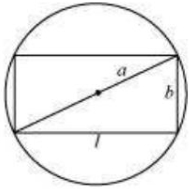
Show that of all the rectangles inscribed in a given fixed circle,the square has the maximum area.
Solution
(N/A) Let a rectangle of length $l$ and breadth $b$ be inscribed in the given circle of radius $R$.
The diagonal of the rectangle passes through the center of the circle and is equal to the diameter,$2R$.
By applying the Pythagoras theorem,we have:
$(2R)^{2} = l^{2} + b^{2}$
$\Rightarrow b^{2} = 4R^{2} - l^{2}$
$\Rightarrow b = \sqrt{4R^{2} - l^{2}}$
Area of the rectangle,$A = l \times b = l \sqrt{4R^{2} - l^{2}}$
To maximize the area,we maximize $A^{2}$. Let $S = A^{2} = l^{2}(4R^{2} - l^{2}) = 4R^{2}l^{2} - l^{4}$.
Differentiating with respect to $l$:
$\frac{dS}{dl} = 8R^{2}l - 4l^{3}$
Setting $\frac{dS}{dl} = 0$:
$4l(2R^{2} - l^{2}) = 0$
Since $l \neq 0$,we have $l^{2} = 2R^{2} \Rightarrow l = R\sqrt{2}$.
Now,$b = \sqrt{4R^{2} - (R\sqrt{2})^{2}} = \sqrt{4R^{2} - 2R^{2}} = \sqrt{2R^{2}} = R\sqrt{2}$.
Since $l = b = R\sqrt{2}$,the rectangle is a square.
Checking the second derivative:
$\frac{d^{2}S}{dl^{2}} = 8R^{2} - 12l^{2}$
At $l^{2} = 2R^{2}$,$\frac{d^{2}S}{dl^{2}} = 8R^{2} - 12(2R^{2}) = 8R^{2} - 24R^{2} = -16R^{2} < 0$.
Since the second derivative is negative,the area is maximum when $l = b = R\sqrt{2}$.
Thus,it is proved that of all rectangles inscribed in a fixed circle,the square has the maximum area.
The diagonal of the rectangle passes through the center of the circle and is equal to the diameter,$2R$.
By applying the Pythagoras theorem,we have:
$(2R)^{2} = l^{2} + b^{2}$
$\Rightarrow b^{2} = 4R^{2} - l^{2}$
$\Rightarrow b = \sqrt{4R^{2} - l^{2}}$
Area of the rectangle,$A = l \times b = l \sqrt{4R^{2} - l^{2}}$
To maximize the area,we maximize $A^{2}$. Let $S = A^{2} = l^{2}(4R^{2} - l^{2}) = 4R^{2}l^{2} - l^{4}$.
Differentiating with respect to $l$:
$\frac{dS}{dl} = 8R^{2}l - 4l^{3}$
Setting $\frac{dS}{dl} = 0$:
$4l(2R^{2} - l^{2}) = 0$
Since $l \neq 0$,we have $l^{2} = 2R^{2} \Rightarrow l = R\sqrt{2}$.
Now,$b = \sqrt{4R^{2} - (R\sqrt{2})^{2}} = \sqrt{4R^{2} - 2R^{2}} = \sqrt{2R^{2}} = R\sqrt{2}$.
Since $l = b = R\sqrt{2}$,the rectangle is a square.
Checking the second derivative:
$\frac{d^{2}S}{dl^{2}} = 8R^{2} - 12l^{2}$
At $l^{2} = 2R^{2}$,$\frac{d^{2}S}{dl^{2}} = 8R^{2} - 12(2R^{2}) = 8R^{2} - 24R^{2} = -16R^{2} < 0$.
Since the second derivative is negative,the area is maximum when $l = b = R\sqrt{2}$.
Thus,it is proved that of all rectangles inscribed in a fixed circle,the square has the maximum area.
0 likes
View Solution341
Difficult
Show that the right circular cylinder of given surface area and maximum volume is such that its height is equal to the diameter of the base.
Solution
(N/A) Let $r$ and $h$ be the radius and height of the cylinder respectively.
The surface area $S$ of the cylinder is given by $S = 2\pi r^2 + 2\pi rh$.
From this,we can express $h$ in terms of $r$ and $S$:
$h = \frac{S - 2\pi r^2}{2\pi r} = \frac{S}{2\pi r} - r$.
The volume $V$ of the cylinder is $V = \pi r^2 h$.
Substituting the expression for $h$:
$V = \pi r^2 \left( \frac{S}{2\pi r} - r \right) = \frac{Sr}{2} - \pi r^3$.
To find the maximum volume,we differentiate $V$ with respect to $r$:
$\frac{dV}{dr} = \frac{S}{2} - 3\pi r^2$.
Setting $\frac{dV}{dr} = 0$ gives $\frac{S}{2} = 3\pi r^2$,so $S = 6\pi r^2$.
Now,find the second derivative to check for maximum:
$\frac{d^2V}{dr^2} = -6\pi r$.
Since $r > 0$,$\frac{d^2V}{dr^2} < 0$,which confirms that the volume is maximum at $S = 6\pi r^2$.
Substituting $S = 6\pi r^2$ into the expression for $h$:
$h = \frac{6\pi r^2 - 2\pi r^2}{2\pi r} = \frac{4\pi r^2}{2\pi r} = 2r$.
Since $2r$ is the diameter of the base,the height of the cylinder is equal to its diameter.
The surface area $S$ of the cylinder is given by $S = 2\pi r^2 + 2\pi rh$.
From this,we can express $h$ in terms of $r$ and $S$:
$h = \frac{S - 2\pi r^2}{2\pi r} = \frac{S}{2\pi r} - r$.
The volume $V$ of the cylinder is $V = \pi r^2 h$.
Substituting the expression for $h$:
$V = \pi r^2 \left( \frac{S}{2\pi r} - r \right) = \frac{Sr}{2} - \pi r^3$.
To find the maximum volume,we differentiate $V$ with respect to $r$:
$\frac{dV}{dr} = \frac{S}{2} - 3\pi r^2$.
Setting $\frac{dV}{dr} = 0$ gives $\frac{S}{2} = 3\pi r^2$,so $S = 6\pi r^2$.
Now,find the second derivative to check for maximum:
$\frac{d^2V}{dr^2} = -6\pi r$.
Since $r > 0$,$\frac{d^2V}{dr^2} < 0$,which confirms that the volume is maximum at $S = 6\pi r^2$.
Substituting $S = 6\pi r^2$ into the expression for $h$:
$h = \frac{6\pi r^2 - 2\pi r^2}{2\pi r} = \frac{4\pi r^2}{2\pi r} = 2r$.
Since $2r$ is the diameter of the base,the height of the cylinder is equal to its diameter.
0 likes
View Solution342
DifficultMCQ
Of all the closed cylindrical cans (right circular) with a given volume of $100 \text{ cm}^3$,find the dimensions of the can that has the minimum surface area.
A
Radius $= \left(\frac{50}{\pi}\right)^{1/3} \text{ cm}$,Height $= 2\left(\frac{50}{\pi}\right)^{1/3} \text{ cm}$
B
Radius $= \left(\frac{100}{\pi}\right)^{1/3} \text{ cm}$,Height $= \left(\frac{100}{\pi}\right)^{1/3} \text{ cm}$
C
Radius $= \left(\frac{50}{\pi}\right)^{1/3} \text{ cm}$,Height $= \left(\frac{50}{\pi}\right)^{1/3} \text{ cm}$
D
Radius $= \left(\frac{25}{\pi}\right)^{1/3} \text{ cm}$,Height $= 4\left(\frac{25}{\pi}\right)^{1/3} \text{ cm}$
Solution
(A) Let $r$ be the radius and $h$ be the height of the cylinder.
Given volume $V = \pi r^2 h = 100 \text{ cm}^3$.
Thus,$h = \frac{100}{\pi r^2}$.
The surface area $S$ is given by $S = 2\pi r^2 + 2\pi rh$.
Substituting $h$,we get $S = 2\pi r^2 + 2\pi r \left(\frac{100}{\pi r^2}\right) = 2\pi r^2 + \frac{200}{r}$.
Differentiating with respect to $r$,we get $\frac{dS}{dr} = 4\pi r - \frac{200}{r^2}$.
Setting $\frac{dS}{dr} = 0$,we have $4\pi r = \frac{200}{r^2} \Rightarrow r^3 = \frac{50}{\pi} \Rightarrow r = \left(\frac{50}{\pi}\right)^{1/3}$.
Checking the second derivative,$\frac{d^2S}{dr^2} = 4\pi + \frac{400}{r^3}$. Since $r > 0$,$\frac{d^2S}{dr^2} > 0$,so $S$ is minimum at $r = \left(\frac{50}{\pi}\right)^{1/3}$.
Then $h = \frac{100}{\pi (50/\pi)^{2/3}} = \frac{100}{\pi} \cdot \frac{\pi^{2/3}}{50^{2/3}} = 2 \cdot \frac{50}{\pi^{1/3} \cdot 50^{2/3}} = 2 \left(\frac{50}{\pi}\right)^{1/3}$.
Thus,the dimensions are $r = \left(\frac{50}{\pi}\right)^{1/3} \text{ cm}$ and $h = 2\left(\frac{50}{\pi}\right)^{1/3} \text{ cm}$.
Given volume $V = \pi r^2 h = 100 \text{ cm}^3$.
Thus,$h = \frac{100}{\pi r^2}$.
The surface area $S$ is given by $S = 2\pi r^2 + 2\pi rh$.
Substituting $h$,we get $S = 2\pi r^2 + 2\pi r \left(\frac{100}{\pi r^2}\right) = 2\pi r^2 + \frac{200}{r}$.
Differentiating with respect to $r$,we get $\frac{dS}{dr} = 4\pi r - \frac{200}{r^2}$.
Setting $\frac{dS}{dr} = 0$,we have $4\pi r = \frac{200}{r^2} \Rightarrow r^3 = \frac{50}{\pi} \Rightarrow r = \left(\frac{50}{\pi}\right)^{1/3}$.
Checking the second derivative,$\frac{d^2S}{dr^2} = 4\pi + \frac{400}{r^3}$. Since $r > 0$,$\frac{d^2S}{dr^2} > 0$,so $S$ is minimum at $r = \left(\frac{50}{\pi}\right)^{1/3}$.
Then $h = \frac{100}{\pi (50/\pi)^{2/3}} = \frac{100}{\pi} \cdot \frac{\pi^{2/3}}{50^{2/3}} = 2 \cdot \frac{50}{\pi^{1/3} \cdot 50^{2/3}} = 2 \left(\frac{50}{\pi}\right)^{1/3}$.
Thus,the dimensions are $r = \left(\frac{50}{\pi}\right)^{1/3} \text{ cm}$ and $h = 2\left(\frac{50}{\pi}\right)^{1/3} \text{ cm}$.
0 likes
View Solution343
DifficultMCQ
$A$ wire of length $28 \, m$ is to be cut into two pieces. One of the pieces is to be made into a square and the other into a circle. What should be the length of the two pieces so that the combined area of the square and the circle is minimum?
A
Square: $\frac{112}{\pi+4} \, m$,Circle: $\frac{28\pi}{\pi+4} \, m$
B
Square: $\frac{28\pi}{\pi+4} \, m$,Circle: $\frac{112}{\pi+4} \, m$
C
Square: $\frac{56}{\pi+4} \, m$,Circle: $\frac{56\pi}{\pi+4} \, m$
D
Square: $\frac{112\pi}{\pi+4} \, m$,Circle: $\frac{28}{\pi+4} \, m$
Solution
(A) Let the length of the wire used for the square be $l \, m$. Then the length of the wire used for the circle is $(28-l) \, m$.
The side of the square is $s = \frac{l}{4}$. The area of the square is $A_s = s^2 = \frac{l^2}{16}$.
For the circle,the circumference is $2\pi r = 28-l$,so the radius is $r = \frac{28-l}{2\pi}$. The area of the circle is $A_c = \pi r^2 = \pi \left( \frac{28-l}{2\pi} \right)^2 = \frac{(28-l)^2}{4\pi}$.
The total area $A = A_s + A_c = \frac{l^2}{16} + \frac{(28-l)^2}{4\pi}$.
To find the minimum,we differentiate $A$ with respect to $l$: $\frac{dA}{dl} = \frac{2l}{16} + \frac{2(28-l)(-1)}{4\pi} = \frac{l}{8} - \frac{28-l}{2\pi}$.
Setting $\frac{dA}{dl} = 0$,we get $\frac{l}{8} = \frac{28-l}{2\pi} \Rightarrow \pi l = 4(28-l) \Rightarrow \pi l = 112 - 4l \Rightarrow l(\pi+4) = 112 \Rightarrow l = \frac{112}{\pi+4}$.
The second derivative $\frac{d^2A}{dl^2} = \frac{1}{8} + \frac{1}{2\pi} > 0$,confirming a minimum.
The length for the square is $\frac{112}{\pi+4} \, m$ and the length for the circle is $28 - \frac{112}{\pi+4} = \frac{28\pi+112-112}{\pi+4} = \frac{28\pi}{\pi+4} \, m$.
The side of the square is $s = \frac{l}{4}$. The area of the square is $A_s = s^2 = \frac{l^2}{16}$.
For the circle,the circumference is $2\pi r = 28-l$,so the radius is $r = \frac{28-l}{2\pi}$. The area of the circle is $A_c = \pi r^2 = \pi \left( \frac{28-l}{2\pi} \right)^2 = \frac{(28-l)^2}{4\pi}$.
The total area $A = A_s + A_c = \frac{l^2}{16} + \frac{(28-l)^2}{4\pi}$.
To find the minimum,we differentiate $A$ with respect to $l$: $\frac{dA}{dl} = \frac{2l}{16} + \frac{2(28-l)(-1)}{4\pi} = \frac{l}{8} - \frac{28-l}{2\pi}$.
Setting $\frac{dA}{dl} = 0$,we get $\frac{l}{8} = \frac{28-l}{2\pi} \Rightarrow \pi l = 4(28-l) \Rightarrow \pi l = 112 - 4l \Rightarrow l(\pi+4) = 112 \Rightarrow l = \frac{112}{\pi+4}$.
The second derivative $\frac{d^2A}{dl^2} = \frac{1}{8} + \frac{1}{2\pi} > 0$,confirming a minimum.
The length for the square is $\frac{112}{\pi+4} \, m$ and the length for the circle is $28 - \frac{112}{\pi+4} = \frac{28\pi+112-112}{\pi+4} = \frac{28\pi}{\pi+4} \, m$.
0 likes
View Solution344
Difficult
Prove that the volume of the largest cone that can be inscribed in a sphere of radius $R$ is $\frac{8}{27}$ of the volume of the sphere.
Solution
(N/A) Let $r$ and $h$ be the radius and height of the cone respectively inscribed in a sphere of radius $R$.
Let $V$ be the volume of the cone.
Then,$V = \frac{1}{3} \pi r^{2} h$.
Height of the cone is given by $h = R + AB = R + \sqrt{R^{2} - r^{2}}$.
$V = \frac{1}{3} \pi r^{2} (R + \sqrt{R^{2} - r^{2}})$.
$V = \frac{1}{3} \pi r^{2} R + \frac{1}{3} \pi r^{2} \sqrt{R^{2} - r^{2}}$.
Differentiating with respect to $r$:
$\frac{dV}{dr} = \frac{2}{3} \pi r R + \frac{1}{3} \pi \left( 2r \sqrt{R^{2} - r^{2}} + r^{2} \cdot \frac{-2r}{2\sqrt{R^{2} - r^{2}}} \right)$.
$\frac{dV}{dr} = \frac{2}{3} \pi r R + \frac{1}{3} \pi \left( \frac{2r(R^{2} - r^{2}) - r^{3}}{\sqrt{R^{2} - r^{2}}} \right) = \frac{2}{3} \pi r R + \frac{\pi r (2R^{2} - 3r^{2})}{3\sqrt{R^{2} - r^{2}}}$.
Setting $\frac{dV}{dr} = 0$:
$\frac{2}{3} \pi r R = - \frac{\pi r (2R^{2} - 3r^{2})}{3\sqrt{R^{2} - r^{2}}} \Rightarrow 2R\sqrt{R^{2} - r^{2}} = 3r^{2} - 2R^{2}$.
Squaring both sides: $4R^{2}(R^{2} - r^{2}) = (3r^{2} - 2R^{2})^{2}$.
$4R^{4} - 4R^{2}r^{2} = 9r^{4} + 4R^{4} - 12r^{2}R^{2}$.
$9r^{4} = 8R^{2}r^{2} \Rightarrow r^{2} = \frac{8}{9}R^{2}$.
Then $h = R + \sqrt{R^{2} - \frac{8}{9}R^{2}} = R + \frac{R}{3} = \frac{4}{3}R$.
Maximum volume $V = \frac{1}{3} \pi (\frac{8}{9}R^{2}) (\frac{4}{3}R) = \frac{32}{81} \pi R^{3}$.
Volume of sphere $V_{s} = \frac{4}{3} \pi R^{3}$.
Ratio $\frac{V}{V_{s}} = \frac{32/81 \pi R^{3}}{4/3 \pi R^{3}} = \frac{32}{81} \cdot \frac{3}{4} = \frac{8}{27}$.
Hence,the volume of the largest cone is $\frac{8}{27}$ of the volume of the sphere.
Let $V$ be the volume of the cone.
Then,$V = \frac{1}{3} \pi r^{2} h$.
Height of the cone is given by $h = R + AB = R + \sqrt{R^{2} - r^{2}}$.
$V = \frac{1}{3} \pi r^{2} (R + \sqrt{R^{2} - r^{2}})$.
$V = \frac{1}{3} \pi r^{2} R + \frac{1}{3} \pi r^{2} \sqrt{R^{2} - r^{2}}$.
Differentiating with respect to $r$:
$\frac{dV}{dr} = \frac{2}{3} \pi r R + \frac{1}{3} \pi \left( 2r \sqrt{R^{2} - r^{2}} + r^{2} \cdot \frac{-2r}{2\sqrt{R^{2} - r^{2}}} \right)$.
$\frac{dV}{dr} = \frac{2}{3} \pi r R + \frac{1}{3} \pi \left( \frac{2r(R^{2} - r^{2}) - r^{3}}{\sqrt{R^{2} - r^{2}}} \right) = \frac{2}{3} \pi r R + \frac{\pi r (2R^{2} - 3r^{2})}{3\sqrt{R^{2} - r^{2}}}$.
Setting $\frac{dV}{dr} = 0$:
$\frac{2}{3} \pi r R = - \frac{\pi r (2R^{2} - 3r^{2})}{3\sqrt{R^{2} - r^{2}}} \Rightarrow 2R\sqrt{R^{2} - r^{2}} = 3r^{2} - 2R^{2}$.
Squaring both sides: $4R^{2}(R^{2} - r^{2}) = (3r^{2} - 2R^{2})^{2}$.
$4R^{4} - 4R^{2}r^{2} = 9r^{4} + 4R^{4} - 12r^{2}R^{2}$.
$9r^{4} = 8R^{2}r^{2} \Rightarrow r^{2} = \frac{8}{9}R^{2}$.
Then $h = R + \sqrt{R^{2} - \frac{8}{9}R^{2}} = R + \frac{R}{3} = \frac{4}{3}R$.
Maximum volume $V = \frac{1}{3} \pi (\frac{8}{9}R^{2}) (\frac{4}{3}R) = \frac{32}{81} \pi R^{3}$.
Volume of sphere $V_{s} = \frac{4}{3} \pi R^{3}$.
Ratio $\frac{V}{V_{s}} = \frac{32/81 \pi R^{3}}{4/3 \pi R^{3}} = \frac{32}{81} \cdot \frac{3}{4} = \frac{8}{27}$.
Hence,the volume of the largest cone is $\frac{8}{27}$ of the volume of the sphere.
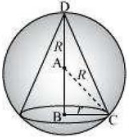
0 likes
View Solution345
Difficult
Show that the right circular cone of least curved surface area and given volume has an altitude equal to $\sqrt{2}$ times the radius of the base.
Solution
(N/A) Let $r$ and $h$ be the radius and the height (altitude) of the cone respectively.
The volume $(V)$ of the cone is given by $V = \frac{1}{3} \pi r^{2} h$,which implies $h = \frac{3V}{\pi r^{2}}$.
The curved surface area $(S)$ of the cone is given by $S = \pi r l = \pi r \sqrt{r^{2} + h^{2}}$.
Substituting $h$,we get $S = \pi r \sqrt{r^{2} + \frac{9V^{2}}{\pi^{2} r^{4}}} = \frac{1}{r} \sqrt{\pi^{2} r^{6} + 9V^{2}}$.
To minimize $S$,we minimize $S^{2} = \frac{\pi^{2} r^{6} + 9V^{2}}{r^{2}} = \pi^{2} r^{4} + 9V^{2} r^{-2}$.
Let $f(r) = S^{2}$. Then $f'(r) = 4 \pi^{2} r^{3} - 18V^{2} r^{-3}$.
Setting $f'(r) = 0$,we get $4 \pi^{2} r^{3} = \frac{18V^{2}}{r^{3}}$,so $r^{6} = \frac{18V^{2}}{4 \pi^{2}} = \frac{9V^{2}}{2 \pi^{2}}$.
Substituting $V = \frac{1}{3} \pi r^{2} h$ into $r^{6} = \frac{9V^{2}}{2 \pi^{2}}$,we get $r^{6} = \frac{9}{2 \pi^{2}} \cdot (\frac{1}{9} \pi^{2} r^{4} h^{2}) = \frac{1}{2} r^{4} h^{2}$.
Thus,$r^{2} = \frac{1}{2} h^{2}$,which implies $h^{2} = 2r^{2}$,or $h = \sqrt{2} r$.
Since $f''(r) = 12 \pi^{2} r^{2} + 54V^{2} r^{-4} > 0$ for $r > 0$,the surface area is indeed minimized at $h = \sqrt{2} r$.
The volume $(V)$ of the cone is given by $V = \frac{1}{3} \pi r^{2} h$,which implies $h = \frac{3V}{\pi r^{2}}$.
The curved surface area $(S)$ of the cone is given by $S = \pi r l = \pi r \sqrt{r^{2} + h^{2}}$.
Substituting $h$,we get $S = \pi r \sqrt{r^{2} + \frac{9V^{2}}{\pi^{2} r^{4}}} = \frac{1}{r} \sqrt{\pi^{2} r^{6} + 9V^{2}}$.
To minimize $S$,we minimize $S^{2} = \frac{\pi^{2} r^{6} + 9V^{2}}{r^{2}} = \pi^{2} r^{4} + 9V^{2} r^{-2}$.
Let $f(r) = S^{2}$. Then $f'(r) = 4 \pi^{2} r^{3} - 18V^{2} r^{-3}$.
Setting $f'(r) = 0$,we get $4 \pi^{2} r^{3} = \frac{18V^{2}}{r^{3}}$,so $r^{6} = \frac{18V^{2}}{4 \pi^{2}} = \frac{9V^{2}}{2 \pi^{2}}$.
Substituting $V = \frac{1}{3} \pi r^{2} h$ into $r^{6} = \frac{9V^{2}}{2 \pi^{2}}$,we get $r^{6} = \frac{9}{2 \pi^{2}} \cdot (\frac{1}{9} \pi^{2} r^{4} h^{2}) = \frac{1}{2} r^{4} h^{2}$.
Thus,$r^{2} = \frac{1}{2} h^{2}$,which implies $h^{2} = 2r^{2}$,or $h = \sqrt{2} r$.
Since $f''(r) = 12 \pi^{2} r^{2} + 54V^{2} r^{-4} > 0$ for $r > 0$,the surface area is indeed minimized at $h = \sqrt{2} r$.
0 likes
View Solution346
Difficult
Show that the semi-vertical angle of the cone of the maximum volume and of given slant height is $\tan ^{-1} \sqrt{2}$.
Solution
(A) Let $\theta$ be the semi-vertical angle of the cone.
It is clear that $\theta \in [0, \frac{\pi}{2}]$.
Let $r$,$h$,and $l$ be the radius,height,and the slant height of the cone respectively.
The slant height $l$ of the cone is given as constant.
Now,$r = l \sin \theta$ and $h = l \cos \theta$.
The volume $(V)$ of the cone is given by $V = \frac{1}{3} \pi r^2 h$.
Substituting the values of $r$ and $h$,we get:
$V = \frac{1}{3} \pi (l^2 \sin^2 \theta)(l \cos \theta) = \frac{1}{3} \pi l^3 \sin^2 \theta \cos \theta$.
Differentiating $V$ with respect to $\theta$:
$\frac{dV}{d\theta} = \frac{\pi l^3}{3} [\sin^2 \theta(-\sin \theta) + \cos \theta(2 \sin \theta \cos \theta)]$
$= \frac{\pi l^3}{3} [-\sin^3 \theta + 2 \sin \theta \cos^2 \theta]$.
For maximum or minimum volume,set $\frac{dV}{d\theta} = 0$:
$\sin^3 \theta = 2 \sin \theta \cos^2 \theta \Rightarrow \tan^2 \theta = 2 \Rightarrow \tan \theta = \sqrt{2} \Rightarrow \theta = \tan^{-1} \sqrt{2}$.
Now,check the second derivative:
$\frac{d^2V}{d\theta^2} = \frac{\pi l^3}{3} [-3 \sin^2 \theta \cos \theta + 2 \cos^3 \theta - 4 \sin^2 \theta \cos \theta] = \frac{\pi l^3}{3} [2 \cos^3 \theta - 7 \sin^2 \theta \cos \theta]$.
Substituting $\sin^2 \theta = 2 \cos^2 \theta$ at $\tan \theta = \sqrt{2}$:
$\frac{d^2V}{d\theta^2} = \frac{\pi l^3}{3} [2 \cos^3 \theta - 7(2 \cos^2 \theta) \cos \theta] = \frac{\pi l^3}{3} [2 \cos^3 \theta - 14 \cos^3 \theta] = -4 \pi l^3 \cos^3 \theta$.
Since $\theta \in [0, \frac{\pi}{2}]$,$\cos \theta > 0$,so $\frac{d^2V}{d\theta^2} < 0$.
Thus,the volume is maximum when $\theta = \tan^{-1} \sqrt{2}$.
It is clear that $\theta \in [0, \frac{\pi}{2}]$.
Let $r$,$h$,and $l$ be the radius,height,and the slant height of the cone respectively.
The slant height $l$ of the cone is given as constant.
Now,$r = l \sin \theta$ and $h = l \cos \theta$.
The volume $(V)$ of the cone is given by $V = \frac{1}{3} \pi r^2 h$.
Substituting the values of $r$ and $h$,we get:
$V = \frac{1}{3} \pi (l^2 \sin^2 \theta)(l \cos \theta) = \frac{1}{3} \pi l^3 \sin^2 \theta \cos \theta$.
Differentiating $V$ with respect to $\theta$:
$\frac{dV}{d\theta} = \frac{\pi l^3}{3} [\sin^2 \theta(-\sin \theta) + \cos \theta(2 \sin \theta \cos \theta)]$
$= \frac{\pi l^3}{3} [-\sin^3 \theta + 2 \sin \theta \cos^2 \theta]$.
For maximum or minimum volume,set $\frac{dV}{d\theta} = 0$:
$\sin^3 \theta = 2 \sin \theta \cos^2 \theta \Rightarrow \tan^2 \theta = 2 \Rightarrow \tan \theta = \sqrt{2} \Rightarrow \theta = \tan^{-1} \sqrt{2}$.
Now,check the second derivative:
$\frac{d^2V}{d\theta^2} = \frac{\pi l^3}{3} [-3 \sin^2 \theta \cos \theta + 2 \cos^3 \theta - 4 \sin^2 \theta \cos \theta] = \frac{\pi l^3}{3} [2 \cos^3 \theta - 7 \sin^2 \theta \cos \theta]$.
Substituting $\sin^2 \theta = 2 \cos^2 \theta$ at $\tan \theta = \sqrt{2}$:
$\frac{d^2V}{d\theta^2} = \frac{\pi l^3}{3} [2 \cos^3 \theta - 7(2 \cos^2 \theta) \cos \theta] = \frac{\pi l^3}{3} [2 \cos^3 \theta - 14 \cos^3 \theta] = -4 \pi l^3 \cos^3 \theta$.
Since $\theta \in [0, \frac{\pi}{2}]$,$\cos \theta > 0$,so $\frac{d^2V}{d\theta^2} < 0$.
Thus,the volume is maximum when $\theta = \tan^{-1} \sqrt{2}$.
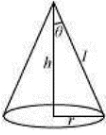
0 likes
View Solution347
Difficult
Show that the semi-vertical angle of a right circular cone of given surface area and maximum volume is $\sin ^{-1}\left(\frac{1}{3}\right)$.
Solution
(N/A) Let $r, h, l$ be the radius,height,and slant height of the right circular cone respectively. Let $S$ be the given surface area of the cone.
We have,$l^{2}=r^{2}+h^{2} \quad \dots (1)$
$S=\pi r l+\pi r^{2}$
$S-\pi r^{2}=\pi r l$
$\Rightarrow l=\frac{S-\pi r^{2}}{\pi r}$
$V=\frac{1}{3} \pi r^{2} h$
$\Rightarrow V=\frac{1}{3} \pi r^{2} \sqrt{l^{2}-r^{2}} \quad (\text{by } (1))$
$\Rightarrow V^{2}=\frac{1}{9} \pi^{2} r^{4}\left(l^{2}-r^{2}\right)$
$\Rightarrow V^{2}=\frac{1}{9} \pi^{2} r^{4}\left[\left(\frac{S-\pi r^{2}}{\pi r}\right)^{2}-r^{2}\right]$
$\Rightarrow V^{2}=\frac{1}{9} \pi^{2} r^{4}\left[\frac{\left(S-\pi r^{2}\right)^{2}-\pi^{2} r^{4}}{\pi^{2} r^{2}}\right]$
$\Rightarrow V^{2}=\frac{1}{9} r^{2}\left[\left(S-\pi r^{2}\right)^{2}-\pi^{2} r^{4}\right]$
$\Rightarrow V^{2}=\frac{1}{9} r^{2}\left[S^{2}-2 \pi S r^{2}+\pi^{2} r^{4}-\pi^{2} r^{4}\right]$
$\Rightarrow V^{2}=\frac{1}{9}\left(r^{2} S^{2}-2 \pi S r^{4}\right)$
$2 V \frac{d V}{d r}=\frac{S^{2}}{9} (2 r)-\frac{2 \pi S}{9} (4 r^{3})$
$2 V \frac{d V}{d r}=\frac{2 r S}{9}\left(S-4 \pi r^{2}\right)$
For maximum volume,$\frac{d V}{d r}=0$
$\Rightarrow \frac{2 r S}{9}\left(S-4 \pi r^{2}\right)=0$
Since $r \neq 0$,we have $S=4 \pi r^{2}$
$\Rightarrow r^{2}=\frac{S}{4 \pi}$
Substituting $S=\pi r l+\pi r^{2}$,we get $4 \pi r^{2}=\pi r l+\pi r^{2}$
$\Rightarrow 3 \pi r^{2}=\pi r l$
$\Rightarrow l=3 r$
Let $\alpha$ be the semi-vertical angle.
$\sin \alpha=\frac{r}{l}=\frac{r}{3 r}=\frac{1}{3}$
$\Rightarrow \alpha=\sin ^{-1}\left(\frac{1}{3}\right)$
We have,$l^{2}=r^{2}+h^{2} \quad \dots (1)$
$S=\pi r l+\pi r^{2}$
$S-\pi r^{2}=\pi r l$
$\Rightarrow l=\frac{S-\pi r^{2}}{\pi r}$
$V=\frac{1}{3} \pi r^{2} h$
$\Rightarrow V=\frac{1}{3} \pi r^{2} \sqrt{l^{2}-r^{2}} \quad (\text{by } (1))$
$\Rightarrow V^{2}=\frac{1}{9} \pi^{2} r^{4}\left(l^{2}-r^{2}\right)$
$\Rightarrow V^{2}=\frac{1}{9} \pi^{2} r^{4}\left[\left(\frac{S-\pi r^{2}}{\pi r}\right)^{2}-r^{2}\right]$
$\Rightarrow V^{2}=\frac{1}{9} \pi^{2} r^{4}\left[\frac{\left(S-\pi r^{2}\right)^{2}-\pi^{2} r^{4}}{\pi^{2} r^{2}}\right]$
$\Rightarrow V^{2}=\frac{1}{9} r^{2}\left[\left(S-\pi r^{2}\right)^{2}-\pi^{2} r^{4}\right]$
$\Rightarrow V^{2}=\frac{1}{9} r^{2}\left[S^{2}-2 \pi S r^{2}+\pi^{2} r^{4}-\pi^{2} r^{4}\right]$
$\Rightarrow V^{2}=\frac{1}{9}\left(r^{2} S^{2}-2 \pi S r^{4}\right)$
$2 V \frac{d V}{d r}=\frac{S^{2}}{9} (2 r)-\frac{2 \pi S}{9} (4 r^{3})$
$2 V \frac{d V}{d r}=\frac{2 r S}{9}\left(S-4 \pi r^{2}\right)$
For maximum volume,$\frac{d V}{d r}=0$
$\Rightarrow \frac{2 r S}{9}\left(S-4 \pi r^{2}\right)=0$
Since $r \neq 0$,we have $S=4 \pi r^{2}$
$\Rightarrow r^{2}=\frac{S}{4 \pi}$
Substituting $S=\pi r l+\pi r^{2}$,we get $4 \pi r^{2}=\pi r l+\pi r^{2}$
$\Rightarrow 3 \pi r^{2}=\pi r l$
$\Rightarrow l=3 r$
Let $\alpha$ be the semi-vertical angle.
$\sin \alpha=\frac{r}{l}=\frac{r}{3 r}=\frac{1}{3}$
$\Rightarrow \alpha=\sin ^{-1}\left(\frac{1}{3}\right)$
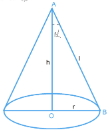
0 likes
View Solution348
DifficultMCQ
For all real values of $x,$ the minimum value of $\frac{1-x+x^{2}}{1+x+x^{2}}$ is
A
$0$
B
$1$
C
$3$
D
$\frac{1}{3}$
Solution
(D) Let $f(x) = \frac{1-x+x^{2}}{1+x+x^{2}}$.
Using the quotient rule,$f^{\prime}(x) = \frac{(1+x+x^{2})(-1+2x) - (1-x+x^{2})(1+2x)}{(1+x+x^{2})^{2}}$.
Simplifying the numerator: $(2x^{2}+x-1) - (2x^{3}+x^{2}-x+1) = 2x^{2}-2 = 2(x^{2}-1)$.
So,$f^{\prime}(x) = \frac{2(x^{2}-1)}{(1+x+x^{2})^{2}}$.
Setting $f^{\prime}(x) = 0$,we get $x^{2}-1 = 0$,which implies $x = 1$ or $x = -1$.
Evaluating $f(x)$ at these critical points:
$f(1) = \frac{1-1+1}{1+1+1} = \frac{1}{3}$.
$f(-1) = \frac{1-(-1)+(-1)^{2}}{1+(-1)+(-1)^{2}} = \frac{1+1+1}{1-1+1} = 3$.
Since $f(x) \to 1$ as $x \to \pm \infty$,the minimum value is $\frac{1}{3}$.
Using the quotient rule,$f^{\prime}(x) = \frac{(1+x+x^{2})(-1+2x) - (1-x+x^{2})(1+2x)}{(1+x+x^{2})^{2}}$.
Simplifying the numerator: $(2x^{2}+x-1) - (2x^{3}+x^{2}-x+1) = 2x^{2}-2 = 2(x^{2}-1)$.
So,$f^{\prime}(x) = \frac{2(x^{2}-1)}{(1+x+x^{2})^{2}}$.
Setting $f^{\prime}(x) = 0$,we get $x^{2}-1 = 0$,which implies $x = 1$ or $x = -1$.
Evaluating $f(x)$ at these critical points:
$f(1) = \frac{1-1+1}{1+1+1} = \frac{1}{3}$.
$f(-1) = \frac{1-(-1)+(-1)^{2}}{1+(-1)+(-1)^{2}} = \frac{1+1+1}{1-1+1} = 3$.
Since $f(x) \to 1$ as $x \to \pm \infty$,the minimum value is $\frac{1}{3}$.
0 likes
View Solution349
DifficultMCQ
The maximum value of $[x(x-1)+1]^{\frac{1}{3}}$ for $0 \leq x \leq 1$ is
A
$1$
B
$\frac{1}{2}$
C
$(\frac{1}{3})^{\frac{1}{3}}$
D
$0$
Solution
(A) Let $f(x) = [x(x-1)+1]^{\frac{1}{3}} = [x^2-x+1]^{\frac{1}{3}}$.
To find the critical points,we calculate the derivative $f'(x)$:
$f'(x) = \frac{1}{3}[x^2-x+1]^{-\frac{2}{3}} \cdot (2x-1) = \frac{2x-1}{3(x^2-x+1)^{\frac{2}{3}}}$.
Setting $f'(x) = 0$,we get $2x-1 = 0$,which implies $x = \frac{1}{2}$.
Since $x = \frac{1}{2}$ lies within the interval $[0, 1]$,we evaluate $f(x)$ at the critical point and the endpoints:
$f(0) = [0(0-1)+1]^{\frac{1}{3}} = 1^{\frac{1}{3}} = 1$.
$f(1) = [1(1-1)+1]^{\frac{1}{3}} = 1^{\frac{1}{3}} = 1$.
$f(\frac{1}{2}) = [\frac{1}{2}(\frac{1}{2}-1)+1]^{\frac{1}{3}} = [\frac{1}{2}(-\frac{1}{2})+1]^{\frac{1}{3}} = [-\frac{1}{4}+1]^{\frac{1}{3}} = (\frac{3}{4})^{\frac{1}{3}}$.
Comparing the values $1$,$1$,and $(\frac{3}{4})^{\frac{1}{3}}$,the maximum value is $1$.
Thus,the correct answer is $A$.
To find the critical points,we calculate the derivative $f'(x)$:
$f'(x) = \frac{1}{3}[x^2-x+1]^{-\frac{2}{3}} \cdot (2x-1) = \frac{2x-1}{3(x^2-x+1)^{\frac{2}{3}}}$.
Setting $f'(x) = 0$,we get $2x-1 = 0$,which implies $x = \frac{1}{2}$.
Since $x = \frac{1}{2}$ lies within the interval $[0, 1]$,we evaluate $f(x)$ at the critical point and the endpoints:
$f(0) = [0(0-1)+1]^{\frac{1}{3}} = 1^{\frac{1}{3}} = 1$.
$f(1) = [1(1-1)+1]^{\frac{1}{3}} = 1^{\frac{1}{3}} = 1$.
$f(\frac{1}{2}) = [\frac{1}{2}(\frac{1}{2}-1)+1]^{\frac{1}{3}} = [\frac{1}{2}(-\frac{1}{2})+1]^{\frac{1}{3}} = [-\frac{1}{4}+1]^{\frac{1}{3}} = (\frac{3}{4})^{\frac{1}{3}}$.
Comparing the values $1$,$1$,and $(\frac{3}{4})^{\frac{1}{3}}$,the maximum value is $1$.
Thus,the correct answer is $A$.
0 likes
View Solution350
DifficultMCQ
An open-topped box is to be constructed by removing equal squares from each corner of a $3 \text{ m}$ by $8 \text{ m}$ rectangular sheet of aluminium and folding up the sides. Find the volume of the largest such box.
A
$ \frac{200}{27} \text{ m}^3 $
B
$ \frac{100}{27} \text{ m}^3 $
C
$ \frac{200}{9} \text{ m}^3 $
D
$ \frac{100}{9} \text{ m}^3 $
Solution
$ (A) $ Let $x$ metres be the side length of the removed squares. The height of the box is $x$, the length is $8-2x$, and the breadth is $3-2x$.
Since the dimensions must be positive, $x > 0$, $8-2x > 0$, and $3-2x > 0$, which implies $0 < x < 1.5$.
The volume $V(x)$ is given by:
$V(x) = x(3-2x)(8-2x) = x(24 - 6x - 16x + 4x^2) = 4x^3 - 22x^2 + 24x$.
To find the maximum volume, we find the derivative $V'(x)$:
$V'(x) = 12x^2 - 44x + 24$.
Setting $V'(x) = 0$:
$12x^2 - 44x + 24 = 0 \implies 4(3x^2 - 11x + 6) = 0 \implies 4(3x-2)(x-3) = 0$.
The critical points are $x = 2/3$ and $x = 3$.
Since $x < 1.5$, we discard $x = 3$.
Using the second derivative test: $V''(x) = 24x - 44$.
$V''(2/3) = 24(2/3) - 44 = 16 - 44 = -28 < 0$.
Thus, $x = 2/3$ is the point of local maxima.
The maximum volume is:
$V(2/3) = (2/3)(3 - 2(2/3))(8 - 2(2/3)) = (2/3)(3 - 4/3)(8 - 4/3) = (2/3)(5/3)(20/3) = 200/27 \text{ m}^3$.
Since the dimensions must be positive, $x > 0$, $8-2x > 0$, and $3-2x > 0$, which implies $0 < x < 1.5$.
The volume $V(x)$ is given by:
$V(x) = x(3-2x)(8-2x) = x(24 - 6x - 16x + 4x^2) = 4x^3 - 22x^2 + 24x$.
To find the maximum volume, we find the derivative $V'(x)$:
$V'(x) = 12x^2 - 44x + 24$.
Setting $V'(x) = 0$:
$12x^2 - 44x + 24 = 0 \implies 4(3x^2 - 11x + 6) = 0 \implies 4(3x-2)(x-3) = 0$.
The critical points are $x = 2/3$ and $x = 3$.
Since $x < 1.5$, we discard $x = 3$.
Using the second derivative test: $V''(x) = 24x - 44$.
$V''(2/3) = 24(2/3) - 44 = 16 - 44 = -28 < 0$.
Thus, $x = 2/3$ is the point of local maxima.
The maximum volume is:
$V(2/3) = (2/3)(3 - 2(2/3))(8 - 2(2/3)) = (2/3)(3 - 4/3)(8 - 4/3) = (2/3)(5/3)(20/3) = 200/27 \text{ m}^3$.
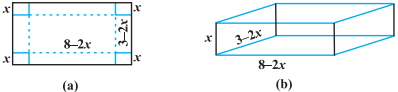
0 likes
View SolutionApplications of Derivatives — Maxima and Minima · Frequently Asked Questions
1Are these Applications of Derivatives questions useful for JEE and NEET?
Yes. All questions in this section are mapped to JEE Main and NEET exam patterns. Previous year questions from JEE Main, NEET, GUJCET and state-level exams are included with full solutions.
2Can I switch to Hindi or Gujarati for these questions?
Yes. Use the language tabs in the hero section or the sidebar to view the same questions and solutions in English, Hindi or Gujarati.
3How do I generate a question paper from this subtopic?
Use the Vedclass Exam Paper Generator — select the chapter and subtopic, set difficulty, and generate Sets A, B, C, D automatically. First 3 chapters of every subject are free.
Vedclass Products
For Students
Vedclass Test Series
Mock tests in real JEE/NEET style with performance analysis. 5-day free trial.
Start Free TrialFor Teachers
Exam Paper Generator
Generate Set A/B/C/D papers from this chapter in 2 minutes. 3 chapters free.
Try FreeFor Institutes
Online Exam Module
Live online exams with unlimited students, 360° analytics & white-label branding.
See DemoFor Teachers & Institutes
Generate a Applications of Derivatives Exam Paper in 2 Minutes
Select subtopic & difficulty — Sets A, B, C, D auto-generated with No Repeat logic.
First 3 chapters of every subject are free — no payment required.