
A English
Maxima and Minima Questions in English
Class 12 Mathematics · Applications of Derivatives · Maxima and Minima
760+
Questions
English
Language
100%
With Solutions
Showing 10 of 760 questions in English
751
MediumMCQ
Maximum value of the function $f(x)=\frac{x}{8}+\frac{2}{x}$ on the interval $[1,6]$ is
A
$1$
B
$\frac{9}{8}$
C
$\frac{13}{12}$
D
$\frac{17}{8}$
Solution
(D) Given function is $f(x) = \frac{x}{8} + \frac{2}{x}$.
First,find the derivative $f'(x) = \frac{1}{8} - \frac{2}{x^2} = \frac{x^2 - 16}{8x^2}$.
To find critical points,set $f'(x) = 0$,which gives $x^2 - 16 = 0$,so $x = 4$ or $x = -4$.
Since the interval is $[1, 6]$,we only consider $x = 4$.
Now,evaluate $f(x)$ at the critical point and the endpoints of the interval $[1, 6]$:
$f(1) = \frac{1}{8} + \frac{2}{1} = \frac{1}{8} + 2 = \frac{17}{8} = 2.125$.
$f(4) = \frac{4}{8} + \frac{2}{4} = \frac{1}{2} + \frac{1}{2} = 1$.
$f(6) = \frac{6}{8} + \frac{2}{6} = \frac{3}{4} + \frac{1}{3} = \frac{9+4}{12} = \frac{13}{12} \approx 1.083$.
Comparing the values $f(1) = \frac{17}{8}$,$f(4) = 1$,and $f(6) = \frac{13}{12}$,the maximum value is $\frac{17}{8}$.
First,find the derivative $f'(x) = \frac{1}{8} - \frac{2}{x^2} = \frac{x^2 - 16}{8x^2}$.
To find critical points,set $f'(x) = 0$,which gives $x^2 - 16 = 0$,so $x = 4$ or $x = -4$.
Since the interval is $[1, 6]$,we only consider $x = 4$.
Now,evaluate $f(x)$ at the critical point and the endpoints of the interval $[1, 6]$:
$f(1) = \frac{1}{8} + \frac{2}{1} = \frac{1}{8} + 2 = \frac{17}{8} = 2.125$.
$f(4) = \frac{4}{8} + \frac{2}{4} = \frac{1}{2} + \frac{1}{2} = 1$.
$f(6) = \frac{6}{8} + \frac{2}{6} = \frac{3}{4} + \frac{1}{3} = \frac{9+4}{12} = \frac{13}{12} \approx 1.083$.
Comparing the values $f(1) = \frac{17}{8}$,$f(4) = 1$,and $f(6) = \frac{13}{12}$,the maximum value is $\frac{17}{8}$.
0 likes
View Solution752
MediumMCQ
Let $f(x) = x^3 e^{-3x}, x > 0$. Then the maximum value of $f(x)$ is
A
$e^{-3}$
B
$3 e^{-3}$
C
$27 e^{-9}$
D
$\infty$
Solution
(A) Given the function $f(x) = x^3 e^{-3x}$ for $x > 0$.
To find the maximum value,we first find the derivative $f'(x)$ using the product rule:
$f'(x) = \frac{d}{dx}(x^3) \cdot e^{-3x} + x^3 \cdot \frac{d}{dx}(e^{-3x})$
$f'(x) = 3x^2 e^{-3x} + x^3 (-3 e^{-3x})$
$f'(x) = 3x^2 e^{-3x} (1 - x)$
Setting $f'(x) = 0$ for critical points:
$3x^2 e^{-3x} (1 - x) = 0$
Since $x > 0$ and $e^{-3x} \neq 0$,we have $1 - x = 0$,which gives $x = 1$.
To confirm it is a maximum,we check the sign of $f'(x)$ around $x = 1$. For $x < 1$,$f'(x) > 0$ and for $x > 1$,$f'(x) < 0$.
Thus,$f(x)$ has a local maximum at $x = 1$.
The maximum value is $f(1) = (1)^3 e^{-3(1)} = e^{-3}$.
To find the maximum value,we first find the derivative $f'(x)$ using the product rule:
$f'(x) = \frac{d}{dx}(x^3) \cdot e^{-3x} + x^3 \cdot \frac{d}{dx}(e^{-3x})$
$f'(x) = 3x^2 e^{-3x} + x^3 (-3 e^{-3x})$
$f'(x) = 3x^2 e^{-3x} (1 - x)$
Setting $f'(x) = 0$ for critical points:
$3x^2 e^{-3x} (1 - x) = 0$
Since $x > 0$ and $e^{-3x} \neq 0$,we have $1 - x = 0$,which gives $x = 1$.
To confirm it is a maximum,we check the sign of $f'(x)$ around $x = 1$. For $x < 1$,$f'(x) > 0$ and for $x > 1$,$f'(x) < 0$.
Thus,$f(x)$ has a local maximum at $x = 1$.
The maximum value is $f(1) = (1)^3 e^{-3(1)} = e^{-3}$.
0 likes
View Solution753
EasyMCQ
The displacement of a particle at time $t$ is $x$,where $x = t^4 - k t^3$. If the velocity of the particle at time $t = 2$ is minimum,then
A
$k = 4$
B
$k = -4$
C
$k = 8$
D
$k = -8$
Solution
(A) The displacement is given by $x = t^4 - k t^3$.
The velocity $v$ is the derivative of displacement with respect to time $t$:
$v = \frac{dx}{dt} = 4t^3 - 3kt^2$.
To find the condition for minimum velocity,we find the acceleration $a = \frac{dv}{dt}$:
$a = \frac{dv}{dt} = 12t^2 - 6kt$.
For the velocity to be minimum at $t = 2$,the derivative of velocity with respect to time must be zero at $t = 2$:
$\frac{dv}{dt} \big|_{t=2} = 12(2)^2 - 6k(2) = 0$.
$12(4) - 12k = 0$.
$48 - 12k = 0$.
$12k = 48$.
$k = 4$.
Thus,the value of $k$ is $4$.
The velocity $v$ is the derivative of displacement with respect to time $t$:
$v = \frac{dx}{dt} = 4t^3 - 3kt^2$.
To find the condition for minimum velocity,we find the acceleration $a = \frac{dv}{dt}$:
$a = \frac{dv}{dt} = 12t^2 - 6kt$.
For the velocity to be minimum at $t = 2$,the derivative of velocity with respect to time must be zero at $t = 2$:
$\frac{dv}{dt} \big|_{t=2} = 12(2)^2 - 6k(2) = 0$.
$12(4) - 12k = 0$.
$48 - 12k = 0$.
$12k = 48$.
$k = 4$.
Thus,the value of $k$ is $4$.
0 likes
View Solution754
MediumMCQ
The point in the interval $[0, 2\pi]$,where $f(x) = e^x \sin x$ has maximum slope,is
A
$\frac{\pi}{4}$
B
$\frac{\pi}{2}$
C
$\pi$
D
$\frac{3\pi}{2}$
Solution
(B) To find the point where the slope is maximum,we need to maximize $f'(x)$. Let $g(x) = f'(x) = e^x(\sin x + \cos x)$.
For $g(x)$ to have a maximum,we set $g'(x) = f''(x) = 0$.
$f'(x) = e^x(\sin x + \cos x)$
$f''(x) = e^x(\sin x + \cos x) + e^x(\cos x - \sin x) = 2e^x \cos x$.
Setting $f''(x) = 0$ gives $2e^x \cos x = 0$. Since $e^x \neq 0$,we have $\cos x = 0$.
In the interval $[0, 2\pi]$,$\cos x = 0$ at $x = \frac{\pi}{2}$ and $x = \frac{3\pi}{2}$.
We check the second derivative of $g(x)$,which is $g'(x) = f''(x) = 2e^x \cos x$.
$g''(x) = f'''(x) = 2e^x \cos x - 2e^x \sin x = 2e^x(\cos x - \sin x)$.
At $x = \frac{\pi}{2}$,$g''(\frac{\pi}{2}) = 2e^{\pi/2}(0 - 1) = -2e^{\pi/2} < 0$ (Local maximum).
At $x = \frac{3\pi}{2}$,$g''(\frac{3\pi}{2}) = 2e^{3\pi/2}(0 - (-1)) = 2e^{3\pi/2} > 0$ (Local minimum).
Thus,the slope is maximum at $x = \frac{\pi}{2}$.
For $g(x)$ to have a maximum,we set $g'(x) = f''(x) = 0$.
$f'(x) = e^x(\sin x + \cos x)$
$f''(x) = e^x(\sin x + \cos x) + e^x(\cos x - \sin x) = 2e^x \cos x$.
Setting $f''(x) = 0$ gives $2e^x \cos x = 0$. Since $e^x \neq 0$,we have $\cos x = 0$.
In the interval $[0, 2\pi]$,$\cos x = 0$ at $x = \frac{\pi}{2}$ and $x = \frac{3\pi}{2}$.
We check the second derivative of $g(x)$,which is $g'(x) = f''(x) = 2e^x \cos x$.
$g''(x) = f'''(x) = 2e^x \cos x - 2e^x \sin x = 2e^x(\cos x - \sin x)$.
At $x = \frac{\pi}{2}$,$g''(\frac{\pi}{2}) = 2e^{\pi/2}(0 - 1) = -2e^{\pi/2} < 0$ (Local maximum).
At $x = \frac{3\pi}{2}$,$g''(\frac{3\pi}{2}) = 2e^{3\pi/2}(0 - (-1)) = 2e^{3\pi/2} > 0$ (Local minimum).
Thus,the slope is maximum at $x = \frac{\pi}{2}$.
0 likes
View Solution755
MediumMCQ
Let $f(x) = x^{4} - 4x^{3} + 4x^{2} + c$,where $c \in R$. Then,
A
$f(x)$ has infinitely many zeros in $(1, 2)$ for all $c$
B
$f(x)$ has exactly one zero in $(1, 2)$ if $-1 < c < 0$
C
$f(x)$ has double zeros in $(1, 2)$ if $-1 < c < 0$
D
whatever be the value of $c, f(x)$ has no zero in $(1, 2)$
Solution
(B) Given,$f(x) = x^{4} - 4x^{3} + 4x^{2} + c$.
Evaluating at the boundaries of the interval $(1, 2)$:
$f(1) = 1^{4} - 4(1)^{3} + 4(1)^{2} + c = 1 - 4 + 4 + c = 1 + c$.
$f(2) = 2^{4} - 4(2)^{3} + 4(2)^{2} + c = 16 - 32 + 16 + c = c$.
According to the Intermediate Value Theorem,if $f(1) \cdot f(2) < 0$,then there exists at least one root in the interval $(1, 2)$.
$f(1) \cdot f(2) = (1 + c)c$.
For $f(1) \cdot f(2) < 0$,we require $c(c + 1) < 0$,which implies $c \in (-1, 0)$.
Since $f'(x) = 4x^{3} - 12x^{2} + 8x = 4x(x^{2} - 3x + 2) = 4x(x - 1)(x - 2)$,we observe that $f'(x) = 0$ at $x = 0, 1, 2$.
In the interval $(1, 2)$,$f'(x) < 0$,meaning the function is strictly decreasing.
Since the function is strictly decreasing on $(1, 2)$ and changes sign,it must have exactly one zero in $(1, 2)$ for $c \in (-1, 0)$.
Evaluating at the boundaries of the interval $(1, 2)$:
$f(1) = 1^{4} - 4(1)^{3} + 4(1)^{2} + c = 1 - 4 + 4 + c = 1 + c$.
$f(2) = 2^{4} - 4(2)^{3} + 4(2)^{2} + c = 16 - 32 + 16 + c = c$.
According to the Intermediate Value Theorem,if $f(1) \cdot f(2) < 0$,then there exists at least one root in the interval $(1, 2)$.
$f(1) \cdot f(2) = (1 + c)c$.
For $f(1) \cdot f(2) < 0$,we require $c(c + 1) < 0$,which implies $c \in (-1, 0)$.
Since $f'(x) = 4x^{3} - 12x^{2} + 8x = 4x(x^{2} - 3x + 2) = 4x(x - 1)(x - 2)$,we observe that $f'(x) = 0$ at $x = 0, 1, 2$.
In the interval $(1, 2)$,$f'(x) < 0$,meaning the function is strictly decreasing.
Since the function is strictly decreasing on $(1, 2)$ and changes sign,it must have exactly one zero in $(1, 2)$ for $c \in (-1, 0)$.
0 likes
View Solution756
DifficultMCQ
Let $f$ be a differentiable function satisfying $f(x)=1-2x+\int_{0}^{x}e^{(x-t)}f(t)dt, x\in R$ and let $g(x)=\int_{0}^{x}(f(t)+2)^{15}(t-4)^{6}(t+12)^{17}dt, x\in R.$ If $p$ and $q$ are respectively the points of local minima and local maxima of $g$,then the value of $|p+q|$ is equal to . . . . . . .
A
$9$
B
$15$
C
$12$
D
$6$
Solution
(A) Given $f(x)=1-2x+\int_{0}^{x}e^{(x-t)}f(t)dt$.
Multiplying by $e^{-x}$,we get $e^{-x}f(x) = (1-2x)e^{-x} + \int_{0}^{x}e^{-t}f(t)dt$.
Differentiating with respect to $x$ using Leibniz rule:
$e^{-x}f'(x) - e^{-x}f(x) = -2e^{-x} - (1-2x)e^{-x} + e^{-x}f(x)$.
$f'(x) - f(x) = -2 - 1 + 2x + f(x) \Rightarrow f'(x) - 2f(x) = 2x - 3$.
This is a linear differential equation with integrating factor $I.F. = e^{\int -2 dx} = e^{-2x}$.
$f(x)e^{-2x} = \int (2x-3)e^{-2x} dx = (2x-3)\frac{e^{-2x}}{-2} - \int 2 \cdot \frac{e^{-2x}}{-2} dx = -\frac{2x-3}{2}e^{-2x} - \frac{1}{2}e^{-2x} + C$.
$f(x) = -x + \frac{3}{2} - \frac{1}{2} + Ce^{2x} = 1-x + Ce^{2x}$.
Since $f(0) = 1-2(0) + 0 = 1$,we have $1 = 1-0 + C \Rightarrow C=0$.
So,$f(x) = 1-x$.
Now,$g(x) = \int_{0}^{x} (1-t+2)^{15}(t-4)^6(t+12)^{17} dt = \int_{0}^{x} (3-t)^{15}(t-4)^6(t+12)^{17} dt$.
$g'(x) = (3-x)^{15}(x-4)^6(x+12)^{17} = -(x-3)^{15}(x-4)^6(x+12)^{17}$.
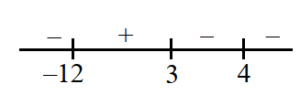
Analyzing the sign of $g'(x)$ around critical points $-12, 3, 4$:
For $x < -12$,$g'(x) < 0$.
For $-12 < x < 3$,$g'(x) > 0$.
For $3 < x < 4$,$g'(x) < 0$.
For $x > 4$,$g'(x) < 0$.
Local minimum at $p = -12$ and local maximum at $q = 3$.
Thus,$|p+q| = |-12+3| = |-9| = 9$.
Multiplying by $e^{-x}$,we get $e^{-x}f(x) = (1-2x)e^{-x} + \int_{0}^{x}e^{-t}f(t)dt$.
Differentiating with respect to $x$ using Leibniz rule:
$e^{-x}f'(x) - e^{-x}f(x) = -2e^{-x} - (1-2x)e^{-x} + e^{-x}f(x)$.
$f'(x) - f(x) = -2 - 1 + 2x + f(x) \Rightarrow f'(x) - 2f(x) = 2x - 3$.
This is a linear differential equation with integrating factor $I.F. = e^{\int -2 dx} = e^{-2x}$.
$f(x)e^{-2x} = \int (2x-3)e^{-2x} dx = (2x-3)\frac{e^{-2x}}{-2} - \int 2 \cdot \frac{e^{-2x}}{-2} dx = -\frac{2x-3}{2}e^{-2x} - \frac{1}{2}e^{-2x} + C$.
$f(x) = -x + \frac{3}{2} - \frac{1}{2} + Ce^{2x} = 1-x + Ce^{2x}$.
Since $f(0) = 1-2(0) + 0 = 1$,we have $1 = 1-0 + C \Rightarrow C=0$.
So,$f(x) = 1-x$.
Now,$g(x) = \int_{0}^{x} (1-t+2)^{15}(t-4)^6(t+12)^{17} dt = \int_{0}^{x} (3-t)^{15}(t-4)^6(t+12)^{17} dt$.
$g'(x) = (3-x)^{15}(x-4)^6(x+12)^{17} = -(x-3)^{15}(x-4)^6(x+12)^{17}$.
Analyzing the sign of $g'(x)$ around critical points $-12, 3, 4$:
For $x < -12$,$g'(x) < 0$.
For $-12 < x < 3$,$g'(x) > 0$.
For $3 < x < 4$,$g'(x) < 0$.
For $x > 4$,$g'(x) < 0$.
Local minimum at $p = -12$ and local maximum at $q = 3$.
Thus,$|p+q| = |-12+3| = |-9| = 9$.
0 likes
View Solution757
DifficultMCQ
Let $(2\alpha, \alpha)$ be the largest interval in which the function $f(t) = \frac{|t+1|}{t^2}, t < 0$,is strictly decreasing. Then the local maximum value of the function $g(x) = 2\log_e(x-2) + \alpha x^2 + 4x - \alpha, x > 2$,is
A
$2$
B
$3$
C
$4$
D
$5$
Solution
(C) Given $f(t) = \frac{|t+1|}{t^2}$ for $t < 0$.
For $t \in (-1, 0)$,$f(t) = \frac{t+1}{t^2} = \frac{1}{t} + \frac{1}{t^2}$. Then $f'(t) = -\frac{1}{t^2} - \frac{2}{t^3} = -\frac{t+2}{t^3}$. Since $t < 0$,$t^3 < 0$,so $f'(t) > 0$ for $t \in (-1, 0)$.
For $t \in (-\infty, -1)$,$f(t) = \frac{-(t+1)}{t^2} = -\frac{1}{t} - \frac{1}{t^2}$. Then $f'(t) = \frac{1}{t^2} + \frac{2}{t^3} = \frac{t+2}{t^3}$.
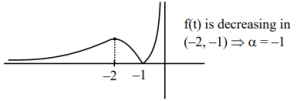
For $f(t)$ to be strictly decreasing,$f'(t) < 0$. Since $t^3 < 0$,we need $t+2 > 0$,i.e.,$t > -2$. Thus,$f(t)$ is strictly decreasing on $(-2, -1)$.
Comparing $(-2, -1)$ with $(2\alpha, \alpha)$,we get $\alpha = -1$.
Now,$g(x) = 2\log_e(x-2) - x^2 + 4x + 1$ for $x > 2$.
$g'(x) = \frac{2}{x-2} - 2x + 4 = \frac{2 - 2x(x-2) + 4(x-2)}{x-2} = \frac{2 - 2x^2 + 4x + 4x - 8}{x-2} = \frac{-2x^2 + 8x - 6}{x-2} = \frac{-2(x^2 - 4x + 3)}{x-2} = \frac{-2(x-3)(x-1)}{x-2}$.
For $x > 2$,$g'(x) = 0$ at $x = 3$.
For $x \in (2, 3)$,$g'(x) > 0$ and for $x > 3$,$g'(x) < 0$. Thus,$g(x)$ has a local maximum at $x = 3$.
The local maximum value is $g(3) = 2\log_e(3-2) - 3^2 + 4(3) + 1 = 2\log_e(1) - 9 + 12 + 1 = 0 - 9 + 13 = 4$.
For $t \in (-1, 0)$,$f(t) = \frac{t+1}{t^2} = \frac{1}{t} + \frac{1}{t^2}$. Then $f'(t) = -\frac{1}{t^2} - \frac{2}{t^3} = -\frac{t+2}{t^3}$. Since $t < 0$,$t^3 < 0$,so $f'(t) > 0$ for $t \in (-1, 0)$.
For $t \in (-\infty, -1)$,$f(t) = \frac{-(t+1)}{t^2} = -\frac{1}{t} - \frac{1}{t^2}$. Then $f'(t) = \frac{1}{t^2} + \frac{2}{t^3} = \frac{t+2}{t^3}$.
For $f(t)$ to be strictly decreasing,$f'(t) < 0$. Since $t^3 < 0$,we need $t+2 > 0$,i.e.,$t > -2$. Thus,$f(t)$ is strictly decreasing on $(-2, -1)$.
Comparing $(-2, -1)$ with $(2\alpha, \alpha)$,we get $\alpha = -1$.
Now,$g(x) = 2\log_e(x-2) - x^2 + 4x + 1$ for $x > 2$.
$g'(x) = \frac{2}{x-2} - 2x + 4 = \frac{2 - 2x(x-2) + 4(x-2)}{x-2} = \frac{2 - 2x^2 + 4x + 4x - 8}{x-2} = \frac{-2x^2 + 8x - 6}{x-2} = \frac{-2(x^2 - 4x + 3)}{x-2} = \frac{-2(x-3)(x-1)}{x-2}$.
For $x > 2$,$g'(x) = 0$ at $x = 3$.
For $x \in (2, 3)$,$g'(x) > 0$ and for $x > 3$,$g'(x) < 0$. Thus,$g(x)$ has a local maximum at $x = 3$.
The local maximum value is $g(3) = 2\log_e(3-2) - 3^2 + 4(3) + 1 = 2\log_e(1) - 9 + 12 + 1 = 0 - 9 + 13 = 4$.
0 likes
View Solution758
DifficultMCQ
Let $f(x) = x^{2025} - x^{2000}$,$x \in [0, 1]$ and the minimum value of the function $f(x)$ in the interval $[0, 1]$ be $(80)^{80}(n)^{-81}$. Then $n$ is equal to
A
$-81$
B
$-40$
C
$-41$
D
$-80$
Solution
(A) Given $f(x) = x^{2025} - x^{2000}$.
To find the minimum value,we find the derivative $f'(x) = 2025x^{2024} - 2000x^{1999}$.
Setting $f'(x) = 0$,we get $x^{1999}(2025x^{25} - 2000) = 0$.
Since $x \in [0, 1]$,the critical point is $x = (\frac{2000}{2025})^{1/25} = (\frac{80}{81})^{1/25} = \alpha$.
Evaluating $f(\alpha) = (\frac{80}{81})^{2025/25} - (\frac{80}{81})^{2000/25} = (\frac{80}{81})^{81} - (\frac{80}{81})^{80}$.
$f(\alpha) = (\frac{80}{81})^{80} (\frac{80}{81} - 1) = (\frac{80}{81})^{80} (-\frac{1}{81}) = 80^{80} \cdot 81^{-80} \cdot (-81)^{-1} = 80^{80} \cdot (-81)^{-81}$.
Comparing this with $(80)^{80}(n)^{-81}$,we get $n = -81$.
To find the minimum value,we find the derivative $f'(x) = 2025x^{2024} - 2000x^{1999}$.
Setting $f'(x) = 0$,we get $x^{1999}(2025x^{25} - 2000) = 0$.
Since $x \in [0, 1]$,the critical point is $x = (\frac{2000}{2025})^{1/25} = (\frac{80}{81})^{1/25} = \alpha$.
Evaluating $f(\alpha) = (\frac{80}{81})^{2025/25} - (\frac{80}{81})^{2000/25} = (\frac{80}{81})^{81} - (\frac{80}{81})^{80}$.
$f(\alpha) = (\frac{80}{81})^{80} (\frac{80}{81} - 1) = (\frac{80}{81})^{80} (-\frac{1}{81}) = 80^{80} \cdot 81^{-80} \cdot (-81)^{-1} = 80^{80} \cdot (-81)^{-81}$.
Comparing this with $(80)^{80}(n)^{-81}$,we get $n = -81$.
0 likes
View Solution759
DifficultMCQ
The absolute minimum value of the function $f(x) = x^3 - 18x^2 + 96x$ for $x \in [0, 9]$ is:
A
$0$
B
$128$
C
$135$
D
$160$
Solution
(A) To find the absolute minimum value of the function $f(x) = x^3 - 18x^2 + 96x$ on the interval $[0, 9]$,we first find the derivative $f'(x)$.
$f'(x) = 3x^2 - 36x + 96$.
Setting $f'(x) = 0$ to find critical points:
$3(x^2 - 12x + 32) = 0$
$3(x - 4)(x - 8) = 0$
So,the critical points are $x = 4$ and $x = 8$.
Now,we evaluate the function $f(x)$ at the critical points and the endpoints of the interval $[0, 9]$:
$f(0) = 0^3 - 18(0)^2 + 96(0) = 0$
$f(4) = 4^3 - 18(4)^2 + 96(4) = 64 - 288 + 384 = 160$
$f(8) = 8^3 - 18(8)^2 + 96(8) = 512 - 1152 + 768 = 128$
$f(9) = 9^3 - 18(9)^2 + 96(9) = 729 - 1458 + 864 = 135$
Comparing these values $(0, 160, 128, 135)$,the absolute minimum value is $0$.
$f'(x) = 3x^2 - 36x + 96$.
Setting $f'(x) = 0$ to find critical points:
$3(x^2 - 12x + 32) = 0$
$3(x - 4)(x - 8) = 0$
So,the critical points are $x = 4$ and $x = 8$.
Now,we evaluate the function $f(x)$ at the critical points and the endpoints of the interval $[0, 9]$:
$f(0) = 0^3 - 18(0)^2 + 96(0) = 0$
$f(4) = 4^3 - 18(4)^2 + 96(4) = 64 - 288 + 384 = 160$
$f(8) = 8^3 - 18(8)^2 + 96(8) = 512 - 1152 + 768 = 128$
$f(9) = 9^3 - 18(9)^2 + 96(9) = 729 - 1458 + 864 = 135$
Comparing these values $(0, 160, 128, 135)$,the absolute minimum value is $0$.
0 likes
View Solution760
MediumMCQ
The maximum value of the function $f(x) = -|x+1| + 3, x \in R$ is . . . . . . .
A
$-2$
B
$2$
C
$3$
D
$4$
Solution
(C) We know that the absolute value function $|x+1|$ is always non-negative,meaning $|x+1| \ge 0$ for all $x \in R$.
Multiplying by $-1$ reverses the inequality: $-|x+1| \le 0$.
Adding $3$ to both sides gives: $-|x+1| + 3 \le 0 + 3$,which simplifies to $f(x) \le 3$.
The maximum value is attained when the term $-|x+1|$ is equal to $0$,which happens at $x = -1$.
Therefore,the maximum value of the function is $3$.
Multiplying by $-1$ reverses the inequality: $-|x+1| \le 0$.
Adding $3$ to both sides gives: $-|x+1| + 3 \le 0 + 3$,which simplifies to $f(x) \le 3$.
The maximum value is attained when the term $-|x+1|$ is equal to $0$,which happens at $x = -1$.
Therefore,the maximum value of the function is $3$.
0 likes
View SolutionApplications of Derivatives — Maxima and Minima · Frequently Asked Questions
1Are these Applications of Derivatives questions useful for JEE and NEET?
Yes. All questions in this section are mapped to JEE Main and NEET exam patterns. Previous year questions from JEE Main, NEET, GUJCET and state-level exams are included with full solutions.
2Can I switch to Hindi or Gujarati for these questions?
Yes. Use the language tabs in the hero section or the sidebar to view the same questions and solutions in English, Hindi or Gujarati.
3How do I generate a question paper from this subtopic?
Use the Vedclass Exam Paper Generator — select the chapter and subtopic, set difficulty, and generate Sets A, B, C, D automatically. First 3 chapters of every subject are free.
Vedclass Products
For Students
Vedclass Test Series
Mock tests in real JEE/NEET style with performance analysis. 5-day free trial.
Start Free TrialFor Teachers
Exam Paper Generator
Generate Set A/B/C/D papers from this chapter in 2 minutes. 3 chapters free.
Try FreeFor Institutes
Online Exam Module
Live online exams with unlimited students, 360° analytics & white-label branding.
See DemoFor Teachers & Institutes
Generate a Applications of Derivatives Exam Paper in 2 Minutes
Select subtopic & difficulty — Sets A, B, C, D auto-generated with No Repeat logic.
First 3 chapters of every subject are free — no payment required.