
A English
Adsorption and Adsorption isotherm Questions in English
Class 12 Chemistry · Surface Chemistry · Adsorption and Adsorption isotherm
422+
Questions
English
Language
100%
With Solutions
Showing 50 of 422 questions in English
251
Difficult
Give information about the Freundlich adsorption isotherm.
Solution
(N/A) Freundlich,in $1909$,gave an empirical relationship between the quantity of gas adsorbed by unit mass of solid adsorbent and pressure at a particular temperature. The relationship can be expressed by the following equation:
$\frac{x}{m} = k \cdot p^{\frac{1}{n}} (n > 1)$
Where $x$ is the mass of gas adsorbed on mass $m$ of the adsorbent at pressure $p$,and $k$ and $n$ are constants which depend on the nature of the adsorbent and the gas at a particular temperature.
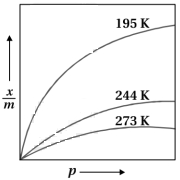
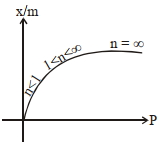
The relationship is generally represented in the form of a curve where the mass of gas adsorbed per gram of the adsorbent is plotted against pressure. These curves indicate that at a fixed pressure,there is a decrease in physical adsorption with an increase in temperature. These curves always seem to approach saturation at high pressure.
Taking the logarithm of the equation:
$\log \frac{x}{m} = \log k + \frac{1}{n} \log p$
$\frac{x}{m} = k \cdot p^{\frac{1}{n}} (n > 1)$
Where $x$ is the mass of gas adsorbed on mass $m$ of the adsorbent at pressure $p$,and $k$ and $n$ are constants which depend on the nature of the adsorbent and the gas at a particular temperature.
The relationship is generally represented in the form of a curve where the mass of gas adsorbed per gram of the adsorbent is plotted against pressure. These curves indicate that at a fixed pressure,there is a decrease in physical adsorption with an increase in temperature. These curves always seem to approach saturation at high pressure.
Taking the logarithm of the equation:
$\log \frac{x}{m} = \log k + \frac{1}{n} \log p$
0 likes
View Solution252
Difficult
Explain the phenomenon that involves solutes from solution being adsorbed on solid adsorbents.
Solution
(N/A) Solids can also adsorb solutes from solutions. When a solution of acetic acid in water is shaken with charcoal,a part of the acid is adsorbed by the charcoal,and the concentration of the acid decreases in the solution. Similarly,a litmus solution becomes colourless when shaken with charcoal.
The precipitate of $Mg(OH)_{2}$ attains a blue colour when precipitated in the presence of a magneson reagent. This colour is due to the adsorption of the magneson. The following observations have been made regarding adsorption from the solution phase:
$(i)$ The extent of adsorption decreases with an increase in temperature.
$(ii)$ The extent of adsorption increases with an increase in the surface area of the adsorbent.
$(iii)$ The extent of adsorption depends on the concentration of the solute in the solution.
$(iv)$ The extent of adsorption depends on the nature of the adsorbent and the adsorbate.
The precise mechanism of adsorption from solution is not fully known. Freundlich's equation approximately describes the behaviour of adsorption from solution,with the difference that instead of pressure,the concentration of the solution is taken into account,i.e.,$\frac{x}{m} = k C^{\frac{1}{n}}$,where $C$ is the equilibrium concentration. Taking the logarithm of the above equation,we get: $\log \frac{x}{m} = \log k + \frac{1}{n} \log C$.
Plotting $\log \frac{x}{m}$ against $\log C$ yields a straight line,which confirms the validity of the Freundlich isotherm. This can be tested experimentally by using solutions of acetic acid with different concentrations. Equal volumes of solutions are added to equal amounts of charcoal in different flasks. The final concentration is determined in each flask after adsorption. The difference between the initial and final concentrations gives the value of $x$. Using the above equation,the validity of the Freundlich isotherm can be established.
The precipitate of $Mg(OH)_{2}$ attains a blue colour when precipitated in the presence of a magneson reagent. This colour is due to the adsorption of the magneson. The following observations have been made regarding adsorption from the solution phase:
$(i)$ The extent of adsorption decreases with an increase in temperature.
$(ii)$ The extent of adsorption increases with an increase in the surface area of the adsorbent.
$(iii)$ The extent of adsorption depends on the concentration of the solute in the solution.
$(iv)$ The extent of adsorption depends on the nature of the adsorbent and the adsorbate.
The precise mechanism of adsorption from solution is not fully known. Freundlich's equation approximately describes the behaviour of adsorption from solution,with the difference that instead of pressure,the concentration of the solution is taken into account,i.e.,$\frac{x}{m} = k C^{\frac{1}{n}}$,where $C$ is the equilibrium concentration. Taking the logarithm of the above equation,we get: $\log \frac{x}{m} = \log k + \frac{1}{n} \log C$.
Plotting $\log \frac{x}{m}$ against $\log C$ yields a straight line,which confirms the validity of the Freundlich isotherm. This can be tested experimentally by using solutions of acetic acid with different concentrations. Equal volumes of solutions are added to equal amounts of charcoal in different flasks. The final concentration is determined in each flask after adsorption. The difference between the initial and final concentrations gives the value of $x$. Using the above equation,the validity of the Freundlich isotherm can be established.
0 likes
View Solution253
Difficult
Give an explanation of the applications of adsorption.
Solution
(N/A) The phenomenon of adsorption has numerous applications. Important ones are listed here:
$(i)$ Production of high vacuum: Remaining traces of air can be adsorbed by charcoal from a vessel evacuated by a vacuum pump to create a very high vacuum.
$(ii)$ Gas masks: Gas masks,which consist of activated charcoal or a mixture of adsorbents,are used in coal mines to adsorb poisonous gases.
$(iii)$ Control of humidity: Silica and aluminium gels are used as adsorbents to remove moisture and control humidity.
$(iv)$ Removal of colouring matter from solutions: Animal charcoal removes colours from solutions by adsorbing coloured impurities.
$(v)$ Heterogeneous catalysis: Adsorption of reactants on the solid surface of catalysts increases the reaction rate. Examples include the manufacture of ammonia using iron,the manufacture of $H_{2}SO_{4}$ by the contact process,and the use of nickel in the hydrogenation of oils.
$(vi)$ Separation of inert gases: Due to differences in the degree of adsorption,a mixture of noble gases can be separated by adsorption on coconut charcoal at different temperatures.
$(vii)$ Curing diseases: Many drugs are used to kill germs by getting adsorbed on them.
$(viii)$ Froth floatation process: Low-grade sulphide ores are concentrated by separating them from silica and other earthy matter using pine oil and a frothing agent.
$(ix)$ Adsorption indicators: Surfaces of precipitates like silver halides adsorb dyes such as eosin or fluorescein,producing a characteristic colour at the end point.
$(x)$ Chromatographic analysis: Based on the phenomenon of adsorption,this technique finds numerous applications in analytical and industrial fields.
$(i)$ Production of high vacuum: Remaining traces of air can be adsorbed by charcoal from a vessel evacuated by a vacuum pump to create a very high vacuum.
$(ii)$ Gas masks: Gas masks,which consist of activated charcoal or a mixture of adsorbents,are used in coal mines to adsorb poisonous gases.
$(iii)$ Control of humidity: Silica and aluminium gels are used as adsorbents to remove moisture and control humidity.
$(iv)$ Removal of colouring matter from solutions: Animal charcoal removes colours from solutions by adsorbing coloured impurities.
$(v)$ Heterogeneous catalysis: Adsorption of reactants on the solid surface of catalysts increases the reaction rate. Examples include the manufacture of ammonia using iron,the manufacture of $H_{2}SO_{4}$ by the contact process,and the use of nickel in the hydrogenation of oils.
$(vi)$ Separation of inert gases: Due to differences in the degree of adsorption,a mixture of noble gases can be separated by adsorption on coconut charcoal at different temperatures.
$(vii)$ Curing diseases: Many drugs are used to kill germs by getting adsorbed on them.
$(viii)$ Froth floatation process: Low-grade sulphide ores are concentrated by separating them from silica and other earthy matter using pine oil and a frothing agent.
$(ix)$ Adsorption indicators: Surfaces of precipitates like silver halides adsorb dyes such as eosin or fluorescein,producing a characteristic colour at the end point.
$(x)$ Chromatographic analysis: Based on the phenomenon of adsorption,this technique finds numerous applications in analytical and industrial fields.
0 likes
View Solution254
EasyMCQ
How much vacuum is needed to obtain a clean surface of metal?
A
$10^{-8} \text{ to } 10^{-9} \text{ Pa}$
B
$10^{-1} \text{ to } 10^{-2} \text{ Pa}$
C
$10^{-5} \text{ to } 10^{-6} \text{ Pa}$
D
$10^{-10} \text{ to } 10^{-11} \text{ Pa}$
Solution
(A) To obtain a clean surface of a metal,it is necessary to maintain an extremely high vacuum.
This is required to prevent the adsorption of gas molecules onto the metal surface from the surrounding atmosphere.
The required pressure for this purpose is typically in the range of $10^{-8} \text{ to } 10^{-9} \text{ Pa}$.
This is required to prevent the adsorption of gas molecules onto the metal surface from the surrounding atmosphere.
The required pressure for this purpose is typically in the range of $10^{-8} \text{ to } 10^{-9} \text{ Pa}$.
0 likes
View Solution255
Medium
What type of phenomenon is adsorption? What type of reaction is adsorption?
Solution
(N/A) Adsorption is a $surface$ phenomenon because it involves the accumulation of molecular species at the surface rather than in the bulk of a solid or liquid.
Adsorption is an $exothermic$ process. In this process,the residual forces of the surface are satisfied,leading to a decrease in surface energy,which is released as heat.
Adsorption is an $exothermic$ process. In this process,the residual forces of the surface are satisfied,leading to a decrease in surface energy,which is released as heat.
0 likes
View Solution256
Easy
Compare the enthalpy of chemical adsorption with physical adsorption.
Solution
(N/A) The enthalpy of adsorption for physical adsorption (physisorption) is low,typically in the range of $20-40 \ kJ \ mol^{-1}$.
This is because the forces involved are weak van der Waals forces.
In contrast,the enthalpy of adsorption for chemical adsorption (chemisorption) is high,typically in the range of $80-240 \ kJ \ mol^{-1}$.
This is because strong chemical bonds are formed between the adsorbate and the adsorbent.
This is because the forces involved are weak van der Waals forces.
In contrast,the enthalpy of adsorption for chemical adsorption (chemisorption) is high,typically in the range of $80-240 \ kJ \ mol^{-1}$.
This is because strong chemical bonds are formed between the adsorbate and the adsorbent.
0 likes
View Solution257
EasyMCQ
Which one is the irreversible adsorption?
A
Physisorption
B
Chemisorption
C
Both $A$ and $B$
D
None of these
Solution
(B) Adsorption is classified into two types: $Physisorption$ and $Chemisorption$.
$Physisorption$ (physical adsorption) is reversible in nature because the forces involved are weak van der Waals forces.
$Chemisorption$ (chemical adsorption) is irreversible in nature because it involves the formation of strong chemical bonds between the adsorbate and the adsorbent.
Therefore,$Chemisorption$ is the irreversible adsorption.
$Physisorption$ (physical adsorption) is reversible in nature because the forces involved are weak van der Waals forces.
$Chemisorption$ (chemical adsorption) is irreversible in nature because it involves the formation of strong chemical bonds between the adsorbate and the adsorbent.
Therefore,$Chemisorption$ is the irreversible adsorption.
0 likes
View Solution258
EasyMCQ
What should be taken on the $Y$-axis in the Freundlich adsorption isotherm plot to obtain a straight line?
A
$\frac{x}{m}$
B
$\log(\frac{x}{m})$
C
$\log(P)$
D
$P$
Solution
(B) The Freundlich adsorption isotherm is given by the equation $\frac{x}{m} = kP^{1/n}$.
Taking the logarithm on both sides,we get $\log(\frac{x}{m}) = \log(k) + \frac{1}{n} \log(P)$.
This equation is in the form of a straight line $y = mx + c$,where $y = \log(\frac{x}{m})$,$x = \log(P)$,$m = \frac{1}{n}$ (slope),and $c = \log(k)$ (intercept).
Therefore,$\log(\frac{x}{m})$ is taken on the $Y$-axis.
Taking the logarithm on both sides,we get $\log(\frac{x}{m}) = \log(k) + \frac{1}{n} \log(P)$.
This equation is in the form of a straight line $y = mx + c$,where $y = \log(\frac{x}{m})$,$x = \log(P)$,$m = \frac{1}{n}$ (slope),and $c = \log(k)$ (intercept).
Therefore,$\log(\frac{x}{m})$ is taken on the $Y$-axis.
0 likes
View Solution259
EasyMCQ
What kind of difference is observed in the amount of adsorption with the increase in temperature?
A
It increases
B
It decreases
C
It remains constant
D
It first increases and then decreases
Solution
(B) Adsorption is an exothermic process. According to Le Chatelier's principle,for an exothermic process,an increase in temperature shifts the equilibrium in the backward direction. Therefore,the amount of adsorption decreases with an increase in temperature.
0 likes
View Solution260
Easy
Give uses of silica gel.
Solution
(N/A) Silica gel is used as a drying agent and as a support for chromatographic materials and catalysts. $Kieselghur$,an amorphous form of silica,is used in filtration plants.
0 likes
View Solution261
Difficult
Explain the following terms related to Adsorption Chromatography:
$(a)$ Principle of Adsorption chromatography.
$(b)$ Adsorbent.
$(c)$ Mobile phase.
$(d)$ Adsorbate.
$(a)$ Principle of Adsorption chromatography.
$(b)$ Adsorbent.
$(c)$ Mobile phase.
$(d)$ Adsorbate.
Solution
(N/A) Principle: This method is based on the differential adsorption of various components of a mixture on a suitable adsorbent to different degrees.
$(b)$ Adsorbent: The solid substance on whose surface the components are adsorbed is called an adsorbent. Examples include $Silica \ gel$ and $Alumina$. It acts as the stationary phase.
$(c)$ Mobile phase: The liquid solvent or gas that flows over the stationary phase (adsorbent) and carries the components of the mixture is known as the mobile phase.
$(d)$ Adsorbate: The substance or mixture of substances that gets adsorbed onto the surface of the adsorbent is called the adsorbate. These components migrate at different rates depending on their affinity for the stationary phase and the mobile phase,leading to their separation.
$(b)$ Adsorbent: The solid substance on whose surface the components are adsorbed is called an adsorbent. Examples include $Silica \ gel$ and $Alumina$. It acts as the stationary phase.
$(c)$ Mobile phase: The liquid solvent or gas that flows over the stationary phase (adsorbent) and carries the components of the mixture is known as the mobile phase.
$(d)$ Adsorbate: The substance or mixture of substances that gets adsorbed onto the surface of the adsorbent is called the adsorbate. These components migrate at different rates depending on their affinity for the stationary phase and the mobile phase,leading to their separation.
0 likes
View Solution262
EasyMCQ
On which factors does the amount of adsorption depend?
A
Nature of the adsorbate
B
Nature of the adsorbent
C
Temperature and pressure
D
All of the above
Solution
(D) The amount of adsorption depends on several factors:
$1$. Nature of the adsorbate: Gases that are easily liquefiable (higher critical temperature) are adsorbed more readily.
$2$. Nature of the adsorbent: The surface area and porosity of the adsorbent significantly affect the extent of adsorption.
$3$. Temperature: Adsorption is generally an exothermic process,so it decreases with an increase in temperature.
$4$. Pressure: For gas-solid adsorption,the extent of adsorption increases with an increase in pressure.
$1$. Nature of the adsorbate: Gases that are easily liquefiable (higher critical temperature) are adsorbed more readily.
$2$. Nature of the adsorbent: The surface area and porosity of the adsorbent significantly affect the extent of adsorption.
$3$. Temperature: Adsorption is generally an exothermic process,so it decreases with an increase in temperature.
$4$. Pressure: For gas-solid adsorption,the extent of adsorption increases with an increase in pressure.
0 likes
View Solution263
EasyMCQ
What type of the graph $\log(x/m)$ vs $\log P$ is obtained for the Freundlich adsorption isotherm?
A
$A$ straight line with a positive slope
B
$A$ straight line with a negative slope
C
$A$ parabolic curve
D
$A$ hyperbolic curve
Solution
(A) The Freundlich adsorption isotherm is given by the equation $\frac{x}{m} = kP^{1/n}$.
Taking logarithm on both sides,we get $\log(\frac{x}{m}) = \log k + \frac{1}{n} \log P$.
This equation is of the form $y = mx + c$,where $y = \log(\frac{x}{m})$,$x = \log P$,slope $m = \frac{1}{n}$,and intercept $c = \log k$.
Therefore,the graph of $\log(\frac{x}{m})$ vs $\log P$ is a straight line with a positive slope equal to $\frac{1}{n}$.
Taking logarithm on both sides,we get $\log(\frac{x}{m}) = \log k + \frac{1}{n} \log P$.
This equation is of the form $y = mx + c$,where $y = \log(\frac{x}{m})$,$x = \log P$,slope $m = \frac{1}{n}$,and intercept $c = \log k$.
Therefore,the graph of $\log(\frac{x}{m})$ vs $\log P$ is a straight line with a positive slope equal to $\frac{1}{n}$.
0 likes
View Solution264
EasyMCQ
What is used to adsorb the poisonous gas obtained from the coal mine?
A
Activated charcoal
B
Silica gel
C
Alumina gel
D
Anhydrous calcium chloride
Solution
(A) Activated charcoal is used in gas masks to adsorb poisonous gases present in the air,such as those found in coal mines,because of its high surface area and porous structure.
0 likes
View Solution265
Medium
Write any two characteristics of chemisorption.
Solution
(N/A) The two characteristics of chemisorption are as follows:
$1$. It is highly specific in nature and occurs only if there is a possibility of chemical bond formation between the adsorbent and the adsorbate.
$2$. It is irreversible in nature,as the adsorbate molecules are held by strong chemical bonds and cannot be easily removed.
$1$. It is highly specific in nature and occurs only if there is a possibility of chemical bond formation between the adsorbent and the adsorbate.
$2$. It is irreversible in nature,as the adsorbate molecules are held by strong chemical bonds and cannot be easily removed.
0 likes
View Solution266
Medium
Why does physical adsorption decrease with an increase in temperature?
Solution
(N/A) Physical adsorption is exothermic in nature. According to Le Chatelier's principle,an increase in temperature shifts the equilibrium in the backward direction,causing the amount of gas adsorbed to decrease. Therefore,physical adsorption occurs more readily at lower temperatures.
0 likes
View Solution267
MediumMCQ
Why are powdered substances more effective adsorbents than their crystalline forms?
A
They have more surface area.
B
They have less surface area.
C
They are more stable.
D
They are less stable.
Solution
(A) Powdered substances are more effective adsorbents than their crystalline forms because when a substance is powdered,its surface area increases. Since adsorption is a surface phenomenon,the extent of adsorption is directly proportional to the surface area of the adsorbent.
0 likes
View Solution268
MediumMCQ
Why is it important to have a clean surface in surface studies?
A
To increase the surface area.
B
To provide proper adsorption sites for the desired species.
C
To prevent chemical reactions.
D
To reduce the temperature of the surface.
Solution
(B) clean surface is essential because it provides the proper adsorption sites for the desired species. If the surface is not clean,the adsorption of the desired species will not take place effectively because other foreign species will occupy those sites.
0 likes
View Solution269
Easy
Why is chemisorption referred to as activated adsorption?
Solution
(N/A) In chemisorption,chemical bonds are formed between the molecules of the adsorbate and the adsorbent. This process requires a significant amount of activation energy to initiate the bond formation. Due to this requirement of high activation energy,chemisorption is often referred to as activated adsorption.
0 likes
View Solution270
MediumMCQ
Why is $Fe(OH)_3$ colloid positively charged when prepared by adding $FeCl_3$ to hot water?
A
Due to adsorption of $Cl^-$ ions.
B
Due to adsorption of $Fe^{3+}$ ions.
C
Due to adsorption of $OH^-$ ions.
D
Due to adsorption of $H^+$ ions.
Solution
(B) When $FeCl_3$ is added to hot water,it undergoes hydrolysis to form $Fe(OH)_3$ sol.
During the formation of the sol,the particles preferentially adsorb $Fe^{3+}$ ions from the dispersion medium,which makes the colloid positively charged.
During the formation of the sol,the particles preferentially adsorb $Fe^{3+}$ ions from the dispersion medium,which makes the colloid positively charged.
0 likes
View Solution271
Medium
Why do physisorption and chemisorption behave differently with a rise in temperature?
Solution
(N/A) In physisorption,the adsorption is held by weak van der Waals' forces. As temperature increases,the kinetic energy of the gas molecules increases,which leads to desorption,thus physisorption decreases with a rise in temperature.
In chemisorption,chemical bonds are formed between the molecules of the adsorbate and the adsorbent. This process often requires an activation energy to initiate the bond formation. Therefore,chemisorption typically increases with an initial rise in temperature.
In chemisorption,chemical bonds are formed between the molecules of the adsorbate and the adsorbent. This process often requires an activation energy to initiate the bond formation. Therefore,chemisorption typically increases with an initial rise in temperature.
0 likes
View Solution272
Medium
Why does the white precipitate of silver halide become coloured in the presence of dye eosin?
Solution
(N/A) Eosin is an adsorption indicator. When eosin is added to the silver halide precipitate,it gets adsorbed on the surface of the silver halide particles. This adsorption causes a change in the color of the precipitate,which is why it appears coloured.
0 likes
View Solution273
MediumMCQ
What is the role of activated charcoal in gas masks used in coal mines?
A
It acts as a catalyst for the oxidation of poisonous gases.
B
It acts as an adsorbent for poisonous gases.
C
It acts as a filter to remove dust particles only.
D
It reacts with poisonous gases to form harmless compounds.
Solution
(B) In coal mines,various poisonous gases are present. The activated charcoal in gas masks acts as an adsorbent for these gases,effectively removing them from the air inhaled by the miners.
0 likes
View Solution274
Medium
Give an example where physisorption changes to chemisorption with rise in temperature. Explain the reason for change.
Solution
(N/A) The adsorption of hydrogen on finely divided nickel at low temperatures is due to weak van der Waals' forces,which is an example of physisorption.
When the temperature is raised,the $H_2$ molecules gain enough energy to dissociate into $H$ atoms.
These $H$ atoms then form strong chemical bonds with the nickel surface,resulting in chemisorption.
When the temperature is raised,the $H_2$ molecules gain enough energy to dissociate into $H$ atoms.
These $H$ atoms then form strong chemical bonds with the nickel surface,resulting in chemisorption.
0 likes
View Solution275
Difficult
What are the applications of adsorption in chemical analysis?
Solution
(N/A) $(i)$ Chromatography: Thin layer chromatography $(TLC)$ works on the principle of adsorption. It is used for the separation of coloured components.
$(ii)$ Adsorption indicators: Precipitates of silver halides $(AgX)$ act as adsorbents. They have the property to adsorb dyes such as eosin and fluorescein,thereby producing a characteristic colour at the end point of a titration.
$(iii)$ Separation of inert gases: Due to the difference in the degree of adsorption of gases by charcoal,a mixture of noble gases can be separated by adsorption on coconut charcoal at different temperatures.
$(ii)$ Adsorption indicators: Precipitates of silver halides $(AgX)$ act as adsorbents. They have the property to adsorb dyes such as eosin and fluorescein,thereby producing a characteristic colour at the end point of a titration.
$(iii)$ Separation of inert gases: Due to the difference in the degree of adsorption of gases by charcoal,a mixture of noble gases can be separated by adsorption on coconut charcoal at different temperatures.
0 likes
View Solution276
DifficultMCQ
What is the role of adsorption in the froth floatation process used especially for the concentration of sulphide ores?
A
It helps in the wetting of sulphide ores by water.
B
It helps in the preferential wetting of sulphide ores by oil,allowing them to rise with the froth.
C
It causes the gangue particles to adsorb onto the surface of the oil bubbles.
D
It has no role in the froth floatation process.
Solution
(B) In the froth floatation process,the sulphide ore particles are preferentially wetted by the pine oil (collector),which acts as an adsorbent on the surface of the ore particles.
This makes the ore particles hydrophobic (water-repelling),allowing them to attach to air bubbles and rise to the surface as froth.
Conversely,the gangue (impurities) is wetted by water and remains in the bottom of the tank.
This makes the ore particles hydrophobic (water-repelling),allowing them to attach to air bubbles and rise to the surface as froth.
Conversely,the gangue (impurities) is wetted by water and remains in the bottom of the tank.
0 likes
View Solution277
EasyMCQ
Between water and an $NaCl$ solution,which will have a higher surface tension? (Effect of solute on surface tension)
A
Water
B
$NaCl$ solution
C
Both are equal
D
Cannot be determined
Solution
(B) The addition of a highly soluble solute like $NaCl$ to water increases the intermolecular forces of attraction in the bulk of the liquid.
This leads to an increase in the surface tension of the solution compared to pure water.
Therefore,the $NaCl$ solution has a higher surface tension than pure water.
This leads to an increase in the surface tension of the solution compared to pure water.
Therefore,the $NaCl$ solution has a higher surface tension than pure water.
0 likes
View Solution278
Easy
What is the difference between adsorbent and adsorbate?
Solution
(N/A)
| $Adsorbent$ | $Adsorbate$ |
| The substance on the surface of which adsorption occurs is called an adsorbent. | The substance which gets adsorbed on the surface of another substance is called an adsorbate. |
| $e.g.$ silica gel,activated charcoal,alumina. | $e.g.$ gases like $O_2$,$H_2$ on charcoal,dyes,inorganic ions. |
0 likes
View Solution279
MediumMCQ
Amongst the following statements regarding adsorption,those that are valid are :
$(a)$ $\Delta H$ becomes less negative as adsorption proceeds.
$(b)$ On a given adsorbent,ammonia is adsorbed more than nitrogen gas.
$(c)$ On adsorption,the residual force acting along the surface of the adsorbent increases.
$(d)$ With increase in temperature,the equilibrium concentration of adsorbate increases.
$(a)$ $\Delta H$ becomes less negative as adsorption proceeds.
$(b)$ On a given adsorbent,ammonia is adsorbed more than nitrogen gas.
$(c)$ On adsorption,the residual force acting along the surface of the adsorbent increases.
$(d)$ With increase in temperature,the equilibrium concentration of adsorbate increases.
A
$(b)$ and $(c)$
B
$(a)$ and $(b)$
C
$(d)$ and $(a)$
D
$(c)$ and $(d)$
Solution
(B) Adsorption is an exothermic process. As adsorption proceeds,the number of available active sites on the adsorbent decreases,resulting in less heat being evolved. Thus,$\Delta H$ becomes less negative.
$(b)$ $NH_3$ is a polar molecule with a higher van der Waals constant $'a'$ compared to $N_2$,leading to stronger forces of attraction and greater adsorption.
$(c)$ Adsorption occurs to satisfy the residual forces on the surface of the adsorbent. Therefore,as adsorption proceeds,the residual forces on the surface decrease,not increase.
$(d)$ According to Le Chatelier's principle,for an exothermic process,an increase in temperature shifts the equilibrium in the backward direction,decreasing the concentration of the adsorbed phase.
$(b)$ $NH_3$ is a polar molecule with a higher van der Waals constant $'a'$ compared to $N_2$,leading to stronger forces of attraction and greater adsorption.
$(c)$ Adsorption occurs to satisfy the residual forces on the surface of the adsorbent. Therefore,as adsorption proceeds,the residual forces on the surface decrease,not increase.
$(d)$ According to Le Chatelier's principle,for an exothermic process,an increase in temperature shifts the equilibrium in the backward direction,decreasing the concentration of the adsorbed phase.
0 likes
View Solution280
DifficultMCQ
The mass of gas adsorbed,$x$,per unit mass of adsorbent,$m$,was measured at various pressures,$p$. $A$ graph between $\log(x/m)$ and $\log p$ gives a straight line with slope equal to $2$ and the intercept equal to $0.4771$. The value of $x/m$ at a pressure of $4 \text{ atm}$ is: (Given $\log 3 = 0.4771$)
A
$45$
B
$48$
C
$50$
D
$54$
Solution
(B) According to the Freundlich adsorption isotherm: $\log(x/m) = \log k + (1/n) \log p$.
Comparing this with the straight-line equation $y = mx + c$:
Slope $(1/n) = 2$.
Intercept $\log k = 0.4771$.
Given $\log 3 = 0.4771$,therefore $k = 3$.
The equation becomes: $x/m = k \cdot p^{(1/n)}$.
At $p = 4 \text{ atm}$:
$x/m = 3 \cdot (4)^2 = 3 \cdot 16 = 48$.
Comparing this with the straight-line equation $y = mx + c$:
Slope $(1/n) = 2$.
Intercept $\log k = 0.4771$.
Given $\log 3 = 0.4771$,therefore $k = 3$.
The equation becomes: $x/m = k \cdot p^{(1/n)}$.
At $p = 4 \text{ atm}$:
$x/m = 3 \cdot (4)^2 = 3 \cdot 16 = 48$.
0 likes
View Solution281
MediumMCQ
Adsorption of a gas follows Freundlich adsorption isotherm. If $x$ is the mass of the gas adsorbed on mass $m$ of the adsorbent,the correct plot of $\frac{x}{m}$ versus $p$ is:
A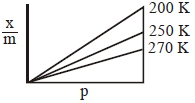
B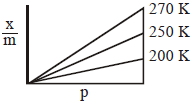
C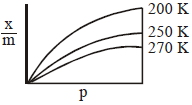
D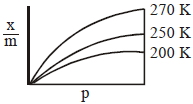
Solution
(C) The Freundlich adsorption isotherm is given by the equation $\frac{x}{m} = K \cdot p^{1/n}$,where $K$ and $n$ are constants that depend on the nature of the adsorbent and the gas at a particular temperature.
Adsorption is an exothermic process. According to Le Chatelier's principle,for an exothermic process,an increase in temperature decreases the extent of adsorption.
Therefore,at a constant pressure,the amount of gas adsorbed $(\frac{x}{m})$ decreases as the temperature increases.
This means that the curve for a lower temperature will lie above the curve for a higher temperature.
Comparing the given options,the plot where $\frac{x}{m}$ is highest for $200 \ K$ and lowest for $270 \ K$ is the correct representation.
Adsorption is an exothermic process. According to Le Chatelier's principle,for an exothermic process,an increase in temperature decreases the extent of adsorption.
Therefore,at a constant pressure,the amount of gas adsorbed $(\frac{x}{m})$ decreases as the temperature increases.
This means that the curve for a lower temperature will lie above the curve for a higher temperature.
Comparing the given options,the plot where $\frac{x}{m}$ is highest for $200 \ K$ and lowest for $270 \ K$ is the correct representation.
0 likes
View Solution282
MediumMCQ
For Freundlich adsorption isotherm,a plot of $\log (x / m)$ ($y$-axis) and $\log p$ ($x$-axis) gives a straight line. The intercept and slope for the line is $0.4771$ and $2,$ respectively. The mass of gas,adsorbed per gram of adsorbent if the initial pressure is $0.04 \ atm,$ is $........\times 10^{-4} \ g$.
$(\log 3 = 0.4771)$
$(\log 3 = 0.4771)$
A
$48$
B
$52$
C
$40$
D
$58$
Solution
(A) The Freundlich adsorption isotherm equation is given by $\frac{x}{m} = K P^{1/n}$.
Taking logarithm on both sides,we get $\log \left( \frac{x}{m} \right) = \frac{1}{n} \log P + \log K$.
Comparing this with the equation of a straight line $y = mx + c$,the slope is $\frac{1}{n} = 2$ and the intercept is $\log K = 0.4771$.
Since $\log 3 = 0.4771$,we find $K = 3$.
Now,substituting the values $K = 3$,$P = 0.04 \ atm$,and $n = 0.5$ (since $\frac{1}{n} = 2$) into the equation $\frac{x}{m} = K P^{1/n}$:
$\frac{x}{m} = 3 \times (0.04)^{2} = 3 \times 0.0016 = 0.0048 \ g$.
Converting this to the required format: $0.0048 \ g = 48 \times 10^{-4} \ g$.
Taking logarithm on both sides,we get $\log \left( \frac{x}{m} \right) = \frac{1}{n} \log P + \log K$.
Comparing this with the equation of a straight line $y = mx + c$,the slope is $\frac{1}{n} = 2$ and the intercept is $\log K = 0.4771$.
Since $\log 3 = 0.4771$,we find $K = 3$.
Now,substituting the values $K = 3$,$P = 0.04 \ atm$,and $n = 0.5$ (since $\frac{1}{n} = 2$) into the equation $\frac{x}{m} = K P^{1/n}$:
$\frac{x}{m} = 3 \times (0.04)^{2} = 3 \times 0.0016 = 0.0048 \ g$.
Converting this to the required format: $0.0048 \ g = 48 \times 10^{-4} \ g$.
0 likes
View Solution283
MediumMCQ
For a gas-solid adsorbent system,the adsorption isotherm $\frac{x}{m}=k p^{1/n}$ is applicable,where $n=5$ in the specified case. Point out the correct statement:
A
$\frac{x}{m}$ vs $p$ plot is a linear graph with slope equal to $5$
B
$\log \frac{x}{m}$ vs $\log p$ plot is a straight line with slope equal to $5$
C
$\log \frac{x}{m}$ vs $\log p$ is a straight line with slope equal to $0.2$
D
none of these
Solution
(C) The Freundlich adsorption isotherm is given by $\frac{x}{m} = k p^{1/n}$.
Taking the logarithm on both sides,we get $\log \frac{x}{m} = \log k + \frac{1}{n} \log p$.
This equation represents a straight line of the form $y = mx + c$,where the slope is $\frac{1}{n}$.
Given $n = 5$,the slope is $\frac{1}{5} = 0.2$.
Taking the logarithm on both sides,we get $\log \frac{x}{m} = \log k + \frac{1}{n} \log p$.
This equation represents a straight line of the form $y = mx + c$,where the slope is $\frac{1}{n}$.
Given $n = 5$,the slope is $\frac{1}{5} = 0.2$.
0 likes
View Solution284
MediumMCQ
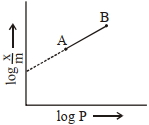
In the Freundlich adsorption isotherm,the slope of the $AB$ line is:
A
$n$ where $(n > 1)$
B
$n$ where $(n = 0.1 \text{ to } 0.5)$
C
$\log(1/n)$ where $(n < 1)$
D
$1/n$ where $(1/n = 0 \text{ to } 1)$
Solution
(D) The Freundlich adsorption isotherm is given by the equation: $\frac{x}{m} = K(P)^{1/n}$
Taking the logarithm on both sides:
$\log \left(\frac{x}{m}\right) = \log K + \frac{1}{n} \log P$
This equation is in the form of a straight line $y = mx + c$,where:
$y = \log \left(\frac{x}{m}\right)$
$x = \log P$
$c = \log K$
$m = \frac{1}{n}$ (slope)
In the Freundlich adsorption isotherm,the value of $\frac{1}{n}$ ranges between $0$ and $1$ (i.e.,$0 \leq \frac{1}{n} \leq 1$).
Thus,the slope of the line is $\frac{1}{n}$ where $\frac{1}{n}$ lies between $0$ and $1$.
Taking the logarithm on both sides:
$\log \left(\frac{x}{m}\right) = \log K + \frac{1}{n} \log P$
This equation is in the form of a straight line $y = mx + c$,where:
$y = \log \left(\frac{x}{m}\right)$
$x = \log P$
$c = \log K$
$m = \frac{1}{n}$ (slope)
In the Freundlich adsorption isotherm,the value of $\frac{1}{n}$ ranges between $0$ and $1$ (i.e.,$0 \leq \frac{1}{n} \leq 1$).
Thus,the slope of the line is $\frac{1}{n}$ where $\frac{1}{n}$ lies between $0$ and $1$.
0 likes
View Solution285
EasyMCQ
In Freundlich adsorption isotherm at moderate pressure,the extent of adsorption $\left(\frac{x}{m}\right)$ is directly proportional to $P^x$. The value of $x$ is
A
zero
B
$\frac{1}{n}$
C
$1$
D
$\infty$
Solution
(B) The Freundlich adsorption isotherm is given by the equation $\frac{x}{m} = K P^{\frac{1}{n}}$.
At moderate pressure,the value of the exponent is $\frac{1}{n}$,where $n > 1$.
Comparing this with the given expression $\frac{x}{m} \propto P^x$,we find that $x = \frac{1}{n}$.
At moderate pressure,the value of the exponent is $\frac{1}{n}$,where $n > 1$.
Comparing this with the given expression $\frac{x}{m} \propto P^x$,we find that $x = \frac{1}{n}$.
0 likes
View Solution286
EasyMCQ
$3.12 \, g$ of oxygen is adsorbed on $1.2 \, g$ of platinum metal. The volume of oxygen adsorbed per gram of the adsorbent at $1 \, atm$ and $300 \, K$ in $L$ is ..... .
$[R = 0.0821 \, L \, atm \, K^{-1} \, mol^{-1}]$
$[R = 0.0821 \, L \, atm \, K^{-1} \, mol^{-1}]$
A
$2$
B
$1$
C
$5$
D
$6$
Solution
(A) First,calculate the number of moles of $O_2$ adsorbed:
$n = \frac{\text{mass}}{\text{molar mass}} = \frac{3.12 \, g}{32 \, g/mol} = 0.0975 \, mol$.
Next,calculate the volume of $O_2$ using the ideal gas equation $PV = nRT$:
$V = \frac{nRT}{P} = \frac{0.0975 \, mol \times 0.0821 \, L \, atm \, K^{-1} \, mol^{-1} \times 300 \, K}{1 \, atm} = 2.40 \, L$.
Since $1.2 \, g$ of platinum adsorbs $2.40 \, L$ of $O_2$,the volume adsorbed per gram is:
$\frac{2.40 \, L}{1.2 \, g} = 2 \, L/g$.
$n = \frac{\text{mass}}{\text{molar mass}} = \frac{3.12 \, g}{32 \, g/mol} = 0.0975 \, mol$.
Next,calculate the volume of $O_2$ using the ideal gas equation $PV = nRT$:
$V = \frac{nRT}{P} = \frac{0.0975 \, mol \times 0.0821 \, L \, atm \, K^{-1} \, mol^{-1} \times 300 \, K}{1 \, atm} = 2.40 \, L$.
Since $1.2 \, g$ of platinum adsorbs $2.40 \, L$ of $O_2$,the volume adsorbed per gram is:
$\frac{2.40 \, L}{1.2 \, g} = 2 \, L/g$.
0 likes
View Solution287
MediumMCQ
Which one of the following is correct for the adsorption of a gas at a given temperature on a solid surface?
A
$\Delta H > 0, \Delta S > 0$
B
$\Delta H > 0, \Delta S < 0$
C
$\Delta H < 0, \Delta S < 0$
D
$\Delta H < 0, \Delta S > 0$
Solution
(C) $(i)$ Adsorption of a gas on a solid surface is an exothermic process,which releases heat,therefore $\Delta H < 0$.
$(ii)$ As the gas molecules are adsorbed onto the solid surface,their freedom of movement is restricted,leading to a decrease in randomness or entropy,therefore $\Delta S < 0$.
$(ii)$ As the gas molecules are adsorbed onto the solid surface,their freedom of movement is restricted,leading to a decrease in randomness or entropy,therefore $\Delta S < 0$.
0 likes
View Solution288
DifficultMCQ
Select the graph that correctly describes the adsorption isotherms at two temperatures $T_{1}$ and $T_{2}$ $\left(T_{1}>T_{2}\right)$ for a gas :
($x-$ mass of the gas adsorbed ; $m-$ mass of adsorbent ; $P -$ pressure)
($x-$ mass of the gas adsorbed ; $m-$ mass of adsorbent ; $P -$ pressure)
A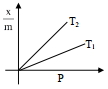
B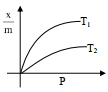
C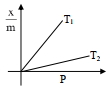
D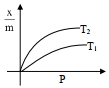
Solution
(D) The Freundlich adsorption isotherm is given by the relation: $\frac{x}{m} = kP^{1/n}$,where $0 < \frac{1}{n} < 1$.
Adsorption is generally an exothermic process. According to Le Chatelier's principle,an increase in temperature will shift the equilibrium in the backward direction,leading to a decrease in the extent of adsorption $(\frac{x}{m})$.
Therefore,at a constant pressure $P$,the extent of adsorption $\frac{x}{m}$ will be higher at a lower temperature $(T_{2})$ compared to a higher temperature $(T_{1})$.
Thus,the curve for $T_{2}$ will lie above the curve for $T_{1}$ (given $T_{1} > T_{2}$),which is correctly represented in option $D$.
Adsorption is generally an exothermic process. According to Le Chatelier's principle,an increase in temperature will shift the equilibrium in the backward direction,leading to a decrease in the extent of adsorption $(\frac{x}{m})$.
Therefore,at a constant pressure $P$,the extent of adsorption $\frac{x}{m}$ will be higher at a lower temperature $(T_{2})$ compared to a higher temperature $(T_{1})$.
Thus,the curve for $T_{2}$ will lie above the curve for $T_{1}$ (given $T_{1} > T_{2}$),which is correctly represented in option $D$.
0 likes
View Solution289
DifficultMCQ
$CH_4$ is adsorbed on $1 \ g$ charcoal at $0^{\circ} C$ following the Freundlich adsorption isotherm. $10.0 \ mL$ of $CH_4$ is adsorbed at $100 \ mm$ of $Hg$,whereas $15.0 \ mL$ is adsorbed at $200 \ mm$ of $Hg$. The volume of $CH_4$ adsorbed at $300 \ mm$ of $Hg$ is $10^x \ mL$. The value of $x$ is $....\times 10^{-2}$ (Nearest integer). [Use $\log_{10} 2=0.3010, \log_{10} 3=0.4771$]
A
$1280$
B
$128$
C
$12.8$
D
$1.28$
Solution
(B) The Freundlich adsorption isotherm is given by $\frac{x}{m} = KP^{1/n}$. Since the mass of adsorbent $(m)$ is constant $(1 \ g)$,we have $V \propto \frac{x}{m}$,so $V = KP^{1/n}$.
For the given data:
$10 = K(100)^{1/n} \quad (1)$
$15 = K(200)^{1/n} \quad (2)$
$V = K(300)^{1/n} \quad (3)$
Dividing $(2)$ by $(1)$:
$\frac{15}{10} = \left(\frac{200}{100}\right)^{1/n} \Rightarrow 1.5 = 2^{1/n}$.
Taking $\log_{10}$ on both sides:
$\log_{10} 1.5 = \frac{1}{n} \log_{10} 2$
$\log_{10} \left(\frac{3}{2}\right) = \frac{1}{n} (0.3010)$
$0.4771 - 0.3010 = \frac{1}{n} (0.3010)$
$0.1761 = \frac{1}{n} (0.3010) \Rightarrow \frac{1}{n} = \frac{0.1761}{0.3010} \approx 0.585$.
Dividing $(3)$ by $(1)$:
$\frac{V}{10} = \left(\frac{300}{100}\right)^{1/n} = 3^{1/n}$.
Taking $\log_{10}$ on both sides:
$\log_{10} \left(\frac{V}{10}\right) = \frac{1}{n} \log_{10} 3$
$\log_{10} \left(\frac{V}{10}\right) = 0.585 \times 0.4771 = 0.2791$.
$\frac{V}{10} = 10^{0.2791} \Rightarrow V = 10 \times 10^{0.2791} = 10^{1.2791}$.
Given $V = 10^x$,so $x = 1.2791$.
Rounding to the nearest integer for $x \times 10^{-2}$,we get $128 \times 10^{-2}$.
For the given data:
$10 = K(100)^{1/n} \quad (1)$
$15 = K(200)^{1/n} \quad (2)$
$V = K(300)^{1/n} \quad (3)$
Dividing $(2)$ by $(1)$:
$\frac{15}{10} = \left(\frac{200}{100}\right)^{1/n} \Rightarrow 1.5 = 2^{1/n}$.
Taking $\log_{10}$ on both sides:
$\log_{10} 1.5 = \frac{1}{n} \log_{10} 2$
$\log_{10} \left(\frac{3}{2}\right) = \frac{1}{n} (0.3010)$
$0.4771 - 0.3010 = \frac{1}{n} (0.3010)$
$0.1761 = \frac{1}{n} (0.3010) \Rightarrow \frac{1}{n} = \frac{0.1761}{0.3010} \approx 0.585$.
Dividing $(3)$ by $(1)$:
$\frac{V}{10} = \left(\frac{300}{100}\right)^{1/n} = 3^{1/n}$.
Taking $\log_{10}$ on both sides:
$\log_{10} \left(\frac{V}{10}\right) = \frac{1}{n} \log_{10} 3$
$\log_{10} \left(\frac{V}{10}\right) = 0.585 \times 0.4771 = 0.2791$.
$\frac{V}{10} = 10^{0.2791} \Rightarrow V = 10 \times 10^{0.2791} = 10^{1.2791}$.
Given $V = 10^x$,so $x = 1.2791$.
Rounding to the nearest integer for $x \times 10^{-2}$,we get $128 \times 10^{-2}$.
0 likes
View Solution290
DifficultMCQ
$CO_{2}$ gas adsorbs on charcoal following Freundlich adsorption isotherm. For a given amount of charcoal,the mass of $CO_{2}$ adsorbed becomes $64$ times when the pressure of $CO_{2}$ is doubled. The value of $n$ in the Freundlich isotherm equation is $......\,\times 10^{-2}$. (Round off to the Nearest Integer)
A
$11$
B
$15$
C
$17$
D
$21$
Solution
(C) The Freundlich adsorption isotherm is given by the equation: $\frac{x}{m} = k \cdot p^{\frac{1}{n}}$.
Let the initial mass adsorbed be $y_1 = \frac{x}{m} = k \cdot p^{\frac{1}{n}}$.
When the pressure is doubled $(p' = 2p)$,the mass adsorbed becomes $y_2 = 64y_1 = k \cdot (2p)^{\frac{1}{n}}$.
Dividing the two equations: $\frac{64y_1}{y_1} = \frac{k \cdot (2p)^{\frac{1}{n}}}{k \cdot p^{\frac{1}{n}}}$.
$64 = (2)^{\frac{1}{n}}$.
Since $64 = 2^6$,we have $2^6 = 2^{\frac{1}{n}}$.
Therefore,$\frac{1}{n} = 6$,which implies $n = \frac{1}{6} \approx 0.1666$.
Expressing this as $n \times 10^{-2}$,we get $16.66 \times 10^{-2}$.
Rounding to the nearest integer,we get $17 \times 10^{-2}$.
Let the initial mass adsorbed be $y_1 = \frac{x}{m} = k \cdot p^{\frac{1}{n}}$.
When the pressure is doubled $(p' = 2p)$,the mass adsorbed becomes $y_2 = 64y_1 = k \cdot (2p)^{\frac{1}{n}}$.
Dividing the two equations: $\frac{64y_1}{y_1} = \frac{k \cdot (2p)^{\frac{1}{n}}}{k \cdot p^{\frac{1}{n}}}$.
$64 = (2)^{\frac{1}{n}}$.
Since $64 = 2^6$,we have $2^6 = 2^{\frac{1}{n}}$.
Therefore,$\frac{1}{n} = 6$,which implies $n = \frac{1}{6} \approx 0.1666$.
Expressing this as $n \times 10^{-2}$,we get $16.66 \times 10^{-2}$.
Rounding to the nearest integer,we get $17 \times 10^{-2}$.
0 likes
View Solution291
DifficultMCQ
Given below are two statements: one is labelled as Assertion $A$ and the other is labelled as Reason $R.$
Assertion $A:$ $SO_{2(g)}$ is adsorbed to a larger extent than $H_{2(g)}$ on activated charcoal.
Reason $R:$ $SO_{2(g)}$ has a higher critical temperature than $H_{2(g)}.$
In the light of the above statements,choose the most appropriate answer from the options given below.
Assertion $A:$ $SO_{2(g)}$ is adsorbed to a larger extent than $H_{2(g)}$ on activated charcoal.
Reason $R:$ $SO_{2(g)}$ has a higher critical temperature than $H_{2(g)}.$
In the light of the above statements,choose the most appropriate answer from the options given below.
A
Both $A$ and $R$ are correct and $R$ is the correct explanation of $A$.
B
$A$ is not correct but $R$ is correct.
C
$A$ is correct but $R$ is not correct.
D
Both $A$ and $R$ are correct but $R$ is not the correct explanation of $A$.
Solution
(A) The extent of adsorption of a gas on a solid adsorbent depends on the ease of liquefaction of the gas.
Easily liquefiable gases have higher critical temperatures $(T_c)$.
Since $SO_{2(g)}$ has a higher critical temperature $(430 \ K)$ compared to $H_{2(g)}$ $(33 \ K)$,it is more easily liquefied and thus adsorbed to a larger extent on activated charcoal.
Therefore,both Assertion $A$ and Reason $R$ are correct,and $R$ is the correct explanation of $A$.
Easily liquefiable gases have higher critical temperatures $(T_c)$.
Since $SO_{2(g)}$ has a higher critical temperature $(430 \ K)$ compared to $H_{2(g)}$ $(33 \ K)$,it is more easily liquefied and thus adsorbed to a larger extent on activated charcoal.
Therefore,both Assertion $A$ and Reason $R$ are correct,and $R$ is the correct explanation of $A$.
0 likes
View Solution292
DifficultMCQ
When $200 \, mL$ of $0.2 \, M$ acetic acid is shaken with $0.6 \, g$ of wood charcoal,the final concentration of acetic acid after adsorption is $0.1 \, M$. The mass of acetic acid adsorbed per gram of carbon is $...... \, g$.
A
$1$
B
$0.2$
C
$2$
D
$20$
Solution
(C) Initial moles of acetic acid $= M_1 \times V_1 = 0.2 \, M \times 0.2 \, L = 0.04 \, mol$.
Final moles of acetic acid $= M_2 \times V_2 = 0.1 \, M \times 0.2 \, L = 0.02 \, mol$.
Moles of acetic acid adsorbed $= 0.04 - 0.02 = 0.02 \, mol$.
Molar mass of acetic acid $(CH_3COOH) = 60 \, g/mol$.
Mass of acetic acid adsorbed $= 0.02 \, mol \times 60 \, g/mol = 1.2 \, g$.
Mass of wood charcoal $= 0.6 \, g$.
Mass of acetic acid adsorbed per gram of carbon $= \frac{1.2 \, g}{0.6 \, g} = 2 \, g/g$.
Final moles of acetic acid $= M_2 \times V_2 = 0.1 \, M \times 0.2 \, L = 0.02 \, mol$.
Moles of acetic acid adsorbed $= 0.04 - 0.02 = 0.02 \, mol$.
Molar mass of acetic acid $(CH_3COOH) = 60 \, g/mol$.
Mass of acetic acid adsorbed $= 0.02 \, mol \times 60 \, g/mol = 1.2 \, g$.
Mass of wood charcoal $= 0.6 \, g$.
Mass of acetic acid adsorbed per gram of carbon $= \frac{1.2 \, g}{0.6 \, g} = 2 \, g/g$.
0 likes
View Solution293
EasyMCQ
$2.0 \, g$ of $H_2$ gas is adsorbed on $2.5 \, g$ of platinum powder at $300 \, K$ and $1 \, bar$ pressure. The volume of the gas adsorbed per gram of the adsorbent is $..... \, mL$.
(Given: $R = 0.083 \, L \, bar \, K^{-1} \, mol^{-1}$)
(Given: $R = 0.083 \, L \, bar \, K^{-1} \, mol^{-1}$)
A
$1245$
B
$7841$
C
$9960$
D
$8960$
Solution
(C) First,calculate the number of moles of $H_2$ gas: $n = \frac{\text{mass}}{\text{molar mass}} = \frac{2.0 \, g}{2.0 \, g/mol} = 1.0 \, mol$.
Using the ideal gas equation $PV = nRT$,we find the volume $V$ of the gas:
$V = \frac{nRT}{P} = \frac{1.0 \, mol \times 0.083 \, L \, bar \, K^{-1} \, mol^{-1} \times 300 \, K}{1 \, bar} = 24.9 \, L$.
Convert the volume to $mL$: $24.9 \, L = 24900 \, mL$.
The volume of gas adsorbed per gram of adsorbent is calculated as:
$\text{Volume per gram} = \frac{\text{Total volume}}{\text{Mass of adsorbent}} = \frac{24900 \, mL}{2.5 \, g} = 9960 \, mL/g$.
Using the ideal gas equation $PV = nRT$,we find the volume $V$ of the gas:
$V = \frac{nRT}{P} = \frac{1.0 \, mol \times 0.083 \, L \, bar \, K^{-1} \, mol^{-1} \times 300 \, K}{1 \, bar} = 24.9 \, L$.
Convert the volume to $mL$: $24.9 \, L = 24900 \, mL$.
The volume of gas adsorbed per gram of adsorbent is calculated as:
$\text{Volume per gram} = \frac{\text{Total volume}}{\text{Mass of adsorbent}} = \frac{24900 \, mL}{2.5 \, g} = 9960 \, mL/g$.
0 likes
View Solution294
DifficultMCQ
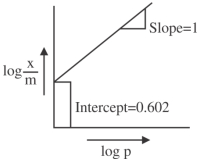
If the initial pressure of a gas is $0.03 \, atm$,the mass of the gas adsorbed per gram of the adsorbent is $...... \, \times 10^{-2} \, g$. Based on the provided graph,determine the value.
A
$214$
B
$24$
C
$12$
D
$67$
Solution
(C) The Freundlich adsorption isotherm is given by $\frac{x}{m} = k \, P^{\frac{1}{n}}$.
Taking logarithm on both sides,we get $\log \frac{x}{m} = \log k + \frac{1}{n} \log P$.
Comparing this with the equation of a straight line $y = mx + c$,the slope is $\frac{1}{n}$ and the intercept is $\log k$.
From the graph,the slope is $1$,so $\frac{1}{n} = 1 \Rightarrow n = 1$.
The intercept is $\log k = 0.602$. Since $\log 4 \approx 0.602$,we have $k = 4$.
Now,substitute the values into the equation: $\frac{x}{m} = 4 \times (0.03)^1$.
$\frac{x}{m} = 0.12 \, g$.
To express this in the form $...... \times 10^{-2} \, g$,we write $0.12 = 12 \times 10^{-2} \, g$.
Taking logarithm on both sides,we get $\log \frac{x}{m} = \log k + \frac{1}{n} \log P$.
Comparing this with the equation of a straight line $y = mx + c$,the slope is $\frac{1}{n}$ and the intercept is $\log k$.
From the graph,the slope is $1$,so $\frac{1}{n} = 1 \Rightarrow n = 1$.
The intercept is $\log k = 0.602$. Since $\log 4 \approx 0.602$,we have $k = 4$.
Now,substitute the values into the equation: $\frac{x}{m} = 4 \times (0.03)^1$.
$\frac{x}{m} = 0.12 \, g$.
To express this in the form $...... \times 10^{-2} \, g$,we write $0.12 = 12 \times 10^{-2} \, g$.
0 likes
View Solution295
MediumMCQ
Given below are two statements. One is labelled as Assertion $A$ and the other is labelled as Reason $R$.
Assertion $A :$ Activated charcoal adsorbs $SO_{2}$ more efficiently than $CH_{4}$.
Reason $R$ : Gases with lower critical temperatures are readily adsorbed by activated charcoal.
In the light of the above statements,choose the correct answer from the options given below.
Assertion $A :$ Activated charcoal adsorbs $SO_{2}$ more efficiently than $CH_{4}$.
Reason $R$ : Gases with lower critical temperatures are readily adsorbed by activated charcoal.
In the light of the above statements,choose the correct answer from the options given below.
A
Both $A$ and $R$ are correct and $R$ is the correct explanation of $A$.
B
Both $A$ and $R$ are correct but $R$ is $NOT$ the correct explanation of $A$.
C
$A$ is correct but $R$ is not correct.
D
$A$ is not correct but $R$ is correct.
Solution
(C) The extent of adsorption of a gas on a solid adsorbent depends on its critical temperature $(T_c)$.
Gases with higher critical temperatures are more easily liquefied and thus more readily adsorbed on the surface of activated charcoal.
$SO_{2}$ has a higher critical temperature $(430 K)$ compared to $CH_{4}$ $(190 K)$.
Therefore,$SO_{2}$ is adsorbed more efficiently than $CH_{4}$,making Assertion $A$ correct.
Reason $R$ states that gases with lower critical temperatures are readily adsorbed,which is incorrect.
Thus,$A$ is correct but $R$ is not correct.
Gases with higher critical temperatures are more easily liquefied and thus more readily adsorbed on the surface of activated charcoal.
$SO_{2}$ has a higher critical temperature $(430 K)$ compared to $CH_{4}$ $(190 K)$.
Therefore,$SO_{2}$ is adsorbed more efficiently than $CH_{4}$,making Assertion $A$ correct.
Reason $R$ states that gases with lower critical temperatures are readily adsorbed,which is incorrect.
Thus,$A$ is correct but $R$ is not correct.
0 likes
View Solution296
MediumMCQ
Among the following,the number of curves not in accordance with the Freundlich adsorption isotherm is:
A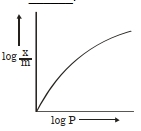
B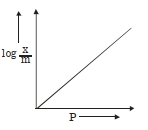
C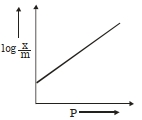
D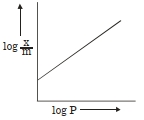
Solution
(B) The Freundlich adsorption isotherm is given by the equation: $\frac{x}{m} = K P^{\frac{1}{n}}$
Taking the logarithm on both sides,we get: $\log \frac{x}{m} = \frac{1}{n} \log P + \log K$
This is a linear equation of the form $y = mx + c$,where the plot of $\log \frac{x}{m}$ versus $\log P$ should be a straight line with a slope of $\frac{1}{n}$ and an intercept of $\log K$.
Analyzing the given curves:
$1$. The first curve $(a)$ is a non-linear curve of $\log \frac{x}{m}$ vs $\log P$,which is incorrect.
$2$. The second curve $(b)$ is a linear plot of $\log \frac{x}{m}$ vs $P$,which is incorrect.
$3$. The third curve $(c)$ is a linear plot of $\log \frac{x}{m}$ vs $P$,which is incorrect.
$4$. The fourth curve $(d)$ is a linear plot of $\log \frac{x}{m}$ vs $\log P$ with a positive intercept,which is correct.
Therefore,there are $3$ curves that are not in accordance with the Freundlich adsorption isotherm.
Taking the logarithm on both sides,we get: $\log \frac{x}{m} = \frac{1}{n} \log P + \log K$
This is a linear equation of the form $y = mx + c$,where the plot of $\log \frac{x}{m}$ versus $\log P$ should be a straight line with a slope of $\frac{1}{n}$ and an intercept of $\log K$.
Analyzing the given curves:
$1$. The first curve $(a)$ is a non-linear curve of $\log \frac{x}{m}$ vs $\log P$,which is incorrect.
$2$. The second curve $(b)$ is a linear plot of $\log \frac{x}{m}$ vs $P$,which is incorrect.
$3$. The third curve $(c)$ is a linear plot of $\log \frac{x}{m}$ vs $P$,which is incorrect.
$4$. The fourth curve $(d)$ is a linear plot of $\log \frac{x}{m}$ vs $\log P$ with a positive intercept,which is correct.
Therefore,there are $3$ curves that are not in accordance with the Freundlich adsorption isotherm.
0 likes
View Solution297
MediumMCQ
Given below are the critical temperatures of some of the gases:
The gas showing least adsorption on a definite amount of charcoal is:
| Gas | Critical temperature $(K)$ |
| $He$ | $5.2$ |
| $CH_{4}$ | $190$ |
| $CO_{2}$ | $304.2$ |
| $NH_{3}$ | $405.5$ |
The gas showing least adsorption on a definite amount of charcoal is:
A
$He$
B
$CH_{4}$
C
$CO_{2}$
D
$NH_{3}$
Solution
(A) The extent of adsorption of a gas on a solid adsorbent like charcoal depends on the ease of liquefaction of the gas.
Easily liquefiable gases have higher critical temperatures $(T_c)$ and are adsorbed to a greater extent.
Conversely,gases with lower critical temperatures are difficult to liquefy and show the least adsorption.
Comparing the given values: $T_c(He) = 5.2 \ K$,$T_c(CH_4) = 190 \ K$,$T_c(CO_2) = 304.2 \ K$,and $T_c(NH_3) = 405.5 \ K$.
Since $He$ has the lowest critical temperature $(5.2 \ K)$,it shows the least adsorption on charcoal.
Easily liquefiable gases have higher critical temperatures $(T_c)$ and are adsorbed to a greater extent.
Conversely,gases with lower critical temperatures are difficult to liquefy and show the least adsorption.
Comparing the given values: $T_c(He) = 5.2 \ K$,$T_c(CH_4) = 190 \ K$,$T_c(CO_2) = 304.2 \ K$,and $T_c(NH_3) = 405.5 \ K$.
Since $He$ has the lowest critical temperature $(5.2 \ K)$,it shows the least adsorption on charcoal.
0 likes
View Solution298
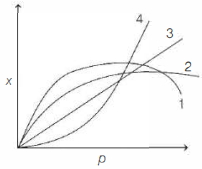
EasyMCQ
The curve that best describes the adsorption of a gas $(x \, g)$ on $1.0 \, g$ of a solid substrate as a function of pressure $(p)$ at a fixed temperature is
A
$1$
B
$2$
C
$3$
D
$4$
Solution
(B) The adsorption of a gas on a solid surface at a constant temperature is described by the Freundlich adsorption isotherm.
According to the Freundlich isotherm,the amount of gas adsorbed $(x)$ per unit mass of adsorbent $(m)$ is given by the relation $\frac{x}{m} = k \cdot p^{1/n}$,where $k$ and $n$ are constants for a given gas and adsorbent at a particular temperature.
As the pressure $(p)$ increases,the amount of gas adsorbed $(x/m)$ increases rapidly at low pressures and then approaches a saturation limit at high pressures.
Graph $2$ represents this characteristic behavior of the adsorption isotherm,showing a rapid initial increase followed by a plateau as it approaches saturation.
According to the Freundlich isotherm,the amount of gas adsorbed $(x)$ per unit mass of adsorbent $(m)$ is given by the relation $\frac{x}{m} = k \cdot p^{1/n}$,where $k$ and $n$ are constants for a given gas and adsorbent at a particular temperature.
As the pressure $(p)$ increases,the amount of gas adsorbed $(x/m)$ increases rapidly at low pressures and then approaches a saturation limit at high pressures.
Graph $2$ represents this characteristic behavior of the adsorption isotherm,showing a rapid initial increase followed by a plateau as it approaches saturation.
0 likes
View Solution299
DifficultMCQ
The plot that best represents the relationship between the extent of adsorption $(x / m)$ and pressure $(p)$ is
A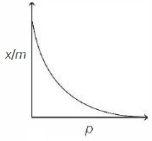
B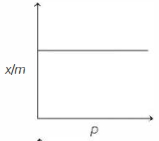
C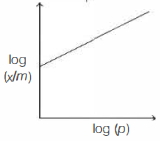
D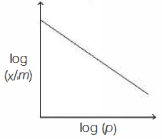
Solution
(C)
The relation between the extent of adsorption $(x / m)$ and pressure $(p)$ is given by the Freundlich adsorption isotherm.
According to this,
$\frac{x}{m} = k p^{1 / n} \quad (n > 1)$
where $x$ is the mass of gas adsorbed on mass $m$ of the adsorbent at pressure $p$,and $k$ and $n$ are constants.
Taking $\log$ on both sides:
$\log (x / m) = \log k + \frac{1}{n} \log p$
Comparing this with the equation of a straight line,$y = mx + c$,where $y = \log (x / m)$,$x = \log p$,slope $m = 1 / n$,and intercept $c = \log k$.
Thus,the plot of $\log (x / m)$ versus $\log p$ is a straight line with a positive slope,which is represented by graph $(C)$.
The relation between the extent of adsorption $(x / m)$ and pressure $(p)$ is given by the Freundlich adsorption isotherm.
According to this,
$\frac{x}{m} = k p^{1 / n} \quad (n > 1)$
where $x$ is the mass of gas adsorbed on mass $m$ of the adsorbent at pressure $p$,and $k$ and $n$ are constants.
Taking $\log$ on both sides:
$\log (x / m) = \log k + \frac{1}{n} \log p$
Comparing this with the equation of a straight line,$y = mx + c$,where $y = \log (x / m)$,$x = \log p$,slope $m = 1 / n$,and intercept $c = \log k$.
Thus,the plot of $\log (x / m)$ versus $\log p$ is a straight line with a positive slope,which is represented by graph $(C)$.
0 likes
View Solution300
MediumMCQ
The number of statement/s which are the characteristics of physisorption is
$A.$ It is highly specific in nature
$B.$ Enthalpy of adsorption is high
$C.$ It decreases with increase in temperature
$D.$ It results into unimolecular layer
$E.$ No activation energy is needed
$A.$ It is highly specific in nature
$B.$ Enthalpy of adsorption is high
$C.$ It decreases with increase in temperature
$D.$ It results into unimolecular layer
$E.$ No activation energy is needed
A
$2$
B
$3$
C
$4$
D
$5$
Solution
(A) The characteristics of physisorption are:
$1.$ It is not specific in nature (it is non-specific).
$2.$ Enthalpy of adsorption is low $(20-40 \ kJ \ mol^{-1})$.
$3.$ It decreases with an increase in temperature.
$4.$ It results in multimolecular layers.
$5.$ No appreciable activation energy is needed.
Comparing these with the given statements:
$A.$ Incorrect (Physisorption is non-specific).
$B.$ Incorrect (Enthalpy is low).
$C.$ Correct.
$D.$ Incorrect (It forms multimolecular layers).
$E.$ Correct.
Thus,there are $2$ correct statements ($C$ and $E$).
$1.$ It is not specific in nature (it is non-specific).
$2.$ Enthalpy of adsorption is low $(20-40 \ kJ \ mol^{-1})$.
$3.$ It decreases with an increase in temperature.
$4.$ It results in multimolecular layers.
$5.$ No appreciable activation energy is needed.
Comparing these with the given statements:
$A.$ Incorrect (Physisorption is non-specific).
$B.$ Incorrect (Enthalpy is low).
$C.$ Correct.
$D.$ Incorrect (It forms multimolecular layers).
$E.$ Correct.
Thus,there are $2$ correct statements ($C$ and $E$).
0 likes
View SolutionSurface Chemistry — Adsorption and Adsorption isotherm · Frequently Asked Questions
1Are these Surface Chemistry questions useful for JEE and NEET?
Yes. All questions in this section are mapped to JEE Main and NEET exam patterns. Previous year questions from JEE Main, NEET, GUJCET and state-level exams are included with full solutions.
2Can I switch to Hindi or Gujarati for these questions?
Yes. Use the language tabs in the hero section or the sidebar to view the same questions and solutions in English, Hindi or Gujarati.
3How do I generate a question paper from this subtopic?
Use the Vedclass Exam Paper Generator — select the chapter and subtopic, set difficulty, and generate Sets A, B, C, D automatically. First 3 chapters of every subject are free.
Vedclass Products
For Students
Vedclass Test Series
Mock tests in real JEE/NEET style with performance analysis. 5-day free trial.
Start Free TrialFor Teachers
Exam Paper Generator
Generate Set A/B/C/D papers from this chapter in 2 minutes. 3 chapters free.
Try FreeFor Institutes
Online Exam Module
Live online exams with unlimited students, 360° analytics & white-label branding.
See DemoFor Teachers & Institutes
Generate a Surface Chemistry Exam Paper in 2 Minutes
Select subtopic & difficulty — Sets A, B, C, D auto-generated with No Repeat logic.
First 3 chapters of every subject are free — no payment required.