
A English
Adsorption and Adsorption isotherm Questions in English
Class 12 Chemistry · Surface Chemistry · Adsorption and Adsorption isotherm
422+
Questions
English
Language
100%
With Solutions
Showing 49 of 422 questions in English
301
DifficultMCQ
The number of incorrect statement/s from the following is/are:
$A.$ Water vapours are adsorbed by anhydrous calcium chloride.
$B.$ There is a decrease in surface energy during adsorption.
$C.$ As the adsorption proceeds,$\Delta H$ becomes more and more negative.
$D.$ Adsorption is accompanied by decrease in entropy of the system.
$A.$ Water vapours are adsorbed by anhydrous calcium chloride.
$B.$ There is a decrease in surface energy during adsorption.
$C.$ As the adsorption proceeds,$\Delta H$ becomes more and more negative.
$D.$ Adsorption is accompanied by decrease in entropy of the system.
A
$4$
B
$6$
C
$8$
D
$1$
Solution
(D) $A.$ Incorrect. Water vapours are absorbed by anhydrous calcium chloride,not adsorbed.
$B.$ Correct. Adsorption is a spontaneous process,and surface energy decreases as the surface area available for adsorption decreases.
$C.$ Incorrect. As adsorption proceeds,the surface becomes covered,and the heat released per unit of adsorption decreases,so $\Delta H$ becomes less and less negative.
$D.$ Correct. Adsorption restricts the movement of gas molecules,leading to a decrease in the entropy of the system.
Therefore,there are $2$ incorrect statements ($A$ and $C$).
$B.$ Correct. Adsorption is a spontaneous process,and surface energy decreases as the surface area available for adsorption decreases.
$C.$ Incorrect. As adsorption proceeds,the surface becomes covered,and the heat released per unit of adsorption decreases,so $\Delta H$ becomes less and less negative.
$D.$ Correct. Adsorption restricts the movement of gas molecules,leading to a decrease in the entropy of the system.
Therefore,there are $2$ incorrect statements ($A$ and $C$).
0 likes
View Solution302
DifficultMCQ
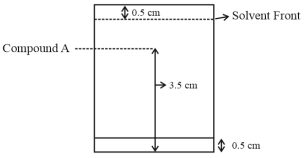
The following chromatogram was developed by adsorption of compound '$A$' on a $6 \ cm$ $TLC$ glass plate. The retardation factor $(R_f)$ of the compound '$A$' is $.......... \times 10^{-1}$.
A
$6$
B
$3$
C
$12$
D
$9$
Solution
(A) The retardation factor $(R_f)$ is defined as the ratio of the distance traveled by the substance to the distance traveled by the solvent front from the baseline.
From the provided chromatogram:
Distance moved by compound '$A$' from the baseline = $3.5 \ cm$.
Total length of the plate = $6 \ cm$.
Distance of solvent front from the top = $0.5 \ cm$.
Distance of baseline from the bottom = $0.5 \ cm$.
Therefore,the distance moved by the solvent front from the baseline = $6 \ cm - 0.5 \ cm - 0.5 \ cm = 5.0 \ cm$.
$R_f = \frac{\text{Distance moved by the substance}}{\text{Distance moved by the solvent}} = \frac{3.5 \ cm}{5.0 \ cm} = 0.7$.
Thus,$R_f = 7 \times 10^{-1}$.
Since $7$ is not among the options,let us re-evaluate the provided image data. If the distance moved by compound '$A$' is $3.0 \ cm$ and solvent front is $5.0 \ cm$,then $R_f = 0.6 = 6 \times 10^{-1}$. Given the options,$A$ is the correct choice.
From the provided chromatogram:
Distance moved by compound '$A$' from the baseline = $3.5 \ cm$.
Total length of the plate = $6 \ cm$.
Distance of solvent front from the top = $0.5 \ cm$.
Distance of baseline from the bottom = $0.5 \ cm$.
Therefore,the distance moved by the solvent front from the baseline = $6 \ cm - 0.5 \ cm - 0.5 \ cm = 5.0 \ cm$.
$R_f = \frac{\text{Distance moved by the substance}}{\text{Distance moved by the solvent}} = \frac{3.5 \ cm}{5.0 \ cm} = 0.7$.
Thus,$R_f = 7 \times 10^{-1}$.
Since $7$ is not among the options,let us re-evaluate the provided image data. If the distance moved by compound '$A$' is $3.0 \ cm$ and solvent front is $5.0 \ cm$,then $R_f = 0.6 = 6 \times 10^{-1}$. Given the options,$A$ is the correct choice.
0 likes
View Solution303
MediumMCQ
Given below are two statements: one is labelled as Assertion $(A)$ and the other is labelled as Reason $(R)$.
Assertion $(A)$: In expensive scientific instruments,silica gel is kept in watch-glasses or in semipermeable membrane bags.
Reason $(R)$: Silica gel adsorbs moisture from air via adsorption,thus protects the instrument from water corrosion (rusting) and/or prevents malfunctioning.
In the light of the above statements,choose the correct answer from the options given below:
Assertion $(A)$: In expensive scientific instruments,silica gel is kept in watch-glasses or in semipermeable membrane bags.
Reason $(R)$: Silica gel adsorbs moisture from air via adsorption,thus protects the instrument from water corrosion (rusting) and/or prevents malfunctioning.
In the light of the above statements,choose the correct answer from the options given below:
A
$(A)$ is false but $(R)$ is true
B
$(A)$ is true but $(R)$ is false
C
Both $(A)$ and $(R)$ are true and $(R)$ is the correct explanation of $(A)$
D
Both $(A)$ and $(R)$ are true but $(R)$ is not the correct explanation of $(A)$
Solution
(C) Silica gel is a well-known adsorbent used to remove moisture from the surrounding environment.
In expensive scientific instruments,it is placed in watch-glasses or semipermeable bags to adsorb water vapor from the air.
By adsorbing moisture,it prevents the corrosion of metallic parts and protects sensitive electronic components from malfunctioning due to humidity.
Therefore,both the Assertion $(A)$ and the Reason $(R)$ are true,and $(R)$ is the correct explanation of $(A)$.
In expensive scientific instruments,it is placed in watch-glasses or semipermeable bags to adsorb water vapor from the air.
By adsorbing moisture,it prevents the corrosion of metallic parts and protects sensitive electronic components from malfunctioning due to humidity.
Therefore,both the Assertion $(A)$ and the Reason $(R)$ are true,and $(R)$ is the correct explanation of $(A)$.
0 likes
View Solution304
DifficultMCQ
The graph of $\log \frac{x}{m}$ vs $\log p$ for an adsorption process is a straight line inclined at an angle of $45^{\circ}$ with an intercept equal to $0.6020$. The mass of gas adsorbed per unit mass of adsorbent at the pressure of $0.4 \ atm$ is $......... \times 10^{-1}$ (Nearest integer). Given: $\log 2 = 0.3010$.
A
$14$
B
$12$
C
$10$
D
$16$
Solution
(D) The Freundlich adsorption isotherm is given by the equation: $\log \frac{x}{m} = \log k + \frac{1}{n} \log P$.
Comparing this with the equation of a straight line $y = mx + c$,we have the slope $\frac{1}{n} = \tan 45^{\circ} = 1$ and the intercept $c = \log k = 0.6020$.
Since $\log 2 = 0.3010$,then $2 \times \log 2 = 0.6020$,which implies $\log 2^2 = \log 4 = 0.6020$. Thus,$k = 4$.
Substituting these values into the isotherm equation: $\frac{x}{m} = k \cdot P^{1/n} = 4 \times (0.4)^1 = 1.6$.
Expressing $1.6$ in the form $......... \times 10^{-1}$,we get $1.6 = 16 \times 10^{-1}$.
Therefore,the nearest integer is $16$.
Comparing this with the equation of a straight line $y = mx + c$,we have the slope $\frac{1}{n} = \tan 45^{\circ} = 1$ and the intercept $c = \log k = 0.6020$.
Since $\log 2 = 0.3010$,then $2 \times \log 2 = 0.6020$,which implies $\log 2^2 = \log 4 = 0.6020$. Thus,$k = 4$.
Substituting these values into the isotherm equation: $\frac{x}{m} = k \cdot P^{1/n} = 4 \times (0.4)^1 = 1.6$.
Expressing $1.6$ in the form $......... \times 10^{-1}$,we get $1.6 = 16 \times 10^{-1}$.
Therefore,the nearest integer is $16$.
0 likes
View Solution305
MediumMCQ
Match List-$I$ with List-$II$.
Choose the correct answer from the options given below:
| List-$I$ | List-$II$ |
|---|---|
| $A$. Physisorption | $I$. Single layer adsorption |
| $B$. Chemisorption | $II$. $20-40 \, kJ \, mol^{-1}$ |
| $C$. $N_{2(g)} + 3H_{2(g)} \xrightarrow{Fe(s)} 2NH_{3(g)}$ | $III$. Chromatography |
| $D$. Analytical Application of Adsorption | $IV$. Heterogeneous catalysis |
Choose the correct answer from the options given below:
A
$A-II, B-I, C-IV, D-III$
B
$A-III, B-IV, C-I, D-II$
C
$A-IV, B-II, C-III, D-I$
D
$A-II, B-I, C-IV, D-III$
Solution
(A) . Physisorption involves weak van der Waals forces with low enthalpy of adsorption $(20-40 \, kJ \, mol^{-1})$.
$B$. Chemisorption involves strong chemical bonds and is typically unimolecular (single layer).
$C$. The reaction $N_{2(g)} + 3H_{2(g)} \xrightarrow{Fe(s)} 2NH_{3(g)}$ is an example of heterogeneous catalysis where the catalyst $(Fe)$ is in a solid phase and reactants are in a gaseous phase.
$D$. Chromatography is a common analytical application based on the principle of differential adsorption.
Therefore,the correct matching is: $A-II, B-I, C-IV, D-III$.
$B$. Chemisorption involves strong chemical bonds and is typically unimolecular (single layer).
$C$. The reaction $N_{2(g)} + 3H_{2(g)} \xrightarrow{Fe(s)} 2NH_{3(g)}$ is an example of heterogeneous catalysis where the catalyst $(Fe)$ is in a solid phase and reactants are in a gaseous phase.
$D$. Chromatography is a common analytical application based on the principle of differential adsorption.
Therefore,the correct matching is: $A-II, B-I, C-IV, D-III$.
0 likes
View Solution306
DifficultMCQ
Given below are two statements: One is labelled as Assertion $A$ and the other is labelled as Reason $R$.
Assertion $A:$ Amongst $He$,$Ne$,$Ar$ and $Kr$; $1 \ g$ of activated charcoal adsorbs more of $Kr$.
Reason $R$: The critical volume $V_c \left( cm^3 \ mol^{-1} \right)$ and critical pressure $P_c \left( atm \right)$ is highest for Krypton but the compressibility factor at critical point $Z_c$ is lowest for Krypton.
In the light of the above statements,choose the correct answer from the options given below.
Assertion $A:$ Amongst $He$,$Ne$,$Ar$ and $Kr$; $1 \ g$ of activated charcoal adsorbs more of $Kr$.
Reason $R$: The critical volume $V_c \left( cm^3 \ mol^{-1} \right)$ and critical pressure $P_c \left( atm \right)$ is highest for Krypton but the compressibility factor at critical point $Z_c$ is lowest for Krypton.
In the light of the above statements,choose the correct answer from the options given below.
A
$A$ is true but $R$ is false
B
$A$ is false but $R$ is true
C
Both $A$ and $R$ are true but $R$ is $NOT$ the correct explanation of $A$
D
Both $A$ and $R$ are true and $R$ is the correct explanation of $A$
Solution
(A) Assertion $A$ is true: The extent of adsorption of gases on activated charcoal increases with an increase in the magnitude of van der Waals forces of attraction. Since $Kr$ has the largest atomic size among the given noble gases,it has the strongest van der Waals forces,leading to maximum adsorption.
Reason $R$ is false: The critical temperature $T_c$ is the primary factor determining the ease of liquefaction and adsorption. While $V_c$ and $P_c$ values vary,the statement regarding $Z_c$ is incorrect because for all real gases following the van der Waals equation,the compressibility factor at the critical point $Z_c = \frac{P_c V_c}{R T_c}$ is a constant value of $\frac{3}{8} = 0.375$.
Reason $R$ is false: The critical temperature $T_c$ is the primary factor determining the ease of liquefaction and adsorption. While $V_c$ and $P_c$ values vary,the statement regarding $Z_c$ is incorrect because for all real gases following the van der Waals equation,the compressibility factor at the critical point $Z_c = \frac{P_c V_c}{R T_c}$ is a constant value of $\frac{3}{8} = 0.375$.
0 likes
View Solution307
DifficultMCQ
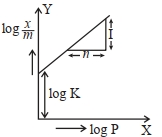
In the figure,a straight line is given for the Freundlich Adsorption isotherm equation $(y = mx + c)$,where the equation is $y = 0.3x + 0.7033$. The values of $\frac{1}{n}$ and $\log K$ are respectively:
A
$0.3$ and $\log 2.505$
B
$0.3$ and $0.7033$
C
$3$ and $2.505$
D
$3$ and $0.7033$
Solution
(B) The Freundlich adsorption isotherm is given by the equation: $\frac{x}{m} = K \cdot P^{1/n}$.
Taking logarithm on both sides,we get: $\log(\frac{x}{m}) = \log K + \frac{1}{n} \log P$.
Comparing this with the equation of a straight line $y = mx + c$,where $y = \log(\frac{x}{m})$,$x = \log P$,the slope $m = \frac{1}{n}$,and the intercept $c = \log K$.
Given the equation $y = 0.3x + 0.7033$,we have:
Slope $(m)$ = $\frac{1}{n} = 0.3$.
Intercept $(c)$ = $\log K = 0.7033$.
Thus,the values of $\frac{1}{n}$ and $\log K$ are $0.3$ and $0.7033$ respectively.
Taking logarithm on both sides,we get: $\log(\frac{x}{m}) = \log K + \frac{1}{n} \log P$.
Comparing this with the equation of a straight line $y = mx + c$,where $y = \log(\frac{x}{m})$,$x = \log P$,the slope $m = \frac{1}{n}$,and the intercept $c = \log K$.
Given the equation $y = 0.3x + 0.7033$,we have:
Slope $(m)$ = $\frac{1}{n} = 0.3$.
Intercept $(c)$ = $\log K = 0.7033$.
Thus,the values of $\frac{1}{n}$ and $\log K$ are $0.3$ and $0.7033$ respectively.
0 likes
View Solution308
DifficultMCQ
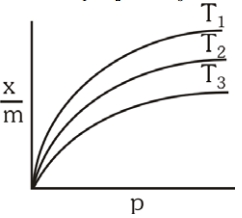
Shown below are adsorption isotherms for a gas '$X$' at temperatures $T_1$,$T_2$,and $T_3$. Here,$p$ and $\frac{x}{m}$ represent pressure and the extent of adsorption,respectively. The correct order of temperatures for the given adsorption is:
A
$T_1 > T_2 > T_3$
B
$T_3 > T_2 > T_1$
C
$T_1 = T_2 = T_3$
D
$T_1 = T_2 > T_3$
Solution
(B) Physical adsorption is an exothermic process. According to Le Chatelier's principle,an increase in temperature decreases the extent of adsorption $(\frac{x}{m})$ at a constant pressure.
From the given graph,at any constant pressure $p$,the extent of adsorption follows the order: $(x/m)_{T_1} > (x/m)_{T_2} > (x/m)_{T_3}$.
Since adsorption decreases with an increase in temperature,the corresponding temperatures must follow the inverse order: $T_1 < T_2 < T_3$,or $T_3 > T_2 > T_1$.
From the given graph,at any constant pressure $p$,the extent of adsorption follows the order: $(x/m)_{T_1} > (x/m)_{T_2} > (x/m)_{T_3}$.
Since adsorption decreases with an increase in temperature,the corresponding temperatures must follow the inverse order: $T_1 < T_2 < T_3$,or $T_3 > T_2 > T_1$.
0 likes
View Solution309
MediumMCQ
For the adsorption of hydrogen on platinum,the activation energy is $30 \ kJ \ mol^{-1}$ and for the adsorption of hydrogen on nickel,the activation energy is $41.4 \ kJ \ mol^{-1}$. The logarithm of the ratio of the rates of chemisorption on equal areas of the metals at $300 \ K$ is $........$ (Nearest integer). Given: $\ln 10 = 2.3$,$R = 8.3 \ J \ K^{-1} \ mol^{-1}$.
A
$4$
B
$6$
C
$8$
D
$2$
Solution
(D) The rate of chemisorption follows the Arrhenius equation: $k = Ae^{-\frac{E_a}{RT}}$.
Let $k_1$ be the rate on platinum and $k_2$ be the rate on nickel.
$\frac{k_2}{k_1} = \frac{Ae^{-\frac{(E_a)_2}{RT}}}{Ae^{-\frac{(E_a)_1}{RT}}} = e^{\frac{(E_a)_1 - (E_a)_2}{RT}}$.
Taking the logarithm to the base $10$:
$\log_{10} \left( \frac{k_2}{k_1} \right) = \frac{(E_a)_1 - (E_a)_2}{2.303 RT}$.
Given $(E_a)_1 = 30 \ kJ \ mol^{-1} = 30000 \ J \ mol^{-1}$,$(E_a)_2 = 41.4 \ kJ \ mol^{-1} = 41400 \ J \ mol^{-1}$,$R = 8.3 \ J \ K^{-1} \ mol^{-1}$,$T = 300 \ K$,and $\ln 10 \approx 2.3$.
$\log_{10} \left( \frac{k_2}{k_1} \right) = \frac{30000 - 41400}{2.3 \times 8.3 \times 300} = \frac{-11400}{5727} \approx -1.99$.
Since the question asks for the logarithm of the ratio of rates (usually implying the magnitude or the ratio of $k_1/k_2$ to get a positive value),the nearest integer is $2$.
Let $k_1$ be the rate on platinum and $k_2$ be the rate on nickel.
$\frac{k_2}{k_1} = \frac{Ae^{-\frac{(E_a)_2}{RT}}}{Ae^{-\frac{(E_a)_1}{RT}}} = e^{\frac{(E_a)_1 - (E_a)_2}{RT}}$.
Taking the logarithm to the base $10$:
$\log_{10} \left( \frac{k_2}{k_1} \right) = \frac{(E_a)_1 - (E_a)_2}{2.303 RT}$.
Given $(E_a)_1 = 30 \ kJ \ mol^{-1} = 30000 \ J \ mol^{-1}$,$(E_a)_2 = 41.4 \ kJ \ mol^{-1} = 41400 \ J \ mol^{-1}$,$R = 8.3 \ J \ K^{-1} \ mol^{-1}$,$T = 300 \ K$,and $\ln 10 \approx 2.3$.
$\log_{10} \left( \frac{k_2}{k_1} \right) = \frac{30000 - 41400}{2.3 \times 8.3 \times 300} = \frac{-11400}{5727} \approx -1.99$.
Since the question asks for the logarithm of the ratio of rates (usually implying the magnitude or the ratio of $k_1/k_2$ to get a positive value),the nearest integer is $2$.
0 likes
View Solution310
MediumMCQ
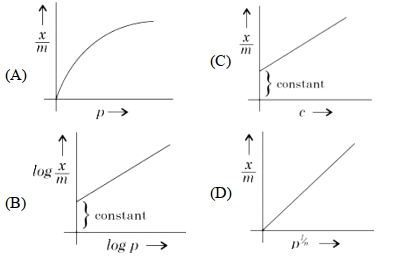
Which of the following represent the Freundlich adsorption isotherms?
Choose the correct answer from the options given below:
Choose the correct answer from the options given below:
A
$B, C, D$ only
B
$A, B, D$ only
C
$A, B$ only
D
$A, C, D$ only
Solution
(B) The Freundlich adsorption isotherm is given by the equation $\frac{x}{m} = k p^{1/n}$.
Graph $(A)$ represents the plot of $\frac{x}{m}$ versus $p$,which is a characteristic curve of the Freundlich isotherm.
Taking the logarithm on both sides,we get $\log \frac{x}{m} = \log k + \frac{1}{n} \log p$. This is a linear equation of the form $y = mx + c$,where the slope is $\frac{1}{n}$ and the intercept is $\log k$. Graph $(B)$ represents this linear relationship.
Graph $(D)$ represents the plot of $\frac{x}{m}$ versus $p^{1/n}$,which is also a linear relationship derived from the equation $\frac{x}{m} = k p^{1/n}$ (where $y = kx$).
Graph $(C)$ is not a standard representation of the Freundlich adsorption isotherm as it plots $\frac{x}{m}$ against concentration $c$ with an intercept,which does not match the standard form.
Therefore,graphs $(A), (B),$ and $(D)$ represent the Freundlich adsorption isotherms.
Graph $(A)$ represents the plot of $\frac{x}{m}$ versus $p$,which is a characteristic curve of the Freundlich isotherm.
Taking the logarithm on both sides,we get $\log \frac{x}{m} = \log k + \frac{1}{n} \log p$. This is a linear equation of the form $y = mx + c$,where the slope is $\frac{1}{n}$ and the intercept is $\log k$. Graph $(B)$ represents this linear relationship.
Graph $(D)$ represents the plot of $\frac{x}{m}$ versus $p^{1/n}$,which is also a linear relationship derived from the equation $\frac{x}{m} = k p^{1/n}$ (where $y = kx$).
Graph $(C)$ is not a standard representation of the Freundlich adsorption isotherm as it plots $\frac{x}{m}$ against concentration $c$ with an intercept,which does not match the standard form.
Therefore,graphs $(A), (B),$ and $(D)$ represent the Freundlich adsorption isotherms.
0 likes
View Solution311
MediumMCQ
Four gases $A$,$B$,$C$,and $D$ have critical temperatures $5.3 \ K$,$33.2 \ K$,$126.0 \ K$,and $154.3 \ K$ respectively. For their adsorption on a fixed amount of charcoal,the correct order is:
A
$C > B > D > A$
B
$C > D > B > A$
C
$D > C > A > B$
D
$D > C > B > A$
Solution
(D) The extent of adsorption of a gas on a solid adsorbent like charcoal is directly proportional to its critical temperature $(T_c)$.
Higher critical temperature implies that the gas is more easily liquefiable and has stronger van der Waals forces of attraction.
Given critical temperatures are:
$A = 5.3 \ K$
$B = 33.2 \ K$
$C = 126.0 \ K$
$D = 154.3 \ K$
Therefore,the order of adsorption is $D > C > B > A$.
Higher critical temperature implies that the gas is more easily liquefiable and has stronger van der Waals forces of attraction.
Given critical temperatures are:
$A = 5.3 \ K$
$B = 33.2 \ K$
$C = 126.0 \ K$
$D = 154.3 \ K$
Therefore,the order of adsorption is $D > C > B > A$.
0 likes
View Solution312
DifficultMCQ
The principle of $Adsorption$ is used in which of the following purification methods?
A
Extraction
B
Chromatography
C
Distillation
D
Sublimation
Solution
(B) The fundamental principle used in $Chromatography$ is $Adsorption$. In this technique,different components of a mixture are adsorbed to different extents on a stationary phase.
0 likes
View Solution313
MediumMCQ
The adsorbent used in adsorption chromatography is/are:
$A$. silica gel
$B$. alumina
$C$. quick lime
$D$. magnesia
Choose the most appropriate answer from the options given below:
$A$. silica gel
$B$. alumina
$C$. quick lime
$D$. magnesia
Choose the most appropriate answer from the options given below:
A
$B$ only
B
$C$ and $D$ only
C
$A$ and $B$ only
D
$A$ only
Solution
(C) In adsorption chromatography,the stationary phase consists of an adsorbent material.
Silica gel $(SiO_2 \cdot xH_2O)$ is the most commonly used polar adsorbent.
Alumina $(Al_2O_3)$ is also a widely used polar adsorbent in adsorption chromatography.
Both silica gel and alumina are standard materials used for the separation of organic compounds based on their polarity.
Therefore,both $A$ and $B$ are correct.
Silica gel $(SiO_2 \cdot xH_2O)$ is the most commonly used polar adsorbent.
Alumina $(Al_2O_3)$ is also a widely used polar adsorbent in adsorption chromatography.
Both silica gel and alumina are standard materials used for the separation of organic compounds based on their polarity.
Therefore,both $A$ and $B$ are correct.
0 likes
View Solution314
DifficultMCQ
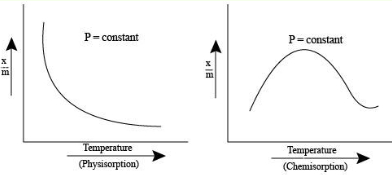
The correct statement$(s)$ pertaining to the adsorption of a gas on a solid surface is (are):
$(A)$ Adsorption is always exothermic.
$(B)$ Physisorption may transform into chemisorption at high temperature.
$(C)$ Physisorption increases with increasing temperature but chemisorption decreases with increasing temperature.
$(D)$ Chemisorption is more exothermic than physisorption,however it is very slow due to higher energy of activation.
$(A)$ Adsorption is always exothermic.
$(B)$ Physisorption may transform into chemisorption at high temperature.
$(C)$ Physisorption increases with increasing temperature but chemisorption decreases with increasing temperature.
$(D)$ Chemisorption is more exothermic than physisorption,however it is very slow due to higher energy of activation.
A
$(A, B, C)$
B
$(A, B, D)$
C
$(A, C, D)$
D
$(B, C, D)$
Solution
(B) Adsorption is always exothermic because it involves the release of energy as surface forces are satisfied.
$(B)$ Physisorption is reversible and weak,but at higher temperatures,it can provide enough activation energy for chemical bond formation,transforming into chemisorption.
$(C)$ This statement is incorrect. Physisorption decreases with an increase in temperature. Chemisorption initially increases with temperature (due to activation energy) and then decreases at very high temperatures.
$(D)$ Chemisorption involves chemical bond formation,which releases more energy than the weak van der Waals forces in physisorption. It is slow because it requires a significant activation energy.
$(B)$ Physisorption is reversible and weak,but at higher temperatures,it can provide enough activation energy for chemical bond formation,transforming into chemisorption.
$(C)$ This statement is incorrect. Physisorption decreases with an increase in temperature. Chemisorption initially increases with temperature (due to activation energy) and then decreases at very high temperatures.
$(D)$ Chemisorption involves chemical bond formation,which releases more energy than the weak van der Waals forces in physisorption. It is slow because it requires a significant activation energy.
0 likes
View Solution315
AdvancedMCQ
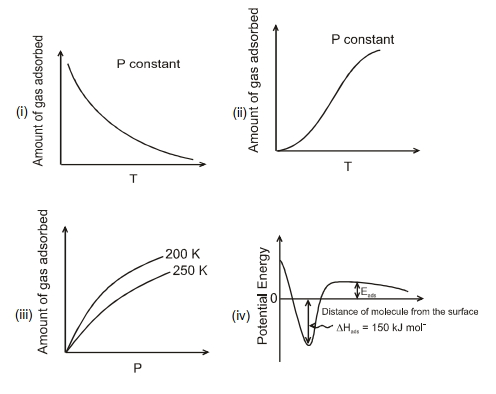
The given graphs $I$,$II$,$III$,and $IV$ represent general trends observed for different physisorption and chemisorption processes under mild conditions of temperature and pressure. Which of the following choice$(s)$ about $I$,$II$,$III$,and $IV$ is (are) correct?
$(A)$ $I$ is physisorption and $II$ is chemisorption
$(B)$ $I$ is physisorption and $III$ is chemisorption
$(C)$ $IV$ is chemisorption and $II$ is chemisorption
$(D)$ $IV$ is chemisorption and $III$ is chemisorption
$(A)$ $I$ is physisorption and $II$ is chemisorption
$(B)$ $I$ is physisorption and $III$ is chemisorption
$(C)$ $IV$ is chemisorption and $II$ is chemisorption
$(D)$ $IV$ is chemisorption and $III$ is chemisorption
A
$(A), (B)$
B
$(A), (C)$
C
$(A), (D)$
D
$(B), (D)$
Solution
(B) In physisorption,adsorption decreases with an increase in temperature at constant pressure. Thus,graph $I$ represents physisorption.
In chemisorption,adsorption initially increases with an increase in temperature due to the requirement of activation energy. Thus,graph $II$ represents chemisorption.
Graph $III$ shows that at a constant pressure,the extent of adsorption decreases as the temperature increases from $200 \ K$ to $250 \ K$,which is characteristic of physisorption.
Graph $IV$ shows a high enthalpy of adsorption $(\Delta H_{ads} = 150 \ kJ \ mol^{-1})$ and an activation energy $(E_{ads})$,which are characteristic of chemisorption.
Therefore,the correct statements are:
$I$ is physisorption and $II$ is chemisorption (Statement $A$ is correct).
$IV$ is chemisorption and $II$ is chemisorption (Statement $C$ is correct).
Thus,the correct choice is $(B)$.
In chemisorption,adsorption initially increases with an increase in temperature due to the requirement of activation energy. Thus,graph $II$ represents chemisorption.
Graph $III$ shows that at a constant pressure,the extent of adsorption decreases as the temperature increases from $200 \ K$ to $250 \ K$,which is characteristic of physisorption.
Graph $IV$ shows a high enthalpy of adsorption $(\Delta H_{ads} = 150 \ kJ \ mol^{-1})$ and an activation energy $(E_{ads})$,which are characteristic of chemisorption.
Therefore,the correct statements are:
$I$ is physisorption and $II$ is chemisorption (Statement $A$ is correct).
$IV$ is chemisorption and $II$ is chemisorption (Statement $C$ is correct).
Thus,the correct choice is $(B)$.
0 likes
View Solution316
MediumMCQ
Methylene blue,from its aqueous solution,is adsorbed on activated charcoal at $25 \ ^{\circ}C$. For this process,the correct statement is
A
The adsorption requires activation at $25 \ ^{\circ}C$.
B
The adsorption is accompanied by a decrease in enthalpy.
C
The adsorption increases with increase of temperature.
D
The adsorption is irreversible.
Solution
(B) The adsorption of methylene blue on activated charcoal is a physical adsorption process (physisorption).
Physical adsorption is an exothermic process,which means it is accompanied by a decrease in enthalpy $(\Delta H < 0)$.
Physical adsorption is an exothermic process,which means it is accompanied by a decrease in enthalpy $(\Delta H < 0)$.
0 likes
View Solution317
AdvancedMCQ
When $O_{2}$ is adsorbed on a metallic surface,electron transfer occurs from the metal to $O_{2}$. The $TRUE$ statement$(s)$ regarding this adsorption is(are)
$(A)$ $O_{2}$ is physisorbed
$(B)$ heat is released
$(C)$ occupancy of $\pi_{2p}^{*}$ of $O_{2}$ is increased
$(D)$ bond length of $O_{2}$ is increased
$(A)$ $O_{2}$ is physisorbed
$(B)$ heat is released
$(C)$ occupancy of $\pi_{2p}^{*}$ of $O_{2}$ is increased
$(D)$ bond length of $O_{2}$ is increased
A
$(B, C, D)$
B
$(A, B, C)$
C
$(A, B, D)$
D
$(A, C, D)$
Solution
(A) * Adsorption of $O_{2}$ on a metal surface involves chemical bond formation,so it is chemisorption,not physisorption.
* Adsorption is an exothermic process,so heat is released.
* During electron transfer from the metal to $O_{2}$,the electron occupies the antibonding $\pi_{2p}^{*}$ orbital of $O_{2}$.
* As the occupancy of the antibonding orbital increases,the bond order of $O_{2}$ decreases,which leads to an increase in the bond length of $O_{2}$.
* Adsorption is an exothermic process,so heat is released.
* During electron transfer from the metal to $O_{2}$,the electron occupies the antibonding $\pi_{2p}^{*}$ orbital of $O_{2}$.
* As the occupancy of the antibonding orbital increases,the bond order of $O_{2}$ decreases,which leads to an increase in the bond length of $O_{2}$.
0 likes
View Solution318
DifficultMCQ
The correct option$(s)$ related to adsorption processes is(are):
$A$. Chemisorption results in a unimolecular layer.
$B$. The enthalpy change during physisorption is in the range of $100$ to $140 \ kJ \ mol^{-1}$.
$C$. Chemisorption is an endothermic process.
$D$. Lowering the temperature favors physisorption processes.
$A$. Chemisorption results in a unimolecular layer.
$B$. The enthalpy change during physisorption is in the range of $100$ to $140 \ kJ \ mol^{-1}$.
$C$. Chemisorption is an endothermic process.
$D$. Lowering the temperature favors physisorption processes.
A
$A, B$
B
$A, C$
C
$A, B, C$
D
$A, D$
Solution
(D) . Chemisorption involves the formation of chemical bonds,resulting in a unimolecular layer. This is correct.
$B$. The enthalpy of physisorption is low,typically in the range of $20$ to $40 \ kJ \ mol^{-1}$,not $100$ to $140 \ kJ \ mol^{-1}$. This is incorrect.
$C$. Chemisorption is generally an exothermic process because chemical bond formation releases energy. This is incorrect.
$D$. Physisorption is an exothermic process $( \Delta H < 0 )$. According to Le Chatelier's principle,lowering the temperature favors the forward reaction,thus favoring physisorption. This is correct.
Therefore,the correct options are $A$ and $D$.
$B$. The enthalpy of physisorption is low,typically in the range of $20$ to $40 \ kJ \ mol^{-1}$,not $100$ to $140 \ kJ \ mol^{-1}$. This is incorrect.
$C$. Chemisorption is generally an exothermic process because chemical bond formation releases energy. This is incorrect.
$D$. Physisorption is an exothermic process $( \Delta H < 0 )$. According to Le Chatelier's principle,lowering the temperature favors the forward reaction,thus favoring physisorption. This is correct.
Therefore,the correct options are $A$ and $D$.
0 likes
View Solution319
AdvancedMCQ
To form a complete monolayer of acetic acid on $1 \ g$ of charcoal,$100 \ mL$ of $0.5 \ M$ acetic acid was used. Some of the acetic acid remained unadsorbed. To neutralize the unadsorbed acetic acid,$40 \ mL$ of $1 \ M$ $NaOH$ solution was required. If each molecule of acetic acid occupies $P \times 10^{-23} \ m^2$ surface area on charcoal,the value of $P$ is $\qquad$
[Use given data : Surface area of charcoal $= 1.5 \times 10^2 \ m^2 \ g^{-1}$; Avogadro's number $(N_A) = 6.0 \times 10^{23} \ mol^{-1}$]
[Use given data : Surface area of charcoal $= 1.5 \times 10^2 \ m^2 \ g^{-1}$; Avogadro's number $(N_A) = 6.0 \times 10^{23} \ mol^{-1}$]
A
$2300$
B
$2200$
C
$2500$
D
$3000$
Solution
(C) Initial millimoles of acetic acid $= 100 \ mL \times 0.5 \ M = 50 \ mmol$.
Millimoles of unadsorbed acetic acid neutralized by $NaOH = 40 \ mL \times 1 \ M = 40 \ mmol$.
Millimoles of acetic acid adsorbed on $1 \ g$ of charcoal $= 50 - 40 = 10 \ mmol = 10 \times 10^{-3} \ mol$.
Number of molecules of acetic acid adsorbed $= 10 \times 10^{-3} \ mol \times 6.0 \times 10^{23} \ mol^{-1} = 6.0 \times 10^{21} \ \text{molecules}$.
Surface area occupied by one molecule $= \frac{\text{Total surface area}}{\text{Number of molecules}} = \frac{1.5 \times 10^2 \ m^2}{6.0 \times 10^{21}} = 0.25 \times 10^{-19} \ m^2 = 2500 \times 10^{-23} \ m^2$.
Comparing this with $P \times 10^{-23} \ m^2$,we get $P = 2500$.
Millimoles of unadsorbed acetic acid neutralized by $NaOH = 40 \ mL \times 1 \ M = 40 \ mmol$.
Millimoles of acetic acid adsorbed on $1 \ g$ of charcoal $= 50 - 40 = 10 \ mmol = 10 \times 10^{-3} \ mol$.
Number of molecules of acetic acid adsorbed $= 10 \times 10^{-3} \ mol \times 6.0 \times 10^{23} \ mol^{-1} = 6.0 \times 10^{21} \ \text{molecules}$.
Surface area occupied by one molecule $= \frac{\text{Total surface area}}{\text{Number of molecules}} = \frac{1.5 \times 10^2 \ m^2}{6.0 \times 10^{21}} = 0.25 \times 10^{-19} \ m^2 = 2500 \times 10^{-23} \ m^2$.
Comparing this with $P \times 10^{-23} \ m^2$,we get $P = 2500$.
0 likes
View Solution320
MediumMCQ
Statement $I$: Silica gel and alumina are used as adsorbents for adsorption chromatography.
Statement $II$: Paper chromatography is a type of partition chromatography.
In the light of the above statements,select the correct option.
Statement $II$: Paper chromatography is a type of partition chromatography.
In the light of the above statements,select the correct option.
A
Statement $I$ is true but statement $II$ is false
B
Statement $I$ is false but statement $II$ is true
C
Both statements $I$ and $II$ are true
D
Both statements $I$ and $II$ are false
Solution
(C) Statement $I$ is true: Silica gel and alumina are commonly used as stationary phases (adsorbents) in adsorption chromatography because of their high surface area and polar nature.
Statement $II$ is true: Paper chromatography is a form of partition chromatography where the stationary phase is water held in the pores of the filter paper,and the separation is based on the differential distribution of components between the stationary liquid phase and the mobile liquid phase.
Therefore,both statements are correct.
Statement $II$ is true: Paper chromatography is a form of partition chromatography where the stationary phase is water held in the pores of the filter paper,and the separation is based on the differential distribution of components between the stationary liquid phase and the mobile liquid phase.
Therefore,both statements are correct.
0 likes
View Solution321
EasyMCQ
Which of the following compounds is formed when tungsten adsorbs oxygen gas?
A
Tungsten dioxide
B
Tungsten oxide
C
Tungsten tetraoxide
D
Tungsten trioxide
Solution
(D) When tungsten $(W)$ metal is exposed to oxygen gas $(O_2)$,it undergoes surface adsorption followed by oxidation to form tungsten trioxide $(WO_3)$.
0 likes
View Solution322
EasyMCQ
Which inert gas is used in chromatography?
A
$Ar$
B
$Ne$
C
$Kr$
D
$He$
Solution
(D) In gas chromatography,a carrier gas is an inert gas used to transport the sample through the column.
Commonly used carrier gases include helium $(He)$,nitrogen $(N_2)$,hydrogen $(H_2)$,and argon $(Ar)$.
Helium and nitrogen are the most frequently used gases,and helium is particularly preferred when using a capillary column due to its efficiency.
Commonly used carrier gases include helium $(He)$,nitrogen $(N_2)$,hydrogen $(H_2)$,and argon $(Ar)$.
Helium and nitrogen are the most frequently used gases,and helium is particularly preferred when using a capillary column due to its efficiency.
0 likes
View Solution323
EasyMCQ
Which among the following gases is adsorbed to a greater extent at similar conditions of temperature and pressure if the adsorbent remains same?
A
$N_2$
B
$Cl_2$
C
$H_2$
D
$O_2$
Solution
(B) The extent of adsorption of a gas on a solid depends on the ease of liquefaction of the gas,which is directly related to its critical temperature $(T_c)$.
Easily liquefiable gases have higher critical temperatures and are adsorbed to a greater extent.
The critical temperatures $(T_c)$ of the given gases are:
$Cl_2$: $417 \ K$
$O_2$: $154 \ K$
$N_2$: $126 \ K$
$H_2$: $33 \ K$
Since $Cl_2$ has the highest critical temperature,it is adsorbed to the greatest extent.
Easily liquefiable gases have higher critical temperatures and are adsorbed to a greater extent.
The critical temperatures $(T_c)$ of the given gases are:
$Cl_2$: $417 \ K$
$O_2$: $154 \ K$
$N_2$: $126 \ K$
$H_2$: $33 \ K$
Since $Cl_2$ has the highest critical temperature,it is adsorbed to the greatest extent.
0 likes
View Solution324
EasyMCQ
Identify the example of sorption from the following.
A
Charcoal is added to methylene blue solution.
B
Chalk is dipped in ink.
C
Hydrogen gas is passed over platinum.
D
Oxygen gas is passed over finely divided nickel.
Solution
(A) Sorption is a phenomenon where both adsorption and absorption occur simultaneously.
$1$. When charcoal is added to a methylene blue solution,the dye molecules are adsorbed on the surface of the charcoal,while the solvent molecules are absorbed into the bulk of the charcoal. This is a classic example of sorption.
$2$. Dipping chalk in ink involves both adsorption on the surface and absorption into the porous structure of the chalk,which is also an example of sorption.
$3$. Hydrogen gas on platinum and oxygen on nickel are primarily examples of adsorption.
Since both $A$ and $B$ represent sorption,in the context of standard chemistry textbooks,the addition of charcoal to methylene blue is the most frequently cited example.
$1$. When charcoal is added to a methylene blue solution,the dye molecules are adsorbed on the surface of the charcoal,while the solvent molecules are absorbed into the bulk of the charcoal. This is a classic example of sorption.
$2$. Dipping chalk in ink involves both adsorption on the surface and absorption into the porous structure of the chalk,which is also an example of sorption.
$3$. Hydrogen gas on platinum and oxygen on nickel are primarily examples of adsorption.
Since both $A$ and $B$ represent sorption,in the context of standard chemistry textbooks,the addition of charcoal to methylene blue is the most frequently cited example.
0 likes
View Solution325
EasyMCQ
Which of the following gases is adsorbed to a greater extent if the adsorbent remains the same under similar conditions of temperature and pressure?
A
$O_2$
B
$SO_2$
C
$N_2$
D
$H_2$
Solution
(B) The extent of adsorption of a gas on a solid adsorbent depends on the ease of liquefaction of the gas.
Easily liquefiable gases have higher critical temperatures $(T_c)$ and stronger van der Waals forces of attraction,leading to greater adsorption.
The critical temperatures $(T_c)$ of the given gases are:
$SO_2$ $(430 \ K)$ > $O_2$ $(154 \ K)$ > $N_2$ $(126 \ K)$ > $H_2$ $(33 \ K)$.
Since $SO_2$ has the highest critical temperature,it is the most easily liquefiable and thus adsorbed to the greatest extent.
Easily liquefiable gases have higher critical temperatures $(T_c)$ and stronger van der Waals forces of attraction,leading to greater adsorption.
The critical temperatures $(T_c)$ of the given gases are:
$SO_2$ $(430 \ K)$ > $O_2$ $(154 \ K)$ > $N_2$ $(126 \ K)$ > $H_2$ $(33 \ K)$.
Since $SO_2$ has the highest critical temperature,it is the most easily liquefiable and thus adsorbed to the greatest extent.
0 likes
View Solution326
EasyMCQ
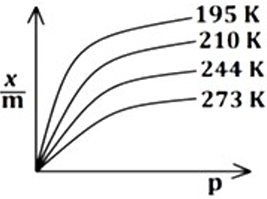
Find the temperature from the following graph at which the highest amount of a gas is adsorbed. (in $K$)
A
$195$
B
$210$
C
$244$
D
$273$
Solution
(A) The graph shows the variation of the extent of adsorption $(x/m)$ with pressure $(p)$ at different temperatures.
Physical adsorption is an exothermic process.
According to Le Chatelier's principle,for an exothermic process,the extent of adsorption decreases with an increase in temperature.
Therefore,the highest amount of gas is adsorbed at the lowest temperature.
From the given graph,the lowest temperature is $195 \ K$.
Physical adsorption is an exothermic process.
According to Le Chatelier's principle,for an exothermic process,the extent of adsorption decreases with an increase in temperature.
Therefore,the highest amount of gas is adsorbed at the lowest temperature.
From the given graph,the lowest temperature is $195 \ K$.
0 likes
View Solution327
EasyMCQ
Which among the following gases is least adsorbed on a solid at similar conditions of temperature and pressure?
A
$Cl_2$
B
$NH_3$
C
$SO_2$
D
$H_2$
Solution
(D) The extent of adsorption of a gas on a solid surface depends on the ease of liquefaction of the gas. Gases that are easily liquefiable have higher critical temperatures $(T_c)$ and are adsorbed more strongly due to stronger van der Waals forces.
Among the given gases,$H_2$ has the lowest critical temperature $(T_c \approx 33 \ K)$,whereas $Cl_2$,$NH_3$,and $SO_2$ have significantly higher critical temperatures.
Since $H_2$ is the most difficult to liquefy,it is the least adsorbed on a solid surface.
Among the given gases,$H_2$ has the lowest critical temperature $(T_c \approx 33 \ K)$,whereas $Cl_2$,$NH_3$,and $SO_2$ have significantly higher critical temperatures.
Since $H_2$ is the most difficult to liquefy,it is the least adsorbed on a solid surface.
0 likes
View Solution328
EasyMCQ
Which of the following is $NOT$ a characteristic of chemisorption?
A
It is specific.
B
Heat released is in the range of $40-200 \ kJ/mol$.
C
Formation of multimolecular layer of adsorbate.
D
It is irreversible.
Solution
(C) Chemisorption (chemical adsorption) involves the formation of strong chemical bonds between the adsorbate and the adsorbent.
$1$. It is highly specific in nature.
$2$. The enthalpy of adsorption is high,typically in the range of $40-200 \ kJ/mol$.
$3$. It is an irreversible process.
$4$. Chemisorption results in the formation of a unimolecular layer,not a multimolecular layer.
Therefore,the formation of a multimolecular layer is a characteristic of physisorption,not chemisorption.
$1$. It is highly specific in nature.
$2$. The enthalpy of adsorption is high,typically in the range of $40-200 \ kJ/mol$.
$3$. It is an irreversible process.
$4$. Chemisorption results in the formation of a unimolecular layer,not a multimolecular layer.
Therefore,the formation of a multimolecular layer is a characteristic of physisorption,not chemisorption.
0 likes
View Solution329
MediumMCQ
Which of the following statements is $NOT$ true about absorption?
A
Concentration of absorbate is uniform throughout the bulk of the absorbent.
B
It is independent of temperature and pressure.
C
It is not accompanied by evolution or absorption of heat.
D
It depends on surface area.
Solution
(D) Absorption is a bulk phenomenon where the substance is uniformly distributed throughout the body of the material. Unlike adsorption,it is not a surface phenomenon and therefore does not depend on the surface area of the absorbent.
0 likes
View Solution330
EasyMCQ
Identify physisorption from the following.
A
$O_2$ gas deposited on tungsten
B
$H_2$ gas deposited on nickel
C
$N_2$ gas deposited on iron
D
All gases deposited on charcoal
Solution
(D) Physisorption (physical adsorption) is characterized by weak van der Waals forces between the adsorbate and the adsorbent.
It is non-specific in nature.
Chemisorption involves strong chemical bonds and is highly specific.
$O_2$ on tungsten,$H_2$ on nickel,and $N_2$ on iron involve chemical bond formation (chemisorption).
Adsorption of gases on charcoal is a classic example of physisorption due to weak van der Waals forces.
It is non-specific in nature.
Chemisorption involves strong chemical bonds and is highly specific.
$O_2$ on tungsten,$H_2$ on nickel,and $N_2$ on iron involve chemical bond formation (chemisorption).
Adsorption of gases on charcoal is a classic example of physisorption due to weak van der Waals forces.
0 likes
View Solution331
EasyMCQ
Which of the following phenomena is inversely proportional to adsorption?
A
Critical temperature of gas
B
Surface area of adsorbent
C
Temperature of process
D
Pressure of gas
Solution
(C) Adsorption is an exothermic process,where $\Delta H < 0$.
According to Le Chatelier's principle,an increase in temperature favors the reverse process,which is desorption.
Therefore,the extent of adsorption is inversely proportional to the temperature of the process.
According to Le Chatelier's principle,an increase in temperature favors the reverse process,which is desorption.
Therefore,the extent of adsorption is inversely proportional to the temperature of the process.
0 likes
View Solution332
EasyMCQ
Identify the $FALSE$ statement regarding adsorption from the following.
A
It takes place due to unbalanced forces acting on the surface of solid or liquid.
B
During adsorption,the surface energy of the adsorbent increases.
C
It is caused by van der Waals forces.
D
It is an exothermic process.
Solution
(B) Adsorption is a surface phenomenon that occurs due to unbalanced forces on the surface of a solid or liquid.
During the process of adsorption,the residual forces on the surface decrease,which leads to a decrease in the surface energy of the adsorbent.
Therefore,the statement that surface energy increases is $FALSE$.
Adsorption is generally an exothermic process and can be caused by van der Waals forces (physisorption) or chemical bonds (chemisorption).
During the process of adsorption,the residual forces on the surface decrease,which leads to a decrease in the surface energy of the adsorbent.
Therefore,the statement that surface energy increases is $FALSE$.
Adsorption is generally an exothermic process and can be caused by van der Waals forces (physisorption) or chemical bonds (chemisorption).
0 likes
View Solution333
EasyMCQ
Which of the following gases is readily adsorbed by solid adsorbent?
A
$Cl_2$
B
$N_2$
C
$O_2$
D
$H_2$
Solution
(A) The extent of adsorption of a gas on a solid surface depends on the ease of liquefaction of the gas.
Gases with higher critical temperatures are more easily liquefied and thus show greater adsorption.
Among the given options,$Cl_2$ has the highest critical temperature $(417 \ K)$,making it the most readily adsorbed gas compared to $N_2$,$O_2$,and $H_2$.
Gases with higher critical temperatures are more easily liquefied and thus show greater adsorption.
Among the given options,$Cl_2$ has the highest critical temperature $(417 \ K)$,making it the most readily adsorbed gas compared to $N_2$,$O_2$,and $H_2$.
0 likes
View Solution334
EasyMCQ
Which among the following is an example of sorption?
A
$A$. Oxygen gas is passed over finely divided nickel
B
$B$. Charcoal is added to methylene blue solution
C
$C$. Chalk is dipped in ink
D
$D$. Hydrogen gas is passed over platinum
Solution
(C) Sorption is a phenomenon where both adsorption and absorption occur simultaneously.
When chalk is dipped in ink,the ink particles (solute) get adsorbed on the surface of the chalk,while the solvent (water) is absorbed into the bulk of the chalk.
Therefore,this process represents both adsorption and absorption,which is termed as sorption.
When chalk is dipped in ink,the ink particles (solute) get adsorbed on the surface of the chalk,while the solvent (water) is absorbed into the bulk of the chalk.
Therefore,this process represents both adsorption and absorption,which is termed as sorption.
0 likes
View Solution335
MediumMCQ
What is the effect of pressure on the extent of adsorption?
A
Increases as pressure increases continuously
B
Increases at the start as pressure increases and then remains constant
C
Decreases as pressure increases
D
No change in the extent of adsorption if pressure increases or decreases
Solution
(B) According to the Freundlich adsorption isotherm,the extent of adsorption $(x/m)$ increases with an increase in pressure $(P)$ at low pressures.
As the pressure increases further,the surface of the adsorbent becomes saturated,and the rate of adsorption decreases until it reaches a point where it becomes independent of pressure (saturation pressure).
Therefore,the extent of adsorption increases at the start and then remains constant at higher pressures.
As the pressure increases further,the surface of the adsorbent becomes saturated,and the rate of adsorption decreases until it reaches a point where it becomes independent of pressure (saturation pressure).
Therefore,the extent of adsorption increases at the start and then remains constant at higher pressures.
0 likes
View Solution336
EasyMCQ
Which of the following phenomena is exhibited by adsorption?
A
Exothermic
B
Endothermic
C
Bulk
D
None
Solution
(A) Adsorption is a surface phenomenon where the concentration of molecules increases at the surface rather than in the bulk of a solid or liquid.
During adsorption,there is a decrease in the residual forces of the surface,which leads to a decrease in surface energy.
This decrease in surface energy is released as heat,making adsorption an $ \text{exothermic} $ process.
During adsorption,there is a decrease in the residual forces of the surface,which leads to a decrease in surface energy.
This decrease in surface energy is released as heat,making adsorption an $ \text{exothermic} $ process.
0 likes
View Solution337
EasyMCQ
Which of the following statements is correct for physisorption?
A
It involves the formation of covalent or ionic bonds.
B
It is favoured at high temperature.
C
It is reversible.
D
It is very specific.
Solution
(C) Physisorption:
$-$ It arises because of weak van der Waals' forces.
$-$ It is not specific in nature.
$-$ It is reversible in nature.
$-$ Low temperature is favourable for adsorption. It decreases with an increase in temperature.
$-$ It arises because of weak van der Waals' forces.
$-$ It is not specific in nature.
$-$ It is reversible in nature.
$-$ Low temperature is favourable for adsorption. It decreases with an increase in temperature.
0 likes
View Solution338
EasyMCQ
Which among the following is true for chemisorption?
A
Heat of adsorption is in the range of $20-40 \ kJ \ mol^{-1}$
B
It is multimolecular layered
C
Van der Waals forces are involved
D
It is favored at high temperature up to a certain limit
Solution
(D) Chemisorption involves the formation of chemical bonds between the adsorbate and the adsorbent.
- The heat of adsorption is high,typically in the range of $80-240 \ kJ \ mol^{-1}$.
- It is unimolecular in nature,as chemical bonds are specific.
- It involves chemical forces,not $Van \ der \ Waals$ forces.
- It is favored at high temperatures because it requires activation energy to form chemical bonds.
- The heat of adsorption is high,typically in the range of $80-240 \ kJ \ mol^{-1}$.
- It is unimolecular in nature,as chemical bonds are specific.
- It involves chemical forces,not $Van \ der \ Waals$ forces.
- It is favored at high temperatures because it requires activation energy to form chemical bonds.
0 likes
View Solution339
EasyMCQ
Which of the following statements is true for adsorption?
A
It is accompanied by evolution of heat.
B
It is a bulk phenomenon.
C
It is independent of surface area.
D
It is independent of temperature.
Solution
(A) Adsorption is an exothermic process,meaning it is accompanied by the evolution of heat.
Adsorption is a surface phenomenon,not a bulk phenomenon.
Adsorption depends on temperature and the surface area of the adsorbent.
It increases with an increase in the surface area of the adsorbent.
Adsorption is a surface phenomenon,not a bulk phenomenon.
Adsorption depends on temperature and the surface area of the adsorbent.
It increases with an increase in the surface area of the adsorbent.
0 likes
View Solution340
EasyMCQ
Which of the following represents the Freundlich adsorption isotherm equation for the adsorption of a gas on a solid (where $n > 1$)?
A
$x/m = k p^{1/n}$
B
$m/x = k p^{1/n}$
C
$x/m = k p^n$
D
$m/x = k p^n$
Solution
(A) The Freundlich adsorption isotherm is an empirical relationship between the amount of gas adsorbed per unit mass of adsorbent and the pressure of the gas at a constant temperature.
It is expressed by the equation: $x/m = k p^{1/n}$,where $x$ is the mass of the gas adsorbed,$m$ is the mass of the adsorbent,$p$ is the equilibrium pressure,and $k$ and $n$ are constants that depend on the nature of the adsorbent and the gas at a particular temperature.
For the adsorption process,the value of $n$ is typically greater than $1$,which implies that $1/n$ lies between $0$ and $1$.
It is expressed by the equation: $x/m = k p^{1/n}$,where $x$ is the mass of the gas adsorbed,$m$ is the mass of the adsorbent,$p$ is the equilibrium pressure,and $k$ and $n$ are constants that depend on the nature of the adsorbent and the gas at a particular temperature.
For the adsorption process,the value of $n$ is typically greater than $1$,which implies that $1/n$ lies between $0$ and $1$.
0 likes
View Solution341
EasyMCQ
What is the value of the slope in the Freundlich adsorption isotherm plot of $\log \frac{x}{m}$ against $\log C$?
A
$\frac{1}{n}$
B
$n$
C
$K$
D
$\log K$
Solution
(A) According to the Freundlich adsorption isotherm equation: $\log \frac{x}{m} = \log K + \frac{1}{n} \log C$.
Comparing this with the equation of a straight line $y = mx + c$,where $y = \log \frac{x}{m}$,$x = \log C$,and $c = \log K$.
The slope of the straight line is $\frac{1}{n}$.
Comparing this with the equation of a straight line $y = mx + c$,where $y = \log \frac{x}{m}$,$x = \log C$,and $c = \log K$.
The slope of the straight line is $\frac{1}{n}$.
0 likes
View Solution342
DifficultMCQ
What is the value of the intercept on the $y$-axis when $\log \frac{x}{m}$ is plotted against $\log P$ in the Freundlich isotherm?
A
$\frac{1}{n}$
B
$\log k$
C
$n$
D
$k$
Solution
(B) The Freundlich adsorption isotherm is given by the equation: $\frac{x}{m} = k P^{\frac{1}{n}}$.
Taking the logarithm on both sides,we get: $\log \frac{x}{m} = \log k + \frac{1}{n} \log P$.
Comparing this with the equation of a straight line,$y = mx + c$,where $y = \log \frac{x}{m}$,$x = \log P$,the slope $m = \frac{1}{n}$,and the intercept $c = \log k$.
Therefore,the intercept on the $y$-axis is $\log k$.
Taking the logarithm on both sides,we get: $\log \frac{x}{m} = \log k + \frac{1}{n} \log P$.
Comparing this with the equation of a straight line,$y = mx + c$,where $y = \log \frac{x}{m}$,$x = \log P$,the slope $m = \frac{1}{n}$,and the intercept $c = \log k$.
Therefore,the intercept on the $y$-axis is $\log k$.
0 likes
View Solution343
EasyMCQ
Freundlich's equation for adsorption of gas on solid is represented as
A
$m/x = k P^n$
B
$x/m = k P^n$
C
$m/x = k P^{1/n}$
D
$x/m = k P^{1/n}$
Solution
(D) The Freundlich adsorption isotherm is an empirical relationship between the amount of gas adsorbed per unit mass of solid adsorbent $(x/m)$ and the equilibrium pressure $(P)$ of the gas.
The mathematical expression is given by: $x/m = k P^{1/n}$,where $k$ and $n$ are constants that depend on the nature of the adsorbent and the gas at a particular temperature $(n > 1)$.
The mathematical expression is given by: $x/m = k P^{1/n}$,where $k$ and $n$ are constants that depend on the nature of the adsorbent and the gas at a particular temperature $(n > 1)$.
0 likes
View Solution344
DifficultMCQ
The Freundlich adsorption isotherm is given by:
A
$x/m = k p^{1/n}$
B
$x = m k p^{1/n}$
C
$x/m = k p^{-n}$
D
All of these
Solution
(A) The Freundlich adsorption isotherm is represented by the equation:
$x/m = k p^{1/n}$
Where:
$x$ is the mass of the adsorbate adsorbed on mass $m$ of the adsorbent.
$p$ is the equilibrium pressure.
$k$ and $n$ are constants that depend on the nature of the adsorbent and the adsorbate at a particular temperature.
Note: The Freundlich isotherm is an empirical relation and is not applicable at very high pressure.
$x/m = k p^{1/n}$
Where:
$x$ is the mass of the adsorbate adsorbed on mass $m$ of the adsorbent.
$p$ is the equilibrium pressure.
$k$ and $n$ are constants that depend on the nature of the adsorbent and the adsorbate at a particular temperature.
Note: The Freundlich isotherm is an empirical relation and is not applicable at very high pressure.
0 likes
View Solution345
MediumMCQ
If a dilute solution of $AgNO_3$ is added to a dilute solution of excess $NaI$,then the species adsorbed on $AgI$ colloidal particles is:
A
$NO_3^-$
B
$Na^+$
C
$I^-$
D
$Ag^+$
Solution
(C) When $AgNO_3$ is added to an excess of $NaI$,the $AgI$ precipitate is formed.
According to the preferential adsorption theory,the common ion present in excess in the dispersion medium is adsorbed on the surface of the colloidal particles.
Here,$I^-$ ions are in excess,so they get adsorbed on the $AgI$ surface,forming a negatively charged sol: $[AgI]I^- / Na^+$.
According to the preferential adsorption theory,the common ion present in excess in the dispersion medium is adsorbed on the surface of the colloidal particles.
Here,$I^-$ ions are in excess,so they get adsorbed on the $AgI$ surface,forming a negatively charged sol: $[AgI]I^- / Na^+$.
0 likes
View Solution346
EasyMCQ
For the Freundlich adsorption isotherm,a graph of $\log \frac{x}{m}$ is plotted against $\log P$. The slope of the line and its $y$-axis intercept,respectively,correspond to:
A
$\log \frac{1}{n}, k$
B
$\log \frac{1}{n}, \log k$
C
$\frac{1}{n}, k$
D
$\frac{1}{n}, \log k$
Solution
(D) The Freundlich adsorption isotherm is given by the equation:
$\frac{x}{m} = k p^{\frac{1}{n}}$
Taking the logarithm on both sides:
$\log \frac{x}{m} = \log k + \frac{1}{n} \log p$
Comparing this with the equation of a straight line,$y = mx + c$,where $y = \log \frac{x}{m}$,$x = \log p$,$m$ (slope) $= \frac{1}{n}$,and $c$ (intercept) $= \log k$.
Therefore,the slope is $\frac{1}{n}$ and the intercept is $\log k$.
$\frac{x}{m} = k p^{\frac{1}{n}}$
Taking the logarithm on both sides:
$\log \frac{x}{m} = \log k + \frac{1}{n} \log p$
Comparing this with the equation of a straight line,$y = mx + c$,where $y = \log \frac{x}{m}$,$x = \log p$,$m$ (slope) $= \frac{1}{n}$,and $c$ (intercept) $= \log k$.
Therefore,the slope is $\frac{1}{n}$ and the intercept is $\log k$.
0 likes
View Solution347
EasyMCQ
Aqueous solution of raw sugar when passed over beds of animal charcoal,it becomes colourless. Pick the correct set of terminologies (Adsorbent,Adsorbate,Process) that can be used for the above example.
A
$A$: $\text{Solution of sugar}$,$B$: $\text{Animal charcoal}$,$C$: $\text{Sorption}$
B
$A$: $\text{Animal charcoal}$,$B$: $\text{Solution of sugar}$,$C$: $\text{Absorption}$
C
$A$: $\text{Animal charcoal}$,$B$: $\text{Colouring substance}$,$C$: $\text{Adsorption}$
D
$A$: $\text{Colouring substance}$,$B$: $\text{Animal charcoal}$,$C$: $\text{Adsorption}$
Solution
(C) In the process of decolorization of raw sugar,$\text{Animal charcoal}$ acts as the $\text{adsorbent}$ because it provides the surface for the impurities to stick to.
The $\text{colouring substances}$ (impurities) present in the sugar solution are the $\text{adsorbate}$ as they get accumulated on the surface of the charcoal.
This phenomenon is known as $\text{adsorption}$.
Therefore,the correct set is: $\text{Adsorbent} = \text{Animal charcoal}$,$\text{Adsorbate} = \text{Colouring substance}$,$\text{Process} = \text{Adsorption}$.
The $\text{colouring substances}$ (impurities) present in the sugar solution are the $\text{adsorbate}$ as they get accumulated on the surface of the charcoal.
This phenomenon is known as $\text{adsorption}$.
Therefore,the correct set is: $\text{Adsorbent} = \text{Animal charcoal}$,$\text{Adsorbate} = \text{Colouring substance}$,$\text{Process} = \text{Adsorption}$.
0 likes
View Solution348
EasyMCQ
During the adsorption of a gas on a solid at low temperature,which of the following thermodynamic conditions is correct?
A
$\Delta G < 0, \Delta H < 0, \Delta S < 0$
B
$\Delta G > 0, \Delta H > 0, \Delta S > 0$
C
$\Delta G < 0, \Delta H < 0, \Delta S > 0$
D
$\Delta G < 0, \Delta H > 0, \Delta S < 0$
Solution
(A) Adsorption is a spontaneous process,so $\Delta G < 0$.
It is an exothermic process,which means heat is released,so $\Delta H < 0$.
As gas molecules get adsorbed on the solid surface,their freedom of movement decreases,leading to a decrease in entropy,so $\Delta S < 0$.
According to the Gibbs-Helmholtz equation,$\Delta G = \Delta H - T \Delta S$. At low temperatures,the negative $\Delta H$ term dominates,ensuring $\Delta G < 0$.
It is an exothermic process,which means heat is released,so $\Delta H < 0$.
As gas molecules get adsorbed on the solid surface,their freedom of movement decreases,leading to a decrease in entropy,so $\Delta S < 0$.
According to the Gibbs-Helmholtz equation,$\Delta G = \Delta H - T \Delta S$. At low temperatures,the negative $\Delta H$ term dominates,ensuring $\Delta G < 0$.
0 likes
View Solution349
EasyMCQ
Which of the following is not a favourable condition for physical adsorption?
A
High temperature
B
High pressure
C
Higher critical temperature of adsorbate
D
Low temperature
Solution
(A) Physical adsorption is an exothermic process. According to Le Chatelier's principle,an increase in temperature decreases the extent of adsorption. Therefore,high temperature is an unfavorable condition for physical adsorption.
0 likes
View SolutionSurface Chemistry — Adsorption and Adsorption isotherm · Frequently Asked Questions
1Are these Surface Chemistry questions useful for JEE and NEET?
Yes. All questions in this section are mapped to JEE Main and NEET exam patterns. Previous year questions from JEE Main, NEET, GUJCET and state-level exams are included with full solutions.
2Can I switch to Hindi or Gujarati for these questions?
Yes. Use the language tabs in the hero section or the sidebar to view the same questions and solutions in English, Hindi or Gujarati.
3How do I generate a question paper from this subtopic?
Use the Vedclass Exam Paper Generator — select the chapter and subtopic, set difficulty, and generate Sets A, B, C, D automatically. First 3 chapters of every subject are free.
Vedclass Products
For Students
Vedclass Test Series
Mock tests in real JEE/NEET style with performance analysis. 5-day free trial.
Start Free TrialFor Teachers
Exam Paper Generator
Generate Set A/B/C/D papers from this chapter in 2 minutes. 3 chapters free.
Try FreeFor Institutes
Online Exam Module
Live online exams with unlimited students, 360° analytics & white-label branding.
See DemoFor Teachers & Institutes
Generate a Surface Chemistry Exam Paper in 2 Minutes
Select subtopic & difficulty — Sets A, B, C, D auto-generated with No Repeat logic.
First 3 chapters of every subject are free — no payment required.