
A English
Adsorption and Adsorption isotherm Questions in English
Class 12 Chemistry · Surface Chemistry · Adsorption and Adsorption isotherm
422+
Questions
English
Language
100%
With Solutions
Showing 49 of 422 questions in English
201
EasyMCQ
Regarding the adsorption of a gas on the surface of a solid,which of the following is $NOT$ true?
A
Adsorption increases continuously with an increase in temperature.
B
The enthalpy and entropy changes are negative.
C
Adsorption is specific for a particular substance.
D
It is a reversible process.
0 likes
View Solution202
EasyMCQ
Which of the following statements is not true?
A
The extent of adsorption depends on the nature of the adsorbent and adsorbate.
B
The extent of adsorption depends on the pressure of the gas.
C
The extent of adsorption depends on the temperature.
D
There is no upper limit to adsorption.
Solution
(D) Adsorption is a surface phenomenon where the adsorbate molecules accumulate on the surface of the adsorbent.
It is a process that reaches saturation,meaning there is an upper limit to the amount of substance that can be adsorbed on a given surface area of the adsorbent.
Therefore,the statement that there is no upper limit to adsorption is incorrect.
It is a process that reaches saturation,meaning there is an upper limit to the amount of substance that can be adsorbed on a given surface area of the adsorbent.
Therefore,the statement that there is no upper limit to adsorption is incorrect.
0 likes
View Solution203
EasyMCQ
In the Freundlich adsorption isotherm equation $(x/m) = kp^{1/n}$,the value of $n$ is:
A
Always greater than $1$
B
Always less than $1$
C
Always $1$
D
Greater than $1$ at low temperature and less than $1$ at high temperature
Solution
(A) The Freundlich adsorption isotherm is given by the equation $(x/m) = kp^{1/n}$.
Here,$x$ is the mass of the adsorbate adsorbed on mass $m$ of the adsorbent,$p$ is the pressure,and $k$ and $n$ are constants which depend on the nature of the adsorbent and the gas at a particular temperature.
The value of $1/n$ ranges between $0$ and $1$,which implies that the value of $n$ is always greater than $1$ $(n > 1)$.
Here,$x$ is the mass of the adsorbate adsorbed on mass $m$ of the adsorbent,$p$ is the pressure,and $k$ and $n$ are constants which depend on the nature of the adsorbent and the gas at a particular temperature.
The value of $1/n$ ranges between $0$ and $1$,which implies that the value of $n$ is always greater than $1$ $(n > 1)$.
0 likes
View Solution204
EasyMCQ
For the adsorption of a gas on a solid,the slope of the linear plot of $log(x/m)$ versus $log(p)$ is .... ($n$ is an integer).
A
$K$
B
$log(K)$
C
$n$
D
$1/n$
0 likes
View Solution205
EasyMCQ
Hydrogen can be adsorbed in the interstitial spaces between $Pd$ atoms. This phenomenon is known as ...........
A
Absorption
B
Desorption
C
Adsorption
D
Occlusion
Solution
(D) When a gas is adsorbed on the surface of a solid,it is called adsorption.
However,when a gas like hydrogen is adsorbed into the bulk of a solid (specifically in the interstitial spaces of the metal lattice,such as $Pd$),it is termed as occlusion.
However,when a gas like hydrogen is adsorbed into the bulk of a solid (specifically in the interstitial spaces of the metal lattice,such as $Pd$),it is termed as occlusion.
0 likes
View Solution206
EasyMCQ
Identify the incorrect statement.
A
In adsorption,bonds may or may not form between the adsorbent and the adsorbate.
B
At high pressure,the Freundlich isotherm takes the form $x/m = ap$.
C
Multi-molecular layers are formed in physical adsorption.
D
Adsorption is related to the concentration of one substance on the surface of another.
Solution
(B) $1$. Adsorption is a surface phenomenon where the concentration of a substance increases at the surface of another substance. This is correct.
$2$. In physical adsorption (physisorption),multi-molecular layers are formed due to weak van der Waals forces. This is correct.
$3$. In adsorption,bonds (either physical or chemical) are formed between the adsorbent and the adsorbate. This is correct.
$4$. The Freundlich adsorption isotherm is given by $x/m = kP^{1/n}$. At high pressure,$1/n$ approaches $0$,so $x/m = kP^0 = k$ (a constant). The statement $x/m = ap$ is incorrect as it implies a linear relationship at high pressure,which is not true.
$2$. In physical adsorption (physisorption),multi-molecular layers are formed due to weak van der Waals forces. This is correct.
$3$. In adsorption,bonds (either physical or chemical) are formed between the adsorbent and the adsorbate. This is correct.
$4$. The Freundlich adsorption isotherm is given by $x/m = kP^{1/n}$. At high pressure,$1/n$ approaches $0$,so $x/m = kP^0 = k$ (a constant). The statement $x/m = ap$ is incorrect as it implies a linear relationship at high pressure,which is not true.
0 likes
View Solution207
EasyMCQ
Which of the following becomes less than zero during the process of adsorption?
A
$\Delta G$
B
$\Delta S$
C
$\Delta H$
D
All of the above
Solution
(D) Adsorption is a spontaneous process,so the Gibbs free energy change,$\Delta G$,must be negative $(\Delta G < 0)$.
Since the particles of the adsorbate are trapped on the surface of the adsorbent,their randomness decreases,leading to a decrease in entropy,so $\Delta S < 0$.
Adsorption is an exothermic process,meaning heat is released,so the enthalpy change,$\Delta H$,is negative $(\Delta H < 0)$.
Therefore,all three thermodynamic quantities are less than zero during adsorption.
Since the particles of the adsorbate are trapped on the surface of the adsorbent,their randomness decreases,leading to a decrease in entropy,so $\Delta S < 0$.
Adsorption is an exothermic process,meaning heat is released,so the enthalpy change,$\Delta H$,is negative $(\Delta H < 0)$.
Therefore,all three thermodynamic quantities are less than zero during adsorption.
0 likes
View Solution208
EasyMCQ
Adsorption is:
A
Always exothermic
B
Always endothermic
C
Can be exothermic or endothermic
D
Neither exothermic nor endothermic
Solution
(A) Adsorption is a surface phenomenon where particles of a substance (adsorbate) accumulate on the surface of another substance (adsorbent).
During the process of adsorption,there is a decrease in the residual forces acting on the surface of the adsorbent,which leads to a decrease in surface energy.
This decrease in surface energy is released as heat.
Therefore,the process of adsorption is always exothermic,meaning $\Delta H < 0$.
During the process of adsorption,there is a decrease in the residual forces acting on the surface of the adsorbent,which leads to a decrease in surface energy.
This decrease in surface energy is released as heat.
Therefore,the process of adsorption is always exothermic,meaning $\Delta H < 0$.
0 likes
View Solution209
EasyMCQ
According to the Langmuir adsorption isotherm,at very high pressure,the amount of gas adsorbed $x/m$ is:
A
Reaches a constant limiting value
B
Increases with increase in pressure
C
Decreases with increase in pressure
D
First increases and then decreases with increase in pressure
Solution
(A) The Langmuir adsorption isotherm equation is given by: $\frac{x}{m} = \frac{ap}{1 + bp}$.
At very high pressure,the term $bp$ becomes much larger than $1$ $(bp >> 1)$.
Therefore,the equation simplifies to: $\frac{x}{m} \approx \frac{ap}{bp} = \frac{a}{b}$.
Since $a$ and $b$ are constants,the amount of gas adsorbed $\frac{x}{m}$ becomes independent of pressure and reaches a constant limiting value.
At very high pressure,the term $bp$ becomes much larger than $1$ $(bp >> 1)$.
Therefore,the equation simplifies to: $\frac{x}{m} \approx \frac{ap}{bp} = \frac{a}{b}$.
Since $a$ and $b$ are constants,the amount of gas adsorbed $\frac{x}{m}$ becomes independent of pressure and reaches a constant limiting value.
0 likes
View Solution210
MediumMCQ
Which of the following statements is not correct?
A
Physisorption is due to van der Waals forces.
B
Chemisorption decreases at high temperature and low pressure.
C
Physisorption is reversible.
D
Generally,the enthalpy of adsorption for chemisorption is higher than that for physisorption.
Solution
(B) $1$. Physisorption is caused by weak van der Waals forces and is reversible in nature.
$2$. Chemisorption involves the formation of chemical bonds,making it irreversible and typically exothermic with a higher enthalpy of adsorption compared to physisorption.
$3$. Chemisorption is favored by high pressure and often increases with temperature initially due to activation energy requirements.
$4$. Therefore,the statement that chemisorption decreases at high temperature and low pressure is incorrect.
$2$. Chemisorption involves the formation of chemical bonds,making it irreversible and typically exothermic with a higher enthalpy of adsorption compared to physisorption.
$3$. Chemisorption is favored by high pressure and often increases with temperature initially due to activation energy requirements.
$4$. Therefore,the statement that chemisorption decreases at high temperature and low pressure is incorrect.
0 likes
View Solution211
DifficultMCQ
Which of the following statements is $NOT$ correct?
A
Physisorption occurs at very low temperatures and chemisorption occurs at all temperatures.
B
The extent of chemisorption decreases with an increase in temperature,while the extent of physisorption increases.
C
Chemisorption is irreversible,while physisorption is reversible.
D
The activation energy of desorption in physisorption is very low,while the activation energy in chemisorption is very high.
Solution
(B) $1$. Physisorption is exothermic and generally decreases with an increase in temperature.
$2$. Chemisorption often requires activation energy and may increase initially with temperature before decreasing.
$3$. Statement $B$ is incorrect because the extent of physisorption decreases with an increase in temperature,whereas the statement claims it increases.
$2$. Chemisorption often requires activation energy and may increase initially with temperature before decreasing.
$3$. Statement $B$ is incorrect because the extent of physisorption decreases with an increase in temperature,whereas the statement claims it increases.
0 likes
View Solution212
EasyMCQ
At high pressure,the entire surface is covered by a unimolecular layer of gas,which follows ......... order.
A
$3/2$
B
$2$
C
$1$
D
$0$
Solution
(D) According to the Freundlich adsorption isotherm,the extent of adsorption is given by $\frac{x}{m} = kP^{1/n}$.
At high pressure,the surface is completely covered by a unimolecular layer of gas,meaning the adsorption becomes independent of pressure.
This implies that the exponent $\frac{1}{n}$ becomes $0$.
Therefore,the reaction follows $0$ order kinetics with respect to pressure.
At high pressure,the surface is completely covered by a unimolecular layer of gas,meaning the adsorption becomes independent of pressure.
This implies that the exponent $\frac{1}{n}$ becomes $0$.
Therefore,the reaction follows $0$ order kinetics with respect to pressure.
0 likes
View Solution213
EasyMCQ
During the process of adsorption,
A
$T \cdot \Delta S$ is positive
B
$\Delta H - T \cdot \Delta S$ is negative
C
$\Delta H$ is positive
D
$T \cdot \Delta S$ and $\Delta G$ become zero
Solution
(B) Adsorption is a spontaneous process,which means the change in Gibbs free energy $(\Delta G)$ must be negative $(\Delta G < 0)$.
According to the Gibbs-Helmholtz equation,$\Delta G = \Delta H - T \cdot \Delta S$.
Since adsorption is an exothermic process,the enthalpy change $(\Delta H)$ is negative $(\Delta H < 0)$.
Also,during adsorption,the randomness of the gas molecules decreases,so the entropy change $(\Delta S)$ is negative $(\Delta S < 0)$.
For the process to be spontaneous,the term $(\Delta H - T \cdot \Delta S)$ must be negative.
According to the Gibbs-Helmholtz equation,$\Delta G = \Delta H - T \cdot \Delta S$.
Since adsorption is an exothermic process,the enthalpy change $(\Delta H)$ is negative $(\Delta H < 0)$.
Also,during adsorption,the randomness of the gas molecules decreases,so the entropy change $(\Delta S)$ is negative $(\Delta S < 0)$.
For the process to be spontaneous,the term $(\Delta H - T \cdot \Delta S)$ must be negative.
0 likes
View Solution214
EasyMCQ
According to the Langmuir adsorption isotherm,which of the following plots is a straight line?
A
Plot of $p/(x/m)$ versus $1/p$
B
Plot of $p/(x/m)$ versus $p$
C
Plot of $1/(x/m)$ versus $p$
D
Plot of $1/(x/m)$ versus $1/p$
Solution
(B) The Langmuir adsorption isotherm is given by the equation: $\frac{x}{m} = \frac{ap}{1 + bp}$.
Rearranging this equation,we get: $\frac{1}{x/m} = \frac{1 + bp}{ap} = \frac{1}{ap} + \frac{b}{a}$.
Alternatively,multiplying by $p$,we get: $\frac{p}{x/m} = \frac{1 + bp}{a} = \frac{1}{a} + \frac{b}{a}p$.
Comparing this with the equation of a straight line $y = mx + c$,where $y = \frac{p}{x/m}$ and $x = p$,we see that the plot of $\frac{p}{x/m}$ versus $p$ is a straight line with slope $\frac{b}{a}$ and intercept $\frac{1}{a}$.
Rearranging this equation,we get: $\frac{1}{x/m} = \frac{1 + bp}{ap} = \frac{1}{ap} + \frac{b}{a}$.
Alternatively,multiplying by $p$,we get: $\frac{p}{x/m} = \frac{1 + bp}{a} = \frac{1}{a} + \frac{b}{a}p$.
Comparing this with the equation of a straight line $y = mx + c$,where $y = \frac{p}{x/m}$ and $x = p$,we see that the plot of $\frac{p}{x/m}$ versus $p$ is a straight line with slope $\frac{b}{a}$ and intercept $\frac{1}{a}$.
0 likes
View Solution215
EasyMCQ
Which of the following statements is incorrect for physical adsorption?
A
It is a reversible process.
B
It requires low enthalpy of adsorption.
C
It requires high activation energy.
D
It occurs at low temperatures.
Solution
(C) Physical adsorption (physisorption) is characterized by weak van der Waals forces between the adsorbate and the adsorbent.
$1$. It is a reversible process.
$2$. It involves low enthalpy of adsorption (usually $20-40 \ kJ \ mol^{-1}$).
$3$. It does not require high activation energy because the forces involved are weak.
$4$. It is favored at low temperatures and decreases with an increase in temperature.
Therefore,the statement that it requires high activation energy is incorrect.
$1$. It is a reversible process.
$2$. It involves low enthalpy of adsorption (usually $20-40 \ kJ \ mol^{-1}$).
$3$. It does not require high activation energy because the forces involved are weak.
$4$. It is favored at low temperatures and decreases with an increase in temperature.
Therefore,the statement that it requires high activation energy is incorrect.
0 likes
View Solution216
EasyMCQ
Which of the following is $NOT$ a characteristic of chemisorption?
A
Multimolecular layers can be formed on the adsorbent
B
Adsorption is specific
C
The value of $\Delta H$ is in the order of $400 \ kJ$
D
Adsorption is irreversible
Solution
(A) Chemisorption (chemical adsorption) involves the formation of strong chemical bonds between the adsorbate and the adsorbent.
It is highly specific in nature.
It is generally irreversible.
The enthalpy of adsorption $(\Delta H)$ is high,typically ranging from $80 \ kJ/mol$ to $400 \ kJ/mol$.
However,chemisorption results in the formation of a unimolecular layer,not a multimolecular layer. Multimolecular layers are a characteristic of physisorption.
It is highly specific in nature.
It is generally irreversible.
The enthalpy of adsorption $(\Delta H)$ is high,typically ranging from $80 \ kJ/mol$ to $400 \ kJ/mol$.
However,chemisorption results in the formation of a unimolecular layer,not a multimolecular layer. Multimolecular layers are a characteristic of physisorption.
0 likes
View Solution217
EasyMCQ
The adsorption of a gas on the surface of a solid is generally an exothermic process because ......
A
Free energy decreases
B
Entropy increases
C
Entropy decreases
D
Interaction occurs between gas and solid particles
Solution
(C) Adsorption is a surface phenomenon where gas molecules are trapped on the surface of a solid.
When gas molecules are adsorbed,their freedom of movement is restricted,which leads to a decrease in the entropy of the system $(\Delta S < 0)$.
According to the Gibbs free energy equation,$\Delta G = \Delta H - T\Delta S$.
For a spontaneous process,$\Delta G$ must be negative.
Since $\Delta S$ is negative,the term $-T\Delta S$ becomes positive.
To make $\Delta G$ negative,the enthalpy change $(\Delta H)$ must be negative (exothermic),and its magnitude must be greater than the magnitude of $T\Delta S$.
Therefore,the decrease in entropy is the primary reason why the process is exothermic.
When gas molecules are adsorbed,their freedom of movement is restricted,which leads to a decrease in the entropy of the system $(\Delta S < 0)$.
According to the Gibbs free energy equation,$\Delta G = \Delta H - T\Delta S$.
For a spontaneous process,$\Delta G$ must be negative.
Since $\Delta S$ is negative,the term $-T\Delta S$ becomes positive.
To make $\Delta G$ negative,the enthalpy change $(\Delta H)$ must be negative (exothermic),and its magnitude must be greater than the magnitude of $T\Delta S$.
Therefore,the decrease in entropy is the primary reason why the process is exothermic.
0 likes
View Solution218
EasyMCQ
Sorption is a phenomenon where:
A
It is the reverse of adsorption
B
It is the reverse of absorption
C
Both adsorption and absorption occur simultaneously
D
None of these
0 likes
View Solution219
EasyMCQ
Which gas will be adsorbed to a greater extent on the surface of a solid?
A
Gas with non-polar molecules
B
Gas with the highest critical temperature
C
Gas with the lowest critical temperature
D
Gas with the lowest critical pressure
Solution
(B) The extent of adsorption of a gas on a solid surface depends on the ease of liquefaction of the gas.
Easily liquefiable gases have higher intermolecular forces of attraction (van der Waals forces).
These gases have higher critical temperatures $(T_c)$.
Therefore,gases with higher critical temperatures are adsorbed to a greater extent on the surface of a solid.
Easily liquefiable gases have higher intermolecular forces of attraction (van der Waals forces).
These gases have higher critical temperatures $(T_c)$.
Therefore,gases with higher critical temperatures are adsorbed to a greater extent on the surface of a solid.
0 likes
View Solution220
EasyMCQ
The correct order of the volume of $NH_3, CO_2$,and $H_2$ gases adsorbed on $1 \ g$ of charcoal at $300 \ K$ is:
A
$H_2 > CO_2 > NH_3$
B
$NH_3 > H_2 > CO_2$
C
$NH_3 > CO_2 > H_2$
D
$CO_2 > NH_3 > H_2$
Solution
(C) The extent of adsorption of a gas on a solid surface depends on the critical temperature $(T_c)$ of the gas.
Easily liquefiable gases (gases with higher $T_c$) are adsorbed more readily.
The critical temperatures of the given gases are:
$NH_3$ $(405.5 \ K)$,$CO_2$ $(304.1 \ K)$,and $H_2$ $(33.2 \ K)$.
Since the order of critical temperatures is $NH_3 > CO_2 > H_2$,the order of adsorption will also be $NH_3 > CO_2 > H_2$.
Easily liquefiable gases (gases with higher $T_c$) are adsorbed more readily.
The critical temperatures of the given gases are:
$NH_3$ $(405.5 \ K)$,$CO_2$ $(304.1 \ K)$,and $H_2$ $(33.2 \ K)$.
Since the order of critical temperatures is $NH_3 > CO_2 > H_2$,the order of adsorption will also be $NH_3 > CO_2 > H_2$.
0 likes
View Solution221
MediumMCQ
Which of the following is used for the adsorption of moisture?
A
Silica gel
B
Calcium acetate
C
Hair gel
D
Anhydrous $CaCl_2$
Solution
(A) Silica gel is a common adsorbent used to remove moisture from the air or to keep products dry.
It works by adsorbing water molecules onto its porous surface.
Therefore,the correct option is $A$.
It works by adsorbing water molecules onto its porous surface.
Therefore,the correct option is $A$.
0 likes
View Solution222
EasyMCQ
When $H_2S$ gas is passed through an arsenious oxide solution,an arsenious sulphide sol is formed. The charge on the particles is due to the adsorption of .......
A
$H^+$
B
$S^{2-}$
C
$OH^-$
D
$O^{2-}$
Solution
(B) The formation of arsenious sulphide $(As_2S_3)$ sol occurs by the reaction: $As_2O_3 + 3H_2S \rightarrow As_2S_3 + 3H_2O$.
In the preparation of $As_2S_3$ sol,the particles preferentially adsorb $S^{2-}$ ions from the dispersion medium.
This adsorption of common ions gives a negative charge to the colloidal particles,which stabilizes the sol.
In the preparation of $As_2S_3$ sol,the particles preferentially adsorb $S^{2-}$ ions from the dispersion medium.
This adsorption of common ions gives a negative charge to the colloidal particles,which stabilizes the sol.
0 likes
View Solution223
DifficultMCQ
The surface area of $1 \, g$ of activated charcoal is $1000 \, m^2$. Assuming complete coverage and unimolecular adsorption,if the radius of an ammonia molecule is $10^{-8} \, cm$,then the volume of ammonia adsorbed at $STP$ on $44/7 \, g$ of carbon will be ........ $L$. $(N_A = 6 \times 10^{23})$
A
$7.46$
B
$0.33$
C
$44.8$
D
$23.5$
Solution
(A) Radius of $NH_3$ molecule,$r = 10^{-8} \, cm = 10^{-10} \, m$.
Area occupied by one $NH_3$ molecule $= \pi r^2 = \frac{22}{7} \times (10^{-10})^2 = \frac{22}{7} \times 10^{-20} \, m^2$.
Total surface area of $\frac{44}{7} \, g$ charcoal $= \frac{44}{7} \times 1000 \, m^2$.
Number of $NH_3$ molecules adsorbed $= \frac{\text{Total Area}}{\text{Area per molecule}} = \frac{\frac{44}{7} \times 1000}{\frac{22}{7} \times 10^{-20}} = 2 \times 10^{23}$.
Moles of $NH_3$ adsorbed $= \frac{2 \times 10^{23}}{6 \times 10^{23}} = \frac{1}{3} \, mol$.
Volume of $NH_3$ at $STP = \text{moles} \times 22.4 \, L = \frac{1}{3} \times 22.4 = 7.46 \, L$.
Area occupied by one $NH_3$ molecule $= \pi r^2 = \frac{22}{7} \times (10^{-10})^2 = \frac{22}{7} \times 10^{-20} \, m^2$.
Total surface area of $\frac{44}{7} \, g$ charcoal $= \frac{44}{7} \times 1000 \, m^2$.
Number of $NH_3$ molecules adsorbed $= \frac{\text{Total Area}}{\text{Area per molecule}} = \frac{\frac{44}{7} \times 1000}{\frac{22}{7} \times 10^{-20}} = 2 \times 10^{23}$.
Moles of $NH_3$ adsorbed $= \frac{2 \times 10^{23}}{6 \times 10^{23}} = \frac{1}{3} \, mol$.
Volume of $NH_3$ at $STP = \text{moles} \times 22.4 \, L = \frac{1}{3} \times 22.4 = 7.46 \, L$.
0 likes
View Solution224
DifficultMCQ
Assuming Langmuir monolayer adsorption,the volume of nitrogen gas adsorbed on a sample of silica gel at $STP$ is $1.30 \, cm^3 \, g^{-1}$. The area occupied by a nitrogen molecule is $0.16 \, nm^2$. The surface area of silica gel per gram is ......... $m^2 \, g^{-1}$.
A
$5.57$
B
$3.48$
C
$1.6$
D
None of these
Solution
(A) Volume of $N_2$ at $STP = 1.30 \, cm^3 \, g^{-1} = 1.30 \times 10^{-3} \, L \, g^{-1}$.
Moles of $N_2$ adsorbed $= \frac{1.30 \times 10^{-3} \, L}{22.4 \, L \, mol^{-1}} = 5.8036 \times 10^{-5} \, mol \, g^{-1}$.
Number of $N_2$ molecules $= (5.8036 \times 10^{-5}) \times (6.022 \times 10^{23}) \approx 3.495 \times 10^{19} \, \text{molecules} \, g^{-1}$.
Area occupied by one molecule $= 0.16 \, nm^2 = 0.16 \times 10^{-18} \, m^2$.
Total surface area $= (3.495 \times 10^{19}) \times (0.16 \times 10^{-18}) \, m^2 \, g^{-1} = 5.592 \, m^2 \, g^{-1}$.
Rounding to the nearest value provided,the answer is $5.57 \, m^2 \, g^{-1}$.
Moles of $N_2$ adsorbed $= \frac{1.30 \times 10^{-3} \, L}{22.4 \, L \, mol^{-1}} = 5.8036 \times 10^{-5} \, mol \, g^{-1}$.
Number of $N_2$ molecules $= (5.8036 \times 10^{-5}) \times (6.022 \times 10^{23}) \approx 3.495 \times 10^{19} \, \text{molecules} \, g^{-1}$.
Area occupied by one molecule $= 0.16 \, nm^2 = 0.16 \times 10^{-18} \, m^2$.
Total surface area $= (3.495 \times 10^{19}) \times (0.16 \times 10^{-18}) \, m^2 \, g^{-1} = 5.592 \, m^2 \, g^{-1}$.
Rounding to the nearest value provided,the answer is $5.57 \, m^2 \, g^{-1}$.
0 likes
View Solution225
MediumMCQ
Assertion : $NH_3$ is absorbed more readily over activated charcoal than $CO_2$.
Reason : $NH_3$ is non-polar.
Reason : $NH_3$ is non-polar.
A
If both Assertion and Reason are correct and the Reason is a correct explanation of the Assertion.
B
If both Assertion and Reason are correct but Reason is not a correct explanation of the Assertion.
C
If the Assertion is correct but Reason is incorrect.
D
If both the Assertion and Reason are incorrect.
Solution
(C) The extent of adsorption of a gas on a solid adsorbent like activated charcoal depends on the ease of liquefaction of the gas.
Easily liquefiable gases (which have higher critical temperatures and stronger intermolecular forces) are adsorbed more readily.
$NH_3$ is a polar molecule with hydrogen bonding,making it more easily liquefiable than $CO_2$.
Therefore,$NH_3$ is adsorbed more readily than $CO_2$.
Since $NH_3$ is a polar molecule,the Reason stating that $NH_3$ is non-polar is incorrect.
Easily liquefiable gases (which have higher critical temperatures and stronger intermolecular forces) are adsorbed more readily.
$NH_3$ is a polar molecule with hydrogen bonding,making it more easily liquefiable than $CO_2$.
Therefore,$NH_3$ is adsorbed more readily than $CO_2$.
Since $NH_3$ is a polar molecule,the Reason stating that $NH_3$ is non-polar is incorrect.
0 likes
View Solution226
MediumMCQ
Assertion : Physical adsorption of molecules takes place on the surface only.
Reason : In this process,the bonds of the adsorbed molecules are broken.
Reason : In this process,the bonds of the adsorbed molecules are broken.
A
If both Assertion and Reason are correct and the Reason is a correct explanation of the Assertion.
B
If both Assertion and Reason are correct but Reason is not a correct explanation of the Assertion.
C
If the Assertion is correct but Reason is incorrect.
D
If both the Assertion and Reason are incorrect.
Solution
(D) The Assertion is incorrect because physical adsorption is a surface phenomenon,but the term used in the assertion is 'absorption',which is a bulk phenomenon.
Furthermore,the Reason is incorrect because physical adsorption involves weak van der Waals forces and does not involve the breaking of chemical bonds.
Therefore,both the Assertion and the Reason are incorrect.
Furthermore,the Reason is incorrect because physical adsorption involves weak van der Waals forces and does not involve the breaking of chemical bonds.
Therefore,both the Assertion and the Reason are incorrect.
0 likes
View Solution227
DifficultMCQ
Assertion : In chemisorption,adsorption first increases with temperature and then decreases.
Reason : Heat keeps on providing more and more activation energy.
Reason : Heat keeps on providing more and more activation energy.
A
If both Assertion and Reason are correct and the Reason is a correct explanation of the Assertion.
B
If both Assertion and Reason are correct but Reason is not a correct explanation of the Assertion.
C
If the Assertion is correct but Reason is incorrect.
D
If both the Assertion and Reason are incorrect.
Solution
(C) In chemisorption,adsorption involves the formation of chemical bonds between the adsorbate and the adsorbent,which requires an initial activation energy.
Initially,as temperature increases,more molecules gain sufficient energy to overcome this activation barrier,leading to an increase in adsorption.
However,once the chemical bonds are formed,the process is typically exothermic. According to Le Chatelier's principle,an increase in temperature at higher values favors the reverse (desorption) process,causing adsorption to decrease.
Therefore,the Assertion is correct,but the Reason is incorrect because heat does not provide 'more and more' activation energy indefinitely; rather,it facilitates the initial bond formation,and excessive heat eventually destabilizes the formed bonds.
Initially,as temperature increases,more molecules gain sufficient energy to overcome this activation barrier,leading to an increase in adsorption.
However,once the chemical bonds are formed,the process is typically exothermic. According to Le Chatelier's principle,an increase in temperature at higher values favors the reverse (desorption) process,causing adsorption to decrease.
Therefore,the Assertion is correct,but the Reason is incorrect because heat does not provide 'more and more' activation energy indefinitely; rather,it facilitates the initial bond formation,and excessive heat eventually destabilizes the formed bonds.
0 likes
View Solution228
MediumMCQ
Assertion : The relation $\frac{x}{m} = k \cdot p^{1/n}$ is known as Freundlich adsorption isotherm,where $x$ is the mass of gas adsorbed by $m$ grams of adsorbent,$p$ is the equilibrium pressure,$k$ and $n$ are constants for a given system and temperature.
Reason : When several substances have the same value of $\frac{1}{n}$,the lines by which their adsorption isotherms can be represented will meet at a point.
Reason : When several substances have the same value of $\frac{1}{n}$,the lines by which their adsorption isotherms can be represented will meet at a point.
A
If both Assertion and Reason are correct and the Reason is a correct explanation of the Assertion.
B
If both Assertion and Reason are correct but Reason is not a correct explanation of the Assertion.
C
If the Assertion is correct but Reason is incorrect.
D
If both the Assertion and Reason are incorrect.
Solution
(C) The Assertion is correct because the Freundlich adsorption isotherm is indeed given by the equation $\frac{x}{m} = k \cdot p^{1/n}$.
The Reason is incorrect. The Freundlich isotherm is typically represented by plotting $\log(\frac{x}{m})$ versus $\log(p)$,which yields a straight line with a slope of $\frac{1}{n}$ and an intercept of $\log(k)$.
If several substances have the same value of $\frac{1}{n}$,their plots will have the same slope,meaning the lines will be parallel to each other and will not meet at a single point.
The Reason is incorrect. The Freundlich isotherm is typically represented by plotting $\log(\frac{x}{m})$ versus $\log(p)$,which yields a straight line with a slope of $\frac{1}{n}$ and an intercept of $\log(k)$.
If several substances have the same value of $\frac{1}{n}$,their plots will have the same slope,meaning the lines will be parallel to each other and will not meet at a single point.
0 likes
View Solution229
MediumMCQ
Assertion : The enthalpy of physisorption is greater than chemisorption.
Reason : Molecules of adsorbate and adsorbent are held by van der Waal's forces in physisorption and by chemical bonds in chemisorption.
Reason : Molecules of adsorbate and adsorbent are held by van der Waal's forces in physisorption and by chemical bonds in chemisorption.
A
If both Assertion and Reason are correct and the Reason is a correct explanation of the Assertion.
B
If both Assertion and Reason are correct but Reason is not a correct explanation of the Assertion.
C
If the Assertion is correct but Reason is incorrect.
D
If both the Assertion and Reason are incorrect.
Solution
(D) The enthalpy of chemisorption is high,typically in the range of $40-400 \ kJ \ mol^{-1}$,because it involves the formation of chemical bonds.
In contrast,physisorption involves weak van der Waal's forces,resulting in a low enthalpy of adsorption,typically in the range of $20-40 \ kJ \ mol^{-1}$.
Therefore,the enthalpy of physisorption is lower than that of chemisorption.
Thus,the Assertion is false,and the Reason is true.
In contrast,physisorption involves weak van der Waal's forces,resulting in a low enthalpy of adsorption,typically in the range of $20-40 \ kJ \ mol^{-1}$.
Therefore,the enthalpy of physisorption is lower than that of chemisorption.
Thus,the Assertion is false,and the Reason is true.
0 likes
View Solution230
MediumMCQ
The correct option representing a Freundlich adsorption isotherm is
A
$x/m = k p^{0.3}$
B
$x/m = k p^{2.5}$
C
$x/m = k p^{-0.5}$
D
$x/m = k p^{-1}$
Solution
(A) The Freundlich adsorption isotherm is given by the equation $x/m = K(P)^{1/n}$.
In this equation,the exponent $1/n$ represents the fraction of the surface covered by the adsorbate,and its value typically lies between $0$ and $1$ (i.e.,$0 < 1/n < 1$).
Comparing the given options with the condition $0 < 1/n < 1$,the value $0.3$ satisfies this range.
Therefore,the correct option is $x/m = k p^{0.3}$.
In this equation,the exponent $1/n$ represents the fraction of the surface covered by the adsorbate,and its value typically lies between $0$ and $1$ (i.e.,$0 < 1/n < 1$).
Comparing the given options with the condition $0 < 1/n < 1$,the value $0.3$ satisfies this range.
Therefore,the correct option is $x/m = k p^{0.3}$.
0 likes
View Solution231
EasyMCQ
$A$ mixture of gases $O_2$,$H_2$,and $CO$ are taken in a closed vessel containing charcoal. The graph that represents the correct behaviour of pressure with time is
A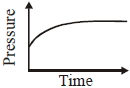
B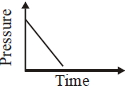
C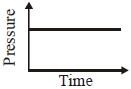
D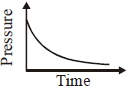
Solution
(D) When a mixture of gases is introduced into a closed vessel containing charcoal,the charcoal acts as an adsorbent.
As time passes,the gas molecules get adsorbed onto the surface of the charcoal.
Since the number of gas molecules in the gaseous phase decreases due to adsorption,the pressure exerted by the gas mixture in the vessel decreases with time until it reaches an equilibrium state.
Therefore,the graph showing a decrease in pressure over time is the correct representation.
As time passes,the gas molecules get adsorbed onto the surface of the charcoal.
Since the number of gas molecules in the gaseous phase decreases due to adsorption,the pressure exerted by the gas mixture in the vessel decreases with time until it reaches an equilibrium state.
Therefore,the graph showing a decrease in pressure over time is the correct representation.
0 likes
View Solution232
Difficult
Write any two characteristics of Chemisorption.
Solution
(N/A) $1.$ Chemisorption is highly specific in nature. It occurs only if there is a possibility of chemical bonding between the adsorbent and the adsorbate.
$2.$ Like physisorption,chemisorption also increases with an increase in the surface area of the adsorbent.
$2.$ Like physisorption,chemisorption also increases with an increase in the surface area of the adsorbent.
0 likes
View Solution233
Medium
Why does physisorption decrease with the increase of temperature?
Solution
(N/A) Physisorption is an exothermic process. According to Le Chatelier's principle,for an exothermic process,an increase in temperature shifts the equilibrium in the backward direction. Therefore,physisorption decreases as the temperature increases,and it occurs more readily at lower temperatures.
0 likes
View Solution234
MediumMCQ
Why are powdered substances more effective adsorbents than their crystalline forms?
A
They have higher density.
B
They have larger surface area.
C
They are more stable.
D
They have higher purity.
Solution
(B) Powdered substances are more effective adsorbents than their crystalline forms because when a substance is powdered,its surface area increases.
Since physisorption is directly proportional to the surface area of the adsorbent,a larger surface area provides more active sites for the adsorption of molecules.
Since physisorption is directly proportional to the surface area of the adsorbent,a larger surface area provides more active sites for the adsorption of molecules.
0 likes
View Solution235
Medium
What is the role of desorption in the process of catalysis?
Solution
(N/A) The role of desorption in the process of catalysis is to release the product molecules from the surface of the solid catalyst. This makes the surface of the catalyst free for the fresh adsorption of the reactant molecules,thereby allowing the catalytic cycle to continue.
0 likes
View Solution236
Difficult
Distinguish between the meaning of the terms adsorption and absorption. Give one example of each.
Solution
(N/A) Adsorption is a surface phenomenon where molecules of a substance accumulate at the surface rather than in the bulk of a solid or liquid. The substance that gets adsorbed is called the 'adsorbate',and the substance on whose surface the adsorption takes place is called the 'adsorbent'. In adsorption,the concentration of the adsorbate increases only at the surface. For example,when a chalk stick is dipped into an ink solution,only the surface becomes coloured; the inside remains white.
Absorption is a bulk phenomenon where the substance is uniformly distributed throughout the entire bulk of the solid or liquid. For example,when a sponge is dipped in water,the water is absorbed throughout the entire volume of the sponge.
Absorption is a bulk phenomenon where the substance is uniformly distributed throughout the entire bulk of the solid or liquid. For example,when a sponge is dipped in water,the water is absorbed throughout the entire volume of the sponge.
0 likes
View Solution237
Difficult
What is the difference between physisorption and chemisorption?
Solution
(N/A)
| Feature | Physisorption vs. Chemisorption |
|---|---|
| $1$. Nature of forces | $Physisorption$ involves weak van der Waal's forces,whereas $Chemisorption$ involves strong chemical bonds. |
| $2$. Compound formation | No new compound is formed in $Physisorption$,while new compounds are formed in $Chemisorption$. |
| $3$. Reversibility | $Physisorption$ is generally reversible,whereas $Chemisorption$ is usually irreversible. |
| $4$. Enthalpy of adsorption | $Physisorption$ has low enthalpy $(20-40 \ kJ \ mol^{-1})$,while $Chemisorption$ has high enthalpy $(40-400 \ kJ \ mol^{-1})$. |
| $5$. Temperature dependence | $Physisorption$ is favored by low temperature,while $Chemisorption$ is favored by high temperature. |
| $6$. Molecular layer | $Physisorption$ is multi-layer,whereas $Chemisorption$ is mono-layer. |
0 likes
View Solution238
Medium
Give a reason why a finely divided substance is more effective as an adsorbent.
Solution
(N/A) Adsorption is a surface phenomenon.
Therefore,the extent of adsorption is directly proportional to the surface area of the adsorbent.
$A$ finely divided substance possesses a much larger surface area per unit mass compared to a bulk substance.
Since both physisorption and chemisorption depend on the available surface area,a finely divided substance provides more active sites for the adsorbate molecules to get adsorbed,making it a more effective adsorbent.
Therefore,the extent of adsorption is directly proportional to the surface area of the adsorbent.
$A$ finely divided substance possesses a much larger surface area per unit mass compared to a bulk substance.
Since both physisorption and chemisorption depend on the available surface area,a finely divided substance provides more active sites for the adsorbate molecules to get adsorbed,making it a more effective adsorbent.
0 likes
View Solution239
Difficult
What are the factors which influence the adsorption of a gas on a solid?
Solution
(N/A) There are various factors that affect the rate of adsorption of a gas on a solid surface:
$1$. Nature of the gas:
Easily liquefiable gases such as $NH_3$ and $HCl$ are adsorbed to a greater extent compared to gases like $H_2$ and $O_2$. This is because van der Waals forces are stronger in easily liquefiable gases.
$2$. Surface area of the solid:
The greater the surface area of the adsorbent,the greater is the adsorption of a gas on the solid surface.
$3$. Effect of pressure:
Adsorption is a reversible process. According to Le Chatelier's principle,an increase in pressure leads to an increase in the extent of adsorption.
$4$. Effect of temperature:
Adsorption is an exothermic process. Therefore,in accordance with Le Chatelier's principle,the magnitude of adsorption decreases with an increase in temperature.
$1$. Nature of the gas:
Easily liquefiable gases such as $NH_3$ and $HCl$ are adsorbed to a greater extent compared to gases like $H_2$ and $O_2$. This is because van der Waals forces are stronger in easily liquefiable gases.
$2$. Surface area of the solid:
The greater the surface area of the adsorbent,the greater is the adsorption of a gas on the solid surface.
$3$. Effect of pressure:
Adsorption is a reversible process. According to Le Chatelier's principle,an increase in pressure leads to an increase in the extent of adsorption.
$4$. Effect of temperature:
Adsorption is an exothermic process. Therefore,in accordance with Le Chatelier's principle,the magnitude of adsorption decreases with an increase in temperature.
0 likes
View Solution240
Advanced
What is an adsorption isotherm? Describe Freundlich adsorption isotherm.
Solution
The plot between the extent of adsorption $\left(\frac{x}{m}\right)$ against the pressure of gas $(P)$ at constant temperature $(T)$ is called the adsorption isotherm.
Freundlich adsorption isotherm:
Freundlich adsorption isotherm gives an empirical relationship between the quantity of gas adsorbed by the unit mass of solid adsorbent and pressure at a specific temperature.
From the given plot it is clear that at pressure $P_{s},$ $\frac{x}{m}$ reaches the maximum value. $P_{s}$ is called the saturation pressure. Three cases arise from the graph now.
Case $I$ - At low pressure:
The plot is straight and sloping,indicating that the pressure is directly proportional to $\frac{x}{m}$:
$\frac{x}{m} \propto P$
$\frac{x}{m} = k P$ ($k$ is a constant)
Case $II$ - At high pressure:
When pressure exceeds the saturation pressure,$\frac{x}{m}$ becomes independent of $P$ values.
$\frac{x}{m} \propto P^{0}$
$\frac{x}{m} = k P^{0}$
Case $III$ - At intermediate pressure:
At intermediate pressure,$\frac{x}{m}$ depends on $P$ raised to the powers between $0$ and $1.$ This relationship is known as the Freundlich adsorption isotherm.
$\frac{x}{m} \propto P^{\frac{1}{n}}$
$\frac{x}{m} = k P^{\frac{1}{n}}$ $(n > 1)$
Now,taking log:
$\log \left(\frac{x}{m}\right) = \log k + \frac{1}{n} \log P$
On plotting the graph between $\log \left(\frac{x}{m}\right)$ and $\log P,$ a straight line is obtained with the slope equal to $\frac{1}{n}$ and the intercept equal to $\log k.$
Freundlich adsorption isotherm:
Freundlich adsorption isotherm gives an empirical relationship between the quantity of gas adsorbed by the unit mass of solid adsorbent and pressure at a specific temperature.
From the given plot it is clear that at pressure $P_{s},$ $\frac{x}{m}$ reaches the maximum value. $P_{s}$ is called the saturation pressure. Three cases arise from the graph now.
Case $I$ - At low pressure:
The plot is straight and sloping,indicating that the pressure is directly proportional to $\frac{x}{m}$:
$\frac{x}{m} \propto P$
$\frac{x}{m} = k P$ ($k$ is a constant)
Case $II$ - At high pressure:
When pressure exceeds the saturation pressure,$\frac{x}{m}$ becomes independent of $P$ values.
$\frac{x}{m} \propto P^{0}$
$\frac{x}{m} = k P^{0}$
Case $III$ - At intermediate pressure:
At intermediate pressure,$\frac{x}{m}$ depends on $P$ raised to the powers between $0$ and $1.$ This relationship is known as the Freundlich adsorption isotherm.
$\frac{x}{m} \propto P^{\frac{1}{n}}$
$\frac{x}{m} = k P^{\frac{1}{n}}$ $(n > 1)$
Now,taking log:
$\log \left(\frac{x}{m}\right) = \log k + \frac{1}{n} \log P$
On plotting the graph between $\log \left(\frac{x}{m}\right)$ and $\log P,$ a straight line is obtained with the slope equal to $\frac{1}{n}$ and the intercept equal to $\log k.$
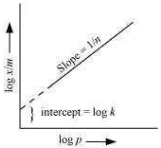
0 likes
View Solution241
Difficult
What do you understand by activation of adsorbent? How is it achieved?
Solution
(N/A) Activation of an adsorbent refers to the process of increasing its adsorbing power.
Some ways to achieve this are:
$(i)$ By increasing the surface area of the adsorbent: This is achieved by breaking the adsorbent into smaller pieces or converting it into a fine powder.
$(ii)$ By specific chemical or physical treatments: For example,wood charcoal is activated by heating it between $650 \ K$ and $1330 \ K$ in vacuum or air. This process expels all previously adsorbed gases,thereby creating more vacant sites for the adsorption of other gases.
Some ways to achieve this are:
$(i)$ By increasing the surface area of the adsorbent: This is achieved by breaking the adsorbent into smaller pieces or converting it into a fine powder.
$(ii)$ By specific chemical or physical treatments: For example,wood charcoal is activated by heating it between $650 \ K$ and $1330 \ K$ in vacuum or air. This process expels all previously adsorbed gases,thereby creating more vacant sites for the adsorption of other gases.
0 likes
View Solution242
Medium
Why is adsorption always exothermic?
Solution
(N/A) Adsorption is always exothermic. This can be explained in two ways:
$(i)$ Adsorption leads to a decrease in the residual forces on the surface of the adsorbent. This causes a decrease in the surface energy of the adsorbent,which is released as heat. Therefore,adsorption is always exothermic.
$(ii)$ From the thermodynamic perspective,for a process to be spontaneous,the Gibbs free energy change,$\Delta G$,must be negative. The relationship is given by $\Delta G = \Delta H - T\Delta S$. When a gas is adsorbed on a solid surface,its movement is restricted,leading to a decrease in entropy,i.e.,$\Delta S$ is negative. Since $\Delta G$ must be negative and $\Delta S$ is negative,$\Delta H$ must be negative to satisfy the equation. Hence,adsorption is always exothermic.
$(i)$ Adsorption leads to a decrease in the residual forces on the surface of the adsorbent. This causes a decrease in the surface energy of the adsorbent,which is released as heat. Therefore,adsorption is always exothermic.
$(ii)$ From the thermodynamic perspective,for a process to be spontaneous,the Gibbs free energy change,$\Delta G$,must be negative. The relationship is given by $\Delta G = \Delta H - T\Delta S$. When a gas is adsorbed on a solid surface,its movement is restricted,leading to a decrease in entropy,i.e.,$\Delta S$ is negative. Since $\Delta G$ must be negative and $\Delta S$ is negative,$\Delta H$ must be negative to satisfy the equation. Hence,adsorption is always exothermic.
0 likes
View Solution243
Difficult
Discuss the effect of pressure and temperature on the adsorption of gases on solids.
Solution
(N/A) Effect of pressure: Adsorption is a reversible process and is generally accompanied by a decrease in volume. Therefore,according to Le Chatelier's principle,adsorption increases with an increase in pressure.
Effect of temperature: Adsorption is an exothermic process $(\Delta H < 0)$. Thus,in accordance with Le Chatelier's principle,the magnitude of adsorption decreases with an increase in temperature.
Effect of temperature: Adsorption is an exothermic process $(\Delta H < 0)$. Thus,in accordance with Le Chatelier's principle,the magnitude of adsorption decreases with an increase in temperature.
0 likes
View Solution244
Medium
What is adsorption,adsorbate,adsorbent and desorption? Explain with appropriate examples.
Solution
(N/A) Adsorption: The accumulation of molecular species at the surface rather than in the bulk of a solid or liquid is termed adsorption.
Adsorbate: The molecular species or substance,which concentrates or accumulates at the surface is termed adsorbate. e.g.,particles of colour.
Adsorbent: The material on the surface of which the adsorption takes place is called adsorbent. e.g.,charcoal,silica gel,alumina gel,clay,colloids,metals in finely divided state.
Desorption: The process of removing an adsorbed substance from a surface on which it is adsorbed is called desorption.
It is clear from the above examples that solid surfaces can hold the gas or liquid molecules by virtue of adsorption.
Some examples of adsorption process are as under:
$(i)$ If a gas like $O_2$,$H_2$,$CO$,$Cl_2$,$NH_3$ or $SO_2$ is taken in a closed vessel containing powdered charcoal,it is observed that the pressure of the gas in the enclosed vessel decreases. The gas molecules concentrate at the surface of the charcoal,i.e.,gases are adsorbed at the surface.
$(ii)$ In a solution of an organic dye,say methylene blue,when animal charcoal is added and the solution is well shaken,it is observed that the filtrate turns colourless. The molecules of the dye,thus,accumulate on the surface of charcoal,i.e.,are adsorbed.
$(iii)$ Aqueous solution of raw sugar when passed over beds of animal charcoal becomes colourless as the colouring substances are adsorbed by the charcoal.
$(iv)$ The air becomes dry in the presence of silica gel because the water molecules get adsorbed on the surface of the gel.
Adsorbate: The molecular species or substance,which concentrates or accumulates at the surface is termed adsorbate. e.g.,particles of colour.
Adsorbent: The material on the surface of which the adsorption takes place is called adsorbent. e.g.,charcoal,silica gel,alumina gel,clay,colloids,metals in finely divided state.
Desorption: The process of removing an adsorbed substance from a surface on which it is adsorbed is called desorption.
It is clear from the above examples that solid surfaces can hold the gas or liquid molecules by virtue of adsorption.
Some examples of adsorption process are as under:
$(i)$ If a gas like $O_2$,$H_2$,$CO$,$Cl_2$,$NH_3$ or $SO_2$ is taken in a closed vessel containing powdered charcoal,it is observed that the pressure of the gas in the enclosed vessel decreases. The gas molecules concentrate at the surface of the charcoal,i.e.,gases are adsorbed at the surface.
$(ii)$ In a solution of an organic dye,say methylene blue,when animal charcoal is added and the solution is well shaken,it is observed that the filtrate turns colourless. The molecules of the dye,thus,accumulate on the surface of charcoal,i.e.,are adsorbed.
$(iii)$ Aqueous solution of raw sugar when passed over beds of animal charcoal becomes colourless as the colouring substances are adsorbed by the charcoal.
$(iv)$ The air becomes dry in the presence of silica gel because the water molecules get adsorbed on the surface of the gel.
0 likes
View Solution245
Medium
Explain the difference between adsorption and absorption.
Solution
(N/A) In adsorption,the substance is concentrated only at the surface and does not penetrate through the surface to the bulk of the adsorbent,while in absorption,the substance is uniformly distributed throughout the bulk of the solid.
For example,when a chalk stick is dipped in ink,the surface retains the colour of the ink due to adsorption of coloured molecules,while the solvent of the ink goes deeper into the stick due to absorption. On breaking the chalk stick,it is found to be white from inside.
$A$ distinction can be made between absorption and adsorption by taking an example of water vapour.
Water vapours are absorbed by anhydrous calcium chloride $(CaCl_2)$ but adsorbed by silica gel.
In adsorption,the concentration of the adsorbate increases only at the surface of the adsorbent,while in absorption,the concentration is uniform throughout the bulk of the solid.
For example,when a chalk stick is dipped in ink,the surface retains the colour of the ink due to adsorption of coloured molecules,while the solvent of the ink goes deeper into the stick due to absorption. On breaking the chalk stick,it is found to be white from inside.
$A$ distinction can be made between absorption and adsorption by taking an example of water vapour.
Water vapours are absorbed by anhydrous calcium chloride $(CaCl_2)$ but adsorbed by silica gel.
In adsorption,the concentration of the adsorbate increases only at the surface of the adsorbent,while in absorption,the concentration is uniform throughout the bulk of the solid.
0 likes
View Solution246
Difficult
Explain the mechanism of adsorption.
Solution
(N/A) Adsorption arises because the surface particles of the adsorbent are not in the same environment as the particles inside the bulk. Inside the adsorbent,all forces acting between the particles are mutually balanced,but on the surface,the particles are not surrounded by atoms or molecules of their kind on all sides,and hence they possess unbalanced or residual attractive forces.
These forces of the adsorbent are responsible for attracting the adsorbate particles to its surface. The extent of adsorption increases with an increase in surface area per unit mass of the adsorbent at a given temperature and pressure.
Another important factor in adsorption is the heat of adsorption. During adsorption,there is always a decrease in the residual forces of the surface,i.e.,there is a decrease in surface energy which is released as heat. Therefore,adsorption is invariably an exothermic process. Thus,adsorption is accompanied by a decrease in enthalpy as well as a decrease in the entropy of the system.
For a process to be spontaneous,the thermodynamic requirement is that at constant temperature and pressure,$\Delta G$ must be negative,i.e.,there is a decrease in Gibbs energy.
On the basis of the equation,$\Delta G = \Delta H - T \Delta S$,if $\Delta H$ has a sufficiently high negative value,then $\Delta G$ can be negative even though $\Delta S$ is negative (making $-T \Delta S$ positive).
Thus,in an adsorption process,which is spontaneous,a combination of these factors makes $\Delta G$ negative. As the adsorption proceeds,$\Delta H$ becomes less negative; ultimately,$\Delta H$ becomes equal to $T \Delta S$ and $\Delta G$ becomes zero. At this state,equilibrium is attained.
These forces of the adsorbent are responsible for attracting the adsorbate particles to its surface. The extent of adsorption increases with an increase in surface area per unit mass of the adsorbent at a given temperature and pressure.
Another important factor in adsorption is the heat of adsorption. During adsorption,there is always a decrease in the residual forces of the surface,i.e.,there is a decrease in surface energy which is released as heat. Therefore,adsorption is invariably an exothermic process. Thus,adsorption is accompanied by a decrease in enthalpy as well as a decrease in the entropy of the system.
For a process to be spontaneous,the thermodynamic requirement is that at constant temperature and pressure,$\Delta G$ must be negative,i.e.,there is a decrease in Gibbs energy.
On the basis of the equation,$\Delta G = \Delta H - T \Delta S$,if $\Delta H$ has a sufficiently high negative value,then $\Delta G$ can be negative even though $\Delta S$ is negative (making $-T \Delta S$ positive).
Thus,in an adsorption process,which is spontaneous,a combination of these factors makes $\Delta G$ negative. As the adsorption proceeds,$\Delta H$ becomes less negative; ultimately,$\Delta H$ becomes equal to $T \Delta S$ and $\Delta G$ becomes zero. At this state,equilibrium is attained.
0 likes
View Solution247
Medium
Explain the types of adsorption.
Solution
(N/A) There are mainly two types of adsorption of gases on solids:
$1$. $\text{Physical adsorption (Physisorption)}$: If the accumulation of gas on the surface of a solid occurs due to weak van der Waals' forces,it is termed as physical adsorption.
$2$. $\text{Chemical adsorption (Chemisorption)}$: When the gas molecules or atoms are held to the solid surface by chemical bonds (covalent or ionic),the adsorption is termed as chemical adsorption. It involves a high energy of activation and is often referred to as activated adsorption.
Sometimes,these two processes occur simultaneously. $A$ physical adsorption at low temperature may pass into chemisorption as the temperature is increased. For example,$H_2$ is first adsorbed on $Ni$ by van der Waals' forces,and then the molecules dissociate to form hydrogen atoms held by chemisorption.
$1$. $\text{Physical adsorption (Physisorption)}$: If the accumulation of gas on the surface of a solid occurs due to weak van der Waals' forces,it is termed as physical adsorption.
$2$. $\text{Chemical adsorption (Chemisorption)}$: When the gas molecules or atoms are held to the solid surface by chemical bonds (covalent or ionic),the adsorption is termed as chemical adsorption. It involves a high energy of activation and is often referred to as activated adsorption.
Sometimes,these two processes occur simultaneously. $A$ physical adsorption at low temperature may pass into chemisorption as the temperature is increased. For example,$H_2$ is first adsorbed on $Ni$ by van der Waals' forces,and then the molecules dissociate to form hydrogen atoms held by chemisorption.
0 likes
View Solution248
Difficult
Explain the characteristics of physisorption and chemisorption.
Solution
(N/A) Characteristics of Physisorption (Physical Adsorption):
$(i)$ Lack of specificity: $A$ given surface of an adsorbent does not show any preference for a particular gas because van der Waals' forces are universal.
$(ii)$ Nature of adsorbate: Easily liquefiable gases (e.g.,$NH_3$,$HCl$) are adsorbed more readily because van der Waals' forces are stronger near the critical temperature.
$(iii)$ Reversible nature: It is generally reversible. The process is represented as: $\text{Solid} + \text{Gas} \rightleftharpoons \text{Gas/Solid} + \text{Heat}$. Adsorption increases with pressure and decreases with an increase in temperature.
$(iv)$ Surface area: The extent of adsorption increases with an increase in the surface area of the adsorbent.
$(v)$ Enthalpy of adsorption: It is low,typically in the range of $20-40 \ kJ \ mol^{-1}$,due to weak van der Waals' forces.
$(B)$ Characteristics of Chemisorption (Chemical Adsorption):
$(i)$ High specificity: It occurs only if there is a possibility of chemical bond formation between the adsorbent and adsorbate.
$(ii)$ Irreversibility: It is usually irreversible as it involves the formation of chemical compounds.
$(iii)$ Surface area: Like physisorption,it increases with an increase in surface area.
$(iv)$ Enthalpy of adsorption: It is high,typically in the range of $80-240 \ kJ \ mol^{-1}$,due to the formation of strong chemical bonds.
$(v)$ Temperature effect: It often increases with an increase in temperature initially,as it requires activation energy.
$(i)$ Lack of specificity: $A$ given surface of an adsorbent does not show any preference for a particular gas because van der Waals' forces are universal.
$(ii)$ Nature of adsorbate: Easily liquefiable gases (e.g.,$NH_3$,$HCl$) are adsorbed more readily because van der Waals' forces are stronger near the critical temperature.
$(iii)$ Reversible nature: It is generally reversible. The process is represented as: $\text{Solid} + \text{Gas} \rightleftharpoons \text{Gas/Solid} + \text{Heat}$. Adsorption increases with pressure and decreases with an increase in temperature.
$(iv)$ Surface area: The extent of adsorption increases with an increase in the surface area of the adsorbent.
$(v)$ Enthalpy of adsorption: It is low,typically in the range of $20-40 \ kJ \ mol^{-1}$,due to weak van der Waals' forces.
$(B)$ Characteristics of Chemisorption (Chemical Adsorption):
$(i)$ High specificity: It occurs only if there is a possibility of chemical bond formation between the adsorbent and adsorbate.
$(ii)$ Irreversibility: It is usually irreversible as it involves the formation of chemical compounds.
$(iii)$ Surface area: Like physisorption,it increases with an increase in surface area.
$(iv)$ Enthalpy of adsorption: It is high,typically in the range of $80-240 \ kJ \ mol^{-1}$,due to the formation of strong chemical bonds.
$(v)$ Temperature effect: It often increases with an increase in temperature initially,as it requires activation energy.
0 likes
View Solution249
Difficult
Give the differences between physical adsorption and chemical adsorption.
Solution
(N/A)
| Physical adsorption (Physisorption) | Chemical adsorption (Chemisorption) |
| $1$. It arises due to weak van der Waals forces. | $1$. It is caused by strong chemical bond formation. |
| $2$. It is not specific in nature. | $2$. It is highly specific in nature. |
| $3$. It is reversible in nature. | $3$. It is irreversible in nature. |
| $4$. It depends on the nature of gas; easily liquefiable gases are adsorbed readily. | $4$. It depends on the nature of gas; gases that react with the adsorbent show chemisorption. |
| $5$. Enthalpy of adsorption is low $(20-40 \ kJ \ mol^{-1})$. | $5$. Enthalpy of adsorption is high $(80-240 \ kJ \ mol^{-1})$. |
| $6$. Low temperature is favourable; it decreases with an increase in temperature. | $6$. High temperature is often favourable; it increases with an increase in temperature. |
| $7$. No appreciable activation energy is needed. | $7$. High activation energy is often required. |
| $8$. It depends on the surface area; it increases with an increase in surface area. | $8$. It also increases with an increase in surface area. |
| $9$. It results in multimolecular layers on the adsorbent surface. | $9$. It results in a unimolecular layer. |
0 likes
View SolutionSurface Chemistry — Adsorption and Adsorption isotherm · Frequently Asked Questions
1Are these Surface Chemistry questions useful for JEE and NEET?
Yes. All questions in this section are mapped to JEE Main and NEET exam patterns. Previous year questions from JEE Main, NEET, GUJCET and state-level exams are included with full solutions.
2Can I switch to Hindi or Gujarati for these questions?
Yes. Use the language tabs in the hero section or the sidebar to view the same questions and solutions in English, Hindi or Gujarati.
3How do I generate a question paper from this subtopic?
Use the Vedclass Exam Paper Generator — select the chapter and subtopic, set difficulty, and generate Sets A, B, C, D automatically. First 3 chapters of every subject are free.
Vedclass Products
For Students
Vedclass Test Series
Mock tests in real JEE/NEET style with performance analysis. 5-day free trial.
Start Free TrialFor Teachers
Exam Paper Generator
Generate Set A/B/C/D papers from this chapter in 2 minutes. 3 chapters free.
Try FreeFor Institutes
Online Exam Module
Live online exams with unlimited students, 360° analytics & white-label branding.
See DemoFor Teachers & Institutes
Generate a Surface Chemistry Exam Paper in 2 Minutes
Select subtopic & difficulty — Sets A, B, C, D auto-generated with No Repeat logic.
First 3 chapters of every subject are free — no payment required.