
A English
Adsorption and Adsorption isotherm Questions in English
Class 12 Chemistry · Surface Chemistry · Adsorption and Adsorption isotherm
422+
Questions
English
Language
100%
With Solutions
Showing 49 of 422 questions in English
151
MediumMCQ
The Freundlich adsorption isotherm gives a straight line on plotting:
A
$x/m$ vs $\log P$
B
$\log(x/m)$ vs $P$
C
$\log(x/m)$ vs $\log P$
D
$x/m$ vs $1/P$
Solution
(C) The Freundlich adsorption isotherm equation is given by $\frac{x}{m} = kP^{1/n}$,where $x$ is the mass of the adsorbate,$m$ is the mass of the adsorbent,$P$ is the pressure,and $k$ and $n$ are constants.
Taking the logarithm on both sides,we get: $\log(\frac{x}{m}) = \log k + \frac{1}{n} \log P$.
This equation is in the form of a straight line $y = mx + c$,where $y = \log(\frac{x}{m})$,$x = \log P$,slope $m = \frac{1}{n}$,and intercept $c = \log k$.
Therefore,plotting $\log(\frac{x}{m})$ versus $\log P$ yields a straight line.
Taking the logarithm on both sides,we get: $\log(\frac{x}{m}) = \log k + \frac{1}{n} \log P$.
This equation is in the form of a straight line $y = mx + c$,where $y = \log(\frac{x}{m})$,$x = \log P$,slope $m = \frac{1}{n}$,and intercept $c = \log k$.
Therefore,plotting $\log(\frac{x}{m})$ versus $\log P$ yields a straight line.
0 likes
View Solution152
EasyMCQ
Which graph represents the amount of chemisorption of a gas with temperature under constant pressure?
A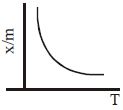
B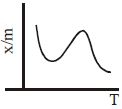
C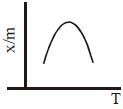
D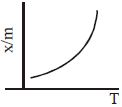
Solution
(C) Chemisorption is an exothermic process that requires activation energy.
Initially,as temperature increases,the rate of adsorption increases because more molecules gain the necessary activation energy to form chemical bonds with the surface.
However,as the temperature continues to rise,the exothermic nature of the process causes the equilibrium to shift towards desorption,leading to a decrease in the amount of gas adsorbed $(x/m)$.
Therefore,the graph of $x/m$ versus $T$ for chemisorption shows an initial increase followed by a decrease,resulting in a peak.
Initially,as temperature increases,the rate of adsorption increases because more molecules gain the necessary activation energy to form chemical bonds with the surface.
However,as the temperature continues to rise,the exothermic nature of the process causes the equilibrium to shift towards desorption,leading to a decrease in the amount of gas adsorbed $(x/m)$.
Therefore,the graph of $x/m$ versus $T$ for chemisorption shows an initial increase followed by a decrease,resulting in a peak.
0 likes
View Solution153
DifficultMCQ
Two compounds $I$ and $II$ are eluted by column chromatography (adsorption of $I > II$). Which one of the following is a correct statement?
A
$II$ moves slower and has higher $R_f$ value than $I$
B
$II$ moves faster and has higher $R_f$ value than $I$
C
$I$ moves faster and has higher $R_f$ value than $II$
D
$I$ moves slower and has higher $R_f$ value than $II$
Solution
(B) In column chromatography,the compound that is more strongly adsorbed on the stationary phase moves slower through the column.
Given that the adsorption of $I > II$,compound $I$ is more strongly adsorbed than compound $II$.
Therefore,compound $I$ moves slower and travels a shorter distance,while compound $II$ moves faster and travels a longer distance.
The $R_f$ value is defined as the ratio of the distance traveled by the substance to the distance traveled by the solvent front.
Since compound $II$ travels a greater distance,it has a higher $R_f$ value than compound $I$.
Given that the adsorption of $I > II$,compound $I$ is more strongly adsorbed than compound $II$.
Therefore,compound $I$ moves slower and travels a shorter distance,while compound $II$ moves faster and travels a longer distance.
The $R_f$ value is defined as the ratio of the distance traveled by the substance to the distance traveled by the solvent front.
Since compound $II$ travels a greater distance,it has a higher $R_f$ value than compound $I$.
0 likes
View Solution154
DifficultMCQ
If $x$ gram of gas is adsorbed by $m$ gram of adsorbent at pressure $P$,the plot of $\log \frac{x}{m}$ versus $\log P$ is linear. The slope of the plot is: ($n$ and $k$ are constants and $n > 1$ )
A
$\log k$
B
$\frac{1}{n}$
C
$2k$
D
$n$
Solution
(B) According to the Freundlich adsorption isotherm,the relationship is given by:
$\frac{x}{m} = kP^{\frac{1}{n}}$
Taking the logarithm on both sides:
$\log_{10} \frac{x}{m} = \log_{10} (kP^{\frac{1}{n}})$
$\log_{10} \frac{x}{m} = \frac{1}{n} \log_{10} P + \log_{10} k$
This equation follows the linear form $y = mx + c$,where $y = \log \frac{x}{m}$,$x = \log P$,the slope $m = \frac{1}{n}$,and the intercept $c = \log k$.
Therefore,the slope of the plot is $\frac{1}{n}$.
$\frac{x}{m} = kP^{\frac{1}{n}}$
Taking the logarithm on both sides:
$\log_{10} \frac{x}{m} = \log_{10} (kP^{\frac{1}{n}})$
$\log_{10} \frac{x}{m} = \frac{1}{n} \log_{10} P + \log_{10} k$
This equation follows the linear form $y = mx + c$,where $y = \log \frac{x}{m}$,$x = \log P$,the slope $m = \frac{1}{n}$,and the intercept $c = \log k$.
Therefore,the slope of the plot is $\frac{1}{n}$.
0 likes
View Solution155
DifficultMCQ
Which one of the following is not a property of physical adsorption?
A
Higher the pressure,more the adsorption
B
Greater the surface area,more the adsorption
C
Lower the temperature,more the adsorption
D
Unilayer adsorption occurs
Solution
(D) Physical adsorption (physisorption) is characterized by weak van der Waals forces between the adsorbate and the adsorbent.
It is a reversible process that is favored by low temperatures and high pressures.
It increases with an increase in the surface area of the adsorbent.
Unlike chemisorption,physical adsorption is multi-layered in nature.
Therefore,the statement that 'Unilayer adsorption occurs' is incorrect,as it is a property of chemisorption.
It is a reversible process that is favored by low temperatures and high pressures.
It increases with an increase in the surface area of the adsorbent.
Unlike chemisorption,physical adsorption is multi-layered in nature.
Therefore,the statement that 'Unilayer adsorption occurs' is incorrect,as it is a property of chemisorption.
0 likes
View Solution156
DifficultMCQ
Adsorption of a gas on a surface follows the Freundlich adsorption isotherm. The plot of $\log \frac{x}{m}$ versus $\log P$ gives a straight line with a slope equal to $0.5$. Then,(where $\frac{x}{m}$ is the mass of the gas adsorbed per gram of adsorbent):
A
Adsorption is independent of pressure.
B
Adsorption is proportional to the pressure.
C
Adsorption is proportional to the square root of pressure.
D
Adsorption is proportional to the square of pressure.
Solution
(C) According to the Freundlich adsorption isotherm:
$\log \frac{x}{m} = \log k + \frac{1}{n} \log P$
Comparing this with the equation of a straight line $y = mx + c$,the slope is $\frac{1}{n}$.
Given that the slope is $0.5$,we have $\frac{1}{n} = 0.5 = \frac{1}{2}$.
Substituting this into the adsorption equation $\frac{x}{m} = k \cdot P^{1/n}$,we get:
$\frac{x}{m} = k \cdot P^{1/2}$
This implies that the adsorption is proportional to the square root of pressure $(P^{1/2})$.
$\log \frac{x}{m} = \log k + \frac{1}{n} \log P$
Comparing this with the equation of a straight line $y = mx + c$,the slope is $\frac{1}{n}$.
Given that the slope is $0.5$,we have $\frac{1}{n} = 0.5 = \frac{1}{2}$.
Substituting this into the adsorption equation $\frac{x}{m} = k \cdot P^{1/n}$,we get:
$\frac{x}{m} = k \cdot P^{1/2}$
This implies that the adsorption is proportional to the square root of pressure $(P^{1/2})$.
0 likes
View Solution157
MediumMCQ
$A$ particular adsorption process has the following characteristics: $(i)$ It arises due to van der Waals forces and $(ii)$ it is reversible. Identify the correct statement that describes the above adsorption process.
A
Adsorption is monolayer.
B
Adsorption increases with increase in temperature.
C
Enthalpy of adsorption is greater than $100 \ kJ \ mol^{-1}$.
D
Energy of activation is low.
Solution
(D) The characteristics given suggest that this is physical adsorption (physisorption).
Physical adsorption is characterized by weak van der Waals forces,reversibility,and the formation of multimolecular layers.
It is an exothermic process that typically decreases with an increase in temperature.
The enthalpy of adsorption is low (usually $20-40 \ kJ \ mol^{-1}$).
Since it involves weak forces and no chemical bond formation,the energy of activation required is very low.
Physical adsorption is characterized by weak van der Waals forces,reversibility,and the formation of multimolecular layers.
It is an exothermic process that typically decreases with an increase in temperature.
The enthalpy of adsorption is low (usually $20-40 \ kJ \ mol^{-1}$).
Since it involves weak forces and no chemical bond formation,the energy of activation required is very low.
0 likes
View Solution158
MediumMCQ
The following statements relate to the adsorption of gases on a solid surface. Identify the incorrect statement among them.
A
Enthalpy of adsorption is negative
B
Energy appears as heat
C
On adsorption,the residual forces on the surface are increased
D
Entropy of adsorption is negative
Solution
(C) Adsorption is a surface phenomenon where molecules of a substance accumulate on the surface of a solid or liquid.
During adsorption,the residual forces on the surface are satisfied by the incoming molecules,leading to a decrease in surface energy.
Therefore,the statement that residual forces increase is incorrect.
For adsorption,$\Delta H < 0$ (exothermic),$\Delta S < 0$ (decrease in randomness),and $\Delta G < 0$ (spontaneous process).
During adsorption,the residual forces on the surface are satisfied by the incoming molecules,leading to a decrease in surface energy.
Therefore,the statement that residual forces increase is incorrect.
For adsorption,$\Delta H < 0$ (exothermic),$\Delta S < 0$ (decrease in randomness),and $\Delta G < 0$ (spontaneous process).
0 likes
View Solution159
DifficultMCQ
If $x$ is the mass of the gas adsorbed on mass $m$ of the adsorbent at pressure $p,$ Freundlich adsorption isotherm gives a straight line on plotting
A
$x/m$ vs $p$
B
$x/m$ vs $1/p$
C
$\log(x/m)$ vs $\log p$
D
$\log(x/m)$ vs $p$
Solution
(C) The Freundlich adsorption isotherm is given by the equation: $x/m = k \cdot p^{1/n}$
Taking the logarithm on both sides: $\log(x/m) = \log k + (1/n) \log p$
This equation is of the form $y = mx + c,$ where $y = \log(x/m),$ $x = \log p,$ slope $m = 1/n,$ and intercept $c = \log k.$
Therefore,plotting $\log(x/m)$ against $\log p$ yields a straight line.
Taking the logarithm on both sides: $\log(x/m) = \log k + (1/n) \log p$
This equation is of the form $y = mx + c,$ where $y = \log(x/m),$ $x = \log p,$ slope $m = 1/n,$ and intercept $c = \log k.$
Therefore,plotting $\log(x/m)$ against $\log p$ yields a straight line.
0 likes
View Solution160
DifficultMCQ
The correct statement for both the processes of physisorption and chemisorption is
A
both are endothermic
B
chemisorption is endothermic but physisorption is exothermic
C
both are exothermic
D
physisorption is endothermic but chemisorption is exothermic.
Solution
(C) Adsorption is a surface phenomenon that involves the release of energy.
Both physisorption (physical adsorption) and chemisorption (chemical adsorption) are exothermic processes because they involve the formation of bonds (van der Waals forces in physisorption and chemical bonds in chemisorption) which leads to a decrease in the enthalpy of the system $(\Delta H < 0)$.
Both physisorption (physical adsorption) and chemisorption (chemical adsorption) are exothermic processes because they involve the formation of bonds (van der Waals forces in physisorption and chemical bonds in chemisorption) which leads to a decrease in the enthalpy of the system $(\Delta H < 0)$.
0 likes
View Solution161
DifficultMCQ
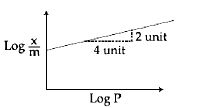
Adsorption of a gas follows the Freundlich adsorption isotherm. In the given plot,$x$ is the mass of gas adsorbed on mass $m$ of the adsorbent at pressure $p$. $\frac{x}{m}$ is proportional to:
A
$p^2$
B
$p^{1/4}$
C
$p^{1/2}$
D
$p$
Solution
(C) The Freundlich adsorption isotherm is given by the equation: $\frac{x}{m} = kP^{1/n}$.
Taking logarithm on both sides: $\log(\frac{x}{m}) = \log k + \frac{1}{n} \log P$.
This is in the form of a straight line equation $y = mx + c$,where the slope is $\frac{1}{n}$.
From the given plot,the slope is calculated as: $\text{Slope} = \frac{\text{change in } y}{\text{change in } x} = \frac{2}{4} = \frac{1}{2}$.
Therefore,$\frac{1}{n} = \frac{1}{2}$.
Substituting this back into the original equation,we get: $\frac{x}{m} \propto P^{1/2}$.
Taking logarithm on both sides: $\log(\frac{x}{m}) = \log k + \frac{1}{n} \log P$.
This is in the form of a straight line equation $y = mx + c$,where the slope is $\frac{1}{n}$.
From the given plot,the slope is calculated as: $\text{Slope} = \frac{\text{change in } y}{\text{change in } x} = \frac{2}{4} = \frac{1}{2}$.
Therefore,$\frac{1}{n} = \frac{1}{2}$.
Substituting this back into the original equation,we get: $\frac{x}{m} \propto P^{1/2}$.
0 likes
View Solution162
DifficultMCQ
Given the following data:
Based on the data provided,predict which of the following gases shows the least adsorption on a definite amount of charcoal.
| Gas | $H_2$ | $CH_4$ | $CO_2$ | $SO_2$ |
| Critical Temp $/ K$ | $33$ | $190$ | $304$ | $630$ |
A
$H_2$
B
$CH_4$
C
$CO_2$
D
$SO_2$
Solution
(A) The extent of adsorption of a gas on a solid surface is directly related to its ease of liquefaction.
Easier liquefaction occurs for gases with higher critical temperatures.
Therefore,the smaller the value of the critical temperature of a gas,the lesser is the extent of its adsorption.
Comparing the given values,the critical temperature of $H_2$ $(33 \ K)$ is the lowest among all the gases listed.
Thus,$H_2$ is the least adsorbed gas.
Easier liquefaction occurs for gases with higher critical temperatures.
Therefore,the smaller the value of the critical temperature of a gas,the lesser is the extent of its adsorption.
Comparing the given values,the critical temperature of $H_2$ $(33 \ K)$ is the lowest among all the gases listed.
Thus,$H_2$ is the least adsorbed gas.
0 likes
View Solution163
DifficultMCQ
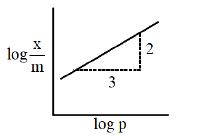
Adsorption of a gas follows the Freundlich adsorption isotherm. $x$ is the mass of the gas adsorbed on mass $m$ of the adsorbent. The plot of $\log \frac{x}{m}$ versus $\log p$ is shown in the given graph. $\frac{x}{m}$ is proportional to:
A
$p^{2/3}$
B
$p^2$
C
$p^3$
D
$p^{3/2}$
Solution
(A) The Freundlich adsorption isotherm is given by the equation: $\frac{x}{m} = k P^{1/n}$
Taking the logarithm on both sides,we get: $\log \frac{x}{m} = \log k + \frac{1}{n} \log P$
This equation represents a straight line of the form $y = mx + c$,where the slope is $\frac{1}{n}$.
From the given graph,the slope is calculated as: $\text{Slope} = \frac{\text{rise}}{\text{run}} = \frac{2}{3}$.
Therefore,$\frac{1}{n} = \frac{2}{3}$.
Substituting this back into the original equation,we get: $\frac{x}{m} = k P^{2/3}$.
Thus,$\frac{x}{m}$ is proportional to $p^{2/3}$.
Taking the logarithm on both sides,we get: $\log \frac{x}{m} = \log k + \frac{1}{n} \log P$
This equation represents a straight line of the form $y = mx + c$,where the slope is $\frac{1}{n}$.
From the given graph,the slope is calculated as: $\text{Slope} = \frac{\text{rise}}{\text{run}} = \frac{2}{3}$.
Therefore,$\frac{1}{n} = \frac{2}{3}$.
Substituting this back into the original equation,we get: $\frac{x}{m} = k P^{2/3}$.
Thus,$\frac{x}{m}$ is proportional to $p^{2/3}$.
0 likes
View Solution164
DifficultMCQ
$10 \, mL$ of $1 \, mM$ surfactant solution forms a monolayer covering $0.24 \, cm^2$ on a polar substrate. If the polar head is approximated as a cube, what is its edge length?
A
$2.0 \, pm$
B
$2.0 \, nm$
C
$1.0 \, pm$
D
$0.1 \, nm$
Solution
(A) Calculate the number of moles of surfactant: $n = \frac{M \times V \, (mL)}{1000} = \frac{10^{-3} \times 10}{1000} = 10^{-8} \, mol$.
Calculate the number of molecules: $N = n \times N_A = 10^{-8} \times 6 \times 10^{23} = 6 \times 10^{15} \, \text{molecules}$.
Area covered by one molecule $(a^2)$: $a^2 = \frac{\text{Total Area}}{\text{Number of molecules}} = \frac{0.24 \, cm^2}{6 \times 10^{15}} = 0.04 \times 10^{-15} \, cm^2 = 4 \times 10^{-17} \, cm^2$.
Calculate edge length $(a)$: $a = \sqrt{4 \times 10^{-17} \, cm^2} = 2 \times 10^{-8.5} \, cm \approx 6.32 \times 10^{-9} \, cm$.
Re-evaluating based on standard approximation: If $N_A = 6 \times 10^{23}$, $a^2 = \frac{0.24}{10^{-5} \times 6 \times 10^{23}} = 4 \times 10^{-20} \, cm^2$.
$a = \sqrt{4 \times 10^{-20}} = 2 \times 10^{-10} \, cm = 2 \times 10^{-12} \, m = 2 \, pm$.
Calculate the number of molecules: $N = n \times N_A = 10^{-8} \times 6 \times 10^{23} = 6 \times 10^{15} \, \text{molecules}$.
Area covered by one molecule $(a^2)$: $a^2 = \frac{\text{Total Area}}{\text{Number of molecules}} = \frac{0.24 \, cm^2}{6 \times 10^{15}} = 0.04 \times 10^{-15} \, cm^2 = 4 \times 10^{-17} \, cm^2$.
Calculate edge length $(a)$: $a = \sqrt{4 \times 10^{-17} \, cm^2} = 2 \times 10^{-8.5} \, cm \approx 6.32 \times 10^{-9} \, cm$.
Re-evaluating based on standard approximation: If $N_A = 6 \times 10^{23}$, $a^2 = \frac{0.24}{10^{-5} \times 6 \times 10^{23}} = 4 \times 10^{-20} \, cm^2$.
$a = \sqrt{4 \times 10^{-20}} = 2 \times 10^{-10} \, cm = 2 \times 10^{-12} \, m = 2 \, pm$.
0 likes
View Solution165
DifficultMCQ
$A$ gas undergoes physical adsorption on a surface and follows the given Freundlich adsorption isotherm equation $\frac{x}{m} = k p^{0.5}$. Adsorption of the gas increases with
A
Increase in $p$ and decrease in $T$
B
Increase in $p$ and increase in $T$
C
Decrease in $p$ and increase in $T$
D
Decrease in $p$ and decrease in $T$
Solution
(A) The Freundlich adsorption isotherm is given by $\frac{x}{m} = k p^{1/n}$.
According to the given equation $\frac{x}{m} = k p^{0.5}$,the extent of adsorption $\frac{x}{m}$ is directly proportional to the square root of pressure $p$.
Therefore,an increase in pressure $p$ leads to an increase in the extent of adsorption.
Physical adsorption is an exothermic process,which means it releases heat.
According to Le Chatelier's principle,for an exothermic process,a decrease in temperature $T$ favors the forward reaction,thereby increasing the extent of adsorption.
Thus,adsorption increases with an increase in $p$ and a decrease in $T$.
According to the given equation $\frac{x}{m} = k p^{0.5}$,the extent of adsorption $\frac{x}{m}$ is directly proportional to the square root of pressure $p$.
Therefore,an increase in pressure $p$ leads to an increase in the extent of adsorption.
Physical adsorption is an exothermic process,which means it releases heat.
According to Le Chatelier's principle,for an exothermic process,a decrease in temperature $T$ favors the forward reaction,thereby increasing the extent of adsorption.
Thus,adsorption increases with an increase in $p$ and a decrease in $T$.
0 likes
View Solution166
MediumMCQ
In chromatography,which of the following statements is incorrect for $R_f$?
A
$R_f$ value depends on the type of chromatography.
B
The value of $R_f$ cannot be more than one.
C
Higher $R_f$ value means higher adsorption.
D
$R_f$ value is dependent on the mobile phase.
Solution
(C) The $R_f$ (retention factor) value is defined as the ratio of the distance traveled by the solute to the distance traveled by the solvent front.
Since the solute cannot travel further than the solvent front,the $R_f$ value is always $\le 1$.
$A$ higher $R_f$ value indicates that the substance has a greater affinity for the mobile phase and a lower affinity for the stationary phase (i.e.,lower adsorption).
Therefore,the statement "Higher $R_f$ value means higher adsorption" is incorrect.
Since the solute cannot travel further than the solvent front,the $R_f$ value is always $\le 1$.
$A$ higher $R_f$ value indicates that the substance has a greater affinity for the mobile phase and a lower affinity for the stationary phase (i.e.,lower adsorption).
Therefore,the statement "Higher $R_f$ value means higher adsorption" is incorrect.
0 likes
View Solution167
MediumMCQ
Which of the following gas molecules has the maximum value of enthalpy of physisorption?
A
$CH_4$
B
$H_2$
C
$Ne$
D
$H_2O$
Solution
(D) Physisorption is directly related to the ease of liquefaction of a gas.
Easily liquefiable gases have higher critical temperatures and stronger van der Waals forces of attraction.
Among the given options,$H_2O$ has the highest critical temperature and is the most easily liquefiable due to hydrogen bonding.
Therefore,$H_2O$ has the maximum enthalpy of physisorption.
Easily liquefiable gases have higher critical temperatures and stronger van der Waals forces of attraction.
Among the given options,$H_2O$ has the highest critical temperature and is the most easily liquefiable due to hydrogen bonding.
Therefore,$H_2O$ has the maximum enthalpy of physisorption.
0 likes
View Solution168
DifficultMCQ
Which of the following is correct for Freundlich adsorption isotherm?
A
$x/m = K P^{1/n}; 0 < 1/n < 1$
B
$x/m = K P^{1/n}; 0 \le 1/n \le 1$
C
$\log (x/m) = (1/n) \log P; 1/n > 1$
D
$\log (x/m) = (1/n) \log K + \log P; 0 \le 1/n \le 1$
Solution
(B) According to the Freundlich adsorption isotherm,the relationship is given by $x/m = K P^{1/n}$.
Here,$x/m$ is the amount of gas adsorbed per unit mass of the adsorbent at pressure $P$.
$K$ and $n$ are constants that depend on the nature of the gas and the adsorbent.
The value of $1/n$ ranges between $0$ and $1$ (i.e.,$0 \le 1/n \le 1$),where $n > 1$.
At low pressure,$1/n = 1$,so $x/m \propto P^1$.
At high pressure,$1/n = 0$,so $x/m \propto P^0$ (independent of pressure).
Thus,the general expression is $x/m = K P^{1/n}$ with $0 \le 1/n \le 1$.
Here,$x/m$ is the amount of gas adsorbed per unit mass of the adsorbent at pressure $P$.
$K$ and $n$ are constants that depend on the nature of the gas and the adsorbent.
The value of $1/n$ ranges between $0$ and $1$ (i.e.,$0 \le 1/n \le 1$),where $n > 1$.
At low pressure,$1/n = 1$,so $x/m \propto P^1$.
At high pressure,$1/n = 0$,so $x/m \propto P^0$ (independent of pressure).
Thus,the general expression is $x/m = K P^{1/n}$ with $0 \le 1/n \le 1$.
0 likes
View Solution169
MediumMCQ
Which of the following statements regarding adsorption is incorrect?
A
The extent of adsorption increases with an increase in surface area.
B
Physical adsorption is an exothermic process,but its enthalpy of adsorption is quite low compared to chemical adsorption.
C
Physical adsorption is highly specific and it will only occur if there is some possibility of chemical bonding between adsorbent and adsorbate.
D
Physisorption of a gas adsorbed at low temperature may change into chemisorption at a high temperature.
Solution
(C) Physical adsorption (physisorption) is not specific in nature because it arises due to weak van der Waals forces between the adsorbent and the adsorbate. It can occur between any gas and solid. Chemical adsorption (chemisorption) is highly specific as it involves the formation of chemical bonds. Therefore,the statement in option $C$ is incorrect.
0 likes
View Solution170
MediumMCQ
In the adsorption of a gas on a solid,the Freundlich isotherm is obeyed. If the slope of the plot of $\log(\frac{x}{m})$ versus $\log(p)$ is zero,then the extent of adsorption is:
A
directly proportional to the pressure of the gas
B
inversely proportional to the pressure of the gas
C
independent of the pressure of the gas
D
proportional to the square of the pressure of the gas
Solution
(C) The Freundlich adsorption isotherm is given by the equation: $\frac{x}{m} = k \times p^{\frac{1}{n}}$.
Taking the logarithm on both sides,we get: $\log(\frac{x}{m}) = \log(k) + \frac{1}{n} \log(p)$.
This equation represents a straight line of the form $y = mx + c$,where the slope is $\frac{1}{n}$.
If the slope is zero,then $\frac{1}{n} = 0$.
Substituting this into the original equation: $\frac{x}{m} = k \times p^0 = k$.
Since $\frac{x}{m}$ is constant and does not depend on $p$,the extent of adsorption is independent of the pressure of the gas.
Taking the logarithm on both sides,we get: $\log(\frac{x}{m}) = \log(k) + \frac{1}{n} \log(p)$.
This equation represents a straight line of the form $y = mx + c$,where the slope is $\frac{1}{n}$.
If the slope is zero,then $\frac{1}{n} = 0$.
Substituting this into the original equation: $\frac{x}{m} = k \times p^0 = k$.
Since $\frac{x}{m}$ is constant and does not depend on $p$,the extent of adsorption is independent of the pressure of the gas.
0 likes
View Solution171
EasyMCQ
Correct for physical adsorption is
A
$\Delta S = +ve$
B
$\Delta G = -ve$
C
$\Delta H = +ve$
D
None of these
Solution
(B) Physical adsorption is a spontaneous process,which implies that the change in Gibbs free energy,$\Delta G$,must be negative $(\Delta G < 0)$.
During adsorption,the gas molecules are trapped on the surface of the adsorbent,leading to a decrease in randomness,so $\Delta S$ is negative $(\Delta S < 0)$.
Adsorption is an exothermic process,meaning heat is released,so the enthalpy change,$\Delta H$,is negative $(\Delta H < 0)$.
Therefore,the correct statement is $\Delta G = -ve$.
During adsorption,the gas molecules are trapped on the surface of the adsorbent,leading to a decrease in randomness,so $\Delta S$ is negative $(\Delta S < 0)$.
Adsorption is an exothermic process,meaning heat is released,so the enthalpy change,$\Delta H$,is negative $(\Delta H < 0)$.
Therefore,the correct statement is $\Delta G = -ve$.
0 likes
View Solution172
MediumMCQ
Which of the following is an incorrect statement?
A
Physical adsorption is a multilayered adsorption.
B
Chemical adsorption is irreversible.
C
On increasing the temperature,physical adsorption first increases then decreases.
D
Explanation of chemical adsorption is done by Langmuir adsorption isotherm.
Solution
(C) Physical adsorption is a multilayered process due to weak van der Waals forces,so statement $A$ is correct.
Chemical adsorption involves the formation of strong chemical bonds,making it irreversible,so statement $B$ is correct.
Physical adsorption is an exothermic process; therefore,it decreases with an increase in temperature. Statement $C$ is incorrect because it does not increase with temperature.
Langmuir adsorption isotherm is primarily used to explain chemical adsorption (chemisorption),so statement $D$ is correct.
Thus,the incorrect statement is $C$.
Chemical adsorption involves the formation of strong chemical bonds,making it irreversible,so statement $B$ is correct.
Physical adsorption is an exothermic process; therefore,it decreases with an increase in temperature. Statement $C$ is incorrect because it does not increase with temperature.
Langmuir adsorption isotherm is primarily used to explain chemical adsorption (chemisorption),so statement $D$ is correct.
Thus,the incorrect statement is $C$.
0 likes
View Solution173
MediumMCQ
Froth floatation process for the concentration of sulphide ores is an illustration of the practical application of
A
adsorption
B
absorption
C
sedimentation
D
coagulation
Solution
(A) The froth floatation process is used for the concentration of sulphide ores.
In this process,the sulphide ore particles are preferentially wetted by the oil (frother),while the gangue particles are wetted by water.
This selective wetting is based on the principle of adsorption,where the collector (like pine oil or xanthates) gets adsorbed on the surface of the sulphide ore particles,making them hydrophobic and allowing them to attach to air bubbles and rise to the surface as froth.
In this process,the sulphide ore particles are preferentially wetted by the oil (frother),while the gangue particles are wetted by water.
This selective wetting is based on the principle of adsorption,where the collector (like pine oil or xanthates) gets adsorbed on the surface of the sulphide ore particles,making them hydrophobic and allowing them to attach to air bubbles and rise to the surface as froth.
0 likes
View Solution174
EasyMCQ
Which of the following gases is adsorbed to the maximum extent by activated charcoal?
A
$CO_2$
B
$N_2$
C
$CH_4$
D
$H_2$
Solution
(A) The extent of adsorption of a gas on a solid adsorbent like activated charcoal depends on the ease of liquefaction of the gas.
Easily liquefiable gases (which have higher critical temperatures) are adsorbed more strongly.
Among the given options,$CO_2$ has the highest critical temperature $(304.1 \ K)$ compared to $CH_4$ $(190.6 \ K)$,$N_2$ $(126.2 \ K)$,and $H_2$ $(33.2 \ K)$.
Therefore,$CO_2$ is adsorbed to the maximum extent.
Easily liquefiable gases (which have higher critical temperatures) are adsorbed more strongly.
Among the given options,$CO_2$ has the highest critical temperature $(304.1 \ K)$ compared to $CH_4$ $(190.6 \ K)$,$N_2$ $(126.2 \ K)$,and $H_2$ $(33.2 \ K)$.
Therefore,$CO_2$ is adsorbed to the maximum extent.
0 likes
View Solution175
MediumMCQ
When $\left( \frac{m}{x} \right)$ is plotted against $\frac{1}{p}$ for the equation $\frac{x}{m} = \frac{ap}{1 + bp}$,we get a straight line. What are the slope and intercept of this line?
A
$\frac{b}{a}, \frac{1}{a}$
B
$\frac{a}{b}, \frac{1}{b}$
C
$\frac{1}{a}, \frac{b}{a}$
D
$\frac{1}{a}, \frac{a}{b}$
Solution
(C) Given the Langmuir adsorption isotherm equation: $\frac{x}{m} = \frac{ap}{1 + bp}$.
Taking the reciprocal of both sides,we get: $\frac{m}{x} = \frac{1 + bp}{ap}$.
This can be rewritten as: $\frac{m}{x} = \frac{1}{ap} + \frac{bp}{ap} = \left( \frac{1}{a} \right) \left( \frac{1}{p} \right) + \frac{b}{a}$.
Comparing this with the equation of a straight line $y = mx + c$,where $y = \frac{m}{x}$ and $x = \frac{1}{p}$:
The slope $(m)$ is $\frac{1}{a}$ and the intercept $(c)$ is $\frac{b}{a}$.
Taking the reciprocal of both sides,we get: $\frac{m}{x} = \frac{1 + bp}{ap}$.
This can be rewritten as: $\frac{m}{x} = \frac{1}{ap} + \frac{bp}{ap} = \left( \frac{1}{a} \right) \left( \frac{1}{p} \right) + \frac{b}{a}$.
Comparing this with the equation of a straight line $y = mx + c$,where $y = \frac{m}{x}$ and $x = \frac{1}{p}$:
The slope $(m)$ is $\frac{1}{a}$ and the intercept $(c)$ is $\frac{b}{a}$.
0 likes
View Solution176
MediumMCQ
Which of the following adsorption isotherms represents the adsorption of a gas by a solid involving physical adsorption ($P_s =$ saturation pressure)?
A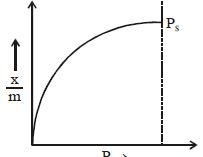
B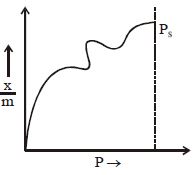
C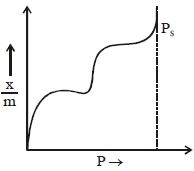
D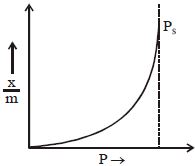
Solution
(A) Physical adsorption (physisorption) is characterized by the formation of multimolecular layers on the surface of an adsorbent.
As the pressure $(P)$ of the gas increases,the extent of adsorption $(x/m)$ increases.
At low pressures,the adsorption is proportional to the pressure.
As the pressure increases further,the rate of increase of adsorption decreases,leading to a characteristic curve that approaches a limiting value at the saturation pressure $(P_s)$.
This behavior is described by the Freundlich adsorption isotherm,which shows a smooth,continuous curve that levels off as it approaches $P_s$,representing the saturation of the surface sites.
Option $A$ correctly depicts this standard behavior of physical adsorption.
As the pressure $(P)$ of the gas increases,the extent of adsorption $(x/m)$ increases.
At low pressures,the adsorption is proportional to the pressure.
As the pressure increases further,the rate of increase of adsorption decreases,leading to a characteristic curve that approaches a limiting value at the saturation pressure $(P_s)$.
This behavior is described by the Freundlich adsorption isotherm,which shows a smooth,continuous curve that levels off as it approaches $P_s$,representing the saturation of the surface sites.
Option $A$ correctly depicts this standard behavior of physical adsorption.
0 likes
View Solution177
DifficultMCQ
$100 \ mL$ of $0.6 \ M$ acetic acid is shaken with $2 \ g$ activated carbon. The final concentration of the solution after adsorption is $0.5 \ M$. The amount of acetic acid adsorbed per gram of carbon is $... \ g$.
A
$0.6$
B
$0.3$
C
$1.2$
D
None of these
Solution
(B) Initial moles of acetic acid $= M \times V = 0.6 \ M \times 0.1 \ L = 0.06 \ mol$.
Final moles of acetic acid $= 0.5 \ M \times 0.1 \ L = 0.05 \ mol$.
Moles adsorbed $= 0.06 - 0.05 = 0.01 \ mol$.
Mass of acetic acid adsorbed $= 0.01 \ mol \times 60 \ g/mol = 0.6 \ g$.
Mass of carbon used $= 2 \ g$.
Amount adsorbed per gram of carbon $= \frac{0.6 \ g}{2 \ g} = 0.3 \ g/g$.
Final moles of acetic acid $= 0.5 \ M \times 0.1 \ L = 0.05 \ mol$.
Moles adsorbed $= 0.06 - 0.05 = 0.01 \ mol$.
Mass of acetic acid adsorbed $= 0.01 \ mol \times 60 \ g/mol = 0.6 \ g$.
Mass of carbon used $= 2 \ g$.
Amount adsorbed per gram of carbon $= \frac{0.6 \ g}{2 \ g} = 0.3 \ g/g$.
0 likes
View Solution178
EasyMCQ
Which of the following is incorrect for physisorption?
A
Reversible
B
Increases with increase in temperature
C
Low heat of adsorption
D
Increases with increase in surface area
Solution
(B) Physisorption is an exothermic process. According to Le Chatelier's principle,for an exothermic process,the extent of adsorption decreases with an increase in temperature. Therefore,the statement that it increases with an increase in temperature is incorrect.
0 likes
View Solution179
MediumMCQ
If $x$ is the amount of adsorbate and $m$ is the amount of adsorbent,which of the following relations is not related to the adsorption process?
A
$\frac{x}{m} = f(P)$ at constant $T$
B
$\frac{x}{m} = f(T)$ at constant $P$
C
$P = f(T)$ at constant $\frac{x}{m}$
D
$\frac{x}{m} = P \times T$
Solution
(D) The Freundlich adsorption isotherm is given by the equation $\frac{x}{m} = kP^{1/n}$,which represents the relationship between the amount of adsorbate and pressure at constant temperature.
The Langmuir adsorption isotherm is given by $\frac{x}{m} = \frac{bP}{1+aP}$,which also relates the amount of adsorbate to pressure at constant temperature.
Adsorption isotherms are plots of $\frac{x}{m}$ versus $P$ at constant $T$,and adsorption isobars are plots of $\frac{x}{m}$ versus $T$ at constant $P$.
Adsorption isosteres are plots of $P$ versus $T$ at constant $\frac{x}{m}$.
The relation $\frac{x}{m} = P \times T$ does not represent any standard adsorption isotherm,isobar,or isostere,as it does not maintain either $P$ or $T$ as a constant variable.
Therefore,option $D$ is not related to the adsorption process.
The Langmuir adsorption isotherm is given by $\frac{x}{m} = \frac{bP}{1+aP}$,which also relates the amount of adsorbate to pressure at constant temperature.
Adsorption isotherms are plots of $\frac{x}{m}$ versus $P$ at constant $T$,and adsorption isobars are plots of $\frac{x}{m}$ versus $T$ at constant $P$.
Adsorption isosteres are plots of $P$ versus $T$ at constant $\frac{x}{m}$.
The relation $\frac{x}{m} = P \times T$ does not represent any standard adsorption isotherm,isobar,or isostere,as it does not maintain either $P$ or $T$ as a constant variable.
Therefore,option $D$ is not related to the adsorption process.
0 likes
View Solution180
EasyMCQ
$A$ plot of $\log \left( \frac{x}{m} \right)$ vs $\log \, P$ for the adsorption of a gas on a solid gives a straight line with slope equal to
A
$\frac{1}{n}$
B
$\log \, K$
C
$-\log \, K$
D
$n$
Solution
(A) The Freundlich adsorption isotherm is given by the equation: $\frac{x}{m} = K \cdot P^{\frac{1}{n}}$
Taking the logarithm on both sides,we get: $\log \left( \frac{x}{m} \right) = \log K + \frac{1}{n} \log P$
Comparing this equation with the straight-line equation $y = mx + c$,where $y = \log \left( \frac{x}{m} \right)$,$x = \log P$,$m = \frac{1}{n}$,and $c = \log K$.
Thus,the slope of the plot is equal to $\frac{1}{n}$.
Taking the logarithm on both sides,we get: $\log \left( \frac{x}{m} \right) = \log K + \frac{1}{n} \log P$
Comparing this equation with the straight-line equation $y = mx + c$,where $y = \log \left( \frac{x}{m} \right)$,$x = \log P$,$m = \frac{1}{n}$,and $c = \log K$.
Thus,the slope of the plot is equal to $\frac{1}{n}$.
0 likes
View Solution181
EasyMCQ
Choose the correct statement for chemical adsorption.
A
Value of adsorption enthalpy $| \Delta H |$ is less than $20 \ kJ \ mol^{-1}$
B
Van der Waals forces exist between adsorbent and adsorbate
C
Usually a unimolecular layer is formed on the adsorbent
D
Entropy of the system increases during chemical adsorption
Solution
(C) In chemical adsorption (chemisorption),a chemical bond is formed between the adsorbate and the adsorbent.
$1$. The enthalpy of adsorption is high,typically ranging from $80-240 \ kJ \ mol^{-1}$,not less than $20 \ kJ \ mol^{-1}$.
$2$. Chemical bonds are formed,not Van der Waals forces (which are characteristic of physisorption).
$3$. Since chemical bonds are formed,the process is specific and usually results in the formation of a unimolecular layer.
$4$. Adsorption is a spontaneous process where the surface area decreases,leading to a decrease in entropy $(\Delta S < 0)$.
Therefore,the correct statement is that a unimolecular layer is formed.
$1$. The enthalpy of adsorption is high,typically ranging from $80-240 \ kJ \ mol^{-1}$,not less than $20 \ kJ \ mol^{-1}$.
$2$. Chemical bonds are formed,not Van der Waals forces (which are characteristic of physisorption).
$3$. Since chemical bonds are formed,the process is specific and usually results in the formation of a unimolecular layer.
$4$. Adsorption is a spontaneous process where the surface area decreases,leading to a decrease in entropy $(\Delta S < 0)$.
Therefore,the correct statement is that a unimolecular layer is formed.
0 likes
View Solution182
MediumMCQ
Which of the following gases is adsorbed to maximum extent?
A
$He$
B
$Ne$
C
$Ar$
D
$Xe$
Solution
(D) The extent of adsorption of gases on a solid surface depends on the ease of liquefaction of the gas.
Easily liquefiable gases have higher critical temperatures $(T_c)$ and are adsorbed to a greater extent.
Among the noble gases,the atomic size increases from $He$ to $Xe$,which leads to an increase in the magnitude of van der Waals forces.
Therefore,$Xe$ has the highest critical temperature and is most easily liquefied,resulting in the maximum extent of adsorption.
Easily liquefiable gases have higher critical temperatures $(T_c)$ and are adsorbed to a greater extent.
Among the noble gases,the atomic size increases from $He$ to $Xe$,which leads to an increase in the magnitude of van der Waals forces.
Therefore,$Xe$ has the highest critical temperature and is most easily liquefied,resulting in the maximum extent of adsorption.
0 likes
View Solution183
EasyMCQ
When temperature is increased,what happens to the extent of adsorption in physisorption?
A
Extent of adsorption increases in physisorption.
B
Extent of adsorption decreases in physisorption.
C
No effect on adsorption.
D
Extent of adsorption first decreases,then increases.
Solution
(B) Physisorption is an exothermic process,which can be represented as: Adsorbate + Adsorbent $\rightleftharpoons$ Adsorption Complex + Heat.
According to Le Chatelier's principle,for an exothermic process,an increase in temperature shifts the equilibrium in the backward direction.
Therefore,the extent of physical adsorption decreases with an increase in temperature.
According to Le Chatelier's principle,for an exothermic process,an increase in temperature shifts the equilibrium in the backward direction.
Therefore,the extent of physical adsorption decreases with an increase in temperature.
0 likes
View Solution184
MediumMCQ
The addition of soap in water:
A
increases its surface tension
B
decreases its surface tension
C
increases its surface tension at low concentration but decreases at high concentration
D
decreases its surface tension at low concentration but increases at high concentration
Solution
(B) Soap molecules are surfactants,which consist of a long hydrophobic hydrocarbon chain and a hydrophilic polar head group.
When soap is added to water,these molecules accumulate at the surface,with the hydrophobic tails pointing away from the water.
This arrangement disrupts the cohesive forces between water molecules at the surface,thereby reducing the surface tension of the water.
This reduction in surface tension is what allows soap to act as a cleaning agent by enabling water to penetrate into fabrics and emulsify dirt.
When soap is added to water,these molecules accumulate at the surface,with the hydrophobic tails pointing away from the water.
This arrangement disrupts the cohesive forces between water molecules at the surface,thereby reducing the surface tension of the water.
This reduction in surface tension is what allows soap to act as a cleaning agent by enabling water to penetrate into fabrics and emulsify dirt.
0 likes
View Solution185
EasyMCQ
The critical temperatures of some gases are given. Which gas shows the least adsorption on a definite amount of charcoal?
| Gas | Critical Temperature |
|---|---|
| $A$ | $304 \ K$ |
| $B$ | $630 \ K$ |
| $C$ | $200 \ K$ |
| $D$ | $540 \ K$ |
A
$A$
B
$B$
C
$C$
D
$D$
Solution
(C) The extent of adsorption of a gas on a solid adsorbent like charcoal is directly proportional to its critical temperature $(T_c)$.
This is because gases with higher critical temperatures are more easily liquefiable and have stronger van der Waals forces of attraction,leading to greater adsorption.
Comparing the given critical temperatures:
$A = 304 \ K$
$B = 630 \ K$
$C = 200 \ K$
$D = 540 \ K$
Since gas $C$ has the lowest critical temperature $(200 \ K)$,it will show the least adsorption on a definite amount of charcoal.
This is because gases with higher critical temperatures are more easily liquefiable and have stronger van der Waals forces of attraction,leading to greater adsorption.
Comparing the given critical temperatures:
$A = 304 \ K$
$B = 630 \ K$
$C = 200 \ K$
$D = 540 \ K$
Since gas $C$ has the lowest critical temperature $(200 \ K)$,it will show the least adsorption on a definite amount of charcoal.
0 likes
View Solution186
MediumMCQ
Adsorption is accompanied by
A
decrease in entropy
B
decrease in enthalpy
C
$T\Delta S$ for the process is negative
D
$(A)$,$(B)$ and $(C)$ are correct
Solution
(D) Adsorption is a spontaneous process where gas molecules are trapped on a solid surface,leading to a decrease in randomness,so $\Delta S < 0$.
Since it is an exothermic process,heat is released,so $\Delta H < 0$.
For a spontaneous process,the Gibbs free energy change $\Delta G = \Delta H - T\Delta S$ must be negative.
Since $\Delta S$ is negative,$-T\Delta S$ becomes positive.
Thus,$(A)$,$(B)$,and $(C)$ are all correct.
Since it is an exothermic process,heat is released,so $\Delta H < 0$.
For a spontaneous process,the Gibbs free energy change $\Delta G = \Delta H - T\Delta S$ must be negative.
Since $\Delta S$ is negative,$-T\Delta S$ becomes positive.
Thus,$(A)$,$(B)$,and $(C)$ are all correct.
0 likes
View Solution187
EasyMCQ
Which of the following statements about physical adsorption is not correct?
A
It is usually mono-molecular layered
B
It is reversible in nature
C
It involves van der Waals interaction between adsorbent and adsorbate
D
It involves a small value of heat of adsorption
Solution
(A) Physical adsorption (physisorption) is characterized by the formation of multi-molecular layers on the surface of the adsorbent.
Therefore,the statement that it is usually mono-molecular layered is incorrect.
Therefore,the statement that it is usually mono-molecular layered is incorrect.
0 likes
View Solution188
MediumMCQ
Which of the following statements is incorrect?
A
Physical adsorption is a multilayered adsorption.
B
Chemical adsorption is irreversible.
C
On increasing the temperature,physical adsorption first increases then decreases.
D
Explanation of chemical adsorption is done by Langmuir adsorption isotherm.
Solution
(C) $1$. Physical adsorption (physisorption) is multilayered due to weak van der Waals forces.
$2$. Chemical adsorption (chemisorption) is irreversible because it involves the formation of strong chemical bonds.
$3$. Physical adsorption is an exothermic process; therefore,it decreases with an increase in temperature. It does not increase first.
$4$. Langmuir adsorption isotherm is primarily used to describe chemisorption,where a monolayer is formed on the surface.
$2$. Chemical adsorption (chemisorption) is irreversible because it involves the formation of strong chemical bonds.
$3$. Physical adsorption is an exothermic process; therefore,it decreases with an increase in temperature. It does not increase first.
$4$. Langmuir adsorption isotherm is primarily used to describe chemisorption,where a monolayer is formed on the surface.
0 likes
View Solution189
EasyMCQ
Which substance is used as an adsorbent in chromatography?
A
$NaCl$
B
Alumina
C
$CuO$
D
$Fe_2O_3$
Solution
(B) In chromatography,the stationary phase acts as an adsorbent. Common adsorbents used in column chromatography include alumina $(Al_2O_3)$ and silica gel $(SiO_2 \cdot xH_2O)$. Therefore,alumina is the correct choice among the given options.
0 likes
View Solution190
MediumMCQ
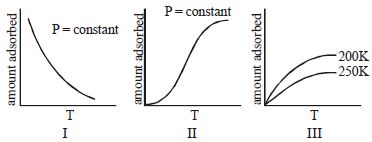
The given graphs $I$,$II$,and $III$ represent general trends observed for different physisorption and chemisorption processes under mild conditions of temperature and pressure. Which of the following statements are correct?
A
$I$ is physisorption and $II$ is physisorption
B
$I$ is physisorption and $III$ is chemisorption
C
$I$ is physisorption and $II$ is chemisorption
D
$II$ is chemisorption and $III$ is chemisorption
Solution
(C) Graph $I$ shows that the amount adsorbed decreases with an increase in temperature at constant pressure,which is characteristic of physisorption.
Graph $II$ shows that the amount adsorbed increases with an increase in temperature,which is characteristic of chemisorption (as it requires activation energy).
Graph $III$ shows the adsorption isotherm at different temperatures,where adsorption decreases as temperature increases $(200 \ K > 250 \ K)$,which is characteristic of physisorption.
Therefore,$I$ is physisorption,$II$ is chemisorption,and $III$ is physisorption.
Comparing this with the given options,statement $C$ is correct.
Graph $II$ shows that the amount adsorbed increases with an increase in temperature,which is characteristic of chemisorption (as it requires activation energy).
Graph $III$ shows the adsorption isotherm at different temperatures,where adsorption decreases as temperature increases $(200 \ K > 250 \ K)$,which is characteristic of physisorption.
Therefore,$I$ is physisorption,$II$ is chemisorption,and $III$ is physisorption.
Comparing this with the given options,statement $C$ is correct.
0 likes
View Solution191
MediumMCQ
Which of the following orders is correct?
A
$He > Ne > Ar > Kr$ (Adsorption tendency)
B
$He > Ne > Ar > Kr$ (Critical temperature)
C
$He > Ne > Ar > Kr$ (Boiling point)
D
$Xe > Kr > Ar > Ne$ (Polarisation)
Solution
(D) The correct order is $Xe > Kr > Ar > Ne$ for polarisation.
As the size of the noble gas atom increases down the group,the valence electrons are held less tightly by the nucleus,making the electron cloud more easily polarisable.
Therefore,the polarisability increases as $He < Ne < Ar < Kr < Xe$.
Option $A$,$B$,and $C$ are incorrect because for noble gases,adsorption tendency,critical temperature,and boiling point all increase with increasing atomic size $(He < Ne < Ar < Kr < Xe)$.
As the size of the noble gas atom increases down the group,the valence electrons are held less tightly by the nucleus,making the electron cloud more easily polarisable.
Therefore,the polarisability increases as $He < Ne < Ar < Kr < Xe$.
Option $A$,$B$,and $C$ are incorrect because for noble gases,adsorption tendency,critical temperature,and boiling point all increase with increasing atomic size $(He < Ne < Ar < Kr < Xe)$.
0 likes
View Solution192
EasyMCQ
Which one of the following is not applicable to chemisorption?
A
Heat of adsorption is negative
B
It is reversible
C
It is very specific
D
It forms mono-molecular layer
Solution
(B) Chemisorption involves the formation of strong chemical bonds between the adsorbate and the adsorbent,making it a highly specific process.
It is generally irreversible in nature because the chemical bonds formed are strong.
It typically results in the formation of a mono-molecular layer on the surface.
Since it involves chemical bond formation,it is usually exothermic,meaning the heat of adsorption is negative (or high in magnitude).
Therefore,the statement that it is reversible is not applicable to chemisorption.
It is generally irreversible in nature because the chemical bonds formed are strong.
It typically results in the formation of a mono-molecular layer on the surface.
Since it involves chemical bond formation,it is usually exothermic,meaning the heat of adsorption is negative (or high in magnitude).
Therefore,the statement that it is reversible is not applicable to chemisorption.
0 likes
View Solution193
MediumMCQ
Wood charcoal is used in gas masks because...
A
It is poisonous
B
It liquefies gases
C
It is porous
D
It adsorbs gases
Solution
(D) Gas masks are used to protect against toxic gases. Wood charcoal is a form of activated carbon which has a large surface area and a porous structure. Due to this,it acts as an adsorbent and effectively adsorbs toxic gases from the air,making it safe for breathing.
0 likes
View Solution194
EasyMCQ
Which of the following statements is correct for the Langmuir adsorption isotherm?
A
$A$ unimolecular layer is formed on the adsorbent.
B
It occurs at low temperatures.
C
It is reversible in nature.
D
It is non-specific in nature.
0 likes
View Solution195
EasyMCQ
Which of the following conditions is favorable for $Van \ der \ Waals$ adsorption?
A
High temperature,low pressure
B
High temperature,high pressure
C
Low temperature,high pressure
D
Low temperature,low pressure
Solution
(C) $Van \ der \ Waals$ adsorption (physical adsorption) is an exothermic process. According to $Le \ Chatelier's \ Principle$,low temperature favors exothermic processes. Furthermore,physical adsorption involves the accumulation of gas molecules on the surface,which is favored by high pressure. Therefore,low temperature and high pressure are the favorable conditions for $Van \ der \ Waals$ adsorption.
0 likes
View Solution196
MediumMCQ
Which of the following statements is correct for the Freundlich adsorption isotherm?
A
$(x/m) \propto p^1$
B
$(x/m) \propto p^{1/n}$
C
$(x/m) \propto p^0$
D
All of the above are correct at different ranges of pressure
Solution
(D) The Freundlich adsorption isotherm is given by the equation $(x/m) = k \cdot p^{1/n}$,where $n > 1$.
At low pressure,the value of $1/n$ is approximately $1$,so $(x/m) \propto p^1$.
At high pressure,the value of $1/n$ approaches $0$,so $(x/m) \propto p^0$ (independent of pressure).
At intermediate pressure,$(x/m) \propto p^{1/n}$.
Therefore,the relationship holds true across different pressure ranges.
At low pressure,the value of $1/n$ is approximately $1$,so $(x/m) \propto p^1$.
At high pressure,the value of $1/n$ approaches $0$,so $(x/m) \propto p^0$ (independent of pressure).
At intermediate pressure,$(x/m) \propto p^{1/n}$.
Therefore,the relationship holds true across different pressure ranges.
0 likes
View Solution197
EasyMCQ
Which of the following properties belongs to physical adsorption?
A
It is highly specific
B
It is irreversible
C
It is not specific
D
None of the above
Solution
(C) Physical adsorption (physisorption) is caused by weak van der Waals forces between the adsorbate and the adsorbent.
It is not specific in nature because any gas can be adsorbed on any solid to some extent.
It is reversible in nature and involves low enthalpy of adsorption.
It is not specific in nature because any gas can be adsorbed on any solid to some extent.
It is reversible in nature and involves low enthalpy of adsorption.
0 likes
View Solution198
EasyMCQ
According to the Freundlich adsorption isotherm,a straight line is obtained for the plot of:
A
$x/m \text{ vs. } p$
B
$\log(x/m) \text{ vs. } \log(p)$
C
$m/x \text{ vs. } 1/p$
D
$m/x \text{ vs. } p$
Solution
(B) The Freundlich adsorption isotherm is given by the equation: $x/m = k \cdot p^{1/n}$ (where $n > 1$).
Taking the logarithm on both sides,we get: $\log(x/m) = \log(k) + (1/n) \log(p)$.
This equation is in the form of a straight line $y = mx + c$,where $y = \log(x/m)$,$x = \log(p)$,slope $m = 1/n$,and intercept $c = \log(k)$.
Therefore,the plot of $\log(x/m)$ versus $\log(p)$ gives a straight line.
Taking the logarithm on both sides,we get: $\log(x/m) = \log(k) + (1/n) \log(p)$.
This equation is in the form of a straight line $y = mx + c$,where $y = \log(x/m)$,$x = \log(p)$,slope $m = 1/n$,and intercept $c = \log(k)$.
Therefore,the plot of $\log(x/m)$ versus $\log(p)$ gives a straight line.
0 likes
View Solution199
EasyMCQ
The force of attraction present in physical adsorption is ....
A
Ionic
B
Covalent
C
Van der Waals
D
Hydrogen bond
Solution
(C) Physical adsorption,also known as physisorption,occurs when adsorbate molecules are held on the surface of an adsorbent by weak intermolecular forces known as $Van \ der \ Waals$ forces. These forces are non-specific and reversible in nature.
0 likes
View SolutionSurface Chemistry — Adsorption and Adsorption isotherm · Frequently Asked Questions
1Are these Surface Chemistry questions useful for JEE and NEET?
Yes. All questions in this section are mapped to JEE Main and NEET exam patterns. Previous year questions from JEE Main, NEET, GUJCET and state-level exams are included with full solutions.
2Can I switch to Hindi or Gujarati for these questions?
Yes. Use the language tabs in the hero section or the sidebar to view the same questions and solutions in English, Hindi or Gujarati.
3How do I generate a question paper from this subtopic?
Use the Vedclass Exam Paper Generator — select the chapter and subtopic, set difficulty, and generate Sets A, B, C, D automatically. First 3 chapters of every subject are free.
Vedclass Products
For Students
Vedclass Test Series
Mock tests in real JEE/NEET style with performance analysis. 5-day free trial.
Start Free TrialFor Teachers
Exam Paper Generator
Generate Set A/B/C/D papers from this chapter in 2 minutes. 3 chapters free.
Try FreeFor Institutes
Online Exam Module
Live online exams with unlimited students, 360° analytics & white-label branding.
See DemoFor Teachers & Institutes
Generate a Surface Chemistry Exam Paper in 2 Minutes
Select subtopic & difficulty — Sets A, B, C, D auto-generated with No Repeat logic.
First 3 chapters of every subject are free — no payment required.