
A English
Composition, Properties and Uses of Polymer Questions in English
Class 12 Chemistry · Polymers · Composition, Properties and Uses of Polymer
556+
Questions
English
Language
100%
With Solutions
Showing 50 of 556 questions in English
101
MediumMCQ
The repeating unit of $PCTFE$ is .........
A
$CF_2 = CF_2$
B
$CH_2 = CH_2$
C
$CF_3 = CF_3$
D
$CFCl = CF_2$
Solution
(D) $PCTFE$ stands for Polychlorotrifluoroethylene.
The monomer unit of $PCTFE$ is chlorotrifluoroethylene,which is $CFCl = CF_2$.
Therefore,the repeating unit is derived from $CFCl = CF_2$.
The monomer unit of $PCTFE$ is chlorotrifluoroethylene,which is $CFCl = CF_2$.
Therefore,the repeating unit is derived from $CFCl = CF_2$.
0 likes
View Solution102
EasyMCQ
Ebonite is a form of $........$.
A
Polypropylene
B
Natural rubber
C
Synthetic rubber
D
Vulcanized rubber
Solution
(D) Ebonite is a highly vulcanized rubber containing a high percentage of sulfur (usually $20-30 \%$),which makes it hard and brittle.
0 likes
View Solution103
EasyMCQ
In elastomers,the intermolecular forces are......
A
Negligible
B
Weak
C
Strong
D
Very strong
Solution
(B) In elastomers,the polymer chains are held together by weak intermolecular forces.
For example,vulcanized rubber.
For example,vulcanized rubber.
0 likes
View Solution104
EasyMCQ
What is the process of heating rubber with sulfur called?
A
Vulcanization
B
Galvanization
C
Sulfonation
D
Bessemerization
Solution
(A) The process of heating natural rubber with sulfur at a temperature range of $373 \ K$ to $415 \ K$ is known as $Vulcanization$. This process introduces sulfur bridges between the polymer chains,which improves the mechanical properties of rubber,such as its elasticity and strength.
0 likes
View Solution105
MediumMCQ
Which of the following statements is not correct?
A
Buna-$S$ is a copolymer of butadiene and styrene.
B
Natural rubber is a $1, 4-$polymer of isoprene.
C
In the vulcanization process,sulfur forms cross-links between chains,making rubber hard and strong.
D
Natural rubber has a trans configuration at every double bond.
Solution
(D) Natural rubber is a linear polymer of isoprene ($2-$methyl-$1, 3-$butadiene) and has a $cis-$configuration at every double bond. Therefore,the statement that it has a trans configuration is incorrect.
0 likes
View Solution106
EasyMCQ
What is the polymer of prop-$2$-enenitrile called?
A
Saran
B
Orlon
C
Dacron
D
Tetron
Solution
(B) The monomer prop-$2$-enenitrile is commonly known as acrylonitrile $(CH_2=CH-CN)$.
Polymerization of acrylonitrile leads to the formation of polyacrylonitrile $(PAN)$.
Polyacrylonitrile is commercially known as Orlon or Acrilan.
Polymerization of acrylonitrile leads to the formation of polyacrylonitrile $(PAN)$.
Polyacrylonitrile is commercially known as Orlon or Acrilan.
0 likes
View Solution107
DifficultMCQ
The polymer $\begin{array}{*{20}{c}} {\,\,\,\,\,\,\,\,\,\,\,\,\,\,\,\,CH_3\,\,\,\,\,\,\,\,\,\,\,\,\,CH_3} \\ {\,\,\,\,\,\,\,\,\,\,\,\,|\,\,\,\,\,\,\,\,\,\,\,\,\,\,\,\,\,\,\,\,\,\,\,|} \\ {{( - CH_2 - C - CH_2 - C - )}_n} \\ {\,\,\,\,\,\,\,\,\,\,\,\,|\,\,\,\,\,\,\,\,\,\,\,\,\,\,\,\,\,\,\,\,\,\,\,|} \\ {\,\,\,\,\,\,\,\,\,\,\,\,\,\,\,\,CH_3\,\,\,\,\,\,\,\,\,\,\,\,\,CH_3} \\ \end{array}$ is formed from which monomer unit?
A
$CH_2=C(CH_3)_2$
B
$CH_2=CH-CH_3$
C
$CH_2=CH_2$
D
$CH_2=C(CH_3)-C(CH_3)=CH_2$
Solution
(A) The given polymer structure is:
$(-CH_2-C(CH_3)_2-CH_2-C(CH_3)_2-)_n$
This is the structure of polyisobutylene.
The repeating unit is $-CH_2-C(CH_3)_2-$.
To find the monomer,we introduce a double bond between the carbon atoms that are bonded to each other in the polymer chain.
Thus,the monomer is $CH_2=C(CH_3)_2$,which is isobutylene ($2$-methylpropene).
$(-CH_2-C(CH_3)_2-CH_2-C(CH_3)_2-)_n$
This is the structure of polyisobutylene.
The repeating unit is $-CH_2-C(CH_3)_2-$.
To find the monomer,we introduce a double bond between the carbon atoms that are bonded to each other in the polymer chain.
Thus,the monomer is $CH_2=C(CH_3)_2$,which is isobutylene ($2$-methylpropene).
0 likes
View Solution108
EasyMCQ
Which of the following is a thermosetting plastic?
A
$PVC$
B
$PVA$
C
Bakelite
D
Perspex
Solution
(C) Thermosetting plastics are polymers that become hard and infusible on heating and cannot be remolded.
$Bakelite$ (phenol-formaldehyde resin) is a classic example of a thermosetting plastic.
$PVC$,$PVA$,and $Perspex$ are thermoplastic polymers that soften upon heating and can be reshaped.
$Bakelite$ (phenol-formaldehyde resin) is a classic example of a thermosetting plastic.
$PVC$,$PVA$,and $Perspex$ are thermoplastic polymers that soften upon heating and can be reshaped.
0 likes
View Solution109
EasyMCQ
Nylon is a.......
A
Condensation polymer
B
Homopolymer
C
Copolymer
D
Polyamide
Solution
(D) Nylon is a type of synthetic polymer that contains repeating amide linkages $(-CONH-)$ in its backbone. Therefore,it is classified as a polyamide. While it is also a condensation polymer,the most specific and descriptive classification among the given options is polyamide.
0 likes
View Solution110
EasyMCQ
Which of the following is a biodegradable polymer of the polyamide class?
A
Nylon-$6,6$
B
Nylon-$2$-nylon-$6$
C
$PHBV$
D
Dextran
Solution
(B) Biodegradable polymers are polymers that can be decomposed by bacteria.
Nylon-$2$-nylon-$6$ is a polyamide copolymer of glycine $(H_2N-CH_2-COOH)$ and amino caproic acid $(H_2N-(CH_2)_5-COOH)$.
It is a biodegradable polymer because it contains amide linkages that can be hydrolyzed by enzymes.
$PHBV$ is a polyester,not a polyamide.
Nylon-$6,6$ is a synthetic polyamide but is not biodegradable.
Dextran is a polysaccharide.
Nylon-$2$-nylon-$6$ is a polyamide copolymer of glycine $(H_2N-CH_2-COOH)$ and amino caproic acid $(H_2N-(CH_2)_5-COOH)$.
It is a biodegradable polymer because it contains amide linkages that can be hydrolyzed by enzymes.
$PHBV$ is a polyester,not a polyamide.
Nylon-$6,6$ is a synthetic polyamide but is not biodegradable.
Dextran is a polysaccharide.
0 likes
View Solution111
MediumMCQ
Which polymer is used as a lubricant and an insulator?
A
$SBR$
B
$PVC$
C
$PTFE$
D
$PAN$
Solution
(C) $PTFE$ (Polytetrafluoroethylene),commonly known as Teflon,is chemically inert and resistant to attack by corrosive reagents.
It has a low coefficient of friction,making it useful for making non-stick surfaces and as a lubricant.
Due to its high thermal stability and chemical resistance,it is also used as an electrical insulator.
It has a low coefficient of friction,making it useful for making non-stick surfaces and as a lubricant.
Due to its high thermal stability and chemical resistance,it is also used as an electrical insulator.
0 likes
View Solution112
MediumMCQ
Which of the following statements is correct?
A
The monomer of Orlon is $CH_2 = CH-Cl$.
B
The monomer of Orlon is $CH_2 = CH-CN$.
C
Orlon is a polymer of $CH_2 = CH-COOCH_3$ monomer.
D
Orlon is a polymer of $CF_2 = CF_2$ monomer.
Solution
(B) Orlon,also known as polyacrylonitrile $(PAN)$,is a synthetic polymer.
Its monomer is acrylonitrile,which has the chemical formula $CH_2 = CH-CN$.
Therefore,the correct statement is that the monomer of Orlon is $CH_2 = CH-CN$.
Its monomer is acrylonitrile,which has the chemical formula $CH_2 = CH-CN$.
Therefore,the correct statement is that the monomer of Orlon is $CH_2 = CH-CN$.
0 likes
View Solution113
EasyMCQ
Which of the following polymers is used in the manufacture of non-stick cookware?
A
$PVC$
B
Polystyrene
C
Polytetrafluoroethene
D
Polyethylene terephthalate
Solution
(C) Non-stick cookware is coated with $Teflon$,which is the common name for $Polytetrafluoroethene$ $(PTFE)$.
$PTFE$ is a synthetic fluoropolymer of tetrafluoroethene that has numerous applications due to its high thermal stability and chemical inertness.
Therefore,the correct option is $C$.
$PTFE$ is a synthetic fluoropolymer of tetrafluoroethene that has numerous applications due to its high thermal stability and chemical inertness.
Therefore,the correct option is $C$.
0 likes
View Solution114
EasyMCQ
Among cellulose,polyvinyl chloride,nylon,and natural rubber,which one has the weakest intermolecular forces?
A
Nylon
B
Polyvinyl chloride
C
Cellulose
D
Natural rubber
Solution
(D) Natural rubber is an example of an elastomer. Elastomers are polymers held together by the weakest intermolecular forces,such as weak van der Waals forces,which allow the polymer chains to be stretched.
0 likes
View Solution115
EasyMCQ
Terylene is a polymer of which components?
A
Ethylene glycol and terephthalic acid
B
Vinyl chloride and formaldehyde
C
Melamine and formaldehyde
D
$HMDA$ and adipic acid
Solution
(A) Terylene,also known as $Dacron$,is a condensation polymer formed by the polymerization of $Ethylene \ glycol$ $(HO-CH_2-CH_2-OH)$ and $Terephthalic \ acid$ $(C_6H_4(COOH)_2)$.
This reaction involves the elimination of water molecules to form an ester linkage,classifying it as a polyester.
This reaction involves the elimination of water molecules to form an ester linkage,classifying it as a polyester.
0 likes
View Solution116
EasyMCQ
Identify the monomer of Teflon.
A
$CF_2 = CF_2$
B
$CH_2 = CH - Cl$
C
$CH_2 = C(Cl) - CH = CH_2$
D
$CH_2 = CH - CN$
Solution
(A) Teflon is a polymer of tetrafluoroethene.
The chemical formula of the monomer tetrafluoroethene is $CF_2 = CF_2$.
Therefore,the correct option is $A$.
The chemical formula of the monomer tetrafluoroethene is $CF_2 = CF_2$.
Therefore,the correct option is $A$.
0 likes
View Solution117
EasyMCQ
Which polymer is used in orthopedic devices and in controlled drug-release capsules?
A
Dacron
B
Nylon-$6$
C
$PAN$
D
$PHBV$
Solution
(D) $PHBV$ (Poly-$\beta$-hydroxybutyrate-co-$\beta$-hydroxyvalerate) is a biodegradable,aliphatic polyester.
It is used in orthopedic devices and in controlled drug-release capsules because it undergoes bacterial degradation in the environment.
It is used in orthopedic devices and in controlled drug-release capsules because it undergoes bacterial degradation in the environment.
0 likes
View Solution118
EasyMCQ
Which of the following is a polyamide class polymer?
A
Nylon-$6,6$
B
Terylene
C
Teflon
D
Bakelite
Solution
(A) Polyamides are polymers containing amide linkages $(-CONH-)$ in their backbone.
Nylon-$6,6$ is a condensation polymer formed by the reaction of hexamethylenediamine and adipic acid,which contains amide bonds.
Terylene is a polyester,Teflon is an addition polymer of tetrafluoroethene,and Bakelite is a phenol-formaldehyde resin.
Nylon-$6,6$ is a condensation polymer formed by the reaction of hexamethylenediamine and adipic acid,which contains amide bonds.
Terylene is a polyester,Teflon is an addition polymer of tetrafluoroethene,and Bakelite is a phenol-formaldehyde resin.
0 likes
View Solution119
EasyMCQ
Ebonite is ........ .
A
Polypropene
B
Natural rubber
C
Synthetic rubber
D
Hard and highly vulcanized rubber
Solution
(D) Ebonite is a hard and highly $(20-30\%)$ vulcanized rubber.
0 likes
View Solution120
DifficultMCQ
Which of the following polymers has ethylene glycol as one of its monomer units?
A
$(-O-CH_2-CH_2-OOC-C_6H_4-CO-)_n$
B
$(-CH_2-CH_2-)_n$
C
$(-CH_2-CH=CH-CH_2-CH(C_6H_5)-CH_2-)_n$
D
$[-O-CH(CH_3)-CH_2-CO-O-CH(CH_2CH_3)-CH_2-CO-]_n$
Solution
(A) The polymer Terylene (also known as Dacron) is formed by the condensation polymerization of ethylene glycol $(HO-CH_2-CH_2-OH)$ and terephthalic acid $(HOOC-C_6H_4-COOH)$.
Its structure is represented as $(-O-CH_2-CH_2-OOC-C_6H_4-CO-)_n$.
Therefore,option $A$ is the correct answer.
Its structure is represented as $(-O-CH_2-CH_2-OOC-C_6H_4-CO-)_n$.
Therefore,option $A$ is the correct answer.
0 likes
View Solution121
EasyMCQ
Which of the following is Teflon?
A
$[CH_2-CH_2]_n$
B
$[CH_2-CH(CH_3)]_n$
C
$[CF_2-CF_2]_n$
D
$[CH_2-CFCl]_n$
Solution
(C) Teflon is a polymer of tetrafluoroethene $(CF_2=CF_2)$.
Its chemical structure is represented as $[CF_2-CF_2]_n$.
Therefore,the correct option is $C$.
Its chemical structure is represented as $[CF_2-CF_2]_n$.
Therefore,the correct option is $C$.
0 likes
View Solution122
EasyMCQ
Which of the following polymers contains an ester linkage?
A
Nylon
B
Bakelite
C
Terylene
D
Rubber
Solution
(C) Terylene (also known as Dacron) is a polyester fiber.
It is formed by the condensation polymerization of ethylene glycol $(HO-CH_2-CH_2-OH)$ and terephthalic acid $(HOOC-C_6H_4-COOH)$.
The reaction involves the elimination of water molecules to form an ester linkage $(-COO-)$ between the monomer units.
It is formed by the condensation polymerization of ethylene glycol $(HO-CH_2-CH_2-OH)$ and terephthalic acid $(HOOC-C_6H_4-COOH)$.
The reaction involves the elimination of water molecules to form an ester linkage $(-COO-)$ between the monomer units.
0 likes
View Solution123
MediumMCQ
Which of the following is not a biodegradable polymer?
A
$PHBV$
B
$PGA$
C
$PMMA$
D
$PCL$
Solution
(C) $PHBV$ (poly-$\beta$-hydroxybutyrate-co-$\beta$-hydroxyvalerate),$PGA$ (polyglycolic acid),and $PCL$ (polycaprolactone) are well-known biodegradable polymers.
$PMMA$ (polymethyl methacrylate) is a synthetic,non-biodegradable polymer commonly used as a shatterproof substitute for glass.
$PMMA$ (polymethyl methacrylate) is a synthetic,non-biodegradable polymer commonly used as a shatterproof substitute for glass.
0 likes
View Solution124
EasyMCQ
Nylon-$6, 6$ is not a ...... .
A
Condensation polymer
B
Polyamide
C
Both condensation polymer and polyamide
D
Polyester
Solution
(D) Nylon-$6, 6$ is formed by the condensation polymerization of hexamethylenediamine and adipic acid.
It contains amide linkages $(-CONH-)$,so it is a polyamide.
Since it is formed by the elimination of small molecules like water,it is a condensation polymer.
It is not a polyester because it does not contain ester linkages $(-COO-)$.
It contains amide linkages $(-CONH-)$,so it is a polyamide.
Since it is formed by the elimination of small molecules like water,it is a condensation polymer.
It is not a polyester because it does not contain ester linkages $(-COO-)$.
0 likes
View Solution125
EasyMCQ
Which of the following pairs is $NOT$ correctly matched?
A
Neoprene: Synthetic rubber
B
Nylon-$6$,$6$: Polyamide
C
Terylene: Polyester
D
Polystyrene: Polyether
Solution
(D) The correct classifications are as follows:
$A$. Neoprene is a synthetic rubber (polychloroprene).
$B$. Nylon-$6,6$ is a polyamide.
$C$. Terylene (Dacron) is a polyester.
$D$. Polystyrene is a vinyl polymer,not a polyether. Therefore,the pair $D$ is incorrectly matched.
$A$. Neoprene is a synthetic rubber (polychloroprene).
$B$. Nylon-$6,6$ is a polyamide.
$C$. Terylene (Dacron) is a polyester.
$D$. Polystyrene is a vinyl polymer,not a polyether. Therefore,the pair $D$ is incorrectly matched.
0 likes
View Solution126
MediumMCQ
If a plastic is hard,which substance is added to it to introduce the property of softness?
A
Catalyst
B
Telomers
C
Plasticizer
D
Vulcanizer
Solution
(C) $PVC$ is very hard. To make it soft (rubber-like),a plasticizer such as di-$n$-butyl phthalate is added to it.
0 likes
View Solution127
EasyMCQ
Natural rubber is a polymer of $.......$
A
Polyester
B
Polyamide
C
Polyisoprene
D
Polysaccharide
Solution
(C) Natural rubber is a linear polymer of $isoprene$ $(2-methyl-1,3-butadiene)$.
It is also known as $cis-1,4-polyisoprene$.
Therefore,the correct option is $C$.
It is also known as $cis-1,4-polyisoprene$.
Therefore,the correct option is $C$.
0 likes
View Solution128
MediumMCQ
The polymer used for bulletproof glass coating is ......
A
$PMMA$
B
Lexan
C
Nomex
D
Kevlar
Solution
(B) Lexan is a polycarbonate polymer known for its high impact resistance and optical clarity,making it suitable for use in bulletproof glass.
0 likes
View Solution129
EasyMCQ
Perlon is ........ .
A
Rubber
B
Nylon-$6$
C
Terylene
D
Orlon
Solution
(B) Perlon is another name for Nylon-$6$.
It is a polyamide polymer formed by the polymerization of caprolactam.
It is a polyamide polymer formed by the polymerization of caprolactam.
0 likes
View Solution130
EasyMCQ
Which of the following is a copolymer obtained by condensation polymerization?
A
Terylene
B
Buna-$S$
C
Buna-$N$
D
Neoprene
Solution
(A) Terylene (also known as Dacron) is a polyester formed by the condensation polymerization of ethylene glycol $(HO-CH_2-CH_2-OH)$ and terephthalic acid $(C_6H_4(COOH)_2)$.
Since it is formed from two different monomers with the elimination of small molecules like water,it is a condensation copolymer.
Buna-$S$ and Buna-$N$ are addition copolymers,and Neoprene is an addition homopolymer.
Since it is formed from two different monomers with the elimination of small molecules like water,it is a condensation copolymer.
Buna-$S$ and Buna-$N$ are addition copolymers,and Neoprene is an addition homopolymer.
0 likes
View Solution131
MediumMCQ
In the vulcanization of rubber,........ $(\%)$ percent of sulfur is used.
A
$5$
B
$3$
C
$30$
D
$55$
Solution
(A) In the process of vulcanization,natural rubber is heated with sulfur ($4$ to $5\ \%$) and an appropriate additive to accelerate the reaction between rubber and sulfur.
This process creates cross-links between the polymer chains,which improves the elasticity and wear resistance of the rubber.
This process creates cross-links between the polymer chains,which improves the elasticity and wear resistance of the rubber.
0 likes
View Solution132
MediumMCQ
Which of the following is $NOT$ true for Terylene?
A
Step-growth polymer
B
Synthetic fiber
C
Condensation polymer
D
Thermosetting plastic
Solution
(D) Terylene is a polyester fiber formed by the condensation polymerization of ethylene glycol and terephthalic acid.
It is a thermoplastic polymer,not a thermosetting plastic.
Thermosetting plastics are cross-linked polymers that do not melt upon heating,whereas Terylene softens and melts when heated.
It is a thermoplastic polymer,not a thermosetting plastic.
Thermosetting plastics are cross-linked polymers that do not melt upon heating,whereas Terylene softens and melts when heated.
0 likes
View Solution133
MediumMCQ
Which polymer is used in the manufacture of contact lenses for the eyes?
A
Polymethyl methacrylate
B
Polyethylene
C
Polyethyl acrylate
D
Nylon-$6$
Solution
(A) The polymer used is Polymethyl methacrylate,commonly known as $PMMA$.
It is transparent and possesses excellent light transmission properties.
Due to its superior optical clarity compared to glass,it is widely used in the manufacturing of contact lenses.
It is transparent and possesses excellent light transmission properties.
Due to its superior optical clarity compared to glass,it is widely used in the manufacturing of contact lenses.
0 likes
View Solution134
MediumMCQ
The polymer Buna-$S$ is made of .....
A
Only butadiene
B
Butadiene and styrene
C
Only styrene
D
Butadiene and nitrile
Solution
(B) Buna-$S$ is a synthetic rubber formed by the copolymerization of $1,3$-butadiene and styrene in the presence of a peroxide catalyst.
The name 'Buna' is derived from 'Bu' for butadiene and 'na' for sodium (which was used as a catalyst in early processes),while '$S$' stands for styrene.
The name 'Buna' is derived from 'Bu' for butadiene and 'na' for sodium (which was used as a catalyst in early processes),while '$S$' stands for styrene.
0 likes
View Solution135
EasyMCQ
Nylon threads are made from which polymer?
A
Polyester
B
Polyamide
C
Polyethylene
D
Polyvinyl
Solution
(B) Nylon is a synthetic fiber that belongs to the class of polymers known as polyamides. It is formed by the condensation polymerization of diamines and dicarboxylic acids,which results in the formation of amide linkages $(-CONH-)$ in the polymer chain. Therefore,nylon threads are made from polyamides.
0 likes
View Solution136
EasyMCQ
Bakelite is a type of .......
A
Rubber
B
Rayon
C
Resin
D
Plasticizer
Solution
(C) Bakelite is a thermosetting phenol-formaldehyde resin. It is formed by the condensation polymerization of phenol and formaldehyde. Therefore,it is classified as a resin.
0 likes
View Solution137
MediumMCQ
Which of the following is $NOT$ correct for Terylene?
A
Step-growth polymer
B
Synthetic fiber
C
Addition polymer
D
It is also known as Dacron
Solution
(C) Terylene (also known as Dacron) is a polyester fiber.
It is prepared by the condensation polymerization of ethylene glycol and terephthalic acid.
Since it is formed by the elimination of small molecules like $H_2O$,it is a condensation polymer,not an addition polymer.
Therefore,the statement that it is an addition polymer is incorrect.
It is prepared by the condensation polymerization of ethylene glycol and terephthalic acid.
Since it is formed by the elimination of small molecules like $H_2O$,it is a condensation polymer,not an addition polymer.
Therefore,the statement that it is an addition polymer is incorrect.
0 likes
View Solution138
EasyMCQ
Which of the following is currently used for the manufacture of tyre cords?
A
Terylene
B
Polythene
C
Polypropene
D
Nylon-$6,6$
Solution
(D) Nylon-$6,6$ is a polyamide polymer formed by the condensation polymerization of hexamethylenediamine and adipic acid. Due to its high tensile strength,elasticity,and durability,it is widely used in the manufacture of tyre cords,ropes,and fabrics.
0 likes
View Solution139
EasyMCQ
Nylon thread is made of........
A
Polyvinyl polymer
B
Polyester polymer
C
Polyamide
D
Polyethylene polymer
Solution
(C) Nylon is a generic designation for a family of synthetic polymers known as aliphatic polyamides. It is formed by the condensation polymerization of diamines with dicarboxylic acids or by the ring-opening polymerization of lactams. Therefore,nylon thread is made of polyamide.
0 likes
View Solution140
EasyMCQ
What are carbon fibers used for?
A
Bone plates
B
Brake pads
C
Bulletproof jackets
D
All of the above
Solution
(D) Carbon fibers are high-strength,lightweight materials known for their exceptional mechanical properties.
They are widely used in medical applications such as $Bone \ plates$ due to their biocompatibility and strength.
They are also used in automotive and aerospace industries for $Brake \ pads$ because of their high heat resistance and durability.
Additionally,due to their high tensile strength,they are used in the manufacturing of $Bulletproof \ jackets$.
Therefore,all the given options are correct applications of carbon fibers.
They are widely used in medical applications such as $Bone \ plates$ due to their biocompatibility and strength.
They are also used in automotive and aerospace industries for $Brake \ pads$ because of their high heat resistance and durability.
Additionally,due to their high tensile strength,they are used in the manufacturing of $Bulletproof \ jackets$.
Therefore,all the given options are correct applications of carbon fibers.
0 likes
View Solution141
MediumMCQ
$A$ polymer containing nitrogen is
A
Bakelite
B
Dacron
C
Rubber
D
Nylon $-66$
Solution
(D) - Nylon $-66$ is a polyamide polymer,which contains nitrogen atoms in its structure.
Its repeating unit is represented as: $[ -NH-(CH_2)_6-NH-CO-(CH_2)_4-CO- ]_n$.
Its repeating unit is represented as: $[ -NH-(CH_2)_6-NH-CO-(CH_2)_4-CO- ]_n$.
0 likes
View Solution142
MediumMCQ
Ethylene-propylene rubber can be:
A
Vulcanized by sulphur
B
Vulcanized by peroxides
C
Both $(a)$ and $(b)$
D
Non-vulcanizable
Solution
(B) Ethylene-propylene rubber $(EPR)$ lacks sufficient unsaturation in its polymer backbone for effective vulcanization with sulphur.
Therefore,it is typically vulcanized using peroxides,which generate free radicals to form cross-links between the polymer chains.
Therefore,it is typically vulcanized using peroxides,which generate free radicals to form cross-links between the polymer chains.
0 likes
View Solution143
EasyMCQ
Buna-$S$ is a polymer of
A
Butadiene and styrene
B
Butadiene
C
Styrene
D
Butadiene and chloroprene
Solution
(A) Buna-$S$ is a copolymer formed by the polymerization of $1,3$-butadiene and styrene in the presence of a catalyst.
It is also known as $SBR$ (styrene-butadiene rubber).
The reaction is:
$nCH_2=CH-CH=CH_2 + nC_6H_5CH=CH_2 \xrightarrow{Na} (-CH_2-CH=CH-CH_2-CH(C_6H_5)-CH_2-)_n$
It is also known as $SBR$ (styrene-butadiene rubber).
The reaction is:
$nCH_2=CH-CH=CH_2 + nC_6H_5CH=CH_2 \xrightarrow{Na} (-CH_2-CH=CH-CH_2-CH(C_6H_5)-CH_2-)_n$
0 likes
View Solution144
EasyMCQ
Orlon has a monomer unit:
A
Vinyl cyanide
B
Acrolein
C
Glycol
D
Isoprene
Solution
(A) Orlon is polyacrylonitrile $(PAN)$,which is a synthetic polymer.
Its monomer unit is vinyl cyanide,also known as acrylonitrile $(CH_2=CH-CN)$.
Its monomer unit is vinyl cyanide,also known as acrylonitrile $(CH_2=CH-CN)$.
0 likes
View Solution145
DifficultMCQ
Which one of the following polymers will not catch fire?
A
$(-CF_2-CF_2-)_n$
B
$(-CH_2-CH_2-)_n$
C
$(-CH_2-CHCl-)_n$
D
$(-CH_2-CH(C_6H_5)-)_n$
Solution
(A) The correct answer is $A$.
$(-CF_2-CF_2-)_n$ is known as Teflon (Polytetrafluoroethene).
It is a highly stable polymer due to the strong $C-F$ bonds and is resistant to heat and fire,making it non-flammable.
$(-CF_2-CF_2-)_n$ is known as Teflon (Polytetrafluoroethene).
It is a highly stable polymer due to the strong $C-F$ bonds and is resistant to heat and fire,making it non-flammable.
0 likes
View Solution146
EasyMCQ
Artificial silk is
A
Polyamides
B
Polyesters
C
Polyacids
D
Polysaccharides
Solution
(D) Artificial silk,commonly known as rayon,is a regenerated cellulose fiber. Cellulose is a natural polymer made up of glucose units,which is a type of polysaccharide.
0 likes
View Solution147
DifficultMCQ
Which one of the following structures represents nylon $6, 6$ polymer?
A
$[-CH_2-CH(NH_2)-CH_2-CH(CH_3)-]_{66}$
B
$[-CH_2-CH(NH_2)-CH_2-CH(NH_2)-]_{66}$
C
$[-CH_2-CH(NH_2)-CH_2-CH(Cl)-]_6-[-CH_2-CH(CH_3)-CH_2-CH(COOH)-]_6$
D
$[-CO-(CH_2)_4-CO-NH-(CH_2)_6-NH-]_n$
Solution
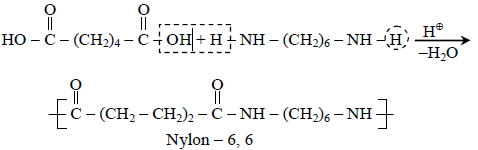
0 likes
View Solution148
DifficultMCQ
Natural rubber has
A
alternate $cis-$ and $trans-$ configuration
B
random $cis-$ and $trans-$ configuration
C
all $cis-$ configuration
D
all $trans-$ configuration.
Solution
(C) Natural rubber is a linear polymer of isoprene $(2-methyl-1,3-butadiene)$.
In natural rubber,the double bonds are present in the $cis-$ configuration,which means the bulky groups are on the same side of the double bond.
This $cis-$ configuration gives natural rubber its elastic properties.
Therefore,natural rubber has an all $cis-$ configuration.
In natural rubber,the double bonds are present in the $cis-$ configuration,which means the bulky groups are on the same side of the double bond.
This $cis-$ configuration gives natural rubber its elastic properties.
Therefore,natural rubber has an all $cis-$ configuration.
0 likes
View Solution149
MediumMCQ
The biodegradable polymer which can be produced from glycine and aminocaproic acid is
A
buna-$N$
B
nylon $6,6$
C
nylon-$2$-nylon-$6$
D
$PHBV$
Solution
(C) Nylon-$2$-nylon-$6$ is a biodegradable polyamide copolymer.
It is formed by the condensation polymerization of glycine $(H_2N-CH_2-COOH)$ and aminocaproic acid $(H_2N-(CH_2)_5-COOH)$.
The reaction is: $n(H_2N-CH_2-COOH) + n(H_2N-(CH_2)_5-COOH) \rightarrow [NH-CH_2-CO-NH-(CH_2)_5-CO]_n + 2nH_2O$.
It is formed by the condensation polymerization of glycine $(H_2N-CH_2-COOH)$ and aminocaproic acid $(H_2N-(CH_2)_5-COOH)$.
The reaction is: $n(H_2N-CH_2-COOH) + n(H_2N-(CH_2)_5-COOH) \rightarrow [NH-CH_2-CO-NH-(CH_2)_5-CO]_n + 2nH_2O$.
0 likes
View Solution150
DifficultMCQ
Which one of the following is an example of a thermosetting polymer?
A
$(-CH_2-C(Cl)=CH-CH_2-)_n$
B
$(-CH_2-CH(Cl)-)_n$
C
$(-NH-(CH_2)_6-NH-CO-(CH_2)_4-CO-)_n$
D
Bakelite
Solution
(D) Bakelite is a thermosetting polymer. These polymers are cross-linked or heavily branched molecules,which on heating undergo extensive cross-linking in moulds and become infusible. They cannot be reused.
Option $(A)$ is Neoprene (elastomer),$(B)$ is $PVC$ (thermoplastic),and $(C)$ is Nylon $6,6$ (fiber).
Option $(A)$ is Neoprene (elastomer),$(B)$ is $PVC$ (thermoplastic),and $(C)$ is Nylon $6,6$ (fiber).
0 likes
View SolutionPolymers — Composition, Properties and Uses of Polymer · Frequently Asked Questions
1Are these Polymers questions useful for JEE and NEET?
Yes. All questions in this section are mapped to JEE Main and NEET exam patterns. Previous year questions from JEE Main, NEET, GUJCET and state-level exams are included with full solutions.
2Can I switch to Hindi or Gujarati for these questions?
Yes. Use the language tabs in the hero section or the sidebar to view the same questions and solutions in English, Hindi or Gujarati.
3How do I generate a question paper from this subtopic?
Use the Vedclass Exam Paper Generator — select the chapter and subtopic, set difficulty, and generate Sets A, B, C, D automatically. First 3 chapters of every subject are free.
Vedclass Products
For Students
Vedclass Test Series
Mock tests in real JEE/NEET style with performance analysis. 5-day free trial.
Start Free TrialFor Teachers
Exam Paper Generator
Generate Set A/B/C/D papers from this chapter in 2 minutes. 3 chapters free.
Try FreeFor Institutes
Online Exam Module
Live online exams with unlimited students, 360° analytics & white-label branding.
See DemoFor Teachers & Institutes
Generate a Polymers Exam Paper in 2 Minutes
Select subtopic & difficulty — Sets A, B, C, D auto-generated with No Repeat logic.
First 3 chapters of every subject are free — no payment required.