
A English
Nitrogen family Questions in English
Class 12 Chemistry · p-Block Elements (Class 12) · Nitrogen family
1110+
Questions
English
Language
100%
With Solutions
Showing 50 of 1110 questions in English
551
MediumMCQ
Which of the following statements about phosphine $(PH_3)$ is/are correct?
$(a)$ It has a rotten egg-like smell.
$(b)$ In aqueous solution and in the presence of light,it yields red phosphorus and hydrogen.
$(c)$ It explodes with $Br_2$.
$(d)$ In its pure form,it is non-inflammable.
$(a)$ It has a rotten egg-like smell.
$(b)$ In aqueous solution and in the presence of light,it yields red phosphorus and hydrogen.
$(c)$ It explodes with $Br_2$.
$(d)$ In its pure form,it is non-inflammable.
A
Only $c$ and $d$
B
Only $b, c$ and $d$
C
Only $d$
D
All are correct
Solution
(B) $1$. Phosphine $(PH_3)$ has a rotten fish-like smell,not a rotten egg-like smell. Thus,statement $(a)$ is incorrect.
$2$. In aqueous solution and in the presence of light,$PH_3$ decomposes to give red phosphorus and hydrogen: $PH_{3(aq)} \xrightarrow{\text{light}} P_{(red)} + H_2$. Thus,statement $(b)$ is correct.
$3$. Phosphine is highly reactive and explodes in contact with strong oxidizing agents like $Br_2$,$Cl_2$,or $HNO_3$. Thus,statement $(c)$ is correct.
$4$. Pure phosphine is non-inflammable,but it becomes inflammable due to the presence of $P_2H_4$ or $P_4$ vapors. Thus,statement $(d)$ is correct.
Therefore,statements $(b)$,$(c)$,and $(d)$ are correct.
$2$. In aqueous solution and in the presence of light,$PH_3$ decomposes to give red phosphorus and hydrogen: $PH_{3(aq)} \xrightarrow{\text{light}} P_{(red)} + H_2$. Thus,statement $(b)$ is correct.
$3$. Phosphine is highly reactive and explodes in contact with strong oxidizing agents like $Br_2$,$Cl_2$,or $HNO_3$. Thus,statement $(c)$ is correct.
$4$. Pure phosphine is non-inflammable,but it becomes inflammable due to the presence of $P_2H_4$ or $P_4$ vapors. Thus,statement $(d)$ is correct.
Therefore,statements $(b)$,$(c)$,and $(d)$ are correct.
0 likes
View Solution552
EasyMCQ
On heating ammonium dichromate,the gas evolved is
A
$O_2$
B
$N_2$
C
$N_2O$
D
$NH_3$
Solution
(B) The thermal decomposition reaction of ammonium dichromate is given by:
$(NH_4)_2Cr_2O_{7(s)} \rightarrow N_{2(g)} + 4H_2O_{(g)} + Cr_2O_{3(s)}$
Ammonium dichromate decomposes on heating to produce nitrogen gas $(N_2)$,water vapour,and solid chromium$(III)$ oxide $(Cr_2O_3)$.
$(NH_4)_2Cr_2O_{7(s)} \rightarrow N_{2(g)} + 4H_2O_{(g)} + Cr_2O_{3(s)}$
Ammonium dichromate decomposes on heating to produce nitrogen gas $(N_2)$,water vapour,and solid chromium$(III)$ oxide $(Cr_2O_3)$.
0 likes
View Solution553
MediumMCQ
Ammonia with excess of $Cl_2$ forms:
A
$N_2$
B
$NOCl$
C
$NH_4Cl$
D
$NCl_3$
Solution
(D) When ammonia $(NH_3)$ reacts with an excess of chlorine $(Cl_2)$,the reaction produces nitrogen trichloride $(NCl_3)$ and hydrogen chloride $(HCl)$.
The balanced chemical equation is:
$NH_3 + 3Cl_2 \rightarrow NCl_3 + 3HCl$
Since $Cl_2$ is in excess,the product formed is nitrogen trichloride $(NCl_3)$.
The balanced chemical equation is:
$NH_3 + 3Cl_2 \rightarrow NCl_3 + 3HCl$
Since $Cl_2$ is in excess,the product formed is nitrogen trichloride $(NCl_3)$.
0 likes
View Solution554
MediumMCQ
$NH_3$ can not be obtained by
A
heating of $NH_4NO_3$
B
heating of $NH_4Cl$
C
heating of $(NH_4)_2CO_3$
D
None
Solution
(A) The thermal decomposition of ammonium salts depends on the nature of the anion.
$1$. Heating $NH_4NO_3$ produces nitrous oxide and water: $NH_4NO_3 \rightarrow N_2O + 2H_2O$.
$2$. Heating $NH_4Cl$ produces ammonia and hydrogen chloride: $NH_4Cl \rightarrow NH_3 + HCl$.
$3$. Heating $(NH_4)_2CO_3$ produces ammonia,carbon dioxide,and water: $(NH_4)_2CO_3 \rightarrow 2NH_3 + CO_2 + H_2O$.
Since $NH_4NO_3$ does not produce $NH_3$ upon heating,the correct option is $A$.
$1$. Heating $NH_4NO_3$ produces nitrous oxide and water: $NH_4NO_3 \rightarrow N_2O + 2H_2O$.
$2$. Heating $NH_4Cl$ produces ammonia and hydrogen chloride: $NH_4Cl \rightarrow NH_3 + HCl$.
$3$. Heating $(NH_4)_2CO_3$ produces ammonia,carbon dioxide,and water: $(NH_4)_2CO_3 \rightarrow 2NH_3 + CO_2 + H_2O$.
Since $NH_4NO_3$ does not produce $NH_3$ upon heating,the correct option is $A$.
0 likes
View Solution555
DifficultMCQ
In the following reaction,identify the nature of the product formed by the underlined atom upon complete hydrolysis at $R.T$.:
$H_4\underline{P}_2O_8 + H_2O \longrightarrow H_3PO_4 + H_2O_2$
$H_4\underline{P}_2O_8 + H_2O \longrightarrow H_3PO_4 + H_2O_2$
A
If the product is an oxyacid with an $-ic$ suffix.
B
If the product is an oxyacid with an $-ous$ suffix.
C
If the products are two oxyacids,one with an $-ic$ suffix and the other with an $-ous$ suffix.
D
If the product is not an oxyacid,neither with an $-ic$ suffix nor with an $-ous$ suffix.
Solution
(A) The given reaction is the hydrolysis of peroxodiphosphoric acid $(H_4P_2O_8)$:
$H_4P_2O_8 + 2H_2O \longrightarrow 2H_3PO_4 + H_2O_2$.
In the product $H_3PO_4$ (phosphoric acid),the phosphorus atom is in the $+5$ oxidation state.
Acids of phosphorus in the $+5$ oxidation state are named with the $-ic$ suffix (e.g.,phosphoric acid).
Therefore,the product is an oxyacid with an $-ic$ suffix.
$H_4P_2O_8 + 2H_2O \longrightarrow 2H_3PO_4 + H_2O_2$.
In the product $H_3PO_4$ (phosphoric acid),the phosphorus atom is in the $+5$ oxidation state.
Acids of phosphorus in the $+5$ oxidation state are named with the $-ic$ suffix (e.g.,phosphoric acid).
Therefore,the product is an oxyacid with an $-ic$ suffix.
0 likes
View Solution556
DifficultMCQ
In the following reaction,identify the nature of the product formed by the complete hydrolysis of the underlined atom at $R.T.$:
$\underline{N}F_3 + H_2O \longrightarrow \text{No reaction}$
$\underline{N}F_3 + H_2O \longrightarrow \text{No reaction}$
A
If product is oxy acid with $-ic$ suffix
B
If product is oxy acid with $-ous$ suffix
C
If product are two oxy acids,one with $-ic$ suffix and the other with $-ous$ suffix
D
If product is not an oxy acid,neither with $-ic$ suffix nor with $-ous$ suffix
Solution
(D) $NF_3$ is a very stable molecule due to the high electronegativity of fluorine and the small size of the nitrogen atom,which prevents the attack of water molecules on the nitrogen center.
Therefore,$NF_3$ does not undergo hydrolysis at room temperature $(R.T.)$.
Since there is no reaction,the product is not an oxy acid.
Thus,the correct description is that the product is not an oxy acid,neither with $-ic$ suffix nor with $-ous$ suffix.
Therefore,$NF_3$ does not undergo hydrolysis at room temperature $(R.T.)$.
Since there is no reaction,the product is not an oxy acid.
Thus,the correct description is that the product is not an oxy acid,neither with $-ic$ suffix nor with $-ous$ suffix.
0 likes
View Solution557
DifficultMCQ
In the following reaction,identify the nature of the product formed by the complete hydrolysis of the underlined atom at $R.T.$:
$\underline{N}Cl_3 + 3H_2O \longrightarrow 3HOCl + NH_3$
$\underline{N}Cl_3 + 3H_2O \longrightarrow 3HOCl + NH_3$
A
If product is oxy acid with -ic suffix
B
If product is oxy acid with -ous suffix
C
If product are two oxy acids one with -ic suffix and other one with -ous suffix.
D
If product is not oxy acid,neither with -ic suffix nor with -ous suffix.
Solution
(D) The reaction is: $NCl_3 + 3H_2O \longrightarrow 3HOCl + NH_3$.
In this reaction,the underlined atom is $N$ (nitrogen).
The products formed are $HOCl$ (hypochlorous acid) and $NH_3$ (ammonia).
$NH_3$ is a base,not an oxyacid.
$HOCl$ is an oxyacid of chlorine,but the question asks about the product related to the underlined atom $(N)$.
Since $NH_3$ is not an oxyacid,it does not have an -ic or -ous suffix.
Therefore,the product containing the underlined atom is not an oxyacid.
In this reaction,the underlined atom is $N$ (nitrogen).
The products formed are $HOCl$ (hypochlorous acid) and $NH_3$ (ammonia).
$NH_3$ is a base,not an oxyacid.
$HOCl$ is an oxyacid of chlorine,but the question asks about the product related to the underlined atom $(N)$.
Since $NH_3$ is not an oxyacid,it does not have an -ic or -ous suffix.
Therefore,the product containing the underlined atom is not an oxyacid.
0 likes
View Solution558
DifficultMCQ
In the following reaction,assign the correct option for the underlined atom in the product of complete hydrolysis at $R.T.$:
$\underline{N}_2O_3 + H_2O \longrightarrow 2HNO_2$
$\underline{N}_2O_3 + H_2O \longrightarrow 2HNO_2$
A
If product is oxy acid with $-ic$ suffix
B
If product is oxy acid with $-ous$ suffix
C
If product are two oxy acids one with $-ic$ suffix and other one with $-ous$ suffix.
D
If product is not oxy acid,neither with $-ic$ suffix nor with $-ous$ suffix.
Solution
(B) The reaction is: $\underline{N}_2O_3 + H_2O \longrightarrow 2HNO_2$.
In $N_2O_3$,the oxidation state of nitrogen is $+3$.
$HNO_2$ is nitrous acid,which contains nitrogen in the $+3$ oxidation state.
Since the suffix for the acid with the lower oxidation state is $-ous$,$HNO_2$ is an oxy acid with an $-ous$ suffix.
Therefore,the correct option is $B$.
In $N_2O_3$,the oxidation state of nitrogen is $+3$.
$HNO_2$ is nitrous acid,which contains nitrogen in the $+3$ oxidation state.
Since the suffix for the acid with the lower oxidation state is $-ous$,$HNO_2$ is an oxy acid with an $-ous$ suffix.
Therefore,the correct option is $B$.
0 likes
View Solution559
DifficultMCQ
In the following reaction,identify the nature of the product formed by the complete hydrolysis of the underlined atom at $R.T.$:
$\underline{N}_2O_5 + H_2O \longrightarrow 2HNO_3$
$\underline{N}_2O_5 + H_2O \longrightarrow 2HNO_3$
A
If the product is an oxyacid with an $-ic$ suffix.
B
If the product is an oxyacid with an $-ous$ suffix.
C
If the products are two oxyacids,one with an $-ic$ suffix and the other with an $-ous$ suffix.
D
If the product is not an oxyacid,neither with an $-ic$ suffix nor with an $-ous$ suffix.
Solution
(A) The reaction for the hydrolysis of $N_2O_5$ is:
$N_2O_5 + H_2O \longrightarrow 2HNO_3$
In $HNO_3$ (nitric acid),the oxidation state of nitrogen is $+5$.
Since the nitrogen is in its highest oxidation state,the resulting acid is named with the $-ic$ suffix (nitric acid).
Therefore,the product is an oxyacid with an $-ic$ suffix.
$N_2O_5 + H_2O \longrightarrow 2HNO_3$
In $HNO_3$ (nitric acid),the oxidation state of nitrogen is $+5$.
Since the nitrogen is in its highest oxidation state,the resulting acid is named with the $-ic$ suffix (nitric acid).
Therefore,the product is an oxyacid with an $-ic$ suffix.
0 likes
View Solution560
DifficultMCQ
In the following reaction,identify the nature of the product formed by the complete hydrolysis of the underlined atom at $R.T$:
$\underline{P}Cl_3 + H_2O \longrightarrow H_3PO_3 + HCl$
$\underline{P}Cl_3 + H_2O \longrightarrow H_3PO_3 + HCl$
A
If product is oxy acid with $-ic$ suffix
B
If product is oxy acid with $-ous$ suffix
C
If product are two oxy acids,one with $-ic$ suffix and other one with $-ous$ suffix
D
If product is not an oxy acid,neither with $-ic$ suffix nor with $-ous$ suffix
Solution
(B) The complete hydrolysis of $PCl_3$ at room temperature $(R.T)$ is given by the reaction:
$PCl_3 + 3H_2O \longrightarrow H_3PO_3 + 3HCl$
In the product $H_3PO_3$ (phosphorous acid),the oxidation state of phosphorus is $+3$.
Oxy acids of phosphorus with an oxidation state of $+3$ are named with the suffix $-ous$.
Therefore,$H_3PO_3$ is phosphorous acid,which has an $-ous$ suffix.
Thus,the correct option is $B$.
$PCl_3 + 3H_2O \longrightarrow H_3PO_3 + 3HCl$
In the product $H_3PO_3$ (phosphorous acid),the oxidation state of phosphorus is $+3$.
Oxy acids of phosphorus with an oxidation state of $+3$ are named with the suffix $-ous$.
Therefore,$H_3PO_3$ is phosphorous acid,which has an $-ous$ suffix.
Thus,the correct option is $B$.
0 likes
View Solution561
DifficultMCQ
In the following reaction,identify the nature of the product formed by the complete hydrolysis of the underlined atom at $R.T.$:
$\underline{P}Cl_5 + H_2O \longrightarrow H_3PO_4 + HCl$
$\underline{P}Cl_5 + H_2O \longrightarrow H_3PO_4 + HCl$
A
If product is an oxy acid with $-ic$ suffix
B
If product is an oxy acid with $-ous$ suffix
C
If product are two oxy acids,one with $-ic$ suffix and the other with $-ous$ suffix
D
If product is not an oxy acid,neither with $-ic$ suffix nor with $-ous$ suffix
Solution
(A) The complete hydrolysis of $PCl_5$ is given by the reaction:
$PCl_5 + 4H_2O \longrightarrow H_3PO_4 + 5HCl$
In this reaction,the phosphorus atom in $PCl_5$ (oxidation state $+5$) is converted to phosphoric acid $(H_3PO_4)$,where phosphorus is also in the $+5$ oxidation state.
Since the oxidation state of phosphorus remains $+5$,the product is phosphoric acid,which ends with the $-ic$ suffix.
Therefore,the correct option is $A$.
$PCl_5 + 4H_2O \longrightarrow H_3PO_4 + 5HCl$
In this reaction,the phosphorus atom in $PCl_5$ (oxidation state $+5$) is converted to phosphoric acid $(H_3PO_4)$,where phosphorus is also in the $+5$ oxidation state.
Since the oxidation state of phosphorus remains $+5$,the product is phosphoric acid,which ends with the $-ic$ suffix.
Therefore,the correct option is $A$.
0 likes
View Solution562
DifficultMCQ
In the following reaction,identify the nature of the products formed by the complete hydrolysis of $\underline{P}_4O_8$ at $R.T$:
$\underline{P}_4O_8 + H_2O \longrightarrow H_3PO_3 + H_3PO_4$
$\underline{P}_4O_8 + H_2O \longrightarrow H_3PO_3 + H_3PO_4$
A
If the product is an oxy acid with $-ic$ suffix.
B
If the product is an oxy acid with $-ous$ suffix.
C
If the products are two oxy acids,one with $-ic$ suffix and the other with $-ous$ suffix.
D
If the product is not an oxy acid,neither with $-ic$ suffix nor with $-ous$ suffix.
Solution
(C) The hydrolysis of phosphorus($III$,$V$) oxide,$\underline{P}_4O_8$,involves the reaction with water to produce a mixture of phosphoric acid and phosphorous acid.
The balanced chemical equation is:
$P_4O_8 + 6H_2O \longrightarrow 2H_3PO_3 + 2H_3PO_4$
In this reaction:
$1$. $H_3PO_4$ is phosphoric acid ($-ic$ suffix).
$2$. $H_3PO_3$ is phosphorous acid ($-ous$ suffix).
Since the products are two oxy acids,one with an $-ic$ suffix and the other with an $-ous$ suffix,the correct option is $C$.
The balanced chemical equation is:
$P_4O_8 + 6H_2O \longrightarrow 2H_3PO_3 + 2H_3PO_4$
In this reaction:
$1$. $H_3PO_4$ is phosphoric acid ($-ic$ suffix).
$2$. $H_3PO_3$ is phosphorous acid ($-ous$ suffix).
Since the products are two oxy acids,one with an $-ic$ suffix and the other with an $-ous$ suffix,the correct option is $C$.
0 likes
View Solution563
DifficultMCQ
Consider the following reaction and select the incorrect statement about gas $(P)$:
$Zn + HNO_3 (\text{Dilute}) \to Zn(NO_3)_2 + P \uparrow $
$Zn + HNO_3 (\text{Dilute}) \to Zn(NO_3)_2 + P \uparrow $
A
Gives neutral solution in water
B
Contains more $O_2$ than Air
C
Forms Brown ring with $FeSO_4$ solution
D
None of these
Solution
(C) The reaction of $Zn$ with dilute $HNO_3$ is:
$4Zn 10HNO_3 (\text{dil.}) \to 4Zn(NO_3)_2 N_2O 5H_2O$
Thus,the gas $(P)$ is $N_2O$ (nitrous oxide).
$1.$ $N_2O$ is a neutral oxide,so it gives a neutral solution in water.
$2.$ $N_2O$ contains $33.3\%$ oxygen by mass,which is higher than the oxygen content in air $(\approx 21\%)$.
$3.$ The brown ring test is given by $NO$ gas,not by $N_2O$. Therefore,the statement that $N_2O$ forms a brown ring with $FeSO_4$ is incorrect.
$4Zn 10HNO_3 (\text{dil.}) \to 4Zn(NO_3)_2 N_2O 5H_2O$
Thus,the gas $(P)$ is $N_2O$ (nitrous oxide).
$1.$ $N_2O$ is a neutral oxide,so it gives a neutral solution in water.
$2.$ $N_2O$ contains $33.3\%$ oxygen by mass,which is higher than the oxygen content in air $(\approx 21\%)$.
$3.$ The brown ring test is given by $NO$ gas,not by $N_2O$. Therefore,the statement that $N_2O$ forms a brown ring with $FeSO_4$ is incorrect.
0 likes
View Solution564
DifficultMCQ
Which of the following combinations does not liberate $NH_3$ gas?
A
Heating of $NH_4ClO_4$
B
Heating of $NH_4Cl$
C
$(NH_4)_2CO_3 + NaOH$
D
$Li_3N + H_2O$
Solution
(A) $1$. Heating of $NH_4ClO_4$: $2 NH_4ClO_4 \xrightarrow{\Delta} N_2 \uparrow + Cl_2 \uparrow + 2 O_2 \uparrow + 4 H_2O$. This reaction produces $N_2$ gas,not $NH_3$.
$2$. Heating of $NH_4Cl$: $NH_4Cl \xrightarrow{\Delta} NH_3 \uparrow + HCl \uparrow$. This reaction liberates $NH_3$ gas.
$3$. $(NH_4)_2CO_3 + 2 NaOH \longrightarrow 2 NH_3 \uparrow + Na_2CO_3 + 2 H_2O$. This reaction liberates $NH_3$ gas.
$4$. $Li_3N + 3 H_2O \longrightarrow 3 LiOH + NH_3 \uparrow$. This reaction liberates $NH_3$ gas.
Therefore,the heating of $NH_4ClO_4$ does not liberate $NH_3$ gas.
$2$. Heating of $NH_4Cl$: $NH_4Cl \xrightarrow{\Delta} NH_3 \uparrow + HCl \uparrow$. This reaction liberates $NH_3$ gas.
$3$. $(NH_4)_2CO_3 + 2 NaOH \longrightarrow 2 NH_3 \uparrow + Na_2CO_3 + 2 H_2O$. This reaction liberates $NH_3$ gas.
$4$. $Li_3N + 3 H_2O \longrightarrow 3 LiOH + NH_3 \uparrow$. This reaction liberates $NH_3$ gas.
Therefore,the heating of $NH_4ClO_4$ does not liberate $NH_3$ gas.
0 likes
View Solution565
DifficultMCQ
Select the compound in which $HCl$ is not the product of hydrolysis.
A
$NCl_3$
B
$PCl_3$
C
$AsCl_3$
D
$BiCl_3$
Solution
(A) $NCl_3 + 3 H_2O \longrightarrow NH_3 + 3 HOCl$
$PCl_3 + 3 H_2O \longrightarrow H_3PO_3 + 3 HCl$
$AsCl_3 + 3 H_2O \longrightarrow H_3AsO_3 + 3 HCl$
$BiCl_3 + H_2O \rightleftharpoons BiOCl + 2 HCl$
In the hydrolysis of $NCl_3$,the products are ammonia $(NH_3)$ and hypochlorous acid $(HOCl)$,not hydrochloric acid $(HCl)$.
$PCl_3 + 3 H_2O \longrightarrow H_3PO_3 + 3 HCl$
$AsCl_3 + 3 H_2O \longrightarrow H_3AsO_3 + 3 HCl$
$BiCl_3 + H_2O \rightleftharpoons BiOCl + 2 HCl$
In the hydrolysis of $NCl_3$,the products are ammonia $(NH_3)$ and hypochlorous acid $(HOCl)$,not hydrochloric acid $(HCl)$.
0 likes
View Solution566
MediumMCQ
$Pb + \text{Dil. } HNO_3 \xrightarrow{\text{Warm}} P + Q\uparrow + H_2O$
Incorrect statement for $Q$ is
Incorrect statement for $Q$ is
A
Paramagnetic colourless gas
B
It is oxidized to paramagnetic coloured gas by air
C
It combines with $Fe_2(SO_4)_3$
D
It can be also obtained by disproportionation of $HNO_2$
Solution
(C) The reaction of lead $(Pb)$ with dilute nitric acid $(HNO_3)$ is given by:
$3Pb + 8HNO_3 (\text{dil.}) \xrightarrow{\Delta} 3Pb(NO_3)_2 + 2NO\uparrow + 4H_2O$
Here,$Q$ is $NO$ (Nitric oxide).
$NO$ is a paramagnetic colourless gas. (Statement $A$ is correct).
$NO$ reacts with $O_2$ in the air to form $NO_2$,which is a paramagnetic brown coloured gas. (Statement $B$ is correct).
$NO$ reacts with $FeSO_4$ to form a brown ring complex $[Fe(H_2O)_5(NO)]SO_4$,but it does not combine with $Fe_2(SO_4)_3$. (Statement $C$ is incorrect).
$HNO_2$ undergoes disproportionation to form $HNO_3$ and $NO$. (Statement $D$ is correct).
Therefore,the incorrect statement is $C$.
$3Pb + 8HNO_3 (\text{dil.}) \xrightarrow{\Delta} 3Pb(NO_3)_2 + 2NO\uparrow + 4H_2O$
Here,$Q$ is $NO$ (Nitric oxide).
$NO$ is a paramagnetic colourless gas. (Statement $A$ is correct).
$NO$ reacts with $O_2$ in the air to form $NO_2$,which is a paramagnetic brown coloured gas. (Statement $B$ is correct).
$NO$ reacts with $FeSO_4$ to form a brown ring complex $[Fe(H_2O)_5(NO)]SO_4$,but it does not combine with $Fe_2(SO_4)_3$. (Statement $C$ is incorrect).
$HNO_2$ undergoes disproportionation to form $HNO_3$ and $NO$. (Statement $D$ is correct).
Therefore,the incorrect statement is $C$.
0 likes
View Solution567
DifficultMCQ
$Pb + \text{dil. } HNO_3 \xrightarrow{\text{Warm}} P + Q \uparrow + H_2O$
The incorrect statement for $Q$ is:
The incorrect statement for $Q$ is:
A
Paramagnetic colourless gas
B
It is oxidized to paramagnetic coloured gas by air
C
It combines with $Fe_2(SO_4)_3$
D
It is also obtained by disproportionation of $HNO_2$
Solution
(C) The reaction is: $3Pb + 8HNO_3 \to 3Pb(NO_3)_2 + 2NO \uparrow + 4H_2O$.
Here,$Q$ is $NO$ (Nitric oxide).
$NO$ has $15$ electrons,making it a paramagnetic,colourless gas.
$NO$ reacts with $O_2$ in air to form $NO_2$ $(2NO + O_2 \to 2NO_2)$,which is a paramagnetic,brown-coloured gas.
$HNO_2$ undergoes disproportionation: $3HNO_2 \to HNO_3 + 2NO + H_2O$,producing $NO$.
$NO$ combines with $FeSO_4$ to form a brown ring complex $[Fe(H_2O)_5(NO)]SO_4$,but it does not combine with $Fe_2(SO_4)_3$ (where $Fe$ is in $+3$ oxidation state).
Therefore,the statement in option $C$ is incorrect.
Here,$Q$ is $NO$ (Nitric oxide).
$NO$ has $15$ electrons,making it a paramagnetic,colourless gas.
$NO$ reacts with $O_2$ in air to form $NO_2$ $(2NO + O_2 \to 2NO_2)$,which is a paramagnetic,brown-coloured gas.
$HNO_2$ undergoes disproportionation: $3HNO_2 \to HNO_3 + 2NO + H_2O$,producing $NO$.
$NO$ combines with $FeSO_4$ to form a brown ring complex $[Fe(H_2O)_5(NO)]SO_4$,but it does not combine with $Fe_2(SO_4)_3$ (where $Fe$ is in $+3$ oxidation state).
Therefore,the statement in option $C$ is incorrect.
0 likes
View Solution568
MediumMCQ
$Mg_3N_2(s) + H_2O \xrightarrow{R.T.} P \downarrow + Q \uparrow$. Excess $Q$ gas does not form a coloured complex with:
A
$Ni^{2+}(aq.)$
B
$Zn^{2+}(aq.)$
C
$Cr^{3+}(aq.)$
D
$Cu^{2+}(aq.)$
Solution
(B) The reaction is: $Mg_3N_2(s) + 6H_2O(l) \rightarrow 3Mg(OH)_2(s) \downarrow + 2NH_3(g) \uparrow$.
Here,$P$ is $Mg(OH)_2$ and $Q$ is $NH_3$ gas.
Excess $NH_3$ forms coloured complexes with transition metal ions like $Ni^{2+}$,$Cr^{3+}$,and $Cu^{2+}$ due to $d-d$ transitions.
However,$Zn^{2+}$ has a $3d^{10}$ electronic configuration (no unpaired electrons),so the complex $[Zn(NH_3)_4]^{2+}$ is colourless.
Therefore,the correct option is $B$.
Here,$P$ is $Mg(OH)_2$ and $Q$ is $NH_3$ gas.
Excess $NH_3$ forms coloured complexes with transition metal ions like $Ni^{2+}$,$Cr^{3+}$,and $Cu^{2+}$ due to $d-d$ transitions.
However,$Zn^{2+}$ has a $3d^{10}$ electronic configuration (no unpaired electrons),so the complex $[Zn(NH_3)_4]^{2+}$ is colourless.
Therefore,the correct option is $B$.
0 likes
View Solution569
MediumMCQ
Which of the following reactions is incorrect?
A
$PCl_3 + 3H_2O \to H_3PO_3 + 3HCl$
B
$NCl_3 + 3H_2O \to NH_3 + 3HOCl$
C
$SbCl_3 + 3H_2O \to H_2SbO_3 + 3HCl$
D
$BiCl_3 + H_2O \to BiOCl + 2HCl$
Solution
(C) The hydrolysis of group $15$ trihalides varies based on the nature of the central atom.
$PCl_3$ undergoes complete hydrolysis to form $H_3PO_3$ and $HCl$.
$NCl_3$ undergoes hydrolysis to form $NH_3$ and $HOCl$.
$SbCl_3$ and $BiCl_3$ undergo partial hydrolysis to form oxychlorides ($SbOCl$ and $BiOCl$ respectively) and $HCl$.
Therefore,the reaction $SbCl_3 + 3H_2O \to H_2SbO_3 + 3HCl$ is incorrect,as the correct reaction is $SbCl_3 + H_2O \to SbOCl + 2HCl$.
$PCl_3$ undergoes complete hydrolysis to form $H_3PO_3$ and $HCl$.
$NCl_3$ undergoes hydrolysis to form $NH_3$ and $HOCl$.
$SbCl_3$ and $BiCl_3$ undergo partial hydrolysis to form oxychlorides ($SbOCl$ and $BiOCl$ respectively) and $HCl$.
Therefore,the reaction $SbCl_3 + 3H_2O \to H_2SbO_3 + 3HCl$ is incorrect,as the correct reaction is $SbCl_3 + H_2O \to SbOCl + 2HCl$.
0 likes
View Solution570
MediumMCQ
Which non-metal does not react with water but reacts with alkali?
A
Boron
B
Bromine
C
$P_4$
D
Fluorine
Solution
(C) Non-metals like phosphorus $(P_4)$ do not react with water but react with strong alkalis like $NaOH$ to form phosphine $(PH_3)$ and sodium hypophosphite $(NaH_2PO_2)$.
The reaction is: $P_4 + 3NaOH + 3H_2O \to PH_3 + 3NaH_2PO_2$.
The reaction is: $P_4 + 3NaOH + 3H_2O \to PH_3 + 3NaH_2PO_2$.
0 likes
View Solution571
DifficultMCQ
Heating $(NH_4)_2Cr_2O_7$ liberates a gas. The same gas is obtained by:
A
Heating $NH_4NO_2$
B
Heating $NH_4NO_3$
C
Heating $(NH_4)_2SO_4$
D
Treating $Mg_3N_2$ with $H_2O$
Solution
(A) The thermal decomposition of ammonium dichromate is given by the reaction: $(NH_4)_2Cr_2O_7 \to N_2 + Cr_2O_3 + 4H_2O$. The gas liberated is nitrogen $(N_2)$.
Similarly,the thermal decomposition of ammonium nitrite is: $NH_4NO_2 \to N_2 + 2H_2O$. This also produces nitrogen gas $(N_2)$.
Similarly,the thermal decomposition of ammonium nitrite is: $NH_4NO_2 \to N_2 + 2H_2O$. This also produces nitrogen gas $(N_2)$.
0 likes
View Solution572
MediumMCQ
$NH_3$ gas is not liberated by which of the following combinations?
A
Heating of $NH_4ClO_4$
B
Heating of $NH_4Cl$
C
$(NH_4)_2CO_3 + NaOH$
D
$Li_3N + H_2O$
Solution
(A) $2NH_4ClO_4 \xrightarrow{\Delta} N_2 \uparrow + Cl_2 \uparrow + 2O_2 \uparrow + 4H_2O$. Here,$NH_3$ is not produced.
$(b)$ $NH_4Cl \xrightarrow{\Delta} NH_3 \uparrow + HCl \uparrow$. $NH_3$ is produced.
$(c)$ $(NH_4)_2CO_3 + 2NaOH \rightarrow 2NH_3 + 2H_2O + Na_2CO_3$. $NH_3$ is produced.
$(d)$ $Li_3N + 3H_2O \rightarrow 3LiOH + NH_3$. $NH_3$ is produced.
$(b)$ $NH_4Cl \xrightarrow{\Delta} NH_3 \uparrow + HCl \uparrow$. $NH_3$ is produced.
$(c)$ $(NH_4)_2CO_3 + 2NaOH \rightarrow 2NH_3 + 2H_2O + Na_2CO_3$. $NH_3$ is produced.
$(d)$ $Li_3N + 3H_2O \rightarrow 3LiOH + NH_3$. $NH_3$ is produced.
0 likes
View Solution573
MediumMCQ
Which of the following gases is diamagnetic and neutral towards water?
A
$N_2O$
B
$NO_2$
C
$NO$
D
$N_2O_3$
Solution
(A) $(A). \ N_2O \text{ is diamagnetic and neutral towards water.}$
$(B). \ NO_2 \text{ is paramagnetic and acidic in nature.}$
$(C). \ NO \text{ is paramagnetic and neutral towards water.}$
$(D). \ N_2O_3 \text{ is diamagnetic and acidic in nature.}$
$(B). \ NO_2 \text{ is paramagnetic and acidic in nature.}$
$(C). \ NO \text{ is paramagnetic and neutral towards water.}$
$(D). \ N_2O_3 \text{ is diamagnetic and acidic in nature.}$
0 likes
View Solution574
MediumMCQ
When $PbO_2$ reacts with concentrated $HNO_3$,the evolved gas is:
A
$NO_2$
B
$O_2$
C
$N_2$
D
$N_2O$
Solution
(B) The reaction between lead$(IV)$ oxide $(PbO_2)$ and concentrated nitric acid $(HNO_3)$ is a redox reaction where $PbO_2$ acts as an oxidizing agent.
The balanced chemical equation is:
$PbO_2 + 2HNO_3 \to Pb(NO_3)_2 + H_2O + \frac{1}{2}O_2 \uparrow$
As shown in the equation,oxygen gas $(O_2)$ is evolved during the reaction.
The balanced chemical equation is:
$PbO_2 + 2HNO_3 \to Pb(NO_3)_2 + H_2O + \frac{1}{2}O_2 \uparrow$
As shown in the equation,oxygen gas $(O_2)$ is evolved during the reaction.
0 likes
View Solution575
MediumMCQ
What is the number of oxygen atoms attached to each phosphorus atom in $P_4O_{10}$?
A
$4$
B
$3$
C
$2.5$
D
None of these
Solution
(A) In the structure of $P_4O_{10}$,each phosphorus atom is bonded to four oxygen atoms.
Three of these oxygen atoms are bridging oxygen atoms ($P$-$O$-$P$),and one is a terminal oxygen atom ($P$=$O$).
Therefore,the total number of oxygen atoms attached to each phosphorus atom is $4$.
Three of these oxygen atoms are bridging oxygen atoms ($P$-$O$-$P$),and one is a terminal oxygen atom ($P$=$O$).
Therefore,the total number of oxygen atoms attached to each phosphorus atom is $4$.
0 likes
View Solution576
DifficultMCQ
Which of the following is an incorrect match?
A
Borax; cyclic compound having $2$ six-membered rings
B
$P_4O_{10}$; cyclic compound having $4$ six-membered rings
C
Beryl; cyclic silicate in which $12$ oxygen atoms are monovalent
D
$(HPO_3)_3$; cyclic compound in which $3$ $P-O-P$ linkages are present
Solution
(D) $1$. Borax $(Na_2[B_4O_5(OH)_4] \cdot 8H_2O)$ contains the $[B_4O_5(OH)_4]^{2-}$ ion,which has $2$ six-membered rings.
$2$. $P_4O_{10}$ has a cage-like structure containing $4$ six-membered rings in a chair conformation.
$3$. Beryl $(Be_3Al_2Si_6O_{18})$ is a cyclic silicate containing $[Si_6O_{18}]^{12-}$ rings,where $12$ oxygen atoms are monovalent (terminal) and $6$ are shared.
$4$. $(HPO_3)_3$ (trimetaphosphoric acid) is a cyclic compound containing $3$ $P-O-P$ linkages,not $P-P$ linkages. Therefore,option $D$ is the incorrect match.
$2$. $P_4O_{10}$ has a cage-like structure containing $4$ six-membered rings in a chair conformation.
$3$. Beryl $(Be_3Al_2Si_6O_{18})$ is a cyclic silicate containing $[Si_6O_{18}]^{12-}$ rings,where $12$ oxygen atoms are monovalent (terminal) and $6$ are shared.
$4$. $(HPO_3)_3$ (trimetaphosphoric acid) is a cyclic compound containing $3$ $P-O-P$ linkages,not $P-P$ linkages. Therefore,option $D$ is the incorrect match.
0 likes
View Solution577
DifficultMCQ
Consider the following statements:-
$I. \, PCl_3$ hydrolyses in the presence of moisture giving fumes of $HCl$.
$II. \, PCl_5$ exists as $[PCl_4]^+[PCl_6]^-$ in the solid state.
$III. \, $All the five bonds in the $PCl_5$ molecule are equivalent.
Choose the correct statements.
$I. \, PCl_3$ hydrolyses in the presence of moisture giving fumes of $HCl$.
$II. \, PCl_5$ exists as $[PCl_4]^+[PCl_6]^-$ in the solid state.
$III. \, $All the five bonds in the $PCl_5$ molecule are equivalent.
Choose the correct statements.
A
$II$ and $III$
B
$I, II$ and $III$
C
Only $I$
D
$I$ and $II$
Solution
(D) $I.$ $PCl_3$ reacts with moisture to produce $H_3PO_3$ and $HCl$ fumes,which is a correct statement.
$II.$ In the solid state,$PCl_5$ exists as an ionic solid $[PCl_4]^+[PCl_6]^-$,which is a correct statement.
$III.$ In the gaseous phase,$PCl_5$ has a trigonal bipyramidal geometry where the three equatorial bonds are equivalent and the two axial bonds are longer and weaker than the equatorial bonds. Thus,all five bonds are not equivalent. This statement is incorrect.
Therefore,statements $I$ and $II$ are correct.
$II.$ In the solid state,$PCl_5$ exists as an ionic solid $[PCl_4]^+[PCl_6]^-$,which is a correct statement.
$III.$ In the gaseous phase,$PCl_5$ has a trigonal bipyramidal geometry where the three equatorial bonds are equivalent and the two axial bonds are longer and weaker than the equatorial bonds. Thus,all five bonds are not equivalent. This statement is incorrect.
Therefore,statements $I$ and $II$ are correct.
0 likes
View Solution578
MediumMCQ
Which of the following statements is incorrect?
A
$Bi^{5+}$ salts do not exist
B
$Pb^{4+}$ salts are good oxidising agents
C
$Sn^{4+}$ salts are good oxidising agents
D
$Tl^{+}$ salts are good oxidising agents
Solution
(C) $1$. Due to the inert pair effect,the stability of the lower oxidation state increases down the group.
$2$. $Bi^{5+}$ is highly unstable because $Bi(III)$ is the most stable oxidation state for Bismuth,hence $Bi^{5+}$ salts do not exist.
$3$. $Pb^{4+}$ is a strong oxidising agent because $Pb(II)$ is more stable than $Pb(IV)$.
$4$. $Sn^{4+}$ is the most stable oxidation state for Tin,so it is not a good oxidising agent.
$5$. $Tl^{+}$ is the most stable oxidation state for Thallium,so it is not a good oxidising agent.
$6$. Therefore,the statement that $Sn^{4+}$ salts are good oxidising agents is incorrect.
$2$. $Bi^{5+}$ is highly unstable because $Bi(III)$ is the most stable oxidation state for Bismuth,hence $Bi^{5+}$ salts do not exist.
$3$. $Pb^{4+}$ is a strong oxidising agent because $Pb(II)$ is more stable than $Pb(IV)$.
$4$. $Sn^{4+}$ is the most stable oxidation state for Tin,so it is not a good oxidising agent.
$5$. $Tl^{+}$ is the most stable oxidation state for Thallium,so it is not a good oxidising agent.
$6$. Therefore,the statement that $Sn^{4+}$ salts are good oxidising agents is incorrect.
0 likes
View Solution579
MediumMCQ
The oxide which forms a dimer is
A
$N_2O_5$
B
$N_2O$
C
$NO_2$
D
$N_2O_3$
Solution
(C) $NO_2$ contains an odd number of valence electrons,specifically one unpaired electron on the nitrogen atom.
Due to this unpaired electron,$NO_2$ is paramagnetic and reactive.
To achieve a more stable electronic configuration,two $NO_2$ molecules combine to form the dimer $N_2O_4$,which is diamagnetic.
Due to this unpaired electron,$NO_2$ is paramagnetic and reactive.
To achieve a more stable electronic configuration,two $NO_2$ molecules combine to form the dimer $N_2O_4$,which is diamagnetic.
0 likes
View Solution580
MediumMCQ
$HNO_3 + P_4O_{10} \to 4HPO_3 + X$. $X$ is
A
$N_2O_5$
B
$NO_2$
C
$NO$
D
$N_2O_3$
Solution
(A) The reaction between nitric acid $(HNO_3)$ and phosphorus pentoxide $(P_4O_{10})$ is a dehydration reaction.
The balanced chemical equation is:
$4HNO_3 + P_4O_{10} \to 4HPO_3 + 2N_2O_5$
Comparing this with the given equation $HNO_3 + P_4O_{10} \to 4HPO_3 + X$,we can see that $X$ corresponds to $2N_2O_5$.
Therefore,$X$ is $N_2O_5$ (dinitrogen pentoxide).
The balanced chemical equation is:
$4HNO_3 + P_4O_{10} \to 4HPO_3 + 2N_2O_5$
Comparing this with the given equation $HNO_3 + P_4O_{10} \to 4HPO_3 + X$,we can see that $X$ corresponds to $2N_2O_5$.
Therefore,$X$ is $N_2O_5$ (dinitrogen pentoxide).
0 likes
View Solution581
MediumMCQ
In which of the following reactions are the products not correctly matched?
A
$HNO_3 + P_4O_{10} \to N_2O_5 + HPO_3$
B
$P_4 + SO_2Cl_2 \to PCl_5 + SO_2$
C
$Ca_3P_2 + 6HCl \to 3CaCl_2 + 2PH_3$
D
$NH_4Cl + NaNO_2 \xrightarrow{\Delta} N_2 + 2H_2O + NaCl$
Solution
(NONE) Let us analyze each reaction:
$1$. $4HNO_3 + P_4O_{10} \to 2N_2O_5 + 4HPO_3$: This reaction is correct as $P_4O_{10}$ acts as a dehydrating agent.
$2$. $P_4 + 10SO_2Cl_2 \to 4PCl_5 + 10SO_2$: This reaction is correct.
$3$. $Ca_3P_2 + 6HCl \to 3CaCl_2 + 2PH_3$: This reaction is correct.
$4$. $NH_4Cl + NaNO_2 \xrightarrow{\Delta} N_2 + 2H_2O + NaCl$: This reaction is correct.
Upon reviewing the provided options,all reactions are chemically balanced and represent standard textbook reactions for the preparation of these compounds. However,if this is a multiple-choice question where one must be incorrect,there may be a typo in the provided options. Given the standard chemistry,all these reactions are correct. If forced to choose,please verify the source material for a potential typo in the stoichiometry or products.
$1$. $4HNO_3 + P_4O_{10} \to 2N_2O_5 + 4HPO_3$: This reaction is correct as $P_4O_{10}$ acts as a dehydrating agent.
$2$. $P_4 + 10SO_2Cl_2 \to 4PCl_5 + 10SO_2$: This reaction is correct.
$3$. $Ca_3P_2 + 6HCl \to 3CaCl_2 + 2PH_3$: This reaction is correct.
$4$. $NH_4Cl + NaNO_2 \xrightarrow{\Delta} N_2 + 2H_2O + NaCl$: This reaction is correct.
Upon reviewing the provided options,all reactions are chemically balanced and represent standard textbook reactions for the preparation of these compounds. However,if this is a multiple-choice question where one must be incorrect,there may be a typo in the provided options. Given the standard chemistry,all these reactions are correct. If forced to choose,please verify the source material for a potential typo in the stoichiometry or products.
0 likes
View Solution582
MediumMCQ
The number of $H$ atoms directly attached to the $P$ atom in hypophosphorous acid is:
A
$1$
B
$3$
C
$2$
D
$0$
Solution
(C) The chemical formula of hypophosphorous acid is $H_{3}PO_{2}$.
In its structure,the phosphorus atom is bonded to one oxygen atom via a double bond $(P=O)$,one hydroxyl group $(-OH)$,and two hydrogen atoms directly attached to the phosphorus atom ($P-H$ bonds).
Therefore,there are $2$ hydrogen atoms directly attached to the $P$ atom.
In its structure,the phosphorus atom is bonded to one oxygen atom via a double bond $(P=O)$,one hydroxyl group $(-OH)$,and two hydrogen atoms directly attached to the phosphorus atom ($P-H$ bonds).
Therefore,there are $2$ hydrogen atoms directly attached to the $P$ atom.
0 likes
View Solution583
MediumMCQ
Which of the following oxides does not form an acidic aqueous solution?
A
$N_2O_3$
B
$NO_2$
C
$N_2O_5$
D
$NO$
Solution
(D) $N_2O_3$,$NO_2$,and $N_2O_5$ are acidic oxides because they react with water to form acids (e.g.,$N_2O_3 + H_2O \rightarrow 2HNO_2$).
$NO$ (Nitric oxide) is a neutral oxide and does not react with water to form an acidic solution.
$NO$ (Nitric oxide) is a neutral oxide and does not react with water to form an acidic solution.
0 likes
View Solution584
EasyMCQ
Which of the following does not produce $N_2$ gas on heating?
A
$NH_2CONH_2$
B
$NaN_3$
C
$NH_4NO_2$
D
$Ba(N_3)_2$
Solution
(A) $1$. $NH_4NO_2$ on heating produces $N_2$ gas: $NH_4NO_2 \rightarrow N_2 + 2H_2O$.
$2$. $NaN_3$ (Sodium azide) on heating produces $N_2$ gas: $2NaN_3 \rightarrow 2Na + 3N_2$.
$3$. $Ba(N_3)_2$ (Barium azide) on heating produces $N_2$ gas: $Ba(N_3)_2 \rightarrow Ba + 3N_2$.
$4$. $NH_2CONH_2$ (Urea) on heating decomposes to produce ammonia $(NH_3)$ and cyanic acid $(HNCO)$,not $N_2$ gas.
$2$. $NaN_3$ (Sodium azide) on heating produces $N_2$ gas: $2NaN_3 \rightarrow 2Na + 3N_2$.
$3$. $Ba(N_3)_2$ (Barium azide) on heating produces $N_2$ gas: $Ba(N_3)_2 \rightarrow Ba + 3N_2$.
$4$. $NH_2CONH_2$ (Urea) on heating decomposes to produce ammonia $(NH_3)$ and cyanic acid $(HNCO)$,not $N_2$ gas.
0 likes
View Solution585
AdvancedMCQ
In which of the following options are the product gases $X$ and $Y$ (other than water vapour) the same?
A
$Mg_2C_3 + H_2O \to X$; $Al_4C_3 + H_2O \to Y$
B
$NH_4NO_3 \xrightarrow{\Delta} X$; $(NH_4)_2Cr_2O_7 \xrightarrow{\Delta} Y$
C
$NH_4Cl \xrightarrow{NaOH(aq.)} X$; $NaNO_3 \xrightarrow{Al/NaOH(aq.)} Y$
D
$Cu + dil. HNO_3 \to X$; $Ag + dil. HNO_3 \to Y$
Solution
(C) Let us analyze each option:
$(A)$ $Mg_2C_3 + 4H_2O \to 2Mg(OH)_2 + C_3H_4$ (Propyne); $Al_4C_3 + 12H_2O \to 4Al(OH)_3 + 3CH_4$ (Methane). Gases are different.
$(B)$ $NH_4NO_3 \xrightarrow{\Delta} N_2O + 2H_2O$; $(NH_4)_2Cr_2O_7 \xrightarrow{\Delta} N_2 + Cr_2O_3 + 4H_2O$. Gases are different.
$(C)$ $NH_4Cl + NaOH \to NaCl + H_2O + NH_3(X)$; $NaNO_3 + 8Al + 5NaOH + 18H_2O \to 8Na[Al(OH)_4] + 3NH_3(Y)$. Both produce $NH_3$. Thus,$X = Y$.
$(D)$ $3Cu + 8dil. HNO_3 \to 3Cu(NO_3)_2 + 4H_2O + 2NO(X)$; $3Ag + 4dil. HNO_3 \to 3AgNO_3 + 2H_2O + NO(Y)$. Both produce $NO$. Thus,$X = Y$.
Note: In many competitive contexts,both $(C)$ and $(D)$ are considered correct as they produce the same gaseous products.
$(A)$ $Mg_2C_3 + 4H_2O \to 2Mg(OH)_2 + C_3H_4$ (Propyne); $Al_4C_3 + 12H_2O \to 4Al(OH)_3 + 3CH_4$ (Methane). Gases are different.
$(B)$ $NH_4NO_3 \xrightarrow{\Delta} N_2O + 2H_2O$; $(NH_4)_2Cr_2O_7 \xrightarrow{\Delta} N_2 + Cr_2O_3 + 4H_2O$. Gases are different.
$(C)$ $NH_4Cl + NaOH \to NaCl + H_2O + NH_3(X)$; $NaNO_3 + 8Al + 5NaOH + 18H_2O \to 8Na[Al(OH)_4] + 3NH_3(Y)$. Both produce $NH_3$. Thus,$X = Y$.
$(D)$ $3Cu + 8dil. HNO_3 \to 3Cu(NO_3)_2 + 4H_2O + 2NO(X)$; $3Ag + 4dil. HNO_3 \to 3AgNO_3 + 2H_2O + NO(Y)$. Both produce $NO$. Thus,$X = Y$.
Note: In many competitive contexts,both $(C)$ and $(D)$ are considered correct as they produce the same gaseous products.
0 likes
View Solution586
DifficultMCQ
Select the correct diagram related to the chemical reactions of nitric oxide $(NO)$.
A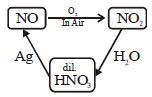
B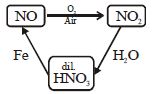
C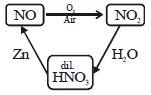
D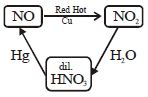
Solution
(A) The reaction cycle for the production and interconversion of nitrogen oxides is as follows:
$1$. $NO$ reacts with $O_2$ in air to form $NO_2$: $2NO + O_2 \rightarrow 2NO_2$.
$2$. $NO_2$ reacts with water to form nitric acid: $3NO_2 + H_2O \rightarrow 2HNO_3 + NO$.
$3$. Dilute nitric acid $(HNO_3)$ reacts with dilute metals like copper $(Cu)$ or silver $(Ag)$ to produce $NO$. Specifically,$3Ag + 4HNO_3 \text{ (dilute)} \rightarrow 3AgNO_3 + NO + 2H_2O$.
Comparing this with the given options,option $A$ correctly represents the cycle where $Ag$ reacts with dilute $HNO_3$ to produce $NO$.
$1$. $NO$ reacts with $O_2$ in air to form $NO_2$: $2NO + O_2 \rightarrow 2NO_2$.
$2$. $NO_2$ reacts with water to form nitric acid: $3NO_2 + H_2O \rightarrow 2HNO_3 + NO$.
$3$. Dilute nitric acid $(HNO_3)$ reacts with dilute metals like copper $(Cu)$ or silver $(Ag)$ to produce $NO$. Specifically,$3Ag + 4HNO_3 \text{ (dilute)} \rightarrow 3AgNO_3 + NO + 2H_2O$.
Comparing this with the given options,option $A$ correctly represents the cycle where $Ag$ reacts with dilute $HNO_3$ to produce $NO$.
0 likes
View Solution587
DifficultMCQ
$P_4O_{10}$ reacts with $HNO_3$ to give:
A
$N_2O, H_3PO_2$
B
$N_2O_3, H_3PO_4$
C
$NO_2, HPO_3$
D
$N_2O_5, HPO_3$
Solution
(D) $P_4O_{10}$ is a strong dehydrating agent.
When it reacts with concentrated $HNO_3$,it dehydrates the acid to form its anhydride,$N_2O_5$,and phosphoric acid derivative,$HPO_3$.
The balanced chemical equation is:
$4 HNO_3 + P_4O_{10} \rightarrow 2 N_2O_5 + 4 HPO_3$
When it reacts with concentrated $HNO_3$,it dehydrates the acid to form its anhydride,$N_2O_5$,and phosphoric acid derivative,$HPO_3$.
The balanced chemical equation is:
$4 HNO_3 + P_4O_{10} \rightarrow 2 N_2O_5 + 4 HPO_3$
0 likes
View Solution588
EasyMCQ
Laughing gas is prepared by heating
A
$NH_4Cl + NaNO_3$
B
$NH_4Cl$
C
$NH_4NO_3$
D
$Pb(NO_3)_2$
Solution
(C) Laughing gas $(N_2O)$ is prepared by the thermal decomposition of ammonium nitrate $(NH_4NO_3)$.
The reaction is: $NH_4NO_3 \xrightarrow{\Delta} N_2O + 2H_2O$.
Alternatively,it can be prepared by heating a mixture of $NH_4Cl$ and $NaNO_3$ as they react to form $NH_4NO_3$ in situ,which then decomposes to produce $N_2O$.
The reaction is: $NH_4NO_3 \xrightarrow{\Delta} N_2O + 2H_2O$.
Alternatively,it can be prepared by heating a mixture of $NH_4Cl$ and $NaNO_3$ as they react to form $NH_4NO_3$ in situ,which then decomposes to produce $N_2O$.
0 likes
View Solution589
EasyMCQ
Which oxide is least acidic?
A
$P_4O_6$
B
$P_4O_{10}$
C
$As_4O_6$
D
$As_4O_{10}$
Solution
(C) The acidic character of non-metallic oxides increases with an increase in the oxidation state of the central atom and decreases down the group as metallic character increases.
Comparing the oxidation states: $P$ in $P_4O_6$ is $+3$,$P$ in $P_4O_{10}$ is $+5$,$As$ in $As_4O_6$ is $+3$,and $As$ in $As_4O_{10}$ is $+5$.
Since $As$ is more metallic than $P$,its oxides are less acidic than the corresponding oxides of $P$.
Between $As_4O_6$ and $As_4O_{10}$,$As_4O_6$ has a lower oxidation state $(+3 < +5)$,making it the least acidic among the given options.
Comparing the oxidation states: $P$ in $P_4O_6$ is $+3$,$P$ in $P_4O_{10}$ is $+5$,$As$ in $As_4O_6$ is $+3$,and $As$ in $As_4O_{10}$ is $+5$.
Since $As$ is more metallic than $P$,its oxides are less acidic than the corresponding oxides of $P$.
Between $As_4O_6$ and $As_4O_{10}$,$As_4O_6$ has a lower oxidation state $(+3 < +5)$,making it the least acidic among the given options.
0 likes
View Solution590
DifficultMCQ
The reaction of elemental $P_4$ and aqueous $NaOH$ gives
A
$PH_3, \, NaH_2PO_2$
B
$PH_3, \, Na_3PO_4$
C
$NaHPO_4, \, Na_3PO_4$
D
$Na_3P, \, Na_3PO_4$
Solution
(A) The reaction of white phosphorus $(P_4)$ with aqueous sodium hydroxide $(NaOH)$ is a disproportionation reaction.
The balanced chemical equation is:
$P_4 + 3NaOH + 3H_2O \longrightarrow PH_3 + 3NaH_2PO_2$
In this reaction,phosphorus is simultaneously oxidized and reduced.
$PH_3$ is phosphine and $NaH_2PO_2$ is sodium hypophosphite.
The balanced chemical equation is:
$P_4 + 3NaOH + 3H_2O \longrightarrow PH_3 + 3NaH_2PO_2$
In this reaction,phosphorus is simultaneously oxidized and reduced.
$PH_3$ is phosphine and $NaH_2PO_2$ is sodium hypophosphite.
0 likes
View Solution591
MediumMCQ
Which of the following is a true acidic anhydride?
A
$CO$
B
$NO$
C
$ClO_2$
D
$N_2O_5$
Solution
(D) An acidic anhydride is an oxide that reacts with water to form an acid.
$N_2O_5$ is the anhydride of nitric acid $(HNO_3)$.
The reaction is: $N_2O_5 + H_2O \longrightarrow 2HNO_3$.
$CO$ and $NO$ are neutral oxides,while $ClO_2$ is a mixed anhydride.
$N_2O_5$ is the anhydride of nitric acid $(HNO_3)$.
The reaction is: $N_2O_5 + H_2O \longrightarrow 2HNO_3$.
$CO$ and $NO$ are neutral oxides,while $ClO_2$ is a mixed anhydride.
0 likes
View Solution592
DifficultMCQ
Impure phosphine is combustible due to the presence of:
A
$P_2H_4$
B
$N_2$
C
$PH_5$
D
$P_2O_5$
Solution
(A) Pure phosphine $(PH_3)$ is non-flammable. However,it becomes inflammable due to the presence of impurities like diphosphine $(P_2H_4)$ or white phosphorus $(P_4)$ vapours.
0 likes
View Solution593
DifficultMCQ
$\underbrace{2NO + O_2}_{(X)} \rightleftharpoons \underbrace{2NO_2}_{(Y)} \underset{heat}{\overset{cold}{\longleftrightarrow}} \underbrace{N_2O_4}_{(Z)}$
$X, Y$ and $Z$ can be described as:
$X, Y$ and $Z$ can be described as:
A
$X \to$ Colourless,$Y \to$ Brown,paramagnetic,$Z \to$ Colourless,diamagnetic
B
$X \to$ Brown,$Y \to$ Colourless,diamagnetic,$Z \to$ Brown,paramagnetic
C
$X \to$ Colourless,$Y \to$ Colourless,paramagnetic,$Z \to$ Brown,diamagnetic
D
$X \to$ Brown,$Y \to$ Brown,paramagnetic,$Z \to$ Brown,diamagnetic
Solution
(A) $X$ $(2NO + O_2)$ consists of colourless gases.
$Y$ $(NO_2)$ is a brown-coloured gas and is paramagnetic due to the presence of an odd electron.
$Z$ $(N_2O_4)$ is a colourless solid or liquid and is diamagnetic because all electrons are paired.
$Y$ $(NO_2)$ is a brown-coloured gas and is paramagnetic due to the presence of an odd electron.
$Z$ $(N_2O_4)$ is a colourless solid or liquid and is diamagnetic because all electrons are paired.
0 likes
View Solution594
MediumMCQ
Which of the following does not produce $NO_2$ gas with concentrated $HNO_3$?
A
$Cu$
B
$I_2$
C
$Ag$
D
$Au$
Solution
(D) $Au$ (Gold) is a noble metal and is chemically inert towards concentrated $HNO_3$.
$Cu$ and $Ag$ react with concentrated $HNO_3$ to produce $NO_2$ gas.
$I_2$ is oxidized by concentrated $HNO_3$ to $HIO_3$ along with the evolution of $NO_2$ gas.
$Cu$ and $Ag$ react with concentrated $HNO_3$ to produce $NO_2$ gas.
$I_2$ is oxidized by concentrated $HNO_3$ to $HIO_3$ along with the evolution of $NO_2$ gas.
0 likes
View Solution595
MediumMCQ
When bauxite powder is mixed with coke and heated with nitrogen at $2075 \ K$,carbon monoxide and $x$ are formed. Which gas is produced when $x$ reacts with water?
A
$NH_3$
B
$N_2$
C
$N_2O$
D
$O_2$
Solution
(A) The reaction of bauxite $(Al_2O_3)$ with coke $(C)$ and nitrogen $(N_2)$ at $2075 \ K$ is:
$Al_2O_3 + 3C + N_2 \xrightarrow{2075 \ K} 2AlN + 3CO$
Here,$x$ is aluminium nitride $(AlN)$.
When $AlN$ reacts with water,it undergoes hydrolysis to produce ammonia gas:
$AlN + 3H_2O \rightarrow Al(OH)_3 + NH_3 \uparrow$
Thus,the gas produced is $NH_3$.
$Al_2O_3 + 3C + N_2 \xrightarrow{2075 \ K} 2AlN + 3CO$
Here,$x$ is aluminium nitride $(AlN)$.
When $AlN$ reacts with water,it undergoes hydrolysis to produce ammonia gas:
$AlN + 3H_2O \rightarrow Al(OH)_3 + NH_3 \uparrow$
Thus,the gas produced is $NH_3$.
0 likes
View Solution596
EasyMCQ
In which of the following does aluminum become passive?
A
Concentrated $HNO_3$
B
$H_2CrO_4$
C
$HClO_4$
D
All of these
Solution
(D) Aluminum becomes passive in concentrated oxidizing acids because it forms a thin,protective,non-porous layer of oxide $(Al_2O_3)$ on its surface. This layer prevents further reaction of the metal with the acid. Concentrated $HNO_3$,$H_2CrO_4$,and $HClO_4$ are all strong oxidizing agents that cause this passivation.
0 likes
View Solution597
MediumMCQ
Which of the following ions does not exist in an aqueous solution?
A
$Pb^{2+}$
B
$Sn^{4+}$
C
$B^{3+}$
D
$Ti^{4+}$
Solution
(C) The ionization energy of $B$ is very high. The sum of the first three ionization enthalpies of boron is extremely large,which is not compensated by the hydration energy of the $B^{3+}$ ion. Therefore,the $B^{3+}$ ion does not exist in an aqueous solution.
0 likes
View Solution598
MediumMCQ
Which of the following represents the correct order of the inert pair effect in Group $13$ elements?
A
$B < Al < Ga < In < Tl$
B
$Tl > In > Ga > Al > B$
C
$Ga < In < Tl < B < Al$
D
$Be \approx Al > Ga > Tl > In$
Solution
(A) The inert pair effect is the tendency of the two electrons in the outermost $s$-orbital to remain unshared in compounds due to the poor shielding effect of intervening $d$ and $f$ orbitals.
As we move down the group from $B$ to $Tl$,the inert pair effect increases.
Therefore,the stability of the $+1$ oxidation state increases down the group,while the stability of the $+3$ oxidation state decreases.
The correct order of the inert pair effect for Group $13$ elements is $B < Al < Ga < In < Tl$.
As we move down the group from $B$ to $Tl$,the inert pair effect increases.
Therefore,the stability of the $+1$ oxidation state increases down the group,while the stability of the $+3$ oxidation state decreases.
The correct order of the inert pair effect for Group $13$ elements is $B < Al < Ga < In < Tl$.
0 likes
View Solution599
MediumMCQ
Which of the following metals does not exhibit the inert pair effect?
A
Indium
B
Aluminium
C
Gallium
D
Thallium
Solution
(B) The inert pair effect is the tendency of the two electrons in the outermost $s$-orbital to remain unshared in compounds of post-transition metals. This effect becomes more prominent as we move down the group in the $p$-block elements. $Aluminium$ $(Al)$ belongs to group $13$ and is the first member of the group. It does not exhibit the inert pair effect because it lacks the $d$ or $f$ orbitals that would shield the $s$-electrons from the nucleus,and it is too small to have a stable $+1$ oxidation state. Therefore,$Al$ typically shows a $+3$ oxidation state.
0 likes
View Solution600
EasyMCQ
All alums contain ......
A
One monovalent and one trivalent metal
B
Both monovalent metals
C
One divalent and one monovalent metal
D
Both divalent metals
Solution
(A) Alums are double salts with the general formula $M^I M^{III} (SO_4)_2 \cdot 12H_2O$,where $M^I$ is a monovalent metal ion (like $K^+$,$Na^+$,$NH_4^+$) and $M^{III}$ is a trivalent metal ion (like $Al^{3+}$,$Cr^{3+}$,$Fe^{3+}$). Therefore,all alums contain one monovalent and one trivalent metal.
0 likes
View Solutionp-Block Elements (Class 12) — Nitrogen family · Frequently Asked Questions
1Are these p-Block Elements (Class 12) questions useful for JEE and NEET?
Yes. All questions in this section are mapped to JEE Main and NEET exam patterns. Previous year questions from JEE Main, NEET, GUJCET and state-level exams are included with full solutions.
2Can I switch to Hindi or Gujarati for these questions?
Yes. Use the language tabs in the hero section or the sidebar to view the same questions and solutions in English, Hindi or Gujarati.
3How do I generate a question paper from this subtopic?
Use the Vedclass Exam Paper Generator — select the chapter and subtopic, set difficulty, and generate Sets A, B, C, D automatically. First 3 chapters of every subject are free.
Vedclass Products
For Students
Vedclass Test Series
Mock tests in real JEE/NEET style with performance analysis. 5-day free trial.
Start Free TrialFor Teachers
Exam Paper Generator
Generate Set A/B/C/D papers from this chapter in 2 minutes. 3 chapters free.
Try FreeFor Institutes
Online Exam Module
Live online exams with unlimited students, 360° analytics & white-label branding.
See DemoFor Teachers & Institutes
Generate a p-Block Elements (Class 12) Exam Paper in 2 Minutes
Select subtopic & difficulty — Sets A, B, C, D auto-generated with No Repeat logic.
First 3 chapters of every subject are free — no payment required.