
A English
Nitrogen family Questions in English
Class 12 Chemistry · p-Block Elements (Class 12) · Nitrogen family
1110+
Questions
English
Language
100%
With Solutions
Showing 50 of 1110 questions in English
451
EasyMCQ
$Fe$ is made passive by
A
dil. $H_2SO_4$
B
dil. $HCl$
C
conc. $HNO_3$
D
conc. $H_2SO_4$
Solution
(C) Iron $(Fe)$ becomes passive when treated with concentrated nitric acid $(conc. HNO_3)$.
This is due to the formation of a thin,protective,and non-reactive oxide layer $(Fe_2O_3)$ on the surface of the metal,which prevents further reaction with the acid.
This is due to the formation of a thin,protective,and non-reactive oxide layer $(Fe_2O_3)$ on the surface of the metal,which prevents further reaction with the acid.
0 likes
View Solution452
MediumMCQ
Mercury $(II)$ chloride solution on reaction with gaseous ammonia forms:
A
$Hg(NH_2)Cl$
B
$Hg(NH_3)_2Cl_2$
C
$[Hg(NH_3)_4]Cl_2$
D
$[Hg(NH_3)_2]Cl$
Solution
(A) Mercury $(II)$ chloride reacts with gaseous ammonia to form a white precipitate of amino mercury $(II)$ chloride,also known as infusible white precipitate.
The chemical reaction is: $HgCl_2 + 2NH_3 \rightarrow Hg(NH_2)Cl + NH_4Cl$.
The chemical reaction is: $HgCl_2 + 2NH_3 \rightarrow Hg(NH_2)Cl + NH_4Cl$.
0 likes
View Solution453
EasyMCQ
Dilute nitric acid on reaction with silver liberates
A
$NO$ gas
B
$NO_2$ gas
C
$N_2$ gas
D
$O_2$ gas
Solution
(A) Silver reacts with dilute nitric acid to liberate nitric oxide $(NO)$ gas.
$3Ag + 4HNO_3 (\text{dil}) \rightarrow 3AgNO_3 + 2H_2O + NO \uparrow$
$3Ag + 4HNO_3 (\text{dil}) \rightarrow 3AgNO_3 + 2H_2O + NO \uparrow$
0 likes
View Solution454
DifficultMCQ
Dinitrogen and dioxygen are main constituents of air but these do not react with each other to form oxides of nitrogen because .......................
A
the reaction is endothermic and requires very high temperature
B
the reaction can be initiated only in presence of a catalyst
C
oxides of nitrogen are unstable
D
$N_2$ and $O_2$ are unreactive
Solution
(A) The atmosphere consists mainly of dinitrogen $(N_2)$ and dioxygen $(O_2)$.
$N_2$ contains a very strong triple bond $(N \equiv N)$,which requires a significant amount of energy to break (high dissociation energy).
Therefore,the reaction between $N_2$ and $O_2$ is highly endothermic and only occurs at extremely high temperatures (e.g.,during lightning or in internal combustion engines).
$N_{2(g)} + O_{2(g)} \xrightarrow{3000\,^{\circ}C} 2 NO_{(g)}$
$N_2$ contains a very strong triple bond $(N \equiv N)$,which requires a significant amount of energy to break (high dissociation energy).
Therefore,the reaction between $N_2$ and $O_2$ is highly endothermic and only occurs at extremely high temperatures (e.g.,during lightning or in internal combustion engines).
$N_{2(g)} + O_{2(g)} \xrightarrow{3000\,^{\circ}C} 2 NO_{(g)}$
0 likes
View Solution455
EasyMCQ
Which of the following statements is $NOT$ true for both white and red phosphorus?
A
Both are soluble in $CS_2$.
B
Both undergo oxidation upon heating in air.
C
Both consist of the same type of atoms.
D
Both can be converted into each other.
Solution
(A) White phosphorus is soluble in $CS_2$,whereas red phosphorus is insoluble in $CS_2$. Therefore,the statement that both are soluble in $CS_2$ is incorrect.
0 likes
View Solution456
MediumMCQ
Which of the following oxides is the least acidic?
A
$P_4O_6$
B
$P_4O_{10}$
C
$As_4O_6$
D
$As_4O_{10}$
Solution
(C) The acidity of oxides decreases down the group as the metallic character increases. Therefore,oxides of $As$ are less acidic than oxides of $P$.
Furthermore,for the same element,the acidity increases with an increase in the oxidation state of the central atom.
Comparing the given oxides:
$P_4O_{10}$ ($P$ in $+5$ state) is more acidic than $P_4O_6$ ($P$ in $+3$ state).
$As_4O_{10}$ ($As$ in $+5$ state) is more acidic than $As_4O_6$ ($As$ in $+3$ state).
Since $As$ is less electronegative than $P$,$As_4O_6$ is the least acidic among the given options.
Furthermore,for the same element,the acidity increases with an increase in the oxidation state of the central atom.
Comparing the given oxides:
$P_4O_{10}$ ($P$ in $+5$ state) is more acidic than $P_4O_6$ ($P$ in $+3$ state).
$As_4O_{10}$ ($As$ in $+5$ state) is more acidic than $As_4O_6$ ($As$ in $+3$ state).
Since $As$ is less electronegative than $P$,$As_4O_6$ is the least acidic among the given options.
0 likes
View Solution457
EasyMCQ
Which of the following forms of phosphorus is thermodynamically the most stable?
A
Red
B
White
C
Black
D
All are equally stable
Solution
(C) Black phosphorus is the most stable and inert allotrope of phosphorus under standard conditions.
0 likes
View Solution458
EasyMCQ
Which of the following statements is true for $PH_3$?
A
It is less basic than $NH_3$.
B
It is less toxic than $NH_3$.
C
The electronegativity of $N$ is higher than $P$.
D
It has a stronger reducing property.
Solution
(A) $PH_3$ is less basic than $NH_3$ because the lone pair on $P$ is present in a larger orbital,making it less available for donation. Additionally,$PH_3$ acts as a stronger reducing agent compared to $NH_3$ due to the weaker $P-H$ bond.
0 likes
View Solution459
EasyMCQ
Which of the following substances is the most acidic?
A
$P_2O_3$
B
$Sb_2O_3$
C
$Bi_2O_3$
D
$As_2O_3$
Solution
(A) For the oxides of elements in group $15$,the acidic strength decreases as we move down the group.
Since $P$ is at the top of the group,its oxide $P_2O_3$ is the most acidic among the given options.
Since $P$ is at the top of the group,its oxide $P_2O_3$ is the most acidic among the given options.
0 likes
View Solution460
MediumMCQ
Nitrogen forms $N_2$,but phosphorus is converted from $P_2$ to $P_4$. Which of the following is the reason for this?
A
Existence of triple bonds between phosphorus atoms.
B
$P-P$ single bond is weaker than $P \equiv P$ bond.
C
$P-P$ single bond is stronger than $P \equiv P$ bond.
D
Multiple bonding occurs easily.
Solution
(B) Nitrogen forms a stable $N \equiv N$ triple bond due to effective $p\pi - p\pi$ overlapping,which is possible because of its small size.
In the case of phosphorus,the atomic size is larger,making $p\pi - p\pi$ overlapping ineffective.
Therefore,phosphorus prefers to form three $P-P$ single bonds rather than one $P \equiv P$ triple bond.
As a result,phosphorus exists as $P_4$ molecules where each phosphorus atom is linked by single bonds.
In the case of phosphorus,the atomic size is larger,making $p\pi - p\pi$ overlapping ineffective.
Therefore,phosphorus prefers to form three $P-P$ single bonds rather than one $P \equiv P$ triple bond.
As a result,phosphorus exists as $P_4$ molecules where each phosphorus atom is linked by single bonds.
0 likes
View Solution461
MediumMCQ
Why is nitrogen chemically inert?
A
High electronegativity of nitrogen
B
Absence of bond polarity
C
Short inter-nuclear distance
D
High bond dissociation energy
Solution
(D) Nitrogen is chemically inert due to the very high bond dissociation energy of the $N \equiv N$ triple bond.
0 likes
View Solution462
EasyMCQ
Which of the following is an oxoacid?
A
$Ba(OH)_2$
B
$Mg(OH)_2$
C
$H_3PO_3$
D
$HCl$
Solution
(C) An oxoacid is an acid that contains oxygen.
$H_3PO_3$ (phosphorous acid) contains oxygen and is an oxoacid.
$Ba(OH)_2$ and $Mg(OH)_2$ are basic hydroxides.
$HCl$ is a binary acid (hydracid) and does not contain oxygen.
$H_3PO_3$ (phosphorous acid) contains oxygen and is an oxoacid.
$Ba(OH)_2$ and $Mg(OH)_2$ are basic hydroxides.
$HCl$ is a binary acid (hydracid) and does not contain oxygen.
0 likes
View Solution463
EasyMCQ
What are the number of $P - O - P$ bridges in phosphorus pentoxide and phosphorus trioxide,respectively?
A
$6, 6$
B
$5, 5$
C
$5, 6$
D
$6, 5$
Solution
(A) The structure of phosphorus trioxide $(P_4O_6)$ consists of $4$ phosphorus atoms at the corners of a tetrahedron,with $6$ oxygen atoms bridging the $P-P$ edges,resulting in $6$ $P - O - P$ bridges.
Similarly,the structure of phosphorus pentoxide $(P_4O_{10})$ consists of $4$ phosphorus atoms at the corners of a tetrahedron,with $6$ oxygen atoms bridging the $P-P$ edges and $4$ additional oxygen atoms attached to each phosphorus atom via a double bond,also resulting in $6$ $P - O - P$ bridges.
Therefore,both have $6$ $P - O - P$ bridges.
Similarly,the structure of phosphorus pentoxide $(P_4O_{10})$ consists of $4$ phosphorus atoms at the corners of a tetrahedron,with $6$ oxygen atoms bridging the $P-P$ edges and $4$ additional oxygen atoms attached to each phosphorus atom via a double bond,also resulting in $6$ $P - O - P$ bridges.
Therefore,both have $6$ $P - O - P$ bridges.
0 likes
View Solution464
EasyMCQ
When $KNO_3$ is heated with concentrated $H_2SO_4$,brown fumes are evolved. These fumes are due to:
A
$SO_2$
B
$SO_3$
C
$NO_2$
D
$NO$
Solution
(C) The reaction between $KNO_3$ and concentrated $H_2SO_4$ produces $HNO_3$:
$KNO_3 + H_2SO_4 \xrightarrow{\Delta} KHSO_4 + HNO_3$
Upon further heating,$HNO_3$ undergoes thermal decomposition to produce brown fumes of nitrogen dioxide $(NO_2)$:
$4HNO_3 \xrightarrow{\Delta} 4NO_2 + 2H_2O + O_2$
Therefore,the brown fumes are due to $NO_2$.
$KNO_3 + H_2SO_4 \xrightarrow{\Delta} KHSO_4 + HNO_3$
Upon further heating,$HNO_3$ undergoes thermal decomposition to produce brown fumes of nitrogen dioxide $(NO_2)$:
$4HNO_3 \xrightarrow{\Delta} 4NO_2 + 2H_2O + O_2$
Therefore,the brown fumes are due to $NO_2$.
0 likes
View Solution465
MediumMCQ
During which of the following processes is phosphine $(PH_3)$ $NOT$ obtained?
A
When white phosphorus is heated with $NaOH$.
B
When red phosphorus is heated with $NaOH$.
C
When $Ca_3P_2$ reacts with water.
D
When $PH_4I$ is boiled with $KOH$.
Solution
(B) White phosphorus reacts with $NaOH$ to produce $PH_3$.
$Ca_3P_2$ undergoes hydrolysis to produce $PH_3$.
$PH_4I$ reacts with $KOH$ to produce $PH_3$.
Red phosphorus is chemically inert towards alkalis and does not react with $NaOH$ to produce $PH_3$.
$Ca_3P_2$ undergoes hydrolysis to produce $PH_3$.
$PH_4I$ reacts with $KOH$ to produce $PH_3$.
Red phosphorus is chemically inert towards alkalis and does not react with $NaOH$ to produce $PH_3$.
0 likes
View Solution466
MediumMCQ
What is produced when white phosphorus is boiled with a strong solution of caustic soda?
A
Sodium phosphide
B
Sodium phosphate
C
Phosphine
D
Red phosphorus
Solution
(C) When white phosphorus $(P_4)$ is boiled with a strong solution of caustic soda $(NaOH)$,it undergoes disproportionation to form phosphine $(PH_3)$ and sodium hypophosphite $(NaH_2PO_2)$.
The chemical equation is: $P_4 + 3NaOH + 3H_2O \to PH_3 + 3NaH_2PO_2$.
Thus,the product formed is phosphine $(PH_3)$.
The chemical equation is: $P_4 + 3NaOH + 3H_2O \to PH_3 + 3NaH_2PO_2$.
Thus,the product formed is phosphine $(PH_3)$.
0 likes
View Solution467
EasyMCQ
Which of the following pentahalides is $NOT$ formed?
A
$PF_5$
B
$AsF_5$
C
$SbF_5$
D
$BiF_5$
Solution
(D) Due to the inert pair effect,the stability of the $+5$ oxidation state decreases down the group $15$.
$Bi$ (Bismuth) is the heaviest element in the group,and its $+3$ oxidation state is much more stable than its $+5$ oxidation state.
Therefore,$Bi$ does not form a stable pentahalide like $BiF_5$ under normal conditions; instead,it prefers to form trihalides.
$Bi$ (Bismuth) is the heaviest element in the group,and its $+3$ oxidation state is much more stable than its $+5$ oxidation state.
Therefore,$Bi$ does not form a stable pentahalide like $BiF_5$ under normal conditions; instead,it prefers to form trihalides.
0 likes
View Solution468
EasyMCQ
Which element of group $15$ forms the most basic compound with hydrogen?
A
Nitrogen
B
Bismuth
C
Arsenic
D
Phosphorus
Solution
(A) Among the group $15$ hydrides $(NH_3, PH_3, AsH_3, SbH_3, BiH_3)$,the basic strength decreases down the group.
This is because the lone pair on the central atom is more concentrated in a smaller orbital for $N$ $(NH_3)$,making it the most available for donation.
Therefore,$NH_3$ (ammonia) is the most basic compound.
This is because the lone pair on the central atom is more concentrated in a smaller orbital for $N$ $(NH_3)$,making it the most available for donation.
Therefore,$NH_3$ (ammonia) is the most basic compound.
0 likes
View Solution469
DifficultMCQ
In the hydrides of the nitrogen group,the $H-M-H$ bond angle gradually approaches $90^o$ as we move from $N$ to $Sb$. This indicates that gradually.....
A
The basic character of the hydrides increases.
B
Almost pure $p$-orbitals are used in $M-H$ bonding.
C
The bond strength of the $M-H$ bond increases.
D
The bond pair of electrons moves closer to the central atom.
Solution
(B) As we move down the group,the electronegativity of the central atom decreases.
Consequently,the bond pair of electrons moves away from the central atom.
This results in a decrease in the $H-M-H$ bond angle,which approaches $90^o$.
This indicates that the $M-H$ bonds involve almost pure $p$-orbitals,as there is very little hybridization.
Consequently,the bond pair of electrons moves away from the central atom.
This results in a decrease in the $H-M-H$ bond angle,which approaches $90^o$.
This indicates that the $M-H$ bonds involve almost pure $p$-orbitals,as there is very little hybridization.
0 likes
View Solution470
EasyMCQ
Which of the following oxoacids of phosphorus has the lowest oxidation state of phosphorus?
A
Hypophosphorous acid
B
Orthophosphoric acid
C
Pyrophosphoric acid
D
Metaphosphoric acid
Solution
(A) The oxidation states of phosphorus in the given oxoacids are as follows:
$1$. Hypophosphorous acid $(H_3PO_2)$: $3(+1) + x + 2(-2) = 0 \implies x = +1$.
$2$. Orthophosphoric acid $(H_3PO_4)$: $3(+1) + x + 4(-2) = 0 \implies x = +5$.
$3$. Pyrophosphoric acid $(H_4P_2O_7)$: $4(+1) + 2x + 7(-2) = 0 \implies 2x = +10 \implies x = +5$.
$4$. Metaphosphoric acid $(HPO_3)$: $1(+1) + x + 3(-2) = 0 \implies x = +5$.
Thus,hypophosphorous acid has the lowest oxidation state of $+1$.
$1$. Hypophosphorous acid $(H_3PO_2)$: $3(+1) + x + 2(-2) = 0 \implies x = +1$.
$2$. Orthophosphoric acid $(H_3PO_4)$: $3(+1) + x + 4(-2) = 0 \implies x = +5$.
$3$. Pyrophosphoric acid $(H_4P_2O_7)$: $4(+1) + 2x + 7(-2) = 0 \implies 2x = +10 \implies x = +5$.
$4$. Metaphosphoric acid $(HPO_3)$: $1(+1) + x + 3(-2) = 0 \implies x = +5$.
Thus,hypophosphorous acid has the lowest oxidation state of $+1$.
0 likes
View Solution471
EasyMCQ
In which of the following ranges does nitrogen exhibit its various oxidation states?
A
$-5$ to $+5$
B
$-3$ to $+3$
C
$-5$ to $+3$
D
$-3$ to $+5$
Solution
(D) Nitrogen exhibits various oxidation states ranging from $-3$ to $+5$.
0 likes
View Solution472
EasyMCQ
Which of the following statements is $NOT$ true?
A
$NCl_3$ undergoes hydrolysis to give $HOCl$.
B
$PH_3$ is less stable than $NH_3$.
C
$NH_3$ is a weaker reducing agent than $PH_3$.
D
Nitric oxide $(NO)$ shows diamagnetism in the solid state.
Solution
(C) $NCl_3$ undergoes hydrolysis to give $NH_3$ and $HOCl$ $(NCl_3 + 3H_2O \rightarrow NH_3 + 3HOCl)$.
$PH_3$ is less stable than $NH_3$ due to the smaller size of the $N$ atom compared to the $P$ atom.
$NH_3$ is a weaker reducing agent than $PH_3$ because the $N-H$ bond is stronger than the $P-H$ bond.
Nitric oxide $(NO)$ is paramagnetic in the gaseous state due to the presence of an unpaired electron,but it forms a dimer $(N_2O_2)$ in the solid state,which is diamagnetic.
Therefore,all statements are technically true in their respective contexts,but statement $C$ is often phrased as $NH_3$ being a weaker reducing agent,which is correct. Upon reviewing the options,if the question implies a false statement,there might be a typo in the source. However,based on standard chemistry,all these statements are factually correct.
$PH_3$ is less stable than $NH_3$ due to the smaller size of the $N$ atom compared to the $P$ atom.
$NH_3$ is a weaker reducing agent than $PH_3$ because the $N-H$ bond is stronger than the $P-H$ bond.
Nitric oxide $(NO)$ is paramagnetic in the gaseous state due to the presence of an unpaired electron,but it forms a dimer $(N_2O_2)$ in the solid state,which is diamagnetic.
Therefore,all statements are technically true in their respective contexts,but statement $C$ is often phrased as $NH_3$ being a weaker reducing agent,which is correct. Upon reviewing the options,if the question implies a false statement,there might be a typo in the source. However,based on standard chemistry,all these statements are factually correct.
0 likes
View Solution473
EasyMCQ
Phosphine is obtained by the reaction of which of the following?
A
$P$ and $H_2SO_4$
B
$P$ and $NaOH$
C
$P$ and $H_2S$
D
$P$ and $HNO_3$
Solution
(B) Phosphine $(PH_3)$ is prepared by heating white phosphorus with concentrated sodium hydroxide solution $(NaOH)$ in an inert atmosphere of $CO_2$.
The chemical reaction is:
$P_4 + 3NaOH + 3H_2O \to 3NaH_2PO_2 + PH_3$
Thus,the correct option is $B$.
The chemical reaction is:
$P_4 + 3NaOH + 3H_2O \to 3NaH_2PO_2 + PH_3$
Thus,the correct option is $B$.
0 likes
View Solution474
MediumMCQ
In $P_4O_6$,how many oxygen atoms are attached to each phosphorus atom?
A
$1.5$
B
$2$
C
$3$
D
$4$
Solution
(C) The structure of $P_4O_6$ consists of four phosphorus atoms at the corners of a tetrahedron. Each phosphorus atom is bonded to three oxygen atoms,which bridge the phosphorus atoms. Thus,each phosphorus atom is attached to $3$ oxygen atoms.
0 likes
View Solution475
MediumMCQ
What is formed when $PCl_3$ reacts with water?
A
$PH_3$
B
$H_3PO_4$
C
$POCl_3$
D
$H_2PO_3$
Solution
(B) The hydrolysis of phosphorus trichloride $(PCl_3)$ with water proceeds as follows:
$PCl_3 + 3H_2O \to H_3PO_3 + 3HCl$
Note: $PCl_3$ reacts with water to form phosphorous acid $(H_3PO_3)$ and hydrogen chloride $(HCl)$.
$PCl_3 + 3H_2O \to H_3PO_3 + 3HCl$
Note: $PCl_3$ reacts with water to form phosphorous acid $(H_3PO_3)$ and hydrogen chloride $(HCl)$.
0 likes
View Solution476
EasyMCQ
What is the formula of metaphosphoric acid?
A
$H_3PO_4$
B
$HPO_3$
C
$H_3PO_3$
D
$H_4P_2O_7$
Solution
(B) The formula of metaphosphoric acid is $HPO_3$. It is formed by the dehydration of orthophosphoric acid $(H_3PO_4)$.
0 likes
View Solution477
EasyMCQ
What is the basicity of orthophosphoric acid?
A
$2$
B
$3$
C
$4$
D
$5$
Solution
(B) The chemical formula of orthophosphoric acid is $H_3PO_4$.
In its structure,there are three $P-OH$ bonds.
The basicity of an oxoacid is determined by the number of $P-OH$ groups present in its structure,as these hydrogen atoms are ionizable.
Since $H_3PO_4$ has three $P-OH$ groups,it is tribasic,meaning its basicity is $3$.
In its structure,there are three $P-OH$ bonds.
The basicity of an oxoacid is determined by the number of $P-OH$ groups present in its structure,as these hydrogen atoms are ionizable.
Since $H_3PO_4$ has three $P-OH$ groups,it is tribasic,meaning its basicity is $3$.
0 likes
View Solution478
EasyMCQ
Which of the following oxides is the anhydride of orthophosphoric acid?
A
$P_4O_{10}$
B
$P_2O_5$
C
$P_4O_6$
D
$P_2O_3$
Solution
(A) The reaction of phosphorus pentoxide with water is given by:
$P_4O_{10} + 6H_2O \to 4H_3PO_4$
Here,$H_3PO_4$ is orthophosphoric acid.
Thus,$P_4O_{10}$ is the anhydride of orthophosphoric acid.
$P_4O_{10} + 6H_2O \to 4H_3PO_4$
Here,$H_3PO_4$ is orthophosphoric acid.
Thus,$P_4O_{10}$ is the anhydride of orthophosphoric acid.
0 likes
View Solution479
EasyMCQ
The atomic number of nitrogen is $7$. What will be the atomic number of the third member of the nitrogen family?
A
$23$
B
$15$
C
$33$
D
$43$
Solution
(C) The atomic number of nitrogen $(N)$ is $7$.
The nitrogen family belongs to group $15$. The atomic numbers of the members are determined by adding the magic numbers $8, 18, 18, 32$.
First member $(N)$: $Z = 7$
Second member $(P)$: $Z = 7 + 8 = 15$
Third member $(As)$: $Z = 15 + 18 = 33$
Therefore,the atomic number of the third member is $33$.
The nitrogen family belongs to group $15$. The atomic numbers of the members are determined by adding the magic numbers $8, 18, 18, 32$.
First member $(N)$: $Z = 7$
Second member $(P)$: $Z = 7 + 8 = 15$
Third member $(As)$: $Z = 15 + 18 = 33$
Therefore,the atomic number of the third member is $33$.
0 likes
View Solution480
EasyMCQ
The molecular formula of an acid of phosphorus is $H_3PO_2$. What are its name and basicity,respectively?
A
Phosphoric acid and two
B
Hypophosphorous acid and two
C
Hypophosphorous acid and one
D
Hypophosphoric acid and two
Solution
(C) The molecular formula $H_3PO_2$ corresponds to hypophosphorous acid.
In its structure,there is only one $P-OH$ bond,which means only one hydrogen atom is ionizable.
Therefore,its basicity is $1$ (monobasic).
In its structure,there is only one $P-OH$ bond,which means only one hydrogen atom is ionizable.
Therefore,its basicity is $1$ (monobasic).
0 likes
View Solution481
MediumMCQ
Which of the following is the structural formula of hypophosphorous acid?
A
B
C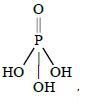
D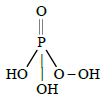
Solution
(A) Hypophosphorous acid,also known as phosphinic acid,has the chemical formula $H_3PO_2$.
In its structure,the phosphorus atom is bonded to one oxygen atom via a double bond $(P=O)$,two hydrogen atoms directly $(P-H)$,and one hydroxyl group $(P-OH)$.
This corresponds to the structure shown in option $A$.
In its structure,the phosphorus atom is bonded to one oxygen atom via a double bond $(P=O)$,two hydrogen atoms directly $(P-H)$,and one hydroxyl group $(P-OH)$.
This corresponds to the structure shown in option $A$.
0 likes
View Solution482
EasyMCQ
What is the product obtained when orthophosphoric acid $(H_3PO_4)$ is heated to a high temperature?
A
$PH_3$
B
$P_2O_5$
C
$H_3PO_3$
D
$HPO_3$
Solution
(D) When orthophosphoric acid $(H_3PO_4)$ is heated to a high temperature (approx. $600 \ ^oC$),it undergoes dehydration to form metaphosphoric acid $(HPO_3)$.
The chemical reaction is:
$H_3PO_4 \xrightarrow{600 \ ^oC} HPO_3 + H_2O$
The chemical reaction is:
$H_3PO_4 \xrightarrow{600 \ ^oC} HPO_3 + H_2O$
0 likes
View Solution483
EasyMCQ
Which of the following substances is a deliquescent ionic solid?
A
$BrF_5$
B
$S_4N_4$
C
$N_2O_5$
D
$NO$
Solution
(C) $N_2O_5$ is a colorless,deliquescent ionic solid.
0 likes
View Solution484
EasyMCQ
Pure $HNO_3$ is a colorless liquid,but it turns light brown in the presence of light. This is due to its decomposition into which of the following substances in small amounts?
A
$NO, NO_2$
B
$NO_2, O_2$
C
$NO, O_2$
D
$N_2O_5, O_2$
Solution
(B) Pure $HNO_3$ is a colorless liquid. On exposure to light,it undergoes decomposition to form nitrogen dioxide $(NO_2)$,which dissolves in the remaining $HNO_3$ and imparts a light brown color to it.
The decomposition reaction is:
$4HNO_3 \xrightarrow{hv} 4NO_2 + O_2 + 2H_2O$
The decomposition reaction is:
$4HNO_3 \xrightarrow{hv} 4NO_2 + O_2 + 2H_2O$
0 likes
View Solution485
EasyMCQ
Which of the following processes is used for the production of $HNO_3$ to obtain a good yield?
A
Ostwald process
B
Haber process
C
Birkeland-Eyde process
D
Hall process
Solution
(A) The $HNO_3$ is produced on a large scale by the Ostwald process,which provides a good yield.
0 likes
View Solution486
EasyMCQ
Which of the following molecules is stable,does not undergo hydrolysis by water,and has a very low tendency to act as a donor?
A
$NBr_3$
B
$NCl_3$
C
$NF_3$
D
$NI_3$
Solution
(C) $NF_3$ is the only stable trihalide of nitrogen.
It does not undergo hydrolysis by water because the $N-F$ bond is very strong and the nitrogen atom is sterically hindered by three fluorine atoms.
Additionally,due to the high electronegativity of fluorine,the lone pair on nitrogen is not easily available for donation,making it a very poor donor.
It does not undergo hydrolysis by water because the $N-F$ bond is very strong and the nitrogen atom is sterically hindered by three fluorine atoms.
Additionally,due to the high electronegativity of fluorine,the lone pair on nitrogen is not easily available for donation,making it a very poor donor.
0 likes
View Solution487
MediumMCQ
Which allotropic form of phosphorus is the most stable,least reactive,and possesses a graphite-like structure?
A
White phosphorus
B
Red phosphorus
C
Black phosphorus
D
Scarlet phosphorus
Solution
(C) Among the allotropes of phosphorus,$Black \ phosphorus$ is the most stable and least reactive form.
It possesses a layered structure similar to $Graphite$,which allows it to conduct electricity.
It possesses a layered structure similar to $Graphite$,which allows it to conduct electricity.
0 likes
View Solution488
EasyMCQ
Which of the following molecules contains the highest number of $P-H$ bonds?
A
$H_4P_2O_7$
B
$H_3PO_2$
C
$H_3PO_3$
D
$H_3PO_4$
Solution
(B) To determine the number of $P-H$ bonds,we examine the structures of the given oxoacids of phosphorus:
$1$. $H_4P_2O_7$ (Pyrophosphoric acid): It has zero $P-H$ bonds.
$2$. $H_3PO_2$ (Hypophosphorous acid): It has two $P-H$ bonds.
$3$. $H_3PO_3$ (Phosphorous acid): It has one $P-H$ bond.
$4$. $H_3PO_4$ (Orthophosphoric acid): It has zero $P-H$ bonds.
Comparing these,$H_3PO_2$ contains the highest number of $P-H$ bonds,which is $2$.
$1$. $H_4P_2O_7$ (Pyrophosphoric acid): It has zero $P-H$ bonds.
$2$. $H_3PO_2$ (Hypophosphorous acid): It has two $P-H$ bonds.
$3$. $H_3PO_3$ (Phosphorous acid): It has one $P-H$ bond.
$4$. $H_3PO_4$ (Orthophosphoric acid): It has zero $P-H$ bonds.
Comparing these,$H_3PO_2$ contains the highest number of $P-H$ bonds,which is $2$.
0 likes
View Solution489
EasyMCQ
Under which of the following conditions can active nitrogen be produced by passing $N_2$ gas through an electric spark?
A
At very low pressure (at $2 \ mm$ of $Hg$)
B
At high pressure
C
At very low temperature
D
At atmospheric pressure
Solution
(A) Active nitrogen is produced by passing $N_2$ gas through an electric spark at very low pressure (at $2 \ mm$ of $Hg$).
0 likes
View Solution490
MediumMCQ
Which of the following oxides of nitrogen is a mixed anhydride of two acids?
A
$N_2O$
B
$NO$
C
$N_2O_4$
D
$NO_2$
Solution
(C) The oxide $N_2O_4$ (dinitrogen tetroxide) acts as a mixed anhydride of nitrous acid $(HNO_2)$ and nitric acid $(HNO_3)$.
The chemical reaction is:
$N_2O_4 + H_2O \to HNO_2 + HNO_3$
The chemical reaction is:
$N_2O_4 + H_2O \to HNO_2 + HNO_3$
0 likes
View Solution491
MediumMCQ
Which of the following statements is incorrect for nitrogen dioxide $(NO_2)$?
A
It is the anhydride of nitrous acid.
B
It is not paramagnetic.
C
It does not undergo dimerization.
D
Its dipole moment is $0.12 \ D$.
0 likes
View Solution492
MediumMCQ
$N_2O_3$ is a/an.......
A
acidic oxide and is the anhydride of $HNO_2$.
B
acidic oxide and is the anhydride of $H_2N_2O_2$.
C
neutral oxide and is the anhydride of $HNO_3$.
D
basic oxide and is the anhydride of $HNO_2$.
Solution
(A) $N_2O_3$ is an acidic oxide and is the anhydride of nitrous acid $(HNO_2)$.
The reaction is as follows:
$2HNO_2 \to N_2O_3 + H_2O$
The reaction is as follows:
$2HNO_2 \to N_2O_3 + H_2O$
0 likes
View Solution493
MediumMCQ
What is the product of the reaction between $HNO_3$ and $P_4O_{10}$?
A
$N_2O_5$
B
$NO_2$
C
$N_2O_4$
D
$N_2O$
Solution
(A) The reaction between nitric acid $(HNO_3)$ and phosphorus pentoxide $(P_4O_{10})$ is a dehydration reaction.
$P_4O_{10}$ acts as a strong dehydrating agent.
The balanced chemical equation is:
$4HNO_3 + P_4O_{10} \to 2N_2O_5 + 4HPO_3$
Thus,the product formed is dinitrogen pentoxide $(N_2O_5)$.
$P_4O_{10}$ acts as a strong dehydrating agent.
The balanced chemical equation is:
$4HNO_3 + P_4O_{10} \to 2N_2O_5 + 4HPO_3$
Thus,the product formed is dinitrogen pentoxide $(N_2O_5)$.
0 likes
View Solution494
MediumMCQ
Which of the following substances does not produce ammonia upon heating?
A
Alkaline $NH_4Cl$
B
$(NH_4)_2SO_4$
C
All of the above
D
$NH_4NO_2$
Solution
(D) Heating $NH_4NO_2$ results in the evolution of nitrogen gas,not ammonia.
The reaction is: $NH_4NO_2 \to N_2 + 2H_2O$.
In contrast,alkaline $NH_4Cl$ and $(NH_4)_2SO_4$ produce $NH_3$ when heated with a base or under specific conditions.
The reaction is: $NH_4NO_2 \to N_2 + 2H_2O$.
In contrast,alkaline $NH_4Cl$ and $(NH_4)_2SO_4$ produce $NH_3$ when heated with a base or under specific conditions.
0 likes
View Solution495
EasyMCQ
$FeSO_4$ forms a brown ring with which of the following?
A
$NO_2$
B
$N_2O_3$
C
$NO$
D
$N_2O_5$
Solution
(C) $FeSO_4$ reacts with $NO$ to form a hydrated nitrosyl complex $[Fe(H_2O)_5NO]SO_4$,which is responsible for the brown ring observed in the test.
0 likes
View Solution496
EasyMCQ
Pure $N_2$ gas is obtained from which of the following?
A
$NH_3 + NaNO_2$
B
$NH_4Cl + NaNO_2$
C
$N_2O + Cu$
D
$(NH_4)_2Cr_2O_7$
Solution
(B) Pure $N_2$ gas is prepared by the thermal decomposition of sodium azide or barium azide. However,in the laboratory,it is prepared by heating an aqueous solution of ammonium chloride and sodium nitrite:
$NH_4Cl(aq) + NaNO_2(aq) \to N_2(g) + 2H_2O(l) + NaCl(aq)$
This reaction produces pure $N_2$ gas.
$NH_4Cl(aq) + NaNO_2(aq) \to N_2(g) + 2H_2O(l) + NaCl(aq)$
This reaction produces pure $N_2$ gas.
0 likes
View Solution497
EasyMCQ
Which of the following statements is not true for nitrogen?
A
It has a very high electronegativity.
B
$d-$ orbitals are available for bonding.
C
It is a typical non-metal.
D
It has a small molecular size.
Solution
(B) Nitrogen does not have $d-$ orbitals available for bonding,which is why it cannot expand its octet.
0 likes
View Solution498
EasyMCQ
Which of the following is $NOT$ true for $N_2O$?
A
It is called laughing gas.
B
It is nitrous oxide.
C
It is not a linear molecule.
D
It is the least reactive among all oxides of nitrogen.
Solution
(C) $N_2O$ (nitrous oxide) is a linear molecule with the structure $N \equiv N^+ - O^- \leftrightarrow N^- = N^+ = O$.
Since the statement in option $C$ claims it is not a linear molecule,it is the incorrect statement.
Since the statement in option $C$ claims it is not a linear molecule,it is the incorrect statement.
0 likes
View Solution499
EasyMCQ
$NH_3$ is $NOT$ used in which of the following?
A
Cold storage
B
Production of nitric acid
C
None of these
D
As an anesthetic in medicines
Solution
(D) $NH_3$ (ammonia) is used as a refrigerant in cold storage and as a starting material for the production of nitric acid $(HNO_3)$ via the Ostwald process.
It is $NOT$ used as an anesthetic in medicines.
It is $NOT$ used as an anesthetic in medicines.
0 likes
View Solution500
EasyMCQ
Which of the following statements is $NOT$ correct?
A
Ammonia is used as a refrigerant.
B
The mixture of $CaCN_2$ and $C$ is called nitrolim.
C
The mixture of $Ca(H_2PO_4)_2$ and $CaSO_4 \cdot 2H_2O$ is called superphosphate of lime.
D
Hydrolysis of $NCl_3$ gives $NH_3$ and $HOCl$.
Solution
(C) Statement $C$ is incorrect because the formula for superphosphate of lime is $Ca(H_2PO_4)_2$ and $CaSO_4 \cdot 2H_2O$,not $Ca(H_2SO_4)_2$. Statement $D$ is also incorrect as the hydrolysis of $NCl_3$ yields $NH_3$ and $HOCl$ is a common misconception; it actually produces $NH_3$ and $HOCl$ only in specific conditions,but the standard reaction is $NCl_3 + 3H_2O \rightarrow NH_3 + 3HOCl$. However,in many textbooks,the formula provided in option $C$ is chemically invalid ($Ca(H_2SO_4)_2$ does not exist as a standard compound),making $C$ the most clearly incorrect statement.
0 likes
View Solutionp-Block Elements (Class 12) — Nitrogen family · Frequently Asked Questions
1Are these p-Block Elements (Class 12) questions useful for JEE and NEET?
Yes. All questions in this section are mapped to JEE Main and NEET exam patterns. Previous year questions from JEE Main, NEET, GUJCET and state-level exams are included with full solutions.
2Can I switch to Hindi or Gujarati for these questions?
Yes. Use the language tabs in the hero section or the sidebar to view the same questions and solutions in English, Hindi or Gujarati.
3How do I generate a question paper from this subtopic?
Use the Vedclass Exam Paper Generator — select the chapter and subtopic, set difficulty, and generate Sets A, B, C, D automatically. First 3 chapters of every subject are free.
Vedclass Products
For Students
Vedclass Test Series
Mock tests in real JEE/NEET style with performance analysis. 5-day free trial.
Start Free TrialFor Teachers
Exam Paper Generator
Generate Set A/B/C/D papers from this chapter in 2 minutes. 3 chapters free.
Try FreeFor Institutes
Online Exam Module
Live online exams with unlimited students, 360° analytics & white-label branding.
See DemoFor Teachers & Institutes
Generate a p-Block Elements (Class 12) Exam Paper in 2 Minutes
Select subtopic & difficulty — Sets A, B, C, D auto-generated with No Repeat logic.
First 3 chapters of every subject are free — no payment required.