
A English
Polyhalogenated compounds Questions in English
Class 12 Chemistry · Haloalkanes and Haloarenes · Polyhalogenated compounds
78+
Questions
English
Language
100%
With Solutions
Showing 26 of 78 questions in English
51
Medium
Explain in detail about Freons.
Solution
(N/A) Freons: The chlorofluorocarbon compounds of methane and ethane are collectively known as Freons. They are extremely stable,unreactive,non-toxic,non-corrosive,and easily liquefiable gases. The most common representative is $CCl_2F_2$,which is known as Freon-$12$.
$(b)$ Properties: Freons are colorless,odorless,and non-corrosive. They do not cause corrosion to metals.
$(c)$ Uses: Freon-$12$ is the most widely used Freon in industries. It is manufactured from tetrachloromethane by the Swarts reaction. They are used as aerosol propellants,refrigerants,and in air conditioning systems.
$(d)$ Environmental Impact: Freons released into the atmosphere initiate free radical chain reactions that can disturb the natural ozone balance in the stratosphere.
$(b)$ Properties: Freons are colorless,odorless,and non-corrosive. They do not cause corrosion to metals.
$(c)$ Uses: Freon-$12$ is the most widely used Freon in industries. It is manufactured from tetrachloromethane by the Swarts reaction. They are used as aerosol propellants,refrigerants,and in air conditioning systems.
$(d)$ Environmental Impact: Freons released into the atmosphere initiate free radical chain reactions that can disturb the natural ozone balance in the stratosphere.
0 likes
View Solution52
Medium
Write a note on $DDT$.
Solution
(N/A) $DDT$ (p,p'-dichlorodiphenyltrichloroethane) is the first chlorinated organic insecticide.
It was originally prepared in $1873$,but its effectiveness as an insecticide was discovered in $1939$ by Paul Muller of Geigy Pharmaceuticals in Switzerland.
For this discovery,Paul Muller was awarded the Nobel Prize in Medicine and Physiology in $1948$.
The chemical structure of $DDT$ is as follows:
(Structure: Two chlorobenzene rings attached to a central carbon atom,which is also bonded to a hydrogen atom and a trichloromethyl group $-CCl_3$).
It was originally prepared in $1873$,but its effectiveness as an insecticide was discovered in $1939$ by Paul Muller of Geigy Pharmaceuticals in Switzerland.
For this discovery,Paul Muller was awarded the Nobel Prize in Medicine and Physiology in $1948$.
The chemical structure of $DDT$ is as follows:
(Structure: Two chlorobenzene rings attached to a central carbon atom,which is also bonded to a hydrogen atom and a trichloromethyl group $-CCl_3$).
0 likes
View Solution53
Medium
Write the preparation,properties,problems,and uses of $DDT$.
Solution
(A) Preparation: $DDT$ is prepared by the reaction of chloral with chlorobenzene in the presence of concentrated sulfuric acid.
$(b)$ Discovery: It is the first chlorinated organic insecticide. It was originally prepared in $1873$,and its effectiveness as an insecticide was discovered by Paul $M$üller of Geigy Pharmaceuticals in Switzerland in $1939$. Paul $M$üller was awarded the Nobel Prize in Medicine and Physiology in $1948$ for this discovery.
$(c)$ Properties: $(i)$ $DDT$ is a white solid. $(ii)$ It has a strong chlorine odor and causes eye irritation. $(iii)$ Ingestion may lead to cancer.
$(d)$ Uses: It was and is highly useful as an insecticide. It was effective in destroying mosquitoes that spread malaria and lice that spread typhus. Consequently,its use became widespread globally after World War $II$.
$(e)$ Problems and Disadvantages: Problems emerged in the late $1940$s due to excessive use. Many insect species developed resistance to $DDT$,and it proved highly toxic to fish. The problem was compounded by its chemical stability and fat solubility. $DDT$ is not metabolized rapidly; instead,it accumulates in fatty tissues. If ingestion continues,its concentration increases over time. The United States banned its use in $1973$,although it is still used in many parts of the world.
$(b)$ Discovery: It is the first chlorinated organic insecticide. It was originally prepared in $1873$,and its effectiveness as an insecticide was discovered by Paul $M$üller of Geigy Pharmaceuticals in Switzerland in $1939$. Paul $M$üller was awarded the Nobel Prize in Medicine and Physiology in $1948$ for this discovery.
$(c)$ Properties: $(i)$ $DDT$ is a white solid. $(ii)$ It has a strong chlorine odor and causes eye irritation. $(iii)$ Ingestion may lead to cancer.
$(d)$ Uses: It was and is highly useful as an insecticide. It was effective in destroying mosquitoes that spread malaria and lice that spread typhus. Consequently,its use became widespread globally after World War $II$.
$(e)$ Problems and Disadvantages: Problems emerged in the late $1940$s due to excessive use. Many insect species developed resistance to $DDT$,and it proved highly toxic to fish. The problem was compounded by its chemical stability and fat solubility. $DDT$ is not metabolized rapidly; instead,it accumulates in fatty tissues. If ingestion continues,its concentration increases over time. The United States banned its use in $1973$,although it is still used in many parts of the world.
0 likes
View Solution54
MediumMCQ
Why does iodoform have an appreciable antiseptic property?
A
It is a strong oxidizing agent.
B
It liberates free iodine.
C
It is a strong reducing agent.
D
It is highly soluble in water.
Solution
(B) The antiseptic property of iodoform $(CHI_3)$ is due to the liberation of free iodine.
When applied to the skin,it slowly decomposes to release iodine,which acts as an antiseptic agent.
When applied to the skin,it slowly decomposes to release iodine,which acts as an antiseptic agent.
0 likes
View Solution55
Medium
What are the $IUPAC$ names of the insecticide $DDT$ and benzenehexachloride? Why is their use banned in India and other countries?
Solution
(N/A) The $IUPAC$ name of $DDT$ is $1,1,1-\text{trichloro}-2,2-\text{bis}(4-\text{chlorophenyl})\text{ethane}$.
The $IUPAC$ name of benzenehexachloride $(BHC)$ is $1,2,3,4,5,6-\text{hexachlorocyclohexane}$.
Their use is banned because these substances are non-biodegradable and highly toxic.
Furthermore,they are lipophilic,meaning they accumulate in the fatty tissues of organisms and undergo biomagnification,leading to increased concentrations as they move up the food chain.
The $IUPAC$ name of benzenehexachloride $(BHC)$ is $1,2,3,4,5,6-\text{hexachlorocyclohexane}$.
Their use is banned because these substances are non-biodegradable and highly toxic.
Furthermore,they are lipophilic,meaning they accumulate in the fatty tissues of organisms and undergo biomagnification,leading to increased concentrations as they move up the food chain.
0 likes
View Solution56
Medium
Match the structures in Column-$I$ with their common names in Column-$II$ and $IUPAC$ names in Column-$III$.
| Column-$I$ (Structure) | Column-$II$ (Common Name) and Column-$III$ ($IUPAC$ Name) |
| $A$. $CH_3Cl$ | $iv$. Methyl chloride; $s$. Chloromethane |
| $B$. $CH_2Cl_2$ | $iii$. Methylene dichloride; $q$. Dichloromethane |
| $C$. $CHCl_3$ | $ii$. Chloroform; $p$. Trichloromethane |
| $D$. $CCl_4$ | $i$. Carbon tetrachloride; $r$. Tetrachloromethane |
Solution
(A) The correct matches are:
$A \rightarrow (iv, s)$
$B \rightarrow (iii, q)$
$C \rightarrow (ii, p)$
$D \rightarrow (i, r)$
$A \rightarrow (iv, s)$
$B \rightarrow (iii, q)$
$C \rightarrow (ii, p)$
$D \rightarrow (i, r)$
0 likes
View Solution57
Difficult
State the adverse effects of polyhalogenated compounds. How can the adverse effects of chlorofluorocarbons be prevented?
Solution
(N/A) $(i)$ Methylene dichloride: Exposure to lower levels of methylene chloride in air causes dizziness,nausea,tingling,and numbness in the fingers and toes. In humans,direct skin contact with methylene chloride causes intense burning and mild redness of the skin. Direct contact with the eyes can burn the cornea.
$(ii)$ Trichloromethane (Chloroform): Inhaling chloroform depresses the central nervous system. Breathing about $900 \ ppm$ of chloroform for a short time can cause dizziness,fatigue,and headache. Chronic chloroform exposure may cause damage to the liver,where it is metabolized to phosgene,and to the kidneys. $2 CHCl_{3} + O_{2} \xrightarrow{\text{Light / Oxidation}} 2 COCl_{2} + 2 HCl$. Chloroform is slowly oxidized by air in the presence of light to form an extremely poisonous gas; therefore,it is stored in closed,dark-colored bottles completely filled to exclude air.
$(iii)$ Tetrachloromethane $(CCl_{4})$: Exposure to carbon tetrachloride causes liver cancer in humans. Common effects include dizziness,lightheadedness,nausea,and vomiting,which can cause permanent damage to nerve cells. In severe cases,it leads to stupor,coma,or death. It can cause irregular heartbeat and eye irritation. When released into the air,it rises to the atmosphere and depletes the ozone layer,increasing human exposure to $UV$ rays,which leads to skin cancer and immune system disruption.
$(iv)$ Freons: In the stratosphere,freons initiate radical chain reactions that upset the natural ozone balance.
Prevention of adverse effects of $CFCs$: $CFCs$ are highly stable and non-reactive. They initiate chemical chain reactions that disturb the ozone layer. It is recommended that $CFCs$ used in refrigerators be replaced by other environmentally friendly compounds.
$(ii)$ Trichloromethane (Chloroform): Inhaling chloroform depresses the central nervous system. Breathing about $900 \ ppm$ of chloroform for a short time can cause dizziness,fatigue,and headache. Chronic chloroform exposure may cause damage to the liver,where it is metabolized to phosgene,and to the kidneys. $2 CHCl_{3} + O_{2} \xrightarrow{\text{Light / Oxidation}} 2 COCl_{2} + 2 HCl$. Chloroform is slowly oxidized by air in the presence of light to form an extremely poisonous gas; therefore,it is stored in closed,dark-colored bottles completely filled to exclude air.
$(iii)$ Tetrachloromethane $(CCl_{4})$: Exposure to carbon tetrachloride causes liver cancer in humans. Common effects include dizziness,lightheadedness,nausea,and vomiting,which can cause permanent damage to nerve cells. In severe cases,it leads to stupor,coma,or death. It can cause irregular heartbeat and eye irritation. When released into the air,it rises to the atmosphere and depletes the ozone layer,increasing human exposure to $UV$ rays,which leads to skin cancer and immune system disruption.
$(iv)$ Freons: In the stratosphere,freons initiate radical chain reactions that upset the natural ozone balance.
Prevention of adverse effects of $CFCs$: $CFCs$ are highly stable and non-reactive. They initiate chemical chain reactions that disturb the ozone layer. It is recommended that $CFCs$ used in refrigerators be replaced by other environmentally friendly compounds.
0 likes
View Solution58
Medium
State the adverse effects of polyhalogenated compounds. How can the adverse effects of chlorofluorocarbons be prevented?
Solution
(N/A) $(i)$ Methylene dichloride: Exposure to lower levels of methylene chloride in air causes dizziness,nausea,tingling,and numbness in the fingers and toes. In humans,direct skin contact causes intense burning and mild redness. Direct contact with the eyes can burn the cornea.
$(ii)$ Trichloromethane (Chloroform): Inhaling chloroform depresses the central nervous system. Chronic exposure may cause damage to the liver and kidneys. It is slowly oxidized by air to the extremely poisonous gas phosgene $(COCl_2)$: $2CHCl_3 + O_2 \xrightarrow{\text{Light/Oxidation}} 2COCl_2 + 2HCl$. It is stored in closed,dark-colored bottles completely filled to exclude air.
$(iii)$ Tetrachloromethane $(CCl_4)$: Exposure causes liver cancer,dizziness,nausea,and permanent nerve cell damage. In severe cases,it leads to coma or death. It also depletes the ozone layer,increasing exposure to $UV$ rays,which leads to skin cancer and immune system disorders.
$(iv)$ Freons: In the stratosphere,freons initiate radical chain reactions that upset the natural ozone balance.
Prevention of adverse effects of $CFCs$: $CFCs$ are stable and non-reactive but deplete the ozone layer. It is recommended that $CFCs$ used in refrigerators be replaced by other environmentally friendly compounds.
$(ii)$ Trichloromethane (Chloroform): Inhaling chloroform depresses the central nervous system. Chronic exposure may cause damage to the liver and kidneys. It is slowly oxidized by air to the extremely poisonous gas phosgene $(COCl_2)$: $2CHCl_3 + O_2 \xrightarrow{\text{Light/Oxidation}} 2COCl_2 + 2HCl$. It is stored in closed,dark-colored bottles completely filled to exclude air.
$(iii)$ Tetrachloromethane $(CCl_4)$: Exposure causes liver cancer,dizziness,nausea,and permanent nerve cell damage. In severe cases,it leads to coma or death. It also depletes the ozone layer,increasing exposure to $UV$ rays,which leads to skin cancer and immune system disorders.
$(iv)$ Freons: In the stratosphere,freons initiate radical chain reactions that upset the natural ozone balance.
Prevention of adverse effects of $CFCs$: $CFCs$ are stable and non-reactive but deplete the ozone layer. It is recommended that $CFCs$ used in refrigerators be replaced by other environmentally friendly compounds.
0 likes
View Solution59
EasyMCQ
In the following halogenated organic compounds,the one with the maximum number of chlorine atoms in its structure is:
A
Chloral
B
Gammaxene
C
Chloropicrin
D
Freon $-12$
Solution
(B) To determine the number of chlorine atoms in each compound:
$1$. Chloral $(CCl_3CHO)$: Contains $3$ chlorine atoms.
$2$. Gammaxene (Benzene hexachloride,$C_6H_6Cl_6$): Contains $6$ chlorine atoms.
$3$. Chloropicrin $(CCl_3NO_2)$: Contains $3$ chlorine atoms.
$4$. Freon $-12$ $(CCl_2F_2)$: Contains $2$ chlorine atoms.
Comparing these,Gammaxene has the maximum number of chlorine atoms $(6)$.
Therefore,the correct option is $B$.
$1$. Chloral $(CCl_3CHO)$: Contains $3$ chlorine atoms.
$2$. Gammaxene (Benzene hexachloride,$C_6H_6Cl_6$): Contains $6$ chlorine atoms.
$3$. Chloropicrin $(CCl_3NO_2)$: Contains $3$ chlorine atoms.
$4$. Freon $-12$ $(CCl_2F_2)$: Contains $2$ chlorine atoms.
Comparing these,Gammaxene has the maximum number of chlorine atoms $(6)$.
Therefore,the correct option is $B$.
0 likes
View Solution60
EasyMCQ
Which of the following compounds is an example of Freon?
A
$CCl_2F_2$
B
$C_2HF_3$
C
$C_2H_2F_2$
D
$C_2F_4$
Solution
(A) Freons are chlorofluorocarbons of methane and ethane.
Among the given options,$CCl_2F_2$ (dichlorodifluoromethane) is a well-known Freon,specifically known as Freon-$12$.
Therefore,the correct option is $A$.
Among the given options,$CCl_2F_2$ (dichlorodifluoromethane) is a well-known Freon,specifically known as Freon-$12$.
Therefore,the correct option is $A$.
0 likes
View Solution61
EasyMCQ
What is the chemical formula of mustard gas?
A
$COCl_2$
B
$ClCH_2CH_2SCH_2CH_2Cl$
C
$CCl_3NO_2$
D
$CCl_2F_2$
Solution
(B) Mustard gas is a chemical warfare agent known as $2,2'$-dichlorodiethyl sulfide.
Its chemical formula is $ClCH_2CH_2SCH_2CH_2Cl$.
Its chemical formula is $ClCH_2CH_2SCH_2CH_2Cl$.
0 likes
View Solution62
EasyMCQ
Which of the following is the most commonly used refrigerant $Freon-12$?
A
Chlorofluoromethane
B
Dichlorodifluoromethane
C
Chlorodifluoromethane
D
Dichlorofluoromethane
Solution
(B) $Freon-12$ is the common name for the chemical compound $CCl_2F_2$.
Its $IUPAC$ name is $Dichlorodifluoromethane$.
It is widely used as a refrigerant in air conditioning and refrigeration systems.
Its $IUPAC$ name is $Dichlorodifluoromethane$.
It is widely used as a refrigerant in air conditioning and refrigeration systems.
0 likes
View Solution63
MediumMCQ
Which is the most commonly used refrigerant Freon-$12$?
A
Monochloromonofluoromethane
B
Dichlorodifluoromethane
C
Chlorodifluoromethane
D
Dichlorofluoromethane
Solution
(B) The correct answer is $B$. Dichlorodifluoromethane.
Freon-$12$,also known as dichlorodifluoromethane $(CCl_2F_2)$,is a commonly used refrigerant.
It was widely used in refrigeration and air conditioning systems for many years until its use was phased out due to concerns about ozone layer depletion.
Here is a quick explanation of the other options:
$-$ $A$. Monochloromonofluoromethane: This is not the correct structure for Freon-$12$.
$-$ $C$. Chlorodifluoromethane: This is Freon-$22$,not Freon-$12$.
$-$ $D$. Dichlorofluoromethane: This is not the correct chemical name for Freon-$12$.
Freon-$12$,also known as dichlorodifluoromethane $(CCl_2F_2)$,is a commonly used refrigerant.
It was widely used in refrigeration and air conditioning systems for many years until its use was phased out due to concerns about ozone layer depletion.
Here is a quick explanation of the other options:
$-$ $A$. Monochloromonofluoromethane: This is not the correct structure for Freon-$12$.
$-$ $C$. Chlorodifluoromethane: This is Freon-$22$,not Freon-$12$.
$-$ $D$. Dichlorofluoromethane: This is not the correct chemical name for Freon-$12$.
0 likes
View Solution64
EasyMCQ
Which among the following is used as refrigerants and for air conditioning?
A
Trichloromethane
B
Carbon tetrachloride
C
Dichloromethane
D
Dichlorodifluoromethane
Solution
(D) $CFC$s (Chlorofluorocarbons) are widely used as refrigerants in refrigerators and air conditioning systems.
$Dichlorodifluoromethane$ $(CCl_2F_2)$,also known as $Freon-12$,is a common $CFC$ used for this purpose.
$Dichlorodifluoromethane$ $(CCl_2F_2)$,also known as $Freon-12$,is a common $CFC$ used for this purpose.
0 likes
View Solution65
DifficultMCQ
Which of the following compounds is used to prepare the refrigerant $R-22$?
A
Monochloromethane
B
Dichloromethane
C
Trichloromethane
D
Tetrachloromethane
Solution
(C) The refrigerant $R-22$,also known as chlorodifluoromethane $(CHClF_2)$,is prepared by the reaction of trichloromethane $(CHCl_3)$,commonly known as chloroform,with hydrogen fluoride $(HF)$ in the presence of a catalyst.
The chemical reaction is: $CHCl_3 + 2HF \rightarrow CHClF_2 + 2HCl$.
The chemical reaction is: $CHCl_3 + 2HF \rightarrow CHClF_2 + 2HCl$.
0 likes
View Solution66
MediumMCQ
How many chlorine atoms are present in a molecule of $D.D.T.$?
A
$3$
B
$5$
C
$2$
D
$4$
Solution
(B) The chemical structure of $D.D.T.$ (dichlorodiphenyltrichloroethane) consists of two chlorobenzene rings attached to a central carbon atom,which is also bonded to a trichloromethyl group $(-CCl_3)$.
By examining the structure,we can count the chlorine atoms:
$1$. There is one chlorine atom on each of the two benzene rings ($2$ atoms).
$2$. There are three chlorine atoms on the terminal carbon atom ($3$ atoms).
Total number of chlorine atoms = $2 + 3 = 5$.
By examining the structure,we can count the chlorine atoms:
$1$. There is one chlorine atom on each of the two benzene rings ($2$ atoms).
$2$. There are three chlorine atoms on the terminal carbon atom ($3$ atoms).
Total number of chlorine atoms = $2 + 3 = 5$.
0 likes
View Solution67
MediumMCQ
Identify the structural formula of $DDT$.
A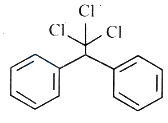
B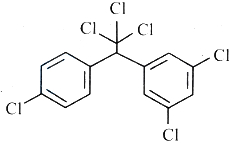
C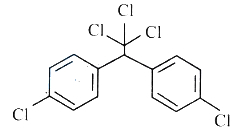
D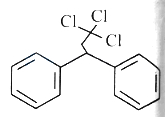
Solution
(C) $DDT$ stands for dichlorodiphenyltrichloroethane and it is a chemical compound with the formula $C_{14}H_9Cl_5$.
It is also called $1,1,1$-trichloro-$2,2$-bis($p$-chlorophenyl)ethane.
The structure consists of two $p$-chlorophenyl groups attached to a central carbon atom,which is also bonded to a hydrogen atom and a trichloromethyl group $(-CCl_3)$.
This matches the structure shown in option $C$.
It is also called $1,1,1$-trichloro-$2,2$-bis($p$-chlorophenyl)ethane.
The structure consists of two $p$-chlorophenyl groups attached to a central carbon atom,which is also bonded to a hydrogen atom and a trichloromethyl group $(-CCl_3)$.
This matches the structure shown in option $C$.
0 likes
View Solution68
EasyMCQ
Which of the following is the structural formula of $DDT$?
A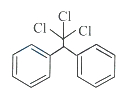
B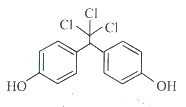
C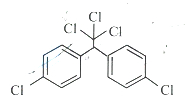
D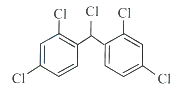
Solution
(C) $DDT$ stands for $p,p'$-dichlorodiphenyltrichloroethane.
Its structure consists of two $p$-chlorophenyl groups attached to a central carbon atom,which is also bonded to a hydrogen atom and a trichloromethyl group $(CCl_3)$.
This corresponds to the structure shown in option $C$.
Its structure consists of two $p$-chlorophenyl groups attached to a central carbon atom,which is also bonded to a hydrogen atom and a trichloromethyl group $(CCl_3)$.
This corresponds to the structure shown in option $C$.
0 likes
View Solution69
DifficultMCQ
Identify a compound having properties of tear gas.
A
$SOCl_2$
B
$COCl_2$
C
$Cl(CH_2)_2 S(CH_2)_2 Cl$
D
$CCl_3 NO_2$
Solution
(D) The compound commonly known as tear gas is chloropicrin,which has the chemical formula $CCl_3 NO_2$.
This compound is also known as trichloronitromethane.
It is used as a tear gas agent because it acts as a powerful lachrymator,causing severe irritation to the eyes and respiratory system.
This compound is also known as trichloronitromethane.
It is used as a tear gas agent because it acts as a powerful lachrymator,causing severe irritation to the eyes and respiratory system.
0 likes
View Solution70
EasyMCQ
Which among the following is the formula of mustard gas?
A
$COCl_2$
B
$SO_2Cl_2$
C
$S(CH_2CH_2Cl)_2$
D
$CCl_3NO_2$
Solution
(C) Mustard gas,also known as sulfur mustard,has the chemical formula $S(CH_2CH_2Cl)_2$.
It is a potent vesicant chemical warfare agent that causes severe blistering and burning of the skin,eyes,and respiratory tract.
It is a potent vesicant chemical warfare agent that causes severe blistering and burning of the skin,eyes,and respiratory tract.
0 likes
View Solution71
DifficultMCQ
Which among the following compounds contains the highest number of chlorine atoms in its single molecule?
A
Phosgene
B
Tear gas
C
Mustard gas
D
Phosphine
Solution
(B) The chemical formulas for the given compounds are:
$1$. Phosgene: $COCl_2$ (contains $2$ chlorine atoms)
$2$. Tear gas: $CCl_3NO_2$ (contains $3$ chlorine atoms)
$3$. Mustard gas: $(ClCH_2CH_2)_2S$ or $C_4H_8Cl_2S$ (contains $2$ chlorine atoms)
$4$. Phosphine: $PH_3$ (contains $0$ chlorine atoms)
Comparing the number of chlorine atoms,Tear gas $(CCl_3NO_2)$ contains the highest number of chlorine atoms $(3)$ in a single molecule.
$1$. Phosgene: $COCl_2$ (contains $2$ chlorine atoms)
$2$. Tear gas: $CCl_3NO_2$ (contains $3$ chlorine atoms)
$3$. Mustard gas: $(ClCH_2CH_2)_2S$ or $C_4H_8Cl_2S$ (contains $2$ chlorine atoms)
$4$. Phosphine: $PH_3$ (contains $0$ chlorine atoms)
Comparing the number of chlorine atoms,Tear gas $(CCl_3NO_2)$ contains the highest number of chlorine atoms $(3)$ in a single molecule.
0 likes
View Solution72
EasyMCQ
Which statement is incorrect for tetra-chloromethane $(CCl_4)$?
A
It causes red rashes if it comes in direct contact with the skin.
B
At high temperatures,it reacts with water to form phosgene.
C
It is used for extinguishing fires in substances like oil and petrol.
D
It is insoluble in water and has a sweet,aromatic smell.
Solution
(A) The correct answer is $A$. $CCl_4$ is a toxic substance that can cause liver damage and skin irritation,but it does not specifically cause 'red rashes' as a primary chemical property in the context of standard chemistry textbooks. Option $B$ is correct as $CCl_4$ reacts with water vapor at high temperatures to produce phosgene $(COCl_2)$,a highly toxic gas. Option $C$ is correct as $CCl_4$ was historically used in fire extinguishers (Pyrene extinguishers). Option $D$ is correct as $CCl_4$ is a non-polar solvent,making it insoluble in water,and it possesses a characteristic sweet,aromatic odor.
0 likes
View Solution73
EasyMCQ
Which of the following compounds can burn the cornea when it comes in direct contact with the eyes?
A
$CH_3Cl$
B
$CCl_4$
C
$CH_2Cl_2$
D
$CHCl_3$
Solution
(C) Dichloromethane $(CH_2Cl_2)$ is a volatile liquid that is used as a solvent and paint remover. When it comes in direct contact with the eyes,it can cause mild to moderate irritation and can burn the cornea. Therefore,the correct compound is $CH_2Cl_2$.
0 likes
View Solution74
EasyMCQ
The number of chlorine $(Cl)$ atoms in the structure of $DDT$ molecule is
A
$4$
B
$3$
C
$2$
D
$5$
Solution
(D) $DDT$ stands for $p,p'$-dichlorodiphenyltrichloroethane.
The chemical formula of $DDT$ is $(ClC_6H_4)_2CHCCl_3$.
In this structure,there are two chlorobenzene rings,each containing one chlorine atom at the para position,and a trichloromethyl group attached to the central carbon atom.
Total number of chlorine atoms = $2$ (from benzene rings) + $3$ (from the trichloromethyl group) = $5$.
The chemical formula of $DDT$ is $(ClC_6H_4)_2CHCCl_3$.
In this structure,there are two chlorobenzene rings,each containing one chlorine atom at the para position,and a trichloromethyl group attached to the central carbon atom.
Total number of chlorine atoms = $2$ (from benzene rings) + $3$ (from the trichloromethyl group) = $5$.
0 likes
View Solution75
MediumMCQ
Mustard gas among the following is
A
$CCl_3NO_2$
B
$ClCH_2CH_2SCH_2CH_2Cl$
C
$CH_3SH$
D
$H_2S$
Solution
(B) Mustard gas,also known as sulphur mustard,is a chemical compound belonging to the family of cytotoxic and blister agent chemical warfare agents.
The chemical formula of mustard gas is $C_4H_8Cl_2S$,and its structural formula is $ClCH_2CH_2SCH_2CH_2Cl$.
It can be synthesized by the reaction of ethylene with sulphur dichloride:
$2C_2H_4 + SCl_2 \rightarrow (ClCH_2CH_2)_2S$
The chemical formula of mustard gas is $C_4H_8Cl_2S$,and its structural formula is $ClCH_2CH_2SCH_2CH_2Cl$.
It can be synthesized by the reaction of ethylene with sulphur dichloride:
$2C_2H_4 + SCl_2 \rightarrow (ClCH_2CH_2)_2S$
0 likes
View Solution76
EasyMCQ
The chemical formula of 'tear gas' is
A
$COCl_2$
B
$CO_2$
C
$Cl_2$
D
$CCl_3NO_2$
Solution
(D) Tear gas is known as chloropicrin $(CCl_3NO_2)$.
It is prepared by the reaction of chloroform $(CHCl_3)$ with concentrated nitric acid $(HNO_3)$:
$CHCl_3 + HNO_3 \rightarrow CCl_3NO_2 + H_2O$
It is prepared by the reaction of chloroform $(CHCl_3)$ with concentrated nitric acid $(HNO_3)$:
$CHCl_3 + HNO_3 \rightarrow CCl_3NO_2 + H_2O$
0 likes
View SolutionHaloalkanes and Haloarenes — Polyhalogenated compounds · Frequently Asked Questions
1Are these Haloalkanes and Haloarenes questions useful for JEE and NEET?
Yes. All questions in this section are mapped to JEE Main and NEET exam patterns. Previous year questions from JEE Main, NEET, GUJCET and state-level exams are included with full solutions.
2Can I switch to Hindi or Gujarati for these questions?
Yes. Use the language tabs in the hero section or the sidebar to view the same questions and solutions in English, Hindi or Gujarati.
3How do I generate a question paper from this subtopic?
Use the Vedclass Exam Paper Generator — select the chapter and subtopic, set difficulty, and generate Sets A, B, C, D automatically. First 3 chapters of every subject are free.
Vedclass Products
For Students
Vedclass Test Series
Mock tests in real JEE/NEET style with performance analysis. 5-day free trial.
Start Free TrialFor Teachers
Exam Paper Generator
Generate Set A/B/C/D papers from this chapter in 2 minutes. 3 chapters free.
Try FreeFor Institutes
Online Exam Module
Live online exams with unlimited students, 360° analytics & white-label branding.
See DemoFor Teachers & Institutes
Generate a Haloalkanes and Haloarenes Exam Paper in 2 Minutes
Select subtopic & difficulty — Sets A, B, C, D auto-generated with No Repeat logic.
First 3 chapters of every subject are free — no payment required.