
A English
Chemical properties Questions in English
Class 12 Chemistry · d-and f-Block Elements · Chemical properties
135+
Questions
English
Language
100%
With Solutions
Showing 50 of 135 questions in English
51
EasyMCQ
Iron may be rendered passive by treatment with a concentrated solution of
A
$KSCN$
B
$H_2C_2O_4$
C
$Hg_2(NO_3)_2$
D
$HNO_3$
Solution
(D) Iron becomes passive when treated with concentrated nitric acid $(HNO_3)$.
This happens because a thin,protective,and non-porous layer of iron oxide $(Fe_2O_3)$ forms on the surface of the metal,which prevents further reaction with the acid.
This happens because a thin,protective,and non-porous layer of iron oxide $(Fe_2O_3)$ forms on the surface of the metal,which prevents further reaction with the acid.
0 likes
View Solution52
EasyMCQ
Correct order of oxidising nature is
A
$CrO_3 > MoO_3 > WO_3$
B
$MoO_3 > CrO_3 > WO_3$
C
$WO_3 > CrO_3 > MoO_3$
D
$CrO_3 > WO_3 > MoO_3$
Solution
(A) The oxidising nature of the trioxides of group $6$ elements depends on the stability of the lower oxidation states.
As we move down the group from $Cr$ to $W$,the stability of the $+6$ oxidation state increases,while the stability of lower oxidation states decreases.
Therefore,$CrO_3$ is a strong oxidising agent because $Cr$ prefers to be in the $+3$ oxidation state.
In contrast,$MoO_3$ and $WO_3$ are much less oxidising because $Mo$ and $W$ are more stable in the $+6$ oxidation state.
The correct order of oxidising nature is $CrO_3 > MoO_3 > WO_3$.
As we move down the group from $Cr$ to $W$,the stability of the $+6$ oxidation state increases,while the stability of lower oxidation states decreases.
Therefore,$CrO_3$ is a strong oxidising agent because $Cr$ prefers to be in the $+3$ oxidation state.
In contrast,$MoO_3$ and $WO_3$ are much less oxidising because $Mo$ and $W$ are more stable in the $+6$ oxidation state.
The correct order of oxidising nature is $CrO_3 > MoO_3 > WO_3$.
0 likes
View Solution53
DifficultMCQ
Highest oxidation state of manganese in fluoride is $+4$ $(MnF_4)$ but highest oxidation state in oxides is $+7$ $(Mn_2O_7)$ because $..........$
A
Fluorine is more electronegative than oxygen
B
Fluorine does not possess $d-$ orbitals
C
Fluorine stabilizes lower oxidation state
D
In covalent compounds fluorine can form single bond only while oxygen forms double bond
Solution
(D) The ability of an element to exhibit a higher oxidation state depends on its ability to form multiple bonds with the central metal atom.
Oxygen $(O)$ is capable of forming $p\pi-d\pi$ multiple bonds with transition metals,which stabilizes higher oxidation states.
In contrast,Fluorine $(F)$ can only form single covalent bonds $(F-M)$ and cannot form multiple bonds.
Therefore,oxygen can stabilize the $ 7$ oxidation state of manganese in $Mn_2O_7$,whereas fluorine can only stabilize up to the $ 4$ oxidation state in $MnF_4$.
Oxygen $(O)$ is capable of forming $p\pi-d\pi$ multiple bonds with transition metals,which stabilizes higher oxidation states.
In contrast,Fluorine $(F)$ can only form single covalent bonds $(F-M)$ and cannot form multiple bonds.
Therefore,oxygen can stabilize the $ 7$ oxidation state of manganese in $Mn_2O_7$,whereas fluorine can only stabilize up to the $ 4$ oxidation state in $MnF_4$.
0 likes
View Solution54
DifficultMCQ
Which of the following ions does not liberate hydrogen gas on reaction with dilute acids?
A
$Ti^{2+}$
B
$V^{2+}$
C
$Cr^{2+}$
D
$Mn^{2+}$
Solution
(D)
The liberation of hydrogen gas from dilute acids by metal ions depends on the reduction potential of the $M^{3+}/M^{2+}$ couple.
If the $E^o$ value is negative,the $M^{2+}$ ion can be oxidized to $M^{3+}$ while reducing $H^+$ to $H_2$ gas.
Among the given ions,$Mn^{2+}$ has a highly positive $E^o$ value $(+1.57 \ V)$,which means it is very stable and does not easily lose an electron to reduce $H^+$ ions.
Therefore,$Mn^{2+}$ does not liberate hydrogen gas.
| Ion | $E^o \ (M^{3+}/M^{2+}) \ (V)$ |
| $Ti^{2+}$ | $-0.37$ |
| $V^{2+}$ | $-0.26$ |
| $Cr^{2+}$ | $-0.41$ |
| $Mn^{2+}$ | $+1.57$ |
The liberation of hydrogen gas from dilute acids by metal ions depends on the reduction potential of the $M^{3+}/M^{2+}$ couple.
If the $E^o$ value is negative,the $M^{2+}$ ion can be oxidized to $M^{3+}$ while reducing $H^+$ to $H_2$ gas.
Among the given ions,$Mn^{2+}$ has a highly positive $E^o$ value $(+1.57 \ V)$,which means it is very stable and does not easily lose an electron to reduce $H^+$ ions.
Therefore,$Mn^{2+}$ does not liberate hydrogen gas.
0 likes
View Solution55
DifficultMCQ
Which of these statements is not true?
A
$NO^{+}$ is isoelectronic with $O_2$
B
$B$ is always covalent in its compounds
C
In aqueous solution,the $Ti^{+}$ ion is much more stable than $Ti(III)$
D
$LiAlH_4$ is a versatile reducing agent in organic synthesis
Solution
(C) $(a) \ NO^{+} = 7+8-1 = 14 \ e^-$. $O_2 = 16 \ e^-$. Thus,they are not isoelectronic. This statement is false.
$(b)$ Boron forms only covalent compounds due to its extremely high ionization energy. This statement is true.
$(c)$ In aqueous solution,$Ti^{3+}$ is more stable than $Ti^{+}$. This statement is false.
$(d) \ LiAlH_4$ is a well-known versatile reducing agent in organic synthesis. This statement is true.
Note: The question asks for the statement that is not true. Both $(a)$ and $(c)$ are technically false,but $(c)$ is a more standard textbook error regarding stability in aqueous media.
$(b)$ Boron forms only covalent compounds due to its extremely high ionization energy. This statement is true.
$(c)$ In aqueous solution,$Ti^{3+}$ is more stable than $Ti^{+}$. This statement is false.
$(d) \ LiAlH_4$ is a well-known versatile reducing agent in organic synthesis. This statement is true.
Note: The question asks for the statement that is not true. Both $(a)$ and $(c)$ are technically false,but $(c)$ is a more standard textbook error regarding stability in aqueous media.
1 likes
View Solution56
DifficultMCQ
Select the incorrect statement.
A
$s-$ block metal oxides are basic in nature except $BeO$ which is amphoteric.
B
Non-metal oxides are acidic in nature (except $NO, N_2O, CO, H_2O$).
C
In $d-$ block,all elements are metals.
D
$d-$ block metal oxides are only basic in nature.
Solution
(D) . $BeO$ is amphoteric in nature. It reacts with both acids and bases. Oxides of other $s-$ block metal elements are basic in nature and react only with acids.
$B$. The oxides $NO, N_2O, CO$ are neutral,while most other non-metal oxides are acidic.
$C$. All $d-$ block elements are transition metals.
$D$. This statement is incorrect because $d-$ block metal oxides exhibit a range of properties: some are basic,some are acidic,and others are amphoteric (e.g.,$CrO_3$ is acidic,$Cr_2O_3$ is amphoteric,and $CrO$ is basic).
$B$. The oxides $NO, N_2O, CO$ are neutral,while most other non-metal oxides are acidic.
$C$. All $d-$ block elements are transition metals.
$D$. This statement is incorrect because $d-$ block metal oxides exhibit a range of properties: some are basic,some are acidic,and others are amphoteric (e.g.,$CrO_3$ is acidic,$Cr_2O_3$ is amphoteric,and $CrO$ is basic).
0 likes
View Solution57
MediumMCQ
Ferrous sulphate on heating gives
A
$SO_2$ and $SO_3$
B
$SO_2$ only
C
$SO_3$ only
D
$H_2S$ only
Solution
(A) When ferrous sulphate heptahydrate $(FeSO_4 \cdot 7H_2O)$ is heated,it first loses water of crystallization to form anhydrous ferrous sulphate $(FeSO_4)$.
Upon further heating,anhydrous ferrous sulphate decomposes to form ferric oxide $(Fe_2O_3)$,sulphur dioxide $(SO_2)$,and sulphur trioxide $(SO_3)$.
The chemical reaction is as follows:
$2FeSO_4(s) \xrightarrow{\Delta} Fe_2O_3(s) + SO_2(g) + SO_3(g)$
Upon further heating,anhydrous ferrous sulphate decomposes to form ferric oxide $(Fe_2O_3)$,sulphur dioxide $(SO_2)$,and sulphur trioxide $(SO_3)$.
The chemical reaction is as follows:
$2FeSO_4(s) \xrightarrow{\Delta} Fe_2O_3(s) + SO_2(g) + SO_3(g)$
0 likes
View Solution58
EasyMCQ
Which of the following metal cation oxides is not amphoteric?
A
$Al_2O_3$
B
$Cr_2O_3$
C
$Fe_2O_3$
D
$ZnO$
Solution
(C) Amphoteric oxides are those that react with both acids and bases.
$Al_2O_3$ (Aluminum oxide),$Cr_2O_3$ (Chromium$(III)$ oxide),and $ZnO$ (Zinc oxide) are well-known amphoteric oxides.
$Fe_2O_3$ (Ferric oxide) is basic in nature and does not react with bases,hence it is not amphoteric.
$Al_2O_3$ (Aluminum oxide),$Cr_2O_3$ (Chromium$(III)$ oxide),and $ZnO$ (Zinc oxide) are well-known amphoteric oxides.
$Fe_2O_3$ (Ferric oxide) is basic in nature and does not react with bases,hence it is not amphoteric.
0 likes
View Solution59
EasyMCQ
Iron is rendered passive by treatment with
A
$H_2SO_4$ (dil.)
B
$H_2PO_4$
C
conc. $HNO_3$
D
$HCl$
Solution
(C) Iron becomes passive when treated with concentrated nitric acid $(conc. HNO_3)$.
This is due to the formation of a thin,protective,and non-reactive oxide layer $(Fe_2O_3)$ on the surface of the metal,which prevents further reaction with the acid.
This is due to the formation of a thin,protective,and non-reactive oxide layer $(Fe_2O_3)$ on the surface of the metal,which prevents further reaction with the acid.
0 likes
View Solution60
MediumMCQ
Passivity of iron is due to the formation of
A
$Fe_2O_3$
B
$Fe_3O_4$
C
$FeSO_4$
D
None of these
Solution
(A) The passivity of iron is caused by the formation of a thin,non-porous,and protective layer of oxide on its surface when it is treated with concentrated nitric acid $(HNO_3)$.
This protective layer is composed of ferric oxide $(Fe_2O_3)$.
This layer prevents further reaction of the metal with the acid,making the iron passive.
This protective layer is composed of ferric oxide $(Fe_2O_3)$.
This layer prevents further reaction of the metal with the acid,making the iron passive.
0 likes
View Solution61
MediumMCQ
Oxygen is absorbed by molten $Ag$,which is evolved on cooling and the silver particles are scattered,this phenomenon is known as
A
silvering of mirror
B
spitting of silver
C
frosting of silver
D
hairing of silver
Solution
(B) When molten silver absorbs oxygen,it dissolves in the liquid metal. Upon cooling,the solubility of oxygen decreases,and the gas is released. This rapid evolution of oxygen gas causes the surface of the solidifying silver to break,scattering small particles of silver. This phenomenon is known as the $spitting$ of silver.
0 likes
View Solution62
MediumMCQ
Consider the following transformation:
$2CuX_2 \xrightarrow{\text{Room temperature}} 2CuX + X_2 \uparrow$
Then $X^-$ can be:
$2CuX_2 \xrightarrow{\text{Room temperature}} 2CuX + X_2 \uparrow$
Then $X^-$ can be:
A
$F^-, Br^-$
B
$Cl^-, Br^-$
C
$CN^-, I^-$
D
$Cl^-, F^-$
Solution
(C) The stability of copper$(II)$ halides is limited. While $CuF_2$,$CuCl_2$,and $CuBr_2$ are stable,$CuI_2$ and $Cu(CN)_2$ are unstable at room temperature.
$CuI_2$ spontaneously decomposes into $CuI$ and $I_2$.
$Cu(CN)_2$ spontaneously decomposes into $CuCN$ and $(CN)_2$.
Therefore,$X^-$ can be $CN^-$ or $I^-$.
$CuI_2$ spontaneously decomposes into $CuI$ and $I_2$.
$Cu(CN)_2$ spontaneously decomposes into $CuCN$ and $(CN)_2$.
Therefore,$X^-$ can be $CN^-$ or $I^-$.
0 likes
View Solution63
EasyMCQ
Which of the following metals becomes passive when treated with concentrated $HNO_3$?
A
$Ni$
B
$Cr$
C
$Co$
D
All of these
Solution
(D) Metals like $Ni$,$Cr$,and $Co$ become passive when treated with concentrated $HNO_3$ due to the formation of a thin,protective,and non-porous oxide layer on their surface.
0 likes
View Solution64
MediumMCQ
Which of the following orders is not correct?
A
$Zn > Cd > Hg$ (Heat of atomisation)
B
$Mn_2O_7 > MnO_2 > MnO$ (Acidic strength)
C
$CrO_3 > MoO_3 > WO_3$ (Oxidising nature)
D
$HgCl_2 > CdCl_2 > ZnCl_2$ (Ionic character)
Solution
(D) $1$. Heat of atomisation: $Zn, Cd, Hg$ have low enthalpies of atomisation due to their $d^{10}$ configuration. The order is $Zn > Cd > Hg$ because metallic bonding strength decreases down the group. This is correct.
$2$. Acidic strength: Acidic character of oxides increases with the oxidation state of the metal. $Mn$ in $Mn_2O_7$ is $+7$,in $MnO_2$ is $+4$,and in $MnO$ is $+2$. Thus,$Mn_2O_7 > MnO_2 > MnO$ is correct.
$3$. Oxidising nature: Oxidising power decreases down the group in the same oxidation state for $Cr, Mo, W$. Thus,$CrO_3 > MoO_3 > WO_3$ is correct.
$4$. Ionic character: According to Fajan's rule,smaller cations have higher polarising power,leading to more covalent character. $Zn^{2+}$ is the smallest,so $ZnCl_2$ is the most covalent and $HgCl_2$ is the most ionic. The correct order of ionic character is $HgCl_2 > CdCl_2 > ZnCl_2$. Wait,actually,$HgCl_2$ is covalent due to high polarising power of $Hg^{2+}$. The order of ionic character is $ZnCl_2 > CdCl_2 > HgCl_2$. Therefore,the given order $HgCl_2 > CdCl_2 > ZnCl_2$ is incorrect.
$2$. Acidic strength: Acidic character of oxides increases with the oxidation state of the metal. $Mn$ in $Mn_2O_7$ is $+7$,in $MnO_2$ is $+4$,and in $MnO$ is $+2$. Thus,$Mn_2O_7 > MnO_2 > MnO$ is correct.
$3$. Oxidising nature: Oxidising power decreases down the group in the same oxidation state for $Cr, Mo, W$. Thus,$CrO_3 > MoO_3 > WO_3$ is correct.
$4$. Ionic character: According to Fajan's rule,smaller cations have higher polarising power,leading to more covalent character. $Zn^{2+}$ is the smallest,so $ZnCl_2$ is the most covalent and $HgCl_2$ is the most ionic. The correct order of ionic character is $HgCl_2 > CdCl_2 > ZnCl_2$. Wait,actually,$HgCl_2$ is covalent due to high polarising power of $Hg^{2+}$. The order of ionic character is $ZnCl_2 > CdCl_2 > HgCl_2$. Therefore,the given order $HgCl_2 > CdCl_2 > ZnCl_2$ is incorrect.
0 likes
View Solution65
EasyMCQ
Which of the following will not form an amalgam?
A
$Au$
B
$Ag$
C
$Zn$
D
$Fe$
Solution
(D) An amalgam is an alloy of mercury $(Hg)$ with other metals.
Iron $(Fe)$ does not form an amalgam with mercury because it is insoluble in mercury.
In contrast,metals like gold $(Au)$,silver $(Ag)$,zinc $(Zn)$,copper $(Cu)$,and tin $(Sn)$ readily form amalgams.
Iron $(Fe)$ does not form an amalgam with mercury because it is insoluble in mercury.
In contrast,metals like gold $(Au)$,silver $(Ag)$,zinc $(Zn)$,copper $(Cu)$,and tin $(Sn)$ readily form amalgams.
0 likes
View Solution66
MediumMCQ
Which of the following represents the correct chemical reactions related to iron and its compounds?
A
$Fe$ $\xrightarrow{dil. H_2SO_4} FeSO_4$ $\xrightarrow{H_2SO_4, O_2} Fe_2(SO_4)_3$ $\xrightarrow{heat} Fe_2O_3$
B
$Fe$ $\xrightarrow{O_2, heat} Fe_3O_4$ $\xrightarrow{dil. H_2SO_4} FeSO_4$ $\xrightarrow{heat} Fe_2O_3$
C
$Fe$ $\xrightarrow{Cl_2, heat} FeCl_3$ $\xrightarrow{H_2, heat} FeCl_2$ $\xrightarrow{Zn} Fe$
D
$Fe$ $\xrightarrow{O_2, heat} Fe_3O_4$ $\xrightarrow{CO, 600 ^\circ C} FeO$ $\xrightarrow{CO, 700 ^\circ C} Fe$
Solution
(C) Let us analyze the reactions:
$A$: $Fe_2(SO_4)_3$ on heating decomposes to $Fe_2O_3$ and $SO_3$,not $Fe$.
$B$: $FeSO_4$ on heating decomposes to $Fe_2O_3$,$SO_2$,and $SO_3$,not $Fe$.
$C$: $FeCl_3$ with $H_2$ gives $FeCl_2$ and $HCl$. $FeCl_2$ with $Zn$ gives $Fe$ and $ZnCl_2$. This is a valid sequence.
$D$: The reduction of $Fe_3O_4$ with $CO$ at $600 ^\circ C$ typically yields $FeO$,and further reduction at $700 ^\circ C$ yields $Fe$. Both $C$ and $D$ represent valid chemical transformations.
$A$: $Fe_2(SO_4)_3$ on heating decomposes to $Fe_2O_3$ and $SO_3$,not $Fe$.
$B$: $FeSO_4$ on heating decomposes to $Fe_2O_3$,$SO_2$,and $SO_3$,not $Fe$.
$C$: $FeCl_3$ with $H_2$ gives $FeCl_2$ and $HCl$. $FeCl_2$ with $Zn$ gives $Fe$ and $ZnCl_2$. This is a valid sequence.
$D$: The reduction of $Fe_3O_4$ with $CO$ at $600 ^\circ C$ typically yields $FeO$,and further reduction at $700 ^\circ C$ yields $Fe$. Both $C$ and $D$ represent valid chemical transformations.
0 likes
View Solution67
MediumMCQ
$Cu^{2+}(aq.) + X^{-}(aq.) \xrightarrow{R.T.} CuX \downarrow + X_2$
$X$ cannot be
$X$ cannot be
A
$Cl^{-}(aq.)$
B
$I^{-}(aq.)$
C
$CN^{-}(aq.)$
D
$SCN^{-}(aq.)$
Solution
(A) $Cu^{2+}(aq.)$ acts as an oxidizing agent.
It oxidizes $I^{-}(aq.)$,$CN^{-}(aq.)$,and $SCN^{-}(aq.)$ to their respective products $I_2$,$(CN)_2$,and $(SCN)_2$ while getting reduced to $CuX$.
However,$Cl^{-}(aq.)$ is a much weaker reducing agent compared to the others and cannot be oxidized by $Cu^{2+}(aq.)$ at room temperature $(R.T.)$.
Therefore,$X$ cannot be $Cl^{-}(aq.)$.
It oxidizes $I^{-}(aq.)$,$CN^{-}(aq.)$,and $SCN^{-}(aq.)$ to their respective products $I_2$,$(CN)_2$,and $(SCN)_2$ while getting reduced to $CuX$.
However,$Cl^{-}(aq.)$ is a much weaker reducing agent compared to the others and cannot be oxidized by $Cu^{2+}(aq.)$ at room temperature $(R.T.)$.
Therefore,$X$ cannot be $Cl^{-}(aq.)$.
0 likes
View Solution68
MediumMCQ
Which of the following metal hydroxide is not soluble in excess of $NH_3$ solution?
A
$Fe(OH)_2$
B
$Ni(OH)_2$
C
$Cd(OH)_2$
D
$Cu(OH)_2$
Solution
(A) Transition metal hydroxides like $Ni(OH)_2$,$Cd(OH)_2$,and $Cu(OH)_2$ form soluble ammine complexes with excess $NH_3$ solution.
For example,$Cu(OH)_2 + 4NH_3 \rightarrow [Cu(NH_3)_4]^{2+} + 2OH^-$.
However,$Fe(OH)_2$ does not form a stable soluble ammine complex in aqueous $NH_3$ solution and remains as a precipitate.
For example,$Cu(OH)_2 + 4NH_3 \rightarrow [Cu(NH_3)_4]^{2+} + 2OH^-$.
However,$Fe(OH)_2$ does not form a stable soluble ammine complex in aqueous $NH_3$ solution and remains as a precipitate.
0 likes
View Solution69
MediumMCQ
Which of the following compounds does not react with cold and dil. $HNO_3$?
A
$PbO$
B
$PbO_2$
C
$FeSO_4$
D
$PbCl_2$
Solution
(B) $PbO_2$ is a lead$(IV)$ oxide,which is an acidic oxide. It does not react with cold dilute $HNO_3$ because it is not basic enough to undergo an acid-base neutralization reaction with dilute nitric acid.
0 likes
View Solution70
MediumMCQ
$\underset{\text{coloured}}{P(\text{soln.})}$ $\xrightarrow{\text{Air}} \underset{\text{coloured}}{Q(\text{soln.})}$ $\xrightarrow{KOH} R \downarrow$
$(R = \text{ppt. Insoluble in both excess } NaOH \text{ and excess } NH_3 \text{ solution})$
Then $P$ contains
$(R = \text{ppt. Insoluble in both excess } NaOH \text{ and excess } NH_3 \text{ solution})$
Then $P$ contains
A
$Cu^{2+}(aq.)$
B
$Fe^{2+}(aq.)$
C
$Cr^{2+}(aq.)$
D
$Ni^{2+}(aq.)$
Solution
(B) The reaction sequence is as follows:
$1$. $P$ is a coloured solution containing $Fe^{2+}$ ions (pale green).
$2$. Upon exposure to air,$Fe^{2+}$ is oxidized to $Fe^{3+}$,forming solution $Q$ (yellowish).
$3$. When $KOH$ is added to $Q$,$Fe^{3+}$ forms a reddish-brown precipitate of $Fe(OH)_3$ $(R)$.
$4$. $Fe(OH)_3$ is insoluble in both excess $NaOH$ and excess $NH_3$ solution.
Therefore,$P$ contains $Fe^{2+}(aq.)$.
$1$. $P$ is a coloured solution containing $Fe^{2+}$ ions (pale green).
$2$. Upon exposure to air,$Fe^{2+}$ is oxidized to $Fe^{3+}$,forming solution $Q$ (yellowish).
$3$. When $KOH$ is added to $Q$,$Fe^{3+}$ forms a reddish-brown precipitate of $Fe(OH)_3$ $(R)$.
$4$. $Fe(OH)_3$ is insoluble in both excess $NaOH$ and excess $NH_3$ solution.
Therefore,$P$ contains $Fe^{2+}(aq.)$.
0 likes
View Solution71
MediumMCQ
When an excess of $KI$ is added to a $CuSO_4$ solution and then $Na_2S_2O_3$ is added to the mixture,which of the following statements is incorrect?
A
The produced $I_2$ undergoes reduction.
B
$CuI_2$ is produced.
C
$Na_2S_2O_3$ undergoes oxidation.
D
$Cu_2I_2$ is produced.
0 likes
View Solution72
MediumMCQ
Assertion : Transition metals are good catalysts.
Reason : $V_2O_5$ or $Pt$ is used in the preparation of $H_2SO_4$ by contact process.
Reason : $V_2O_5$ or $Pt$ is used in the preparation of $H_2SO_4$ by contact process.
A
If both Assertion and Reason are correct and the Reason is a correct explanation of the Assertion.
B
If both Assertion and Reason are correct but Reason is not a correct explanation of the Assertion.
C
If the Assertion is correct but Reason is incorrect.
D
If both the Assertion and Reason are incorrect.
Solution
(A) Transition metals act as good catalysts because they provide a large surface area for reactants to adsorb and possess variable oxidation states,which allow them to form unstable intermediate compounds.
In the contact process for the manufacture of $H_2SO_4$,$V_2O_5$ (vanadium pentoxide) is used as a catalyst for the oxidation of $SO_2$ to $SO_3$.
Since the reason provides a specific example that supports the general statement in the assertion,the reason is the correct explanation of the assertion.
In the contact process for the manufacture of $H_2SO_4$,$V_2O_5$ (vanadium pentoxide) is used as a catalyst for the oxidation of $SO_2$ to $SO_3$.
Since the reason provides a specific example that supports the general statement in the assertion,the reason is the correct explanation of the assertion.
0 likes
View Solution73
Easy
The compound $AgF_2$ is an unstable compound. However,if formed,the compound acts as a very strong oxidizing agent. Why?
Solution
(N/A) $AgF_2$ contains $Ag$ in the $+2$ oxidation state.
Since $+2$ is an unstable oxidation state for $Ag$,it has a strong tendency to gain an electron to return to the more stable $+1$ oxidation state $(Ag^{2+} + e^- \rightarrow Ag^+)$.
Because it readily gains an electron,it acts as a powerful oxidizing agent.
Since $+2$ is an unstable oxidation state for $Ag$,it has a strong tendency to gain an electron to return to the more stable $+1$ oxidation state $(Ag^{2+} + e^- \rightarrow Ag^+)$.
Because it readily gains an electron,it acts as a powerful oxidizing agent.
0 likes
View Solution74
MediumMCQ
Which of the following does not react with oxygen directly? $Zn$,$Ti$,$Pt$,$Fe$
A
$Zn$
B
$Ti$
C
$Pt$
D
$Fe$
Solution
(C) $Pt$ (Platinum) is a noble metal and is chemically inert under standard conditions.
It does not react with oxygen directly.
In contrast,$Zn$,$Ti$,and $Fe$ are reactive metals that form their respective oxides upon heating with oxygen.
It does not react with oxygen directly.
In contrast,$Zn$,$Ti$,and $Fe$ are reactive metals that form their respective oxides upon heating with oxygen.
0 likes
View Solution75
Easy
How would you account for the increasing oxidising power in the series $VO_2^+ < Cr_2O_7^{2-} < MnO_4^-$?
Solution
(N/A) The oxidising power of these oxoanions depends on the stability of the lower oxidation states to which they are reduced.
As we move from $VO_2^+$ to $MnO_4^-$,the stability of the reduced species increases,which makes the reduction of the parent oxoanion more favorable.
Specifically,the reduction potentials increase in the order $VO_2^+ < Cr_2O_7^{2-} < MnO_4^-$,reflecting the increasing ease with which these species accept electrons.
As we move from $VO_2^+$ to $MnO_4^-$,the stability of the reduced species increases,which makes the reduction of the parent oxoanion more favorable.
Specifically,the reduction potentials increase in the order $VO_2^+ < Cr_2O_7^{2-} < MnO_4^-$,reflecting the increasing ease with which these species accept electrons.
0 likes
View Solution76
Medium
Which is a stronger reducing agent,$Cr^{2+}$ or $Fe^{2+}$,and why?
Solution
(N/A) The following reactions occur when $Cr^{2+}$ and $Fe^{2+}$ act as reducing agents:
$Cr^{2+} \longrightarrow Cr^{3+} + e^-$
$Fe^{2+} \longrightarrow Fe^{3+} + e^-$
The standard electrode potential value $E^\circ_{Cr^{3+}/Cr^{2+}}$ is $-0.41 \ V$,while $E^\circ_{Fe^{3+}/Fe^{2+}}$ is $+0.77 \ V$.
$A$ more negative $E^\circ$ value indicates a greater tendency to undergo oxidation.
Since the $E^\circ$ value for $Cr^{3+}/Cr^{2+}$ is negative,$Cr^{2+}$ is easily oxidized to $Cr^{3+}$.
Conversely,the positive $E^\circ$ value for $Fe^{3+}/Fe^{2+}$ indicates that $Fe^{2+}$ is not easily oxidized to $Fe^{3+}$.
Therefore,$Cr^{2+}$ is a stronger reducing agent than $Fe^{2+}$.
$Cr^{2+} \longrightarrow Cr^{3+} + e^-$
$Fe^{2+} \longrightarrow Fe^{3+} + e^-$
The standard electrode potential value $E^\circ_{Cr^{3+}/Cr^{2+}}$ is $-0.41 \ V$,while $E^\circ_{Fe^{3+}/Fe^{2+}}$ is $+0.77 \ V$.
$A$ more negative $E^\circ$ value indicates a greater tendency to undergo oxidation.
Since the $E^\circ$ value for $Cr^{3+}/Cr^{2+}$ is negative,$Cr^{2+}$ is easily oxidized to $Cr^{3+}$.
Conversely,the positive $E^\circ$ value for $Fe^{3+}/Fe^{2+}$ indicates that $Fe^{2+}$ is not easily oxidized to $Fe^{3+}$.
Therefore,$Cr^{2+}$ is a stronger reducing agent than $Fe^{2+}$.
0 likes
View Solution77
Difficult
How would you account for the following:
$(i)$ Of the $d^{4}$ species,$Cr^{2+}$ is strongly reducing while $Mn^{3+}$ is strongly oxidising.
$(ii)$ $Co^{2+}$ is stable in aqueous solution but in the presence of complexing reagents it is easily oxidised.
$(iii)$ The $d^{1}$ configuration is very unstable in ions.
$(i)$ Of the $d^{4}$ species,$Cr^{2+}$ is strongly reducing while $Mn^{3+}$ is strongly oxidising.
$(ii)$ $Co^{2+}$ is stable in aqueous solution but in the presence of complexing reagents it is easily oxidised.
$(iii)$ The $d^{1}$ configuration is very unstable in ions.
Solution
(N/A) $(i)$ $Cr^{2+}$ is strongly reducing in nature. It has a $d^{4}$ configuration. While acting as a reducing agent,it gets oxidized to $Cr^{3+}$ (electronic configuration,$d^{3}$). This $d^{3}$ configuration can be written as $t_{2g}^{3}$ configuration,which is a more stable configuration. In the case of $Mn^{3+} (d^{4})$,it acts as an oxidizing agent and gets reduced to $Mn^{2+} (d^{5})$. This has an exactly half-filled $d$-orbital and is highly stable.
$(ii)$ $Co^{2+}$ is stable in aqueous solutions. However,in the presence of strong field complexing reagents,it is oxidized to $Co^{3+}$. Although the $3^{rd}$ ionization energy for $Co$ is high,the higher amount of crystal field stabilization energy $(CFSE)$ released in the presence of strong field ligands overcomes this ionization energy.
$(iii)$ The ions in $d^{1}$ configuration tend to lose one more electron to get into stable $d^{0}$ configuration. Also,the hydration or lattice energy is more than sufficient to remove the only electron present in the $d$-orbital of these ions. Therefore,they act as reducing agents.
$(ii)$ $Co^{2+}$ is stable in aqueous solutions. However,in the presence of strong field complexing reagents,it is oxidized to $Co^{3+}$. Although the $3^{rd}$ ionization energy for $Co$ is high,the higher amount of crystal field stabilization energy $(CFSE)$ released in the presence of strong field ligands overcomes this ionization energy.
$(iii)$ The ions in $d^{1}$ configuration tend to lose one more electron to get into stable $d^{0}$ configuration. Also,the hydration or lattice energy is more than sufficient to remove the only electron present in the $d$-orbital of these ions. Therefore,they act as reducing agents.
0 likes
View Solution78
Difficult
Give examples and suggest reasons for the following features of the transition metal chemistry:
$(i)$ The lowest oxide of transition metal is basic,the highest is amphoteric/acidic.
$(ii)$ $A$ transition metal exhibits highest oxidation state in oxides and fluorides.
$(iii)$ The highest oxidation state is exhibited in oxoanions of a metal.
$(i)$ The lowest oxide of transition metal is basic,the highest is amphoteric/acidic.
$(ii)$ $A$ transition metal exhibits highest oxidation state in oxides and fluorides.
$(iii)$ The highest oxidation state is exhibited in oxoanions of a metal.
Solution
(N/A) $(i)$ In the case of a lower oxide of a transition metal,the metal atom has a low oxidation state. This means that some of the valence electrons of the metal atom are not involved in bonding. As a result,it can donate electrons and behave as a base.
On the other hand,in the case of a higher oxide of a transition metal,the metal atom has a high oxidation state. This means that the valence electrons are involved in bonding and so,they are unavailable. There is also a high effective nuclear charge. As a result,it can accept electrons and behave as an acid.
For example,$MnO$ is basic and $Mn_2O_7$ is acidic.
$(ii)$ Oxygen and fluorine act as strong oxidising agents because of their high electronegativities and small sizes. Hence,they bring out the highest oxidation states from the transition metals. In other words,a transition metal exhibits higher oxidation states in oxides and fluorides. For example,in $OsF_6$ and $V_2O_5$,the oxidation states of $Os$ and $V$ are $+6$ and $+5$ respectively.
$(iii)$ Oxygen is a strong oxidising agent due to its high electronegativity and small size.
So,oxo-anions of a metal have the highest oxidation state. For example,in $MnO_4^-$,the oxidation state of $Mn$ is $+7$.
On the other hand,in the case of a higher oxide of a transition metal,the metal atom has a high oxidation state. This means that the valence electrons are involved in bonding and so,they are unavailable. There is also a high effective nuclear charge. As a result,it can accept electrons and behave as an acid.
For example,$MnO$ is basic and $Mn_2O_7$ is acidic.
$(ii)$ Oxygen and fluorine act as strong oxidising agents because of their high electronegativities and small sizes. Hence,they bring out the highest oxidation states from the transition metals. In other words,a transition metal exhibits higher oxidation states in oxides and fluorides. For example,in $OsF_6$ and $V_2O_5$,the oxidation states of $Os$ and $V$ are $+6$ and $+5$ respectively.
$(iii)$ Oxygen is a strong oxidising agent due to its high electronegativity and small size.
So,oxo-anions of a metal have the highest oxidation state. For example,in $MnO_4^-$,the oxidation state of $Mn$ is $+7$.
0 likes
View Solution79
Difficult
Explain the trends in $M^{2+}/M$ standard electrode potentials.
Solution
(N/A) The stability of $M^{2+}$ ions in an aqueous medium depends on three factors:
$(i)$ Enthalpy of atomisation
$(ii)$ Summation of first and second ionization enthalpies
$(iii)$ Hydration enthalpy
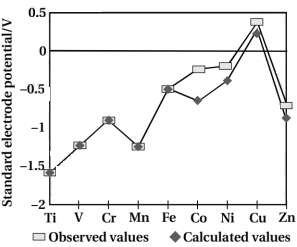
An element in the $M^{2+}$ state in an aqueous medium is more stable if the electrode potential $(M^{2+}/M)$ value is more negative. Across the period,the tendency to form $M^{2+}$ ions generally decreases.
Except for copper,all elements of the first transition series show negative values of electrode potentials. The exceptional behavior of copper is due to its high enthalpy of atomisation and very high summation of first and second ionization enthalpies,which is not compensated by its hydration enthalpy $(Cu^{2+})$.
Because of its positive electrode potential,copper does not liberate hydrogen gas from dilute acids and reacts only with oxidizing acids such as nitric acid and hot concentrated sulphuric acid.
The electrode potentials of $Mn$,$Ni$,and $Zn$ are more negative than expected. The electrode potential values of $Mn$ and $Zn$ are lowered because of their stable electronic configurations (half-filled $d^5$ for $Mn^{2+}$ and fully-filled $d^{10}$ for $Zn^{2+}$),while $Ni$ has an exceptionally more negative electrode potential due to its high hydration enthalpy.
$(i)$ Enthalpy of atomisation
$(ii)$ Summation of first and second ionization enthalpies
$(iii)$ Hydration enthalpy
An element in the $M^{2+}$ state in an aqueous medium is more stable if the electrode potential $(M^{2+}/M)$ value is more negative. Across the period,the tendency to form $M^{2+}$ ions generally decreases.
Except for copper,all elements of the first transition series show negative values of electrode potentials. The exceptional behavior of copper is due to its high enthalpy of atomisation and very high summation of first and second ionization enthalpies,which is not compensated by its hydration enthalpy $(Cu^{2+})$.
Because of its positive electrode potential,copper does not liberate hydrogen gas from dilute acids and reacts only with oxidizing acids such as nitric acid and hot concentrated sulphuric acid.
The electrode potentials of $Mn$,$Ni$,and $Zn$ are more negative than expected. The electrode potential values of $Mn$ and $Zn$ are lowered because of their stable electronic configurations (half-filled $d^5$ for $Mn^{2+}$ and fully-filled $d^{10}$ for $Zn^{2+}$),while $Ni$ has an exceptionally more negative electrode potential due to its high hydration enthalpy.
0 likes
View Solution80
Difficult
Explain the trends in $E_{M^{3+}/M^{2+}}^{o}$ electrode potential.
Solution
(N/A) The $E_{M^{3+}/M^{2+}}^{o}$ values are determined by the stability of the $M^{3+}$ and $M^{2+}$ oxidation states.
$1$. $Sc^{3+}$ has a noble gas configuration,making it very stable,which results in a very low (highly negative) $E_{M^{3+}/M^{2+}}^{o}$ value.
$2$. The high value for $Mn^{3+}/Mn^{2+}$ $(+1.57 \ V)$ is due to the extra stability of the half-filled $d^5$ configuration in $Mn^{2+}$.
$3$. The low value for $Fe^{3+}/Fe^{2+}$ $(+0.77 \ V)$ is due to the extra stability of the $Fe^{3+}$ $(d^5)$ ion.
$4$. The high value for $Co^{3+}/Co^{2+}$ $(+1.97 \ V)$ is due to the high Crystal Field Stabilization Energy $(CFSE)$ of the $Co^{2+}$ $(d^7)$ system in an aqueous medium.
$5$. Elements with high positive $E_{M^{3+}/M^{2+}}^{o}$ values (like $Mn^{3+}$ and $Co^{3+}$) act as strong oxidizing agents. Conversely,elements with low or negative values (like $Ti^{2+}, V^{2+}, Cr^{2+}$) act as strong reducing agents and can liberate $H_2$ from acids.
Example: $2Cr^{2+}_{(aq)} + 2H^+_{(aq)} \rightarrow 2Cr^{3+}_{(aq)} + H_{2(g)} \uparrow$
$1$. $Sc^{3+}$ has a noble gas configuration,making it very stable,which results in a very low (highly negative) $E_{M^{3+}/M^{2+}}^{o}$ value.
$2$. The high value for $Mn^{3+}/Mn^{2+}$ $(+1.57 \ V)$ is due to the extra stability of the half-filled $d^5$ configuration in $Mn^{2+}$.
$3$. The low value for $Fe^{3+}/Fe^{2+}$ $(+0.77 \ V)$ is due to the extra stability of the $Fe^{3+}$ $(d^5)$ ion.
$4$. The high value for $Co^{3+}/Co^{2+}$ $(+1.97 \ V)$ is due to the high Crystal Field Stabilization Energy $(CFSE)$ of the $Co^{2+}$ $(d^7)$ system in an aqueous medium.
$5$. Elements with high positive $E_{M^{3+}/M^{2+}}^{o}$ values (like $Mn^{3+}$ and $Co^{3+}$) act as strong oxidizing agents. Conversely,elements with low or negative values (like $Ti^{2+}, V^{2+}, Cr^{2+}$) act as strong reducing agents and can liberate $H_2$ from acids.
Example: $2Cr^{2+}_{(aq)} + 2H^+_{(aq)} \rightarrow 2Cr^{3+}_{(aq)} + H_{2(g)} \uparrow$
| Element | Electrode potential ($E_{M^{3+}/M^{2+}}^{o}$ in $V$) |
| $Ti$ | $-0.37$ |
| $V$ | $-0.26$ |
| $Cr$ | $-0.41$ |
| $Mn$ | $+1.57$ |
| $Fe$ | $+0.77$ |
| $Co$ | $+1.97$ |
0 likes
View Solution81
Difficult
Transition metals vary widely in their chemical reactivity. Explain this with examples or write about the reactivity of $3d$ series metals with acids.
Solution
(N/A) Transition metals exhibit a wide range of chemical reactivity. Many of them are sufficiently electropositive to dissolve in mineral acids,although some are noble (e.g.,$Ag$,$Au$,$Pt$).
For the $3d$ series,the reactivity is related to the standard electrode potential $(E^{\circ})$ values. Metals with more negative $E^{\circ}$ values are more reactive.
For example,$Cr^{2+}$ is a strong reducing agent and can liberate hydrogen from acids:
$2Cr^{2+}_{(aq)} + 2H^+_{(aq)} \rightarrow 2Cr^{3+}_{(aq)} + H_{2(g)}$
In this reaction,$Cr^{2+}$ is oxidized to $Cr^{3+}$ (oxidation state changes from $+2$ to $+3$),while $H^+$ is reduced to $H_2$ (oxidation state changes from $+1$ to $0$).
For the $3d$ series,the reactivity is related to the standard electrode potential $(E^{\circ})$ values. Metals with more negative $E^{\circ}$ values are more reactive.
For example,$Cr^{2+}$ is a strong reducing agent and can liberate hydrogen from acids:
$2Cr^{2+}_{(aq)} + 2H^+_{(aq)} \rightarrow 2Cr^{3+}_{(aq)} + H_{2(g)}$
In this reaction,$Cr^{2+}$ is oxidized to $Cr^{3+}$ (oxidation state changes from $+2$ to $+3$),while $H^+$ is reduced to $H_2$ (oxidation state changes from $+1$ to $0$).
0 likes
View Solution82
Medium
Discuss the catalytic properties of transition elements.
Solution
(N/A) The transition elements and their compounds (mainly oxides) are known for their catalytic properties due to their ability to adopt multiple oxidation states and provide a large surface area.
In the first transition series,elements such as $Fe, Ni, Mn, Co$ utilize their $3d$ and $4s$ electrons to form intermediate bonds with reactant molecules on their surface. This increases the concentration of reactants on the surface and weakens the bonds in the reactant molecules,thereby decreasing the activation energy of the reaction.
Because transition elements can change their oxidation states,they act as effective catalysts by providing alternative reaction pathways.
Example: $Fe(III)$ catalyzes the reaction between iodide and persulphate ions.
$2 I^{-} + S_{2}O_{8}^{2-} \rightarrow I_{2} + 2 SO_{4}^{2-}$
The catalytic action of $Fe^{3+}$ can be shown as:
$2 Fe^{3+} + 2 I^{-} \rightarrow I_{2} + 2 Fe^{2+}$
$2 Fe^{2+} + S_{2}O_{8}^{2-} \rightarrow 2 SO_{4}^{2-} + 2 Fe^{3+}$
Other examples include $V_{2}O_{5}$ in the contact process,$Fe$ in Haber's process,$Ni$ in the hydrogenation of fats,and $TiCl_{4}$ in polymerization.
Thus,the catalytic properties of transition elements are due to the presence of vacant $d$-orbitals,the tendency to exist in variable oxidation states,and the ability to form complexes.
In the first transition series,elements such as $Fe, Ni, Mn, Co$ utilize their $3d$ and $4s$ electrons to form intermediate bonds with reactant molecules on their surface. This increases the concentration of reactants on the surface and weakens the bonds in the reactant molecules,thereby decreasing the activation energy of the reaction.
Because transition elements can change their oxidation states,they act as effective catalysts by providing alternative reaction pathways.
Example: $Fe(III)$ catalyzes the reaction between iodide and persulphate ions.
$2 I^{-} + S_{2}O_{8}^{2-} \rightarrow I_{2} + 2 SO_{4}^{2-}$
The catalytic action of $Fe^{3+}$ can be shown as:
$2 Fe^{3+} + 2 I^{-} \rightarrow I_{2} + 2 Fe^{2+}$
$2 Fe^{2+} + S_{2}O_{8}^{2-} \rightarrow 2 SO_{4}^{2-} + 2 Fe^{3+}$
Other examples include $V_{2}O_{5}$ in the contact process,$Fe$ in Haber's process,$Ni$ in the hydrogenation of fats,and $TiCl_{4}$ in polymerization.
Thus,the catalytic properties of transition elements are due to the presence of vacant $d$-orbitals,the tendency to exist in variable oxidation states,and the ability to form complexes.
0 likes
View Solution83
Difficult
Explain the catalytic properties of transition metals.
Solution
(N/A) Transition metals and their compounds are known for their catalytic activity. This is primarily due to their ability to adopt multiple oxidation states and to form complexes.
Examples:
$(i)$ Vanadium$(V)$ oxide $(V_2O_5)$ in the Contact process.
$(ii)$ Finely divided iron $(Fe)$ in the Haber process.
$(iii)$ Finely divided nickel $(Ni)$ in catalytic hydrogenation.
Explanation of catalytic action:
$(i)$ Adsorption: The reactant molecules get adsorbed on the surface of the catalyst. The transition metal atoms use their $3d$ and $4s$ electrons to form bonds with reactant molecules. This increases the concentration of reactants on the surface and weakens the bonds in the reactant molecules,thereby lowering the activation energy.
$(ii)$ Variable oxidation states: Transition metals can change their oxidation states,which helps in providing an alternative pathway with lower activation energy.
Example: $Fe^{3+}$ ions catalyze the reaction between iodide $(I^-)$ and persulphate $(S_2O_8^{2-})$ ions:
$(i)$ $2I^- + S_2O_8^{2-} \xrightarrow{Fe^{3+}} I_2 + 2SO_4^{2-}$
$(ii)$ $2Fe^{2+} + S_2O_8^{2-} \rightarrow 2Fe^{3+} + 2SO_4^{2-}$
Examples:
$(i)$ Vanadium$(V)$ oxide $(V_2O_5)$ in the Contact process.
$(ii)$ Finely divided iron $(Fe)$ in the Haber process.
$(iii)$ Finely divided nickel $(Ni)$ in catalytic hydrogenation.
Explanation of catalytic action:
$(i)$ Adsorption: The reactant molecules get adsorbed on the surface of the catalyst. The transition metal atoms use their $3d$ and $4s$ electrons to form bonds with reactant molecules. This increases the concentration of reactants on the surface and weakens the bonds in the reactant molecules,thereby lowering the activation energy.
$(ii)$ Variable oxidation states: Transition metals can change their oxidation states,which helps in providing an alternative pathway with lower activation energy.
Example: $Fe^{3+}$ ions catalyze the reaction between iodide $(I^-)$ and persulphate $(S_2O_8^{2-})$ ions:
$(i)$ $2I^- + S_2O_8^{2-} \xrightarrow{Fe^{3+}} I_2 + 2SO_4^{2-}$
$(ii)$ $2Fe^{2+} + S_2O_8^{2-} \rightarrow 2Fe^{3+} + 2SO_4^{2-}$
0 likes
View Solution84
Difficult
Fill in the blanks:
$(a)$ The only $Mn$ halide compound that shows an oxidation state of $+7$ is ........
$(b)$ The $E^{\ominus}_{M^{II}/M}$ value is maximum negative for ........ in the $3d$ series.
$(c)$ Between $Cr^{2+}$ and $Fe^{2+}$,the stronger reducing agent is ........
$(a)$ The only $Mn$ halide compound that shows an oxidation state of $+7$ is ........
$(b)$ The $E^{\ominus}_{M^{II}/M}$ value is maximum negative for ........ in the $3d$ series.
$(c)$ Between $Cr^{2+}$ and $Fe^{2+}$,the stronger reducing agent is ........
Solution
(N/A) The only stable manganese halide in $+7$ oxidation state is $MnF_7$ (though it is highly unstable and often discussed as $MnO_3F$ in related contexts,$MnF_7$ is the theoretical answer for halides).
$(b)$ The $E^{\ominus}_{M^{II}/M}$ value is maximum negative for $Mn$ $(-1.18 \ V)$ in the $3d$ series because of the extra stability of the $d^5$ configuration in $Mn^{2+}$.
$(c)$ $Cr^{2+}$ is a stronger reducing agent than $Fe^{2+}$ because $Cr^{2+}$ changes from $d^4$ to $d^3$ ($t_{2g}^3$ configuration),which is more stable due to half-filled $t_{2g}$ orbitals,while $Fe^{2+}$ changes from $d^6$ to $d^5$.
$(b)$ The $E^{\ominus}_{M^{II}/M}$ value is maximum negative for $Mn$ $(-1.18 \ V)$ in the $3d$ series because of the extra stability of the $d^5$ configuration in $Mn^{2+}$.
$(c)$ $Cr^{2+}$ is a stronger reducing agent than $Fe^{2+}$ because $Cr^{2+}$ changes from $d^4$ to $d^3$ ($t_{2g}^3$ configuration),which is more stable due to half-filled $t_{2g}$ orbitals,while $Fe^{2+}$ changes from $d^6$ to $d^5$.
0 likes
View Solution85
Medium
The compound $AgF_2$ is an unstable compound. However,if formed,the compound acts as a very strong oxidizing agent. Why?
Solution
(N/A) In $AgF_2$,the oxidation number of $Ag$ is $+2$,which is highly unstable.
Therefore,it rapidly gains an electron to return to the more stable $+1$ oxidation state.
$Ag^{2+} + e^- \rightarrow Ag^+$.
Because it readily accepts electrons,$AgF_2$ acts as a strong oxidizing agent.
Therefore,it rapidly gains an electron to return to the more stable $+1$ oxidation state.
$Ag^{2+} + e^- \rightarrow Ag^+$.
Because it readily accepts electrons,$AgF_2$ acts as a strong oxidizing agent.
0 likes
View Solution86
Difficult
Discuss the chemical properties of lanthanoids.
Solution
(N/A) The earlier members of the series show chemical behavior similar to that of calcium. However,with an increase in atomic number,they behave more like aluminium.
The $E^{\circ}$ values for the half-reaction $Ln_{(aq)}^{3+} + 3e^{-} \rightarrow Ln_{(s)}$ range from $-2.2 \ V$ to $-2.4 \ V$,except for $Eu$,which has a value of $-2.0 \ V$.
Lanthanoids react with hydrogen when heated gently in the gas. When heated with carbon,they form carbides of the types $Ln_{3}C$,$Ln_{2}C_{3}$,and $LnC_{2}$.
These metals form trihalides $(LnX_{3})$ with halogens and liberate hydrogen gas when treated with dilute acids. They combine with oxygen to form oxides of the type $Ln_{2}O_{3}$. These oxides are basic in nature and react with water to form hydroxides,$Ln(OH)_{3}$. The basicity of these oxides and hydroxides is intermediate between that of aluminium and calcium compounds:
$Al_{2}O_{3} < Ln_{2}O_{3} < CaO$
$Al(OH)_{3} < Ln(OH)_{3} < Ca(OH)_{2}$
As the atomic number increases,the basicity of the hydroxides decreases due to lanthanoid contraction.
Summary of chemical reactions:
- With $O_{2}$: Forms $Ln_{2}O_{3}$
- With acids: Liberates $H_{2}$
- With halogens: Forms $LnX_{3}$
- With $H_{2}O$: Forms $Ln(OH)_{3} + H_{2}$
- With $C$ (at $2773 \ K$): Forms $LnC_{2}$
- With $N$: Forms $LnN$
- With $S$: Forms $Ln_{2}S_{3}$
The $E^{\circ}$ values for the half-reaction $Ln_{(aq)}^{3+} + 3e^{-} \rightarrow Ln_{(s)}$ range from $-2.2 \ V$ to $-2.4 \ V$,except for $Eu$,which has a value of $-2.0 \ V$.
Lanthanoids react with hydrogen when heated gently in the gas. When heated with carbon,they form carbides of the types $Ln_{3}C$,$Ln_{2}C_{3}$,and $LnC_{2}$.
These metals form trihalides $(LnX_{3})$ with halogens and liberate hydrogen gas when treated with dilute acids. They combine with oxygen to form oxides of the type $Ln_{2}O_{3}$. These oxides are basic in nature and react with water to form hydroxides,$Ln(OH)_{3}$. The basicity of these oxides and hydroxides is intermediate between that of aluminium and calcium compounds:
$Al_{2}O_{3} < Ln_{2}O_{3} < CaO$
$Al(OH)_{3} < Ln(OH)_{3} < Ca(OH)_{2}$
As the atomic number increases,the basicity of the hydroxides decreases due to lanthanoid contraction.
Summary of chemical reactions:
- With $O_{2}$: Forms $Ln_{2}O_{3}$
- With acids: Liberates $H_{2}$
- With halogens: Forms $LnX_{3}$
- With $H_{2}O$: Forms $Ln(OH)_{3} + H_{2}$
- With $C$ (at $2773 \ K$): Forms $LnC_{2}$
- With $N$: Forms $LnN$
- With $S$: Forms $Ln_{2}S_{3}$
0 likes
View Solution87
Easy
Describe the chemical reactions of the lanthanoids with $H_2$ and $O_2$.
Solution
(N/A) Lanthanoids react with $H_2$ when heated to form hydrides of the formula $LnH_2$ and $LnH_3$ (where $Ln$ represents a lanthanoid element).
Lanthanoids react with $O_2$ when heated to form oxides of the formula $Ln_2O_3$ (where $Ln$ represents a lanthanoid element).
Lanthanoids react with $O_2$ when heated to form oxides of the formula $Ln_2O_3$ (where $Ln$ represents a lanthanoid element).
0 likes
View Solution88
Medium
Write the chemical reactions of lanthanoids $(Ln)$ with the following:
$(1)$ With acid:
$2Ln + 6HCl \rightarrow 2LnCl_3 + 3H_2$
$(2)$ With halogens ($X_2$,where $X = F, Cl, Br, I$):
$2Ln + 3X_2 \rightarrow 2LnX_3$
$(1)$ With acid:
$2Ln + 6HCl \rightarrow 2LnCl_3 + 3H_2$
$(2)$ With halogens ($X_2$,where $X = F, Cl, Br, I$):
$2Ln + 3X_2 \rightarrow 2LnX_3$
Solution
(N/A) Lanthanoids are highly reactive metals.
$(1)$ They react with dilute acids to liberate hydrogen gas: $2Ln + 6HCl \rightarrow 2LnCl_3 + 3H_2$.
$(2)$ They react with halogens $(X_2)$ upon heating to form trihalides: $2Ln + 3X_2 \rightarrow 2LnX_3$.
$(1)$ They react with dilute acids to liberate hydrogen gas: $2Ln + 6HCl \rightarrow 2LnCl_3 + 3H_2$.
$(2)$ They react with halogens $(X_2)$ upon heating to form trihalides: $2Ln + 3X_2 \rightarrow 2LnX_3$.
0 likes
View Solution89
Medium
When $Cu^{2+}$ ion is treated with $KI$,a white precipitate is formed. Explain the reaction with the help of a chemical equation.
Solution
(N/A) When $Cu^{2+}$ ions are treated with $KI$,the $Cu^{2+}$ ions are reduced to $Cu^{+}$ ions by iodide ions $(I^-)$.
The resulting $Cu^{+}$ ions react with the remaining iodide ions to form a white precipitate of copper$(I)$ iodide $(Cu_2I_2)$.
The balanced chemical equation for this reaction is:
$2Cu^{2+}_{(aq)} + 4I^{-}_{(aq)} \rightarrow Cu_2I_{2(s)} + I_{2(s)}$
The resulting $Cu^{+}$ ions react with the remaining iodide ions to form a white precipitate of copper$(I)$ iodide $(Cu_2I_2)$.
The balanced chemical equation for this reaction is:
$2Cu^{2+}_{(aq)} + 4I^{-}_{(aq)} \rightarrow Cu_2I_{2(s)} + I_{2(s)}$
0 likes
View Solution90
Difficult
$(a)$ Transition metals can act as catalysts because they can change their oxidation state. How does $Fe(III)$ catalyze the reaction between iodide and persulphate ions?
$(b)$ Mention any three processes where transition metals act as catalysts.
$(b)$ Mention any three processes where transition metals act as catalysts.
Solution
(N/A) The reaction between iodide and persulphate ions is given by: $2 I^{-} + S_{2}O_{8}^{2-} \xrightarrow{Fe^{3+}} I_{2} + 2 SO_{4}^{2-}$
Mechanism:
$(i)$ $2 Fe^{3+} + 2 I^{-} \rightarrow 2 Fe^{2+} + I_{2}$
$(ii)$ $2 Fe^{2+} + S_{2}O_{8}^{2-} \rightarrow 2 Fe^{3+} + 2 SO_{4}^{2-}$
$(b)$ Three processes where transition metals act as catalysts are:
$(i)$ Contact process: $V_{2}O_{5}$ is used as a catalyst.
$(ii)$ Haber's process: Finely divided $Fe$ is used as a catalyst.
$(iii)$ Decomposition of $KClO_{3}$: $MnO_{2}$ is used as a catalyst.
Mechanism:
$(i)$ $2 Fe^{3+} + 2 I^{-} \rightarrow 2 Fe^{2+} + I_{2}$
$(ii)$ $2 Fe^{2+} + S_{2}O_{8}^{2-} \rightarrow 2 Fe^{3+} + 2 SO_{4}^{2-}$
$(b)$ Three processes where transition metals act as catalysts are:
$(i)$ Contact process: $V_{2}O_{5}$ is used as a catalyst.
$(ii)$ Haber's process: Finely divided $Fe$ is used as a catalyst.
$(iii)$ Decomposition of $KClO_{3}$: $MnO_{2}$ is used as a catalyst.
0 likes
View Solution91
MediumMCQ
The incorrect statement$(s)$ among $(a)-(c)$ is (are) :-
$(a)$ $W(VI)$ is more stable than $Cr(VI)$
$(b)$ In the presence of $HCl$,permanganate titrations provide satisfactory results.
$(c)$ Some lanthanoid oxides can be used as phosphors.
$(a)$ $W(VI)$ is more stable than $Cr(VI)$
$(b)$ In the presence of $HCl$,permanganate titrations provide satisfactory results.
$(c)$ Some lanthanoid oxides can be used as phosphors.
A
$(a)$ and $(b)$ only
B
$(a)$ only
C
$(b)$ and $(c)$ only
D
$(b)$ only
Solution
(D) $W(VI)$ (tungsten in $+6$ oxidation state) is indeed more stable than $Cr(VI)$ (chromium in $+6$ oxidation state) because stability increases down the group in group $6$ elements.
$(b)$ $KMnO_4$ is a strong oxidizing agent. In the presence of $HCl$,$KMnO_4$ oxidizes $HCl$ to $Cl_2$ gas. Therefore,$HCl$ cannot be used in permanganate titrations as it interferes with the reaction,making the results unsatisfactory.
$(c)$ Lanthanoid oxides (e.g.,$Y_2O_3$ doped with $Eu$) are widely used as phosphors in television screens and fluorescent lamps.
Thus,only statement $(b)$ is incorrect.
$(b)$ $KMnO_4$ is a strong oxidizing agent. In the presence of $HCl$,$KMnO_4$ oxidizes $HCl$ to $Cl_2$ gas. Therefore,$HCl$ cannot be used in permanganate titrations as it interferes with the reaction,making the results unsatisfactory.
$(c)$ Lanthanoid oxides (e.g.,$Y_2O_3$ doped with $Eu$) are widely used as phosphors in television screens and fluorescent lamps.
Thus,only statement $(b)$ is incorrect.
0 likes
View Solution92
MediumMCQ
Identify the incorrect statement.
A
The oxidation states of chromium in $CrO_{4}^{2-}$ and $Cr_{2}O_{7}^{2-}$ are not the same.
B
$Cr^{2+}(d^{4})$ is a stronger reducing agent than $Fe^{2+}(d^{6})$ in water.
C
The transition metals and their compounds are known for their catalytic activity due to their ability to adopt multiple oxidation states and to form complexes.
D
Interstitial compounds are those that are formed when small atoms like $H, C$ or $N$ are trapped inside the crystal lattices of metals.
Solution
(A) In $CrO_{4}^{2-}$,the oxidation state of $Cr$ is $x + 4(-2) = -2$,so $x = +6$.
In $Cr_{2}O_{7}^{2-}$,the oxidation state of $Cr$ is $2x + 7(-2) = -2$,so $2x = +12$,$x = +6$.
Since the oxidation states of chromium in both ions are $+6$,the statement in option $A$ is incorrect.
In $Cr_{2}O_{7}^{2-}$,the oxidation state of $Cr$ is $2x + 7(-2) = -2$,so $2x = +12$,$x = +6$.
Since the oxidation states of chromium in both ions are $+6$,the statement in option $A$ is incorrect.
0 likes
View Solution93
EasyMCQ
Which element can have oxidation state from $4$ to $6$?
A
$Fe$
B
$Mg$
C
$Co$
D
$Cr$
Solution
(D) The element that can exhibit oxidation states ranging from $+4$ to $+6$ is chromium $(Cr)$.
Chromium has an electronic configuration of $[Ar] 3d^5 4s^1$.
It can show various oxidation states from $+1$ to $+6$ in its compounds,such as in $CrO_2$ $(+4)$ and $CrO_3$ $(+6)$.
Chromium has an electronic configuration of $[Ar] 3d^5 4s^1$.
It can show various oxidation states from $+1$ to $+6$ in its compounds,such as in $CrO_2$ $(+4)$ and $CrO_3$ $(+6)$.
0 likes
View Solution94
MediumMCQ
The nature of oxides $V_{2}O_{3}$ and $CrO$ is indexed as '$X$' and '$Y$' type respectively. The correct set of $X$ and $Y$ is:
A
$X=$ basic,$Y=$ amphoteric
B
$X=$ amphoteric,$Y=$ basic
C
$X=$ acidic,$Y=$ acidic
D
$X=$ basic,$Y=$ basic
Solution
(D) The nature of transition metal oxides depends on the oxidation state of the metal.
$V_{2}O_{3}$ contains $V$ in the $+3$ oxidation state,which is basic in nature.
$CrO$ contains $Cr$ in the $+2$ oxidation state,which is also basic in nature.
Therefore,both $V_{2}O_{3}$ and $CrO$ are basic oxides.
Thus,$X=$ basic and $Y=$ basic.
$V_{2}O_{3}$ contains $V$ in the $+3$ oxidation state,which is basic in nature.
$CrO$ contains $Cr$ in the $+2$ oxidation state,which is also basic in nature.
Therefore,both $V_{2}O_{3}$ and $CrO$ are basic oxides.
Thus,$X=$ basic and $Y=$ basic.
0 likes
View Solution95
MediumMCQ
The addition of dilute $NaOH$ to $Cr^{3+}$ salt solution will give:
A
a solution of $[Cr(OH)_{4}]^{-}$
B
precipitate of $Cr_{2}O_{3} \cdot nH_{2}O$
C
precipitate of $[Cr(OH)_{6}]^{3-}$
D
precipitate of $Cr(OH)_{3}$
Solution
(B) When dilute $NaOH$ is added to a $Cr^{3+}$ salt solution,it forms a green precipitate of hydrated chromium$(III)$ oxide,which is represented as $Cr_{2}O_{3} \cdot nH_{2}O$ (often written as $Cr(OH)_{3}$ in simpler contexts,but the hydrated oxide is the standard description).
Therefore,the correct option is $B$.
Therefore,the correct option is $B$.
0 likes
View Solution96
MediumMCQ
$Cu^{2+}$ salt reacts with potassium iodide to give :
A
$Cu_{2}I_{3}$
B
$CuI$
C
$Cu_{2}I_{2}$
D
$Cu(I_{3})_{2}$
Solution
(B) When $Cu^{2+}$ salts react with potassium iodide $(KI)$,the $Cu^{2+}$ ions are reduced to $Cu^{+}$ ions by the iodide ions $(I^{-})$.
The chemical reaction is as follows:
$2Cu^{2+} + 4I^{-} \longrightarrow 2CuI(s) + I_{2}$
Here,$CuI$ is formed as a white precipitate,and $I_{2}$ is liberated.
Therefore,the correct product is $CuI$.
The chemical reaction is as follows:
$2Cu^{2+} + 4I^{-} \longrightarrow 2CuI(s) + I_{2}$
Here,$CuI$ is formed as a white precipitate,and $I_{2}$ is liberated.
Therefore,the correct product is $CuI$.
0 likes
View Solution97
Medium
When $Cu^{2+}$ ion is treated with $KI$,a white precipitate is formed. Explain the reaction with the help of a chemical equation.
Solution
(N/A) $I^{-}$ is a strong reducing agent. It reduces $Cu^{2+}$ ions to $Cu^{+}$ ions.
The reaction is as follows:
$2Cu^{2+} (aq) + 4I^{-} (aq) \rightarrow Cu_{2}I_{2} (s) + I_{2} (s)$
The white precipitate formed is $Cu_{2}I_{2}$ (Copper$(I)$ iodide).
The reaction is as follows:
$2Cu^{2+} (aq) + 4I^{-} (aq) \rightarrow Cu_{2}I_{2} (s) + I_{2} (s)$
The white precipitate formed is $Cu_{2}I_{2}$ (Copper$(I)$ iodide).
0 likes
View Solution98
EasyMCQ
Among the following,which is the strongest oxidizing agent?
A
$Mn^{3+}$
B
$Fe^{3+}$
C
$Ti^{3+}$
D
$Cr^{3+}$
Solution
(A) The strength of an oxidizing agent is determined by its reduction potential value. $A$ higher positive reduction potential indicates a stronger oxidizing agent.
Comparing the standard reduction potentials $(E^{0})$ for the given ions:
$E^{0}_{Mn^{3+}/Mn^{2+}} = +1.51 \, V$
$E^{0}_{Fe^{3+}/Fe^{2+}} = +0.77 \, V$
$E^{0}_{Ti^{3+}/Ti^{2+}} = -0.37 \, V$
$E^{0}_{Cr^{3+}/Cr^{2+}} = -0.41 \, V$
Since $Mn^{3+}$ has the highest positive reduction potential,it is the strongest oxidizing agent among the given options.
Comparing the standard reduction potentials $(E^{0})$ for the given ions:
$E^{0}_{Mn^{3+}/Mn^{2+}} = +1.51 \, V$
$E^{0}_{Fe^{3+}/Fe^{2+}} = +0.77 \, V$
$E^{0}_{Ti^{3+}/Ti^{2+}} = -0.37 \, V$
$E^{0}_{Cr^{3+}/Cr^{2+}} = -0.41 \, V$
Since $Mn^{3+}$ has the highest positive reduction potential,it is the strongest oxidizing agent among the given options.
0 likes
View Solution99
MediumMCQ
The set of correct statements is:
$(i)$ Manganese exhibits $+7$ oxidation state in its oxide.
$(ii)$ Ruthenium and Osmium exhibit $+8$ oxidation state in their oxides.
$(iii)$ $Sc$ shows $+4$ oxidation state which is oxidizing in nature.
$(iv)$ $Cr$ shows oxidizing nature in $+6$ oxidation state.
$(i)$ Manganese exhibits $+7$ oxidation state in its oxide.
$(ii)$ Ruthenium and Osmium exhibit $+8$ oxidation state in their oxides.
$(iii)$ $Sc$ shows $+4$ oxidation state which is oxidizing in nature.
$(iv)$ $Cr$ shows oxidizing nature in $+6$ oxidation state.
A
$(ii)$ and $(iii)$
B
$(i), (ii)$ and $(iv)$
C
$(i)$ and $(iii)$
D
$(ii), (iii)$ and $(iv)$
Solution
(B) $(i)$ Manganese exhibits $+7$ oxidation state in its oxide,$Mn_2O_7$. This is a correct statement.
$(ii)$ Ruthenium $(Ru)$ and Osmium $(Os)$ exhibit $+8$ oxidation state in their oxides,$RuO_4$ and $OsO_4$. This is a correct statement.
$(iii)$ Scandium $(Sc)$ has an electronic configuration of $[Ar] 3d^1 4s^2$ and shows only $+3$ oxidation state. It does not show $+4$ oxidation state. This is an incorrect statement.
$(iv)$ Chromium $(Cr)$ in its $+6$ oxidation state (e.g.,in $Cr_2O_7^{2-}$) acts as a strong oxidizing agent. This is a correct statement.
Therefore,the correct statements are $(i), (ii)$ and $(iv)$.
$(ii)$ Ruthenium $(Ru)$ and Osmium $(Os)$ exhibit $+8$ oxidation state in their oxides,$RuO_4$ and $OsO_4$. This is a correct statement.
$(iii)$ Scandium $(Sc)$ has an electronic configuration of $[Ar] 3d^1 4s^2$ and shows only $+3$ oxidation state. It does not show $+4$ oxidation state. This is an incorrect statement.
$(iv)$ Chromium $(Cr)$ in its $+6$ oxidation state (e.g.,in $Cr_2O_7^{2-}$) acts as a strong oxidizing agent. This is a correct statement.
Therefore,the correct statements are $(i), (ii)$ and $(iv)$.
0 likes
View Solution100
MediumMCQ
The correct order of basicity of oxides of vanadium is
A
$V_2O_3 > V_2O_4 > V_2O_5$
B
$V_2O_3 > V_2O_5 > V_2O_4$
C
$V_2O_5 > V_2O_4 > V_2O_3$
D
$V_2O_4 > V_2O_3 > V_2O_5$
Solution
(A) The basicity of oxides of a transition metal decreases as the oxidation state of the metal increases.
In $V_2O_3$,the oxidation state of $V$ is $+3$.
In $V_2O_4$,the oxidation state of $V$ is $+4$.
In $V_2O_5$,the oxidation state of $V$ is $+5$.
As the oxidation state increases,the acidic character increases and the basic character decreases.
Therefore,the order of basicity is $V_2O_3 > V_2O_4 > V_2O_5$.
In $V_2O_3$,the oxidation state of $V$ is $+3$.
In $V_2O_4$,the oxidation state of $V$ is $+4$.
In $V_2O_5$,the oxidation state of $V$ is $+5$.
As the oxidation state increases,the acidic character increases and the basic character decreases.
Therefore,the order of basicity is $V_2O_3 > V_2O_4 > V_2O_5$.
0 likes
View Solutiond-and f-Block Elements — Chemical properties · Frequently Asked Questions
1Are these d-and f-Block Elements questions useful for JEE and NEET?
Yes. All questions in this section are mapped to JEE Main and NEET exam patterns. Previous year questions from JEE Main, NEET, GUJCET and state-level exams are included with full solutions.
2Can I switch to Hindi or Gujarati for these questions?
Yes. Use the language tabs in the hero section or the sidebar to view the same questions and solutions in English, Hindi or Gujarati.
3How do I generate a question paper from this subtopic?
Use the Vedclass Exam Paper Generator — select the chapter and subtopic, set difficulty, and generate Sets A, B, C, D automatically. First 3 chapters of every subject are free.
Vedclass Products
For Students
Vedclass Test Series
Mock tests in real JEE/NEET style with performance analysis. 5-day free trial.
Start Free TrialFor Teachers
Exam Paper Generator
Generate Set A/B/C/D papers from this chapter in 2 minutes. 3 chapters free.
Try FreeFor Institutes
Online Exam Module
Live online exams with unlimited students, 360° analytics & white-label branding.
See DemoFor Teachers & Institutes
Generate a d-and f-Block Elements Exam Paper in 2 Minutes
Select subtopic & difficulty — Sets A, B, C, D auto-generated with No Repeat logic.
First 3 chapters of every subject are free — no payment required.