
A English
Isomerism and Magnetic properties Questions in English
Class 12 Chemistry · Coordination Compounds · Isomerism and Magnetic properties
800+
Questions
English
Language
100%
With Solutions
Showing 50 of 800 questions in English
251
DifficultMCQ
Which of the following statements is not correct?
A
$Ti(NO_3)_4$ is a colourless compound
B
$[Cr(NH_3)_6]Cl_3$ is a coloured compound
C
$K_3[VF_6]$ is a colourless compound
D
$[Cu(NCCH_3)_4]BF_4$ is a colourless compound
Solution
(C) To determine if a coordination compound is coloured,we check for the presence of unpaired $d$-electrons. If the metal ion has a $d^0$ or $d^{10}$ configuration,it is typically colourless due to the absence of $d-d$ transitions.
$1$. In $Ti(NO_3)_4$,$Ti$ is in the $+4$ oxidation state $(3d^0)$. It has no unpaired electrons,so it is colourless.
$2$. In $[Cr(NH_3)_6]Cl_3$,$Cr$ is in the $+3$ oxidation state $(3d^3)$. It has unpaired electrons,so it is coloured.
$3$. In $K_3[VF_6]$,$V$ is in the $+3$ oxidation state $(3d^2)$. It has unpaired electrons,so it should be coloured. Thus,the statement that it is colourless is incorrect.
$4$. In $[Cu(NCCH_3)_4]BF_4$,$Cu$ is in the $+1$ oxidation state $(3d^{10})$. It has no unpaired electrons,so it is colourless.
$1$. In $Ti(NO_3)_4$,$Ti$ is in the $+4$ oxidation state $(3d^0)$. It has no unpaired electrons,so it is colourless.
$2$. In $[Cr(NH_3)_6]Cl_3$,$Cr$ is in the $+3$ oxidation state $(3d^3)$. It has unpaired electrons,so it is coloured.
$3$. In $K_3[VF_6]$,$V$ is in the $+3$ oxidation state $(3d^2)$. It has unpaired electrons,so it should be coloured. Thus,the statement that it is colourless is incorrect.
$4$. In $[Cu(NCCH_3)_4]BF_4$,$Cu$ is in the $+1$ oxidation state $(3d^{10})$. It has no unpaired electrons,so it is colourless.
0 likes
View Solution252
MediumMCQ
Of the following,which is diamagnetic in nature?
A
$[CoF_6]^{3-}$
B
$[NiCl_4]^{2-}$
C
$[CuCl_4]^{2-}$
D
$[Ni(CN)_4]^{2-}$
Solution
(D) In $[Ni(CN)_4]^{2-}$,the oxidation state of $Ni$ is $+2$,which corresponds to a $d^8$ electronic configuration.
$CN^-$ is a strong field ligand,which causes the pairing of electrons in the $3d$ orbitals.
This results in $dsp^2$ hybridization with no unpaired electrons,making the complex diamagnetic.
$CN^-$ is a strong field ligand,which causes the pairing of electrons in the $3d$ orbitals.
This results in $dsp^2$ hybridization with no unpaired electrons,making the complex diamagnetic.
0 likes
View Solution253
DifficultMCQ
Which of the following statements is correct?
A
Geometrical isomerism is not observed in complexes of $C.N. = 4$ having tetrahedral geometry.
B
Square planar complexes generally do not show geometrical isomerism.
C
The square planar complex of general formulae $Ma_3b$ or $Mab_3$ exhibits cis-trans isomerism.
D
The platinum glycinato complex,$[Pt(Gly)_2]$ does not show geometrical isomerism.
Solution
(A) $1$. Tetrahedral complexes with $C.N. = 4$ do not show geometrical isomerism because all positions are equivalent relative to each other.
$2$. Square planar complexes of the type $[Ma_2b_2]$,$[Ma_2bc]$,and $[Mabcd]$ show geometrical isomerism.
$3$. Complexes with formula $Ma_3b$ or $Mab_3$ do not show geometrical isomerism because there is only one possible arrangement.
$4$. The complex $[Pt(Gly)_2]$ is a square planar complex where $Gly^-$ is an unsymmetrical bidentate ligand. It exists in two geometrical isomeric forms: $cis$ and $trans$. Therefore,statement $A$ is the only correct statement.
$2$. Square planar complexes of the type $[Ma_2b_2]$,$[Ma_2bc]$,and $[Mabcd]$ show geometrical isomerism.
$3$. Complexes with formula $Ma_3b$ or $Mab_3$ do not show geometrical isomerism because there is only one possible arrangement.
$4$. The complex $[Pt(Gly)_2]$ is a square planar complex where $Gly^-$ is an unsymmetrical bidentate ligand. It exists in two geometrical isomeric forms: $cis$ and $trans$. Therefore,statement $A$ is the only correct statement.
0 likes
View Solution254
DifficultMCQ
Geometrical isomerism can be shown by
A
$[Ag(NH_3)(CN)]$
B
$Na_2[Cd(NO_2)_4]$
C
$[PtCl_4I_2]$
D
$[Pt(NH_3)_3Cl][Au(CN)_4]$
Solution
(C) Geometrical isomerism in coordination compounds is typically observed in complexes with coordination numbers $4$ (square planar) or $6$ (octahedral).
For an octahedral complex of the type $[MA_4B_2]$,geometrical isomerism (cis and trans forms) is possible.
In the complex $[PtCl_4I_2]$,the central metal $Pt$ is surrounded by $4$ $Cl^-$ ligands and $2$ $I^-$ ligands.
This fits the general formula $[MA_4B_2]$,where $M = Pt$,$A = Cl$,and $B = I$.
Therefore,it can exhibit geometrical isomerism.
For an octahedral complex of the type $[MA_4B_2]$,geometrical isomerism (cis and trans forms) is possible.
In the complex $[PtCl_4I_2]$,the central metal $Pt$ is surrounded by $4$ $Cl^-$ ligands and $2$ $I^-$ ligands.
This fits the general formula $[MA_4B_2]$,where $M = Pt$,$A = Cl$,and $B = I$.
Therefore,it can exhibit geometrical isomerism.
0 likes
View Solution255
DifficultMCQ
$[Co(en)_3]^{3+}$ ion is expected to show
A
two optically active isomers: $d$ and $l$ forms
B
three optically active isomers: $d, l$ and meso forms
C
four optically active isomers: cis,$d$ and $l$ isomers and trans $d$ and $l$ isomers
D
none of these
Solution
(A) The complex $[Co(en)_3]^{3+}$ contains three bidentate ethylenediamine $(en)$ ligands attached to the central $Co^{3+}$ ion.
This complex forms an octahedral geometry.
Due to the presence of three bidentate ligands,the complex is chiral and does not possess a plane of symmetry or a center of inversion.
Therefore,it exists as two non-superimposable mirror images,which are a pair of enantiomers: the dextrorotatory $(d)$ form and the levorotatory $(l)$ form.
Thus,it shows two optically active isomers.
This complex forms an octahedral geometry.
Due to the presence of three bidentate ligands,the complex is chiral and does not possess a plane of symmetry or a center of inversion.
Therefore,it exists as two non-superimposable mirror images,which are a pair of enantiomers: the dextrorotatory $(d)$ form and the levorotatory $(l)$ form.
Thus,it shows two optically active isomers.
0 likes
View Solution256
MediumMCQ
Which of the following statements is not true about the complex ion $[Cr(en)_2Cl_2]^+$?
A
It has two geometrical isomers -$cis$ and $trans$.
B
Both the $cis$ and $trans$ isomers display optical activity.
C
Only the $cis$ isomer displays optical activity.
D
Only the $cis$ isomer has non-superimposable mirror image.
Solution
(B) The complex ion $[Cr(en)_2Cl_2]^+$ exhibits geometrical isomerism,existing as $cis$ and $trans$ forms.
In the $trans$ isomer,the two $Cl$ ligands are $180^{\circ}$ apart,and the molecule possesses a plane of symmetry,making it achiral (optically inactive).
In the $cis$ isomer,the two $Cl$ ligands are $90^{\circ}$ apart,and the molecule lacks a plane of symmetry,making it chiral (optically active).
Therefore,the statement that both $cis$ and $trans$ isomers display optical activity is false.
In the $trans$ isomer,the two $Cl$ ligands are $180^{\circ}$ apart,and the molecule possesses a plane of symmetry,making it achiral (optically inactive).
In the $cis$ isomer,the two $Cl$ ligands are $90^{\circ}$ apart,and the molecule lacks a plane of symmetry,making it chiral (optically active).
Therefore,the statement that both $cis$ and $trans$ isomers display optical activity is false.
0 likes
View Solution257
MediumMCQ
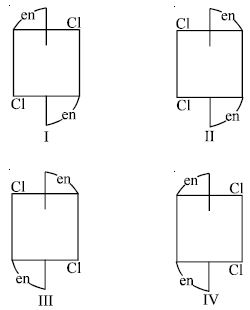
Of the following configurations,the optical isomers are
A
$I$ and $II$
B
$I$ and $III$
C
$II$ and $IV$
D
$II$ and $III$
Solution
(D) The complex $[M(en)_{2}Cl_{2}]$ shows geometrical isomerism (cis and trans).
In the trans isomer,the two $Cl$ atoms are at $180^{\circ}$ to each other,making the molecule centrosymmetric and optically inactive.
In the cis isomer,the two $Cl$ atoms are at $90^{\circ}$ to each other,making the molecule chiral (lacking a plane of symmetry) and optically active.
Looking at the structures:
Structure $I$ is a trans isomer (optically inactive).
Structure $II$ is a cis isomer (optically active).
Structure $III$ is a cis isomer (optically active).
Structure $IV$ is a trans isomer (optically inactive).
Therefore,the optical isomers are the two cis forms,$II$ and $III$.
In the trans isomer,the two $Cl$ atoms are at $180^{\circ}$ to each other,making the molecule centrosymmetric and optically inactive.
In the cis isomer,the two $Cl$ atoms are at $90^{\circ}$ to each other,making the molecule chiral (lacking a plane of symmetry) and optically active.
Looking at the structures:
Structure $I$ is a trans isomer (optically inactive).
Structure $II$ is a cis isomer (optically active).
Structure $III$ is a cis isomer (optically active).
Structure $IV$ is a trans isomer (optically inactive).
Therefore,the optical isomers are the two cis forms,$II$ and $III$.
0 likes
View Solution258
AdvancedMCQ
Other than $X$-ray diffraction,how can the following pairs of isomers be distinguished from one another?
$[Cr(NH_3)_6][Cr(NO_2)_6]$ and $[Cr(NH_3)_4(NO_2)_2][Cr(NH_3)_2(NO_2)_4]$
$[Cr(NH_3)_6][Cr(NO_2)_6]$ and $[Cr(NH_3)_4(NO_2)_2][Cr(NH_3)_2(NO_2)_4]$
A
Electrolysis of an aqueous solution
B
Measurement of molar conductance
C
Measuring magnetic moments
D
Observing their colours
Solution
(B) $1)$ The given compounds are coordination isomers. The first complex $[Cr(NH_3)_6][Cr(NO_2)_6]$ consists of a $3+:3-$ electrolyte system,while the second complex $[Cr(NH_3)_4(NO_2)_2][Cr(NH_3)_2(NO_2)_4]$ consists of a $1+:1-$ electrolyte system.
$2)$ Molar conductance $(Lambda_m)$ depends on the number of ions and the magnitude of the charge on the ions. Since the charge on the complex ions differs between the two isomers ($3$ vs $1$),their molar conductances will be significantly different.
$3)$ Magnetic moments depend on the number of unpaired electrons. Since both complexes contain $Cr^{3+}$ ions in an octahedral field,they have the same number of unpaired electrons and similar magnetic properties.
$4)$ Therefore,measurement of molar conductance is the most effective method to distinguish these isomers.
$2)$ Molar conductance $(Lambda_m)$ depends on the number of ions and the magnitude of the charge on the ions. Since the charge on the complex ions differs between the two isomers ($3$ vs $1$),their molar conductances will be significantly different.
$3)$ Magnetic moments depend on the number of unpaired electrons. Since both complexes contain $Cr^{3+}$ ions in an octahedral field,they have the same number of unpaired electrons and similar magnetic properties.
$4)$ Therefore,measurement of molar conductance is the most effective method to distinguish these isomers.
0 likes
View Solution259
DifficultMCQ
How can the isomeric complexes $[Co(NH_3)_6][Cr(NO_2)_6]$ and $[Cr(NH_3)_6][Co(NO_2)_6]$ be distinguished from one another?
A
Conductivity measurement
B
Measuring magnetic moments
C
Electrolysis of their aqueous solutions
D
Optical measurement
Solution
(C) The given complexes are coordination isomers.
In $[Co(NH_3)_6][Cr(NO_2)_6]$,the central metal ions are $Co^{3+}$ and $Cr^{3+}$.
In $[Cr(NH_3)_6][Co(NO_2)_6]$,the central metal ions are $Cr^{3+}$ and $Co^{3+}$.
Both complexes contain the same metal ions in the same oxidation states,so they have the same number of unpaired electrons.
However,the metal ions are coordinated to different ligands in the two isomers.
By performing electrolysis of their aqueous solutions,the metal ions deposited at the electrodes will be different.
In the first complex,$Co$ will be deposited at the cathode from the cationic part,while in the second,$Cr$ will be deposited at the cathode.
Thus,electrolysis is the correct method to distinguish them.
In $[Co(NH_3)_6][Cr(NO_2)_6]$,the central metal ions are $Co^{3+}$ and $Cr^{3+}$.
In $[Cr(NH_3)_6][Co(NO_2)_6]$,the central metal ions are $Cr^{3+}$ and $Co^{3+}$.
Both complexes contain the same metal ions in the same oxidation states,so they have the same number of unpaired electrons.
However,the metal ions are coordinated to different ligands in the two isomers.
By performing electrolysis of their aqueous solutions,the metal ions deposited at the electrodes will be different.
In the first complex,$Co$ will be deposited at the cathode from the cationic part,while in the second,$Cr$ will be deposited at the cathode.
Thus,electrolysis is the correct method to distinguish them.
0 likes
View Solution260
MediumMCQ
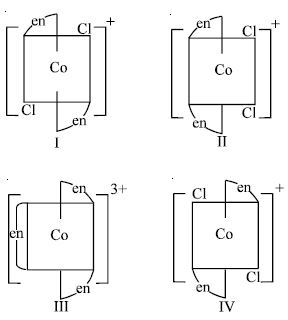
Which of the following ions are optically active?
A
$I$ only
B
$II$ only
C
$II$ and $III$
D
$IV$ only
Solution
(C) An ion is optically active if it lacks a plane of symmetry or a center of inversion.
$I$: This is the $trans-[Co(en)_2Cl_2]^+$ isomer. It has a plane of symmetry and is optically inactive.
$II$: This is the $cis-[Co(en)_2Cl_2]^+$ isomer. It lacks a plane of symmetry and is optically active.
$III$: This is $[Co(en)_3]^{3+}$. It is a propeller-shaped complex that lacks a plane of symmetry and is optically active.
$IV$: This is the $trans-[Co(en)_2Cl_2]^+$ isomer (same as $I$). It has a plane of symmetry and is optically inactive.
Therefore,$II$ and $III$ are optically active.
$I$: This is the $trans-[Co(en)_2Cl_2]^+$ isomer. It has a plane of symmetry and is optically inactive.
$II$: This is the $cis-[Co(en)_2Cl_2]^+$ isomer. It lacks a plane of symmetry and is optically active.
$III$: This is $[Co(en)_3]^{3+}$. It is a propeller-shaped complex that lacks a plane of symmetry and is optically active.
$IV$: This is the $trans-[Co(en)_2Cl_2]^+$ isomer (same as $I$). It has a plane of symmetry and is optically inactive.
Therefore,$II$ and $III$ are optically active.
0 likes
View Solution261
DifficultMCQ
Which of the following polymerisation isomers of the compound having empirical formula $Cr(NH_3)_3(NO_2)_3$ has the lowest molecular mass?
A
$[Cr(NH_3)_4(NO_2)_2]^+ [Cr(NH_3)_2(NO_2)_4]^-$
B
$[Cr(NH_3)_6]^{3+} [Cr(NO_2)_6]^{3-}$
C
$[Cr(NH_3)_5(NO_2)]^{2+} [Cr(NH_3)(NO_2)_5]^{2-}$
D
all
Solution
(D) Polymerisation isomerism is a type of isomerism where different isomers have the same empirical formula but different molecular masses,which are multiples of the empirical formula mass.
Given empirical formula is $Cr(NH_3)_3(NO_2)_3$. The formula mass is $M = Cr + 3(NH_3) + 3(NO_2)$.
All the given options are dimers of the empirical formula,meaning they all have the same molecular formula $Cr_2(NH_3)_6(NO_2)_6$.
Since all options represent the same molecular composition ($2 \times$ empirical formula),they all have the same molecular mass.
Therefore,none of them has a lower molecular mass than the others.
Given empirical formula is $Cr(NH_3)_3(NO_2)_3$. The formula mass is $M = Cr + 3(NH_3) + 3(NO_2)$.
All the given options are dimers of the empirical formula,meaning they all have the same molecular formula $Cr_2(NH_3)_6(NO_2)_6$.
Since all options represent the same molecular composition ($2 \times$ empirical formula),they all have the same molecular mass.
Therefore,none of them has a lower molecular mass than the others.
0 likes
View Solution262
MediumMCQ
For the correct assignment of electronic configuration of a complex,the valence bond theory often requires the measurement of
A
molar conductance
B
optical activity
C
magnetic moment
D
dipole moment
Solution
(C) The Valence Bond Theory $(VBT)$ explains the bonding in coordination complexes by considering the hybridization of metal orbitals.
To determine the correct electronic configuration and the number of unpaired electrons in a complex,the measurement of the $magnetic \ moment$ is essential.
The $magnetic \ moment$ $(\mu)$ is calculated using the spin-only formula $\mu = \sqrt{n(n+2)} \ BM$,where $n$ is the number of unpaired electrons.
By comparing the experimental $magnetic \ moment$ with the theoretical values,one can confirm the presence of high-spin or low-spin complexes and the hybridization state of the central metal ion.
To determine the correct electronic configuration and the number of unpaired electrons in a complex,the measurement of the $magnetic \ moment$ is essential.
The $magnetic \ moment$ $(\mu)$ is calculated using the spin-only formula $\mu = \sqrt{n(n+2)} \ BM$,where $n$ is the number of unpaired electrons.
By comparing the experimental $magnetic \ moment$ with the theoretical values,one can confirm the presence of high-spin or low-spin complexes and the hybridization state of the central metal ion.
0 likes
View Solution263
DifficultMCQ
How many isomers are possible for the complex ion $[Cr(NH_3)(OH)_2Cl_3]^{2-}$?
A
$2$
B
$3$
C
$4$
D
$5$
Solution
(D) The complex ion is $[Cr(NH_3)(OH)_2Cl_3]^{2-}$.
This is an octahedral complex of the type $[M(a)(b)_2(c)_3]$.
Here,$a = NH_3$,$b = OH^-$,and $c = Cl^-$.
For a complex of the type $[M(a)(b)_2(c)_3]$,the possible geometric isomers are:
$1$. $mer-fac$ isomerism is not applicable here due to the presence of different ligands.
$2$. The possible arrangements for the ligands are:
- $fac$ arrangement of $Cl$ ligands with $NH_3$ trans to $OH$.
- $mer$ arrangement of $Cl$ ligands with $NH_3$ trans to $Cl$.
- Other variations based on the relative positions of $OH$ and $Cl$ ligands.
For the coordination number $6$,the total number of geometric isomers for $[M(a)(b)_2(c)_3]$ is $5$.
This is an octahedral complex of the type $[M(a)(b)_2(c)_3]$.
Here,$a = NH_3$,$b = OH^-$,and $c = Cl^-$.
For a complex of the type $[M(a)(b)_2(c)_3]$,the possible geometric isomers are:
$1$. $mer-fac$ isomerism is not applicable here due to the presence of different ligands.
$2$. The possible arrangements for the ligands are:
- $fac$ arrangement of $Cl$ ligands with $NH_3$ trans to $OH$.
- $mer$ arrangement of $Cl$ ligands with $NH_3$ trans to $Cl$.
- Other variations based on the relative positions of $OH$ and $Cl$ ligands.
For the coordination number $6$,the total number of geometric isomers for $[M(a)(b)_2(c)_3]$ is $5$.
0 likes
View Solution264
DifficultMCQ
$A$ complex of a certain metal has a magnetic moment of $4.91 \ BM$,whereas another complex of the same metal with the same oxidation state has zero magnetic moment. The metal ion could be:
A
$Co^{2+}$
B
$Mn^{2+}$
C
$Fe^{2+}$
D
$Fe^{3+}$
Solution
(C) The magnetic moment is given by the formula $\mu = \sqrt{n(n+2)} \ BM$,where $n$ is the number of unpaired electrons.
For $\mu = 4.91 \ BM$,we find $n = 4$.
For $\mu = 0 \ BM$,we find $n = 0$.
$Fe^{2+}$ has a $d^6$ electronic configuration.
In a high-spin complex (with weak field ligands),$Fe^{2+}$ has $4$ unpaired electrons $(n=4)$,resulting in $\mu = \sqrt{4(4+2)} = \sqrt{24} \approx 4.90 \ BM$.
In a low-spin complex (with strong field ligands),the electrons pair up,resulting in $0$ unpaired electrons $(n=0)$ and $\mu = 0 \ BM$.
For $\mu = 4.91 \ BM$,we find $n = 4$.
For $\mu = 0 \ BM$,we find $n = 0$.
$Fe^{2+}$ has a $d^6$ electronic configuration.
In a high-spin complex (with weak field ligands),$Fe^{2+}$ has $4$ unpaired electrons $(n=4)$,resulting in $\mu = \sqrt{4(4+2)} = \sqrt{24} \approx 4.90 \ BM$.
In a low-spin complex (with strong field ligands),the electrons pair up,resulting in $0$ unpaired electrons $(n=0)$ and $\mu = 0 \ BM$.
0 likes
View Solution265
DifficultMCQ
The tetrahedral $[CoI_4]^{2-}$ and square planar $[PdBr_4]^{2-}$ complex ions are respectively:
A
low spin,high spin
B
high spin,low spin
C
both low spin
D
both high spin
Solution
(B) $1$. In $[CoI_4]^{2-}$,the oxidation state of $Co$ is $+2$ ($d^7$ configuration). Since $I^-$ is a weak field ligand and the geometry is tetrahedral,the crystal field splitting energy $(\Delta_t)$ is small. Thus,it is a high spin complex.
$2$. In $[PdBr_4]^{2-}$,the oxidation state of $Pd$ is $+2$ ($d^8$ configuration). $Pd^{2+}$ is a $4d$ series metal ion. For $4d$ and $5d$ series metal ions,the crystal field splitting energy $(\Delta_o)$ is always large enough to cause pairing of electrons,regardless of the ligand strength. Therefore,square planar complexes of $Pd^{2+}$ are always low spin.
$2$. In $[PdBr_4]^{2-}$,the oxidation state of $Pd$ is $+2$ ($d^8$ configuration). $Pd^{2+}$ is a $4d$ series metal ion. For $4d$ and $5d$ series metal ions,the crystal field splitting energy $(\Delta_o)$ is always large enough to cause pairing of electrons,regardless of the ligand strength. Therefore,square planar complexes of $Pd^{2+}$ are always low spin.
0 likes
View Solution266
DifficultMCQ
On treatment of $[Ni(NH_3)_4]^{2+}$ with concentrated $HCl,$ two compounds $I$ and $II$ having the same formula,$Ni(NH_3)_2Cl_2$ are obtained. $I$ can be converted into $II$ by boiling with dilute $HCl.$ $A$ solution of $I$ reacts with oxalic acid to form $[Ni(NH_3)_2(C_2O_4)]$ whereas $II$ does not react. Point out the correct statement of the following:
A
$I$ cis,$II$ trans; both tetrahedral
B
$I$ cis,$II$ trans; both square planar
C
$I$ trans,$II$ cis; both tetrahedral
D
$I$ trans,$II$ cis; both square planar
Solution
(B) The complex $[Ni(NH_3)_4]^{2+}$ has a square planar geometry.
When treated with $HCl,$ it forms two isomers of $[Ni(NH_3)_2Cl_2].$
$I$ is the $cis$-isomer and $II$ is the $trans$-isomer.
Both isomers possess a square planar geometry because $Ni^{2+}$ in this coordination environment typically undergoes $dsp^2$ hybridization.
Oxalic acid is a bidentate ligand that can form a chelate ring by replacing two $cis$ ligands.
Since $I$ reacts with oxalic acid,it must be the $cis$-isomer,while $II$ is the $trans$-isomer which does not react because the $Cl$ atoms are not adjacent.
When treated with $HCl,$ it forms two isomers of $[Ni(NH_3)_2Cl_2].$
$I$ is the $cis$-isomer and $II$ is the $trans$-isomer.
Both isomers possess a square planar geometry because $Ni^{2+}$ in this coordination environment typically undergoes $dsp^2$ hybridization.
Oxalic acid is a bidentate ligand that can form a chelate ring by replacing two $cis$ ligands.
Since $I$ reacts with oxalic acid,it must be the $cis$-isomer,while $II$ is the $trans$-isomer which does not react because the $Cl$ atoms are not adjacent.
0 likes
View Solution267
DifficultMCQ
Coordination isomerism could be shown by
A
$[Ag(NH_3)_2][CuCl_2]$
B
$[Al(H_2O)_6][Co(CN)_6]$
C
$[Fe(NH_3)_6]_2[Pt(CN)_6]_3$
D
Both $(a)$ and $(b)$
Solution
(D) Coordination isomerism occurs in compounds containing both cationic and anionic coordination entities,where the ligands can be exchanged between the metal ions.
For a complex to exhibit coordination isomerism,both the cation and the anion must be coordination complexes.
In option $(a)$,$[Ag(NH_3)_2][CuCl_2]$ consists of a cationic complex $[Ag(NH_3)_2]^+$ and an anionic complex $[CuCl_2]^-$. Thus,it can show coordination isomerism by exchanging ligands to form $[AgCl_2][Cu(NH_3)_2]$.
In option $(b)$,$[Al(H_2O)_6][Co(CN)_6]$ consists of a cationic complex $[Al(H_2O)_6]^{3+}$ and an anionic complex $[Co(CN)_6]^{3-}$. It can also show coordination isomerism by forming $[Al(CN)_6][Co(H_2O)_6]$.
Therefore,both $(a)$ and $(b)$ exhibit coordination isomerism.
For a complex to exhibit coordination isomerism,both the cation and the anion must be coordination complexes.
In option $(a)$,$[Ag(NH_3)_2][CuCl_2]$ consists of a cationic complex $[Ag(NH_3)_2]^+$ and an anionic complex $[CuCl_2]^-$. Thus,it can show coordination isomerism by exchanging ligands to form $[AgCl_2][Cu(NH_3)_2]$.
In option $(b)$,$[Al(H_2O)_6][Co(CN)_6]$ consists of a cationic complex $[Al(H_2O)_6]^{3+}$ and an anionic complex $[Co(CN)_6]^{3-}$. It can also show coordination isomerism by forming $[Al(CN)_6][Co(H_2O)_6]$.
Therefore,both $(a)$ and $(b)$ exhibit coordination isomerism.
0 likes
View Solution268
MediumMCQ
Which of the following complexes shows ionization isomerism?
A
$[Cr(NH_3)_6]Cl_3$
B
$[Cr(en)_2]Cl_2$
C
$[Cr(en)_3]Cl_3$
D
$[Co(NH_3)_5Br]SO_4$
Solution
(D) Ionization isomerism occurs when the counter ion in a coordination compound is a potential ligand and can displace a ligand that is currently coordinated to the central metal ion.
In the complex $[Co(NH_3)_5Br]SO_4$,the $SO_4^{2-}$ ion is outside the coordination sphere and the $Br^-$ ion is inside.
This can form an isomer $[Co(NH_3)_5SO_4]Br$,where the $Br^-$ ion is outside and the $SO_4^{2-}$ ion is inside.
Therefore,$[Co(NH_3)_5Br]SO_4$ exhibits ionization isomerism.
In the complex $[Co(NH_3)_5Br]SO_4$,the $SO_4^{2-}$ ion is outside the coordination sphere and the $Br^-$ ion is inside.
This can form an isomer $[Co(NH_3)_5SO_4]Br$,where the $Br^-$ ion is outside and the $SO_4^{2-}$ ion is inside.
Therefore,$[Co(NH_3)_5Br]SO_4$ exhibits ionization isomerism.
0 likes
View Solution269
EasyMCQ
In the nitroprusside ion,the iron exists as $Fe^{2+}$ and $NO$ as $NO^{+}$ rather than $Fe^{3+}$ and $NO$ respectively. These forms of ions are established with the help of
A
magnetic moment in solid state
B
thermal decomposition method
C
by reaction with $KCN$
D
by action with $K_2SO_4$
Solution
(A) The nitroprusside ion is $[Fe(CN)_5NO]^{2-}$.
Experimental measurements of the magnetic moment in the solid state reveal the presence of unpaired electrons consistent with the $Fe^{2+}$ $(3d^6)$ configuration.
If iron were $Fe^{3+}$ $(3d^5)$,the magnetic properties would differ significantly.
Thus,the oxidation state of iron is confirmed as $+2$ and $NO$ as $NO^{+}$.
Experimental measurements of the magnetic moment in the solid state reveal the presence of unpaired electrons consistent with the $Fe^{2+}$ $(3d^6)$ configuration.
If iron were $Fe^{3+}$ $(3d^5)$,the magnetic properties would differ significantly.
Thus,the oxidation state of iron is confirmed as $+2$ and $NO$ as $NO^{+}$.
0 likes
View Solution270
MediumMCQ
Which of the following is coloured as well as paramagnetic?
A
$K_2[PtCl_6]$
B
$K_4[Fe(CN)_6]$
C
$[Ni(dmg)_2]$
D
$[Cu(NH_3)_4]^{2+}$
Solution
(D) To be coloured,a complex must have $d-d$ transitions (usually requiring unpaired electrons or charge transfer). To be paramagnetic,it must have at least one unpaired electron.
$(A)$ $K_2[PtCl_6]$: $Pt^{4+}$ is $5d^6$,low spin,diamagnetic.
$(B)$ $K_4[Fe(CN)_6]$: $Fe^{2+}$ is $3d^6$,$CN^-$ is a strong field ligand,$d^2sp^3$ hybridization,diamagnetic.
$(C)$ $[Ni(dmg)_2]$: $Ni^{2+}$ is $3d^8$,$dsp^2$ hybridization,square planar,diamagnetic.
$(D)$ $[Cu(NH_3)_4]^{2+}$: $Cu^{2+}$ is $3d^9$,$dsp^2$ hybridization,one unpaired electron in $d_{x^2-y^2}$ orbital,paramagnetic and coloured due to $d-d$ transition.
$(A)$ $K_2[PtCl_6]$: $Pt^{4+}$ is $5d^6$,low spin,diamagnetic.
$(B)$ $K_4[Fe(CN)_6]$: $Fe^{2+}$ is $3d^6$,$CN^-$ is a strong field ligand,$d^2sp^3$ hybridization,diamagnetic.
$(C)$ $[Ni(dmg)_2]$: $Ni^{2+}$ is $3d^8$,$dsp^2$ hybridization,square planar,diamagnetic.
$(D)$ $[Cu(NH_3)_4]^{2+}$: $Cu^{2+}$ is $3d^9$,$dsp^2$ hybridization,one unpaired electron in $d_{x^2-y^2}$ orbital,paramagnetic and coloured due to $d-d$ transition.
0 likes
View Solution271
DifficultMCQ
Which of the following spin paramagnetic complexes shows both geometrical and optical isomerism?
A
$[Cr(NH_3)_2Cl_2Br_2]^-$
B
$Na_2[Fe(CN)_5NO]$
C
$[Ni(en)_2Cl_2]$
D
$[Fe(en)_2Cl_2]^+$
Solution
(D) $1$. To show optical isomerism,the complex must be chiral (non-superimposable on its mirror image).
$2$. To show geometrical isomerism,the complex must have different spatial arrangements of ligands.
$3$. $[Fe(en)_2Cl_2]^+$ is an octahedral complex of the type $[M(AA)_2a_2]$.
$4$. The cis-isomer of $[Fe(en)_2Cl_2]^+$ is optically active because it lacks a plane of symmetry.
$5$. The trans-isomer of $[Fe(en)_2Cl_2]^+$ shows geometrical isomerism but is optically inactive.
$6$. The iron center in $[Fe(en)_2Cl_2]^+$ is $Fe^{3+}$,which has a $d^5$ configuration. In the presence of weak field ligands like $Cl^-$,it is high-spin and paramagnetic.
$7$. Therefore,$[Fe(en)_2Cl_2]^+$ satisfies both conditions.
$2$. To show geometrical isomerism,the complex must have different spatial arrangements of ligands.
$3$. $[Fe(en)_2Cl_2]^+$ is an octahedral complex of the type $[M(AA)_2a_2]$.
$4$. The cis-isomer of $[Fe(en)_2Cl_2]^+$ is optically active because it lacks a plane of symmetry.
$5$. The trans-isomer of $[Fe(en)_2Cl_2]^+$ shows geometrical isomerism but is optically inactive.
$6$. The iron center in $[Fe(en)_2Cl_2]^+$ is $Fe^{3+}$,which has a $d^5$ configuration. In the presence of weak field ligands like $Cl^-$,it is high-spin and paramagnetic.
$7$. Therefore,$[Fe(en)_2Cl_2]^+$ satisfies both conditions.
0 likes
View Solution272
AdvancedMCQ
$26.7 \ g$ of a compound with the formula $PtCl_2Br_2 \cdot 6H_2O$ is taken for analysis. This compound exhibits stereoisomerism,and a total of $3$ stereoisomers exist. Find the loss in mass (in $g$) when the given amount of the compound is treated with concentrated $H_2SO_4$. (Molar mass: $PtCl_2Br_2 \cdot 6H_2O = 534 \ g \ mol^{-1}$)
A
$1.80$
B
$2.70$
C
$4.47$
D
$2.31$
Solution
(B) The compound $PtCl_2Br_2 \cdot 6H_2O$ can be represented as $[Pt(H_2O)_3Cl_2Br]Br \cdot 3H_2O$ or $[Pt(H_2O)_3Br_2Cl]Cl \cdot 3H_2O$ to satisfy the coordination number of $6$ and the existence of $3$ stereoisomers (geometrical isomers).
Number of moles of the compound $= \frac{26.7 \ g}{534 \ g \ mol^{-1}} = 0.05 \ mol$.
In the formula,there are $3$ molecules of water of crystallization.
Moles of water of crystallization $= 0.05 \times 3 = 0.15 \ mol$.
Concentrated $H_2SO_4$ acts as a dehydrating agent and absorbs the water of crystallization.
Mass of water lost $= 0.15 \ mol \times 18 \ g \ mol^{-1} = 2.7 \ g$.
Number of moles of the compound $= \frac{26.7 \ g}{534 \ g \ mol^{-1}} = 0.05 \ mol$.
In the formula,there are $3$ molecules of water of crystallization.
Moles of water of crystallization $= 0.05 \times 3 = 0.15 \ mol$.
Concentrated $H_2SO_4$ acts as a dehydrating agent and absorbs the water of crystallization.
Mass of water lost $= 0.15 \ mol \times 18 \ g \ mol^{-1} = 2.7 \ g$.
0 likes
View Solution273
AdvancedMCQ
Two soluble salts of iron $A$ & $B$,on combining with excess of a reagent $(R)$ produce compound $C$ (pale yellow) & $D$ (yellow) respectively. Reaction of $A$ with $D$ and that of $B$ with $C$ both produce a blue coloured compound. Which of the following statements is correct?
A
Blue colour of the compound is due to $d-d$ transition
B
Compounds $C$ & $D$ both are inner orbital complexes
C
Compounds $C$ & $D$ both are paramagnetic
D
Reaction of $A$ with $C$ and that of $B$ with $D$ produces same coloured compounds
Solution
(A) is $FeCl_{2}$ and $B$ is $FeCl_{3}$. The reagent $(R)$ is $KCN$.
$C$ is $K_{4}[Fe(CN)_{6}]$ (pale yellow) and $D$ is $K_{3}[Fe(CN)_{6}]$ (yellow).
Reaction of $A$ $(Fe^{2+})$ with $D$ $([Fe(CN)_{6}]^{3-})$ gives $Fe_{3}[Fe(CN)_{6}]_{2}$ (Turnbull's blue).
Reaction of $B$ $(Fe^{3+})$ with $C$ $([Fe(CN)_{6}]^{4-})$ gives $Fe_{4}[Fe(CN)_{6}]_{3}$ (Prussian blue).
Both are blue coloured compounds.
The blue colour in these complexes is due to metal-to-metal charge transfer $(MMCT)$ between $Fe^{2+}$ and $Fe^{3+}$,not $d-d$ transition.
$C$ $([Fe(CN)_{6}]^{4-})$ is diamagnetic ($d^{6}$,low spin),while $D$ $([Fe(CN)_{6}]^{3-})$ is paramagnetic ($d^{5}$,low spin).
Thus,the statement that the blue colour is due to $d-d$ transition is incorrect,and the statement about paramagnetism is only true for $D$.
$C$ is $K_{4}[Fe(CN)_{6}]$ (pale yellow) and $D$ is $K_{3}[Fe(CN)_{6}]$ (yellow).
Reaction of $A$ $(Fe^{2+})$ with $D$ $([Fe(CN)_{6}]^{3-})$ gives $Fe_{3}[Fe(CN)_{6}]_{2}$ (Turnbull's blue).
Reaction of $B$ $(Fe^{3+})$ with $C$ $([Fe(CN)_{6}]^{4-})$ gives $Fe_{4}[Fe(CN)_{6}]_{3}$ (Prussian blue).
Both are blue coloured compounds.
The blue colour in these complexes is due to metal-to-metal charge transfer $(MMCT)$ between $Fe^{2+}$ and $Fe^{3+}$,not $d-d$ transition.
$C$ $([Fe(CN)_{6}]^{4-})$ is diamagnetic ($d^{6}$,low spin),while $D$ $([Fe(CN)_{6}]^{3-})$ is paramagnetic ($d^{5}$,low spin).
Thus,the statement that the blue colour is due to $d-d$ transition is incorrect,and the statement about paramagnetism is only true for $D$.
0 likes
View Solution274
DifficultMCQ
Which of the following species is paramagnetic?
A
$K_3[Co(C_2O_4)_3]$
B
$NO[PF_6]$
C
$[NMe_4]O_3$
D
$H[BF_4]$
Solution
(C) $1$. $K_3[Co(C_2O_4)_3]$ contains $[Co(C_2O_4)_3]^{3-}$. Here,$Co^{3+}$ is in $d^6$ configuration. With strong field ligand $C_2O_4^{2-}$,it is diamagnetic.
$2$. $NO[PF_6]$ consists of $NO^+$ and $[PF_6]^-$. $NO^+$ has $14$ electrons (isoelectronic with $N_2$),so it is diamagnetic. $[PF_6]^-$ is also diamagnetic.
$3$. $[NMe_4]O_3$ consists of $[NMe_4]^+$ and $O_3^-$. The ozonide ion $O_3^-$ has $19$ valence electrons,making it paramagnetic due to an unpaired electron.
$4$. $H[BF_4]$ consists of $H^+$ and $[BF_4]^-$. Both are diamagnetic.
Thus,$[NMe_4]O_3$ is the paramagnetic species.
$2$. $NO[PF_6]$ consists of $NO^+$ and $[PF_6]^-$. $NO^+$ has $14$ electrons (isoelectronic with $N_2$),so it is diamagnetic. $[PF_6]^-$ is also diamagnetic.
$3$. $[NMe_4]O_3$ consists of $[NMe_4]^+$ and $O_3^-$. The ozonide ion $O_3^-$ has $19$ valence electrons,making it paramagnetic due to an unpaired electron.
$4$. $H[BF_4]$ consists of $H^+$ and $[BF_4]^-$. Both are diamagnetic.
Thus,$[NMe_4]O_3$ is the paramagnetic species.
0 likes
View Solution275
MediumMCQ
Which of the following complex compounds has the highest number of geometrical isomers?
A
$[PtCl_2Br_2]^{2-}$
B
$[CoCl_2Br_2]^{2-}$
C
$[Pt(NH_3)(Gly)Br]$
D
$[Co(NH_3)_2(Gly)_2]^+$
Solution
(D) $1$. $[PtCl_2Br_2]^{2-}$ is a square planar complex of type $[M(a)_2(b)_2]$. It has $2$ geometrical isomers (cis and trans).
$2$. $[CoCl_2Br_2]^{2-}$ is a tetrahedral complex of type $[M(a)_2(b)_2]$. Tetrahedral complexes do not show geometrical isomerism.
$3$. $[Pt(NH_3)(Gly)Br]$ is a square planar complex of type $[M(abcd)]$. It has $3$ geometrical isomers.
$4$. $[Co(NH_3)_2(Gly)_2]^+$ is an octahedral complex of type $[M(a)_2(b)_2]$ where $b$ is a bidentate ligand. It has $5$ geometrical isomers (cis-cis-cis,cis-cis-trans,cis-trans-cis,trans-cis-cis,and trans-trans-trans).
Therefore,the complex with the highest number of geometrical isomers is $[Co(NH_3)_2(Gly)_2]^+$,which has $5$ isomers.
$2$. $[CoCl_2Br_2]^{2-}$ is a tetrahedral complex of type $[M(a)_2(b)_2]$. Tetrahedral complexes do not show geometrical isomerism.
$3$. $[Pt(NH_3)(Gly)Br]$ is a square planar complex of type $[M(abcd)]$. It has $3$ geometrical isomers.
$4$. $[Co(NH_3)_2(Gly)_2]^+$ is an octahedral complex of type $[M(a)_2(b)_2]$ where $b$ is a bidentate ligand. It has $5$ geometrical isomers (cis-cis-cis,cis-cis-trans,cis-trans-cis,trans-cis-cis,and trans-trans-trans).
Therefore,the complex with the highest number of geometrical isomers is $[Co(NH_3)_2(Gly)_2]^+$,which has $5$ isomers.
0 likes
View Solution276
DifficultMCQ
Which of the following complex ions is expected to absorb light in the visible region?
A
$[Ti(en)_3]^{4+}$
B
$[Sc(NH_3)_4(H_2O)_2]^{3+}$
C
$[Cr(NH_3)_6]^{3+}$
D
$[Zn(CN)_4]^{2-}$
Solution
(C) Only those transition metal complexes are expected to absorb visible light in which the $d$-subshell is incomplete,allowing for $d-d$ electronic transitions.
$(A)$ In $[Ti(en)_3]^{4+}$,$Ti$ is in the $Ti^{4+}$ state: $[Ar] 3d^0$. Since there are no $d$-electrons,no $d-d$ transition is possible.
$(B)$ In $[Sc(NH_3)_4(H_2O)_2]^{3+}$,$Sc$ is in the $Sc^{3+}$ state: $[Ar] 3d^0$. No $d$-electrons are available for transition.
$(C)$ In $[Cr(NH_3)_6]^{3+}$,$Cr$ is in the $Cr^{3+}$ state: $[Ar] 3d^3$. The presence of unpaired electrons in the $d$-orbitals allows for $d-d$ transitions,making it absorb light in the visible region.
$(D)$ In $[Zn(CN)_4]^{2-}$,$Zn$ is in the $Zn^{2+}$ state: $[Ar] 3d^{10}$. The $d$-subshell is completely filled,so no $d-d$ transition is possible.
The correct option is $C$.
$(A)$ In $[Ti(en)_3]^{4+}$,$Ti$ is in the $Ti^{4+}$ state: $[Ar] 3d^0$. Since there are no $d$-electrons,no $d-d$ transition is possible.
$(B)$ In $[Sc(NH_3)_4(H_2O)_2]^{3+}$,$Sc$ is in the $Sc^{3+}$ state: $[Ar] 3d^0$. No $d$-electrons are available for transition.
$(C)$ In $[Cr(NH_3)_6]^{3+}$,$Cr$ is in the $Cr^{3+}$ state: $[Ar] 3d^3$. The presence of unpaired electrons in the $d$-orbitals allows for $d-d$ transitions,making it absorb light in the visible region.
$(D)$ In $[Zn(CN)_4]^{2-}$,$Zn$ is in the $Zn^{2+}$ state: $[Ar] 3d^{10}$. The $d$-subshell is completely filled,so no $d-d$ transition is possible.
The correct option is $C$.
0 likes
View Solution277
DifficultMCQ
Which of the following complexes exhibits both geometrical and optical isomerism?
A
$[Cr(C_2O_4)_3]^{3-}$
B
$[Co(NH_3)_3 Cl_3]$
C
$[Cr(H_2O)_2 (C_2O_4)_2]^-$
D
$[Co(en)Cl_4]^-$
Solution
(C) The complex $[Cr(H_2O)_2(C_2O_4)_2]^-$ is of the type $[M(AA)_2a_2]$.
It exhibits geometrical isomerism in the form of $cis$ and $trans$ isomers.
The $cis$-isomer is optically active because it lacks a plane of symmetry,while the $trans$-isomer is optically inactive due to the presence of a plane of symmetry.
Therefore,the $cis$-isomer shows optical isomerism,making the complex exhibit both types of isomerism.
It exhibits geometrical isomerism in the form of $cis$ and $trans$ isomers.
The $cis$-isomer is optically active because it lacks a plane of symmetry,while the $trans$-isomer is optically inactive due to the presence of a plane of symmetry.
Therefore,the $cis$-isomer shows optical isomerism,making the complex exhibit both types of isomerism.
0 likes
View Solution278
DifficultMCQ
Maximum number of stereoisomers are possible for the octahedral complex $Mabcdef$ :-
A
$15$
B
$30$
C
$12$
D
$10$
Solution
(B) For an octahedral complex of the type $Mabcdef$,where all six ligands are different,the number of geometrical isomers is $15$.
Each geometrical isomer is chiral (except in cases of symmetry which do not exist here),meaning each geometrical isomer exists as a pair of enantiomers.
Therefore,the total number of stereoisomers is $15 \times 2 = 30$.
Each geometrical isomer is chiral (except in cases of symmetry which do not exist here),meaning each geometrical isomer exists as a pair of enantiomers.
Therefore,the total number of stereoisomers is $15 \times 2 = 30$.
0 likes
View Solution279
MediumMCQ
Select the incorrect match.
A
$[Co(NO_2)(H_2O)(en)_2]Cl_2 , [CoCl(NO_2)(en)_2]Cl \cdot H_2O \longrightarrow$ Hydrate Isomerism
B
$[Cu(NH_3)_4][PtCl_4] , [CuCl(NH_3)_3][PtCl_3(NH_3)] \longrightarrow$ Coordination isomerism
C
$[Ni(CN)(H_2O)(NH_3)_4]Cl , [NiCl(H_2O)(NH_3)_4]CN \longrightarrow$ Ionisation isomerism
D
$[Cr(NO_2)(NH_3)_5][ZnCl_4] , [Cr(ONO)(NH_3)_5][ZnCl_4] \longrightarrow$ Linkage isomerism
Solution
(NONE) In option $A$,the two complexes are $[Co(NO_2)(H_2O)(en)_2]Cl_2$ and $[CoCl(NO_2)(en)_2]Cl \cdot H_2O$. These are hydrate isomers because the number of water molecules inside and outside the coordination sphere differs.
In option $B$,the two complexes are $[Cu(NH_3)_4][PtCl_4]$ and $[CuCl(NH_3)_3][PtCl_3(NH_3)]$. These are coordination isomers as the ligands are exchanged between the cationic and anionic parts.
In option $C$,the two complexes are $[Ni(CN)(H_2O)(NH_3)_4]Cl$ and $[NiCl(H_2O)(NH_3)_4]CN$. These are ionisation isomers because the counter ions ($Cl^-$ and $CN^-$) are exchanged with ligands inside the coordination sphere.
In option $D$,the complexes are $[Cr(NO_2)(NH_3)_5][ZnCl_4]$ and $[Cr(ONO)(NH_3)_5][ZnCl_4]$. These are linkage isomers because the ambidentate ligand $NO_2^-$ is bonded through different donor atoms ($N$ vs $O$).
Wait,re-evaluating option $A$: The formula $[Co(NO_2)(H_2O)(en)_2]Cl_2$ and $[CoCl(NO_2)(en)_2]Cl \cdot H_2O$ are indeed hydrate isomers. However,looking closely at the coordination sphere,the first complex has $Cl_2$ outside,while the second has $Cl$ outside and $H_2O$ outside. This is a valid example of hydrate isomerism.
Actually,all options provided are technically correct examples of their respective isomerism types. However,in many textbooks,option $A$ is often cited as a classic example of hydrate isomerism. Upon closer inspection,all matches are correct. If forced to choose an error,there is no incorrect match provided in the list.
In option $B$,the two complexes are $[Cu(NH_3)_4][PtCl_4]$ and $[CuCl(NH_3)_3][PtCl_3(NH_3)]$. These are coordination isomers as the ligands are exchanged between the cationic and anionic parts.
In option $C$,the two complexes are $[Ni(CN)(H_2O)(NH_3)_4]Cl$ and $[NiCl(H_2O)(NH_3)_4]CN$. These are ionisation isomers because the counter ions ($Cl^-$ and $CN^-$) are exchanged with ligands inside the coordination sphere.
In option $D$,the complexes are $[Cr(NO_2)(NH_3)_5][ZnCl_4]$ and $[Cr(ONO)(NH_3)_5][ZnCl_4]$. These are linkage isomers because the ambidentate ligand $NO_2^-$ is bonded through different donor atoms ($N$ vs $O$).
Wait,re-evaluating option $A$: The formula $[Co(NO_2)(H_2O)(en)_2]Cl_2$ and $[CoCl(NO_2)(en)_2]Cl \cdot H_2O$ are indeed hydrate isomers. However,looking closely at the coordination sphere,the first complex has $Cl_2$ outside,while the second has $Cl$ outside and $H_2O$ outside. This is a valid example of hydrate isomerism.
Actually,all options provided are technically correct examples of their respective isomerism types. However,in many textbooks,option $A$ is often cited as a classic example of hydrate isomerism. Upon closer inspection,all matches are correct. If forced to choose an error,there is no incorrect match provided in the list.
0 likes
View Solution280
DifficultMCQ
Which of the following compounds has a magnetic moment of $\sqrt{15} \ B.M.$?
A
$[Fe(H_2O)_6]^{+2}$
B
$[Cr(CN)_6]^{-3}$
C
$[Ni(NH_3)_6]^{+2}$
D
$[PtCl_4]^{-2}$
Solution
(B) The magnetic moment $\mu$ is given by the formula $\mu = \sqrt{n(n+2)} \ B.M.$,where $n$ is the number of unpaired electrons.
Given $\mu = \sqrt{15} \ B.M.$,we have $n(n+2) = 15$,which implies $n^2 + 2n - 15 = 0$. Solving this quadratic equation gives $(n+5)(n-3) = 0$,so $n = 3$.
Now,let us analyze the complexes:
$A$: In $[Fe(H_2O)_6]^{+2}$,$Fe$ is in $+2$ oxidation state $(3d^6)$. $H_2O$ is a weak field ligand,so $Fe^{+2}$ has $4$ unpaired electrons $(n=4)$.
$B$: In $[Cr(CN)_6]^{-3}$,$Cr$ is in $+3$ oxidation state $(3d^3)$. $CN^-$ is a strong field ligand,so $Cr^{+3}$ has $3$ unpaired electrons $(n=3)$.
$C$: In $[Ni(NH_3)_6]^{+2}$,$Ni$ is in $+2$ oxidation state $(3d^8)$. $NH_3$ is a strong field ligand,so $Ni^{+2}$ has $2$ unpaired electrons $(n=2)$.
$D$: In $[PtCl_4]^{-2}$,$Pt$ is in $+2$ oxidation state $(5d^8)$. $Pt$ is a $5d$ series metal,so it forms square planar complexes with $0$ unpaired electrons $(n=0)$.
Thus,$[Cr(CN)_6]^{-3}$ has $3$ unpaired electrons,corresponding to $\sqrt{15} \ B.M.$
Given $\mu = \sqrt{15} \ B.M.$,we have $n(n+2) = 15$,which implies $n^2 + 2n - 15 = 0$. Solving this quadratic equation gives $(n+5)(n-3) = 0$,so $n = 3$.
Now,let us analyze the complexes:
$A$: In $[Fe(H_2O)_6]^{+2}$,$Fe$ is in $+2$ oxidation state $(3d^6)$. $H_2O$ is a weak field ligand,so $Fe^{+2}$ has $4$ unpaired electrons $(n=4)$.
$B$: In $[Cr(CN)_6]^{-3}$,$Cr$ is in $+3$ oxidation state $(3d^3)$. $CN^-$ is a strong field ligand,so $Cr^{+3}$ has $3$ unpaired electrons $(n=3)$.
$C$: In $[Ni(NH_3)_6]^{+2}$,$Ni$ is in $+2$ oxidation state $(3d^8)$. $NH_3$ is a strong field ligand,so $Ni^{+2}$ has $2$ unpaired electrons $(n=2)$.
$D$: In $[PtCl_4]^{-2}$,$Pt$ is in $+2$ oxidation state $(5d^8)$. $Pt$ is a $5d$ series metal,so it forms square planar complexes with $0$ unpaired electrons $(n=0)$.
Thus,$[Cr(CN)_6]^{-3}$ has $3$ unpaired electrons,corresponding to $\sqrt{15} \ B.M.$
0 likes
View Solution281
EasyMCQ
Which of the following complexes can show coordination isomerism?
A
$[Pt(H_2O)_6] (SO_4)_2$
B
$[Co(en)_3] [Cr(CN)_6]$
C
$[Co(NH_3)_5 ONO]Cl_2$
D
$[(NH_3)_4Co(NH_2)(O_2)Co(NH_3)_2Cl_2]$
Solution
(B) Coordination isomerism occurs in compounds containing both cationic and anionic coordination entities,where the ligands can be exchanged between the metal centers.
Among the given options,$[Co(en)_3] [Cr(CN)_6]$ consists of a complex cation $[Co(en)_3]^{3+}$ and a complex anion $[Cr(CN)_6]^{3-}$.
This complex can exhibit coordination isomerism by exchanging ligands between the two metal centers,forming the isomer $[Cr(en)_3] [Co(CN)_6]$.
Among the given options,$[Co(en)_3] [Cr(CN)_6]$ consists of a complex cation $[Co(en)_3]^{3+}$ and a complex anion $[Cr(CN)_6]^{3-}$.
This complex can exhibit coordination isomerism by exchanging ligands between the two metal centers,forming the isomer $[Cr(en)_3] [Co(CN)_6]$.
0 likes
View Solution282
DifficultMCQ
Which of the following compounds cannot show coordination isomerism?
A
$[Pt(NH_3)_4][PtCl_4]$
B
$[Co(NH_3)_4Cl_2][Cr(NH_3)_2(C_2O_4)_2]$
C
$[Pt(NH_3)_4Cl_2][Pt(SCN)_2Cl_2]$
D
$[Zn(en)_2][Zn(OH)_4]$
Solution
(D) Coordination isomerism occurs in compounds containing both cationic and anionic coordination entities where the ligands can be exchanged between the metal centers.
For coordination isomerism to exist,both the cation and the anion must be complex ions,and the metal atoms should be different or have different oxidation states/ligand environments.
In option $D$,$[Zn(en)_2][Zn(OH)_4]$,both the cation and anion contain the same metal $(Zn)$ and the same oxidation state $(+2)$.
Exchanging ligands between these two identical metal centers does not result in a new chemical isomer,as the structure remains effectively the same.
Therefore,$[Zn(en)_2][Zn(OH)_4]$ cannot show coordination isomerism.
For coordination isomerism to exist,both the cation and the anion must be complex ions,and the metal atoms should be different or have different oxidation states/ligand environments.
In option $D$,$[Zn(en)_2][Zn(OH)_4]$,both the cation and anion contain the same metal $(Zn)$ and the same oxidation state $(+2)$.
Exchanging ligands between these two identical metal centers does not result in a new chemical isomer,as the structure remains effectively the same.
Therefore,$[Zn(en)_2][Zn(OH)_4]$ cannot show coordination isomerism.
0 likes
View Solution283
MediumMCQ
Which of the following complexes of $Co^{3+}$ shows more than one type of isomerism?
A
$[Co(en)_3]^{3+}$
B
$[Co(NH_2CH_2CH_2S)_3]^0$
C
$[Co(C_2O_4)(en)_2]^{+}$
D
$[Co(EDTA)]^{-}$
Solution
(B) To show more than one type of isomerism,a complex must exhibit both stereoisomerism (geometrical or optical) and potentially other forms like linkage or coordination isomerism.
$1$. $[Co(en)_3]^{3+}$: Shows only optical isomerism.
$2$. $[Co(NH_2CH_2CH_2S)_3]^0$: This complex contains a ligand $(NH_2CH_2CH_2S^-)$ which is an ambidentate ligand (can coordinate through $N$ or $S$). Thus,it shows linkage isomerism. Additionally,it can show geometrical isomerism (facial and meridional forms) and optical isomerism.
$3$. $[Co(C_2O_4)(en)_2]^{+}$: Shows only optical isomerism.
$4$. $[Co(EDTA)]^{-}$: Shows only optical isomerism.
Therefore,$[Co(NH_2CH_2CH_2S)_3]^0$ exhibits multiple types of isomerism.
$1$. $[Co(en)_3]^{3+}$: Shows only optical isomerism.
$2$. $[Co(NH_2CH_2CH_2S)_3]^0$: This complex contains a ligand $(NH_2CH_2CH_2S^-)$ which is an ambidentate ligand (can coordinate through $N$ or $S$). Thus,it shows linkage isomerism. Additionally,it can show geometrical isomerism (facial and meridional forms) and optical isomerism.
$3$. $[Co(C_2O_4)(en)_2]^{+}$: Shows only optical isomerism.
$4$. $[Co(EDTA)]^{-}$: Shows only optical isomerism.
Therefore,$[Co(NH_2CH_2CH_2S)_3]^0$ exhibits multiple types of isomerism.
0 likes
View Solution284
DifficultMCQ
The magnetic moment of $X^{n+}$ is $\sqrt{24} \ B.M.$ Find the number of unpaired electrons and the value of '$n$' respectively. (Atomic number of $X = 26$)
A
$4, 3$
B
$3, 5$
C
$4, 2$
D
$4, 1$
Solution
(C) The magnetic moment formula is $\mu = \sqrt{n(n+2)} \ B.M.$,where $n$ is the number of unpaired electrons.
Given $\mu = \sqrt{24} \ B.M.$,we have $\sqrt{n(n+2)} = \sqrt{24}$,which implies $n(n+2) = 24$.
Solving for $n$,we get $n^2 + 2n - 24 = 0$,so $(n+6)(n-4) = 0$. Since $n$ must be positive,the number of unpaired electrons is $4$.
The atomic number of $X$ is $26$,which corresponds to $Fe$. The electronic configuration of $Fe$ is $[Ar] 3d^6 4s^2$.
For $Fe^{2+}$,the configuration is $[Ar] 3d^6$,which has $4$ unpaired electrons.
Thus,the number of unpaired electrons is $4$ and the value of '$n$' is $2$.
Given $\mu = \sqrt{24} \ B.M.$,we have $\sqrt{n(n+2)} = \sqrt{24}$,which implies $n(n+2) = 24$.
Solving for $n$,we get $n^2 + 2n - 24 = 0$,so $(n+6)(n-4) = 0$. Since $n$ must be positive,the number of unpaired electrons is $4$.
The atomic number of $X$ is $26$,which corresponds to $Fe$. The electronic configuration of $Fe$ is $[Ar] 3d^6 4s^2$.
For $Fe^{2+}$,the configuration is $[Ar] 3d^6$,which has $4$ unpaired electrons.
Thus,the number of unpaired electrons is $4$ and the value of '$n$' is $2$.
0 likes
View Solution285
DifficultMCQ
Which of the following statements is correct?
A
$[NiCl_4(NH_3)_2]^{2-} \to$ geometrical isomerism
B
$[Pt(NH_3)_2Cl_2] \to$ Fac-mer isomerism
C
$CoCl_3 \cdot 6H_2O \to$ Hydrate isomerism possible
D
$A$ and $C$ both
Solution
(D) For option $A$: The complex $[NiCl_4(NH_3)_2]^{2-}$ follows the formula $[Ma_4b_2]$,which exhibits geometrical isomerism (cis and trans forms).
For option $B$: $[Pt(NH_3)_2Cl_2]$ is a square planar complex $([Ma_2b_2])$ and exhibits cis-trans isomerism,not Fac-mer isomerism.
For option $C$: $CoCl_3 \cdot 6H_2O$ can exist as $[Co(H_2O)_6]Cl_3$,$[Co(H_2O)_5Cl]Cl_2 \cdot H_2O$,and $[Co(H_2O)_4Cl_2]Cl \cdot 2H_2O$,thus exhibiting hydrate isomerism.
Therefore,both $A$ and $C$ are correct.
For option $B$: $[Pt(NH_3)_2Cl_2]$ is a square planar complex $([Ma_2b_2])$ and exhibits cis-trans isomerism,not Fac-mer isomerism.
For option $C$: $CoCl_3 \cdot 6H_2O$ can exist as $[Co(H_2O)_6]Cl_3$,$[Co(H_2O)_5Cl]Cl_2 \cdot H_2O$,and $[Co(H_2O)_4Cl_2]Cl \cdot 2H_2O$,thus exhibiting hydrate isomerism.
Therefore,both $A$ and $C$ are correct.
0 likes
View Solution286
DifficultMCQ
Visible light will be absorbed by
A
$[Sc(H_2O)_3(NH_3)_3]^{3+}$
B
$[Ti(en)_2(NH_3)_2]^{4+}$
C
$[Cr(NH_3)_6]^{3+}$
D
$[Zn(NH_3)_6]^{2+}$
Solution
(C) Transition metal complexes absorb visible light only when they have an incomplete $d$-subshell,allowing for $d-d$ transitions.
In $[Sc(H_2O)_3(NH_3)_3]^{3+}$,$Sc^{3+}$ has a $d^0$ configuration.
In $[Ti(en)_2(NH_3)_2]^{4+}$,$Ti^{4+}$ has a $d^0$ configuration.
In $[Zn(NH_3)_6]^{2+}$,$Zn^{2+}$ has a $d^{10}$ configuration.
In $[Cr(NH_3)_6]^{3+}$,$Cr$ is present as $Cr^{3+}$.
The electronic configuration of $Cr^{3+}$ is $[Ar] 3d^3$.
Since the complex has unpaired electrons in the $d$-subshell,$d-d$ transitions are possible,and it will absorb visible light.
In $[Sc(H_2O)_3(NH_3)_3]^{3+}$,$Sc^{3+}$ has a $d^0$ configuration.
In $[Ti(en)_2(NH_3)_2]^{4+}$,$Ti^{4+}$ has a $d^0$ configuration.
In $[Zn(NH_3)_6]^{2+}$,$Zn^{2+}$ has a $d^{10}$ configuration.
In $[Cr(NH_3)_6]^{3+}$,$Cr$ is present as $Cr^{3+}$.
The electronic configuration of $Cr^{3+}$ is $[Ar] 3d^3$.
Since the complex has unpaired electrons in the $d$-subshell,$d-d$ transitions are possible,and it will absorb visible light.
0 likes
View Solution287
MediumMCQ
Total number of isomers possible for the complex $[Co(en)_2Cl_2]$ is
A
$2$
B
$3$
C
$4$
D
$5$
Solution
(B) The complex $[Co(en)_2Cl_2]$ exhibits both geometrical and optical isomerism.
There are two geometrical isomers: $cis$ and $trans$.
The $trans$ isomer is optically inactive (achiral).
The $cis$ isomer is optically active and exists as a pair of enantiomers ($d$ and $l$ forms).
Thus,the total number of isomers is $1$ $(trans)$ + $2$ ($cis$ enantiomers) = $3$.
There are two geometrical isomers: $cis$ and $trans$.
The $trans$ isomer is optically inactive (achiral).
The $cis$ isomer is optically active and exists as a pair of enantiomers ($d$ and $l$ forms).
Thus,the total number of isomers is $1$ $(trans)$ + $2$ ($cis$ enantiomers) = $3$.
0 likes
View Solution288
AdvancedMCQ
Calculate the total number of stereoisomers for the octahedral complex $[Fe(F)(Cl)(Br)(I)(NH_3)(H_2O)]^-$.
A
$45$
B
$30$
C
$15$
D
$22$
Solution
(B) The given complex is an octahedral complex of the type $[M(abcdef)]$,where all six ligands are different.
For an octahedral complex with six different ligands,the number of geometrical isomers is $15$.
Each geometrical isomer exists as a pair of enantiomers (optical isomers) because they lack a plane of symmetry.
Therefore,the total number of stereoisomers is $15 \times 2 = 30$.
For an octahedral complex with six different ligands,the number of geometrical isomers is $15$.
Each geometrical isomer exists as a pair of enantiomers (optical isomers) because they lack a plane of symmetry.
Therefore,the total number of stereoisomers is $15 \times 2 = 30$.
0 likes
View Solution289
EasyMCQ
Out of the following coordination entities,which is chiral (optically active)?
A
cis-$[CrCl_2(ox)_2]^{3-}$
B
trans-$[CrCl_2(ox)_2]^{3-}$
C
Both $A$ and $B$
D
$[Zn(NH_3)_4]^{2+}$
Solution
(A) The complex $[CrCl_2(ox)_2]^{3-}$ is of the type $[M(AA)_2b_2]^{n\pm}$.
The $cis$-isomer is chiral (optically active) because it lacks a plane of symmetry.
The $trans$-isomer is optically inactive due to the presence of a plane of symmetry.
$[Zn(NH_3)_4]^{2+}$ has a tetrahedral geometry and possesses a plane of symmetry,making it optically inactive.
Therefore,$cis-[CrCl_2(ox)_2]^{3-}$ is chiral.
The $cis$-isomer is chiral (optically active) because it lacks a plane of symmetry.
The $trans$-isomer is optically inactive due to the presence of a plane of symmetry.
$[Zn(NH_3)_4]^{2+}$ has a tetrahedral geometry and possesses a plane of symmetry,making it optically inactive.
Therefore,$cis-[CrCl_2(ox)_2]^{3-}$ is chiral.
0 likes
View Solution290
MediumMCQ
Select the diamagnetic coloured compound:
A
$AgI$
B
$KMnO_4$
C
$I_2$
D
All of these
Solution
(D) All the given compounds are diamagnetic in nature.
$I_2$: The colour arises due to the $HOMO-LUMO$ transition.
$AgI$: The colour arises due to the polarisation of the $I^-$ ion by the $Ag^+$ ion.
$KMnO_4$: The colour arises due to the charge transfer from $O^{2-}$ to $Mn^{7+}$.
$I_2$: The colour arises due to the $HOMO-LUMO$ transition.
$AgI$: The colour arises due to the polarisation of the $I^-$ ion by the $Ag^+$ ion.
$KMnO_4$: The colour arises due to the charge transfer from $O^{2-}$ to $Mn^{7+}$.
0 likes
View Solution291
AdvancedMCQ
Which of the following is not correctly matched?
A
$[MnCl_4]^{2-}$ Tetrahedral,zero $CFSE$
B
$[Pt(NH_3)ClBr(py)]$ Shows both $G.I$ and optical isomerism
C
$[Fe(CO)_2(NO)_2]$ Tetrahedral,$EAN = 36$
D
$[Co(CO)_4]^-$ Tetrahedral,$C-O$ bond length larger than $CO$
Solution
(B) Let us analyze each option:
$A$. $[MnCl_4]^{2-}$: $Mn^{2+}$ is $d^5$. $Cl^-$ is a weak field ligand,so it is high spin. $CFSE = [0.6 \times n_{eg} - 0.4 \times n_{t2g}] \Delta_t = [0.6 \times 2 - 0.4 \times 3] \Delta_t = 0$. This is correct.
$B$. $[Pt(NH_3)ClBr(py)]$ is a square planar complex of type $[Mabcd]$. It shows $3$ geometrical isomers but does not show optical isomerism because square planar complexes are generally achiral. This is incorrect.
$C$. $[Fe(CO)_2(NO)_2]$: $Fe$ is $0$ oxidation state $(d^8)$. $NO$ acts as $NO^+$. $EAN = 26 + 2(2) + 2(2) = 36$. It is tetrahedral. This is correct.
$D$. $[Co(CO)_4]^-$: $Co$ is $-1$ oxidation state $(d^{10})$. Due to back-bonding from metal to $CO$,the $C-O$ bond order decreases,making the bond length larger than in free $CO$. This is correct.
$A$. $[MnCl_4]^{2-}$: $Mn^{2+}$ is $d^5$. $Cl^-$ is a weak field ligand,so it is high spin. $CFSE = [0.6 \times n_{eg} - 0.4 \times n_{t2g}] \Delta_t = [0.6 \times 2 - 0.4 \times 3] \Delta_t = 0$. This is correct.
$B$. $[Pt(NH_3)ClBr(py)]$ is a square planar complex of type $[Mabcd]$. It shows $3$ geometrical isomers but does not show optical isomerism because square planar complexes are generally achiral. This is incorrect.
$C$. $[Fe(CO)_2(NO)_2]$: $Fe$ is $0$ oxidation state $(d^8)$. $NO$ acts as $NO^+$. $EAN = 26 + 2(2) + 2(2) = 36$. It is tetrahedral. This is correct.
$D$. $[Co(CO)_4]^-$: $Co$ is $-1$ oxidation state $(d^{10})$. Due to back-bonding from metal to $CO$,the $C-O$ bond order decreases,making the bond length larger than in free $CO$. This is correct.
0 likes
View Solution292
MediumMCQ
The correct match is:
| Complexes | No. of unpaired electrons |
| $A. [CrF_6]^{4-}$ | $P. 5$ |
| $B. [MnF_6]^{4-}$ | $Q. 2$ |
| $C. [Cr(CN)_6]^{4-}$ | $R. 1$ |
| $D. [Mn(CN)_6]^{4-}$ | $S. 4$ |
A
$A-S, B-P, C-Q, D-R$
B
$A-P, B-R, C-Q, D-S$
C
$A-S, B-P, C-R, D-Q$
D
$A-R, B-S, C-Q, D-P$
Solution
(A) $1$. For $A. [CrF_6]^{4-}$: $Cr^{2+}$ is $3d^4$. $F^-$ is a weak field ligand,so electrons remain unpaired. Unpaired electrons = $4$ $(S)$.
$2$. For $B. [MnF_6]^{4-}$: $Mn^{2+}$ is $3d^5$. $F^-$ is a weak field ligand,so electrons remain unpaired. Unpaired electrons = $5$ $(P)$.
$3$. For $C. [Cr(CN)_6]^{4-}$: $Cr^{2+}$ is $3d^4$. $CN^-$ is a strong field ligand,causing pairing. $t_{2g}^4 e_g^0$ configuration leads to $2$ unpaired electrons $(Q)$.
$4$. For $D. [Mn(CN)_6]^{4-}$: $Mn^{2+}$ is $3d^5$. $CN^-$ is a strong field ligand,causing pairing. $t_{2g}^5 e_g^0$ configuration leads to $1$ unpaired electron $(R)$.
Thus,the correct match is $A-S, B-P, C-Q, D-R$.
$2$. For $B. [MnF_6]^{4-}$: $Mn^{2+}$ is $3d^5$. $F^-$ is a weak field ligand,so electrons remain unpaired. Unpaired electrons = $5$ $(P)$.
$3$. For $C. [Cr(CN)_6]^{4-}$: $Cr^{2+}$ is $3d^4$. $CN^-$ is a strong field ligand,causing pairing. $t_{2g}^4 e_g^0$ configuration leads to $2$ unpaired electrons $(Q)$.
$4$. For $D. [Mn(CN)_6]^{4-}$: $Mn^{2+}$ is $3d^5$. $CN^-$ is a strong field ligand,causing pairing. $t_{2g}^5 e_g^0$ configuration leads to $1$ unpaired electron $(R)$.
Thus,the correct match is $A-S, B-P, C-Q, D-R$.
0 likes
View Solution293
DifficultMCQ
How many geometrical isomers are shown by the complex $[Pt(NH_3)(NH_2OH)(H_2O)(Py)]^+$?
A
$2$
B
$3$
C
$6$
D
$5$
Solution
(B) The given complex is of the type $[Mabcd]$,where $M = Pt^{2+}$,and $a, b, c, d$ are four different monodentate ligands $(NH_3, NH_2OH, H_2O, Py)$.
For a square planar complex of the type $[Mabcd]$,the number of geometrical isomers is $3$.
These isomers are formed by keeping one ligand fixed and changing the positions of the other three ligands relative to the fixed one.
If we fix $a$,then $b, c, d$ can be arranged in $3$ ways:
$1$. $b$ is trans to $a$ ($c$ and $d$ are trans to each other).
$2$. $c$ is trans to $a$ ($b$ and $d$ are trans to each other).
$3$. $d$ is trans to $a$ ($b$ and $c$ are trans to each other).
Thus,there are $3$ geometrical isomers.
For a square planar complex of the type $[Mabcd]$,the number of geometrical isomers is $3$.
These isomers are formed by keeping one ligand fixed and changing the positions of the other three ligands relative to the fixed one.
If we fix $a$,then $b, c, d$ can be arranged in $3$ ways:
$1$. $b$ is trans to $a$ ($c$ and $d$ are trans to each other).
$2$. $c$ is trans to $a$ ($b$ and $d$ are trans to each other).
$3$. $d$ is trans to $a$ ($b$ and $c$ are trans to each other).
Thus,there are $3$ geometrical isomers.
0 likes
View Solution294
DifficultMCQ
The total number of isomers for the square planar complex $K_2[PdClBr_2(SCN)]$ is/are:
A
$2$
B
$3$
C
$4$
D
$6$
Solution
(C) The complex is $[PdClBr_2(SCN)]^{2-}$,which is of the type $Ma_2bc$ where $M = Pd^{2+}$,$a = Br^-$,$b = Cl^-$,and $c = SCN^-$.
For a square planar complex of type $Ma_2bc$,there are $2$ geometrical isomers:
$1$. $cis$-isomer: where the two $Br^-$ ligands are adjacent to each other.
$2$. $trans$-isomer: where the two $Br^-$ ligands are opposite to each other.
Additionally,the $SCN^-$ ligand is an ambidentate ligand,which can coordinate through either the $S$ atom (thiocyanate) or the $N$ atom (isothiocyanate),leading to linkage isomerism.
Each of the $2$ geometrical isomers can exist in $2$ linkage forms ($Pd-SCN$ and $Pd-NCS$).
Therefore,the total number of isomers = $2 \text{ (geometrical)} \times 2 \text{ (linkage)} = 4$.
For a square planar complex of type $Ma_2bc$,there are $2$ geometrical isomers:
$1$. $cis$-isomer: where the two $Br^-$ ligands are adjacent to each other.
$2$. $trans$-isomer: where the two $Br^-$ ligands are opposite to each other.
Additionally,the $SCN^-$ ligand is an ambidentate ligand,which can coordinate through either the $S$ atom (thiocyanate) or the $N$ atom (isothiocyanate),leading to linkage isomerism.
Each of the $2$ geometrical isomers can exist in $2$ linkage forms ($Pd-SCN$ and $Pd-NCS$).
Therefore,the total number of isomers = $2 \text{ (geometrical)} \times 2 \text{ (linkage)} = 4$.
0 likes
View Solution295
AdvancedMCQ
Which of the following complexes shows optical isomerism?
A
$[Co(en)_2Cl_2]^+$
B
$[Co(gly)_3]$
C
$[Co(gly)Cl_4]^{2-}$
D
Both $A$ and $B$
Solution
(D) Optical isomerism is shown by complexes that do not have a plane of symmetry or a center of inversion.
$1$. $[Co(en)_2Cl_2]^+$: The cis-isomer of this complex lacks a plane of symmetry and is optically active. The trans-isomer is optically inactive.
$2$. $[Co(gly)_3]$: This complex exists in facial $(fac)$ and meridional $(mer)$ forms. The $fac-[Co(gly)_3]$ isomer is optically active because it lacks a plane of symmetry.
$3$. $[Co(gly)Cl_4]^{2-}$: This complex is highly symmetric and does not exhibit optical isomerism.
Therefore,both $A$ and $B$ show optical isomerism.
$1$. $[Co(en)_2Cl_2]^+$: The cis-isomer of this complex lacks a plane of symmetry and is optically active. The trans-isomer is optically inactive.
$2$. $[Co(gly)_3]$: This complex exists in facial $(fac)$ and meridional $(mer)$ forms. The $fac-[Co(gly)_3]$ isomer is optically active because it lacks a plane of symmetry.
$3$. $[Co(gly)Cl_4]^{2-}$: This complex is highly symmetric and does not exhibit optical isomerism.
Therefore,both $A$ and $B$ show optical isomerism.
0 likes
View Solution296
AdvancedMCQ
The magnetic moment of the complexes is zero in:
A
$[Ni(CN)_4]^{2-} , [Ni(CO)_4]$
B
$[Ni(H_2O)_6]^{2+} , [Ni(CN)_4]^{2-}$
C
$[Ni(H_2O)_6]^{2+} , [Ni(CO)_4]$
D
$[Fe(CN)_6]^{4-} , [Fe(CN)_6]^{3-}$
Solution
(A) For a complex to have a magnetic moment of zero,it must be diamagnetic (no unpaired electrons).
$1$. In $[Ni(CN)_4]^{2-}$,$Ni$ is in the $+2$ oxidation state $(3d^8)$. $CN^-$ is a strong field ligand,causing pairing of electrons,resulting in $0$ unpaired electrons.
$2$. In $[Ni(CO)_4]$,$Ni$ is in the $0$ oxidation state $(3d^8 4s^2)$. $CO$ is a strong field ligand,causing pairing of electrons,resulting in $0$ unpaired electrons.
Both complexes are diamagnetic,so $\mu_s = 0$.
$1$. In $[Ni(CN)_4]^{2-}$,$Ni$ is in the $+2$ oxidation state $(3d^8)$. $CN^-$ is a strong field ligand,causing pairing of electrons,resulting in $0$ unpaired electrons.
$2$. In $[Ni(CO)_4]$,$Ni$ is in the $0$ oxidation state $(3d^8 4s^2)$. $CO$ is a strong field ligand,causing pairing of electrons,resulting in $0$ unpaired electrons.
Both complexes are diamagnetic,so $\mu_s = 0$.
0 likes
View Solution297
AdvancedMCQ
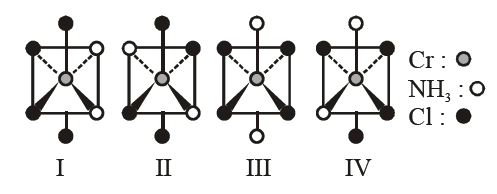
Consider the following isomers of $[Cr(NH_3)_2 Cl_4]^-$ and identify the correct classification of these isomers as $cis$ or $trans$.
A
$I$ and $IV$ are $trans$ and $II$ and $III$ are $cis$
B
$I$ and $IV$ are $cis$ and $II$ and $III$ are $trans$
C
$I$ and $II$ are $cis$ and $III$ and $IV$ are $trans$
D
$I$ and $II$ are $trans$ and $III$ and $IV$ are $cis$
Solution
(A) In an octahedral complex of the type $[MA_2B_4]$,the $cis$ isomer has the two $A$ ligands adjacent to each other (at $90^\circ$),while the $trans$ isomer has the two $A$ ligands opposite to each other (at $180^\circ$).
$1$. In structure $I$,the two $NH_3$ ligands are at $180^\circ$ (opposite),so it is $trans$.
$2$. In structure $II$,the two $NH_3$ ligands are at $90^\circ$ (adjacent),so it is $cis$.
$3$. In structure $III$,the two $NH_3$ ligands are at $90^\circ$ (adjacent),so it is $cis$.
$4$. In structure $IV$,the two $NH_3$ ligands are at $180^\circ$ (opposite),so it is $trans$.
Thus,$I$ and $IV$ are $trans$,and $II$ and $III$ are $cis$.
$1$. In structure $I$,the two $NH_3$ ligands are at $180^\circ$ (opposite),so it is $trans$.
$2$. In structure $II$,the two $NH_3$ ligands are at $90^\circ$ (adjacent),so it is $cis$.
$3$. In structure $III$,the two $NH_3$ ligands are at $90^\circ$ (adjacent),so it is $cis$.
$4$. In structure $IV$,the two $NH_3$ ligands are at $180^\circ$ (opposite),so it is $trans$.
Thus,$I$ and $IV$ are $trans$,and $II$ and $III$ are $cis$.
0 likes
View Solution298
MediumMCQ
Match the complex ion (in List-$I$) with the number of unpaired electrons (in List-$II$):
| List-$I$ | List-$II$ |
|---|---|
| $A$. $[Fe(H_2O)_6]^{2+}$ | $P$. $0$ |
| $B$. $[Fe(H_2O)_6]^{3+}$ | $Q$. $1$ |
| $C$. $[Fe(CN)_6]^{4-}$ | $R$. $2$ |
| $D$. $[Fe(CN)_6]^{3-}$ | $S$. $4$ |
| $E$. $[Ni(H_2O)_4]^{2+}$ | $T$. $5$ |
A
$A-S, B-T, C-P, D-Q, E-R$
B
$A-S, B-T, C-Q, D-P, E-R$
C
$A-T, B-S, C-P, D-Q, E-R$
D
$A-R, B-S, C-P, D-Q, E-T$
Solution
(A) . $[Fe(H_2O)_6]^{2+}$: $Fe^{2+}$ is $d^6$. $H_2O$ is a weak field ligand. Configuration is $t_{2g}^4 e_g^2$. Unpaired electrons = $4$ $(S)$.
$B$. $[Fe(H_2O)_6]^{3+}$: $Fe^{3+}$ is $d^5$. $H_2O$ is a weak field ligand. Configuration is $t_{2g}^3 e_g^2$. Unpaired electrons = $5$ $(T)$.
$C$. $[Fe(CN)_6]^{4-}$: $Fe^{2+}$ is $d^6$. $CN^-$ is a strong field ligand. Configuration is $t_{2g}^6 e_g^0$. Unpaired electrons = $0$ $(P)$.
$D$. $[Fe(CN)_6]^{3-}$: $Fe^{3+}$ is $d^5$. $CN^-$ is a strong field ligand. Configuration is $t_{2g}^5 e_g^0$. Unpaired electrons = $1$ $(Q)$.
$E$. $[Ni(H_2O)_4]^{2+}$: $Ni^{2+}$ is $d^8$. $H_2O$ is a weak field ligand. Configuration is $t_{2g}^6 e_g^2$. Unpaired electrons = $2$ $(R)$.
Thus,the correct match is $A-S, B-T, C-P, D-Q, E-R$.
$B$. $[Fe(H_2O)_6]^{3+}$: $Fe^{3+}$ is $d^5$. $H_2O$ is a weak field ligand. Configuration is $t_{2g}^3 e_g^2$. Unpaired electrons = $5$ $(T)$.
$C$. $[Fe(CN)_6]^{4-}$: $Fe^{2+}$ is $d^6$. $CN^-$ is a strong field ligand. Configuration is $t_{2g}^6 e_g^0$. Unpaired electrons = $0$ $(P)$.
$D$. $[Fe(CN)_6]^{3-}$: $Fe^{3+}$ is $d^5$. $CN^-$ is a strong field ligand. Configuration is $t_{2g}^5 e_g^0$. Unpaired electrons = $1$ $(Q)$.
$E$. $[Ni(H_2O)_4]^{2+}$: $Ni^{2+}$ is $d^8$. $H_2O$ is a weak field ligand. Configuration is $t_{2g}^6 e_g^2$. Unpaired electrons = $2$ $(R)$.
Thus,the correct match is $A-S, B-T, C-P, D-Q, E-R$.
0 likes
View Solution299
MediumMCQ
Which of the following complexes will show both geometrical and optical isomerism?
A
$[Pt(NH_3)_2Cl_2]$
B
$[Cu(NH_3)_4]^{2+}$
C
$[Cr(en)_2Cl_2]^+$
D
$[Co(NH_3)_4Cl_2]^+$
Solution
(C) For a complex to show both geometrical and optical isomerism,it must have at least one geometrical isomer that is chiral (lacks a plane of symmetry).
$1$. $[Pt(NH_3)_2Cl_2]$ is a square planar complex,which shows geometrical isomerism (cis and trans) but not optical isomerism.
$2$. $[Cu(NH_3)_4]^{2+}$ is a square planar complex and does not show optical isomerism.
$3$. $[Cr(en)_2Cl_2]^+$ is an octahedral complex of the type $[M(AA)_2a_2]$. The $cis$-isomer of this complex is optically active because it lacks a plane of symmetry,while the $trans$-isomer is optically inactive.
$4$. $[Co(NH_3)_4Cl_2]^+$ is an octahedral complex of the type $[MA_4a_2]$,which shows geometrical isomerism but its isomers possess planes of symmetry,making them optically inactive.
Therefore,$[Cr(en)_2Cl_2]^+$ is the correct answer.
$1$. $[Pt(NH_3)_2Cl_2]$ is a square planar complex,which shows geometrical isomerism (cis and trans) but not optical isomerism.
$2$. $[Cu(NH_3)_4]^{2+}$ is a square planar complex and does not show optical isomerism.
$3$. $[Cr(en)_2Cl_2]^+$ is an octahedral complex of the type $[M(AA)_2a_2]$. The $cis$-isomer of this complex is optically active because it lacks a plane of symmetry,while the $trans$-isomer is optically inactive.
$4$. $[Co(NH_3)_4Cl_2]^+$ is an octahedral complex of the type $[MA_4a_2]$,which shows geometrical isomerism but its isomers possess planes of symmetry,making them optically inactive.
Therefore,$[Cr(en)_2Cl_2]^+$ is the correct answer.
0 likes
View Solution300
EasyMCQ
Total number of geometrical isomers of $[Ma_3b_3]$ is/are:
A
$0$
B
$2$
C
$3$
D
$4$
Solution
(B) For an octahedral complex of the type $[Ma_3b_3]$,there are two possible geometrical isomers:
$1$. $fac$ (facial) isomer: In this isomer,the three identical ligands occupy the corners of one triangular face of the octahedron.
$2$. $mer$ (meridional) isomer: In this isomer,the three identical ligands occupy the meridian of the octahedron.
Therefore,the total number of geometrical isomers is $2$.
$1$. $fac$ (facial) isomer: In this isomer,the three identical ligands occupy the corners of one triangular face of the octahedron.
$2$. $mer$ (meridional) isomer: In this isomer,the three identical ligands occupy the meridian of the octahedron.
Therefore,the total number of geometrical isomers is $2$.
0 likes
View SolutionCoordination Compounds — Isomerism and Magnetic properties · Frequently Asked Questions
1Are these Coordination Compounds questions useful for JEE and NEET?
Yes. All questions in this section are mapped to JEE Main and NEET exam patterns. Previous year questions from JEE Main, NEET, GUJCET and state-level exams are included with full solutions.
2Can I switch to Hindi or Gujarati for these questions?
Yes. Use the language tabs in the hero section or the sidebar to view the same questions and solutions in English, Hindi or Gujarati.
3How do I generate a question paper from this subtopic?
Use the Vedclass Exam Paper Generator — select the chapter and subtopic, set difficulty, and generate Sets A, B, C, D automatically. First 3 chapters of every subject are free.
Vedclass Products
For Students
Vedclass Test Series
Mock tests in real JEE/NEET style with performance analysis. 5-day free trial.
Start Free TrialFor Teachers
Exam Paper Generator
Generate Set A/B/C/D papers from this chapter in 2 minutes. 3 chapters free.
Try FreeFor Institutes
Online Exam Module
Live online exams with unlimited students, 360° analytics & white-label branding.
See DemoFor Teachers & Institutes
Generate a Coordination Compounds Exam Paper in 2 Minutes
Select subtopic & difficulty — Sets A, B, C, D auto-generated with No Repeat logic.
First 3 chapters of every subject are free — no payment required.