
A English
Isomerism and Magnetic properties Questions in English
Class 12 Chemistry · Coordination Compounds · Isomerism and Magnetic properties
800+
Questions
English
Language
100%
With Solutions
Showing 50 of 800 questions in English
201
MediumMCQ
The complexes $[Co(NH_3)_6][Cr(CN)_6]$ and $[Cr(NH_3)_6][Co(CN)_6]$ are the examples of which type of isomerism?
A
Linkage isomerism
B
Ionization isomerism
C
Coordination isomerism
D
Geometrical isomerism
Solution
(C) The complexes $[Co(NH_3)_6][Cr(CN)_6]$ and $[Cr(NH_3)_6][Co(CN)_6]$ are examples of coordination isomerism.
This type of isomerism occurs in complexes where both the cation and the anion are complex ions.
It arises due to the interchange of ligands between the cationic and anionic coordination spheres.
This type of isomerism occurs in complexes where both the cation and the anion are complex ions.
It arises due to the interchange of ligands between the cationic and anionic coordination spheres.
0 likes
View Solution202
DifficultMCQ
The complex,$[Pt(Py)(NH_3)BrCl]$,will have how many geometrical isomers?
A
$3$
B
$4$
C
$0$
D
$2$
Solution
(A) The complex $[Pt(Py)(NH_3)BrCl]$ is a square planar complex of the type $[M(abcd)]$,where $M = Pt$,$a = Py$,$b = NH_3$,$c = Br$,and $d = Cl$.
For a square planar complex of the type $[M(abcd)]$,there are $3$ possible geometrical isomers.
These isomers are formed by fixing one ligand (e.g.,$Py$) and varying the positions of the other three ligands $(NH_3, Br, Cl)$ relative to it.
Thus,the total number of geometrical isomers is $3$.
For a square planar complex of the type $[M(abcd)]$,there are $3$ possible geometrical isomers.
These isomers are formed by fixing one ligand (e.g.,$Py$) and varying the positions of the other three ligands $(NH_3, Br, Cl)$ relative to it.
Thus,the total number of geometrical isomers is $3$.
0 likes
View Solution203
DifficultMCQ
The $d-$electron configurations of $Cr^{2+}, Mn^{2+}, Fe^{2+}$ and $Co^{2+}$ are $d^4, d^5, d^6$ and $d^7$ respectively. Which one of the following will exhibit minimum paramagnetic behaviour?
(At. nos. $Cr = 24, Mn = 25, Fe = 26, Co = 27$)
(At. nos. $Cr = 24, Mn = 25, Fe = 26, Co = 27$)
A
$[Mn(H_2O)_6]^{2+}$
B
$[Fe(H_2O)_6]^{2+}$
C
$[Co(H_2O)_6]^{2+}$
D
$[Cr(H_2O)_6]^{2+}$
Solution
(C) The paramagnetic behaviour depends on the number of unpaired electrons $(n)$.
$1$. For $[Cr(H_2O)_6]^{2+}$,$Cr^{2+}$ is $d^4$. In a weak field ligand like $H_2O$,$n = 4$.
$2$. For $[Mn(H_2O)_6]^{2+}$,$Mn^{2+}$ is $d^5$. In a weak field ligand like $H_2O$,$n = 5$.
$3$. For $[Fe(H_2O)_6]^{2+}$,$Fe^{2+}$ is $d^6$. In a weak field ligand like $H_2O$,$n = 4$.
$4$. For $[Co(H_2O)_6]^{2+}$,$Co^{2+}$ is $d^7$. In a weak field ligand like $H_2O$,$n = 3$.
Since $[Co(H_2O)_6]^{2+}$ has the minimum number of unpaired electrons $(n = 3)$,it exhibits the minimum paramagnetic behaviour.
The magnetic moment is given by $\mu = \sqrt{n(n+2)} \text{ BM}$.
$1$. For $[Cr(H_2O)_6]^{2+}$,$Cr^{2+}$ is $d^4$. In a weak field ligand like $H_2O$,$n = 4$.
$2$. For $[Mn(H_2O)_6]^{2+}$,$Mn^{2+}$ is $d^5$. In a weak field ligand like $H_2O$,$n = 5$.
$3$. For $[Fe(H_2O)_6]^{2+}$,$Fe^{2+}$ is $d^6$. In a weak field ligand like $H_2O$,$n = 4$.
$4$. For $[Co(H_2O)_6]^{2+}$,$Co^{2+}$ is $d^7$. In a weak field ligand like $H_2O$,$n = 3$.
Since $[Co(H_2O)_6]^{2+}$ has the minimum number of unpaired electrons $(n = 3)$,it exhibits the minimum paramagnetic behaviour.
The magnetic moment is given by $\mu = \sqrt{n(n+2)} \text{ BM}$.
0 likes
View Solution204
MediumMCQ
Which of the following complex compounds will exhibit highest paramagnetic behaviour?
(At. No. $Ti = 22, Cr = 24, Co = 27, Zn = 30$)
(At. No. $Ti = 22, Cr = 24, Co = 27, Zn = 30$)
A
$[Ti(NH_3)_6]^{3+}$
B
$[Cr(NH_3)_6]^{3+}$
C
$[Co(NH_3)_6]^{3+}$
D
$[Zn(NH_3)_6]^{2+}$
Solution
(B) $Ti$ $\rightarrow [Ar] 3d^{2} 4s^{2}, Ti^{3+}$ $\rightarrow [Ar] 3d^{1} 4s^{0}$ ($1$ unpaired electron)
$Cr$ $\rightarrow [Ar] 3d^{5} 4s^{1}, Cr^{3+}$ $\rightarrow [Ar] 3d^{3} 4s^{0}$ ($3$ unpaired electrons)
$Co$ $\rightarrow [Ar] 3d^{7} 4s^{2}, Co^{3+}$ $\rightarrow [Ar] 3d^{6} 4s^{0}$ ($0$ unpaired electrons because $NH_3$ is a strong field ligand causing pairing)
$Zn$ $\rightarrow [Ar] 3d^{10} 4s^{2}, Zn^{2+}$ $\rightarrow [Ar] 3d^{10}$ ($0$ unpaired electrons)
Since $[Cr(NH_3)_6]^{3+}$ has the highest number of unpaired electrons $(3)$,it exhibits the highest paramagnetic behaviour.
$Cr$ $\rightarrow [Ar] 3d^{5} 4s^{1}, Cr^{3+}$ $\rightarrow [Ar] 3d^{3} 4s^{0}$ ($3$ unpaired electrons)
$Co$ $\rightarrow [Ar] 3d^{7} 4s^{2}, Co^{3+}$ $\rightarrow [Ar] 3d^{6} 4s^{0}$ ($0$ unpaired electrons because $NH_3$ is a strong field ligand causing pairing)
$Zn$ $\rightarrow [Ar] 3d^{10} 4s^{2}, Zn^{2+}$ $\rightarrow [Ar] 3d^{10}$ ($0$ unpaired electrons)
Since $[Cr(NH_3)_6]^{3+}$ has the highest number of unpaired electrons $(3)$,it exhibits the highest paramagnetic behaviour.
0 likes
View Solution205
DifficultMCQ
Which of the following complex ions is not expected to absorb visible light?
A
$[Ni(CN)_4]^{2-}$
B
$[Cr(NH_3)_6]^{3+}$
C
$[Fe(H_2O)_6]^{2+}$
D
$[Ni(H_2O)_6]^{2+}$
Solution
(A) transition metal complex absorbs visible light only if it has unpaired electrons,which allows for $d-d$ transitions.
$1$. In $[Ni(CN)_4]^{2-}$,$Ni$ is in the $+2$ oxidation state $(3d^8)$. Since $CN^-$ is a strong field ligand,it causes pairing of electrons in the $3d$ orbitals,resulting in no unpaired electrons ($d^8$ configuration: $t_{2g}^6 e_g^2$ is not applicable here as it is square planar,but all electrons are paired).
$2$. $[Cr(NH_3)_6]^{3+}$ has $Cr^{3+}$ $(3d^3)$,which has $3$ unpaired electrons.
$3$. $[Fe(H_2O)_6]^{2+}$ has $Fe^{2+}$ $(3d^6)$,which has $4$ unpaired electrons.
$4$. $[Ni(H_2O)_6]^{2+}$ has $Ni^{2+}$ $(3d^8)$,which has $2$ unpaired electrons.
Since $[Ni(CN)_4]^{2-}$ has no unpaired electrons,it is not expected to absorb visible light.
$1$. In $[Ni(CN)_4]^{2-}$,$Ni$ is in the $+2$ oxidation state $(3d^8)$. Since $CN^-$ is a strong field ligand,it causes pairing of electrons in the $3d$ orbitals,resulting in no unpaired electrons ($d^8$ configuration: $t_{2g}^6 e_g^2$ is not applicable here as it is square planar,but all electrons are paired).
$2$. $[Cr(NH_3)_6]^{3+}$ has $Cr^{3+}$ $(3d^3)$,which has $3$ unpaired electrons.
$3$. $[Fe(H_2O)_6]^{2+}$ has $Fe^{2+}$ $(3d^6)$,which has $4$ unpaired electrons.
$4$. $[Ni(H_2O)_6]^{2+}$ has $Ni^{2+}$ $(3d^8)$,which has $2$ unpaired electrons.
Since $[Ni(CN)_4]^{2-}$ has no unpaired electrons,it is not expected to absorb visible light.
0 likes
View Solution206
MediumMCQ
The existence of two different coloured complexes with the composition of $[Co(NH_3)_4Cl_2]^+$ is due to
A
linkage isomerism
B
ionization isomerism
C
coordination isomerism
D
geometrical isomerism
Solution
(D) Complexes of $[MA_4B_2]$ type exhibit geometrical isomerism.
The complex $[Co(NH_3)_4Cl_2]^+$ is a $[MA_4B_2]$ type complex and thus,fulfills the conditions that are necessary to exhibit geometrical isomerism.
Hence,it has two geometrical isomers (cis and trans) of different colours.
For linkage isomerism,the presence of an ambidentate ligand is necessary.
For coordination isomerism,both the cation and anion of the complex must be complex ions.
For ionisation isomerism,an anion different from the ligands must be present outside the coordination sphere.
All these conditions are not satisfied by this complex. Hence,it does not exhibit other given isomerisms.
The complex $[Co(NH_3)_4Cl_2]^+$ is a $[MA_4B_2]$ type complex and thus,fulfills the conditions that are necessary to exhibit geometrical isomerism.
Hence,it has two geometrical isomers (cis and trans) of different colours.
For linkage isomerism,the presence of an ambidentate ligand is necessary.
For coordination isomerism,both the cation and anion of the complex must be complex ions.
For ionisation isomerism,an anion different from the ligands must be present outside the coordination sphere.
All these conditions are not satisfied by this complex. Hence,it does not exhibit other given isomerisms.
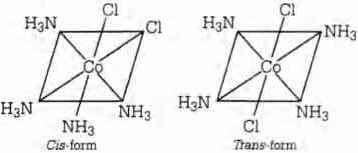
0 likes
View Solution207
MediumMCQ
Which one of the following complexes is not expected to exhibit isomerism?
A
$[Ni(NH_3)_4(H_2O)_2]^{2+}$
B
$[Pt(NH_3)_2Cl_2]$
C
$[Ni(NH_3)_2Cl_2]$
D
$[Ni(en)_3]^{2+}$
Solution
(C) The complex $[Ni(NH_3)_2Cl_2]$ adopts a tetrahedral geometry because $Ni^{2+}$ is a $d^8$ ion and $NH_3$ and $Cl^-$ are weak field ligands in this context,leading to $sp^3$ hybridization.
Tetrahedral complexes of the type $[M(A)_2(B)_2]$ do not exhibit geometric isomerism because all positions in a tetrahedron are equivalent relative to each other.
In contrast,$[Pt(NH_3)_2Cl_2]$ is a square planar complex which exhibits cis-trans isomerism.
$[Ni(NH_3)_4(H_2O)_2]^{2+}$ is an octahedral complex which exhibits geometric isomerism.
$[Ni(en)_3]^{2+}$ is an octahedral complex which exhibits optical isomerism.
Tetrahedral complexes of the type $[M(A)_2(B)_2]$ do not exhibit geometric isomerism because all positions in a tetrahedron are equivalent relative to each other.
In contrast,$[Pt(NH_3)_2Cl_2]$ is a square planar complex which exhibits cis-trans isomerism.
$[Ni(NH_3)_4(H_2O)_2]^{2+}$ is an octahedral complex which exhibits geometric isomerism.
$[Ni(en)_3]^{2+}$ is an octahedral complex which exhibits optical isomerism.
0 likes
View Solution208
AdvancedMCQ
Out of $TiF_6^{2-}$,$CoF_6^{3-}$,$Cu_2Cl_2$ and $NiCl_4^{2-}$ ($Z$ of $Ti = 22, Co = 27, Cu = 29, Ni = 28$),the colourless species are:
A
$Cu_2Cl_2$ and $NiCl_4^{2-}$
B
$TiF_6^{2-}$ and $Cu_2Cl_2$
C
$CoF_6^{3-}$ and $NiCl_4^{2-}$
D
$TiF_6^{2-}$ and $CoF_6^{3-}$
Solution
(B) To determine if a species is colourless,we check for the presence of unpaired electrons in the $d$-orbitals. If the $d$-orbital is either completely empty $(d^0)$ or completely filled $(d^{10})$,the species is colourless due to the absence of $d-d$ transitions.
$1$. $TiF_6^{2-}$: $Ti$ is in $+4$ oxidation state. Electronic configuration: $Ti^{4+} = [Ar] 3d^0$. Since it has no $d$-electrons,it is colourless.
$2$. $CoF_6^{3-}$: $Co$ is in $+3$ oxidation state. Electronic configuration: $Co^{3+} = [Ar] 3d^6$. It has unpaired electrons,so it is coloured.
$3$. $Cu_2Cl_2$: $Cu$ is in $+1$ oxidation state. Electronic configuration: $Cu^{+} = [Ar] 3d^{10}$. Since the $d$-orbital is fully filled,it is colourless.
$4$. $NiCl_4^{2-}$: $Ni$ is in $+2$ oxidation state. Electronic configuration: $Ni^{2+} = [Ar] 3d^8$. It has unpaired electrons,so it is coloured.
Therefore,$TiF_6^{2-}$ and $Cu_2Cl_2$ are the colourless species.
$1$. $TiF_6^{2-}$: $Ti$ is in $+4$ oxidation state. Electronic configuration: $Ti^{4+} = [Ar] 3d^0$. Since it has no $d$-electrons,it is colourless.
$2$. $CoF_6^{3-}$: $Co$ is in $+3$ oxidation state. Electronic configuration: $Co^{3+} = [Ar] 3d^6$. It has unpaired electrons,so it is coloured.
$3$. $Cu_2Cl_2$: $Cu$ is in $+1$ oxidation state. Electronic configuration: $Cu^{+} = [Ar] 3d^{10}$. Since the $d$-orbital is fully filled,it is colourless.
$4$. $NiCl_4^{2-}$: $Ni$ is in $+2$ oxidation state. Electronic configuration: $Ni^{2+} = [Ar] 3d^8$. It has unpaired electrons,so it is coloured.
Therefore,$TiF_6^{2-}$ and $Cu_2Cl_2$ are the colourless species.
0 likes
View Solution209
MediumMCQ
Which of the following does not show optical isomerism?
$(en = \text{ethylenediamine})$
$(en = \text{ethylenediamine})$
A
$[Co(NH_3)_3Cl_3]^0$
B
$[Co(en)Cl_2(NH_3)_2]^+$
C
$[Co(en)_3]^{3+}$
D
$[Co(en)_2Cl_2]^+$
Solution
(A) Optical isomerism is exhibited by only those complexes in which elements of symmetry are absent.
Octahedral complexes of the types $[M(aa)_3]$,$[M(aa)x_2y_2]$,and $[M(aa)_2x_2]$ lack elements of symmetry and thus exhibit optical isomerism,where $aa$ represents a bidentate ligand,$x$ or $y$ represent monodentate ligands,and $M$ represents the central metal ion.
Complexes of the type $[MA_3B_3]$,such as $[Co(NH_3)_3Cl_3]^0$,possess planes of symmetry and therefore do not exhibit optical isomerism.
Conversely,$[Co(en)_3]^{3+}$ (type $[M(aa)_3]$),$[Co(en)_2Cl_2]^+$ (type $[M(aa)_2x_2]$),and $[Co(en)Cl_2(NH_3)_2]^+$ (type $[M(aa)x_2y_2]$) all exhibit optical isomerism.
Octahedral complexes of the types $[M(aa)_3]$,$[M(aa)x_2y_2]$,and $[M(aa)_2x_2]$ lack elements of symmetry and thus exhibit optical isomerism,where $aa$ represents a bidentate ligand,$x$ or $y$ represent monodentate ligands,and $M$ represents the central metal ion.
Complexes of the type $[MA_3B_3]$,such as $[Co(NH_3)_3Cl_3]^0$,possess planes of symmetry and therefore do not exhibit optical isomerism.
Conversely,$[Co(en)_3]^{3+}$ (type $[M(aa)_3]$),$[Co(en)_2Cl_2]^+$ (type $[M(aa)_2x_2]$),and $[Co(en)Cl_2(NH_3)_2]^+$ (type $[M(aa)x_2y_2]$) all exhibit optical isomerism.
0 likes
View Solution210
DifficultMCQ
Which of the following complex ions is expected to absorb visible light?
[At. nos. $Zn = 30$,$Sc = 21$,$Ti = 22$,$Cr = 24$]
[At. nos. $Zn = 30$,$Sc = 21$,$Ti = 22$,$Cr = 24$]
A
$[Ti(en)_2(NH_3)_2]^{4+}$
B
$[Cr(NH_3)_6]^{3+}$
C
$[Zn(NH_3)_6]^{2+}$
D
$[Sc(H_2O)_3(NH_3)_3]^{3+}$
Solution
(B) complex ion absorbs visible light if it contains unpaired electrons in its $d$-orbitals,allowing for $d-d$ transitions.
$1$. In $[Ti(en)_2(NH_3)_2]^{4+}$,$Ti$ is in the $+4$ oxidation state. $Ti^{4+} = [Ar] 3d^0$. No $d$-electrons,so no $d-d$ transition.
$2$. In $[Cr(NH_3)_6]^{3+}$,$Cr$ is in the $+3$ oxidation state. $Cr^{3+} = [Ar] 3d^3$. It has $3$ unpaired electrons,allowing for $d-d$ transitions.
$3$. In $[Zn(NH_3)_6]^{2+}$,$Zn$ is in the $+2$ oxidation state. $Zn^{2+} = [Ar] 3d^{10}$. Fully filled $d$-orbitals,no $d-d$ transition.
$4$. In $[Sc(H_2O)_3(NH_3)_3]^{3+}$,$Sc$ is in the $+3$ oxidation state. $Sc^{3+} = [Ar] 3d^0$. No $d$-electrons,so no $d-d$ transition.
Therefore,only $[Cr(NH_3)_6]^{3+}$ is expected to absorb visible light.
$1$. In $[Ti(en)_2(NH_3)_2]^{4+}$,$Ti$ is in the $+4$ oxidation state. $Ti^{4+} = [Ar] 3d^0$. No $d$-electrons,so no $d-d$ transition.
$2$. In $[Cr(NH_3)_6]^{3+}$,$Cr$ is in the $+3$ oxidation state. $Cr^{3+} = [Ar] 3d^3$. It has $3$ unpaired electrons,allowing for $d-d$ transitions.
$3$. In $[Zn(NH_3)_6]^{2+}$,$Zn$ is in the $+2$ oxidation state. $Zn^{2+} = [Ar] 3d^{10}$. Fully filled $d$-orbitals,no $d-d$ transition.
$4$. In $[Sc(H_2O)_3(NH_3)_3]^{3+}$,$Sc$ is in the $+3$ oxidation state. $Sc^{3+} = [Ar] 3d^0$. No $d$-electrons,so no $d-d$ transition.
Therefore,only $[Cr(NH_3)_6]^{3+}$ is expected to absorb visible light.
0 likes
View Solution211
DifficultMCQ
Which of the following complexes exhibits the highest paramagnetic behaviour? (where $gly = \text{glycine}$,$en = \text{ethylenediamine}$,and $bpy = \text{bipyridyl}$ moieties. At. nos. $Ti = 22, V = 23, Fe = 26, Co = 27$)
A
$[Co(ox)_2(OH)_2]^-$
B
$[Ti(NH_3)_6]^{3+}$
C
$[V(gly)_2(OH)_2(NH_3)_2]^+$
D
$[Fe(en)(bpy)(NH_3)_2]^{2+}$
Solution
(C) To determine the highest paramagnetic behaviour,we calculate the number of unpaired electrons in each complex:
$1$. $[Ti(NH_3)_6]^{3+}$: $Ti$ is in $+3$ oxidation state $(3d^1)$. Number of unpaired electrons $(n)$ = $1$.
$2$. $[V(gly)_2(OH)_2(NH_3)_2]^+$: $V$ is in $+3$ oxidation state $(3d^2)$. Number of unpaired electrons $(n)$ = $2$.
$3$. $[Fe(en)(bpy)(NH_3)_2]^{2+}$: $Fe$ is in $+2$ oxidation state $(3d^6)$. Since $en$ and $bpy$ are strong field ligands,they cause pairing of electrons. However,even with pairing,$Fe^{2+}$ in an octahedral field typically results in $t_{2g}^6 e_g^0$ (low spin,$n=0$) or $t_{2g}^4 e_g^2$ (high spin,$n=4$). Given the ligands,it is a low-spin complex $(n=0)$.
$4$. $[Co(ox)_2(OH)_2]^-$: $Co$ is in $+5$ oxidation state $(3d^4)$. This is highly unstable and unlikely.
Re-evaluating the options based on standard coordination chemistry: $[Fe(en)(bpy)(NH_3)_2]^{2+}$ is a low-spin $d^6$ complex $(n=0)$. $[V(gly)_2(OH)_2(NH_3)_2]^+$ has $n=2$. $[Ti(NH_3)_6]^{3+}$ has $n=1$. The question likely contains a typo in the options or complex formulas. Based on typical competitive exam patterns for this specific question,the complex $[Fe(en)(bpy)(NH_3)_2]^{2+}$ is often intended to be high-spin or the comparison is between standard $d$-electron counts. Given the options,$[V(gly)_2(OH)_2(NH_3)_2]^+$ has the highest number of unpaired electrons $(n=2)$.
$1$. $[Ti(NH_3)_6]^{3+}$: $Ti$ is in $+3$ oxidation state $(3d^1)$. Number of unpaired electrons $(n)$ = $1$.
$2$. $[V(gly)_2(OH)_2(NH_3)_2]^+$: $V$ is in $+3$ oxidation state $(3d^2)$. Number of unpaired electrons $(n)$ = $2$.
$3$. $[Fe(en)(bpy)(NH_3)_2]^{2+}$: $Fe$ is in $+2$ oxidation state $(3d^6)$. Since $en$ and $bpy$ are strong field ligands,they cause pairing of electrons. However,even with pairing,$Fe^{2+}$ in an octahedral field typically results in $t_{2g}^6 e_g^0$ (low spin,$n=0$) or $t_{2g}^4 e_g^2$ (high spin,$n=4$). Given the ligands,it is a low-spin complex $(n=0)$.
$4$. $[Co(ox)_2(OH)_2]^-$: $Co$ is in $+5$ oxidation state $(3d^4)$. This is highly unstable and unlikely.
Re-evaluating the options based on standard coordination chemistry: $[Fe(en)(bpy)(NH_3)_2]^{2+}$ is a low-spin $d^6$ complex $(n=0)$. $[V(gly)_2(OH)_2(NH_3)_2]^+$ has $n=2$. $[Ti(NH_3)_6]^{3+}$ has $n=1$. The question likely contains a typo in the options or complex formulas. Based on typical competitive exam patterns for this specific question,the complex $[Fe(en)(bpy)(NH_3)_2]^{2+}$ is often intended to be high-spin or the comparison is between standard $d$-electron counts. Given the options,$[V(gly)_2(OH)_2(NH_3)_2]^+$ has the highest number of unpaired electrons $(n=2)$.
0 likes
View Solution212
DifficultMCQ
Which of the following will give a pair of enantiomorphs?
$(en = NH_2CH_2CH_2NH_2)$
$(en = NH_2CH_2CH_2NH_2)$
A
$[Cr(NH_3)_6][Co(CN)_6]$
B
$[Co(en)_2Cl_2]Cl$
C
$[Pt(NH_3)_4][PtCl_6]$
D
$[Co(NH_3)_4Cl_2]NO_2$
Solution
(B) Enantiomorphs (or enantiomers) are non-superimposable mirror images of each other.
For a coordination complex to exhibit optical isomerism (enantiomerism),it must lack a plane of symmetry and a center of inversion.
In the complex $[Co(en)_2Cl_2]^+$,the $cis$-isomer lacks a plane of symmetry and thus exists as a pair of enantiomorphs ($d$ and $l$ forms).
The $trans$-isomer of $[Co(en)_2Cl_2]^+$ possesses a plane of symmetry and is optically inactive.
Other options like $[Cr(NH_3)_6][Co(CN)_6]$,$[Pt(NH_3)_4][PtCl_6]$,and $[Co(NH_3)_4Cl_2]NO_2$ do not exhibit optical isomerism due to the presence of planes of symmetry in their structures.
For a coordination complex to exhibit optical isomerism (enantiomerism),it must lack a plane of symmetry and a center of inversion.
In the complex $[Co(en)_2Cl_2]^+$,the $cis$-isomer lacks a plane of symmetry and thus exists as a pair of enantiomorphs ($d$ and $l$ forms).
The $trans$-isomer of $[Co(en)_2Cl_2]^+$ possesses a plane of symmetry and is optically inactive.
Other options like $[Cr(NH_3)_6][Co(CN)_6]$,$[Pt(NH_3)_4][PtCl_6]$,and $[Co(NH_3)_4Cl_2]NO_2$ do not exhibit optical isomerism due to the presence of planes of symmetry in their structures.
0 likes
View Solution213
DifficultMCQ
The $d$ electron configurations of $Cr^{2+}, Mn^{2+}, Fe^{2+}$ and $Ni^{2+}$ are $3d^4, 3d^5, 3d^6$ and $3d^8$ respectively. Which one of the following aqua complexes will exhibit the minimum paramagnetic behaviour?
(At. No. $Cr = 24, Mn = 25, Fe = 26, Ni = 28$)
(At. No. $Cr = 24, Mn = 25, Fe = 26, Ni = 28$)
A
$[Fe(H_2O)_6]^{2+}$
B
$[Ni(H_2O)_6]^{2+}$
C
$[Cr(H_2O)_6]^{2+}$
D
$[Mn(H_2O)_6]^{2+}$
Solution
(B) Paramagnetic behaviour is directly proportional to the number of unpaired electrons present in the metal ion.
$H_2O$ is a weak field ligand,so it does not cause pairing of electrons in these $3d$ metal ions.
$1$. For $[Cr(H_2O)_6]^{2+}$: $Cr^{2+}$ is $3d^4$,having $4$ unpaired electrons.
$2$. For $[Mn(H_2O)_6]^{2+}$: $Mn^{2+}$ is $3d^5$,having $5$ unpaired electrons.
$3$. For $[Fe(H_2O)_6]^{2+}$: $Fe^{2+}$ is $3d^6$,having $4$ unpaired electrons.
$4$. For $[Ni(H_2O)_6]^{2+}$: $Ni^{2+}$ is $3d^8$,having $2$ unpaired electrons.
Since $[Ni(H_2O)_6]^{2+}$ has the minimum number of unpaired electrons $(2)$,it exhibits the minimum paramagnetic behaviour.
$H_2O$ is a weak field ligand,so it does not cause pairing of electrons in these $3d$ metal ions.
$1$. For $[Cr(H_2O)_6]^{2+}$: $Cr^{2+}$ is $3d^4$,having $4$ unpaired electrons.
$2$. For $[Mn(H_2O)_6]^{2+}$: $Mn^{2+}$ is $3d^5$,having $5$ unpaired electrons.
$3$. For $[Fe(H_2O)_6]^{2+}$: $Fe^{2+}$ is $3d^6$,having $4$ unpaired electrons.
$4$. For $[Ni(H_2O)_6]^{2+}$: $Ni^{2+}$ is $3d^8$,having $2$ unpaired electrons.
Since $[Ni(H_2O)_6]^{2+}$ has the minimum number of unpaired electrons $(2)$,it exhibits the minimum paramagnetic behaviour.
0 likes
View Solution214
MediumMCQ
$[Co(NH_3)_4(NO_2)_2]Cl$ exhibits
A
linkage isomerism,geometrical isomerism and optical isomerism
B
linkage isomerism,ionization isomerism and optical isomerism
C
linkage isomerism,ionization isomerism and geometrical isomerism
D
ionization isomerism,geometrical isomerism and optical isomerism
Solution
(C) The complex $[Co(NH_3)_4(NO_2)_2]Cl$ exhibits the following types of isomerism:
$1.$ Linkage isomerism: Due to the presence of the ambidentate ligand $NO_2^-$ (it can coordinate through $N$ or $O$).
$2.$ Ionization isomerism: It can exchange ions between the coordination sphere and the ionization sphere to form $[Co(NH_3)_4(NO_2)Cl]NO_2$.
$3.$ Geometrical isomerism: It is an $[MA_4B_2]$ type octahedral complex,which exists in $\text{cis}$ and $\text{trans}$ forms.
It does not show optical isomerism because both $\text{cis}$ and $\text{trans}$ forms possess a plane of symmetry.
$1.$ Linkage isomerism: Due to the presence of the ambidentate ligand $NO_2^-$ (it can coordinate through $N$ or $O$).
$2.$ Ionization isomerism: It can exchange ions between the coordination sphere and the ionization sphere to form $[Co(NH_3)_4(NO_2)Cl]NO_2$.
$3.$ Geometrical isomerism: It is an $[MA_4B_2]$ type octahedral complex,which exists in $\text{cis}$ and $\text{trans}$ forms.
It does not show optical isomerism because both $\text{cis}$ and $\text{trans}$ forms possess a plane of symmetry.
0 likes
View Solution215
MediumMCQ
Which of the following complexes exhibits optical isomerism?
A
$[Co(en)(NH_3)_2]^{2+}$
B
$[Co(H_2O)_4(en)]^{3+}$
C
$[Co(en)_2(NH_3)_2]^{3+}$
D
$[Co(NH_3)_3Cl_3]$
Solution
(C) Optical isomerism is exhibited by complexes that lack a plane of symmetry or a center of inversion.
For octahedral complexes of the type $[M(AA)_2a_2]^{n+}$,the cis-isomer is optically active because it lacks a plane of symmetry.
In the given options,$[Co(en)_2(NH_3)_2]^{3+}$ is of the type $[M(AA)_2a_2]^{n+}$.
The cis-form of $[Co(en)_2(NH_3)_2]^{3+}$ exists as a pair of enantiomers (non-superimposable mirror images).
Therefore,the correct option is $C$.
For octahedral complexes of the type $[M(AA)_2a_2]^{n+}$,the cis-isomer is optically active because it lacks a plane of symmetry.
In the given options,$[Co(en)_2(NH_3)_2]^{3+}$ is of the type $[M(AA)_2a_2]^{n+}$.
The cis-form of $[Co(en)_2(NH_3)_2]^{3+}$ exists as a pair of enantiomers (non-superimposable mirror images).
Therefore,the correct option is $C$.
0 likes
View Solution216
DifficultMCQ
Which of the following pairs represent linkage isomers?
A
$[Pd(PH_3)_2(NCS)_2]$ and $[Pd(PH_3)_2(SCN)_2]$
B
$[Co(NH_3)_5NO_3]SO_4$ and $[Co(NH_3)_5SO_4]NO_3$
C
$[PtCl_2(NH_3)_4]Br_2$ and $[PtBr_2(NH_3)_4]Cl_2$
D
$[Cu(NH_3)_4][PtCl_4]$ and $[Pt(NH_3)_4][CuCl_4]$
Solution
(A) Linkage isomerism occurs in coordination compounds containing ambidentate ligands,which can bind to the central metal atom through two different donor atoms.
In the pair $[Pd(PH_3)_2(NCS)_2]$ and $[Pd(PH_3)_2(SCN)_2]$,the ligand $SCN^-$ is an ambidentate ligand.
It can coordinate through the sulfur atom $(S)$ to form thiocyanato complexes $(M-SCN)$ or through the nitrogen atom $(N)$ to form isothiocyanato complexes $(M-NCS)$.
Therefore,this pair represents linkage isomers.
In the pair $[Pd(PH_3)_2(NCS)_2]$ and $[Pd(PH_3)_2(SCN)_2]$,the ligand $SCN^-$ is an ambidentate ligand.
It can coordinate through the sulfur atom $(S)$ to form thiocyanato complexes $(M-SCN)$ or through the nitrogen atom $(N)$ to form isothiocyanato complexes $(M-NCS)$.
Therefore,this pair represents linkage isomers.
0 likes
View Solution217
MediumMCQ
Which one of the following has an optical isomer?
$(en = \text{ethylenediamine})$
$(en = \text{ethylenediamine})$
A
$[Zn(en)(NH_3)_2]^{+2}$
B
$[Co(en)_3]^{+3}$
C
$[Co(H_2O)_4(en)]^{+3}$
D
$[Zn(en)_2]^{+2}$
Solution
(B) Optical isomerism is shown by complexes that lack a plane of symmetry and a center of symmetry.
$1$. $[Zn(en)(NH_3)_2]^{+2}$ is a tetrahedral complex of the type $[M(AA)a_2]$,which is optically inactive due to the presence of a plane of symmetry.
$2$. $[Co(en)_3]^{+3}$ is an octahedral complex of the type $[M(AA)_3]$. It does not possess any plane of symmetry or center of symmetry,making it chiral and optically active.
$3$. $[Co(H_2O)_4(en)]^{+3}$ is of the type $[M(AA)a_4]$,which has a plane of symmetry and is optically inactive.
$4$. $[Zn(en)_2]^{+2}$ is a tetrahedral complex of the type $[M(AA)_2]$,which is optically inactive due to the presence of a plane of symmetry.
Therefore,$[Co(en)_3]^{+3}$ exhibits optical isomerism.
$1$. $[Zn(en)(NH_3)_2]^{+2}$ is a tetrahedral complex of the type $[M(AA)a_2]$,which is optically inactive due to the presence of a plane of symmetry.
$2$. $[Co(en)_3]^{+3}$ is an octahedral complex of the type $[M(AA)_3]$. It does not possess any plane of symmetry or center of symmetry,making it chiral and optically active.
$3$. $[Co(H_2O)_4(en)]^{+3}$ is of the type $[M(AA)a_4]$,which has a plane of symmetry and is optically inactive.
$4$. $[Zn(en)_2]^{+2}$ is a tetrahedral complex of the type $[M(AA)_2]$,which is optically inactive due to the presence of a plane of symmetry.
Therefore,$[Co(en)_3]^{+3}$ exhibits optical isomerism.
0 likes
View Solution218
EasyMCQ
The magnetic moment (spin only) of $[NiCl_{4}]^{2-}$ is ....... $B.M.$
A
$1.82$
B
$5.46$
C
$2.82$
D
$1.41$
Solution
(C) In $[NiCl_{4}]^{2-}$,the oxidation state of $Ni$ is $+2$.
$Ni^{2+}$ has the electronic configuration $[Ar] 3d^{8}$.
Since $Cl^{-}$ is a weak field ligand,it does not cause pairing of electrons in the $3d$ orbitals.
Thus,there are $n = 2$ unpaired electrons.
The spin-only magnetic moment is calculated as $\mu = \sqrt{n(n+2)} \ B.M.$
$\mu = \sqrt{2(2+2)} = \sqrt{8} \approx 2.82 \ B.M.$
$Ni^{2+}$ has the electronic configuration $[Ar] 3d^{8}$.
Since $Cl^{-}$ is a weak field ligand,it does not cause pairing of electrons in the $3d$ orbitals.
Thus,there are $n = 2$ unpaired electrons.
The spin-only magnetic moment is calculated as $\mu = \sqrt{n(n+2)} \ B.M.$
$\mu = \sqrt{2(2+2)} = \sqrt{8} \approx 2.82 \ B.M.$
0 likes
View Solution219
MediumMCQ
Which of the following complex species is not expected to exhibit optical isomerism? $(en = \text{ethylenediamine})$
A
$[Co(en)_3]^{3+}$
B
$[Co(en)_2Cl_2]^{+}$
C
$[Co(NH_3)_3Cl_3]$
D
$[Co(en)(NH_3)_2Cl_2]^{+}$
Solution
(C) Optical isomerism is exhibited by only those complexes which lack elements of symmetry (plane of symmetry or center of symmetry).
$[Co(en)_3]^{3+}$ is a chiral complex and exhibits optical isomerism.
$[Co(en)_2Cl_2]^{+}$ exists in $cis$ and $trans$ forms; the $cis$ form is optically active.
$[Co(NH_3)_3Cl_3]$ exists in facial $(fac)$ and meridional $(mer)$ isomeric forms. Both these forms possess a plane of symmetry,hence they are optically inactive.
$[Co(en)(NH_3)_2Cl_2]^{+}$ can exist in optically active forms depending on the arrangement of ligands.
Therefore,$[Co(NH_3)_3Cl_3]$ is the complex that does not exhibit optical isomerism.
$[Co(en)_3]^{3+}$ is a chiral complex and exhibits optical isomerism.
$[Co(en)_2Cl_2]^{+}$ exists in $cis$ and $trans$ forms; the $cis$ form is optically active.
$[Co(NH_3)_3Cl_3]$ exists in facial $(fac)$ and meridional $(mer)$ isomeric forms. Both these forms possess a plane of symmetry,hence they are optically inactive.
$[Co(en)(NH_3)_2Cl_2]^{+}$ can exist in optically active forms depending on the arrangement of ligands.
Therefore,$[Co(NH_3)_3Cl_3]$ is the complex that does not exhibit optical isomerism.
0 likes
View Solution220
DifficultMCQ
The number of geometric isomers that can exist for the square planar complex $[Pt(Cl)(py)(NH_3)(NH_2OH)]^+$ is ($py=$ pyridine):
A
$4$
B
$6$
C
$2$
D
$3$
Solution
(D) The complex $[Pt(Cl)(py)(NH_3)(NH_2OH)]^+$ is of the type $[M(abcd)]$,where $M=Pt$,$a=Cl^-$,$b=py$,$c=NH_3$,and $d=NH_2OH$.
For a square planar complex of the type $[M(abcd)]$,the number of geometric isomers is given by $3$.
These isomers are formed by fixing one ligand (e.g.,$Cl^-$) at one position and arranging the other three ligands ($py$,$NH_3$,$NH_2OH$) in the remaining three positions relative to the fixed ligand.
Thus,there are $3$ possible geometric isomers.
For a square planar complex of the type $[M(abcd)]$,the number of geometric isomers is given by $3$.
These isomers are formed by fixing one ligand (e.g.,$Cl^-$) at one position and arranging the other three ligands ($py$,$NH_3$,$NH_2OH$) in the remaining three positions relative to the fixed ligand.
Thus,there are $3$ possible geometric isomers.
0 likes
View Solution221
DifficultMCQ
Which one of the following complexes shows optical isomerism? $(en = \text{ethylenediamine})$
A
$trans-[Co(en)_2Cl_2]Cl$
B
$[Co(NH_3)_4Cl_2]Cl$
C
$[Co(NH_3)_3Cl_3]$
D
$cis-[Co(en)_2Cl_2]Cl$
Solution
(D) Optical isomerism is shown by complexes that are chiral,meaning they do not have a plane of symmetry or a center of inversion.
In the case of octahedral complexes of the type $[M(AA)_2X_2]$,the $cis$-isomer is chiral and exists as a pair of enantiomers (non-superimposable mirror images).
The $trans$-isomer,however,has a plane of symmetry and is achiral.
Therefore,$cis-[Co(en)_2Cl_2]Cl$ shows optical isomerism.
In the case of octahedral complexes of the type $[M(AA)_2X_2]$,the $cis$-isomer is chiral and exists as a pair of enantiomers (non-superimposable mirror images).
The $trans$-isomer,however,has a plane of symmetry and is achiral.
Therefore,$cis-[Co(en)_2Cl_2]Cl$ shows optical isomerism.
0 likes
View Solution222
DifficultMCQ
The pair having the same magnetic moment is $:$
[At. No.$: $ $Cr= 24, Mn= 25, Fe= 26, Co= 27$]
[At. No.$: $ $Cr= 24, Mn= 25, Fe= 26, Co= 27$]
A
$[Mn(H_2O)_6]^{2+}$ and $[Cr(H_2O)_6]^{2+}$
B
$[CoCl_4]^{2-}$ and $[Fe(H_2O)_6]^{2+}$
C
$[Cr(H_2O)_6]^{2+}$ and $[CoCl_4]^{2-}$
D
$[Cr(H_2O)_6]^{2+}$ and $[Fe(H_2O)_6]^{2+}$
Solution
(D) The magnetic moment is calculated using the formula $\mu = \sqrt{n(n+2)} \text{ B.M.}$,where $n$ is the number of unpaired electrons.
$1$. $[Cr(H_2O)_6]^{2+}$: $Cr$ is in $+2$ oxidation state $(3d^4)$. It has $4$ unpaired electrons $(n=4)$.
$2$. $[Fe(H_2O)_6]^{2+}$: $Fe$ is in $+2$ oxidation state $(3d^6)$. In a weak field ligand like $H_2O$,it has $4$ unpaired electrons $(n=4)$.
$3$. $[Mn(H_2O)_6]^{2+}$: $Mn$ is in $+2$ oxidation state $(3d^5)$,having $5$ unpaired electrons $(n=5)$.
$4$. $[CoCl_4]^{2-}$: $Co$ is in $+2$ oxidation state $(3d^7)$,having $3$ unpaired electrons $(n=3)$.
Since $[Cr(H_2O)_6]^{2+}$ and $[Fe(H_2O)_6]^{2+}$ both have $4$ unpaired electrons,they have the same magnetic moment.
$1$. $[Cr(H_2O)_6]^{2+}$: $Cr$ is in $+2$ oxidation state $(3d^4)$. It has $4$ unpaired electrons $(n=4)$.
$2$. $[Fe(H_2O)_6]^{2+}$: $Fe$ is in $+2$ oxidation state $(3d^6)$. In a weak field ligand like $H_2O$,it has $4$ unpaired electrons $(n=4)$.
$3$. $[Mn(H_2O)_6]^{2+}$: $Mn$ is in $+2$ oxidation state $(3d^5)$,having $5$ unpaired electrons $(n=5)$.
$4$. $[CoCl_4]^{2-}$: $Co$ is in $+2$ oxidation state $(3d^7)$,having $3$ unpaired electrons $(n=3)$.
Since $[Cr(H_2O)_6]^{2+}$ and $[Fe(H_2O)_6]^{2+}$ both have $4$ unpaired electrons,they have the same magnetic moment.
0 likes
View Solution223
AdvancedMCQ
An octahedral complex of $M^{+3}$ with $NH_3$ and $NO_2^{-}$ ligands has four $M-N$ linkages and two $M-O$ linkages. Which type of isomerism will such a complex exhibit?
A
Geometrical isomerism
B
Linkage isomerism
C
Optical isomerism
D
Both $(a)$ and $(b)$
Solution
(D) The complex has the formula $[M(NH_3)_4(NO_2)_2]^+$.
Since there are two $NO_2^-$ ligands,they can be arranged in $cis$ or $trans$ positions,which leads to geometrical isomerism.
Additionally,the $NO_2^-$ ligand is an ambidentate ligand,meaning it can coordinate through either the $N$ atom or the $O$ atom.
Since the complex contains both $M-N$ and $M-O$ linkages,it exhibits linkage isomerism.
Therefore,the complex shows both geometrical and linkage isomerism.
Since there are two $NO_2^-$ ligands,they can be arranged in $cis$ or $trans$ positions,which leads to geometrical isomerism.
Additionally,the $NO_2^-$ ligand is an ambidentate ligand,meaning it can coordinate through either the $N$ atom or the $O$ atom.
Since the complex contains both $M-N$ and $M-O$ linkages,it exhibits linkage isomerism.
Therefore,the complex shows both geometrical and linkage isomerism.
0 likes
View Solution224
MediumMCQ
The magnetic moments of the following,arranged in decreasing order,will be:-
$(i)$ $Co^{3+}$ (Octahedral complex with a strong field ligand)
$(ii)$ $Co^{3+}$ (Octahedral complex with a weak field ligand like $F^{-}$)
$(iii)$ $Co^{2+}$ (Tetrahedral complex)
$(iv)$ $Co^{2+}$ (Square planar complex)
$(i)$ $Co^{3+}$ (Octahedral complex with a strong field ligand)
$(ii)$ $Co^{3+}$ (Octahedral complex with a weak field ligand like $F^{-}$)
$(iii)$ $Co^{2+}$ (Tetrahedral complex)
$(iv)$ $Co^{2+}$ (Square planar complex)
A
$i > ii > iii > iv$
B
$iii > ii > iv > i$
C
$ii > iii > iv > i$
D
$ii > iv > iii > i$
Solution
(C) The magnetic moment is calculated as $\mu = \sqrt{n(n+2)} \text{ BM}$,where $n$ is the number of unpaired electrons.
$(i)$ $Co^{3+}$ $(3d^6)$: Strong field ligand causes pairing,$t_{2g}^6 e_g^0$,$n = 0$,$\mu = 0 \text{ BM}$.
$(ii)$ $Co^{3+}$ $(3d^6)$: Weak field ligand,$t_{2g}^4 e_g^2$,$n = 4$,$\mu = \sqrt{4(6)} = \sqrt{24} \approx 4.9 \text{ BM}$.
$(iii)$ $Co^{2+}$ $(3d^7)$: Tetrahedral complex,$e^4 t_2^3$,$n = 3$,$\mu = \sqrt{3(5)} = \sqrt{15} \approx 3.87 \text{ BM}$.
$(iv)$ $Co^{2+}$ $(3d^7)$: Square planar complex,$d_{xz}^2 d_{yz}^2 d_{z^2}^2 d_{xy}^1$,$n = 1$,$\mu = \sqrt{1(3)} = \sqrt{3} \approx 1.73 \text{ BM}$.
Comparing the values: $ii (4.9) > iii (3.87) > iv (1.73) > i (0)$.
Thus,the decreasing order is $ii > iii > iv > i$.
$(i)$ $Co^{3+}$ $(3d^6)$: Strong field ligand causes pairing,$t_{2g}^6 e_g^0$,$n = 0$,$\mu = 0 \text{ BM}$.
$(ii)$ $Co^{3+}$ $(3d^6)$: Weak field ligand,$t_{2g}^4 e_g^2$,$n = 4$,$\mu = \sqrt{4(6)} = \sqrt{24} \approx 4.9 \text{ BM}$.
$(iii)$ $Co^{2+}$ $(3d^7)$: Tetrahedral complex,$e^4 t_2^3$,$n = 3$,$\mu = \sqrt{3(5)} = \sqrt{15} \approx 3.87 \text{ BM}$.
$(iv)$ $Co^{2+}$ $(3d^7)$: Square planar complex,$d_{xz}^2 d_{yz}^2 d_{z^2}^2 d_{xy}^1$,$n = 1$,$\mu = \sqrt{1(3)} = \sqrt{3} \approx 1.73 \text{ BM}$.
Comparing the values: $ii (4.9) > iii (3.87) > iv (1.73) > i (0)$.
Thus,the decreasing order is $ii > iii > iv > i$.
0 likes
View Solution225
DifficultMCQ
Which of the following pairs of complexes both show optical activity?
A
$Cis-[Cr(C_2O_4)_2Cl_2]^{3-} , Trans-[Co(NH_3)_4Cl_2]^+$
B
$[PtCl(dien)]Cl , [NiCl_2Br_2]^{2-}$
C
$[Co(EDTA)]^- , [Co(en)_3]Cl_3$
D
$[Co(NO_3)_3(NH_3)_3] , Cis-[Pt(en)_2Cl_2]$
Solution
(C) Optical activity in coordination complexes is observed when the complex lacks a plane of symmetry or center of inversion (i.e.,it is chiral).
$1$. $[Co(EDTA)]^-$: The $EDTA^{4-}$ ligand is hexadentate and creates a chiral environment around the $Co^{3+}$ ion,making the complex optically active.
$2$. $[Co(en)_3]Cl_3$: The tris(ethylenediamine)cobalt$(III)$ ion has $D_3$ symmetry and lacks any plane of symmetry,making it optically active.
Both complexes in option $C$ are chiral and exhibit optical activity.
$1$. $[Co(EDTA)]^-$: The $EDTA^{4-}$ ligand is hexadentate and creates a chiral environment around the $Co^{3+}$ ion,making the complex optically active.
$2$. $[Co(en)_3]Cl_3$: The tris(ethylenediamine)cobalt$(III)$ ion has $D_3$ symmetry and lacks any plane of symmetry,making it optically active.
Both complexes in option $C$ are chiral and exhibit optical activity.
0 likes
View Solution226
MediumMCQ
Select the correct order of the property indicated against them:
A
$Li^{+}_{(g)} < Be^{2+}_{(g)} < Mg^{2+}_{(g)}$ (Ionisation energy)
B
$Li^{+} < Mg^{2+} < Al^{3+}$ (Polarisation power)
C
$[Ma_3b_3] < [M(AA)_2cd] < [M(AB)_2cd]$ (Number of stereo isomers)
D
$Mg < Fe < Al$ (Ascending position of element in Ellingham graph,element nearer to $\Delta G^o = 0$ line is kept at last)
Solution
(C) $1$. For option $A$: Ionisation energy increases with charge and decreases with size. The order should be $Li^{+} < Mg^{2+} < Be^{2+}$. Thus,$A$ is incorrect.
$2$. For option $B$: Polarisation power is proportional to charge density $(charge/size)$. The order is $Li^{+} < Mg^{2+} < Al^{3+}$. The given option has an incorrect inequality sign.
$3$. For option $C$: The number of stereoisomers for $[Ma_3b_3]$ is $2$ (fac and mer). For $[M(AA)_2cd]$,it is $6$ (cis and trans isomers). For $[M(AB)_2cd]$,it is $10$. Thus,the order $[Ma_3b_3] < [M(AA)_2cd] < [M(AB)_2cd]$ is correct.
$4$. For option $D$: In an Ellingham diagram,the stability of oxides determines the position. The order of stability of oxides is $Al_2O_3 > MgO > Fe_2O_3$. The position in the graph (from bottom to top) is $Al < Mg < Fe$. Thus,$D$ is incorrect.
$2$. For option $B$: Polarisation power is proportional to charge density $(charge/size)$. The order is $Li^{+} < Mg^{2+} < Al^{3+}$. The given option has an incorrect inequality sign.
$3$. For option $C$: The number of stereoisomers for $[Ma_3b_3]$ is $2$ (fac and mer). For $[M(AA)_2cd]$,it is $6$ (cis and trans isomers). For $[M(AB)_2cd]$,it is $10$. Thus,the order $[Ma_3b_3] < [M(AA)_2cd] < [M(AB)_2cd]$ is correct.
$4$. For option $D$: In an Ellingham diagram,the stability of oxides determines the position. The order of stability of oxides is $Al_2O_3 > MgO > Fe_2O_3$. The position in the graph (from bottom to top) is $Al < Mg < Fe$. Thus,$D$ is incorrect.
0 likes
View Solution227
MediumMCQ
Which of the following compounds is diamagnetic?
A
$K_4[Fe(CN)_5(O_2)]$
B
$[NiF_6]^{2-}$
C
$[Fe(H_2O)_5(NO)]^{2+}$
D
None of these
Solution
(D) $K_4[Fe(CN)_5(O_2)]$ contains the superoxide ion $O_2^-$,which has an unpaired electron,making it paramagnetic.
In $[NiF_6]^{2-}$,$Ni$ is in the $+4$ oxidation state ($d^6$ configuration). With $F^-$ as a weak field ligand,the electrons remain unpaired,making it paramagnetic.
In $[Fe(H_2O)_5(NO)]^{2+}$,$Fe$ is in the $+1$ oxidation state $(d^7)$ and $NO$ is $NO^+$. This complex is known to be paramagnetic due to the presence of unpaired electrons.
Therefore,none of the given complexes are diamagnetic.
In $[NiF_6]^{2-}$,$Ni$ is in the $+4$ oxidation state ($d^6$ configuration). With $F^-$ as a weak field ligand,the electrons remain unpaired,making it paramagnetic.
In $[Fe(H_2O)_5(NO)]^{2+}$,$Fe$ is in the $+1$ oxidation state $(d^7)$ and $NO$ is $NO^+$. This complex is known to be paramagnetic due to the presence of unpaired electrons.
Therefore,none of the given complexes are diamagnetic.
0 likes
View Solution228
MediumMCQ
Which of the following compounds may show optical activity?
A
Trans-$[CoCl_2(en)_2]^+$
B
$[Pt(NH_2CH(CH_3)COO)_2]$
C
$[Co(H_2O)_3F_3]$
D
All are optically active
Solution
(B) Optical activity in coordination compounds requires the absence of a plane of symmetry $(P.O.S.)$ and center of symmetry $(C.O.S.)$.
$A$. Trans-$[CoCl_2(en)_2]^+$ has a plane of symmetry,so it is optically inactive.
$B$. $[Pt(NH_2CH(CH_3)COO)_2]$ (bis(alaninato)platinum$(II)$) in its cis-form lacks a plane of symmetry and is optically active,as shown in the provided structure.
$C$. $[Co(H_2O)_3F_3]$ (facial or meridional isomers) possesses planes of symmetry,making it optically inactive.
Therefore,only the complex in option $B$ shows optical activity.
$A$. Trans-$[CoCl_2(en)_2]^+$ has a plane of symmetry,so it is optically inactive.
$B$. $[Pt(NH_2CH(CH_3)COO)_2]$ (bis(alaninato)platinum$(II)$) in its cis-form lacks a plane of symmetry and is optically active,as shown in the provided structure.
$C$. $[Co(H_2O)_3F_3]$ (facial or meridional isomers) possesses planes of symmetry,making it optically inactive.
Therefore,only the complex in option $B$ shows optical activity.
0 likes
View Solution229
MediumMCQ
Which of the following complexes will be optically inactive?
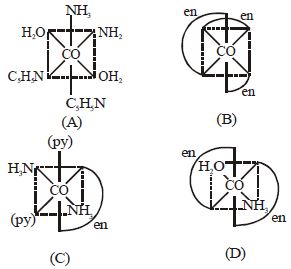
A
$A$
B
$A$ & $D$
C
$A, C$ & $D$
D
All of these
Solution
(B) complex is optically inactive if it possesses a plane of symmetry or a center of inversion.
$A$: The complex has a plane of symmetry passing through the central metal atom and the ligands,making it optically inactive.
$B$: This is a tris(ethylenediamine)cobalt$(III)$ complex,$[Co(en)_3]^{3+}$,which is chiral and optically active.
$C$: This complex lacks a plane of symmetry and is optically active.
$D$: The complex $[Co(en)_2(H_2O)(NH_3)]^{3+}$ in the given configuration has a plane of symmetry,making it optically inactive.
Thus,$A$ and $D$ are optically inactive.
$A$: The complex has a plane of symmetry passing through the central metal atom and the ligands,making it optically inactive.
$B$: This is a tris(ethylenediamine)cobalt$(III)$ complex,$[Co(en)_3]^{3+}$,which is chiral and optically active.
$C$: This complex lacks a plane of symmetry and is optically active.
$D$: The complex $[Co(en)_2(H_2O)(NH_3)]^{3+}$ in the given configuration has a plane of symmetry,making it optically inactive.
Thus,$A$ and $D$ are optically inactive.
0 likes
View Solution230
MediumMCQ
Select the complex in which the metal has primary valency $= 2$,secondary valency $= 4$ and shows stereo-isomerism:
A
$[Pt(NH_3)_4]Cl_2$
B
$[Pt(NH_3)_2Cl_4]$
C
$[Pt(NH_3)_2Cl_2]$
D
$[Pt(NH_3)_3Cl]Cl$
Solution
(C) Primary valency corresponds to the oxidation state of the metal,and secondary valency corresponds to the coordination number.
For $[Pt(NH_3)_2Cl_2]$:
$1$. The oxidation state of $Pt$ is $+2$,so primary valency $= 2$.
$2$. The coordination number is $4$ (two $NH_3$ and two $Cl^-$ ligands),so secondary valency $= 4$.
$3$. Square planar complexes of the type $[MA_2B_2]$ exhibit geometrical (stereo) isomerism (cis and trans forms).
For $[Pt(NH_3)_2Cl_2]$:
$1$. The oxidation state of $Pt$ is $+2$,so primary valency $= 2$.
$2$. The coordination number is $4$ (two $NH_3$ and two $Cl^-$ ligands),so secondary valency $= 4$.
$3$. Square planar complexes of the type $[MA_2B_2]$ exhibit geometrical (stereo) isomerism (cis and trans forms).
0 likes
View Solution231
MediumMCQ
Which of the following compounds is not coloured?
A
$Na_2[CuCl_4]$
B
$Na_2[CdCl_4]$
C
$K_4[Fe(CN)_6]$
D
$K_3[Fe(CN)_6]$
Solution
(B) compound is coloured if it has unpaired electrons in its $d$-orbitals,allowing for $d-d$ transitions.
In $Na_2[CuCl_4]$,$Cu^{2+}$ has a $3d^9$ configuration with $1$ unpaired electron,so it is coloured.
In $Na_2[CdCl_4]$,$Cd^{2+}$ has a $4d^{10}$ configuration. Since all $d$-orbitals are completely filled,no $d-d$ transition is possible,making it colourless.
In $K_4[Fe(CN)_6]$,$Fe^{2+}$ is $3d^6$ (low spin),which is diamagnetic but often shows colour due to charge transfer,however,$Cd^{2+}$ complexes are characteristically colourless due to the $d^{10}$ configuration.
In $K_3[Fe(CN)_6]$,$Fe^{3+}$ is $3d^5$,which is coloured.
In $Na_2[CuCl_4]$,$Cu^{2+}$ has a $3d^9$ configuration with $1$ unpaired electron,so it is coloured.
In $Na_2[CdCl_4]$,$Cd^{2+}$ has a $4d^{10}$ configuration. Since all $d$-orbitals are completely filled,no $d-d$ transition is possible,making it colourless.
In $K_4[Fe(CN)_6]$,$Fe^{2+}$ is $3d^6$ (low spin),which is diamagnetic but often shows colour due to charge transfer,however,$Cd^{2+}$ complexes are characteristically colourless due to the $d^{10}$ configuration.
In $K_3[Fe(CN)_6]$,$Fe^{3+}$ is $3d^5$,which is coloured.
0 likes
View Solution232
MediumMCQ
In $[Cr(C_2O_4)_3]^{3-}$,the isomerism shown is :-
A
ligand
B
optical
C
geometrical
D
ionisation
Solution
(B) The complex $[Cr(C_2O_4)_3]^{3-}$ contains three bidentate oxalate ligands $(ox)$.
It does not have a plane of symmetry or a center of inversion,making it chiral.
Therefore,it exists as two non-superimposable mirror images,known as $d$-form and $l$-form.
This type of isomerism is known as optical isomerism.
It does not have a plane of symmetry or a center of inversion,making it chiral.
Therefore,it exists as two non-superimposable mirror images,known as $d$-form and $l$-form.
This type of isomerism is known as optical isomerism.
0 likes
View Solution233
EasyMCQ
$\mu = \sqrt{15}$ is true for the pair :-
A
$Co^{+2}, Cr^{+3}$
B
$Fe^{+2}, Cr^{+3}$
C
$Fe^{+3}, Fe^{+2}$
D
$Mn^{+2}, Fe^{+2}$
Solution
(A) The magnetic moment $\mu$ is given by the formula $\mu = \sqrt{n(n+2)} \ B.M.$,where $n$ is the number of unpaired electrons.
For $\mu = \sqrt{15}$,we have $n(n+2) = 15$,which implies $n^2 + 2n - 15 = 0$. Solving this quadratic equation,we get $(n+5)(n-3) = 0$,so $n = 3$.
Thus,the pair must have $3$ unpaired electrons each.
For $Co^{+2}$ $(Z=27)$: $[Ar] 3d^7$,which has $3$ unpaired electrons.
For $Cr^{+3}$ $(Z=24)$: $[Ar] 3d^3$,which has $3$ unpaired electrons.
Therefore,the pair $Co^{+2}, Cr^{+3}$ satisfies the condition.
For $\mu = \sqrt{15}$,we have $n(n+2) = 15$,which implies $n^2 + 2n - 15 = 0$. Solving this quadratic equation,we get $(n+5)(n-3) = 0$,so $n = 3$.
Thus,the pair must have $3$ unpaired electrons each.
For $Co^{+2}$ $(Z=27)$: $[Ar] 3d^7$,which has $3$ unpaired electrons.
For $Cr^{+3}$ $(Z=24)$: $[Ar] 3d^3$,which has $3$ unpaired electrons.
Therefore,the pair $Co^{+2}, Cr^{+3}$ satisfies the condition.
0 likes
View Solution234
MediumMCQ
Which of the following complexes or complex ions can have an optically active isomer?
A
$[Pd(en)_2]^{2+}$
B
$[Co(H_2O)_4Cl_2]Cl \cdot 2H_2O$
C
$Na_2[ZnCl_4]$
D
$[Pt(en)_2]^{2+}$
Solution
(B) For a complex to exhibit optical isomerism,it must be chiral,meaning it should not have a plane of symmetry or a center of symmetry.
$1$. $[Pd(en)_2]^{2+}$ and $[Pt(en)_2]^{2+}$ are square planar complexes. Square planar complexes with bidentate ligands like $en$ (ethylenediamine) are planar and possess a plane of symmetry,hence they are optically inactive.
$2$. $[Co(H_2O)_4Cl_2]Cl \cdot 2H_2O$ is an octahedral complex. The isomer $trans-[Co(H_2O)_4Cl_2]^+$ has a plane of symmetry,while the $cis$ isomer can exist in chiral forms if the ligands are arranged appropriately,but generally,simple octahedral complexes of the type $[MA_4B_2]$ are not optically active unless the ligands are chelating.
$3$. However,looking at the options provided,there is a common error in the question structure. Usually,$[M(en)_3]^{n+}$ or $[M(en)_2X_2]^{n+}$ (cis-form) are the standard examples for optical activity. Given the options,if we consider $[Co(H_2O)_4Cl_2]Cl \cdot 2H_2O$,it is the only one that can potentially form a $cis$ isomer which lacks a plane of symmetry if the geometry allows. But strictly,none of these are classic examples of optical activity. Re-evaluating: $[Pt(en)_2]^{2+}$ is square planar (inactive). $[Pd(en)_2]^{2+}$ is square planar (inactive). $[ZnCl_4]^{2-}$ is tetrahedral (achiral). The question likely intended to include a complex like $[Co(en)_2Cl_2]^+$. Given the options,$B$ is the most complex structure capable of geometric isomerism,but none are optically active. If forced to choose,the question is flawed.
$1$. $[Pd(en)_2]^{2+}$ and $[Pt(en)_2]^{2+}$ are square planar complexes. Square planar complexes with bidentate ligands like $en$ (ethylenediamine) are planar and possess a plane of symmetry,hence they are optically inactive.
$2$. $[Co(H_2O)_4Cl_2]Cl \cdot 2H_2O$ is an octahedral complex. The isomer $trans-[Co(H_2O)_4Cl_2]^+$ has a plane of symmetry,while the $cis$ isomer can exist in chiral forms if the ligands are arranged appropriately,but generally,simple octahedral complexes of the type $[MA_4B_2]$ are not optically active unless the ligands are chelating.
$3$. However,looking at the options provided,there is a common error in the question structure. Usually,$[M(en)_3]^{n+}$ or $[M(en)_2X_2]^{n+}$ (cis-form) are the standard examples for optical activity. Given the options,if we consider $[Co(H_2O)_4Cl_2]Cl \cdot 2H_2O$,it is the only one that can potentially form a $cis$ isomer which lacks a plane of symmetry if the geometry allows. But strictly,none of these are classic examples of optical activity. Re-evaluating: $[Pt(en)_2]^{2+}$ is square planar (inactive). $[Pd(en)_2]^{2+}$ is square planar (inactive). $[ZnCl_4]^{2-}$ is tetrahedral (achiral). The question likely intended to include a complex like $[Co(en)_2Cl_2]^+$. Given the options,$B$ is the most complex structure capable of geometric isomerism,but none are optically active. If forced to choose,the question is flawed.
0 likes
View Solution235
MediumMCQ
Which of the following pairs of complexes are coordination isomers?
A
$[Co(NH_3)_5Br]SO_4$ & $[Co(NH_3)_5SO_4]Br$
B
$[Pt(NH_3)_4] [PtCl_4]$ & $[Pt(NH_3)_3Cl] [Pt(NH_3)Cl_3]$
C
$[Co(H_2O)_6]Cl_3$ & $[Co(H_2O)_5Cl]Cl_2 \cdot H_2O$
D
None of these
Solution
(B) Coordination isomerism occurs when both the cationic and anionic parts of a complex salt are complex ions,and the ligands are exchanged between them.
In the pair $[Pt(NH_3)_4] [PtCl_4]$ and $[Pt(NH_3)_3Cl] [Pt(NH_3)Cl_3]$,the ligands $NH_3$ and $Cl^-$ are exchanged between the two metal centers.
Option $A$ represents ionization isomerism.
Option $C$ represents hydrate isomerism.
Therefore,the correct pair showing coordination isomerism is $[Pt(NH_3)_4] [PtCl_4]$ and $[Pt(NH_3)_3Cl] [Pt(NH_3)Cl_3]$.
In the pair $[Pt(NH_3)_4] [PtCl_4]$ and $[Pt(NH_3)_3Cl] [Pt(NH_3)Cl_3]$,the ligands $NH_3$ and $Cl^-$ are exchanged between the two metal centers.
Option $A$ represents ionization isomerism.
Option $C$ represents hydrate isomerism.
Therefore,the correct pair showing coordination isomerism is $[Pt(NH_3)_4] [PtCl_4]$ and $[Pt(NH_3)_3Cl] [Pt(NH_3)Cl_3]$.
0 likes
View Solution236
MediumMCQ
Which of the following planar complex is diamagnetic and shows stereo isomerism?
A
$[Ni(gly)_2]$
B
$[Pt(NH_3)_3Cl]^+$
C
$[Co(H_2O)_3Cl_3]$
D
$[Co(en)_3]^{3+}$
Solution
(A) $1$. $A$ planar complex (square planar) typically involves $d^{sp^2}$ hybridization,which is diamagnetic if all electrons are paired.
$2$. $[Ni(gly)_2]$ is a square planar complex where $Ni^{2+}$ has a $d^8$ configuration. The glycinate ligand is a strong field ligand,causing pairing of electrons,making it diamagnetic.
$3$. $[Ni(gly)_2]$ exhibits geometrical isomerism (cis and trans forms) because it is a $MA_2B_2$ type complex (where gly is a bidentate ligand acting as $AB$ type).
$4$. $[Pt(NH_3)_3Cl]^+$ is square planar but does not show stereoisomerism.
$5$. $[Co(H_2O)_3Cl_3]$ and $[Co(en)_3]^{3+}$ are octahedral complexes,not planar.
$2$. $[Ni(gly)_2]$ is a square planar complex where $Ni^{2+}$ has a $d^8$ configuration. The glycinate ligand is a strong field ligand,causing pairing of electrons,making it diamagnetic.
$3$. $[Ni(gly)_2]$ exhibits geometrical isomerism (cis and trans forms) because it is a $MA_2B_2$ type complex (where gly is a bidentate ligand acting as $AB$ type).
$4$. $[Pt(NH_3)_3Cl]^+$ is square planar but does not show stereoisomerism.
$5$. $[Co(H_2O)_3Cl_3]$ and $[Co(en)_3]^{3+}$ are octahedral complexes,not planar.
0 likes
View Solution237
DifficultMCQ
Select the correct statement about $[Mn(CO)_4NO]$ which is diamagnetic.
A
It is diamagnetic because $Mn$ metal is diamagnetic in free state.
B
It is diamagnetic because $Mn$ is in $+1$ oxidation state in this complex.
C
$NO$ is present as positive ligand.
D
All of these.
0 likes
View Solution238
AdvancedMCQ
Which of the following statements is correct?
A
$K_2[Ni(CN)_4]$ is diamagnetic but $K_4[Ni(CN)_4]$ is a paramagnetic complex.
B
$[RhCl(PPh_3)_3]$ is tetrahedral but $[RhH_2Cl(PPh_3)_3]$ is an octahedral geometry involving inner $d$-orbital.
C
$[AuCl_4]^-$ is optically inactive but $[ZnCl(NH_2)(CO)(PPh_3)]$ is optically active.
D
None of these
Solution
(C) $1$. In $K_2[Ni(CN)_4]$,$Ni$ is in $+2$ oxidation state $(d^8)$. It is square planar and diamagnetic. $K_4[Ni(CN)_4]$ contains $Ni(0)$ $(d^{10})$,which is tetrahedral and diamagnetic. Thus,option $A$ is incorrect.
$2$. $[RhCl(PPh_3)_3]$ (Wilkinson's catalyst) is square planar. $[RhH_2Cl(PPh_3)_3]$ is octahedral. Thus,option $B$ is incorrect.
$3$. $[AuCl_4]^-$ is a square planar complex,which is achiral and optically inactive. $[ZnCl(NH_2)(CO)(PPh_3)]$ is a tetrahedral complex with four different ligands attached to the central $Zn$ atom,making it chiral and optically active. Thus,option $C$ is correct.
$2$. $[RhCl(PPh_3)_3]$ (Wilkinson's catalyst) is square planar. $[RhH_2Cl(PPh_3)_3]$ is octahedral. Thus,option $B$ is incorrect.
$3$. $[AuCl_4]^-$ is a square planar complex,which is achiral and optically inactive. $[ZnCl(NH_2)(CO)(PPh_3)]$ is a tetrahedral complex with four different ligands attached to the central $Zn$ atom,making it chiral and optically active. Thus,option $C$ is correct.
0 likes
View Solution239
AdvancedMCQ
Which of the following complex compounds is optically inactive?
A
$[M(AA)_2cd]$
B
$[M(AB)(CD)(EF)]$
C
$[M(AA)_2]$
D
$Mabcd$ (tetrahedral)
Solution
(C) An optically inactive complex is one that possesses a plane of symmetry or a center of inversion.
$1$. $[M(AA)_2cd]$: This complex has a plane of symmetry if the ligands are arranged such that the two $(AA)$ rings are in the same plane,but generally,it can show optical isomerism.
$2$. $[M(AB)(CD)(EF)]$: This complex is highly asymmetric and is optically active.
$3$. $[M(AA)_2]$: This complex is a square planar complex (assuming coordination number $4$). Square planar complexes are generally optically inactive due to the presence of a molecular plane of symmetry.
$4$. $Mabcd$ (tetrahedral): Tetrahedral complexes with four different ligands are chiral and optically active.
Therefore,the complex $[M(AA)_2]$ is optically inactive.
$1$. $[M(AA)_2cd]$: This complex has a plane of symmetry if the ligands are arranged such that the two $(AA)$ rings are in the same plane,but generally,it can show optical isomerism.
$2$. $[M(AB)(CD)(EF)]$: This complex is highly asymmetric and is optically active.
$3$. $[M(AA)_2]$: This complex is a square planar complex (assuming coordination number $4$). Square planar complexes are generally optically inactive due to the presence of a molecular plane of symmetry.
$4$. $Mabcd$ (tetrahedral): Tetrahedral complexes with four different ligands are chiral and optically active.
Therefore,the complex $[M(AA)_2]$ is optically inactive.
0 likes
View Solution240
EasyMCQ
Three complex compounds $I$,$II$ and $III$ have Blue,Red and Green colour respectively. Which of the following orders of $\lambda_{abs}$ (absorbed wavelength) is $CORRECT$?
A
$I > II > III$
B
$III > II > I$
C
$II > I > III$
D
$III > I > II$
Solution
(D) The color observed in a complex is the complementary color of the wavelength absorbed.
The relationship between absorbed wavelength $(\lambda_{abs})$ and observed color is:
$1$. Blue color observed $\rightarrow$ Orange light absorbed $(\approx 580-620 \ nm)$.
$2$. Red color observed $\rightarrow$ Green light absorbed $(\approx 500-560 \ nm)$.
$3$. Green color observed $\rightarrow$ Red light absorbed $(\approx 620-750 \ nm)$.
Comparing the absorbed wavelengths:
$\lambda_{abs}$ for $III$ (Red absorbed) > $\lambda_{abs}$ for $I$ (Orange absorbed) > $\lambda_{abs}$ for $II$ (Green absorbed).
Therefore,the correct order is $III > I > II$.
The relationship between absorbed wavelength $(\lambda_{abs})$ and observed color is:
$1$. Blue color observed $\rightarrow$ Orange light absorbed $(\approx 580-620 \ nm)$.
$2$. Red color observed $\rightarrow$ Green light absorbed $(\approx 500-560 \ nm)$.
$3$. Green color observed $\rightarrow$ Red light absorbed $(\approx 620-750 \ nm)$.
Comparing the absorbed wavelengths:
$\lambda_{abs}$ for $III$ (Red absorbed) > $\lambda_{abs}$ for $I$ (Orange absorbed) > $\lambda_{abs}$ for $II$ (Green absorbed).
Therefore,the correct order is $III > I > II$.
0 likes
View Solution241
MediumMCQ
Among $TiF_6^{2-}$,$CoF_6^{3-}$,$Cu_2Cl_2$ and $NiCl_4^{2-}$,the colourless species are:
A
$CoF_6^{3-}$ and $NiCl_4^{2-}$
B
$TiF_6^{2-}$ and $CoF_6^{3-}$
C
$NiCl_4^{2-}$ and $Cu_2Cl_2$
D
$TiF_6^{2-}$ and $Cu_2Cl_2$
Solution
(D) species is colourless if it does not have any unpaired electrons in its $d$-orbitals,preventing $d-d$ transitions.
$1$. In $TiF_6^{2-}$,the oxidation state of $Ti$ is $+4$. The electronic configuration of $Ti^{4+}$ is $3d^0$,which has no electrons to undergo $d-d$ transition.
$2$. In $Cu_2Cl_2$,the oxidation state of $Cu$ is $+1$. The electronic configuration of $Cu^+$ is $3d^{10}$,which is fully filled,preventing $d-d$ transition.
$3$. In $CoF_6^{3-}$,$Co$ is in $+3$ state $(3d^6)$,which has unpaired electrons.
$4$. In $NiCl_4^{2-}$,$Ni$ is in $+2$ state $(3d^8)$,which has unpaired electrons.
Therefore,$TiF_6^{2-}$ and $Cu_2Cl_2$ are colourless.
$1$. In $TiF_6^{2-}$,the oxidation state of $Ti$ is $+4$. The electronic configuration of $Ti^{4+}$ is $3d^0$,which has no electrons to undergo $d-d$ transition.
$2$. In $Cu_2Cl_2$,the oxidation state of $Cu$ is $+1$. The electronic configuration of $Cu^+$ is $3d^{10}$,which is fully filled,preventing $d-d$ transition.
$3$. In $CoF_6^{3-}$,$Co$ is in $+3$ state $(3d^6)$,which has unpaired electrons.
$4$. In $NiCl_4^{2-}$,$Ni$ is in $+2$ state $(3d^8)$,which has unpaired electrons.
Therefore,$TiF_6^{2-}$ and $Cu_2Cl_2$ are colourless.
0 likes
View Solution242
EasyMCQ
Which of the following ligands can show linkage isomerism?
A
$CNS^-$
B
$NO_2^-$
C
$CN^-$
D
All of these
Solution
(D) Linkage isomerism occurs in coordination compounds that contain ambidentate ligands.
Ambidentate ligands are ligands that can coordinate to the central metal atom through more than one donor atom.
Examples of such ligands include:
$1$. $NO_2^-$ (can coordinate through $N$ or $O$)
$2$. $SCN^-$ or $CNS^-$ (can coordinate through $S$ or $N$)
$3$. $CN^-$ (can coordinate through $C$ or $N$)
Since all the given ligands ($CNS^-$,$NO_2^-$,and $CN^-$) are ambidentate,they all exhibit linkage isomerism.
Ambidentate ligands are ligands that can coordinate to the central metal atom through more than one donor atom.
Examples of such ligands include:
$1$. $NO_2^-$ (can coordinate through $N$ or $O$)
$2$. $SCN^-$ or $CNS^-$ (can coordinate through $S$ or $N$)
$3$. $CN^-$ (can coordinate through $C$ or $N$)
Since all the given ligands ($CNS^-$,$NO_2^-$,and $CN^-$) are ambidentate,they all exhibit linkage isomerism.
0 likes
View Solution243
EasyMCQ
The complexes given below show:
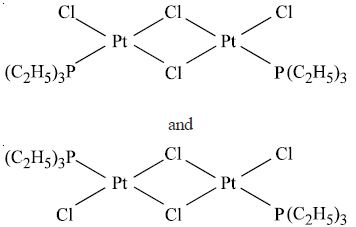
A
Optical isomerism
B
Coordination isomerism
C
Geometrical isomerism
D
Bridged isomerism
Solution
(C) The given structures represent a dinuclear platinum complex where the ligands around the platinum centers are arranged differently.
In the first structure,the $(C_2H_5)_3P$ groups are on the same side relative to the bridging $Cl$ atoms,representing the $cis$-isomer.
In the second structure,the $(C_2H_5)_3P$ groups are on opposite sides,representing the $trans$-isomer.
Since these complexes differ in the spatial arrangement of ligands around the metal centers,they exhibit geometrical isomerism.
In the first structure,the $(C_2H_5)_3P$ groups are on the same side relative to the bridging $Cl$ atoms,representing the $cis$-isomer.
In the second structure,the $(C_2H_5)_3P$ groups are on opposite sides,representing the $trans$-isomer.
Since these complexes differ in the spatial arrangement of ligands around the metal centers,they exhibit geometrical isomerism.
0 likes
View Solution244
MediumMCQ
$[(C_6H_5)_2 Pd (SCN)_2]$ and $[(C_6H_5)_2 Pd (NCS)_2]$ are :
A
Linkage isomers
B
Coordination isomers
C
Ionisation isomers
D
Geometrical isomers
Solution
(A) The given complexes contain the thiocyanate ligand,which is an ambidentate ligand.
An ambidentate ligand can coordinate to the central metal atom through two different donor atoms.
In the first complex,the donor atom is $S$ (thiocyanato-$S$),while in the second complex,the donor atom is $N$ (isothiocyanato-$N$).
Since the mode of linkage of the ligand to the metal atom differs,these complexes exhibit linkage isomerism.
An ambidentate ligand can coordinate to the central metal atom through two different donor atoms.
In the first complex,the donor atom is $S$ (thiocyanato-$S$),while in the second complex,the donor atom is $N$ (isothiocyanato-$N$).
Since the mode of linkage of the ligand to the metal atom differs,these complexes exhibit linkage isomerism.
0 likes
View Solution245
MediumMCQ
Which one of the following will be able to show $cis-trans$ isomerism?
A
$MA_3B$
B
$M(AA)_2$
C
$MABCD$
D
$MA_4$
Solution
(C) For square planar complexes of the type $MABCD$,there are three possible geometrical isomers.
These isomers arise from the different relative positions of the ligands $A, B, C,$ and $D$ around the central metal atom $M$.
Specifically,one can fix the position of $A$ and then arrange the other ligands $B, C,$ and $D$ in different positions relative to $A$,leading to three distinct isomers.
In contrast,complexes of the type $MA_3B$,$MA_4$,and $M(AA)_2$ (where $AA$ is a symmetrical bidentate ligand) do not exhibit geometrical isomerism because all positions are equivalent or the arrangement is fixed by the symmetry of the ligands.
These isomers arise from the different relative positions of the ligands $A, B, C,$ and $D$ around the central metal atom $M$.
Specifically,one can fix the position of $A$ and then arrange the other ligands $B, C,$ and $D$ in different positions relative to $A$,leading to three distinct isomers.
In contrast,complexes of the type $MA_3B$,$MA_4$,and $M(AA)_2$ (where $AA$ is a symmetrical bidentate ligand) do not exhibit geometrical isomerism because all positions are equivalent or the arrangement is fixed by the symmetry of the ligands.
0 likes
View Solution246
EasyMCQ
$Cis-trans$ isomerism is found in square planar complexes of the molecular formula: ($A$ and $B$ are monodentate ligands):
A
$MA_4$
B
$MA_3B$
C
$MA_2B_2$
D
$MAB_3$
Solution
(C) In square planar complexes with coordination number $4$,$cis-trans$ isomerism is observed when the ligands are arranged such that identical groups are adjacent $(cis)$ or opposite $(trans)$ to each other.
For a complex of the type $[MA_2B_2]$,two isomers are possible: one where the two $A$ ligands are adjacent $(cis)$ and one where they are opposite $(trans)$.
Complexes of the type $[MA_4]$,$[MA_3B]$,and $[MAB_3]$ do not exhibit $cis-trans$ isomerism because all possible arrangements are equivalent due to symmetry.
For a complex of the type $[MA_2B_2]$,two isomers are possible: one where the two $A$ ligands are adjacent $(cis)$ and one where they are opposite $(trans)$.
Complexes of the type $[MA_4]$,$[MA_3B]$,and $[MAB_3]$ do not exhibit $cis-trans$ isomerism because all possible arrangements are equivalent due to symmetry.
0 likes
View Solution247
DifficultMCQ
The two compounds $[Co(SO_4)(NH_3)_5]Br$ and $[Co(SO_4)(NH_3)_5]Cl$ represent:
A
Linkage isomerism
B
Ionisation isomerism
C
Coordination isomerism
D
No isomerism
Solution
(D) Isomerism is defined as the phenomenon where compounds have the same molecular formula but different structural arrangements.
In the given compounds,$[Co(SO_4)(NH_3)_5]Br$ and $[Co(SO_4)(NH_3)_5]Cl$,the molecular formulas are different because the counter-ions ($Br^-$ and $Cl^-$) are different.
Therefore,they do not represent any type of isomerism.
In the given compounds,$[Co(SO_4)(NH_3)_5]Br$ and $[Co(SO_4)(NH_3)_5]Cl$,the molecular formulas are different because the counter-ions ($Br^-$ and $Cl^-$) are different.
Therefore,they do not represent any type of isomerism.
0 likes
View Solution248
AdvancedMCQ
Complexes $[Co(NH_3)_5SO_4]Br$ and $[Co(NH_3)_5Br]SO_4$ can be distinguished by
A
conductance measurement
B
using $BaCl_2$
C
using $AgNO_3$
D
all
Solution
(D) The two complexes are ionization isomers.
$1$. $[Co(NH_3)_5SO_4]Br$ ionizes in water to give $[Co(NH_3)_5SO_4]^+$ and $Br^-$ ions. The $Br^-$ ions react with $AgNO_3$ to form a yellow precipitate of $AgBr$.
$2$. $[Co(NH_3)_5Br]SO_4$ ionizes in water to give $[Co(NH_3)_5Br]^{2+}$ and $SO_4^{2-}$ ions. The $SO_4^{2-}$ ions react with $BaCl_2$ to form a white precipitate of $BaSO_4$.
$3$. Conductance measurement: The first complex gives $2$ ions per formula unit,while the second complex gives $2$ ions per formula unit. However,the charge density and mobility of the ions differ,leading to different molar conductivities.
Since all three methods can distinguish between these isomers,the correct answer is $D$.
$1$. $[Co(NH_3)_5SO_4]Br$ ionizes in water to give $[Co(NH_3)_5SO_4]^+$ and $Br^-$ ions. The $Br^-$ ions react with $AgNO_3$ to form a yellow precipitate of $AgBr$.
$2$. $[Co(NH_3)_5Br]SO_4$ ionizes in water to give $[Co(NH_3)_5Br]^{2+}$ and $SO_4^{2-}$ ions. The $SO_4^{2-}$ ions react with $BaCl_2$ to form a white precipitate of $BaSO_4$.
$3$. Conductance measurement: The first complex gives $2$ ions per formula unit,while the second complex gives $2$ ions per formula unit. However,the charge density and mobility of the ions differ,leading to different molar conductivities.
Since all three methods can distinguish between these isomers,the correct answer is $D$.
0 likes
View Solution249
MediumMCQ
Amongst the following ions,which one has the highest paramagnetism?
A
$[Cr(H_2O)_6]^{3+}$
B
$[Fe(H_2O)_6]^{2+}$
C
$[Zn(H_2O)_6]^{2+}$
D
$[Cu(H_2O)_6]^{2+}$
Solution
(B) To determine the highest paramagnetism,we calculate the number of unpaired electrons in each ion:
$1$. $[Cr(H_2O)_6]^{3+}$: $Cr$ is in $+3$ oxidation state. $Cr$ $(Z=24)$ is $[Ar] 3d^5 4s^1$. $Cr^{3+}$ is $[Ar] 3d^3$. Number of unpaired electrons $(n)$ = $3$.
$2$. $[Fe(H_2O)_6]^{2+}$: $Fe$ is in $+2$ oxidation state. $Fe$ $(Z=26)$ is $[Ar] 3d^6 4s^2$. $Fe^{2+}$ is $[Ar] 3d^6$. Since $H_2O$ is a weak field ligand,electrons remain unpaired: $t_{2g}^4 e_g^2$. Number of unpaired electrons $(n)$ = $4$.
$3$. $[Zn(H_2O)_6]^{2+}$: $Zn$ is in $+2$ oxidation state. $Zn$ $(Z=30)$ is $[Ar] 3d^{10} 4s^2$. $Zn^{2+}$ is $[Ar] 3d^{10}$. Number of unpaired electrons $(n)$ = $0$.
$4$. $[Cu(H_2O)_6]^{2+}$: $Cu$ is in $+2$ oxidation state. $Cu$ $(Z=29)$ is $[Ar] 3d^{10} 4s^1$. $Cu^{2+}$ is $[Ar] 3d^9$. Number of unpaired electrons $(n)$ = $1$.
Since $[Fe(H_2O)_6]^{2+}$ has the maximum number of unpaired electrons $(n=4)$,it exhibits the highest paramagnetism.
$1$. $[Cr(H_2O)_6]^{3+}$: $Cr$ is in $+3$ oxidation state. $Cr$ $(Z=24)$ is $[Ar] 3d^5 4s^1$. $Cr^{3+}$ is $[Ar] 3d^3$. Number of unpaired electrons $(n)$ = $3$.
$2$. $[Fe(H_2O)_6]^{2+}$: $Fe$ is in $+2$ oxidation state. $Fe$ $(Z=26)$ is $[Ar] 3d^6 4s^2$. $Fe^{2+}$ is $[Ar] 3d^6$. Since $H_2O$ is a weak field ligand,electrons remain unpaired: $t_{2g}^4 e_g^2$. Number of unpaired electrons $(n)$ = $4$.
$3$. $[Zn(H_2O)_6]^{2+}$: $Zn$ is in $+2$ oxidation state. $Zn$ $(Z=30)$ is $[Ar] 3d^{10} 4s^2$. $Zn^{2+}$ is $[Ar] 3d^{10}$. Number of unpaired electrons $(n)$ = $0$.
$4$. $[Cu(H_2O)_6]^{2+}$: $Cu$ is in $+2$ oxidation state. $Cu$ $(Z=29)$ is $[Ar] 3d^{10} 4s^1$. $Cu^{2+}$ is $[Ar] 3d^9$. Number of unpaired electrons $(n)$ = $1$.
Since $[Fe(H_2O)_6]^{2+}$ has the maximum number of unpaired electrons $(n=4)$,it exhibits the highest paramagnetism.
0 likes
View Solution250
DifficultMCQ
$Ni(CO)_4$ and $[Ni(NH_3)_4]^{2+}$ do not differ in
A
magnetic moment
B
oxidation number of $Ni$
C
geometry
D
$EAN$
Solution
(A) For $Ni(CO)_4$: The oxidation state of $Ni$ is $0$. The configuration is $3d^{10} 4s^0$. The $EAN = 28 + 2(4) = 36$. It undergoes $sp^3$ hybridization,resulting in a tetrahedral geometry. It has $0$ unpaired electrons,so the magnetic moment is $0 \ BM$.
For $[Ni(NH_3)_4]^{2+}$: The oxidation state of $Ni$ is $+2$. The configuration is $3d^8$. The $EAN = 28 - 2 + 2(4) = 34$. It undergoes $dsp^2$ hybridization,resulting in a square planar geometry. It has $0$ unpaired electrons,so the magnetic moment is $0 \ BM$.
Since both complexes have $0$ unpaired electrons,they do not differ in their magnetic moment.
For $[Ni(NH_3)_4]^{2+}$: The oxidation state of $Ni$ is $+2$. The configuration is $3d^8$. The $EAN = 28 - 2 + 2(4) = 34$. It undergoes $dsp^2$ hybridization,resulting in a square planar geometry. It has $0$ unpaired electrons,so the magnetic moment is $0 \ BM$.
Since both complexes have $0$ unpaired electrons,they do not differ in their magnetic moment.
0 likes
View SolutionCoordination Compounds — Isomerism and Magnetic properties · Frequently Asked Questions
1Are these Coordination Compounds questions useful for JEE and NEET?
Yes. All questions in this section are mapped to JEE Main and NEET exam patterns. Previous year questions from JEE Main, NEET, GUJCET and state-level exams are included with full solutions.
2Can I switch to Hindi or Gujarati for these questions?
Yes. Use the language tabs in the hero section or the sidebar to view the same questions and solutions in English, Hindi or Gujarati.
3How do I generate a question paper from this subtopic?
Use the Vedclass Exam Paper Generator — select the chapter and subtopic, set difficulty, and generate Sets A, B, C, D automatically. First 3 chapters of every subject are free.
Vedclass Products
For Students
Vedclass Test Series
Mock tests in real JEE/NEET style with performance analysis. 5-day free trial.
Start Free TrialFor Teachers
Exam Paper Generator
Generate Set A/B/C/D papers from this chapter in 2 minutes. 3 chapters free.
Try FreeFor Institutes
Online Exam Module
Live online exams with unlimited students, 360° analytics & white-label branding.
See DemoFor Teachers & Institutes
Generate a Coordination Compounds Exam Paper in 2 Minutes
Select subtopic & difficulty — Sets A, B, C, D auto-generated with No Repeat logic.
First 3 chapters of every subject are free — no payment required.