
A English
Crystal Field theory Questions in English
Class 12 Chemistry · Coordination Compounds · Crystal Field theory
242+
Questions
English
Language
100%
With Solutions
Showing 50 of 242 questions in English
51
DifficultMCQ
The correct order of ligands in the spectrochemical series is
A
$Cl^{-} > en > CN^{-} > NCS^{-}$
B
$CN^{-} > en > NCS^{-} > Cl^{-}$
C
$NCS^{-} > CN^{-} > Cl^{-} > en$
D
$en > CN^{-} > Cl^{-} > NCS^{-}$
Solution
(B) The spectrochemical series is an arrangement of ligands in order of their increasing field strength.
According to the spectrochemical series,the field strength order is $I^{-} < Br^{-} < S^{2-} < SCN^{-} < Cl^{-} < N_{3} < F^{-} < OH^{-} < C_{2}O_{4}^{2-} < H_{2}O < NCS^{-} < EDTA^{4-} < NH_{3} < en < NO_{2}^{-} < CN^{-} < CO$.
Comparing the given ligands: $CN^{-} > en > NCS^{-} > Cl^{-}$.
Thus,the correct order is $CN^{-} > en > NCS^{-} > Cl^{-}$.
According to the spectrochemical series,the field strength order is $I^{-} < Br^{-} < S^{2-} < SCN^{-} < Cl^{-} < N_{3} < F^{-} < OH^{-} < C_{2}O_{4}^{2-} < H_{2}O < NCS^{-} < EDTA^{4-} < NH_{3} < en < NO_{2}^{-} < CN^{-} < CO$.
Comparing the given ligands: $CN^{-} > en > NCS^{-} > Cl^{-}$.
Thus,the correct order is $CN^{-} > en > NCS^{-} > Cl^{-}$.
0 likes
View Solution52
DifficultMCQ
Two complexes $[Cr(H_2O)_6]Cl_3 \ (A)$ and $[Cr(NH_3)_6]Cl_3 \ (B)$ are violet and yellow coloured respectively. The incorrect statement regarding them is
A
$ \Delta_0 $ values of $(A)$ and $(B)$ are calculated from the energies of violet and yellow light,respectively
B
both are paramagnetic with three unpaired electrons
C
both absorb energies corresponding to their complementary colours
D
$ \Delta_0 $ value for $(A)$ is less than that of $(B)$
Solution
(A) The colour observed is the complementary colour of the light absorbed by the complex.
$ \Delta_0 $ is calculated from the energy of the absorbed light,not the emitted (observed) light.
Since $(A)$ is violet,it absorbs yellow light,and since $(B)$ is yellow,it absorbs violet light.
Therefore,the statement that $ \Delta_0 $ values are calculated from the energies of violet and yellow light respectively is incorrect.
$ \Delta_0 $ is calculated from the energy of the absorbed light,not the emitted (observed) light.
Since $(A)$ is violet,it absorbs yellow light,and since $(B)$ is yellow,it absorbs violet light.
Therefore,the statement that $ \Delta_0 $ values are calculated from the energies of violet and yellow light respectively is incorrect.
0 likes
View Solution53
AdvancedMCQ
The complex that has the highest crystal field splitting energy $(\Delta)$ is
A
$[Co(NH_3)_5(H_2O)]Cl_3$
B
$K_2[CoCl_4]$
C
$[Co(NH_3)_5Cl]Cl_2$
D
$K_3[Co(CN)_6]$
Solution
(D) The crystal field splitting energy $(\Delta)$ depends on the nature of the ligand and the oxidation state of the central metal ion.
Strong field ligands cause larger splitting compared to weak field ligands.
Among the given ligands,$CN^-$ is a strong field ligand (spectrochemical series).
In $K_3[Co(CN)_6]$,the cobalt ion is in the $+3$ oxidation state and is coordinated to six strong $CN^-$ ligands,resulting in the highest crystal field splitting energy.
Strong field ligands cause larger splitting compared to weak field ligands.
Among the given ligands,$CN^-$ is a strong field ligand (spectrochemical series).
In $K_3[Co(CN)_6]$,the cobalt ion is in the $+3$ oxidation state and is coordinated to six strong $CN^-$ ligands,resulting in the highest crystal field splitting energy.
0 likes
View Solution54
AdvancedMCQ
Homoleptic octahedral complexes of a metal ion $M^{3+}$ with three monodentate ligands $L_1, L_2$ and $L_3$ absorb wavelengths in the region of green,blue and red respectively. The increasing order of the ligand strength is:
A
$L_3 < L_1 < L_2$
B
$L_3 < L_2 < L_1$
C
$L_1 < L_2 < L_3$
D
$L_2 < L_1 < L_3$
Solution
(A) The crystal field splitting energy $(\Delta_o)$ is inversely proportional to the wavelength of light absorbed $(\Delta_o = \frac{hc}{\lambda})$.
The order of wavelengths for the given colors is $\lambda_{blue} < \lambda_{green} < \lambda_{red}$.
Thus,the energy order is $E_{blue} > E_{green} > E_{red}$.
Since ligand strength is directly proportional to $\Delta_o$,the order of ligand strength is $L_2 > L_1 > L_3$ or $L_3 < L_1 < L_2$.
The order of wavelengths for the given colors is $\lambda_{blue} < \lambda_{green} < \lambda_{red}$.
Thus,the energy order is $E_{blue} > E_{green} > E_{red}$.
Since ligand strength is directly proportional to $\Delta_o$,the order of ligand strength is $L_2 > L_1 > L_3$ or $L_3 < L_1 < L_2$.
0 likes
View Solution55
DifficultMCQ
The metal $d-$orbitals that directly face the ligands in $K_3[Co(CN)_6]$ are:
A
$d_{xy}$ and $d_{x^2 - y^2}$
B
$d_{x^2 - y^2}$ and $d_{z^2}$
C
$d_{xz}, d_{yz}$ and $d_{z^2}$
D
$d_{xy}, d_{xz}$,and $d_{yz}$
Solution
(B) $K_3[Co(CN)_6]$ is an octahedral coordination complex.
In an octahedral geometry,the ligands approach the central metal ion along the $x, y,$ and $z$ axes.
The $d_{x^2 - y^2}$ and $d_{z^2}$ orbitals (collectively known as $e_g$ orbitals) have their electron density lobes directed along the axes.
Therefore,these orbitals directly face the incoming ligands,leading to greater electrostatic repulsion and higher energy compared to the $t_{2g}$ orbitals $(d_{xy}, d_{xz}, d_{yz})$,which have lobes directed between the axes.
In an octahedral geometry,the ligands approach the central metal ion along the $x, y,$ and $z$ axes.
The $d_{x^2 - y^2}$ and $d_{z^2}$ orbitals (collectively known as $e_g$ orbitals) have their electron density lobes directed along the axes.
Therefore,these orbitals directly face the incoming ligands,leading to greater electrostatic repulsion and higher energy compared to the $t_{2g}$ orbitals $(d_{xy}, d_{xz}, d_{yz})$,which have lobes directed between the axes.
0 likes
View Solution56
DifficultMCQ
The degenerate orbitals of $[Cr(H_2O)_6]^{3+}$ are
A
$d_{xz}$ and $d_{yz}$
B
$d_{x^2-y^2}$ and $d_{xy}$
C
$d_{yz}$ and $d_{z^2}$
D
$d_{z^2}$ and $d_{xz}$
Solution
(A) In an octahedral complex like $[Cr(H_2O)_6]^{3+}$,the five $d$-orbitals split into two sets due to the crystal field: the $t_{2g}$ set and the $e_g$ set.
The $t_{2g}$ set consists of three degenerate orbitals: $d_{xy}$,$d_{yz}$,and $d_{xz}$.
The $e_g$ set consists of two degenerate orbitals: $d_{x^2-y^2}$ and $d_{z^2}$.
Among the given options,$d_{xz}$ and $d_{yz}$ belong to the same degenerate set $(t_{2g})$.
The $t_{2g}$ set consists of three degenerate orbitals: $d_{xy}$,$d_{yz}$,and $d_{xz}$.
The $e_g$ set consists of two degenerate orbitals: $d_{x^2-y^2}$ and $d_{z^2}$.
Among the given options,$d_{xz}$ and $d_{yz}$ belong to the same degenerate set $(t_{2g})$.
0 likes
View Solution57
DifficultMCQ
The correct statements among $I$ to $III$ are:
$I$. Valence bond theory cannot explain the color exhibited by transition metal complexes.
$II$. Valence bond theory can predict quantitatively the magnetic properties of transition metal complexes.
$III$. Valence bond theory cannot distinguish ligands as weak and strong field ones.
$I$. Valence bond theory cannot explain the color exhibited by transition metal complexes.
$II$. Valence bond theory can predict quantitatively the magnetic properties of transition metal complexes.
$III$. Valence bond theory cannot distinguish ligands as weak and strong field ones.
A
$I$ and $II$ only
B
$I$,$II$ and $III$
C
$I$ and $III$ only
D
$II$ and $III$ only
Solution
(C) $(I)$ Valence Bond Theory $(VBT)$ does not explain the color exhibited by transition metal complexes because the splitting of $d-$orbitals is explained by Crystal Field Theory $(CFT)$.
$(II)$ $VBT$ cannot predict the magnetic properties of transition metal complexes quantitatively; it only provides qualitative information.
$(III)$ $VBT$ does not distinguish between strong field and weak field ligands.
Therefore,statements $I$ and $III$ are correct.
$(II)$ $VBT$ cannot predict the magnetic properties of transition metal complexes quantitatively; it only provides qualitative information.
$(III)$ $VBT$ does not distinguish between strong field and weak field ligands.
Therefore,statements $I$ and $III$ are correct.
0 likes
View Solution58
DifficultMCQ
Three complexes,$[CoCl(NH_3)_5]^{2+} (I)$,$[Co(NH_3)_5H_2O]^{3+} (II)$ and $[Co(NH_3)_6]^{3+} (III)$ absorb light in the visible region. The correct order of the wavelength of light absorbed by them is
A
$II > I > III$
B
$III > II > I$
C
$I > II > III$
D
$III > I > II$
Solution
(C) The energy of absorbed light $(E)$ is inversely proportional to the wavelength $(\lambda)$ of the absorbed light,i.e.,$E = \frac{hc}{\lambda}$.
The energy of absorption corresponds to the Crystal Field Splitting Energy ($CFSE$ or $\Delta_o$),which depends on the strength of the ligands.
The spectrochemical series order for the ligands is $Cl^- < H_2O < NH_3$.
Comparing the complexes:
$(I) [CoCl(NH_3)_5]^{2 }$ has $Cl^-$ as a ligand.
$(II) [Co(NH_3)_5H_2O]^{3 }$ has $H_2O$ as a ligand.
$(III) [Co(NH_3)_6]^{3 }$ has $NH_3$ as a ligand.
Since $NH_3$ is a stronger ligand than $H_2O$,and $H_2O$ is stronger than $Cl^-$,the order of $CFSE$ is $(III) > (II) > (I)$.
Since $E \propto \Delta_o$,the order of energy absorbed is $(III) > (II) > (I)$.
Since $\lambda \propto \frac{1}{E}$,the order of wavelength absorbed is $(I) > (II) > (III)$.
The energy of absorption corresponds to the Crystal Field Splitting Energy ($CFSE$ or $\Delta_o$),which depends on the strength of the ligands.
The spectrochemical series order for the ligands is $Cl^- < H_2O < NH_3$.
Comparing the complexes:
$(I) [CoCl(NH_3)_5]^{2 }$ has $Cl^-$ as a ligand.
$(II) [Co(NH_3)_5H_2O]^{3 }$ has $H_2O$ as a ligand.
$(III) [Co(NH_3)_6]^{3 }$ has $NH_3$ as a ligand.
Since $NH_3$ is a stronger ligand than $H_2O$,and $H_2O$ is stronger than $Cl^-$,the order of $CFSE$ is $(III) > (II) > (I)$.
Since $E \propto \Delta_o$,the order of energy absorbed is $(III) > (II) > (I)$.
Since $\lambda \propto \frac{1}{E}$,the order of wavelength absorbed is $(I) > (II) > (III)$.
0 likes
View Solution59
DifficultMCQ
The crystal field stabilization energy $(CFSE)$ of $[Fe(H_2O)_6]Cl_2$ and $K_2[NiCl_4]$,respectively,are
A
$ -0.4 \, \Delta_o$ and $ -0.8 \, \Delta_t$
B
$ -0.4 \, \Delta_o$ and $ -1.2 \, \Delta_t$
C
$ -2.4 \, \Delta_o$ and $ -1.2 \, \Delta_t$
D
$ -0.6 \, \Delta_o$ and $ -0.8 \, \Delta_t$
Solution
(A) $1$. For $[Fe(H_2O)_6]Cl_2$: The central metal ion is $Fe^{2+}$,which has a $d^6$ configuration. $H_2O$ is a weak field ligand,so the configuration is $t_{2g}^4 e_g^2$. The $CFSE$ is calculated as: $CFSE = [-0.4 \times 4 + 0.6 \times 2] \, \Delta_o = [-1.6 + 1.2] \, \Delta_o = -0.4 \, \Delta_o$.
$2$. For $K_2[NiCl_4]$: The central metal ion is $Ni^{2+}$,which has a $d^8$ configuration. It forms a tetrahedral complex $[NiCl_4]^{2-}$. The configuration is $e^4 t_2^4$. The $CFSE$ for a tetrahedral complex is calculated as: $CFSE = [-0.6 \times n_e + 0.4 \times n_{t2}] \, \Delta_t = [-0.6 \times 4 + 0.4 \times 4] \, \Delta_t = [-2.4 + 1.6] \, \Delta_t = -0.8 \, \Delta_t$.
$3$. Therefore,the values are $-0.4 \, \Delta_o$ and $-0.8 \, \Delta_t$.
$2$. For $K_2[NiCl_4]$: The central metal ion is $Ni^{2+}$,which has a $d^8$ configuration. It forms a tetrahedral complex $[NiCl_4]^{2-}$. The configuration is $e^4 t_2^4$. The $CFSE$ for a tetrahedral complex is calculated as: $CFSE = [-0.6 \times n_e + 0.4 \times n_{t2}] \, \Delta_t = [-0.6 \times 4 + 0.4 \times 4] \, \Delta_t = [-2.4 + 1.6] \, \Delta_t = -0.8 \, \Delta_t$.
$3$. Therefore,the values are $-0.4 \, \Delta_o$ and $-0.8 \, \Delta_t$.
0 likes
View Solution60
DifficultMCQ
The complex ion that will lose its crystal field stabilization energy upon oxidation of its metal to $+3$ state is
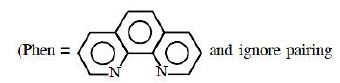
A
$[Ni(phen)_3]^{2+}$
B
$[Zn(phen)_3]^{2+}$
C
$[Co(phen)_3]^{2+}$
D
$[Fe(phen)_3]^{2+}$
Solution
(D) The Crystal Field Stabilization Energy $(CFSE)$ for an octahedral complex is given by $CFSE = (-0.4n_{t2g} + 0.6n_{eg})\Delta_o$.
For $[Fe(phen)_3]^{2+}$,the central metal is $Fe^{2+}$ ($d^6$ configuration). Since $phen$ is a strong field ligand,it forms a low-spin complex with $t_{2g}^6 e_g^0$ configuration.
$CFSE = (-0.4 \times 6 + 0.6 \times 0)\Delta_o = -2.4\Delta_o$.
Upon oxidation to $Fe^{3+}$ ($d^5$ configuration),the complex becomes $[Fe(phen)_3]^{3+}$ with $t_{2g}^5 e_g^0$ configuration.
$CFSE = (-0.4 \times 5 + 0.6 \times 0)\Delta_o = -2.0\Delta_o$.
However,the question implies a significant loss or change in stability. Let's check $[Co(phen)_3]^{2+}$ $(d^7)$: $t_{2g}^6 e_g^1$ $(CFSE = -1.8\Delta_o)$. Oxidation to $Co^{3+}$ $(d^6)$: $t_{2g}^6 e_g^0$ $(CFSE = -2.4\Delta_o)$.
Actually,for $Fe^{2+}$ $(d^6)$ to $Fe^{3+}$ $(d^5)$,the loss of an electron from the $t_{2g}$ orbital significantly reduces the stabilization energy. Thus,$[Fe(phen)_3]^{2+}$ is the correct answer.
For $[Fe(phen)_3]^{2+}$,the central metal is $Fe^{2+}$ ($d^6$ configuration). Since $phen$ is a strong field ligand,it forms a low-spin complex with $t_{2g}^6 e_g^0$ configuration.
$CFSE = (-0.4 \times 6 + 0.6 \times 0)\Delta_o = -2.4\Delta_o$.
Upon oxidation to $Fe^{3+}$ ($d^5$ configuration),the complex becomes $[Fe(phen)_3]^{3+}$ with $t_{2g}^5 e_g^0$ configuration.
$CFSE = (-0.4 \times 5 + 0.6 \times 0)\Delta_o = -2.0\Delta_o$.
However,the question implies a significant loss or change in stability. Let's check $[Co(phen)_3]^{2+}$ $(d^7)$: $t_{2g}^6 e_g^1$ $(CFSE = -1.8\Delta_o)$. Oxidation to $Co^{3+}$ $(d^6)$: $t_{2g}^6 e_g^0$ $(CFSE = -2.4\Delta_o)$.
Actually,for $Fe^{2+}$ $(d^6)$ to $Fe^{3+}$ $(d^5)$,the loss of an electron from the $t_{2g}$ orbital significantly reduces the stabilization energy. Thus,$[Fe(phen)_3]^{2+}$ is the correct answer.
0 likes
View Solution61
DifficultMCQ
Complete removal of both the axial ligands (along the $z-$ axis) from an octahedral complex leads to which of the following splitting patterns? (relative orbital energies not on scale)
A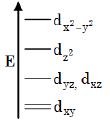
B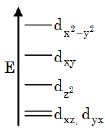
C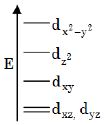
D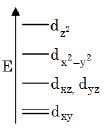
Solution
(B) In an octahedral complex,the ligands are present along the $x, y,$ and $z$ axes.
When the two ligands along the $z-$ axis are removed,the complex becomes square planar.
The ligands now exert repulsion only along the $x$ and $y$ axes.
Consequently,the orbitals with components along the $x$ and $y$ axes ($d_{x^2-y^2}$ and $d_{xy}$) will experience higher repulsion and thus have higher energy.
The $d_{z^2}$ orbital,having no ligand interaction along the $z-$ axis,will decrease significantly in energy.
The $d_{xz}$ and $d_{yz}$ orbitals will also decrease in energy but remain higher than $d_{z^2}$ due to their interaction with the $x$ and $y$ ligands.
The correct splitting pattern for a square planar complex is $d_{x^2-y^2} > d_{xy} > d_{z^2} > d_{xz}, d_{yz}$,which corresponds to the pattern shown in image $821-b1769$.
When the two ligands along the $z-$ axis are removed,the complex becomes square planar.
The ligands now exert repulsion only along the $x$ and $y$ axes.
Consequently,the orbitals with components along the $x$ and $y$ axes ($d_{x^2-y^2}$ and $d_{xy}$) will experience higher repulsion and thus have higher energy.
The $d_{z^2}$ orbital,having no ligand interaction along the $z-$ axis,will decrease significantly in energy.
The $d_{xz}$ and $d_{yz}$ orbitals will also decrease in energy but remain higher than $d_{z^2}$ due to their interaction with the $x$ and $y$ ligands.
The correct splitting pattern for a square planar complex is $d_{x^2-y^2} > d_{xy} > d_{z^2} > d_{xz}, d_{yz}$,which corresponds to the pattern shown in image $821-b1769$.
0 likes
View Solution62
MediumMCQ
The crystal field stabilisation energy of $[Co(NH_3)_6]Cl_3$ is
A
$-7.2 \, \Delta_0$
B
$-4.0 \, \Delta_0$
C
$-2.4 \, \Delta_0$
D
$-3.6 \, \Delta_0$
Solution
(C) In $[Co(NH_3)_6]Cl_3$,the oxidation state of $Co$ is $+3$.
The electronic configuration of $Co^{3+}$ is $3d^6$.
Since $NH_3$ is a strong field ligand,it causes pairing of electrons in the $d$-orbitals.
Thus,all $6$ electrons occupy the $t_{2g}$ orbitals.
The crystal field stabilisation energy $(CFSE)$ is calculated as:
$CFSE = (n_{t2g} \times -0.4 \, \Delta_0) + (n_{eg} \times +0.6 \, \Delta_0) + mP$
$CFSE = (6 \times -0.4 \, \Delta_0) + (0 \times +0.6 \, \Delta_0) + 3P$
$CFSE = -2.4 \, \Delta_0 + 3P$
Considering only the crystal field splitting energy term,the value is $-2.4 \, \Delta_0$.
The electronic configuration of $Co^{3+}$ is $3d^6$.
Since $NH_3$ is a strong field ligand,it causes pairing of electrons in the $d$-orbitals.
Thus,all $6$ electrons occupy the $t_{2g}$ orbitals.
The crystal field stabilisation energy $(CFSE)$ is calculated as:
$CFSE = (n_{t2g} \times -0.4 \, \Delta_0) + (n_{eg} \times +0.6 \, \Delta_0) + mP$
$CFSE = (6 \times -0.4 \, \Delta_0) + (0 \times +0.6 \, \Delta_0) + 3P$
$CFSE = -2.4 \, \Delta_0 + 3P$
Considering only the crystal field splitting energy term,the value is $-2.4 \, \Delta_0$.
0 likes
View Solution63
MediumMCQ
Calculate the crystal field stabilization energy $(CFSE)$ in $[Co(CN)_6]^{3-}$.
A
$-2.4\,\Delta_0 + 2p$
B
$+2.4\,\Delta_0 + 2p$
C
$-3.6\,\Delta_0 + 2p$
D
$-1.8\,\Delta_0 + 2p$
Solution
(A) In $[Co(CN)_6]^{3-}$,the central metal ion is $Co^{3+}$. The electronic configuration of $Co^{3+}$ is $3d^6$.
Since $CN^-$ is a strong field ligand,it causes pairing of electrons,resulting in a low-spin complex.
All $6$ electrons occupy the $t_{2g}$ orbitals,and $0$ electrons occupy the $e_g$ orbitals.
The formula for $CFSE$ is: $CFSE = (n_{t_{2g}} \times -0.4\Delta_0) + (n_{e_g} \times 0.6\Delta_0) + mP$,where $m$ is the number of extra electron pairs formed.
For $d^6$ in a strong field,$CFSE = (6 \times -0.4\Delta_0) + (0 \times 0.6\Delta_0) = -2.4\Delta_0$.
Including the pairing energy $2p$ (for the two extra pairs formed compared to the free ion),the total energy is $-2.4\Delta_0 + 2p$.
Since $CN^-$ is a strong field ligand,it causes pairing of electrons,resulting in a low-spin complex.
All $6$ electrons occupy the $t_{2g}$ orbitals,and $0$ electrons occupy the $e_g$ orbitals.
The formula for $CFSE$ is: $CFSE = (n_{t_{2g}} \times -0.4\Delta_0) + (n_{e_g} \times 0.6\Delta_0) + mP$,where $m$ is the number of extra electron pairs formed.
For $d^6$ in a strong field,$CFSE = (6 \times -0.4\Delta_0) + (0 \times 0.6\Delta_0) = -2.4\Delta_0$.
Including the pairing energy $2p$ (for the two extra pairs formed compared to the free ion),the total energy is $-2.4\Delta_0 + 2p$.
0 likes
View Solution64
MediumMCQ
In which of the following complexes will $H_2O$ act as a weak field ligand?
A
$[Co(H_2O)_6]^{+3}$
B
$[Pt(H_2O)_4]^{+2}$
C
$[Mn(H_2O)_6]^{+2}$
D
All of these
Solution
(C) $H_2O$ is generally considered a weak field ligand in the spectrochemical series.
However,its behavior can be influenced by the oxidation state of the central metal ion.
In $[Mn(H_2O)_6]^{+2}$,$Mn$ is in the $+2$ oxidation state,and $H_2O$ acts as a weak field ligand.
In $[Co(H_2O)_6]^{+3}$,$Co$ is in the $+3$ oxidation state,where $H_2O$ acts as a strong field ligand due to the high charge density of the metal ion.
In $[Pt(H_2O)_4]^{+2}$,$Pt$ is a $5d$ series element,and complexes of $5d$ metals are almost always low-spin (strong field behavior).
Therefore,$H_2O$ acts as a weak field ligand specifically in $[Mn(H_2O)_6]^{+2}$.
However,its behavior can be influenced by the oxidation state of the central metal ion.
In $[Mn(H_2O)_6]^{+2}$,$Mn$ is in the $+2$ oxidation state,and $H_2O$ acts as a weak field ligand.
In $[Co(H_2O)_6]^{+3}$,$Co$ is in the $+3$ oxidation state,where $H_2O$ acts as a strong field ligand due to the high charge density of the metal ion.
In $[Pt(H_2O)_4]^{+2}$,$Pt$ is a $5d$ series element,and complexes of $5d$ metals are almost always low-spin (strong field behavior).
Therefore,$H_2O$ acts as a weak field ligand specifically in $[Mn(H_2O)_6]^{+2}$.
0 likes
View Solution65
AdvancedMCQ
Calculate the Crystal Field Stabilization Energy $(CFSE)$ for a high-spin $d^4$ tetrahedral complex.
A
$-0.6 \, \Delta_t$
B
$-1.2 \, \Delta_t$
C
$-0.4 \, \Delta_t$
D
$-1.6 \, \Delta_t$
Solution
(C) For a tetrahedral complex,the $d$-orbitals split into two sets: the lower energy $e$ set and the higher energy $t_2$ set.
The energy of the $e$ set is $-0.6 \, \Delta_t$ and the energy of the $t_2$ set is $+0.4 \, \Delta_t$.
For a high-spin $d^4$ configuration,the electrons fill the orbitals according to Hund's rule: $e^2 t_2^2$.
$CFSE = (n_e \times -0.6 \, \Delta_t) + (n_{t_2} \times +0.4 \, \Delta_t)$
$CFSE = (2 \times -0.6 \, \Delta_t) + (2 \times +0.4 \, \Delta_t)$
$CFSE = -1.2 \, \Delta_t + 0.8 \, \Delta_t = -0.4 \, \Delta_t$
The energy of the $e$ set is $-0.6 \, \Delta_t$ and the energy of the $t_2$ set is $+0.4 \, \Delta_t$.
For a high-spin $d^4$ configuration,the electrons fill the orbitals according to Hund's rule: $e^2 t_2^2$.
$CFSE = (n_e \times -0.6 \, \Delta_t) + (n_{t_2} \times +0.4 \, \Delta_t)$
$CFSE = (2 \times -0.6 \, \Delta_t) + (2 \times +0.4 \, \Delta_t)$
$CFSE = -1.2 \, \Delta_t + 0.8 \, \Delta_t = -0.4 \, \Delta_t$
0 likes
View Solution66
DifficultMCQ
For which of the following types of ions is the number of unpaired electrons in octahedral complexes fixed at the same number as in the free ion,no matter how weak or strong the crystal field is?
A
$d^3$
B
$d^4$
C
$d^5$
D
$d^6$
Solution
(A) In an octahedral complex,the $d$-orbitals split into $t_{2g}$ and $e_g$ sets.
For a $d^3$ configuration,the three electrons occupy the three $t_{2g}$ orbitals singly according to Hund's rule.
Since the $e_g$ orbitals are higher in energy,these three electrons remain unpaired regardless of whether the ligand is a weak field or a strong field ligand.
For $d^4, d^5,$ and $d^6$ configurations,the number of unpaired electrons changes depending on the crystal field splitting energy (pairing vs. excitation to $e_g$ orbitals).
For a $d^3$ configuration,the three electrons occupy the three $t_{2g}$ orbitals singly according to Hund's rule.
Since the $e_g$ orbitals are higher in energy,these three electrons remain unpaired regardless of whether the ligand is a weak field or a strong field ligand.
For $d^4, d^5,$ and $d^6$ configurations,the number of unpaired electrons changes depending on the crystal field splitting energy (pairing vs. excitation to $e_g$ orbitals).
0 likes
View Solution67
AdvancedMCQ
Among the following pairs of complexes,in which case is the $\Delta_0$ value higher for the first one?
A
$[Co(NH_3)_6]^{3+}$ and $[Co(CN)_6]^{3-}$
B
$[CoF_6]^{3-}$ and $[Co(NH_3)_6]^{3+}$
C
$[Co(H_2O)_6]^{2+}$ and $[Co(H_2O)_6]^{3+}$
D
$[Rh(H_2O)_6]^{3+}$ and $[Co(H_2O)_6]^{3+}$
Solution
(D) The crystal field splitting energy $\Delta_0$ depends on the nature of the ligand,the oxidation state of the metal,and the principal quantum number of the metal ion.
For the pair $[Rh(H_2O)_6]^{3+}$ and $[Co(H_2O)_6]^{3+}$,both have the same ligand $(H_2O)$ and the same oxidation state $(+3)$.
However,$Rh$ belongs to the $4d$ series while $Co$ belongs to the $3d$ series.
As we move down a group,the size of the $d$-orbitals increases,leading to greater overlap with ligand orbitals and thus a larger $\Delta_0$ value.
Therefore,$\Delta_0$ for $[Rh(H_2O)_6]^{3+} > \Delta_0$ for $[Co(H_2O)_6]^{3+}$.
For the pair $[Rh(H_2O)_6]^{3+}$ and $[Co(H_2O)_6]^{3+}$,both have the same ligand $(H_2O)$ and the same oxidation state $(+3)$.
However,$Rh$ belongs to the $4d$ series while $Co$ belongs to the $3d$ series.
As we move down a group,the size of the $d$-orbitals increases,leading to greater overlap with ligand orbitals and thus a larger $\Delta_0$ value.
Therefore,$\Delta_0$ for $[Rh(H_2O)_6]^{3+} > \Delta_0$ for $[Co(H_2O)_6]^{3+}$.
0 likes
View Solution68
EasyMCQ
The correct order of energies of $d-$ orbitals of a metal ion in a square planar complex is:
A
$d_{xy} = d_{yz} = d_{zx} > d_{x^2-y^2} = d_{z^2}$
B
$d_{x^2-y^2} = d_{z^2} > d_{xy} = d_{yz} = d_{zx}$
C
$d_{x^2-y^2} > d_{z^2} > d_{xy} > d_{yz} = d_{zx}$
D
$d_{x^2-y^2} > d_{xy} > d_{z^2} > d_{yz} = d_{zx}$
Solution
(D) In a square planar complex,the ligands approach along the $x$ and $y$ axes.
This leads to a significant increase in the energy of the $d_{x^2-y^2}$ orbital.
The $d_{xy}$ orbital also experiences repulsion,but less than $d_{x^2-y^2}$.
The $d_{z^2}$ orbital is lower in energy than $d_{xy}$ because the ligands are absent along the $z$-axis.
The $d_{yz}$ and $d_{zx}$ orbitals are the lowest in energy and are degenerate.
Thus,the correct order of energy is $d_{x^2-y^2} > d_{xy} > d_{z^2} > d_{yz} = d_{zx}$.
This leads to a significant increase in the energy of the $d_{x^2-y^2}$ orbital.
The $d_{xy}$ orbital also experiences repulsion,but less than $d_{x^2-y^2}$.
The $d_{z^2}$ orbital is lower in energy than $d_{xy}$ because the ligands are absent along the $z$-axis.
The $d_{yz}$ and $d_{zx}$ orbitals are the lowest in energy and are degenerate.
Thus,the correct order of energy is $d_{x^2-y^2} > d_{xy} > d_{z^2} > d_{yz} = d_{zx}$.
0 likes
View Solution69
MediumMCQ
The crystal field stabilization energy of $[Co(NH_3)_6]Cl_3$ is $......... \Delta_0$
A
$-7.2$
B
$-4$
C
$-2.4$
D
$-3.6$
Solution
(C) In $[Co(NH_3)_6]Cl_3$,the oxidation state of $Co$ is $+3$.
The electronic configuration of $Co^{3+}$ is $[Ar] 3d^6$.
Since $NH_3$ is a strong field ligand,it causes pairing of electrons in the $d$-orbitals.
Thus,the $6$ electrons occupy the $t_{2g}$ orbitals,and the $e_g$ orbitals remain empty.
The $CFSE$ is calculated as: $CFSE = (n_{t_{2g}} \times -0.4 \Delta_0) + (n_{e_g} \times 0.6 \Delta_0)$.
$CFSE = (6 \times -0.4 \Delta_0) + (0 \times 0.6 \Delta_0) = -2.4 \Delta_0$.
The electronic configuration of $Co^{3+}$ is $[Ar] 3d^6$.
Since $NH_3$ is a strong field ligand,it causes pairing of electrons in the $d$-orbitals.
Thus,the $6$ electrons occupy the $t_{2g}$ orbitals,and the $e_g$ orbitals remain empty.
The $CFSE$ is calculated as: $CFSE = (n_{t_{2g}} \times -0.4 \Delta_0) + (n_{e_g} \times 0.6 \Delta_0)$.
$CFSE = (6 \times -0.4 \Delta_0) + (0 \times 0.6 \Delta_0) = -2.4 \Delta_0$.
0 likes
View Solution70
EasyMCQ
The magnitude of crystal field stabilisation energy in octahedral field depends on :
$I.$ The nature of the ligand
$II.$ The charge on the metal ion
$III.$ Whether the metal is in the first,second or third row of the transition elements
$I.$ The nature of the ligand
$II.$ The charge on the metal ion
$III.$ Whether the metal is in the first,second or third row of the transition elements
A
$I, II, III$ only correct
B
$I, II$ only correct
C
$II, III$ only correct
D
$III$ only correct
Solution
(A) The magnitude of crystal field splitting energy $(\Delta_o)$ in an octahedral complex depends on several factors:
$1.$ The nature of the ligand: Strong field ligands cause larger splitting than weak field ligands.
$2.$ The charge on the metal ion: Higher oxidation states of the metal ion lead to greater splitting.
$3.$ The transition series: The splitting energy increases as we move down a group (from $3d$ to $4d$ to $5d$ series) because the $d$-orbitals become more extended and interact more strongly with ligands.
Therefore,all three factors $(I, II, III)$ influence the magnitude of the crystal field stabilisation energy.
$1.$ The nature of the ligand: Strong field ligands cause larger splitting than weak field ligands.
$2.$ The charge on the metal ion: Higher oxidation states of the metal ion lead to greater splitting.
$3.$ The transition series: The splitting energy increases as we move down a group (from $3d$ to $4d$ to $5d$ series) because the $d$-orbitals become more extended and interact more strongly with ligands.
Therefore,all three factors $(I, II, III)$ influence the magnitude of the crystal field stabilisation energy.
0 likes
View Solution71
AdvancedMCQ
The degeneracy of $d-$orbitals is lost under:
$I$. Strong field ligand
$II$. Weak field ligand
$III$. Mixed field ligand
$IV$. Chelated ligand field
Choose the correct code:
$I$. Strong field ligand
$II$. Weak field ligand
$III$. Mixed field ligand
$IV$. Chelated ligand field
Choose the correct code:
A
$I, II$ and $IV$
B
$I$ and $II$
C
$I, II, III$ and $IV$
D
$I, II$ and $III$
Solution
(C) According to Crystal Field Theory,the degeneracy of $d-$orbitals is lifted when a metal ion is surrounded by ligands.
This splitting occurs regardless of whether the ligand is a strong field ligand,a weak field ligand,a mixed field ligand,or a chelating ligand.
Therefore,in all the given cases $(I, II, III, IV)$,the degeneracy of $d-$orbitals is lost.
The correct option is $C$.
This splitting occurs regardless of whether the ligand is a strong field ligand,a weak field ligand,a mixed field ligand,or a chelating ligand.
Therefore,in all the given cases $(I, II, III, IV)$,the degeneracy of $d-$orbitals is lost.
The correct option is $C$.
0 likes
View Solution72
AdvancedMCQ
What is the electronic arrangement of a metal atom/ion in an octahedral complex with $d^4$ configuration,if $\Delta_0 < P$ (pairing energy)?
A
$t^4_{2g}e^0_g$
B
$e^4_gt^0_{2g}$
C
$t^3_{2g}e^1_g$
D
$e^2_gt^2_{2g}$
Solution
(C) In an octahedral complex,the $d$-orbitals split into two sets: $t_{2g}$ (lower energy) and $e_g$ (higher energy).
For a $d^4$ configuration,if the crystal field splitting energy $\Delta_0$ is less than the pairing energy $P$ (i.e.,$\Delta_0 < P$),the complex is a high-spin complex.
In this case,the fourth electron will occupy the higher energy $e_g$ orbital rather than pairing up in the $t_{2g}$ orbital because the energy required to pair is greater than the energy required to promote the electron to the $e_g$ level.
Thus,the first three electrons occupy the $t_{2g}$ orbitals singly,and the fourth electron occupies one of the $e_g$ orbitals.
The electronic configuration is $t^3_{2g}e^1_g$.
For a $d^4$ configuration,if the crystal field splitting energy $\Delta_0$ is less than the pairing energy $P$ (i.e.,$\Delta_0 < P$),the complex is a high-spin complex.
In this case,the fourth electron will occupy the higher energy $e_g$ orbital rather than pairing up in the $t_{2g}$ orbital because the energy required to pair is greater than the energy required to promote the electron to the $e_g$ level.
Thus,the first three electrons occupy the $t_{2g}$ orbitals singly,and the fourth electron occupies one of the $e_g$ orbitals.
The electronic configuration is $t^3_{2g}e^1_g$.
0 likes
View Solution73
AdvancedMCQ
$A$ $[M(H_2O)_6]^{2+}$ complex typically absorbs at around $600 \ nm$. It is allowed to react with ammonia to form a new complex $[M(NH_3)_6]^{2+}$ that should have absorption at ....... $nm$.
A
$800$
B
$580$
C
$620$
D
$320$
Solution
(B) The energy of absorption is given by $E = \frac{hc}{\lambda}$, where $\lambda$ is the wavelength.
Since $NH_3$ is a stronger ligand than $H_2O$ in the spectrochemical series, the crystal field splitting energy $(\Delta_o)$ for $[M(NH_3)_6]^{2+}$ is greater than that for $[M(H_2O)_6]^{2+}$.
Because $E \propto \frac{1}{\lambda}$, a higher splitting energy corresponds to a smaller wavelength of absorption.
Therefore, the absorption wavelength for $[M(NH_3)_6]^{2+}$ must be less than $600 \ nm$.
Among the given options, $580 \ nm$ is the only value smaller than $600 \ nm$ and reasonably close to it, as the difference in splitting power between $NH_3$ and $H_2O$ is not extremely large.
Since $NH_3$ is a stronger ligand than $H_2O$ in the spectrochemical series, the crystal field splitting energy $(\Delta_o)$ for $[M(NH_3)_6]^{2+}$ is greater than that for $[M(H_2O)_6]^{2+}$.
Because $E \propto \frac{1}{\lambda}$, a higher splitting energy corresponds to a smaller wavelength of absorption.
Therefore, the absorption wavelength for $[M(NH_3)_6]^{2+}$ must be less than $600 \ nm$.
Among the given options, $580 \ nm$ is the only value smaller than $600 \ nm$ and reasonably close to it, as the difference in splitting power between $NH_3$ and $H_2O$ is not extremely large.
0 likes
View Solution74
AdvancedMCQ
An ion $M^{2+}$ forms the complexes $[M(H_2O)_6]^{2+}$,$[M(en)_3]^{2+}$,and $[MBr_6]^{4-}$. Match the complex with the appropriate colour.
A
Green,blue and red
B
Red,blue and green
C
Green,red and blue
D
Blue,red and green
Solution
(D) The crystal field splitting energy $\Delta_o$ is directly proportional to the strength of the ligand.
Stronger ligands cause larger splitting,leading to the absorption of light with shorter wavelengths.
The order of ligand field strength is $Br^{-} < H_2O < en$.
Consequently,the order of $\Delta_o$ is $[MBr_6]^{4-} < [M(H_2O)_6]^{2+} < [M(en)_3]^{2+}$.
As the energy of absorbed light increases,the wavelength of the absorbed light decreases,shifting the observed (complementary) color from green to red to blue.
Therefore,$[M(H_2O)_6]^{2+}$ is blue,$[M(en)_3]^{2+}$ is red,and $[MBr_6]^{4-}$ is green.
Stronger ligands cause larger splitting,leading to the absorption of light with shorter wavelengths.
The order of ligand field strength is $Br^{-} < H_2O < en$.
Consequently,the order of $\Delta_o$ is $[MBr_6]^{4-} < [M(H_2O)_6]^{2+} < [M(en)_3]^{2+}$.
As the energy of absorbed light increases,the wavelength of the absorbed light decreases,shifting the observed (complementary) color from green to red to blue.
Therefore,$[M(H_2O)_6]^{2+}$ is blue,$[M(en)_3]^{2+}$ is red,and $[MBr_6]^{4-}$ is green.
0 likes
View Solution75
MediumMCQ
The $CFSE$ for $[CoCl_6]^{4-}$ complex is $18000 \ cm^{-1}$. The $\Delta_t$ for $[CoCl_4]^{2-}$ will be ........... $cm^{-1}$.
A
$18000$
B
$16000$
C
$2000$
D
$8000$
Solution
(D) The relationship between octahedral splitting energy $(\Delta_0)$ and tetrahedral splitting energy $(\Delta_t)$ is given by the formula: $\Delta_t = \frac{4}{9} \Delta_0$.
Given that for the octahedral complex $[CoCl_6]^{4-}$,$\Delta_0 = 18000 \ cm^{-1}$.
Substituting this value into the formula: $\Delta_t = \frac{4}{9} \times 18000 \ cm^{-1}$.
$\Delta_t = 4 \times 2000 \ cm^{-1} = 8000 \ cm^{-1}$.
Given that for the octahedral complex $[CoCl_6]^{4-}$,$\Delta_0 = 18000 \ cm^{-1}$.
Substituting this value into the formula: $\Delta_t = \frac{4}{9} \times 18000 \ cm^{-1}$.
$\Delta_t = 4 \times 2000 \ cm^{-1} = 8000 \ cm^{-1}$.
0 likes
View Solution76
AdvancedMCQ
Which of the following order of $CFSE$ is incorrect?
A
$[Co(en)_3]^{3+} > [Co(NH_3)_6]^{3+} > [Co(H_2O)_6]^{3+}$
B
$[Ni(DMG)_2] < [Ni(en)_2]^{2+}$
C
$[PtCl_4]^{2-} > [PdCl_4]^{2-} > [NiCl_4]^{2-}$
D
$[Co(ox)_3]^{3-} < [Co(en)_3]^{3+}$
Solution
(B) The $CFSE$ (Crystal Field Splitting Energy) depends on the nature of the ligand and the metal ion.
For the same metal ion,the order of field strength is $en > NH_3 > H_2O$,so option $A$ is correct.
For $Ni^{2+}$ complexes,$[Ni(DMG)_2]$ is a square planar complex with strong field ligands,whereas $[Ni(en)_2]^{2+}$ is tetrahedral/octahedral depending on conditions,but generally,the $CFSE$ of $[Ni(DMG)_2]$ is higher than $[Ni(en)_2]^{2+}$.
Thus,the statement $[Ni(DMG)_2] < [Ni(en)_2]^{2+}$ is incorrect.
For the same metal ion,the order of field strength is $en > NH_3 > H_2O$,so option $A$ is correct.
For $Ni^{2+}$ complexes,$[Ni(DMG)_2]$ is a square planar complex with strong field ligands,whereas $[Ni(en)_2]^{2+}$ is tetrahedral/octahedral depending on conditions,but generally,the $CFSE$ of $[Ni(DMG)_2]$ is higher than $[Ni(en)_2]^{2+}$.
Thus,the statement $[Ni(DMG)_2] < [Ni(en)_2]^{2+}$ is incorrect.
0 likes
View Solution77
EasyMCQ
Zero value of $CFSE$ is observed in which of the following complexes?
A
$[Cr(H_2O)_6]^{3+}$
B
$[CoF_6]^{3-}$
C
$[MnF_6]^{2-}$
D
$[FeF_6]^{3-}$
Solution
(D) The $CFSE$ (Crystal Field Stabilization Energy) for an octahedral complex is calculated as $CFSE = (-0.4n_{t_{2g}} + 0.6n_{e_g}) \Delta_o$.
For $CFSE$ to be zero,the configuration must be $d^0$,$d^5$ (high spin),or $d^{10}$.
Let us analyze the oxidation states and $d$-electron configurations:
$A$: $[Cr(H_2O)_6]^{3+}$ $\rightarrow Cr^{3+} (d^3)$ $\rightarrow CFSE = -1.2 \Delta_o$.
$B$: $[CoF_6]^{3-}$ $\rightarrow Co^{3+} (d^6)$ $\rightarrow \text{High spin } t_{2g}^4 e_g^2$ $\rightarrow CFSE = -0.4 \Delta_o$.
$C$: $[MnF_6]^{2-}$ $\rightarrow Mn^{4+} (d^3)$ $\rightarrow CFSE = -1.2 \Delta_o$.
$D$: $[FeF_6]^{3-}$ $\rightarrow Fe^{3+} (d^5)$ $\rightarrow \text{High spin } t_{2g}^3 e_g^2$ $\rightarrow CFSE = (-0.4 \times 3 + 0.6 \times 2) \Delta_o = (-1.2 + 1.2) \Delta_o = 0$.
Thus,$[FeF_6]^{3-}$ has a $CFSE$ of zero.
For $CFSE$ to be zero,the configuration must be $d^0$,$d^5$ (high spin),or $d^{10}$.
Let us analyze the oxidation states and $d$-electron configurations:
$A$: $[Cr(H_2O)_6]^{3+}$ $\rightarrow Cr^{3+} (d^3)$ $\rightarrow CFSE = -1.2 \Delta_o$.
$B$: $[CoF_6]^{3-}$ $\rightarrow Co^{3+} (d^6)$ $\rightarrow \text{High spin } t_{2g}^4 e_g^2$ $\rightarrow CFSE = -0.4 \Delta_o$.
$C$: $[MnF_6]^{2-}$ $\rightarrow Mn^{4+} (d^3)$ $\rightarrow CFSE = -1.2 \Delta_o$.
$D$: $[FeF_6]^{3-}$ $\rightarrow Fe^{3+} (d^5)$ $\rightarrow \text{High spin } t_{2g}^3 e_g^2$ $\rightarrow CFSE = (-0.4 \times 3 + 0.6 \times 2) \Delta_o = (-1.2 + 1.2) \Delta_o = 0$.
Thus,$[FeF_6]^{3-}$ has a $CFSE$ of zero.
0 likes
View Solution78
AdvancedMCQ
Select the correct order of $\Delta_o$ (Crystal Field Splitting Energy).
A
$[Co(NH_3)_6]^{3+} > [Rh(NH_3)_6]^{3+} > [Ir(NH_3)_6]^{3+}$
B
$[NiCl_4]^{2-} > [NiCl_6]^{4-}$
C
$[M(H_2O)_6]^{3+} < [M(NO_2)_6]^{3-} < [M(CN)_6]^{3-}$
D
$[M(CN)_6]^{3-} > [M(CN)_6]^{2-}$
Solution
(C) The magnitude of crystal field splitting energy $(\Delta_o)$ depends on several factors:
$1$. Nature of the ligand: Strong field ligands (like $CN^-$) cause larger splitting than weak field ligands (like $H_2O$). The spectrochemical series order is $H_2O < NO_2^- < CN^-$.
$2$. Oxidation state of the metal: Higher oxidation states lead to larger $\Delta_o$ values.
$3$. Principal quantum number $(n)$: For the same group,$\Delta_o$ increases down the group $(3d < 4d < 5d)$.
Evaluating the options:
- Option $A$ is incorrect because the order should be $3d < 4d < 5d$,i.e.,$[Co(NH_3)_6]^{3+} < [Rh(NH_3)_6]^{3+} < [Ir(NH_3)_6]^{3+}$.
- Option $B$ is incorrect because octahedral complexes generally have larger $\Delta_o$ than tetrahedral complexes.
- Option $C$ is correct based on the spectrochemical series: $H_2O$ is a weaker ligand than $NO_2^-$,which is weaker than $CN^-$.
- Option $D$ is correct because higher oxidation state of the metal ion $(M^{3+} > M^{2+})$ results in greater $\Delta_o$.
$1$. Nature of the ligand: Strong field ligands (like $CN^-$) cause larger splitting than weak field ligands (like $H_2O$). The spectrochemical series order is $H_2O < NO_2^- < CN^-$.
$2$. Oxidation state of the metal: Higher oxidation states lead to larger $\Delta_o$ values.
$3$. Principal quantum number $(n)$: For the same group,$\Delta_o$ increases down the group $(3d < 4d < 5d)$.
Evaluating the options:
- Option $A$ is incorrect because the order should be $3d < 4d < 5d$,i.e.,$[Co(NH_3)_6]^{3+} < [Rh(NH_3)_6]^{3+} < [Ir(NH_3)_6]^{3+}$.
- Option $B$ is incorrect because octahedral complexes generally have larger $\Delta_o$ than tetrahedral complexes.
- Option $C$ is correct based on the spectrochemical series: $H_2O$ is a weaker ligand than $NO_2^-$,which is weaker than $CN^-$.
- Option $D$ is correct because higher oxidation state of the metal ion $(M^{3+} > M^{2+})$ results in greater $\Delta_o$.
0 likes
View Solution79
DifficultMCQ
Of the following complexes,the one with the largest value of crystal field splitting energy is
A
$[Fe(H_2O)_6]^{3+}$
B
$[Ru(CN)_6]^{3-}$
C
$[Fe(H_2O)_6]^{2+}$
D
$[Fe(NH_3)_6]^{3+}$
Solution
(B) The crystal field splitting energy $(\Delta_o)$ depends on the nature of the ligand,the oxidation state of the metal ion,and the principal quantum number of the metal ($d$-orbitals).
$1$. Ligand strength: $CN^-$ is a strong field ligand,while $H_2O$ and $NH_3$ are weaker.
$2$. Metal identity: For complexes with the same geometry and similar ligands,$\Delta_o$ increases down a group in the periodic table. $Ru$ is in the $4d$ series,while $Fe$ is in the $3d$ series.
$3$. Oxidation state: Higher oxidation states generally lead to larger $\Delta_o$.
Comparing the options,$[Ru(CN)_6]^{3-}$ involves a $4d$ metal $(Ru^{3+})$ and a very strong field ligand $(CN^-)$,which results in a significantly larger $\Delta_o$ compared to the $3d$ complexes $[Fe(H_2O)_6]^{3+}$,$[Fe(H_2O)_6]^{2+}$,and $[Fe(NH_3)_6]^{3+}$.
$1$. Ligand strength: $CN^-$ is a strong field ligand,while $H_2O$ and $NH_3$ are weaker.
$2$. Metal identity: For complexes with the same geometry and similar ligands,$\Delta_o$ increases down a group in the periodic table. $Ru$ is in the $4d$ series,while $Fe$ is in the $3d$ series.
$3$. Oxidation state: Higher oxidation states generally lead to larger $\Delta_o$.
Comparing the options,$[Ru(CN)_6]^{3-}$ involves a $4d$ metal $(Ru^{3+})$ and a very strong field ligand $(CN^-)$,which results in a significantly larger $\Delta_o$ compared to the $3d$ complexes $[Fe(H_2O)_6]^{3+}$,$[Fe(H_2O)_6]^{2+}$,and $[Fe(NH_3)_6]^{3+}$.
0 likes
View Solution80
MediumMCQ
In the spectrochemical series, the positions occupied by the ligands $Cl^{-}$, $OH^{-}$, and $CN^{-}$ in increasing order of their crystal field splitting power are:
A
$Cl^{-}, CN^{-}, OH^{-}$
B
$Cl^{-}, OH^{-}, CN^{-}$
C
$CN^{-}, OH^{-}, Cl^{-}$
D
$CN^{-}, Cl^{-}, OH^{-}$
Solution
(B) The spectrochemical series is an arrangement of ligands in order of their increasing crystal field splitting power $(\Delta_o)$.
According to the spectrochemical series, the order for the given ligands is: $I^{-} < Br^{-} < S^{2-} < SCN^{-} < Cl^{-} < S_2O_3^{2-} < F^{-} < OH^{-} < C_2O_4^{2-} < H_2O < NCS^{-} < EDTA^{4-} < NH_3 < en < CN^{-} < CO$.
Comparing the given ligands $Cl^{-}$, $OH^{-}$, and $CN^{-}$, the order of increasing splitting power is $Cl^{-} < OH^{-} < CN^{-}$.
Therefore, the correct option is $B$.
According to the spectrochemical series, the order for the given ligands is: $I^{-} < Br^{-} < S^{2-} < SCN^{-} < Cl^{-} < S_2O_3^{2-} < F^{-} < OH^{-} < C_2O_4^{2-} < H_2O < NCS^{-} < EDTA^{4-} < NH_3 < en < CN^{-} < CO$.
Comparing the given ligands $Cl^{-}$, $OH^{-}$, and $CN^{-}$, the order of increasing splitting power is $Cl^{-} < OH^{-} < CN^{-}$.
Therefore, the correct option is $B$.
0 likes
View Solution81
MediumMCQ
What is the electronic arrangement of a metal atom/ion in an octahedral complex with $d^4$ configuration,if $\Delta_0 < P$ (pairing energy)?
A
$t_{2g}^4 e_g^0$
B
$e_g^4 t_{2g}^0$
C
$t_{2g}^3 e_g^1$
D
$e_g^2 t_{2g}^2$
Solution
(C) In an octahedral complex,the $d$-orbitals split into $t_{2g}$ and $e_g$ sets.
When the crystal field splitting energy $\Delta_0$ is less than the pairing energy $P$ (weak field ligand),the electrons prefer to occupy higher energy orbitals rather than pairing up.
For a $d^4$ configuration,the first three electrons occupy the $t_{2g}$ orbitals singly.
The fourth electron enters the higher energy $e_g$ orbital because $\Delta_0 < P$.
Therefore,the electronic configuration is $t_{2g}^3 e_g^1$.
When the crystal field splitting energy $\Delta_0$ is less than the pairing energy $P$ (weak field ligand),the electrons prefer to occupy higher energy orbitals rather than pairing up.
For a $d^4$ configuration,the first three electrons occupy the $t_{2g}$ orbitals singly.
The fourth electron enters the higher energy $e_g$ orbital because $\Delta_0 < P$.
Therefore,the electronic configuration is $t_{2g}^3 e_g^1$.
0 likes
View Solution82
MediumMCQ
Which of the following is the correct order of crystal field splitting strength for ligands based on the donor atom?
A
$C^{-}$ donor $> N^{-}$ donor $> O^{-}$ donor
B
$N^{-}$ donor $> O^{-}$ donor $> C^{-}$ donor
C
$C^{-}$ donor $> O^{-}$ donor $> N^{-}$ donor
D
$O^{-}$ donor $> N^{-}$ donor $> C^{-}$ donor
Solution
(A) The crystal field splitting strength depends on the ability of the ligand to donate electron density to the metal center.
Carbon is the least electronegative among $C$,$N$,and $O$,allowing it to donate electron density more effectively,often involving $\pi$-backbonding.
Nitrogen is less electronegative than oxygen,making it a better donor than oxygen.
Therefore,the order of field strength is $C^{-} \text{ donor} > N^{-} \text{ donor} > O^{-} \text{ donor}$.
Carbon is the least electronegative among $C$,$N$,and $O$,allowing it to donate electron density more effectively,often involving $\pi$-backbonding.
Nitrogen is less electronegative than oxygen,making it a better donor than oxygen.
Therefore,the order of field strength is $C^{-} \text{ donor} > N^{-} \text{ donor} > O^{-} \text{ donor}$.
0 likes
View Solution83
MediumMCQ
The value of $CFSE$ in a tetrahedral complex having a $3d^4$ configuration of the metal ion,surrounded by strong field ligands,will be:
A
$-\frac{2}{5} \Delta_t$
B
$+\frac{2}{5} \Delta_t$
C
$-\frac{4}{5} \Delta_t$
D
$+\frac{3}{5} \Delta_t$
Solution
(A) In a tetrahedral complex,the $d$-orbitals split into $e$ and $t_2$ sets,where the $e$ set is lower in energy and the $t_2$ set is higher in energy.
For a $d^4$ configuration,the electrons fill the orbitals according to the energy levels.
Since tetrahedral complexes are generally high-spin (because $\Delta_t < P$),the electrons fill the orbitals as $e^2 t_2^2$.
The $CFSE$ formula for tetrahedral complexes is $CFSE = [(-0.6 \times n_e) + (0.4 \times n_{t_2})] \Delta_t$.
Substituting $n_e = 2$ and $n_{t_2} = 2$:
$CFSE = [(-0.6 \times 2) + (0.4 \times 2)] \Delta_t = [-1.2 + 0.8] \Delta_t = -0.4 \Delta_t$.
$-0.4 \Delta_t$ is equivalent to $-\frac{2}{5} \Delta_t$.
For a $d^4$ configuration,the electrons fill the orbitals according to the energy levels.
Since tetrahedral complexes are generally high-spin (because $\Delta_t < P$),the electrons fill the orbitals as $e^2 t_2^2$.
The $CFSE$ formula for tetrahedral complexes is $CFSE = [(-0.6 \times n_e) + (0.4 \times n_{t_2})] \Delta_t$.
Substituting $n_e = 2$ and $n_{t_2} = 2$:
$CFSE = [(-0.6 \times 2) + (0.4 \times 2)] \Delta_t = [-1.2 + 0.8] \Delta_t = -0.4 \Delta_t$.
$-0.4 \Delta_t$ is equivalent to $-\frac{2}{5} \Delta_t$.
0 likes
View Solution84
DifficultMCQ
$[Fe(CN)_6]^{4-}$ and $[Fe(H_2O)_6]^{2+}$ show different colours in dilute solution because
A
$CN^{-}$ is a strong field ligand and $H_2O$ is a weak field ligand,hence the magnitude of $CFSE$ is different
B
both $CN^{-}$ and $H_2O$ absorb the same wavelength of energy
C
complexes of weak field ligands are generally colourless
D
the sizes of $CN^{-}$ and $H_2O$ are different,hence their colours are also different
Solution
(A) The colour of coordination compounds arises due to $d-d$ transitions.
The energy gap $(\Delta_o)$ between $t_{2g}$ and $e_g$ orbitals depends on the strength of the ligand.
$CN^{-}$ is a strong field ligand,which causes a larger splitting $(\Delta_o)$,while $H_2O$ is a weak field ligand,causing smaller splitting.
Since the energy gap is different,they absorb different wavelengths of light from the visible spectrum,resulting in different observed colours.
The energy gap $(\Delta_o)$ between $t_{2g}$ and $e_g$ orbitals depends on the strength of the ligand.
$CN^{-}$ is a strong field ligand,which causes a larger splitting $(\Delta_o)$,while $H_2O$ is a weak field ligand,causing smaller splitting.
Since the energy gap is different,they absorb different wavelengths of light from the visible spectrum,resulting in different observed colours.
0 likes
View Solution85
DifficultMCQ
Which complex shows the highest crystal field stabilisation energy?
A
$[CoF_4]^{2-}$
B
$[Co(H_2O)_6]^{2+}$
C
$[CoCl_4]^{2-}$
D
$[Co(NH_3)_6]^{3+}$
Solution
(D) The crystal field splitting energy $(\Delta)$ depends on the oxidation state of the central metal ion and the nature of the ligand.
$1$. Higher oxidation state of the central metal ion leads to greater splitting energy.
$2$. Strong field ligands (like $NH_3$) cause greater splitting compared to weak field ligands (like $F^-$,$Cl^-$,$H_2O$).
$3$. In $[Co(NH_3)_6]^{3+}$,the oxidation state of $Co$ is $+3$ and $NH_3$ is a strong field ligand.
$4$. In the other complexes,the oxidation state of $Co$ is $+2$ and the ligands are weaker.
Therefore,$[Co(NH_3)_6]^{3+}$ has the highest crystal field stabilisation energy.
$1$. Higher oxidation state of the central metal ion leads to greater splitting energy.
$2$. Strong field ligands (like $NH_3$) cause greater splitting compared to weak field ligands (like $F^-$,$Cl^-$,$H_2O$).
$3$. In $[Co(NH_3)_6]^{3+}$,the oxidation state of $Co$ is $+3$ and $NH_3$ is a strong field ligand.
$4$. In the other complexes,the oxidation state of $Co$ is $+2$ and the ligands are weaker.
Therefore,$[Co(NH_3)_6]^{3+}$ has the highest crystal field stabilisation energy.
0 likes
View Solution86
MediumMCQ
Which of the following ligands will cause the smallest crystal field splitting?
A
$I^{-}$
B
$Cl^{-}$
C
$F^{-}$
D
$H_2O$
Solution
(A) According to the spectrochemical series,the order of field strength for the given ligands is $I^{-} < Cl^{-} < F^{-} < H_2O$.
Crystal field splitting energy $(\Delta)$ is directly proportional to the field strength of the ligand.
Since $I^{-}$ is the weakest ligand among the given options,it will cause the smallest crystal field splitting.
Crystal field splitting energy $(\Delta)$ is directly proportional to the field strength of the ligand.
Since $I^{-}$ is the weakest ligand among the given options,it will cause the smallest crystal field splitting.
0 likes
View Solution87
DifficultMCQ
Which of the following complexes has the highest value of crystal field splitting energy $(\Delta_o)$?
A
$[Fe(H_2O)_6]^{3+}$
B
$[Ru(CN)_6]^{3-}$
C
$[Fe(CN)_6]^{3-}$
D
$[Fe(NH_3)_6]^{3+}$
Solution
(B) The magnitude of crystal field splitting energy $(\Delta_o)$ depends on the nature of the ligand and the oxidation state of the metal ion.
$1$. Strong field ligands like $CN^{-}$ cause larger splitting compared to weak field ligands like $H_2O$ or $NH_3$.
$2$. For the same ligand,$\Delta_o$ increases as we move down a group in the periodic table because the $4d$ and $5d$ orbitals are more extended than $3d$ orbitals.
$3$. Comparing $[Fe(CN)_6]^{3-}$ ($3d$ metal) and $[Ru(CN)_6]^{3-}$ ($4d$ metal),the complex with the $4d$ metal $(Ru)$ will have a significantly higher $\Delta_o$ value.
Therefore,$[Ru(CN)_6]^{3-}$ has the highest crystal field splitting energy.
$1$. Strong field ligands like $CN^{-}$ cause larger splitting compared to weak field ligands like $H_2O$ or $NH_3$.
$2$. For the same ligand,$\Delta_o$ increases as we move down a group in the periodic table because the $4d$ and $5d$ orbitals are more extended than $3d$ orbitals.
$3$. Comparing $[Fe(CN)_6]^{3-}$ ($3d$ metal) and $[Ru(CN)_6]^{3-}$ ($4d$ metal),the complex with the $4d$ metal $(Ru)$ will have a significantly higher $\Delta_o$ value.
Therefore,$[Ru(CN)_6]^{3-}$ has the highest crystal field splitting energy.
0 likes
View Solution88
EasyMCQ
Which of the following is the strongest field ligand?
A
$CN^-$
B
$NO_2^-$
C
$NH_3$
D
$en$
Solution
(A) According to the spectrochemical series,the strength of ligands is determined by their ability to cause splitting in the $d$-orbitals of the central metal ion.
The order of field strength for the given ligands is $NH_3 < en < NO_2^- < CN^-$.
Among the given options,$CN^-$ is the strongest field ligand as it is a strong $\pi$-acceptor ligand.
The order of field strength for the given ligands is $NH_3 < en < NO_2^- < CN^-$.
Among the given options,$CN^-$ is the strongest field ligand as it is a strong $\pi$-acceptor ligand.
0 likes
View Solution89
MediumMCQ
Which of the following produces high crystal field splitting?
A
$CO$
B
$NO_2^-$
C
$CN^-$
D
All of these
Solution
(D) According to the spectrochemical series,ligands are arranged in increasing order of their crystal field splitting energy $(CFSE)$.
$CO$,$CN^-$,and $NO_2^-$ are all strong field ligands that cause large crystal field splitting.
Among the given options,$CO$ is a very strong $\pi$-acid ligand,but $CN^-$ and $NO_2^-$ also exhibit significant splitting.
In the context of standard chemistry problems,all these ligands are considered strong field ligands that produce high crystal field splitting compared to halides or water.
Therefore,the correct answer is $D$.
$CO$,$CN^-$,and $NO_2^-$ are all strong field ligands that cause large crystal field splitting.
Among the given options,$CO$ is a very strong $\pi$-acid ligand,but $CN^-$ and $NO_2^-$ also exhibit significant splitting.
In the context of standard chemistry problems,all these ligands are considered strong field ligands that produce high crystal field splitting compared to halides or water.
Therefore,the correct answer is $D$.
0 likes
View Solution90
EasyMCQ
The tetrahedral crystal field splitting energy is equal to ................. of the octahedral crystal field splitting energy.
A
$2/9$
B
$4/9$
C
$9/4$
D
$3/5$
Solution
(B) In crystal field theory,the relationship between tetrahedral splitting energy $(\Delta_t)$ and octahedral splitting energy $(\Delta_o)$ is given by the expression: $\Delta_t = \frac{4}{9} \Delta_o$.
Therefore,the tetrahedral crystal field splitting is $4/9$ of the octahedral crystal field splitting.
Therefore,the tetrahedral crystal field splitting is $4/9$ of the octahedral crystal field splitting.
0 likes
View Solution91
MediumMCQ
Complexes containing halide ligands are generally .....
A
High spin complexes
B
Low spin complexes
C
Both $(A)$ and $(B)$
D
None of these
Solution
(A) Halide ligands ($F^-$,$Cl^-$,$Br^-$,$I^-$) are weak field ligands according to the spectrochemical series.
Weak field ligands cause a small crystal field splitting energy $(\Delta_o < P)$,where $P$ is the pairing energy.
Because the splitting energy is small,electrons prefer to occupy higher energy orbitals rather than pairing up in lower energy orbitals.
Therefore,complexes containing halide ligands are generally high spin complexes.
Weak field ligands cause a small crystal field splitting energy $(\Delta_o < P)$,where $P$ is the pairing energy.
Because the splitting energy is small,electrons prefer to occupy higher energy orbitals rather than pairing up in lower energy orbitals.
Therefore,complexes containing halide ligands are generally high spin complexes.
0 likes
View Solution92
MediumMCQ
$CN^{-}$ ligand containing complexes are generally ...... .
A
High spin complex
B
Low spin complex
C
Both $(A)$ and $(B)$
D
None of these
Solution
(B) $CN^{-}$ is a strong field ligand according to the spectrochemical series.
Strong field ligands cause a large splitting of $d$-orbitals ($\Delta_o > P$,where $P$ is the pairing energy).
Due to this large splitting,electrons prefer to pair up in the lower energy $t_{2g}$ orbitals rather than occupying the higher energy $e_g$ orbitals.
Therefore,complexes containing $CN^{-}$ ligands are generally low spin complexes.
Strong field ligands cause a large splitting of $d$-orbitals ($\Delta_o > P$,where $P$ is the pairing energy).
Due to this large splitting,electrons prefer to pair up in the lower energy $t_{2g}$ orbitals rather than occupying the higher energy $e_g$ orbitals.
Therefore,complexes containing $CN^{-}$ ligands are generally low spin complexes.
0 likes
View Solution93
DifficultMCQ
The color of $[Ti(H_2O)_6]^{3+}$ is due to:
A
Transfer of electrons from one $Ti$ to another
B
Presence of water molecules
C
$d \to d$ transition
D
Intermolecular vibration
Solution
(C) In the complex $[Ti(H_2O)_6]^{3+}$,the central metal ion is $Ti^{3+}$.
The electronic configuration of $Ti^{3+}$ is $3d^1$.
When white light falls on the complex,the single electron in the $t_{2g}$ orbital absorbs a photon of light and gets excited to the higher energy $e_g$ orbital.
This process is known as $d \to d$ transition.
The energy absorbed corresponds to the yellow-green region,and the complex appears purple due to the transmission of the complementary color.
The electronic configuration of $Ti^{3+}$ is $3d^1$.
When white light falls on the complex,the single electron in the $t_{2g}$ orbital absorbs a photon of light and gets excited to the higher energy $e_g$ orbital.
This process is known as $d \to d$ transition.
The energy absorbed corresponds to the yellow-green region,and the complex appears purple due to the transmission of the complementary color.
0 likes
View Solution94
DifficultMCQ
For which of the following pairs of complexes is the crystal field splitting energy $\Delta_0$ for $II > \Delta_0$ for $I$?
| $I$ | $II$ |
| $(a). [Cr(H_2O)_6]^{2+}$ | $[Cr(H_2O)_6]^{3+}$ |
| $(b). [Fe(H_2O)_6]^{3+}$ | $[Fe(CN)_6]^{3-}$ |
| $(c). [Fe(CN)_6]^{3-}$ | $[Ru(CN)_6]^{3-}$ |
| $(d). [NiF_6]^{4-}$ | $[NiF_6]^{2-}$ |
A
$a, b, c$
B
$b, c, d$
C
$a, b, c, d$
D
$c, d$
Solution
(C) The crystal field splitting energy $\Delta_0$ depends on the oxidation state of the metal ion,the nature of the ligand,and the principal quantum number of the metal ($3d$ vs $4d$ vs $5d$).
$(a)$ $[Cr(H_2O)_6]^{2+}$ vs $[Cr(H_2O)_6]^{3+}$: Higher oxidation state $(+3 > +2)$ leads to larger $\Delta_0$. Thus,$II > I$.
$(b)$ $[Fe(H_2O)_6]^{3+}$ vs $[Fe(CN)_6]^{3-}$: $CN^-$ is a stronger field ligand than $H_2O$,leading to larger $\Delta_0$. Thus,$II > I$.
$(c)$ $[Fe(CN)_6]^{3-}$ vs $[Ru(CN)_6]^{3-}$: $Ru$ is a $4d$ metal while $Fe$ is a $3d$ metal. $\Delta_0$ increases down the group. Thus,$II > I$.
$(d)$ $[NiF_6]^{4-}$ vs $[NiF_6]^{2-}$: Higher oxidation state $(+4 > +2)$ leads to larger $\Delta_0$. Thus,$II > I$.
All pairs satisfy the condition $\Delta_0(II) > \Delta_0(I)$.
$(a)$ $[Cr(H_2O)_6]^{2+}$ vs $[Cr(H_2O)_6]^{3+}$: Higher oxidation state $(+3 > +2)$ leads to larger $\Delta_0$. Thus,$II > I$.
$(b)$ $[Fe(H_2O)_6]^{3+}$ vs $[Fe(CN)_6]^{3-}$: $CN^-$ is a stronger field ligand than $H_2O$,leading to larger $\Delta_0$. Thus,$II > I$.
$(c)$ $[Fe(CN)_6]^{3-}$ vs $[Ru(CN)_6]^{3-}$: $Ru$ is a $4d$ metal while $Fe$ is a $3d$ metal. $\Delta_0$ increases down the group. Thus,$II > I$.
$(d)$ $[NiF_6]^{4-}$ vs $[NiF_6]^{2-}$: Higher oxidation state $(+4 > +2)$ leads to larger $\Delta_0$. Thus,$II > I$.
All pairs satisfy the condition $\Delta_0(II) > \Delta_0(I)$.
0 likes
View Solution95
MediumMCQ
What is the electronic arrangement of a metal atom/ion in an octahedral complex with $d^4$ configuration,if $\Delta_{0} < P$ (pairing energy)?
A
$t_{2g}^4 e_g^0$
B
$e_g^4 t_{2g}^0$
C
$t_{2g}^3 e_g^1$
D
$t_{2g}^2 e_g^2$
Solution
(C) In an octahedral complex,the $d$-orbitals split into $t_{2g}$ and $e_g$ sets.
When $\Delta_{0} < P$ (where $\Delta_{0}$ is the crystal field splitting energy and $P$ is the pairing energy),the complex is a high-spin complex.
For a $d^4$ configuration,the first three electrons occupy the lower energy $t_{2g}$ orbitals singly according to Hund's rule.
The fourth electron will occupy the higher energy $e_{g}$ orbital because the energy required to pair it in the $t_{2g}$ orbital is greater than the energy required to promote it to the $e_{g}$ orbital.
Therefore,the electronic arrangement is $t_{2g}^3 e_g^1$.
When $\Delta_{0} < P$ (where $\Delta_{0}$ is the crystal field splitting energy and $P$ is the pairing energy),the complex is a high-spin complex.
For a $d^4$ configuration,the first three electrons occupy the lower energy $t_{2g}$ orbitals singly according to Hund's rule.
The fourth electron will occupy the higher energy $e_{g}$ orbital because the energy required to pair it in the $t_{2g}$ orbital is greater than the energy required to promote it to the $e_{g}$ orbital.
Therefore,the electronic arrangement is $t_{2g}^3 e_g^1$.
0 likes
View Solution96
MediumMCQ
Assertion : Potassium ferrocyanide is diamagnetic,whereas potassium ferricyanide is paramagnetic.
Reason : Crystal field splitting in ferrocyanide ion is greater than that of ferricyanide ion.
Reason : Crystal field splitting in ferrocyanide ion is greater than that of ferricyanide ion.
A
If both Assertion and Reason are correct and the Reason is a correct explanation of the Assertion.
B
If both Assertion and Reason are correct but Reason is not a correct explanation of the Assertion.
C
If the Assertion is correct but Reason is incorrect.
D
If both the Assertion and Reason are incorrect.
Solution
(C) In potassium ferrocyanide,$K_4[Fe(CN)_6]$,$Fe$ is in the $+2$ oxidation state ($Fe^{2+}$: $3d^6$). Since $CN^-$ is a strong field ligand,it causes pairing of electrons,resulting in $t_{2g}^6 e_g^0$ configuration with $n=0$ unpaired electrons,making it diamagnetic.
In potassium ferricyanide,$K_3[Fe(CN)_6]$,$Fe$ is in the $+3$ oxidation state ($Fe^{3+}$: $3d^5$). $CN^-$ causes pairing,resulting in $t_{2g}^5 e_g^0$ configuration with $n=1$ unpaired electron,making it paramagnetic.
The Assertion is correct.
The Reason states that crystal field splitting in ferrocyanide is greater than in ferricyanide. This is incorrect because crystal field splitting energy $(\Delta_o)$ increases with the oxidation state of the metal ion. Since $Fe^{3+}$ has a higher oxidation state than $Fe^{2+}$,the crystal field splitting in the ferricyanide ion is greater than in the ferrocyanide ion. Thus,the Reason is incorrect.
In potassium ferricyanide,$K_3[Fe(CN)_6]$,$Fe$ is in the $+3$ oxidation state ($Fe^{3+}$: $3d^5$). $CN^-$ causes pairing,resulting in $t_{2g}^5 e_g^0$ configuration with $n=1$ unpaired electron,making it paramagnetic.
The Assertion is correct.
The Reason states that crystal field splitting in ferrocyanide is greater than in ferricyanide. This is incorrect because crystal field splitting energy $(\Delta_o)$ increases with the oxidation state of the metal ion. Since $Fe^{3+}$ has a higher oxidation state than $Fe^{2+}$,the crystal field splitting in the ferricyanide ion is greater than in the ferrocyanide ion. Thus,the Reason is incorrect.
0 likes
View Solution97
MediumMCQ
What is the correct electronic configuration of the central atom in $K_{4}[Fe(CN)_{6}]$ based on crystal field theory?
A
$t_{2g}^{4} e_{g}^{2}$
B
$t_{2g}^{6} e_{g}^{0}$
C
$e^{3} t_{2}^{3}$
D
$e^{4} t_{2}^{2}$
Solution
(B) In the complex $K_{4}[Fe(CN)_{6}]$,the oxidation state of $Fe$ is $+2$.
The electronic configuration of $Fe$ $(Z=26)$ is $[Ar] 3d^{6} 4s^{2}$.
For $Fe^{2+}$,the configuration is $3d^{6}$.
$CN^{-}$ is a strong field ligand $(SFL)$,which causes pairing of electrons in the $d$-orbitals.
According to crystal field theory for an octahedral complex,the $d$-orbitals split into $t_{2g}$ and $e_{g}$ sets.
Due to the strong field,all $6$ electrons pair up in the lower energy $t_{2g}$ orbitals,resulting in the configuration $t_{2g}^{6} e_{g}^{0}$.
The electronic configuration of $Fe$ $(Z=26)$ is $[Ar] 3d^{6} 4s^{2}$.
For $Fe^{2+}$,the configuration is $3d^{6}$.
$CN^{-}$ is a strong field ligand $(SFL)$,which causes pairing of electrons in the $d$-orbitals.
According to crystal field theory for an octahedral complex,the $d$-orbitals split into $t_{2g}$ and $e_{g}$ sets.
Due to the strong field,all $6$ electrons pair up in the lower energy $t_{2g}$ orbitals,resulting in the configuration $t_{2g}^{6} e_{g}^{0}$.
0 likes
View Solution98
AdvancedMCQ
The Crystal Field Stabilisation Energy $(CFSE)$ for $[CoCl_{6}]^{4-}$ is $18000 \; cm^{-1}$. The $CFSE$ for $[CoCl_{4}]^{2-}$ will be $...... \ cm^{-1}$.
A
$6000$
B
$16000$
C
$18000$
D
$8000$
Solution
(D) The relationship between the crystal field splitting energy of tetrahedral complexes $(\Delta_{t})$ and octahedral complexes $(\Delta_{o})$ is given by the formula: $\Delta_{t} = \frac{4}{9} \times \Delta_{o}$.
Given that $\Delta_{o}$ for $[CoCl_{6}]^{4-}$ is $18000 \; cm^{-1}$.
Therefore,$\Delta_{t}$ for $[CoCl_{4}]^{2-}$ is calculated as: $\Delta_{t} = \frac{4}{9} \times 18000 \; cm^{-1} = 8000 \; cm^{-1}$.
Given that $\Delta_{o}$ for $[CoCl_{6}]^{4-}$ is $18000 \; cm^{-1}$.
Therefore,$\Delta_{t}$ for $[CoCl_{4}]^{2-}$ is calculated as: $\Delta_{t} = \frac{4}{9} \times 18000 \; cm^{-1} = 8000 \; cm^{-1}$.
0 likes
View Solution99
AdvancedMCQ
$[Pd(F)(Cl)(Br)(I)]^{2-}$ has $n$ number of geometrical isomers. Then,the spin-only magnetic moment and crystal field stabilisation energy $[CFSE]$ of $[Fe(CN)_6]^{n-6}$ are
[Note : Ignore the pairing energy]
[Note : Ignore the pairing energy]
A
$2.84 \ BM$ and $-1.6 \ \Delta_{0}$
B
$1.73 \ BM$ and $-2.0 \ \Delta_{0}$
C
$0 \ BM$ and $-2.4 \ \Delta_{0}$
D
$5.92 \ BM$ and $0$
Solution
(B) The complex $[Pd(F)(Cl)(Br)(I)]^{2-}$ is a square planar complex of the type $[M(abcd)]$. It has $3$ geometrical isomers. Thus,$n = 3$.
The formula for the second complex becomes $[Fe(CN)_6]^{3- - 6} = [Fe(CN)_6]^{3-}$.
In $[Fe(CN)_6]^{3-}$,the oxidation state of $Fe$ is $+3$. The electronic configuration of $Fe^{3+}$ is $3d^5$.
Since $CN^-$ is a strong field ligand,it causes pairing of electrons in the $3d$ orbitals. The configuration becomes $t_{2g}^5 e_g^0$.
Number of unpaired electrons $(n_{u}) = 1$.
Spin-only magnetic moment $= \sqrt{n_{u}(n_{u}+2)} \ BM = \sqrt{1(1+2)} \ BM = \sqrt{3} \ BM \approx 1.73 \ BM$.
$CFSE = [(-0.4 \times n_{t2g}) + (0.6 \times n_{eg})] \ \Delta_{0} = [(-0.4 \times 5) + (0.6 \times 0)] \ \Delta_{0} = -2.0 \ \Delta_{0}$.
The formula for the second complex becomes $[Fe(CN)_6]^{3- - 6} = [Fe(CN)_6]^{3-}$.
In $[Fe(CN)_6]^{3-}$,the oxidation state of $Fe$ is $+3$. The electronic configuration of $Fe^{3+}$ is $3d^5$.
Since $CN^-$ is a strong field ligand,it causes pairing of electrons in the $3d$ orbitals. The configuration becomes $t_{2g}^5 e_g^0$.
Number of unpaired electrons $(n_{u}) = 1$.
Spin-only magnetic moment $= \sqrt{n_{u}(n_{u}+2)} \ BM = \sqrt{1(1+2)} \ BM = \sqrt{3} \ BM \approx 1.73 \ BM$.
$CFSE = [(-0.4 \times n_{t2g}) + (0.6 \times n_{eg})] \ \Delta_{0} = [(-0.4 \times 5) + (0.6 \times 0)] \ \Delta_{0} = -2.0 \ \Delta_{0}$.
0 likes
View Solution100
Medium
$[Fe(H_2O)_6]^{3+}$ is strongly paramagnetic whereas $[Fe(CN)_6]^{3-}$ is weakly paramagnetic. Explain.
Solution
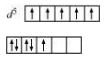
(N/A) In both $[Fe(H_2O)_6]^{3+}$ and $[Fe(CN)_6]^{3-}$,$Fe$ exists in the $+3$ oxidation state,i.e.,in $d^5$ configuration.
Since $CN^{-}$ is a strong field ligand,it causes the pairing of unpaired electrons. Therefore,there is only one unpaired electron left in the $d$-orbital.
Therefore,
$\mu = \sqrt{n(n+2)}$
$= \sqrt{1(1+2)}$
$= \sqrt{3}$
$= 1.732 \, BM$
On the other hand,$H_2O$ is a weak field ligand. Therefore,it cannot cause the pairing of electrons. This means that the number of unpaired electrons is $5$.
Therefore,
$\mu = \sqrt{n(n+2)}$
$= \sqrt{5(5+2)}$
$= \sqrt{35}$
$\simeq 5.92 \, BM$
Thus,it is evident that $[Fe(H_2O)_6]^{3+}$ is strongly paramagnetic (with $5$ unpaired electrons),while $[Fe(CN)_6]^{3-}$ is weakly paramagnetic (with $1$ unpaired electron).
Since $CN^{-}$ is a strong field ligand,it causes the pairing of unpaired electrons. Therefore,there is only one unpaired electron left in the $d$-orbital.
Therefore,
$\mu = \sqrt{n(n+2)}$
$= \sqrt{1(1+2)}$
$= \sqrt{3}$
$= 1.732 \, BM$
On the other hand,$H_2O$ is a weak field ligand. Therefore,it cannot cause the pairing of electrons. This means that the number of unpaired electrons is $5$.
Therefore,
$\mu = \sqrt{n(n+2)}$
$= \sqrt{5(5+2)}$
$= \sqrt{35}$
$\simeq 5.92 \, BM$
Thus,it is evident that $[Fe(H_2O)_6]^{3+}$ is strongly paramagnetic (with $5$ unpaired electrons),while $[Fe(CN)_6]^{3-}$ is weakly paramagnetic (with $1$ unpaired electron).
0 likes
View SolutionCoordination Compounds — Crystal Field theory · Frequently Asked Questions
1Are these Coordination Compounds questions useful for JEE and NEET?
Yes. All questions in this section are mapped to JEE Main and NEET exam patterns. Previous year questions from JEE Main, NEET, GUJCET and state-level exams are included with full solutions.
2Can I switch to Hindi or Gujarati for these questions?
Yes. Use the language tabs in the hero section or the sidebar to view the same questions and solutions in English, Hindi or Gujarati.
3How do I generate a question paper from this subtopic?
Use the Vedclass Exam Paper Generator — select the chapter and subtopic, set difficulty, and generate Sets A, B, C, D automatically. First 3 chapters of every subject are free.
Vedclass Products
For Students
Vedclass Test Series
Mock tests in real JEE/NEET style with performance analysis. 5-day free trial.
Start Free TrialFor Teachers
Exam Paper Generator
Generate Set A/B/C/D papers from this chapter in 2 minutes. 3 chapters free.
Try FreeFor Institutes
Online Exam Module
Live online exams with unlimited students, 360° analytics & white-label branding.
See DemoFor Teachers & Institutes
Generate a Coordination Compounds Exam Paper in 2 Minutes
Select subtopic & difficulty — Sets A, B, C, D auto-generated with No Repeat logic.
First 3 chapters of every subject are free — no payment required.