
A English
Crystal Field theory Questions in English
Class 12 Chemistry · Coordination Compounds · Crystal Field theory
242+
Questions
English
Language
100%
With Solutions
Showing 50 of 242 questions in English
101
Medium
The hexaquo manganese $(II)$ ion contains five unpaired electrons,while the hexacyano manganese $(II)$ ion contains only one unpaired electron. Explain using Crystal Field Theory.
Solution
(N/A)
The crystal field is octahedral. Water $(H_{2}O)$ is a weak field ligand,while cyanide $(CN^-)$ is a strong field ligand.
In $[Mn(H_{2}O)_{6}]^{2+}$,the weak field ligand does not cause pairing of electrons,resulting in the configuration $t_{2g}^{3}e_{g}^{2}$,which has $5$ unpaired electrons.
In $[Mn(CN)_{6}]^{4-}$,the strong field ligand causes pairing of electrons,resulting in the configuration $t_{2g}^{5}e_{g}^{0}$,which has $1$ unpaired electron.
| $[Mn(H_{2}O)_{6}]^{2+}$ | $[Mn(CN)_{6}]^{4-}$ |
| $Mn$ is in the $+2$ oxidation state. | $Mn$ is in the $+2$ oxidation state. |
| The electronic configuration is $d^{5}$. | The electronic configuration is $d^{5}$. |
The crystal field is octahedral. Water $(H_{2}O)$ is a weak field ligand,while cyanide $(CN^-)$ is a strong field ligand.
In $[Mn(H_{2}O)_{6}]^{2+}$,the weak field ligand does not cause pairing of electrons,resulting in the configuration $t_{2g}^{3}e_{g}^{2}$,which has $5$ unpaired electrons.
In $[Mn(CN)_{6}]^{4-}$,the strong field ligand causes pairing of electrons,resulting in the configuration $t_{2g}^{5}e_{g}^{0}$,which has $1$ unpaired electron.
0 likes
View Solution102
Medium
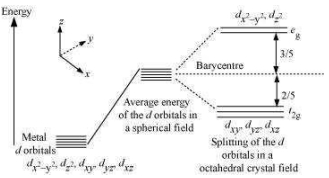
Draw a figure to show the splitting of $d$ orbitals in an octahedral crystal field.
Solution
(N/A) In an octahedral crystal field,the five degenerate $d$ orbitals of the metal ion split into two sets due to the approach of ligands along the axes.
$1$. The $d_{x^{2}-y^{2}}$ and $d_{z^{2}}$ orbitals,which point directly towards the ligands,experience greater electrostatic repulsion and thus have higher energy,forming the $e_{g}$ set.
$2$. The $d_{xy}$,$d_{yz}$,and $d_{zx}$ orbitals,which point between the axes,experience less repulsion and thus have lower energy,forming the $t_{2g}$ set.
$3$. The energy difference between these two sets is denoted by $\Delta_{o}$ (crystal field splitting energy in octahedral field).
$1$. The $d_{x^{2}-y^{2}}$ and $d_{z^{2}}$ orbitals,which point directly towards the ligands,experience greater electrostatic repulsion and thus have higher energy,forming the $e_{g}$ set.
$2$. The $d_{xy}$,$d_{yz}$,and $d_{zx}$ orbitals,which point between the axes,experience less repulsion and thus have lower energy,forming the $t_{2g}$ set.
$3$. The energy difference between these two sets is denoted by $\Delta_{o}$ (crystal field splitting energy in octahedral field).
0 likes
View Solution103
Medium
What is the spectrochemical series? Explain the difference between a weak field ligand and a strong field ligand.
Solution
(N/A) spectrochemical series is an arrangement of common ligands in the increasing order of their crystal-field splitting energy $(CFSE)$ values.
Ligands on the right-hand side $(R.H.S.)$ of the series are strong field ligands,while those on the left-hand side $(L.H.S.)$ are weak field ligands.
Strong field ligands cause greater splitting of the $d$-orbitals compared to weak field ligands.
The series is: $I^{-} < Br^{-} < S^{2-} < SCN^{-} < Cl^{-} < N_{3}^{-} < F^{-} < OH^{-} < C_{2}O_{4}^{2-} \approx H_{2}O < NCS^{-} < H^{-} < CN^{-} < NH_{3} < en \approx SO_{3}^{2-} < NO_{2}^{-} < phen < CO$.
Ligands on the right-hand side $(R.H.S.)$ of the series are strong field ligands,while those on the left-hand side $(L.H.S.)$ are weak field ligands.
Strong field ligands cause greater splitting of the $d$-orbitals compared to weak field ligands.
The series is: $I^{-} < Br^{-} < S^{2-} < SCN^{-} < Cl^{-} < N_{3}^{-} < F^{-} < OH^{-} < C_{2}O_{4}^{2-} \approx H_{2}O < NCS^{-} < H^{-} < CN^{-} < NH_{3} < en \approx SO_{3}^{2-} < NO_{2}^{-} < phen < CO$.
0 likes
View Solution104
Medium
What is crystal field splitting energy? How does the magnitude of $\Delta_{o}$ decide the actual configuration of $d$-orbitals in a coordination entity?
Solution
(N/A) The degenerate $d$-orbitals (in a spherical field environment) split into two levels,i.e.,$e_{g}$ and $t_{2g}$,in the presence of ligands. The splitting of the degenerate levels due to the presence of ligands is called the crystal-field splitting,while the energy difference between the two levels ($e_{g}$ and $t_{2g}$) is called the crystal-field splitting energy. It is denoted by $\Delta_{o}$.
After the orbitals have split,the filling of the electrons takes place. After $1$ electron (each) has been filled in the three $t_{2g}$ orbitals,the filling of the fourth electron takes place in two ways. It can enter the $e_{g}$ orbital (giving rise to $t_{2g}^{3} e_{g}^{1}$ electronic configuration) or the pairing of the electrons can take place in the $t_{2g}$ orbitals (giving rise to $t_{2g}^{4} e_{g}^{0}$ electronic configuration). If the $\Delta_{o}$ value of a ligand is less than the pairing energy $(P)$,then the electrons enter the $e_{g}$ orbital. On the other hand,if the $\Delta_{o}$ value of a ligand is more than the pairing energy $(P)$,then the electrons enter the $t_{2g}$ orbital.
After the orbitals have split,the filling of the electrons takes place. After $1$ electron (each) has been filled in the three $t_{2g}$ orbitals,the filling of the fourth electron takes place in two ways. It can enter the $e_{g}$ orbital (giving rise to $t_{2g}^{3} e_{g}^{1}$ electronic configuration) or the pairing of the electrons can take place in the $t_{2g}$ orbitals (giving rise to $t_{2g}^{4} e_{g}^{0}$ electronic configuration). If the $\Delta_{o}$ value of a ligand is less than the pairing energy $(P)$,then the electrons enter the $e_{g}$ orbital. On the other hand,if the $\Delta_{o}$ value of a ligand is more than the pairing energy $(P)$,then the electrons enter the $t_{2g}$ orbital.
0 likes
View Solution105
Medium
$[Fe(CN)_{6}]^{4-}$ and $[Fe(H_{2}O)_{6}]^{2+}$ are of different colours in dilute solutions. Why?
Solution
(N/A) The colour of a coordination compound depends on the magnitude of the crystal-field splitting energy,$\Delta$.
This $CFSE$ depends on the nature of the ligand attached to the central metal ion.
In $[Fe(CN)_{6}]^{4-}$,$CN^{-}$ is a strong field ligand,which causes a large splitting of $d$-orbitals.
In $[Fe(H_{2}O)_{6}]^{2+}$,$H_{2}O$ is a weak field ligand,which causes a smaller splitting of $d$-orbitals.
Since the energy gap $\Delta$ is different for both complexes,the wavelength of light absorbed during the $d-d$ transition is different.
Consequently,the transmitted light (complementary colour) is also different,leading to different observed colours.
This $CFSE$ depends on the nature of the ligand attached to the central metal ion.
In $[Fe(CN)_{6}]^{4-}$,$CN^{-}$ is a strong field ligand,which causes a large splitting of $d$-orbitals.
In $[Fe(H_{2}O)_{6}]^{2+}$,$H_{2}O$ is a weak field ligand,which causes a smaller splitting of $d$-orbitals.
Since the energy gap $\Delta$ is different for both complexes,the wavelength of light absorbed during the $d-d$ transition is different.
Consequently,the transmitted light (complementary colour) is also different,leading to different observed colours.
0 likes
View Solution106
EasyMCQ
What will be the correct order for the wavelengths of absorption in the visible region for the following complexes: $[Ni(NO_{2})_{6}]^{4-}, [Ni(NH_{3})_{6}]^{2+}, [Ni(H_{2}O)_{6}]^{2+}$?
A
$[Ni(H_{2}O)_{6}]^{2+} > [Ni(NH_{3})_{6}]^{2+} > [Ni(NO_{2})_{6}]^{4-}$
B
$[Ni(NO_{2})_{6}]^{4-} > [Ni(NH_{3})_{6}]^{2+} > [Ni(H_{2}O)_{6}]^{2+}$
C
$[Ni(NH_{3})_{6}]^{2+} > [Ni(H_{2}O)_{6}]^{2+} > [Ni(NO_{2})_{6}]^{4-}$
D
$[Ni(NO_{2})_{6}]^{4-} > [Ni(H_{2}O)_{6}]^{2+} > [Ni(NH_{3})_{6}]^{2+}$
Solution
(A) The central metal ion in all three complexes is the same,$Ni^{2+}$. Therefore,the crystal field splitting energy,$\Delta$,depends on the strength of the ligands.
According to the spectrochemical series,the order of ligand field strength is: $H_{2}O < NH_{3} < NO_{2}^{-}$.
Since $\Delta = \frac{hc}{\lambda}$,the magnitude of crystal field splitting is inversely proportional to the wavelength of absorption,$\lambda$.
The order of crystal field splitting,$\Delta$,is: $[Ni(H_{2}O)_{6}]^{2+} < [Ni(NH_{3})_{6}]^{2+} < [Ni(NO_{2})_{6}]^{4-}$.
Therefore,the order of wavelengths of absorption,$\lambda$,is: $[Ni(H_{2}O)_{6}]^{2+} > [Ni(NH_{3})_{6}]^{2+} > [Ni(NO_{2})_{6}]^{4-}$.
According to the spectrochemical series,the order of ligand field strength is: $H_{2}O < NH_{3} < NO_{2}^{-}$.
Since $\Delta = \frac{hc}{\lambda}$,the magnitude of crystal field splitting is inversely proportional to the wavelength of absorption,$\lambda$.
The order of crystal field splitting,$\Delta$,is: $[Ni(H_{2}O)_{6}]^{2+} < [Ni(NH_{3})_{6}]^{2+} < [Ni(NO_{2})_{6}]^{4-}$.
Therefore,the order of wavelengths of absorption,$\lambda$,is: $[Ni(H_{2}O)_{6}]^{2+} > [Ni(NH_{3})_{6}]^{2+} > [Ni(NO_{2})_{6}]^{4-}$.
0 likes
View Solution107
Difficult
Write down the number of $3d$ electrons in each of the following ions:
$Ti^{2+}, V^{2+}, Cr^{3+}, Mn^{2+}, Fe^{2+}, Fe^{3+}, Co^{2+}, Ni^{2+}$ and $Cu^{2+}$
Indicate how you would expect the five $3d$ orbitals to be occupied for these hydrated ions (octahedral).
$Ti^{2+}, V^{2+}, Cr^{3+}, Mn^{2+}, Fe^{2+}, Fe^{3+}, Co^{2+}, Ni^{2+}$ and $Cu^{2+}$
Indicate how you would expect the five $3d$ orbitals to be occupied for these hydrated ions (octahedral).
Solution
(N/A) The electronic configuration of the metal ions is determined by removing electrons from the $4s$ orbital first,followed by the $3d$ orbital. In an octahedral field,the $d$-orbitals split into $t_{2g}$ and $e_g$ sets. The filling follows Hund's rule and the Aufbau principle.
| Metal ion | Number of $3d$ electrons | Filling of $d$-orbitals |
| $Ti^{2+}$ | $2$ | $t_{2g}^2 e_g^0$ |
| $V^{2+}$ | $3$ | $t_{2g}^3 e_g^0$ |
| $Cr^{3+}$ | $3$ | $t_{2g}^3 e_g^0$ |
| $Mn^{2+}$ | $5$ | $t_{2g}^3 e_g^2$ |
| $Fe^{2+}$ | $6$ | $t_{2g}^4 e_g^2$ |
| $Fe^{3+}$ | $5$ | $t_{2g}^3 e_g^2$ |
| $Co^{2+}$ | $7$ | $t_{2g}^5 e_g^2$ |
| $Ni^{2+}$ | $8$ | $t_{2g}^6 e_g^2$ |
| $Cu^{2+}$ | $9$ | $t_{2g}^6 e_g^3$ |
0 likes
View Solution108
Difficult
Why do transition elements form coloured compounds?
Solution
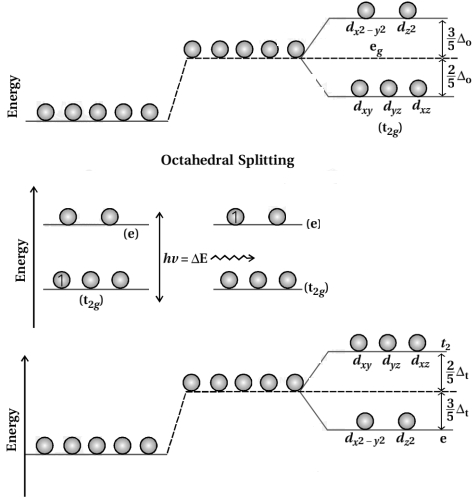
(N/A) Most of the compounds of transition elements are coloured. This can be explained by $d-d$ transition.
In the presence of combining molecules or anions called ligands,the $d$-orbital loses its degeneracy and splits into two sets of orbitals,typically $e_g$ $(d_{x^2-y^2}, d_{z^2})$ and $t_{2g}$ $(d_{xy}, d_{yz}, d_{xz})$,depending upon the geometry of the complex.
These sets of orbitals have different energies after splitting. When an electron from a lower energy $d$-orbital is excited to a higher energy $d$-orbital,the energy of excitation corresponds to the frequency of light absorbed from the visible region,resulting in the complementary colour being observed.
In the presence of combining molecules or anions called ligands,the $d$-orbital loses its degeneracy and splits into two sets of orbitals,typically $e_g$ $(d_{x^2-y^2}, d_{z^2})$ and $t_{2g}$ $(d_{xy}, d_{yz}, d_{xz})$,depending upon the geometry of the complex.
These sets of orbitals have different energies after splitting. When an electron from a lower energy $d$-orbital is excited to a higher energy $d$-orbital,the energy of excitation corresponds to the frequency of light absorbed from the visible region,resulting in the complementary colour being observed.
0 likes
View Solution109
Medium
State the limitations of crystal field theory $(CFT)$.
Solution
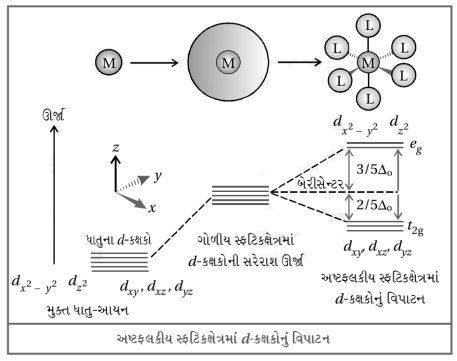
(N/A) Although the crystal field theory $(CFT)$ successfully explains the formation of structures,color,and magnetic properties of coordination compounds,it has the following limitations:
$1$. $CFT$ is based on an electrostatic model where metal ions and ligands are assumed to be point charges. Hence,it cannot explain the covalent character of the metal-ligand $(M-L)$ bond.
$2$. Anionic ligands are assumed to be point charges and thus should exert the maximum splitting effect. However,in reality,anionic ligands are found at the low end of the spectrochemical series.
$3$. It does not account for the $\pi$-bonding in complexes.
$4$. The limitations of $CFT$ are addressed by Ligand Field Theory $(LFT)$ and Molecular Orbital Theory $(MOT)$.
$1$. $CFT$ is based on an electrostatic model where metal ions and ligands are assumed to be point charges. Hence,it cannot explain the covalent character of the metal-ligand $(M-L)$ bond.
$2$. Anionic ligands are assumed to be point charges and thus should exert the maximum splitting effect. However,in reality,anionic ligands are found at the low end of the spectrochemical series.
$3$. It does not account for the $\pi$-bonding in complexes.
$4$. The limitations of $CFT$ are addressed by Ligand Field Theory $(LFT)$ and Molecular Orbital Theory $(MOT)$.
0 likes
View Solution110
Difficult
Explain the color in coordination compounds.
Solution
(N/A) The color of coordination compounds is a major property of transition metal complexes. When white light passes through a sample,some part of it is absorbed. Therefore,the transmitted light is not white.
The color of the complex is the complementary color of the light absorbed. The complementary color is the color generated by the remaining wavelengths. For example,if green light is absorbed by the complex,it appears red. The relationship between the absorbed wavelength and the observed color is well-defined.
The color in coordination compounds can be explained in terms of Crystal Field Theory $(CFT)$.
Consider the complex $[Ti(H_2O)_6]^{3+}$,which is purple in color. This complex has a single electron $(3d^1)$ in the ground state occupying the $t_{2g}$ orbital. The next higher energy level available for the electron is the empty $e_g$ orbital.
If the complex absorbs light corresponding to the blue-green region,the electron is excited from the $t_{2g}$ level to the $e_g$ level.
$(t_{2g}^1 e_g^0 \rightarrow t_{2g}^0 e_g^1)$
As a result,the complex appears purple. This phenomenon is known as $d-d$ transition.
The color of the complex is the complementary color of the light absorbed. The complementary color is the color generated by the remaining wavelengths. For example,if green light is absorbed by the complex,it appears red. The relationship between the absorbed wavelength and the observed color is well-defined.
The color in coordination compounds can be explained in terms of Crystal Field Theory $(CFT)$.
Consider the complex $[Ti(H_2O)_6]^{3+}$,which is purple in color. This complex has a single electron $(3d^1)$ in the ground state occupying the $t_{2g}$ orbital. The next higher energy level available for the electron is the empty $e_g$ orbital.
If the complex absorbs light corresponding to the blue-green region,the electron is excited from the $t_{2g}$ level to the $e_g$ level.
$(t_{2g}^1 e_g^0 \rightarrow t_{2g}^0 e_g^1)$
As a result,the complex appears purple. This phenomenon is known as $d-d$ transition.
0 likes
View Solution111
MediumMCQ
In which case is a $d^7$ complex species more stable?
A
Strong field ligand with octahedral geometry
B
Weak field ligand with octahedral geometry
C
Strong field ligand with tetrahedral geometry
D
Weak field ligand with tetrahedral geometry
Solution
(A) For a $d^7$ metal ion in an octahedral field,the Crystal Field Stabilization Energy $(CFSE)$ is calculated as follows:
$1$. For a strong field ligand (low spin),the configuration is $t_{2g}^6 e_g^1$. The $CFSE$ is $(-0.4 \times 6 + 0.6 \times 1) \Delta_o = -1.8 \Delta_o$.
$2$. For a weak field ligand (high spin),the configuration is $t_{2g}^5 e_g^2$. The $CFSE$ is $(-0.4 \times 5 + 0.6 \times 2) \Delta_o = -0.8 \Delta_o$.
Since $-1.8 \Delta_o$ is more negative than $-0.8 \Delta_o$,the strong field ligand complex is more stable.
$1$. For a strong field ligand (low spin),the configuration is $t_{2g}^6 e_g^1$. The $CFSE$ is $(-0.4 \times 6 + 0.6 \times 1) \Delta_o = -1.8 \Delta_o$.
$2$. For a weak field ligand (high spin),the configuration is $t_{2g}^5 e_g^2$. The $CFSE$ is $(-0.4 \times 5 + 0.6 \times 2) \Delta_o = -0.8 \Delta_o$.
Since $-1.8 \Delta_o$ is more negative than $-0.8 \Delta_o$,the strong field ligand complex is more stable.
0 likes
View Solution112
MediumMCQ
What is the color of the $[Ti(H_2O)_6]^{3+}$ complex?
A
Blue
B
Purple
C
Green
D
Yellow
Solution
(B) The electronic configuration of $Ti^{3+}$ is $3d^1$.
In the presence of water ligands,the $d$-orbitals split into $t_{2g}$ and $e_g$ levels.
The single electron occupies the $t_{2g}$ orbital.
When white light falls on the complex,the electron undergoes $d-d$ transition by absorbing light in the yellow-green region.
Consequently,the complex appears purple due to the transmission of the complementary color.
In the presence of water ligands,the $d$-orbitals split into $t_{2g}$ and $e_g$ levels.
The single electron occupies the $t_{2g}$ orbital.
When white light falls on the complex,the electron undergoes $d-d$ transition by absorbing light in the yellow-green region.
Consequently,the complex appears purple due to the transmission of the complementary color.
1 likes
View Solution113
Difficult
On the basis of crystal field theory,explain why $Co(III)$ forms a paramagnetic octahedral complex with weak field ligands,whereas it forms a diamagnetic octahedral complex with strong field ligands.
Solution
(N/A) $Co^{3+}$ has a $d^{6}$ electronic configuration.
In the presence of a strong field ligand,the crystal field splitting energy $\Delta_{o}$ is greater than the pairing energy $P$ (i.e.,$\Delta_{o} > P$). This forces the electrons to pair up in the lower energy $t_{2g}$ orbitals,resulting in a $t_{2g}^{6} e_{g}^{0}$ configuration.
Since all electrons are paired in the $t_{2g}^{6} e_{g}^{0}$ configuration,the complex is diamagnetic.
In the presence of a weak field ligand,$\Delta_{o} < P$. The electrons occupy the higher energy $e_{g}$ orbitals before pairing occurs,resulting in a $t_{2g}^{4} e_{g}^{2}$ configuration.
In the $t_{2g}^{4} e_{g}^{2}$ configuration,there are four unpaired electrons,making the complex paramagnetic.
In the presence of a strong field ligand,the crystal field splitting energy $\Delta_{o}$ is greater than the pairing energy $P$ (i.e.,$\Delta_{o} > P$). This forces the electrons to pair up in the lower energy $t_{2g}$ orbitals,resulting in a $t_{2g}^{6} e_{g}^{0}$ configuration.
Since all electrons are paired in the $t_{2g}^{6} e_{g}^{0}$ configuration,the complex is diamagnetic.
In the presence of a weak field ligand,$\Delta_{o} < P$. The electrons occupy the higher energy $e_{g}$ orbitals before pairing occurs,resulting in a $t_{2g}^{4} e_{g}^{2}$ configuration.
In the $t_{2g}^{4} e_{g}^{2}$ configuration,there are four unpaired electrons,making the complex paramagnetic.
0 likes
View Solution114
Advanced
Why are low spin tetrahedral complexes not formed?
Solution
(N/A) In tetrahedral complexes,the crystal field splitting energy,denoted as $\Delta_t$,is significantly smaller than the pairing energy,denoted as $P$.
Since $\Delta_t < P$,the electrons prefer to occupy higher energy orbitals rather than pairing up in the lower energy orbitals.
Therefore,low spin configurations are rarely observed in tetrahedral complexes.
Since $\Delta_t < P$,the electrons prefer to occupy higher energy orbitals rather than pairing up in the lower energy orbitals.
Therefore,low spin configurations are rarely observed in tetrahedral complexes.
0 likes
View Solution115
DifficultMCQ
Arrange the following complex ions in increasing order of crystal field splitting energy $(\Delta_{0}):$ $[Cr(Cl)_{6}]^{3-}, [Cr(CN)_{6}]^{3-}, [Cr(NH_{3})_{6}]^{3+}$
A
$[Cr(Cl)_{6}]^{3-} < [Cr(NH_{3})_{6}]^{3+} < [Cr(CN)_{6}]^{3-}$
B
$[Cr(CN)_{6}]^{3-} < [Cr(NH_{3})_{6}]^{3+} < [Cr(Cl)_{6}]^{3-}$
C
$[Cr(NH_{3})_{6}]^{3+} < [Cr(Cl)_{6}]^{3-} < [Cr(CN)_{6}]^{3-}$
D
$[Cr(Cl)_{6}]^{3-} < [Cr(CN)_{6}]^{3-} < [Cr(NH_{3})_{6}]^{3+}$
Solution
(A) The crystal field splitting energy $(\Delta_{0})$ depends on the strength of the ligand according to the spectrochemical series.
Stronger ligands cause greater splitting.
The order of ligand strength is $Cl^{-} < NH_{3} < CN^{-}$.
Therefore,the increasing order of crystal field splitting energy is $[Cr(Cl)_{6}]^{3-} < [Cr(NH_{3})_{6}]^{3+} < [Cr(CN)_{6}]^{3-}$.
Stronger ligands cause greater splitting.
The order of ligand strength is $Cl^{-} < NH_{3} < CN^{-}$.
Therefore,the increasing order of crystal field splitting energy is $[Cr(Cl)_{6}]^{3-} < [Cr(NH_{3})_{6}]^{3+} < [Cr(CN)_{6}]^{3-}$.
0 likes
View Solution116
Medium
$CuSO_4 \cdot 5 H_2O$ is blue in colour while $CuSO_4$ is colourless. Why?
Solution
(N/A) In $CuSO_4 \cdot 5 H_2O$,the $H_2O$ molecules act as ligands that cause the splitting of $d$-orbitals in the $Cu^{2+}$ ion.
This splitting allows for $d-d$ transitions of electrons when light is absorbed,which results in the blue colour of the hydrated salt.
In anhydrous $CuSO_4$,there are no ligands present to cause $d$-orbital splitting.
Consequently,no $d-d$ transition can occur,making $CuSO_4$ colourless.
This splitting allows for $d-d$ transitions of electrons when light is absorbed,which results in the blue colour of the hydrated salt.
In anhydrous $CuSO_4$,there are no ligands present to cause $d$-orbital splitting.
Consequently,no $d-d$ transition can occur,making $CuSO_4$ colourless.
0 likes
View Solution117
Difficult
Based on Crystal Field Theory,show the energy level splitting and determine the $d$-electron configuration and magnetic moment for the central metal atom/ion in the following complexes: $[CoF_6]^{3-}$,$[Co(H_2O)_6]^{2+}$,$[Co(CN)_6]^{3-}$.
Solution
(N/A) $1$. $[CoF_6]^{3-}$: $Co^{3+}$ is $3d^6$. $F^-$ is a weak field ligand. Splitting: $t_{2g}^4 e_g^2$. Number of unpaired electrons $(n)$ = $4$. Magnetic moment $\mu = \sqrt{n(n+2)} = \sqrt{4(6)} = \sqrt{24} \approx 4.90 \ BM$.
$2$. $[Co(H_2O)_6]^{2+}$: $Co^{2+}$ is $3d^7$. $H_2O$ is a weak field ligand. Splitting: $t_{2g}^5 e_g^2$. Number of unpaired electrons $(n)$ = $3$. Magnetic moment $\mu = \sqrt{3(5)} = \sqrt{15} \approx 3.87 \ BM$.
$3$. $[Co(CN)_6]^{3-}$: $Co^{3+}$ is $3d^6$. $CN^-$ is a strong field ligand. Splitting: $t_{2g}^6 e_g^0$. Number of unpaired electrons $(n)$ = $0$. Magnetic moment $\mu = 0 \ BM$ (Diamagnetic).
$2$. $[Co(H_2O)_6]^{2+}$: $Co^{2+}$ is $3d^7$. $H_2O$ is a weak field ligand. Splitting: $t_{2g}^5 e_g^2$. Number of unpaired electrons $(n)$ = $3$. Magnetic moment $\mu = \sqrt{3(5)} = \sqrt{15} \approx 3.87 \ BM$.
$3$. $[Co(CN)_6]^{3-}$: $Co^{3+}$ is $3d^6$. $CN^-$ is a strong field ligand. Splitting: $t_{2g}^6 e_g^0$. Number of unpaired electrons $(n)$ = $0$. Magnetic moment $\mu = 0 \ BM$ (Diamagnetic).
0 likes
View Solution118
Difficult
Using crystal field theory,draw energy level diagrams,write the electronic configuration of the central metal atom/ion,and determine the magnetic moment value for the following:
$(i)$ $[CoF_{6}]^{3-}, [Co(H_{2}O)_{6}]^{2+}, [Co(CN)_{6}]^{3-}$
$(ii)$ $[FeF_{6}]^{3-}, [Fe(H_{2}O)_{6}]^{2+}, [Fe(CN)_{6}]^{4-}$
$(i)$ $[CoF_{6}]^{3-}, [Co(H_{2}O)_{6}]^{2+}, [Co(CN)_{6}]^{3-}$
$(ii)$ $[FeF_{6}]^{3-}, [Fe(H_{2}O)_{6}]^{2+}, [Fe(CN)_{6}]^{4-}$
Solution
(N/A) The magnetic moment $\mu$ is calculated using the formula $\mu = \sqrt{n(n+2)} \ BM$,where $n$ is the number of unpaired electrons.
$(i)$ $[CoF_{6}]^{3-}$: $Co^{3+}$ $(3d^{6})$,weak field ligand,$t_{2g}^{4} e_{g}^{2}$,$n=4$,$\mu = \sqrt{4(4+2)} = 4.90 \ BM$.
$[Co(H_{2}O)_{6}]^{2+}$: $Co^{2+}$ $(3d^{7})$,weak field ligand,$t_{2g}^{5} e_{g}^{2}$,$n=3$,$\mu = \sqrt{3(3+2)} = 3.87 \ BM$.
$[Co(CN)_{6}]^{3-}$: $Co^{3+}$ $(3d^{6})$,strong field ligand,$t_{2g}^{6} e_{g}^{0}$,$n=0$,$\mu = 0 \ BM$.
$(ii)$ $[FeF_{6}]^{3-}$: $Fe^{3+}$ $(3d^{5})$,weak field ligand,$t_{2g}^{3} e_{g}^{2}$,$n=5$,$\mu = \sqrt{5(5+2)} = 5.92 \ BM$.
$[Fe(H_{2}O)_{6}]^{2+}$: $Fe^{2+}$ $(3d^{6})$,weak field ligand,$t_{2g}^{4} e_{g}^{2}$,$n=4$,$\mu = \sqrt{4(4+2)} = 4.90 \ BM$.
$[Fe(CN)_{6}]^{4-}$: $Fe^{2+}$ $(3d^{6})$,strong field ligand,$t_{2g}^{6} e_{g}^{0}$,$n=0$,$\mu = 0 \ BM$.
$(i)$ $[CoF_{6}]^{3-}$: $Co^{3+}$ $(3d^{6})$,weak field ligand,$t_{2g}^{4} e_{g}^{2}$,$n=4$,$\mu = \sqrt{4(4+2)} = 4.90 \ BM$.
$[Co(H_{2}O)_{6}]^{2+}$: $Co^{2+}$ $(3d^{7})$,weak field ligand,$t_{2g}^{5} e_{g}^{2}$,$n=3$,$\mu = \sqrt{3(3+2)} = 3.87 \ BM$.
$[Co(CN)_{6}]^{3-}$: $Co^{3+}$ $(3d^{6})$,strong field ligand,$t_{2g}^{6} e_{g}^{0}$,$n=0$,$\mu = 0 \ BM$.
$(ii)$ $[FeF_{6}]^{3-}$: $Fe^{3+}$ $(3d^{5})$,weak field ligand,$t_{2g}^{3} e_{g}^{2}$,$n=5$,$\mu = \sqrt{5(5+2)} = 5.92 \ BM$.
$[Fe(H_{2}O)_{6}]^{2+}$: $Fe^{2+}$ $(3d^{6})$,weak field ligand,$t_{2g}^{4} e_{g}^{2}$,$n=4$,$\mu = \sqrt{4(4+2)} = 4.90 \ BM$.
$[Fe(CN)_{6}]^{4-}$: $Fe^{2+}$ $(3d^{6})$,strong field ligand,$t_{2g}^{6} e_{g}^{0}$,$n=0$,$\mu = 0 \ BM$.
0 likes
View Solution119
AdvancedMCQ
What is the relationship between the observed colour of a coordination complex and the wavelength of light absorbed by it?
A
The observed colour is the same as the absorbed wavelength.
B
The observed colour is the complementary colour of the absorbed wavelength.
C
The observed colour is independent of the absorbed wavelength.
D
The observed colour is always the shortest wavelength of the visible spectrum.
Solution
(B) When white light falls on a coordination complex,it absorbs light of a specific wavelength corresponding to the energy of the $d-d$ transition.
The colour observed by the human eye is the complementary colour of the light absorbed by the complex.
If the crystal field splitting energy $(\Delta_o)$ is high,light of shorter wavelength (higher energy) is absorbed,and the complex appears to have a colour corresponding to a longer wavelength.
The colour observed by the human eye is the complementary colour of the light absorbed by the complex.
If the crystal field splitting energy $(\Delta_o)$ is high,light of shorter wavelength (higher energy) is absorbed,and the complex appears to have a colour corresponding to a longer wavelength.
0 likes
View Solution120
Medium
Why are different colours observed in octahedral and tetrahedral complexes for the same metal and same ligands?
Solution
(N/A) The colour of coordination complexes arises from $d-d$ transitions,which depend on the magnitude of crystal field splitting $(\Delta)$.
For the same metal ion and the same ligands,the crystal field splitting energy in an octahedral complex $(\Delta_o)$ is significantly larger than in a tetrahedral complex $(\Delta_t)$.
The relationship between them is given by $\Delta_t = \frac{4}{9} \Delta_o$.
Since the energy gap $(\Delta)$ is different,the wavelength of light absorbed $(\Delta E = \frac{hc}{\lambda})$ is different,leading to the observation of different complementary colours for the same metal-ligand system.
For the same metal ion and the same ligands,the crystal field splitting energy in an octahedral complex $(\Delta_o)$ is significantly larger than in a tetrahedral complex $(\Delta_t)$.
The relationship between them is given by $\Delta_t = \frac{4}{9} \Delta_o$.
Since the energy gap $(\Delta)$ is different,the wavelength of light absorbed $(\Delta E = \frac{hc}{\lambda})$ is different,leading to the observation of different complementary colours for the same metal-ligand system.
0 likes
View Solution121
DifficultMCQ
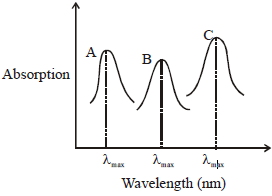
Simplified absorption spectra of three complexes $(i), (ii)$ and $(iii)$ of $M^{n+}$ ion are provided below; their $\lambda_{max}$ values are marked as $A, B$ and $C$ respectively. The correct match between the complexes and their $\lambda_{max}$ values is
$(i)$ $[M(NCS)_6]^{(-6+n)}$
$(ii)$ $[MF_6]^{(-6+n)}$
$(iii)$ $[M(NH_3)_6]^{n+}$
$(i)$ $[M(NCS)_6]^{(-6+n)}$
$(ii)$ $[MF_6]^{(-6+n)}$
$(iii)$ $[M(NH_3)_6]^{n+}$
A
$A-(ii), B-(i), C-(iii)$
B
$A-(iii), B-(i), C-(ii)$
C
$A-(iii), B-(ii), C-(i)$
D
$A-(i), B-(ii), C-(iii)$
Solution
(A) The crystal field splitting energy $(\Delta_{oh})$ is directly proportional to the strength of the ligand.
The spectrochemical series for the given ligands is: $F^{-} < NCS^{-} < NH_3$.
Therefore,the order of $\Delta_{oh}$ is: $[MF_6]^{(-6+n)} < [M(NCS)_6]^{(-6+n)} < [M(NH_3)_6]^{n+}$.
Since $\Delta_{oh} = \frac{hc}{\lambda_{max}}$,the wavelength of maximum absorption $(\lambda_{max})$ is inversely proportional to $\Delta_{oh}$.
Thus,the order of $\lambda_{max}$ is: $[MF_6]^{(-6+n)} > [M(NCS)_6]^{(-6+n)} > [M(NH_3)_6]^{n+}$.
From the given graph,the $\lambda_{max}$ values are in the order $A < B < C$.
Matching the values: $A$ corresponds to $[MF_6]^{(-6+n)}$ (complex $ii$),$B$ corresponds to $[M(NCS)_6]^{(-6+n)}$ (complex $i$),and $C$ corresponds to $[M(NH_3)_6]^{n+}$ (complex $iii$).
Therefore,the correct match is $A-(ii), B-(i), C-(iii)$.
The spectrochemical series for the given ligands is: $F^{-} < NCS^{-} < NH_3$.
Therefore,the order of $\Delta_{oh}$ is: $[MF_6]^{(-6+n)} < [M(NCS)_6]^{(-6+n)} < [M(NH_3)_6]^{n+}$.
Since $\Delta_{oh} = \frac{hc}{\lambda_{max}}$,the wavelength of maximum absorption $(\lambda_{max})$ is inversely proportional to $\Delta_{oh}$.
Thus,the order of $\lambda_{max}$ is: $[MF_6]^{(-6+n)} > [M(NCS)_6]^{(-6+n)} > [M(NH_3)_6]^{n+}$.
From the given graph,the $\lambda_{max}$ values are in the order $A < B < C$.
Matching the values: $A$ corresponds to $[MF_6]^{(-6+n)}$ (complex $ii$),$B$ corresponds to $[M(NCS)_6]^{(-6+n)}$ (complex $i$),and $C$ corresponds to $[M(NH_3)_6]^{n+}$ (complex $iii$).
Therefore,the correct match is $A-(ii), B-(i), C-(iii)$.
0 likes
View Solution122
MediumMCQ
The $d-$electron configuration of $[Ru(en)_3]Cl_2$ and $[Fe(H_2O)_6]Cl_2,$ respectively are :
A
$t_{2g}^4 e_g^2$ and $t_{2g}^6 e_g^0$
B
$t_{2g}^6 e_g^0$ and $t_{2g}^6 e_g^0$
C
$t_{2g}^6 e_g^0$ and $t_{2g}^4 e_g^2$
D
$t_{2g}^4 e_g^2$ and $t_{2g}^4 e_g^2$
Solution
(C) $1$. For $[Ru(en)_3]Cl_2$: $Ru$ is in the $+2$ oxidation state. $Ru$ belongs to the $4d$ series. For $4d$ and $5d$ series elements,the crystal field splitting energy $(\Delta_o)$ is large,even with weak field ligands,leading to low spin complexes. Thus,$Ru^{+2}$ $(d^6)$ will have the configuration $t_{2g}^6 e_g^0$.
$2$. For $[Fe(H_2O)_6]Cl_2$: $Fe$ is in the $+2$ oxidation state $(d^6)$. $H_2O$ is a weak field ligand. Therefore,it forms a high spin complex with the configuration $t_{2g}^4 e_g^2$.
$3$. Thus,the configurations are $t_{2g}^6 e_g^0$ and $t_{2g}^4 e_g^2$ respectively.
$2$. For $[Fe(H_2O)_6]Cl_2$: $Fe$ is in the $+2$ oxidation state $(d^6)$. $H_2O$ is a weak field ligand. Therefore,it forms a high spin complex with the configuration $t_{2g}^4 e_g^2$.
$3$. Thus,the configurations are $t_{2g}^6 e_g^0$ and $t_{2g}^4 e_g^2$ respectively.
0 likes
View Solution123
MediumMCQ
The electronic spectrum of $[Ti(H_2O)_6]^{3+}$ shows a single broad peak with a maximum at $20,300 \, cm^{-1}$. The crystal field stabilization energy $(CFSE)$ of the complex ion,in $kJ \, mol^{-1}$,is :
A
$242.5$
B
$83.7$
C
$145.5$
D
$97$
Solution
(D) The complex $[Ti(H_2O)_6]^{3+}$ contains $Ti^{3+}$ which has a $d^1$ electronic configuration.
In an octahedral field,the $d^1$ electron occupies the $t_{2g}$ orbital.
The energy difference between $t_{2g}$ and $e_g$ orbitals is $\Delta_0 = 20,300 \, cm^{-1}$.
The $CFSE$ for a $d^1$ configuration is given by $0.4 \Delta_0$.
$CFSE = 0.4 \times 20,300 \, cm^{-1} = 8,120 \, cm^{-1}$.
To convert $cm^{-1}$ to $kJ \, mol^{-1}$,we use the conversion factor $1 \, kJ \, mol^{-1} \approx 83.7 \, cm^{-1}$.
$CFSE = \frac{8,120}{83.7} \approx 97 \, kJ \, mol^{-1}$.
In an octahedral field,the $d^1$ electron occupies the $t_{2g}$ orbital.
The energy difference between $t_{2g}$ and $e_g$ orbitals is $\Delta_0 = 20,300 \, cm^{-1}$.
The $CFSE$ for a $d^1$ configuration is given by $0.4 \Delta_0$.
$CFSE = 0.4 \times 20,300 \, cm^{-1} = 8,120 \, cm^{-1}$.
To convert $cm^{-1}$ to $kJ \, mol^{-1}$,we use the conversion factor $1 \, kJ \, mol^{-1} \approx 83.7 \, cm^{-1}$.
$CFSE = \frac{8,120}{83.7} \approx 97 \, kJ \, mol^{-1}$.
0 likes
View Solution124
DifficultMCQ
The crystal field stabilization energy $(CFSE)$ of $[CoF_{3}(H_{2}O)_{3}]$ $(\Delta_{0} < P)$ is $:-$
A
$-0.8 \Delta_{0}$
B
$-0.4 \Delta_{0} + P$
C
$-0.8 \Delta_{0} + 2P$
D
$-0.4 \Delta_{0}$
Solution
(D) In $[CoF_{3}(H_{2}O)_{3}]$,the oxidation state of $Co$ is $+3$. The electronic configuration of $Co^{3+}$ is $3d^{6}$.
Given $\Delta_{0} < P$,the complex is a high-spin complex,meaning electrons will occupy the $e_{g}$ orbitals before pairing in the $t_{2g}$ orbitals.
The distribution of $6$ electrons in $d$-orbitals is $t_{2g}^{4} e_{g}^{2}$.
$CFSE = [n(t_{2g}) \times (-0.4) + n(e_{g}) \times (0.6)] \Delta_{0}$
$CFSE = [4 \times (-0.4) + 2 \times (0.6)] \Delta_{0}$
$CFSE = [-1.6 + 1.2] \Delta_{0} = -0.4 \Delta_{0}$
Given $\Delta_{0} < P$,the complex is a high-spin complex,meaning electrons will occupy the $e_{g}$ orbitals before pairing in the $t_{2g}$ orbitals.
The distribution of $6$ electrons in $d$-orbitals is $t_{2g}^{4} e_{g}^{2}$.
$CFSE = [n(t_{2g}) \times (-0.4) + n(e_{g}) \times (0.6)] \Delta_{0}$
$CFSE = [4 \times (-0.4) + 2 \times (0.6)] \Delta_{0}$
$CFSE = [-1.6 + 1.2] \Delta_{0} = -0.4 \Delta_{0}$
0 likes
View Solution125
MediumMCQ
The values of the crystal field stabilization energies for a high spin $d^{6}$ metal ion in octahedral and tetrahedral fields,respectively,are :
A
$-0.4 \Delta_{o}$ and $-0.27 \Delta_{t}$
B
$-1.6 \Delta_{o}$ and $-0.4 \Delta_{t}$
C
$-0.4 \Delta_{o}$ and $-0.6 \Delta_{t}$
D
$-2.4 \Delta_{o}$ and $-0.6 \Delta_{t}$
Solution
(C) For a high spin $d^{6}$ ion in an octahedral field,the electronic configuration is $t_{2g}^{4} e_{g}^{2}$.
$CFSE = (4 \times -0.4 \Delta_{o}) + (2 \times 0.6 \Delta_{o}) = -1.6 \Delta_{o} + 1.2 \Delta_{o} = -0.4 \Delta_{o}$.
For a high spin $d^{6}$ ion in a tetrahedral field,the electronic configuration is $e^{3} t_{2}^{3}$.
$CFSE = (3 \times -0.6 \Delta_{t}) + (3 \times 0.4 \Delta_{t}) = -1.8 \Delta_{t} + 1.2 \Delta_{t} = -0.6 \Delta_{t}$.
Thus,the values are $-0.4 \Delta_{o}$ and $-0.6 \Delta_{t}$.
$CFSE = (4 \times -0.4 \Delta_{o}) + (2 \times 0.6 \Delta_{o}) = -1.6 \Delta_{o} + 1.2 \Delta_{o} = -0.4 \Delta_{o}$.
For a high spin $d^{6}$ ion in a tetrahedral field,the electronic configuration is $e^{3} t_{2}^{3}$.
$CFSE = (3 \times -0.6 \Delta_{t}) + (3 \times 0.4 \Delta_{t}) = -1.8 \Delta_{t} + 1.2 \Delta_{t} = -0.6 \Delta_{t}$.
Thus,the values are $-0.4 \Delta_{o}$ and $-0.6 \Delta_{t}$.
0 likes
View Solution126
MediumMCQ
For a $d^{4}$ metal ion in an octahedral field,the correct electronic configuration is:
A
$t_{2g}^{4} e_{g}^{0}$ when $\Delta_{o} < P$
B
$e_{g}^{2} t_{2g}^{2}$ when $\Delta_{o} < P$
C
$t_{2g}^{3} e_{g}^{1}$ when $\Delta_{o} < P$
D
$t_{2g}^{3} e_{g}^{1}$ when $\Delta_{o} > P$
Solution
(C) In an octahedral field,the $d$-orbitals split into $t_{2g}$ and $e_{g}$ sets.
For a $d^{4}$ ion,if the crystal field splitting energy $\Delta_{o}$ is less than the pairing energy $P$ (weak field ligand),the electrons will occupy the orbitals singly before pairing occurs.
Thus,the configuration is $t_{2g}^{3} e_{g}^{1}$.
If $\Delta_{o} > P$ (strong field ligand),the fourth electron will pair in the $t_{2g}$ orbital,resulting in $t_{2g}^{4} e_{g}^{0}$.
For a $d^{4}$ ion,if the crystal field splitting energy $\Delta_{o}$ is less than the pairing energy $P$ (weak field ligand),the electrons will occupy the orbitals singly before pairing occurs.
Thus,the configuration is $t_{2g}^{3} e_{g}^{1}$.
If $\Delta_{o} > P$ (strong field ligand),the fourth electron will pair in the $t_{2g}$ orbital,resulting in $t_{2g}^{4} e_{g}^{0}$.
0 likes
View Solution127
MediumMCQ
Which of the following is the correct order of increasing field strength of ligands to form coordination compounds?
A
$SCN^{-} < F^{-} < C_{2}O_{4}^{2-} < CN^{-}$
B
$F^{-} < SCN^{-} < CN^{-} < C_{2}O_{4}^{2-}$
C
$SCN^{-} < F^{-} < CN^{-} < C_{2}O_{4}^{2-}$
D
$F^{-} < SCN^{-} < C_{2}O_{4}^{2-} < CN^{-}$
Solution
(A) According to the spectrochemical series,the order of increasing field strength of the given ligands is $SCN^{-} < F^{-} < C_{2}O_{4}^{2-} < CN^{-}$.
This series is based on the experimental data of the crystal field splitting energy $(\Delta_o)$ produced by different ligands.
This series is based on the experimental data of the crystal field splitting energy $(\Delta_o)$ produced by different ligands.
0 likes
View Solution128
MediumMCQ
The electronic configuration of the central metal atom/ion in $\left[ Co(CN)_6 \right]^{3-}$ is
A
$t_{2g}^5 e_g^0$
B
$t_{2g}^4 e_g^2$
C
$t_{2g}^4 e_g^3$
D
$t_{2g}^6 e_g^0$
Solution
(D) The complex $\left[ Co(CN)_6 \right]^{3-}$ contains $Co^{3+}$ as the central metal ion.
The atomic number of $Co$ is $27$. The electronic configuration of $Co$ is $[Ar] 3d^7 4s^2$.
For $Co^{3+}$,the electronic configuration is $[Ar] 3d^6$.
$CN^-$ is a strong field ligand,which causes the pairing of electrons in the $d$-orbitals.
In an octahedral field,the $d$-orbitals split into $t_{2g}$ and $e_g$ sets.
Since $CN^-$ is a strong field ligand,all $6$ electrons of $Co^{3+}$ $(3d^6)$ will occupy the $t_{2g}$ orbitals,resulting in the configuration $t_{2g}^6 e_g^0$.
Therefore,the correct option is $D$.
The atomic number of $Co$ is $27$. The electronic configuration of $Co$ is $[Ar] 3d^7 4s^2$.
For $Co^{3+}$,the electronic configuration is $[Ar] 3d^6$.
$CN^-$ is a strong field ligand,which causes the pairing of electrons in the $d$-orbitals.
In an octahedral field,the $d$-orbitals split into $t_{2g}$ and $e_g$ sets.
Since $CN^-$ is a strong field ligand,all $6$ electrons of $Co^{3+}$ $(3d^6)$ will occupy the $t_{2g}$ orbitals,resulting in the configuration $t_{2g}^6 e_g^0$.
Therefore,the correct option is $D$.
0 likes
View Solution129
MediumMCQ
Correct increasing order for the wavelength of absorption in the visible region for the complexes of $Co^{3+}$ is :
A
$[Co(CN)_6]^{3-}, [Co(NH_3)_6]^{3+}, [Co(NH_3)_5(H_2O)]^{3+}, [Co(NH_3)_5Cl]^{2+}$
B
$[Co(CN)_6]^{3-}, [Co(NH_3)_5(H_2O)]^{3+}, [Co(NH_3)_5Cl]^{2+}, [Co(NH_3)_6]^{3+}$
C
$[Co(NH_3)_6]^{3+}, [Co(CN)_6]^{3-}, [Co(NH_3)_5(H_2O)]^{3+}, [Co(NH_3)_5Cl]^{2+}$
D
$[Co(NH_3)_5Cl]^{2+}, [Co(NH_3)_5(H_2O)]^{3+}, [Co(NH_3)_6]^{3+}, [Co(CN)_6]^{3-}$
Solution
(A) The crystal field splitting energy $(\Delta_{0})$ increases as the field strength of the ligand increases.
The spectrochemical series order for the given ligands is: $CN^{-} > NH_3 > H_2O > Cl^{-}$.
Since the energy of the absorbed light is inversely proportional to the wavelength $(\lambda \propto \frac{1}{\Delta_{0}})$,a stronger ligand field results in a larger $\Delta_{0}$ and a shorter wavelength of absorption.
Thus,the increasing order of wavelength is: $[Co(CN)_6]^{3-} < [Co(NH_3)_6]^{3+} < [Co(NH_3)_5(H_2O)]^{3+} < [Co(NH_3)_5Cl]^{2+}$.
The spectrochemical series order for the given ligands is: $CN^{-} > NH_3 > H_2O > Cl^{-}$.
Since the energy of the absorbed light is inversely proportional to the wavelength $(\lambda \propto \frac{1}{\Delta_{0}})$,a stronger ligand field results in a larger $\Delta_{0}$ and a shorter wavelength of absorption.
Thus,the increasing order of wavelength is: $[Co(CN)_6]^{3-} < [Co(NH_3)_6]^{3+} < [Co(NH_3)_5(H_2O)]^{3+} < [Co(NH_3)_5Cl]^{2+}$.
0 likes
View Solution130
MediumMCQ
Which of the following complexes has maximum $CFSE$?
A
$K_{3}[Fe(CN)_{6}]$
B
$K_{3}[Co(Ox)_{3}]$
C
$K_{3}[CoF_{6}]$
D
$K_{3}[Co(CN)_{6}]$
Solution
(D) The $CFSE$ (Crystal Field Stabilization Energy) depends on the oxidation state of the metal,the nature of the ligand,and the $d$-electron configuration.
$1$. In $K_{3}[Fe(CN)_{6}]$,$Fe$ is in $+3$ oxidation state ($d^{5}$ configuration). $CN^{-}$ is a strong field ligand,resulting in a low-spin $t_{2g}^{5}e_{g}^{0}$ configuration. $CFSE = -2.0 \Delta_{o}$.
$2$. In $K_{3}[Co(Ox)_{3}]$,$Co$ is in $+3$ oxidation state ($d^{6}$ configuration). $Ox^{2-}$ is a moderate field ligand,resulting in a low-spin $t_{2g}^{6}e_{g}^{0}$ configuration. $CFSE = -2.4 \Delta_{o}$.
$3$. In $K_{3}[CoF_{6}]$,$Co$ is in $+3$ oxidation state ($d^{6}$ configuration). $F^{-}$ is a weak field ligand,resulting in a high-spin $t_{2g}^{4}e_{g}^{2}$ configuration. $CFSE = -0.4 \Delta_{o}$.
$4$. In $K_{3}[Co(CN)_{6}]$,$Co$ is in $+3$ oxidation state ($d^{6}$ configuration). $CN^{-}$ is a strong field ligand,resulting in a low-spin $t_{2g}^{6}e_{g}^{0}$ configuration. $CFSE = -2.4 \Delta_{o}$.
Comparing the magnitudes,$[Co(CN)_{6}]^{3-}$ and $[Co(Ox)_{3}]^{3-}$ have the highest $CFSE$ values. However,since $CN^{-}$ is a stronger field ligand than $Ox^{2-}$,$\Delta_{o}$ for $[Co(CN)_{6}]^{3-}$ is significantly larger,making its $CFSE$ the maximum.
$1$. In $K_{3}[Fe(CN)_{6}]$,$Fe$ is in $+3$ oxidation state ($d^{5}$ configuration). $CN^{-}$ is a strong field ligand,resulting in a low-spin $t_{2g}^{5}e_{g}^{0}$ configuration. $CFSE = -2.0 \Delta_{o}$.
$2$. In $K_{3}[Co(Ox)_{3}]$,$Co$ is in $+3$ oxidation state ($d^{6}$ configuration). $Ox^{2-}$ is a moderate field ligand,resulting in a low-spin $t_{2g}^{6}e_{g}^{0}$ configuration. $CFSE = -2.4 \Delta_{o}$.
$3$. In $K_{3}[CoF_{6}]$,$Co$ is in $+3$ oxidation state ($d^{6}$ configuration). $F^{-}$ is a weak field ligand,resulting in a high-spin $t_{2g}^{4}e_{g}^{2}$ configuration. $CFSE = -0.4 \Delta_{o}$.
$4$. In $K_{3}[Co(CN)_{6}]$,$Co$ is in $+3$ oxidation state ($d^{6}$ configuration). $CN^{-}$ is a strong field ligand,resulting in a low-spin $t_{2g}^{6}e_{g}^{0}$ configuration. $CFSE = -2.4 \Delta_{o}$.
Comparing the magnitudes,$[Co(CN)_{6}]^{3-}$ and $[Co(Ox)_{3}]^{3-}$ have the highest $CFSE$ values. However,since $CN^{-}$ is a stronger field ligand than $Ox^{2-}$,$\Delta_{o}$ for $[Co(CN)_{6}]^{3-}$ is significantly larger,making its $CFSE$ the maximum.
1 likes
View Solution131
DifficultMCQ
$\left[ Ti \left( H_{2} O \right)_{6} \right]^{3+}$ absorbs light of wavelength $498 \, nm$ during a $d-d$ transition. The octahedral splitting energy for the above complex is $....... \times 10^{-19} \, J$. (Round off to the Nearest Integer). Given: $h = 6.626 \times 10^{-34} \, Js$,$c = 3 \times 10^{8} \, ms^{-1}$.
A
$4$
B
$3$
C
$2$
D
$1$
Solution
(A) The energy of the absorbed photon corresponds to the octahedral splitting energy $\Delta_{0}$.
Using the formula $E = \frac{hc}{\lambda}$:
Given $\lambda = 498 \, nm = 498 \times 10^{-9} \, m$,$h = 6.626 \times 10^{-34} \, Js$,and $c = 3 \times 10^{8} \, ms^{-1}$.
$\Delta_{0} = \frac{6.626 \times 10^{-34} \times 3 \times 10^{8}}{498 \times 10^{-9}} \, J$
$\Delta_{0} = \frac{19.878 \times 10^{-26}}{498 \times 10^{-9}} \, J$
$\Delta_{0} \approx 0.039915 \times 10^{-17} \, J = 3.9915 \times 10^{-19} \, J$.
Rounding off to the nearest integer,we get $4 \times 10^{-19} \, J$.
Using the formula $E = \frac{hc}{\lambda}$:
Given $\lambda = 498 \, nm = 498 \times 10^{-9} \, m$,$h = 6.626 \times 10^{-34} \, Js$,and $c = 3 \times 10^{8} \, ms^{-1}$.
$\Delta_{0} = \frac{6.626 \times 10^{-34} \times 3 \times 10^{8}}{498 \times 10^{-9}} \, J$
$\Delta_{0} = \frac{19.878 \times 10^{-26}}{498 \times 10^{-9}} \, J$
$\Delta_{0} \approx 0.039915 \times 10^{-17} \, J = 3.9915 \times 10^{-19} \, J$.
Rounding off to the nearest integer,we get $4 \times 10^{-19} \, J$.
0 likes
View Solution132
MediumMCQ
Arrange the following Cobalt complexes in the order of increasing Crystal Field Stabilization Energy $(CFSE)$ value.
Complexes: $[CoF_{6}]^{3-}, [Co(H_{2}O)_{6}]^{2+}, [Co(NH_{3})_{6}]^{3+}$ and $[Co(en)_{3}]^{3+}$
$A: [CoF_{6}]^{3-}, B: [Co(H_{2}O)_{6}]^{2+}, C: [Co(NH_{3})_{6}]^{3+}, D: [Co(en)_{3}]^{3+}$
Choose the correct option:
Complexes: $[CoF_{6}]^{3-}, [Co(H_{2}O)_{6}]^{2+}, [Co(NH_{3})_{6}]^{3+}$ and $[Co(en)_{3}]^{3+}$
$A: [CoF_{6}]^{3-}, B: [Co(H_{2}O)_{6}]^{2+}, C: [Co(NH_{3})_{6}]^{3+}, D: [Co(en)_{3}]^{3+}$
Choose the correct option:
A
$A < B < C < D$
B
$B < A < C < D$
C
$B < C < D < A$
D
$C < D < B < A$
Solution
(B) The $CFSE$ value depends on two main factors:
$1$. Oxidation state of the central metal ion: Higher oxidation state leads to higher $CFSE$.
$2$. Strength of the ligand (Spectrochemical series): Stronger ligands cause larger splitting.
Let's analyze the complexes:
- $[Co(H_{2}O)_{6}]^{2+}$: $Co^{2+}$ $(d^{7})$,weak field ligand $(H_{2}O)$.
- $[CoF_{6}]^{3-}$: $Co^{3+}$ $(d^{6})$,weak field ligand $(F^{-})$.
- $[Co(NH_{3})_{6}]^{3+}$: $Co^{3+}$ $(d^{6})$,strong field ligand $(NH_{3})$.
- $[Co(en)_{3}]^{3+}$: $Co^{3+}$ $(d^{6})$,very strong field ligand $(en)$.
Comparing $B$ $(Co^{2+})$ and $A$ $(Co^{3+})$,$B$ has a lower oxidation state,so it has lower $CFSE$. Among the $Co^{3+}$ complexes,the order of ligand strength is $F^{-} < NH_{3} < en$.
Thus,the increasing order of $CFSE$ is: $[Co(H_{2}O)_{6}]^{2+} < [CoF_{6}]^{3-} < [Co(NH_{3})_{6}]^{3+} < [Co(en)_{3}]^{3+}$,which corresponds to $B < A < C < D$.
$1$. Oxidation state of the central metal ion: Higher oxidation state leads to higher $CFSE$.
$2$. Strength of the ligand (Spectrochemical series): Stronger ligands cause larger splitting.
Let's analyze the complexes:
- $[Co(H_{2}O)_{6}]^{2+}$: $Co^{2+}$ $(d^{7})$,weak field ligand $(H_{2}O)$.
- $[CoF_{6}]^{3-}$: $Co^{3+}$ $(d^{6})$,weak field ligand $(F^{-})$.
- $[Co(NH_{3})_{6}]^{3+}$: $Co^{3+}$ $(d^{6})$,strong field ligand $(NH_{3})$.
- $[Co(en)_{3}]^{3+}$: $Co^{3+}$ $(d^{6})$,very strong field ligand $(en)$.
Comparing $B$ $(Co^{2+})$ and $A$ $(Co^{3+})$,$B$ has a lower oxidation state,so it has lower $CFSE$. Among the $Co^{3+}$ complexes,the order of ligand strength is $F^{-} < NH_{3} < en$.
Thus,the increasing order of $CFSE$ is: $[Co(H_{2}O)_{6}]^{2+} < [CoF_{6}]^{3-} < [Co(NH_{3})_{6}]^{3+} < [Co(en)_{3}]^{3+}$,which corresponds to $B < A < C < D$.
0 likes
View Solution133
EasyMCQ
The Crystal Field Stabilization Energy $(CFSE)$ and magnetic moment (spin-only) of an octahedral aqua complex of a metal ion $(M^{2+})$ are $-0.8\, \Delta_{0}$ and $3.87\, BM$,respectively. Identify $(M^{2+})$:
A
$V^{3+}$
B
$Cr^{3+}$
C
$Mn^{4+}$
D
$Co^{2+}$
Solution
(D) The magnetic moment $\mu = 3.87 \, BM$ corresponds to $n = 3$ unpaired electrons,as $\mu = \sqrt{n(n+2)} \, BM$.
For an octahedral complex,the $CFSE$ is given by the formula: $CFSE = (-0.4 \times n_{t_{2g}} + 0.6 \times n_{e_g}) \Delta_0$.
For a $d^7$ ion in a weak field (aqua complex),the configuration is $t_{2g}^5 e_g^2$.
$CFSE = (-0.4 \times 5 + 0.6 \times 2) \Delta_0 = (-2.0 + 1.2) \Delta_0 = -0.8 \Delta_0$.
This matches the given $CFSE$ and the number of unpaired electrons $(3)$.
Thus,the metal ion is $Co^{2+}$ ($d^7$ configuration).
For an octahedral complex,the $CFSE$ is given by the formula: $CFSE = (-0.4 \times n_{t_{2g}} + 0.6 \times n_{e_g}) \Delta_0$.
For a $d^7$ ion in a weak field (aqua complex),the configuration is $t_{2g}^5 e_g^2$.
$CFSE = (-0.4 \times 5 + 0.6 \times 2) \Delta_0 = (-2.0 + 1.2) \Delta_0 = -0.8 \Delta_0$.
This matches the given $CFSE$ and the number of unpaired electrons $(3)$.
Thus,the metal ion is $Co^{2+}$ ($d^7$ configuration).
0 likes
View Solution134
EasyMCQ
The electron distribution in $d^{n}$ coordination complexes depends on the magnitude of crystal field splitting,$(\Delta_{0})$ and pairing energy $(P).$ The condition which favours the formation of high spin complexes is
A
$\Delta_{0} > P$
B
$\Delta_{0} < P$
C
$\Delta_{0} = P$
D
$t_{2g}^{4} e_{g}^{0}$
Solution
(B) In coordination complexes,the electron distribution is determined by the competition between the crystal field splitting energy $(\Delta_{0})$ and the pairing energy $(P).$
If $\Delta_{0} > P$,the energy required to pair electrons is less than the energy required to promote an electron to the higher energy $e_{g}$ orbitals. This leads to the formation of low spin complexes.
If $\Delta_{0} < P$,the energy required to pair electrons is greater than the energy required to promote an electron to the higher energy $e_{g}$ orbitals. This leads to the formation of high spin complexes.
Therefore,the condition that favours the formation of high spin complexes is $\Delta_{0} < P$.
If $\Delta_{0} > P$,the energy required to pair electrons is less than the energy required to promote an electron to the higher energy $e_{g}$ orbitals. This leads to the formation of low spin complexes.
If $\Delta_{0} < P$,the energy required to pair electrons is greater than the energy required to promote an electron to the higher energy $e_{g}$ orbitals. This leads to the formation of high spin complexes.
Therefore,the condition that favours the formation of high spin complexes is $\Delta_{0} < P$.
0 likes
View Solution135
Medium
Write a note on crystal field theory.
Solution
(N/A) The crystal field theory $(CFT)$ is an electrostatic model which considers the metal-ligand bond to be ionic,arising purely from electrostatic interactions between the metal ion and the ligand.
If the ligands are anions,they are treated as point charges,and if they are neutral molecules,they are considered point dipoles.
The five $d$-orbitals in an isolated gaseous metal atom/ion have the same energy,i.e.,they are degenerate. This degeneracy is maintained if a spherically symmetrical field of negative charges surrounds the metal atom/ion.
However,when this negative field is due to ligands (either anions or the negative ends of dipolar molecules like $NH_3$ and $H_2O$) in a complex,it becomes asymmetrical,and the degeneracy of the $d$-orbitals is lifted,which results in the splitting of the $d$-orbitals. The pattern of splitting depends upon the nature of the crystal field.
If the ligands are anions,they are treated as point charges,and if they are neutral molecules,they are considered point dipoles.
The five $d$-orbitals in an isolated gaseous metal atom/ion have the same energy,i.e.,they are degenerate. This degeneracy is maintained if a spherically symmetrical field of negative charges surrounds the metal atom/ion.
However,when this negative field is due to ligands (either anions or the negative ends of dipolar molecules like $NH_3$ and $H_2O$) in a complex,it becomes asymmetrical,and the degeneracy of the $d$-orbitals is lifted,which results in the splitting of the $d$-orbitals. The pattern of splitting depends upon the nature of the crystal field.
0 likes
View Solution136
Medium
Explain crystal field splitting in octahedral complexes.
Solution
(N/A) In an octahedral coordination entity with $6$ ligands surrounding the metal atom/ion,there will be repulsion between the electrons in $d$-orbitals of metal and the electrons of the ligands.
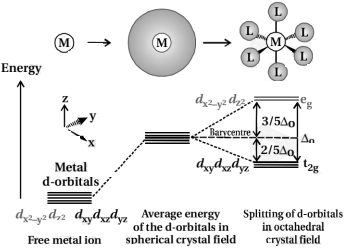
The $d$-orbitals $[d_{x^{2}-y^{2}}$ and $d_{z^{2}}]$ experience greater repulsions as they are pointed towards the axes along the direction of ligands while the $d$-orbitals $[d_{xy}, d_{yz}$ and $d_{xz}]$ which are directed between the axes,comparatively experience less repulsions. As a result,the energy of orbitals $d_{xy}, d_{yz}$ and $d_{xz}$ will be lowered relative to the average energy in a spherical crystal field while the energy of $d_{x^{2}-y^{2}}$ and $d_{z^{2}}$ will be raised.
The metal electron-ligand electron repulsions cause the loss in degeneracy of the $d$-orbitals in an octahedral complex to yield $3$ orbitals of lower energy,the $t_{2g}$ set,and $2$ orbitals of higher energy,the $e_{g}$ set. This splitting of the degenerate levels due to the presence of ligands in a definite geometry is called crystal field splitting and the energy separation is denoted by $\Delta_{o}$ (the subscript $o$ is for octahedral).
The energy of the $2$ $e_{g}$ orbitals will increase by $\frac{3}{5} \Delta_{o}$ and that of the $3$ $t_{2g}$ will decrease by $\frac{2}{5} \Delta_{o}$.
The $d$-orbitals $[d_{x^{2}-y^{2}}$ and $d_{z^{2}}]$ experience greater repulsions as they are pointed towards the axes along the direction of ligands while the $d$-orbitals $[d_{xy}, d_{yz}$ and $d_{xz}]$ which are directed between the axes,comparatively experience less repulsions. As a result,the energy of orbitals $d_{xy}, d_{yz}$ and $d_{xz}$ will be lowered relative to the average energy in a spherical crystal field while the energy of $d_{x^{2}-y^{2}}$ and $d_{z^{2}}$ will be raised.
The metal electron-ligand electron repulsions cause the loss in degeneracy of the $d$-orbitals in an octahedral complex to yield $3$ orbitals of lower energy,the $t_{2g}$ set,and $2$ orbitals of higher energy,the $e_{g}$ set. This splitting of the degenerate levels due to the presence of ligands in a definite geometry is called crystal field splitting and the energy separation is denoted by $\Delta_{o}$ (the subscript $o$ is for octahedral).
The energy of the $2$ $e_{g}$ orbitals will increase by $\frac{3}{5} \Delta_{o}$ and that of the $3$ $t_{2g}$ will decrease by $\frac{2}{5} \Delta_{o}$.
0 likes
View Solution137
Medium
On what factors does the crystal field splitting in an octahedral complex depend?
Solution
(N/A) The crystal field splitting $\Delta_{o}$ depends on the following factors:
$(i)$ Charge (oxidation state) of the metal ion: $A$ higher charge on the metal ion results in greater crystal field splitting.
$(ii)$ Strength of the ligands: Strong ligands produce strong fields,causing larger splitting of $d$-orbitals,which increases the crystal field splitting. Weak ligands result in smaller crystal field splitting.
The strength of ligands is determined experimentally based on the absorption of light by complexes with different ligands. When these ligands are arranged in a series in increasing order of field strength,it is known as the spectrochemical series:
$I^{-} < Br^{-} < SCN^{-} < Cl^{-} < S^{2-} < F^{-} < OH^{-} < C_{2}O_{4}^{2-} < H_{2}O < NCS^{-} < edta^{4-} < NH_{3} < en < CN^{-} < CO$
$(i)$ Charge (oxidation state) of the metal ion: $A$ higher charge on the metal ion results in greater crystal field splitting.
$(ii)$ Strength of the ligands: Strong ligands produce strong fields,causing larger splitting of $d$-orbitals,which increases the crystal field splitting. Weak ligands result in smaller crystal field splitting.
The strength of ligands is determined experimentally based on the absorption of light by complexes with different ligands. When these ligands are arranged in a series in increasing order of field strength,it is known as the spectrochemical series:
$I^{-} < Br^{-} < SCN^{-} < Cl^{-} < S^{2-} < F^{-} < OH^{-} < C_{2}O_{4}^{2-} < H_{2}O < NCS^{-} < edta^{4-} < NH_{3} < en < CN^{-} < CO$
0 likes
View Solution138
Medium
Explain crystal field splitting in tetrahedral complexes.
Solution
(N/A) In tetrahedral coordination entities,the $d$-orbital splitting is inverted and is smaller compared to the octahedral field splitting.
The crystal field splitting energy,denoted as $\Delta_{t}$ (where the subscript $t$ stands for tetrahedral),for the same ligands and metal-ligand distances,is related to the octahedral splitting energy $\Delta_{0}$ by the expression: $\Delta_{t} = \frac{4}{9} \Delta_{0}$.
As a result,the orbital splitting energies are not sufficiently large to force electron pairing; therefore,low-spin configurations are rarely observed in tetrahedral complexes.
The '$g$' subscript (gerade) is used for octahedral and square planar complexes as they are centrosymmetric. Since tetrahedral complexes lack a center of symmetry,the '$g$' subscript is not used with their energy levels.
In the tetrahedral field,the energy of the two $e$ orbitals decreases by $\frac{3}{5} \Delta_{t}$,while the energy of the three $t_{2}$ orbitals increases by $\frac{2}{5} \Delta_{t}$ relative to the barycenter.
The crystal field splitting energy,denoted as $\Delta_{t}$ (where the subscript $t$ stands for tetrahedral),for the same ligands and metal-ligand distances,is related to the octahedral splitting energy $\Delta_{0}$ by the expression: $\Delta_{t} = \frac{4}{9} \Delta_{0}$.
As a result,the orbital splitting energies are not sufficiently large to force electron pairing; therefore,low-spin configurations are rarely observed in tetrahedral complexes.
The '$g$' subscript (gerade) is used for octahedral and square planar complexes as they are centrosymmetric. Since tetrahedral complexes lack a center of symmetry,the '$g$' subscript is not used with their energy levels.
In the tetrahedral field,the energy of the two $e$ orbitals decreases by $\frac{3}{5} \Delta_{t}$,while the energy of the three $t_{2}$ orbitals increases by $\frac{2}{5} \Delta_{t}$ relative to the barycenter.
0 likes
View Solution139
Medium
What is pairing energy $(P)$? Explain the distribution of $d^n$ ($n=1$ to $10$) electrons in high spin and low spin octahedral complexes.
Solution
(N/A) Pairing energy $(P)$ is the energy required to pair two electrons in a single orbital.
In an octahedral complex,the $d$-orbitals split into $t_{2g}$ (lower energy) and $e_g$ (higher energy) sets.
For $d^1, d^2, d^3$ configurations,electrons occupy $t_{2g}$ orbitals singly according to Hund's rule.
For $d^4$ to $d^7$ configurations,the distribution depends on the relative values of crystal field splitting energy $(\Delta_0)$ and pairing energy $(P)$:
$(i)$ If $\Delta_0 < P$ (weak field ligands),the energy required to pair is higher than the energy to promote an electron to the $e_g$ level. This results in high spin complexes (e.g.,$d^4$ is $t_{2g}^3 e_g^1$).
$(ii)$ If $\Delta_0 > P$ (strong field ligands),the energy required to pair is lower than the energy to promote an electron. This results in low spin complexes (e.g.,$d^4$ is $t_{2g}^4 e_g^0$).
For $d^8, d^9, d^{10}$ configurations,the $t_{2g}$ and $e_g$ orbitals are filled according to Hund's rule regardless of the ligand field strength.
In an octahedral complex,the $d$-orbitals split into $t_{2g}$ (lower energy) and $e_g$ (higher energy) sets.
For $d^1, d^2, d^3$ configurations,electrons occupy $t_{2g}$ orbitals singly according to Hund's rule.
For $d^4$ to $d^7$ configurations,the distribution depends on the relative values of crystal field splitting energy $(\Delta_0)$ and pairing energy $(P)$:
$(i)$ If $\Delta_0 < P$ (weak field ligands),the energy required to pair is higher than the energy to promote an electron to the $e_g$ level. This results in high spin complexes (e.g.,$d^4$ is $t_{2g}^3 e_g^1$).
$(ii)$ If $\Delta_0 > P$ (strong field ligands),the energy required to pair is lower than the energy to promote an electron. This results in low spin complexes (e.g.,$d^4$ is $t_{2g}^4 e_g^0$).
For $d^8, d^9, d^{10}$ configurations,the $t_{2g}$ and $e_g$ orbitals are filled according to Hund's rule regardless of the ligand field strength.
0 likes
View Solution140
Medium
Explain the origin of colour in coordination compounds.
Solution
(N/A) When white light passes through a coordination compound,a portion of the visible spectrum is absorbed. The light that emerges is no longer white; its colour is the complementary colour of the light that was absorbed.
The complementary colour is generated from the remaining wavelengths of the visible spectrum.
For example,if a sample absorbs green light,it appears red. This phenomenon can be explained using Crystal Field Theory $(CFT)$.
Consider the complex $[Ti(H_{2}O)_{6}]^{3+}$,which is violet in colour. This complex has a $d^{1}$ configuration. The single electron occupies the $t_{2g}$ level in the ground state. Upon absorbing light,this electron undergoes a $d-d$ transition to the higher energy $e_{g}$ orbital. The energy of the absorbed photon corresponds to the crystal field splitting energy $(\Delta_{o})$,which falls within the visible region.
The complementary colour is generated from the remaining wavelengths of the visible spectrum.
For example,if a sample absorbs green light,it appears red. This phenomenon can be explained using Crystal Field Theory $(CFT)$.
Consider the complex $[Ti(H_{2}O)_{6}]^{3+}$,which is violet in colour. This complex has a $d^{1}$ configuration. The single electron occupies the $t_{2g}$ level in the ground state. Upon absorbing light,this electron undergoes a $d-d$ transition to the higher energy $e_{g}$ orbital. The energy of the absorbed photon corresponds to the crystal field splitting energy $(\Delta_{o})$,which falls within the visible region.
0 likes
View Solution141
Medium
State the limitations of crystal field theory $(CFT)$.
Solution
(N/A) Although the crystal field theory successfully explains the formation of structures,color,and magnetic properties of coordination compounds,it has the following limitations:
$1$. $CFT$ is based on an electrostatic model where metal ions and ligands are assumed to be point charges. Hence,it cannot explain the covalent character of the $M-L$ bond.
$2$. Anionic ligands are assumed to be point charges and thus should exert the maximum splitting effect. However,anionic ligands are actually found at the low end of the spectrochemical series.
$3$. It does not account for the $\pi$-bonding in coordination complexes.
The limitations of $CFT$ are explained by Ligand Field Theory $(LFT)$ and Molecular Orbital Theory $(MOT)$.
$1$. $CFT$ is based on an electrostatic model where metal ions and ligands are assumed to be point charges. Hence,it cannot explain the covalent character of the $M-L$ bond.
$2$. Anionic ligands are assumed to be point charges and thus should exert the maximum splitting effect. However,anionic ligands are actually found at the low end of the spectrochemical series.
$3$. It does not account for the $\pi$-bonding in coordination complexes.
The limitations of $CFT$ are explained by Ligand Field Theory $(LFT)$ and Molecular Orbital Theory $(MOT)$.
0 likes
View Solution142
MediumMCQ
The order of energy absorbed,which is responsible for the color of the following complexes,is:
A
$C > B > A$
B
$C > A > B$
C
$B > A > C$
D
$A > B > C$
Solution
(B) The complexes are:
$A: [Ni(H_{2}O)_{2}(en)_{2}]^{2+}$
$B: [Ni(H_{2}O)_{4}(en)]^{2+}$
$C: [Ni(en)_{3}]^{2+}$
$en$ (ethylenediamine) is a stronger field ligand $(SFL)$ compared to $H_{2}O$.
According to the spectrochemical series,the crystal field splitting energy $(\Delta_{0})$ increases as the number of strong field ligands increases.
In complex $C$,there are $3$ $en$ ligands.
In complex $A$,there are $2$ $en$ ligands.
In complex $B$,there is $1$ $en$ ligand.
Therefore,the order of crystal field splitting energy $(\Delta_{0})$ is $C > A > B$.
Since the energy absorbed $(E = h\nu = \Delta_{0})$ is directly proportional to the splitting energy,the order of energy absorbed is $C > A > B$.
$A: [Ni(H_{2}O)_{2}(en)_{2}]^{2+}$
$B: [Ni(H_{2}O)_{4}(en)]^{2+}$
$C: [Ni(en)_{3}]^{2+}$
$en$ (ethylenediamine) is a stronger field ligand $(SFL)$ compared to $H_{2}O$.
According to the spectrochemical series,the crystal field splitting energy $(\Delta_{0})$ increases as the number of strong field ligands increases.
In complex $C$,there are $3$ $en$ ligands.
In complex $A$,there are $2$ $en$ ligands.
In complex $B$,there is $1$ $en$ ligand.
Therefore,the order of crystal field splitting energy $(\Delta_{0})$ is $C > A > B$.
Since the energy absorbed $(E = h\nu = \Delta_{0})$ is directly proportional to the splitting energy,the order of energy absorbed is $C > A > B$.
0 likes
View Solution143
MediumMCQ
The transition metal complex with the highest value of crystal field splitting $(\Delta_{0})$ is ........ .
A
$[Cr(H_{2}O)_{6}]^{3+}$
B
$[Mo(H_{2}O)_{6}]^{3+}$
C
$[Fe(H_{2}O)_{6}]^{3+}$
D
$[Os(H_{2}O)_{6}]^{3+}$
Solution
(D) The crystal field splitting energy $(\Delta_{0})$ increases down a group in the periodic table for metal ions with the same charge and same ligand environment.
This is because the $d$-orbitals of the $5d$ series elements are more extended in space compared to the $3d$ and $4d$ series,leading to stronger interaction with the ligands.
Among the given complexes,$Cr^{3+}$ $(3d)$,$Mo^{3+}$ $(4d)$,$Fe^{3+}$ $(3d)$,and $Os^{3+}$ $(5d)$ are present.
Since $Os$ belongs to the $5d$ series,the complex $[Os(H_{2}O)_{6}]^{3+}$ will have the highest $\Delta_{0}$ value.
This is because the $d$-orbitals of the $5d$ series elements are more extended in space compared to the $3d$ and $4d$ series,leading to stronger interaction with the ligands.
Among the given complexes,$Cr^{3+}$ $(3d)$,$Mo^{3+}$ $(4d)$,$Fe^{3+}$ $(3d)$,and $Os^{3+}$ $(5d)$ are present.
Since $Os$ belongs to the $5d$ series,the complex $[Os(H_{2}O)_{6}]^{3+}$ will have the highest $\Delta_{0}$ value.
0 likes
View Solution144
DifficultMCQ
If $[Cu(H_{2}O)_{4}]^{2+}$ absorbs light of wavelength $600 \ nm$ for $d-d$ transition,then the value of octahedral crystal field splitting energy for $[Cu(H_{2}O)_{6}]^{2+}$ will be $..... \times 10^{-21} \ J$. (Nearest Integer)
(Given: $h = 6.63 \times 10^{-34} \ Js$ and $c = 3.08 \times 10^{8} \ ms^{-1}$)
(Given: $h = 6.63 \times 10^{-34} \ Js$ and $c = 3.08 \times 10^{8} \ ms^{-1}$)
A
$766$
B
$852$
C
$412$
D
$344$
Solution
(A) The energy of the absorbed photon for the $d-d$ transition in the tetrahedral complex is given by $\Delta_{t} = \frac{hc}{\lambda}$.
Substituting the given values: $\Delta_{t} = \frac{6.63 \times 10^{-34} \times 3.08 \times 10^{8}}{600 \times 10^{-9}} \ J$.
$\Delta_{t} = \frac{20.4204 \times 10^{-26}}{600 \times 10^{-9}} = 0.034034 \times 10^{-17} \ J = 340.34 \times 10^{-21} \ J$.
The relationship between octahedral splitting energy $(\Delta_{o})$ and tetrahedral splitting energy $(\Delta_{t})$ is $\Delta_{o} = \frac{9}{4} \Delta_{t}$.
$\Delta_{o} = \frac{9}{4} \times 340.34 \times 10^{-21} \ J = 765.765 \times 10^{-21} \ J$.
Rounding to the nearest integer,we get $766 \times 10^{-21} \ J$.
Substituting the given values: $\Delta_{t} = \frac{6.63 \times 10^{-34} \times 3.08 \times 10^{8}}{600 \times 10^{-9}} \ J$.
$\Delta_{t} = \frac{20.4204 \times 10^{-26}}{600 \times 10^{-9}} = 0.034034 \times 10^{-17} \ J = 340.34 \times 10^{-21} \ J$.
The relationship between octahedral splitting energy $(\Delta_{o})$ and tetrahedral splitting energy $(\Delta_{t})$ is $\Delta_{o} = \frac{9}{4} \Delta_{t}$.
$\Delta_{o} = \frac{9}{4} \times 340.34 \times 10^{-21} \ J = 765.765 \times 10^{-21} \ J$.
Rounding to the nearest integer,we get $766 \times 10^{-21} \ J$.
0 likes
View Solution145
EasyMCQ
Which of the following will have maximum stabilization due to crystal field?
A
$[Ti(H_2O)_6]^{3+}$
B
$[Co(H_2O)_6]^{2+}$
C
$[Co(CN)_6]^{3-}$
D
$[Cu(NH_3)_4]^{2+}$
Solution
(C) The crystal field stabilization energy $(CFSE)$ depends on the nature of the ligand and the oxidation state of the metal ion.
$CN^-$ is a strong field ligand,which causes a large splitting of $d$-orbitals $(\Delta_o)$.
In $[Co(CN)_6]^{3-}$,$Co$ is in the $+3$ oxidation state ($d^6$ configuration).
Since $CN^-$ is a strong field ligand,it leads to a low-spin $t_{2g}^6 e_g^0$ configuration,resulting in a very high $CFSE$ value compared to the other complexes listed,which involve weak field ligands like $H_2O$ or have lower oxidation states.
$CN^-$ is a strong field ligand,which causes a large splitting of $d$-orbitals $(\Delta_o)$.
In $[Co(CN)_6]^{3-}$,$Co$ is in the $+3$ oxidation state ($d^6$ configuration).
Since $CN^-$ is a strong field ligand,it leads to a low-spin $t_{2g}^6 e_g^0$ configuration,resulting in a very high $CFSE$ value compared to the other complexes listed,which involve weak field ligands like $H_2O$ or have lower oxidation states.
0 likes
View Solution146
MediumMCQ
The correct order of energy of absorption for the following metal complexes is
$A: [Ni(en)_3]^{2+}, B: [Ni(NH_3)_6]^{2+}, C: [Ni(H_2O)_6]^{2+}$
$A: [Ni(en)_3]^{2+}, B: [Ni(NH_3)_6]^{2+}, C: [Ni(H_2O)_6]^{2+}$
A
$C < B < A$
B
$B < C < A$
C
$C < A < B$
D
$A < C < B$
Solution
(A) The energy of absorption is directly proportional to the crystal field splitting energy $(\Delta_o)$.
According to the spectrochemical series,the field strength of the ligands is $H_2O < NH_3 < en$.
Since the metal ion $(Ni^{2+})$ is the same in all complexes,the splitting energy depends on the ligand strength.
Therefore,the order of splitting energy (and thus energy of absorption) is $[Ni(H_2O)_6]^{2+} < [Ni(NH_3)_6]^{2+} < [Ni(en)_3]^{2+}$,which corresponds to $C < B < A$.
According to the spectrochemical series,the field strength of the ligands is $H_2O < NH_3 < en$.
Since the metal ion $(Ni^{2+})$ is the same in all complexes,the splitting energy depends on the ligand strength.
Therefore,the order of splitting energy (and thus energy of absorption) is $[Ni(H_2O)_6]^{2+} < [Ni(NH_3)_6]^{2+} < [Ni(en)_3]^{2+}$,which corresponds to $C < B < A$.
0 likes
View Solution147
MediumMCQ
$[Fe(CN)_{6}]^{3-}$ is an inner orbital complex. Ignoring the pairing energy,the value of crystal field stabilization energy for this complex is $(-)\;\dots \;\Delta_{o}$.
A
$5$
B
$4$
C
$3$
D
$2$
Solution
(D) The complex is $[Fe(CN)_{6}]^{3-}$.
$Fe$ is in the $+3$ oxidation state,so its electronic configuration is $3d^{5}$.
$CN^{-}$ is a strong field ligand,which causes pairing of electrons in the $d$-orbitals.
For an octahedral complex,the $d$-orbitals split into $t_{2g}$ and $e_{g}$ sets.
The $5$ electrons occupy the $t_{2g}$ orbitals as $(t_{2g}^{5} e_{g}^{0})$.
The crystal field stabilization energy $(CFSE)$ is calculated as:
$CFSE = n(t_{2g}) \times (-0.4 \Delta_{o}) + n(e_{g}) \times (0.6 \Delta_{o})$
$CFSE = 5 \times (-0.4 \Delta_{o}) + 0 \times (0.6 \Delta_{o}) = -2.0 \Delta_{o}$.
Thus,the value is $2$.
$Fe$ is in the $+3$ oxidation state,so its electronic configuration is $3d^{5}$.
$CN^{-}$ is a strong field ligand,which causes pairing of electrons in the $d$-orbitals.
For an octahedral complex,the $d$-orbitals split into $t_{2g}$ and $e_{g}$ sets.
The $5$ electrons occupy the $t_{2g}$ orbitals as $(t_{2g}^{5} e_{g}^{0})$.
The crystal field stabilization energy $(CFSE)$ is calculated as:
$CFSE = n(t_{2g}) \times (-0.4 \Delta_{o}) + n(e_{g}) \times (0.6 \Delta_{o})$
$CFSE = 5 \times (-0.4 \Delta_{o}) + 0 \times (0.6 \Delta_{o}) = -2.0 \Delta_{o}$.
Thus,the value is $2$.
0 likes
View Solution148
MediumMCQ
The energies of $d_{xy}$ and $d_{z^2}$-orbitals in octahedral and tetrahedral transition metal complexes are such that
A
$E(d_{xy}) > E(d_{z^2})$ in both tetrahedral and octahedral complexes
B
$E(d_{xy}) < E(d_{z^2})$ in both tetrahedral and octahedral complexes
C
$E(d_{xy}) > E(d_{z^2})$ in tetrahedral but $E(d_{xy}) < E(d_{z^2})$ in octahedral complexes
D
$E(d_{xy}) < E(d_{z^2})$ in tetrahedral but $E(d_{xy}) > E(d_{z^2})$ in octahedral complexes
Solution
(C) In an octahedral complex,the ligands approach along the axes. The $d_{x^2-y^2}$ and $d_{z^2}$ orbitals (axial orbitals) point directly towards the ligands and experience greater repulsion,thus having higher energy. The $d_{xy}$,$d_{yz}$,and $d_{zx}$ orbitals (non-axial) point between the axes and have lower energy. Thus,in octahedral complexes,$E(d_{xy}) < E(d_{z^2})$.
In a tetrahedral complex,the ligands approach from the corners of a tetrahedron,which is between the axes. The $d_{xy}$,$d_{yz}$,and $d_{zx}$ orbitals point closer to the ligands and experience greater repulsion,thus having higher energy than the $d_{x^2-y^2}$ and $d_{z^2}$ orbitals. Thus,in tetrahedral complexes,$E(d_{xy}) > E(d_{z^2})$.
In a tetrahedral complex,the ligands approach from the corners of a tetrahedron,which is between the axes. The $d_{xy}$,$d_{yz}$,and $d_{zx}$ orbitals point closer to the ligands and experience greater repulsion,thus having higher energy than the $d_{x^2-y^2}$ and $d_{z^2}$ orbitals. Thus,in tetrahedral complexes,$E(d_{xy}) > E(d_{z^2})$.
0 likes
View Solution149
DifficultMCQ
The Crystal Field Stabilisation Energies $(CFSE)$ of high spin and low spin $d^6$ metal complexes in terms of $\Delta_o$,respectively are
A
$-0.4$ and $-2.4$
B
$-2.4$ and $-0.4$
C
$-0.4$ and $0.0$
D
$-2.4$ and $0.0$
Solution
(A) The correct option is $A$.
For a high spin $d^6$ metal complex,the electron configuration is $t_{2g}^4 e_g^2$.
$CFSE = (-0.4 \times 4 + 0.6 \times 2) \Delta_o = (-1.6 + 1.2) \Delta_o = -0.4 \Delta_o$.
For a low spin $d^6$ metal complex,the electron configuration is $t_{2g}^6 e_g^0$.
$CFSE = (-0.4 \times 6 + 0.6 \times 0) \Delta_o = (-2.4 + 0) \Delta_o = -2.4 \Delta_o$.
For a high spin $d^6$ metal complex,the electron configuration is $t_{2g}^4 e_g^2$.
$CFSE = (-0.4 \times 4 + 0.6 \times 2) \Delta_o = (-1.6 + 1.2) \Delta_o = -0.4 \Delta_o$.
For a low spin $d^6$ metal complex,the electron configuration is $t_{2g}^6 e_g^0$.
$CFSE = (-0.4 \times 6 + 0.6 \times 0) \Delta_o = (-2.4 + 0) \Delta_o = -2.4 \Delta_o$.
0 likes
View Solution150
MediumMCQ
The crystal field stabilisation energy $(CFSE)$ and the spin-only magnetic moment in Bohr Magneton $(BM)$ for the complex $K_3[Fe(CN)_6]$ are,respectively
A
$0.0 \Delta_o$ and $\sqrt{35} BM$
B
$-2.0 \Delta_o$ and $\sqrt{3} BM$
C
$-0.4 \Delta_o$ and $\sqrt{24} BM$
D
$-2.4 \Delta_o$ and $0 BM$
Solution
(B) The oxidation state of $Fe$ in $K_3[Fe(CN)_6]$ is $+3$. Thus,the electronic configuration for $Fe^{3+}$ is $[Ar] 3d^5$.
Since $CN^-$ is a strong field ligand,it causes pairing of electrons in the $d$-orbitals.
The configuration in the crystal field is $t_{2g}^5 e_g^0$.
$CFSE = (-0.4 \times n(t_{2g}) + 0.6 \times n(e_g)) \Delta_o + mP$
$CFSE = (-0.4 \times 5 + 0.6 \times 0) \Delta_o + 2P = -2.0 \Delta_o + 2P$.
However,considering only the crystal field splitting energy contribution:
$CFSE = -0.4 \times 5 = -2.0 \Delta_o$.
Number of unpaired electrons $(n) = 1$.
Magnetic moment,$\mu = \sqrt{n(n+2)} = \sqrt{1(1+2)} = \sqrt{3} BM$.
Therefore,the correct option is $B$.
Since $CN^-$ is a strong field ligand,it causes pairing of electrons in the $d$-orbitals.
The configuration in the crystal field is $t_{2g}^5 e_g^0$.
$CFSE = (-0.4 \times n(t_{2g}) + 0.6 \times n(e_g)) \Delta_o + mP$
$CFSE = (-0.4 \times 5 + 0.6 \times 0) \Delta_o + 2P = -2.0 \Delta_o + 2P$.
However,considering only the crystal field splitting energy contribution:
$CFSE = -0.4 \times 5 = -2.0 \Delta_o$.
Number of unpaired electrons $(n) = 1$.
Magnetic moment,$\mu = \sqrt{n(n+2)} = \sqrt{1(1+2)} = \sqrt{3} BM$.
Therefore,the correct option is $B$.
0 likes
View SolutionCoordination Compounds — Crystal Field theory · Frequently Asked Questions
1Are these Coordination Compounds questions useful for JEE and NEET?
Yes. All questions in this section are mapped to JEE Main and NEET exam patterns. Previous year questions from JEE Main, NEET, GUJCET and state-level exams are included with full solutions.
2Can I switch to Hindi or Gujarati for these questions?
Yes. Use the language tabs in the hero section or the sidebar to view the same questions and solutions in English, Hindi or Gujarati.
3How do I generate a question paper from this subtopic?
Use the Vedclass Exam Paper Generator — select the chapter and subtopic, set difficulty, and generate Sets A, B, C, D automatically. First 3 chapters of every subject are free.
Vedclass Products
For Students
Vedclass Test Series
Mock tests in real JEE/NEET style with performance analysis. 5-day free trial.
Start Free TrialFor Teachers
Exam Paper Generator
Generate Set A/B/C/D papers from this chapter in 2 minutes. 3 chapters free.
Try FreeFor Institutes
Online Exam Module
Live online exams with unlimited students, 360° analytics & white-label branding.
See DemoFor Teachers & Institutes
Generate a Coordination Compounds Exam Paper in 2 Minutes
Select subtopic & difficulty — Sets A, B, C, D auto-generated with No Repeat logic.
First 3 chapters of every subject are free — no payment required.