
A English
Basic Terms Questions in English
Class 12 Chemistry · Coordination Compounds · Basic Terms
495+
Questions
English
Language
100%
With Solutions
Showing 50 of 495 questions in English
301
Medium
Give the chemical formulas for the following compounds:
$(i)$ Ammonium molybdate
$(ii)$ Ammonium phosphomolybdate
$(iii)$ Ferric thiocyanate ion
$(iv)$ Sodium sulphide
$(i)$ Ammonium molybdate
$(ii)$ Ammonium phosphomolybdate
$(iii)$ Ferric thiocyanate ion
$(iv)$ Sodium sulphide
Solution
(N/A) $(i)$ Ammonium molybdate is $(NH_4)_2MoO_4$.
$(ii)$ Ammonium phosphomolybdate is $(NH_4)_3[PMo_{12}O_{40}]$.
$(iii)$ Ferric thiocyanate ion is $[Fe(SCN)]^{2+}$.
$(iv)$ Sodium sulphide is $Na_2S$.
$(ii)$ Ammonium phosphomolybdate is $(NH_4)_3[PMo_{12}O_{40}]$.
$(iii)$ Ferric thiocyanate ion is $[Fe(SCN)]^{2+}$.
$(iv)$ Sodium sulphide is $Na_2S$.
0 likes
View Solution302
MediumMCQ
The total number of coordination sites in ethylenediaminetetraacetate $(EDTA^{4-})$ is
A
$15$
B
$8$
C
$6$
D
$10$
Solution
(C) $EDTA^{4-}$ (ethylenediaminetetraacetate) is a hexadentate ligand.
It contains $2$ nitrogen atoms and $4$ oxygen atoms as donor sites.
Therefore,the total number of coordination sites (denticity) is $6$.
It contains $2$ nitrogen atoms and $4$ oxygen atoms as donor sites.
Therefore,the total number of coordination sites (denticity) is $6$.
0 likes
View Solution303
MediumMCQ
The equivalents of ethylene diamine $(en)$ required to replace the neutral ligands from the coordination sphere of the trans-complex of $CoCl_{3} \cdot 4NH_{3}$ is ............ (Round off to the Nearest Integer).
A
$1$
B
$5$
C
$2$
D
$6$
Solution
(C) The complex $trans-CoCl_{3} \cdot 4NH_{3}$ can be written as $trans-[Co(NH_{3})_{4}Cl_{2}]Cl$.
In this complex,there are $4$ neutral $NH_{3}$ ligands in the coordination sphere.
Ethylene diamine $(en)$ is a bidentate ligand,meaning one molecule of $en$ occupies two coordination sites.
To replace $4$ monodentate $NH_{3}$ ligands,we require $2$ molecules of the bidentate ligand $en$ ($2 \times 2 = 4$ coordination sites).
Therefore,the number of equivalents of ethylene diamine required is $2$.
In this complex,there are $4$ neutral $NH_{3}$ ligands in the coordination sphere.
Ethylene diamine $(en)$ is a bidentate ligand,meaning one molecule of $en$ occupies two coordination sites.
To replace $4$ monodentate $NH_{3}$ ligands,we require $2$ molecules of the bidentate ligand $en$ ($2 \times 2 = 4$ coordination sites).
Therefore,the number of equivalents of ethylene diamine required is $2$.
0 likes
View Solution304
EasyMCQ
On complete reaction of $FeCl_3$ with oxalic acid in an aqueous solution containing $KOH$,the product $A$ is formed. The secondary valency of $Fe$ in the product $A$ is $...$ (Round off to the nearest integer).
A
$1$
B
$10$
C
$4$
D
$6$
Solution
(D) The reaction of $FeCl_3$ with oxalic acid in the presence of $KOH$ leads to the formation of potassium trioxalatoferrate$(III)$:
$FeCl_3 + 3H_2C_2O_4 + 6KOH \rightarrow K_3[Fe(C_2O_4)_3] + 3KCl + 6H_2O$
The product $A$ is $K_3[Fe(C_2O_4)_3]$.
In this coordination complex,the oxalate ion $(C_2O_4^{2-})$ is a bidentate ligand.
Since there are $3$ oxalate ligands,the coordination number (secondary valency) of $Fe$ is $3 \times 2 = 6$.
$FeCl_3 + 3H_2C_2O_4 + 6KOH \rightarrow K_3[Fe(C_2O_4)_3] + 3KCl + 6H_2O$
The product $A$ is $K_3[Fe(C_2O_4)_3]$.
In this coordination complex,the oxalate ion $(C_2O_4^{2-})$ is a bidentate ligand.
Since there are $3$ oxalate ligands,the coordination number (secondary valency) of $Fe$ is $3 \times 2 = 6$.
0 likes
View Solution305
DifficultMCQ
The secondary valency and the number of hydrogen bonded water molecule$(s)$ in $CuSO_{4} \cdot 5H_{2}O,$ respectively,are :
A
$6$ and $4$
B
$4$ and $1$
C
$6$ and $5$
D
$5$ and $1$
Solution
(B) In the structure of $CuSO_{4} \cdot 5H_{2}O,$ the copper ion $(Cu^{2+})$ is coordinated to $4$ water molecules directly,which defines its secondary valency as $4$.
The fifth water molecule is not directly coordinated to the $Cu^{2+}$ ion but is held in the crystal lattice by hydrogen bonding between the water molecule and the sulfate $(SO_{4}^{2-})$ group.
Therefore,the secondary valency is $4$ and the number of hydrogen-bonded water molecules is $1$.
The fifth water molecule is not directly coordinated to the $Cu^{2+}$ ion but is held in the crystal lattice by hydrogen bonding between the water molecule and the sulfate $(SO_{4}^{2-})$ group.
Therefore,the secondary valency is $4$ and the number of hydrogen-bonded water molecules is $1$.
0 likes
View Solution306
EasyMCQ
Given below are two statements :
Statement $I :$ The identification of $Ni^{2+}$ is carried out by dimethyl glyoxime in the presence of $NH_{4}OH$.
Statement $II :$ The dimethyl glyoxime is a bidentate neutral ligand.
In the light of the above statements,choose the correct answer from the options given below:
Statement $I :$ The identification of $Ni^{2+}$ is carried out by dimethyl glyoxime in the presence of $NH_{4}OH$.
Statement $II :$ The dimethyl glyoxime is a bidentate neutral ligand.
In the light of the above statements,choose the correct answer from the options given below:
A
Statement $I$ is false but Statement $II$ is true.
B
Both Statement $I$ and Statement $II$ are false.
C
Statement $I$ is true but Statement $II$ is false.
D
Both Statement $I$ and Statement $II$ are true.
Solution
(C) Statement $I$ is true because dimethyl glyoxime $(DMG)$ is used as a specific reagent for the detection of $Ni^{2+}$ ions in an ammoniacal medium $(NH_{4}OH)$.
Statement $II$ is false because dimethyl glyoxime $(C_{4}H_{8}N_{2}O_{2})$ acts as a bidentate monoanionic ligand $(dmg^{-})$ after losing a proton,not as a neutral ligand.
The reaction is: $Ni^{2+}_{(aq)} + 2dmg^{-} \rightarrow [Ni(dmg)_{2}] \text{ (rosy red precipitate)}$.
Statement $II$ is false because dimethyl glyoxime $(C_{4}H_{8}N_{2}O_{2})$ acts as a bidentate monoanionic ligand $(dmg^{-})$ after losing a proton,not as a neutral ligand.
The reaction is: $Ni^{2+}_{(aq)} + 2dmg^{-} \rightarrow [Ni(dmg)_{2}] \text{ (rosy red precipitate)}$.
0 likes
View Solution307
EasyMCQ
$1 \ mol$ of an octahedral metal complex with formula $MCl_{3} \cdot 2 \ L$ on reaction with excess of $AgNO_{3}$ gives $1 \ mol$ of $AgCl$. The denticity of ligand $L$ is ...... . (Integer answer)
A
$3$
B
$4$
C
$2$
D
$1$
Solution
(C) The complex $MCl_{3} \cdot 2 \ L$ reacts with excess $AgNO_{3}$ to yield $1 \ mol$ of $AgCl$,which indicates that only $1 \ mol$ of $Cl^{-}$ ion is present in the ionization sphere.
Thus,the coordination formula can be written as $[MCl_{2} \ L_{2}]Cl$.
For an octahedral complex,the coordination number is $6$.
Let the denticity of ligand $L$ be $x$.
The coordination number is calculated as: $(2 \times \text{denticity of } Cl^{-}) + (2 \times x) = 6$.
Since $Cl^{-}$ is a monodentate ligand (denticity $= 1$),we have: $(2 \times 1) + 2x = 6$.
$2 + 2x = 6 \implies 2x = 4 \implies x = 2$.
Therefore,the denticity of ligand $L$ is $2$.
Thus,the coordination formula can be written as $[MCl_{2} \ L_{2}]Cl$.
For an octahedral complex,the coordination number is $6$.
Let the denticity of ligand $L$ be $x$.
The coordination number is calculated as: $(2 \times \text{denticity of } Cl^{-}) + (2 \times x) = 6$.
Since $Cl^{-}$ is a monodentate ligand (denticity $= 1$),we have: $(2 \times 1) + 2x = 6$.
$2 + 2x = 6 \implies 2x = 4 \implies x = 2$.
Therefore,the denticity of ligand $L$ is $2$.
0 likes
View Solution308
MediumMCQ
The denticity of the organic ligand,biuret,is:
A
$2$
B
$4$
C
$3$
D
$6$
Solution
(A) Biuret $(NH_2CONHCONH_2)$ acts as a bidentate ligand in coordination complexes.
It coordinates to the central metal ion through the two oxygen atoms of the carbonyl groups.
Therefore,its denticity is $2$.
It coordinates to the central metal ion through the two oxygen atoms of the carbonyl groups.
Therefore,its denticity is $2$.
0 likes
View Solution309
EasyMCQ
Ethylene diaminetetraacetate $(EDTA^{4-})$ ion is:
A
Hexadentate ligand with four $O$ and two $N$ donor atoms
B
Unidentate ligand
C
Bidentate ligand with two $N$ donor atoms
D
Tridentate ligand with three $N$ donor atoms
Solution
(A) The structure of the ethylene diaminetetraacetate $(EDTA^{4-})$ ion consists of two nitrogen atoms and four oxygen atoms (from the four carboxylate groups) that can act as donor sites.
Since it has six donor atoms capable of binding to a central metal ion,it is classified as a hexadentate ligand.
Therefore,the correct option is $A$.
Since it has six donor atoms capable of binding to a central metal ion,it is classified as a hexadentate ligand.
Therefore,the correct option is $A$.
0 likes
View Solution310
DifficultMCQ
Three moles of $AgCl$ get precipitated when one mole of an octahedral coordination compound with empirical formula $CrCl_{3} \cdot 3NH_{3} \cdot 3H_{2}O$ reacts with excess of silver nitrate. The number of chloride ions satisfying the secondary valency of the metal ion is $......$
A
$1$
B
$0$
C
$2$
D
$3$
Solution
(B) The number of moles of $AgCl$ precipitated corresponds to the number of $Cl^{-}$ ions present in the ionization sphere.
Given the empirical formula $CrCl_{3} \cdot 3NH_{3} \cdot 3H_{2}O$,and the fact that $3$ moles of $AgCl$ are precipitated,all $3$ chloride ions must be outside the coordination sphere.
Thus,the complex is $[Cr(H_{2}O)_{3}(NH_{3})_{3}]Cl_{3}$.
In this complex,the coordination number of the central metal ion $Cr^{3+}$ is $6$,which is satisfied by $3$ $H_{2}O$ molecules and $3$ $NH_{3}$ molecules.
Since all $3$ $Cl^{-}$ ions are in the ionization sphere,the number of chloride ions satisfying the secondary valency (coordination number) is $0$.
Given the empirical formula $CrCl_{3} \cdot 3NH_{3} \cdot 3H_{2}O$,and the fact that $3$ moles of $AgCl$ are precipitated,all $3$ chloride ions must be outside the coordination sphere.
Thus,the complex is $[Cr(H_{2}O)_{3}(NH_{3})_{3}]Cl_{3}$.
In this complex,the coordination number of the central metal ion $Cr^{3+}$ is $6$,which is satisfied by $3$ $H_{2}O$ molecules and $3$ $NH_{3}$ molecules.
Since all $3$ $Cl^{-}$ ions are in the ionization sphere,the number of chloride ions satisfying the secondary valency (coordination number) is $0$.
0 likes
View Solution311
MediumMCQ
$3$ moles of a metal complex with the formula $Co(en)_2 Cl_3$ gives $3$ moles of silver chloride on treatment with an excess of silver nitrate. The secondary valency of $Co$ in the complex is $.....$ (Round off to the nearest integer).
A
$6$
B
$5$
C
$4$
D
$3$
Solution
(A) The complex $Co(en)_2 Cl_3$ reacts with $AgNO_3$ to precipitate $AgCl$. Since $3$ moles of $AgCl$ are produced from $3$ moles of the complex,each mole of the complex releases $1$ mole of $Cl^-$ ions.
This indicates the formula is $[Co(en)_2 Cl_2]Cl$.
The secondary valency corresponds to the coordination number $(C.N.)$.
In $[Co(en)_2 Cl_2]Cl$,the central metal $Co$ is bonded to two bidentate $en$ ligands ($2 \times 2 = 4$ coordination sites) and two monodentate $Cl^-$ ligands ($2 \times 1 = 2$ coordination sites).
Therefore,the coordination number $= 4 + 2 = 6$.
The secondary valency of $Co$ is $6$.
This indicates the formula is $[Co(en)_2 Cl_2]Cl$.
The secondary valency corresponds to the coordination number $(C.N.)$.
In $[Co(en)_2 Cl_2]Cl$,the central metal $Co$ is bonded to two bidentate $en$ ligands ($2 \times 2 = 4$ coordination sites) and two monodentate $Cl^-$ ligands ($2 \times 1 = 2$ coordination sites).
Therefore,the coordination number $= 4 + 2 = 6$.
The secondary valency of $Co$ is $6$.
0 likes
View Solution312
Medium
Write a note on chelating ligands.
Solution
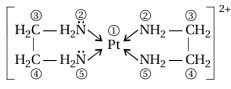
(N/A) When a polydentate ligand coordinates to a metal ion,forming a five- or six-membered closed ring structure that includes the metal ion,it is called a chelating ligand,and the phenomenon is known as chelation. The resulting compounds are known as chelates.
Chelates are highly stable. The stabilization of coordination compounds due to chelation is called the chelate effect.
For example: $[Pt(en)_2]^{2+}$
In the above example,the bidentate ligand ethylene diamine $(en)$ forms a five-membered closed ring structure with the central metal ion $Pt^{2+}$.
Chelates are highly stable. The stabilization of coordination compounds due to chelation is called the chelate effect.
For example: $[Pt(en)_2]^{2+}$
In the above example,the bidentate ligand ethylene diamine $(en)$ forms a five-membered closed ring structure with the central metal ion $Pt^{2+}$.
0 likes
View Solution313
Medium
State the rules to write the formulas of mononuclear coordination entities.
Solution
(N/A) The following rules are applied while writing the formulas:
$1$. The central atom is listed first.
$2$. The ligands are then listed in alphabetical order. The placement of a ligand in the list does not depend on its charge.
$3$. Polydentate ligands are sorted alphabetically. In case of an abbreviated ligand,the first letter of the abbreviation is used to determine the position of the ligand in the alphabetical order.
$4$. The formula for the entire coordination entity,whether charged or not,is enclosed in square brackets. When ligands are polyatomic,their formulas are enclosed in parentheses. Ligand abbreviations are also enclosed in parentheses.
$5$. There should be no space between the ligands and the metal within a coordination sphere.
$6$. When the formula of a charged coordination entity is to be written without that of the counter ion,the charge is indicated outside the square brackets as a right superscript with the number before the sign. For example,$[Co(CN)_{6}]^{3-}$,$[Cr(H_{2}O)_{6}]^{3+}$,etc.
$7$. The charge of the cation$(s)$ is balanced by the charge of the anion$(s)$.
$1$. The central atom is listed first.
$2$. The ligands are then listed in alphabetical order. The placement of a ligand in the list does not depend on its charge.
$3$. Polydentate ligands are sorted alphabetically. In case of an abbreviated ligand,the first letter of the abbreviation is used to determine the position of the ligand in the alphabetical order.
$4$. The formula for the entire coordination entity,whether charged or not,is enclosed in square brackets. When ligands are polyatomic,their formulas are enclosed in parentheses. Ligand abbreviations are also enclosed in parentheses.
$5$. There should be no space between the ligands and the metal within a coordination sphere.
$6$. When the formula of a charged coordination entity is to be written without that of the counter ion,the charge is indicated outside the square brackets as a right superscript with the number before the sign. For example,$[Co(CN)_{6}]^{3-}$,$[Cr(H_{2}O)_{6}]^{3+}$,etc.
$7$. The charge of the cation$(s)$ is balanced by the charge of the anion$(s)$.
0 likes
View Solution314
Medium
State the limitations of Werner's coordination theory.
Solution
(N/A) Werner's theory could not explain the following:
$1$. The directional properties of bonds in coordination compounds.
$2$. The ability of certain elements to form coordination compounds.
$3$. The magnetic and optical properties of coordination compounds.
The nature of bonding in coordination compounds is better explained by Valence Bond Theory $(VBT)$,Crystal Field Theory $(CFT)$,Ligand Field Theory $(LFT)$,and Molecular Orbital Theory $(MOT)$.
$1$. The directional properties of bonds in coordination compounds.
$2$. The ability of certain elements to form coordination compounds.
$3$. The magnetic and optical properties of coordination compounds.
The nature of bonding in coordination compounds is better explained by Valence Bond Theory $(VBT)$,Crystal Field Theory $(CFT)$,Ligand Field Theory $(LFT)$,and Molecular Orbital Theory $(MOT)$.
0 likes
View Solution315
EasyMCQ
The conductivity of a solution of a complex with the formula $CoCl_3(NH_3)_4$ corresponds to a $1:1$ electrolyte. What is the primary valency of the central metal ion?
A
$3$
B
$2$
C
$4$
D
$6$
Solution
(A) The complex $CoCl_3(NH_3)_4$ acts as a $1:1$ electrolyte,which means it dissociates into two ions in solution.
This indicates the formula is $[Co(NH_3)_4Cl_2]Cl$.
The primary valency of the central metal ion $(Co)$ corresponds to its oxidation state.
In $[Co(NH_3)_4Cl_2]Cl$,let the oxidation state of $Co$ be $x$.
$x + 4(0) + 2(-1) + 1(-1) = 0$
$x - 3 = 0$
$x = +3$.
Therefore,the primary valency is $3$.
This indicates the formula is $[Co(NH_3)_4Cl_2]Cl$.
The primary valency of the central metal ion $(Co)$ corresponds to its oxidation state.
In $[Co(NH_3)_4Cl_2]Cl$,let the oxidation state of $Co$ be $x$.
$x + 4(0) + 2(-1) + 1(-1) = 0$
$x - 3 = 0$
$x = +3$.
Therefore,the primary valency is $3$.
0 likes
View Solution316
EasyMCQ
The sum of the oxidation state (magnitude) and the coordination number of cobalt in $Na[Co(bpy)Cl_4]$ is $.......$ (Given $bpy = 2,2'-bipyridine$)
A
$6$
B
$3$
C
$9$
D
$12$
Solution
(C) The complex is $Na[Co(bpy)Cl_4]$.
$bpy$ $(2,2'-bipyridine)$ is a bidentate ligand,and $Cl^-$ is a monodentate ligand.
Coordination number of $Co = (1 \times 2) + (4 \times 1) = 6$.
Let the oxidation state of $Co$ be $x$.
The charge on $Na$ is $+1$,$bpy$ is $0$,and $Cl$ is $-1$.
$1 + x + 0 + 4(-1) = 0$
$1 + x - 4 = 0$
$x - 3 = 0$
$x = +3$.
Magnitude of oxidation state $= 3$.
Sum $= 6 + 3 = 9$.
$bpy$ $(2,2'-bipyridine)$ is a bidentate ligand,and $Cl^-$ is a monodentate ligand.
Coordination number of $Co = (1 \times 2) + (4 \times 1) = 6$.
Let the oxidation state of $Co$ be $x$.
The charge on $Na$ is $+1$,$bpy$ is $0$,and $Cl$ is $-1$.
$1 + x + 0 + 4(-1) = 0$
$1 + x - 4 = 0$
$x - 3 = 0$
$x = +3$.
Magnitude of oxidation state $= 3$.
Sum $= 6 + 3 = 9$.
0 likes
View Solution317
DifficultMCQ
$2.33 \ g$ of compound $X$ (empirical formula $= CoH_{12}N_{4}Cl_{3}$) upon treatment with excess $AgNO_{3}$ solution produces $1.435 \ g$ of a white precipitate. The primary and secondary valences of cobalt in compound $X$,respectively are.
[Given,atomic mass : $Co = 59, Cl = 35.5, Ag = 108$]
[Given,atomic mass : $Co = 59, Cl = 35.5, Ag = 108$]
A
$3, 6$
B
$3, 4$
C
$2, 4$
D
$4, 3$
Solution
(A) The reaction is: $CoH_{12}N_{4}Cl_{3} + AgNO_{3} \rightarrow AgCl$ (white ppt).
Molar mass of $CoH_{12}N_{4}Cl_{3} = 59 + 12(1) + 4(14) + 3(35.5) = 59 + 12 + 56 + 106.5 = 233.5 \ g/mol$.
Moles of $X = \frac{2.33 \ g}{233.5 \ g/mol} = 0.01 \ mol$.
Moles of $AgCl = \frac{1.435 \ g}{143.5 \ g/mol} = 0.01 \ mol$.
Since $0.01 \ mol$ of $X$ produces $0.01 \ mol$ of $AgCl$,there is $1 \ Cl^-$ ion outside the coordination sphere.
The complex is $[Co(NH_{3})_{4}Cl_{2}]Cl$.
Primary valency (oxidation state of $Co$): $x + 4(0) + 2(-1) = +1 \Rightarrow x = +3$.
Secondary valency (coordination number of $Co$): $4(NH_{3}) + 2(Cl) = 6$.
Molar mass of $CoH_{12}N_{4}Cl_{3} = 59 + 12(1) + 4(14) + 3(35.5) = 59 + 12 + 56 + 106.5 = 233.5 \ g/mol$.
Moles of $X = \frac{2.33 \ g}{233.5 \ g/mol} = 0.01 \ mol$.
Moles of $AgCl = \frac{1.435 \ g}{143.5 \ g/mol} = 0.01 \ mol$.
Since $0.01 \ mol$ of $X$ produces $0.01 \ mol$ of $AgCl$,there is $1 \ Cl^-$ ion outside the coordination sphere.
The complex is $[Co(NH_{3})_{4}Cl_{2}]Cl$.
Primary valency (oxidation state of $Co$): $x + 4(0) + 2(-1) = +1 \Rightarrow x = +3$.
Secondary valency (coordination number of $Co$): $4(NH_{3}) + 2(Cl) = 6$.
0 likes
View Solution318
MediumMCQ
The number of ions produced in water by dissolution of the complex having the empirical formula,$CoCl_3 \cdot 4NH_3$,is
A
$1$
B
$2$
C
$4$
D
$3$
Solution
(B) The structure of the complex with the empirical formula $CoCl_3 \cdot 4NH_3$ is represented as $[Co(NH_3)_4Cl_2]Cl$.
Upon dissolution in water,it dissociates as follows:
$[Co(NH_3)_4Cl_2]Cl \rightarrow [Co(NH_3)_4Cl_2]^+ + Cl^-$.
This complex produces $2$ ions in total ($1$ complex cation and $1$ chloride anion).
Upon dissolution in water,it dissociates as follows:
$[Co(NH_3)_4Cl_2]Cl \rightarrow [Co(NH_3)_4Cl_2]^+ + Cl^-$.
This complex produces $2$ ions in total ($1$ complex cation and $1$ chloride anion).
0 likes
View Solution319
MediumMCQ
The primary and secondary valencies of cobalt respectively in $[Co(NH_3)_5Cl]Cl_2$ are :
A
$3$ and $5$
B
$2$ and $6$
C
$2$ and $8$
D
$3$ and $6$
Solution
(D) In the complex $[Co(NH_3)_5Cl]Cl_2$,the oxidation state of $Co$ is calculated as: $x + 5(0) + 1(-1) = +2$,so $x = +3$.
Primary valency corresponds to the oxidation state of the central metal atom,which is $3$.
Secondary valency corresponds to the coordination number,which is the total number of ligands directly bonded to the central metal atom. Here,$5$ $NH_3$ molecules and $1$ $Cl^-$ ion are bonded,so the coordination number is $5 + 1 = 6$.
Thus,the primary and secondary valencies are $3$ and $6$ respectively.
Primary valency corresponds to the oxidation state of the central metal atom,which is $3$.
Secondary valency corresponds to the coordination number,which is the total number of ligands directly bonded to the central metal atom. Here,$5$ $NH_3$ molecules and $1$ $Cl^-$ ion are bonded,so the coordination number is $5 + 1 = 6$.
Thus,the primary and secondary valencies are $3$ and $6$ respectively.
0 likes
View Solution320
MediumMCQ
Total number of moles of $AgCl$ precipitated on addition of excess of $AgNO_3$ to one mole each of the following complexes $[Co(NH_3)_4Cl_2]Cl$,$[Ni(H_2O)_6]Cl_2$,$[Pt(NH_3)_2Cl_2]$ and $[Pd(NH_3)_4]Cl_2$ is $...............$ (in $.00$)
A
$4$
B
$3$
C
$6$
D
$5$
Solution
(D) The number of $AgCl$ moles precipitated depends on the number of ionizable chloride ions $(Cl^-)$ outside the coordination sphere.
$1$. $[Co(NH_3)_4Cl_2]Cl$ dissociates to give $1$ $Cl^-$ ion,so it produces $1$ mole of $AgCl$.
$2$. $[Ni(H_2O)_6]Cl_2$ dissociates to give $2$ $Cl^-$ ions,so it produces $2$ moles of $AgCl$.
$3$. $[Pt(NH_3)_2Cl_2]$ has no ionizable $Cl^-$ ions outside the coordination sphere,so it produces $0$ moles of $AgCl$.
$4$. $[Pd(NH_3)_4]Cl_2$ dissociates to give $2$ $Cl^-$ ions,so it produces $2$ moles of $AgCl$.
Total moles of $AgCl = 1 + 2 + 0 + 2 = 5$ moles.
$1$. $[Co(NH_3)_4Cl_2]Cl$ dissociates to give $1$ $Cl^-$ ion,so it produces $1$ mole of $AgCl$.
$2$. $[Ni(H_2O)_6]Cl_2$ dissociates to give $2$ $Cl^-$ ions,so it produces $2$ moles of $AgCl$.
$3$. $[Pt(NH_3)_2Cl_2]$ has no ionizable $Cl^-$ ions outside the coordination sphere,so it produces $0$ moles of $AgCl$.
$4$. $[Pd(NH_3)_4]Cl_2$ dissociates to give $2$ $Cl^-$ ions,so it produces $2$ moles of $AgCl$.
Total moles of $AgCl = 1 + 2 + 0 + 2 = 5$ moles.
0 likes
View Solution321
MediumMCQ
The denticity of the ligand present in the Fehling's reagent is $..........$.
A
$2$
B
$6$
C
$4$
D
$8$
Solution
(A) Fehling's reagent contains a copper$(II)$ complex with tartrate ions $(C_4H_4O_6^{2-})$.
In this complex,the tartrate ion acts as a bidentate ligand,meaning it coordinates to the central metal ion through two donor atoms (typically the carboxylate oxygen and the hydroxyl oxygen).
Therefore,the denticity of the tartrate ligand is $2$.
In this complex,the tartrate ion acts as a bidentate ligand,meaning it coordinates to the central metal ion through two donor atoms (typically the carboxylate oxygen and the hydroxyl oxygen).
Therefore,the denticity of the tartrate ligand is $2$.
0 likes
View Solution322
MediumMCQ
Which of the following are examples of double salts?
$A$. $FeSO_4 \cdot (NH_4)_2SO_4 \cdot 6H_2O$
$B$. $CuSO_4 \cdot 4NH_3 \cdot H_2O$
$C$. $K_2SO_4 \cdot Al_2(SO_4)_3 \cdot 24H_2O$
$D$. $Fe(CN)_2 \cdot 4KCN$
Choose the correct answer.
$A$. $FeSO_4 \cdot (NH_4)_2SO_4 \cdot 6H_2O$
$B$. $CuSO_4 \cdot 4NH_3 \cdot H_2O$
$C$. $K_2SO_4 \cdot Al_2(SO_4)_3 \cdot 24H_2O$
$D$. $Fe(CN)_2 \cdot 4KCN$
Choose the correct answer.
A
$A$ and $C$ only
B
$A$ and $B$ only
C
$A, B$ and $D$ only
D
$B$ and $D$ only
Solution
(A) Double salts are addition compounds that dissociate into their constituent ions completely when dissolved in water.
$FeSO_4 \cdot (NH_4)_2SO_4 \cdot 6H_2O$ (Mohr's salt) and $K_2SO_4 \cdot Al_2(SO_4)_3 \cdot 24H_2O$ (Potash alum) are examples of double salts.
$CuSO_4 \cdot 4NH_3 \cdot H_2O$ and $Fe(CN)_2 \cdot 4KCN$ (which is $K_4[Fe(CN)_6]$) are coordination compounds (complex salts) that do not dissociate completely into their constituent ions in solution.
Therefore,$A$ and $C$ are double salts.
$FeSO_4 \cdot (NH_4)_2SO_4 \cdot 6H_2O$ (Mohr's salt) and $K_2SO_4 \cdot Al_2(SO_4)_3 \cdot 24H_2O$ (Potash alum) are examples of double salts.
$CuSO_4 \cdot 4NH_3 \cdot H_2O$ and $Fe(CN)_2 \cdot 4KCN$ (which is $K_4[Fe(CN)_6]$) are coordination compounds (complex salts) that do not dissociate completely into their constituent ions in solution.
Therefore,$A$ and $C$ are double salts.
0 likes
View Solution323
MediumMCQ
Number of ambidentate ligands in a representative metal complex $[M(en)(SCN)_4]$ is $[en = \text{ethylenediamine}]$
A
$1$
B
$2$
C
$4$
D
$6$
Solution
(C) An ambidentate ligand is a ligand that can coordinate to the central metal atom through two different donor atoms.
In the complex $[M(en)(SCN)_4]$,the ligand $en$ (ethylenediamine) is a bidentate chelating ligand,which coordinates through two nitrogen atoms.
The ligand $SCN^-$ (thiocyanate) is an ambidentate ligand because it can coordinate through either the sulfur atom $(S-CN^-)$ or the nitrogen atom $(N-CS^-)$.
There are $4$ $SCN^-$ ligands present in the complex.
Therefore,the number of ambidentate ligands in the complex is $4$.
In the complex $[M(en)(SCN)_4]$,the ligand $en$ (ethylenediamine) is a bidentate chelating ligand,which coordinates through two nitrogen atoms.
The ligand $SCN^-$ (thiocyanate) is an ambidentate ligand because it can coordinate through either the sulfur atom $(S-CN^-)$ or the nitrogen atom $(N-CS^-)$.
There are $4$ $SCN^-$ ligands present in the complex.
Therefore,the number of ambidentate ligands in the complex is $4$.
0 likes
View Solution324
MediumMCQ
The set which does not have any ambidentate ligand$(s)$ is:
A
$C_2O_4^{2-}$,ethylene diamine,$H_2O$
B
$EDTA^{4-}, NCS^{-}, C_2O_4^{2-}$
C
$NO_2^{-}, C_2O_4^{2-}, EDTA^{4-}$
D
$C_2O_4^{2-}, NO_2^{-}, NCS^{-}$
Solution
(A) An ambidentate ligand is a ligand that can coordinate to a metal atom through more than one donor atom (e.g.,$NO_2^-$ can coordinate through $N$ or $O$,and $NCS^-$ can coordinate through $N$ or $S$).
Analyzing the options:
$A$: $C_2O_4^{2-}$ (oxalate) is a didentate ligand,ethylene diamine $(en)$ is a didentate ligand,and $H_2O$ is a monodentate ligand. None of these are ambidentate.
$B$: $NCS^-$ is an ambidentate ligand.
$C$: $NO_2^-$ is an ambidentate ligand.
$D$: $NO_2^-$ and $NCS^-$ are ambidentate ligands.
Therefore,the set that does not contain any ambidentate ligand is $A$.
Analyzing the options:
$A$: $C_2O_4^{2-}$ (oxalate) is a didentate ligand,ethylene diamine $(en)$ is a didentate ligand,and $H_2O$ is a monodentate ligand. None of these are ambidentate.
$B$: $NCS^-$ is an ambidentate ligand.
$C$: $NO_2^-$ is an ambidentate ligand.
$D$: $NO_2^-$ and $NCS^-$ are ambidentate ligands.
Therefore,the set that does not contain any ambidentate ligand is $A$.
0 likes
View Solution325
DifficultMCQ
The volume (in $mL$) of $0.1 \, M \, AgNO_3$ required for complete precipitation of chloride ions present in $20 \, mL$ of $0.01 \, M$ solution of $[Cr(H_2O)_5Cl]Cl_2$ as silver chloride is $..........$.
A
$4$
B
$3$
C
$2$
D
$1$
Solution
(A) The complex $[Cr(H_2O)_5Cl]Cl_2$ dissociates in water as: $[Cr(H_2O)_5Cl]Cl_2 \rightarrow [Cr(H_2O)_5Cl]^{2+} + 2Cl^-$.
Each mole of the complex provides $2$ moles of ionizable chloride ions $(Cl^-)$.
Number of millimoles of the complex $= Molarity \times Volume (mL) = 0.01 \, M \times 20 \, mL = 0.2 \, mmol$.
Since $1$ mole of complex gives $2$ moles of $Cl^-$,$0.2 \, mmol$ of complex gives $0.4 \, mmol$ of $Cl^-$.
The precipitation reaction is: $Ag^+ + Cl^- \rightarrow AgCl(s)$.
Thus,$0.4 \, mmol$ of $AgNO_3$ is required to precipitate $0.4 \, mmol$ of $Cl^-$.
Using $Molarity = \frac{millimoles}{Volume (mL)}$,we get $0.1 = \frac{0.4}{V}$.
$V = \frac{0.4}{0.1} = 4 \, mL$.
Each mole of the complex provides $2$ moles of ionizable chloride ions $(Cl^-)$.
Number of millimoles of the complex $= Molarity \times Volume (mL) = 0.01 \, M \times 20 \, mL = 0.2 \, mmol$.
Since $1$ mole of complex gives $2$ moles of $Cl^-$,$0.2 \, mmol$ of complex gives $0.4 \, mmol$ of $Cl^-$.
The precipitation reaction is: $Ag^+ + Cl^- \rightarrow AgCl(s)$.
Thus,$0.4 \, mmol$ of $AgNO_3$ is required to precipitate $0.4 \, mmol$ of $Cl^-$.
Using $Molarity = \frac{millimoles}{Volume (mL)}$,we get $0.1 = \frac{0.4}{V}$.
$V = \frac{0.4}{0.1} = 4 \, mL$.
0 likes
View Solution326
DifficultMCQ
Which of the following is a homoleptic complex?
A
Triamminetriaquachromium $(III)$ chloride
B
Potassium trioxalatoaluminate $(III)$
C
Diamminechloridonitrito-$N$-platinum $(II)$
D
Pentaamminecarbonatocobalt $(III)$ chloride
Solution
(B) homoleptic complex is a coordination compound in which the central metal atom or ion is bound to only one type of donor atom or ligand.
- Triamminetriaquachromium $(III)$ chloride: $[Cr(NH_3)_3(H_2O)_3]Cl_3$ (Heteroleptic)
- Potassium trioxalatoaluminate $(III)$: $K_3[Al(C_2O_4)_3]$ (Homoleptic,as all ligands are oxalate ions)
- Diamminechloridonitrito-$N$-platinum $(II)$: $[Pt(NH_3)_2Cl(NO_2)]$ (Heteroleptic)
- Pentaamminecarbonatocobalt $(III)$ chloride: $[Co(NH_3)_5(CO_3)]Cl$ (Heteroleptic)
Therefore,the correct option is $B$.
- Triamminetriaquachromium $(III)$ chloride: $[Cr(NH_3)_3(H_2O)_3]Cl_3$ (Heteroleptic)
- Potassium trioxalatoaluminate $(III)$: $K_3[Al(C_2O_4)_3]$ (Homoleptic,as all ligands are oxalate ions)
- Diamminechloridonitrito-$N$-platinum $(II)$: $[Pt(NH_3)_2Cl(NO_2)]$ (Heteroleptic)
- Pentaamminecarbonatocobalt $(III)$ chloride: $[Co(NH_3)_5(CO_3)]Cl$ (Heteroleptic)
Therefore,the correct option is $B$.
0 likes
View Solution327
DifficultMCQ
The oxidation number of iron in the compound formed during the brown ring test for $NO_3^{-}$ ion is . . . . . .
A
$+1$
B
$+2$
C
$+3$
D
$0$
Solution
(A) The brown ring complex formed is $[Fe(H_2O)_5(NO)]^{2+}$.
In this complex,$H_2O$ is a neutral ligand (charge $0$) and $NO$ exists as $NO^+$ (nitrosonium ion) with a charge of $+1$.
Let the oxidation state of $Fe$ be $x$.
$x + 5(0) + 1 = +2$
$x + 1 = +2$
$x = +1$.
Therefore,the oxidation number of iron is $+1$.
In this complex,$H_2O$ is a neutral ligand (charge $0$) and $NO$ exists as $NO^+$ (nitrosonium ion) with a charge of $+1$.
Let the oxidation state of $Fe$ be $x$.
$x + 5(0) + 1 = +2$
$x + 1 = +2$
$x = +1$.
Therefore,the oxidation number of iron is $+1$.
0 likes
View Solution328
DifficultMCQ
Which of the following complexes is homoleptic?
A
$[Ni(CN)_4]^{2-}$
B
$[Ni(NH_3)_2 Cl_2]$
C
$[Fe(NH_3)_4 Cl_2]^{+}$
D
$[Co(NH_3)_4 Cl_2]^{+}$
Solution
(A) homoleptic complex is a coordination compound in which all the ligands attached to the central metal atom or ion are of the same type.
In the complex $[Ni(CN)_4]^{2-}$,all four ligands are cyanide $(CN^-)$ ions.
Therefore,$[Ni(CN)_4]^{2-}$ is a homoleptic complex.
In the complex $[Ni(CN)_4]^{2-}$,all four ligands are cyanide $(CN^-)$ ions.
Therefore,$[Ni(CN)_4]^{2-}$ is a homoleptic complex.
0 likes
View Solution329
MediumMCQ
An octahedral complex with the formula $CoCl_3 \cdot nNH_3$ upon reaction with excess of $AgNO_3$ solution gives $2$ moles of $AgCl$. Consider the oxidation state of $Co$ in the complex is '$x$'. The value of $x+n$ is . . . . .
A
$3$
B
$6$
C
$8$
D
$5$
Solution
(C) The reaction of the complex with excess $AgNO_3$ yields $2$ moles of $AgCl$,which indicates that there are $2$ chloride ions outside the coordination sphere.
The formula of the complex is $[Co(NH_3)_nCl]Cl_2$.
Since the complex is octahedral,the coordination number of $Co$ is $6$. Thus,$n + 1 = 6$,which gives $n = 5$.
The complex is $[Co(NH_3)_5Cl]Cl_2$.
Let the oxidation state of $Co$ be $x$. The sum of oxidation states in the complex is $x + 5(0) + 1(-1) + 2(-1) = 0$,which gives $x - 3 = 0$,so $x = +3$.
Therefore,$x + n = 3 + 5 = 8$.
The formula of the complex is $[Co(NH_3)_nCl]Cl_2$.
Since the complex is octahedral,the coordination number of $Co$ is $6$. Thus,$n + 1 = 6$,which gives $n = 5$.
The complex is $[Co(NH_3)_5Cl]Cl_2$.
Let the oxidation state of $Co$ be $x$. The sum of oxidation states in the complex is $x + 5(0) + 1(-1) + 2(-1) = 0$,which gives $x - 3 = 0$,so $x = +3$.
Therefore,$x + n = 3 + 5 = 8$.
0 likes
View Solution330
MediumMCQ
Number of ambidentate ligands among the following is ................ $NO_2^{-}$,$SCN^{-}$,$C_2O_4^{2-}$,$NH_3$,$CN^{-}$,$SO_4^{2-}$,$H_2O$.
A
$5$
B
$8$
C
$3$
D
$4$
Solution
(C) Ambidentate ligands are those which possess two different donor atoms but can coordinate to the central metal atom through only one of them at a time.
In the given list:
$1$. $NO_2^{-}$ (can coordinate through $N$ or $O$)
$2$. $SCN^{-}$ (can coordinate through $S$ or $N$)
$3$. $CN^{-}$ (can coordinate through $C$ or $N$)
Other ligands like $C_2O_4^{2-}$,$NH_3$,$SO_4^{2-}$,and $H_2O$ are not ambidentate.
Therefore,the total number of ambidentate ligands is $3$.
In the given list:
$1$. $NO_2^{-}$ (can coordinate through $N$ or $O$)
$2$. $SCN^{-}$ (can coordinate through $S$ or $N$)
$3$. $CN^{-}$ (can coordinate through $C$ or $N$)
Other ligands like $C_2O_4^{2-}$,$NH_3$,$SO_4^{2-}$,and $H_2O$ are not ambidentate.
Therefore,the total number of ambidentate ligands is $3$.
0 likes
View Solution331
MediumMCQ
Given below are two statements :
Statement $I$ : $[Co(NH_3)_6]^{3+}$ is a homoleptic complex whereas $[Co(NH_3)_4 Cl_2]^{+}$ is a heteroleptic complex.
Statement $II$ : Complex $[Co(NH_3)_6]^{3+}$ has only one kind of ligands but $[Co(NH_3)_4 Cl_2]^{+}$ has more than one kind of ligands.
In the light of the above statements,choose the correct answer from the options given below.
Statement $I$ : $[Co(NH_3)_6]^{3+}$ is a homoleptic complex whereas $[Co(NH_3)_4 Cl_2]^{+}$ is a heteroleptic complex.
Statement $II$ : Complex $[Co(NH_3)_6]^{3+}$ has only one kind of ligands but $[Co(NH_3)_4 Cl_2]^{+}$ has more than one kind of ligands.
In the light of the above statements,choose the correct answer from the options given below.
A
Both Statement $I$ and Statement $II$ are false
B
Statement $I$ is true but Statement $II$ is false
C
Statement $I$ is false but Statement $II$ is true
D
Both Statement $I$ and Statement $II$ are true
Solution
(D) homoleptic complex is one in which a metal is bound to only one kind of donor groups.
$[Co(NH_3)_6]^{3+}$ contains only $NH_3$ ligands,so it is homoleptic.
Statement $I$ is true.
$A$ heteroleptic complex is one in which a metal is bound to more than one kind of donor groups.
$[Co(NH_3)_4 Cl_2]^{+}$ contains both $NH_3$ and $Cl^{-}$ ligands,so it is heteroleptic.
Statement $II$ correctly explains the definitions of homoleptic and heteroleptic complexes.
Therefore,both Statement $I$ and Statement $II$ are true.
$[Co(NH_3)_6]^{3+}$ contains only $NH_3$ ligands,so it is homoleptic.
Statement $I$ is true.
$A$ heteroleptic complex is one in which a metal is bound to more than one kind of donor groups.
$[Co(NH_3)_4 Cl_2]^{+}$ contains both $NH_3$ and $Cl^{-}$ ligands,so it is heteroleptic.
Statement $II$ correctly explains the definitions of homoleptic and heteroleptic complexes.
Therefore,both Statement $I$ and Statement $II$ are true.
0 likes
View Solution332
DifficultMCQ
The number of water molecule$(s)$ directly bonded to the metal centre in $CuSO_4 \cdot 5 H_2 O$ is
A
$6$
B
$5$
C
$4$
D
$2$
Solution
(C) In $CuSO_4 \cdot 5 H_2 O$,the copper ion $(Cu^{2+})$ is six-coordinated.
Four water molecules are directly coordinated to the $Cu^{2+}$ ion.
The remaining fifth water molecule is held by hydrogen bonding between the coordinated water molecules and the sulphate $(SO_4^{2-})$ ions.
Therefore,the number of water molecules directly bonded to the metal centre is $4$.
Four water molecules are directly coordinated to the $Cu^{2+}$ ion.
The remaining fifth water molecule is held by hydrogen bonding between the coordinated water molecules and the sulphate $(SO_4^{2-})$ ions.
Therefore,the number of water molecules directly bonded to the metal centre is $4$.
0 likes
View Solution333
EasyMCQ
The correct structure of ethylenediaminetetraacetic acid $(EDTA)$ is
A
$(HOOCCH_2)_2N-CH=CH-N(CH_2COOH)_2$
B
$(HOOC)_2N-CH_2-CH_2-N(COOH)_2$
C
$(HOOCCH_2)_2N-CH_2-CH_2-N(CH_2COOH)_2$
D
$(HOOCCH_2)_2N-CH(CH_2COOH)-CH_2-NH(CH_2COOH)$
Solution
(C) Ethylenediaminetetraacetic acid $(EDTA)$ is a hexadentate ligand.
Its structure consists of an ethylenediamine backbone $(H_2N-CH_2-CH_2-NH_2)$ where the four hydrogen atoms on the nitrogen atoms are replaced by four acetic acid groups $(CH_2COOH)$.
Therefore,the structure is $(HOOCCH_2)_2N-CH_2-CH_2-N(CH_2COOH)_2$.
This corresponds to option $C$.
Its structure consists of an ethylenediamine backbone $(H_2N-CH_2-CH_2-NH_2)$ where the four hydrogen atoms on the nitrogen atoms are replaced by four acetic acid groups $(CH_2COOH)$.
Therefore,the structure is $(HOOCCH_2)_2N-CH_2-CH_2-N(CH_2COOH)_2$.
This corresponds to option $C$.
0 likes
View Solution334
AdvancedMCQ
In the complex acetylbromidodicarbonylbis(triethylphosphine)iron$(II)$,the number of $Fe-C$ bond$(s)$ is
A
$1$
B
$2$
C
$3$
D
$4$
Solution
(C) The complex is acetylbromidodicarbonylbis(triethylphosphine)iron$(II)$.
From the structure,the ligands attached to the central $Fe$ atom are:
$1$. Two $CO$ (carbonyl) ligands,which are $Fe-C$ bonded.
$2$. One acetyl group $(-COCH_3)$,which is $Fe-C$ bonded.
$3$. Two $PEt_3$ (triethylphosphine) ligands,which are $Fe-P$ bonded.
$4$. One $Br^-$ (bromide) ligand,which is $Fe-Br$ bonded.
Therefore,the total number of $Fe-C$ bonds is $2$ (from $CO$) $+ 1$ (from acetyl) $= 3$.
From the structure,the ligands attached to the central $Fe$ atom are:
$1$. Two $CO$ (carbonyl) ligands,which are $Fe-C$ bonded.
$2$. One acetyl group $(-COCH_3)$,which is $Fe-C$ bonded.
$3$. Two $PEt_3$ (triethylphosphine) ligands,which are $Fe-P$ bonded.
$4$. One $Br^-$ (bromide) ligand,which is $Fe-Br$ bonded.
Therefore,the total number of $Fe-C$ bonds is $2$ (from $CO$) $+ 1$ (from acetyl) $= 3$.
0 likes
View Solution335
MediumMCQ
The complex of $Ni^{2+}$ ion and dimethylglyoxime contains $..........$ number of Hydrogen $(H)$ atoms.
A
$11$
B
$12$
C
$14$
D
$13$
Solution
(C) The chemical formula of the complex formed between $Ni^{2+}$ and dimethylglyoxime $(dmg)$ is $[Ni(dmg)_2]$.
Each dimethylglyoxime ligand has the formula $C_4H_7N_2O_2^-$.
In the complex $[Ni(dmg)_2]$,there are two such ligands.
Total number of $H$ atoms = $2 \times 7 = 14$.
These $14$ hydrogen atoms include $12$ hydrogen atoms from the four methyl groups $(-CH_3)$ and $2$ hydrogen atoms involved in intramolecular hydrogen bonding.
Each dimethylglyoxime ligand has the formula $C_4H_7N_2O_2^-$.
In the complex $[Ni(dmg)_2]$,there are two such ligands.
Total number of $H$ atoms = $2 \times 7 = 14$.
These $14$ hydrogen atoms include $12$ hydrogen atoms from the four methyl groups $(-CH_3)$ and $2$ hydrogen atoms involved in intramolecular hydrogen bonding.
0 likes
View Solution336
DifficultMCQ
One mole of the octahedral complex compound $Co(NH_3)_5Cl_3$ gives $3$ moles of ions on dissolution in water. One mole of the same complex reacts with excess of $AgNO_3$ solution to yield two moles of $AgCl_{(s)}$. The structure of the complex is :
A
$[Co(NH_3)_5Cl]Cl_2$
B
$[Co(NH_3)_4Cl] \cdot Cl_2 \cdot NH_3$
C
$[Co(NH_3)_4Cl_2]Cl \cdot NH_3$
D
$[Co(NH_3)_3Cl_3] \cdot 2NH_3$
Solution
(A) The complex $Co(NH_3)_5Cl_3$ dissociates in water to give $3$ moles of ions,which implies the formula is $[Co(NH_3)_5Cl]Cl_2$.
The dissociation reaction is: $[Co(NH_3)_5Cl]Cl_2 \rightarrow [Co(NH_3)_5Cl]^{2+} + 2Cl^{-}$.
This results in $1$ complex ion and $2$ chloride ions,totaling $3$ ions.
The reaction with excess $AgNO_3$ confirms the presence of $2$ ionizable chloride ions: $[Co(NH_3)_5Cl]Cl_2 + 2AgNO_3 \rightarrow [Co(NH_3)_5Cl](NO_3)_2 + 2AgCl_{(s)}$.
The dissociation reaction is: $[Co(NH_3)_5Cl]Cl_2 \rightarrow [Co(NH_3)_5Cl]^{2+} + 2Cl^{-}$.
This results in $1$ complex ion and $2$ chloride ions,totaling $3$ ions.
The reaction with excess $AgNO_3$ confirms the presence of $2$ ionizable chloride ions: $[Co(NH_3)_5Cl]Cl_2 + 2AgNO_3 \rightarrow [Co(NH_3)_5Cl](NO_3)_2 + 2AgCl_{(s)}$.
0 likes
View Solution337
MediumMCQ
Match List-$I$ with List-$II$:
Choose the correct answer from the options given below:
| List-$I$ (Complex) | List-$II$ (Primary valency and Secondary valency) |
| $(A)$ $[Co(en)_2 Cl_2] Cl$ | $(I)$ $3, 6$ |
| $(B)$ $[Pt(NH_3)_2 Cl(NO_2)]$ | $(II)$ $2, 4$ |
| $(C)$ $Hg[Co(SCN)_4]$ | $(III)$ $3, 4$ |
| $(D)$ $[Mg(EDTA)]^{2-}$ | $(IV)$ $2, 6$ |
Choose the correct answer from the options given below:
A
$A-I, B-II, C-III, D-IV$
B
$A-I, B-IV, C-II, D-III$
C
$A-I, B-III, C-II, D-IV$
D
$A-II, B-III, C-IV, D-I$
Solution
(A) Primary valency is equal to the oxidation state of the central metal atom.
Secondary valency is equal to the coordination number of the central metal atom.
$1$. $[Co(en)_2 Cl_2] Cl$: $Co$ is in $+3$ state,$CN = 2(2) + 2 = 6$. So,$(A-I)$.
$2$. $[Pt(NH_3)_2 Cl(NO_2)]$: $Pt$ is in $+2$ state,$CN = 2 + 1 + 1 = 4$. So,$(B-II)$.
$3$. $Hg[Co(SCN)_4]$: $Co$ is in $+3$ state (considering $Hg^{2+}$),$CN = 4$. So,$(C-III)$.
$4$. $[Mg(EDTA)]^{2-}$: $Mg$ is in $+2$ state,$EDTA$ is hexadentate,$CN = 6$. So,$(D-IV)$.
Thus,the correct match is $A-I, B-II, C-III, D-IV$.
Secondary valency is equal to the coordination number of the central metal atom.
$1$. $[Co(en)_2 Cl_2] Cl$: $Co$ is in $+3$ state,$CN = 2(2) + 2 = 6$. So,$(A-I)$.
$2$. $[Pt(NH_3)_2 Cl(NO_2)]$: $Pt$ is in $+2$ state,$CN = 2 + 1 + 1 = 4$. So,$(B-II)$.
$3$. $Hg[Co(SCN)_4]$: $Co$ is in $+3$ state (considering $Hg^{2+}$),$CN = 4$. So,$(C-III)$.
$4$. $[Mg(EDTA)]^{2-}$: $Mg$ is in $+2$ state,$EDTA$ is hexadentate,$CN = 6$. So,$(D-IV)$.
Thus,the correct match is $A-I, B-II, C-III, D-IV$.
0 likes
View Solution338
MediumMCQ
$[NiCl_4]^{2-}$ and $[Ni(CN)_4]^{2-}$ show similarity in
A
Geometry
B
Magnetic nature
C
Hybridisation state of $Ni$
D
Primary valency of $Ni$
Solution
(D) In both complexes,the oxidation state of $Ni$ is calculated as follows:
For $[NiCl_4]^{2-}$: $x + 4(-1) = -2 \Rightarrow x = +2$.
For $[Ni(CN)_4]^{2-}$: $x + 4(-1) = -2 \Rightarrow x = +2$.
The oxidation state of the central metal ion is referred to as the primary valency.
Therefore,both complexes show similarity in the primary valency of $Ni$.
For $[NiCl_4]^{2-}$: $x + 4(-1) = -2 \Rightarrow x = +2$.
For $[Ni(CN)_4]^{2-}$: $x + 4(-1) = -2 \Rightarrow x = +2$.
The oxidation state of the central metal ion is referred to as the primary valency.
Therefore,both complexes show similarity in the primary valency of $Ni$.
0 likes
View Solution339
EasyMCQ
Mohr salt is prepared from an equimolar solution of:
A
$FeSO_4 \cdot 7 H_2O$ and $K_2SO_4$
B
$FeSO_4 \cdot 7 H_2O$ and $(NH_4)_2SO_4$
C
$CuSO_4 \cdot 5 H_2O$ and $K_2SO_4$
D
$CuSO_4 \cdot 5 H_2O$ and $(NH_4)_2SO_4$
Solution
(B) Mohr salt is a double salt with the chemical formula $(NH_4)_2Fe(SO_4)_2 \cdot 6 H_2O$.
It is prepared by mixing equimolar aqueous solutions of ferrous sulfate $(FeSO_4 \cdot 7 H_2O)$ and ammonium sulfate $((NH_4)_2SO_4)$.
The reaction is: $FeSO_4 + (NH_4)_2SO_4 + 6 H_2O \rightarrow (NH_4)_2Fe(SO_4)_2 \cdot 6 H_2O$.
It is prepared by mixing equimolar aqueous solutions of ferrous sulfate $(FeSO_4 \cdot 7 H_2O)$ and ammonium sulfate $((NH_4)_2SO_4)$.
The reaction is: $FeSO_4 + (NH_4)_2SO_4 + 6 H_2O \rightarrow (NH_4)_2Fe(SO_4)_2 \cdot 6 H_2O$.
0 likes
View Solution340
MediumMCQ
The ligand $N(CH_2-CH_2-NH_2)_3$ is : $-$
A
Bidentate
B
Tridentate
C
Tetradentate
D
Pentadentate
Solution
(C) The ligand $N(CH_2-CH_2-NH_2)_3$ is known as $tren$ (tris($2$-aminoethyl)amine).
It contains one tertiary amine nitrogen atom and three primary amine nitrogen atoms,all of which have lone pairs available for coordination.
Since it has four donor nitrogen atoms that can bind to a central metal ion simultaneously,it acts as a tetradentate ligand.
It contains one tertiary amine nitrogen atom and three primary amine nitrogen atoms,all of which have lone pairs available for coordination.
Since it has four donor nitrogen atoms that can bind to a central metal ion simultaneously,it acts as a tetradentate ligand.
0 likes
View Solution341
MediumMCQ
Which of the following complexes is not a chelate complex?
A
bis(dimethylglyoximato)nickel$(II)$
B
potassium ethylenediaminetetrathiocyanatochromate$(III)$
C
tetraamminediazidocobalt$(III)$ nitrate
D
trans-diglycinatoplatinum$(II)$
Solution
(C) chelate complex is formed when a polydentate ligand binds to a central metal atom through two or more donor atoms,forming a ring structure.
$A$: bis(dimethylglyoximato)nickel$(II)$ contains the bidentate ligand dimethylglyoximate,which forms a chelate.
$B$: Potassium ethylenediaminetetrathiocyanatochromate$(III)$ contains the bidentate ligand ethylenediamine,which forms a chelate.
$C$: Tetraamminediazidocobalt$(III)$ nitrate contains monodentate ligands ($NH_3$ and $N_3^-$). Monodentate ligands cannot form chelate rings.
$D$: trans-diglycinatoplatinum$(II)$ contains the bidentate ligand glycinate,which forms a chelate.
$A$: bis(dimethylglyoximato)nickel$(II)$ contains the bidentate ligand dimethylglyoximate,which forms a chelate.
$B$: Potassium ethylenediaminetetrathiocyanatochromate$(III)$ contains the bidentate ligand ethylenediamine,which forms a chelate.
$C$: Tetraamminediazidocobalt$(III)$ nitrate contains monodentate ligands ($NH_3$ and $N_3^-$). Monodentate ligands cannot form chelate rings.
$D$: trans-diglycinatoplatinum$(II)$ contains the bidentate ligand glycinate,which forms a chelate.
0 likes
View Solution342
MediumMCQ
Which of the following complexes gives only one mole of $AgCl$ when reacted with excess $AgNO_3$?
A
One mole of $PtCl_4 \cdot 4 NH_3$
B
One mole of $PtCl_4 \cdot 5 NH_3$
C
One mole of $PtCl_4 \cdot 2 NH_3$
D
One mole of $PtCl_4 \cdot 3 NH_3$
Solution
(D) According to Werner's theory,the chloride ions present outside the coordination sphere (ionizable chlorides) react with $AgNO_3$ to form $AgCl$ precipitate.
$1$. $PtCl_4 \cdot 4 NH_3$ can be written as $[Pt(NH_3)_4Cl_2]Cl_2$,which gives $2$ moles of $AgCl$.
$2$. $PtCl_4 \cdot 5 NH_3$ can be written as $[Pt(NH_3)_5Cl]Cl_3$,which gives $3$ moles of $AgCl$.
$3$. $PtCl_4 \cdot 2 NH_3$ can be written as $[Pt(NH_3)_2Cl_4]$,which gives $0$ moles of $AgCl$.
$4$. $PtCl_4 \cdot 3 NH_3$ can be written as $[Pt(NH_3)_3Cl_3]Cl$,which gives $1$ mole of $AgCl$.
Therefore,the complex that gives only one mole of $AgCl$ is $PtCl_4 \cdot 3 NH_3$.
$1$. $PtCl_4 \cdot 4 NH_3$ can be written as $[Pt(NH_3)_4Cl_2]Cl_2$,which gives $2$ moles of $AgCl$.
$2$. $PtCl_4 \cdot 5 NH_3$ can be written as $[Pt(NH_3)_5Cl]Cl_3$,which gives $3$ moles of $AgCl$.
$3$. $PtCl_4 \cdot 2 NH_3$ can be written as $[Pt(NH_3)_2Cl_4]$,which gives $0$ moles of $AgCl$.
$4$. $PtCl_4 \cdot 3 NH_3$ can be written as $[Pt(NH_3)_3Cl_3]Cl$,which gives $1$ mole of $AgCl$.
Therefore,the complex that gives only one mole of $AgCl$ is $PtCl_4 \cdot 3 NH_3$.
0 likes
View Solution343
MediumMCQ
Which one is a Homoleptic complex?
A
Wilkinson catalyst
B
Prussian blue
C
Brown ring complex
D
$cis-$platin
Solution
(B) homoleptic complex is a coordination compound in which all the ligands attached to the central metal atom are of the same type.
In $Fe_4[Fe(CN)_6]_3$ (Prussian blue),the coordination entity is $[Fe(CN)_6]^{4-}$,where only one type of ligand,$CN^-$,is present.
Therefore,it is a homoleptic complex.
In $Fe_4[Fe(CN)_6]_3$ (Prussian blue),the coordination entity is $[Fe(CN)_6]^{4-}$,where only one type of ligand,$CN^-$,is present.
Therefore,it is a homoleptic complex.
0 likes
View Solution344
MediumMCQ
Pentaaquachloridochromium $(III)$ chloride monohydrate complex has the formula.
A
$[Cr(H_2O)_6]Cl_2$
B
$[Cr(H_2O)_5Cl]Cl_2 \cdot H_2O$
C
$[Cr(H_2O)_4Cl_2]Cl \cdot 2H_2O$
D
None
Solution
(B) The name of the complex is Pentaaquachloridochromium $(III)$ chloride monohydrate.
$1$. The central metal atom is Chromium $(Cr)$ with an oxidation state of $+3$.
$2$. The ligands are five water molecules $(pentaaqua = 5 \ H_2O)$ and one chloride ion $(chlorido = 1 \ Cl^-)$ inside the coordination sphere.
$3$. The counter ion is chloride $(Cl^-)$ outside the coordination sphere.
$4$. There is one water molecule of hydration $(monohydrate = 1 \ H_2O)$.
$5$. Balancing the charges: $[Cr(H_2O)_5Cl]^{x} + Cl^- = 0$. Since $Cr$ is $+3$ and $Cl$ is $-1$,the complex ion charge is $+2$. Thus,two chloride ions are needed to balance the charge: $[Cr(H_2O)_5Cl]Cl_2$.
$6$. Adding the monohydrate: $[Cr(H_2O)_5Cl]Cl_2 \cdot H_2O$.
$1$. The central metal atom is Chromium $(Cr)$ with an oxidation state of $+3$.
$2$. The ligands are five water molecules $(pentaaqua = 5 \ H_2O)$ and one chloride ion $(chlorido = 1 \ Cl^-)$ inside the coordination sphere.
$3$. The counter ion is chloride $(Cl^-)$ outside the coordination sphere.
$4$. There is one water molecule of hydration $(monohydrate = 1 \ H_2O)$.
$5$. Balancing the charges: $[Cr(H_2O)_5Cl]^{x} + Cl^- = 0$. Since $Cr$ is $+3$ and $Cl$ is $-1$,the complex ion charge is $+2$. Thus,two chloride ions are needed to balance the charge: $[Cr(H_2O)_5Cl]Cl_2$.
$6$. Adding the monohydrate: $[Cr(H_2O)_5Cl]Cl_2 \cdot H_2O$.
0 likes
View Solution345
MediumMCQ
The following reaction is performed for detection of $NO_2^{-}$: $FeSO_4 + NO \rightarrow$ Product. Choose the correct statement.
A
Colour of the complex compound formed is violet
B
Oxidation number of $Fe$ in complex is $+3$
C
The complex formed is $[Fe(H_2O)_5NO]^{2+}$
D
Colour of the complex product is yellow
Solution
(C) The reaction for the detection of $NO_2^{-}$ (or $NO_3^{-}$) is the brown ring test.
In this test,$Fe^{2+}$ ions react with $NO$ in the presence of water to form the brown-coloured complex $[Fe(H_2O)_5NO]^{2+}$.
In this complex,the oxidation state of $Fe$ is calculated as: $x + 0 + 0 = +2$,so $x = +2$.
Therefore,the correct statement is that the complex formed is $[Fe(H_2O)_5NO]^{2+}$.
In this test,$Fe^{2+}$ ions react with $NO$ in the presence of water to form the brown-coloured complex $[Fe(H_2O)_5NO]^{2+}$.
In this complex,the oxidation state of $Fe$ is calculated as: $x + 0 + 0 = +2$,so $x = +2$.
Therefore,the correct statement is that the complex formed is $[Fe(H_2O)_5NO]^{2+}$.
0 likes
View Solution346
EasyMCQ
Which of the following coordination complexes contains the ligand $en$?
A
Tetraamminecopper$(II)$ ion
B
Bis(ethylenediamine)dithiocyanatoplatinum$(IV)$
C
Pentacarbonyliron$(0)$
D
Tetracyanonickelate$(II)$
Solution
(B) The ligand $en$ stands for ethylenediamine,which is a bidentate ligand.
In the given options,$Bis(ethylenediamine)dithiocyanatoplatinum(IV)$ contains the ligand $en$ as indicated by the name 'ethylenediamine'.
The formula for this complex is $[Pt(en)_2(SCN)_2]^{2+}$.
Therefore,the correct option is $B$.
In the given options,$Bis(ethylenediamine)dithiocyanatoplatinum(IV)$ contains the ligand $en$ as indicated by the name 'ethylenediamine'.
The formula for this complex is $[Pt(en)_2(SCN)_2]^{2+}$.
Therefore,the correct option is $B$.
0 likes
View Solution347
EasyMCQ
What is the total number of donor atoms present in the Tetracyanonickelate$(II)$ ion?
A
$2$
B
$4$
C
$6$
D
$1$
Solution
(B) The chemical formula for the Tetracyanonickelate$(II)$ ion is $[Ni(CN)_4]^{2-}$.
In this complex,the ligand is the cyanide ion $(CN^-)$.
Each cyanide ion acts as a monodentate ligand,meaning it donates one electron pair through the carbon atom.
Since there are $4$ cyanide ligands,the total number of donor atoms is $4 \times 1 = 4$.
In this complex,the ligand is the cyanide ion $(CN^-)$.
Each cyanide ion acts as a monodentate ligand,meaning it donates one electron pair through the carbon atom.
Since there are $4$ cyanide ligands,the total number of donor atoms is $4 \times 1 = 4$.
0 likes
View Solution348
EasyMCQ
Identify the ligands present in cisplatin.
A
$Cl^{-}$ and $CN^{-}$
B
$NH_{3}$ and $Cl^{-}$
C
$NH_{3}$ and $H_{2}O$
D
$Cl^{-}$ and $H_{2}O$
Solution
(B) The chemical formula of cisplatin is $[Pt(NH_{3})_{2}Cl_{2}]$.
In this coordination complex,the central metal ion is platinum $(Pt^{2+})$.
The ligands attached to the central metal ion are two ammonia $(NH_{3})$ molecules and two chloride $(Cl^{-})$ ions.
Therefore,the correct option is $B$.
In this coordination complex,the central metal ion is platinum $(Pt^{2+})$.
The ligands attached to the central metal ion are two ammonia $(NH_{3})$ molecules and two chloride $(Cl^{-})$ ions.
Therefore,the correct option is $B$.
0 likes
View Solution349
EasyMCQ
What is the coordination number of $Pt$ in cisplatin?
A
$4$
B
$2$
C
$6$
D
$12$
Solution
(A) Cisplatin is a coordination complex with the chemical formula $[Pt(NH_3)_2Cl_2]$.
In this complex,the central metal atom is $Pt$ (Platinum).
It is bonded to two $NH_3$ ligands and two $Cl^-$ ligands.
Since each ligand is monodentate,the total number of coordinate bonds formed by the central metal atom is $2 + 2 = 4$.
Therefore,the coordination number of $Pt$ in cisplatin is $4$.
In this complex,the central metal atom is $Pt$ (Platinum).
It is bonded to two $NH_3$ ligands and two $Cl^-$ ligands.
Since each ligand is monodentate,the total number of coordinate bonds formed by the central metal atom is $2 + 2 = 4$.
Therefore,the coordination number of $Pt$ in cisplatin is $4$.
0 likes
View Solution350
EasyMCQ
What is the number of moles of silver chloride precipitated when excess silver nitrate is treated with one mole of pentaamminecarbonatocobalt$(III)$ chloride?
A
$4$
B
$3$
C
$2$
D
$1$
Solution
(D) The chemical formula for pentaamminecarbonatocobalt$(III)$ chloride is $[Co(NH_3)_5(CO_3)]Cl$.
In this coordination compound,the chloride ion $(Cl^-)$ is present outside the coordination sphere as a counter ion.
When this compound reacts with excess silver nitrate $(AgNO_3)$,the chloride ion outside the coordination sphere reacts to form silver chloride $(AgCl)$ precipitate:
$[Co(NH_3)_5(CO_3)]Cl + AgNO_3 \rightarrow [Co(NH_3)_5(CO_3)]NO_3 + AgCl(s)$.
Since there is only $1$ mole of ionizable $Cl^-$ per mole of the complex,$1$ mole of $AgCl$ will be precipitated.
In this coordination compound,the chloride ion $(Cl^-)$ is present outside the coordination sphere as a counter ion.
When this compound reacts with excess silver nitrate $(AgNO_3)$,the chloride ion outside the coordination sphere reacts to form silver chloride $(AgCl)$ precipitate:
$[Co(NH_3)_5(CO_3)]Cl + AgNO_3 \rightarrow [Co(NH_3)_5(CO_3)]NO_3 + AgCl(s)$.
Since there is only $1$ mole of ionizable $Cl^-$ per mole of the complex,$1$ mole of $AgCl$ will be precipitated.
0 likes
View SolutionCoordination Compounds — Basic Terms · Frequently Asked Questions
1Are these Coordination Compounds questions useful for JEE and NEET?
Yes. All questions in this section are mapped to JEE Main and NEET exam patterns. Previous year questions from JEE Main, NEET, GUJCET and state-level exams are included with full solutions.
2Can I switch to Hindi or Gujarati for these questions?
Yes. Use the language tabs in the hero section or the sidebar to view the same questions and solutions in English, Hindi or Gujarati.
3How do I generate a question paper from this subtopic?
Use the Vedclass Exam Paper Generator — select the chapter and subtopic, set difficulty, and generate Sets A, B, C, D automatically. First 3 chapters of every subject are free.
Vedclass Products
For Students
Vedclass Test Series
Mock tests in real JEE/NEET style with performance analysis. 5-day free trial.
Start Free TrialFor Teachers
Exam Paper Generator
Generate Set A/B/C/D papers from this chapter in 2 minutes. 3 chapters free.
Try FreeFor Institutes
Online Exam Module
Live online exams with unlimited students, 360° analytics & white-label branding.
See DemoFor Teachers & Institutes
Generate a Coordination Compounds Exam Paper in 2 Minutes
Select subtopic & difficulty — Sets A, B, C, D auto-generated with No Repeat logic.
First 3 chapters of every subject are free — no payment required.