
A English
Rate of a reaction Questions in English
Class 12 Chemistry · Chemical Kinetics · Rate of a reaction
237+
Questions
English
Language
100%
With Solutions
Showing 50 of 237 questions in English
51
DifficultMCQ
In a reaction $A_2B_{3(g)} \to A_{2(g)} + \frac{3}{2}B_{2(g)}$,the pressure increases from $60 \ torr$ to $75 \ torr$ in $2.5 \ min$. The rate of disappearance of $A_2B_3$ is ........ $torr \cdot min^{-1}$.
A
$8$
B
$18$
C
$4$
D
$10$
Solution
(C) Given reaction: $A_2B_{3(g)} \to A_{2(g)} + \frac{3}{2}B_{2(g)}$
Initial pressure $(t=0)$: $P_0 = 60 \ torr$
Pressure at $t = 2.5 \ min$:
$P(A_2B_3) = 60 - x$
$P(A_2) = x$
$P(B_2) = \frac{3}{2}x$
Total pressure $P_t = (60 - x) + x + \frac{3}{2}x = 60 + \frac{3}{2}x$
$75 = 60 + 1.5x$ $\Rightarrow 1.5x = 15$ $\Rightarrow x = 10 \ torr$
Rate of disappearance of $A_2B_3 = \frac{x}{t} = \frac{10}{2.5} = 4 \ torr \cdot min^{-1}$.
Initial pressure $(t=0)$: $P_0 = 60 \ torr$
Pressure at $t = 2.5 \ min$:
$P(A_2B_3) = 60 - x$
$P(A_2) = x$
$P(B_2) = \frac{3}{2}x$
Total pressure $P_t = (60 - x) + x + \frac{3}{2}x = 60 + \frac{3}{2}x$
$75 = 60 + 1.5x$ $\Rightarrow 1.5x = 15$ $\Rightarrow x = 10 \ torr$
Rate of disappearance of $A_2B_3 = \frac{x}{t} = \frac{10}{2.5} = 4 \ torr \cdot min^{-1}$.
0 likes
View Solution52
DifficultMCQ
In the reaction $xA \to yB,$
$0.48 + \log \left\{ -\frac{d[A]}{dt} \right\} = \log \left\{ +\frac{d[B]}{dt} \right\} + 0.7$
Then,$x : y$ is
$0.48 + \log \left\{ -\frac{d[A]}{dt} \right\} = \log \left\{ +\frac{d[B]}{dt} \right\} + 0.7$
Then,$x : y$ is
A
$3:1$
B
$3:5$
C
$5:3$
D
None
Solution
(C) The rate law for the reaction $xA \to yB$ is given by: $\frac{1}{x} (-\frac{d[A]}{dt}) = \frac{1}{y} (+\frac{d[B]}{dt})$.
Given equation: $0.48 + \log \{-\frac{d[A]}{dt}\} = \log \{+\frac{d[B]}{dt}\} + 0.7$.
Using $\log 3 \approx 0.477 \approx 0.48$ and $\log 5 \approx 0.699 \approx 0.7$,we rewrite the equation:
$\log 3 + \log \{-\frac{d[A]}{dt}\} = \log \{+\frac{d[B]}{dt}\} + \log 5$.
$\log \{3 \times (-\frac{d[A]}{dt})\} = \log \{5 \times (+\frac{d[B]}{dt})\}$.
$3 (-\frac{d[A]}{dt}) = 5 (+\frac{d[B]}{dt})$.
Rearranging gives: $\frac{-\frac{d[A]}{dt}}{5} = \frac{+\frac{d[B]}{dt}}{3}$.
Comparing this with the stoichiometric rate expression $\frac{-\frac{d[A]}{dt}}{x} = \frac{+\frac{d[B]}{dt}}{y}$,we get $x = 5$ and $y = 3$.
Therefore,$x : y = 5 : 3$.
Given equation: $0.48 + \log \{-\frac{d[A]}{dt}\} = \log \{+\frac{d[B]}{dt}\} + 0.7$.
Using $\log 3 \approx 0.477 \approx 0.48$ and $\log 5 \approx 0.699 \approx 0.7$,we rewrite the equation:
$\log 3 + \log \{-\frac{d[A]}{dt}\} = \log \{+\frac{d[B]}{dt}\} + \log 5$.
$\log \{3 \times (-\frac{d[A]}{dt})\} = \log \{5 \times (+\frac{d[B]}{dt})\}$.
$3 (-\frac{d[A]}{dt}) = 5 (+\frac{d[B]}{dt})$.
Rearranging gives: $\frac{-\frac{d[A]}{dt}}{5} = \frac{+\frac{d[B]}{dt}}{3}$.
Comparing this with the stoichiometric rate expression $\frac{-\frac{d[A]}{dt}}{x} = \frac{+\frac{d[B]}{dt}}{y}$,we get $x = 5$ and $y = 3$.
Therefore,$x : y = 5 : 3$.
0 likes
View Solution53
MediumMCQ
In a hydrogenation reaction at $27\,^oC$,it is observed that the hydrogen gas pressure falls from $2\,atm$ to $1.2\,atm$ in $50\,min$. Calculate the rate of disappearance of hydrogen.
A
$3.6 \times 10^{-8} \, M s^{-1}$
B
$1.08 \times 10^{-5} \, M s^{-1}$
C
$5.2 \times 10^{-3} \, M s^{-1}$
D
$6.5 \times 10^{-4} \, M s^{-1}$
Solution
(B) The rate of reaction in terms of pressure is given by $\frac{dp}{dt} = \frac{P_1 - P_2}{\Delta t} = \frac{2 - 1.2}{50 \times 60} \, atm \, s^{-1} = \frac{0.8}{3000} \, atm \, s^{-1} = 2.66 \times 10^{-4} \, atm \, s^{-1}$.
Using the ideal gas equation $PV = nRT$,we have $P = CRT$,so $\frac{dP}{dt} = RT \frac{dC}{dt}$.
Here,$R = 0.0821 \, L \, atm \, K^{-1} \, mol^{-1}$ and $T = 27 + 273 = 300 \, K$.
Therefore,$\frac{dC}{dt} = \frac{1}{RT} \times \frac{dP}{dt} = \frac{2.66 \times 10^{-4}}{0.0821 \times 300} \, M s^{-1}$.
$\frac{dC}{dt} = \frac{2.66 \times 10^{-4}}{24.63} \approx 1.08 \times 10^{-5} \, M s^{-1}$.
Using the ideal gas equation $PV = nRT$,we have $P = CRT$,so $\frac{dP}{dt} = RT \frac{dC}{dt}$.
Here,$R = 0.0821 \, L \, atm \, K^{-1} \, mol^{-1}$ and $T = 27 + 273 = 300 \, K$.
Therefore,$\frac{dC}{dt} = \frac{1}{RT} \times \frac{dP}{dt} = \frac{2.66 \times 10^{-4}}{0.0821 \times 300} \, M s^{-1}$.
$\frac{dC}{dt} = \frac{2.66 \times 10^{-4}}{24.63} \approx 1.08 \times 10^{-5} \, M s^{-1}$.
0 likes
View Solution54
MediumMCQ
The rate of reaction is expressed as
$+\frac{1}{2}\frac{d[C]}{dt} = -\frac{1}{3}\frac{d[D]}{dt} = +\frac{1}{4}\frac{d[A]}{dt} = -\frac{d[B]}{dt}$
The reaction is:
$+\frac{1}{2}\frac{d[C]}{dt} = -\frac{1}{3}\frac{d[D]}{dt} = +\frac{1}{4}\frac{d[A]}{dt} = -\frac{d[B]}{dt}$
The reaction is:
A
$4A + B \to 2C + 3D$
B
$A + B \to C + D$
C
$B + 3D \to 4A + 2C$
D
$B + D \to A + C$
Solution
(C) For a general reaction $aA + bB \to cC + dD$,the rate of reaction is expressed as:
Rate $= -\frac{1}{a}\frac{d[A]}{dt} = -\frac{1}{b}\frac{d[B]}{dt} = +\frac{1}{c}\frac{d[C]}{dt} = +\frac{1}{d}\frac{d[D]}{dt}$
Given expression:
$+\frac{1}{2}\frac{d[C]}{dt} = -\frac{1}{3}\frac{d[D]}{dt} = +\frac{1}{4}\frac{d[A]}{dt} = -\frac{d[B]}{dt}$
Comparing the coefficients:
For $C$,the coefficient is $2$.
For $D$,the coefficient is $3$ (negative sign indicates reactant).
For $A$,the coefficient is $4$.
For $B$,the coefficient is $1$ (negative sign indicates reactant).
Thus,the reactants are $B$ and $D$ with stoichiometric coefficients $1$ and $3$ respectively,and the products are $A$ and $C$ with stoichiometric coefficients $4$ and $2$ respectively.
The balanced chemical equation is: $B + 3D \to 4A + 2C$.
Rate $= -\frac{1}{a}\frac{d[A]}{dt} = -\frac{1}{b}\frac{d[B]}{dt} = +\frac{1}{c}\frac{d[C]}{dt} = +\frac{1}{d}\frac{d[D]}{dt}$
Given expression:
$+\frac{1}{2}\frac{d[C]}{dt} = -\frac{1}{3}\frac{d[D]}{dt} = +\frac{1}{4}\frac{d[A]}{dt} = -\frac{d[B]}{dt}$
Comparing the coefficients:
For $C$,the coefficient is $2$.
For $D$,the coefficient is $3$ (negative sign indicates reactant).
For $A$,the coefficient is $4$.
For $B$,the coefficient is $1$ (negative sign indicates reactant).
Thus,the reactants are $B$ and $D$ with stoichiometric coefficients $1$ and $3$ respectively,and the products are $A$ and $C$ with stoichiometric coefficients $4$ and $2$ respectively.
The balanced chemical equation is: $B + 3D \to 4A + 2C$.
0 likes
View Solution55
MediumMCQ
The rate of disappearance of $SO_2$ in the reaction,$2SO_2 + O_2 \to 2SO_3$ is $1.28 \times 10^{-5} \ mol \ s^{-1}$. The rate of appearance of $SO_3$ is:
A
$0.64 \times 10^{-5} \ mol \ s^{-1}$
B
$0.32 \times 10^{-5} \ mol \ s^{-1}$
C
$2.56 \times 10^{-5} \ mol \ s^{-1}$
D
$1.28 \times 10^{-5} \ mol \ s^{-1}$
Solution
(D) For the reaction $2SO_2 + O_2 \to 2SO_3$,the rate expression is given by:
$-\frac{1}{2} \frac{d[SO_2]}{dt} = \frac{1}{2} \frac{d[SO_3]}{dt}$.
Since the stoichiometric coefficients of $SO_2$ and $SO_3$ are both $2$,the rate of disappearance of $SO_2$ is equal to the rate of appearance of $SO_3$.
Therefore,the rate of appearance of $SO_3 = 1.28 \times 10^{-5} \ mol \ s^{-1}$.
$-\frac{1}{2} \frac{d[SO_2]}{dt} = \frac{1}{2} \frac{d[SO_3]}{dt}$.
Since the stoichiometric coefficients of $SO_2$ and $SO_3$ are both $2$,the rate of disappearance of $SO_2$ is equal to the rate of appearance of $SO_3$.
Therefore,the rate of appearance of $SO_3 = 1.28 \times 10^{-5} \ mol \ s^{-1}$.
0 likes
View Solution56
MediumMCQ
For the reaction,$2N_2O_{5(g)} \rightarrow 4NO_{2(g)} + O_{2(g)}$,the rate of formation of $O_2$ is $0.032 \ g \ h^{-1}$. What is the rate of conversion of $N_2O_5$ in $g \ h^{-1}$?
A
$0.22$
B
$0.09$
C
$0.63$
D
$0.31$
Solution
(A) The stoichiometric equation is $2N_2O_{5(g)} \rightarrow 4NO_{2(g)} + O_{2(g)}$.
According to the rate law,the rate of reaction is given by: $-\frac{1}{2} \frac{d[N_2O_5]}{dt} = \frac{d[O_2]}{dt}$.
Therefore,the rate of disappearance of $N_2O_5$ is $-\frac{d[N_2O_5]}{dt} = 2 \times \frac{d[O_2]}{dt}$.
Given the rate of formation of $O_2$ is $0.032 \ g \ h^{-1}$,we convert this to molar rate: $\text{Rate in mol } h^{-1} = \frac{0.032 \ g \ h^{-1}}{32 \ g \ mol^{-1}} = 0.001 \ mol \ h^{-1}$.
The rate of disappearance of $N_2O_5$ in $mol \ h^{-1}$ is $2 \times 0.001 = 0.002 \ mol \ h^{-1}$.
Converting this back to mass rate: $0.002 \ mol \ h^{-1} \times 108 \ g \ mol^{-1} = 0.216 \ g \ h^{-1}$,which is approximately $0.22 \ g \ h^{-1}$.
According to the rate law,the rate of reaction is given by: $-\frac{1}{2} \frac{d[N_2O_5]}{dt} = \frac{d[O_2]}{dt}$.
Therefore,the rate of disappearance of $N_2O_5$ is $-\frac{d[N_2O_5]}{dt} = 2 \times \frac{d[O_2]}{dt}$.
Given the rate of formation of $O_2$ is $0.032 \ g \ h^{-1}$,we convert this to molar rate: $\text{Rate in mol } h^{-1} = \frac{0.032 \ g \ h^{-1}}{32 \ g \ mol^{-1}} = 0.001 \ mol \ h^{-1}$.
The rate of disappearance of $N_2O_5$ in $mol \ h^{-1}$ is $2 \times 0.001 = 0.002 \ mol \ h^{-1}$.
Converting this back to mass rate: $0.002 \ mol \ h^{-1} \times 108 \ g \ mol^{-1} = 0.216 \ g \ h^{-1}$,which is approximately $0.22 \ g \ h^{-1}$.
0 likes
View Solution57
MediumMCQ
Consider the following reactant samples:
$I$. $1 \ mol$ of $A$ and $2 \ mol$ of $B$ in a $1 \ L$ vessel
$II$. $2 \ mol$ of $A$ and $2 \ mol$ of $B$ in a $2 \ L$ vessel
$III$. $0.2 \ mol$ of $A$ and $0.2 \ mol$ of $B$ in a $0.1 \ L$ vessel
Which reactant sample reacts at the highest rate if the reactants are in the gaseous state and do not follow a zero-order reaction?
$I$. $1 \ mol$ of $A$ and $2 \ mol$ of $B$ in a $1 \ L$ vessel
$II$. $2 \ mol$ of $A$ and $2 \ mol$ of $B$ in a $2 \ L$ vessel
$III$. $0.2 \ mol$ of $A$ and $0.2 \ mol$ of $B$ in a $0.1 \ L$ vessel
Which reactant sample reacts at the highest rate if the reactants are in the gaseous state and do not follow a zero-order reaction?
A
$I$
B
$II$
C
$III$
D
All have equal rate
Solution
(C) The rate of reaction $r$ for a non-zero order reaction depends on the concentration of reactants. Assuming a simple second-order reaction $r = k[A][B]$,we calculate the molar concentrations $(M = mol/L)$:
$I$. $[A] = 1 \ mol / 1 \ L = 1 \ M$,$[B] = 2 \ mol / 1 \ L = 2 \ M$. Rate $r_I = k(1)(2) = 2k$.
$II$. $[A] = 2 \ mol / 2 \ L = 1 \ M$,$[B] = 2 \ mol / 2 \ L = 1 \ M$. Rate $r_{II} = k(1)(1) = 1k$.
$III$. $[A] = 0.2 \ mol / 0.1 \ L = 2 \ M$,$[B] = 0.2 \ mol / 0.1 \ L = 2 \ M$. Rate $r_{III} = k(2)(2) = 4k$.
Comparing the rates,$r_{III} > r_I > r_{II}$. Therefore,sample $III$ reacts at the highest rate.
$I$. $[A] = 1 \ mol / 1 \ L = 1 \ M$,$[B] = 2 \ mol / 1 \ L = 2 \ M$. Rate $r_I = k(1)(2) = 2k$.
$II$. $[A] = 2 \ mol / 2 \ L = 1 \ M$,$[B] = 2 \ mol / 2 \ L = 1 \ M$. Rate $r_{II} = k(1)(1) = 1k$.
$III$. $[A] = 0.2 \ mol / 0.1 \ L = 2 \ M$,$[B] = 0.2 \ mol / 0.1 \ L = 2 \ M$. Rate $r_{III} = k(2)(2) = 4k$.
Comparing the rates,$r_{III} > r_I > r_{II}$. Therefore,sample $III$ reacts at the highest rate.
0 likes
View Solution58
MediumMCQ
The rate of disappearance of $MnO_4^-$ in the following reaction is $4.56 \times 10^{-3} \ M/s$.
$2MnO_4^- + 10I^{-} + 16H^{+} \to 2Mn^{2+} + 5I_2 + 8H_2O$
The rate of appearance of $I_2$ is:
$2MnO_4^- + 10I^{-} + 16H^{+} \to 2Mn^{2+} + 5I_2 + 8H_2O$
The rate of appearance of $I_2$ is:
A
$1.14 \times 10^{-3} \ M/s$
B
$5.7 \times 10^{-3} \ M/s$
C
$4.56 \times 10^{-4} \ M/s$
D
$1.14 \times 10^{-2} \ M/s$
Solution
(D) For the reaction $2MnO_4^- + 10I^{-} + 16H^{+} \to 2Mn^{2+} + 5I_2 + 8H_2O$,the rate expression is given by:
Rate $= -\frac{1}{2} \frac{d[MnO_4^-]}{dt} = \frac{1}{5} \frac{d[I_2]}{dt}$
Given that the rate of disappearance of $MnO_4^-$ is $-\frac{d[MnO_4^-]}{dt} = 4.56 \times 10^{-3} \ M/s$.
Substituting this into the rate equation:
$\frac{1}{2} \times (4.56 \times 10^{-3}) = \frac{1}{5} \times \text{rate of appearance of } I_2$
Rate of appearance of $I_2 = \frac{5}{2} \times 4.56 \times 10^{-3} \ M/s$
Rate of appearance of $I_2 = 2.5 \times 4.56 \times 10^{-3} \ M/s = 1.14 \times 10^{-2} \ M/s$.
Rate $= -\frac{1}{2} \frac{d[MnO_4^-]}{dt} = \frac{1}{5} \frac{d[I_2]}{dt}$
Given that the rate of disappearance of $MnO_4^-$ is $-\frac{d[MnO_4^-]}{dt} = 4.56 \times 10^{-3} \ M/s$.
Substituting this into the rate equation:
$\frac{1}{2} \times (4.56 \times 10^{-3}) = \frac{1}{5} \times \text{rate of appearance of } I_2$
Rate of appearance of $I_2 = \frac{5}{2} \times 4.56 \times 10^{-3} \ M/s$
Rate of appearance of $I_2 = 2.5 \times 4.56 \times 10^{-3} \ M/s = 1.14 \times 10^{-2} \ M/s$.
0 likes
View Solution59
EasyMCQ
For the chemical reaction $A + 2B \to 3C$,which of the following expressions correctly represents the rate of reaction?
A
$-\frac{d[A]}{dt} = -\frac{1}{2} \frac{d[B]}{dt} = -\frac{1}{3} \frac{d[C]}{dt}$
B
$-\frac{d[A]}{dt} = -\frac{1}{2} \frac{d[B]}{dt} = \frac{1}{3} \frac{d[C]}{dt}$
C
$\frac{d[A]}{dt} = \frac{1}{2} \frac{d[B]}{dt} = \frac{1}{3} \frac{d[C]}{dt}$
D
$-\frac{d[A]}{dt} = 2 \frac{d[B]}{dt} = 3 \frac{d[C]}{dt}$
Solution
(B) For a general chemical reaction $aA + bB \to cC + dD$,the rate of reaction is given by:
Rate $= -\frac{1}{a} \frac{d[A]}{dt} = -\frac{1}{b} \frac{d[B]}{dt} = \frac{1}{c} \frac{d[C]}{dt} = \frac{1}{d} \frac{d[D]}{dt}$.
For the given reaction $A + 2B \to 3C$,the stoichiometric coefficients are $a=1$,$b=2$,and $c=3$.
Substituting these values,we get:
Rate $= -\frac{d[A]}{dt} = -\frac{1}{2} \frac{d[B]}{dt} = \frac{1}{3} \frac{d[C]}{dt}$.
Rate $= -\frac{1}{a} \frac{d[A]}{dt} = -\frac{1}{b} \frac{d[B]}{dt} = \frac{1}{c} \frac{d[C]}{dt} = \frac{1}{d} \frac{d[D]}{dt}$.
For the given reaction $A + 2B \to 3C$,the stoichiometric coefficients are $a=1$,$b=2$,and $c=3$.
Substituting these values,we get:
Rate $= -\frac{d[A]}{dt} = -\frac{1}{2} \frac{d[B]}{dt} = \frac{1}{3} \frac{d[C]}{dt}$.
0 likes
View Solution60
DifficultMCQ
In the reaction of formation of sulphur trioxide by contact process $2SO_2 + O_2 \rightleftharpoons 2SO_3$,the rate of reaction was measured as $\frac{d[O_2]}{dt} = -2.5 \times 10^{-4} \ mol \ L^{-1} \ s^{-1}$. The rate of reaction in terms of $[SO_2]$ in $mol \ L^{-1} \ s^{-1}$ will be:
A
$-1.25 \times 10^{-4}$
B
$-2.50 \times 10^{-4}$
C
$-3.75 \times 10^{-4}$
D
$-5.00 \times 10^{-4}$
Solution
(D) For the reaction $2SO_2 + O_2 \rightleftharpoons 2SO_3$,the rate of reaction is expressed as:
Rate $= -\frac{1}{2} \frac{d[SO_2]}{dt} = -\frac{d[O_2]}{dt} = \frac{1}{2} \frac{d[SO_3]}{dt}$
Given that $\frac{d[O_2]}{dt} = -2.5 \times 10^{-4} \ mol \ L^{-1} \ s^{-1}$.
Equating the terms for $SO_2$ and $O_2$:
$-\frac{1}{2} \frac{d[SO_2]}{dt} = -\frac{d[O_2]}{dt}$
$\frac{d[SO_2]}{dt} = 2 \times \frac{d[O_2]}{dt}$
$\frac{d[SO_2]}{dt} = 2 \times (-2.5 \times 10^{-4} \ mol \ L^{-1} \ s^{-1})$
$\frac{d[SO_2]}{dt} = -5.00 \times 10^{-4} \ mol \ L^{-1} \ s^{-1}$.
Rate $= -\frac{1}{2} \frac{d[SO_2]}{dt} = -\frac{d[O_2]}{dt} = \frac{1}{2} \frac{d[SO_3]}{dt}$
Given that $\frac{d[O_2]}{dt} = -2.5 \times 10^{-4} \ mol \ L^{-1} \ s^{-1}$.
Equating the terms for $SO_2$ and $O_2$:
$-\frac{1}{2} \frac{d[SO_2]}{dt} = -\frac{d[O_2]}{dt}$
$\frac{d[SO_2]}{dt} = 2 \times \frac{d[O_2]}{dt}$
$\frac{d[SO_2]}{dt} = 2 \times (-2.5 \times 10^{-4} \ mol \ L^{-1} \ s^{-1})$
$\frac{d[SO_2]}{dt} = -5.00 \times 10^{-4} \ mol \ L^{-1} \ s^{-1}$.
0 likes
View Solution61
DifficultMCQ
For the reaction,$3A + 2B \to C + D$,the differential rate law can be written as:
A
$-\frac{1}{3} \frac{d[A]}{dt} = \frac{d[C]}{dt} = k[A]^n[B]^m$
B
$-\frac{d[A]}{dt} = \frac{d[C]}{dt} = k[A]^n[B]^m$
C
$+\frac{1}{3} \frac{d[A]}{dt} = -\frac{d[C]}{dt} = k[A]^n[B]^m$
D
$-\frac{1}{3} \frac{d[A]}{dt} = \frac{d[C]}{dt} = k[A]^n[B]^m$
Solution
(A) For a general reaction $aA + bB \to cC + dD$,the rate of reaction is expressed as:
Rate $= -\frac{1}{a} \frac{d[A]}{dt} = -\frac{1}{b} \frac{d[B]}{dt} = \frac{1}{c} \frac{d[C]}{dt} = \frac{1}{d} \frac{d[D]}{dt} = k[A]^n[B]^m$
Given the reaction $3A + 2B \to C + D$,the rate expression is:
Rate $= -\frac{1}{3} \frac{d[A]}{dt} = -\frac{1}{2} \frac{d[B]}{dt} = \frac{d[C]}{dt} = \frac{d[D]}{dt} = k[A]^n[B]^m$
Comparing this with the given options,the correct representation is $-\frac{1}{3} \frac{d[A]}{dt} = \frac{d[C]}{dt} = k[A]^n[B]^m$.
Rate $= -\frac{1}{a} \frac{d[A]}{dt} = -\frac{1}{b} \frac{d[B]}{dt} = \frac{1}{c} \frac{d[C]}{dt} = \frac{1}{d} \frac{d[D]}{dt} = k[A]^n[B]^m$
Given the reaction $3A + 2B \to C + D$,the rate expression is:
Rate $= -\frac{1}{3} \frac{d[A]}{dt} = -\frac{1}{2} \frac{d[B]}{dt} = \frac{d[C]}{dt} = \frac{d[D]}{dt} = k[A]^n[B]^m$
Comparing this with the given options,the correct representation is $-\frac{1}{3} \frac{d[A]}{dt} = \frac{d[C]}{dt} = k[A]^n[B]^m$.
0 likes
View Solution62
DifficultMCQ
The instantaneous rate of disappearance of $MnO_4^-$ ion in the following reaction is $4.56 \times 10^{-3} \ M s^{-1}$.
$2MnO_4^- + 10I^{-} + 16H^{+} \to 2Mn^{2+} + 5I_2 + 8H_2O$
The rate of appearance of $I_2$ is $...... \times 10^{-2} \ M s^{-1}$.
$2MnO_4^- + 10I^{-} + 16H^{+} \to 2Mn^{2+} + 5I_2 + 8H_2O$
The rate of appearance of $I_2$ is $...... \times 10^{-2} \ M s^{-1}$.
A
$0.0456$
B
$1.14$
C
$0.114$
D
$0.57$
Solution
(B) Given: The rate of disappearance of $MnO_4^-$ is $-\frac{d[MnO_4^-]}{dt} = 4.56 \times 10^{-3} \ M s^{-1}$.
From the stoichiometry of the reaction $2MnO_4^- + 10I^{-} + 16H^{+} \to 2Mn^{2+} + 5I_2 + 8H_2O$,the rate expression is:
$-\frac{1}{2} \frac{d[MnO_4^-]}{dt} = \frac{1}{5} \frac{d[I_2]}{dt}$.
Rearranging to find the rate of appearance of $I_2$:
$\frac{d[I_2]}{dt} = -\frac{5}{2} \frac{d[MnO_4^-]}{dt}$.
Substituting the given value:
$\frac{d[I_2]}{dt} = \frac{5}{2} \times (4.56 \times 10^{-3}) \ M s^{-1} = 2.5 \times 4.56 \times 10^{-3} \ M s^{-1} = 11.4 \times 10^{-3} \ M s^{-1} = 1.14 \times 10^{-2} \ M s^{-1}$.
From the stoichiometry of the reaction $2MnO_4^- + 10I^{-} + 16H^{+} \to 2Mn^{2+} + 5I_2 + 8H_2O$,the rate expression is:
$-\frac{1}{2} \frac{d[MnO_4^-]}{dt} = \frac{1}{5} \frac{d[I_2]}{dt}$.
Rearranging to find the rate of appearance of $I_2$:
$\frac{d[I_2]}{dt} = -\frac{5}{2} \frac{d[MnO_4^-]}{dt}$.
Substituting the given value:
$\frac{d[I_2]}{dt} = \frac{5}{2} \times (4.56 \times 10^{-3}) \ M s^{-1} = 2.5 \times 4.56 \times 10^{-3} \ M s^{-1} = 11.4 \times 10^{-3} \ M s^{-1} = 1.14 \times 10^{-2} \ M s^{-1}$.
0 likes
View Solution63
DifficultMCQ
In the following reaction; $x A \longrightarrow y B$
$\log_{10} \left[ -\frac{d[A]}{dt} \right] = \log_{10} \left[ \frac{d[B]}{dt} \right] + 0.3010$
$'A'$ and $'B'$ respectively can be
$\log_{10} \left[ -\frac{d[A]}{dt} \right] = \log_{10} \left[ \frac{d[B]}{dt} \right] + 0.3010$
$'A'$ and $'B'$ respectively can be
A
$C_2H_2$ and $C_6H_6$
B
$n-\text{Butane}$ and $\text{Iso-butane}$
C
$N_2O_4$ and $NO_2$
D
$C_2H_4$ and $C_4H_8$
Solution
(D) The rate expression for the reaction $x A \longrightarrow y B$ is given by: $-\frac{1}{x} \frac{d[A]}{dt} = \frac{1}{y} \frac{d[B]}{dt}$.
Given the equation: $\log_{10} \left[ -\frac{d[A]}{dt} \right] = \log_{10} \left[ \frac{d[B]}{dt} \right] + 0.3010$.
Since $\log_{10}(2) \approx 0.3010$,we can write: $\log_{10} \left[ -\frac{d[A]}{dt} \right] = \log_{10} \left[ 2 \times \frac{d[B]}{dt} \right]$.
Taking antilog on both sides: $-\frac{d[A]}{dt} = 2 \frac{d[B]}{dt}$,which implies $-\frac{1}{2} \frac{d[A]}{dt} = \frac{d[B]}{dt}$.
Comparing this with the general rate expression,we get $x = 2$ and $y = 1$.
Thus,the reaction is $2 A \longrightarrow B$. For $A = C_2H_4$ and $B = C_4H_8$,the reaction is $2 C_2H_4 \longrightarrow C_4H_8$.
Given the equation: $\log_{10} \left[ -\frac{d[A]}{dt} \right] = \log_{10} \left[ \frac{d[B]}{dt} \right] + 0.3010$.
Since $\log_{10}(2) \approx 0.3010$,we can write: $\log_{10} \left[ -\frac{d[A]}{dt} \right] = \log_{10} \left[ 2 \times \frac{d[B]}{dt} \right]$.
Taking antilog on both sides: $-\frac{d[A]}{dt} = 2 \frac{d[B]}{dt}$,which implies $-\frac{1}{2} \frac{d[A]}{dt} = \frac{d[B]}{dt}$.
Comparing this with the general rate expression,we get $x = 2$ and $y = 1$.
Thus,the reaction is $2 A \longrightarrow B$. For $A = C_2H_4$ and $B = C_4H_8$,the reaction is $2 C_2H_4 \longrightarrow C_4H_8$.
0 likes
View Solution64
DifficultMCQ
$NO_2$ required for a reaction is produced by the decomposition of $N_2O_5$ in $CCl_4$ as per the equation $2N_2O_{5(g)} \to 4NO_{2(g)} + O_{2(g)}$. The initial concentration of $N_2O_5$ is $3.00 \, mol \, L^{-1}$ and it is $2.75 \, mol \, L^{-1}$ after $30 \, minutes$. The rate of formation of $NO_2$ is ............... $mol \, L^{-1} \, min^{-1}$
A
$1.667 \times 10^{-2}$
B
$4.167 \times 10^{-3}$
C
$8.333 \times 10^{-3}$
D
$2.083 \times 10^{-3}$
Solution
(A) The given reaction is $2N_2O_{5(g)} \to 4NO_{2(g)} + O_{2(g)}$.
Rate of reaction is given by: $\text{Rate} = -\frac{1}{2} \frac{\Delta [N_2O_5]}{\Delta t} = \frac{1}{4} \frac{\Delta [NO_2]}{\Delta t}$.
Change in concentration of $N_2O_5$ is $\Delta [N_2O_5] = 2.75 - 3.00 = -0.25 \, mol \, L^{-1}$.
Time interval $\Delta t = 30 \, min$.
Rate of disappearance of $N_2O_5 = -\frac{\Delta [N_2O_5]}{\Delta t} = -\frac{-0.25}{30} = 8.333 \times 10^{-3} \, mol \, L^{-1} \, min^{-1}$.
From the stoichiometry,$\frac{1}{4} \frac{\Delta [NO_2]}{\Delta t} = -\frac{1}{2} \frac{\Delta [N_2O_5]}{\Delta t}$.
Therefore,$\frac{\Delta [NO_2]}{\Delta t} = 2 \times (-\frac{\Delta [N_2O_5]}{\Delta t}) = 2 \times 8.333 \times 10^{-3} = 1.667 \times 10^{-2} \, mol \, L^{-1} \, min^{-1}$.
Rate of reaction is given by: $\text{Rate} = -\frac{1}{2} \frac{\Delta [N_2O_5]}{\Delta t} = \frac{1}{4} \frac{\Delta [NO_2]}{\Delta t}$.
Change in concentration of $N_2O_5$ is $\Delta [N_2O_5] = 2.75 - 3.00 = -0.25 \, mol \, L^{-1}$.
Time interval $\Delta t = 30 \, min$.
Rate of disappearance of $N_2O_5 = -\frac{\Delta [N_2O_5]}{\Delta t} = -\frac{-0.25}{30} = 8.333 \times 10^{-3} \, mol \, L^{-1} \, min^{-1}$.
From the stoichiometry,$\frac{1}{4} \frac{\Delta [NO_2]}{\Delta t} = -\frac{1}{2} \frac{\Delta [N_2O_5]}{\Delta t}$.
Therefore,$\frac{\Delta [NO_2]}{\Delta t} = 2 \times (-\frac{\Delta [N_2O_5]}{\Delta t}) = 2 \times 8.333 \times 10^{-3} = 1.667 \times 10^{-2} \, mol \, L^{-1} \, min^{-1}$.
0 likes
View Solution65
MediumMCQ
$N_2 + 3H_2 \to 2NH_3$. If the concentration of $NH_3$ changes from $0.01 \ M$ to $0.04 \ M$ in $20 \ seconds$,then the rate of reaction will be:
A
$1.5 \times 10^{-3} \ M \ sec^{-1}$
B
$0.75 \times 10^{-3} \ M \ sec^{-1}$
C
$2 \times 10^{-3} \ M \ sec^{-1}$
D
$3 \times 10^{-3} \ M \ sec^{-1}$
Solution
(B) The rate of formation of $NH_3$ is given by: $\frac{d[NH_3]}{dt} = \frac{\Delta [NH_3]}{\Delta t} = \frac{0.04 \ M - 0.01 \ M}{20 \ s} = \frac{0.03 \ M}{20 \ s} = 1.5 \times 10^{-3} \ M \ s^{-1}$.
For the reaction $N_2 + 3H_2 \to 2NH_3$,the rate of reaction $(r)$ is defined as: $r = \frac{1}{2} \frac{d[NH_3]}{dt}$.
Substituting the value: $r = \frac{1}{2} \times 1.5 \times 10^{-3} \ M \ s^{-1} = 0.75 \times 10^{-3} \ M \ s^{-1}$.
For the reaction $N_2 + 3H_2 \to 2NH_3$,the rate of reaction $(r)$ is defined as: $r = \frac{1}{2} \frac{d[NH_3]}{dt}$.
Substituting the value: $r = \frac{1}{2} \times 1.5 \times 10^{-3} \ M \ s^{-1} = 0.75 \times 10^{-3} \ M \ s^{-1}$.
0 likes
View Solution66
EasyMCQ
For the reaction $2P + Q \to R$. If the rate of appearance of $R$ is $0.5 \ mol \ L^{-1} \ h^{-1}$,then the rate of disappearance of $P$ and $Q$ are:
A
$0.5 \ mol \ L^{-1} \ h^{-1}$ and $0.25 \ mol \ L^{-1} \ h^{-1}$
B
$0.5 \ mol \ L^{-1} \ h^{-1}$ and $0.5 \ mol \ L^{-1} \ h^{-1}$
C
$1 \ mol \ L^{-1} \ h^{-1}$ and $0.5 \ mol \ L^{-1} \ h^{-1}$
D
$0.25 \ mol \ L^{-1} \ h^{-1}$ and $1 \ mol \ L^{-1} \ h^{-1}$
Solution
(C) The rate of reaction for $2P + Q \to R$ is given by the expression:
$Rate = -\frac{1}{2} \frac{d[P]}{dt} = -\frac{d[Q]}{dt} = \frac{d[R]}{dt}$
Given that the rate of appearance of $R$ is $\frac{d[R]}{dt} = 0.5 \ mol \ L^{-1} \ h^{-1}$.
For $P$: $-\frac{1}{2} \frac{d[P]}{dt} = 0.5 \implies -\frac{d[P]}{dt} = 2 \times 0.5 = 1 \ mol \ L^{-1} \ h^{-1}$.
For $Q$: $-\frac{d[Q]}{dt} = 0.5 \ mol \ L^{-1} \ h^{-1}$.
Thus,the rate of disappearance of $P$ is $1 \ mol \ L^{-1} \ h^{-1}$ and for $Q$ is $0.5 \ mol \ L^{-1} \ h^{-1}$.
$Rate = -\frac{1}{2} \frac{d[P]}{dt} = -\frac{d[Q]}{dt} = \frac{d[R]}{dt}$
Given that the rate of appearance of $R$ is $\frac{d[R]}{dt} = 0.5 \ mol \ L^{-1} \ h^{-1}$.
For $P$: $-\frac{1}{2} \frac{d[P]}{dt} = 0.5 \implies -\frac{d[P]}{dt} = 2 \times 0.5 = 1 \ mol \ L^{-1} \ h^{-1}$.
For $Q$: $-\frac{d[Q]}{dt} = 0.5 \ mol \ L^{-1} \ h^{-1}$.
Thus,the rate of disappearance of $P$ is $1 \ mol \ L^{-1} \ h^{-1}$ and for $Q$ is $0.5 \ mol \ L^{-1} \ h^{-1}$.
0 likes
View Solution67
MediumMCQ
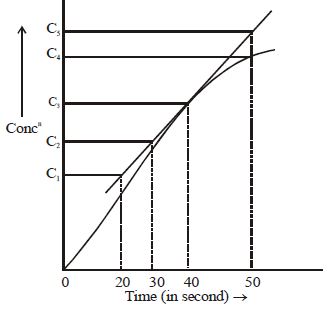
Consider the graph given in the following diagram. Which of the following options does not show the instantaneous rate of reaction at the $40^{th}$ second?
A
$\frac{C_5 - C_2}{50 - 30}$
B
$\frac{C_3 - C_2}{40 - 30}$
C
$\frac{C_3 - C_1}{40 - 20}$
D
$\frac{C_4 - C_2}{50 - 30}$
Solution
(D) The instantaneous rate of reaction at a specific time is determined by the slope of the tangent drawn to the concentration-time curve at that point.
For the $40^{th}$ second,the tangent passes through points corresponding to $(30, C_2)$ and $(50, C_5)$.
The slope of this tangent is calculated as $\frac{\Delta C}{\Delta t} = \frac{C_5 - C_2}{50 - 30}$.
Option $(A)$ represents this slope correctly.
Options $(B)$ and $(C)$ represent slopes of secant lines that approximate the instantaneous rate at $40 \ s$ by using points on either side of $40 \ s$ (e.g.,$(30, C_2)$ to $(40, C_3)$ or $(20, C_1)$ to $(40, C_3)$).
Option $(D)$,$\frac{C_4 - C_2}{50 - 30}$,uses $C_4$ instead of $C_5$,which does not correspond to the tangent line at $40 \ s$. Therefore,it does not represent the instantaneous rate.
For the $40^{th}$ second,the tangent passes through points corresponding to $(30, C_2)$ and $(50, C_5)$.
The slope of this tangent is calculated as $\frac{\Delta C}{\Delta t} = \frac{C_5 - C_2}{50 - 30}$.
Option $(A)$ represents this slope correctly.
Options $(B)$ and $(C)$ represent slopes of secant lines that approximate the instantaneous rate at $40 \ s$ by using points on either side of $40 \ s$ (e.g.,$(30, C_2)$ to $(40, C_3)$ or $(20, C_1)$ to $(40, C_3)$).
Option $(D)$,$\frac{C_4 - C_2}{50 - 30}$,uses $C_4$ instead of $C_5$,which does not correspond to the tangent line at $40 \ s$. Therefore,it does not represent the instantaneous rate.
0 likes
View Solution68
DifficultMCQ
In a reaction,$n_1A + n_2B \to m_1C + m_2D$,$5 \ M$ of reactant $A$ are allowed to react with $3 \ M$ of reactant $B$. After $5 \ sec$,the concentration of $A$ was found to be $4 \ M$. What are the rate of decomposition of $A$ and the rate of formation of $D$,respectively?
A
$0.2 \ M \ sec^{-1} ; \left( \frac{m_2}{m_1} \times 0.2 \right) \ M \ sec^{-1}$
B
$0.2 \ M \ sec^{-1} ; \left( \frac{n_2}{m_2} \times 0.2 \right) \ M \ sec^{-1}$
C
$0.1 \ M \ sec^{-1} ; \left( \frac{m_2}{n_1} \times 0.2 \right) \ M \ sec^{-1}$
D
$0.2 \ M \ sec^{-1} ; \left( \frac{m_2}{n_1} \times 0.2 \right) \ M \ sec^{-1}$
Solution
(D) The rate of decomposition of $A$ is given by: $\frac{-\Delta[A]}{\Delta t} = - \frac{(4 \ M - 5 \ M)}{5 \ sec} = \frac{1 \ M}{5 \ sec} = 0.2 \ M \ sec^{-1}$.
According to the stoichiometry of the reaction,the rate of reaction is $\frac{1}{n_1} \left( \frac{-\Delta[A]}{\Delta t} \right) = \frac{1}{m_2} \left( \frac{+\Delta[D]}{\Delta t} \right)$.
Therefore,the rate of formation of $D$ is: $\frac{+\Delta[D]}{\Delta t} = \frac{m_2}{n_1} \left( \frac{-\Delta[A]}{\Delta t} \right) = \left( \frac{m_2}{n_1} \times 0.2 \right) \ M \ sec^{-1}$.
According to the stoichiometry of the reaction,the rate of reaction is $\frac{1}{n_1} \left( \frac{-\Delta[A]}{\Delta t} \right) = \frac{1}{m_2} \left( \frac{+\Delta[D]}{\Delta t} \right)$.
Therefore,the rate of formation of $D$ is: $\frac{+\Delta[D]}{\Delta t} = \frac{m_2}{n_1} \left( \frac{-\Delta[A]}{\Delta t} \right) = \left( \frac{m_2}{n_1} \times 0.2 \right) \ M \ sec^{-1}$.
0 likes
View Solution69
DifficultMCQ
For the reaction $N_{2(g)} + 3H_{2(g)} \to 2NH_{3(g)}$ under certain conditions of temperature and partial pressure of the reactants,the rate of formation of $NH_3$ is $0.001 \ kg \ L^{-1} \ h^{-1}$. The rate of consumption of $H_2$ under the same condition is $..... \ kg \ L^{-1} \ h^{-1}$.
A
$0.001 \ kg \ L^{-1} \ h^{-1}$
B
$0.0015 \ kg \ L^{-1} \ h^{-1}$
C
$0.00017 \ kg \ L^{-1} \ h^{-1}$
D
$0.0017 \ kg \ L^{-1} \ h^{-1}$
Solution
(C) The rate of reaction $r$ is given by: $r = -\frac{1}{3} \frac{d[H_2]}{dt} = \frac{1}{2} \frac{d[NH_3]}{dt}$.
Given the rate of formation of $NH_3$ is $0.001 \ kg \ L^{-1} \ h^{-1}$.
To find the rate of consumption of $H_2$ in terms of mass,we use the stoichiometry: $\frac{d[H_2]}{dt} = \frac{3}{2} \times \frac{d[NH_3]}{dt}$.
Since the rate is given in $kg \ L^{-1} \ h^{-1}$,we can directly use the stoichiometric coefficients: $\text{Rate of consumption of } H_2 = \frac{3}{2} \times (\text{Rate of formation of } NH_3) \times \frac{M_{H_2}}{M_{NH_3}}$.
$M_{H_2} = 2 \ g/mol$ and $M_{NH_3} = 17 \ g/mol$.
Rate of consumption of $H_2 = \frac{3}{2} \times 0.001 \times \frac{2}{17} \approx 0.000176 \ kg \ L^{-1} \ h^{-1}$.
Rounding to the nearest provided option,the answer is $0.00017 \ kg \ L^{-1} \ h^{-1}$.
Given the rate of formation of $NH_3$ is $0.001 \ kg \ L^{-1} \ h^{-1}$.
To find the rate of consumption of $H_2$ in terms of mass,we use the stoichiometry: $\frac{d[H_2]}{dt} = \frac{3}{2} \times \frac{d[NH_3]}{dt}$.
Since the rate is given in $kg \ L^{-1} \ h^{-1}$,we can directly use the stoichiometric coefficients: $\text{Rate of consumption of } H_2 = \frac{3}{2} \times (\text{Rate of formation of } NH_3) \times \frac{M_{H_2}}{M_{NH_3}}$.
$M_{H_2} = 2 \ g/mol$ and $M_{NH_3} = 17 \ g/mol$.
Rate of consumption of $H_2 = \frac{3}{2} \times 0.001 \times \frac{2}{17} \approx 0.000176 \ kg \ L^{-1} \ h^{-1}$.
Rounding to the nearest provided option,the answer is $0.00017 \ kg \ L^{-1} \ h^{-1}$.
0 likes
View Solution70
AdvancedMCQ
In the following reaction: $xA \to yB$,$\log \left[ -\frac{d[A]}{dt} \right] = \log \left[ \frac{d[B]}{dt} \right] + \log 2$,where the negative sign indicates the rate of disappearance of the reactant. Thus,$x : y$ is:
A
$1 : 2$
B
$2 : 1$
C
$3 : 1$
D
$3 : 10$
Solution
(B) For the reaction $xA \longrightarrow yB$,the rate of reaction $(ROR)$ is given by:
$ROR = -\frac{1}{x} \frac{d[A]}{dt} = \frac{1}{y} \frac{d[B]}{dt}$
Rearranging the terms,we get:
$-\frac{d[A]}{dt} = \frac{x}{y} \frac{d[B]}{dt}$
Taking the logarithm on both sides:
$\log \left[ -\frac{d[A]}{dt} \right] = \log \left( \frac{x}{y} \cdot \frac{d[B]}{dt} \right)$
Using the property $\log(ab) = \log a + \log b$:
$\log \left[ -\frac{d[A]}{dt} \right] = \log \frac{x}{y} + \log \left[ \frac{d[B]}{dt} \right]$ ...... $(i)$
Given in the question:
$\log \left[ -\frac{d[A]}{dt} \right] = \log \left[ \frac{d[B]}{dt} \right] + \log 2$ ...... $(ii)$
Comparing equation $(i)$ and $(ii)$:
$\log \frac{x}{y} = \log 2$
Therefore,$\frac{x}{y} = 2$,which implies $x : y = 2 : 1$.
$ROR = -\frac{1}{x} \frac{d[A]}{dt} = \frac{1}{y} \frac{d[B]}{dt}$
Rearranging the terms,we get:
$-\frac{d[A]}{dt} = \frac{x}{y} \frac{d[B]}{dt}$
Taking the logarithm on both sides:
$\log \left[ -\frac{d[A]}{dt} \right] = \log \left( \frac{x}{y} \cdot \frac{d[B]}{dt} \right)$
Using the property $\log(ab) = \log a + \log b$:
$\log \left[ -\frac{d[A]}{dt} \right] = \log \frac{x}{y} + \log \left[ \frac{d[B]}{dt} \right]$ ...... $(i)$
Given in the question:
$\log \left[ -\frac{d[A]}{dt} \right] = \log \left[ \frac{d[B]}{dt} \right] + \log 2$ ...... $(ii)$
Comparing equation $(i)$ and $(ii)$:
$\log \frac{x}{y} = \log 2$
Therefore,$\frac{x}{y} = 2$,which implies $x : y = 2 : 1$.
0 likes
View Solution71
MediumMCQ
The instantaneous rate of disappearance of $MnO_4^-$ ion in the following reaction is $4.56 \times 10^{-3} \ Ms^{-1}$,$2MnO_4^- + 10I^{-} + 16H^{+} \to 2Mn^{2+} + 5I_2 + 8H_2O$. The rate of appearance of $I_2$ is
A
$1.14 \times 10^{-2} \ Ms^{-1}$
B
$5.7 \times 10^{-3} \ Ms^{-1}$
C
$4.56 \times 10^{-4} \ Ms^{-1}$
D
$1.14 \times 10^{-3} \ Ms^{-1}$
Solution
(A) The rate of reaction is given by the expression: $\text{Rate} = -\frac{1}{2} \frac{d[MnO_4^-]}{dt} = \frac{1}{5} \frac{d[I_2]}{dt}$.
Given that the rate of disappearance of $MnO_4^-$ is $-\frac{d[MnO_4^-]}{dt} = 4.56 \times 10^{-3} \ Ms^{-1}$.
Substituting this into the rate expression: $\frac{1}{2} \times (4.56 \times 10^{-3}) = \frac{1}{5} \frac{d[I_2]}{dt}$.
Therefore,the rate of appearance of $I_2$ is $\frac{d[I_2]}{dt} = \frac{5}{2} \times 4.56 \times 10^{-3} \ Ms^{-1} = 1.14 \times 10^{-2} \ Ms^{-1}$.
Given that the rate of disappearance of $MnO_4^-$ is $-\frac{d[MnO_4^-]}{dt} = 4.56 \times 10^{-3} \ Ms^{-1}$.
Substituting this into the rate expression: $\frac{1}{2} \times (4.56 \times 10^{-3}) = \frac{1}{5} \frac{d[I_2]}{dt}$.
Therefore,the rate of appearance of $I_2$ is $\frac{d[I_2]}{dt} = \frac{5}{2} \times 4.56 \times 10^{-3} \ Ms^{-1} = 1.14 \times 10^{-2} \ Ms^{-1}$.
0 likes
View Solution72
MediumMCQ
In a gaseous reaction $A_{2(g)} \longrightarrow B_{(g)} + \frac{1}{2} C_{(g)}$,the increase in pressure from $100 \text{ mm}$ to $120 \text{ mm}$ is noticed in $5 \text{ min}$. The rate of disappearance of $A_2$ in $\text{mm min}^{-1}$ is
A
$4$
B
$8$
C
$16$
D
$2$
Solution
(B) Given reaction: $A_{2(g)} \longrightarrow B_{(g)} + \frac{1}{2} C_{(g)}$
Initial pressure at $t = 0$: $P_{A_2} = 100 \text{ mm}$,$P_B = 0$,$P_C = 0$
Pressure at $t = 5 \text{ min}$: $P_{A_2} = 100 - x$,$P_B = x$,$P_C = \frac{1}{2} x$
Total pressure $P_t = (100 - x) + x + \frac{1}{2} x = 100 + \frac{1}{2} x$
Given $P_t = 120 \text{ mm}$,so $100 + \frac{1}{2} x = 120$
$\frac{1}{2} x = 20 \implies x = 40 \text{ mm}$
The rate of disappearance of $A_2$ is defined as the change in its partial pressure over time: $\frac{x}{t} = \frac{40 \text{ mm}}{5 \text{ min}} = 8 \text{ mm min}^{-1}$.
Initial pressure at $t = 0$: $P_{A_2} = 100 \text{ mm}$,$P_B = 0$,$P_C = 0$
Pressure at $t = 5 \text{ min}$: $P_{A_2} = 100 - x$,$P_B = x$,$P_C = \frac{1}{2} x$
Total pressure $P_t = (100 - x) + x + \frac{1}{2} x = 100 + \frac{1}{2} x$
Given $P_t = 120 \text{ mm}$,so $100 + \frac{1}{2} x = 120$
$\frac{1}{2} x = 20 \implies x = 40 \text{ mm}$
The rate of disappearance of $A_2$ is defined as the change in its partial pressure over time: $\frac{x}{t} = \frac{40 \text{ mm}}{5 \text{ min}} = 8 \text{ mm min}^{-1}$.
0 likes
View Solution73
MediumMCQ
$A$ general reaction $A_{(g)} \to \text{product}$ occurs in a container of volume $V$ at temperature $T$. Which of the following is correct?
A
$-\frac{d[A]}{dt} = -\frac{1}{V} \frac{dn_A}{dt} = -\frac{1}{RT} \frac{dP_A}{dt}$
B
$-\frac{d[A]}{dt} = -\frac{1}{V} \frac{dn_A}{dt} = -RT \frac{dP_A}{dt}$
C
$-\frac{d[A]}{dt} = -V \frac{dn_A}{dt} = -\frac{1}{RT} \frac{dP_A}{dt}$
D
$-\frac{d[A]}{Vdt} = -\frac{dn_A}{dt} = -\frac{dP_A}{[RT]dt}$
Solution
(A) For a gaseous reaction,the concentration of $A$ is given by $[A] = \frac{n_A}{V}$.
Taking the derivative with respect to time $t$,we get $-\frac{d[A]}{dt} = -\frac{1}{V} \frac{dn_A}{dt}$.
From the ideal gas law,$P_A V = n_A RT$,so $P_A = \frac{n_A}{V} RT = [A] RT$.
Therefore,$[A] = \frac{P_A}{RT}$.
Substituting this into the rate expression,we get $-\frac{d[A]}{dt} = -\frac{d}{dt} \left( \frac{P_A}{RT} \right) = -\frac{1}{RT} \frac{dP_A}{dt}$ (assuming $T$ is constant).
Thus,the correct relation is $-\frac{d[A]}{dt} = -\frac{1}{V} \frac{dn_A}{dt} = -\frac{1}{RT} \frac{dP_A}{dt}$.
Taking the derivative with respect to time $t$,we get $-\frac{d[A]}{dt} = -\frac{1}{V} \frac{dn_A}{dt}$.
From the ideal gas law,$P_A V = n_A RT$,so $P_A = \frac{n_A}{V} RT = [A] RT$.
Therefore,$[A] = \frac{P_A}{RT}$.
Substituting this into the rate expression,we get $-\frac{d[A]}{dt} = -\frac{d}{dt} \left( \frac{P_A}{RT} \right) = -\frac{1}{RT} \frac{dP_A}{dt}$ (assuming $T$ is constant).
Thus,the correct relation is $-\frac{d[A]}{dt} = -\frac{1}{V} \frac{dn_A}{dt} = -\frac{1}{RT} \frac{dP_A}{dt}$.
0 likes
View Solution74
MediumMCQ
For the reaction $2A + 3B \to 4C$,the rate of reaction may be represented as:
A
$r = - \frac{1}{2} \frac{d[A]}{dt} = - \frac{1}{3} \frac{d[B]}{dt} = \frac{1}{4} \frac{d[C]}{dt}$
B
$r = - 2 \frac{d[A]}{dt} = - 3 \frac{d[B]}{dt} = 4 \frac{d[C]}{dt}$
C
$r = - \frac{1}{2} \frac{d[A]}{dt} = \frac{1}{3} \frac{d[B]}{dt} = \frac{1}{4} \frac{d[C]}{dt}$
D
$r = - \frac{d[A]}{dt} = - \frac{d[B]}{dt} = \frac{d[C]}{dt}$
Solution
(A) For a general chemical reaction $aA + bB \to cC + dD$,the rate of reaction $(r)$ is given by the expression:
$r = - \frac{1}{a} \frac{d[A]}{dt} = - \frac{1}{b} \frac{d[B]}{dt} = \frac{1}{c} \frac{d[C]}{dt} = \frac{1}{d} \frac{d[D]}{dt}$
Given the reaction $2A + 3B \to 4C$,we identify the stoichiometric coefficients as $a = 2$,$b = 3$,and $c = 4$.
Substituting these values into the rate expression,we get:
$r = - \frac{1}{2} \frac{d[A]}{dt} = - \frac{1}{3} \frac{d[B]}{dt} = \frac{1}{4} \frac{d[C]}{dt}$
Thus,option $A$ is the correct representation.
$r = - \frac{1}{a} \frac{d[A]}{dt} = - \frac{1}{b} \frac{d[B]}{dt} = \frac{1}{c} \frac{d[C]}{dt} = \frac{1}{d} \frac{d[D]}{dt}$
Given the reaction $2A + 3B \to 4C$,we identify the stoichiometric coefficients as $a = 2$,$b = 3$,and $c = 4$.
Substituting these values into the rate expression,we get:
$r = - \frac{1}{2} \frac{d[A]}{dt} = - \frac{1}{3} \frac{d[B]}{dt} = \frac{1}{4} \frac{d[C]}{dt}$
Thus,option $A$ is the correct representation.
0 likes
View Solution75
DifficultMCQ
In a reaction $N_{2(g)} + 3H_{2(g)} \longrightarrow 2NH_{3(g)}$,the rate of appearance of $NH_3$ is $2.5 \times 10^{-4} \ mol \ L^{-1} s^{-1}$. The rate of reaction and rate of disappearance of $H_2$ will be (in $mol \ L^{-1} s^{-1}$):
A
$3.75 \times 10^{-4}, 1.25 \times 10^{-4}$
B
$1.25 \times 10^{-4}, 2.5 \times 10^{-4}$
C
$1.25 \times 10^{-4}, 3.75 \times 10^{-4}$
D
$5.0 \times 10^{-4}, 3.75 \times 10^{-4}$
Solution
(C) The given reaction is: $N_{2(g)} + 3H_{2(g)} \longrightarrow 2NH_{3(g)}$
The rate of appearance of $NH_3$ is given as $\frac{d[NH_3]}{dt} = 2.5 \times 10^{-4} \ mol \ L^{-1} s^{-1}$.
The rate of reaction $(ROR)$ is expressed as:
$ROR = -\frac{d[N_2]}{dt} = -\frac{1}{3} \frac{d[H_2]}{dt} = \frac{1}{2} \frac{d[NH_3]}{dt}$
Calculating $ROR$:
$ROR = \frac{1}{2} \times (2.5 \times 10^{-4}) = 1.25 \times 10^{-4} \ mol \ L^{-1} s^{-1}$.
Calculating the rate of disappearance of $H_2$ $(-\frac{d[H_2]}{dt})$:
$-\frac{d[H_2]}{dt} = \frac{3}{2} \times \frac{d[NH_3]}{dt} = \frac{3}{2} \times (2.5 \times 10^{-4}) = 3.75 \times 10^{-4} \ mol \ L^{-1} s^{-1}$.
Thus,the rate of reaction is $1.25 \times 10^{-4} \ mol \ L^{-1} s^{-1}$ and the rate of disappearance of $H_2$ is $3.75 \times 10^{-4} \ mol \ L^{-1} s^{-1}$.
Therefore,option $C$ is correct.
The rate of appearance of $NH_3$ is given as $\frac{d[NH_3]}{dt} = 2.5 \times 10^{-4} \ mol \ L^{-1} s^{-1}$.
The rate of reaction $(ROR)$ is expressed as:
$ROR = -\frac{d[N_2]}{dt} = -\frac{1}{3} \frac{d[H_2]}{dt} = \frac{1}{2} \frac{d[NH_3]}{dt}$
Calculating $ROR$:
$ROR = \frac{1}{2} \times (2.5 \times 10^{-4}) = 1.25 \times 10^{-4} \ mol \ L^{-1} s^{-1}$.
Calculating the rate of disappearance of $H_2$ $(-\frac{d[H_2]}{dt})$:
$-\frac{d[H_2]}{dt} = \frac{3}{2} \times \frac{d[NH_3]}{dt} = \frac{3}{2} \times (2.5 \times 10^{-4}) = 3.75 \times 10^{-4} \ mol \ L^{-1} s^{-1}$.
Thus,the rate of reaction is $1.25 \times 10^{-4} \ mol \ L^{-1} s^{-1}$ and the rate of disappearance of $H_2$ is $3.75 \times 10^{-4} \ mol \ L^{-1} s^{-1}$.
Therefore,option $C$ is correct.
0 likes
View Solution76
EasyMCQ
If the first order reaction involves gaseous reactants and gaseous products,the units of its rate are:
A
$atm$
B
$atm \cdot sec$
C
$atm \cdot sec^{-1}$
D
$atm^2 \cdot sec^{2}$
Solution
(C) For any chemical reaction,the rate of reaction is defined as the change in concentration or partial pressure of a reactant or product per unit time.
For a gaseous reaction,the rate is expressed as the change in partial pressure $(P)$ per unit time $(t)$.
Therefore,the unit of the rate of reaction is $\frac{\text{pressure}}{\text{time}}$,which is $atm \cdot sec^{-1}$ or $atm \cdot s^{-1}$.
Note: While the rate constant $(k)$ for a first-order reaction has units of $s^{-1}$,the rate of the reaction itself always has units of $\text{concentration} \cdot \text{time}^{-1}$ or $\text{pressure} \cdot \text{time}^{-1}$.
For a gaseous reaction,the rate is expressed as the change in partial pressure $(P)$ per unit time $(t)$.
Therefore,the unit of the rate of reaction is $\frac{\text{pressure}}{\text{time}}$,which is $atm \cdot sec^{-1}$ or $atm \cdot s^{-1}$.
Note: While the rate constant $(k)$ for a first-order reaction has units of $s^{-1}$,the rate of the reaction itself always has units of $\text{concentration} \cdot \text{time}^{-1}$ or $\text{pressure} \cdot \text{time}^{-1}$.
0 likes
View Solution77
MediumMCQ
For the decomposition of $A$ as shown below,calculate the rate of appearance of $B$ if the initial concentration of $A$ is $2 \ M$.
$A_{(g)} \xrightarrow{K_1 = 2 \times 10^{-3} \ s^{-1}} 2B_{(g)}$
$A_{(g)} \xrightarrow{K_2 = 1 \times 10^{-3} \ s^{-1}} C_{(g)}$
$A_{(g)} \xrightarrow{K_1 = 2 \times 10^{-3} \ s^{-1}} 2B_{(g)}$
$A_{(g)} \xrightarrow{K_2 = 1 \times 10^{-3} \ s^{-1}} C_{(g)}$
A
$2 \times 10^{-3} \ M \ s^{-1}$
B
$4 \times 10^{-3} \ M \ s^{-1}$
C
$8 \times 10^{-3} \ M \ s^{-1}$
D
None of these
Solution
(C) The rate of appearance of $B$ is determined by the first reaction path.
For the reaction $A \rightarrow 2B$,the rate of reaction is given by $\frac{1}{2} \frac{d[B]}{dt} = K_1 [A]$.
Therefore,$\frac{d[B]}{dt} = 2 K_1 [A]$.
Given $K_1 = 2 \times 10^{-3} \ s^{-1}$ and $[A] = 2 \ M$.
$\frac{d[B]}{dt} = 2 \times (2 \times 10^{-3} \ s^{-1}) \times (2 \ M) = 8 \times 10^{-3} \ M \ s^{-1}$.
For the reaction $A \rightarrow 2B$,the rate of reaction is given by $\frac{1}{2} \frac{d[B]}{dt} = K_1 [A]$.
Therefore,$\frac{d[B]}{dt} = 2 K_1 [A]$.
Given $K_1 = 2 \times 10^{-3} \ s^{-1}$ and $[A] = 2 \ M$.
$\frac{d[B]}{dt} = 2 \times (2 \times 10^{-3} \ s^{-1}) \times (2 \ M) = 8 \times 10^{-3} \ M \ s^{-1}$.
0 likes
View Solution78
MediumMCQ
For the reaction $4NH_3 + 5O_2 \to 4NO + 6H_2O$,if the rate of disappearance of $NH_3$ is $3.6 \times 10^{-3} \ mol \ L^{-1} \ s^{-1}$,what is the rate of formation of $H_2O$?
A
$5.4 \times 10^{-3} \ mol \ L^{-1} \ s^{-1}$
B
$3.6 \times 10^{-3} \ mol \ L^{-1} \ s^{-1}$
C
$4 \times 10^{-4} \ mol \ L^{-1} \ s^{-1}$
D
$0.6 \times 10^{-4} \ mol \ L^{-1} \ s^{-1}$
Solution
(A) The rate of reaction is given by the expression: $-\frac{1}{4} \frac{d[NH_3]}{dt} = +\frac{1}{6} \frac{d[H_2O]}{dt}$.
Given that the rate of disappearance of $NH_3$ is $-\frac{d[NH_3]}{dt} = 3.6 \times 10^{-3} \ mol \ L^{-1} \ s^{-1}$.
Substituting this value into the expression: $\frac{1}{4} \times (3.6 \times 10^{-3}) = \frac{1}{6} \frac{d[H_2O]}{dt}$.
Therefore,the rate of formation of $H_2O$ is $\frac{d[H_2O]}{dt} = \frac{6}{4} \times 3.6 \times 10^{-3} = 1.5 \times 3.6 \times 10^{-3} = 5.4 \times 10^{-3} \ mol \ L^{-1} \ s^{-1}$.
Given that the rate of disappearance of $NH_3$ is $-\frac{d[NH_3]}{dt} = 3.6 \times 10^{-3} \ mol \ L^{-1} \ s^{-1}$.
Substituting this value into the expression: $\frac{1}{4} \times (3.6 \times 10^{-3}) = \frac{1}{6} \frac{d[H_2O]}{dt}$.
Therefore,the rate of formation of $H_2O$ is $\frac{d[H_2O]}{dt} = \frac{6}{4} \times 3.6 \times 10^{-3} = 1.5 \times 3.6 \times 10^{-3} = 5.4 \times 10^{-3} \ mol \ L^{-1} \ s^{-1}$.
0 likes
View Solution79
MediumMCQ
In a reaction,$2X \to Y$,the concentration of $X$ decreases from $0.50 \ M$ to $0.38 \ M$ in $10 \ min$. What is the rate of reaction in $M s^{-1}$ during the interval?
A
$2 \times 10^{-4}$
B
$4 \times 10^{-2}$
C
$2 \times 10^{-2}$
D
$1 \times 10^{-4}$
Solution
(D) The rate of reaction for $2X \to Y$ is defined as: $\text{Rate} = -\frac{1}{2} \frac{\Delta[X]}{\Delta t}$.
Given: $\Delta[X] = [X]_f - [X]_i = 0.38 \ M - 0.50 \ M = -0.12 \ M$.
Time interval $\Delta t = 10 \ min = 10 \times 60 \ s = 600 \ s$.
Substituting the values: $\text{Rate} = -\frac{1}{2} \times \frac{-0.12 \ M}{600 \ s} = \frac{0.12}{1200} \ M s^{-1} = 1 \times 10^{-4} \ M s^{-1}$.
Given: $\Delta[X] = [X]_f - [X]_i = 0.38 \ M - 0.50 \ M = -0.12 \ M$.
Time interval $\Delta t = 10 \ min = 10 \times 60 \ s = 600 \ s$.
Substituting the values: $\text{Rate} = -\frac{1}{2} \times \frac{-0.12 \ M}{600 \ s} = \frac{0.12}{1200} \ M s^{-1} = 1 \times 10^{-4} \ M s^{-1}$.
0 likes
View Solution80
MediumMCQ
In a pseudo first order hydrolysis of ester in water,the following results were obtained:
What will be the average rate of reaction between the time interval $30 \ s$ to $60 \ s$?
| $t \ (s)$ | $0$ | $30$ | $60$ | $90$ |
| $[\text{Ester}] \ (mol \ L^{-1})$ | $0.55$ | $0.31$ | $0.17$ | $0.085$ |
What will be the average rate of reaction between the time interval $30 \ s$ to $60 \ s$?
A
$1.91 \times 10^{-2} \ s^{-1}$
B
$4.67 \times 10^{-3} \ mol \ L^{-1} \ s^{-1}$
C
$1.98 \times 10^{-3} \ s^{-1}$
D
$2.07 \times 10^{-2} \ s^{-1}$
Solution
(B) The average rate of reaction is given by the formula:
$\text{Average Rate} = -\frac{\Delta[\text{Ester}]}{\Delta t} = -\frac{[\text{Ester}]_{t_2} - [\text{Ester}]_{t_1}}{t_2 - t_1}$
Given $t_1 = 30 \ s$ and $t_2 = 60 \ s$,the corresponding concentrations are $[\text{Ester}]_{t_1} = 0.31 \ mol \ L^{-1}$ and $[\text{Ester}]_{t_2} = 0.17 \ mol \ L^{-1}$.
$\text{Average Rate} = -\frac{0.17 - 0.31}{60 - 30} = -\frac{-0.14}{30} = \frac{0.14}{30} \ mol \ L^{-1} \ s^{-1}$
$\text{Average Rate} = 4.67 \times 10^{-3} \ mol \ L^{-1} \ s^{-1}$
$\text{Average Rate} = -\frac{\Delta[\text{Ester}]}{\Delta t} = -\frac{[\text{Ester}]_{t_2} - [\text{Ester}]_{t_1}}{t_2 - t_1}$
Given $t_1 = 30 \ s$ and $t_2 = 60 \ s$,the corresponding concentrations are $[\text{Ester}]_{t_1} = 0.31 \ mol \ L^{-1}$ and $[\text{Ester}]_{t_2} = 0.17 \ mol \ L^{-1}$.
$\text{Average Rate} = -\frac{0.17 - 0.31}{60 - 30} = -\frac{-0.14}{30} = \frac{0.14}{30} \ mol \ L^{-1} \ s^{-1}$
$\text{Average Rate} = 4.67 \times 10^{-3} \ mol \ L^{-1} \ s^{-1}$
0 likes
View Solution81
MediumMCQ
In the reaction $2SO_3 \to 2SO_2 + O_2$,initially $40 \ g$ of $SO_3$ is heated in a $100 \ mL$ container. If after $10 \ min$,$3.2 \ g$ of $O_2$ is formed,find the rate of reaction in $mol \ L^{-1} \ min^{-1}$.
A
$0.2$
B
$0.23$
C
$0.1$
D
$0.4$
Solution
(C) The molar mass of $SO_3$ is $80 \ g/mol$. Initial moles of $SO_3 = \frac{40 \ g}{80 \ g/mol} = 0.5 \ mol$.
For the reaction $2SO_3 \to 2SO_2 + O_2$,let $x$ be the moles of $O_2$ formed.
At $t = 10 \ min$,moles of $O_2 = \frac{3.2 \ g}{32 \ g/mol} = 0.1 \ mol$.
Thus,$x = 0.1 \ mol$.
The concentration of $O_2$ formed is $[O_2] = \frac{0.1 \ mol}{0.1 \ L} = 1 \ mol \ L^{-1}$.
The rate of reaction is given by $\frac{d[O_2]}{dt} = \frac{\Delta[O_2]}{\Delta t} = \frac{1 \ mol \ L^{-1}}{10 \ min} = 0.1 \ mol \ L^{-1} \ min^{-1}$.
For the reaction $2SO_3 \to 2SO_2 + O_2$,let $x$ be the moles of $O_2$ formed.
At $t = 10 \ min$,moles of $O_2 = \frac{3.2 \ g}{32 \ g/mol} = 0.1 \ mol$.
Thus,$x = 0.1 \ mol$.
The concentration of $O_2$ formed is $[O_2] = \frac{0.1 \ mol}{0.1 \ L} = 1 \ mol \ L^{-1}$.
The rate of reaction is given by $\frac{d[O_2]}{dt} = \frac{\Delta[O_2]}{\Delta t} = \frac{1 \ mol \ L^{-1}}{10 \ min} = 0.1 \ mol \ L^{-1} \ min^{-1}$.
0 likes
View Solution82
MediumMCQ
In the following reaction $3A \to B + 2C$,the initial concentration of $A$ is $8\,mol\,L^{-1}$. After $10\,min$,it becomes $5\,mol\,L^{-1}$. Find the rate of reaction in $mol\,L^{-1}\,min^{-1}$.
A
$0.01$
B
$0.1$
C
$0.02$
D
$0.2$
Solution
(B) The rate of reaction for $3A \to B + 2C$ is given by the expression: $r = -\frac{1}{3} \frac{\Delta[A]}{\Delta t}$.
Given: Initial concentration $[A]_0 = 8\,mol\,L^{-1}$,Final concentration $[A]_t = 5\,mol\,L^{-1}$,Time interval $\Delta t = 10\,min$.
Calculate the change in concentration: $\Delta[A] = [A]_t - [A]_0 = 5 - 8 = -3\,mol\,L^{-1}$.
Substitute the values into the rate equation: $r = -\frac{1}{3} \times \frac{-3\,mol\,L^{-1}}{10\,min} = \frac{1}{10} = 0.1\,mol\,L^{-1}\,min^{-1}$.
Given: Initial concentration $[A]_0 = 8\,mol\,L^{-1}$,Final concentration $[A]_t = 5\,mol\,L^{-1}$,Time interval $\Delta t = 10\,min$.
Calculate the change in concentration: $\Delta[A] = [A]_t - [A]_0 = 5 - 8 = -3\,mol\,L^{-1}$.
Substitute the values into the rate equation: $r = -\frac{1}{3} \times \frac{-3\,mol\,L^{-1}}{10\,min} = \frac{1}{10} = 0.1\,mol\,L^{-1}\,min^{-1}$.
0 likes
View Solution83
MediumMCQ
For the reaction,$A + B \to 2C + D$,which one is the incorrect statement?
A
Rate of disappearance of $A =$ Rate of disappearance of $B$
B
Rate of disappearance of $A =$ Rate of appearance of $D$
C
Rate of disappearance of $B = 2 \times$ Rate of appearance of $C$
D
Rate of disappearance of $B = 1/2 \times$ Rate of appearance of $C$
Solution
(C) For the reaction $A + B \to 2C + D$,the rate of reaction is given by:
$Rate = -\frac{d[A]}{dt} = -\frac{d[B]}{dt} = \frac{1}{2} \frac{d[C]}{dt} = \frac{d[D]}{dt}$
From this expression:
$1$. Rate of disappearance of $A = -\frac{d[A]}{dt}$
$2$. Rate of disappearance of $B = -\frac{d[B]}{dt}$
$3$. Rate of appearance of $C = \frac{d[C]}{dt}$
$4$. Rate of appearance of $D = \frac{d[D]}{dt}$
Comparing these:
- Rate of disappearance of $A = \text{Rate of disappearance of } B$ (Correct)
- Rate of disappearance of $A = \text{Rate of appearance of } D$ (Correct)
- Since $-\frac{d[B]}{dt} = \frac{1}{2} \frac{d[C]}{dt}$,it implies $\text{Rate of disappearance of } B = \frac{1}{2} \times \text{Rate of appearance of } C$ (Correct)
- Therefore,the statement $\text{Rate of disappearance of } B = 2 \times \text{Rate of appearance of } C$ is incorrect.
$Rate = -\frac{d[A]}{dt} = -\frac{d[B]}{dt} = \frac{1}{2} \frac{d[C]}{dt} = \frac{d[D]}{dt}$
From this expression:
$1$. Rate of disappearance of $A = -\frac{d[A]}{dt}$
$2$. Rate of disappearance of $B = -\frac{d[B]}{dt}$
$3$. Rate of appearance of $C = \frac{d[C]}{dt}$
$4$. Rate of appearance of $D = \frac{d[D]}{dt}$
Comparing these:
- Rate of disappearance of $A = \text{Rate of disappearance of } B$ (Correct)
- Rate of disappearance of $A = \text{Rate of appearance of } D$ (Correct)
- Since $-\frac{d[B]}{dt} = \frac{1}{2} \frac{d[C]}{dt}$,it implies $\text{Rate of disappearance of } B = \frac{1}{2} \times \text{Rate of appearance of } C$ (Correct)
- Therefore,the statement $\text{Rate of disappearance of } B = 2 \times \text{Rate of appearance of } C$ is incorrect.
0 likes
View Solution84
MediumMCQ
For the reaction $N_2 + 3H_2 \to 2NH_3$,which of the following represents the correct expression for $d[NH_3]/dt$?
A
$\frac{2}{3} \frac{d[H_2]}{dt}$
B
$-\frac{2}{3} \frac{d[H_2]}{dt}$
C
$-\frac{d[N_2]}{dt}$
D
$-\frac{3}{2} \frac{d[H_2]}{dt}$
Solution
(B) The rate of reaction is given by the expression:
Rate $= -\frac{d[N_2]}{dt} = -\frac{1}{3} \frac{d[H_2]}{dt} = \frac{1}{2} \frac{d[NH_3]}{dt}$
To find $d[NH_3]/dt$,we equate the terms involving $H_2$ and $NH_3$:
$-\frac{1}{3} \frac{d[H_2]}{dt} = \frac{1}{2} \frac{d[NH_3]}{dt}$
Multiplying both sides by $2$:
$\frac{d[NH_3]}{dt} = -\frac{2}{3} \frac{d[H_2]}{dt}$
Rate $= -\frac{d[N_2]}{dt} = -\frac{1}{3} \frac{d[H_2]}{dt} = \frac{1}{2} \frac{d[NH_3]}{dt}$
To find $d[NH_3]/dt$,we equate the terms involving $H_2$ and $NH_3$:
$-\frac{1}{3} \frac{d[H_2]}{dt} = \frac{1}{2} \frac{d[NH_3]}{dt}$
Multiplying both sides by $2$:
$\frac{d[NH_3]}{dt} = -\frac{2}{3} \frac{d[H_2]}{dt}$
0 likes
View Solution85
MediumMCQ
For the reaction $A_{(g)} + 3B_{(g)} \to 2C_{(g)}$,if the value of $-d[A]/dt$ is $3 \times 10^{-3} \ mol \ L^{-1} \ min^{-1}$,then the value of $-d[B]/dt$ will be:
A
$3 \times 10^{-3} \ mol \ L^{-1} \ min^{-1}$
B
$9 \times 10^{-6} \ mol \ L^{-1} \ min^{-1}$
C
$9 \times 10^{-3} \ mol \ L^{-1} \ min^{-1}$
D
$1.5 \times 10^{-3} \ mol \ L^{-1} \ min^{-1}$
Solution
(C) The rate of reaction for $A_{(g)} + 3B_{(g)} \to 2C_{(g)}$ is given by the expression:
Rate $= -\frac{d[A]}{dt} = -\frac{1}{3} \frac{d[B]}{dt} = \frac{1}{2} \frac{d[C]}{dt}$
Given that $-\frac{d[A]}{dt} = 3 \times 10^{-3} \ mol \ L^{-1} \ min^{-1}$.
Equating the rates of $A$ and $B$:
$-\frac{d[A]}{dt} = -\frac{1}{3} \frac{d[B]}{dt}$
$3 \times 10^{-3} = -\frac{1}{3} \frac{d[B]}{dt}$
$-\frac{d[B]}{dt} = 3 \times (3 \times 10^{-3}) = 9 \times 10^{-3} \ mol \ L^{-1} \ min^{-1}$.
Rate $= -\frac{d[A]}{dt} = -\frac{1}{3} \frac{d[B]}{dt} = \frac{1}{2} \frac{d[C]}{dt}$
Given that $-\frac{d[A]}{dt} = 3 \times 10^{-3} \ mol \ L^{-1} \ min^{-1}$.
Equating the rates of $A$ and $B$:
$-\frac{d[A]}{dt} = -\frac{1}{3} \frac{d[B]}{dt}$
$3 \times 10^{-3} = -\frac{1}{3} \frac{d[B]}{dt}$
$-\frac{d[B]}{dt} = 3 \times (3 \times 10^{-3}) = 9 \times 10^{-3} \ mol \ L^{-1} \ min^{-1}$.
0 likes
View Solution86
DifficultMCQ
For the reaction $4KClO_3 \to 3KClO_4 + KCl$,if $-d[KClO_3]/dt = K_1[KClO_3]^4$,$d[KClO_4]/dt = K_2[KClO_3]^4$,and $d[KCl]/dt = K_3[KClO_3]^4$,then:
A
$K_1 = K_2 = K_3$
B
$4K_1 = 3K_2 = 2K_3$
C
$3K_1 = 4K_2 = 12K_3$
D
$K_1 = 4K_2 = 3K_3$
Solution
(C) The rate of reaction for $4KClO_3 \to 3KClO_4 + KCl$ is given by the expression:
Rate $= -\frac{1}{4} \frac{d[KClO_3]}{dt} = \frac{1}{3} \frac{d[KClO_4]}{dt} = \frac{d[KCl]}{dt}$.
Substituting the given rate expressions:
$-\frac{1}{4} (-K_1[KClO_3]^4) = \frac{1}{3} (K_2[KClO_3]^4) = K_3[KClO_3]^4$.
This simplifies to:
$\frac{K_1}{4} = \frac{K_2}{3} = K_3$.
Multiplying throughout by $12$,we get:
$3K_1 = 4K_2 = 12K_3$.
Rate $= -\frac{1}{4} \frac{d[KClO_3]}{dt} = \frac{1}{3} \frac{d[KClO_4]}{dt} = \frac{d[KCl]}{dt}$.
Substituting the given rate expressions:
$-\frac{1}{4} (-K_1[KClO_3]^4) = \frac{1}{3} (K_2[KClO_3]^4) = K_3[KClO_3]^4$.
This simplifies to:
$\frac{K_1}{4} = \frac{K_2}{3} = K_3$.
Multiplying throughout by $12$,we get:
$3K_1 = 4K_2 = 12K_3$.
0 likes
View Solution87
MediumMCQ
In the hydrogenation of ethene at $298 \, K$,the number of moles of hydrogen decreases from $2.2$ to $1.4$ in $50 \, min$. Calculate the rate of reaction in units of $mol \, s^{-1}$.
A
$2.67 \times 10^{-4}$
B
$2.67 \times 10^{-8}$
C
$4.86 \times 10^{-3}$
D
$2.96 \times 10^{-4}$
Solution
(A) The rate of reaction is defined as the change in concentration (or moles) over time.
Rate $= -\frac{\Delta n}{\Delta t} = -\frac{n_2 - n_1}{t_2 - t_1}$
Given: $n_1 = 2.2 \, mol$,$n_2 = 1.4 \, mol$,$\Delta t = 50 \, min = 50 \times 60 \, s = 3000 \, s$.
Rate $= -\frac{1.4 - 2.2}{3000} = \frac{0.8}{3000} \, mol \, s^{-1}$.
Rate $= 2.666... \times 10^{-4} \approx 2.67 \times 10^{-4} \, mol \, s^{-1}$.
Rate $= -\frac{\Delta n}{\Delta t} = -\frac{n_2 - n_1}{t_2 - t_1}$
Given: $n_1 = 2.2 \, mol$,$n_2 = 1.4 \, mol$,$\Delta t = 50 \, min = 50 \times 60 \, s = 3000 \, s$.
Rate $= -\frac{1.4 - 2.2}{3000} = \frac{0.8}{3000} \, mol \, s^{-1}$.
Rate $= 2.666... \times 10^{-4} \approx 2.67 \times 10^{-4} \, mol \, s^{-1}$.
0 likes
View Solution88
MediumMCQ
The rate of a gaseous reaction is given by $r = K[x][y]$. If the volume of the reaction vessel is suddenly reduced to $1/4$ of its initial volume,the rate of the reaction will ............
A
increase by $1/8$ times
B
increase by $16$ times
C
remain constant
D
increase or decrease
Solution
(B) The initial rate is $r_1 = K[x][y]$.
When the volume of the vessel is reduced to $1/4$ of its initial volume $(V_2 = V_1/4)$,the concentration of the reactants increases by a factor of $4$ because concentration $C = n/V$.
Therefore,the new concentrations are $[x]_2 = 4[x]$ and $[y]_2 = 4[y]$.
The new rate $r_2 = K[x]_2[y]_2 = K(4[x])(4[y]) = 16K[x][y]$.
Thus,$r_2 = 16r_1$.
The rate of the reaction increases by $16$ times.
When the volume of the vessel is reduced to $1/4$ of its initial volume $(V_2 = V_1/4)$,the concentration of the reactants increases by a factor of $4$ because concentration $C = n/V$.
Therefore,the new concentrations are $[x]_2 = 4[x]$ and $[y]_2 = 4[y]$.
The new rate $r_2 = K[x]_2[y]_2 = K(4[x])(4[y]) = 16K[x][y]$.
Thus,$r_2 = 16r_1$.
The rate of the reaction increases by $16$ times.
1 likes
View Solution89
EasyMCQ
For the following reaction in aqueous solution,what happens to the rate of reaction if $HCl$ is added?
$NH_2NO_{2(aq)} + OH^-_{(aq)} \to NHNO^-_{2(aq)} + H_2O_{(l)}$
$NHNO^-_{2(aq)} \to N_2O_{(aq)} + OH^-_{(aq)}$
$NH_2NO_{2(aq)} + OH^-_{(aq)} \to NHNO^-_{2(aq)} + H_2O_{(l)}$
$NHNO^-_{2(aq)} \to N_2O_{(aq)} + OH^-_{(aq)}$
A
Increases
B
Decreases
C
Remains constant
D
Increases or decreases
Solution
(B) The reaction involves the consumption of $OH^-$ ions in the first step.
Adding $HCl$ introduces $H^+$ ions into the solution.
The $H^+$ ions react with $OH^-$ ions according to the neutralization reaction: $H^+_{(aq)} + OH^-_{(aq)} \to H_2O_{(l)}$.
This decreases the concentration of $OH^-$ ions in the reaction mixture.
Since $OH^-$ is a reactant in the first step,the rate of the reaction,which depends on the concentration of $OH^-$,will decrease.
Adding $HCl$ introduces $H^+$ ions into the solution.
The $H^+$ ions react with $OH^-$ ions according to the neutralization reaction: $H^+_{(aq)} + OH^-_{(aq)} \to H_2O_{(l)}$.
This decreases the concentration of $OH^-$ ions in the reaction mixture.
Since $OH^-$ is a reactant in the first step,the rate of the reaction,which depends on the concentration of $OH^-$,will decrease.
0 likes
View Solution90
EasyMCQ
In some cases,the reaction rate increases with time. This phenomenon is known as ..........
A
Induced catalysis
B
Catalytic promotion
C
Autocatalysis
D
Catalytic poisoning
Solution
(C) In some chemical reactions,one of the products formed acts as a catalyst for the reaction.
As the reaction proceeds,the concentration of this product increases,which in turn increases the rate of the reaction.
This phenomenon is known as $Autocatalysis$.
As the reaction proceeds,the concentration of this product increases,which in turn increases the rate of the reaction.
This phenomenon is known as $Autocatalysis$.
0 likes
View Solution91
MediumMCQ
Assertion : Ionic reactions are not instantaneous.
Reason : Oppositely charged ions exert strong forces.
Reason : Oppositely charged ions exert strong forces.
A
If both Assertion and Reason are correct and the Reason is a correct explanation of the Assertion.
B
If both Assertion and Reason are correct but Reason is not a correct explanation of the Assertion.
C
If the Assertion is correct but Reason is incorrect.
D
If the Assertion is incorrect but the Reason is correct.
Solution
(D) Ionic reactions involve the interaction of oppositely charged ions in solution. Because these ions exert strong electrostatic forces of attraction on each other,they combine almost immediately upon mixing. Therefore,ionic reactions are considered to be instantaneous. The Assertion is incorrect,while the Reason is correct.
0 likes
View Solution92
EasyMCQ
For the reaction,$2N_2O_5 \to 4NO_2 + O_2$,the rate of reaction is
A
$-\frac{1}{2}\frac{d[N_2O_5]}{dt}$
B
$-2\frac{d[N_2O_5]}{dt}$
C
$\frac{1}{4}\frac{d[NO_2]}{dt}$
D
$4\frac{d[NO_2]}{dt}$
Solution
(A) For a general reaction $aA + bB \to cC + dD$,the rate of reaction is given by:
Rate $= -\frac{1}{a}\frac{d[A]}{dt} = -\frac{1}{b}\frac{d[B]}{dt} = \frac{1}{c}\frac{d[C]}{dt} = \frac{1}{d}\frac{d[D]}{dt}$.
For the given reaction $2N_2O_5 \to 4NO_2 + O_2$,the rate of reaction is:
Rate $= -\frac{1}{2}\frac{d[N_2O_5]}{dt} = \frac{1}{4}\frac{d[NO_2]}{dt} = \frac{d[O_2]}{dt}$.
Rate $= -\frac{1}{a}\frac{d[A]}{dt} = -\frac{1}{b}\frac{d[B]}{dt} = \frac{1}{c}\frac{d[C]}{dt} = \frac{1}{d}\frac{d[D]}{dt}$.
For the given reaction $2N_2O_5 \to 4NO_2 + O_2$,the rate of reaction is:
Rate $= -\frac{1}{2}\frac{d[N_2O_5]}{dt} = \frac{1}{4}\frac{d[NO_2]}{dt} = \frac{d[O_2]}{dt}$.
0 likes
View Solution93
MediumMCQ
Assertion : The rate of the reaction is the rate of change of concentration of a reactant or a product.
Reason : Rate of reaction remains constant during the course of reaction.
Reason : Rate of reaction remains constant during the course of reaction.
A
If both Assertion and Reason are correct and the Reason is a correct explanation of the Assertion.
B
If both Assertion and Reason are correct but Reason is not a correct explanation of the Assertion.
C
If the Assertion is correct but Reason is incorrect.
D
If both the Assertion and Reason are incorrect.
Solution
(C) The rate of reaction is defined as the change in concentration of a reactant or product per unit time. Thus,the Assertion is correct.
However,the rate of reaction generally depends on the concentration of the reactants. As the reaction proceeds,the concentration of reactants decreases,which leads to a decrease in the rate of reaction. Therefore,the rate of reaction does not remain constant. Thus,the Reason is incorrect.
However,the rate of reaction generally depends on the concentration of the reactants. As the reaction proceeds,the concentration of reactants decreases,which leads to a decrease in the rate of reaction. Therefore,the rate of reaction does not remain constant. Thus,the Reason is incorrect.
0 likes
View Solution94
DifficultMCQ
For the chemical reaction $N_{2(g)} + 3 H_{2(g)} \rightleftharpoons 2 NH_{3(g)}$,the correct option is
A
$-\frac{1}{3} \frac{d[H_{2}]}{dt} = -\frac{1}{2} \frac{d[NH_{3}]}{dt}$
B
$-\frac{d[N_{2}]}{dt} = 2 \frac{d[NH_{3}]}{dt}$
C
$-\frac{d[N_{2}]}{dt} = \frac{1}{2} \frac{d[NH_{3}]}{dt}$
D
$3 \frac{d[H_{2}]}{dt} = 2 \frac{d[NH_{3}]}{dt}$
Solution
(C) For the reaction $N_{2(g)} + 3 H_{2(g)} \rightleftharpoons 2 NH_{3(g)}$,the rate of reaction is expressed as:
$-\frac{d[N_{2}]}{dt} = -\frac{1}{3} \frac{d[H_{2}]}{dt} = +\frac{1}{2} \frac{d[NH_{3}]}{dt}$.
Comparing this with the given options,we see that $-\frac{d[N_{2}]}{dt} = \frac{1}{2} \frac{d[NH_{3}]}{dt}$ is the correct relationship.
$-\frac{d[N_{2}]}{dt} = -\frac{1}{3} \frac{d[H_{2}]}{dt} = +\frac{1}{2} \frac{d[NH_{3}]}{dt}$.
Comparing this with the given options,we see that $-\frac{d[N_{2}]}{dt} = \frac{1}{2} \frac{d[NH_{3}]}{dt}$ is the correct relationship.
0 likes
View Solution95
Difficult
From the concentrations of $C_{4}H_{9}Cl$ (butyl chloride) at different times given below,calculate the average rate of the reaction:
$C_{4}H_{9}Cl + H_{2}O \rightarrow C_{4}H_{9}OH + HCl$
during different intervals of time.
$C_{4}H_{9}Cl + H_{2}O \rightarrow C_{4}H_{9}OH + HCl$
during different intervals of time.
| $t/s$ | $0$ | $50$ | $100$ | $150$ | $200$ | $300$ | $400$ | $700$ | $800$ |
| $[C_{4}H_{9}Cl]/mol\ L^{-1}$ | $0.100$ | $0.0905$ | $0.0820$ | $0.0741$ | $0.0671$ | $0.0549$ | $0.0439$ | $0.0210$ | $0.017$ |
Solution
(N/A) The average rate of reaction is calculated using the formula: $r_{av} = -\frac{\Delta[R]}{\Delta t} = -\frac{[R]_{2} - [R]_{1}}{t_{2} - t_{1}}$.
| $Time \ Interval \ (s)$ | $Average \ Rate \ (mol \ L^{-1} s^{-1})$ |
| $0-50$ | $1.90 \times 10^{-4}$ |
| $50-100$ | $1.70 \times 10^{-4}$ |
| $100-150$ | $1.58 \times 10^{-4}$ |
| $150-200$ | $1.40 \times 10^{-4}$ |
| $200-300$ | $1.22 \times 10^{-4}$ |
| $300-400$ | $1.10 \times 10^{-4}$ |
| $700-800$ | $0.40 \times 10^{-4}$ |
0 likes
View Solution96
Medium
The decomposition of $N_{2}O_{5}$ in $CCl_{4}$ at $318 \ K$ has been studied by monitoring the concentration of $N_{2}O_{5}$ in the solution. Initially the concentration of $N_{2}O_{5}$ is $2.33 \ mol \ L^{-1}$ and after $184 \ minutes$,it is reduced to $2.08 \ mol \ L^{-1}$. The reaction takes place according to the equation:
$2N_{2}O_{5(g)} \rightarrow 4NO_{2(g)} + O_{2(g)}$
Calculate the average rate of this reaction in terms of hours,minutes,and seconds. What is the rate of production of $NO_{2}$ during this period?
$2N_{2}O_{5(g)} \rightarrow 4NO_{2(g)} + O_{2(g)}$
Calculate the average rate of this reaction in terms of hours,minutes,and seconds. What is the rate of production of $NO_{2}$ during this period?
Solution
(N/A) Average Rate $= \frac{1}{2} \left\{ -\frac{\Delta[N_{2}O_{5}]}{\Delta t} \right\} = -\frac{1}{2} \left[ \frac{(2.08-2.33) \ mol \ L^{-1}}{184 \ min} \right] = 6.79 \times 10^{-4} \ mol \ L^{-1} \ min^{-1}$
In terms of hours:
Rate $= (6.79 \times 10^{-4} \ mol \ L^{-1} \ min^{-1}) \times (60 \ min / 1 \ h) = 4.07 \times 10^{-2} \ mol \ L^{-1} \ h^{-1}$
In terms of seconds:
Rate $= (6.79 \times 10^{-4} \ mol \ L^{-1} \ min^{-1}) / (60 \ s / 1 \ min) = 1.13 \times 10^{-5} \ mol \ L^{-1} \ s^{-1}$
Rate of production of $NO_{2}$:
Rate $= \frac{1}{4} \frac{\Delta[NO_{2}]}{\Delta t} \implies \frac{\Delta[NO_{2}]}{\Delta t} = 4 \times \text{Average Rate}$
$= 4 \times 6.79 \times 10^{-4} \ mol \ L^{-1} \ min^{-1} = 2.72 \times 10^{-3} \ mol \ L^{-1} \ min^{-1}$
In terms of hours:
Rate $= (6.79 \times 10^{-4} \ mol \ L^{-1} \ min^{-1}) \times (60 \ min / 1 \ h) = 4.07 \times 10^{-2} \ mol \ L^{-1} \ h^{-1}$
In terms of seconds:
Rate $= (6.79 \times 10^{-4} \ mol \ L^{-1} \ min^{-1}) / (60 \ s / 1 \ min) = 1.13 \times 10^{-5} \ mol \ L^{-1} \ s^{-1}$
Rate of production of $NO_{2}$:
Rate $= \frac{1}{4} \frac{\Delta[NO_{2}]}{\Delta t} \implies \frac{\Delta[NO_{2}]}{\Delta t} = 4 \times \text{Average Rate}$
$= 4 \times 6.79 \times 10^{-4} \ mol \ L^{-1} \ min^{-1} = 2.72 \times 10^{-3} \ mol \ L^{-1} \ min^{-1}$
0 likes
View Solution97
Difficult
For the reaction $R \rightarrow P$,the concentration of a reactant changes from $0.03 \, M$ to $0.02 \, M$ in $25 \, minutes$. Calculate the average rate of reaction using units of time both in $minutes$ and $seconds$.
Solution
The average rate of reaction is given by the formula: $\text{Average rate} = -\frac{\Delta[R]}{\Delta t}$
Substituting the given values:
$\text{Average rate} = -\frac{[R]_2 - [R]_1}{t_2 - t_1} = -\frac{0.02 \, M - 0.03 \, M}{25 \, min} = -\frac{-0.01 \, M}{25 \, min} = 4 \times 10^{-4} \, M \, min^{-1}$
To convert the rate into $seconds^{-1}$:
$\text{Average rate} = \frac{4 \times 10^{-4} \, M}{60 \, s} = 6.67 \times 10^{-6} \, M \, s^{-1}$
Substituting the given values:
$\text{Average rate} = -\frac{[R]_2 - [R]_1}{t_2 - t_1} = -\frac{0.02 \, M - 0.03 \, M}{25 \, min} = -\frac{-0.01 \, M}{25 \, min} = 4 \times 10^{-4} \, M \, min^{-1}$
To convert the rate into $seconds^{-1}$:
$\text{Average rate} = \frac{4 \times 10^{-4} \, M}{60 \, s} = 6.67 \times 10^{-6} \, M \, s^{-1}$
0 likes
View Solution98
MediumMCQ
In a reaction,$2 A \rightarrow \text{Products}$,the concentration of $A$ decreases from $0.5 \ mol \ L^{-1}$ to $0.4 \ mol \ L^{-1}$ in $10 \ minutes$. Calculate the rate during this interval?
A
$0.005 \ mol \ L^{-1} \ min^{-1}$
B
$0.01 \ mol \ L^{-1} \ min^{-1}$
C
$0.05 \ mol \ L^{-1} \ min^{-1}$
D
$0.001 \ mol \ L^{-1} \ min^{-1}$
Solution
(A) The rate of reaction for $2 A \rightarrow \text{Products}$ is given by: $\text{Rate} = -\frac{1}{2} \frac{\Delta [A]}{\Delta t}$
Substituting the values: $\text{Rate} = -\frac{1}{2} \frac{[A]_{2} - [A]_{1}}{t_{2} - t_{1}}$
$\text{Rate} = -\frac{1}{2} \frac{0.4 - 0.5}{10}$
$\text{Rate} = -\frac{1}{2} \frac{-0.1}{10}$
$\text{Rate} = 0.005 \ mol \ L^{-1} \ min^{-1}$
$\text{Rate} = 5 \times 10^{-3} \ M \ min^{-1}$
Substituting the values: $\text{Rate} = -\frac{1}{2} \frac{[A]_{2} - [A]_{1}}{t_{2} - t_{1}}$
$\text{Rate} = -\frac{1}{2} \frac{0.4 - 0.5}{10}$
$\text{Rate} = -\frac{1}{2} \frac{-0.1}{10}$
$\text{Rate} = 0.005 \ mol \ L^{-1} \ min^{-1}$
$\text{Rate} = 5 \times 10^{-3} \ M \ min^{-1}$
0 likes
View Solution99
Medium
Mention the factors that affect the rate of a chemical reaction.
Solution
(N/A) The factors that affect the rate of a chemical reaction are as follows:
$(i)$ Concentration of reactants (or pressure in case of gaseous reactants).
$(ii)$ Temperature of the reaction system.
$(iii)$ Presence of a catalyst.
$(iv)$ Surface area of reactants (in case of solid reactants).
$(v)$ Exposure to radiation (in case of photochemical reactions).
$(i)$ Concentration of reactants (or pressure in case of gaseous reactants).
$(ii)$ Temperature of the reaction system.
$(iii)$ Presence of a catalyst.
$(iv)$ Surface area of reactants (in case of solid reactants).
$(v)$ Exposure to radiation (in case of photochemical reactions).
0 likes
View Solution100
Difficult
In a pseudo first order reaction in water,the following results were obtained:
Calculate the average rate of reaction between the time interval $30$ to $60 \ s$.
| $t / s$ | $0$ | $30$ | $60$ | $90$ |
| $[A] / mol \ L^{-1}$ | $0.55$ | $0.31$ | $0.17$ | $0.085$ |
Calculate the average rate of reaction between the time interval $30$ to $60 \ s$.
Solution
(A) The average rate of reaction between the time interval $30 \ s$ to $60 \ s$ is given by the formula:
$\text{Average rate} = -\frac{\Delta [A]}{\Delta t}$
$= -\frac{[A]_{60} - [A]_{30}}{60 - 30}$
$= -\frac{0.17 - 0.31}{30}$
$= -\frac{-0.14}{30}$
$= 4.67 \times 10^{-3} \ mol \ L^{-1} \ s^{-1}$
$\text{Average rate} = -\frac{\Delta [A]}{\Delta t}$
$= -\frac{[A]_{60} - [A]_{30}}{60 - 30}$
$= -\frac{0.17 - 0.31}{30}$
$= -\frac{-0.14}{30}$
$= 4.67 \times 10^{-3} \ mol \ L^{-1} \ s^{-1}$
0 likes
View SolutionChemical Kinetics — Rate of a reaction · Frequently Asked Questions
1Are these Chemical Kinetics questions useful for JEE and NEET?
Yes. All questions in this section are mapped to JEE Main and NEET exam patterns. Previous year questions from JEE Main, NEET, GUJCET and state-level exams are included with full solutions.
2Can I switch to Hindi or Gujarati for these questions?
Yes. Use the language tabs in the hero section or the sidebar to view the same questions and solutions in English, Hindi or Gujarati.
3How do I generate a question paper from this subtopic?
Use the Vedclass Exam Paper Generator — select the chapter and subtopic, set difficulty, and generate Sets A, B, C, D automatically. First 3 chapters of every subject are free.
Vedclass Products
For Students
Vedclass Test Series
Mock tests in real JEE/NEET style with performance analysis. 5-day free trial.
Start Free TrialFor Teachers
Exam Paper Generator
Generate Set A/B/C/D papers from this chapter in 2 minutes. 3 chapters free.
Try FreeFor Institutes
Online Exam Module
Live online exams with unlimited students, 360° analytics & white-label branding.
See DemoFor Teachers & Institutes
Generate a Chemical Kinetics Exam Paper in 2 Minutes
Select subtopic & difficulty — Sets A, B, C, D auto-generated with No Repeat logic.
First 3 chapters of every subject are free — no payment required.