
A English
First Order reaction Questions in English
Class 12 Chemistry · Chemical Kinetics · First Order reaction
534+
Questions
English
Language
100%
With Solutions
Showing 50 of 534 questions in English
301
MediumMCQ
For a first order reaction,a plot of $\log(a-x)$ against time is a straight line with negative slope equal to
A
$\frac{-k}{2.303}$
B
$-2.303 k$
C
$\frac{2.303}{k}$
D
$-\frac{E_{a}}{2.303 R}$
Solution
(A) For a first order reaction,the integrated rate equation is given by:
$k = \frac{2.303}{t} \log \left(\frac{a}{a-x}\right)$
Rearranging the equation:
$kt = 2.303 \log a - 2.303 \log (a-x)$
$2.303 \log (a-x) = 2.303 \log a - kt$
$\log (a-x) = \log a - \frac{kt}{2.303}$
Comparing this with the equation of a straight line $y = mx + c$,where $y = \log(a-x)$,$x = t$,and $c = \log a$,the slope $m$ is equal to $-\frac{k}{2.303}$.
$k = \frac{2.303}{t} \log \left(\frac{a}{a-x}\right)$
Rearranging the equation:
$kt = 2.303 \log a - 2.303 \log (a-x)$
$2.303 \log (a-x) = 2.303 \log a - kt$
$\log (a-x) = \log a - \frac{kt}{2.303}$
Comparing this with the equation of a straight line $y = mx + c$,where $y = \log(a-x)$,$x = t$,and $c = \log a$,the slope $m$ is equal to $-\frac{k}{2.303}$.
0 likes
View Solution302
MediumMCQ
For a certain first order reaction,$32 \%$ of the reactant is left after $570 \ s$. The rate constant of this reaction is ........... $\times 10^{-3} \ s^{-1}$. (Round off to the Nearest Integer).
$[$Given: $\log_{10} 2 = 0.301, \ln 10 = 2.303]$
$[$Given: $\log_{10} 2 = 0.301, \ln 10 = 2.303]$
A
$2$
B
$4$
C
$6$
D
$8$
Solution
(A) For a $1^{st}$ order reaction,the rate constant $K$ is given by:
$K = \frac{2.303}{t} \log_{10} \left( \frac{[A]_0}{[A]_t} \right)$
Given $t = 570 \ s$ and $[A]_t = 32 \%$ of $[A]_0$,so $\frac{[A]_0}{[A]_t} = \frac{100}{32} = 3.125$.
$K = \frac{2.303}{570} \log_{10} (3.125)$
Since $\log_{10} (3.125) = \log_{10} (100/32) = \log_{10} 100 - \log_{10} 32 = 2 - 5 \log_{10} 2 = 2 - 5(0.301) = 2 - 1.505 = 0.495$.
$K = \frac{2.303 \times 0.495}{570} \approx \frac{1.14}{570} = 0.002 \ s^{-1} = 2 \times 10^{-3} \ s^{-1}$.
Rounding to the nearest integer,the value is $2$.
$K = \frac{2.303}{t} \log_{10} \left( \frac{[A]_0}{[A]_t} \right)$
Given $t = 570 \ s$ and $[A]_t = 32 \%$ of $[A]_0$,so $\frac{[A]_0}{[A]_t} = \frac{100}{32} = 3.125$.
$K = \frac{2.303}{570} \log_{10} (3.125)$
Since $\log_{10} (3.125) = \log_{10} (100/32) = \log_{10} 100 - \log_{10} 32 = 2 - 5 \log_{10} 2 = 2 - 5(0.301) = 2 - 1.505 = 0.495$.
$K = \frac{2.303 \times 0.495}{570} \approx \frac{1.14}{570} = 0.002 \ s^{-1} = 2 \times 10^{-3} \ s^{-1}$.
Rounding to the nearest integer,the value is $2$.
0 likes
View Solution303
MediumMCQ
$A$ and $B$ decompose via first order kinetics with half-lives $54.0 \, min$ and $18.0 \, min$ respectively. Starting from an equimolar non-reactive mixture of $A$ and $B$,the time taken for the concentration of $A$ to become $16$ times that of $B$ is ...... $min.$ (Round off to the Nearest Integer).
A
$110$
B
$108$
C
$208$
D
$136$
Solution
(B) Given $(t_{1/2})_A = 54 \, min$ and $(t_{1/2})_B = 18 \, min$.
Starting with equimolar concentrations,let $[A]_0 = [B]_0 = x$.
For first order kinetics,the concentration at time $t$ is given by $[A]_t = [A]_0 \times (1/2)^n$,where $n = t / t_{1/2}$.
We want $[A]_t = 16 \times [B]_t$.
Substituting the expressions: $x \times (1/2)^{t/54} = 16 \times x \times (1/2)^{t/18}$.
$(1/2)^{t/54} = 2^4 \times (1/2)^{t/18}$.
$(1/2)^{t/54} = (1/2)^{-4} \times (1/2)^{t/18}$.
$(1/2)^{t/54} = (1/2)^{(t/18) - 4}$.
Equating the exponents: $t/54 = (t/18) - 4$.
$4 = t/18 - t/54 = (3t - t) / 54 = 2t / 54 = t / 27$.
$t = 4 \times 27 = 108 \, min$.
Starting with equimolar concentrations,let $[A]_0 = [B]_0 = x$.
For first order kinetics,the concentration at time $t$ is given by $[A]_t = [A]_0 \times (1/2)^n$,where $n = t / t_{1/2}$.
We want $[A]_t = 16 \times [B]_t$.
Substituting the expressions: $x \times (1/2)^{t/54} = 16 \times x \times (1/2)^{t/18}$.
$(1/2)^{t/54} = 2^4 \times (1/2)^{t/18}$.
$(1/2)^{t/54} = (1/2)^{-4} \times (1/2)^{t/18}$.
$(1/2)^{t/54} = (1/2)^{(t/18) - 4}$.
Equating the exponents: $t/54 = (t/18) - 4$.
$4 = t/18 - t/54 = (3t - t) / 54 = 2t / 54 = t / 27$.
$t = 4 \times 27 = 108 \, min$.
0 likes
View Solution304
DifficultMCQ
$A$ reaction has a half-life of $1 \, \text{min}$. The time required for $99.9 \, \%$ completion of the reaction is ......... $\text{min}$. (Round off to the nearest integer)
[Use: $\ln 2 = 0.69, \ln 10 = 2.3$]
[Use: $\ln 2 = 0.69, \ln 10 = 2.3$]
A
$4$
B
$15$
C
$11$
D
$10$
Solution
(D) For a first-order reaction,the time required for $n \%$ completion is given by $t = \frac{1}{k} \ln \frac{[A]_0}{[A]_t}$.
Given $t_{1/2} = 1 \, \text{min}$,we know $k = \frac{\ln 2}{t_{1/2}} = \frac{0.69}{1} = 0.69 \, \text{min}^{-1}$.
For $99.9 \, \%$ completion,$[A]_t = [A]_0 - 0.999[A]_0 = 0.001[A]_0$.
$t_{99.9} = \frac{1}{k} \ln \frac{[A]_0}{0.001[A]_0} = \frac{1}{k} \ln 1000 = \frac{1}{k} \ln 10^3 = \frac{3 \ln 10}{k}$.
Substituting the values: $t_{99.9} = \frac{3 \times 2.3}{0.69} = \frac{6.9}{0.69} = 10 \, \text{min}$.
Given $t_{1/2} = 1 \, \text{min}$,we know $k = \frac{\ln 2}{t_{1/2}} = \frac{0.69}{1} = 0.69 \, \text{min}^{-1}$.
For $99.9 \, \%$ completion,$[A]_t = [A]_0 - 0.999[A]_0 = 0.001[A]_0$.
$t_{99.9} = \frac{1}{k} \ln \frac{[A]_0}{0.001[A]_0} = \frac{1}{k} \ln 1000 = \frac{1}{k} \ln 10^3 = \frac{3 \ln 10}{k}$.
Substituting the values: $t_{99.9} = \frac{3 \times 2.3}{0.69} = \frac{6.9}{0.69} = 10 \, \text{min}$.
0 likes
View Solution305
MediumMCQ
Gaseous cyclobutene isomerizes to butadiene in a first order process which has a $k$ value of $3.3 \times 10^{-4} \ s^{-1}$ at $153^{\circ}C$. The time in minutes it takes for the isomerization to proceed $40\%$ to completion at this temperature is ..........
(Rounded off to the nearest integer)
(Rounded off to the nearest integer)
A
$10$
B
$20$
C
$26$
D
$30$
Solution
(C) The reaction is a first order process.
The integrated rate equation for a first order reaction is given by:
$Kt = \ln \frac{[A]_{0}}{[A]_{t}}$
Given that the reaction proceeds $40\%$ to completion,the remaining concentration $[A]_{t}$ is $60\%$ of the initial concentration $[A]_{0}$.
So,$[A]_{t} = 0.60 [A]_{0}$ or $\frac{[A]_{0}}{[A]_{t}} = \frac{100}{60} = \frac{5}{3}$.
Substituting the values:
$3.3 \times 10^{-4} \ s^{-1} \times t = \ln \left(\frac{100}{60}\right)$
$3.3 \times 10^{-4} \times t = \ln(1.6667)$
$3.3 \times 10^{-4} \times t = 0.5108$
$t = \frac{0.5108}{3.3 \times 10^{-4}} \ s$
$t = 1547.95 \ s$
To convert the time into minutes:
$t = \frac{1547.95}{60} \ min$
$t = 25.799 \ min$
Rounding off to the nearest integer,we get $26 \ min$.
The integrated rate equation for a first order reaction is given by:
$Kt = \ln \frac{[A]_{0}}{[A]_{t}}$
Given that the reaction proceeds $40\%$ to completion,the remaining concentration $[A]_{t}$ is $60\%$ of the initial concentration $[A]_{0}$.
So,$[A]_{t} = 0.60 [A]_{0}$ or $\frac{[A]_{0}}{[A]_{t}} = \frac{100}{60} = \frac{5}{3}$.
Substituting the values:
$3.3 \times 10^{-4} \ s^{-1} \times t = \ln \left(\frac{100}{60}\right)$
$3.3 \times 10^{-4} \times t = \ln(1.6667)$
$3.3 \times 10^{-4} \times t = 0.5108$
$t = \frac{0.5108}{3.3 \times 10^{-4}} \ s$
$t = 1547.95 \ s$
To convert the time into minutes:
$t = \frac{1547.95}{60} \ min$
$t = 25.799 \ min$
Rounding off to the nearest integer,we get $26 \ min$.
0 likes
View Solution306
DifficultMCQ
Sucrose hydrolyses in acid solution into glucose and fructose following first order rate law with a half-life of $3.33 \ h$ at $25^{\circ} C$. After $9 \ h$,the fraction of sucrose remaining is $f$. The value of $\log _{10} (\frac{1}{f})$ is ..... $\times 10^{-2}$. (Rounded off to the nearest integer) [Assume : $\ln 10 = 2.303, \ln 2 = 0.693$ ]
A
$475$
B
$525$
C
$125$
D
$81$
Solution
(D) For a first order reaction,the rate constant $k$ is given by $k = \frac{\ln 2}{t_{1/2}} = \frac{0.693}{3.33 \ h} = \frac{0.693}{10/3 \ h} = 0.2079 \ h^{-1}$.
The integrated rate law for a first order reaction is $\ln \frac{[A]_0}{[A]_t} = kt$,which can be written as $\log_{10} \frac{[A]_0}{[A]_t} = \frac{kt}{2.303}$.
Given that the fraction of sucrose remaining is $f = \frac{[A]_t}{[A]_0}$,we have $\frac{1}{f} = \frac{[A]_0}{[A]_t}$.
Substituting the values: $\log_{10} (\frac{1}{f}) = \frac{0.2079 \times 9}{2.303} = \frac{0.693 \times 3 \times 9}{10 \times 2.303} = \frac{0.693}{2.303} \times 2.7 = 0.3009 \times 2.7 = 0.81243$.
Thus,$\log_{10} (\frac{1}{f}) = 81.24 \times 10^{-2}$.
Rounding to the nearest integer,we get $81$.
The integrated rate law for a first order reaction is $\ln \frac{[A]_0}{[A]_t} = kt$,which can be written as $\log_{10} \frac{[A]_0}{[A]_t} = \frac{kt}{2.303}$.
Given that the fraction of sucrose remaining is $f = \frac{[A]_t}{[A]_0}$,we have $\frac{1}{f} = \frac{[A]_0}{[A]_t}$.
Substituting the values: $\log_{10} (\frac{1}{f}) = \frac{0.2079 \times 9}{2.303} = \frac{0.693 \times 3 \times 9}{10 \times 2.303} = \frac{0.693}{2.303} \times 2.7 = 0.3009 \times 2.7 = 0.81243$.
Thus,$\log_{10} (\frac{1}{f}) = 81.24 \times 10^{-2}$.
Rounding to the nearest integer,we get $81$.
0 likes
View Solution307
MediumMCQ
For a first order reaction,the ratio of the time for $75 \% $ completion of a reaction to the time for $50 \% $ completion is $....$ . (Integer answer)
A
$4$
B
$1$
C
$3$
D
$2$
Solution
(D) For a first order reaction,the rate constant $k$ is given by $k = \frac{2.303}{t} \log \frac{[A]_0}{[A]_t}$.
For $50 \% $ completion,$t_{50 \%} = \frac{2.303}{k} \log \frac{100}{50} = \frac{2.303}{k} \log 2$.
For $75 \% $ completion,$t_{75 \%} = \frac{2.303}{k} \log \frac{100}{25} = \frac{2.303}{k} \log 4 = \frac{2.303}{k} \log 2^2 = 2 \times \frac{2.303}{k} \log 2$.
Therefore,the ratio $\frac{t_{75 \%}}{t_{50 \%}} = \frac{2 \times (\frac{2.303}{k} \log 2)}{\frac{2.303}{k} \log 2} = 2$.
For $50 \% $ completion,$t_{50 \%} = \frac{2.303}{k} \log \frac{100}{50} = \frac{2.303}{k} \log 2$.
For $75 \% $ completion,$t_{75 \%} = \frac{2.303}{k} \log \frac{100}{25} = \frac{2.303}{k} \log 4 = \frac{2.303}{k} \log 2^2 = 2 \times \frac{2.303}{k} \log 2$.
Therefore,the ratio $\frac{t_{75 \%}}{t_{50 \%}} = \frac{2 \times (\frac{2.303}{k} \log 2)}{\frac{2.303}{k} \log 2} = 2$.
0 likes
View Solution308
DifficultMCQ
The inactivation rate of a viral preparation is proportional to the amount of virus. In the first minute after preparation,$10 \%$ of the virus is inactivated. The rate constant for viral inactivation is $..... \times 10^{-3} \ min^{-1}$. (Nearest integer)
[Use : $\ln 10 = 2.303; \log_{10} 3 = 0.477; \text{property of logarithm} : \log x^y = y \log x$]
[Use : $\ln 10 = 2.303; \log_{10} 3 = 0.477; \text{property of logarithm} : \log x^y = y \log x$]
A
$106$
B
$521$
C
$728$
D
$425$
Solution
(A) Since the unit of the rate constant is $min^{-1}$,it follows first-order kinetics.
The integrated rate equation is $K \times t = 2.303 \log(A_0 / A_t)$.
Given that $10 \%$ of the virus is inactivated in $1 \ min$,we have $A_0 = 100$ and $A_t = 100 - 10 = 90$.
Substituting the values: $K \times 1 = 2.303 \times \log(100 / 90)$.
$K = 2.303 \times (\log 10 - \log 9) = 2.303 \times (1 - 2 \log 3)$.
$K = 2.303 \times (1 - 2 \times 0.477) = 2.303 \times (1 - 0.954) = 2.303 \times 0.046 = 0.105938$.
$K = 105.938 \times 10^{-3} \ min^{-1}$.
Rounding to the nearest integer,we get $106 \times 10^{-3} \ min^{-1}$.
The integrated rate equation is $K \times t = 2.303 \log(A_0 / A_t)$.
Given that $10 \%$ of the virus is inactivated in $1 \ min$,we have $A_0 = 100$ and $A_t = 100 - 10 = 90$.
Substituting the values: $K \times 1 = 2.303 \times \log(100 / 90)$.
$K = 2.303 \times (\log 10 - \log 9) = 2.303 \times (1 - 2 \log 3)$.
$K = 2.303 \times (1 - 2 \times 0.477) = 2.303 \times (1 - 0.954) = 2.303 \times 0.046 = 0.105938$.
$K = 105.938 \times 10^{-3} \ min^{-1}$.
Rounding to the nearest integer,we get $106 \times 10^{-3} \ min^{-1}$.
0 likes
View Solution309
DifficultMCQ
$PCl_{5(g)} \rightarrow PCl_{3(g)} + Cl_{2(g)}$
In the above first order reaction,the concentration of $PCl_{5}$ reduces from an initial concentration of $50 \ mol \ L^{-1}$ to $10 \ mol \ L^{-1}$ in $120 \ minutes$ at $300 \ K$. The rate constant for the reaction at $300 \ K$ is $X \times 10^{-2} \ min^{-1}$. The value of $X$ is $......$
$[$ Given $\log 5 = 0.6989 ]$
In the above first order reaction,the concentration of $PCl_{5}$ reduces from an initial concentration of $50 \ mol \ L^{-1}$ to $10 \ mol \ L^{-1}$ in $120 \ minutes$ at $300 \ K$. The rate constant for the reaction at $300 \ K$ is $X \times 10^{-2} \ min^{-1}$. The value of $X$ is $......$
$[$ Given $\log 5 = 0.6989 ]$
A
$8$
B
$5$
C
$1$
D
$4$
Solution
(C) For a first order reaction,the rate constant $K$ is given by:
$K = \frac{2.303}{t} \log \frac{[A]_{0}}{[A]_{t}}$
Given:
$[A]_{0} = 50 \ mol \ L^{-1}$
$[A]_{t} = 10 \ mol \ L^{-1}$
$t = 120 \ min$
Substituting the values:
$K = \frac{2.303}{120} \log \frac{50}{10}$
$K = \frac{2.303}{120} \times \log 5$
$K = \frac{2.303}{120} \times 0.6989$
$K \approx 0.013413 \ min^{-1}$
$K \approx 1.34 \times 10^{-2} \ min^{-1}$
Comparing with $X \times 10^{-2} \ min^{-1}$,we get $X = 1.34$. Rounding to the nearest integer,$X = 1$.
$K = \frac{2.303}{t} \log \frac{[A]_{0}}{[A]_{t}}$
Given:
$[A]_{0} = 50 \ mol \ L^{-1}$
$[A]_{t} = 10 \ mol \ L^{-1}$
$t = 120 \ min$
Substituting the values:
$K = \frac{2.303}{120} \log \frac{50}{10}$
$K = \frac{2.303}{120} \times \log 5$
$K = \frac{2.303}{120} \times 0.6989$
$K \approx 0.013413 \ min^{-1}$
$K \approx 1.34 \times 10^{-2} \ min^{-1}$
Comparing with $X \times 10^{-2} \ min^{-1}$,we get $X = 1.34$. Rounding to the nearest integer,$X = 1$.
0 likes
View Solution310
MediumMCQ
$N_{2}O_{5(g)} \rightarrow 2NO_{2(g)} + \frac{1}{2}O_{2(g)}$
In the above first order reaction,the initial concentration of $N_{2}O_{5}$ is $2.40 \times 10^{-2} \ mol \ L^{-1}$ at $318 \ K$. The concentration of $N_{2}O_{5}$ after $1 \ hour$ was $1.60 \times 10^{-2} \ mol \ L^{-1}$. The rate constant of the reaction at $318 \ K$ is $..... \times 10^{-3} \ min^{-1}$. (Nearest integer)
[Given: $\log 3 = 0.477, \log 5 = 0.699$]
In the above first order reaction,the initial concentration of $N_{2}O_{5}$ is $2.40 \times 10^{-2} \ mol \ L^{-1}$ at $318 \ K$. The concentration of $N_{2}O_{5}$ after $1 \ hour$ was $1.60 \times 10^{-2} \ mol \ L^{-1}$. The rate constant of the reaction at $318 \ K$ is $..... \times 10^{-3} \ min^{-1}$. (Nearest integer)
[Given: $\log 3 = 0.477, \log 5 = 0.699$]
A
$5$
B
$6$
C
$7$
D
$8$
Solution
(C) For a first order reaction,the rate constant $k$ is given by:
$k = \frac{2.303}{t} \log \frac{[A]_{0}}{[A]_{t}}$
Given:
$[A]_{0} = 2.40 \times 10^{-2} \ mol \ L^{-1}$
$[A]_{t} = 1.60 \times 10^{-2} \ mol \ L^{-1}$
$t = 1 \ hour = 60 \ min$
Substituting the values:
$k = \frac{2.303}{60} \log \left( \frac{2.40 \times 10^{-2}}{1.60 \times 10^{-2}} \right)$
$k = \frac{2.303}{60} \log (1.5)$
$k = \frac{2.303}{60} \times 0.1761$
$k \approx 0.00676 \ min^{-1} = 6.76 \times 10^{-3} \ min^{-1}$
Rounding to the nearest integer,we get $7 \times 10^{-3} \ min^{-1}$.
$k = \frac{2.303}{t} \log \frac{[A]_{0}}{[A]_{t}}$
Given:
$[A]_{0} = 2.40 \times 10^{-2} \ mol \ L^{-1}$
$[A]_{t} = 1.60 \times 10^{-2} \ mol \ L^{-1}$
$t = 1 \ hour = 60 \ min$
Substituting the values:
$k = \frac{2.303}{60} \log \left( \frac{2.40 \times 10^{-2}}{1.60 \times 10^{-2}} \right)$
$k = \frac{2.303}{60} \log (1.5)$
$k = \frac{2.303}{60} \times 0.1761$
$k \approx 0.00676 \ min^{-1} = 6.76 \times 10^{-3} \ min^{-1}$
Rounding to the nearest integer,we get $7 \times 10^{-3} \ min^{-1}$.
0 likes
View Solution311
DifficultMCQ
For the first order reaction $A \rightarrow 2B$,$1 \ mole$ of reactant $A$ gives $0.2 \ moles$ of $B$ after $100 \ minutes$. The half-life of the reaction is $..... \ min$. [Use: $\ln 2 = 0.69, \ln 10 = 2.3$]
A
$450$
B
$200$
C
$100$
D
$300$
Solution
(NONE) For the reaction $A \rightarrow 2B$:
At $t=0$,$[A]_0 = 1 \ mol$ and $[B] = 0$.
At $t=100 \ min$,let the amount of $A$ reacted be $x$. Then $[A]_t = 1-x$ and $[B] = 2x$.
Given $2x = 0.2 \ mol$,so $x = 0.1 \ mol$.
Thus,$[A]_t = 1 - 0.1 = 0.9 \ mol$.
The rate constant $k$ is given by $k = \frac{1}{t} \ln \frac{[A]_0}{[A]_t} = \frac{1}{100} \ln \frac{1}{0.9} = \frac{1}{100} \ln(1.111)$.
Using $\ln(1.111) \approx 0.105$,$k \approx 0.00105 \ min^{-1}$.
The half-life $t_{1/2} = \frac{\ln 2}{k} = \frac{0.69}{0.00105} \approx 657 \ min$.
At $t=0$,$[A]_0 = 1 \ mol$ and $[B] = 0$.
At $t=100 \ min$,let the amount of $A$ reacted be $x$. Then $[A]_t = 1-x$ and $[B] = 2x$.
Given $2x = 0.2 \ mol$,so $x = 0.1 \ mol$.
Thus,$[A]_t = 1 - 0.1 = 0.9 \ mol$.
The rate constant $k$ is given by $k = \frac{1}{t} \ln \frac{[A]_0}{[A]_t} = \frac{1}{100} \ln \frac{1}{0.9} = \frac{1}{100} \ln(1.111)$.
Using $\ln(1.111) \approx 0.105$,$k \approx 0.00105 \ min^{-1}$.
The half-life $t_{1/2} = \frac{\ln 2}{k} = \frac{0.69}{0.00105} \approx 657 \ min$.
0 likes
View Solution312
MediumMCQ
For a first order reaction $A \rightarrow \text{Products}$,initial concentration of $A$ is $0.1 \, M$,which becomes $0.001 \, M$ after $5 \, \min$. Rate constant for the reaction in $\min^{-1}$ is .... .
A
$0.9212$
B
$0.4606$
C
$0.2303$
D
$1.3818$
Solution
(A) For a first order reaction,the rate constant $K$ is given by the formula:
$K = \frac{2.303}{t} \log \left(\frac{[A]_0}{[A]_t}\right)$
Given:
Initial concentration $[A]_0 = 0.1 \, M$
Concentration after time $t$,$[A]_t = 0.001 \, M$
Time $t = 5 \, \min$
Substituting the values:
$K = \frac{2.303}{5} \log \left(\frac{0.1}{0.001}\right)$
$K = \frac{2.303}{5} \log(100)$
Since $\log(100) = 2$:
$K = \frac{2.303 \times 2}{5} = \frac{4.606}{5} = 0.9212 \, \min^{-1}$
$K = \frac{2.303}{t} \log \left(\frac{[A]_0}{[A]_t}\right)$
Given:
Initial concentration $[A]_0 = 0.1 \, M$
Concentration after time $t$,$[A]_t = 0.001 \, M$
Time $t = 5 \, \min$
Substituting the values:
$K = \frac{2.303}{5} \log \left(\frac{0.1}{0.001}\right)$
$K = \frac{2.303}{5} \log(100)$
Since $\log(100) = 2$:
$K = \frac{2.303 \times 2}{5} = \frac{4.606}{5} = 0.9212 \, \min^{-1}$
0 likes
View Solution313
MediumMCQ
For a first order reaction,the time required for completion of $90 \%$ reaction is '$x$' times the half life of the reaction. The value of '$x$' is $........$. (Given: $\ln 10 = 2.303$ and $\log 2 = 0.3010$)
A
$1.12$
B
$2.43$
C
$3.32$
D
$33.31$
Solution
(C) For a first order reaction,the rate constant $K$ is given by $K = \frac{0.693}{t_{1/2}}$.
The time $t$ required for a reaction to complete $90 \%$ is given by $t_{90\%} = \frac{2.303}{K} \log \left( \frac{100}{100 - 90} \right) = \frac{2.303}{K} \log 10 = \frac{2.303}{K}$.
Substituting $K = \frac{\ln 2}{t_{1/2}} = \frac{0.693}{t_{1/2}}$ into the equation:
$t_{90\%} = \frac{2.303}{0.693} \times t_{1/2}$.
Since $2.303 \approx \ln 10$ and $0.693 \approx \ln 2$,we have $t_{90\%} = \frac{\ln 10}{\ln 2} \times t_{1/2} = \frac{2.303}{2.303 \times 0.3010} \times t_{1/2} = \frac{1}{0.3010} \times t_{1/2} \approx 3.32 \times t_{1/2}$.
Therefore,$x = 3.32$.
The time $t$ required for a reaction to complete $90 \%$ is given by $t_{90\%} = \frac{2.303}{K} \log \left( \frac{100}{100 - 90} \right) = \frac{2.303}{K} \log 10 = \frac{2.303}{K}$.
Substituting $K = \frac{\ln 2}{t_{1/2}} = \frac{0.693}{t_{1/2}}$ into the equation:
$t_{90\%} = \frac{2.303}{0.693} \times t_{1/2}$.
Since $2.303 \approx \ln 10$ and $0.693 \approx \ln 2$,we have $t_{90\%} = \frac{\ln 10}{\ln 2} \times t_{1/2} = \frac{2.303}{2.303 \times 0.3010} \times t_{1/2} = \frac{1}{0.3010} \times t_{1/2} \approx 3.32 \times t_{1/2}$.
Therefore,$x = 3.32$.
0 likes
View Solution314
MediumMCQ
$A$ flask is filled with equal moles of $A$ and $B$. The half-lives of $A$ and $B$ are $100 \, s$ and $50 \, s$ respectively and are independent of the initial concentration. The time required for the concentration of $A$ to be four times that of $B$ is $.... \, s.$
(Given : $\ln 2 = 0.693$ )
(Given : $\ln 2 = 0.693$ )
A
$855$
B
$400$
C
$200$
D
$300$
Solution
(C) The rate constants for first-order reactions are given by $k = \frac{\ln 2}{t_{1/2}}$.
$k_{A} = \frac{\ln 2}{100} \, s^{-1}$ and $k_{B} = \frac{\ln 2}{50} \, s^{-1}$.
The concentration at time $t$ is given by $[A]_t = [A]_0 e^{-k_A t}$ and $[B]_t = [B]_0 e^{-k_B t}$.
Given $[A]_0 = [B]_0$,we set $[A]_t = 4[B]_t$.
$[A]_0 e^{-k_A t} = 4 [A]_0 e^{-k_B t}$.
$e^{(k_B - k_A)t} = 4$.
Taking natural log on both sides: $(k_B - k_A)t = \ln 4 = 2 \ln 2$.
$(\frac{\ln 2}{50} - \frac{\ln 2}{100})t = 2 \ln 2$.
$(\frac{2 \ln 2 - \ln 2}{100})t = 2 \ln 2$.
$(\frac{\ln 2}{100})t = 2 \ln 2$.
$t = 200 \, s$.
$k_{A} = \frac{\ln 2}{100} \, s^{-1}$ and $k_{B} = \frac{\ln 2}{50} \, s^{-1}$.
The concentration at time $t$ is given by $[A]_t = [A]_0 e^{-k_A t}$ and $[B]_t = [B]_0 e^{-k_B t}$.
Given $[A]_0 = [B]_0$,we set $[A]_t = 4[B]_t$.
$[A]_0 e^{-k_A t} = 4 [A]_0 e^{-k_B t}$.
$e^{(k_B - k_A)t} = 4$.
Taking natural log on both sides: $(k_B - k_A)t = \ln 4 = 2 \ln 2$.
$(\frac{\ln 2}{50} - \frac{\ln 2}{100})t = 2 \ln 2$.
$(\frac{2 \ln 2 - \ln 2}{100})t = 2 \ln 2$.
$(\frac{\ln 2}{100})t = 2 \ln 2$.
$t = 200 \, s$.
0 likes
View Solution315
MediumMCQ
For a first order reaction $A \rightarrow B$,the rate constant,$k = 5.5 \times 10^{-14} \, s^{-1}$. The time required for $67 \, \%$ completion of reaction is $x \times 10^{-1}$ times the half life of reaction. The value of $x$ is $....$ (Nearest integer)
A
$160$
B
$16$
C
$35$
D
$90$
Solution
(B) For a first order reaction,the time $t$ required for completion is given by $t = \frac{1}{k} \ln \left(\frac{[A]_0}{[A]_t}\right)$.
For $67 \, \%$ completion,$[A]_t = [A]_0 - 0.67[A]_0 = 0.33[A]_0 \approx \frac{1}{3}[A]_0$.
Thus,$t_{67 \, \%} = \frac{1}{k} \ln \left(\frac{1}{1/3}\right) = \frac{\ln 3}{k}$.
The half-life is $t_{1/2} = \frac{\ln 2}{k}$.
Therefore,$\frac{t_{67 \, \%}}{t_{1/2}} = \frac{\ln 3}{\ln 2} \approx \frac{1.0986}{0.6931} \approx 1.585$.
Given $t_{67 \, \%} = (x \times 10^{-1}) \times t_{1/2}$,we have $x \times 10^{-1} = 1.585$,which implies $x = 15.85$.
Rounding to the nearest integer,$x = 16$.
For $67 \, \%$ completion,$[A]_t = [A]_0 - 0.67[A]_0 = 0.33[A]_0 \approx \frac{1}{3}[A]_0$.
Thus,$t_{67 \, \%} = \frac{1}{k} \ln \left(\frac{1}{1/3}\right) = \frac{\ln 3}{k}$.
The half-life is $t_{1/2} = \frac{\ln 2}{k}$.
Therefore,$\frac{t_{67 \, \%}}{t_{1/2}} = \frac{\ln 3}{\ln 2} \approx \frac{1.0986}{0.6931} \approx 1.585$.
Given $t_{67 \, \%} = (x \times 10^{-1}) \times t_{1/2}$,we have $x \times 10^{-1} = 1.585$,which implies $x = 15.85$.
Rounding to the nearest integer,$x = 16$.
0 likes
View Solution316
MediumMCQ
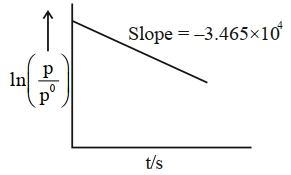
For the decomposition of azomethane,$CH_3N_2CH_{3(g)} \rightarrow CH_3CH_{3(g)} + N_{2(g)}$,a first order reaction,the variation in partial pressure with time at $600 \ K$ is given as shown in the graph. The value of the rate constant $k$ in $s^{-1}$ is $x \times 10^4$. Find the value of $x$.
A
$1$
B
$2$
C
$3$
D
$9$
Solution
(C) For a first order reaction,the integrated rate equation is $\ln(P/P_0) = -kt$.
Comparing this with the equation of a straight line $y = mx + c$,where $y = \ln(P/P_0)$ and $x = t$,the slope $m = -k$.
From the given graph,the slope is $-3.465 \times 10^4 \ s^{-1}$.
Therefore,$-k = -3.465 \times 10^4 \ s^{-1}$,which gives $k = 3.465 \times 10^4 \ s^{-1}$.
Given $k = x \times 10^4 \ s^{-1}$,we have $x = 3.465 \approx 3$ (rounding to the nearest integer as per options).
Comparing this with the equation of a straight line $y = mx + c$,where $y = \ln(P/P_0)$ and $x = t$,the slope $m = -k$.
From the given graph,the slope is $-3.465 \times 10^4 \ s^{-1}$.
Therefore,$-k = -3.465 \times 10^4 \ s^{-1}$,which gives $k = 3.465 \times 10^4 \ s^{-1}$.
Given $k = x \times 10^4 \ s^{-1}$,we have $x = 3.465 \approx 3$ (rounding to the nearest integer as per options).
0 likes
View Solution317
MediumMCQ
The half-life for the decomposition of gaseous compound $A$ is $240 \ s$ when the initial gaseous pressure is $500 \ Torr$. When the initial pressure is $250 \ Torr$,the half-life is found to be $4.0 \ min$. The order of the reaction is....... (Nearest integer)
A
$4$
B
$3$
C
$2$
D
$1$
Solution
(D) The half-life for a reaction of order $n$ is given by the relation $t_{1/2} \propto \frac{1}{P_0^{n-1}}$,where $P_0$ is the initial pressure.
Given: $(t_{1/2})_1 = 240 \ s = 4 \ min$ at $P_1 = 500 \ Torr$.
Given: $(t_{1/2})_2 = 4 \ min$ at $P_2 = 250 \ Torr$.
Since the half-life remains constant $(4 \ min)$ despite the change in initial pressure,the half-life is independent of the initial pressure.
For $t_{1/2}$ to be independent of $P_0$,the exponent $(n-1)$ must be $0$.
Therefore,$n-1 = 0$,which implies $n = 1$.
The reaction is of the $1^{st}$ order.
Given: $(t_{1/2})_1 = 240 \ s = 4 \ min$ at $P_1 = 500 \ Torr$.
Given: $(t_{1/2})_2 = 4 \ min$ at $P_2 = 250 \ Torr$.
Since the half-life remains constant $(4 \ min)$ despite the change in initial pressure,the half-life is independent of the initial pressure.
For $t_{1/2}$ to be independent of $P_0$,the exponent $(n-1)$ must be $0$.
Therefore,$n-1 = 0$,which implies $n = 1$.
The reaction is of the $1^{st}$ order.
0 likes
View Solution318
MediumMCQ
At $30^{\circ}C$,the half-life for the decomposition of $AB_{2}$ is $200\,s$ and is independent of the initial concentration of $AB_{2}$. The time required for $80\%$ of the $AB_{2}$ to decompose is $....s$ (Given: $\log 2 = 0.30; \log 5 = 0.70$)
A
$200$
B
$323$
C
$467$
D
$532$
Solution
(C) Since the half-life is independent of the initial concentration,it is a $1^{st}$ order reaction.
$k = \frac{0.693}{T_{1/2}} = \frac{0.693}{200} = 3.465 \times 10^{-3} \, s^{-1}$.
For $80\%$ decomposition,the remaining concentration is $20\%$ of the initial concentration $(A = 0.2 A_{0})$.
The rate equation is $t = \frac{2.303}{k} \log \frac{A_{0}}{A}$.
$t = \frac{2.303}{3.465 \times 10^{-3}} \log \frac{A_{0}}{0.2 A_{0}} = \frac{2.303}{3.465 \times 10^{-3}} \log 5$.
Using $\log 5 = 0.70$ and $\frac{2.303}{k} = \frac{200}{0.693} \approx 288.66$.
$t = 288.66 \times 0.70 \approx 202.06 \times 2.303 \approx 466.67 \, s \approx 467 \, s$.
$k = \frac{0.693}{T_{1/2}} = \frac{0.693}{200} = 3.465 \times 10^{-3} \, s^{-1}$.
For $80\%$ decomposition,the remaining concentration is $20\%$ of the initial concentration $(A = 0.2 A_{0})$.
The rate equation is $t = \frac{2.303}{k} \log \frac{A_{0}}{A}$.
$t = \frac{2.303}{3.465 \times 10^{-3}} \log \frac{A_{0}}{0.2 A_{0}} = \frac{2.303}{3.465 \times 10^{-3}} \log 5$.
Using $\log 5 = 0.70$ and $\frac{2.303}{k} = \frac{200}{0.693} \approx 288.66$.
$t = 288.66 \times 0.70 \approx 202.06 \times 2.303 \approx 466.67 \, s \approx 467 \, s$.
0 likes
View Solution319
MediumMCQ
$[A] \rightarrow [B]$. If the formation of compound $[B]$ follows first-order kinetics and after $70 \ min$ the concentration of $[A]$ was found to be half of its initial concentration,then the rate constant of the reaction is $x \times 10^{-6} \ s^{-1}$. The value of $x$ is $......$ (Nearest Integer).
A
$166$
B
$165$
C
$167$
D
$186$
Solution
(B) For a first-order reaction,the half-life $t_{1/2}$ is given as $70 \ min$.
Converting time to seconds: $t_{1/2} = 70 \times 60 \ s = 4200 \ s$.
The rate constant $k$ is calculated as:
$k = \frac{0.693}{t_{1/2}} = \frac{0.693}{4200} \ s^{-1}$.
$k = \frac{693}{4200000} \ s^{-1} = \frac{693}{42} \times 10^{-6} \ s^{-1}$.
$k = 165 \times 10^{-6} \ s^{-1}$.
Thus,the value of $x$ is $165$.
Converting time to seconds: $t_{1/2} = 70 \times 60 \ s = 4200 \ s$.
The rate constant $k$ is calculated as:
$k = \frac{0.693}{t_{1/2}} = \frac{0.693}{4200} \ s^{-1}$.
$k = \frac{693}{4200000} \ s^{-1} = \frac{693}{42} \times 10^{-6} \ s^{-1}$.
$k = 165 \times 10^{-6} \ s^{-1}$.
Thus,the value of $x$ is $165$.
0 likes
View Solution320
DifficultMCQ
For the given first order reaction $A \rightarrow B$,the half-life of the reaction is $0.3010 \ min$. The ratio of the initial concentration of reactant to the concentration of reactant at time $2.0 \ min$ will be equal to $........$ (Nearest integer).
A
$110$
B
$112$
C
$100$
D
$113$
Solution
(C) For a first-order reaction,the rate constant $K$ is given by $K = \frac{0.693}{t_{1/2}}$.
Given $t_{1/2} = 0.3010 \ min$,so $K = \frac{0.693}{0.3010} \approx 2.303 \ min^{-1}$.
The integrated rate equation is $\ln \frac{[A]_0}{[A]_t} = Kt$,which can be written as $\log \frac{[A]_0}{[A]_t} = \frac{Kt}{2.303}$.
Substituting the values: $\log \frac{[A]_0}{[A]_t} = \frac{2.303 \times 2.0}{2.303} = 2.0$.
Therefore,$\frac{[A]_0}{[A]_t} = 10^2 = 100$.
Given $t_{1/2} = 0.3010 \ min$,so $K = \frac{0.693}{0.3010} \approx 2.303 \ min^{-1}$.
The integrated rate equation is $\ln \frac{[A]_0}{[A]_t} = Kt$,which can be written as $\log \frac{[A]_0}{[A]_t} = \frac{Kt}{2.303}$.
Substituting the values: $\log \frac{[A]_0}{[A]_t} = \frac{2.303 \times 2.0}{2.303} = 2.0$.
Therefore,$\frac{[A]_0}{[A]_t} = 10^2 = 100$.
0 likes
View Solution321
MediumMCQ
It takes $1 \, h$ for a first order reaction to go to $50 \, \%$ completion. The total time required for the same reaction to reach $87.5 \, \%$ completion will be $..... \, h$.
A
$1.75$
B
$6.00$
C
$3.50$
D
$3.00$
Solution
(D) For a $1^{st}$ order reaction,the half-life $t_{1/2}$ is given as $1 \, h$. This means $50 \, \%$ of the reaction is completed in $1 \, h$.
For $87.5 \, \%$ completion,the amount remaining is $100 \, \% - 87.5 \, \% = 12.5 \, \%$.
We can relate the number of half-lives $(n)$ to the fraction remaining: $\frac{[A]_t}{[A]_0} = (\frac{1}{2})^n$.
Here,$\frac{12.5}{100} = \frac{1}{8} = (\frac{1}{2})^3$.
Thus,$n = 3$ half-lives are required.
Total time $t = n \times t_{1/2} = 3 \times 1 \, h = 3 \, h$.
For $87.5 \, \%$ completion,the amount remaining is $100 \, \% - 87.5 \, \% = 12.5 \, \%$.
We can relate the number of half-lives $(n)$ to the fraction remaining: $\frac{[A]_t}{[A]_0} = (\frac{1}{2})^n$.
Here,$\frac{12.5}{100} = \frac{1}{8} = (\frac{1}{2})^3$.
Thus,$n = 3$ half-lives are required.
Total time $t = n \times t_{1/2} = 3 \times 1 \, h = 3 \, h$.
0 likes
View Solution322
EasyMCQ
The concentration of a substance undergoing a chemical reaction becomes one-half of its original value after time,regardless of the initial concentration. The reaction is an example of a
A
$zero$ order reaction
B
$first$ order reaction
C
$second$ order reaction
D
$third$ order reaction
Solution
(B)
As given in the question,the concentration of a substance becomes one-half of its original value,which refers to the half-life period $(t_{1/2})$.
The half-life period is the time required to reduce the initial concentration to half of its value.
For a $zero$ order reaction,$t_{1/2} = \frac{[A]_0}{2k}$.
For a $first$ order reaction,$t_{1/2} = \frac{0.693}{k}$.
For a $second$ order reaction,$t_{1/2} = \frac{1}{k[A]_0}$.
For a $third$ order reaction,$t_{1/2} = \frac{1}{2k[A]_0^2}$.
Here,$[A]_0$ is the initial concentration.
Since the half-life of a $first$ order reaction is independent of the initial concentration,the correct option is $(b)$.
As given in the question,the concentration of a substance becomes one-half of its original value,which refers to the half-life period $(t_{1/2})$.
The half-life period is the time required to reduce the initial concentration to half of its value.
For a $zero$ order reaction,$t_{1/2} = \frac{[A]_0}{2k}$.
For a $first$ order reaction,$t_{1/2} = \frac{0.693}{k}$.
For a $second$ order reaction,$t_{1/2} = \frac{1}{k[A]_0}$.
For a $third$ order reaction,$t_{1/2} = \frac{1}{2k[A]_0^2}$.
Here,$[A]_0$ is the initial concentration.
Since the half-life of a $first$ order reaction is independent of the initial concentration,the correct option is $(b)$.
0 likes
View Solution323
MediumMCQ
For a first order reaction $R \longrightarrow P$,the rate constant is $k$. If the initial concentration of $R$ is $[R_0]$,the concentration of $R$ at any time $t$ is given by the expression:
A
$[R_0] e^{kt}$
B
$[R_0] e^{-kt}$
C
$[R_0](1 - e^{-kt})$
D
$[R_0] + e^{-kt}$
Solution
(B) For a first order reaction $R \longrightarrow P$,the rate law is given by: $\text{Rate} = -\frac{d[R]}{dt} = k[R]$.
Rearranging the terms,we get: $\frac{d[R]}{[R]} = -k dt$.
Integrating both sides: $\int \frac{d[R]}{[R]} = -\int k dt \Rightarrow \ln[R] = -kt + C$.
At $t = 0$,$[R] = [R_0]$,so $\ln[R_0] = C$.
Substituting $C$ back into the equation: $\ln[R] = -kt + \ln[R_0]$.
Rearranging: $\ln \frac{[R]}{[R_0]} = -kt$.
Taking the exponential of both sides: $\frac{[R]}{[R_0]} = e^{-kt}$.
Therefore,the concentration at time $t$ is: $[R] = [R_0] e^{-kt}$.
Rearranging the terms,we get: $\frac{d[R]}{[R]} = -k dt$.
Integrating both sides: $\int \frac{d[R]}{[R]} = -\int k dt \Rightarrow \ln[R] = -kt + C$.
At $t = 0$,$[R] = [R_0]$,so $\ln[R_0] = C$.
Substituting $C$ back into the equation: $\ln[R] = -kt + \ln[R_0]$.
Rearranging: $\ln \frac{[R]}{[R_0]} = -kt$.
Taking the exponential of both sides: $\frac{[R]}{[R_0]} = e^{-kt}$.
Therefore,the concentration at time $t$ is: $[R] = [R_0] e^{-kt}$.
0 likes
View Solution324
MediumMCQ
The half-life of a first order reaction is $30 \, min$. The time required for $75 \, \%$ completion of the same reaction will be $..... \, min$
A
$45$
B
$60$
C
$75$
D
$90$
Solution
(B)
For a first order reaction,the rate constant $k$ is given by $k = \frac{0.693}{t_{1/2}}$.
Given $t_{1/2} = 30 \, min$,so $k = \frac{0.693}{30} \, min^{-1}$.
The time $t$ required for $75 \, \%$ completion is given by the formula $t = \frac{2.303}{k} \log \frac{[A]_0}{[A]_t}$.
For $75 \, \%$ completion,$[A]_t = [A]_0 - 0.75[A]_0 = 0.25[A]_0$.
Thus,$t = \frac{2.303}{0.693/30} \log \frac{[A]_0}{0.25[A]_0} = \frac{2.303 \times 30}{0.693} \log 4$.
Since $\frac{2.303}{0.693} \approx \frac{1}{0.301} \approx 3.32$,we have $t = 30 \times 2 = 60 \, min$.
Alternatively,$75 \, \%$ completion corresponds to $2 \times t_{1/2} = 2 \times 30 = 60 \, min$.
For a first order reaction,the rate constant $k$ is given by $k = \frac{0.693}{t_{1/2}}$.
Given $t_{1/2} = 30 \, min$,so $k = \frac{0.693}{30} \, min^{-1}$.
The time $t$ required for $75 \, \%$ completion is given by the formula $t = \frac{2.303}{k} \log \frac{[A]_0}{[A]_t}$.
For $75 \, \%$ completion,$[A]_t = [A]_0 - 0.75[A]_0 = 0.25[A]_0$.
Thus,$t = \frac{2.303}{0.693/30} \log \frac{[A]_0}{0.25[A]_0} = \frac{2.303 \times 30}{0.693} \log 4$.
Since $\frac{2.303}{0.693} \approx \frac{1}{0.301} \approx 3.32$,we have $t = 30 \times 2 = 60 \, min$.
Alternatively,$75 \, \%$ completion corresponds to $2 \times t_{1/2} = 2 \times 30 = 60 \, min$.
0 likes
View Solution325
DifficultMCQ
For the first order reaction $A \rightarrow B$,the half-life is $30 \ min$. The time taken for $75 \%$ completion of the reaction is $..... \ min$. (Nearest integer)
Given: $\log 2 = 0.3010, \log 3 = 0.4771, \log 5 = 0.6989$
Given: $\log 2 = 0.3010, \log 3 = 0.4771, \log 5 = 0.6989$
A
$30$
B
$60$
C
$15$
D
$20$
Solution
(B) For a first-order reaction,the half-life is given by $t_{1/2} = \frac{0.693}{k} = 30 \ min$.
The time required for $75 \%$ completion $(T_{75\%})$ is the time taken for two half-lives to pass.
$T_{75\%} = 2 \times t_{1/2} = 2 \times 30 \ min = 60 \ min$.
Alternatively,using the formula $k = \frac{2.303}{t} \log \frac{[A]_0}{[A]_t}$:
$t = \frac{2.303}{k} \log \frac{100}{100-75} = \frac{2.303}{k} \log 4 = \frac{2.303}{k} \times 2 \log 2$.
Since $t_{1/2} = \frac{2.303 \log 2}{k} = 30 \ min$,then $t = 2 \times 30 = 60 \ min$.
The time required for $75 \%$ completion $(T_{75\%})$ is the time taken for two half-lives to pass.
$T_{75\%} = 2 \times t_{1/2} = 2 \times 30 \ min = 60 \ min$.
Alternatively,using the formula $k = \frac{2.303}{t} \log \frac{[A]_0}{[A]_t}$:
$t = \frac{2.303}{k} \log \frac{100}{100-75} = \frac{2.303}{k} \log 4 = \frac{2.303}{k} \times 2 \log 2$.
Since $t_{1/2} = \frac{2.303 \log 2}{k} = 30 \ min$,then $t = 2 \times 30 = 60 \ min$.
0 likes
View Solution326
DifficultMCQ
$A$ first order reaction has the rate constant,$k = 4.6 \times 10^{-3} \ s^{-1}$. The number of correct statement/s from the following is/are
Given : $\log 3 = 0.48$
$A.$ Reaction completes in $1000 \ s$.
$B.$ The reaction has a half-life of $500 \ s$.
$C.$ The time required for $10 \ \%$ completion is $25$ times the time required for $90 \ \%$ completion.
$D.$ The degree of dissociation is equal to $(1 - e^{-kt})$.
$E.$ The rate and the rate constant have the same unit.
Given : $\log 3 = 0.48$
$A.$ Reaction completes in $1000 \ s$.
$B.$ The reaction has a half-life of $500 \ s$.
$C.$ The time required for $10 \ \%$ completion is $25$ times the time required for $90 \ \%$ completion.
$D.$ The degree of dissociation is equal to $(1 - e^{-kt})$.
$E.$ The rate and the rate constant have the same unit.
A
$4$
B
$6$
C
$8$
D
$2$
Solution
(D) $A.$ Incorrect. $A$ first-order reaction theoretically takes infinite time to complete.
$B.$ Incorrect. $t_{1/2} = \frac{0.693}{k} = \frac{0.693}{4.6 \times 10^{-3}} \approx 150.65 \ s$.
$C.$ Incorrect. $t_{10\%} = \frac{1}{k} \ln(\frac{100}{90}) = \frac{2.303}{k} \log(1.11) \approx \frac{0.105}{k}$. $t_{90\%} = \frac{1}{k} \ln(\frac{100}{10}) = \frac{2.303}{k} \log(10) \approx \frac{2.303}{k}$. Thus,$t_{90\%} = 22 \times t_{10\%}$ (approx),not $25$.
$D.$ Correct. For first order,$[A]_t = [A]_0 e^{-kt}$. Degree of dissociation $\alpha = \frac{[A]_0 - [A]_t}{[A]_0} = 1 - e^{-kt}$.
$E.$ Correct. For a first-order reaction,rate $= k[A]^1$. Units of rate are $mol \ L^{-1} \ s^{-1}$ and units of $[A]$ are $mol \ L^{-1}$,so units of $k$ are $s^{-1}$. They are not the same.
Wait,re-evaluating $E$: Rate unit is $M \ s^{-1}$,$k$ unit is $s^{-1}$. They are different. So $E$ is incorrect.
Only statement $D$ is correct. The number of correct statements is $1$.
$B.$ Incorrect. $t_{1/2} = \frac{0.693}{k} = \frac{0.693}{4.6 \times 10^{-3}} \approx 150.65 \ s$.
$C.$ Incorrect. $t_{10\%} = \frac{1}{k} \ln(\frac{100}{90}) = \frac{2.303}{k} \log(1.11) \approx \frac{0.105}{k}$. $t_{90\%} = \frac{1}{k} \ln(\frac{100}{10}) = \frac{2.303}{k} \log(10) \approx \frac{2.303}{k}$. Thus,$t_{90\%} = 22 \times t_{10\%}$ (approx),not $25$.
$D.$ Correct. For first order,$[A]_t = [A]_0 e^{-kt}$. Degree of dissociation $\alpha = \frac{[A]_0 - [A]_t}{[A]_0} = 1 - e^{-kt}$.
$E.$ Correct. For a first-order reaction,rate $= k[A]^1$. Units of rate are $mol \ L^{-1} \ s^{-1}$ and units of $[A]$ are $mol \ L^{-1}$,so units of $k$ are $s^{-1}$. They are not the same.
Wait,re-evaluating $E$: Rate unit is $M \ s^{-1}$,$k$ unit is $s^{-1}$. They are different. So $E$ is incorrect.
Only statement $D$ is correct. The number of correct statements is $1$.
0 likes
View Solution327
MediumMCQ
If compound $A$ reacts with $B$ following first order kinetics with rate constant $2.011 \times 10^{-3} \ s^{-1}$. The time taken by $A$ (in seconds) to reduce from $7 \ g$ to $2 \ g$ will be $.........$ (Nearest Integer) $[\log 5=0.698, \log 7=0.845, \log 2=0.301]$
A
$620$
B
$623$
C
$622$
D
$625$
Solution
(B) For a first order reaction,the time $t$ is given by:
$t = \frac{2.303}{k} \log \frac{[A]_0}{[A]_t}$
Given:
$k = 2.011 \times 10^{-3} \ s^{-1}$
$[A]_0 = 7 \ g$
$[A]_t = 2 \ g$
$\log 7 = 0.845$
$\log 2 = 0.301$
Substituting the values:
$t = \frac{2.303}{2.011 \times 10^{-3}} \log \left( \frac{7}{2} \right)$
$t = \frac{2.303}{2.011 \times 10^{-3}} (\log 7 - \log 2)$
$t = \frac{2.303}{2.011 \times 10^{-3}} (0.845 - 0.301)$
$t = \frac{2.303 \times 0.544}{2.011} \times 10^3$
$t = \frac{1.252832}{2.011} \times 1000$
$t \approx 622.989 \ s$
The nearest integer is $623$.
$t = \frac{2.303}{k} \log \frac{[A]_0}{[A]_t}$
Given:
$k = 2.011 \times 10^{-3} \ s^{-1}$
$[A]_0 = 7 \ g$
$[A]_t = 2 \ g$
$\log 7 = 0.845$
$\log 2 = 0.301$
Substituting the values:
$t = \frac{2.303}{2.011 \times 10^{-3}} \log \left( \frac{7}{2} \right)$
$t = \frac{2.303}{2.011 \times 10^{-3}} (\log 7 - \log 2)$
$t = \frac{2.303}{2.011 \times 10^{-3}} (0.845 - 0.301)$
$t = \frac{2.303 \times 0.544}{2.011} \times 10^3$
$t = \frac{1.252832}{2.011} \times 1000$
$t \approx 622.989 \ s$
The nearest integer is $623$.
0 likes
View Solution328
DifficultMCQ
An organic compound undergoes first order decomposition. If the time taken for the $60 \%$ decomposition is $540 \ s$,then the time required for $90 \%$ decomposition will be $.......... \ s$. (Nearest integer). Given : $\ln 10 = 2.3 ; \log 2 = 0.3$
A
$1351$
B
$1352$
C
$1353$
D
$1350$
Solution
(D) For a first order reaction,the rate constant $k$ is given by $k = \frac{1}{t} \ln \frac{a_0}{a_t}$.
For $60 \%$ decomposition,$a_t = a_0 - 0.6 a_0 = 0.4 a_0$ and $t_1 = 540 \ s$.
$k = \frac{1}{540} \ln \frac{a_0}{0.4 a_0} = \frac{1}{540} \ln \frac{10}{4} = \frac{1}{540} (\ln 10 - \ln 4) = \frac{1}{540} (2.3 - 2 \times 0.3 \times 2.3 / 2.3) = \frac{1}{540} (2.3 - 1.38) = \frac{0.92}{540}$.
For $90 \%$ decomposition,$a_t = a_0 - 0.9 a_0 = 0.1 a_0$.
$t_2 = \frac{1}{k} \ln \frac{a_0}{0.1 a_0} = \frac{1}{k} \ln 10 = \frac{1}{k} \times 2.3$.
Substituting $k$: $t_2 = \frac{540}{0.92} \times 2.3 = \frac{540 \times 2.3}{0.92} = \frac{1242}{0.92} = 1350 \ s$.
For $60 \%$ decomposition,$a_t = a_0 - 0.6 a_0 = 0.4 a_0$ and $t_1 = 540 \ s$.
$k = \frac{1}{540} \ln \frac{a_0}{0.4 a_0} = \frac{1}{540} \ln \frac{10}{4} = \frac{1}{540} (\ln 10 - \ln 4) = \frac{1}{540} (2.3 - 2 \times 0.3 \times 2.3 / 2.3) = \frac{1}{540} (2.3 - 1.38) = \frac{0.92}{540}$.
For $90 \%$ decomposition,$a_t = a_0 - 0.9 a_0 = 0.1 a_0$.
$t_2 = \frac{1}{k} \ln \frac{a_0}{0.1 a_0} = \frac{1}{k} \ln 10 = \frac{1}{k} \times 2.3$.
Substituting $k$: $t_2 = \frac{540}{0.92} \times 2.3 = \frac{540 \times 2.3}{0.92} = \frac{1242}{0.92} = 1350 \ s$.
0 likes
View Solution329
DifficultMCQ
The rate constant for a first order reaction is $20 \, min^{-1}$. The time required for the initial concentration of the reactant to reduce to its $\frac{1}{32}$ level is $........ \times 10^{-2} \, min$. (Nearest integer) (Given: $\ln 10 = 2.303, \log 2 = 0.3010$)
A
$16$
B
$15$
C
$17$
D
$14$
Solution
(C) For a first order reaction,the rate constant $k$ is given by $k = \frac{2.303}{t} \log \frac{[A]_0}{[A]_t}$.
Given $[A]_t = \frac{[A]_0}{32}$ and $k = 20 \, min^{-1}$.
Substituting the values: $20 = \frac{2.303}{t} \log \frac{[A]_0}{[A]_0 / 32} = \frac{2.303}{t} \log 32$.
Since $32 = 2^5$,$\log 32 = 5 \log 2 = 5 \times 0.3010 = 1.505$.
$t = \frac{2.303 \times 1.505}{20} = \frac{3.466}{20} = 0.1733 \, min$.
Converting to $10^{-2} \, min$: $0.1733 \, min = 17.33 \times 10^{-2} \, min$.
The nearest integer is $17$.
Given $[A]_t = \frac{[A]_0}{32}$ and $k = 20 \, min^{-1}$.
Substituting the values: $20 = \frac{2.303}{t} \log \frac{[A]_0}{[A]_0 / 32} = \frac{2.303}{t} \log 32$.
Since $32 = 2^5$,$\log 32 = 5 \log 2 = 5 \times 0.3010 = 1.505$.
$t = \frac{2.303 \times 1.505}{20} = \frac{3.466}{20} = 0.1733 \, min$.
Converting to $10^{-2} \, min$: $0.1733 \, min = 17.33 \times 10^{-2} \, min$.
The nearest integer is $17$.
0 likes
View Solution330
DifficultMCQ
The half-life of a first-order reaction is $2000$ years. If the concentration after $8000$ years is $0.02 \, M$,then the initial concentration was $........... \, M$.
A
$0.16$
B
$0.32$
C
$0.08$
D
$0.04$
Solution
(B) For a first-order reaction,the number of half-lives $(n)$ is calculated as $n = \frac{t}{t_{1/2}} = \frac{8000}{2000} = 4$.
After $n$ half-lives,the remaining concentration $[A]_t$ is given by $[A]_t = \frac{[A]_0}{2^n}$.
Substituting the values: $0.02 = \frac{[A]_0}{2^4}$.
$0.02 = \frac{[A]_0}{16}$.
$[A]_0 = 0.02 \times 16 = 0.32 \, M$.
After $n$ half-lives,the remaining concentration $[A]_t$ is given by $[A]_t = \frac{[A]_0}{2^n}$.
Substituting the values: $0.02 = \frac{[A]_0}{2^4}$.
$0.02 = \frac{[A]_0}{16}$.
$[A]_0 = 0.02 \times 16 = 0.32 \, M$.
0 likes
View Solution331
MediumMCQ
$A$ molecule undergoes two independent first order reactions whose respective half-lives are $12 \ min$ and $3 \ min$. If both the reactions are occurring simultaneously,the time taken for the $50 \%$ consumption of the reactant is $.......... \ min$ (Nearest integer).
A
$4$
B
$2$
C
$6$
D
$8$
Solution
(B) For parallel first-order reactions,the effective rate constant $k_{eff}$ is the sum of individual rate constants: $k_{eff} = k_1 + k_2$.
Since $k = \frac{\ln 2}{t_{1/2}}$,we have $\frac{\ln 2}{t_{eff}} = \frac{\ln 2}{t_1} + \frac{\ln 2}{t_2}$.
This simplifies to $\frac{1}{t_{eff}} = \frac{1}{t_1} + \frac{1}{t_2}$.
Given $t_1 = 12 \ min$ and $t_2 = 3 \ min$,we calculate $\frac{1}{t_{eff}} = \frac{1}{12} + \frac{1}{3} = \frac{1+4}{12} = \frac{5}{12}$.
Thus,$t_{eff} = \frac{12}{5} \ min = 2.4 \ min$.
The nearest integer is $2 \ min$.
Since $k = \frac{\ln 2}{t_{1/2}}$,we have $\frac{\ln 2}{t_{eff}} = \frac{\ln 2}{t_1} + \frac{\ln 2}{t_2}$.
This simplifies to $\frac{1}{t_{eff}} = \frac{1}{t_1} + \frac{1}{t_2}$.
Given $t_1 = 12 \ min$ and $t_2 = 3 \ min$,we calculate $\frac{1}{t_{eff}} = \frac{1}{12} + \frac{1}{3} = \frac{1+4}{12} = \frac{5}{12}$.
Thus,$t_{eff} = \frac{12}{5} \ min = 2.4 \ min$.
The nearest integer is $2 \ min$.
0 likes
View Solution332
MediumMCQ
$t_{87.5}$ is the time required for the reaction to undergo $87.5 \%$ completion and $t_{50}$ is the time required for the reaction to undergo $50 \%$ completion. The relation between $t_{87.5}$ and $t_{50}$ for a first order reaction is $t_{87.5} = x \times t_{50}$. The value of $x$ is $......$. (Nearest integer)
A
$4$
B
$2$
C
$3$
D
$1$
Solution
(C) For a first order reaction,the time taken for $50 \%$ completion is the half-life,$t_{50} = t_{1/2}$.
At $87.5 \%$ completion,the remaining amount of reactant is $A_t = A_0 - 0.875 A_0 = 0.125 A_0 = \frac{A_0}{8}$.
Using the half-life concept:
$A_0$ $\xrightarrow{t_{1/2}} \frac{A_0}{2}$ $\xrightarrow{t_{1/2}} \frac{A_0}{4}$ $\xrightarrow{t_{1/2}} \frac{A_0}{8}$.
This shows that $t_{87.5} = 3 \times t_{1/2}$.
Since $t_{50} = t_{1/2}$,we have $t_{87.5} = 3 \times t_{50}$.
Therefore,$x = 3$.
At $87.5 \%$ completion,the remaining amount of reactant is $A_t = A_0 - 0.875 A_0 = 0.125 A_0 = \frac{A_0}{8}$.
Using the half-life concept:
$A_0$ $\xrightarrow{t_{1/2}} \frac{A_0}{2}$ $\xrightarrow{t_{1/2}} \frac{A_0}{4}$ $\xrightarrow{t_{1/2}} \frac{A_0}{8}$.
This shows that $t_{87.5} = 3 \times t_{1/2}$.
Since $t_{50} = t_{1/2}$,we have $t_{87.5} = 3 \times t_{50}$.
Therefore,$x = 3$.
0 likes
View Solution333
MediumMCQ
$A ( g ) \rightarrow 2 B ( g ) + C ( g )$ is a first order reaction. The initial pressure of the system was found to be $800 \ mm \ Hg$ which increased to $1600 \ mm \ Hg$ after $10 \ min$. The total pressure of the system after $30 \ min$ will be . . . . . . $mm \ Hg$. (Nearest integer)
A
$2100$
B
$2000$
C
$2300$
D
$2200$
Solution
(D) For the reaction $A ( g ) \rightarrow 2 B ( g ) + C ( g )$,let the initial pressure of $A$ be $P_0 = 800 \ mm \ Hg$.
At $t = 10 \ min$,the total pressure $P_t = P_0 - x + 2x + x = P_0 + 2x = 1600 \ mm \ Hg$.
Substituting $P_0 = 800$,we get $800 + 2x = 1600$,so $2x = 800$,which means $x = 400 \ mm \ Hg$.
The pressure of $A$ remaining at $t = 10 \ min$ is $P_0 - x = 800 - 400 = 400 \ mm \ Hg$.
Since the initial pressure was $800 \ mm \ Hg$ and it became $400 \ mm \ Hg$ in $10 \ min$,the half-life $t_{1/2} = 10 \ min$.
After $30 \ min$ $(3 \times t_{1/2})$,the pressure of $A$ remaining is $P_A = P_0 \times (1/2)^3 = 800 \times (1/8) = 100 \ mm \ Hg$.
The amount of $A$ reacted is $800 - 100 = 700 \ mm \ Hg$.
According to stoichiometry,$A \rightarrow 2B + C$,the pressure of $B$ produced is $2 \times 700 = 1400 \ mm \ Hg$ and $C$ produced is $700 \ mm \ Hg$.
The total pressure at $t = 30 \ min$ is $P_A + P_B + P_C = 100 + 1400 + 700 = 2200 \ mm \ Hg$.
At $t = 10 \ min$,the total pressure $P_t = P_0 - x + 2x + x = P_0 + 2x = 1600 \ mm \ Hg$.
Substituting $P_0 = 800$,we get $800 + 2x = 1600$,so $2x = 800$,which means $x = 400 \ mm \ Hg$.
The pressure of $A$ remaining at $t = 10 \ min$ is $P_0 - x = 800 - 400 = 400 \ mm \ Hg$.
Since the initial pressure was $800 \ mm \ Hg$ and it became $400 \ mm \ Hg$ in $10 \ min$,the half-life $t_{1/2} = 10 \ min$.
After $30 \ min$ $(3 \times t_{1/2})$,the pressure of $A$ remaining is $P_A = P_0 \times (1/2)^3 = 800 \times (1/8) = 100 \ mm \ Hg$.
The amount of $A$ reacted is $800 - 100 = 700 \ mm \ Hg$.
According to stoichiometry,$A \rightarrow 2B + C$,the pressure of $B$ produced is $2 \times 700 = 1400 \ mm \ Hg$ and $C$ produced is $700 \ mm \ Hg$.
The total pressure at $t = 30 \ min$ is $P_A + P_B + P_C = 100 + 1400 + 700 = 2200 \ mm \ Hg$.
0 likes
View Solution334
DifficultMCQ
Time required for completion of $99.9 \%$ of a First order reaction is . . . . . . times of half life $(t_{1/2})$ of the reaction.
A
$15$
B
$17$
C
$10$
D
$5$
Solution
(C) For a first order reaction,the time $t$ is given by $t = \frac{2.303}{k} \log \left( \frac{a}{a-x} \right)$.
For $99.9 \%$ completion,$x = 0.999a$,so $a-x = 0.001a = \frac{a}{1000}$.
Thus,$t_{99.9 \%} = \frac{2.303}{k} \log \left( \frac{a}{a/1000} \right) = \frac{2.303}{k} \log(10^3) = \frac{2.303 \times 3}{k}$.
The half-life is $t_{1/2} = \frac{0.693}{k} = \frac{2.303 \times 0.301}{k}$.
Taking the ratio: $\frac{t_{99.9 \%}}{t_{1/2}} = \frac{2.303 \times 3 / k}{2.303 \times 0.301 / k} \approx \frac{3}{0.3} = 10$.
For $99.9 \%$ completion,$x = 0.999a$,so $a-x = 0.001a = \frac{a}{1000}$.
Thus,$t_{99.9 \%} = \frac{2.303}{k} \log \left( \frac{a}{a/1000} \right) = \frac{2.303}{k} \log(10^3) = \frac{2.303 \times 3}{k}$.
The half-life is $t_{1/2} = \frac{0.693}{k} = \frac{2.303 \times 0.301}{k}$.
Taking the ratio: $\frac{t_{99.9 \%}}{t_{1/2}} = \frac{2.303 \times 3 / k}{2.303 \times 0.301 / k} \approx \frac{3}{0.3} = 10$.
0 likes
View Solution335
DifficultMCQ
The rate of a first-order reaction is $0.04 \ mol \ L^{-1} \ s^{-1}$ at $10 \ minutes$ and $0.03 \ mol \ L^{-1} \ s^{-1}$ at $20 \ minutes$ after initiation. The half-life of the reaction is . . . . . . minutes. (Given $\log 2 = 0.3010, \log 3 = 0.4771$)
A
$24$
B
$30$
C
$35$
D
$40$
Solution
(A) For a first-order reaction,the rate $r = k[A]_t = k[A]_0 e^{-kt}$.
Given $r_1 = 0.04 \ mol \ L^{-1} \ s^{-1}$ at $t_1 = 10 \ min$ and $r_2 = 0.03 \ mol \ L^{-1} \ s^{-1}$ at $t_2 = 20 \ min$.
$\frac{r_1}{r_2} = \frac{k[A]_0 e^{-kt_1}}{k[A]_0 e^{-kt_2}} = e^{k(t_2 - t_1)}$.
$\frac{0.04}{0.03} = e^{k(20 - 10)} = e^{10k}$.
$\frac{4}{3} = e^{10k} \implies 10k = \ln(\frac{4}{3}) = 2.303 \log(\frac{4}{3})$.
$10k = 2.303 \times (2 \log 2 - \log 3) = 2.303 \times (2 \times 0.3010 - 0.4771) = 2.303 \times (0.6020 - 0.4771) = 2.303 \times 0.1249 \approx 0.2876$.
$k = 0.02876 \ min^{-1}$.
Half-life $t_{1/2} = \frac{0.693}{k} = \frac{0.693}{0.02876} \approx 24.09 \ min$.
Thus,the half-life is approximately $24 \ minutes$.
Given $r_1 = 0.04 \ mol \ L^{-1} \ s^{-1}$ at $t_1 = 10 \ min$ and $r_2 = 0.03 \ mol \ L^{-1} \ s^{-1}$ at $t_2 = 20 \ min$.
$\frac{r_1}{r_2} = \frac{k[A]_0 e^{-kt_1}}{k[A]_0 e^{-kt_2}} = e^{k(t_2 - t_1)}$.
$\frac{0.04}{0.03} = e^{k(20 - 10)} = e^{10k}$.
$\frac{4}{3} = e^{10k} \implies 10k = \ln(\frac{4}{3}) = 2.303 \log(\frac{4}{3})$.
$10k = 2.303 \times (2 \log 2 - \log 3) = 2.303 \times (2 \times 0.3010 - 0.4771) = 2.303 \times (0.6020 - 0.4771) = 2.303 \times 0.1249 \approx 0.2876$.
$k = 0.02876 \ min^{-1}$.
Half-life $t_{1/2} = \frac{0.693}{k} = \frac{0.693}{0.02876} \approx 24.09 \ min$.
Thus,the half-life is approximately $24 \ minutes$.
0 likes
View Solution336
DifficultMCQ
The integrated rate law equation for a first-order gas-phase reaction $A(g) \rightarrow B(g) + C(g)$ is given by (where $P_i$ is the initial pressure and $P_t$ is the total pressure at time $t$):
A
$k = \frac{2.303}{t} \log \frac{P_i}{2 P_i - P_t}$
B
$k = \frac{2.303}{t} \log \frac{2 P_i}{2 P_i - P_t}$
C
$k = \frac{2.303}{t} \log \frac{2 P_i - P_t}{P_i}$
D
$k = \frac{2.303}{t} \times \frac{P_i}{2 P_i - P_t}$
Solution
(A) For the reaction $A(g) \rightarrow B(g) + C(g)$:
Total pressure at time $t$ is $P_t = (P_i - x) + x + x = P_i + x$.
Therefore,$x = P_t - P_i$.
The partial pressure of reactant $A$ at time $t$ is $P_A = P_i - x = P_i - (P_t - P_i) = 2 P_i - P_t$.
Substituting into the first-order rate equation $k = \frac{2.303}{t} \log \frac{P_i}{P_A}$:
$k = \frac{2.303}{t} \log \frac{P_i}{2 P_i - P_t}$.
| Time $t=0$ | $P_i$ | $0$ | $0$ |
| Time $t$ | $P_i - x$ | $x$ | $x$ |
Total pressure at time $t$ is $P_t = (P_i - x) + x + x = P_i + x$.
Therefore,$x = P_t - P_i$.
The partial pressure of reactant $A$ at time $t$ is $P_A = P_i - x = P_i - (P_t - P_i) = 2 P_i - P_t$.
Substituting into the first-order rate equation $k = \frac{2.303}{t} \log \frac{P_i}{P_A}$:
$k = \frac{2.303}{t} \log \frac{P_i}{2 P_i - P_t}$.
0 likes
View Solution337
DifficultMCQ
For a reaction,$r = k[A]$. If $50 \%$ of $A$ is decomposed in $120 \ \text{minutes}$,the time taken for $90 \%$ decomposition of $A$ is $............ \ \text{minutes}$.
A
$390$
B
$399$
C
$499$
D
$490$
Solution
(B) The rate law $r = k[A]$ indicates that the reaction is of the first order.
For a first-order reaction,the half-life is given by $t_{1/2} = \frac{0.693}{k} = 120 \ \text{min}$.
Thus,$k = \frac{0.693}{120} \ \text{min}^{-1}$.
For $90 \%$ decomposition,the amount remaining is $100 - 90 = 10 \%$.
The time $t$ is given by the formula $t = \frac{2.303}{k} \log \left( \frac{[A]_0}{[A]_t} \right)$.
Substituting the values: $t = \frac{2.303}{(0.693 / 120)} \log \left( \frac{100}{10} \right)$.
$t = \frac{2.303 \times 120}{0.693} \times \log(10)$.
Since $\frac{2.303}{0.693} \approx \frac{1}{0.301} \approx 3.32$,we get $t = 120 \times 3.32 \approx 399 \ \text{minutes}$.
For a first-order reaction,the half-life is given by $t_{1/2} = \frac{0.693}{k} = 120 \ \text{min}$.
Thus,$k = \frac{0.693}{120} \ \text{min}^{-1}$.
For $90 \%$ decomposition,the amount remaining is $100 - 90 = 10 \%$.
The time $t$ is given by the formula $t = \frac{2.303}{k} \log \left( \frac{[A]_0}{[A]_t} \right)$.
Substituting the values: $t = \frac{2.303}{(0.693 / 120)} \log \left( \frac{100}{10} \right)$.
$t = \frac{2.303 \times 120}{0.693} \times \log(10)$.
Since $\frac{2.303}{0.693} \approx \frac{1}{0.301} \approx 3.32$,we get $t = 120 \times 3.32 \approx 399 \ \text{minutes}$.
0 likes
View Solution338
DifficultMCQ
The following data were obtained during the first order thermal decomposition of a gas $A$ at constant volume:
$A_{(g)} \rightarrow 2 B_{(g)} + C_{(g)}$
The rate constant of the reaction is . . . . . . $\times 10^{-2} \ s^{-1}$ (nearest integer).
$A_{(g)} \rightarrow 2 B_{(g)} + C_{(g)}$
| $S.No.$ | $Time/s$ | $Total Pressure/(atm)$ |
| $1.$ | $0$ | $0.1$ |
| $2.$ | $115$ | $0.28$ |
The rate constant of the reaction is . . . . . . $\times 10^{-2} \ s^{-1}$ (nearest integer).
A
$1$
B
$2$
C
$5$
D
$10$
Solution
(B) For the reaction $A_{(g)} \rightarrow 2 B_{(g)} + C_{(g)}$:
Let the initial pressure of $A$ be $P_0 = 0.1 \ atm$.
At time $t = 115 \ s$,let the decrease in pressure of $A$ be $x$.
Then,the pressures are: $P_A = P_0 - x$,$P_B = 2x$,and $P_C = x$.
The total pressure $P_t = (P_0 - x) + 2x + x = P_0 + 2x$.
Given $P_t = 0.28 \ atm$ at $t = 115 \ s$,we have $0.1 + 2x = 0.28$,which gives $2x = 0.18$,so $x = 0.09 \ atm$.
The pressure of $A$ at $t = 115 \ s$ is $P_A = 0.1 - 0.09 = 0.01 \ atm$.
For a first-order reaction,the rate constant $k = \frac{1}{t} \ln \frac{P_0}{P_A} = \frac{1}{115} \ln \frac{0.1}{0.01} = \frac{1}{115} \ln(10)$.
Using $\ln(10) \approx 2.303$,$k = \frac{2.303}{115} \approx 0.02002 \ s^{-1} = 2.002 \times 10^{-2} \ s^{-1}$.
The nearest integer is $2$.
Let the initial pressure of $A$ be $P_0 = 0.1 \ atm$.
At time $t = 115 \ s$,let the decrease in pressure of $A$ be $x$.
Then,the pressures are: $P_A = P_0 - x$,$P_B = 2x$,and $P_C = x$.
The total pressure $P_t = (P_0 - x) + 2x + x = P_0 + 2x$.
Given $P_t = 0.28 \ atm$ at $t = 115 \ s$,we have $0.1 + 2x = 0.28$,which gives $2x = 0.18$,so $x = 0.09 \ atm$.
The pressure of $A$ at $t = 115 \ s$ is $P_A = 0.1 - 0.09 = 0.01 \ atm$.
For a first-order reaction,the rate constant $k = \frac{1}{t} \ln \frac{P_0}{P_A} = \frac{1}{115} \ln \frac{0.1}{0.01} = \frac{1}{115} \ln(10)$.
Using $\ln(10) \approx 2.303$,$k = \frac{2.303}{115} \approx 0.02002 \ s^{-1} = 2.002 \times 10^{-2} \ s^{-1}$.
The nearest integer is $2$.
0 likes
View Solution339
MediumMCQ
Consider the following reaction,the rate expression of which is given below:
$A + B \rightarrow C$
$\text{rate} = k[A]^{1/2}[B]^{1/2}$
The reaction is initiated by taking $1 \ M$ concentration of $A$ and $B$ each. If the rate constant $(k)$ is $4.6 \times 10^{-2} \ s^{-1}$,then the time taken for $A$ to become $0.1 \ M$ is . . . . . . . . . . $sec$. (nearest integer)
$A + B \rightarrow C$
$\text{rate} = k[A]^{1/2}[B]^{1/2}$
The reaction is initiated by taking $1 \ M$ concentration of $A$ and $B$ each. If the rate constant $(k)$ is $4.6 \times 10^{-2} \ s^{-1}$,then the time taken for $A$ to become $0.1 \ M$ is . . . . . . . . . . $sec$. (nearest integer)
A
$50$
B
$40$
C
$51$
D
$55$
Solution
(A) Given the reaction $A + B \rightarrow C$ and the rate law $\text{rate} = k[A]^{1/2}[B]^{1/2}$.
Since the initial concentrations $[A]_0 = [B]_0 = 1 \ M$,at any time $t$,$[A] = [B]$.
Substituting this into the rate law: $\text{rate} = k[A]^{1/2}[A]^{1/2} = k[A]$.
This confirms the reaction follows first-order kinetics with respect to $A$.
The integrated rate equation for a first-order reaction is $k = \frac{2.303}{t} \log \frac{[A]_0}{[A]_t}$.
Given $k = 4.6 \times 10^{-2} \ s^{-1}$,$[A]_0 = 1 \ M$,and $[A]_t = 0.1 \ M$.
Substituting the values: $4.6 \times 10^{-2} = \frac{2.303}{t} \log \frac{1}{0.1}$.
$4.6 \times 10^{-2} = \frac{2.303}{t} \times 1$.
$t = \frac{2.303}{4.6 \times 10^{-2}} \approx 50.06 \ s$.
Rounding to the nearest integer,$t = 50 \ s$.
Since the initial concentrations $[A]_0 = [B]_0 = 1 \ M$,at any time $t$,$[A] = [B]$.
Substituting this into the rate law: $\text{rate} = k[A]^{1/2}[A]^{1/2} = k[A]$.
This confirms the reaction follows first-order kinetics with respect to $A$.
The integrated rate equation for a first-order reaction is $k = \frac{2.303}{t} \log \frac{[A]_0}{[A]_t}$.
Given $k = 4.6 \times 10^{-2} \ s^{-1}$,$[A]_0 = 1 \ M$,and $[A]_t = 0.1 \ M$.
Substituting the values: $4.6 \times 10^{-2} = \frac{2.303}{t} \log \frac{1}{0.1}$.
$4.6 \times 10^{-2} = \frac{2.303}{t} \times 1$.
$t = \frac{2.303}{4.6 \times 10^{-2}} \approx 50.06 \ s$.
Rounding to the nearest integer,$t = 50 \ s$.
0 likes
View Solution340
MediumMCQ
Time required for $99.9 \%$ completion of a first order reaction is . . . . . . . times the time required for completion of $90 \%$ reaction. (nearest integer).
A
$5$
B
$4$
C
$3$
D
$8$
Solution
(C) For a first order reaction,the rate constant $K$ is given by $K = \frac{2.303}{t} \log \left(\frac{[A]_0}{[A]_t}\right)$.
For $99.9 \%$ completion,$[A]_t = 0.1 \% \text{ of } [A]_0$,so $[A]_t = 0.001 [A]_0$. Thus,$t_{99.9 \%} = \frac{2.303}{K} \log \left(\frac{100}{0.1}\right) = \frac{2.303}{K} \log(10^3) = \frac{2.303}{K} \times 3$.
For $90 \%$ completion,$[A]_t = 10 \% \text{ of } [A]_0$,so $[A]_t = 0.1 [A]_0$. Thus,$t_{90 \%} = \frac{2.303}{K} \log \left(\frac{100}{10}\right) = \frac{2.303}{K} \log(10) = \frac{2.303}{K} \times 1$.
Taking the ratio,$\frac{t_{99.9 \%}}{t_{90 \%}} = \frac{3}{1} = 3$.
Therefore,the time required for $99.9 \%$ completion is $3$ times the time required for $90 \%$ completion.
For $99.9 \%$ completion,$[A]_t = 0.1 \% \text{ of } [A]_0$,so $[A]_t = 0.001 [A]_0$. Thus,$t_{99.9 \%} = \frac{2.303}{K} \log \left(\frac{100}{0.1}\right) = \frac{2.303}{K} \log(10^3) = \frac{2.303}{K} \times 3$.
For $90 \%$ completion,$[A]_t = 10 \% \text{ of } [A]_0$,so $[A]_t = 0.1 [A]_0$. Thus,$t_{90 \%} = \frac{2.303}{K} \log \left(\frac{100}{10}\right) = \frac{2.303}{K} \log(10) = \frac{2.303}{K} \times 1$.
Taking the ratio,$\frac{t_{99.9 \%}}{t_{90 \%}} = \frac{3}{1} = 3$.
Therefore,the time required for $99.9 \%$ completion is $3$ times the time required for $90 \%$ completion.
0 likes
View Solution341
MediumMCQ
Consider the two different first order reactions given below:
$A + B \rightarrow C$ (Reaction $1$)
$P \rightarrow Q$ (Reaction $2$)
The ratio of the half-life of Reaction $1$ : Reaction $2$ is $5 : 2$. If $t_1$ and $t_2$ represent the time taken to complete $2/3$ and $4/5$ of Reaction $1$ and Reaction $2$,respectively,then the value of the ratio $t_1 : t_2$ is $. . . . \times 10^{-1}$ (nearest integer).
[Given: $\log_{10}(3) = 0.477$ and $\log_{10}(5) = 0.699$]
$A + B \rightarrow C$ (Reaction $1$)
$P \rightarrow Q$ (Reaction $2$)
The ratio of the half-life of Reaction $1$ : Reaction $2$ is $5 : 2$. If $t_1$ and $t_2$ represent the time taken to complete $2/3$ and $4/5$ of Reaction $1$ and Reaction $2$,respectively,then the value of the ratio $t_1 : t_2$ is $. . . . \times 10^{-1}$ (nearest integer).
[Given: $\log_{10}(3) = 0.477$ and $\log_{10}(5) = 0.699$]
A
$15$
B
$18$
C
$20$
D
$17$
Solution
(D) For a first-order reaction,the half-life is given by $t_{1/2} = \frac{\ln 2}{k}$.
Given $\frac{(t_{1/2})_1}{(t_{1/2})_2} = \frac{k_2}{k_1} = \frac{5}{2}$.
For a first-order reaction,the time $t$ to complete a fraction $x$ is $t = \frac{1}{k} \ln \frac{1}{1-x}$.
For Reaction $1$,$t_1 = \frac{1}{k_1} \ln \frac{1}{1 - 2/3} = \frac{1}{k_1} \ln 3$.
For Reaction $2$,$t_2 = \frac{1}{k_2} \ln \frac{1}{1 - 4/5} = \frac{1}{k_2} \ln 5$.
Taking the ratio: $\frac{t_1}{t_2} = \frac{k_2}{k_1} \times \frac{\ln 3}{\ln 5} = \frac{5}{2} \times \frac{\log_{10} 3}{\log_{10} 5}$.
Substituting the given values: $\frac{t_1}{t_2} = \frac{5}{2} \times \frac{0.477}{0.699} = 2.5 \times 0.6824 = 1.706$.
Rounding to the nearest integer,$1.706 \approx 1.7 = 17 \times 10^{-1}$.
Given $\frac{(t_{1/2})_1}{(t_{1/2})_2} = \frac{k_2}{k_1} = \frac{5}{2}$.
For a first-order reaction,the time $t$ to complete a fraction $x$ is $t = \frac{1}{k} \ln \frac{1}{1-x}$.
For Reaction $1$,$t_1 = \frac{1}{k_1} \ln \frac{1}{1 - 2/3} = \frac{1}{k_1} \ln 3$.
For Reaction $2$,$t_2 = \frac{1}{k_2} \ln \frac{1}{1 - 4/5} = \frac{1}{k_2} \ln 5$.
Taking the ratio: $\frac{t_1}{t_2} = \frac{k_2}{k_1} \times \frac{\ln 3}{\ln 5} = \frac{5}{2} \times \frac{\log_{10} 3}{\log_{10} 5}$.
Substituting the given values: $\frac{t_1}{t_2} = \frac{5}{2} \times \frac{0.477}{0.699} = 2.5 \times 0.6824 = 1.706$.
Rounding to the nearest integer,$1.706 \approx 1.7 = 17 \times 10^{-1}$.
0 likes
View Solution342
MediumMCQ
Consider the following first order gas phase reaction at constant temperature:
$A_{(g)} \rightarrow 2B_{(g)} + C_{(g)}$
If the total pressure of the gases is found to be $200 \ torr$ after $23 \ s$ and $300 \ torr$ upon the complete decomposition of $A$ after a very long time,then the rate constant of the given reaction is . . . . . . $\times 10^{-2} \ s^{-1}$ (nearest integer).
[Given: $\log_{10}(2) = 0.301$]
$A_{(g)} \rightarrow 2B_{(g)} + C_{(g)}$
If the total pressure of the gases is found to be $200 \ torr$ after $23 \ s$ and $300 \ torr$ upon the complete decomposition of $A$ after a very long time,then the rate constant of the given reaction is . . . . . . $\times 10^{-2} \ s^{-1}$ (nearest integer).
[Given: $\log_{10}(2) = 0.301$]
A
$3$
B
$5$
C
$8$
D
$9$
Solution
(A) For the reaction $A_{(g)} \rightarrow 2B_{(g)} + C_{(g)}$,let the initial pressure of $A$ be $P_0$.
At $t = 0$: $P_A = P_0, P_B = 0, P_C = 0, P_{total} = P_0$.
At $t = 23 \ s$: $P_A = P_0 - x, P_B = 2x, P_C = x, P_{total} = P_0 + 2x = 200 \ torr$.
At $t = \infty$: $P_A = 0, P_B = 2P_0, P_C = P_0, P_{total} = 3P_0 = 300 \ torr$.
Thus,$P_0 = 100 \ torr$.
Substituting $P_0$ in $P_{total} = P_0 + 2x = 200$,we get $100 + 2x = 200$,so $x = 50 \ torr$.
The pressure of $A$ at $t = 23 \ s$ is $P_A = P_0 - x = 100 - 50 = 50 \ torr$.
For a first-order reaction,$k = \frac{2.303}{t} \log \frac{P_0}{P_A} = \frac{2.303}{23} \log \frac{100}{50} = \frac{2.303}{23} \log(2) = \frac{2.303 \times 0.301}{23} \approx 0.0301 \ s^{-1} = 3.01 \times 10^{-2} \ s^{-1}$.
The nearest integer is $3$.
At $t = 0$: $P_A = P_0, P_B = 0, P_C = 0, P_{total} = P_0$.
At $t = 23 \ s$: $P_A = P_0 - x, P_B = 2x, P_C = x, P_{total} = P_0 + 2x = 200 \ torr$.
At $t = \infty$: $P_A = 0, P_B = 2P_0, P_C = P_0, P_{total} = 3P_0 = 300 \ torr$.
Thus,$P_0 = 100 \ torr$.
Substituting $P_0$ in $P_{total} = P_0 + 2x = 200$,we get $100 + 2x = 200$,so $x = 50 \ torr$.
The pressure of $A$ at $t = 23 \ s$ is $P_A = P_0 - x = 100 - 50 = 50 \ torr$.
For a first-order reaction,$k = \frac{2.303}{t} \log \frac{P_0}{P_A} = \frac{2.303}{23} \log \frac{100}{50} = \frac{2.303}{23} \log(2) = \frac{2.303 \times 0.301}{23} \approx 0.0301 \ s^{-1} = 3.01 \times 10^{-2} \ s^{-1}$.
The nearest integer is $3$.
0 likes
View Solution343
DifficultMCQ
For the first order reaction $2 N_2O_{5(g)} \rightarrow 4 NO_{2(g)} + O_{2(g)}$,which of the following statements are correct?
$A.$ The concentration of the reactant decreases exponentially with time.
$B.$ The half-life of the reaction decreases with increasing temperature.
$C.$ The half-life of the reaction depends on the initial concentration of the reactant.
$D.$ The reaction proceeds to $99.6 \%$ completion in eight half-life durations.
$A.$ The concentration of the reactant decreases exponentially with time.
$B.$ The half-life of the reaction decreases with increasing temperature.
$C.$ The half-life of the reaction depends on the initial concentration of the reactant.
$D.$ The reaction proceeds to $99.6 \%$ completion in eight half-life durations.
A
$A, B, D$
B
$A, B, C$
C
$A, C, D$
D
$B, C, D$
Solution
(A) For a first-order reaction,the concentration at time $t$ is given by $C_t = C_0 e^{-kt}$,which shows exponential decay. Thus,statement $A$ is correct.
The half-life is $t_{1/2} = \frac{\ln 2}{k}$. Since the rate constant $k$ increases with temperature according to the Arrhenius equation,$t_{1/2}$ decreases as temperature increases. Thus,statement $B$ is correct.
For a first-order reaction,$t_{1/2} = \frac{0.693}{k}$,which is independent of the initial concentration $C_0$. Thus,statement $C$ is incorrect.
After $n$ half-lives,the remaining reactant is $C_t = \frac{C_0}{2^n}$. For $n = 8$,$C_t = \frac{C_0}{2^8} = \frac{C_0}{256}$.
Percentage completion = $\frac{C_0 - C_t}{C_0} \times 100 = \frac{C_0 - \frac{C_0}{256}}{C_0} \times 100 = (1 - \frac{1}{256}) \times 100 \approx 99.6 \%$. Thus,statement $D$ is correct.
Therefore,statements $A, B,$ and $D$ are correct.
The half-life is $t_{1/2} = \frac{\ln 2}{k}$. Since the rate constant $k$ increases with temperature according to the Arrhenius equation,$t_{1/2}$ decreases as temperature increases. Thus,statement $B$ is correct.
For a first-order reaction,$t_{1/2} = \frac{0.693}{k}$,which is independent of the initial concentration $C_0$. Thus,statement $C$ is incorrect.
After $n$ half-lives,the remaining reactant is $C_t = \frac{C_0}{2^n}$. For $n = 8$,$C_t = \frac{C_0}{2^8} = \frac{C_0}{256}$.
Percentage completion = $\frac{C_0 - C_t}{C_0} \times 100 = \frac{C_0 - \frac{C_0}{256}}{C_0} \times 100 = (1 - \frac{1}{256}) \times 100 \approx 99.6 \%$. Thus,statement $D$ is correct.
Therefore,statements $A, B,$ and $D$ are correct.
0 likes
View Solution344
AdvancedMCQ
An organic compound undergoes first-order decomposition. The time taken for its decomposition to $1/8$ and $1/10$ of its initial concentration are $t_{1/8}$ and $t_{1/10}$ respectively. What is the value of $\frac{t_{1/8}}{t_{1/10}} \times 10$? (Given: $\log_{10} 2 = 0.3$)
A
$8$
B
$9$
C
$7$
D
$6$
Solution
(B) For a first-order reaction,the rate constant $K$ is given by $K = \frac{1}{t} \ln \left( \frac{C_0}{C_t} \right)$.
For $t_{1/8}$,the concentration $C_t = C_0 / 8$,so $K t_{1/8} = \ln(8) = 3 \ln(2)$.
For $t_{1/10}$,the concentration $C_t = C_0 / 10$,so $K t_{1/10} = \ln(10)$.
Taking the ratio: $\frac{t_{1/8}}{t_{1/10}} = \frac{3 \ln(2)}{\ln(10)} = 3 \log_{10} 2$.
Given $\log_{10} 2 = 0.3$,we have $\frac{t_{1/8}}{t_{1/10}} = 3 \times 0.3 = 0.9$.
Therefore,$\frac{t_{1/8}}{t_{1/10}} \times 10 = 0.9 \times 10 = 9$.
For $t_{1/8}$,the concentration $C_t = C_0 / 8$,so $K t_{1/8} = \ln(8) = 3 \ln(2)$.
For $t_{1/10}$,the concentration $C_t = C_0 / 10$,so $K t_{1/10} = \ln(10)$.
Taking the ratio: $\frac{t_{1/8}}{t_{1/10}} = \frac{3 \ln(2)}{\ln(10)} = 3 \log_{10} 2$.
Given $\log_{10} 2 = 0.3$,we have $\frac{t_{1/8}}{t_{1/10}} = 3 \times 0.3 = 0.9$.
Therefore,$\frac{t_{1/8}}{t_{1/10}} \times 10 = 0.9 \times 10 = 9$.
0 likes
View Solution345
AdvancedMCQ
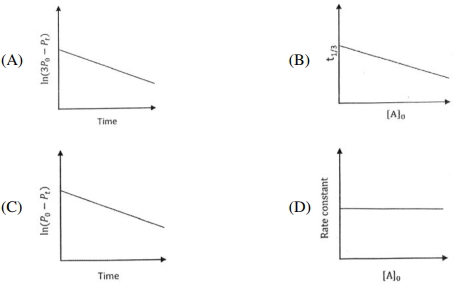
For a first order reaction $A_{(g)} \rightarrow 2B_{(g)} + C_{(g)}$ at constant volume and $300 \ K$,the total pressure at the beginning $(t=0)$ and at time $t$ are $P_0$ and $P_t$,respectively. Initially,only $A$ is present with concentration $[A]_0$,and $t_{1/3}$ is the time required for the partial pressure of $A$ to reach $1/3^{rd}$ of its initial value. The correct option$(s)$ is (are) (Assume that all these gases behave as ideal gases)
A
$A, D$
B
$A, C$
C
$A, B$
D
$A, B, C$
Solution
(A) For the reaction $A_{(g)} \rightarrow 2B_{(g)} + C_{(g)}$:
At $t=0$,pressure of $A$ is $P_0$,and total pressure is $P_0$.
At time $t$,let the pressure of $A$ reacted be $x$. Then $P_A = P_0 - x$,$P_B = 2x$,and $P_C = x$.
Total pressure $P_t = (P_0 - x) + 2x + x = P_0 + 2x$.
Thus,$x = \frac{P_t - P_0}{2}$.
Partial pressure of $A$ at time $t$ is $P_A = P_0 - \frac{P_t - P_0}{2} = \frac{3P_0 - P_t}{2}$.
For a first order reaction,$k = \frac{1}{t} \ln \left( \frac{P_0}{P_A} \right) = \frac{1}{t} \ln \left( \frac{P_0}{(3P_0 - P_t)/2} \right) = \frac{1}{t} \ln \left( \frac{2P_0}{3P_0 - P_t} \right)$.
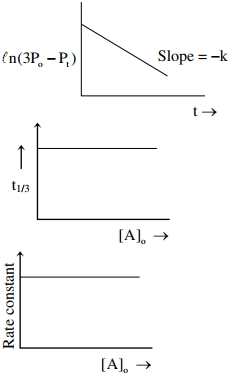
Rearranging gives $\ln(3P_0 - P_t) = \ln(2P_0) - kt$. This represents a straight line with a negative slope $(-k)$,matching graph $A$.
For a first order reaction,the rate constant $k$ is independent of the initial concentration $[A]_0$,matching graph $D$.
Also,$t_{1/3}$ (time for $A$ to become $1/3$ of its initial value) is $\frac{\ln 3}{k}$,which is independent of $[A]_0$.
At $t=0$,pressure of $A$ is $P_0$,and total pressure is $P_0$.
At time $t$,let the pressure of $A$ reacted be $x$. Then $P_A = P_0 - x$,$P_B = 2x$,and $P_C = x$.
Total pressure $P_t = (P_0 - x) + 2x + x = P_0 + 2x$.
Thus,$x = \frac{P_t - P_0}{2}$.
Partial pressure of $A$ at time $t$ is $P_A = P_0 - \frac{P_t - P_0}{2} = \frac{3P_0 - P_t}{2}$.
For a first order reaction,$k = \frac{1}{t} \ln \left( \frac{P_0}{P_A} \right) = \frac{1}{t} \ln \left( \frac{P_0}{(3P_0 - P_t)/2} \right) = \frac{1}{t} \ln \left( \frac{2P_0}{3P_0 - P_t} \right)$.
Rearranging gives $\ln(3P_0 - P_t) = \ln(2P_0) - kt$. This represents a straight line with a negative slope $(-k)$,matching graph $A$.
For a first order reaction,the rate constant $k$ is independent of the initial concentration $[A]_0$,matching graph $D$.
Also,$t_{1/3}$ (time for $A$ to become $1/3$ of its initial value) is $\frac{\ln 3}{k}$,which is independent of $[A]_0$.
0 likes
View Solution346
AdvancedMCQ
The decomposition reaction $2N_2O_{5(g)} \xrightarrow{\Delta} 2N_2O_{4(g)} + O_{2(g)}$ is started in a closed cylinder under isothermal isochoric conditions at an initial pressure of $1 \ atm$. After $Y \times 10^3 \ s$,the pressure inside the cylinder is found to be $1.45 \ atm$. If the rate constant of the reaction is $5 \times 10^{-4} \ s^{-1}$,assuming ideal gas behavior,the value of $Y$ is. . . . . . . .
A
$2.20$
B
$2.30$
C
$2.40$
D
$2.50$
Solution
(B) For the reaction $2N_2O_{5(g)} \rightarrow 2N_2O_{4(g)} + O_{2(g)}$ at constant $V$ and $T$:
At $t = 0$,$P_{N_2O_5} = 1 \ atm$,$P_{N_2O_4} = 0$,$P_{O_2} = 0$.
At $t = Y \times 10^3 \ s$,let the pressure of $O_2$ formed be $P$. Then $P_{N_2O_5} = 1 - 2P$,$P_{N_2O_4} = 2P$,and $P_{O_2} = P$.
The total pressure $P_T = (1 - 2P) + 2P + P = 1 + P = 1.45 \ atm$.
Thus,$P = 0.45 \ atm$.
The initial pressure of $N_2O_5$ is $P_0 = 1 \ atm$ and the pressure at time $t$ is $P_t = 1 - 2P = 1 - 2(0.45) = 0.1 \ atm$.
For a first-order reaction,$k = \frac{2.303}{t} \log \left(\frac{P_0}{P_t}\right)$.
Substituting the values: $5 \times 10^{-4} = \frac{2.303}{Y \times 10^3} \log \left(\frac{1}{0.1}\right)$.
$5 \times 10^{-4} = \frac{2.303}{Y \times 10^3} \times 1$.
$0.5 = \frac{2.303}{Y} \implies Y = \frac{2.303}{0.5} = 4.606$.
Given the options provided,there is a discrepancy in the calculation or the provided options. Based on standard calculation,$Y = 4.606$.
At $t = 0$,$P_{N_2O_5} = 1 \ atm$,$P_{N_2O_4} = 0$,$P_{O_2} = 0$.
At $t = Y \times 10^3 \ s$,let the pressure of $O_2$ formed be $P$. Then $P_{N_2O_5} = 1 - 2P$,$P_{N_2O_4} = 2P$,and $P_{O_2} = P$.
The total pressure $P_T = (1 - 2P) + 2P + P = 1 + P = 1.45 \ atm$.
Thus,$P = 0.45 \ atm$.
The initial pressure of $N_2O_5$ is $P_0 = 1 \ atm$ and the pressure at time $t$ is $P_t = 1 - 2P = 1 - 2(0.45) = 0.1 \ atm$.
For a first-order reaction,$k = \frac{2.303}{t} \log \left(\frac{P_0}{P_t}\right)$.
Substituting the values: $5 \times 10^{-4} = \frac{2.303}{Y \times 10^3} \log \left(\frac{1}{0.1}\right)$.
$5 \times 10^{-4} = \frac{2.303}{Y \times 10^3} \times 1$.
$0.5 = \frac{2.303}{Y} \implies Y = \frac{2.303}{0.5} = 4.606$.
Given the options provided,there is a discrepancy in the calculation or the provided options. Based on standard calculation,$Y = 4.606$.
0 likes
View Solution347
MediumMCQ
Which of the following plots is(are) correct for the given reaction? $( [P]_0$ is the initial concentration of $P$ $)$
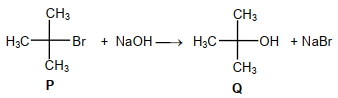
A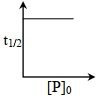
B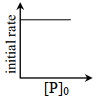
C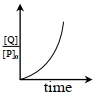
D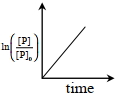
Solution
(A) The reaction is a $SN^1$ reaction,which follows first-order kinetics.
For a first-order reaction:
$1$. The half-life $t_{1/2} = \frac{0.693}{k}$ is independent of the initial concentration $[P]_0$. Thus,the plot of $t_{1/2}$ vs $[P]_0$ is a horizontal line.
$2$. The rate of reaction is given by $rate = k[P]$. The initial rate is $rate_0 = k[P]_0$. Thus,the plot of initial rate vs $[P]_0$ is a straight line passing through the origin.
$3$. The concentration of product $Q$ at time $t$ is $[Q] = [P]_0 - [P] = [P]_0(1 - e^{-kt})$. Thus,$\frac{[Q]}{[P]_0} = 1 - e^{-kt}$. This plot is an exponential growth curve.
$4$. For first-order kinetics,$\ln(\frac{[P]}{[P]_0}) = -kt$. The plot of $\ln(\frac{[P]}{[P]_0})$ vs time is a straight line with a negative slope $-k$ passing through the origin.
For a first-order reaction:
$1$. The half-life $t_{1/2} = \frac{0.693}{k}$ is independent of the initial concentration $[P]_0$. Thus,the plot of $t_{1/2}$ vs $[P]_0$ is a horizontal line.
$2$. The rate of reaction is given by $rate = k[P]$. The initial rate is $rate_0 = k[P]_0$. Thus,the plot of initial rate vs $[P]_0$ is a straight line passing through the origin.
$3$. The concentration of product $Q$ at time $t$ is $[Q] = [P]_0 - [P] = [P]_0(1 - e^{-kt})$. Thus,$\frac{[Q]}{[P]_0} = 1 - e^{-kt}$. This plot is an exponential growth curve.
$4$. For first-order kinetics,$\ln(\frac{[P]}{[P]_0}) = -kt$. The plot of $\ln(\frac{[P]}{[P]_0})$ vs time is a straight line with a negative slope $-k$ passing through the origin.
0 likes
View Solution348
DifficultMCQ
For the thermal decomposition of $N_2O_{5(g)}$ at constant volume,the following table can be formed for the reaction mentioned below:
$2N_2O_{5(g)} \rightarrow 2N_2O_{4(g)} + O_{2(g)}$
$X = . . . . . . \times 10^{-3} \ atm$ [nearest integer]
Given: Rate constant for the reaction is $4.606 \times 10^{-2} \ s^{-1}$.
$2N_2O_{5(g)} \rightarrow 2N_2O_{4(g)} + O_{2(g)}$
| $S.NO$ | $Time/s$ | Total pressure $(atm)$ |
| $1.$ | $0$ | $0.6$ |
| $2.$ | $100$ | $X$ |
$X = . . . . . . \times 10^{-3} \ atm$ [nearest integer]
Given: Rate constant for the reaction is $4.606 \times 10^{-2} \ s^{-1}$.
A
$500$
B
$700$
C
$800$
D
$900$
Solution
(D) The reaction is $2N_2O_{5(g)} \rightarrow 2N_2O_{4(g)} + O_{2(g)}$.
For a first-order reaction,the rate constant $k$ is given by $k = \frac{2.303}{t} \log \frac{P_0}{P_t}$,where $P_0$ is the initial pressure of $N_2O_5$ and $P_t$ is the pressure at time $t$.
Given $k = 4.606 \times 10^{-2} \ s^{-1}$ and $t = 100 \ s$.
$4.606 \times 10^{-2} = \frac{2.303}{100} \log \frac{0.6}{P_{N_2O_5}}$
$2 = \log \frac{0.6}{P_{N_2O_5}} \Rightarrow \frac{0.6}{P_{N_2O_5}} = 10^2 = 100$.
$P_{N_2O_5} = \frac{0.6}{100} = 0.006 \ atm$.
Let $x$ be the pressure of $N_2O_5$ decomposed. Then $0.6 - x = 0.006 \Rightarrow x = 0.594 \ atm$.
The total pressure $P_{total} = (0.6 - x) + x + \frac{x}{2} = 0.6 + \frac{x}{2}$.
$P_{total} = 0.6 + \frac{0.594}{2} = 0.6 + 0.297 = 0.897 \ atm$.
$P_{total} = 897 \times 10^{-3} \ atm$.
Rounding to the nearest integer,$X = 897$.
For a first-order reaction,the rate constant $k$ is given by $k = \frac{2.303}{t} \log \frac{P_0}{P_t}$,where $P_0$ is the initial pressure of $N_2O_5$ and $P_t$ is the pressure at time $t$.
Given $k = 4.606 \times 10^{-2} \ s^{-1}$ and $t = 100 \ s$.
$4.606 \times 10^{-2} = \frac{2.303}{100} \log \frac{0.6}{P_{N_2O_5}}$
$2 = \log \frac{0.6}{P_{N_2O_5}} \Rightarrow \frac{0.6}{P_{N_2O_5}} = 10^2 = 100$.
$P_{N_2O_5} = \frac{0.6}{100} = 0.006 \ atm$.
Let $x$ be the pressure of $N_2O_5$ decomposed. Then $0.6 - x = 0.006 \Rightarrow x = 0.594 \ atm$.
The total pressure $P_{total} = (0.6 - x) + x + \frac{x}{2} = 0.6 + \frac{x}{2}$.
$P_{total} = 0.6 + \frac{0.594}{2} = 0.6 + 0.297 = 0.897 \ atm$.
$P_{total} = 897 \times 10^{-3} \ atm$.
Rounding to the nearest integer,$X = 897$.
0 likes
View Solution349
MediumMCQ
Given below are two statements:
Statement $I$: The graph of $t_{1/2}$ versus initial concentration $[R]_0$ for a first-order reaction is a horizontal line.
Statement $II$: The graph of $\log \frac{[R]_0}{[R]}$ versus time $t$ for a first-order reaction is a straight line passing through the origin with a slope equal to $\frac{k}{2.303}$.
In the light of the above statements,choose the correct answer from the options given below:
Statement $I$: The graph of $t_{1/2}$ versus initial concentration $[R]_0$ for a first-order reaction is a horizontal line.
Statement $II$: The graph of $\log \frac{[R]_0}{[R]}$ versus time $t$ for a first-order reaction is a straight line passing through the origin with a slope equal to $\frac{k}{2.303}$.
In the light of the above statements,choose the correct answer from the options given below:
A
Both Statement $I$ and Statement $II$ are false
B
Statement $I$ is false but Statement $II$ is true
C
Both Statement $I$ and Statement $II$ are true
D
Statement $I$ is true but Statement $II$ is false
Solution
(C) For a first-order reaction,the half-life is given by $t_{1/2} = \frac{\ln 2}{k}$. Since this expression is independent of the initial concentration $[R]_0$,the graph of $t_{1/2}$ versus $[R]_0$ is a horizontal line. Thus,Statement $I$ is true.
For a first-order reaction,the integrated rate equation is $\ln \frac{[R]_0}{[R]} = kt$,which can be written as $\log \frac{[R]_0}{[R]} = \frac{k}{2.303} \times t$. This is an equation of a straight line $y = mx$ where $y = \log \frac{[R]_0}{[R]}$,$x = t$,and the slope $m = \frac{k}{2.303}$. Thus,Statement $II$ is true.
For a first-order reaction,the integrated rate equation is $\ln \frac{[R]_0}{[R]} = kt$,which can be written as $\log \frac{[R]_0}{[R]} = \frac{k}{2.303} \times t$. This is an equation of a straight line $y = mx$ where $y = \log \frac{[R]_0}{[R]}$,$x = t$,and the slope $m = \frac{k}{2.303}$. Thus,Statement $II$ is true.
0 likes
View Solution350
MediumMCQ
Drug $X$ becomes ineffective after $50 \%$ decomposition. The original concentration of drug in a bottle was $16 \ mg/mL$ which becomes $4 \ mg/mL$ in $12 \ months$. The expiry time of the drug in months is $..........$ Assume that the decomposition of the drug follows first order kinetics.
A
$12$
B
$2$
C
$3$
D
$6$
Solution
(D) For a first-order reaction,the rate constant $k$ is given by $k = \frac{2.303}{t} \log \frac{[A]_0}{[A]_t}$.
Given $[A]_0 = 16 \ mg/mL$,$[A]_t = 4 \ mg/mL$,and $t = 12 \ months$.
$k = \frac{2.303}{12} \log \frac{16}{4} = \frac{2.303}{12} \log 4 = \frac{2.303 \times 0.602}{12} \approx 0.1155 \ month^{-1}$.
The drug becomes ineffective after $50 \%$ decomposition,meaning $50 \%$ remains. Thus,$[A]_t = 0.5 \times [A]_0$.
The time taken for $50 \%$ decomposition is the half-life $t_{1/2} = \frac{0.693}{k}$.
$t_{1/2} = \frac{0.693}{0.1155} = 6 \ months$.
Given $[A]_0 = 16 \ mg/mL$,$[A]_t = 4 \ mg/mL$,and $t = 12 \ months$.
$k = \frac{2.303}{12} \log \frac{16}{4} = \frac{2.303}{12} \log 4 = \frac{2.303 \times 0.602}{12} \approx 0.1155 \ month^{-1}$.
The drug becomes ineffective after $50 \%$ decomposition,meaning $50 \%$ remains. Thus,$[A]_t = 0.5 \times [A]_0$.
The time taken for $50 \%$ decomposition is the half-life $t_{1/2} = \frac{0.693}{k}$.
$t_{1/2} = \frac{0.693}{0.1155} = 6 \ months$.
0 likes
View SolutionChemical Kinetics — First Order reaction · Frequently Asked Questions
1Are these Chemical Kinetics questions useful for JEE and NEET?
Yes. All questions in this section are mapped to JEE Main and NEET exam patterns. Previous year questions from JEE Main, NEET, GUJCET and state-level exams are included with full solutions.
2Can I switch to Hindi or Gujarati for these questions?
Yes. Use the language tabs in the hero section or the sidebar to view the same questions and solutions in English, Hindi or Gujarati.
3How do I generate a question paper from this subtopic?
Use the Vedclass Exam Paper Generator — select the chapter and subtopic, set difficulty, and generate Sets A, B, C, D automatically. First 3 chapters of every subject are free.
Vedclass Products
For Students
Vedclass Test Series
Mock tests in real JEE/NEET style with performance analysis. 5-day free trial.
Start Free TrialFor Teachers
Exam Paper Generator
Generate Set A/B/C/D papers from this chapter in 2 minutes. 3 chapters free.
Try FreeFor Institutes
Online Exam Module
Live online exams with unlimited students, 360° analytics & white-label branding.
See DemoFor Teachers & Institutes
Generate a Chemical Kinetics Exam Paper in 2 Minutes
Select subtopic & difficulty — Sets A, B, C, D auto-generated with No Repeat logic.
First 3 chapters of every subject are free — no payment required.