
A English
Carbohydrates Questions in English
Class 12 Chemistry · Biomolecules · Carbohydrates
808+
Questions
English
Language
100%
With Solutions
Showing 50 of 808 questions in English
1
MediumMCQ
Which of the following elements of matter would best convey that there is life on Earth?
A
Oxygen
B
Hydrogen
C
Carbon
D
Iron
Solution
(C) Life on Earth is based on carbon,likely because each carbon atom can form bonds with up to four other atoms simultaneously.
This quality makes carbon well-suited to form the long chains of molecules that serve as the basis for life as we know it,such as proteins and $DNA$.
This quality makes carbon well-suited to form the long chains of molecules that serve as the basis for life as we know it,such as proteins and $DNA$.
0 likes
View Solution2
MediumMCQ
Starch can be used as an indicator for the detection of traces of
A
Glucose in aqueous solution
B
Proteins in blood
C
Iodine in aqueous solution
D
Urea in blood
Solution
(C) $Starch$ is colourless,but it forms a characteristic $blue-black$ complex with $Iodine$.
$Starch + Iodine_{(violet)} \to Starch-Iodine_{(blue-black)}$
Therefore,$Starch$ is used as an indicator for the detection of $Iodine$.
$Starch + Iodine_{(violet)} \to Starch-Iodine_{(blue-black)}$
Therefore,$Starch$ is used as an indicator for the detection of $Iodine$.
0 likes
View Solution3
EasyMCQ
Glucose and fructose are
A
Optical isomers
B
Functional isomers
C
Position isomers
D
Chain isomers
Solution
(B) $Glucose$ $(C_6H_{12}O_6)$ and $fructose$ $(C_6H_{12}O_6)$ have the same molecular formula but differ in their functional groups.
$Glucose$ contains an aldehyde group $(-CHO)$,whereas $fructose$ contains a ketone group $(>C=O)$.
Therefore,they are functional isomers.
$Glucose$ contains an aldehyde group $(-CHO)$,whereas $fructose$ contains a ketone group $(>C=O)$.
Therefore,they are functional isomers.
0 likes
View Solution4
MediumMCQ
How many optical isomers does glucose have?
A
$8$
B
$12$
C
$16$
D
Cannot be predicted
Solution
(C) Glucose in its open-chain aldehyde form has $4$ chiral carbon atoms (at $C-2, C-3, C-4,$ and $C-5$).
According to the formula for the number of stereoisomers,$N = 2^n$,where $n$ is the number of chiral centers.
Here,$n = 4$,so the number of stereoisomers is $2^4 = 16$.
According to the formula for the number of stereoisomers,$N = 2^n$,where $n$ is the number of chiral centers.
Here,$n = 4$,so the number of stereoisomers is $2^4 = 16$.
0 likes
View Solution5
MediumMCQ
The normal amount of glucose in $100 \ mL$ of blood ($8-12 \ hours$ after a meal) is ........ $mg$.
A
$8$
B
$80$
C
$200$
D
$800$
Solution
(B) The normal blood glucose level in a healthy human,measured $8-12 \ hours$ after a meal (fasting state),typically ranges between $70 \ mg/dL$ and $100 \ mg/dL$.
Since $1 \ dL = 100 \ mL$,the amount of glucose in $100 \ mL$ of blood is approximately $80 \ mg$ to $100 \ mg$.
Among the given options,$80 \ mg$ is the correct value representing the normal fasting blood glucose level.
Since $1 \ dL = 100 \ mL$,the amount of glucose in $100 \ mL$ of blood is approximately $80 \ mg$ to $100 \ mg$.
Among the given options,$80 \ mg$ is the correct value representing the normal fasting blood glucose level.
0 likes
View Solution6
EasyMCQ
Which of the following molecules would diffuse through a cell membrane?
A
$Fructose$
B
$Glycogen$
C
$Haemoglobin$
D
$Catalase$
Solution
(A) The cell membrane is a semi-permeable membrane that allows the passage of small molecules while restricting larger ones.
$Fructose$ is a monosaccharide with a low molecular weight $(180.16 \ g/mol)$,allowing it to pass through the membrane via facilitated diffusion.
$Glycogen$,$Haemoglobin$,and $Catalase$ are macromolecules (polysaccharides or proteins) with very high molecular weights,which cannot diffuse through the cell membrane.
$Fructose$ is a monosaccharide with a low molecular weight $(180.16 \ g/mol)$,allowing it to pass through the membrane via facilitated diffusion.
$Glycogen$,$Haemoglobin$,and $Catalase$ are macromolecules (polysaccharides or proteins) with very high molecular weights,which cannot diffuse through the cell membrane.
0 likes
View Solution7
EasyMCQ
The formation of starch in plants results from
A
Photosynthesis
B
Photolysis
C
Flash photolysis
D
None of the above
Solution
(A) The reaction taking place during photosynthesis is:
$6 CO_2 + 6 H_2O \rightarrow C_6H_{12}O_6 + 6 O_2$
This glucose molecule undergoes polymerization to form starch,which is a polysaccharide.
Therefore,the formation of starch in plants is a result of the process of photosynthesis.
$6 CO_2 + 6 H_2O \rightarrow C_6H_{12}O_6 + 6 O_2$
This glucose molecule undergoes polymerization to form starch,which is a polysaccharide.
Therefore,the formation of starch in plants is a result of the process of photosynthesis.
0 likes
View Solution8
EasyMCQ
Which of the following does not contain a hydrophobic structure?
A
Linseed oil
B
Lanolin
C
Glycogen
D
Rubber
Solution
(C) The correct answer is $(C)$.
Hydrophobic structures are typically found in substances that are non-polar or have long hydrocarbon chains that repel water.
Linseed oil,lanolin,and rubber are hydrophobic in nature as they contain long hydrocarbon chains or non-polar structures.
Glycogen is a polysaccharide consisting of many glucose units,which contain numerous hydroxyl $(-OH)$ groups.
These hydroxyl groups make glycogen hydrophilic (water-attracting) rather than hydrophobic.
Hydrophobic structures are typically found in substances that are non-polar or have long hydrocarbon chains that repel water.
Linseed oil,lanolin,and rubber are hydrophobic in nature as they contain long hydrocarbon chains or non-polar structures.
Glycogen is a polysaccharide consisting of many glucose units,which contain numerous hydroxyl $(-OH)$ groups.
These hydroxyl groups make glycogen hydrophilic (water-attracting) rather than hydrophobic.
0 likes
View Solution9
MediumMCQ
Maltose on hydrolysis gives:
A
Mannose + glucose
B
Galactose + glucose
C
Glucose
D
Mannose + fructose
Solution
(C) Maltose is a disaccharide composed of two glucose units.
On hydrolysis,it yields two molecules of glucose:
$C_{12}H_{22}O_{11} + H_2O \xrightarrow{\text{Maltase}} 2C_6H_{12}O_6$ (Glucose).
On hydrolysis,it yields two molecules of glucose:
$C_{12}H_{22}O_{11} + H_2O \xrightarrow{\text{Maltase}} 2C_6H_{12}O_6$ (Glucose).
0 likes
View Solution10
MediumMCQ
In fermentation by zymase,alcohol and $CO_2$ are obtained from which of the following sugars?
A
Glucose
B
Invert sugar
C
Fructose
D
All of these
Solution
(D) The enzyme zymase is capable of fermenting various hexose sugars into ethanol and $CO_2$.
$C_6H_{12}O_6$ (Glucose) $\xrightarrow{\text{Zymase}} 2C_2H_5OH + 2CO_2$.
Similarly,invert sugar (a mixture of glucose and fructose) and fructose itself can also be fermented by zymase to produce alcohol and $CO_2$.
Therefore,the correct option is $D$.
$C_6H_{12}O_6$ (Glucose) $\xrightarrow{\text{Zymase}} 2C_2H_5OH + 2CO_2$.
Similarly,invert sugar (a mixture of glucose and fructose) and fructose itself can also be fermented by zymase to produce alcohol and $CO_2$.
Therefore,the correct option is $D$.
0 likes
View Solution11
MediumMCQ
$Glucose + \text{Tollen's reagent} o \text{Silver mirror}$ shows:
A
Presence of acidic group
B
Presence of alkaline group
C
Presence of ketonic group
D
Presence of aldehyde group
Solution
(D) Tollen's reagent is an ammoniacal silver nitrate solution,$[Ag(NH_3)_2]^+OH^-$.
It acts as a mild oxidizing agent.
Aldehydes are oxidized to corresponding carboxylate ions by Tollen's reagent,while the silver ions are reduced to metallic silver,which deposits on the inner walls of the test tube as a '$Silver mirror$'.
Since $Glucose$ gives a positive '$Silver mirror$' test,it confirms the presence of an aldehyde group in its open-chain structure.
It acts as a mild oxidizing agent.
Aldehydes are oxidized to corresponding carboxylate ions by Tollen's reagent,while the silver ions are reduced to metallic silver,which deposits on the inner walls of the test tube as a '$Silver mirror$'.
Since $Glucose$ gives a positive '$Silver mirror$' test,it confirms the presence of an aldehyde group in its open-chain structure.
0 likes
View Solution12
MediumMCQ
The pair of compounds in which both the compounds give positive test with Tollen's reagent is
A
Glucose and Sucrose
B
Fructose and Sucrose
C
Acetophenone and Hexanal
D
Glucose and Fructose
Solution
(D) Tollen's reagent oxidizes compounds containing an aldehyde group,such as glucose.
It also oxidizes $\alpha$-hydroxy ketones that possess a $-COCH_2OH$ group,such as fructose,because they undergo tautomerization to form an aldehyde in an alkaline medium.
It also oxidizes $\alpha$-hydroxy ketones that possess a $-COCH_2OH$ group,such as fructose,because they undergo tautomerization to form an aldehyde in an alkaline medium.
0 likes
View Solution13
EasyMCQ
Which of the following is not a polymer?
A
Sucrose
B
Enzyme
C
Starch
D
Teflon
Solution
(A) Sucrose is a disaccharide,not a polymer. Upon acid or enzymatic hydrolysis,it yields only two molecules of monosaccharides.
Sucrose $\xrightarrow{H^+ \text{ or invertase}} D(+)\text{-glucose} + D(-)\text{-fructose}$
Sucrose $\xrightarrow{H^+ \text{ or invertase}} D(+)\text{-glucose} + D(-)\text{-fructose}$
0 likes
View Solution14
MediumMCQ
Complete hydrolysis of cellulose gives
A
$D$-fructose
B
$D$-ribose
C
$D$-glucose
D
$L$-glucose
Solution
(C) Cellulose is a linear polysaccharide consisting of a large number of $D$-glucose units joined by $\beta$-glycosidic linkages.
Upon complete hydrolysis,cellulose yields only $D$-glucose molecules.
Upon complete hydrolysis,cellulose yields only $D$-glucose molecules.
0 likes
View Solution15
EasyMCQ
In the process of forming 'mercerised cellulose',the swelling of cellulose is caused by
A
Water
B
$Na_2CO_3$
C
$Aq. \ NaOH$
D
$Aq. \ HCl$
Solution
(C) The process of mercerisation involves treating cotton fibers with a concentrated solution of $NaOH$ (sodium hydroxide).
This treatment causes the cellulose fibers to swell,which increases their affinity for dyes and imparts a silky lustre to the fabric.
Therefore,the swelling of cellulose is caused by $Aq. \ NaOH$.
This treatment causes the cellulose fibers to swell,which increases their affinity for dyes and imparts a silky lustre to the fabric.
Therefore,the swelling of cellulose is caused by $Aq. \ NaOH$.
0 likes
View Solution16
MediumMCQ
The sterile gauze (or cotton) used in medicine is obtained by oxidizing cellulose with:
A
Nitrogen
B
$KMnO_4$
C
Nitrogen dioxide
D
Potassium chlorate
Solution
(C) Sterile gauze or medical cotton is prepared by the oxidation of cellulose using $NO_2$ (nitrogen dioxide) gas. This process converts the primary hydroxyl groups of cellulose into carboxylic acid groups,resulting in oxidized cellulose,which is used as a hemostatic agent in medicine.
0 likes
View Solution17
EasyMCQ
What is the chemical formula of cellulose?
A
$({C_6}{H_{10}}{O_5})_n$
B
$({C_3}{H_3}{N_3})_n$
C
$({C_3}{H_6}{N_6})_n$
D
$({C_{12}}{H_{22}}{O_{11}})_n$
Solution
(A) Cellulose is a natural polymer of $\beta-D-glucose$ units. The general formula for cellulose is represented as $({C_6}{H_{10}}{O_5})_n$,where $n$ is the degree of polymerization.
0 likes
View Solution18
MediumMCQ
The value of $n$ in the formula $(C_5H_{10}O_5)_n$ for inulin is about
A
$30$
B
$300$
C
$3000$
D
$300000$
Solution
(A) Inulin is a naturally occurring polysaccharide consisting of fructose units.
Its general formula is $(C_6H_{10}O_5)_n$ (often represented as a polymer of fructose).
However,for the specific context of the question provided,the value of $n$ for inulin found in the roots of Dahlia is approximately $30$.
Therefore,the correct option is $A$.
Its general formula is $(C_6H_{10}O_5)_n$ (often represented as a polymer of fructose).
However,for the specific context of the question provided,the value of $n$ for inulin found in the roots of Dahlia is approximately $30$.
Therefore,the correct option is $A$.
0 likes
View Solution19
EasyMCQ
$Starch$ consists of two fractions; one is $\alpha-amylose$ and the other is
A
Amylopectin
B
Glycogen
C
Pecticamide
D
Alginic acid
Solution
(A) $Starch$ is a polymeric carbohydrate consisting of numerous glucose units joined by glycosidic bonds.
It consists of two types of molecules: the linear and helical $\alpha-amylose$ and the branched $amylopectin$.
Depending on the plant,$starch$ generally contains $20$ to $25 \%$ $amylose$ and $75$ to $80 \%$ $amylopectin$ by weight.
It consists of two types of molecules: the linear and helical $\alpha-amylose$ and the branched $amylopectin$.
Depending on the plant,$starch$ generally contains $20$ to $25 \%$ $amylose$ and $75$ to $80 \%$ $amylopectin$ by weight.
0 likes
View Solution20
EasyMCQ
Cellulose is a polymer of
A
Fructose
B
Ribose
C
Glucose
D
Sucrose
Solution
(C) Explanation: Cellulose is a structural component of the cell walls in plants.
It is a polysaccharide that consists of several $D-glucose$ units joined by glycosidic bonds.
Specifically,it is formed by the $\beta-1,4-glycosidic$ linkage of $\beta-D-glucose$ units.
Therefore,cellulose is a polymer of $\beta-D-glucose$.
It is a polysaccharide that consists of several $D-glucose$ units joined by glycosidic bonds.
Specifically,it is formed by the $\beta-1,4-glycosidic$ linkage of $\beta-D-glucose$ units.
Therefore,cellulose is a polymer of $\beta-D-glucose$.
0 likes
View Solution21
MediumMCQ
The change in optical rotation,with time,of a freshly prepared solution of sugar is known as
A
Rotatory motion
B
Inversion
C
Specific rotation
D
Mutarotation
Solution
(D) . The change in optical rotation of a freshly prepared solution of sugar with time is known as mutarotation.
$(\alpha-D$-Glucose$) ([\alpha] = +112^o, 36\%) \rightleftharpoons$ Equilibrium mixture $([\alpha]_D = +52^o, 0.02\%) \rightleftharpoons$ $(\beta-D-$Glucose$)$ $([\alpha]_D = +19^o, 64\%)$.
Glucose exists in two anomeric forms,$\alpha$ and $\beta$. When either of these pure forms is dissolved in water,it undergoes interconversion until an equilibrium mixture is reached,resulting in a change in the observed optical rotation.
$(\alpha-D$-Glucose$) ([\alpha] = +112^o, 36\%) \rightleftharpoons$ Equilibrium mixture $([\alpha]_D = +52^o, 0.02\%) \rightleftharpoons$ $(\beta-D-$Glucose$)$ $([\alpha]_D = +19^o, 64\%)$.
Glucose exists in two anomeric forms,$\alpha$ and $\beta$. When either of these pure forms is dissolved in water,it undergoes interconversion until an equilibrium mixture is reached,resulting in a change in the observed optical rotation.
0 likes
View Solution22
EasyMCQ
Which of the following is a carbohydrate?
A
Leucine
B
Albumin
C
Inulin
D
Maltase
Solution
(C) is the correct answer.
Inulin is a polysaccharide carbohydrate which is stored in the roots of Dahliya.
Inulin is a polysaccharide carbohydrate which is stored in the roots of Dahliya.
0 likes
View Solution23
MediumMCQ
The general formula for carbohydrates is:
A
$C_nH_{2n}O_{2n+2}$
B
$C_x(H_2O)_{2x}$
C
$C_x(H_2O)_y$
D
None of these
Solution
(C) The term carbohydrate was derived from the fact that many of them have the general formula $C_x(H_2O)_y$,which represents them as hydrates of carbon.
Therefore,the correct option is $C$.
Therefore,the correct option is $C$.
0 likes
View Solution24
MediumMCQ
Benedict's solution provides which of the following ions?
A
$Ag^{+}$
B
$Li^{+}$
C
$Cu^{+2}$
D
$Ba^{+2}$
Solution
(C) Benedict's solution is a chemical reagent used to test for the presence of reducing sugars,which contain a free aldehyde or ketone group.
It contains copper$(II)$ sulfate $(CuSO_4 \cdot 5H_2O)$,sodium carbonate,and sodium citrate.
The active species in Benedict's solution is the $Cu^{+2}$ ion,which is complexed with citrate ions to keep it in solution at an alkaline $pH$.
During the reaction with a reducing sugar,the aldehyde group is oxidized to a carboxylic acid,and the $Cu^{+2}$ ion is reduced to $Cu^{+1}$ in the form of copper$(I)$ oxide $(Cu_2O)$,which appears as a brick-red precipitate.
It contains copper$(II)$ sulfate $(CuSO_4 \cdot 5H_2O)$,sodium carbonate,and sodium citrate.
The active species in Benedict's solution is the $Cu^{+2}$ ion,which is complexed with citrate ions to keep it in solution at an alkaline $pH$.
During the reaction with a reducing sugar,the aldehyde group is oxidized to a carboxylic acid,and the $Cu^{+2}$ ion is reduced to $Cu^{+1}$ in the form of copper$(I)$ oxide $(Cu_2O)$,which appears as a brick-red precipitate.
0 likes
View Solution25
EasyMCQ
Glucose gives a silver mirror with Tollen's reagent. It shows the presence of:
A
An acidic group
B
An alcoholic group
C
$A$ ketonic group
D
An aldehydic group
Solution
(D) The Tollen's reagent test is a characteristic test for the presence of an aldehyde group.
Glucose $(C_6H_{12}O_6)$ contains an aldehydic group $(-CHO)$ at the $C_1$ position.
When glucose reacts with Tollen's reagent,the aldehyde group is oxidized to a carboxylic acid group (gluconic acid),and the silver ions $(Ag^+)$ are reduced to metallic silver $(Ag)$,which forms a silver mirror on the inner walls of the test tube.
Therefore,the formation of a silver mirror confirms the presence of an aldehydic group.
Glucose $(C_6H_{12}O_6)$ contains an aldehydic group $(-CHO)$ at the $C_1$ position.
When glucose reacts with Tollen's reagent,the aldehyde group is oxidized to a carboxylic acid group (gluconic acid),and the silver ions $(Ag^+)$ are reduced to metallic silver $(Ag)$,which forms a silver mirror on the inner walls of the test tube.
Therefore,the formation of a silver mirror confirms the presence of an aldehydic group.
0 likes
View Solution26
MediumMCQ
$A$ certain compound gives a negative test with ninhydrin and a positive test with Benedict's solution. The compound is:
A
$A$ protein
B
$A$ monosaccharide
C
$A$ lipid
D
An amino acid
Solution
(B) Ninhydrin ($2, 2-$dihydroxyindane$-1, 3-$dione) reacts with amino groups in proteins and amino acids to produce a blue-violet color. Since the compound gives a negative test with ninhydrin,it does not contain free amino groups.
Benedict's solution ($alkaline \ CuSO_4$ and citrate ions) reacts with reducing sugars (monosaccharides and some disaccharides) to produce a reddish-brown precipitate of $Cu_2O$.
Therefore,a compound that is negative for ninhydrin and positive for Benedict's solution is a monosaccharide.
Benedict's solution ($alkaline \ CuSO_4$ and citrate ions) reacts with reducing sugars (monosaccharides and some disaccharides) to produce a reddish-brown precipitate of $Cu_2O$.
Therefore,a compound that is negative for ninhydrin and positive for Benedict's solution is a monosaccharide.
0 likes
View Solution27
MediumMCQ
An organic compound gives a positive result for Molisch's test as well as Benedict's test,but it does not give a positive result for Seliwanoff's test. Most probably,it is:
A
Sucrose
B
Protein
C
Fructose
D
Maltose
Solution
(D) $1$. Molisch's test is a general test for all carbohydrates.
$2$. Benedict's test is used to identify reducing sugars,which possess a free aldehyde or ketone group.
$3$. Seliwanoff's test is specific for ketohexoses (like fructose) and distinguishes them from aldoses.
$4$. Sucrose is a non-reducing sugar (negative Benedict's test).
$5$. Fructose is a ketohexose (positive Seliwanoff's test).
$6$. Maltose is a reducing disaccharide (positive Benedict's test) and an aldose (negative Seliwanoff's test).
$7$. Therefore,the compound is Maltose.
$2$. Benedict's test is used to identify reducing sugars,which possess a free aldehyde or ketone group.
$3$. Seliwanoff's test is specific for ketohexoses (like fructose) and distinguishes them from aldoses.
$4$. Sucrose is a non-reducing sugar (negative Benedict's test).
$5$. Fructose is a ketohexose (positive Seliwanoff's test).
$6$. Maltose is a reducing disaccharide (positive Benedict's test) and an aldose (negative Seliwanoff's test).
$7$. Therefore,the compound is Maltose.
0 likes
View Solution28
DifficultMCQ
Glucose,when heated with $CH_3OH$ in the presence of dry $HCl$ gas,gives $\alpha$ and $\beta$-methyl glucosides because it contains:
A
An aldehyde group
B
$A$ $-CH_2OH$ group
C
$A$ ring structure
D
Five hydroxyl groups
Solution
(C) Glucose exists in a cyclic hemiacetal form in equilibrium with its open-chain structure.
When glucose is treated with methanol $(CH_3OH)$ in the presence of dry $HCl$ gas,the hemiacetal hydroxyl group (at $C_1$) reacts with methanol to form an acetal,known as a methyl glucoside.
The formation of two isomeric products,$\alpha$-methyl glucoside and $\beta$-methyl glucoside,is possible only because the $C_1$ carbon is a chiral center in the cyclic (ring) structure of glucose.
Therefore,the presence of a ring structure is responsible for the formation of these two glucosides.
When glucose is treated with methanol $(CH_3OH)$ in the presence of dry $HCl$ gas,the hemiacetal hydroxyl group (at $C_1$) reacts with methanol to form an acetal,known as a methyl glucoside.
The formation of two isomeric products,$\alpha$-methyl glucoside and $\beta$-methyl glucoside,is possible only because the $C_1$ carbon is a chiral center in the cyclic (ring) structure of glucose.
Therefore,the presence of a ring structure is responsible for the formation of these two glucosides.
0 likes
View Solution29
EasyMCQ
Which one is a disaccharide?
A
Glucose
B
Fructose
C
Xylose
D
Sucrose
Solution
(D) disaccharide,also known as a double sugar,is a carbohydrate composed of two monosaccharide units linked by a glycosidic bond.
Glucose,Fructose,and Xylose are monosaccharides.
Sucrose is a disaccharide formed by the condensation of one molecule of $Glucose$ and one molecule of $Fructose$.
Glucose,Fructose,and Xylose are monosaccharides.
Sucrose is a disaccharide formed by the condensation of one molecule of $Glucose$ and one molecule of $Fructose$.
0 likes
View Solution30
EasyMCQ
The molecular formula $C_6H_{12}O_6$ corresponds to:
A
Glucose
B
Fructose
C
Both $(a)$ and $(b)$
D
None of these
Solution
(C) Both glucose and fructose have the same molecular formula,$C_6H_{12}O_6$.
Glucose is an aldohexose,while fructose is a ketohexose.
Since they share the same molecular formula but have different structural arrangements,they are functional isomers of each other.
Glucose is an aldohexose,while fructose is a ketohexose.
Since they share the same molecular formula but have different structural arrangements,they are functional isomers of each other.
0 likes
View Solution31
MediumMCQ
Hydrolysis of sucrose is called
A
Esterification
B
Saponification
C
Inversion
D
Hydration
Solution
(C) When sucrose is hydrolyzed,the direction of rotation of plane-polarized light changes from dextrorotatory to levorotatory. This change in the sign of optical rotation is why the process is known as the inversion of sucrose. The reaction is catalyzed in an acidic medium.
0 likes
View Solution32
EasyMCQ
In the 'glycolipids',the two sugars known to occur are glucose and
A
Fructose
B
Lactose
C
Galactose
D
Sucrose
Solution
(C) Glycolipids are lipids with a carbohydrate attached by a glycosidic bond.
They are a group of sphingolipids that contain one or more sugar molecules.
The two sugars commonly found in glycolipids are $Glucose$ and $Galactose$.
They are a group of sphingolipids that contain one or more sugar molecules.
The two sugars commonly found in glycolipids are $Glucose$ and $Galactose$.
0 likes
View Solution33
EasyMCQ
The 'epimerisation' involves
A
Change of configuration
B
Addition of one more $C$
C
Substraction of a $C$
D
Conversion of $-CHO$ to $-C=O$
Solution
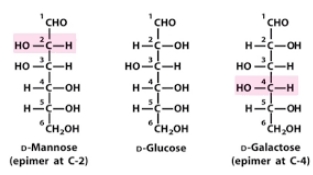
(A) Epimerization is the process by which two compounds formed are epimers,i.e.,two compounds differ in configuration only at one chiral center,while the rest of the configuration of the two compounds is the same.
For example,glucose and galactose are epimers of each other,as they differ only in the position of the hydroxyl group at $C_4$ (a chiral carbon atom).
For example,glucose and galactose are epimers of each other,as they differ only in the position of the hydroxyl group at $C_4$ (a chiral carbon atom).
0 likes
View Solution34
MediumMCQ
The compound which does not contain an asymmetric carbon atom is
A
Glycolaldehyde
B
Glyceraldehyde
C
Glucose
D
Galactose
Solution
(A) An asymmetric carbon atom (chiral carbon) is a carbon atom that is attached to four different types of atoms or groups of atoms.
Glycolaldehyde $(HOCH_2CHO)$ has the structure $HO-CH_2-CHO$. In this molecule,the carbon atom of the $CH_2$ group is attached to two hydrogen atoms,and the carbonyl carbon is attached to a hydrogen and an oxygen atom via a double bond,meaning neither carbon is bonded to four different groups.
Therefore,Glycolaldehyde does not have a chiral carbon atom.
Glycolaldehyde $(HOCH_2CHO)$ has the structure $HO-CH_2-CHO$. In this molecule,the carbon atom of the $CH_2$ group is attached to two hydrogen atoms,and the carbonyl carbon is attached to a hydrogen and an oxygen atom via a double bond,meaning neither carbon is bonded to four different groups.
Therefore,Glycolaldehyde does not have a chiral carbon atom.
0 likes
View Solution35
EasyMCQ
The standard compound for determination of configuration in the 'sugar chemistry' is
A
Glycolaldehyde
B
Glyceraldehyde
C
Glucose
D
Fructose
Solution
(B) Glyceraldehyde has been chosen as the arbitrary standard for the $D$ and $L$ notation in sugar chemistry.
This is because it contains an asymmetric carbon atom and can exist as a pair of enantiomers,which serves as the reference point for assigning relative configurations to other carbohydrates.
This is because it contains an asymmetric carbon atom and can exist as a pair of enantiomers,which serves as the reference point for assigning relative configurations to other carbohydrates.
0 likes
View Solution36
EasyMCQ
Sugars are
A
Optically active polyhydroxy aldehydes
B
Optically active polyhydroxy ketones
C
Optically active polyhydroxy aldehydes or ketones
D
Polyhydroxy aldehydes or ketones which may or may not be optically active
Solution
(C) Sugar may be defined as optically active polyhydroxy aldehydes or ketones.
As it contains at least one asymmetrical (chiral) carbon and is,therefore,optically active.
As it contains at least one asymmetrical (chiral) carbon and is,therefore,optically active.
0 likes
View Solution37
DifficultMCQ
The molecular formula of the pentahydroxy acid obtained when glucose is oxidized with $Br_2$ water is:
A
$C_6H_{12}O_7$
B
$C_6H_{12}O_8$
C
$C_6H_{12}O_6$
D
$C_6H_{10}O_6$
Solution
(A) Glucose $(C_6H_{12}O_6)$ contains an aldehyde group $(-CHO)$ and five hydroxyl groups $(-OH)$.
When glucose is oxidized with bromine water ($Br_2$ water),the aldehyde group is selectively oxidized to a carboxylic acid group $(-COOH)$ while the hydroxyl groups remain unaffected.
This reaction produces gluconic acid,which has the molecular formula $C_6H_{12}O_7$.
Since it contains five hydroxyl groups and one carboxylic acid group,it is a pentahydroxy acid.
When glucose is oxidized with bromine water ($Br_2$ water),the aldehyde group is selectively oxidized to a carboxylic acid group $(-COOH)$ while the hydroxyl groups remain unaffected.
This reaction produces gluconic acid,which has the molecular formula $C_6H_{12}O_7$.
Since it contains five hydroxyl groups and one carboxylic acid group,it is a pentahydroxy acid.
0 likes
View Solution38
EasyMCQ
Sucrose is a
A
Monosaccharide
B
Disaccharide
C
Trisaccharide
D
Polysaccharide
Solution
(B) Sucrose is a disaccharide.
Upon hydrolysis,one molecule of sucrose yields one molecule of $D-(+)$-glucose and one molecule of $D-(-)$-fructose.
Upon hydrolysis,one molecule of sucrose yields one molecule of $D-(+)$-glucose and one molecule of $D-(-)$-fructose.
0 likes
View Solution39
EasyMCQ
The commonest disaccharide has the molecular formula
A
$C_{10}H_{18}O_9$
B
$C_{10}H_{20}O_{10}$
C
$C_{18}H_{22}O_{11}$
D
$C_{12}H_{22}O_{11}$
Solution
(D) Disaccharides are carbohydrates that,upon hydrolysis,yield two same or different monosaccharide units.
Sucrose is the most common disaccharide,commonly known as table sugar.
It is naturally occurring and found in many plants.
The molecular formula of sucrose is $C_{12}H_{22}O_{11}$.
Sucrose is the most common disaccharide,commonly known as table sugar.
It is naturally occurring and found in many plants.
The molecular formula of sucrose is $C_{12}H_{22}O_{11}$.
0 likes
View Solution40
EasyMCQ
On complete hydrolysis of starch,we finally get
A
Glucose
B
Fructose
C
Glucose and fructose
D
Sucrose
Solution
(A) Starch is a polysaccharide,which is a polymer of $D$-glucose units.
Upon complete hydrolysis,the glycosidic linkages in starch are broken down,resulting in the formation of $D$-glucose molecules only.
Upon complete hydrolysis,the glycosidic linkages in starch are broken down,resulting in the formation of $D$-glucose molecules only.
0 likes
View Solution41
EasyMCQ
Which of the following is a monosaccharide?
A
Glucose
B
Fructose
C
Galactose
D
All of these
Solution
(D) Monosaccharides are the simplest form of sugar and the most basic units of carbohydrates.
They cannot be further hydrolyzed into simpler chemical compounds.
Glucose,fructose,and galactose are all examples of monosaccharides.
Therefore,the correct option is $D$.
They cannot be further hydrolyzed into simpler chemical compounds.
Glucose,fructose,and galactose are all examples of monosaccharides.
Therefore,the correct option is $D$.
0 likes
View Solution42
EasyMCQ
Which of the following is a polysaccharide?
A
Starch
B
Cellulose
C
Glycogen
D
All of these
Solution
(D) The correct answer is option $D$ i.e.,"All of these".
Polysaccharides are carbohydrate polymers,such as starch,cellulose,and glycogen,which are composed of more than $10$ monosaccharide units joined together by glycosidic linkages.
Starch,glycogen,and cellulose are all polysaccharides derived from glucose.
Maltose,sucrose,and lactose are disaccharides,whereas fructose and galactose are monosaccharides.
Polysaccharides are carbohydrate polymers,such as starch,cellulose,and glycogen,which are composed of more than $10$ monosaccharide units joined together by glycosidic linkages.
Starch,glycogen,and cellulose are all polysaccharides derived from glucose.
Maltose,sucrose,and lactose are disaccharides,whereas fructose and galactose are monosaccharides.
0 likes
View Solution43
EasyMCQ
Gun-cotton is obtained when conc. nitric acid reacts with
A
Glycerine
B
Glycol
C
Cellulose
D
Starch
Solution
(C) Gun-cotton is a highly flammable compound formed by the nitration of cellulose.
When cellulose is treated with concentrated nitric acid $(HNO_3)$ in the presence of concentrated sulphuric acid $(H_2SO_4)$,it undergoes nitration to form cellulose nitrate,which is commonly known as gun-cotton.
When cellulose is treated with concentrated nitric acid $(HNO_3)$ in the presence of concentrated sulphuric acid $(H_2SO_4)$,it undergoes nitration to form cellulose nitrate,which is commonly known as gun-cotton.
0 likes
View Solution44
EasyMCQ
$A$ carbohydrate consists of
A
$C$ and $O$
B
$C, H$ and $O$
C
$C, H, N$ and $O$
D
$C$ and $H$
Solution
(B) Carbohydrates (also called saccharides) are molecular compounds made from just three elements: Carbon $(C)$,Hydrogen $(H)$,and Oxygen $(O)$.
0 likes
View Solution45
MediumMCQ
Glucose forms many derivatives. The derivative which will help to prove the furanose structure is
A
Acetyl
B
Benzoyl
C
Osazone
D
Isopropylidene
Solution
(D) The furanose structure of sugars (like fructose) is confirmed by the formation of isopropylidene derivatives.
When fructose reacts with acetone in the presence of an acid catalyst,it forms di-isopropylidene fructose,which confirms the presence of a five-membered furanose ring structure.
When fructose reacts with acetone in the presence of an acid catalyst,it forms di-isopropylidene fructose,which confirms the presence of a five-membered furanose ring structure.
0 likes
View Solution46
MediumMCQ
Glucose and fructose form:
A
Same osazone
B
Same acid on oxidation
C
Same alcohol when reduced
D
Different osazone
Solution
(A) Glucose and fructose form the same osazone.
Both glucose and fructose differ only in their configuration at carbon atoms $C-1$ and $C-2$.
During the reaction with excess phenylhydrazine,the structural differences at these two carbons are eliminated,resulting in the formation of an identical osazone derivative for both sugars.
Both glucose and fructose differ only in their configuration at carbon atoms $C-1$ and $C-2$.
During the reaction with excess phenylhydrazine,the structural differences at these two carbons are eliminated,resulting in the formation of an identical osazone derivative for both sugars.
0 likes
View Solution47
MediumMCQ
On heating with conc. $H_2SO_4$,sucrose gives
A
$CO$ and $CO_2$
B
$CO$ and $SO_2$
C
$CO, CO_2$ and $SO_2$
D
None of these
Solution
(D) Sucrose $(C_{12}H_{22}O_{11})$ is a carbohydrate that undergoes dehydration in the presence of concentrated $H_2SO_4$.
Concentrated $H_2SO_4$ acts as a strong dehydrating agent and removes water molecules from the sugar.
The reaction is: $C_{12}H_{22}O_{11} \xrightarrow{\text{conc. } H_2SO_4} 12C + 11H_2O$.
Since the products are carbon and water,none of the given options $(A, B, C)$ are correct.
Concentrated $H_2SO_4$ acts as a strong dehydrating agent and removes water molecules from the sugar.
The reaction is: $C_{12}H_{22}O_{11} \xrightarrow{\text{conc. } H_2SO_4} 12C + 11H_2O$.
Since the products are carbon and water,none of the given options $(A, B, C)$ are correct.
0 likes
View Solution48
EasyMCQ
The letter '$D$' in carbohydrates represents
A
Its direct synthesis
B
Its dextrorotation
C
Its mutarotation
D
Its configuration
Solution
(D) The letter '$D$' indicates the configuration of a carbohydrate.
It represents the position of the $-OH$ group attached to the second-last carbon atom in the Fischer projection.
If the $-OH$ group is present on the right side,it is called '$D$'-configuration,and if it is present on the left side,it is called '$L$'-configuration.
It represents the position of the $-OH$ group attached to the second-last carbon atom in the Fischer projection.
If the $-OH$ group is present on the right side,it is called '$D$'-configuration,and if it is present on the left side,it is called '$L$'-configuration.
0 likes
View Solution49
MediumMCQ
It is best to carry out reactions with sugars in neutral or acid medium and not in alkaline medium. This is because in alkaline medium,sugars undergo one of the following changes:
A
Racemisation
B
Rearrangement
C
Inversion
D
Both $(b)$ and $(c)$
Solution
(B) Sugars contain a carbonyl group which can undergo enolization in the presence of the $OH^-$ ions found in an alkaline medium.
This enolization process leads to the rearrangement of the sugar structure (e.g.,Lobry de Bruyn-van Ekenstein transformation).
Therefore,rearrangement is possible in an alkaline medium.
This enolization process leads to the rearrangement of the sugar structure (e.g.,Lobry de Bruyn-van Ekenstein transformation).
Therefore,rearrangement is possible in an alkaline medium.
0 likes
View Solution50
MediumMCQ
Which one of the following compounds is found abundantly in nature?
A
Fructose
B
Starch
C
Glucose
D
Cellulose
Solution
(D) Cellulose is the most abundant organic polymer found in nature,primarily as the structural component of plant cell walls.
0 likes
View SolutionBiomolecules — Carbohydrates · Frequently Asked Questions
1Are these Biomolecules questions useful for JEE and NEET?
Yes. All questions in this section are mapped to JEE Main and NEET exam patterns. Previous year questions from JEE Main, NEET, GUJCET and state-level exams are included with full solutions.
2Can I switch to Hindi or Gujarati for these questions?
Yes. Use the language tabs in the hero section or the sidebar to view the same questions and solutions in English, Hindi or Gujarati.
3How do I generate a question paper from this subtopic?
Use the Vedclass Exam Paper Generator — select the chapter and subtopic, set difficulty, and generate Sets A, B, C, D automatically. First 3 chapters of every subject are free.
Vedclass Products
For Students
Vedclass Test Series
Mock tests in real JEE/NEET style with performance analysis. 5-day free trial.
Start Free TrialFor Teachers
Exam Paper Generator
Generate Set A/B/C/D papers from this chapter in 2 minutes. 3 chapters free.
Try FreeFor Institutes
Online Exam Module
Live online exams with unlimited students, 360° analytics & white-label branding.
See DemoFor Teachers & Institutes
Generate a Biomolecules Exam Paper in 2 Minutes
Select subtopic & difficulty — Sets A, B, C, D auto-generated with No Repeat logic.
First 3 chapters of every subject are free — no payment required.