
A English
Amino Acids and Proteins Questions in English
Class 12 Chemistry · Biomolecules · Amino Acids and Proteins
518+
Questions
English
Language
100%
With Solutions
Showing 46 of 518 questions in English
451
MediumMCQ
There are $20$ naturally occurring amino acids. The maximum number of tripeptides that can be obtained is
A
$8000$
B
$6470$
C
$7465$
D
$5360$
Solution
(A) tripeptide is formed by the combination of $3$ amino acids.
Since there are $20$ different types of naturally occurring amino acids and each position in the tripeptide can be occupied by any of these $20$ amino acids,the total number of possible tripeptides is calculated as $20 \times 20 \times 20 = 20^{3}$.
Therefore,the total number of tripeptides is $8000$.
Since there are $20$ different types of naturally occurring amino acids and each position in the tripeptide can be occupied by any of these $20$ amino acids,the total number of possible tripeptides is calculated as $20 \times 20 \times 20 = 20^{3}$.
Therefore,the total number of tripeptides is $8000$.
0 likes
View Solution452
MediumMCQ
The amino acid which is not optically active is
A
lactic acid
B
serine
C
alanine
D
glycine
Solution
(D) An amino acid is optically active if it contains at least one chiral carbon atom (an asymmetric carbon atom bonded to four different groups).
Glycine has the structure $NH_2-CH_2-COOH$.
In glycine,the central carbon atom is bonded to two identical hydrogen atoms,meaning it does not have a chiral center.
Therefore,glycine is the only naturally occurring amino acid that is not optically active.
Glycine has the structure $NH_2-CH_2-COOH$.
In glycine,the central carbon atom is bonded to two identical hydrogen atoms,meaning it does not have a chiral center.
Therefore,glycine is the only naturally occurring amino acid that is not optically active.
0 likes
View Solution453
EasyMCQ
Which of the following is generally water insoluble?
A
Amylose
B
Glycine
C
Fibrous protein
D
Vitamin-$C$
Solution
(C)
Fibrous proteins are generally insoluble in water due to the presence of strong intermolecular hydrogen bonds and disulfide linkages that hold the polypeptide chains together.
Fibrous proteins are generally insoluble in water due to the presence of strong intermolecular hydrogen bonds and disulfide linkages that hold the polypeptide chains together.
0 likes
View Solution454
MediumMCQ
Thyroxine produced in the thyroid gland is an iodinated derivative of
A
threonine
B
lysine
C
tyrosine
D
tryptophan
Solution
(C) Thyroxine,also known as tetraiodothyronine or $T_4$,is an iodinated derivative of the amino acid tyrosine.
It is a hormone produced by the thyroid gland and plays a crucial role in regulating the metabolism and growth in the body.
It is a hormone produced by the thyroid gland and plays a crucial role in regulating the metabolism and growth in the body.
0 likes
View Solution455
MediumMCQ
The number of disulphide linkages present in insulin are
A
$1$
B
$2$
C
$3$
D
$4$
Solution
(C) Insulin is composed of two peptide chains referred to as the $A$ chain and $B$ chain.
The $A$ chain consists of $21$ amino acid residues and the $B$ chain consists of $30$ amino acid residues.
These two chains are linked together by two inter-chain disulphide bridges.
Additionally,there is one intra-chain disulphide bridge within the $A$ chain.
Therefore,the total number of disulphide linkages in insulin is $3$.
The $A$ chain consists of $21$ amino acid residues and the $B$ chain consists of $30$ amino acid residues.
These two chains are linked together by two inter-chain disulphide bridges.
Additionally,there is one intra-chain disulphide bridge within the $A$ chain.
Therefore,the total number of disulphide linkages in insulin is $3$.
0 likes
View Solution456
MediumMCQ
The condensation polymer among the following is
A
$rubber$
B
$protein$
C
$PVC$
D
$polyethene$
Solution
(B) $Proteins$ are the condensation polymers of $\alpha$-amino acids.
$Proteins$ contain peptide bonds,which are represented by the linkage:
$(-CO-NH-)$.
$Proteins$ contain peptide bonds,which are represented by the linkage:
$(-CO-NH-)$.
0 likes
View Solution457
MediumMCQ
The list given below contains essential amino acids that are basic $(X)$ and also non-essential amino acids that are neutral $(Y)$. Identify $X$ and $Y$ from the following list:
$a)$ Lysine
$b)$ Alanine
$c)$ Serine
$d)$ Arginine
$e)$ Tyrosine
$a)$ Lysine
$b)$ Alanine
$c)$ Serine
$d)$ Arginine
$e)$ Tyrosine
A
$X = b, c, e; \quad Y = a, d$
B
$X = a, d; \quad Y = b, c, e$
C
$X = a, c; \quad Y = b, d, e$
D
$X = a, b, c; \quad Y = d, e$
Solution
(B) $1$. Analyze the amino acids provided:
$a)$ Lysine: Essential,Basic
$b)$ Alanine: Non-essential,Neutral
$c)$ Serine: Non-essential,Neutral
$d)$ Arginine: Essential,Basic
$e)$ Tyrosine: Non-essential,Neutral
$2$. $X$ represents essential and basic amino acids: Lysine $(a)$ and Arginine $(d)$.
$3$. $Y$ represents non-essential and neutral amino acids: Alanine $(b)$,Serine $(c)$,and Tyrosine $(e)$.
$4$. Therefore,$X = a, d$ and $Y = b, c, e$.
$a)$ Lysine: Essential,Basic
$b)$ Alanine: Non-essential,Neutral
$c)$ Serine: Non-essential,Neutral
$d)$ Arginine: Essential,Basic
$e)$ Tyrosine: Non-essential,Neutral
$2$. $X$ represents essential and basic amino acids: Lysine $(a)$ and Arginine $(d)$.
$3$. $Y$ represents non-essential and neutral amino acids: Alanine $(b)$,Serine $(c)$,and Tyrosine $(e)$.
$4$. Therefore,$X = a, d$ and $Y = b, c, e$.
0 likes
View Solution458
EasyMCQ
Consider the following statements:
Statement-$I$: Lysine and arginine are essential and basic amino acids.
Statement-$II$: Leucine and phenylalanine are non-essential and neutral amino acids.
Statement-$I$: Lysine and arginine are essential and basic amino acids.
Statement-$II$: Leucine and phenylalanine are non-essential and neutral amino acids.
A
Both statement-$I$ and statement-$II$ are correct
B
Both statement-$I$ and statement-$II$ are not correct
C
Statement-$I$ is correct,but statement-$II$ is not correct
D
Statement-$I$ is not correct,but statement-$II$ is correct
Solution
(C) Statement-$I$ is correct: Lysine and arginine are indeed basic amino acids (due to the presence of extra amino groups) and they are essential amino acids (cannot be synthesized by the human body).
Statement-$II$ is incorrect: While leucine and phenylalanine are neutral amino acids,they are both essential amino acids,not non-essential.
Therefore,statement-$I$ is correct,but statement-$II$ is not correct.
Statement-$II$ is incorrect: While leucine and phenylalanine are neutral amino acids,they are both essential amino acids,not non-essential.
Therefore,statement-$I$ is correct,but statement-$II$ is not correct.
0 likes
View Solution459
EasyMCQ
Identify the essential amino acids from the following:
$A$) Leucine
$B$) Tyrosine
$C$) Cysteine
$D$) Histidine
$A$) Leucine
$B$) Tyrosine
$C$) Cysteine
$D$) Histidine
A
$A$ & $B$ only
B
$B$ & $C$ only
C
$B$ & $D$ only
D
$A$ & $D$ only
Solution
(D) Essential amino acids are those that cannot be synthesized by the human body and must be obtained through the diet.
Among the given options:
$1$) Leucine is an essential amino acid.
$2$) Histidine is an essential amino acid (often classified as semi-essential in adults but essential in infants).
$3$) Tyrosine and Cysteine are non-essential amino acids as they can be synthesized by the body.
Therefore,$A$ (Leucine) and $D$ (Histidine) are the essential amino acids.
The correct option is $D$.
Among the given options:
$1$) Leucine is an essential amino acid.
$2$) Histidine is an essential amino acid (often classified as semi-essential in adults but essential in infants).
$3$) Tyrosine and Cysteine are non-essential amino acids as they can be synthesized by the body.
Therefore,$A$ (Leucine) and $D$ (Histidine) are the essential amino acids.
The correct option is $D$.
0 likes
View Solution460
DifficultMCQ
Which of the following is an essential amino acid?
A
$CH_3-CH(NH_2)-COOH$ (Alanine)
B
$HOCH_2-CH(NH_2)-COOH$ (Serine)
C
$(CH_3)_2CH-CH_2-CH(NH_2)-COOH$ (Leucine)
D
$HSCH_2-CH(NH_2)-COOH$ (Cysteine)
Solution
(C) Essential amino acids are those that cannot be synthesized by the human body and must be obtained through diet.
Among the given options,Leucine is an essential amino acid.
Among the given options,Leucine is an essential amino acid.
| Essential Amino Acid | Non-essential Amino Acid |
|---|---|
| Arginine | Alanine |
| Histidine | Asparagine |
| Isoleucine | Aspartate |
| Leucine | Glutamate |
| Lysine | Glycine |
| Methionine | Serine |
| Phenylalanine | Tyrosine |
| Threonine | |
| Tryptophan | |
| Valine |
0 likes
View Solution461
MediumMCQ
Identify the amino acid which has $-NH_2$,$-CO_2H$ and $-CONH_2$ groups.
A
Alanine
B
Arginine
C
Asparagine
D
Aspartic acid
Solution
(C) The structure of Asparagine is $H_2N-CO-CH_2-CH(NH_2)-COOH$.
It contains an amino group $(-NH_2)$,a carboxylic acid group $(-COOH)$,and an amide group $(-CONH_2)$ in its side chain.
Therefore,the correct option is $C$.
It contains an amino group $(-NH_2)$,a carboxylic acid group $(-COOH)$,and an amide group $(-CONH_2)$ in its side chain.
Therefore,the correct option is $C$.
0 likes
View Solution462
MediumMCQ
The number of essential and non-essential amino acids from the following list respectively is:
Val,Gly,Leu,Lys,Pro,Ser
Val,Gly,Leu,Lys,Pro,Ser
A
$3, 3$
B
$4, 2$
C
$2, 4$
D
$5, 1$
Solution
(A) The given amino acids are: $Val$ (Valine),$Gly$ (Glycine),$Leu$ (Leucine),$Lys$ (Lysine),$Pro$ (Proline),and $Ser$ (Serine).
Essential amino acids are those that cannot be synthesized by the body and must be obtained through the diet. Among the given list,$Val$,$Leu$,and $Lys$ are essential amino acids.
Non-essential amino acids are those that can be synthesized by the body. Among the given list,$Gly$,$Pro$,and $Ser$ are non-essential amino acids.
Thus,there are $3$ essential and $3$ non-essential amino acids.
Therefore,the correct option is $A$.
Essential amino acids are those that cannot be synthesized by the body and must be obtained through the diet. Among the given list,$Val$,$Leu$,and $Lys$ are essential amino acids.
Non-essential amino acids are those that can be synthesized by the body. Among the given list,$Gly$,$Pro$,and $Ser$ are non-essential amino acids.
Thus,there are $3$ essential and $3$ non-essential amino acids.
Therefore,the correct option is $A$.
0 likes
View Solution463
MediumMCQ
Which of the following amino acids possesses two chiral centres?
A
Leucine
B
Valine
C
Serine
D
Threonine
Solution
(D) The structure of Threonine is $CH_3-CH(OH)-CH(NH_2)-COOH$.
In this structure,the carbon atom attached to the $-NH_2$ group is chiral because it is bonded to four different groups: $-H$,$-NH_2$,$-COOH$,and the $-CH(OH)CH_3$ group.
The carbon atom attached to the $-OH$ group is also chiral because it is bonded to four different groups: $-H$,$-OH$,$-CH_3$,and the $-CH(NH_2)COOH$ group.
Therefore,Threonine has $2$ chiral centres.
In this structure,the carbon atom attached to the $-NH_2$ group is chiral because it is bonded to four different groups: $-H$,$-NH_2$,$-COOH$,and the $-CH(OH)CH_3$ group.
The carbon atom attached to the $-OH$ group is also chiral because it is bonded to four different groups: $-H$,$-OH$,$-CH_3$,and the $-CH(NH_2)COOH$ group.
Therefore,Threonine has $2$ chiral centres.
0 likes
View Solution464
EasyMCQ
Which of the following is not an essential amino acid?
A
Lysine
B
Histidine
C
Glutamine
D
Methionine
Solution
(C) Essential amino acids are those that cannot be synthesized by the human body and must be obtained through the diet. Non-essential amino acids are those that the body can synthesize on its own.
Based on the table,$Glutamine$ is a non-essential amino acid.
| Essential Amino Acids | Non-essential Amino Acids |
|---|---|
| $Arginine$ $(Arg)$ | $Alanine$ $(Ala)$ |
| $Histidine$ $(His)$ | $Asparagine$ $(Asn)$ |
| $Isoleucine$ $(Ile)$ | $Aspartic$ $acid$ $(Asp)$ |
| $Leucine$ $(Leu)$ | $Glutamic$ $acid$ $(Glu)$ |
| $Lysine$ $(Lys)$ | $Glutamine$ $(Gln)$ |
| $Methionine$ $(Met)$ | $Glycine$ $(Gly)$ |
| $Phenylalanine$ $(Phe)$ | $Proline$ $(Pro)$ |
| $Threonine$ $(Thr)$ | $Serine$ $(Ser)$ |
| $Tryptophan$ $(Trp)$ | $Cysteine$ $(Cys)$ |
| $Valine$ $(Val)$ | $Tyrosine$ $(Tyr)$ |
Based on the table,$Glutamine$ is a non-essential amino acid.
0 likes
View Solution465
MediumMCQ
The structure of $Gly-Ala$ is
A
$H_2N-CH(CH_3)-CO-NH-CH_2-COOH$
B
$H_2N-CH_2-CO-NH-CH(CH_3)-COOH$
C
$H_2N-CH(CH_3)-CO-NH-CH(CH_2OH)-COOH$
D
$H_2N-CH(CH_2OH)-CO-NH-CH(CH_3)-COOH$
Solution
(B) dipeptide is formed by the condensation reaction between the carboxyl group $(-COOH)$ of one amino acid and the amino group $(-NH_2)$ of another amino acid.
In the dipeptide $Gly-Ala$,$Gly$ (Glycine) is the $N$-terminal amino acid and $Ala$ (Alanine) is the $C$-terminal amino acid.
Glycine structure: $H_2N-CH_2-COOH$
Alanine structure: $H_2N-CH(CH_3)-COOH$
When $Gly$ and $Ala$ combine,the $-COOH$ group of $Gly$ reacts with the $-NH_2$ group of $Ala$ to form a peptide bond $(-CO-NH-)$.
The resulting structure is $H_2N-CH_2-CO-NH-CH(CH_3)-COOH$.
In the dipeptide $Gly-Ala$,$Gly$ (Glycine) is the $N$-terminal amino acid and $Ala$ (Alanine) is the $C$-terminal amino acid.
Glycine structure: $H_2N-CH_2-COOH$
Alanine structure: $H_2N-CH(CH_3)-COOH$
When $Gly$ and $Ala$ combine,the $-COOH$ group of $Gly$ reacts with the $-NH_2$ group of $Ala$ to form a peptide bond $(-CO-NH-)$.
The resulting structure is $H_2N-CH_2-CO-NH-CH(CH_3)-COOH$.
0 likes
View Solution466
EasyMCQ
Which of the following are sulphur-containing amino acids?
| $(A)$. Serine | $(B)$. Cysteine |
| $(C)$. Lysine | $(D)$. Methionine |
A
$(A), (D)$
B
$(A), (C)$
C
$(B), (C)$
D
$(B), (D)$
Solution
(D) $S$-containing amino acids are Cysteine and Methionine.
Serine is an $OH$-containing amino acid.
Lysine is a basic amino acid containing an extra $-NH_2$ group.
Therefore,the correct options are $(B)$ and $(D)$.
Serine is an $OH$-containing amino acid.
Lysine is a basic amino acid containing an extra $-NH_2$ group.
Therefore,the correct options are $(B)$ and $(D)$.
0 likes
View Solution467
EasyMCQ
In which of the following amino acids is the $-OH$ group present?
| $(A)$ Lysine | $(B)$ Serine |
| $(C)$ Tyrosine | $(D)$ Valine |
A
$(A), (B)$
B
$(A), (C)$
C
$(B), (C)$
D
$(B), (D)$
Solution
(C) To determine which amino acids contain an $-OH$ (hydroxyl) group in their side chain,let us examine the structures:
$1$. Lysine: Contains an amino group $(-NH_2)$ in its side chain.
$2$. Serine: Contains a hydroxymethyl group $(-CH_2OH)$ in its side chain,which includes an $-OH$ group.
$3$. Tyrosine: Contains a phenolic group $(-C_6H_4OH)$ in its side chain,which includes an $-OH$ group.
$4$. Valine: Contains an isopropyl group $(-CH(CH_3)_2)$ in its side chain,which does not contain an $-OH$ group.
Therefore,both Serine and Tyrosine contain an $-OH$ group. The correct option is $(C)$.
$1$. Lysine: Contains an amino group $(-NH_2)$ in its side chain.
$2$. Serine: Contains a hydroxymethyl group $(-CH_2OH)$ in its side chain,which includes an $-OH$ group.
$3$. Tyrosine: Contains a phenolic group $(-C_6H_4OH)$ in its side chain,which includes an $-OH$ group.
$4$. Valine: Contains an isopropyl group $(-CH(CH_3)_2)$ in its side chain,which does not contain an $-OH$ group.
Therefore,both Serine and Tyrosine contain an $-OH$ group. The correct option is $(C)$.
0 likes
View Solution468
EasyMCQ
Identify the correct statement related to amino acids.
A
Nonessential amino acids cannot be synthesized in the body.
B
These are soluble in ether.
C
These are low melting solid substances.
D
In aqueous solution they exist as zwitter ion.
Solution
(D) Essential amino acids cannot be synthesized in our body,so we need to take them in our diet.
Amino acids are soluble in water but generally insoluble in organic solvents like ether.
Due to their crystalline nature,they are high melting solids because of strong dipole-dipole interactions.
In aqueous solutions,they exist as dipolar zwitter ions,as shown below:
$H_3N^+-CH(R)-COO^-$
Amino acids are soluble in water but generally insoluble in organic solvents like ether.
Due to their crystalline nature,they are high melting solids because of strong dipole-dipole interactions.
In aqueous solutions,they exist as dipolar zwitter ions,as shown below:
$H_3N^+-CH(R)-COO^-$
0 likes
View Solution469
EasyMCQ
What is the functional group present in serine,an amino acid,in addition to $-NH_2$ and $-COOH$ groups?
A
$-OH$
B
$-SH$
C
$-NH^{-}$
D
None of these
Solution
(A) Serine is an amino acid with the chemical structure $HOCH_2-CH(NH_2)-COOH$.
Apart from the amino group $(-NH_2)$ and the carboxylic acid group $(-COOH)$,it contains a hydroxyl group $(-OH)$ in its side chain.
Apart from the amino group $(-NH_2)$ and the carboxylic acid group $(-COOH)$,it contains a hydroxyl group $(-OH)$ in its side chain.
0 likes
View Solution470
EasyMCQ
The total number of amino acids present in insulin is
A
$55$
B
$1051$
C
$51$
D
$100$
Solution
(C) Human insulin is a peptide hormone composed of two polypeptide chains,chain $A$ and chain $B$,linked by disulfide bridges.
Chain $A$ consists of $21$ amino acids and chain $B$ consists of $30$ amino acids.
Therefore,the total number of amino acids in insulin is $21 + 30 = 51$.
Chain $A$ consists of $21$ amino acids and chain $B$ consists of $30$ amino acids.
Therefore,the total number of amino acids in insulin is $21 + 30 = 51$.
0 likes
View Solution471
EasyMCQ
Which of the following amino acids is optically inactive?
A
Glycine
B
Proline
C
Tyrosine
D
Alanine
Solution
(A) An amino acid is optically active if it contains at least one chiral (asymmetrical) carbon atom.
Glycine has the structure $H_2N-CH_2-COOH$.
In glycine,the central carbon atom is bonded to two identical hydrogen atoms,meaning it does not have a chiral center.
Therefore,glycine is the only naturally occurring amino acid that is optically inactive.
Glycine has the structure $H_2N-CH_2-COOH$.
In glycine,the central carbon atom is bonded to two identical hydrogen atoms,meaning it does not have a chiral center.
Therefore,glycine is the only naturally occurring amino acid that is optically inactive.
0 likes
View Solution472
DifficultMCQ
Assertion $(A)$: An optically active amino acid can exist in three forms depending on the $pH$ of the solution.
Reason $(R)$: Amino acids contain both acidic and basic groups; they exist as a zwitterion in aqueous medium,anionic form in basic medium,and cationic form in acidic medium.
Reason $(R)$: Amino acids contain both acidic and basic groups; they exist as a zwitterion in aqueous medium,anionic form in basic medium,and cationic form in acidic medium.
A
$A$ and $R$ are correct and $R$ is the correct explanation for $A$
B
$A$ and $R$ are correct but $R$ is not the correct explanation for $A$
C
$A$ is correct,$R$ is wrong
D
$A$ is wrong,$R$ is correct
Solution
(C) Amino acids contain both acidic $(-COOH)$ and basic $(-NH_2)$ groups.
In an acidic medium (low $pH$),the $-NH_2$ group accepts a proton to form a cation $(R-CH(NH_3^+)-COOH)$.
In a basic medium (high $pH$),the $-COOH$ group loses a proton to form an anion $(R-CH(NH_2)-COO^-)$.
At the isoelectric point,they exist as a zwitterion $(R-CH(NH_3^+)-COO^-)$.
Thus,the assertion is correct.
However,the reason states that they exist as an anionic form in acidic medium and a cationic form in basic medium,which is the reverse of the actual chemical behavior.
Therefore,the reason is wrong.
In an acidic medium (low $pH$),the $-NH_2$ group accepts a proton to form a cation $(R-CH(NH_3^+)-COOH)$.
In a basic medium (high $pH$),the $-COOH$ group loses a proton to form an anion $(R-CH(NH_2)-COO^-)$.
At the isoelectric point,they exist as a zwitterion $(R-CH(NH_3^+)-COO^-)$.
Thus,the assertion is correct.
However,the reason states that they exist as an anionic form in acidic medium and a cationic form in basic medium,which is the reverse of the actual chemical behavior.
Therefore,the reason is wrong.
0 likes
View Solution473
EasyMCQ
The general structural formula of $\alpha$-amino acid is $NH_2-CH(R)-COOH$. The group $R$ in tryptophan $(X)$ and histidine $(Y)$ are respectively:
A
$X$: Indolyl-methyl group; $Y$: Imidazolyl-methyl group
B
$X$: Indolyl-ethyl group; $Y$: Imidazolyl-ethyl group
C
$X$: Indolyl-methyl group; $Y$: Imidazolyl-ethyl group
D
$X$: Indolyl-ethyl group; $Y$: Imidazolyl-methyl group
Solution
(A) The general structure of an $\alpha$-amino acid is $NH_2-CH(R)-COOH$.
In tryptophan,the $R$ group is an indolyl-methyl group (specifically,a $3$-indolylmethyl group).
In histidine,the $R$ group is an imidazolyl-methyl group (specifically,a $4$-imidazolylmethyl group).
Therefore,the correct representation for $R$ in tryptophan $(X)$ and histidine $(Y)$ is the indolyl-methyl group and the imidazolyl-methyl group respectively.
In tryptophan,the $R$ group is an indolyl-methyl group (specifically,a $3$-indolylmethyl group).
In histidine,the $R$ group is an imidazolyl-methyl group (specifically,a $4$-imidazolylmethyl group).
Therefore,the correct representation for $R$ in tryptophan $(X)$ and histidine $(Y)$ is the indolyl-methyl group and the imidazolyl-methyl group respectively.
0 likes
View Solution474
EasyMCQ
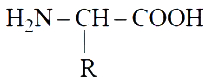
The general formula of an $\alpha$-amino acid is shown below. Identify the side chain $-R$ for the amino acid serine.
A
$-CH_2SH$
B
$-CH_2OH$
C
$-CH(OH)CH_3$
D
$-CH_2CONH_2$
Solution
(B) The general formula of an $\alpha$-amino acid is $H_2N-CH(R)-COOH$.
For the amino acid serine,the side chain $-R$ is a hydroxymethyl group,which is represented as $-CH_2OH$.
Therefore,the correct option is $B$.
For the amino acid serine,the side chain $-R$ is a hydroxymethyl group,which is represented as $-CH_2OH$.
Therefore,the correct option is $B$.
0 likes
View Solution475
EasyMCQ
The amino acid containing an indole part is
A
tryptophan
B
tyrosine
C
proline
D
methionine
Solution
(A) The amino acid $Tryptophan$ contains an indole ring in its side chain.
An indole ring is a bicyclic structure consisting of a six-membered benzene ring fused to a five-membered nitrogen-containing pyrrole ring.
Among the given options,$Tryptophan$ is the only amino acid that possesses this specific structural feature.
An indole ring is a bicyclic structure consisting of a six-membered benzene ring fused to a five-membered nitrogen-containing pyrrole ring.
Among the given options,$Tryptophan$ is the only amino acid that possesses this specific structural feature.
0 likes
View Solution476
MediumMCQ
Consider the following statements:
Statement-$I$: The primary structure of a protein represents its amino acid sequence.
Statement-$II$: The $\alpha$-helix and $\beta$-pleated sheet structures of a protein represent its tertiary structure.
Statement-$I$: The primary structure of a protein represents its amino acid sequence.
Statement-$II$: The $\alpha$-helix and $\beta$-pleated sheet structures of a protein represent its tertiary structure.
A
Both statement-$I$ and statement-$II$ are correct
B
Both statement-$I$ and statement-$II$ are not correct
C
Statement-$I$ is correct,but statement-$II$ is not correct
D
Statement-$I$ is not correct,but statement-$II$ is correct
Solution
(C) Statement-$I$ is correct because the primary structure of a protein refers to the specific sequence of amino acids linked by peptide bonds.
Statement-$II$ is incorrect because $\alpha$-helix and $\beta$-pleated sheet structures are examples of the secondary structure of proteins,not the tertiary structure. The tertiary structure refers to the overall three-dimensional folding of the polypeptide chain.
Statement-$II$ is incorrect because $\alpha$-helix and $\beta$-pleated sheet structures are examples of the secondary structure of proteins,not the tertiary structure. The tertiary structure refers to the overall three-dimensional folding of the polypeptide chain.
0 likes
View Solution477
MediumMCQ
Which of the following structures of proteins represents its constitution?
A
Secondary structure
B
Quaternary structure
C
Primary structure
D
Tertiary structure
Solution
(C) The $Primary$ structure of a protein refers to the specific sequence of amino acids in a polypeptide chain,which defines its constitution.
$Secondary$ structure refers to the local folding of the polypeptide chain into structures like $\alpha$-helices and $\beta$-pleated sheets,stabilized by hydrogen bonding.
$Tertiary$ structure refers to the overall three-dimensional shape of a single polypeptide chain,determined by interactions between side chains.
$Quaternary$ structure refers to the arrangement of multiple polypeptide chains in a multi-subunit protein.
$Secondary$ structure refers to the local folding of the polypeptide chain into structures like $\alpha$-helices and $\beta$-pleated sheets,stabilized by hydrogen bonding.
$Tertiary$ structure refers to the overall three-dimensional shape of a single polypeptide chain,determined by interactions between side chains.
$Quaternary$ structure refers to the arrangement of multiple polypeptide chains in a multi-subunit protein.
0 likes
View Solution478
EasyMCQ
Which of the following are fibrous proteins?
$A$: Keratin
$B$: Insulin
$C$: Myosin
$D$: Albumin
$A$: Keratin
$B$: Insulin
$C$: Myosin
$D$: Albumin
A
$A, B$
B
$A, C$
C
$B, D$
D
$C, D$
Solution
(B) Fibrous proteins are long,thread-like structures that are insoluble in water. Examples include $Keratin$ (found in hair,wool,skin) and $Myosin$ (found in muscles).
Globular proteins have a spherical shape and are generally soluble in water. Examples include $Insulin$ and $Albumin$.
Therefore,$Keratin$ $(A)$ and $Myosin$ $(C)$ are fibrous proteins.
Globular proteins have a spherical shape and are generally soluble in water. Examples include $Insulin$ and $Albumin$.
Therefore,$Keratin$ $(A)$ and $Myosin$ $(C)$ are fibrous proteins.
0 likes
View Solution479
EasyMCQ
Which of the following molecules is eliminated during peptide bond formation?
A
$H_2O$
B
$NH_3$
C
$CH_3OH$
D
$CO_2$
Solution
(A) Chemically,a peptide linkage is an amide bond formed between the $-COOH$ group of one amino acid and the $-NH_2$ group of another amino acid.
During this condensation reaction,the hydroxyl group $(-OH)$ from the carboxyl group and a hydrogen atom $(-H)$ from the amino group combine to form a water molecule $(H_2O)$,which is eliminated.
This results in the formation of a peptide bond $(-CO-NH-)$.
Therefore,the molecule eliminated during peptide bond formation is $H_2O$.
During this condensation reaction,the hydroxyl group $(-OH)$ from the carboxyl group and a hydrogen atom $(-H)$ from the amino group combine to form a water molecule $(H_2O)$,which is eliminated.
This results in the formation of a peptide bond $(-CO-NH-)$.
Therefore,the molecule eliminated during peptide bond formation is $H_2O$.
0 likes
View Solution480
DifficultMCQ
Glycylalanine is a dipeptide of which amino acids?
A
$H_2NCH_2COOH$ and $H_2NCH(CH_3)COOH$
B
$(CH_3)_2CHCH(NH_2)COOH$ and $H_2NCH_2COOH$
C
$(CH_3)_2CHCH_2CH(NH_2)COOH$ and $H_2NCH_2COOH$
D
$(CH_3)_2CHCH(NH_2)COOH$ and $(CH_3)_2CHCH(NH_2)COOH$
Solution
(A) Glycylalanine is a dipeptide formed by the condensation of glycine $(H_2NCH_2COOH)$ and alanine $(H_2NCH(CH_3)COOH)$.
During the formation of the peptide bond,a water molecule is eliminated between the carboxyl group of glycine and the amino group of alanine,resulting in the dipeptide glycylalanine.
During the formation of the peptide bond,a water molecule is eliminated between the carboxyl group of glycine and the amino group of alanine,resulting in the dipeptide glycylalanine.
0 likes
View Solution481
EasyMCQ
In which of the following is $Keratin$,a fibrous protein,absent?
A
Hair
B
Muscles
C
Silk
D
Wool
Solution
(B) $Keratin$ is a fibrous structural protein found in the outer protective layers of animals,such as hair,wool,nails,and skin.
$Silk$ is composed of a different fibrous protein called $Fibroin$.
$Muscles$ are primarily composed of contractile proteins like $Actin$ and $Myosin$.
Therefore,$Keratin$ is absent in $Muscles$ and $Silk$.
$Silk$ is composed of a different fibrous protein called $Fibroin$.
$Muscles$ are primarily composed of contractile proteins like $Actin$ and $Myosin$.
Therefore,$Keratin$ is absent in $Muscles$ and $Silk$.
0 likes
View Solution482
EasyMCQ
Which of the following is not true about the denaturation of protein?
A
$2^{\circ}$ structure gets destroyed
B
$3^{\circ}$ structure gets destroyed
C
$1^{\circ}$ structure gets destroyed
D
Bioactivity is lost
Solution
(C) During the denaturation of proteins,the $1^{\circ}$ (primary) structure remains intact because the peptide bonds are not broken.
However,the $2^{\circ}$ (secondary) and $3^{\circ}$ (tertiary) structures are destroyed due to the disruption of hydrogen bonds and other non-covalent interactions.
As a result,the protein loses its specific shape and its biological activity is lost.
However,the $2^{\circ}$ (secondary) and $3^{\circ}$ (tertiary) structures are destroyed due to the disruption of hydrogen bonds and other non-covalent interactions.
As a result,the protein loses its specific shape and its biological activity is lost.
0 likes
View Solution483
DifficultMCQ
Hydrolysis of proteins gives
A
$\beta$-amino acids
B
$\gamma$-amino acids
C
$\delta$-amino acids
D
$\alpha$-amino acids
Solution
(D) Proteins are polymers of amino acids linked by peptide bonds.
Upon complete hydrolysis,proteins yield only $\alpha$-amino acids.
An $\alpha$-amino acid has the general structure $R-CH(NH_2)-COOH$,where the amino group is attached to the $\alpha$-carbon atom.
Upon complete hydrolysis,proteins yield only $\alpha$-amino acids.
An $\alpha$-amino acid has the general structure $R-CH(NH_2)-COOH$,where the amino group is attached to the $\alpha$-carbon atom.
0 likes
View Solution484
DifficultMCQ
The correct representation of a nucleotide is:
A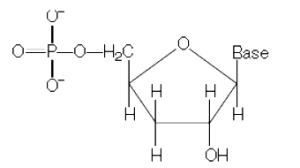
B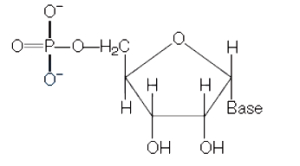
C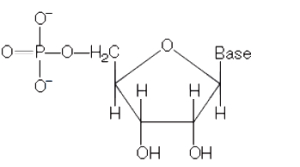
D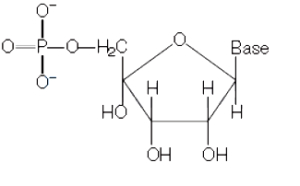
Solution
(C) nucleotide is the basic structural unit of nucleic acids ($DNA$ and $RNA$). It consists of three main components:
$1$. $A$ nitrogenous base (purine or pyrimidine) attached to the $1'$ carbon of the sugar.
$2$. $A$ pentose sugar (ribose in $RNA$ or $2'$-deoxyribose in $DNA$).
$3$. $A$ phosphate group attached to the $5'$ carbon of the sugar.
Looking at the provided structures:
- The structure must show the phosphate group attached to the $5'-CH_2$ group.
- The nitrogenous base must be attached to the $1'$ carbon.
- The $3'$ carbon must have a hydroxyl $(-OH)$ group.
Based on the standard structural representation of a nucleotide,the correct structure is shown in option $(C)$.
$1$. $A$ nitrogenous base (purine or pyrimidine) attached to the $1'$ carbon of the sugar.
$2$. $A$ pentose sugar (ribose in $RNA$ or $2'$-deoxyribose in $DNA$).
$3$. $A$ phosphate group attached to the $5'$ carbon of the sugar.
Looking at the provided structures:
- The structure must show the phosphate group attached to the $5'-CH_2$ group.
- The nitrogenous base must be attached to the $1'$ carbon.
- The $3'$ carbon must have a hydroxyl $(-OH)$ group.
Based on the standard structural representation of a nucleotide,the correct structure is shown in option $(C)$.
0 likes
View Solution485
DifficultMCQ
Match the following types of proteins with their properties:
| Type of Protein | Their Properties |
|---|---|
| $(A)$ Fibrous | $1$. Hydrogen bonding |
| $(B)$ Globular | $2$. Water soluble |
| $3$. Spherical shape | |
| $4$. Disulphide linkage |
A
$A-1, 4; B-2, 3$
B
$A-1, 3; B-2, 4$
C
$A-1, 2; B-3, 4$
D
$A-2, 4; B-1, 3$
Solution
(A) Fibrous proteins are long,thread-like molecules held together by strong hydrogen bonds and disulphide linkages. They are generally insoluble in water.
Globular proteins have a compact,spherical shape where the polypeptide chain twists around itself. The polar groups are on the surface,making them soluble in water.
Therefore,the correct matches are:
Fibrous $(A)$: $1$ (Hydrogen bonding) and $4$ (Disulphide linkage).
Globular $(B)$: $2$ (Water soluble) and $3$ (Spherical shape).
Thus,the correct option is $A-1, 4; B-2, 3$.
Globular proteins have a compact,spherical shape where the polypeptide chain twists around itself. The polar groups are on the surface,making them soluble in water.
Therefore,the correct matches are:
Fibrous $(A)$: $1$ (Hydrogen bonding) and $4$ (Disulphide linkage).
Globular $(B)$: $2$ (Water soluble) and $3$ (Spherical shape).
Thus,the correct option is $A-1, 4; B-2, 3$.
0 likes
View Solution486
MediumMCQ
In an amino acid,the carboxylic group ionises at $pH = 2.56$ $(pK_{a_1})$ and the ammonium ion ionises at $pH = 9.38$ $(pK_{a_2})$. The isoelectric point of the amino acid is at:
A
$11.94$
B
$6.82$
C
$5.97$
D
$3.41$
Solution
(C) The isoelectric point $(pI)$ of an amino acid is the $pH$ at which the molecule carries no net electric charge.
For a simple amino acid,the isoelectric point is calculated as the average of the two $pK_a$ values:
$pI = \frac{pK_{a_1} + pK_{a_2}}{2}$
Given $pK_{a_1} = 2.56$ and $pK_{a_2} = 9.38$,
$pI = \frac{2.56 + 9.38}{2} = \frac{11.94}{2} = 5.97$.
For a simple amino acid,the isoelectric point is calculated as the average of the two $pK_a$ values:
$pI = \frac{pK_{a_1} + pK_{a_2}}{2}$
Given $pK_{a_1} = 2.56$ and $pK_{a_2} = 9.38$,
$pI = \frac{2.56 + 9.38}{2} = \frac{11.94}{2} = 5.97$.
0 likes
View Solution487
MediumMCQ
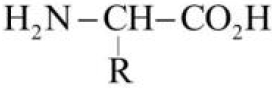
The general structure of $\alpha$-amino acid can be represented as shown below. Which amino acid is not correctly matched with the $R$ group given?
A
$R = -CH_2-C_6H_4-OH(p)$ (Tyrosine)
B
$R = -CH_2-SH$ (Cysteine)
C
$R = -CH_2-CH_2-S-CH_3$ (Serine)
D
$R = -CH_2-C(=O)-NH_2$ (Asparagine)
Solution
(C) The general structure of an $\alpha$-amino acid is $H_2N-CH(R)-COOH$.
Evaluating the options:
$A$. Tyrosine has $R = -CH_2-C_6H_4-OH(p)$,which is correct.
$B$. Cysteine has $R = -CH_2-SH$,which is correct.
$C$. Serine has $R = -CH_2-OH$. The structure given,$R = -CH_2-CH_2-S-CH_3$,corresponds to Methionine,not Serine. Thus,this is incorrectly matched.
$D$. Asparagine has $R = -CH_2-CONH_2$,which is correct.
Evaluating the options:
$A$. Tyrosine has $R = -CH_2-C_6H_4-OH(p)$,which is correct.
$B$. Cysteine has $R = -CH_2-SH$,which is correct.
$C$. Serine has $R = -CH_2-OH$. The structure given,$R = -CH_2-CH_2-S-CH_3$,corresponds to Methionine,not Serine. Thus,this is incorrectly matched.
$D$. Asparagine has $R = -CH_2-CONH_2$,which is correct.
0 likes
View Solution488
MediumMCQ
Amino acid '$X$' contains a phenolic hydroxy group and amino acid '$Y$' contains an amide group. '$X$' and '$Y$' respectively are
A
Ser,Arg
B
Cys,Lys
C
Thr,Asn
D
Tyr,Gln
Solution
(D) $1$. The amino acid '$X$' contains a phenolic hydroxy group. Among the given options,$Tyrosine$ $(Tyr)$ contains a phenolic hydroxy group attached to the benzene ring.
$2$. The amino acid '$Y$' contains an amide group. Among the given options,$Glutamine$ $(Gln)$ contains an amide group $(-CONH_2)$ in its side chain.
$3$. Therefore,'$X$' is $Tyr$ and '$Y$' is $Gln$.
$2$. The amino acid '$Y$' contains an amide group. Among the given options,$Glutamine$ $(Gln)$ contains an amide group $(-CONH_2)$ in its side chain.
$3$. Therefore,'$X$' is $Tyr$ and '$Y$' is $Gln$.
0 likes
View Solution489
EasyMCQ
The functional groups present in Asparagine,a nonessential amino acid,are
A
$ -NH_2, -COOH, -CONH_2 $
B
$ -NH_2, -COOH, -OH $
C
$ -NH_2, -COOH, -CHO $
D
$ -NH_2, -COOH, -SH $
Solution
(A) The structure of asparagine is $H_2N-CO-CH_2-CH(NH_2)-COOH$.
It contains an amino group $(-NH_2)$,a carboxylic acid group $(-COOH)$,and an amide group $(-CONH_2)$ in its side chain.
It contains an amino group $(-NH_2)$,a carboxylic acid group $(-COOH)$,and an amide group $(-CONH_2)$ in its side chain.
0 likes
View Solution490
EasyMCQ
Assertion $(A)$: In aqueous solution,amino acids exist in dipolar ion form.
Reason $(R)$: Most of the naturally occurring amino acids have $L$-configuration.
The correct option among the following is:
Reason $(R)$: Most of the naturally occurring amino acids have $L$-configuration.
The correct option among the following is:
A
$(A)$ is true,$(R)$ is true and $(R)$ is the correct explanation for $(A)$
B
$(A)$ is true,$(R)$ is true but $(R)$ is not the correct explanation for $(A)$
C
$(A)$ is true but $(R)$ is false
D
$(A)$ is false but $(R)$ is true
Solution
(B) In aqueous solution,the carboxyl group of an amino acid can lose a proton and the amino group can accept a proton,giving rise to a dipolar ion known as a zwitterion. Thus,Assertion $(A)$ is true.
Most naturally occurring amino acids have the $L$-configuration,where the $-NH_2$ group is on the left side in the Fischer projection. Thus,Reason $(R)$ is true.
However,the $L$-configuration of amino acids is not the reason why they exist as dipolar ions in aqueous solution. The dipolar nature is due to the acid-base properties of the functional groups present. Therefore,$(R)$ is not the correct explanation for $(A)$.
Most naturally occurring amino acids have the $L$-configuration,where the $-NH_2$ group is on the left side in the Fischer projection. Thus,Reason $(R)$ is true.
However,the $L$-configuration of amino acids is not the reason why they exist as dipolar ions in aqueous solution. The dipolar nature is due to the acid-base properties of the functional groups present. Therefore,$(R)$ is not the correct explanation for $(A)$.
0 likes
View Solution491
MediumMCQ
Assertion $(A)$: In aqueous solution,$\alpha$-amino acids exist as an internal salt called a zwitter ion.
Reason $(R)$: Proline is a natural amino acid having a secondary amino group. The correct option among the following is:
Reason $(R)$: Proline is a natural amino acid having a secondary amino group. The correct option among the following is:
A
$(A)$ is true,$(R)$ is true and $(R)$ is the correct explanation for $(A)$
B
$(A)$ is true,$(R)$ is true but $(R)$ is not the correct explanation for $(A)$
C
$(A)$ is true but $(R)$ is false
D
$(A)$ is false but $(R)$ is true
Solution
(B) In aqueous solution,the carboxyl group $(-COOH)$ can lose a proton to form a carboxylate ion $(-COO^-)$ and the amino group $(-NH_2)$ can accept a proton to form an ammonium ion $(-NH_3^+)$,giving rise to a dipolar ion known as a zwitter ion.
This zwitter ion is electrically neutral but contains both positive and negative charges.
In the zwitter ionic form,amino acids show amphoteric behavior as they react with both acids and bases.
Proline is indeed a natural amino acid that contains a secondary amine group (it is a cyclic amino acid).
Both the Assertion $(A)$ and the Reason $(R)$ are true,but the fact that proline has a secondary amino group is not the reason why amino acids exist as zwitter ions in aqueous solution. Therefore,$(R)$ is not the correct explanation for $(A)$.
This zwitter ion is electrically neutral but contains both positive and negative charges.
In the zwitter ionic form,amino acids show amphoteric behavior as they react with both acids and bases.
Proline is indeed a natural amino acid that contains a secondary amine group (it is a cyclic amino acid).
Both the Assertion $(A)$ and the Reason $(R)$ are true,but the fact that proline has a secondary amino group is not the reason why amino acids exist as zwitter ions in aqueous solution. Therefore,$(R)$ is not the correct explanation for $(A)$.
0 likes
View Solution492
EasyMCQ
Amino acids containing a heterocyclic ring are:
$(i)$ Histidine
$(ii)$ Valine
$(iii)$ Arginine
$(iv)$ Proline
$(i)$ Histidine
$(ii)$ Valine
$(iii)$ Arginine
$(iv)$ Proline
A
$(i)$,$(iv)$
B
$(ii)$,$(iii)$
C
$(i)$,$(iii)$
D
$(ii)$,$(iv)$
Solution
(A) The structures of the given amino acids are as follows:
$1$. Histidine contains an imidazole ring,which is a heterocyclic ring.
$2$. Valine is an aliphatic amino acid with an isopropyl side chain.
$3$. Arginine contains a guanidino group in its side chain,which is not a heterocyclic ring.
$4$. Proline contains a pyrrolidine ring,which is a heterocyclic ring.
Therefore,both Histidine $(i)$ and Proline $(iv)$ contain heterocyclic rings.
$1$. Histidine contains an imidazole ring,which is a heterocyclic ring.
$2$. Valine is an aliphatic amino acid with an isopropyl side chain.
$3$. Arginine contains a guanidino group in its side chain,which is not a heterocyclic ring.
$4$. Proline contains a pyrrolidine ring,which is a heterocyclic ring.
Therefore,both Histidine $(i)$ and Proline $(iv)$ contain heterocyclic rings.
0 likes
View Solution493
DifficultMCQ
Choose the correct Zwitter ionic form for aspartic acid.
A
The structure shows $H_3\stackrel{\oplus}{N}-CH(COOH)-COOH$.
B
The structure shows $H_3\stackrel{\oplus}{N}-CH(COOH)-COO^{\ominus}$.
C
The structure shows $H_3\stackrel{\oplus}{N}-CH(COO^{\ominus})-COO^{\ominus}$.
D
The structure shows $H_2N-CH(COO^{\ominus})-COO^{\ominus}$.
Solution
(B) Aspartic acid is an acidic amino acid with the structure $HOOC-CH(NH_2)-CH_2-COOH$.
In its Zwitter ionic form,the proton from the $\alpha$-carboxyl group $(-COOH)$ migrates to the amino group $(-NH_2)$ to form $-NH_3^{\oplus}$ and $-COO^{\ominus}$.
Since aspartic acid has an additional carboxyl group in its side chain,the $\alpha$-carboxyl group is the most acidic and loses its proton first at physiological pH.
Thus,the correct Zwitter ionic form is $H_3\stackrel{\oplus}{N}-CH(COO^{\ominus})-CH_2-COOH$.
In its Zwitter ionic form,the proton from the $\alpha$-carboxyl group $(-COOH)$ migrates to the amino group $(-NH_2)$ to form $-NH_3^{\oplus}$ and $-COO^{\ominus}$.
Since aspartic acid has an additional carboxyl group in its side chain,the $\alpha$-carboxyl group is the most acidic and loses its proton first at physiological pH.
Thus,the correct Zwitter ionic form is $H_3\stackrel{\oplus}{N}-CH(COO^{\ominus})-CH_2-COOH$.
0 likes
View Solution494
DifficultMCQ
Which one of the following statements is not correct?
A
Except glycine,all other naturally occurring $\alpha$-amino acids are optically active.
B
$\alpha$-amino acids have maximum solubility at their isoelectric point.
C
$A$ tripeptide has two peptide bonds.
D
$\alpha$-amino acids exist as Zwitter ions.
Solution
(B) At the isoelectric point,the net charge on an amino acid is zero,which results in minimum intermolecular electrostatic repulsion and minimum interaction with water molecules. Consequently,amino acids have the least solubility in water at their isoelectric point. Therefore,the statement that they have maximum solubility at their isoelectric point is incorrect.
0 likes
View Solution495
EasyMCQ
$A$ codon has a sequence of $\underline{A}$,and specifies a particular $\underline{B}$ that is to be incorporated into a $\underline{C}$. What are $\underline{A}, \underline{B}, \underline{C}$?
$\underline{A} \quad \underline{B} \quad \underline{C}$
$\underline{A} \quad \underline{B} \quad \underline{C}$
A
$3$ bases,amino acid,carbohydrate
B
$3$ acids,carbohydrate,protein
C
$3$ bases,protein,amino acid
D
$3$ bases,amino acid,protein
Solution
(D) codon is a specific sequence of $3$ adjacent bases on a strand of $DNA$ or $RNA$.
It specifies a particular amino acid that is to be incorporated into a protein chain during the process of translation.
Therefore,$\underline{A} = 3$ bases,$\underline{B} = \text{amino acid}$,and $\underline{C} = \text{protein}$.
It specifies a particular amino acid that is to be incorporated into a protein chain during the process of translation.
Therefore,$\underline{A} = 3$ bases,$\underline{B} = \text{amino acid}$,and $\underline{C} = \text{protein}$.
0 likes
View Solution496
MediumMCQ
How many tripeptides can be prepared by linking the amino acids glycine,alanine and phenylalanine?
A
One
B
Three
C
Six
D
Twelve
Solution
(C) Tripeptides are polymers of amino acids in which three individual amino acid units,called residues,are linked together by amide bonds (peptide bonds).
Since we have $3$ distinct amino acids (glycine,alanine,and phenylalanine),the number of possible tripeptides is given by the number of permutations of these $3$ distinct items.
The number of arrangements is $3! = 3 \times 2 \times 1 = 6$.
Therefore,there are $6$ different ways to link these amino acids.
Since we have $3$ distinct amino acids (glycine,alanine,and phenylalanine),the number of possible tripeptides is given by the number of permutations of these $3$ distinct items.
The number of arrangements is $3! = 3 \times 2 \times 1 = 6$.
Therefore,there are $6$ different ways to link these amino acids.
0 likes
View SolutionBiomolecules — Amino Acids and Proteins · Frequently Asked Questions
1Are these Biomolecules questions useful for JEE and NEET?
Yes. All questions in this section are mapped to JEE Main and NEET exam patterns. Previous year questions from JEE Main, NEET, GUJCET and state-level exams are included with full solutions.
2Can I switch to Hindi or Gujarati for these questions?
Yes. Use the language tabs in the hero section or the sidebar to view the same questions and solutions in English, Hindi or Gujarati.
3How do I generate a question paper from this subtopic?
Use the Vedclass Exam Paper Generator — select the chapter and subtopic, set difficulty, and generate Sets A, B, C, D automatically. First 3 chapters of every subject are free.
Vedclass Products
For Students
Vedclass Test Series
Mock tests in real JEE/NEET style with performance analysis. 5-day free trial.
Start Free TrialFor Teachers
Exam Paper Generator
Generate Set A/B/C/D papers from this chapter in 2 minutes. 3 chapters free.
Try FreeFor Institutes
Online Exam Module
Live online exams with unlimited students, 360° analytics & white-label branding.
See DemoFor Teachers & Institutes
Generate a Biomolecules Exam Paper in 2 Minutes
Select subtopic & difficulty — Sets A, B, C, D auto-generated with No Repeat logic.
First 3 chapters of every subject are free — no payment required.