
A English
Tests for Nitrogen Containing Compounds Questions in English
Class 12 Chemistry · Amines · Tests for Nitrogen Containing Compounds
127+
Questions
English
Language
100%
With Solutions
Showing 50 of 127 questions in English
51
MediumMCQ
Which of the following compounds will not produce an offensive smell when treated with $CHCl_3 / KOH$?
A
Aniline
B
$p$-Aminobenzoic acid
C
Cyclohexylamine
D
Hexan$-2-$amine
Solution
(B) The reaction of primary amines with $CHCl_3$ and alcoholic $KOH$ is known as the carbylamine reaction. This reaction produces isocyanides (carbylamines),which have a characteristic offensive smell.
Both aliphatic and aromatic primary amines undergo this reaction.
However,in the case of $p$-aminobenzoic acid,the presence of the acidic $-COOH$ group and the basic $-NH_2$ group in the same molecule leads to the formation of a zwitterion.
Due to the formation of this zwitterion,the $-NH_2$ group is not available to react with $CHCl_3 / KOH$ under normal conditions,and thus it does not produce the offensive smell of a carbylamine.
Both aliphatic and aromatic primary amines undergo this reaction.
However,in the case of $p$-aminobenzoic acid,the presence of the acidic $-COOH$ group and the basic $-NH_2$ group in the same molecule leads to the formation of a zwitterion.
Due to the formation of this zwitterion,the $-NH_2$ group is not available to react with $CHCl_3 / KOH$ under normal conditions,and thus it does not produce the offensive smell of a carbylamine.
0 likes
View Solution52
DifficultMCQ
Identify the incorrect statement based on the following reaction sequence:
$C_6H_5N_2^+Cl^-$ $\xrightarrow{H_3PO_2/H_2O} A$ $\xrightarrow{SO_3} B$ $\xrightarrow{PCl_5} C$ $\xrightarrow{EtNH_2} D$
$C_6H_5N_2^+Cl^-$ $\xrightarrow{H_3PO_2/H_2O} A$ $\xrightarrow{SO_3} B$ $\xrightarrow{PCl_5} C$ $\xrightarrow{EtNH_2} D$
A
$D$ is insoluble in alkali
B
$A$ is formed when phenol is heated with $Zn$ dust
C
$B$ when treated with fuming $NaOH$ followed by acidification it is converted into phenol
D
Compound $C$ having chlorine
Solution
(A) $1$. The reaction of benzene diazonium chloride with phosphinic acid $(H_3PO_2)$ yields benzene $(A)$.
$2$. Benzene reacts with $SO_3$ (sulfonation) to form benzene sulfonic acid ($B$,$C_6H_5SO_3H$).
$3$. Benzene sulfonic acid reacts with $PCl_5$ to form benzene sulfonyl chloride ($C$,$C_6H_5SO_2Cl$).
$4$. Benzene sulfonyl chloride reacts with ethylamine $(EtNH_2)$ to form $N$-ethylbenzene sulfonamide ($D$,$C_6H_5SO_2NHC_2H_5$).
$5$. Evaluating the statements:
- $A$ (benzene) is $NOT$ formed when phenol is heated with $Zn$ dust; rather,benzene is formed,but the statement implies a specific synthesis pathway. Actually,phenol + $Zn$ dust gives benzene,so statement $B$ is correct.
- $B$ (benzene sulfonic acid) when fused with $NaOH$ followed by acidification gives phenol. This is a standard reaction. Statement $C$ is correct.
- $C$ $(C_6H_5SO_2Cl)$ contains chlorine. Statement $D$ is correct.
- $D$ $(C_6H_5SO_2NHC_2H_5)$ contains an acidic hydrogen on the nitrogen atom,making it soluble in alkali. Therefore,the statement '$D$ is insoluble in alkali' is incorrect.
$2$. Benzene reacts with $SO_3$ (sulfonation) to form benzene sulfonic acid ($B$,$C_6H_5SO_3H$).
$3$. Benzene sulfonic acid reacts with $PCl_5$ to form benzene sulfonyl chloride ($C$,$C_6H_5SO_2Cl$).
$4$. Benzene sulfonyl chloride reacts with ethylamine $(EtNH_2)$ to form $N$-ethylbenzene sulfonamide ($D$,$C_6H_5SO_2NHC_2H_5$).
$5$. Evaluating the statements:
- $A$ (benzene) is $NOT$ formed when phenol is heated with $Zn$ dust; rather,benzene is formed,but the statement implies a specific synthesis pathway. Actually,phenol + $Zn$ dust gives benzene,so statement $B$ is correct.
- $B$ (benzene sulfonic acid) when fused with $NaOH$ followed by acidification gives phenol. This is a standard reaction. Statement $C$ is correct.
- $C$ $(C_6H_5SO_2Cl)$ contains chlorine. Statement $D$ is correct.
- $D$ $(C_6H_5SO_2NHC_2H_5)$ contains an acidic hydrogen on the nitrogen atom,making it soluble in alkali. Therefore,the statement '$D$ is insoluble in alkali' is incorrect.
0 likes
View Solution53
DifficultMCQ
Which of the following compounds gives the carbylamine reaction?
A
$CH_3CH_2CH_2NH_2$
B
$CH_3CH_2NHCH_2CH_3$
C
$(CH_3)_3N$
D
$C_6H_5CH_2CH_2NHCH_3$
Solution
(A) The carbylamine reaction (also known as the isocyanide test) is a diagnostic test used to identify primary amines. In this reaction,a primary amine reacts with chloroform $(CHCl_3)$ and an alcoholic base (like $KOH$) to form an isocyanide (carbylamine),which has a characteristic foul smell. Among the given options,only $CH_3CH_2CH_2NH_2$ (n-propylamine) is a primary amine. The others are secondary or tertiary amines,which do not undergo this reaction.
0 likes
View Solution54
MediumMCQ
Which of the following can be used to distinguish primary,secondary and tertiary amines?
A
Hinsberg reagent
B
$HNO_2$
C
Carbylamine test
D
$A$ and $B$ both
Solution
(D) Primary,secondary,and tertiary amines can be distinguished using the Hinsberg reagent (benzenesulfonyl chloride,$C_6H_5SO_2Cl$).
- Primary amines form a sulfonamide that is soluble in alkali.
- Secondary amines form a sulfonamide that is insoluble in alkali.
- Tertiary amines do not react with the Hinsberg reagent.
Additionally,$HNO_2$ (nitrous acid) also distinguishes them:
- Primary aliphatic amines react with $HNO_2$ to evolve $N_2$ gas.
- Secondary amines form yellow oily $N$-nitrosoamines.
- Tertiary amines form soluble nitrite salts.
Therefore,both $A$ and $B$ are correct.
- Primary amines form a sulfonamide that is soluble in alkali.
- Secondary amines form a sulfonamide that is insoluble in alkali.
- Tertiary amines do not react with the Hinsberg reagent.
Additionally,$HNO_2$ (nitrous acid) also distinguishes them:
- Primary aliphatic amines react with $HNO_2$ to evolve $N_2$ gas.
- Secondary amines form yellow oily $N$-nitrosoamines.
- Tertiary amines form soluble nitrite salts.
Therefore,both $A$ and $B$ are correct.
0 likes
View Solution55
MediumMCQ
Which of the following does not give the isocyanide test?
A
Cyclohexylamine
B
$(CH_3)_2CHNH_2$
C
$C_6H_5NH_2$
D
$CH_3NHCH_3$
Solution
(D) The isocyanide test (carbylamine reaction) is given only by primary $(1^{\circ})$ amines,both aliphatic and aromatic.
$A$: Cyclohexylamine is a primary amine $(R-NH_2)$.
$B$: Isopropylamine $(CH_3)_2CHNH_2$ is a primary amine $(R-NH_2)$.
$C$: Aniline $(C_6H_5NH_2)$ is a primary aromatic amine $(Ar-NH_2)$.
$D$: Dimethylamine $(CH_3NHCH_3)$ is a secondary $(2^{\circ})$ amine $(R_2NH)$.
Since secondary amines do not undergo the carbylamine reaction,$D$ is the correct answer.
$A$: Cyclohexylamine is a primary amine $(R-NH_2)$.
$B$: Isopropylamine $(CH_3)_2CHNH_2$ is a primary amine $(R-NH_2)$.
$C$: Aniline $(C_6H_5NH_2)$ is a primary aromatic amine $(Ar-NH_2)$.
$D$: Dimethylamine $(CH_3NHCH_3)$ is a secondary $(2^{\circ})$ amine $(R_2NH)$.
Since secondary amines do not undergo the carbylamine reaction,$D$ is the correct answer.
0 likes
View Solution56
MediumMCQ
Find out the reaction in which the obtained product gives a positive isocyanide test.
A
$C_6H_5CONH_2 \xrightarrow{LiAlH_4} C_6H_5CH_2NH_2$
B
$C_6H_5CONH_2 \xrightarrow{NaBH_4} \text{No reaction}$
C
$C_6H_5NHCOCH_3 \xrightarrow{LiAlH_4} C_6H_5NHCH_2CH_3$
D
$C_6H_5NHCOCH_3 \xrightarrow{NaBH_4} \text{No reaction}$
Solution
(A) The isocyanide test (carbylamine reaction) is given only by primary amines ($R-NH_2$ or $Ar-NH_2$).
In reaction $(A)$,benzamide $(C_6H_5CONH_2)$ is reduced by $LiAlH_4$ to benzylamine $(C_6H_5CH_2NH_2)$,which is a primary amine and gives a positive isocyanide test.
In reaction $(B)$,$NaBH_4$ does not reduce amides.
In reaction $(C)$,$N$-acetylaniline $(C_6H_5NHCOCH_3)$ is reduced to $N$-ethylaniline $(C_6H_5NHCH_2CH_3)$,which is a secondary amine and does not give the isocyanide test.
In reaction $(D)$,$NaBH_4$ does not reduce amides.
In reaction $(A)$,benzamide $(C_6H_5CONH_2)$ is reduced by $LiAlH_4$ to benzylamine $(C_6H_5CH_2NH_2)$,which is a primary amine and gives a positive isocyanide test.
In reaction $(B)$,$NaBH_4$ does not reduce amides.
In reaction $(C)$,$N$-acetylaniline $(C_6H_5NHCOCH_3)$ is reduced to $N$-ethylaniline $(C_6H_5NHCH_2CH_3)$,which is a secondary amine and does not give the isocyanide test.
In reaction $(D)$,$NaBH_4$ does not reduce amides.
0 likes
View Solution57
MediumMCQ
Carbylamine test is shown by
A
Dimethylamine
B
$N$-methylethanamine
C
Aniline
D
All of these
Solution
(C) The carbylamine test is a characteristic reaction given only by primary $(1^{\circ})$ amines,both aliphatic and aromatic.
$R-NH_2 + CHCl_3 + 3KOH \rightarrow R-NC + 3KCl + 3H_2O$.
Dimethylamine is a secondary $(2^{\circ})$ amine,and $N$-methylethanamine is also a secondary $(2^{\circ})$ amine.
Aniline $(C_6H_5NH_2)$ is a primary $(1^{\circ})$ aromatic amine,therefore it gives the carbylamine test.
$R-NH_2 + CHCl_3 + 3KOH \rightarrow R-NC + 3KCl + 3H_2O$.
Dimethylamine is a secondary $(2^{\circ})$ amine,and $N$-methylethanamine is also a secondary $(2^{\circ})$ amine.
Aniline $(C_6H_5NH_2)$ is a primary $(1^{\circ})$ aromatic amine,therefore it gives the carbylamine test.
0 likes
View Solution58
DifficultMCQ
Find out the reaction in which the obtained product gives a positive isocyanide test.
A
$C_6H_5CONH_2 \xrightarrow{LiAlH_4}$
B
$C_6H_5CONH_2 \xrightarrow{NaBH_4}$
C
$C_6H_5NHCOCH_3 \xrightarrow{LiAlH_4}$
D
$C_6H_5NHCOCH_3 \xrightarrow{NaBH_4}$
Solution
(A) The isocyanide test is a characteristic reaction for primary $(1^{\circ})$ amines. Aliphatic or aromatic primary amines,when heated with chloroform $(CHCl_3)$ and alcoholic potassium hydroxide $(KOH)$,form isocyanides (carbylamines),which have a foul smell.
In option $(A)$,benzamide $(C_6H_5CONH_2)$ is reduced by $LiAlH_4$ to form benzylamine $(C_6H_5CH_2NH_2)$,which is a primary amine. Thus,it gives a positive isocyanide test.
$C_6H_5CONH_2$ $\xrightarrow{LiAlH_4} C_6H_5CH_2NH_2$ $\xrightarrow{CHCl_3 + KOH} C_6H_5CH_2NC$ (Isocyanide).
$NaBH_4$ is a weaker reducing agent and does not reduce amides to amines. Option $(C)$ involves the reduction of an $N$-substituted amide,which would yield a secondary amine,not a primary amine.
In option $(A)$,benzamide $(C_6H_5CONH_2)$ is reduced by $LiAlH_4$ to form benzylamine $(C_6H_5CH_2NH_2)$,which is a primary amine. Thus,it gives a positive isocyanide test.
$C_6H_5CONH_2$ $\xrightarrow{LiAlH_4} C_6H_5CH_2NH_2$ $\xrightarrow{CHCl_3 + KOH} C_6H_5CH_2NC$ (Isocyanide).
$NaBH_4$ is a weaker reducing agent and does not reduce amides to amines. Option $(C)$ involves the reduction of an $N$-substituted amide,which would yield a secondary amine,not a primary amine.
0 likes
View Solution59
DifficultMCQ
The test used to distinguish between primary,secondary,and tertiary amines is:
A
Sandmeyer's reaction
B
Carbylamine reaction
C
Mustard oil test
D
$C_6H_5SO_2Cl$
Solution
(D) Primary,secondary,and tertiary amines are distinguished by the Hinsberg reagent test.
The Hinsberg reagent is benzene sulphonyl chloride,represented as $C_6H_5SO_2Cl$.
The Hinsberg reagent is benzene sulphonyl chloride,represented as $C_6H_5SO_2Cl$.
0 likes
View Solution60
DifficultMCQ
An organic compound '$X$' showing the following solubility profile is:
'$X$' $\xrightarrow{\text{water}}$ Insoluble
'$X$' $\xrightarrow{5\% \,HCl}$ Insoluble
'$X$' $\xrightarrow{10\% \,NaOH}$ Insoluble
'$X$' $\xrightarrow{10\% \,NaHCO_3}$ Insoluble
'$X$' $\xrightarrow{\text{water}}$ Insoluble
'$X$' $\xrightarrow{5\% \,HCl}$ Insoluble
'$X$' $\xrightarrow{10\% \,NaOH}$ Insoluble
'$X$' $\xrightarrow{10\% \,NaHCO_3}$ Insoluble
A
Oleic acid
B
$o-$Toluidine
C
Benzamide
D
$m-$Cresol
Solution
(C) The solubility profile of the compound '$X$' is as follows:
$1$. Insoluble in water: Indicates it is likely a non-polar or high molecular weight organic compound.
$2$. Insoluble in $5\% \,HCl$: Indicates it is not a basic compound (like an amine).
$3$. Insoluble in $10\% \,NaOH$: Indicates it is not an acidic compound (like a carboxylic acid or a phenol).
$4$. Insoluble in $10\% \,NaHCO_3$: Confirms it is not a strong acid (like a carboxylic acid).
Evaluating the options:
- Oleic acid is a carboxylic acid,so it is soluble in $NaOH$ and $NaHCO_3$.
- $o-$Toluidine is an amine,so it is soluble in $HCl$.
- $m-$Cresol is a phenol,so it is soluble in $NaOH$.
- Benzamide $(C_6H_5CONH_2)$ is a neutral compound. It is insoluble in water,$HCl$,$NaOH$,and $NaHCO_3$. Therefore,it matches the given solubility profile.
$1$. Insoluble in water: Indicates it is likely a non-polar or high molecular weight organic compound.
$2$. Insoluble in $5\% \,HCl$: Indicates it is not a basic compound (like an amine).
$3$. Insoluble in $10\% \,NaOH$: Indicates it is not an acidic compound (like a carboxylic acid or a phenol).
$4$. Insoluble in $10\% \,NaHCO_3$: Confirms it is not a strong acid (like a carboxylic acid).
Evaluating the options:
- Oleic acid is a carboxylic acid,so it is soluble in $NaOH$ and $NaHCO_3$.
- $o-$Toluidine is an amine,so it is soluble in $HCl$.
- $m-$Cresol is a phenol,so it is soluble in $NaOH$.
- Benzamide $(C_6H_5CONH_2)$ is a neutral compound. It is insoluble in water,$HCl$,$NaOH$,and $NaHCO_3$. Therefore,it matches the given solubility profile.
0 likes
View Solution61
EasyMCQ
Hinsberg's reagent is
A
$C_6H_5SO_2Cl$
B
$C_6H_5COCl$
C
$SOCl_2$
D
$(COCl)_2$
Solution
(A) Hinsberg's reagent is $C_6H_5SO_2Cl$,which is known as benzene sulphonyl chloride.
It is used to distinguish between primary,secondary,and tertiary amines.
It is used to distinguish between primary,secondary,and tertiary amines.
0 likes
View Solution62
MediumMCQ
Which of the following does not react with $HNO_2$?
A
$CH_3CH(CH_3)NO_2$
B
$CH_3CH(CH_3)NHCH_3$
C
$C_6H_5OH$
D
$(CH_3)_3CNO_2$
Solution
(D) The reaction with $HNO_2$ (nitrous acid) depends on the functional group present:
$1$. $CH_3CH(CH_3)NO_2$ is a secondary nitroalkane. It reacts with $HNO_2$ to form a pseudonitrole.
$2$. $CH_3CH(CH_3)NHCH_3$ is a secondary amine. It reacts with $HNO_2$ to form an $N$-nitrosoamine.
$3$. $C_6H_5OH$ (phenol) reacts with $HNO_2$ to form p-nitrosophenol.
$4$. $(CH_3)_3CNO_2$ is a tertiary nitroalkane. Tertiary nitroalkanes do not have an $\alpha$-hydrogen atom,which is required for the reaction with $HNO_2$ to form a pseudonitrole. Therefore,it does not react with $HNO_2$.
$1$. $CH_3CH(CH_3)NO_2$ is a secondary nitroalkane. It reacts with $HNO_2$ to form a pseudonitrole.
$2$. $CH_3CH(CH_3)NHCH_3$ is a secondary amine. It reacts with $HNO_2$ to form an $N$-nitrosoamine.
$3$. $C_6H_5OH$ (phenol) reacts with $HNO_2$ to form p-nitrosophenol.
$4$. $(CH_3)_3CNO_2$ is a tertiary nitroalkane. Tertiary nitroalkanes do not have an $\alpha$-hydrogen atom,which is required for the reaction with $HNO_2$ to form a pseudonitrole. Therefore,it does not react with $HNO_2$.
0 likes
View Solution63
MediumMCQ
Which of the following reacts with Hinsberg reagent to give a product which is soluble in alkali?
A
$CH_3-CH_2-NH_2$
B
$(CH_3-CH_2)_2NH$
C
$(CH_3-CH_2)_3N$
D
$(CH_3-CH_2)_4N^{+} Cl^{-}$
Solution
(A) The Hinsberg reagent is benzene sulfonyl chloride $(C_6H_5SO_2Cl)$.
Primary amines $(R-NH_2)$ react with the Hinsberg reagent to form $N$-alkylbenzene sulfonamide $(C_6H_5SO_2NHR)$.
This product contains an acidic hydrogen atom attached to the nitrogen atom,which makes it soluble in alkali (e.g.,$NaOH$).
Secondary amines $(R_2NH)$ form $N,N$-dialkylbenzene sulfonamide,which does not contain an acidic hydrogen and is insoluble in alkali.
Tertiary amines $(R_3N)$ do not react with the Hinsberg reagent.
Therefore,$CH_3-CH_2-NH_2$ (a primary amine) is the correct answer.
Primary amines $(R-NH_2)$ react with the Hinsberg reagent to form $N$-alkylbenzene sulfonamide $(C_6H_5SO_2NHR)$.
This product contains an acidic hydrogen atom attached to the nitrogen atom,which makes it soluble in alkali (e.g.,$NaOH$).
Secondary amines $(R_2NH)$ form $N,N$-dialkylbenzene sulfonamide,which does not contain an acidic hydrogen and is insoluble in alkali.
Tertiary amines $(R_3N)$ do not react with the Hinsberg reagent.
Therefore,$CH_3-CH_2-NH_2$ (a primary amine) is the correct answer.
0 likes
View Solution64
DifficultMCQ
Find the reaction in which the obtained product gives a positive isocyanide test.
A
Benzamide + $LiAlH_4$ $\rightarrow$ Product
B
Benzamide + $NaBH_4$ $\rightarrow$ Product
C
$N$-phenylacetamide + $LiAlH_4$ $\rightarrow$ Product
D
$N$-phenylacetamide + $NaBH_4$ $\rightarrow$ Product
Solution
(A) The isocyanide test is a characteristic reaction for primary $(1^{\circ})$ amines. When a primary amine is heated with chloroform $(CHCl_3)$ and alcoholic potassium hydroxide $(KOH)$,it forms an isocyanide (carbylamine),which has a characteristic foul smell.
$1$. In option $A$,benzamide $(C_6H_5CONH_2)$ reacts with $LiAlH_4$ (a strong reducing agent) to form benzylamine $(C_6H_5CH_2NH_2)$,which is a primary amine and thus gives a positive isocyanide test.
$2$. $NaBH_4$ is a weaker reducing agent and does not reduce amides to amines.
$3$. $N$-phenylacetamide $(C_6H_5NHCOCH_3)$ is a secondary amide; its reduction would yield a secondary amine,which does not give the isocyanide test.
Therefore,the correct reaction is benzamide with $LiAlH_4$.
$1$. In option $A$,benzamide $(C_6H_5CONH_2)$ reacts with $LiAlH_4$ (a strong reducing agent) to form benzylamine $(C_6H_5CH_2NH_2)$,which is a primary amine and thus gives a positive isocyanide test.
$2$. $NaBH_4$ is a weaker reducing agent and does not reduce amides to amines.
$3$. $N$-phenylacetamide $(C_6H_5NHCOCH_3)$ is a secondary amide; its reduction would yield a secondary amine,which does not give the isocyanide test.
Therefore,the correct reaction is benzamide with $LiAlH_4$.
0 likes
View Solution65
MediumMCQ
Which of the following is correctly matched?
A
$C_6H_5NO_2 \Rightarrow \text{oil of mirbane}$
B
$CH_3-N=C=S \Rightarrow \text{Mustard oil fragrance}$
C
$C_6H_5SO_2Cl \Rightarrow \text{Hinsberg reagent}$
D
$R-N_2^{\oplus}Cl^{-} \Rightarrow \text{Diazo coupling}$
Solution
(C) Let's analyze each option:
$1$. $C_6H_5NO_2$ (Nitrobenzene) is commonly known as oil of mirbane. This is correct.
$2$. $CH_3-N=C=S$ (Methyl isothiocyanate) has a mustard oil-like smell. The formula provided in the question was incorrect ($CH_3-S^{-}C \equiv N$ is not the standard representation for mustard oil). However,$C_6H_5SO_2Cl$ is the standard Hinsberg reagent.
$3$. $C_6H_5SO_2Cl$ (Benzenesulfonyl chloride) is the Hinsberg reagent. This is correct.
$4$. $R-N_2^{\oplus}Cl^{-}$ (Diazonium salt) undergoes diazo coupling reactions. This is correct.
Given the context of multiple correct statements,the most standard textbook identification for the Hinsberg reagent is $C_6H_5SO_2Cl$ and Nitrobenzene as oil of mirbane. In many competitive contexts,if only one must be chosen,$C_6H_5SO_2Cl$ is the most definitive chemical reagent name.
$1$. $C_6H_5NO_2$ (Nitrobenzene) is commonly known as oil of mirbane. This is correct.
$2$. $CH_3-N=C=S$ (Methyl isothiocyanate) has a mustard oil-like smell. The formula provided in the question was incorrect ($CH_3-S^{-}C \equiv N$ is not the standard representation for mustard oil). However,$C_6H_5SO_2Cl$ is the standard Hinsberg reagent.
$3$. $C_6H_5SO_2Cl$ (Benzenesulfonyl chloride) is the Hinsberg reagent. This is correct.
$4$. $R-N_2^{\oplus}Cl^{-}$ (Diazonium salt) undergoes diazo coupling reactions. This is correct.
Given the context of multiple correct statements,the most standard textbook identification for the Hinsberg reagent is $C_6H_5SO_2Cl$ and Nitrobenzene as oil of mirbane. In many competitive contexts,if only one must be chosen,$C_6H_5SO_2Cl$ is the most definitive chemical reagent name.
0 likes
View Solution66
MediumMCQ
Ammonia reacts with which of the following reagents to give a brown precipitate?
A
Schiff's reagent
B
Fehling's solution
C
Grignard reagent
D
Nessler's reagent
Solution
(D) Ammonia reacts with Nessler's reagent to form a brown precipitate known as the iodide of Millon's base.
The chemical reaction is:
$2K_2HgI_4 + NH_3 + 3KOH \to H_2N-HgO-HgI + 7KI + 2H_2O$
Here,$K_2HgI_4$ is Nessler's reagent,and the product $H_2N-HgO-HgI$ forms a brown precipitate.
The chemical reaction is:
$2K_2HgI_4 + NH_3 + 3KOH \to H_2N-HgO-HgI + 7KI + 2H_2O$
Here,$K_2HgI_4$ is Nessler's reagent,and the product $H_2N-HgO-HgI$ forms a brown precipitate.
0 likes
View Solution67
MediumMCQ
Which one of the following compounds gives a blue color when treated with nitrous acid $(HNO_2)$?
A
$C_6H_5-NO_2$
B
$CH_3-CH_2-NO_2$
C
$CH_3-C(NO)(NO_2)-CH_3$
D
$CH_3-C(NO_2)=NOH$
Solution
(C) The reaction of nitroalkanes with nitrous acid $(HNO_2)$ is used to distinguish between primary,secondary,and tertiary nitroalkanes.
Primary nitroalkanes $(R-CH_2-NO_2)$ react with $HNO_2$ to form nitrolic acids,which dissolve in $NaOH$ to give a red color.
Secondary nitroalkanes $(R_2CH-NO_2)$ react with $HNO_2$ to form pseudonitroles,which are blue in color.
Tertiary nitroalkanes do not react with $HNO_2$.
The compound $CH_3-C(NO)(NO_2)-CH_3$ is a pseudonitrole,which exhibits a blue color.
Primary nitroalkanes $(R-CH_2-NO_2)$ react with $HNO_2$ to form nitrolic acids,which dissolve in $NaOH$ to give a red color.
Secondary nitroalkanes $(R_2CH-NO_2)$ react with $HNO_2$ to form pseudonitroles,which are blue in color.
Tertiary nitroalkanes do not react with $HNO_2$.
The compound $CH_3-C(NO)(NO_2)-CH_3$ is a pseudonitrole,which exhibits a blue color.
0 likes
View Solution68
MediumMCQ
Which one of the following will $NOT$ give the carbylamine reaction?
A
$H_2C=CH-CH_2-NH_2$
B
$C_6H_5-NH_2$
C
$C_6H_5-NH-R$
D
Cyclohexylamine
Solution
(C) The carbylamine reaction is a characteristic test for primary $(1^o)$ amines,both aliphatic and aromatic.
In this reaction,a primary amine reacts with chloroform $(CHCl_3)$ and an alcoholic base $(KOH)$ to form an isocyanide (carbylamine),which has a foul smell.
Secondary $(2^o)$ and tertiary $(3^o)$ amines do not contain the $-NH_2$ group required for this reaction.
Analyzing the options:
$(A)$ $H_2C=CH-CH_2-NH_2$ is a $1^o$ amine.
$(B)$ $C_6H_5-NH_2$ (Aniline) is a $1^o$ amine.
$(C)$ $C_6H_5-NH-R$ is a $2^o$ amine.
$(D)$ Cyclohexylamine is a $1^o$ amine.
Therefore,option $(C)$ will not give the carbylamine reaction.
In this reaction,a primary amine reacts with chloroform $(CHCl_3)$ and an alcoholic base $(KOH)$ to form an isocyanide (carbylamine),which has a foul smell.
Secondary $(2^o)$ and tertiary $(3^o)$ amines do not contain the $-NH_2$ group required for this reaction.
Analyzing the options:
$(A)$ $H_2C=CH-CH_2-NH_2$ is a $1^o$ amine.
$(B)$ $C_6H_5-NH_2$ (Aniline) is a $1^o$ amine.
$(C)$ $C_6H_5-NH-R$ is a $2^o$ amine.
$(D)$ Cyclohexylamine is a $1^o$ amine.
Therefore,option $(C)$ will not give the carbylamine reaction.
0 likes
View Solution69
MediumMCQ
Primary and secondary amines can be distinguished by
A
Hoffmann's mustard oil reaction
B
carbylamine reaction
C
Hinsberg reagent
D
All
Solution
(C) Primary and secondary amines can be distinguished using the $Hinsberg$ reagent ($benzenesulfonyl$ $chloride$,$C_6H_5SO_2Cl$).
$1.$ Primary amines react with $Hinsberg$ reagent to form $N$-alkylbenzenesulfonamide,which is soluble in alkali due to the presence of an acidic hydrogen atom on the nitrogen.
$2.$ Secondary amines react with $Hinsberg$ reagent to form $N,N$-dialkylbenzenesulfonamide,which is insoluble in alkali because it lacks an acidic hydrogen atom on the nitrogen.
$3.$ Tertiary amines do not react with $Hinsberg$ reagent.
Therefore,the $Hinsberg$ reagent is the correct method for distinguishing between primary and secondary amines.
$1.$ Primary amines react with $Hinsberg$ reagent to form $N$-alkylbenzenesulfonamide,which is soluble in alkali due to the presence of an acidic hydrogen atom on the nitrogen.
$2.$ Secondary amines react with $Hinsberg$ reagent to form $N,N$-dialkylbenzenesulfonamide,which is insoluble in alkali because it lacks an acidic hydrogen atom on the nitrogen.
$3.$ Tertiary amines do not react with $Hinsberg$ reagent.
Therefore,the $Hinsberg$ reagent is the correct method for distinguishing between primary and secondary amines.
0 likes
View Solution70
MediumMCQ
$1^o$ amine and $2^o$ amine can be differentiated by
A
$CHCl_3 / Alc. KOH$
B
$NaNO_2 / HCl$
C
$PhSO_2Cl$ then $NaOH$
D
All of these
Solution
(D) $1.$ $CHCl_3 / Alc. KOH$ (Carbylamine test): Only $1^o$ amines give a foul-smelling isocyanide,while $2^o$ amines do not.
$2.$ $NaNO_2 / HCl$: $1^o$ aliphatic amines form unstable diazonium salts that evolve $N_2$ gas,whereas $2^o$ amines form $N$-nitrosoamines (yellow oily liquids).
$3.$ $PhSO_2Cl$ (Hinsberg reagent) then $NaOH$: $1^o$ amines form a sulfonamide soluble in $NaOH$,while $2^o$ amines form a sulfonamide insoluble in $NaOH$.
Since all three reagents can distinguish between $1^o$ and $2^o$ amines,the correct answer is $D$.
$2.$ $NaNO_2 / HCl$: $1^o$ aliphatic amines form unstable diazonium salts that evolve $N_2$ gas,whereas $2^o$ amines form $N$-nitrosoamines (yellow oily liquids).
$3.$ $PhSO_2Cl$ (Hinsberg reagent) then $NaOH$: $1^o$ amines form a sulfonamide soluble in $NaOH$,while $2^o$ amines form a sulfonamide insoluble in $NaOH$.
Since all three reagents can distinguish between $1^o$ and $2^o$ amines,the correct answer is $D$.
0 likes
View Solution71
MediumMCQ
Ethyl amine and aniline can be distinguished by
A
$Br_2/H_2O$
B
$CHCl_3/KOH$
C
$C_6H_5SO_2Cl$
D
All
Solution
(A) Ethyl amine $(CH_3CH_2NH_2)$ is an aliphatic amine,while aniline $(C_6H_5NH_2)$ is an aromatic amine.
$1$. $Br_2/H_2O$: Aniline reacts with bromine water to form a white precipitate of $2,4,6$-tribromoaniline,whereas ethyl amine does not show this reaction.
$2$. $CHCl_3/KOH$: Both undergo the carbylamine test,but the test is generally used to distinguish primary amines from secondary/tertiary amines,not specifically aliphatic from aromatic.
$3$. $C_6H_5SO_2Cl$ (Hinsberg's reagent): Both react,but the solubility of the resulting sulfonamide in alkali differs due to the nature of the substituents.
However,$Br_2/H_2O$ is the most characteristic test to distinguish between aliphatic and aromatic primary amines.
$1$. $Br_2/H_2O$: Aniline reacts with bromine water to form a white precipitate of $2,4,6$-tribromoaniline,whereas ethyl amine does not show this reaction.
$2$. $CHCl_3/KOH$: Both undergo the carbylamine test,but the test is generally used to distinguish primary amines from secondary/tertiary amines,not specifically aliphatic from aromatic.
$3$. $C_6H_5SO_2Cl$ (Hinsberg's reagent): Both react,but the solubility of the resulting sulfonamide in alkali differs due to the nature of the substituents.
However,$Br_2/H_2O$ is the most characteristic test to distinguish between aliphatic and aromatic primary amines.
0 likes
View Solution72
EasyMCQ
Which of the following reagents reacts with ammonia to form a brown precipitate?
A
Schiff's reagent
B
Fehling's solution
C
Grignard reagent
D
Nessler's reagent
Solution
(D) Nessler's reagent is an alkaline solution of potassium tetraiodomercurate$(II)$,$K_2[HgI_4]$.
When ammonia $(NH_3)$ is added to Nessler's reagent,it forms a brown precipitate known as the iodide of Millon's base.
The chemical reaction is: $2K_2[HgI_4] + NH_3 + 3KOH \rightarrow HgO \cdot Hg(NH_2)I + 7KI + 2H_2O$.
The brown precipitate is $HgO \cdot Hg(NH_2)I$.
When ammonia $(NH_3)$ is added to Nessler's reagent,it forms a brown precipitate known as the iodide of Millon's base.
The chemical reaction is: $2K_2[HgI_4] + NH_3 + 3KOH \rightarrow HgO \cdot Hg(NH_2)I + 7KI + 2H_2O$.
The brown precipitate is $HgO \cdot Hg(NH_2)I$.
0 likes
View Solution73
MediumMCQ
Diethyl oxalate is used for distinguishing primary,secondary and tertiary
A
alcohols
B
amines
C
alkyl halides
D
hydrogens in hydrocarbons
Solution
(B) Diethyl oxalate is used for distinguishing $1^o, 2^o$ and $3^o$ amines because they react differently.
$1^o$ amines form crystalline substituted oxamides.
$2^o$ amines form liquid diethyl oxamic esters.
$3^o$ amines do not react with diethyl oxalate because they lack a replaceable hydrogen atom.
$RNH_2 + (COOC_2H_5)_2 \to (CONHR)_2 + 2 C_2H_5OH$ ($1^o$ amine,crystalline oxamide)
$R_2NH + (COOC_2H_5)_2 \to (CONR_2)(COOC_2H_5) + C_2H_5OH$ ($2^o$ amine,liquid oxamic ester)
$R_3N + (COOC_2H_5)_2 \to \text{No reaction}$ ($3^o$ amine)
$1^o$ amines form crystalline substituted oxamides.
$2^o$ amines form liquid diethyl oxamic esters.
$3^o$ amines do not react with diethyl oxalate because they lack a replaceable hydrogen atom.
$RNH_2 + (COOC_2H_5)_2 \to (CONHR)_2 + 2 C_2H_5OH$ ($1^o$ amine,crystalline oxamide)
$R_2NH + (COOC_2H_5)_2 \to (CONR_2)(COOC_2H_5) + C_2H_5OH$ ($2^o$ amine,liquid oxamic ester)
$R_3N + (COOC_2H_5)_2 \to \text{No reaction}$ ($3^o$ amine)
0 likes
View Solution74
MediumMCQ
Benzamide and benzylamine can be distinguished by
A
cold dil. $NaOH$
B
cold dil. $HCl$
C
both $a$ and $b$
D
$NaNO_2, HCl, 0 \ ^\circ C$,then $\beta-naphthol$
Solution
(B) Benzamide $(C_6H_5CONH_2)$ is an amide and is neutral in nature,so it does not react with cold dilute $NaOH$ or $HCl$.
Benzylamine $(C_6H_5CH_2NH_2)$ is a primary aliphatic amine and is basic in nature.
It reacts with cold dilute $HCl$ to form a salt,$C_6H_5CH_2NH_3^+Cl^-$,whereas benzamide does not react.
Therefore,cold dilute $HCl$ can be used to distinguish between them.
Benzylamine $(C_6H_5CH_2NH_2)$ is a primary aliphatic amine and is basic in nature.
It reacts with cold dilute $HCl$ to form a salt,$C_6H_5CH_2NH_3^+Cl^-$,whereas benzamide does not react.
Therefore,cold dilute $HCl$ can be used to distinguish between them.
0 likes
View Solution75
MediumMCQ
Assertion: Benzene diazonium chloride does not give a test for nitrogen.
Reason: Loss of $N_2$ gas takes place during heating.
Reason: Loss of $N_2$ gas takes place during heating.
A
If both Assertion and Reason are correct and the Reason is a correct explanation of the Assertion.
B
If both Assertion and Reason are correct but Reason is not a correct explanation of the Assertion.
C
If the Assertion is correct but Reason is incorrect.
D
If both the Assertion and Reason are incorrect.
Solution
(A) The Lassaigne's test (sodium fusion test) is used to detect nitrogen in organic compounds.
Benzene diazonium chloride $(C_6H_5N_2Cl)$ is unstable and decomposes upon heating to release $N_2$ gas before the fusion process is complete.
Consequently,it does not give the characteristic Prussian blue color test for nitrogen.
Therefore,both the Assertion and the Reason are correct,and the Reason is the correct explanation for the Assertion.
Benzene diazonium chloride $(C_6H_5N_2Cl)$ is unstable and decomposes upon heating to release $N_2$ gas before the fusion process is complete.
Consequently,it does not give the characteristic Prussian blue color test for nitrogen.
Therefore,both the Assertion and the Reason are correct,and the Reason is the correct explanation for the Assertion.
0 likes
View Solution76
DifficultMCQ
The amine that reacts with Hinsberg's reagent to give an alkali-insoluble product is:
A
$(CH_3)_2CH-NH-CH(CH_3)_2$
B
$(CH_3CH_2)_3N$
C
$CH_3-C(CH_3)(NH_2)-CH_2-CH_2-CH_3$
D
$CH_3-C(CH_3)_2-CH(CH_3)-NH_2$
Solution
(A) Hinsberg's reagent (benzene sulfonyl chloride,$C_6H_5SO_2Cl$) is used to distinguish between primary,secondary,and tertiary amines.
$1$. Primary $(1^\circ)$ amines react to form $N$-alkylbenzene sulfonamides,which contain an acidic hydrogen on the nitrogen atom and are therefore soluble in alkali.
$2$. Secondary $(2^\circ)$ amines react to form $N,N$-dialkylbenzene sulfonamides,which lack an acidic hydrogen on the nitrogen atom and are insoluble in alkali.
$3$. Tertiary $(3^\circ)$ amines do not react with Hinsberg's reagent.
In the given options,$(CH_3)_2CH-NH-CH(CH_3)_2$ is a secondary amine. It reacts with Hinsberg's reagent to form an $N,N$-disubstituted sulfonamide that has no acidic hydrogen,making it insoluble in alkali.
$1$. Primary $(1^\circ)$ amines react to form $N$-alkylbenzene sulfonamides,which contain an acidic hydrogen on the nitrogen atom and are therefore soluble in alkali.
$2$. Secondary $(2^\circ)$ amines react to form $N,N$-dialkylbenzene sulfonamides,which lack an acidic hydrogen on the nitrogen atom and are insoluble in alkali.
$3$. Tertiary $(3^\circ)$ amines do not react with Hinsberg's reagent.
In the given options,$(CH_3)_2CH-NH-CH(CH_3)_2$ is a secondary amine. It reacts with Hinsberg's reagent to form an $N,N$-disubstituted sulfonamide that has no acidic hydrogen,making it insoluble in alkali.
0 likes
View Solution77
Easy
Give one chemical test to distinguish between the following pairs of compounds:
$(i)$ Methylamine and dimethylamine
$(ii)$ Secondary and tertiary amines
$(iii)$ Ethylamine and aniline
$(iv)$ Aniline and benzylamine
$(v)$ Aniline and $N$-methylaniline.
$(i)$ Methylamine and dimethylamine
$(ii)$ Secondary and tertiary amines
$(iii)$ Ethylamine and aniline
$(iv)$ Aniline and benzylamine
$(v)$ Aniline and $N$-methylaniline.
Solution
(N/A) $(i)$ Methylamine and dimethylamine can be distinguished by the carbylamine test. Aliphatic and aromatic primary amines on heating with chloroform and ethanolic potassium hydroxide form foul-smelling isocyanides or carbylamines. Methylamine (being an aliphatic primary amine) gives a positive carbylamine test,while dimethylamine does not.
$CH_3NH_2 + CHCl_3 + 3KOH \xrightarrow{\Delta} CH_3NC + 3KCl + 3H_2O$
$(CH_3)_2NH + CHCl_3 + 3KOH \xrightarrow{\Delta} \text{No reaction}$
$(ii)$ Secondary and tertiary amines can be distinguished by Hinsberg's test using benzenesulphonyl chloride $(C_6H_5SO_2Cl)$. Secondary amines react to form a product insoluble in alkali,whereas tertiary amines do not react.
$(iii)$ Ethylamine and aniline can be distinguished using the azo-dye test. Aniline (aromatic primary amine) reacts with $HNO_2$ at $0-5^{\circ}C$ to form a diazonium salt,which couples with $2$-naphthol to form an orange dye. Ethylamine (aliphatic primary amine) does not form a stable diazonium salt and evolves $N_2$ gas.
$(iv)$ Aniline and benzylamine can be distinguished by their reaction with nitrous acid $(HNO_2)$. Benzylamine reacts with $HNO_2$ to form an unstable diazonium salt,which decomposes to give benzyl alcohol and $N_2$ gas. Aniline forms a stable diazonium salt at $0-5^{\circ}C$.
$(v)$ Aniline and $N$-methylaniline can be distinguished using the carbylamine test. Aniline (primary amine) gives a positive carbylamine test,while $N$-methylaniline (secondary amine) does not.
$CH_3NH_2 + CHCl_3 + 3KOH \xrightarrow{\Delta} CH_3NC + 3KCl + 3H_2O$
$(CH_3)_2NH + CHCl_3 + 3KOH \xrightarrow{\Delta} \text{No reaction}$
$(ii)$ Secondary and tertiary amines can be distinguished by Hinsberg's test using benzenesulphonyl chloride $(C_6H_5SO_2Cl)$. Secondary amines react to form a product insoluble in alkali,whereas tertiary amines do not react.
$(iii)$ Ethylamine and aniline can be distinguished using the azo-dye test. Aniline (aromatic primary amine) reacts with $HNO_2$ at $0-5^{\circ}C$ to form a diazonium salt,which couples with $2$-naphthol to form an orange dye. Ethylamine (aliphatic primary amine) does not form a stable diazonium salt and evolves $N_2$ gas.
$(iv)$ Aniline and benzylamine can be distinguished by their reaction with nitrous acid $(HNO_2)$. Benzylamine reacts with $HNO_2$ to form an unstable diazonium salt,which decomposes to give benzyl alcohol and $N_2$ gas. Aniline forms a stable diazonium salt at $0-5^{\circ}C$.
$(v)$ Aniline and $N$-methylaniline can be distinguished using the carbylamine test. Aniline (primary amine) gives a positive carbylamine test,while $N$-methylaniline (secondary amine) does not.
0 likes
View Solution78
Difficult
Describe a method for the identification of primary,secondary and tertiary amines. Also write chemical equations of the reactions involved.
Solution
(N/A) Primary,secondary and tertiary amines can be identified and distinguished by Hinsberg's test. In this test,the amines are allowed to react with Hinsberg's reagent,benzenesulphonyl chloride $(C_6H_5SO_2Cl)$. The three types of amines react differently with Hinsberg's reagent.
$1$. Primary amines $(R-NH_2)$ react with benzenesulphonyl chloride to form $N$-alkylbenzenesulphonamide,which is soluble in alkali due to the acidic hydrogen atom attached to the nitrogen atom.
Reaction: $C_6H_5SO_2Cl + R-NH_2 \rightarrow C_6H_5SO_2NHR + HCl$
$2$. Secondary amines $(R_2NH)$ react with Hinsberg's reagent to give $N,N$-dialkylbenzenesulphonamide,which is insoluble in alkali because there is no hydrogen atom attached to the nitrogen atom.
Reaction: $C_6H_5SO_2Cl + R_2NH \rightarrow C_6H_5SO_2NR_2 + HCl$
$3$. Tertiary amines $(R_3N)$ do not react with Hinsberg's reagent at all because they lack a hydrogen atom on the nitrogen atom to form a sulphonamide.
$1$. Primary amines $(R-NH_2)$ react with benzenesulphonyl chloride to form $N$-alkylbenzenesulphonamide,which is soluble in alkali due to the acidic hydrogen atom attached to the nitrogen atom.
Reaction: $C_6H_5SO_2Cl + R-NH_2 \rightarrow C_6H_5SO_2NHR + HCl$
$2$. Secondary amines $(R_2NH)$ react with Hinsberg's reagent to give $N,N$-dialkylbenzenesulphonamide,which is insoluble in alkali because there is no hydrogen atom attached to the nitrogen atom.
Reaction: $C_6H_5SO_2Cl + R_2NH \rightarrow C_6H_5SO_2NR_2 + HCl$
$3$. Tertiary amines $(R_3N)$ do not react with Hinsberg's reagent at all because they lack a hydrogen atom on the nitrogen atom to form a sulphonamide.
0 likes
View Solution79
Medium
Explain the isocyanide test.
Solution
Carbylamine reaction: Aliphatic and aromatic primary amines,when heated with chloroform $(CHCl_3)$ and ethanolic potassium hydroxide $(KOH)$,form isocyanides or carbylamines,which are foul-smelling substances.
Secondary and tertiary amines do not undergo this reaction.
This reaction is known as the carbylamine reaction or isocyanide test and is used as a diagnostic test for primary amines.
General reaction:
$R-NH_2 + CHCl_3 + 3KOH \xrightarrow{\Delta} R-NC + 3KCl + 3H_2O$
Example with methanamine:
$CH_3NH_2 + CHCl_3 + 3KOH \xrightarrow{\Delta} CH_3-NC + 3KCl + 3H_2O$
Example with aniline:
$C_6H_5NH_2 + CHCl_3 + 3KOH \xrightarrow{\Delta} C_6H_5-NC + 3KCl + 3H_2O$
Secondary and tertiary amines do not undergo this reaction.
This reaction is known as the carbylamine reaction or isocyanide test and is used as a diagnostic test for primary amines.
General reaction:
$R-NH_2 + CHCl_3 + 3KOH \xrightarrow{\Delta} R-NC + 3KCl + 3H_2O$
Example with methanamine:
$CH_3NH_2 + CHCl_3 + 3KOH \xrightarrow{\Delta} CH_3-NC + 3KCl + 3H_2O$
Example with aniline:
$C_6H_5NH_2 + CHCl_3 + 3KOH \xrightarrow{\Delta} C_6H_5-NC + 3KCl + 3H_2O$
0 likes
View Solution80
Easy
What is Hinsberg reagent?
Solution
Benzenesulphonyl chloride $(C_{6}H_{5}SO_{2}Cl)$ is known as Hinsberg's reagent.
It is used to distinguish between primary,secondary,and tertiary amines.
Primary amines react with Hinsberg's reagent to form $N$-alkylbenzenesulphonamide,which is soluble in alkali.
Secondary amines react with Hinsberg's reagent to form $N,N$-dialkylbenzenesulphonamide,which is insoluble in alkali.
Tertiary amines do not react with Hinsberg's reagent.
The reaction of diethylamine (a secondary amine) with benzenesulphonyl chloride is shown below:
$C_{6}H_{5}SO_{2}Cl + HN(C_{2}H_{5})_{2} \rightarrow C_{6}H_{5}SO_{2}N(C_{2}H_{5})_{2} + HCl$
It is used to distinguish between primary,secondary,and tertiary amines.
Primary amines react with Hinsberg's reagent to form $N$-alkylbenzenesulphonamide,which is soluble in alkali.
Secondary amines react with Hinsberg's reagent to form $N,N$-dialkylbenzenesulphonamide,which is insoluble in alkali.
Tertiary amines do not react with Hinsberg's reagent.
The reaction of diethylamine (a secondary amine) with benzenesulphonyl chloride is shown below:
$C_{6}H_{5}SO_{2}Cl + HN(C_{2}H_{5})_{2} \rightarrow C_{6}H_{5}SO_{2}N(C_{2}H_{5})_{2} + HCl$
0 likes
View Solution81
DifficultMCQ
$A$ compound $Z$ with molecular formula $C_3H_9N$ reacts with $C_6H_5SO_2Cl$ to give a solid,insoluble in alkali. Identify $Z$.
A
$CH_3CH_2CH_2NH_2$
B
$(CH_3)_2CHNH_2$
C
$CH_3NHC_2H_5$
D
$(CH_3)_3N$
Solution
(C) The reaction of an amine with $C_6H_5SO_2Cl$ (Hinsberg reagent) is used to distinguish between primary,secondary,and tertiary amines.
Primary amines $(RNH_2)$ react to form a sulfonamide that is soluble in alkali due to the acidic hydrogen on the nitrogen atom.
Secondary amines $(R_2NH)$ react to form a sulfonamide that is insoluble in alkali because there is no acidic hydrogen on the nitrogen atom.
Tertiary amines $(R_3N)$ do not react with $C_6H_5SO_2Cl$.
Since the product is a solid insoluble in alkali,$Z$ must be a secondary amine.
Given the molecular formula $C_3H_9N$,the secondary amine is ethylmethylamine $(CH_3NHC_2H_5)$.
The reaction is: $CH_3NHC_2H_5 + C_6H_5SO_2Cl \rightarrow C_6H_5SO_2N(CH_3)C_2H_5 + HCl$.
Primary amines $(RNH_2)$ react to form a sulfonamide that is soluble in alkali due to the acidic hydrogen on the nitrogen atom.
Secondary amines $(R_2NH)$ react to form a sulfonamide that is insoluble in alkali because there is no acidic hydrogen on the nitrogen atom.
Tertiary amines $(R_3N)$ do not react with $C_6H_5SO_2Cl$.
Since the product is a solid insoluble in alkali,$Z$ must be a secondary amine.
Given the molecular formula $C_3H_9N$,the secondary amine is ethylmethylamine $(CH_3NHC_2H_5)$.
The reaction is: $CH_3NHC_2H_5 + C_6H_5SO_2Cl \rightarrow C_6H_5SO_2N(CH_3)C_2H_5 + HCl$.
0 likes
View Solution82
MediumMCQ
Which of the following will react with $CHCl_{3} +$ alc. $KOH$?
A
Adenine and lysine
B
Adenine and thymine
C
Adenine and proline
D
Thymine and proline
Solution
(A) The reaction of $CHCl_{3} +$ alc. $KOH$ is the Carbylamine test,which is characteristic of primary amines ($-NH_{2}$ groups).
Adenine contains a primary amine group ($-NH_{2}$ attached to the ring).
Lysine is an amino acid with two amino groups,one of which is a primary amine ($-NH_{2}$ at the end of the side chain).
Therefore,both Adenine and Lysine will give a positive Carbylamine test.
Adenine contains a primary amine group ($-NH_{2}$ attached to the ring).
Lysine is an amino acid with two amino groups,one of which is a primary amine ($-NH_{2}$ at the end of the side chain).
Therefore,both Adenine and Lysine will give a positive Carbylamine test.
0 likes
View Solution83
MediumMCQ
Match the following:
| $Test/Method$ | $Reagent$ |
| $(i)$ Lucas Test | $(a)$ $C_6H_5SO_2Cl/aq. KOH$ |
| $(ii)$ Dumas method | $(b)$ $HNO_3/AgNO_3$ |
| $(iii)$ Kjeldahl's method | $(c)$ $CuO/CO_2$ |
| $(iv)$ Hinsberg Test | $(d)$ Conc. $HCl$ and $ZnCl_2$ |
| $(e)$ $H_2SO_4$ |
A
$ (i)-(d), (ii)-(c), (iii)-(e), (iv)-(a) $
B
$ (i)-(b), (ii)-(d), (iii)-(e), (iv)-(a) $
C
$ (i)-(d), (ii)-(c), (iii)-(b), (iv)-(e) $
D
$ (i)-(b), (ii)-(a), (iii)-(c), (iv)-(d) $
Solution
(A) The correct matches are as follows:
Therefore,the correct sequence is $(i)-(d), (ii)-(c), (iii)-(e), (iv)-(a)$.
| $Test/Method$ | $Reagent$ |
| $(i)$ Lucas test | $(d)$ Conc. $HCl + ZnCl_2$ |
| $(ii)$ Dumas method | $(c)$ $CuO/CO_2$ |
| $(iii)$ Kjeldahl's method | $(e)$ $H_2SO_4$ |
| $(iv)$ Hinsberg Test | $(a)$ $C_6H_5SO_2Cl + aq. KOH$ |
Therefore,the correct sequence is $(i)-(d), (ii)-(c), (iii)-(e), (iv)-(a)$.
0 likes
View Solution84
MediumMCQ
Which of the following amines will give the carbylamine test?
A
Secondary amine ($N$-ethylaniline)
B
Primary amine (Aniline)
C
Secondary amine ($N$-methylaniline)
D
Tertiary amine ($N,N$-dimethylaniline)
Solution
(B) The carbylamine test is a characteristic reaction for primary amines (both aliphatic and aromatic).
When a primary amine is heated with chloroform $(CHCl_3)$ and alcoholic potassium hydroxide $(KOH)$,it forms an isocyanide (carbylamine),which has a foul,offensive smell.
Secondary and tertiary amines do not contain the necessary $-NH_2$ group to form an isocyanide and therefore do not give this test.
Among the given options,aniline $(C_6H_5NH_2)$ is a primary amine and will give the carbylamine test.
When a primary amine is heated with chloroform $(CHCl_3)$ and alcoholic potassium hydroxide $(KOH)$,it forms an isocyanide (carbylamine),which has a foul,offensive smell.
Secondary and tertiary amines do not contain the necessary $-NH_2$ group to form an isocyanide and therefore do not give this test.
Among the given options,aniline $(C_6H_5NH_2)$ is a primary amine and will give the carbylamine test.
0 likes
View Solution85
MediumMCQ
$A$ $\xrightarrow{PhSO_2Cl} B$ $\xrightarrow{KOH} C$ $\xrightarrow{C_2H_5I} D$
$C$ is water soluble.
Correct structures of $A$ and $D$ are:
$C$ is water soluble.
Correct structures of $A$ and $D$ are:
A
$R_2NH, PhSO_2NR_2(C_2H_5)$
B
$RNH_2, PhSO_2N(C_2H_5)R$
C
$RNH_2, PhSO_2N(C_2H_5)_2$
D
$RNH_2, PhSO_2N(C_2H_5)R$
Solution
(B) The reaction sequence is a characteristic test for primary amines using Hinsberg's reagent $(PhSO_2Cl)$.
$1$. $A$ is a primary amine $(RNH_2)$.
$2$. $A$ reacts with $PhSO_2Cl$ to form $N$-alkylbenzenesulfonamide ($B$,$PhSO_2NHR$).
$3$. $B$ has an acidic hydrogen on the nitrogen atom,so it reacts with $KOH$ to form a water-soluble potassium salt ($C$,$PhSO_2N^-R K^+$).
$4$. The salt $C$ undergoes alkylation with ethyl iodide $(C_2H_5I)$ to form $N$-ethyl-$N$-alkylbenzenesulfonamide ($D$,$PhSO_2N(C_2H_5)R$).
Therefore,$A$ is $RNH_2$ and $D$ is $PhSO_2N(C_2H_5)R$.
$1$. $A$ is a primary amine $(RNH_2)$.
$2$. $A$ reacts with $PhSO_2Cl$ to form $N$-alkylbenzenesulfonamide ($B$,$PhSO_2NHR$).
$3$. $B$ has an acidic hydrogen on the nitrogen atom,so it reacts with $KOH$ to form a water-soluble potassium salt ($C$,$PhSO_2N^-R K^+$).
$4$. The salt $C$ undergoes alkylation with ethyl iodide $(C_2H_5I)$ to form $N$-ethyl-$N$-alkylbenzenesulfonamide ($D$,$PhSO_2N(C_2H_5)R$).
Therefore,$A$ is $RNH_2$ and $D$ is $PhSO_2N(C_2H_5)R$.
0 likes
View Solution86
MediumMCQ
Which of the following will release $NH_{3}$ upon reaction with $NaOH$?
A
$NH_{2}OH$
B
Ethylenediaminetetraacetic acid $(EDTA)$
C
Hydrazoic acid $(N_{3}H)$
D
Triethylamine
Solution
(C) Hydrazoic acid $(N_{3}H)$ reacts with $NaOH$ to form sodium azide $(NaN_{3})$ and water. However,in the context of nitrogen-containing compounds,$N_{3}H$ is often associated with the release of ammonia under specific reducing conditions or in specific chemical contexts. Given the options,$N_{3}H$ is the only compound containing nitrogen that can be involved in pathways leading to $NH_{3}$ formation.
0 likes
View Solution87
MediumMCQ
Primary,secondary and tertiary amines can be separated using :-
A
Para-Toluene sulphonyl chloride
B
Chloroform and $KOH$
C
Benzene sulphonic acid
D
Acetyl amide
Solution
(A) Primary,secondary,and tertiary amines can be distinguished using Hinsberg's reagent,which is $Para-Toluene$ sulphonyl chloride $(CH_3C_6H_4SO_2Cl)$.
$1.$ Primary amines react with $Para-Toluene$ sulphonyl chloride to form an $N-alkyl$ sulphonamide,which contains an acidic hydrogen atom attached to the nitrogen,making it soluble in $NaOH$.
$2.$ Secondary amines react to form an $N,N-dialkyl$ sulphonamide,which lacks an acidic hydrogen atom,rendering it insoluble in $NaOH$.
$3.$ Tertiary amines do not react with $Para-Toluene$ sulphonyl chloride because they lack a hydrogen atom on the nitrogen.
$1.$ Primary amines react with $Para-Toluene$ sulphonyl chloride to form an $N-alkyl$ sulphonamide,which contains an acidic hydrogen atom attached to the nitrogen,making it soluble in $NaOH$.
$2.$ Secondary amines react to form an $N,N-dialkyl$ sulphonamide,which lacks an acidic hydrogen atom,rendering it insoluble in $NaOH$.
$3.$ Tertiary amines do not react with $Para-Toluene$ sulphonyl chloride because they lack a hydrogen atom on the nitrogen.
0 likes
View Solution88
MediumMCQ
An organic compound $A$ on treatment with benzene sulphonyl chloride gives compound $B$. $B$ is soluble in dil. $NaOH$ solution. Compound $A$ is:
A
$C_6H_5-N(CH_3)_2$
B
$C_6H_5-NH-CH_2-CH_3$
C
$C_6H_5-CH_2-NH-CH_3$
D
$C_6H_5-CH(CH_3)-NH_2$
Solution
(D) The reaction of an organic compound $A$ with benzene sulphonyl chloride (Hinsberg's reagent) to form a product $B$ that is soluble in $NaOH$ indicates that $A$ is a primary amine $(R-NH_2)$.
Primary amines react with benzene sulphonyl chloride to form $N$-alkylbenzene sulphonamide,which contains an acidic hydrogen atom attached to the nitrogen,making it soluble in $NaOH$.
Secondary amines form $N,N$-dialkylbenzene sulphonamides,which lack an acidic hydrogen and are insoluble in $NaOH$.
Tertiary amines do not react with benzene sulphonyl chloride.
Among the given options:
$A$: $C_6H_5-N(CH_3)_2$ is a tertiary amine.
$B$: $C_6H_5-NH-CH_2-CH_3$ is a secondary amine.
$C$: $C_6H_5-CH_2-NH-CH_3$ is a secondary amine.
$D$: $C_6H_5-CH(CH_3)-NH_2$ is a primary amine.
Therefore,the correct compound is $C_6H_5-CH(CH_3)-NH_2$.
Primary amines react with benzene sulphonyl chloride to form $N$-alkylbenzene sulphonamide,which contains an acidic hydrogen atom attached to the nitrogen,making it soluble in $NaOH$.
Secondary amines form $N,N$-dialkylbenzene sulphonamides,which lack an acidic hydrogen and are insoluble in $NaOH$.
Tertiary amines do not react with benzene sulphonyl chloride.
Among the given options:
$A$: $C_6H_5-N(CH_3)_2$ is a tertiary amine.
$B$: $C_6H_5-NH-CH_2-CH_3$ is a secondary amine.
$C$: $C_6H_5-CH_2-NH-CH_3$ is a secondary amine.
$D$: $C_6H_5-CH(CH_3)-NH_2$ is a primary amine.
Therefore,the correct compound is $C_6H_5-CH(CH_3)-NH_2$.
0 likes
View Solution89
EasyMCQ
The carbylamine test is used to detect the presence of a primary amino group in an organic compound. Which of the following compounds is formed when this test is performed with aniline?
A
$C_6H_5NHCH_3$
B
$C_6H_5CONH_2$
C
$C_6H_5CN$
D
$C_6H_5NC$
Solution
(D) The carbylamine test is given by $1^{\circ}$ amines. When aniline $(C_6H_5NH_2)$ is treated with chloroform $(CHCl_3)$ and alcoholic potassium hydroxide $(KOH)$,it undergoes a reaction to form phenyl isocyanide $(C_6H_5NC)$,which is characterized by an extremely unpleasant odor.
The chemical equation is:
$C_6H_5NH_2 + CHCl_3 + 3KOH \rightarrow C_6H_5NC + 3KCl + 3H_2O$
The chemical equation is:
$C_6H_5NH_2 + CHCl_3 + 3KOH \rightarrow C_6H_5NC + 3KCl + 3H_2O$
0 likes
View Solution90
EasyMCQ
Ceric ammonium nitrate and $CHCl_3 / \text{alc. } KOH$ are used for the identification of functional groups present in ...... and ........ respectively.
A
Alcohol,phenol
B
Amine,alcohol
C
Alcohol,amine
D
Amine,phenol
Solution
(C) Ceric ammonium nitrate is used as a test for the identification of alcohols,which gives a characteristic red or yellow color.
$CHCl_3 / \text{alc. } KOH$ is used in the carbylamine test,which is specific for the identification of primary amines $(R-NH_2)$.
$CHCl_3 / \text{alc. } KOH$ is used in the carbylamine test,which is specific for the identification of primary amines $(R-NH_2)$.
0 likes
View Solution91
DifficultMCQ
Which one of the products of the following reactions does not react with Hinsberg reagent to form sulphonamide?
A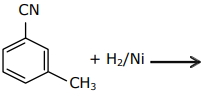
B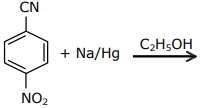
C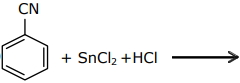
D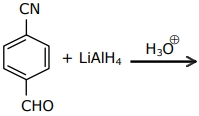
Solution
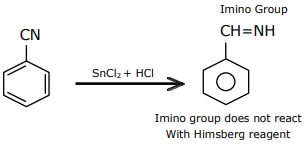
0 likes
View Solution92
EasyMCQ
$p$-toluenesulphonyl chloride is known as Hinsberg's reagent. Which of the following statements is $NOT$ correct for it?
A
It is known as Hinsberg's reagent.
B
It is used to distinguish primary and secondary amines.
C
On treatment with a secondary amine,it leads to a product that is soluble in alkali.
D
It does not react with tertiary amines.
Solution
(C) $p$-toluenesulphonyl chloride $(CH_3C_6H_4SO_2Cl)$ is commonly known as Hinsberg's reagent.
It is used to distinguish between primary $(1^{\circ})$,secondary $(2^{\circ})$,and tertiary $(3^{\circ})$ amines.
$1$. Primary amines react with Hinsberg's reagent to form $N$-alkylbenzenesulphonamide,which contains an acidic hydrogen atom attached to the nitrogen,making it soluble in alkali.
$2$. Secondary amines react with Hinsberg's reagent to form $N,N$-dialkylbenzenesulphonamide. This product does not contain any acidic hydrogen atom attached to the nitrogen,so it is insoluble in alkali.
$3$. Tertiary amines do not react with Hinsberg's reagent because they lack an acidic hydrogen atom.
Therefore,the statement that the product formed with a secondary amine is soluble in alkali is incorrect.
It is used to distinguish between primary $(1^{\circ})$,secondary $(2^{\circ})$,and tertiary $(3^{\circ})$ amines.
$1$. Primary amines react with Hinsberg's reagent to form $N$-alkylbenzenesulphonamide,which contains an acidic hydrogen atom attached to the nitrogen,making it soluble in alkali.
$2$. Secondary amines react with Hinsberg's reagent to form $N,N$-dialkylbenzenesulphonamide. This product does not contain any acidic hydrogen atom attached to the nitrogen,so it is insoluble in alkali.
$3$. Tertiary amines do not react with Hinsberg's reagent because they lack an acidic hydrogen atom.
Therefore,the statement that the product formed with a secondary amine is soluble in alkali is incorrect.
0 likes
View Solution93
MediumMCQ
Among the following,the method which can be used for distinguishing aniline from ethylamine is
A
Treatment with $CHCl_3$ and $KOH$
B
Reaction with $NaNO_2 / HCl$ followed by treatment of $2-$naphthol
C
Reaction with benzene sulfonyl chloride
D
Reaction with benzaldehyde
Solution
(B) Aniline $(C_6H_5NH_2)$ is an aromatic primary amine,while ethylamine $(C_2H_5NH_2)$ is an aliphatic primary amine.
When treated with $NaNO_2 / HCl$ at $0-5 \ ^\circ C$,aniline forms benzene diazonium chloride,which is stable at low temperatures and undergoes a coupling reaction with $2-$naphthol to form an azo dye (red color).
In contrast,ethylamine forms an unstable aliphatic diazonium salt that immediately decomposes to evolve $N_2$ gas and forms ethanol,thus it does not give the azo dye coupling reaction.
Therefore,the reaction with $NaNO_2 / HCl$ followed by treatment with $2-$naphthol can distinguish between them.
When treated with $NaNO_2 / HCl$ at $0-5 \ ^\circ C$,aniline forms benzene diazonium chloride,which is stable at low temperatures and undergoes a coupling reaction with $2-$naphthol to form an azo dye (red color).
In contrast,ethylamine forms an unstable aliphatic diazonium salt that immediately decomposes to evolve $N_2$ gas and forms ethanol,thus it does not give the azo dye coupling reaction.
Therefore,the reaction with $NaNO_2 / HCl$ followed by treatment with $2-$naphthol can distinguish between them.
0 likes
View Solution94
DifficultMCQ
The formula for Nessler's reagent is:
A
$K_2HgI_4$
B
$KHgI_3$
C
$K_2HgI_4$
D
$HgI_2$
Solution
(A) Nessler's reagent is an alkaline solution of potassium tetraiodomercurate$(II)$,which has the chemical formula $K_2[HgI_4]$.
0 likes
View Solution95
DifficultMCQ
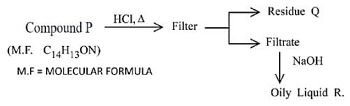
Compound $P$ is neutral. $Q$ gives effervescence with $NaHCO_3$ while $R$ reacts with Hinsberg's reagent to give a solid soluble in $NaOH$. Compound $P$ is:
A
$N$-methylbenzamide
B
$N$-phenyl$-4-$methylbenzamide
C
$N$-phenylbenzamide
D
$3$-(methylamino)benzophenone
Solution
(B) Compound $P$ has the molecular formula $C_{14}H_{13}ON$.
Upon hydrolysis with $HCl$ and $\Delta$,it yields a carboxylic acid $(Q)$ and an amine $(R)$.
$Q$ gives effervescence with $NaHCO_3$,indicating it is a carboxylic acid.
$R$ reacts with Hinsberg's reagent $(PhSO_2Cl)$ to form a product that is soluble in $NaOH$,which confirms that $R$ is a primary amine ($1^{\circ}$ amine).
Based on the molecular formula $C_{14}H_{13}ON$,the compound $P$ is $N$-phenyl$-4-$methylbenzamide $(CH_3-C_6H_4-CONH-C_6H_5)$.
Hydrolysis of $N$-phenyl$-4-$methylbenzamide gives $4-$methylbenzoic acid $(Q)$ and aniline $(R)$.
Aniline $(R)$ reacts with Hinsberg's reagent to form $N$-phenylbenzenesulfonamide,which is soluble in $NaOH$ due to the acidic hydrogen on the nitrogen atom.
Upon hydrolysis with $HCl$ and $\Delta$,it yields a carboxylic acid $(Q)$ and an amine $(R)$.
$Q$ gives effervescence with $NaHCO_3$,indicating it is a carboxylic acid.
$R$ reacts with Hinsberg's reagent $(PhSO_2Cl)$ to form a product that is soluble in $NaOH$,which confirms that $R$ is a primary amine ($1^{\circ}$ amine).
Based on the molecular formula $C_{14}H_{13}ON$,the compound $P$ is $N$-phenyl$-4-$methylbenzamide $(CH_3-C_6H_4-CONH-C_6H_5)$.
Hydrolysis of $N$-phenyl$-4-$methylbenzamide gives $4-$methylbenzoic acid $(Q)$ and aniline $(R)$.
Aniline $(R)$ reacts with Hinsberg's reagent to form $N$-phenylbenzenesulfonamide,which is soluble in $NaOH$ due to the acidic hydrogen on the nitrogen atom.
0 likes
View Solution96
MediumMCQ
The element not present in Nessler's reagent is:
A
$Hg$
B
$I$
C
$K$
D
$N$
Solution
(D) The chemical formula for Nessler's reagent is $K_2[HgI_4]$.
It consists of potassium $(K)$,mercury $(Hg)$,and iodine $(I)$.
Therefore,nitrogen $(N)$ is the element not present in Nessler's reagent.
It consists of potassium $(K)$,mercury $(Hg)$,and iodine $(I)$.
Therefore,nitrogen $(N)$ is the element not present in Nessler's reagent.
0 likes
View Solution97
DifficultMCQ
Match List-$I$ with List-$II$:
Choose the correct answer from the options given below:
| List-$I$ (Reagents used) | List-$II$ (Compound with functional group detected) |
|---|---|
| $A.$ Alkaline solution of copper sulphate and sodium citrate | $I.$ $C_6H_5CH(OH)CH_3$ |
| $B.$ Neutral $FeCl_3$ solution | $II.$ $CH_3CH(NH_2)CH_3$ |
| $C.$ Alkaline chloroform solution | $III.$ $C_6H_5CH_2CHO$ |
| $D.$ Potassium iodide and sodium hypochlorite | $IV.$ $m-C_2H_5C_6H_4OH$ |
Choose the correct answer from the options given below:
A
$A-II, B-IV, C-III, D-I$
B
$A-IV, B-I, C-II, D-III$
C
$A-III, B-IV, C-I, D-II$
D
$A-III, B-IV, C-II, D-I$
Solution
(D) $A.$ Alkaline solution of copper sulphate and sodium citrate is known as Benedict's solution,which is used to test aliphatic aldehydes. Thus,it tests compound $(III)$.
$B.$ Neutral $FeCl_3$ solution is used to test phenolic compounds. Thus,it tests compound $(IV)$.
$C.$ Alkaline chloroform solution (carbylamine test) is used to test primary amines. Thus,it tests compound $(II)$.
$D.$ Potassium iodide and sodium hypochlorite generate $I_2$ in situ,which is used for the iodoform test. This test is positive for compounds containing the $CH_3CO-$ or $CH_3CH(OH)-$ group. Thus,it tests compound $(I)$.
$B.$ Neutral $FeCl_3$ solution is used to test phenolic compounds. Thus,it tests compound $(IV)$.
$C.$ Alkaline chloroform solution (carbylamine test) is used to test primary amines. Thus,it tests compound $(II)$.
$D.$ Potassium iodide and sodium hypochlorite generate $I_2$ in situ,which is used for the iodoform test. This test is positive for compounds containing the $CH_3CO-$ or $CH_3CH(OH)-$ group. Thus,it tests compound $(I)$.
0 likes
View Solution98
DifficultMCQ
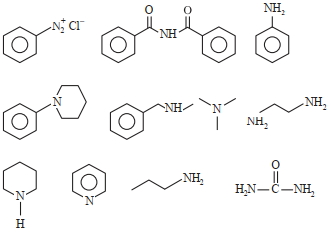
The number of compounds which react with Hinsberg's reagent (benzenesulfonyl chloride) is $ . . . . . . $.
A
$8$
B
$6$
C
$10$
D
$5$
Solution
(D) Hinsberg's reagent $(C_6H_5SO_2Cl)$ reacts with primary $(1^{\circ})$ and secondary $(2^{\circ})$ amines to form sulfonamides. Tertiary $(3^{\circ})$ amines do not react with it.
Let us analyze the given compounds:
$1$. Benzenediazonium chloride: Does not react.
$2$. Dibenzamide: Does not react (amide).
$3$. Aniline ($1^{\circ}$ amine): Reacts.
$4$. $N$-phenylpiperidine ($3^{\circ}$ amine): Does not react.
$5$. $N$-methylbenzylamine ($2^{\circ}$ amine): Reacts.
$6$. $N,N$-dimethylaniline ($3^{\circ}$ amine): Does not react.
$7$. Ethylenediamine ($1^{\circ}$ amine): Reacts.
$8$. Piperidine ($2^{\circ}$ amine): Reacts.
$9$. Pyridine ($3^{\circ}$ amine): Does not react.
$10$. Propylamine ($1^{\circ}$ amine): Reacts.
$11$. Urea: Does not react.
The compounds that react are: Aniline,$N$-methylbenzylamine,Ethylenediamine,Piperidine,and Propylamine.
Total count = $5$.
Let us analyze the given compounds:
$1$. Benzenediazonium chloride: Does not react.
$2$. Dibenzamide: Does not react (amide).
$3$. Aniline ($1^{\circ}$ amine): Reacts.
$4$. $N$-phenylpiperidine ($3^{\circ}$ amine): Does not react.
$5$. $N$-methylbenzylamine ($2^{\circ}$ amine): Reacts.
$6$. $N,N$-dimethylaniline ($3^{\circ}$ amine): Does not react.
$7$. Ethylenediamine ($1^{\circ}$ amine): Reacts.
$8$. Piperidine ($2^{\circ}$ amine): Reacts.
$9$. Pyridine ($3^{\circ}$ amine): Does not react.
$10$. Propylamine ($1^{\circ}$ amine): Reacts.
$11$. Urea: Does not react.
The compounds that react are: Aniline,$N$-methylbenzylamine,Ethylenediamine,Piperidine,and Propylamine.
Total count = $5$.
0 likes
View Solution99
MediumMCQ
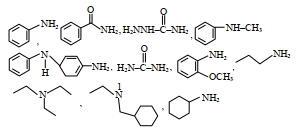
How many of the following amine compounds form a product with Hinsberg's reagent $(C_6H_5SO_2Cl)$ that is soluble in $NaOH$?
A
$3$
B
$4$
C
$5$
D
$6$
Solution
(C) Hinsberg's reagent $(C_6H_5SO_2Cl)$ reacts with primary amines $(R-NH_2)$ to form $N$-alkylbenzenesulfonamide,which contains an acidic hydrogen atom attached to the nitrogen. This acidic hydrogen makes the product soluble in aqueous $NaOH$.
Secondary amines $(R_2NH)$ form $N,N$-dialkylbenzenesulfonamide,which lacks an acidic hydrogen and is insoluble in $NaOH$.
Tertiary amines $(R_3N)$ do not react with Hinsberg's reagent.
Let us analyze the given compounds:
$1$. Aniline $(C_6H_5NH_2)$: Primary amine,forms soluble product.
$2$. $o$-methoxyaniline $(o-CH_3OC_6H_4NH_2)$: Primary amine,forms soluble product.
$3$. Ethanamine $(CH_3CH_2NH_2)$: Primary amine,forms soluble product.
$4$. $N$-phenyl-$p$-phenylenediamine $(C_6H_5NH-C_6H_4-NH_2)$: Contains a primary amine group,forms soluble product.
$5$. Cyclohexanamine $(C_6H_{11}NH_2)$: Primary amine,forms soluble product.
Other compounds like amides,ureas,and secondary/tertiary amines do not meet the criteria.
There are $5$ such primary amine compounds.
Secondary amines $(R_2NH)$ form $N,N$-dialkylbenzenesulfonamide,which lacks an acidic hydrogen and is insoluble in $NaOH$.
Tertiary amines $(R_3N)$ do not react with Hinsberg's reagent.
Let us analyze the given compounds:
$1$. Aniline $(C_6H_5NH_2)$: Primary amine,forms soluble product.
$2$. $o$-methoxyaniline $(o-CH_3OC_6H_4NH_2)$: Primary amine,forms soluble product.
$3$. Ethanamine $(CH_3CH_2NH_2)$: Primary amine,forms soluble product.
$4$. $N$-phenyl-$p$-phenylenediamine $(C_6H_5NH-C_6H_4-NH_2)$: Contains a primary amine group,forms soluble product.
$5$. Cyclohexanamine $(C_6H_{11}NH_2)$: Primary amine,forms soluble product.
Other compounds like amides,ureas,and secondary/tertiary amines do not meet the criteria.
There are $5$ such primary amine compounds.
0 likes
View Solution100
MediumMCQ
Given below are two statements:
Statement $I$: All the following compounds react with $p$-toluenesulfonyl chloride:
$C_6H_5NH_2$
$(C_6H_5)_2NH$
$(C_6H_5)_3N$
Statement $II$: Their products in the above reaction are soluble in aqueous $NaOH$.
In the light of the above statements,choose the correct answer from the options given below.
Statement $I$: All the following compounds react with $p$-toluenesulfonyl chloride:
$C_6H_5NH_2$
$(C_6H_5)_2NH$
$(C_6H_5)_3N$
Statement $II$: Their products in the above reaction are soluble in aqueous $NaOH$.
In the light of the above statements,choose the correct answer from the options given below.
A
Both Statement $I$ and Statement $II$ are false
B
Statement $I$ is true but Statement $II$ is false
C
Statement $I$ is false but Statement $II$ is true
D
Both Statement $I$ and Statement $II$ are true
Solution
(A) $p$-Toluenesulfonyl chloride (Hinsberg reagent) reacts only with primary $(1^{\circ})$ and secondary $(2^{\circ})$ amines.
$C_6H_5NH_2$ ($1^{\circ}$ amine) reacts to form $N$-phenyl-$p$-toluenesulfonamide,which is soluble in aqueous $NaOH$ due to the acidic hydrogen on the nitrogen atom.
$(C_6H_5)_2NH$ ($2^{\circ}$ amine) reacts to form $N,N$-diphenyl-$p$-toluenesulfonamide,which is insoluble in aqueous $NaOH$ because it lacks an acidic hydrogen.
$(C_6H_5)_3N$ ($3^{\circ}$ amine) does not react with $p$-toluenesulfonyl chloride.
Therefore,Statement $I$ is false because not all compounds react,and Statement $II$ is false because the products are not all soluble in $NaOH$.
$C_6H_5NH_2$ ($1^{\circ}$ amine) reacts to form $N$-phenyl-$p$-toluenesulfonamide,which is soluble in aqueous $NaOH$ due to the acidic hydrogen on the nitrogen atom.
$(C_6H_5)_2NH$ ($2^{\circ}$ amine) reacts to form $N,N$-diphenyl-$p$-toluenesulfonamide,which is insoluble in aqueous $NaOH$ because it lacks an acidic hydrogen.
$(C_6H_5)_3N$ ($3^{\circ}$ amine) does not react with $p$-toluenesulfonyl chloride.
Therefore,Statement $I$ is false because not all compounds react,and Statement $II$ is false because the products are not all soluble in $NaOH$.
0 likes
View SolutionAmines — Tests for Nitrogen Containing Compounds · Frequently Asked Questions
1Are these Amines questions useful for JEE and NEET?
Yes. All questions in this section are mapped to JEE Main and NEET exam patterns. Previous year questions from JEE Main, NEET, GUJCET and state-level exams are included with full solutions.
2Can I switch to Hindi or Gujarati for these questions?
Yes. Use the language tabs in the hero section or the sidebar to view the same questions and solutions in English, Hindi or Gujarati.
3How do I generate a question paper from this subtopic?
Use the Vedclass Exam Paper Generator — select the chapter and subtopic, set difficulty, and generate Sets A, B, C, D automatically. First 3 chapters of every subject are free.
Vedclass Products
For Students
Vedclass Test Series
Mock tests in real JEE/NEET style with performance analysis. 5-day free trial.
Start Free TrialFor Teachers
Exam Paper Generator
Generate Set A/B/C/D papers from this chapter in 2 minutes. 3 chapters free.
Try FreeFor Institutes
Online Exam Module
Live online exams with unlimited students, 360° analytics & white-label branding.
See DemoFor Teachers & Institutes
Generate a Amines Exam Paper in 2 Minutes
Select subtopic & difficulty — Sets A, B, C, D auto-generated with No Repeat logic.
First 3 chapters of every subject are free — no payment required.