
A English
Preparation of alcohol Questions in English
Class 12 Chemistry · Alcohols, Phenols and Ethers · Preparation of alcohol
76+
Questions
English
Language
100%
With Solutions
Showing 21 of 76 questions in English
51
Difficult
Explain the method of obtaining alcohols from carboxylic acids and esters.
Solution
(N/A) From Carboxylic Acids: Carboxylic acids are reduced to primary alcohols in excellent yields by the use of a strong reducing agent,lithium aluminium hydride $(LiAlH_{4})$.
Since $LiAlH_{4}$ is an expensive reagent,it is used only for preparing special chemicals.
$(b)$ From Esters: On an industrial scale,carboxylic acids are first converted to esters,which are then reduced to alcohols by hydrogenation in the presence of a catalyst.
$RCOOH + R'OH$ $\xrightarrow{H^+} RCOOR'$ $\xrightarrow{H_2, \text{catalyst}} RCH_2OH + R'OH$
Since $LiAlH_{4}$ is an expensive reagent,it is used only for preparing special chemicals.
$(b)$ From Esters: On an industrial scale,carboxylic acids are first converted to esters,which are then reduced to alcohols by hydrogenation in the presence of a catalyst.
$RCOOH + R'OH$ $\xrightarrow{H^+} RCOOR'$ $\xrightarrow{H_2, \text{catalyst}} RCH_2OH + R'OH$
0 likes
View Solution52
Difficult
Explain the methods of preparing alcohols from carbonyl compounds using Grignard reagents.
Solution
(N/A) The reaction of carbonyl compounds $(C=O)$ with Grignard reagents $(RMgX)$ involves a nucleophilic addition to form an intermediate adduct,which upon hydrolysis yields an alcohol.
$(i)$ Formaldehyde $(HCHO)$ reacts with a Grignard reagent to form a primary $(1^{\circ})$ alcohol.
$(ii)$ Other aldehydes $(RCHO)$ react with Grignard reagents to form secondary $(2^{\circ})$ alcohols.
$(iii)$ Ketones $(RCOR')$ react with Grignard reagents to form tertiary $(3^{\circ})$ alcohols.
$(i)$ Formaldehyde $(HCHO)$ reacts with a Grignard reagent to form a primary $(1^{\circ})$ alcohol.
$(ii)$ Other aldehydes $(RCHO)$ react with Grignard reagents to form secondary $(2^{\circ})$ alcohols.
$(iii)$ Ketones $(RCOR')$ react with Grignard reagents to form tertiary $(3^{\circ})$ alcohols.
0 likes
View Solution53
Medium
Show how the following alcohols can be prepared by the reaction of a suitable Grignard reagent with methanal:
$(i)$ $C_6H_5CH_2OH$
$(ii)$ $CH_3CH_2CH(CH_3)CH_2OH$
$(i)$ $C_6H_5CH_2OH$
$(ii)$ $CH_3CH_2CH(CH_3)CH_2OH$
Solution
(N/A) Grignard reagents $(RMgX)$ react with methanal $(HCHO)$ to form primary alcohols with one additional carbon atom.
$(i)$ To prepare $C_6H_5CH_2OH$,the Grignard reagent required is phenylmagnesium bromide $(C_6H_5MgBr)$.
$C_6H_5MgBr + HCHO$ $\rightarrow C_6H_5CH_2OMgBr$ $\xrightarrow{H_3O^+} C_6H_5CH_2OH + Mg(OH)Br$
$(ii)$ To prepare $CH_3CH_2CH(CH_3)CH_2OH$,the Grignard reagent required is sec-butylmagnesium bromide $(CH_3CH_2CH(CH_3)MgBr)$.
$CH_3CH_2CH(CH_3)MgBr + HCHO$ $\rightarrow CH_3CH_2CH(CH_3)CH_2OMgBr$ $\xrightarrow{H_3O^+} CH_3CH_2CH(CH_3)CH_2OH + Mg(OH)Br$
$(i)$ To prepare $C_6H_5CH_2OH$,the Grignard reagent required is phenylmagnesium bromide $(C_6H_5MgBr)$.
$C_6H_5MgBr + HCHO$ $\rightarrow C_6H_5CH_2OMgBr$ $\xrightarrow{H_3O^+} C_6H_5CH_2OH + Mg(OH)Br$
$(ii)$ To prepare $CH_3CH_2CH(CH_3)CH_2OH$,the Grignard reagent required is sec-butylmagnesium bromide $(CH_3CH_2CH(CH_3)MgBr)$.
$CH_3CH_2CH(CH_3)MgBr + HCHO$ $\rightarrow CH_3CH_2CH(CH_3)CH_2OMgBr$ $\xrightarrow{H_3O^+} CH_3CH_2CH(CH_3)CH_2OH + Mg(OH)Br$
0 likes
View Solution54
Medium
Explain the formation of alcohol from alkene via acid-catalyzed hydration.
Solution
(N/A) The acid-catalyzed hydration of alkenes involves the addition of water $(H_{2}O)$ across the double bond in the presence of an acid catalyst like $H_{2}SO_{4}$.
The mechanism proceeds as follows:
$1$. Protonation of the alkene to form a carbocation intermediate.
$2$. Nucleophilic attack by water on the carbocation.
$3$. Deprotonation to yield the alcohol.
This reaction follows the Markovnikov rule,where the hydroxyl group $(-OH)$ attaches to the more substituted carbon atom. The general reaction is:
$R-CH=CH_{2} + H_{2}O \xrightarrow{H^{+}} R-CH(OH)-CH_{3}$
The mechanism proceeds as follows:
$1$. Protonation of the alkene to form a carbocation intermediate.
$2$. Nucleophilic attack by water on the carbocation.
$3$. Deprotonation to yield the alcohol.
This reaction follows the Markovnikov rule,where the hydroxyl group $(-OH)$ attaches to the more substituted carbon atom. The general reaction is:
$R-CH=CH_{2} + H_{2}O \xrightarrow{H^{+}} R-CH(OH)-CH_{3}$
0 likes
View Solution55
Medium
Preparation of alcohols from alkenes involves the electrophilic attack on alkene carbon. Explain its mechanism.
Solution
(N/A) The mechanism of acid-catalyzed hydration of an alkene to form an alcohol proceeds in three steps:
Step-$1$: Protonation of alkene to form a carbocation by electrophilic attack of hydronium ion $(H_{3}O^{+})$.
$CH_{3}-CH=CH_{2} + H_{3}O^{+} \xrightarrow{\text{slow}} CH_{3}-CH^{+}-CH_{3} + H_{2}O$
Step-$2$: Nucleophilic attack of water on the carbocation.
$CH_{3}-CH^{+}-CH_{3} + H_{2}O \xrightarrow{\text{fast}} CH_{3}-CH(OH_{2}^{+})-CH_{3}$
Step-$3$: Deprotonation to form an alcohol.
$CH_{3}-CH(OH_{2}^{+})-CH_{3} + H_{2}O \xrightarrow{\text{fast}} CH_{3}-CH(OH)-CH_{3} + H_{3}O^{+}$
Step-$1$: Protonation of alkene to form a carbocation by electrophilic attack of hydronium ion $(H_{3}O^{+})$.
$CH_{3}-CH=CH_{2} + H_{3}O^{+} \xrightarrow{\text{slow}} CH_{3}-CH^{+}-CH_{3} + H_{2}O$
Step-$2$: Nucleophilic attack of water on the carbocation.
$CH_{3}-CH^{+}-CH_{3} + H_{2}O \xrightarrow{\text{fast}} CH_{3}-CH(OH_{2}^{+})-CH_{3}$
Step-$3$: Deprotonation to form an alcohol.
$CH_{3}-CH(OH_{2}^{+})-CH_{3} + H_{2}O \xrightarrow{\text{fast}} CH_{3}-CH(OH)-CH_{3} + H_{3}O^{+}$
0 likes
View Solution56
Difficult
Write the method of preparation for alcohol by the reduction of carboxylic acid.
Solution
(N/A) Carboxylic acids are reduced to primary alcohols by lithium aluminium hydride $(LiAlH_{4})$ or more selectively with diborane $(B_{2}H_{6})$.
$RCOOH \xrightarrow[\text{(ii) } H_{3}O^{+}]{\text{(i) } LiAlH_{4} \text{ or } B_{2}H_{6}} RCH_{2}OH$
$(b)$ $(i)$ Diborane does not easily reduce functional groups such as esters,nitro,or halo groups.
$(ii)$ Sodium borohydride $(NaBH_{4})$ does not reduce the carboxyl group.
$(c)$ In this reaction,the reduction of $-COOH$ to $-CH_{2}OH$ is a partial reduction,whereas reduction by ($HI$ + Red $P$) is a complete reduction which yields an alkane.
$RCOOH \xrightarrow[\text{(ii) } H_{3}O^{+}]{\text{(i) } LiAlH_{4} \text{ or } B_{2}H_{6}} RCH_{2}OH$
$(b)$ $(i)$ Diborane does not easily reduce functional groups such as esters,nitro,or halo groups.
$(ii)$ Sodium borohydride $(NaBH_{4})$ does not reduce the carboxyl group.
$(c)$ In this reaction,the reduction of $-COOH$ to $-CH_{2}OH$ is a partial reduction,whereas reduction by ($HI$ + Red $P$) is a complete reduction which yields an alkane.
0 likes
View Solution57
MediumMCQ
Which of the following is an incorrect method for the preparation of alcohols?
A
Ozonolysis of alkene.
B
Reaction of ketone with $RMgBr$ followed by hydrolysis.
C
Hydroboration-oxidation of alkene.
D
Reaction of alkyl halide with aqueous $NaOH$.
Solution
(A) Ozonolysis of an alkene typically results in the formation of aldehydes,ketones,or carboxylic acids,depending on the structure of the alkene,not alcohols. Therefore,it is not a method for preparing alcohols.
0 likes
View Solution58
EasyMCQ
In the given reaction,identify $R$ in $RMgBr$:
$CH_3CH_2CHO \xrightarrow[2. H_3O^+]{1. RMgBr} CH_3CH_2CH(OH)CH_2CH_3$
$CH_3CH_2CHO \xrightarrow[2. H_3O^+]{1. RMgBr} CH_3CH_2CH(OH)CH_2CH_3$
A
$CH_3-$
B
$CH_3CH_2-$
C
$CH_3CH(CH_3)-$
D
$CH_3CH_2CH_2-$
Solution
(B) The reaction of a Grignard reagent $(RMgBr)$ with an aldehyde $(R'CHO)$ followed by acid hydrolysis $(H_3O^+)$ yields a secondary alcohol.
The reaction is:
$CH_3CH_2CHO + RMgBr \rightarrow CH_3CH_2CH(OMgBr)R$
$CH_3CH_2CH(OMgBr)R + H_3O^+ \rightarrow CH_3CH_2CH(OH)R + Mg(OH)Br$
Comparing the product $CH_3CH_2CH(OH)CH_2CH_3$ with the general formula $CH_3CH_2CH(OH)R$,we can see that $R$ must be an ethyl group,$CH_3CH_2-$.
Therefore,the correct option is $B$.
The reaction is:
$CH_3CH_2CHO + RMgBr \rightarrow CH_3CH_2CH(OMgBr)R$
$CH_3CH_2CH(OMgBr)R + H_3O^+ \rightarrow CH_3CH_2CH(OH)R + Mg(OH)Br$
Comparing the product $CH_3CH_2CH(OH)CH_2CH_3$ with the general formula $CH_3CH_2CH(OH)R$,we can see that $R$ must be an ethyl group,$CH_3CH_2-$.
Therefore,the correct option is $B$.
0 likes
View Solution59
EasyMCQ
Which of the following is $NOT$ prepared by the action of Grignard's reagent on methanal?
A
Ethanol
B
Propan-$1$-$ol$
C
Propan-$2$-$ol$
D
Butan-$1$-$ol$
Solution
(C) Methanal $(HCHO)$ reacts with Grignard reagent $(RMgX)$ to form primary alcohols $(R-CH_2-OH)$.
Propan-$2$-$ol$ is a secondary alcohol,which is formed by the reaction of Grignard reagent with aldehydes other than methanal (e.g.,ethanal).
Therefore,propan-$2$-$ol$ cannot be prepared by the action of Grignard reagent on methanal.
Propan-$2$-$ol$ is a secondary alcohol,which is formed by the reaction of Grignard reagent with aldehydes other than methanal (e.g.,ethanal).
Therefore,propan-$2$-$ol$ cannot be prepared by the action of Grignard reagent on methanal.
0 likes
View Solution60
MediumMCQ
Which of the following alcohols is prepared by acid-catalysed hydration of alkenes?
A
Ethanol
B
Methanol
C
Propan$-1-$ol
D
Butan$-1-$ol
Solution
(A) Acid-catalysed hydration of alkenes follows Markovnikov's rule,where the hydroxyl group $(-OH)$ attaches to the more substituted carbon atom.
$CH_2=CH_2 + H_2O \xrightarrow{H^+} CH_3CH_2OH$ (Ethanol).
$CH_3CH=CH_2 + H_2O \xrightarrow{H^+} CH_3CH(OH)CH_3$ (Propan$-2-$ol).
$CH_3CH_2CH=CH_2 + H_2O \xrightarrow{H^+} CH_3CH_2CH(OH)CH_3$ (Butan$-2-$ol).
Methanol $(CH_3OH)$ cannot be prepared by this method as it requires at least two carbon atoms.
Propan$-1-$ol and Butan$-1-$ol are primary alcohols that cannot be formed by direct hydration of simple alkenes due to Markovnikov's rule.
Therefore,Ethanol is the correct answer.
$CH_2=CH_2 + H_2O \xrightarrow{H^+} CH_3CH_2OH$ (Ethanol).
$CH_3CH=CH_2 + H_2O \xrightarrow{H^+} CH_3CH(OH)CH_3$ (Propan$-2-$ol).
$CH_3CH_2CH=CH_2 + H_2O \xrightarrow{H^+} CH_3CH_2CH(OH)CH_3$ (Butan$-2-$ol).
Methanol $(CH_3OH)$ cannot be prepared by this method as it requires at least two carbon atoms.
Propan$-1-$ol and Butan$-1-$ol are primary alcohols that cannot be formed by direct hydration of simple alkenes due to Markovnikov's rule.
Therefore,Ethanol is the correct answer.
0 likes
View Solution61
EasyMCQ
Which of the following alcohols is $NOT$ prepared by acid catalyzed hydration of alkenes?
A
Ethanol
B
$Propan-2-ol$
C
$Propan-1-ol$
D
$2-Methylpropan-2-ol$
Solution
(C) Acid catalyzed hydration of alkenes follows Markovnikov's rule,where the hydroxyl group $(-OH)$ attaches to the more substituted carbon atom.
$Propan-1-ol$ $(CH_3CH_2CH_2OH)$ cannot be prepared by this method because the hydration of $propene$ $(CH_3CH=CH_2)$ yields $propan-2-ol$ as the major product according to Markovnikov's rule.
Therefore,$propan-1-ol$ is the correct answer.
$Propan-1-ol$ $(CH_3CH_2CH_2OH)$ cannot be prepared by this method because the hydration of $propene$ $(CH_3CH=CH_2)$ yields $propan-2-ol$ as the major product according to Markovnikov's rule.
Therefore,$propan-1-ol$ is the correct answer.
0 likes
View Solution62
MediumMCQ
$Isobutylene$ on hydroboration followed by oxidation with hydrogen peroxide in presence of base yields
A
$n-$butyl alcohol
B
$sec-$butyl alcohol
C
$tert-$butyl alcohol
D
Isobutyl alcohol
Solution
(D) Hydroboration-oxidation of $Isobutylene$ $(CH_2=C(CH_3)_2)$ involves the addition of $H_2O$ across the double bond in an anti-$Markovnikov$ fashion.
In this reaction,the $OH$ group attaches to the less substituted carbon atom.
The reaction proceeds as follows:
$CH_2=C(CH_3)_2 + (H-BH_2)_2 \xrightarrow{H_2O_2, OH^-} (CH_3)_2CH-CH_2OH$
The product formed is isobutyl alcohol ($2-$methylpropan$-1-$ol).
In this reaction,the $OH$ group attaches to the less substituted carbon atom.
The reaction proceeds as follows:
$CH_2=C(CH_3)_2 + (H-BH_2)_2 \xrightarrow{H_2O_2, OH^-} (CH_3)_2CH-CH_2OH$
The product formed is isobutyl alcohol ($2-$methylpropan$-1-$ol).
0 likes
View Solution63
MediumMCQ
$3-$methylpentan$-3-$ol will be prepared from
A
ethyl formate and methyl magnesium bromide
B
ethyl ethanoate and ethyl magnesium bromide
C
ethyl propanoate and methyl magnesium bromide
D
ethyl formate and ethyl magnesium bromide
Solution
(B) To prepare $3-$methylpentan$-3-$ol,we need a Grignard reagent to attack an ester. The structure of $3-$methylpentan$-3-$ol is $CH_3CH_2-C(OH)(CH_3)-CH_2CH_3$.
This tertiary alcohol can be formed by the reaction of an ester with two equivalents of a Grignard reagent.
Specifically,reacting ethyl propanoate $(CH_3CH_2COOC_2H_5)$ with two equivalents of methyl magnesium bromide $(CH_3MgBr)$ yields $3-$methylpentan$-3-$ol.
The reaction proceeds as follows:
$CH_3CH_2COOC_2H_5 + CH_3MgBr \rightarrow CH_3CH_2COCH_3 + C_2H_5OMgBr$
$CH_3CH_2COCH_3 + CH_3MgBr \rightarrow CH_3CH_2C(OMgBr)(CH_3)_2$
After hydrolysis: $CH_3CH_2C(OH)(CH_3)_2$ (which is $2-$methylbutan$-2-$ol). Wait,let us re-evaluate.
To get $3-$methylpentan$-3-$ol $(CH_3CH_2-C(OH)(CH_3)-CH_2CH_3)$,we need to react ethyl ethanoate $(CH_3COOC_2H_5)$ with two equivalents of ethyl magnesium bromide $(C_2H_5MgBr)$.
$CH_3COOC_2H_5 + 2C_2H_5MgBr \rightarrow CH_3C(OH)(C_2H_5)_2$.
Thus,the correct option is $B$.
This tertiary alcohol can be formed by the reaction of an ester with two equivalents of a Grignard reagent.
Specifically,reacting ethyl propanoate $(CH_3CH_2COOC_2H_5)$ with two equivalents of methyl magnesium bromide $(CH_3MgBr)$ yields $3-$methylpentan$-3-$ol.
The reaction proceeds as follows:
$CH_3CH_2COOC_2H_5 + CH_3MgBr \rightarrow CH_3CH_2COCH_3 + C_2H_5OMgBr$
$CH_3CH_2COCH_3 + CH_3MgBr \rightarrow CH_3CH_2C(OMgBr)(CH_3)_2$
After hydrolysis: $CH_3CH_2C(OH)(CH_3)_2$ (which is $2-$methylbutan$-2-$ol). Wait,let us re-evaluate.
To get $3-$methylpentan$-3-$ol $(CH_3CH_2-C(OH)(CH_3)-CH_2CH_3)$,we need to react ethyl ethanoate $(CH_3COOC_2H_5)$ with two equivalents of ethyl magnesium bromide $(C_2H_5MgBr)$.
$CH_3COOC_2H_5 + 2C_2H_5MgBr \rightarrow CH_3C(OH)(C_2H_5)_2$.
Thus,the correct option is $B$.
0 likes
View Solution64
EasyMCQ
Which of the following reactions yields propan$-2-$ol?
A
$CH_3-CO-CH_3 \xrightarrow{(i) CH_3MgI / \text{ether}, (ii) H_3O^{+}} CH_3-C(OH)(CH_3)-CH_3$
B
$CH_3-CH=CH_2 \xrightarrow{(i) B_2H_6, (ii) H_2O_2 / OH^{-}} CH_3-CH_2-CH_2-OH$
C
$CH_3-CH=CH_2 \xrightarrow{(i) \text{cold conc. } H_2SO_4, (ii) H_2O} CH_3-CH(OH)-CH_3$
D
$H-CHO \xrightarrow{(i) C_2H_5MgBr / \text{ether}, (ii) H_3O^{+}} CH_3-CH_2-CH_2-OH$
Solution
(C) Let us analyze each reaction:
$A)$ Reaction of acetone $(CH_3COCH_3)$ with $CH_3MgI$ followed by hydrolysis gives $2-$methylpropan$-2-$ol.
$B)$ Hydroboration-oxidation of propene gives propan$-1-$ol.
$C)$ Acid-catalyzed hydration of propene follows Markovnikov's rule to give propan$-2-$ol.
$D)$ Reaction of formaldehyde $(HCHO)$ with $C_2H_5MgBr$ followed by hydrolysis gives propan$-1-$ol.
Therefore,the correct reaction is $C$.
$A)$ Reaction of acetone $(CH_3COCH_3)$ with $CH_3MgI$ followed by hydrolysis gives $2-$methylpropan$-2-$ol.
$B)$ Hydroboration-oxidation of propene gives propan$-1-$ol.
$C)$ Acid-catalyzed hydration of propene follows Markovnikov's rule to give propan$-2-$ol.
$D)$ Reaction of formaldehyde $(HCHO)$ with $C_2H_5MgBr$ followed by hydrolysis gives propan$-1-$ol.
Therefore,the correct reaction is $C$.
0 likes
View Solution65
MediumMCQ
An alcohol,$X$ $(C_5H_{12}O)$ in the presence of $Cu / 573 \ K$ gives $Y$ $(C_5H_{10})$. The reactants required for the preparation of $X$ are
A
$(CH_3)_2C=O, \quad C_2H_5MgBr$
B
$HCHO, \quad (CH_3)_3CMgBr$
C
$CH_3CH_2COCH_3, \quad CH_3MgBr$
D
$CH_3CH_2CHO, \quad (CH_3)_2CHMgBr$
0 likes
View Solution66
DifficultMCQ
Among the following,the appropriate reactants for the preparation of $1$-ethyl cyclohexanol are:
A
Ethylidene cyclohexane + $H_3O^+$
B
Vinyl cyclohexane + $BH_3$
C
Cyclohexyl magnesium bromide + Acetone
D
Acetyl cyclohexane + $NaBH_4$
Solution
(A) The preparation of $1$-ethyl cyclohexanol involves the acid-catalyzed hydration of ethylidene cyclohexane.
$1$. Ethylidene cyclohexane $(C_8H_{14})$ reacts with $H_3O^+$ (acid catalyst).
$2$. The double bond is protonated to form a stable tertiary carbocation at the $1$-position of the cyclohexane ring.
$3$. Water then attacks the carbocation,followed by deprotonation to yield $1$-ethyl cyclohexanol.
Thus,the correct reactants are ethylidene cyclohexane and $H_3O^+$.
$1$. Ethylidene cyclohexane $(C_8H_{14})$ reacts with $H_3O^+$ (acid catalyst).
$2$. The double bond is protonated to form a stable tertiary carbocation at the $1$-position of the cyclohexane ring.
$3$. Water then attacks the carbocation,followed by deprotonation to yield $1$-ethyl cyclohexanol.
Thus,the correct reactants are ethylidene cyclohexane and $H_3O^+$.
0 likes
View Solution67
MediumMCQ
Ethyl magnesium bromide reacts with acetone to give $X$. On hydrolysis,$X$ forms:
A
$CH_3-CH_2-CH_2-CH(OH)-CH_3$
B
$CH_3-CH_2-CH(OH)-CH_2-CH_3$
C
$CH_3-CH_2-C(OH)(CH_3)_2$
D
$CH_3-CH_2-CH(CH_3)-CH_2OH$
Solution
(C) Ethyl magnesium bromide $(CH_3CH_2MgBr)$ is a Grignard reagent.
It reacts with acetone $(CH_3COCH_3)$ to form an addition product $X$ $(CH_3CH_2-C(OMgBr)(CH_3)_2)$.
Upon hydrolysis,this addition product $X$ yields $2-$methylbutan$-2-$ol $(CH_3CH_2-C(OH)(CH_3)_2)$.
It reacts with acetone $(CH_3COCH_3)$ to form an addition product $X$ $(CH_3CH_2-C(OMgBr)(CH_3)_2)$.
Upon hydrolysis,this addition product $X$ yields $2-$methylbutan$-2-$ol $(CH_3CH_2-C(OH)(CH_3)_2)$.
0 likes
View Solution68
MediumMCQ
What are $X$ and $Y$ in the following reactions?
$CH_2O \xrightarrow[(ii) H_3O^+]{(i) X} CH_3(CH_2)_2CH_2OH$
$Y \xrightarrow[(ii) H_3O^+]{(i) C_2H_5MgBr} CH_3CH_2C(CH_3)_2OH$
$CH_2O \xrightarrow[(ii) H_3O^+]{(i) X} CH_3(CH_2)_2CH_2OH$
$Y \xrightarrow[(ii) H_3O^+]{(i) C_2H_5MgBr} CH_3CH_2C(CH_3)_2OH$
A
$X = CH_3-CH(CH_3)-MgBr, Y = C_2H_5COCH_3$
B
$X = CH_3CH_2CH_2MgBr, Y = CH_3-CO-CH_3$
C
$X = CH_3-CH_2-MgBr, Y = CH_3CH_2CHO$
D
$X = (CH_3)_3CMgBr, Y = CH_3-CO-CH_3$
Solution
(B) For the first reaction:
$CH_2O$ (formaldehyde) reacts with a Grignard reagent $(RMgBr)$ followed by hydrolysis to form a primary alcohol. The product is $CH_3CH_2CH_2CH_2OH$ (butan$-1-$ol). The Grignard reagent must be $CH_3CH_2CH_2MgBr$ (propylmagnesium bromide).
For the second reaction:
$Y$ reacts with $C_2H_5MgBr$ followed by hydrolysis to form $CH_3CH_2C(CH_3)_2OH$ ($2$-methylbutan$-2-$ol). This is a tertiary alcohol. The reaction of a ketone with a Grignard reagent produces a tertiary alcohol. Comparing the structure,$Y$ must be $CH_3COCH_3$ (acetone or propanone).
Thus,$X = CH_3CH_2CH_2MgBr$ and $Y = CH_3COCH_3$.
$CH_2O$ (formaldehyde) reacts with a Grignard reagent $(RMgBr)$ followed by hydrolysis to form a primary alcohol. The product is $CH_3CH_2CH_2CH_2OH$ (butan$-1-$ol). The Grignard reagent must be $CH_3CH_2CH_2MgBr$ (propylmagnesium bromide).
For the second reaction:
$Y$ reacts with $C_2H_5MgBr$ followed by hydrolysis to form $CH_3CH_2C(CH_3)_2OH$ ($2$-methylbutan$-2-$ol). This is a tertiary alcohol. The reaction of a ketone with a Grignard reagent produces a tertiary alcohol. Comparing the structure,$Y$ must be $CH_3COCH_3$ (acetone or propanone).
Thus,$X = CH_3CH_2CH_2MgBr$ and $Y = CH_3COCH_3$.
0 likes
View Solution69
DifficultMCQ
$2-$methyl$-2-$butene on hydration gives an alcohol $X$. An isomer of $X$ could be prepared from which of the following?
A
Acetone + Ethylmagnesium bromide followed by hydrolysis
B
Acetaldehyde + Isopropylmagnesium bromide followed by hydrolysis
C
Acetone + Propylmagnesium bromide followed by hydrolysis
D
None of the above
Solution
(B) The hydration of $2-$methyl$-2-$butene $(CH_3-C(CH_3)=CH-CH_3)$ follows Markovnikov's rule to form $2-$methyl$-2-$butanol $(X)$,which is a tertiary alcohol $(CH_3-C(OH)(CH_3)-CH_2-CH_3)$.
An isomer of $X$ is $3-$methyl$-2-$butanol $(CH_3-CH(OH)-CH(CH_3)_2)$,which is a secondary alcohol.
This isomer can be prepared by the reaction of acetaldehyde $(CH_3CHO)$ with isopropylmagnesium bromide $((CH_3)_2CHMgBr)$ followed by hydrolysis,as this is a Grignard reaction forming a secondary alcohol.
Thus,option $(B)$ is correct.
An isomer of $X$ is $3-$methyl$-2-$butanol $(CH_3-CH(OH)-CH(CH_3)_2)$,which is a secondary alcohol.
This isomer can be prepared by the reaction of acetaldehyde $(CH_3CHO)$ with isopropylmagnesium bromide $((CH_3)_2CHMgBr)$ followed by hydrolysis,as this is a Grignard reaction forming a secondary alcohol.
Thus,option $(B)$ is correct.
0 likes
View Solution70
DifficultMCQ
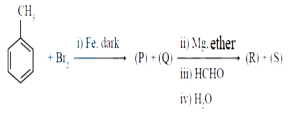
The possible final products $R$ and $S$ of the following reaction sequence are:
A
| $R$ | $S$ |
| $o$-methylbenzyl alcohol | $p$-methylbenzyl alcohol |
B
| $R$ | $S$ |
| $o$-cresol | $p$-cresol |
C
| $R$ | $S$ |
| $o$-xylene | $p$-xylene |
D
| $R$ | $S$ |
| $o$-bromotoluene | $p$-bromotoluene |
Solution
(A) $1$. Toluene reacts with $Br_2$ in the presence of $Fe$ (dark) via electrophilic aromatic substitution to form a mixture of $o$-bromotoluene $(P)$ and $p$-bromotoluene $(Q)$.
$2$. These isomers react with $Mg$ in dry ether to form the corresponding Grignard reagents: $o$-tolylmagnesium bromide and $p$-tolylmagnesium bromide.
$3$. These Grignard reagents react with formaldehyde $(HCHO)$ followed by acidic hydrolysis $(H_2O)$ to form primary alcohols.
$4$. The final products $R$ and $S$ are $o$-methylbenzyl alcohol and $p$-methylbenzyl alcohol,respectively.
$2$. These isomers react with $Mg$ in dry ether to form the corresponding Grignard reagents: $o$-tolylmagnesium bromide and $p$-tolylmagnesium bromide.
$3$. These Grignard reagents react with formaldehyde $(HCHO)$ followed by acidic hydrolysis $(H_2O)$ to form primary alcohols.
$4$. The final products $R$ and $S$ are $o$-methylbenzyl alcohol and $p$-methylbenzyl alcohol,respectively.
0 likes
View Solution71
DifficultMCQ
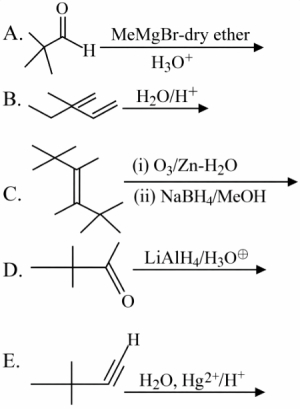
$3, 3-$Dimethyl$-2-$butanol cannot be prepared by:
Choose the correct answer from the options given below :
Choose the correct answer from the options given below :
A
$B$ only
B
$B$ and $E$ only
C
$B$ and $C$ only
D
$B, C$ and $E$ only
Solution
(B) The target molecule is $3, 3-$dimethyl$-2-$butanol,which has the structure $(CH_3)_3C-CH(OH)-CH_3$.
$A$. Reaction of $3, 3-$dimethylbutanal with $MeMgBr$ followed by $H_3O^+$ gives $3, 3-$dimethyl$-2-$butanol. This is a valid preparation.
$B$. Acid-catalyzed hydration of $3, 3-$dimethyl$-1-$butene involves a carbocation rearrangement (ethyl shift) to form a more stable carbocation,leading to $2, 3-$dimethyl$-2-$butanol,not the target alcohol. Thus,$B$ cannot prepare it.
$C$. Ozonolysis of $2, 3, 4, 4-$tetramethyl$-2-$pentene followed by reduction with $NaBH_4$ yields $3, 3-$dimethyl$-2-$butanol and acetone. This is a valid preparation.
$D$. Reduction of $3, 3-$dimethyl$-2-$butanone with $LiAlH_4$ gives $3, 3-$dimethyl$-2-$butanol. This is a valid preparation.
$E$. Hydration of $3, 3-$dimethyl$-1-$butyne with $Hg^{2+}/H^+$ gives $3, 3-$dimethyl$-2-$butanone,not the target alcohol. Thus,$E$ cannot prepare it.
Therefore,$B$ and $E$ cannot be used to prepare the target alcohol.
$A$. Reaction of $3, 3-$dimethylbutanal with $MeMgBr$ followed by $H_3O^+$ gives $3, 3-$dimethyl$-2-$butanol. This is a valid preparation.
$B$. Acid-catalyzed hydration of $3, 3-$dimethyl$-1-$butene involves a carbocation rearrangement (ethyl shift) to form a more stable carbocation,leading to $2, 3-$dimethyl$-2-$butanol,not the target alcohol. Thus,$B$ cannot prepare it.
$C$. Ozonolysis of $2, 3, 4, 4-$tetramethyl$-2-$pentene followed by reduction with $NaBH_4$ yields $3, 3-$dimethyl$-2-$butanol and acetone. This is a valid preparation.
$D$. Reduction of $3, 3-$dimethyl$-2-$butanone with $LiAlH_4$ gives $3, 3-$dimethyl$-2-$butanol. This is a valid preparation.
$E$. Hydration of $3, 3-$dimethyl$-1-$butyne with $Hg^{2+}/H^+$ gives $3, 3-$dimethyl$-2-$butanone,not the target alcohol. Thus,$E$ cannot prepare it.
Therefore,$B$ and $E$ cannot be used to prepare the target alcohol.
0 likes
View SolutionAlcohols, Phenols and Ethers — Preparation of alcohol · Frequently Asked Questions
1Are these Alcohols, Phenols and Ethers questions useful for JEE and NEET?
Yes. All questions in this section are mapped to JEE Main and NEET exam patterns. Previous year questions from JEE Main, NEET, GUJCET and state-level exams are included with full solutions.
2Can I switch to Hindi or Gujarati for these questions?
Yes. Use the language tabs in the hero section or the sidebar to view the same questions and solutions in English, Hindi or Gujarati.
3How do I generate a question paper from this subtopic?
Use the Vedclass Exam Paper Generator — select the chapter and subtopic, set difficulty, and generate Sets A, B, C, D automatically. First 3 chapters of every subject are free.
Vedclass Products
For Students
Vedclass Test Series
Mock tests in real JEE/NEET style with performance analysis. 5-day free trial.
Start Free TrialFor Teachers
Exam Paper Generator
Generate Set A/B/C/D papers from this chapter in 2 minutes. 3 chapters free.
Try FreeFor Institutes
Online Exam Module
Live online exams with unlimited students, 360° analytics & white-label branding.
See DemoFor Teachers & Institutes
Generate a Alcohols, Phenols and Ethers Exam Paper in 2 Minutes
Select subtopic & difficulty — Sets A, B, C, D auto-generated with No Repeat logic.
First 3 chapters of every subject are free — no payment required.