
A English
Properties Questions in English
Class 12 Chemistry · 8-1.Aldehydes and Ketones · Properties
1739+
Questions
English
Language
100%
With Solutions
Showing 50 of 1739 questions in English
201
EasyMCQ
Which of the following is not true about acetophenone?
A
Reacts to form $2,4-$dinitrophenylhydrazine derivative.
B
Reacts with Tollen's reagent to form a silver mirror.
C
Reacts with $I_2 / NaOH$ to form iodoform.
D
On oxidation with alkaline $KMnO_4$ followed by hydrolysis,it gives benzoic acid.
Solution
(B) Acetophenone $(C_6H_5COCH_3)$ is a ketone.
$A$: It reacts with $2,4-$$DNP$ to form a hydrazone derivative (characteristic of carbonyl compounds).
$B$: Ketones do not react with Tollen's reagent to form a silver mirror; only aldehydes show this test.
$C$: Acetophenone contains a methyl ketone group $(-COCH_3)$,so it gives a positive iodoform test.
$D$: Oxidation of acetophenone with alkaline $KMnO_4$ followed by hydrolysis yields benzoic acid.
Therefore,statement $B$ is not true.
$A$: It reacts with $2,4-$$DNP$ to form a hydrazone derivative (characteristic of carbonyl compounds).
$B$: Ketones do not react with Tollen's reagent to form a silver mirror; only aldehydes show this test.
$C$: Acetophenone contains a methyl ketone group $(-COCH_3)$,so it gives a positive iodoform test.
$D$: Oxidation of acetophenone with alkaline $KMnO_4$ followed by hydrolysis yields benzoic acid.
Therefore,statement $B$ is not true.
0 likes
View Solution202
DifficultMCQ
The enol form of acetone,after treatment with $D_2O$,gives:
A
$CH_3-C(OD)=CH_2$
B
$CD_3-CO-CD_3$
C
$CH_2=C(OH)-CH_2D$
D
$CD_2=C(OD)-CD_3$
Solution
(B) Acetone $(CH_3-CO-CH_3)$ undergoes keto-enol tautomerism in the presence of $D_2O$.
The $\alpha$-hydrogens are acidic and exchange with deuterium atoms from $D_2O$.
This exchange process continues until all six $\alpha$-hydrogens are replaced by deuterium,resulting in the formation of hexadeuteroacetone $(CD_3-CO-CD_3)$.
The $\alpha$-hydrogens are acidic and exchange with deuterium atoms from $D_2O$.
This exchange process continues until all six $\alpha$-hydrogens are replaced by deuterium,resulting in the formation of hexadeuteroacetone $(CD_3-CO-CD_3)$.
0 likes
View Solution203
MediumMCQ
The appropriate reagent for the transformation shown below is:
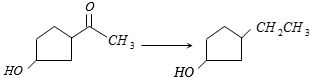
A
$Zn(Hg), HCl$
B
$NH_2NH_2, OH^-$
C
$H_2/Ni$
D
$NaBH_4$
Solution
(B) The reaction involves the reduction of a ketone group $(-COCH_3)$ to an alkyl group $(-CH_2CH_3)$ in the presence of a hydroxyl group $(-OH)$.
$1$. $Zn(Hg), HCl$ is the reagent for Clemmensen reduction,which is acidic. In acidic conditions,the $-OH$ group can undergo dehydration to form an alkene.
$2$. $NH_2NH_2, OH^-$ is the reagent for Wolff-Kishner reduction,which is basic. The $-OH$ group is stable under basic conditions.
Therefore,$NH_2NH_2, OH^-$ is the appropriate reagent for this transformation.
$1$. $Zn(Hg), HCl$ is the reagent for Clemmensen reduction,which is acidic. In acidic conditions,the $-OH$ group can undergo dehydration to form an alkene.
$2$. $NH_2NH_2, OH^-$ is the reagent for Wolff-Kishner reduction,which is basic. The $-OH$ group is stable under basic conditions.
Therefore,$NH_2NH_2, OH^-$ is the appropriate reagent for this transformation.
0 likes
View Solution204
MediumMCQ
Which of the following has the most acidic hydrogen?
A
$3-$hexanone
B
$2, 4-$hexanedione
C
$2, 5-$hexanedione
D
$2, 3-$hexanedione
Solution
(B) $2, 4-$hexanedione is a $1, 3-$diketone,which contains active methylene hydrogens located between two carbonyl groups.
These hydrogens are the most acidic because the resulting carbanion is stabilized by resonance with both carbonyl groups.
$\text{CH}_3-\text{C}(=\text{O})-\text{CH}_2-\text{C}(=\text{O})-\text{CH}_2\text{CH}_3$ $\xrightarrow{-\text{H}^+} \text{CH}_3-\text{C}(=\text{O})-\text{CH}^--\text{C}(=\text{O})-\text{CH}_2\text{CH}_3$.
The negative charge is delocalized over two oxygen atoms,providing significant stability compared to the other options.
These hydrogens are the most acidic because the resulting carbanion is stabilized by resonance with both carbonyl groups.
$\text{CH}_3-\text{C}(=\text{O})-\text{CH}_2-\text{C}(=\text{O})-\text{CH}_2\text{CH}_3$ $\xrightarrow{-\text{H}^+} \text{CH}_3-\text{C}(=\text{O})-\text{CH}^--\text{C}(=\text{O})-\text{CH}_2\text{CH}_3$.
The negative charge is delocalized over two oxygen atoms,providing significant stability compared to the other options.
0 likes
View Solution205
MediumMCQ
Which of the following will be most readily dehydrated in acidic conditions?
A
B
C
D
Solution
(A) Dehydration of alcohols in acidic conditions proceeds via the formation of a carbocation intermediate. The ease of dehydration depends on the stability of the carbocation formed and the ability to form a conjugated system. $\beta$-hydroxy carbonyl compounds (aldols) are particularly prone to dehydration because the resulting product is an $\alpha, \beta$-unsaturated carbonyl compound,which is stabilized by conjugation between the $C=C$ double bond and the $C=O$ carbonyl group. Among the given options,option $A$ represents a $\beta$-hydroxyketone (an aldol),which will undergo dehydration most readily to form a stable conjugated system.
0 likes
View Solution206
MediumMCQ
Identify the major product of the following reaction:
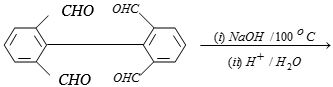
A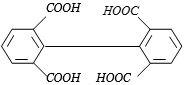
B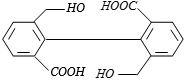
C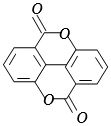
D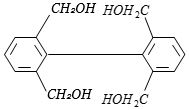
Solution
(C) The given reactant is $2,2',6,6'$-tetrabenzenedicarbaldehyde.
When treated with $NaOH$ at $100 \ ^\circ C$,it undergoes an intramolecular Cannizzaro reaction.
In this reaction,one $-CHO$ group is oxidized to a $-COO^-$ group,and the adjacent $-CHO$ group is reduced to a $-CH_2OH$ group.
This occurs on both benzene rings.
Upon subsequent acidification with $H^+ / H_2O$,the carboxylate ions are protonated to form carboxylic acid groups.
The final product is $2,2'$-bis(hydroxymethyl)-[$1$,$1$'-biphenyl]-$6$,$6$'-dicarboxylic acid.
When treated with $NaOH$ at $100 \ ^\circ C$,it undergoes an intramolecular Cannizzaro reaction.
In this reaction,one $-CHO$ group is oxidized to a $-COO^-$ group,and the adjacent $-CHO$ group is reduced to a $-CH_2OH$ group.
This occurs on both benzene rings.
Upon subsequent acidification with $H^+ / H_2O$,the carboxylate ions are protonated to form carboxylic acid groups.
The final product is $2,2'$-bis(hydroxymethyl)-[$1$,$1$'-biphenyl]-$6$,$6$'-dicarboxylic acid.
0 likes
View Solution207
DifficultMCQ
Which of the following will give a yellow precipitate with $I_2/NaOH$?
A
$ICH_2COCH_2CH_3$
B
$CH_3COOCOCH_3$
C
$CH_3CH(OH)CH_2CH_3$
D
Both $(a)$ and $(c)$
Solution
(D) The iodoform test is given by compounds containing the $CH_3CO-$ group or the $CH_3CH(OH)-$ group.
$1$. $ICH_2COCH_2CH_3$ contains the $CH_3CO-$ group (after considering the reaction conditions,it acts as a methyl ketone derivative),which reacts with $I_2/NaOH$ to form $CHI_3$ (yellow precipitate).
$2$. $CH_3CH(OH)CH_2CH_3$ is a secondary alcohol with a $CH_3CH(OH)-$ group,which is oxidized to a methyl ketone and then undergoes the iodoform reaction to give $CHI_3$ (yellow precipitate).
Therefore,both $(a)$ and $(c)$ give a yellow precipitate.
$1$. $ICH_2COCH_2CH_3$ contains the $CH_3CO-$ group (after considering the reaction conditions,it acts as a methyl ketone derivative),which reacts with $I_2/NaOH$ to form $CHI_3$ (yellow precipitate).
$2$. $CH_3CH(OH)CH_2CH_3$ is a secondary alcohol with a $CH_3CH(OH)-$ group,which is oxidized to a methyl ketone and then undergoes the iodoform reaction to give $CHI_3$ (yellow precipitate).
Therefore,both $(a)$ and $(c)$ give a yellow precipitate.
0 likes
View Solution208
MediumMCQ
The products of acid hydrolysis of $P$ and $Q$ can be distinguished by:
$P = H_2C=C(CH_3)(OCOCH_3)$
$Q = H_3C-CH=CH(OCOCH_3)$
$P = H_2C=C(CH_3)(OCOCH_3)$
$Q = H_3C-CH=CH(OCOCH_3)$
A
Lucas Reagent
B
$2,4-DNP$
C
Fehling’s Solution
D
$NaHSO_3$
Solution
(C) Acid hydrolysis of $P$ $(H_2C=C(CH_3)(OCOCH_3))$ yields an enol which tautomerizes to acetone $(CH_3COCH_3)$,a ketone.
Acid hydrolysis of $Q$ $(H_3C-CH=CH(OCOCH_3))$ yields an enol which tautomerizes to propanal $(CH_3CH_2CHO)$,an aldehyde.
Aldehydes and ketones can be distinguished using Fehling’s solution,as aldehydes give a positive test (red precipitate of $Cu_2O$) while ketones do not.
Acid hydrolysis of $Q$ $(H_3C-CH=CH(OCOCH_3))$ yields an enol which tautomerizes to propanal $(CH_3CH_2CHO)$,an aldehyde.
Aldehydes and ketones can be distinguished using Fehling’s solution,as aldehydes give a positive test (red precipitate of $Cu_2O$) while ketones do not.
0 likes
View Solution209
MediumMCQ
Which of the following can decolorize aldehydes and ketones?
A
Bromine water
B
Quick lime
C
Dilute $H_2SO_4$
D
None of these
Solution
(D) Aldehydes and ketones are generally colorless and stable compounds under standard laboratory conditions. They do not react with bromine water (which is used to test for unsaturation like alkenes or alkynes),quick lime,or dilute $H_2SO_4$ to undergo decolorization. Therefore,none of the given reagents can decolorize them.
0 likes
View Solution210
MediumMCQ
Which of the following statements regarding chemical properties of acetophenone are wrong?
$(1)$ It is reduced to methyl phenyl carbinol by sodium and ethanol
$(2)$ It is oxidised to benzoic acid with acidified $KMnO_4$
$(3)$ It does not undergo electrophilic substitution like nitration at meta position
$(4)$ It does not undergo iodoform reaction with iodine and alkali
$(1)$ It is reduced to methyl phenyl carbinol by sodium and ethanol
$(2)$ It is oxidised to benzoic acid with acidified $KMnO_4$
$(3)$ It does not undergo electrophilic substitution like nitration at meta position
$(4)$ It does not undergo iodoform reaction with iodine and alkali
A
$1$ and $2$
B
$2$ and $4$
C
$3$ and $4$
D
$1$ and $3$
Solution
(C) Acetophenone $(C_6H_5COCH_3)$ is a ketone.
$(1)$ It is reduced to methyl phenyl carbinol $(C_6H_5CH(OH)CH_3)$ by sodium and ethanol,which is a correct statement.
$(2)$ It is oxidized to benzoic acid $(C_6H_5COOH)$ with acidified $KMnO_4$,which is a correct statement.
$(3)$ Acetophenone contains an electron-withdrawing carbonyl group $(-COCH_3)$,which is meta-directing. Therefore,it undergoes electrophilic substitution (like nitration) at the meta position. Thus,statement $(3)$ is wrong.
$(4)$ Acetophenone contains a methyl ketone group $(-COCH_3)$,so it gives a positive iodoform test with iodine and alkali. Thus,statement $(4)$ is wrong.
Therefore,statements $(3)$ and $(4)$ are wrong.
$(1)$ It is reduced to methyl phenyl carbinol $(C_6H_5CH(OH)CH_3)$ by sodium and ethanol,which is a correct statement.
$(2)$ It is oxidized to benzoic acid $(C_6H_5COOH)$ with acidified $KMnO_4$,which is a correct statement.
$(3)$ Acetophenone contains an electron-withdrawing carbonyl group $(-COCH_3)$,which is meta-directing. Therefore,it undergoes electrophilic substitution (like nitration) at the meta position. Thus,statement $(3)$ is wrong.
$(4)$ Acetophenone contains a methyl ketone group $(-COCH_3)$,so it gives a positive iodoform test with iodine and alkali. Thus,statement $(4)$ is wrong.
Therefore,statements $(3)$ and $(4)$ are wrong.
0 likes
View Solution211
MediumMCQ
The most reactive compound towards the formation of cyanohydrin on treatment with $KCN$ followed by acidification is:
A
Benzaldehyde
B
$p-$Nitrobenzaldehyde
C
Phenyl acetaldehyde
D
$p-$Hydroxybenzaldehyde
Solution
(B) The formation of cyanohydrin involves a nucleophilic addition reaction to the carbonyl group.
The reactivity depends on the electrophilicity of the carbonyl carbon.
Electron-withdrawing groups increase the partial positive charge on the carbonyl carbon,making it more susceptible to nucleophilic attack by the $CN^-$ ion.
Among the given options,the $-NO_2$ group in $p-$nitrobenzaldehyde is a strong electron-withdrawing group,which significantly increases the electrophilicity of the carbonyl carbon compared to the other substituents.
Therefore,$p-$nitrobenzaldehyde is the most reactive compound towards cyanohydrin formation.
The reactivity depends on the electrophilicity of the carbonyl carbon.
Electron-withdrawing groups increase the partial positive charge on the carbonyl carbon,making it more susceptible to nucleophilic attack by the $CN^-$ ion.
Among the given options,the $-NO_2$ group in $p-$nitrobenzaldehyde is a strong electron-withdrawing group,which significantly increases the electrophilicity of the carbonyl carbon compared to the other substituents.
Therefore,$p-$nitrobenzaldehyde is the most reactive compound towards cyanohydrin formation.
0 likes
View Solution212
MediumMCQ
The key step in Cannizzaro's reaction is the intermolecular shift of
A
Proton
B
Hydride ion
C
Hydronium ion
D
Hydrogen bond
Solution
(B) The Cannizzaro reaction involves the nucleophilic attack of $OH^{-}$ on the carbonyl carbon,followed by the intermolecular transfer of a hydride ion $({H^{-}})$ from the tetrahedral intermediate to another molecule of the aldehyde.
Thus,the key step is the shift of a hydride ion $({H^{-}})$.
Therefore,the correct option is $(B)$.
Thus,the key step is the shift of a hydride ion $({H^{-}})$.
Therefore,the correct option is $(B)$.
0 likes
View Solution213
EasyMCQ
Benzophenone does not react with:
A
$RNH_2$
B
$SO_3$
C
$NaOH$
D
$Na_2CO_3$
Solution
(D) Benzophenone $(C_6H_5COC_6H_5)$ is a ketone.
$1$. It reacts with primary amines $(RNH_2)$ to form imines (Schiff bases).
$2$. It reacts with $SO_3$ via electrophilic aromatic substitution.
$3$. It can undergo aldol-like reactions or other transformations in the presence of strong bases like $NaOH$.
$4$. It does not react with sodium carbonate $(Na_2CO_3)$,which is a weak base and cannot deprotonate or react with the ketone group.
$1$. It reacts with primary amines $(RNH_2)$ to form imines (Schiff bases).
$2$. It reacts with $SO_3$ via electrophilic aromatic substitution.
$3$. It can undergo aldol-like reactions or other transformations in the presence of strong bases like $NaOH$.
$4$. It does not react with sodium carbonate $(Na_2CO_3)$,which is a weak base and cannot deprotonate or react with the ketone group.
0 likes
View Solution214
MediumMCQ
The conversion of acetophenone to acetanilide is best accomplished by using:
A
Beckmann rearrangement
B
Curtius rearrangement
C
Lossen rearrangement
D
Hofmann rearrangement
Solution
(A) . The conversion involves two steps:
$1$. Formation of oxime: $C_6H_5-CO-CH_3 + NH_2OH \rightarrow C_6H_5-C(=NOH)-CH_3 + H_2O$
$2$. Beckmann rearrangement: The oxime $C_6H_5-C(=NOH)-CH_3$ undergoes rearrangement in the presence of an acid catalyst (like $H_2SO_4$ or $PCl_5$) to form acetanilide $(C_6H_5-NH-CO-CH_3)$.
$1$. Formation of oxime: $C_6H_5-CO-CH_3 + NH_2OH \rightarrow C_6H_5-C(=NOH)-CH_3 + H_2O$
$2$. Beckmann rearrangement: The oxime $C_6H_5-C(=NOH)-CH_3$ undergoes rearrangement in the presence of an acid catalyst (like $H_2SO_4$ or $PCl_5$) to form acetanilide $(C_6H_5-NH-CO-CH_3)$.
0 likes
View Solution215
MediumMCQ
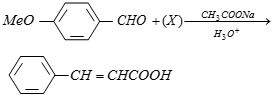
The compound $(X)$ in the given reaction is:
A
$CH_3COOH$
B
$BrCH_2-COOH$
C
$(CH_3CO)_2O$
D
$CHO-COOH$
Solution
(C) The given reaction is an example of the Perkin reaction.
In the Perkin reaction,an aromatic aldehyde reacts with an acid anhydride in the presence of the corresponding sodium salt of the acid to form an $\alpha, \beta$-unsaturated carboxylic acid.
Here,the reaction involves $p$-methoxybenzaldehyde reacting with acetic anhydride $(CH_3CO)_2O$ in the presence of sodium acetate to yield $p$-methoxycinnamic acid.
Thus,the compound $(X)$ is acetic anhydride,$(CH_3CO)_2O$.
In the Perkin reaction,an aromatic aldehyde reacts with an acid anhydride in the presence of the corresponding sodium salt of the acid to form an $\alpha, \beta$-unsaturated carboxylic acid.
Here,the reaction involves $p$-methoxybenzaldehyde reacting with acetic anhydride $(CH_3CO)_2O$ in the presence of sodium acetate to yield $p$-methoxycinnamic acid.
Thus,the compound $(X)$ is acetic anhydride,$(CH_3CO)_2O$.
0 likes
View Solution216
MediumMCQ
$A$ compound,containing only carbon,hydrogen,and oxygen,has a molecular weight of $44$. On complete oxidation,it is converted into a compound of molecular weight $60$. The original compound is:
A
An aldehyde
B
An acid
C
An alcohol
D
An ether
Solution
(A) The increase in molecular weight upon oxidation is $60 - 44 = 16$.
This indicates the addition of one oxygen atom $(16 \text{ amu})$ to the original molecule.
This transformation is characteristic of the oxidation of an aldehyde to a carboxylic acid $(RCHO \xrightarrow{[O]} RCOOH)$.
For an aldehyde with molecular weight $44$,the formula is $CH_3CHO$ $(12+3+12+1+16+1 = 44)$.
Upon oxidation,it forms acetic acid $(CH_3COOH)$,which has a molecular weight of $60$ $(12+3+12+16+16+1 = 60)$.
Therefore,the original compound is an aldehyde.
This indicates the addition of one oxygen atom $(16 \text{ amu})$ to the original molecule.
This transformation is characteristic of the oxidation of an aldehyde to a carboxylic acid $(RCHO \xrightarrow{[O]} RCOOH)$.
For an aldehyde with molecular weight $44$,the formula is $CH_3CHO$ $(12+3+12+1+16+1 = 44)$.
Upon oxidation,it forms acetic acid $(CH_3COOH)$,which has a molecular weight of $60$ $(12+3+12+16+16+1 = 60)$.
Therefore,the original compound is an aldehyde.
0 likes
View Solution217
DifficultMCQ
Acetoacetic ester behaves as
A
An unsaturated hydroxy compound
B
$A$ keto compound
C
Both of these ways
D
None of these
Solution
(C) Acetoacetic ester exhibits keto-enol tautomerism.
It exists in equilibrium between its keto form $(CH_3-C(=O)-CH_2-COOC_2H_5)$ and its enolic form $(CH_3-C(OH)=CH-COOC_2H_5)$.
Therefore,it behaves as both a keto compound and an unsaturated hydroxy compound.
It exists in equilibrium between its keto form $(CH_3-C(=O)-CH_2-COOC_2H_5)$ and its enolic form $(CH_3-C(OH)=CH-COOC_2H_5)$.
Therefore,it behaves as both a keto compound and an unsaturated hydroxy compound.
0 likes
View Solution218
DifficultMCQ
The Tischenko reaction yields an ester in the presence of which catalyst?
A
$LiAlH_4$
B
$N$-bromosuccinimide
C
$Al(OC_2H_5)_3$
D
$Zn-Hg/HCl$
Solution
(C) The Tischenko reaction involves the disproportionation of aldehydes into esters in the presence of an aluminum alkoxide catalyst.
The reaction is represented as: $2CH_3CHO \xrightarrow{Al(OC_2H_5)_3} CH_3COOCH_2CH_3$ (Ethyl acetate).
Thus,the correct catalyst is $Al(OC_2H_5)_3$.
The reaction is represented as: $2CH_3CHO \xrightarrow{Al(OC_2H_5)_3} CH_3COOCH_2CH_3$ (Ethyl acetate).
Thus,the correct catalyst is $Al(OC_2H_5)_3$.
0 likes
View Solution219
MediumMCQ
$CH_3-CO-CH_3$ $\xrightarrow{NaCN/HCl} A$ $\xrightarrow{H_3O^{+}/\Delta} B$. In the above sequence of reactions,$A$ and $B$ are:
A
$CH_3-C(OH)(CN)-CH_3, CH_3-C(OH)(COOH)-CH_3$
B
$CH_3-C(OH)(CN)-CH_3, CH_3-C(OH)_2-CH_3$
C
$CH_3-C(OH)(CN)-CH_3, (CH_3)_2CHCOOH$
D
$CH_3-C(OH)(CN)-CH_3, CH_3-CO-CH_3$
Solution
(A) Acetone reacts with $HCN$ (generated from $NaCN/HCl$) to form acetone cyanohydrin $(A)$ through nucleophilic addition.
Subsequent acidic hydrolysis of the nitrile group $(-CN)$ in $A$ with heat $(\Delta)$ yields $2$-hydroxy-$2$-methylpropanoic acid $(B)$.
$CH_3-CO-CH_3 + HCN$ $\rightarrow CH_3-C(OH)(CN)-CH_3 (A)$ $\xrightarrow{H_3O^{+}/\Delta} CH_3-C(OH)(COOH)-CH_3 (B)$.
Subsequent acidic hydrolysis of the nitrile group $(-CN)$ in $A$ with heat $(\Delta)$ yields $2$-hydroxy-$2$-methylpropanoic acid $(B)$.
$CH_3-CO-CH_3 + HCN$ $\rightarrow CH_3-C(OH)(CN)-CH_3 (A)$ $\xrightarrow{H_3O^{+}/\Delta} CH_3-C(OH)(COOH)-CH_3 (B)$.
0 likes
View Solution220
DifficultMCQ
The rearrangement of an oxime to an amide in the presence of a strong acid is called:
A
Curtius rearrangement
B
Fries rearrangement
C
Beckmann rearrangement
D
Sandmeyer reaction
Solution
(C) The rearrangement of an oxime to an amide in the presence of a strong acid is known as the $Beckmann$ rearrangement.
In this reaction,oximes derived from ketones undergo rearrangement to form amides,while those derived from aldehydes typically form nitriles.
In this reaction,oximes derived from ketones undergo rearrangement to form amides,while those derived from aldehydes typically form nitriles.
0 likes
View Solution221
MediumMCQ
The $Tishchenko$ reaction is used for the preparation of:
A
Ether
B
Ester
C
Amide
D
Acid anhydride
Solution
(B) The $Tishchenko$ reaction involves the disproportionation of an aldehyde in the presence of an alkoxide catalyst to form an ester.
The general reaction is: $2RCHO \xrightarrow{Al(OC_2H_5)_3} RCOOCH_2R$.
The general reaction is: $2RCHO \xrightarrow{Al(OC_2H_5)_3} RCOOCH_2R$.
0 likes
View Solution222
MediumMCQ
Primary aldehyde on oxidation gives
A
Esters
B
Carboxylic acid
C
Ketones
D
Alcohols
Solution
(B) Aldehydes are easily oxidized to carboxylic acids on treatment with common oxidizing agents like nitric acid,potassium permanganate,and dichromate,etc.
0 likes
View Solution223
MediumMCQ
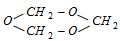
The polymer shown in the image is obtained when a carbon compound is allowed to stand. It is a white solid. The polymer is:
A
Trioxane
B
Formose
C
Paraformaldehyde
D
Metaldehyde
Solution
(A) The structure shown in the image is a cyclic trimer of formaldehyde $(HCHO)$,which is known as $1,3,5$-trioxane or simply trioxane.
It is formed by the trimerization of formaldehyde in the presence of an acid catalyst.
The reaction is: $3HCHO \rightleftharpoons (CH_2O)_3$ (Trioxane).
It is formed by the trimerization of formaldehyde in the presence of an acid catalyst.
The reaction is: $3HCHO \rightleftharpoons (CH_2O)_3$ (Trioxane).
0 likes
View Solution224
MediumMCQ
Reaction of ethyl formate with excess of $CH_3MgI$ followed by hydrolysis gives
A
$n$-propyl alcohol
B
Ethanal
C
Propanal
D
Isopropyl alcohol
Solution
(D) The reaction of ethyl formate $(HCOOC_2H_5)$ with excess $CH_3MgI$ proceeds in two steps.
First,the nucleophilic attack of $CH_3^-$ on the carbonyl carbon of ethyl formate leads to the formation of an intermediate,which eliminates an ethoxide ion to form acetaldehyde $(CH_3CHO)$.
Since $CH_3MgI$ is in excess,it further reacts with the formed acetaldehyde to produce an alkoxide intermediate.
Finally,upon hydrolysis,this intermediate yields a secondary alcohol.
The overall reaction is: $HCOOC_2H_5 + 2CH_3MgI \xrightarrow{H_3O^+} (CH_3)_2CHOH + Mg(OH)I + C_2H_5OH$.
The product formed is isopropyl alcohol $(CH_3CH(OH)CH_3)$.
First,the nucleophilic attack of $CH_3^-$ on the carbonyl carbon of ethyl formate leads to the formation of an intermediate,which eliminates an ethoxide ion to form acetaldehyde $(CH_3CHO)$.
Since $CH_3MgI$ is in excess,it further reacts with the formed acetaldehyde to produce an alkoxide intermediate.
Finally,upon hydrolysis,this intermediate yields a secondary alcohol.
The overall reaction is: $HCOOC_2H_5 + 2CH_3MgI \xrightarrow{H_3O^+} (CH_3)_2CHOH + Mg(OH)I + C_2H_5OH$.
The product formed is isopropyl alcohol $(CH_3CH(OH)CH_3)$.
0 likes
View Solution225
DifficultMCQ
The reaction $2CH_3COOC_2H_5 \xrightarrow{C_2H_5ONa} CH_3COCH_2COOC_2H_5 + C_2H_5OH$ is called:
A
Etard reaction
B
Perkin's reaction
C
Claisen condensation
D
Claisen Schmidt reaction
Solution
(C) The reaction of two molecules of an ester containing $\alpha$-hydrogen atoms in the presence of a strong base like sodium ethoxide $(C_2H_5ONa)$ to form a $\beta$-keto ester is known as Claisen condensation.
In this reaction,two molecules of ethyl acetate condense to form ethyl acetoacetate.
In this reaction,two molecules of ethyl acetate condense to form ethyl acetoacetate.
0 likes
View Solution226
DifficultMCQ
Oxidation of toluene with $CrO_3$ in the presence of $(CH_3CO)_2O$ gives a product '$A$' which on treatment with aqueous $NaOH$ produces
A
$C_6H_5CHO$
B
$(C_6H_5CO)_2O$
C
$C_6H_5COONa$
D
$2, 4-$diacetyl toluene
Solution
(C) The oxidation of toluene with $CrO_3$ in the presence of acetic anhydride $(CH_3CO)_2O$ forms a gem-diacetate intermediate,$C_6H_5CH(OCOCH_3)_2$,which is product '$A$'.
Upon hydrolysis with aqueous $NaOH$,this intermediate yields benzaldehyde $(C_6H_5CHO)$.
Benzaldehyde,lacking $\alpha$-hydrogens,undergoes the Cannizzaro reaction in the presence of concentrated aqueous $NaOH$ to produce sodium benzoate $(C_6H_5COONa)$ and benzyl alcohol $(C_6H_5CH_2OH)$.
Therefore,the final product obtained is $C_6H_5COONa$.
Upon hydrolysis with aqueous $NaOH$,this intermediate yields benzaldehyde $(C_6H_5CHO)$.
Benzaldehyde,lacking $\alpha$-hydrogens,undergoes the Cannizzaro reaction in the presence of concentrated aqueous $NaOH$ to produce sodium benzoate $(C_6H_5COONa)$ and benzyl alcohol $(C_6H_5CH_2OH)$.
Therefore,the final product obtained is $C_6H_5COONa$.
0 likes
View Solution227
DifficultMCQ
$CH_3COOCH_3 +$ excess $PhMgBr$ $\rightarrow \text{product}$ $\xrightarrow{H^+} X$. The product $X$ is:
A
$1,1$-diphenylethanol
B
$1,1$-diphenylmethanol
C
Methyl phenylethanol
D
Methyl phenylketone
Solution
(A) $CH_3COOCH_3$ (methyl acetate) reacts with two equivalents of $PhMgBr$ (phenylmagnesium bromide).
The first equivalent of $PhMgBr$ performs a nucleophilic acyl substitution on the ester to form acetophenone ($CH_3COCH_3$ is incorrect in the prompt,it should be $CH_3COOCH_3$).
The second equivalent of $PhMgBr$ attacks the carbonyl group of the formed acetophenone to produce an alkoxide intermediate.
Upon acid hydrolysis $(H^+)$,the alkoxide is protonated to yield $1,1$-diphenylethanol $(CH_3C(Ph)_2OH)$.
Reaction sequence:
$CH_3COOCH_3 + PhMgBr \rightarrow CH_3COPh + CH_3OMgBr$
$CH_3COPh + PhMgBr$ $\rightarrow CH_3C(Ph)_2OMgBr$ $\xrightarrow{H^+} CH_3C(Ph)_2OH$
The first equivalent of $PhMgBr$ performs a nucleophilic acyl substitution on the ester to form acetophenone ($CH_3COCH_3$ is incorrect in the prompt,it should be $CH_3COOCH_3$).
The second equivalent of $PhMgBr$ attacks the carbonyl group of the formed acetophenone to produce an alkoxide intermediate.
Upon acid hydrolysis $(H^+)$,the alkoxide is protonated to yield $1,1$-diphenylethanol $(CH_3C(Ph)_2OH)$.
Reaction sequence:
$CH_3COOCH_3 + PhMgBr \rightarrow CH_3COPh + CH_3OMgBr$
$CH_3COPh + PhMgBr$ $\rightarrow CH_3C(Ph)_2OMgBr$ $\xrightarrow{H^+} CH_3C(Ph)_2OH$
0 likes
View Solution228
DifficultMCQ
$CH_3CHO$ $\xrightarrow{HCN} A$ $\xrightarrow{H_3O^+} B$. The product $B$ is
A
Malonic acid
B
Glycolic acid
C
Lactic acid
D
Malic acid
Solution
(C) The reaction sequence is as follows:
$1$. Acetaldehyde $(CH_3CHO)$ reacts with $HCN$ to form acetaldehyde cyanohydrin $(A)$,which is $CH_3CH(OH)CN$.
$2$. The cyanohydrin $(A)$ undergoes acid-catalyzed hydrolysis $(H_3O^+)$ to convert the $-CN$ group into a carboxylic acid group $(-COOH)$.
$3$. The resulting product $B$ is $CH_3CH(OH)COOH$,which is known as Lactic acid.
Therefore,the correct option is $C$.
$1$. Acetaldehyde $(CH_3CHO)$ reacts with $HCN$ to form acetaldehyde cyanohydrin $(A)$,which is $CH_3CH(OH)CN$.
$2$. The cyanohydrin $(A)$ undergoes acid-catalyzed hydrolysis $(H_3O^+)$ to convert the $-CN$ group into a carboxylic acid group $(-COOH)$.
$3$. The resulting product $B$ is $CH_3CH(OH)COOH$,which is known as Lactic acid.
Therefore,the correct option is $C$.
0 likes
View Solution229
DifficultMCQ
In a set of reactions,an acid yielded a product $D$.
$CH_3COOH$ $\xrightarrow{SOCl_2} A$ $\xrightarrow[Anhyd. AlCl_3]{Benzene} B$ $\xrightarrow{HCN} C$ $\xrightarrow{H_3O^+} D$
Identify the product $D$.
$CH_3COOH$ $\xrightarrow{SOCl_2} A$ $\xrightarrow[Anhyd. AlCl_3]{Benzene} B$ $\xrightarrow{HCN} C$ $\xrightarrow{H_3O^+} D$
Identify the product $D$.
A
$2-$hydroxy$-2-$phenylpropanoic acid
B
$3-$hydroxy$-3-$phenylbutanoic acid
C
$2-$hydroxy$-2-$phenylbutanenitrile
D
$2-$hydroxy$-2-$phenylpropanenitrile
Solution
(A) The reaction sequence is as follows:
$1$. $CH_3COOH + SOCl_2 \rightarrow CH_3COCl$ ($A$ is acetyl chloride).
$2$. $CH_3COCl + C_6H_6 \xrightarrow{Anhyd. AlCl_3} C_6H_5COCH_3$ ($B$ is acetophenone,a Friedel-Crafts acylation reaction).
$3$. $C_6H_5COCH_3 + HCN \rightarrow C_6H_5C(OH)(CH_3)CN$ ($C$ is acetophenone cyanohydrin,a nucleophilic addition reaction).
$4$. $C_6H_5C(OH)(CH_3)CN + H_3O^+ \rightarrow C_6H_5C(OH)(CH_3)COOH$ ($D$ is $2-$hydroxy$-2-$phenylpropanoic acid,hydrolysis of the nitrile group).
Thus,the final product $D$ is $2-$hydroxy$-2-$phenylpropanoic acid.
$1$. $CH_3COOH + SOCl_2 \rightarrow CH_3COCl$ ($A$ is acetyl chloride).
$2$. $CH_3COCl + C_6H_6 \xrightarrow{Anhyd. AlCl_3} C_6H_5COCH_3$ ($B$ is acetophenone,a Friedel-Crafts acylation reaction).
$3$. $C_6H_5COCH_3 + HCN \rightarrow C_6H_5C(OH)(CH_3)CN$ ($C$ is acetophenone cyanohydrin,a nucleophilic addition reaction).
$4$. $C_6H_5C(OH)(CH_3)CN + H_3O^+ \rightarrow C_6H_5C(OH)(CH_3)COOH$ ($D$ is $2-$hydroxy$-2-$phenylpropanoic acid,hydrolysis of the nitrile group).
Thus,the final product $D$ is $2-$hydroxy$-2-$phenylpropanoic acid.
0 likes
View Solution230
MediumMCQ
$C_6H_5CHO + HCN \to C_6H_5-CH(OH)-CN$. The product would be
A
$A$ racemate
B
Optically active
C
$A$ meso compound
D
$A$ mixture of diastereomers
Solution
(A) The reaction of benzaldehyde $(C_6H_5CHO)$ with hydrogen cyanide $(HCN)$ produces benzaldehyde cyanohydrin $(C_6H_5-CH(OH)-CN)$.
In this product,the carbon atom attached to the phenyl group,hydroxyl group,cyano group,and hydrogen atom is a chiral center.
Since the starting material $(C_6H_5CHO)$ is planar,the nucleophilic attack by $CN^-$ can occur from either side of the carbonyl group with equal probability.
This leads to the formation of an equal mixture of both enantiomers,resulting in a racemic mixture (racemate).
In this product,the carbon atom attached to the phenyl group,hydroxyl group,cyano group,and hydrogen atom is a chiral center.
Since the starting material $(C_6H_5CHO)$ is planar,the nucleophilic attack by $CN^-$ can occur from either side of the carbonyl group with equal probability.
This leads to the formation of an equal mixture of both enantiomers,resulting in a racemic mixture (racemate).
0 likes
View Solution231
DifficultMCQ
If the enolate ion combines with the carbonyl group of an ester,we get:
A
Aldol
B
$\alpha, \beta$-unsaturated ester
C
$\beta$-keto aldehyde
D
Acid
Solution
(C) The reaction between an enolate ion and the carbonyl group of an ester is a type of Claisen-like condensation.
Step $(i)$: Formation of the enolate ion from a ketone (e.g.,acetone) using a base like $CH_3O^-$.
Step $(ii)$: The nucleophilic enolate ion attacks the electrophilic carbonyl carbon of the ester.
This leads to the formation of a $\beta$-keto compound. In the specific case shown in the mechanism,the product is a $\beta$-keto aldehyde.
Step $(i)$: Formation of the enolate ion from a ketone (e.g.,acetone) using a base like $CH_3O^-$.
Step $(ii)$: The nucleophilic enolate ion attacks the electrophilic carbonyl carbon of the ester.
This leads to the formation of a $\beta$-keto compound. In the specific case shown in the mechanism,the product is a $\beta$-keto aldehyde.
0 likes
View Solution232
DifficultMCQ
In a set of the given reactions,acetic acid yielded a product $C$. Product $C$ would be:
$CH_3COOH + PCl_5 \to A$ $\xrightarrow{C_6H_6, \text{anh. } AlCl_3} B$ $\xrightarrow{C_2H_5MgBr, \text{ether}} C$
$CH_3COOH + PCl_5 \to A$ $\xrightarrow{C_6H_6, \text{anh. } AlCl_3} B$ $\xrightarrow{C_2H_5MgBr, \text{ether}} C$
A
$C_2H_5-C(OH)(CH_3)-C_6H_5$
B
$CH_3-CH(OH)-C_2H_5$
C
$CH_3-CO-C_6H_5$
D
$CH_3-CH(OH)-C_6H_5$
Solution
(A) The reaction sequence is as follows:
$1.$ Acetic acid reacts with $PCl_5$ to form acetyl chloride $(A)$:
$CH_3COOH + PCl_5 \to CH_3COCl (A) + POCl_3 + HCl$
$2.$ Acetyl chloride reacts with benzene in the presence of anhydrous $AlCl_3$ (Friedel-Crafts acylation) to form acetophenone $(B)$:
$CH_3COCl + C_6H_6 \xrightarrow{\text{anh. } AlCl_3} C_6H_5COCH_3 (B) + HCl$
$3.$ Acetophenone reacts with ethylmagnesium bromide followed by hydrolysis to form $2$-phenylbutan-$2$-ol $(C)$:
$C_6H_5COCH_3 + C_2H_5MgBr$ $\xrightarrow{\text{ether}} C_6H_5-C(OMgBr)(CH_3)-C_2H_5$ $\xrightarrow{H_2O} C_6H_5-C(OH)(CH_3)-C_2H_5 (C)$
$1.$ Acetic acid reacts with $PCl_5$ to form acetyl chloride $(A)$:
$CH_3COOH + PCl_5 \to CH_3COCl (A) + POCl_3 + HCl$
$2.$ Acetyl chloride reacts with benzene in the presence of anhydrous $AlCl_3$ (Friedel-Crafts acylation) to form acetophenone $(B)$:
$CH_3COCl + C_6H_6 \xrightarrow{\text{anh. } AlCl_3} C_6H_5COCH_3 (B) + HCl$
$3.$ Acetophenone reacts with ethylmagnesium bromide followed by hydrolysis to form $2$-phenylbutan-$2$-ol $(C)$:
$C_6H_5COCH_3 + C_2H_5MgBr$ $\xrightarrow{\text{ether}} C_6H_5-C(OMgBr)(CH_3)-C_2H_5$ $\xrightarrow{H_2O} C_6H_5-C(OH)(CH_3)-C_2H_5 (C)$
0 likes
View Solution233
DifficultMCQ
How will you convert butan$-2-$one to propanoic acid?
A
Tollen's reagent
B
Fehling's solution
C
$NaOH/I_2/H^{+}$
D
$NaOH/NaI/H^{+}$
Solution
(C) Butan$-2-$one $(CH_3-CO-CH_2-CH_3)$ is a methyl ketone. It undergoes the haloform reaction when treated with $I_2$ and $NaOH$ to form a sodium salt of a carboxylic acid with one less carbon atom and iodoform $(CHI_3)$. Subsequent acidification with $H^{+}$ yields propanoic acid $(CH_3-CH_2-COOH)$.
$CH_3-CO-CH_2-CH_3 \xrightarrow{I_2/NaOH} CH_3-CH_2-COONa + CHI_3$
$CH_3-CH_2-COONa \xrightarrow{H^{+}} CH_3-CH_2-COOH$
$CH_3-CO-CH_2-CH_3 \xrightarrow{I_2/NaOH} CH_3-CH_2-COONa + CHI_3$
$CH_3-CH_2-COONa \xrightarrow{H^{+}} CH_3-CH_2-COOH$
0 likes
View Solution234
DifficultMCQ
The product $B$ is formed by the reaction of cyclohexanone with hydroxylamine $(NH_2OH)$ to form an oxime $(A)$,followed by a Beckmann rearrangement using polyphosphoric acid $(PPA)$. Identify the product $B$.
A
Cyclohexane
B
Phenol
C
Caprolactam
D
Cyclohexanone oxime
0 likes
View Solution235
DifficultMCQ
Benzaldehyde condenses with $N,N$-dimethylaniline in the presence of anhydrous $ZnCl_2$ to give:
A
Michler's ketone
B
Azo dye
C
Malachite green
D
Butter yellow
Solution
(C) The reaction of benzaldehyde with two equivalents of $N,N$-dimethylaniline in the presence of anhydrous $ZnCl_2$ (a Lewis acid catalyst) leads to a condensation reaction.
This reaction produces a leuco base,which upon oxidation yields the triphenylmethane dye known as Malachite green.
The reaction is represented as:
$C_6H_5CHO + 2 C_6H_5N(CH_3)_2 \xrightarrow{ZnCl_2} C_6H_5CH[C_6H_4N(CH_3)_2]_2 + H_2O$
Thus,the correct option is $(C)$.
This reaction produces a leuco base,which upon oxidation yields the triphenylmethane dye known as Malachite green.
The reaction is represented as:
$C_6H_5CHO + 2 C_6H_5N(CH_3)_2 \xrightarrow{ZnCl_2} C_6H_5CH[C_6H_4N(CH_3)_2]_2 + H_2O$
Thus,the correct option is $(C)$.
0 likes
View Solution236
MediumMCQ
Which is correct about vanillin?
A
$A$ flavouring agent having vanilla flavour
B
$4-hydroxy-3-methoxybenzaldehyde$
C
$A$ food additive
D
All of these
Solution
(D) Vanillin is a phenolic aldehyde with the chemical formula $C_8H_8O_3$.
Its $IUPAC$ name is $4-hydroxy-3-methoxybenzaldehyde$.
It is widely used as a food additive and a flavouring agent to provide a vanilla flavour.
Therefore,all the given statements are correct.
Its $IUPAC$ name is $4-hydroxy-3-methoxybenzaldehyde$.
It is widely used as a food additive and a flavouring agent to provide a vanilla flavour.
Therefore,all the given statements are correct.
0 likes
View Solution237
EasyMCQ
Which of the following is used to distinguish between acetophenone and acetaldehyde?
A
$NH_2OH$
B
$NaOH/I_2$
C
$NaHSO_3$
D
$C_6H_5NHNH_2$
Solution
(C) Acetaldehyde $(CH_3CHO)$ contains a $CH_3CO-$ group,which gives a positive iodoform test with $NaOH/I_2$ (forming a yellow precipitate of $CHI_3$).
Acetophenone $(C_6H_5COCH_3)$ also contains a $CH_3CO-$ group and gives a positive iodoform test.
However,acetaldehyde reacts with $NaHSO_3$ to form a crystalline bisulfite addition product,whereas acetophenone does not react with $NaHSO_3$ due to steric hindrance.
Therefore,$NaHSO_3$ is used to distinguish between them.
Acetophenone $(C_6H_5COCH_3)$ also contains a $CH_3CO-$ group and gives a positive iodoform test.
However,acetaldehyde reacts with $NaHSO_3$ to form a crystalline bisulfite addition product,whereas acetophenone does not react with $NaHSO_3$ due to steric hindrance.
Therefore,$NaHSO_3$ is used to distinguish between them.
0 likes
View Solution238
MediumMCQ
Match List-$I$ with List-$II$.
| List-$I$ | List-$II$ |
| $1.$ Ammoniacal $AgNO_3$ | $a.$ Primary amine |
| $2.$ $HIO_4$ | $b.$ Aldehyde |
| $3.$ Alkaline $KMnO_4$ | $c.$ Vicinal-$OH$ |
| $4.$ Chloroform $NaOH$ | $d.$ Double bond |
A
$1-b, 2-c, 3-d, 4-a$
B
$1-d, 2-b, 3-a, 4-c$
C
$1-b, 2-c, 3-a, 4-d$
D
$1-d, 2-c, 3-b, 4-a$
Solution
(A) $1.$ Ammoniacal $AgNO_3$ (Tollens' reagent) reacts with aldehydes to form a silver mirror $(1-b)$.
$2.$ $HIO_4$ (Periodic acid) cleaves vicinal diols ($1,2$-diols) $(2-c)$.
$3.$ Alkaline $KMnO_4$ (Baeyer's reagent) reacts with double bonds to form vicinal diols $(3-d)$.
$4.$ Chloroform and $NaOH$ (Carbylamine reaction) react with primary amines to form isocyanides $(4-a)$.
Therefore,the correct matching is $1-b, 2-c, 3-d, 4-a$.
$2.$ $HIO_4$ (Periodic acid) cleaves vicinal diols ($1,2$-diols) $(2-c)$.
$3.$ Alkaline $KMnO_4$ (Baeyer's reagent) reacts with double bonds to form vicinal diols $(3-d)$.
$4.$ Chloroform and $NaOH$ (Carbylamine reaction) react with primary amines to form isocyanides $(4-a)$.
Therefore,the correct matching is $1-b, 2-c, 3-d, 4-a$.
0 likes
View Solution239
MediumMCQ
What is the characteristic odor of nitrobenzene?
A
Benzaldehyde
B
Formaldehyde
C
Acetaldehyde
D
Salicylaldehyde
Solution
(A) Nitrobenzene is known for its distinct odor,which is often described as resembling that of bitter almonds. Among the given options,$Benzaldehyde$ also possesses a characteristic bitter almond-like odor.
0 likes
View Solution240
MediumMCQ
Which of the following compounds does not react with Tollen's reagent?
A
$CH_3CHO$
B
$C_6H_5CHO$
C
$HCOOH$
D
$C_6H_5NO_2$
Solution
(D) Tollen's reagent is an oxidizing agent used to detect the presence of aldehydes and $\alpha$-hydroxy ketones.
$CH_3CHO$ (acetaldehyde) and $C_6H_5CHO$ (benzaldehyde) are aldehydes and will react with Tollen's reagent.
$HCOOH$ (formic acid) also acts as a reducing agent and reacts with Tollen's reagent.
$C_6H_5NO_2$ (nitrobenzene) is a nitro compound and does not contain an aldehyde group or a reducing functional group that reacts with Tollen's reagent.
$CH_3CHO$ (acetaldehyde) and $C_6H_5CHO$ (benzaldehyde) are aldehydes and will react with Tollen's reagent.
$HCOOH$ (formic acid) also acts as a reducing agent and reacts with Tollen's reagent.
$C_6H_5NO_2$ (nitrobenzene) is a nitro compound and does not contain an aldehyde group or a reducing functional group that reacts with Tollen's reagent.
0 likes
View Solution241
MediumMCQ
What is the reaction of benzaldehyde with aniline called?
A
Polymerization
B
Condensation
C
Addition
D
Substitution
Solution
(B) The reaction between a primary amine (aniline,$C_6H_5NH_2$) and an aldehyde (benzaldehyde,$C_6H_5CHO$) involves the loss of a water molecule $(H_2O)$ to form an imine,which is commonly known as a Schiff base. This type of reaction is classified as a condensation reaction. The chemical equation is: $C_6H_5NH_2 + C_6H_5CHO \rightarrow C_6H_5N=CHC_6H_5 + H_2O$.
0 likes
View Solution242
MediumMCQ
What is used in the silvering of mirrors?
A
Red lead
B
Ammoniacal silver nitrate
C
Ammoniacal $AgNO_3 +$ Red lead
D
Ammoniacal $AgNO_3 +$ Red lead $+ HCHO$
Solution
(D) The process of depositing a uniform thin layer of silver on a clean glass surface is known as silvering of mirrors. This layer is protected by a coating of a mixture of red lead and turpentine.
The chemical reaction involved is:
$2AgNO_3 + 2NH_4OH \rightarrow Ag_2O + 2NH_4NO_3 + H_2O$
$Ag_2O + HCHO \rightarrow 2Ag + HCOOH$
Here,$HCHO$ (formaldehyde) acts as a reducing agent to reduce silver ions to metallic silver.
The chemical reaction involved is:
$2AgNO_3 + 2NH_4OH \rightarrow Ag_2O + 2NH_4NO_3 + H_2O$
$Ag_2O + HCHO \rightarrow 2Ag + HCOOH$
Here,$HCHO$ (formaldehyde) acts as a reducing agent to reduce silver ions to metallic silver.
0 likes
View Solution243
MediumMCQ
What is the product formed when acetone reacts with $I_2$ in the presence of $NaOH$?
A
$C_2H_5I$
B
$C_2H_4I_2$
C
$CHI_3$
D
$CH_3I$
Solution
(C) Acetone $(CH_3COCH_3)$ contains a methyl ketone group $(-COCH_3)$.
When it reacts with iodine $(I_2)$ in the presence of a base like sodium hydroxide $(NaOH)$,it undergoes the iodoform reaction.
The reaction is as follows:
$CH_3COCH_3 + 3I_2 + 4NaOH \rightarrow CHI_3 + CH_3COONa + 3NaI + 3H_2O$.
The product formed is iodoform $(CHI_3)$,which is a yellow precipitate.
When it reacts with iodine $(I_2)$ in the presence of a base like sodium hydroxide $(NaOH)$,it undergoes the iodoform reaction.
The reaction is as follows:
$CH_3COCH_3 + 3I_2 + 4NaOH \rightarrow CHI_3 + CH_3COONa + 3NaI + 3H_2O$.
The product formed is iodoform $(CHI_3)$,which is a yellow precipitate.
0 likes
View Solution244
MediumMCQ
Grignard reagent is added to .......
A
$C = O$
B
$-C \equiv N$
C
$C = S$
D
All of the above
Solution
(D) Grignard reagents $(RMgX)$ are highly reactive nucleophiles.
They readily undergo nucleophilic addition reactions with polar multiple bonds.
$RMgX$ reacts with carbonyl groups $(C = O)$ to form alcohols.
It reacts with nitriles $(-C \equiv N)$ to form ketones after hydrolysis.
It also reacts with thiocarbonyl groups $(C = S)$ in a similar manner to carbonyls.
Therefore,Grignard reagents can be added to all the given functional groups.
They readily undergo nucleophilic addition reactions with polar multiple bonds.
$RMgX$ reacts with carbonyl groups $(C = O)$ to form alcohols.
It reacts with nitriles $(-C \equiv N)$ to form ketones after hydrolysis.
It also reacts with thiocarbonyl groups $(C = S)$ in a similar manner to carbonyls.
Therefore,Grignard reagents can be added to all the given functional groups.
0 likes
View Solution245
MediumMCQ
Geminal diols (compounds with two $-OH$ groups on the same carbon atom) are generally unstable. However,which of the following is stable?
A
$CH_3CH(OH)_2$
B
$CH_3-C(OH)_2-OH$
C
$Cl_3C-CH(OH)_2$
D
All of these
Solution
(C) Geminal diols are generally unstable because of the repulsion between the lone pairs of oxygen atoms on the same carbon.
However,if strong electron-withdrawing groups (like $-Cl$) are attached to the same carbon,they stabilize the geminal diol through the formation of intramolecular hydrogen bonds and by reducing the electron density on the carbon atom.
In $Cl_3C-CH(OH)_2$ (chloral hydrate),the three chlorine atoms are strongly electron-withdrawing,which stabilizes the molecule significantly compared to other geminal diols.
However,if strong electron-withdrawing groups (like $-Cl$) are attached to the same carbon,they stabilize the geminal diol through the formation of intramolecular hydrogen bonds and by reducing the electron density on the carbon atom.
In $Cl_3C-CH(OH)_2$ (chloral hydrate),the three chlorine atoms are strongly electron-withdrawing,which stabilizes the molecule significantly compared to other geminal diols.
0 likes
View Solution246
DifficultMCQ
The molecular formula of compound $A$ is $C_2Cl_3OH$. It reduces Fehling's solution and on oxidation gives a monocarboxylic acid $B$. Compound $A$ is obtained by the reaction of chlorine with ethyl alcohol. What is $A$?
A
Chloral
B
$CHCl_3$
C
$CH_3Cl$
D
Chloroacetic acid
Solution
(A) The compound $A$ with formula $C_2Cl_3OH$ is $CCl_3CHO$ (Chloral).
Chloral contains an aldehyde group $(-CHO)$,which allows it to reduce Fehling's solution.
Upon oxidation,$CCl_3CHO$ forms trichloroacetic acid $(CCl_3COOH)$,which is a monocarboxylic acid $B$.
Chloral is prepared by the reaction of ethanol with excess chlorine: $C_2H_5OH + 4Cl_2 \rightarrow CCl_3CHO + 5HCl$.
Chloral contains an aldehyde group $(-CHO)$,which allows it to reduce Fehling's solution.
Upon oxidation,$CCl_3CHO$ forms trichloroacetic acid $(CCl_3COOH)$,which is a monocarboxylic acid $B$.
Chloral is prepared by the reaction of ethanol with excess chlorine: $C_2H_5OH + 4Cl_2 \rightarrow CCl_3CHO + 5HCl$.
0 likes
View Solution247
MediumMCQ
Which of the following can give the iodoform test?
A
$CH_3CH_2OH$
B
$Cl_3COCH_2CH_3$
C
$CH_3CH_2CHO$
D
$Cl_3COCH_2CH_3$ and $CH_3CH_2OH$
Solution
(D) The iodoform test is given by compounds containing the $CH_3CO-$ group or the $CH_3CH(OH)-$ group.
$CH_3CH_2OH$ (ethanol) contains the $CH_3CH(OH)-$ group,so it gives a positive iodoform test.
$Cl_3COCH_2CH_3$ contains the $Cl_3C-CO-$ group. Due to the strong electron-withdrawing effect of the three chlorine atoms,the $C-C$ bond is cleaved in the presence of a base to form $CHCl_3$ (iodoform test reagent conditions),thus it also gives a positive iodoform test.
Therefore,both $CH_3CH_2OH$ and $Cl_3COCH_2CH_3$ give the iodoform test.
$CH_3CH_2OH$ (ethanol) contains the $CH_3CH(OH)-$ group,so it gives a positive iodoform test.
$Cl_3COCH_2CH_3$ contains the $Cl_3C-CO-$ group. Due to the strong electron-withdrawing effect of the three chlorine atoms,the $C-C$ bond is cleaved in the presence of a base to form $CHCl_3$ (iodoform test reagent conditions),thus it also gives a positive iodoform test.
Therefore,both $CH_3CH_2OH$ and $Cl_3COCH_2CH_3$ give the iodoform test.
0 likes
View Solution248
DifficultMCQ
Which of the following compounds gives the iodoform test?
A
Isobutyl alcohol
B
Ethyl methyl ketone
C
Isopropyl alcohol
D
$3$-methyl-$2$-butanone
Solution
(A) The iodoform test is given by compounds containing the $CH_3CO-$ group or the $CH_3CH(OH)-$ group.
$1$. Ethyl methyl ketone $(CH_3COCH_2CH_3)$ contains the $CH_3CO-$ group.
$2$. Isopropyl alcohol $(CH_3CH(OH)CH_3)$ contains the $CH_3CH(OH)-$ group.
$3$. $3$-methyl-$2$-butanone $(CH_3COCH(CH_3)_2)$ contains the $CH_3CO-$ group.
Since all options $B$,$C$,and $D$ give the iodoform test,and the question asks for an exception or a specific case,usually,in such multiple-choice contexts,the question implies which one does $NOT$ give it. Isobutyl alcohol $(CH_3CH(CH_3)CH_2OH)$ does not contain the required structural unit and therefore does not give the iodoform test.
$1$. Ethyl methyl ketone $(CH_3COCH_2CH_3)$ contains the $CH_3CO-$ group.
$2$. Isopropyl alcohol $(CH_3CH(OH)CH_3)$ contains the $CH_3CH(OH)-$ group.
$3$. $3$-methyl-$2$-butanone $(CH_3COCH(CH_3)_2)$ contains the $CH_3CO-$ group.
Since all options $B$,$C$,and $D$ give the iodoform test,and the question asks for an exception or a specific case,usually,in such multiple-choice contexts,the question implies which one does $NOT$ give it. Isobutyl alcohol $(CH_3CH(CH_3)CH_2OH)$ does not contain the required structural unit and therefore does not give the iodoform test.
0 likes
View Solution249
MediumMCQ
Which substance will give a positive iodoform test?
A
$2$-Pentanone
B
Propionaldehyde
C
Benzaldehyde
D
Isobutyl alcohol
Solution
(A) The iodoform test is given by compounds containing the $CH_3CO-$ group (methyl ketones) or the $CH_3CH(OH)-$ group ($2$-alkanols).
$2$-Pentanone is a methyl ketone with the structure $CH_3COCH_2CH_2CH_3$.
Since it contains the $CH_3CO-$ group,it gives a positive iodoform test.
$2$-Pentanone is a methyl ketone with the structure $CH_3COCH_2CH_2CH_3$.
Since it contains the $CH_3CO-$ group,it gives a positive iodoform test.
0 likes
View Solution250
MediumMCQ
What is the product formed when acetaldehyde reacts with $PCl_5$?
A
$CH_3CHCl_2$
B
$ClCH_2-CH_2Cl$
C
$CH_3CH_2Cl$
D
$CH_2Cl-CHCl_2$
Solution
(A) When acetaldehyde $(CH_3CHO)$ reacts with phosphorus pentachloride $(PCl_5)$,the carbonyl oxygen atom is replaced by two chlorine atoms.
The reaction is:
$CH_3CHO + PCl_5 \rightarrow CH_3CHCl_2 + POCl_3$
The product formed is $1,1$-dichloroethane $(CH_3CHCl_2)$.
The reaction is:
$CH_3CHO + PCl_5 \rightarrow CH_3CHCl_2 + POCl_3$
The product formed is $1,1$-dichloroethane $(CH_3CHCl_2)$.
0 likes
View Solution8-1.Aldehydes and Ketones — Properties · Frequently Asked Questions
1Are these 8-1.Aldehydes and Ketones questions useful for JEE and NEET?
Yes. All questions in this section are mapped to JEE Main and NEET exam patterns. Previous year questions from JEE Main, NEET, GUJCET and state-level exams are included with full solutions.
2Can I switch to Hindi or Gujarati for these questions?
Yes. Use the language tabs in the hero section or the sidebar to view the same questions and solutions in English, Hindi or Gujarati.
3How do I generate a question paper from this subtopic?
Use the Vedclass Exam Paper Generator — select the chapter and subtopic, set difficulty, and generate Sets A, B, C, D automatically. First 3 chapters of every subject are free.
Vedclass Products
For Students
Vedclass Test Series
Mock tests in real JEE/NEET style with performance analysis. 5-day free trial.
Start Free TrialFor Teachers
Exam Paper Generator
Generate Set A/B/C/D papers from this chapter in 2 minutes. 3 chapters free.
Try FreeFor Institutes
Online Exam Module
Live online exams with unlimited students, 360° analytics & white-label branding.
See DemoFor Teachers & Institutes
Generate a 8-1.Aldehydes and Ketones Exam Paper in 2 Minutes
Select subtopic & difficulty — Sets A, B, C, D auto-generated with No Repeat logic.
First 3 chapters of every subject are free — no payment required.