
A English
Reproductive Health Questions in English
Class 12 Biology · Reproductive Health · Reproductive Health
88+
Questions
English
Language
100%
With Solutions
Showing 50 of 88 questions in English
1
MediumMCQ
Chromosomal abnormality of an unborn baby (while in mother's womb) can be found out by a technique called
A
Amniocentesis
B
$CAT$ scanning
C
Ultrasound
D
Tissue culture
Solution
(A) Amniocentesis is a prenatal diagnostic technique used to determine chromosomal abnormalities in the fetus. In this procedure,some amniotic fluid is withdrawn from the amniotic cavity surrounding the developing fetus. This fluid contains fetal cells,which are analyzed for genetic disorders and chromosomal anomalies.
0 likes
View Solution2
MediumMCQ
$A$ thrust area in community health is
A
Prevention and control of communicable diseases
B
Prevention of blindness
C
Maternal and child health
D
School health services
Solution
(C) Community health focuses on the health of the entire population.
Among the given options, $Maternal \text{ and } child \text{ health}$ is considered a primary thrust area in public health programs globally and in India.
This is because the health of mothers and children is fundamental to the overall health and development of a community, and it is a major focus of national health policies like the $RCH$ (Reproductive and Child Health) program.
Among the given options, $Maternal \text{ and } child \text{ health}$ is considered a primary thrust area in public health programs globally and in India.
This is because the health of mothers and children is fundamental to the overall health and development of a community, and it is a major focus of national health policies like the $RCH$ (Reproductive and Child Health) program.
0 likes
View Solution3
MediumMCQ
The success of birth control programmes in controlling population growth is dependent on
A
Use of contraceptives
B
Tubectomy
C
Vasectomy
D
Acceptability of the above by the people
Solution
(D) The success of any birth control programme depends not only on the availability of various contraceptive methods like $Tubectomy$,$Vasectomy$,or other barrier/hormonal methods,but primarily on their $Acceptability$ by the people.
If the public does not accept or adopt these methods due to social,cultural,or personal reasons,the programmes cannot effectively control population growth.
Therefore,public awareness and acceptance are the most critical factors for the success of these initiatives.
If the public does not accept or adopt these methods due to social,cultural,or personal reasons,the programmes cannot effectively control population growth.
Therefore,public awareness and acceptance are the most critical factors for the success of these initiatives.
0 likes
View Solution4
MediumMCQ
Which one of the following is tested by the technique of amniocentesis?
A
Biochemical abnormalities in the foetus
B
Errors of metabolism in the foetus
C
Chromosomal abnormalities in the foetus
D
All of the above
Solution
(D) Amniocentesis is a prenatal diagnostic technique based on the chromosomal pattern in the amniotic fluid surrounding the developing foetus.
It is primarily used to detect chromosomal abnormalities (such as Down syndrome,Turner syndrome,etc.),metabolic disorders,and certain biochemical abnormalities in the foetus.
Therefore,all the listed conditions can be tested using this technique.
Thus,the correct option is $D$.
It is primarily used to detect chromosomal abnormalities (such as Down syndrome,Turner syndrome,etc.),metabolic disorders,and certain biochemical abnormalities in the foetus.
Therefore,all the listed conditions can be tested using this technique.
Thus,the correct option is $D$.
0 likes
View Solution5
MediumMCQ
Amniocentesis is a process to
A
Determine any disease in heart
B
Determine any hereditary disease in the embryo
C
Know about the disease of brain
D
All of these
Solution
(B) Amniocentesis is a prenatal diagnostic technique used to determine the sex and health condition of the foetus.
In the early stages of pregnancy,a small amount of amniotic fluid is extracted using a surgical needle.
This fluid contains foetal cells,which are then cultured and analyzed to detect chromosomal abnormalities or hereditary diseases in the embryo.
In the early stages of pregnancy,a small amount of amniotic fluid is extracted using a surgical needle.
This fluid contains foetal cells,which are then cultured and analyzed to detect chromosomal abnormalities or hereditary diseases in the embryo.
0 likes
View Solution6
MediumMCQ
In amniocentesis,the fluid is taken from
A
Foetal blood
B
Mother's blood
C
Body fluid of mother
D
Fluid surrounding foetus
Solution
(D) Amniocentesis is a medical procedure used in prenatal diagnosis of chromosomal abnormalities and foetal infections.
In this process,a small amount of amniotic fluid is extracted from the amniotic sac,which is the fluid surrounding the foetus.
This fluid contains foetal cells that can be analyzed for genetic disorders.
In this process,a small amount of amniotic fluid is extracted from the amniotic sac,which is the fluid surrounding the foetus.
This fluid contains foetal cells that can be analyzed for genetic disorders.
0 likes
View Solution7
MediumMCQ
Amniocentesis involves the analysis of
A
Amnion
B
Body fluid of amniotes
C
Amino acids of protein
D
Amniotic fluid
Solution
(D) Amniocentesis is a medical procedure used in prenatal diagnosis of chromosomal abnormalities and foetal infections.
In this process, a small amount of $Amniotic fluid$ is withdrawn from the amniotic sac surrounding the developing foetus.
This fluid contains foetal skin cells and various proteins, especially enzymes.
The cells can be cultured $in \, vitro$ for further examination, such as karyotyping to detect genetic disorders.
In this process, a small amount of $Amniotic fluid$ is withdrawn from the amniotic sac surrounding the developing foetus.
This fluid contains foetal skin cells and various proteins, especially enzymes.
The cells can be cultured $in \, vitro$ for further examination, such as karyotyping to detect genetic disorders.
0 likes
View Solution8
EasyMCQ
Amniocentesis is used for determining:
A
Heart disease
B
Brain disease
C
Hereditary disease of the embryo
D
All of the above
Solution
(C) Amniocentesis is a prenatal diagnostic technique based on the chromosomal pattern in the amniotic fluid surrounding the developing embryo.
It is primarily used to detect chromosomal abnormalities and hereditary diseases in the embryo,such as Down syndrome,hemophilia,and sickle-cell anemia.
It is also used to determine the sex of the fetus,which is legally banned in many countries to prevent female foeticide.
It is primarily used to detect chromosomal abnormalities and hereditary diseases in the embryo,such as Down syndrome,hemophilia,and sickle-cell anemia.
It is also used to determine the sex of the fetus,which is legally banned in many countries to prevent female foeticide.
0 likes
View Solution9
EasyMCQ
According to the $1991$ census,the number of females per $1000$ males is:
A
$941$
B
$932$
C
$936$
D
$929$
Solution
(D) According to the $1991$ census,the sex ratio was $929$ females per $1000$ males.
In the $2001$ census,this figure was $933$ females per $1000$ males.
Therefore,the correct option is $D$.
In the $2001$ census,this figure was $933$ females per $1000$ males.
Therefore,the correct option is $D$.
0 likes
View Solution10
MediumMCQ
Amniocentesis is the withdrawal of amniotic fluid in
A
Menopause
B
Lactation
C
Gestation
D
Pregnancy
Solution
(D) Amniocentesis is a prenatal diagnostic technique that involves the withdrawal of amniotic fluid from the amniotic sac surrounding the developing fetus.
This procedure is performed during $Pregnancy$ to detect chromosomal abnormalities, genetic disorders, or fetal infections.
The amniotic fluid contains fetal cells and various chemical substances that provide information about the health and development of the fetus.
This procedure is performed during $Pregnancy$ to detect chromosomal abnormalities, genetic disorders, or fetal infections.
The amniotic fluid contains fetal cells and various chemical substances that provide information about the health and development of the fetus.
0 likes
View Solution11
MediumMCQ
In amniocentesis,the cells from the amniotic fluid are observed for the presence of which of the following to determine the sex of the fetus?
A
Barr body
B
Autosomes
C
Sex chromosomes
D
Nucleus
Solution
(A) Amniocentesis is a prenatal diagnostic technique used to determine the sex of the fetus and detect chromosomal abnormalities.
In this procedure,cells are collected from the amniotic fluid surrounding the fetus.
To determine the sex of the fetus,these cells are examined for the presence of the $Barr$ body (a condensed,inactive $X$ chromosome).
Females (who have two $X$ chromosomes) typically show the presence of a $Barr$ body in their somatic cells,whereas males (who have one $X$ and one $Y$ chromosome) do not.
Therefore,the observation of $Barr$ bodies is a key indicator for sex determination.
In this procedure,cells are collected from the amniotic fluid surrounding the fetus.
To determine the sex of the fetus,these cells are examined for the presence of the $Barr$ body (a condensed,inactive $X$ chromosome).
Females (who have two $X$ chromosomes) typically show the presence of a $Barr$ body in their somatic cells,whereas males (who have one $X$ and one $Y$ chromosome) do not.
Therefore,the observation of $Barr$ bodies is a key indicator for sex determination.
0 likes
View Solution12
EasyMCQ
Which stage acts as a bridge between childhood and adulthood?
A
Adolescence
B
Youth
C
Puberty
D
Adulthood
Solution
(A) Adolescence is a biological and developmental period that acts as a bridge between childhood and adulthood. It is characterized by significant physical,psychological,and social changes. According to the World Health Organization $(WHO)$,adolescence is defined as the period of life between $10$ and $19$ years of age.
0 likes
View Solution13
EasyMCQ
The respectful development of boys and girls depends on which of the following factors?
A
Their choices
B
Their personality
C
Their hobbies
D
Their choices and their personality
Solution
(D) The respectful development of boys and girls is a holistic process that depends on both their individual choices and the formation of their personality.
$1$. Choices: The decisions made by individuals regarding their education,career,and lifestyle significantly shape their future.
$2$. Personality: The development of a strong,healthy,and respectful personality is crucial for social interaction and self-esteem.
Therefore,both factors are essential for balanced development.
$1$. Choices: The decisions made by individuals regarding their education,career,and lifestyle significantly shape their future.
$2$. Personality: The development of a strong,healthy,and respectful personality is crucial for social interaction and self-esteem.
Therefore,both factors are essential for balanced development.
0 likes
View Solution14
MediumMCQ
The respectful development of boys and girls depends on which of the following factors?
A
Their choices
B
Their personality
C
Their hobbies
D
Both $(A)$ and $(B)$
Solution
(D) The respectful development of individuals,regardless of gender,is a multifaceted process.
It is primarily influenced by their personal choices,which reflect their values and decision-making capabilities.
Additionally,it is shaped by their personality,which encompasses their character,behavior,and emotional intelligence.
Therefore,both choices and personality are fundamental to the holistic and respectful development of boys and girls.
It is primarily influenced by their personal choices,which reflect their values and decision-making capabilities.
Additionally,it is shaped by their personality,which encompasses their character,behavior,and emotional intelligence.
Therefore,both choices and personality are fundamental to the holistic and respectful development of boys and girls.
0 likes
View Solution15
EasyMCQ
Good health increases the longevity of people,but what does it reduce?
A
Infant mortality
B
Maternal mortality
C
Both $(A)$ and $(B)$
D
None of these
Solution
(C) Good health is defined as a state of complete physical,mental,and social well-being.
When the overall health of a population improves,it leads to a significant decrease in both infant mortality (death of infants) and maternal mortality (death of mothers during childbirth).
Therefore,both $(A)$ and $(B)$ are reduced.
When the overall health of a population improves,it leads to a significant decrease in both infant mortality (death of infants) and maternal mortality (death of mothers during childbirth).
Therefore,both $(A)$ and $(B)$ are reduced.
0 likes
View Solution16
MediumMCQ
The permissible use of the technique amniocentesis is for
A
detecting sex of the unborn foetus
B
artificial insemination
C
transfer of embryo into the uterus of a surrogate mother
D
detecting any genetic abnormality
Solution
(D) : Amniocentesis is the withdrawal of a sample of the fluid (amniotic fluid) surrounding a foetus in the uterus by piercing the amniotic sac through the abdominal wall,under direct ultrasound guidance.
As the amniotic fluid contains cells from the foetus,cell cultures enable chromosome patterns to be studied so that prenatal diagnosis of chromosomal abnormalities can be made.
Certain metabolic errors and other abnormalities,such as spina bifida,can also be diagnosed prenatally from analysis of the cells or of the fluid.
As this technique also helps in the detection of the sex of the unborn foetus,it has been legally banned in many regions to prevent female foeticide.
As the amniotic fluid contains cells from the foetus,cell cultures enable chromosome patterns to be studied so that prenatal diagnosis of chromosomal abnormalities can be made.
Certain metabolic errors and other abnormalities,such as spina bifida,can also be diagnosed prenatally from analysis of the cells or of the fluid.
As this technique also helps in the detection of the sex of the unborn foetus,it has been legally banned in many regions to prevent female foeticide.
0 likes
View Solution17
MediumMCQ
Which of the following cannot be detected in a developing foetus by amniocentesis?
A
Down's syndrome
B
Jaundice
C
Klinefelter's syndrome
D
Sex of the foetus
Solution
(B) Amniocentesis is a prenatal diagnostic technique based on the chromosomal pattern in the amniotic fluid surrounding the developing foetus.
It is used to detect chromosomal abnormalities such as $Down's$ syndrome and $Klinefelter's$ syndrome,as well as to determine the sex of the foetus.
$Jaundice$ is a physiological condition caused by the accumulation of bilirubin or liver dysfunction,which is not a chromosomal disorder.
Therefore,it cannot be detected by amniocentesis.
It is used to detect chromosomal abnormalities such as $Down's$ syndrome and $Klinefelter's$ syndrome,as well as to determine the sex of the foetus.
$Jaundice$ is a physiological condition caused by the accumulation of bilirubin or liver dysfunction,which is not a chromosomal disorder.
Therefore,it cannot be detected by amniocentesis.
0 likes
View Solution18
MediumMCQ
What is the full form of $RCH$?
A
Maternal mortality rate
B
Infant mortality rate
C
Reproductive and child health care
D
Contraceptive methods
Solution
(C) $RCH$ stands for Reproductive and Child Health care.
These are massive programmes aimed at creating awareness among people about various reproduction-related aspects and providing facilities and support for building up a reproductively healthy society.
These are massive programmes aimed at creating awareness among people about various reproduction-related aspects and providing facilities and support for building up a reproductively healthy society.
0 likes
View Solution19
MediumMCQ
For the test of irregularities in the genetic $DNA$ of a developing foetus,the specimen is collected from:
A
The tissues of the mother's uterus
B
Amniotic fluid surrounding the embryo
C
Any part of the mother's body
D
From the placenta
Solution
(B) The procedure used to test for genetic irregularities in a developing foetus is known as Amniocentesis.
In this technique,a small amount of amniotic fluid is withdrawn from the amniotic sac surrounding the foetus using a needle.
This fluid contains foetal cells (such as skin cells) which are shed by the foetus.
These cells are then cultured and analyzed to detect chromosomal abnormalities,genetic disorders,or metabolic defects in the developing foetus.
In this technique,a small amount of amniotic fluid is withdrawn from the amniotic sac surrounding the foetus using a needle.
This fluid contains foetal cells (such as skin cells) which are shed by the foetus.
These cells are then cultured and analyzed to detect chromosomal abnormalities,genetic disorders,or metabolic defects in the developing foetus.
0 likes
View Solution20
MediumMCQ
Amniocentesis is a method used for:
A
Adapted for $MTP$
B
Birth control
C
Foetal sex determination
D
Safe parturition
Solution
(C) Amniocentesis is a prenatal diagnostic technique based on the chromosomal pattern in the amniotic fluid surrounding the developing foetus.
It is primarily used to detect chromosomal abnormalities,developmental disorders,and metabolic diseases in the foetus.
However,it is also misused for foetal sex determination,which is legally banned in many countries,including India,to prevent female foeticide.
Therefore,the correct option is $C$.
It is primarily used to detect chromosomal abnormalities,developmental disorders,and metabolic diseases in the foetus.
However,it is also misused for foetal sex determination,which is legally banned in many countries,including India,to prevent female foeticide.
Therefore,the correct option is $C$.
0 likes
View Solution21
MediumMCQ
The 'family planning' program was initiated in .......
A
$1950$
B
$1951$
C
$1952$
D
$1953$
Solution
(B) India was among the first countries in the world to initiate action plans and programs at a national level to attain total reproductive health as a social goal.
These programs,called 'family planning',were initiated in $1951$ and have been periodically assessed over the past decades.
These programs,called 'family planning',were initiated in $1951$ and have been periodically assessed over the past decades.
0 likes
View Solution22
MediumMCQ
Amniocentesis is a process used for:
A
Determining any heart disease.
B
Determining any genetic disorder in the fetus.
C
Obtaining information about brain diseases.
D
All of the above.
Solution
(B) Amniocentesis is a prenatal diagnostic technique used to determine genetic disorders in the fetus.
It involves taking a sample of the amniotic fluid surrounding the developing fetus.
This fluid contains fetal cells,which can be analyzed for chromosomal abnormalities,metabolic disorders,or genetic mutations.
Therefore,the correct option is $B$.
It involves taking a sample of the amniotic fluid surrounding the developing fetus.
This fluid contains fetal cells,which can be analyzed for chromosomal abnormalities,metabolic disorders,or genetic mutations.
Therefore,the correct option is $B$.
0 likes
View Solution23
MediumMCQ
What is the permitted use of amniocentesis?
A
To determine the sex of the fetus before birth.
B
Artificial insemination.
C
Transfer of embryo into the uterus of a surrogate mother.
D
To detect any genetic abnormalities.
Solution
(D) Amniocentesis is a prenatal diagnostic technique based on the chromosomal pattern in the amniotic fluid surrounding the developing embryo.
It is legally permitted only for the purpose of detecting genetic disorders,such as Down syndrome,hemophilia,sickle-cell anemia,or other chromosomal abnormalities.
Using amniocentesis to determine the sex of the fetus is strictly prohibited by law in many countries,including India,to prevent female feticide.
It is legally permitted only for the purpose of detecting genetic disorders,such as Down syndrome,hemophilia,sickle-cell anemia,or other chromosomal abnormalities.
Using amniocentesis to determine the sex of the fetus is strictly prohibited by law in many countries,including India,to prevent female feticide.
0 likes
View Solution24
MediumMCQ
Which of the following cannot be detected by amniocentesis in a developing fetus?
A
Klinefelter syndrome
B
Sex of the fetus
C
Down syndrome
D
Jaundice
Solution
(D) Amniocentesis is a prenatal diagnostic technique used to determine chromosomal abnormalities and fetal sex by analyzing the amniotic fluid surrounding the fetus.
$1$. Klinefelter syndrome is a chromosomal disorder $(47, XXY)$ which can be detected by karyotyping cells from the amniotic fluid.
$2$. The sex of the fetus can be determined by identifying the presence of Barr bodies or by chromosomal analysis.
$3$. Down syndrome is a chromosomal disorder (Trisomy $21$) which is detectable via amniocentesis.
$4$. Jaundice is a physiological condition related to liver function and bilirubin levels,which cannot be diagnosed through the chromosomal analysis of amniotic fluid.
Therefore,the correct option is $D$.
$1$. Klinefelter syndrome is a chromosomal disorder $(47, XXY)$ which can be detected by karyotyping cells from the amniotic fluid.
$2$. The sex of the fetus can be determined by identifying the presence of Barr bodies or by chromosomal analysis.
$3$. Down syndrome is a chromosomal disorder (Trisomy $21$) which is detectable via amniocentesis.
$4$. Jaundice is a physiological condition related to liver function and bilirubin levels,which cannot be diagnosed through the chromosomal analysis of amniotic fluid.
Therefore,the correct option is $D$.
0 likes
View Solution25
MediumMCQ
Which of the following statements is incorrect regarding amniocentesis?
A
It is used for prenatal sex determination.
B
It is used to detect Down syndrome.
C
It is used to detect cleft palate.
D
It is generally performed when the woman is $14-16$ weeks pregnant.
Solution
(C) Amniocentesis is a prenatal diagnostic technique based on the chromosomal pattern in the amniotic fluid surrounding the developing fetus.
It is used to detect chromosomal abnormalities like Down syndrome,Turner syndrome,etc.,and genetic disorders.
It is also misused for prenatal sex determination,which is legally banned in India.
It is typically performed between $14$ and $16$ weeks of gestation.
However,it is not used to detect physical developmental defects like cleft palate,which are usually diagnosed via ultrasound imaging.
It is used to detect chromosomal abnormalities like Down syndrome,Turner syndrome,etc.,and genetic disorders.
It is also misused for prenatal sex determination,which is legally banned in India.
It is typically performed between $14$ and $16$ weeks of gestation.
However,it is not used to detect physical developmental defects like cleft palate,which are usually diagnosed via ultrasound imaging.
0 likes
View Solution26
Medium
What do you think is the significance of reproductive health in a society?
Solution
(N/A) Reproductive health refers to the total well-being in all aspects of reproduction,including physical,emotional,behavioral,and social health.
Sexually transmitted diseases (STDs) such as $AIDS$ and gonorrhoea are transmitted through sexual contact,and lack of knowledge can lead to unwanted pregnancies.
Creating awareness among the youth is crucial because they are the future of the country and are highly susceptible to STDs.
Educating people about birth control methods,preventive measures for STDs,and gender equality helps in fostering a socially conscious and healthy family.
Furthermore,spreading awareness about the consequences of uncontrolled population growth and social evils helps in building a reproductively healthy society.
Sexually transmitted diseases (STDs) such as $AIDS$ and gonorrhoea are transmitted through sexual contact,and lack of knowledge can lead to unwanted pregnancies.
Creating awareness among the youth is crucial because they are the future of the country and are highly susceptible to STDs.
Educating people about birth control methods,preventive measures for STDs,and gender equality helps in fostering a socially conscious and healthy family.
Furthermore,spreading awareness about the consequences of uncontrolled population growth and social evils helps in building a reproductively healthy society.
0 likes
View Solution27
Medium
Suggest the aspects of reproductive health which need to be given special attention in the present scenario.
Solution
(N/A) Reproductive health refers to the total well-being in all aspects of reproduction. The aspects that require special attention in the present scenario include:
$1$. Counselling and creating awareness among people,especially the youth,regarding various aspects of reproductive health,such as sexually transmitted diseases $(STDs)$,available contraceptive methods,care of pregnant mothers,and adolescence.
$2$. Providing support and facilities,such as medical assistance,to people during pregnancy,$STDs$,abortions,infertility,and the use of contraceptives to build a reproductively healthy society.
$1$. Counselling and creating awareness among people,especially the youth,regarding various aspects of reproductive health,such as sexually transmitted diseases $(STDs)$,available contraceptive methods,care of pregnant mothers,and adolescence.
$2$. Providing support and facilities,such as medical assistance,to people during pregnancy,$STDs$,abortions,infertility,and the use of contraceptives to build a reproductively healthy society.
0 likes
View Solution28
Easy
Is sex education necessary in schools? Why?
Solution
(N/A) Yes,the introduction of sex education in schools is necessary.
It provides accurate information to young individuals at the right time regarding various aspects of reproductive health,such as reproductive organs,puberty,adolescence-related changes,safe sexual practices,and sexually transmitted diseases $(STDs)$.
Adolescents are particularly susceptible to acquiring various $STDs$ due to lack of awareness.
Therefore,providing timely information helps them lead a reproductively healthy life and protects them from myths and misconceptions surrounding sex-related issues.
It provides accurate information to young individuals at the right time regarding various aspects of reproductive health,such as reproductive organs,puberty,adolescence-related changes,safe sexual practices,and sexually transmitted diseases $(STDs)$.
Adolescents are particularly susceptible to acquiring various $STDs$ due to lack of awareness.
Therefore,providing timely information helps them lead a reproductively healthy life and protects them from myths and misconceptions surrounding sex-related issues.
0 likes
View Solution29
Medium
Do you think that reproductive health in our country has improved in the past $50$ years? If yes,mention some such areas of improvement.
Solution
(N/A) Yes,reproductive health in India has improved significantly over the past $50$ years. The key areas of improvement are as follows:
$1$. Massive child immunization programs have led to a significant decrease in the infant mortality rate.
$2$. Maternal and infant mortality rates have decreased drastically due to better antenatal and postnatal care.
$3$. Family planning initiatives have motivated people to adopt smaller family norms.
$4$. Increased awareness and use of contraceptives have resulted in a decrease in the incidence of sexually transmitted infections $(STIs)$ and unwanted pregnancies.
$1$. Massive child immunization programs have led to a significant decrease in the infant mortality rate.
$2$. Maternal and infant mortality rates have decreased drastically due to better antenatal and postnatal care.
$3$. Family planning initiatives have motivated people to adopt smaller family norms.
$4$. Increased awareness and use of contraceptives have resulted in a decrease in the incidence of sexually transmitted infections $(STIs)$ and unwanted pregnancies.
0 likes
View Solution30
Easy
Amniocentesis for sex determination is banned in our country. Is this ban necessary? Comment.
Solution
(N/A) Amniocentesis is a prenatal diagnostic technique used to determine chromosomal patterns,metabolic disorders,and fetal health in the mother's uterus. This method was originally developed to identify genetic disorders in the developing fetus. However,this technique is being misused to determine the sex of the child before birth,leading to female foeticide. Therefore,to prevent the increasing rate of female foeticide and to maintain the sex ratio,it is necessary to ban the use of amniocentesis for sex determination.
0 likes
View Solution31
Easy
What is called reproductive health? Explain in short.
Solution
(N/A) Reproductive health refers to the state of having physically and functionally normal reproductive organs.
In a broader perspective,it encompasses the emotional,behavioral,and social aspects of reproduction.
According to the World Health Organization $(WHO)$,reproductive health means a total well-being in all aspects of reproduction,including physical,emotional,behavioral,and social health.
Therefore,a society where individuals possess healthy reproductive organs and maintain normal educational and behavioral interactions regarding all sex-related aspects is considered to have reproductive health.
In a broader perspective,it encompasses the emotional,behavioral,and social aspects of reproduction.
According to the World Health Organization $(WHO)$,reproductive health means a total well-being in all aspects of reproduction,including physical,emotional,behavioral,and social health.
Therefore,a society where individuals possess healthy reproductive organs and maintain normal educational and behavioral interactions regarding all sex-related aspects is considered to have reproductive health.
0 likes
View Solution32
EasyMCQ
Which country was the first to organize and initiate reproductive health programmes at the national level?
A
China
B
India
C
$USA$
D
Russia
Solution
(B) $India$ is the first country in the world that initiated action plans and programmes at a national level to attain total reproductive health as a social goal.
The programmes, called "Family Planning", were initiated in $1951$ and have been periodically assessed over the past decades.
Under these programmes, people are encouraged to have a small family. The slogan "We two, our two" became famous.
Improved programmes covering wider reproduction-related areas are currently in operation under the popular name Reproductive and Child Health care $(RCH)$ programmes.
Creating awareness among people about various reproduction-related aspects and providing facilities and support for building up a reproductively healthy society are the major tasks under these programmes.
The programmes, called "Family Planning", were initiated in $1951$ and have been periodically assessed over the past decades.
Under these programmes, people are encouraged to have a small family. The slogan "We two, our two" became famous.
Improved programmes covering wider reproduction-related areas are currently in operation under the popular name Reproductive and Child Health care $(RCH)$ programmes.
Creating awareness among people about various reproduction-related aspects and providing facilities and support for building up a reproductively healthy society are the major tasks under these programmes.
0 likes
View Solution33
MediumMCQ
By which arrangements are governmental and non-governmental organizations making efforts for reproductive health?
A
Audio-visual and print media
B
Sex education in schools
C
Awareness about $STD$ and $AIDS$
D
All of the above
Solution
(D) Governmental and non-governmental agencies have taken various steps to create awareness among people about reproductive-related aspects with the help of audio-visual and print media.
Parents,close relatives,teachers,and friends also play a major role in the dissemination of the above information.
Introduction of sex education in schools should be encouraged to provide the right information to the youth so as to discourage children from believing in myths and misconceptions about sex-related aspects.
Proper information about reproductive organs,adolescence and related changes,safe and hygienic sexual practices,Sexually Transmitted Diseases $(STD)$,$AIDS$,etc.,would help people,especially those in the adolescent age group,to lead a reproductively healthy life.
Educating people,especially fertile couples and those in the marriageable age group,about available birth control options,care of pregnant mothers,postnatal care,care of the newborn,importance of breastfeeding,and equal opportunities for the male and female child will address the importance of bringing up socially conscious healthy families of desired size.
There is a need to create awareness about the problems due to uncontrolled population growth,social evils like sex abuse,and sex-related crimes so that people can think and take necessary steps to prevent them and thereby build a socially responsible and healthy society.
Parents,close relatives,teachers,and friends also play a major role in the dissemination of the above information.
Introduction of sex education in schools should be encouraged to provide the right information to the youth so as to discourage children from believing in myths and misconceptions about sex-related aspects.
Proper information about reproductive organs,adolescence and related changes,safe and hygienic sexual practices,Sexually Transmitted Diseases $(STD)$,$AIDS$,etc.,would help people,especially those in the adolescent age group,to lead a reproductively healthy life.
Educating people,especially fertile couples and those in the marriageable age group,about available birth control options,care of pregnant mothers,postnatal care,care of the newborn,importance of breastfeeding,and equal opportunities for the male and female child will address the importance of bringing up socially conscious healthy families of desired size.
There is a need to create awareness about the problems due to uncontrolled population growth,social evils like sex abuse,and sex-related crimes so that people can think and take necessary steps to prevent them and thereby build a socially responsible and healthy society.
0 likes
View Solution34
MediumMCQ
Which are the basic needs to obtain reproductive health?
A
Strong infrastructural facilities
B
Professional expertise
C
Material support
D
All of the above
Solution
(D) $=$ Successful implementation of various action plans to attain reproductive health requires strong infrastructural facilities,professional expertise,and material support.
These are essential to provide medical assistance and care to people for reproduction-related problems like pregnancy,delivery,$STDs$,abortions,contraception,menstrual problems,infertility,etc.
$=$ Implementation of better techniques and new strategies from time to time is also required to provide more efficient care and assistance to people.
$\Rightarrow$ Statutory ban on amniocentesis for sex determination to legally check the increasing menace of female foeticide,massive child immunization,etc.,are some programmes that merit mention in this connection.
In amniocentesis,some of the amniotic fluid of the developing foetus is taken to analyse the fetal cells and dissolved substances.
$=$ The procedure is used to test for the presence of certain genetic disorders such as Down syndrome,haemophilia,sickle cell anaemia,etc.
These are essential to provide medical assistance and care to people for reproduction-related problems like pregnancy,delivery,$STDs$,abortions,contraception,menstrual problems,infertility,etc.
$=$ Implementation of better techniques and new strategies from time to time is also required to provide more efficient care and assistance to people.
$\Rightarrow$ Statutory ban on amniocentesis for sex determination to legally check the increasing menace of female foeticide,massive child immunization,etc.,are some programmes that merit mention in this connection.
In amniocentesis,some of the amniotic fluid of the developing foetus is taken to analyse the fetal cells and dissolved substances.
$=$ The procedure is used to test for the presence of certain genetic disorders such as Down syndrome,haemophilia,sickle cell anaemia,etc.
0 likes
View Solution35
MediumMCQ
How is progress being made in the field of reproductive health?
A
By ignoring reproductive issues.
B
By government and non-governmental agencies supporting research to find new methods and improve existing ones.
C
By limiting medical facilities.
D
By discouraging the use of contraceptives.
Solution
(B) Research on various reproduction-related areas is encouraged and supported by governmental and non-governmental agencies to find out new methods and/or to improve upon the existing ones.
Saheli,a new oral contraceptive for females,was developed by scientists at the Central Drug Research Institute $(CDRI)$ in Lucknow,India. It is a non-steroidal oral contraceptive pill.
Better awareness about sex-related matters,an increased number of medically assisted deliveries,and better post-natal care lead to decreased maternal and infant mortality rates. Furthermore,there is an increased number of couples with small families,better detection and cure of $STDs$,and overall increased medical facilities for all sex-related problems. All these factors indicate the improved reproductive health of society.
Saheli,a new oral contraceptive for females,was developed by scientists at the Central Drug Research Institute $(CDRI)$ in Lucknow,India. It is a non-steroidal oral contraceptive pill.
Better awareness about sex-related matters,an increased number of medically assisted deliveries,and better post-natal care lead to decreased maternal and infant mortality rates. Furthermore,there is an increased number of couples with small families,better detection and cure of $STDs$,and overall increased medical facilities for all sex-related problems. All these factors indicate the improved reproductive health of society.
0 likes
View Solution36
Medium
Give information about pills and implants used as contraceptives.
Solution
(N/A) Oral administration of small doses of either progestogens or progestogen-estrogen combinations is taken as pills orally.
Pills must be taken daily for a period of $21$ days,starting preferably within the first five days of menstruation. This pattern is repeated as long as the female desires to prevent conception,following a gap of $7$ days (during which menstruation occurs).
They inhibit ovulation and implantation,as well as alter the quality of cervical mucus to prevent or retard the entry of sperm.
'Saheli' is a new oral contraceptive for females that contains a non-steroidal preparation. It is a once-a-week pill with very few side effects and high contraceptive value.
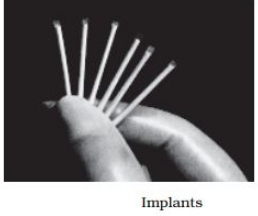
Implants: Progestogens alone or in combination with estrogen can also be used by females as injections or implants under the skin. Their mode of action is similar to that of pills,and their effective periods are much longer.
Administration of progestogens or progestogen-estrogen combinations or $IUDs$ within $72$ hours of coitus has been found to be very effective as emergency contraception to avoid possible pregnancy.
Pills must be taken daily for a period of $21$ days,starting preferably within the first five days of menstruation. This pattern is repeated as long as the female desires to prevent conception,following a gap of $7$ days (during which menstruation occurs).
They inhibit ovulation and implantation,as well as alter the quality of cervical mucus to prevent or retard the entry of sperm.
'Saheli' is a new oral contraceptive for females that contains a non-steroidal preparation. It is a once-a-week pill with very few side effects and high contraceptive value.
Implants: Progestogens alone or in combination with estrogen can also be used by females as injections or implants under the skin. Their mode of action is similar to that of pills,and their effective periods are much longer.
Administration of progestogens or progestogen-estrogen combinations or $IUDs$ within $72$ hours of coitus has been found to be very effective as emergency contraception to avoid possible pregnancy.
0 likes
View Solution37
MediumMCQ
What care should be taken when choosing a contraceptive method?
A
It should be chosen based on self-diagnosis.
B
It should be chosen in consultation with a qualified medical professional.
C
It should be chosen based on advertisements.
D
It should be chosen based on suggestions from friends.
Solution
(B) It needs to be emphasised that the selection of a suitable contraceptive method and its use should always be undertaken in consultation with a qualified medical professional.
Contraceptives are not regular requirements for the maintenance of reproductive health.
They are practiced against a natural reproductive event.
One is forced to use these methods either to prevent pregnancy or to delay or space pregnancy due to personal reasons.
The possible side effects include nausea,abdominal pain,breakthrough bleeding,irregular menstrual bleeding,or even breast cancer.
Contraceptives are not regular requirements for the maintenance of reproductive health.
They are practiced against a natural reproductive event.
One is forced to use these methods either to prevent pregnancy or to delay or space pregnancy due to personal reasons.
The possible side effects include nausea,abdominal pain,breakthrough bleeding,irregular menstrual bleeding,or even breast cancer.
0 likes
View Solution38
Medium
Differentiate between family planning methods and family planning programmes.
Solution
(N/A)
| Family planning methods | Family planning programmes |
|---|---|
| $(1)$ These are techniques used by couples to control pregnancy and space births. | $(1)$ These are large-scale initiatives organized by the government to control population growth. |
| $(2)$ These methods help in preventing unwanted pregnancies and reducing the risk of hereditary diseases in children. | $(2)$ These programmes focus on maternal and child health care,including nutrition and immunization. |
| $(3)$ Examples include vasectomy,tubectomy,$Copper-T$,condoms,and oral contraceptive pills. | $(3)$ These are conducted by trained personnel from governmental or non-governmental organizations. |
| $(4)$ They focus on the individual or couple's choice regarding the number and timing of children. | $(4)$ They focus on public awareness,education,and the implementation of $RCH$ (Reproductive and Child Health) services. |
0 likes
View Solution39
Medium
Give scientific reasons: Government or various welfare institutions make different plans for reproductive health awareness.
Solution
(N/A) The government and various welfare institutions implement $RCH$ (Reproductive and Child Health Care) programs for the following reasons:
$1$. To improve the health of pregnant mothers and infants,thereby reducing maternal and infant mortality rates.
$2$. To provide free services for family planning,contraception,and reproductive health check-ups in government hospitals.
$3$. To conduct promotional and inspirational activities that educate the public about the benefits of small families and the importance of reproductive health,which helps in controlling population growth and ensuring a better quality of life.
$1$. To improve the health of pregnant mothers and infants,thereby reducing maternal and infant mortality rates.
$2$. To provide free services for family planning,contraception,and reproductive health check-ups in government hospitals.
$3$. To conduct promotional and inspirational activities that educate the public about the benefits of small families and the importance of reproductive health,which helps in controlling population growth and ensuring a better quality of life.
0 likes
View Solution40
Medium
Give scientific reasons: Amniocentesis is used to diagnose genetic irregularities in an embryo or foetus.
Solution
(N/A) Amniocentesis is a prenatal diagnostic technique where amniotic fluid,which surrounds the developing foetus,is collected using a needle.
This fluid contains foetal cells that are shed during development.
These cells are analyzed for chromosomal abnormalities and genetic disorders using techniques like $DNA$ testing or karyotyping.
If a serious or incurable genetic disorder is detected,the parents may be advised to consider the termination of the pregnancy.
This fluid contains foetal cells that are shed during development.
These cells are analyzed for chromosomal abnormalities and genetic disorders using techniques like $DNA$ testing or karyotyping.
If a serious or incurable genetic disorder is detected,the parents may be advised to consider the termination of the pregnancy.
0 likes
View Solution41
Medium
Give the full forms of the following abbreviations:
$1.$ $\text{RCH}$
$2.$ $\text{WHO}$
$3.$ $\text{CDRI}$
$4.$ $\text{MTP}$
$5.$ $\text{MMR}$
$6.$ $\text{IMR}$
$1.$ $\text{RCH}$
$2.$ $\text{WHO}$
$3.$ $\text{CDRI}$
$4.$ $\text{MTP}$
$5.$ $\text{MMR}$
$6.$ $\text{IMR}$
Solution
(N/A) $(1)$ $\text{RCH}$: $\text{Reproductive and Child Health care}$
$(2)$ $\text{WHO}$: $\text{World Health Organization}$
$(3)$ $\text{CDRI}$: $\text{Central Drug Research Institute}$
$(4)$ $\text{MTP}$: $\text{Medical Termination of Pregnancy}$
$(5)$ $\text{MMR}$: $\text{Maternal Mortality Rate}$
$(6)$ $\text{IMR}$: $\text{Infant Mortality Rate}$
$(2)$ $\text{WHO}$: $\text{World Health Organization}$
$(3)$ $\text{CDRI}$: $\text{Central Drug Research Institute}$
$(4)$ $\text{MTP}$: $\text{Medical Termination of Pregnancy}$
$(5)$ $\text{MMR}$: $\text{Maternal Mortality Rate}$
$(6)$ $\text{IMR}$: $\text{Infant Mortality Rate}$
0 likes
View Solution42
Easy
Reproductive health refers only to healthy reproductive functions. Comment.
Solution
(N/A) The statement is incorrect. According to the World Health Organization $(WHO)$,reproductive health means a total well-being in all aspects of reproduction,i.e.,physical,emotional,behavioral,and social.
Therefore,a society with people having physically and functionally normal reproductive organs,along with normal emotional and behavioral interactions among them in all sex-related aspects,is considered reproductively healthy.
Therefore,a society with people having physically and functionally normal reproductive organs,along with normal emotional and behavioral interactions among them in all sex-related aspects,is considered reproductively healthy.
0 likes
View Solution43
Medium
Comment on the Reproductive and Child Health $(RCH)$ care programme of the government to improve the reproductive health of the people.
Solution
(N/A) India was among the first countries in the world to initiate action plans and programmes at a national level to attain total reproductive health as a social goal.
These programmes,historically called 'family planning',were initiated in $1951$ and have been periodically assessed over the past decades.
Currently,these programmes operate under the popular name '$RCH$' ($Reproductive$ $and$ $Child$ $Health$ care programme).
Major tasks of these programmes include:
$1$. Creating awareness among people about various reproduction-related aspects.
$2$. Providing facilities and support for building up a reproductively healthy society.
$3$. Providing medical assistance and care to mothers and children to reduce maternal and infant mortality rates.
These programmes,historically called 'family planning',were initiated in $1951$ and have been periodically assessed over the past decades.
Currently,these programmes operate under the popular name '$RCH$' ($Reproductive$ $and$ $Child$ $Health$ care programme).
Major tasks of these programmes include:
$1$. Creating awareness among people about various reproduction-related aspects.
$2$. Providing facilities and support for building up a reproductively healthy society.
$3$. Providing medical assistance and care to mothers and children to reduce maternal and infant mortality rates.
0 likes
View Solution44
Easy
Suggest the reproduction-related aspects in which counselling should be provided at the school level.
Solution
(N/A) At the school level,guidance should be provided regarding the following aspects:
$(i)$ Sex education should be provided to ensure children stay away from myths and misconceptions related to reproduction.
$(ii)$ Proper information should be provided regarding reproductive organs,puberty-related changes,safe and hygienic sexual habits,and $STDs$ (Sexually Transmitted Diseases).
$(iii)$ Awareness should be created about the problems caused by uncontrolled population growth,social evils,and crimes related to sex,such as sexual exploitation.
$(iv)$ Students should be educated about methods of birth control,care for pregnant women,postnatal care for both mother and child,the importance of breastfeeding,and the necessity of providing equal opportunities to both male and female children.
$(i)$ Sex education should be provided to ensure children stay away from myths and misconceptions related to reproduction.
$(ii)$ Proper information should be provided regarding reproductive organs,puberty-related changes,safe and hygienic sexual habits,and $STDs$ (Sexually Transmitted Diseases).
$(iii)$ Awareness should be created about the problems caused by uncontrolled population growth,social evils,and crimes related to sex,such as sexual exploitation.
$(iv)$ Students should be educated about methods of birth control,care for pregnant women,postnatal care for both mother and child,the importance of breastfeeding,and the necessity of providing equal opportunities to both male and female children.
0 likes
View Solution45
Medium
Suggest some important steps that you would recommend to be taken to improve the reproductive health standards in India.
Solution
(N/A) To improve reproductive health standards in India,the following steps are essential:
$(i)$ Strengthening medical infrastructure and ensuring the availability of professional experts is necessary to make reproductive health programs successful.
$(ii)$ Educating people about birth control methods,maternal care,the importance of breastfeeding,safe and hygienic sexual practices,and providing accurate information regarding $STDs$ and their prevention.
$(iii)$ Creating awareness among the public about reproduction-related aspects using audio-visual and print media.
$(iv)$ Addressing problems caused by population growth and social evils such as sexual exploitation and sex-related crimes,along with raising awareness to prevent such crimes.
$(v)$ Implementing a statutory ban on amniocentesis to legally prevent female foeticide and illegal abortions.
$(i)$ Strengthening medical infrastructure and ensuring the availability of professional experts is necessary to make reproductive health programs successful.
$(ii)$ Educating people about birth control methods,maternal care,the importance of breastfeeding,safe and hygienic sexual practices,and providing accurate information regarding $STDs$ and their prevention.
$(iii)$ Creating awareness among the public about reproduction-related aspects using audio-visual and print media.
$(iv)$ Addressing problems caused by population growth and social evils such as sexual exploitation and sex-related crimes,along with raising awareness to prevent such crimes.
$(v)$ Implementing a statutory ban on amniocentesis to legally prevent female foeticide and illegal abortions.
0 likes
View Solution46
Easy
Comment on the essential features required for an ideal contraceptive.
Solution
(N/A) An ideal contraceptive should possess the following essential features:
$1$. User-friendly: It should be easy to use or administer.
$2$. Easily available: It must be accessible to the general population.
$3$. Effective: It should have a high success rate in preventing conception.
$4$. Reversible: It should allow for the return of fertility once the user decides to stop using it.
$5$. Minimal side-effects: It should have no or the least possible side-effects on the user's health.
$6$. Non-interfering: It should not interfere with the sexual drive,sexual desire,or the sexual act of the user.
$1$. User-friendly: It should be easy to use or administer.
$2$. Easily available: It must be accessible to the general population.
$3$. Effective: It should have a high success rate in preventing conception.
$4$. Reversible: It should allow for the return of fertility once the user decides to stop using it.
$5$. Minimal side-effects: It should have no or the least possible side-effects on the user's health.
$6$. Non-interfering: It should not interfere with the sexual drive,sexual desire,or the sexual act of the user.
0 likes
View Solution47
Medium
Do you justify the statutory ban on amniocentesis in our country? Give reasons.
Solution
(A) Yes,the statutory ban on amniocentesis is justified.
$1$. Misuse: The technique is frequently misused to determine the sex of the foetus,leading to female foeticide,which has severely disrupted the sex ratio in many parts of the country.
$2$. Ethical Concerns: This practice reflects a negative social attitude towards the girl child.
$3$. Original Purpose: The primary medical purpose of amniocentesis is to detect chromosomal abnormalities,genetic disorders,or metabolic deficiencies in the developing foetus.
$4$. Clinical Decision: If a serious,incurable genetic defect is detected,the parents may opt for medical termination of pregnancy $(MTP)$. The ban ensures that the test is performed only for legitimate medical reasons under strict supervision,preventing its use for sex determination.
$1$. Misuse: The technique is frequently misused to determine the sex of the foetus,leading to female foeticide,which has severely disrupted the sex ratio in many parts of the country.
$2$. Ethical Concerns: This practice reflects a negative social attitude towards the girl child.
$3$. Original Purpose: The primary medical purpose of amniocentesis is to detect chromosomal abnormalities,genetic disorders,or metabolic deficiencies in the developing foetus.
$4$. Clinical Decision: If a serious,incurable genetic defect is detected,the parents may opt for medical termination of pregnancy $(MTP)$. The ban ensures that the test is performed only for legitimate medical reasons under strict supervision,preventing its use for sex determination.
0 likes
View Solution48
Easy
Enumerate and describe any five reasons for introducing sex education to school-going children.
Solution
(A-D) The reasons for providing sex education to school-going children are as follows:
$(i)$ At the school level,children aged $12$ years or above should be provided with knowledge about the reproductive system,biological processes,and the importance of safe and responsible sexual behavior.
$(ii)$ Education should cover topics such as physiological changes during adolescence,the menstrual cycle,the risks of unwanted pregnancy,unsafe abortion,sexually transmitted diseases $(STDs)$,reproductive tract infections,and reproductive cancers.
$(iii)$ Students should be informed about the physical changes occurring in their bodies according to their age,the importance of personal hygiene,and the maintenance of healthy habits.
$(iv)$ Students should be actively involved in such educational programs to reduce hesitation,build self-confidence,and encourage open communication with their teachers and parents regarding their concerns.
$(v)$ Through open discussion,students become aware of their reproductive organs and their functions. This awareness plays a crucial role in promoting safe and hygienic practices,ultimately leading to a society that is reproductively healthy.
$(i)$ At the school level,children aged $12$ years or above should be provided with knowledge about the reproductive system,biological processes,and the importance of safe and responsible sexual behavior.
$(ii)$ Education should cover topics such as physiological changes during adolescence,the menstrual cycle,the risks of unwanted pregnancy,unsafe abortion,sexually transmitted diseases $(STDs)$,reproductive tract infections,and reproductive cancers.
$(iii)$ Students should be informed about the physical changes occurring in their bodies according to their age,the importance of personal hygiene,and the maintenance of healthy habits.
$(iv)$ Students should be actively involved in such educational programs to reduce hesitation,build self-confidence,and encourage open communication with their teachers and parents regarding their concerns.
$(v)$ Through open discussion,students become aware of their reproductive organs and their functions. This awareness plays a crucial role in promoting safe and hygienic practices,ultimately leading to a society that is reproductively healthy.
0 likes
View Solution49
MediumMCQ
According to the $WHO$,which aspects are included in reproductive health?
A
Physical health
B
Emotional or behavioral health
C
Social health
D
All of the above
Solution
(D) According to the $World$ $Health$ $Organization$ $(WHO)$,reproductive health means a total well-being in all aspects of reproduction,i.e.,physical,emotional,behavioral,and social. Therefore,all the given options are correct.
0 likes
View Solution50
MediumMCQ
India initiated its family planning program in $1951$. By what name is this program currently known as an improved version?
A
$RCH$
B
$CHR$
C
$NACO$
D
$NGO$
Solution
(A) India was among the first countries in the world to initiate action plans and programs at a national level to attain total reproductive health as a social goal. These programs,called 'family planning',were initiated in $1951$ and were periodically assessed over the past decades. Improved programs covering wider reproduction-related areas are currently in operation under the popular name 'Reproductive and Child Health Care' $(RCH)$ programs.
0 likes
View SolutionReproductive Health — Reproductive Health · Frequently Asked Questions
1Are these Reproductive Health questions useful for JEE and NEET?
Yes. All questions in this section are mapped to JEE Main and NEET exam patterns. Previous year questions from JEE Main, NEET, GUJCET and state-level exams are included with full solutions.
2Can I switch to Hindi or Gujarati for these questions?
Yes. Use the language tabs in the hero section or the sidebar to view the same questions and solutions in English, Hindi or Gujarati.
3How do I generate a question paper from this subtopic?
Use the Vedclass Exam Paper Generator — select the chapter and subtopic, set difficulty, and generate Sets A, B, C, D automatically. First 3 chapters of every subject are free.
Vedclass Products
For Students
Vedclass Test Series
Mock tests in real JEE/NEET style with performance analysis. 5-day free trial.
Start Free TrialFor Teachers
Exam Paper Generator
Generate Set A/B/C/D papers from this chapter in 2 minutes. 3 chapters free.
Try FreeFor Institutes
Online Exam Module
Live online exams with unlimited students, 360° analytics & white-label branding.
See DemoFor Teachers & Institutes
Generate a Reproductive Health Exam Paper in 2 Minutes
Select subtopic & difficulty — Sets A, B, C, D auto-generated with No Repeat logic.
First 3 chapters of every subject are free — no payment required.