
A English
Method of birth control Questions in English
Class 12 Biology · Reproductive Health · Method of birth control
340+
Questions
English
Language
100%
With Solutions
Showing 50 of 340 questions in English
251
MediumMCQ
$A$: Maximum chances of failure in Rhythm method of contraception.
$R$: Very few women have absolutely regular cycles.
$R$: Very few women have absolutely regular cycles.
A
Assertion and Reason both are correct and Reason is the correct explanation of Assertion.
B
Assertion and Reason both are correct but Reason is not the correct explanation of Assertion.
C
Assertion is correct,but Reason is incorrect.
D
Both Assertion and Reason are incorrect.
Solution
(A) The Rhythm method (also known as the periodic abstinence or calendar method) relies on predicting the fertile period of a woman's menstrual cycle.
It is based on the assumption that ovulation occurs $14$ days before the next menstrual cycle.
However,the failure rate of this method is very high (approximately $20-30\;\%$) because very few women have perfectly regular menstrual cycles.
Variations in cycle length due to stress,illness,or hormonal changes make it difficult to accurately predict the fertile window,leading to a high risk of unintended pregnancy.
Therefore,both the Assertion and the Reason are correct,and the Reason provides the correct explanation for the high failure rate.
It is based on the assumption that ovulation occurs $14$ days before the next menstrual cycle.
However,the failure rate of this method is very high (approximately $20-30\;\%$) because very few women have perfectly regular menstrual cycles.
Variations in cycle length due to stress,illness,or hormonal changes make it difficult to accurately predict the fertile window,leading to a high risk of unintended pregnancy.
Therefore,both the Assertion and the Reason are correct,and the Reason provides the correct explanation for the high failure rate.
0 likes
View Solution252
MediumMCQ
$A$: Both vasectomy and tubectomy are very effective,as the failure rate of such surgical approaches is almost zero percent.
$R$: Reversibility is poor.
$R$: Reversibility is poor.
A
Assertion and Reason both are correct and Reason is the correct explanation of Assertion.
B
Assertion and Reason both are correct but Reason is not the correct explanation of Assertion.
C
Assertion is correct,but Reason is incorrect.
D
Both Assertion and Reason are incorrect.
Solution
(A) Vasectomy (in males) and tubectomy (in females) are surgical methods of contraception,also known as sterilization.
These methods are highly effective because they physically block the transport of gametes (sperm or ovum),resulting in a failure rate that is nearly zero percent.
However,these procedures are intended to be permanent,and their surgical reversibility is very poor,making them unsuitable for individuals who may wish to have children in the future.
Therefore,both the Assertion and the Reason are correct,and the Reason explains why these methods are considered permanent surgical interventions.
These methods are highly effective because they physically block the transport of gametes (sperm or ovum),resulting in a failure rate that is nearly zero percent.
However,these procedures are intended to be permanent,and their surgical reversibility is very poor,making them unsuitable for individuals who may wish to have children in the future.
Therefore,both the Assertion and the Reason are correct,and the Reason explains why these methods are considered permanent surgical interventions.
0 likes
View Solution253
MediumMCQ
$A$: Lactational amenorrhoea is one of the natural methods of birth control.
$R$: High levels of prolactin inhibit the secretion of gonadotropins.
$R$: High levels of prolactin inhibit the secretion of gonadotropins.
A
Assertion and Reason both are correct and Reason is the correct explanation of Assertion.
B
Assertion and Reason both are correct but Reason is not the correct explanation of Assertion.
C
Assertion is correct,but Reason is incorrect.
D
Both Assertion and Reason are incorrect.
Solution
(A) Lactational amenorrhoea is a natural method of contraception based on the fact that ovulation does not occur during the period of intense lactation following parturition.
During this period,the high levels of prolactin (the hormone responsible for milk production) in the mother's blood inhibit the secretion of gonadotropins ($LH$ and $FSH$) from the anterior pituitary gland.
Since gonadotropins are essential for the maturation of ovarian follicles and ovulation,their inhibition prevents ovulation,thereby acting as a natural contraceptive method.
During this period,the high levels of prolactin (the hormone responsible for milk production) in the mother's blood inhibit the secretion of gonadotropins ($LH$ and $FSH$) from the anterior pituitary gland.
Since gonadotropins are essential for the maturation of ovarian follicles and ovulation,their inhibition prevents ovulation,thereby acting as a natural contraceptive method.
0 likes
View Solution254
MediumMCQ
$A$: Gossypol inhibits spermatogenesis.
$R$: Centchroman inhibits ovulation.
$R$: Centchroman inhibits ovulation.
A
Assertion and Reason both are correct and Reason is the correct explanation of Assertion.
B
Assertion and Reason both are correct but Reason is not the correct explanation of Assertion.
C
Assertion is correct,but Reason is incorrect.
D
Both Assertion and Reason are incorrect.
Solution
(C) : Gossypol is a phenolic compound derived from the cotton plant. It has been studied as a male contraceptive because it inhibits spermatogenesis by affecting the germinal epithelium of the testes.
$R$: Centchroman (marketed as Saheli) is a non-steroidal oral contraceptive pill. It does not inhibit ovulation; instead,it acts as a selective estrogen receptor modulator $(SERM)$ that prevents the implantation of the fertilized ovum in the uterus.
Therefore,the Assertion is correct,but the Reason is incorrect.
$R$: Centchroman (marketed as Saheli) is a non-steroidal oral contraceptive pill. It does not inhibit ovulation; instead,it acts as a selective estrogen receptor modulator $(SERM)$ that prevents the implantation of the fertilized ovum in the uterus.
Therefore,the Assertion is correct,but the Reason is incorrect.
0 likes
View Solution255
EasyMCQ
The most important component of oral contraceptive is
A
$LH$
B
$GH$
C
$Thyroxine$
D
$progesterone$
Solution
(D) Oral contraceptives or contraceptive pills are used to control fertility.
These pills contain a mixture of synthetic oestrogen and progesterone or only synthetic progesterone.
These hormones act by inhibiting ovulation,altering the cervical mucus to prevent sperm entry,and changing the uterine lining to prevent implantation.
These pills contain a mixture of synthetic oestrogen and progesterone or only synthetic progesterone.
These hormones act by inhibiting ovulation,altering the cervical mucus to prevent sperm entry,and changing the uterine lining to prevent implantation.
0 likes
View Solution256
EasyMCQ
The purpose of tubectomy is to prevent:
A
Fertilization
B
Coitus
C
Egg formation
D
Embryonic development
Solution
(A) Tubectomy is a surgical method of female sterilization,which involves cutting and tying (tubal ligation) of the fallopian tubes. By blocking the fallopian tubes,the sperm is prevented from reaching the ovum,thereby preventing fertilization.
0 likes
View Solution257
MediumMCQ
Match List-$I$ with List-$II$.
Choose the correct answer from the options given below.
| List-$I$ | List-$II$ |
| $(a)$ Vaults | $(i)$ Entry of sperm through Cervix is blocked |
| $(b)$ $IUDs$ | $(ii)$ Removal of Vas deferens |
| $(c)$ Vasectomy | $(iii)$ Phagocytosis of sperms within the Uterus |
| $(d)$ Tubectomy | $(iv)$ Removal of fallopian tube |
A
$(iv)-(ii)-(i)-(iii)$
B
$(i)-(iii)-(ii)-(iv)$
C
$(ii)-(iv)-(iii)-(i)$
D
$(iii)-(i)-(iv)-(ii)$
Solution
(B) The correct matches are as follows:
$(a)$ Vaults are barrier methods that prevent the entry of sperm through the Cervix. Thus,$(a)-(i)$.
$(b)$ $IUDs$ (Intra Uterine Devices) like Lippes loop increase phagocytosis of sperms within the Uterus. Thus,$(b)-(iii)$.
$(c)$ Vasectomy is a surgical sterilization method in males involving the removal or ligation of a small part of the Vas deferens. Thus,$(c)-(ii)$.
$(d)$ Tubectomy is a surgical sterilization method in females involving the removal or ligation of a small part of the fallopian tube. Thus,$(d)-(iv)$.
Therefore,the correct sequence is $(a)-(i), (b)-(iii), (c)-(ii), (d)-(iv)$,which corresponds to option $(B)$.
$(a)$ Vaults are barrier methods that prevent the entry of sperm through the Cervix. Thus,$(a)-(i)$.
$(b)$ $IUDs$ (Intra Uterine Devices) like Lippes loop increase phagocytosis of sperms within the Uterus. Thus,$(b)-(iii)$.
$(c)$ Vasectomy is a surgical sterilization method in males involving the removal or ligation of a small part of the Vas deferens. Thus,$(c)-(ii)$.
$(d)$ Tubectomy is a surgical sterilization method in females involving the removal or ligation of a small part of the fallopian tube. Thus,$(d)-(iv)$.
Therefore,the correct sequence is $(a)-(i), (b)-(iii), (c)-(ii), (d)-(iv)$,which corresponds to option $(B)$.
0 likes
View Solution258
EasyMCQ
Which one of the following is an example of a hormone-releasing $IUD$?
A
$CuT$
B
$LNG-20$
C
$Cu-7$
D
Multiload $375$
Solution
(B) Intrauterine devices $(IUDs)$ are effective contraceptive methods. They are categorized into three types:
$1$. Non-medicated $IUDs$: e.g.,Lippes loop.
$2$. Copper-releasing $IUDs$: These increase phagocytosis of sperms within the uterus and suppress sperm motility and fertilizing capacity of sperms. Examples include $CuT$,$Cu-7$,and Multiload $375$.
$3$. Hormone-releasing $IUDs$: These make the uterus unsuitable for implantation and the cervix hostile to the sperms. Examples include Progestasert and $LNG-20$.
Therefore,$LNG-20$ is a hormone-releasing $IUD$.
$1$. Non-medicated $IUDs$: e.g.,Lippes loop.
$2$. Copper-releasing $IUDs$: These increase phagocytosis of sperms within the uterus and suppress sperm motility and fertilizing capacity of sperms. Examples include $CuT$,$Cu-7$,and Multiload $375$.
$3$. Hormone-releasing $IUDs$: These make the uterus unsuitable for implantation and the cervix hostile to the sperms. Examples include Progestasert and $LNG-20$.
Therefore,$LNG-20$ is a hormone-releasing $IUD$.
0 likes
View Solution259
EasyMCQ
Lippe's loop is a type of contraceptive used as:
A
Vault barrier
B
Non-medicated IUDs
C
Copper releasing $IUD$
D
Cervical barrier
Solution
(B) Lippe's loop is a type of $IUD$ (Intrauterine Device).
Specifically,it is classified as a non-medicated $IUD$ because it does not release any hormones or metal ions.
It works by increasing phagocytosis of sperms within the uterus.
Therefore,the correct option is $B$.
Specifically,it is classified as a non-medicated $IUD$ because it does not release any hormones or metal ions.
It works by increasing phagocytosis of sperms within the uterus.
Therefore,the correct option is $B$.
0 likes
View Solution260
MediumMCQ
Match List-$I$ with List-$II$ with respect to methods of contraception and their respective actions.
Choose the correct answer from the options given below:
| List-$I$ | List-$II$ |
| $(a)$ Diaphragms | $(i)$ Inhibit ovulation and implantation |
| $(b)$ Contraceptive pills | $(ii)$ Increase phagocytosis of sperm within uterus |
| $(c)$ Intra Uterine Device | $(iii)$ Absence of menstrual cycle and ovulation following parturition |
| $(d)$ Lactational amenorrhea | $(iv)$ They cover the cervix blocking the entry of sperms |
Choose the correct answer from the options given below:
A
$(a)-(iv), (b)-(i), (c)-(ii), (d)-(iii)$
B
$(a)-(ii), (b)-(iv), (c)-(i), (d)-(iii)$
C
$(a)-(iii), (b)-(ii), (c)-(i), (d)-(iv)$
D
$(a)-(iv), (b)-(i), (c)-(iii), (d)-(ii)$
Solution
(A) The correct matching is as follows:
$(a)$ Diaphragms are barrier methods that cover the cervix,thereby blocking the entry of sperms into the uterus. Thus,$(a)-(iv)$.
$(b)$ Contraceptive pills contain hormones (progestogens or progestogen-estrogen combinations) that inhibit ovulation and implantation,and also alter the quality of cervical mucus to prevent sperm entry. Thus,$(b)-(i)$.
$(c)$ Intra Uterine Devices (IUDs) like Copper-$T$ increase the phagocytosis of sperms within the uterus,which reduces sperm count and motility. Thus,$(c)-(ii)$.
$(d)$ Lactational amenorrhea is a natural method based on the fact that ovulation and the menstrual cycle do not occur during the period of intense lactation following parturition. Thus,$(d)-(iii)$.
Therefore,the correct sequence is $(a)-(iv), (b)-(i), (c)-(ii), (d)-(iii)$.
$(a)$ Diaphragms are barrier methods that cover the cervix,thereby blocking the entry of sperms into the uterus. Thus,$(a)-(iv)$.
$(b)$ Contraceptive pills contain hormones (progestogens or progestogen-estrogen combinations) that inhibit ovulation and implantation,and also alter the quality of cervical mucus to prevent sperm entry. Thus,$(b)-(i)$.
$(c)$ Intra Uterine Devices (IUDs) like Copper-$T$ increase the phagocytosis of sperms within the uterus,which reduces sperm count and motility. Thus,$(c)-(ii)$.
$(d)$ Lactational amenorrhea is a natural method based on the fact that ovulation and the menstrual cycle do not occur during the period of intense lactation following parturition. Thus,$(d)-(iii)$.
Therefore,the correct sequence is $(a)-(iv), (b)-(i), (c)-(ii), (d)-(iii)$.
0 likes
View Solution261
EasyMCQ
In this method,the male partner withdraws his penis from the vagina just before ejaculation to avoid insemination.
A
Coitus interruptus
B
Lactational amenorrhea
C
Withdrawal method
D
Both $A$ and $C$
Solution
(D) Withdrawal or coitus interruptus is a natural method of contraception in which the male partner withdraws his penis from the vagina just before ejaculation so as to avoid insemination.
Therefore,both options $A$ and $C$ refer to the same method.
Therefore,both options $A$ and $C$ refer to the same method.
0 likes
View Solution262
EasyMCQ
Nirodh is a popular brand of .....
A
Oral contraceptive pills for females
B
Condoms for females
C
Condoms for males
D
Intrauterine devices for females
Solution
(C) Nirodh is a well-known and widely used brand of male condoms in India. It is promoted by the government to encourage safe sexual practices and to act as a barrier method for contraception. Therefore,the correct option is $C$.
0 likes
View Solution263
EasyMCQ
The use of spermicidal creams,jellies,and foams along with barrier methods is used to:
A
Increase the contraceptive efficiency.
B
Decrease the contraceptive efficiency.
C
Increase the motility of sperms.
D
None of the above.
Solution
(A) Barrier methods (like condoms,diaphragms,cervical caps,and vaults) prevent the physical meeting of sperm and ovum. When these are used in conjunction with chemical agents like spermicidal creams,jellies,and foams,these chemicals kill the sperms and immobilize them. This combination significantly increases the overall contraceptive efficiency by providing a dual layer of protection against fertilization.
0 likes
View Solution264
MediumMCQ
How do diaphragms,cervical caps,and vaults function as contraceptives?
A
By inhibiting ovulation and implantation
B
By inhibiting sperm motility
C
By preventing the entry of sperm through the cervix
D
By phagocytosis of sperm in the uterus
Solution
(C) Diaphragms,cervical caps,and vaults are barrier methods of contraception. These devices are made of rubber and are inserted into the female reproductive tract to cover the cervix during coitus. By covering the cervix,they physically block the entry of sperm into the uterus,thereby preventing fertilization.
0 likes
View Solution265
MediumMCQ
Match the following columns:
| Column-$I$ | Column-$II$ |
| $P$. Copper releasing $IUDs$ | $I$. $CuT, Cu 7$,Multiload $375$ |
| $Q$. Non-medicated $IUDs$ | $II$. Lippes loop |
| $R$. Hormone releasing $IUDs$ | $III$. Progestasert,$LNG-20$ |
A
$(P-I), (Q-II), (R-III)$
B
$(P-I), (Q-III), (R-II)$
C
$(P-II), (Q-III), (R-I)$
D
$(P-II), (Q-I), (R-III)$
Solution
(A) The classification of Intrauterine Devices $(IUDs)$ is as follows:
$1$. Copper releasing $IUDs$: These devices release copper ions which suppress sperm motility and the fertilizing capacity of sperms. Examples include $CuT$,$Cu 7$,and Multiload $375$. Thus,$P-I$.
$2$. Non-medicated $IUDs$: These are the first generation of $IUDs$ which work primarily by causing a foreign body reaction in the uterus,leading to phagocytosis of sperms. Example is Lippes loop. Thus,$Q-II$.
$3$. Hormone releasing $IUDs$: These devices release hormones (progestogens) that make the uterus unsuitable for implantation and the cervix hostile to sperms. Examples include Progestasert and $LNG-20$. Thus,$R-III$.
Therefore,the correct matching is $(P-I), (Q-II), (R-III)$.
$1$. Copper releasing $IUDs$: These devices release copper ions which suppress sperm motility and the fertilizing capacity of sperms. Examples include $CuT$,$Cu 7$,and Multiload $375$. Thus,$P-I$.
$2$. Non-medicated $IUDs$: These are the first generation of $IUDs$ which work primarily by causing a foreign body reaction in the uterus,leading to phagocytosis of sperms. Example is Lippes loop. Thus,$Q-II$.
$3$. Hormone releasing $IUDs$: These devices release hormones (progestogens) that make the uterus unsuitable for implantation and the cervix hostile to sperms. Examples include Progestasert and $LNG-20$. Thus,$R-III$.
Therefore,the correct matching is $(P-I), (Q-II), (R-III)$.
0 likes
View Solution266
EasyMCQ
Which of the following is an ideal contraceptive for females who want to delay pregnancy and space out children?
A
$IUDs$
B
Condoms
C
Coitus interruptus
D
Pills
Solution
(A) Intrauterine Devices $(IUDs)$ are considered the ideal contraceptive for females who want to delay pregnancy and space out children.
These devices are inserted by doctors or expert nurses in the uterus through the vagina.
$IUDs$ are highly effective,long-acting,and reversible,making them the most widely accepted method for birth spacing in India.
These devices are inserted by doctors or expert nurses in the uterus through the vagina.
$IUDs$ are highly effective,long-acting,and reversible,making them the most widely accepted method for birth spacing in India.
0 likes
View Solution267
MediumMCQ
This method is based on the fact that as long as the mother breastfeeds the child fully, the chances of conception are almost zero. Identify the method.
A
Coitus interruptus
B
Lactational amenorrhea
C
Periodic abstinence
D
Both $A$ and $C$
Solution
(B) The method described is $Lactational \text{ } amenorrhea$.
It is a natural method of contraception based on the biological fact that ovulation does not occur during the period of intense lactation following parturition.
As long as the mother breastfeeds the child fully, the levels of prolactin remain high, which inhibits the release of gonadotropins ($FSH$ and $LH$), thereby preventing ovulation.
This method is effective only up to a maximum period of $6$ months following parturition.
It is a natural method of contraception based on the biological fact that ovulation does not occur during the period of intense lactation following parturition.
As long as the mother breastfeeds the child fully, the levels of prolactin remain high, which inhibits the release of gonadotropins ($FSH$ and $LH$), thereby preventing ovulation.
This method is effective only up to a maximum period of $6$ months following parturition.
0 likes
View Solution268
MediumMCQ
Which of the following functions are true for copper ions released by copper-releasing $IUDs$?
$I -$ Suppress sperm motility
$II -$ Inhibit the fertilizing capacity of sperms
$III -$ Make the uterus unsuitable for implantation
$IV -$ Make the cervix hostile to sperms
$I -$ Suppress sperm motility
$II -$ Inhibit the fertilizing capacity of sperms
$III -$ Make the uterus unsuitable for implantation
$IV -$ Make the cervix hostile to sperms
A
$I, II, III, IV$
B
$I, II, III$
C
$I, II$
D
$III, IV$
Solution
(C) Copper-releasing $IUDs$ (like $CuT$,$Cu7$,$Multiload$ $375$) release $Cu^{2+}$ ions.
These ions perform the following functions:
$1$. They suppress the motility of sperms $(I)$.
$2$. They inhibit the fertilizing capacity of sperms $(II)$.
$3$. They do not affect the uterus or cervix in the way hormone-releasing $IUDs$ do (which make the uterus unsuitable for implantation and the cervix hostile to sperms).
Therefore,only statements $I$ and $II$ are correct.
These ions perform the following functions:
$1$. They suppress the motility of sperms $(I)$.
$2$. They inhibit the fertilizing capacity of sperms $(II)$.
$3$. They do not affect the uterus or cervix in the way hormone-releasing $IUDs$ do (which make the uterus unsuitable for implantation and the cervix hostile to sperms).
Therefore,only statements $I$ and $II$ are correct.
0 likes
View Solution269
MediumMCQ
Match the following columns:
| Column-$I$ | Column-$II$ |
|---|---|
| $P$. Male condom | $I$. Female condom |
| $Q$. Female condom | $II$. Male condom |
| $R$. Copper $T$ | $III$. Implant |
| $S$. Implant | $IV$. Copper $T$ |
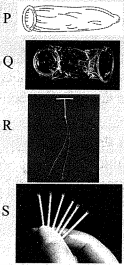
A
$(P-I), (Q-II), (R-III), (S-IV)$
B
$(P-II), (Q-I), (R-IV), (S-III)$
C
$(P-I), (Q-II), (R-IV), (S-III)$
D
$(P-II), (Q-I), (R-III), (S-IV)$
Solution
(B) Based on the provided images:
$P$ represents a male condom.
$Q$ represents a female condom.
$R$ represents a Copper $T$ (an intrauterine device).
$S$ represents hormonal implants.
Matching these with Column-$II$:
$P$ (Male condom) matches with $II$.
$Q$ (Female condom) matches with $I$.
$R$ (Copper $T$) matches with $IV$.
$S$ (Implant) matches with $III$.
Therefore,the correct sequence is $(P-II), (Q-I), (R-IV), (S-III)$.
$P$ represents a male condom.
$Q$ represents a female condom.
$R$ represents a Copper $T$ (an intrauterine device).
$S$ represents hormonal implants.
Matching these with Column-$II$:
$P$ (Male condom) matches with $II$.
$Q$ (Female condom) matches with $I$.
$R$ (Copper $T$) matches with $IV$.
$S$ (Implant) matches with $III$.
Therefore,the correct sequence is $(P-II), (Q-I), (R-IV), (S-III)$.
0 likes
View Solution270
EasyMCQ
Oral contraceptive pills contain:
A
Progestogens
B
Estrogen
C
$A$ combination of progestogens and estrogen
D
Either $A$ or $C$
Solution
(D) Oral contraceptive pills (OCPs) are widely used as a method of birth control. These pills contain either progestogens alone or a combination of progestogens and estrogen. They work by inhibiting ovulation and implantation,as well as altering the quality of cervical mucus to prevent the entry of sperm. Therefore,the correct answer is that they contain progestogens or a combination of progestogens and estrogen.
0 likes
View Solution271
MediumMCQ
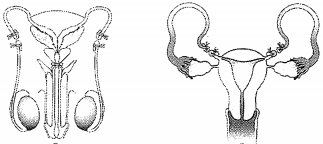
Identify the following contraceptive methods.
$\quad \quad P\quad Q$
$\quad \quad P\quad Q$
A
$IUDs \quad$Implantation
B
Implantation $\quad IUDs$
C
Tubectomy $\quad$ Vasectomy
D
Vasectomy $\quad$ Tubectomy
Solution
(D) In the provided image:
$P$ represents Vasectomy,which is a surgical sterilization method in males where the vas deferens is cut and tied to prevent the transport of sperm.
$Q$ represents Tubectomy,which is a surgical sterilization method in females where the fallopian tubes are cut and tied to prevent the transport of the ovum.
Therefore,the correct sequence is Vasectomy and Tubectomy.
$P$ represents Vasectomy,which is a surgical sterilization method in males where the vas deferens is cut and tied to prevent the transport of sperm.
$Q$ represents Tubectomy,which is a surgical sterilization method in females where the fallopian tubes are cut and tied to prevent the transport of the ovum.
Therefore,the correct sequence is Vasectomy and Tubectomy.
0 likes
View Solution272
MediumMCQ
Match the following columns:
| Column-$I$ | Column-$II$ |
| $P$. Surgical methods | $I$. Easy |
| $Q$. Oral pills | $II$. Tubectomy |
| $R$. $IUDs$ | $III$. Withdrawal |
| $S$. Barrier methods | $IV$. Diaphragm |
| $T$. Natural methods | $V$. $Cu 7$ |
A
$(P-I), (Q-III), (R-II), (S-V), (T-IV)$
B
$(P-II), (Q-I), (R-V), (S-IV), (T-III)$
C
$(P-I), (Q-II), (R-IV), (S-V), (T-III)$
D
$(P-IV), (Q-II), (R-V), (S-III), (T-I)$
Solution
(B) The correct matching is as follows:
$P$. Surgical methods: Tubectomy $(II)$
$Q$. Oral pills: Easy to take orally $(I)$
$R$. $IUDs$: $Cu 7$ $(V)$
$S$. Barrier methods: Diaphragm $(IV)$
$T$. Natural methods: Withdrawal $(III)$
Therefore, the correct sequence is $(P-II), (Q-I), (R-V), (S-IV), (T-III)$.
$P$. Surgical methods: Tubectomy $(II)$
$Q$. Oral pills: Easy to take orally $(I)$
$R$. $IUDs$: $Cu 7$ $(V)$
$S$. Barrier methods: Diaphragm $(IV)$
$T$. Natural methods: Withdrawal $(III)$
Therefore, the correct sequence is $(P-II), (Q-I), (R-V), (S-IV), (T-III)$.
0 likes
View Solution273
MediumMCQ
Which of the following can be used by females as injections or implanted under their skin?
A
Progestogens
B
Estrogen
C
Combination of progestogens and estrogen
D
$A$ or $C$
Solution
(D) Progestogens alone or in combination with estrogen can be used by females as injections or implants under the skin. These hormonal contraceptives work by inhibiting ovulation and altering the cervical mucus to prevent sperm entry. Therefore,both options $A$ and $C$ are correct.
0 likes
View Solution274
MediumMCQ
Oral contraceptive pills are taken daily for a period of $...$ days. After a gap of $...$ days,this process is repeated until the woman desires to prevent conception.
A
$7, 21$
B
$5, 21$
C
$21, 7$
D
$21, 5$
Solution
(C) Oral contraceptive pills (OCPs) are a common method of birth control.
These pills contain either progestogens or a combination of progestogen and estrogen.
The standard regimen involves taking the pill daily for $21$ days,starting preferably within the first five days of the menstrual cycle.
After completing the $21$-day course,a gap of $7$ days is maintained,during which withdrawal bleeding (menstruation) occurs.
This cycle is repeated as long as the woman wishes to prevent pregnancy.
These pills contain either progestogens or a combination of progestogen and estrogen.
The standard regimen involves taking the pill daily for $21$ days,starting preferably within the first five days of the menstrual cycle.
After completing the $21$-day course,a gap of $7$ days is maintained,during which withdrawal bleeding (menstruation) occurs.
This cycle is repeated as long as the woman wishes to prevent pregnancy.
0 likes
View Solution275
MediumMCQ
Which of the following is highly effective as an emergency contraceptive?
A
Use of progestogens
B
Use of progestogen-estrogen combinations
C
$IUDs$
D
Both $A$ and $B$
Solution
(D) Emergency contraceptives are used within $72$ hours of unprotected intercourse to prevent unwanted pregnancy.
Progestogens alone or in combination with estrogen can be used as emergency contraceptives.
$IUDs$ (Intrauterine Devices) are also highly effective if inserted within $72$ hours of unprotected intercourse.
Therefore,all the given options are effective as emergency contraceptives.
Progestogens alone or in combination with estrogen can be used as emergency contraceptives.
$IUDs$ (Intrauterine Devices) are also highly effective if inserted within $72$ hours of unprotected intercourse.
Therefore,all the given options are effective as emergency contraceptives.
0 likes
View Solution276
MediumMCQ
Which of the following is a physical barrier method for birth control?
A
Copper-$T$
B
Lippes loop
C
Diaphragm
D
Coitus interruptus
Solution
(C) Physical barriers are methods used to prevent the physical meeting of sperm and ovum.
$1$. Copper-$T$ and Lippes loop are Intrauterine Devices $(IUDs)$.
$2$. Diaphragms,cervical caps,and vaults are physical barriers made of rubber or latex that cover the cervix in the female reproductive tract to block the entry of sperm.
$3$. Coitus interruptus is a behavioral method of contraception.
Therefore,the diaphragm is the correct physical barrier method.
$1$. Copper-$T$ and Lippes loop are Intrauterine Devices $(IUDs)$.
$2$. Diaphragms,cervical caps,and vaults are physical barriers made of rubber or latex that cover the cervix in the female reproductive tract to block the entry of sperm.
$3$. Coitus interruptus is a behavioral method of contraception.
Therefore,the diaphragm is the correct physical barrier method.
0 likes
View Solution277
MediumMCQ
Which of the following methods of birth control is considered the most effective?
A
Induced abortion
B
Sterilization methods
C
Periodic abstinence
D
Condoms
Solution
(B) Sterilization methods (such as vasectomy in males and tubectomy in females) are considered the most effective and permanent methods of birth control.
These surgical procedures block the transport of gametes,thereby preventing fertilization.
Induced abortion is a medical procedure used to terminate a pregnancy,not a primary method of birth control.
Periodic abstinence and condoms have higher failure rates compared to sterilization.
These surgical procedures block the transport of gametes,thereby preventing fertilization.
Induced abortion is a medical procedure used to terminate a pregnancy,not a primary method of birth control.
Periodic abstinence and condoms have higher failure rates compared to sterilization.
0 likes
View Solution278
MediumMCQ
The primary purpose of tubectomy is to prevent .........
A
Coitus
B
Gamete formation
C
Embryogenesis
D
Fertilization
Solution
(D) Tubectomy is a surgical sterilization procedure for females. In this method,a small part of the fallopian tubes is removed or tied up through a small incision in the abdomen or through the vagina. This blocks the transport of the ovum,thereby preventing the fusion of the sperm and the ovum,which is known as fertilization. Therefore,the primary purpose of tubectomy is to prevent fertilization.
0 likes
View Solution279
MediumMCQ
Tubectomy is a method of population control,which is performed in .......
A
Females only
B
Males only
C
Both males and females
D
Pregnant females only
Solution
(A) Tubectomy is a surgical sterilization procedure performed in females.
In this procedure,a small part of the fallopian tubes is removed or tied up to prevent the fertilization of the egg by the sperm.
This acts as a permanent method of contraception.
In contrast,the surgical sterilization procedure performed in males is called vasectomy.
In this procedure,a small part of the fallopian tubes is removed or tied up to prevent the fertilization of the egg by the sperm.
This acts as a permanent method of contraception.
In contrast,the surgical sterilization procedure performed in males is called vasectomy.
0 likes
View Solution280
EasyMCQ
In this natural method,couples avoid or abstain from coitus during the period between day $10$ to $17$ of the menstrual cycle.
A
Periodic abstinence
B
Coitus interruptus
C
Lactational amenorrhea
D
Barrier method
Solution
(A) Periodic abstinence is a natural method of contraception where couples avoid or abstain from coitus from day $10$ to $17$ of the menstrual cycle when ovulation could be expected.
This period is called the 'fertile period' because the chances of fertilization are very high during these days.
Therefore,abstaining from coitus during this time prevents conception.
This period is called the 'fertile period' because the chances of fertilization are very high during these days.
Therefore,abstaining from coitus during this time prevents conception.
0 likes
View Solution281
MediumMCQ
Vasectomy prevents $.........$.
A
Sperm production
B
Semen production
C
Sperm entry into the urethra
D
Penile erection
Solution
(C) Vasectomy is a permanent surgical method of contraception in males.
In this procedure,a small part of the $vas \ deferens$ is removed or tied up through a small incision on the scrotum.
This blocks the transport of sperm from the testes to the urethra.
Therefore,it prevents the entry of sperm into the urethra,while sperm production in the testes and semen production by accessory glands continue normally.
In this procedure,a small part of the $vas \ deferens$ is removed or tied up through a small incision on the scrotum.
This blocks the transport of sperm from the testes to the urethra.
Therefore,it prevents the entry of sperm into the urethra,while sperm production in the testes and semen production by accessory glands continue normally.
0 likes
View Solution282
MediumMCQ
In vasectomy,a small incision is made on the ....... and it is tied.
A
Vas deferens
B
Scrotum
C
Testis
D
Thorax
Solution
(A) Vasectomy is a surgical method of contraception in males. In this procedure,a small part of the $vas \ deferens$ is removed or tied up through a small incision on the scrotum. This prevents the transport of sperm from the testes to the urethra,thereby preventing fertilization.
0 likes
View Solution283
MediumMCQ
These methods of birth control are highly effective,but their reversibility is very poor.
A
Sterilization
B
$IUDs$
C
Diaphragms
D
Pills
Solution
(A) Sterilization (surgical methods) is a terminal method of contraception. It is highly effective in preventing pregnancy as it blocks the transport of gametes (vasectomy in males and tubectomy in females). However,the reversibility of these procedures is very poor,making them permanent methods of birth control.
0 likes
View Solution284
EasyMCQ
The Lactational Amenorrhea method is effective only up to a maximum of approximately .......... postpartum.
A
three months
B
twelve months
C
five months
D
six months
Solution
(D) Lactational Amenorrhea is a natural method of contraception based on the fact that ovulation and the menstrual cycle do not occur during the period of intense lactation following parturition.
This method is highly effective only up to a maximum period of $6$ months following parturition.
Therefore,the correct option is $D$.
This method is highly effective only up to a maximum period of $6$ months following parturition.
Therefore,the correct option is $D$.
0 likes
View Solution285
MediumMCQ
Which of the following contraceptive methods has a very high failure rate?
A
Natural methods
B
Barrier methods
C
Intrauterine devices (IUDs)
D
Oral pills
Solution
(A) Natural methods of contraception,such as periodic abstinence,withdrawal (coitus interruptus),and lactational amenorrhea,rely on behavioral changes or physiological timing.
These methods have a very high failure rate compared to other contraceptive methods because they require strict adherence and are highly susceptible to human error or miscalculation of the menstrual cycle.
These methods have a very high failure rate compared to other contraceptive methods because they require strict adherence and are highly susceptible to human error or miscalculation of the menstrual cycle.
0 likes
View Solution286
MediumMCQ
Select the incorrect statement regarding '$Saheli$'.
A
It is taken orally.
B
It is a steroidal preparation.
C
It is taken once a week.
D
It has high contraceptive value with very few side effects.
Solution
(B) $Saheli$ is a new oral contraceptive for females developed by the Central Drug Research Institute $(CDRI)$ in Lucknow,India.
It contains a non-steroidal preparation called $Centchroman$.
It is a 'once a week' pill with very few side effects and high contraceptive value.
Therefore,the statement that it is a steroidal preparation is incorrect.
It contains a non-steroidal preparation called $Centchroman$.
It is a 'once a week' pill with very few side effects and high contraceptive value.
Therefore,the statement that it is a steroidal preparation is incorrect.
0 likes
View Solution287
MediumMCQ
Which of the following is not an Intra Uterine Device $(IUD)$?
A
Progestogens
B
Multiload $375$
C
Lippes loop
D
Progestasert
Solution
(A) Intra Uterine Devices (IUDs) are contraceptive methods inserted into the uterus by doctors or expert nurses.
They are categorized as non-medicated IUDs (e.g.,Lippes loop),copper-releasing IUDs (e.g.,CuT,Cu7,Multiload $375$),and hormone-releasing IUDs (e.g.,Progestasert,$LNG$-$20$).
Progestogens are a class of hormones used in contraceptive pills or implants,but they are not classified as IUDs themselves.
Therefore,Progestogens is the correct answer.
They are categorized as non-medicated IUDs (e.g.,Lippes loop),copper-releasing IUDs (e.g.,CuT,Cu7,Multiload $375$),and hormone-releasing IUDs (e.g.,Progestasert,$LNG$-$20$).
Progestogens are a class of hormones used in contraceptive pills or implants,but they are not classified as IUDs themselves.
Therefore,Progestogens is the correct answer.
0 likes
View Solution288
MediumMCQ
$IUDs$ are small objects made up of plastic or copper that are inserted in the uterine cavity. Which of the following statements are correct about $IUDs$?
$(a)$ $IUDs$ decrease phagocytosis of sperm within the uterus.
$(b)$ The released copper ions suppress the sperm motility.
$(c)$ $IUDs$ do not make the cervix hostile to the sperm.
$(d)$ $IUDs$ suppress the fertilization capacity of sperm.
$(e)$ The $IUDs$ require surgical intervention for their insertion in the uterine cavity.
Choose the most appropriate answer from the options given below:
$(a)$ $IUDs$ decrease phagocytosis of sperm within the uterus.
$(b)$ The released copper ions suppress the sperm motility.
$(c)$ $IUDs$ do not make the cervix hostile to the sperm.
$(d)$ $IUDs$ suppress the fertilization capacity of sperm.
$(e)$ The $IUDs$ require surgical intervention for their insertion in the uterine cavity.
Choose the most appropriate answer from the options given below:
A
$(a), (d)$ and $(e)$ only
B
$(b)$ and $(c)$ only
C
$(b)$ and $(d)$ only
D
$(d)$ only
Solution
(C) Intrauterine devices $(IUDs)$ function through various mechanisms:
$1$. Statement $(a)$ is incorrect because $IUDs$ actually increase the phagocytosis of sperm within the uterus.
$2$. Statement $(b)$ is correct; copper ions released from copper-releasing $IUDs$ (like $CuT$) suppress sperm motility and their fertilizing capacity.
$3$. Statement $(c)$ is incorrect because $IUDs$ make the cervix hostile to sperm,preventing their entry.
$4$. Statement $(d)$ is correct; copper ions suppress the fertilization capacity of sperm.
$5$. Statement $(e)$ is incorrect because $IUDs$ are inserted by doctors or expert nurses in the uterine cavity and do not require surgical intervention.
Therefore,statements $(b)$ and $(d)$ are correct.
$1$. Statement $(a)$ is incorrect because $IUDs$ actually increase the phagocytosis of sperm within the uterus.
$2$. Statement $(b)$ is correct; copper ions released from copper-releasing $IUDs$ (like $CuT$) suppress sperm motility and their fertilizing capacity.
$3$. Statement $(c)$ is incorrect because $IUDs$ make the cervix hostile to sperm,preventing their entry.
$4$. Statement $(d)$ is correct; copper ions suppress the fertilization capacity of sperm.
$5$. Statement $(e)$ is incorrect because $IUDs$ are inserted by doctors or expert nurses in the uterine cavity and do not require surgical intervention.
Therefore,statements $(b)$ and $(d)$ are correct.
0 likes
View Solution289
MediumMCQ
Which of the following is not a natural/traditional contraceptive method?
A
Periodic abstinence
B
Lactational amenorrhea
C
Vaults
D
Coitus interruptus
Solution
(C) The correct answer is option $C$ because:
$1$. Vaults are barrier methods of contraception made of rubber,which are inserted into the female reproductive tract to cover the cervix during coitus.
$2$. Periodic abstinence is a natural method of contraception in which couples avoid coitus during the fertile period.
$3$. Lactational amenorrhea is a natural method of contraception based on the fact that ovulation and the menstrual cycle do not occur during the period of intense lactation following parturition.
$4$. Coitus interruptus is a natural method of contraception in which the male partner withdraws his penis from the vagina just before ejaculation to avoid insemination.
$1$. Vaults are barrier methods of contraception made of rubber,which are inserted into the female reproductive tract to cover the cervix during coitus.
$2$. Periodic abstinence is a natural method of contraception in which couples avoid coitus during the fertile period.
$3$. Lactational amenorrhea is a natural method of contraception based on the fact that ovulation and the menstrual cycle do not occur during the period of intense lactation following parturition.
$4$. Coitus interruptus is a natural method of contraception in which the male partner withdraws his penis from the vagina just before ejaculation to avoid insemination.
0 likes
View Solution290
MediumMCQ
Match List $I$ with List $II$.
Choose the correct answer from the options given below:
| List $I$ | List $II$ |
|---|---|
| $A.$ Non-medicated $IUD$ | $I.$ Multiload $375$ |
| $B.$ Copper releasing $IUD$ | $II.$ Progestogens |
| $C.$ Hormone releasing $IUD$ | $III.$ Lippes loop |
| $D.$ Implants | $IV.$ $LNG-20$ |
Choose the correct answer from the options given below:
A
$A-I, B-III, C-IV, D-II$
B
$A-IV, B-I, C-II, D-III$
C
$A-III, B-I, C-IV, D-II$
D
$A-III, B-I, C-II, D-IV$
Solution
(C) The correct answer is option $C$ because:
- Lippes loop is a non-medicated $IUD$ $(A-III)$.
- Multiload $375$ is a copper-releasing $IUD$ $(B-I)$.
- $LNG-20$ is a hormone-releasing $IUD$ $(C-IV)$.
- Progestogens are used as implants $(D-II)$.
- Lippes loop is a non-medicated $IUD$ $(A-III)$.
- Multiload $375$ is a copper-releasing $IUD$ $(B-I)$.
- $LNG-20$ is a hormone-releasing $IUD$ $(C-IV)$.
- Progestogens are used as implants $(D-II)$.
0 likes
View Solution291
MediumMCQ
Generally,which of the following is not used as a female contraceptive?
A
Progesterone
B
Progestogen-estrogen combination
C
Vasectomy
D
Vaults
Solution
(C) Vasectomy is a surgical method of contraception performed in males,where a small part of the vas deferens is removed or tied up to block the transport of sperms.
Progesterone,progestogen-estrogen combinations,and vaults are all methods used for female contraception.
Progesterone and progestogen-estrogen combinations are used in oral pills or injections to prevent ovulation.
Vaults are barrier methods used by females to prevent the entry of sperms into the uterus.
Progesterone,progestogen-estrogen combinations,and vaults are all methods used for female contraception.
Progesterone and progestogen-estrogen combinations are used in oral pills or injections to prevent ovulation.
Vaults are barrier methods used by females to prevent the entry of sperms into the uterus.
0 likes
View Solution292
DifficultMCQ
How many devices are included in Intra Uterine Devices (IUDs) from the following list: Lippes loop,Multiload $375$,Cu-$T$,$LNG$-$20$,Condom,Diaphragm,Cervical Cap,Vaults?
A
$4$
B
$5$
C
$8$
D
$6$
Solution
(A) Intra Uterine Devices (IUDs) are clinical devices inserted into the uterus by doctors or expert nurses to prevent pregnancy.
From the given list,the IUDs are:
$1$. Lippes loop
$2$. Multiload $375$
$3$. Cu-$T$
$4$. $LNG$-$20$
Condom,Diaphragm,Cervical Cap,and Vaults are barrier methods,not IUDs.
Therefore,there are $4$ devices that are IUDs.
From the given list,the IUDs are:
$1$. Lippes loop
$2$. Multiload $375$
$3$. Cu-$T$
$4$. $LNG$-$20$
Condom,Diaphragm,Cervical Cap,and Vaults are barrier methods,not IUDs.
Therefore,there are $4$ devices that are IUDs.
0 likes
View Solution293
MediumMCQ
Which of the following is a copper-releasing $\text{IUD}$?
A
Lippes loop
B
Multiload $375$
C
Progestasert
D
$\text{LNG}-20$
Solution
(B) Intrauterine devices $(\text{IUDs})$ are effective contraceptive methods. They are categorized into three types:
$1$. Non-medicated $\text{IUDs}$: Example is Lippes loop.
$2$. Copper-releasing $\text{IUDs}$: These release copper ions which suppress sperm motility and the fertilizing capacity of sperms. Examples include $\text{CuT}$,$\text{Cu7}$,and Multiload $375$.
$3$. Hormone-releasing $\text{IUDs}$: These make the uterus unsuitable for implantation and the cervix hostile to sperms. Examples include Progestasert and $\text{LNG}-20$.
Therefore,Multiload $375$ is a copper-releasing $\text{IUD}$.
$1$. Non-medicated $\text{IUDs}$: Example is Lippes loop.
$2$. Copper-releasing $\text{IUDs}$: These release copper ions which suppress sperm motility and the fertilizing capacity of sperms. Examples include $\text{CuT}$,$\text{Cu7}$,and Multiload $375$.
$3$. Hormone-releasing $\text{IUDs}$: These make the uterus unsuitable for implantation and the cervix hostile to sperms. Examples include Progestasert and $\text{LNG}-20$.
Therefore,Multiload $375$ is a copper-releasing $\text{IUD}$.
0 likes
View Solution294
EasyMCQ
Which of the following has been used for emergency contraception?
A
Diaphragm
B
Daily tablets
C
Saheli
D
Unwanted-$72$
Solution
(D) Emergency contraception refers to methods that can prevent pregnancy after unprotected sexual intercourse or failure of a contraceptive method.
Unwanted-$72$ is a well-known emergency contraceptive pill that contains the hormone levonorgestrel.
It is most effective when taken within $72$ hours of unprotected intercourse.
Diaphragms are barrier methods used during intercourse,not for emergency use.
Daily tablets (like combined oral contraceptive pills) are used for regular,daily contraception.
Saheli is a non-steroidal,once-a-week oral contraceptive pill.
Unwanted-$72$ is a well-known emergency contraceptive pill that contains the hormone levonorgestrel.
It is most effective when taken within $72$ hours of unprotected intercourse.
Diaphragms are barrier methods used during intercourse,not for emergency use.
Daily tablets (like combined oral contraceptive pills) are used for regular,daily contraception.
Saheli is a non-steroidal,once-a-week oral contraceptive pill.
0 likes
View Solution295
EasyMCQ
Which of the following contraceptive devices makes the uterus unsuitable for implantation and the cervix hostile to the sperms?
A
Mala $- D$
B
$LNG$ $- 20$
C
Lippes loop
D
Today
Solution
(B) Hormone-releasing IUDs,such as $LNG-20$ and Progestasert,function by making the uterus unsuitable for implantation and the cervix hostile to the sperms.
$LNG-20$ is a levonorgestrel-releasing intrauterine device that releases hormones locally,which alters the uterine environment and thickens the cervical mucus,thereby preventing sperm entry and implantation.
$LNG-20$ is a levonorgestrel-releasing intrauterine device that releases hormones locally,which alters the uterine environment and thickens the cervical mucus,thereby preventing sperm entry and implantation.
0 likes
View Solution296
MediumMCQ
Find the odd one out $w.r.t.$ Saheli.
A
Contains steroidal preparation
B
Once a week pill
C
Few side effects
D
High contraceptive value
Solution
(A) Saheli is a non-steroidal oral contraceptive pill developed by $CDRI$ (Central Drug Research Institute) in Lucknow,India.
It is taken once a week,making it distinct from daily contraceptive pills.
It has very few side effects and possesses high contraceptive value.
Therefore,the statement 'Contains steroidal preparation' is incorrect and is the odd one out.
It is taken once a week,making it distinct from daily contraceptive pills.
It has very few side effects and possesses high contraceptive value.
Therefore,the statement 'Contains steroidal preparation' is incorrect and is the odd one out.
0 likes
View Solution297
MediumMCQ
How many of the following contraceptives are included in barrier methods?
$IUD$,Condoms,Pills,Diaphragms,Cervical caps,Vaults,Sterilisation.
$IUD$,Condoms,Pills,Diaphragms,Cervical caps,Vaults,Sterilisation.
A
$3$
B
$4$
C
$6$
D
$2$
Solution
(B) Barrier methods are contraceptives that physically prevent the sperm from reaching the ovum.
Among the given options:
$1$. $IUD$ (Intrauterine Device) is a clinical method.
$2$. Condoms are barrier methods.
$3$. Pills are hormonal/chemical methods.
$4$. Diaphragms are barrier methods.
$5$. Cervical caps are barrier methods.
$6$. Vaults are barrier methods.
$7$. Sterilisation is a surgical method.
Therefore,the barrier methods are: Condoms,Diaphragms,Cervical caps,and Vaults.
The total count is $4$.
Among the given options:
$1$. $IUD$ (Intrauterine Device) is a clinical method.
$2$. Condoms are barrier methods.
$3$. Pills are hormonal/chemical methods.
$4$. Diaphragms are barrier methods.
$5$. Cervical caps are barrier methods.
$6$. Vaults are barrier methods.
$7$. Sterilisation is a surgical method.
Therefore,the barrier methods are: Condoms,Diaphragms,Cervical caps,and Vaults.
The total count is $4$.
0 likes
View Solution298
MediumMCQ
Ovum and sperms are prevented from physically meeting with the help of.
A
$IUD$
B
Condom
C
Periodic abstinence
D
Pills
Solution
(B) Barrier methods are designed to prevent the physical meeting of the sperm and the ovum.
Condoms are a type of barrier method made of thin rubber or latex sheath that covers the penis in the male or is used in the female to prevent the deposition of semen into the vagina.
$IUDs$ (Intrauterine Devices) work by increasing phagocytosis of sperms within the uterus or by releasing copper ions to suppress sperm motility.
Periodic abstinence involves avoiding coitus from day $10$ to $17$ of the menstrual cycle when ovulation is expected.
Pills contain hormones that inhibit ovulation or alter the quality of cervical mucus to prevent the entry of sperms.
Therefore,the correct answer is Condom.
Condoms are a type of barrier method made of thin rubber or latex sheath that covers the penis in the male or is used in the female to prevent the deposition of semen into the vagina.
$IUDs$ (Intrauterine Devices) work by increasing phagocytosis of sperms within the uterus or by releasing copper ions to suppress sperm motility.
Periodic abstinence involves avoiding coitus from day $10$ to $17$ of the menstrual cycle when ovulation is expected.
Pills contain hormones that inhibit ovulation or alter the quality of cervical mucus to prevent the entry of sperms.
Therefore,the correct answer is Condom.
0 likes
View Solution299
MediumMCQ
$.........$ prevents conception by blocking the entry of sperms through the cervix.
A
Lactational amenorrhea
B
$IUD$
C
Diaphragm
D
Tubectomy
Solution
(C) diaphragm is a barrier method of contraception.
It is a rubber dome-shaped device that is inserted into the female reproductive tract to cover the cervix.
By covering the cervix,it physically blocks the entry of sperms into the uterus,thereby preventing fertilization.
Lactational amenorrhea is a natural method based on the absence of menstruation during breastfeeding.
$IUD$s (Intrauterine Devices) are devices inserted into the uterus that increase phagocytosis of sperms or release hormones.
Tubectomy is a surgical sterilization method in females where the fallopian tubes are blocked or cut.
It is a rubber dome-shaped device that is inserted into the female reproductive tract to cover the cervix.
By covering the cervix,it physically blocks the entry of sperms into the uterus,thereby preventing fertilization.
Lactational amenorrhea is a natural method based on the absence of menstruation during breastfeeding.
$IUD$s (Intrauterine Devices) are devices inserted into the uterus that increase phagocytosis of sperms or release hormones.
Tubectomy is a surgical sterilization method in females where the fallopian tubes are blocked or cut.
0 likes
View Solution300
MediumMCQ
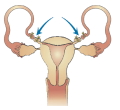
Regarding the given diagram,choose the incorrect statement $:-$
A
$A$ sterilization method
B
Prevents conception
C
Highly effective
D
High reversibility
Solution
(D) The diagram shows Tubectomy,which is a surgical sterilization method in females.
$1$. It is a permanent method of contraception,meaning it is intended to be irreversible.
$2$. It is highly effective in preventing conception by blocking the fallopian tubes.
$3$. Since it is a surgical procedure designed to be permanent,it has very poor reversibility,not high reversibility.
Therefore,the incorrect statement is that it has high reversibility.
$1$. It is a permanent method of contraception,meaning it is intended to be irreversible.
$2$. It is highly effective in preventing conception by blocking the fallopian tubes.
$3$. Since it is a surgical procedure designed to be permanent,it has very poor reversibility,not high reversibility.
Therefore,the incorrect statement is that it has high reversibility.
0 likes
View SolutionReproductive Health — Method of birth control · Frequently Asked Questions
1Are these Reproductive Health questions useful for JEE and NEET?
Yes. All questions in this section are mapped to JEE Main and NEET exam patterns. Previous year questions from JEE Main, NEET, GUJCET and state-level exams are included with full solutions.
2Can I switch to Hindi or Gujarati for these questions?
Yes. Use the language tabs in the hero section or the sidebar to view the same questions and solutions in English, Hindi or Gujarati.
3How do I generate a question paper from this subtopic?
Use the Vedclass Exam Paper Generator — select the chapter and subtopic, set difficulty, and generate Sets A, B, C, D automatically. First 3 chapters of every subject are free.
Vedclass Products
For Students
Vedclass Test Series
Mock tests in real JEE/NEET style with performance analysis. 5-day free trial.
Start Free TrialFor Teachers
Exam Paper Generator
Generate Set A/B/C/D papers from this chapter in 2 minutes. 3 chapters free.
Try FreeFor Institutes
Online Exam Module
Live online exams with unlimited students, 360° analytics & white-label branding.
See DemoFor Teachers & Institutes
Generate a Reproductive Health Exam Paper in 2 Minutes
Select subtopic & difficulty — Sets A, B, C, D auto-generated with No Repeat logic.
First 3 chapters of every subject are free — no payment required.