
A English
Organism and its Environment Questions in English
Class 12 Biology · Organisms and Populations · Organism and its Environment
264+
Questions
English
Language
100%
With Solutions
Showing 50 of 264 questions in English
151
MediumMCQ
In a sea shore,the benthic animals live in sandy,muddy and rocky substrata and accordingly developed the following adaptations:
$(a)$ Burrowing
$(b)$ Building tubes
$(c)$ Holdfasts / peduncle
Match the suitable substratum against each adaptation.
$(a)$ Burrowing
$(b)$ Building tubes
$(c)$ Holdfasts / peduncle
Match the suitable substratum against each adaptation.
A
$(a)$ Sandy,$(b)$ Muddy,$(c)$ Rocky
B
$(a)$ Muddy,$(b)$ Sandy,$(c)$ Rocky
C
$(a)$ Rocky,$(b)$ Muddy,$(c)$ Sandy
D
$(a)$ Sandy,$(b)$ Rocky,$(c)$ Muddy
Solution
(A) The adaptations of benthic animals are directly related to the nature of the substratum they inhabit:
$1$. $(a)$ Burrowing: Animals living in sandy substrata often develop burrowing habits to protect themselves from wave action and predators.
$2$. $(b)$ Building tubes: Animals in muddy substrata often construct tubes to stabilize their environment and prevent suffocation in soft,shifting sediment.
$3$. $(c)$ Holdfasts / peduncle: Animals in rocky substrata require strong attachment mechanisms like holdfasts or peduncles to anchor themselves against the high-energy wave action found on hard surfaces.
Therefore,the correct matching is: $(a)$ Sandy,$(b)$ Muddy,$(c)$ Rocky.
$1$. $(a)$ Burrowing: Animals living in sandy substrata often develop burrowing habits to protect themselves from wave action and predators.
$2$. $(b)$ Building tubes: Animals in muddy substrata often construct tubes to stabilize their environment and prevent suffocation in soft,shifting sediment.
$3$. $(c)$ Holdfasts / peduncle: Animals in rocky substrata require strong attachment mechanisms like holdfasts or peduncles to anchor themselves against the high-energy wave action found on hard surfaces.
Therefore,the correct matching is: $(a)$ Sandy,$(b)$ Muddy,$(c)$ Rocky.
0 likes
View Solution152
MediumMCQ
What is a tree line?
A
The maximum height at which trees can grow.
B
The boundary where forests end and grasslands begin.
C
The altitude beyond which trees cannot grow due to environmental conditions.
D
The line representing the average height of trees in a forest.
Solution
(C) As we increase in altitude,the environmental conditions such as temperature and oxygen levels become less favorable for tree growth.
Beyond a specific elevation,trees are no longer able to survive.
The altitude or the boundary line beyond which no trees are found and the vegetation consists only of shrubs,herbs,and mosses is known as the tree line.
Beyond a specific elevation,trees are no longer able to survive.
The altitude or the boundary line beyond which no trees are found and the vegetation consists only of shrubs,herbs,and mosses is known as the tree line.
0 likes
View Solution153
Medium
Do you agree that regional and local variations exist within each biome? Substantiate your answer with suitable examples.
Solution
(N/A) Yes,regional and local variations exist within each biome.
Regional and local variations within each biome lead to the formation of a wide variety of habitats.
On planet Earth,life exists not just in a few favourable habitats but even in extreme and harsh habitats,such as in the scorching Rajasthan desert,perpetually rain-soaked Meghalaya forests,deep ocean trenches,torrential streams,permafrost polar regions,high mountain tops,boiling thermal springs,and stinking compost pits,to name a few.
Even our intestine is a unique habitat for hundreds of species of microbes.
Regional and local variations within each biome lead to the formation of a wide variety of habitats.
On planet Earth,life exists not just in a few favourable habitats but even in extreme and harsh habitats,such as in the scorching Rajasthan desert,perpetually rain-soaked Meghalaya forests,deep ocean trenches,torrential streams,permafrost polar regions,high mountain tops,boiling thermal springs,and stinking compost pits,to name a few.
Even our intestine is a unique habitat for hundreds of species of microbes.
0 likes
View Solution154
Easy
Give one example for each of the following:
$(i)$ Eurythermal plant species: $................$.
$(ii)$ $A$ hot water spring organism: $................$.
$(iii)$ An organism seen in deep ocean trenches: $................$.
$(iv)$ An organism seen in a compost pit: $................$.
$(v)$ $A$ parasitic angiosperm: $................$.
$(vi)$ $A$ stenothermal plant species: $................$.
$(vii)$ Soil organism: $................$.
$(viii)$ $A$ benthic animal: $................$.
$(ix)$ Antifreeze compound seen in Antarctic fish: $................$.
$(x)$ An organism which can conform: $................$.
$(i)$ Eurythermal plant species: $................$.
$(ii)$ $A$ hot water spring organism: $................$.
$(iii)$ An organism seen in deep ocean trenches: $................$.
$(iv)$ An organism seen in a compost pit: $................$.
$(v)$ $A$ parasitic angiosperm: $................$.
$(vi)$ $A$ stenothermal plant species: $................$.
$(vii)$ Soil organism: $................$.
$(viii)$ $A$ benthic animal: $................$.
$(ix)$ Antifreeze compound seen in Antarctic fish: $................$.
$(x)$ An organism which can conform: $................$.
Solution
(N/A) $(i)$ Red algae (e.g.,$Porphyra$)
$(ii)$ $Thermus$ $aquaticus$
$(iii)$ Sea cucumbers
$(iv)$ Earthworm $(Pheretima)$
$(v)$ $Cuscuta$ $reflexa$
$(vi)$ Conifers (e.g.,$Pinus$)
$(vii)$ Earthworm
$(viii)$ Crabs or Sponges
$(ix)$ Antifreeze glycoproteins $(AFGPs)$
$(x)$ Frog
$(ii)$ $Thermus$ $aquaticus$
$(iii)$ Sea cucumbers
$(iv)$ Earthworm $(Pheretima)$
$(v)$ $Cuscuta$ $reflexa$
$(vi)$ Conifers (e.g.,$Pinus$)
$(vii)$ Earthworm
$(viii)$ Crabs or Sponges
$(ix)$ Antifreeze glycoproteins $(AFGPs)$
$(x)$ Frog
0 likes
View Solution155
Medium
Explain how ecology is related to an organism?
Solution
(N/A) Ecology at the organismic level is essentially physiological ecology,which attempts to understand how different organisms are adapted to their environments in terms of both survival and reproduction.
The rotation of the Earth around the Sun and the tilt of its axis cause annual variations in the intensity and duration of temperature,resulting in distinct seasons.
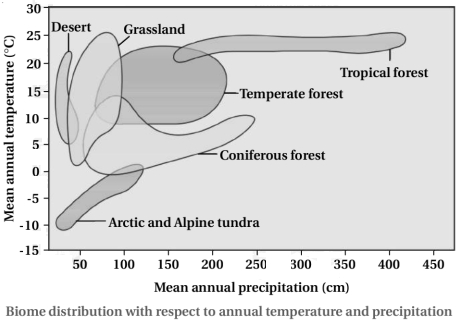
These variations,combined with annual variations in precipitation (rain,snow),result in the formation of major biomes,such as deserts,grasslands,tropical forests,temperate forests,coniferous forests,and tundra,as shown in the figure.
Regional and local variations within each biome lead to the formation of a wide variety of habitats.
The rotation of the Earth around the Sun and the tilt of its axis cause annual variations in the intensity and duration of temperature,resulting in distinct seasons.
These variations,combined with annual variations in precipitation (rain,snow),result in the formation of major biomes,such as deserts,grasslands,tropical forests,temperate forests,coniferous forests,and tundra,as shown in the figure.
Regional and local variations within each biome lead to the formation of a wide variety of habitats.
0 likes
View Solution156
Medium
How do organisms living in different habitats manage stressful conditions?
Solution
(A) During the course of millions of years of their existence,many organisms have evolved a relatively constant internal environment,which allows all biochemical reactions to proceed with maximum efficiency.
Their constant internal environment (maintained by homeostasis) could be in terms of optimal temperature,osmotic concentration of body fluids,etc.
Other organisms cope with the situation by the following:
$(a)$ Regulation: Homeostasis is maintained in organisms by physiological and/or behavioural means to ensure a constant body temperature (thermoregulation),osmotic concentration (osmoregulation),etc.
$(b)$ Conformation: $A$ constant internal environment cannot be maintained by most animals and nearly all plants. Their body temperature changes with the ambient temperature. There is a change in the osmotic concentration of body fluids of aquatic animals with the ambient water osmotic concentration. Thermoregulation is energetically expensive for many organisms,particularly for small organisms like shrews and hummingbirds. Heat loss or heat gain is a function of surface area. Small animals have a larger surface area relative to their volume; they tend to lose body heat very fast when it is cold outside,and then they have to expend much energy to generate body heat through metabolism. Because of this,very small animals are rarely found in polar regions.
$(c)$ Migrate: The organisms can move away temporarily from the stressful habitat to a more hospitable area and return when the stressful period is over. It is like humans living in hot regions moving to hill stations during summer. Many animals,particularly birds,during winter undertake long-distance migrations to more hospitable areas. Every winter,the famous Keoladeo National Park (Bharatpur) in Rajasthan hosts thousands of migratory birds coming from Siberia and other extremely cold northern regions.
Their constant internal environment (maintained by homeostasis) could be in terms of optimal temperature,osmotic concentration of body fluids,etc.
Other organisms cope with the situation by the following:
$(a)$ Regulation: Homeostasis is maintained in organisms by physiological and/or behavioural means to ensure a constant body temperature (thermoregulation),osmotic concentration (osmoregulation),etc.
$(b)$ Conformation: $A$ constant internal environment cannot be maintained by most animals and nearly all plants. Their body temperature changes with the ambient temperature. There is a change in the osmotic concentration of body fluids of aquatic animals with the ambient water osmotic concentration. Thermoregulation is energetically expensive for many organisms,particularly for small organisms like shrews and hummingbirds. Heat loss or heat gain is a function of surface area. Small animals have a larger surface area relative to their volume; they tend to lose body heat very fast when it is cold outside,and then they have to expend much energy to generate body heat through metabolism. Because of this,very small animals are rarely found in polar regions.
$(c)$ Migrate: The organisms can move away temporarily from the stressful habitat to a more hospitable area and return when the stressful period is over. It is like humans living in hot regions moving to hill stations during summer. Many animals,particularly birds,during winter undertake long-distance migrations to more hospitable areas. Every winter,the famous Keoladeo National Park (Bharatpur) in Rajasthan hosts thousands of migratory birds coming from Siberia and other extremely cold northern regions.
0 likes
View Solution157
MediumMCQ
The wide variety of natural habitats is based on which of the following?
A
Regional variation of the habitat
B
Local variation
C
Both $A$ and $B$
D
Diversity of tree-less snow-covered areas
Solution
(C) The wide variety of natural habitats on Earth is primarily determined by two main factors:
$1$. Regional variation: This refers to large-scale differences such as climate,latitude,and altitude (e.g.,deserts,rain forests,tundra).
$2$. Local variation: This refers to smaller-scale differences within a region,such as soil composition,topography,and microclimate.
Together,these factors create the diverse environmental conditions that support different types of organisms. Therefore,both regional and local variations contribute to the diversity of habitats.
$1$. Regional variation: This refers to large-scale differences such as climate,latitude,and altitude (e.g.,deserts,rain forests,tundra).
$2$. Local variation: This refers to smaller-scale differences within a region,such as soil composition,topography,and microclimate.
Together,these factors create the diverse environmental conditions that support different types of organisms. Therefore,both regional and local variations contribute to the diversity of habitats.
0 likes
View Solution158
EasyMCQ
What percentage of organisms are conformers (in $\%$)?
A
$10$
B
$90$
C
$99$
D
$0$
Solution
(C) In the study of ecology,organisms are categorized based on their ability to maintain homeostasis.
Most organisms (about $99 \%$) cannot maintain a constant internal environment and their body temperature or osmotic concentration changes with the ambient environment.
These organisms are known as conformers.
Only a very small percentage of organisms (about $1 \%$) are regulators,which can maintain homeostasis through physiological or behavioral means.
Most organisms (about $99 \%$) cannot maintain a constant internal environment and their body temperature or osmotic concentration changes with the ambient environment.
These organisms are known as conformers.
Only a very small percentage of organisms (about $1 \%$) are regulators,which can maintain homeostasis through physiological or behavioral means.
0 likes
View Solution159
MediumMCQ
Why are small-sized animals rarely found in polar regions?
A
Due to the tendency to lose body heat
B
Due to the need for more energy to produce heat
C
Due to the inability of the body to survive as surface area to volume ratio increases
D
Both $A$ and $B$
Solution
(D) Small animals have a large surface area relative to their volume.
They tend to lose body heat very fast when it is cold outside.
Then they have to spend much energy to generate body heat through metabolism.
Therefore,it is very difficult for small animals to survive in polar regions where the temperature is extremely low.
They tend to lose body heat very fast when it is cold outside.
Then they have to spend much energy to generate body heat through metabolism.
Therefore,it is very difficult for small animals to survive in polar regions where the temperature is extremely low.
0 likes
View Solution160
MediumMCQ
Which of the following organisms do not enter a state of dormancy to escape environmental stress?
A
Bears
B
Snails
C
Zooplankton
D
Birds
Solution
(D) Many organisms undergo dormancy to survive unfavorable environmental conditions.
$1$. Bears undergo hibernation during winter to escape cold stress.
$2$. Snails and fish undergo aestivation to avoid summer-related heat and desiccation.
$3$. Many zooplankton species in lakes and ponds enter diapause,a stage of suspended development,to survive unfavorable conditions.
$4$. Birds do not enter dormancy; instead,they migrate to more favorable regions to escape harsh environmental conditions. Therefore,birds are the correct answer.
$1$. Bears undergo hibernation during winter to escape cold stress.
$2$. Snails and fish undergo aestivation to avoid summer-related heat and desiccation.
$3$. Many zooplankton species in lakes and ponds enter diapause,a stage of suspended development,to survive unfavorable conditions.
$4$. Birds do not enter dormancy; instead,they migrate to more favorable regions to escape harsh environmental conditions. Therefore,birds are the correct answer.
0 likes
View Solution161
MediumMCQ
Which organism does not drink water but uses water produced as a byproduct of its internal metabolic processes?
A
Kangaroo
B
Bear
C
Kangaroo rat
D
Both $A$ and $B$
Solution
(C) The $Kangaroo$ rat (Dipodomys) is a desert-dwelling rodent.
It is capable of meeting all its water requirements through its internal fat oxidation (metabolic water) and does not need to drink liquid water.
This is a physiological adaptation to survive in extremely arid environments.
It is capable of meeting all its water requirements through its internal fat oxidation (metabolic water) and does not need to drink liquid water.
This is a physiological adaptation to survive in extremely arid environments.
0 likes
View Solution162
MediumMCQ
What does $Allen's$ rule represent?
A
Expansion
B
Thermal adaptation
C
Stabilization
D
Formation of longer ears and limbs in mammals
Solution
(B) $Allen's$ rule states that mammals living in colder climates generally have shorter ears and limbs to minimize heat loss. Conversely, mammals in warmer climates tend to have longer ears and limbs to facilitate heat dissipation. Therefore, it represents a form of thermal adaptation.
0 likes
View Solution163
MediumMCQ
Invertebrates living in the deep sea, at extreme depths, experience pressure how many times greater than the normal atmospheric pressure (in $times$)?
A
$100$
B
$50$
C
$10$
D
$70$
Solution
(A) Organisms living at great depths in the ocean are adapted to survive under extreme hydrostatic pressure.
At these depths, the pressure can reach levels that are more than $100$ times the normal atmospheric pressure at sea level.
These organisms have evolved specific physiological and biochemical adaptations to function effectively under such high-pressure conditions.
At these depths, the pressure can reach levels that are more than $100$ times the normal atmospheric pressure at sea level.
These organisms have evolved specific physiological and biochemical adaptations to function effectively under such high-pressure conditions.
0 likes
View Solution164
MediumMCQ
In which of the following natural habitats is it possible for only one type of species to reside?
A
Ocean
B
Land
C
Rocks
D
None of these
Solution
(D) In ecology,a natural habitat is defined by complex interactions between various biotic and abiotic factors.
It is biologically impossible for a natural habitat to support only one species because ecosystems require a food web,which involves producers,consumers,and decomposers.
Even in extreme environments,there is always a presence of microorganisms or other life forms that interact with the primary species.
Therefore,none of the listed natural habitats (ocean,land,or rocks) can support only a single species in isolation.
It is biologically impossible for a natural habitat to support only one species because ecosystems require a food web,which involves producers,consumers,and decomposers.
Even in extreme environments,there is always a presence of microorganisms or other life forms that interact with the primary species.
Therefore,none of the listed natural habitats (ocean,land,or rocks) can support only a single species in isolation.
0 likes
View Solution165
EasyMCQ
What percentage of species are included in conformers (in $\%$)?
A
$99$
B
$1$
C
$90$
D
$10$
Solution
(A) In the context of environmental adaptation,organisms are classified as regulators or conformers.
Regulators are organisms that can maintain a constant internal environment (homeostasis) despite changes in the external environment.
Conformers are organisms that cannot maintain a constant internal environment; their body temperature or osmotic concentration changes with the ambient environmental conditions.
According to ecological studies,the vast majority of animals and nearly all plants cannot maintain a constant internal environment.
Therefore,approximately $99\%$ of all animal species are conformers,while only a very small percentage (about $1\%$) are regulators.
Regulators are organisms that can maintain a constant internal environment (homeostasis) despite changes in the external environment.
Conformers are organisms that cannot maintain a constant internal environment; their body temperature or osmotic concentration changes with the ambient environmental conditions.
According to ecological studies,the vast majority of animals and nearly all plants cannot maintain a constant internal environment.
Therefore,approximately $99\%$ of all animal species are conformers,while only a very small percentage (about $1\%$) are regulators.
0 likes
View Solution166
MediumMCQ
The biome characterized by a layer of permafrost is known as:
A
Tundra
B
Grassland
C
Coniferous forest
D
Tropical forest
Solution
(A) The $Tundra$ biome is characterized by extremely cold temperatures and a layer of permanently frozen subsoil known as $permafrost$.
This layer prevents deep root growth and restricts the types of vegetation that can survive in this environment,primarily consisting of mosses,lichens,and small shrubs.
This layer prevents deep root growth and restricts the types of vegetation that can survive in this environment,primarily consisting of mosses,lichens,and small shrubs.
0 likes
View Solution167
MediumMCQ
Read the given statements and determine how many of them are incorrect.
$(1)$ Regional and local variations in habitats create a wide variety of biomes.
$(2)$ Temperature,light,and soil are the key elements for the physical and chemical variations in an ecosystem.
$(3)$ Tuna fish are found in the ocean and are classified as warm-blooded and homeothermic animals.
$(4)$ Red algae are found in the deep-sea regions.
$(1)$ Regional and local variations in habitats create a wide variety of biomes.
$(2)$ Temperature,light,and soil are the key elements for the physical and chemical variations in an ecosystem.
$(3)$ Tuna fish are found in the ocean and are classified as warm-blooded and homeothermic animals.
$(4)$ Red algae are found in the deep-sea regions.
A
$0$
B
$1$
C
$2$
D
$3$
Solution
(B) Statement $(1)$ is correct: Regional and local variations within each biome lead to the formation of a wide variety of habitats.
Statement $(2)$ is correct: Temperature,water,light,and soil are the most important abiotic factors that determine the physical and chemical characteristics of an ecosystem.
Statement $(3)$ is incorrect: While Tuna fish are found in the ocean,they are generally considered poikilothermic (cold-blooded) or ectothermic,not homeothermic.
Statement $(4)$ is correct: Red algae (Rhodophyta) contain pigments that allow them to perform photosynthesis in deep-sea regions where light intensity is very low.
Therefore,only one statement $(3)$ is incorrect.
Statement $(2)$ is correct: Temperature,water,light,and soil are the most important abiotic factors that determine the physical and chemical characteristics of an ecosystem.
Statement $(3)$ is incorrect: While Tuna fish are found in the ocean,they are generally considered poikilothermic (cold-blooded) or ectothermic,not homeothermic.
Statement $(4)$ is correct: Red algae (Rhodophyta) contain pigments that allow them to perform photosynthesis in deep-sea regions where light intensity is very low.
Therefore,only one statement $(3)$ is incorrect.
0 likes
View Solution168
MediumMCQ
Read the following statements and select the option that represents the correct statements.
$(1)$ Kangaroo rats never drink water.
$(2)$ Birds undergo hibernation to escape adverse environmental conditions.
$(3)$ Thermal adaptation can be explained by Allen's Rule.
$(4)$ Opuntia possesses phylloclade for protection.
$(1)$ Kangaroo rats never drink water.
$(2)$ Birds undergo hibernation to escape adverse environmental conditions.
$(3)$ Thermal adaptation can be explained by Allen's Rule.
$(4)$ Opuntia possesses phylloclade for protection.
A
Only $1$ and $2$
B
Only $1$ and $3$
C
$2, 3$ and $4$
D
All the given statements are correct
Solution
(B) Statement $(1)$ is correct: Kangaroo rats in North American deserts meet their water requirements through internal fat oxidation.
Statement $(2)$ is incorrect: Birds undergo migration to escape adverse conditions,while hibernation is typically observed in some mammals and amphibians.
Statement $(3)$ is correct: Allen's Rule states that mammals from colder climates generally have shorter ears and limbs to minimize heat loss.
Statement $(4)$ is incorrect: Opuntia possesses a phylloclade (modified stem) for photosynthesis and water storage,while the leaves are modified into spines for protection against herbivores.
Therefore,only statements $(1)$ and $(3)$ are correct.
Statement $(2)$ is incorrect: Birds undergo migration to escape adverse conditions,while hibernation is typically observed in some mammals and amphibians.
Statement $(3)$ is correct: Allen's Rule states that mammals from colder climates generally have shorter ears and limbs to minimize heat loss.
Statement $(4)$ is incorrect: Opuntia possesses a phylloclade (modified stem) for photosynthesis and water storage,while the leaves are modified into spines for protection against herbivores.
Therefore,only statements $(1)$ and $(3)$ are correct.
0 likes
View Solution169
MediumMCQ
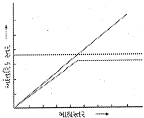
In the given graph,what does the horizontal line passing through the middle represent?
A
Proportion of conformers
B
Partial regulators
C
Regulators
D
Population stabilization
Solution
(C) The graph represents the relationship between internal body conditions and external environmental conditions.
In this graph,the horizontal line represents organisms that maintain a constant internal environment despite changes in the external environment.
These organisms are known as regulators.
Regulators maintain homeostasis through physiological and sometimes behavioral means,ensuring a stable internal body temperature or osmotic concentration.
In this graph,the horizontal line represents organisms that maintain a constant internal environment despite changes in the external environment.
These organisms are known as regulators.
Regulators maintain homeostasis through physiological and sometimes behavioral means,ensuring a stable internal body temperature or osmotic concentration.
0 likes
View Solution170
MediumMCQ
Many freshwater animals cannot live for long in sea water and vice-versa mainly because of the
A
Change in $N$ levels
B
Change in the levels of thermal tolerance
C
Variations in light intensity
D
Osmotic problems
Solution
(D) Freshwater animals are adapted to live in a hypotonic environment,while marine animals are adapted to a hypertonic environment.
When a freshwater animal is placed in sea water,it loses water due to osmosis,leading to dehydration.
Conversely,when a marine animal is placed in freshwater,it gains excess water,which can cause cells to swell and burst.
Therefore,the primary reason they cannot survive in each other's environments is due to osmotic problems.
When a freshwater animal is placed in sea water,it loses water due to osmosis,leading to dehydration.
Conversely,when a marine animal is placed in freshwater,it gains excess water,which can cause cells to swell and burst.
Therefore,the primary reason they cannot survive in each other's environments is due to osmotic problems.
0 likes
View Solution171
MediumMCQ
Large size of pinnae in animals of warm regions in comparison to animals of cold regions is due to:
A
Dollo's law
B
Gloger's law
C
Cope's law
D
Allen's rule
Solution
(D) According to $Allen's$ rule,animals living in colder climates generally have shorter ears,tails,and other extremities compared to those living in warmer climates.
This adaptation helps in minimizing heat loss from the body surface in cold environments.
Conversely,animals in warmer regions possess larger pinnae (ears) to facilitate greater heat dissipation,helping them maintain body temperature.
Therefore,the large size of pinnae in warm-region animals is an application of $Allen's$ rule.
This adaptation helps in minimizing heat loss from the body surface in cold environments.
Conversely,animals in warmer regions possess larger pinnae (ears) to facilitate greater heat dissipation,helping them maintain body temperature.
Therefore,the large size of pinnae in warm-region animals is an application of $Allen's$ rule.
0 likes
View Solution172
MediumMCQ
Weather is the
A
Long-term property of the atmosphere
B
Short-term property of the atmosphere
C
Unchanged property of climate
D
Unknown property of climate
Solution
(B) Weather is defined as the short-term state of the atmosphere at a specific time and place.
Differences between weather and climate:
Differences between weather and climate:
| Weather | Climate |
| It is a short-term property of the atmosphere. Weather changes from place to place. Weather changes have little impact on the flora and fauna of a place. Changes in weather occur from time to time. | It is the long-term property of the atmosphere. It is the average weather. Climate is the same over a larger area. Climate determines the flora and fauna of a place. Climate remains the same over a long period of time. |
0 likes
View Solution173
MediumMCQ
$A$ genetically adapted population to a particular habitat is called:
A
Ecotone
B
Ecotype
C
Biome
D
Niche
Solution
(B) An ecotype is a population of individuals of a species that are genetically adapted to a specific habitat.
These variations are permanent,irreversible,and genetically fixed.
If different ecotypes are grown in an identical habitat,their phenotypic differences will persist because they are genetically determined,although they may show some plasticity.
These variations are permanent,irreversible,and genetically fixed.
If different ecotypes are grown in an identical habitat,their phenotypic differences will persist because they are genetically determined,although they may show some plasticity.
0 likes
View Solution174
MediumMCQ
The organism which tolerates a wide range of salinity is called ...$A$...
$II.$ The organism which tolerates a narrow range of salinity is called ...$B$...
Choose the correct option for $A$ and $B$.
$II.$ The organism which tolerates a narrow range of salinity is called ...$B$...
Choose the correct option for $A$ and $B$.
A
$A-$stenohaline; $B-$euryhaline
B
$A-$euryhaline; $B-$stenohaline
C
$A-$isohaline; $B-$euryhaline
D
$A-$heterohaline; $B-$isohaline
Solution
(B) Organisms that can tolerate a wide range of salinities are known as euryhaline,for example,salmon fish.
Organisms that are restricted to a narrow range of salinities are known as stenohaline,for example,sharks and stingrays.
Many freshwater animals cannot survive for long in seawater and vice versa due to the osmotic problems they would face.
Organisms that are restricted to a narrow range of salinities are known as stenohaline,for example,sharks and stingrays.
Many freshwater animals cannot survive for long in seawater and vice versa due to the osmotic problems they would face.
0 likes
View Solution175
MediumMCQ
Eurythermal organisms are those which
A
Can tolerate a wide range of temperatures
B
Can tolerate a low range of temperatures
C
Cannot tolerate a low range of temperatures
D
Cannot tolerate a wide range of temperatures
Solution
(A) Eurythermal organisms are those organisms that can tolerate and thrive in a wide range of temperature variations.
Most mammals and birds are examples of eurythermal organisms,as they can maintain their internal body temperature despite significant fluctuations in the external environment.
Most mammals and birds are examples of eurythermal organisms,as they can maintain their internal body temperature despite significant fluctuations in the external environment.
0 likes
View Solution176
MediumMCQ
Which of the following are the dominant plants of the cold desert?
A
Shrubs and small trees
B
Low stature shrubs and perennial grasses
C
Tall trees and herbaceous plants
D
Low stature shrubs and herbaceous plants
Solution
(B) Cold deserts are characterized by extreme cold and low precipitation,which limits the growth of large plants. The vegetation in cold deserts,such as the Gobi or Tibetan deserts,is dominated by low-stature shrubs,perennial grasses,and herbaceous plants. These plants are adapted to survive in harsh,arid,and freezing conditions.
0 likes
View Solution177
EasyMCQ
Plants growing on sand and gravel are called
A
Eremophytes
B
Psammophytes
C
Psilophytes
D
Oxylophytes
Solution
(B) Plants that grow on sand and gravel are known as $Psammophytes$.
$Eremophytes$ are plants that grow in deserts or sandy areas.
$Psilophytes$ are primitive vascular plants.
$Oxylophytes$ are plants that grow in acidic soils.
$Eremophytes$ are plants that grow in deserts or sandy areas.
$Psilophytes$ are primitive vascular plants.
$Oxylophytes$ are plants that grow in acidic soils.
0 likes
View Solution178
MediumMCQ
Many freshwater fishes cannot live in seawater and vice versa because of:
A
Nutrient
B
Osmotic problems
C
Breathing problems
D
Excretion problems
Solution
(B) The correct answer is $B$ (Osmotic problems).
Some organisms are tolerant to a wide range of salinities and are called euryhaline,for example,salmon fish. Others are restricted to a narrow range of salinities and are called stenohaline,such as most freshwater and marine fishes.
Many freshwater animals cannot live for long in seawater and vice versa because of the osmotic problems they would face. When placed in a different salinity environment,their body cells either lose water (plasmolysis) or gain excessive water,disrupting their internal homeostasis.
Some organisms are tolerant to a wide range of salinities and are called euryhaline,for example,salmon fish. Others are restricted to a narrow range of salinities and are called stenohaline,such as most freshwater and marine fishes.
Many freshwater animals cannot live for long in seawater and vice versa because of the osmotic problems they would face. When placed in a different salinity environment,their body cells either lose water (plasmolysis) or gain excessive water,disrupting their internal homeostasis.
0 likes
View Solution179
MediumMCQ
The niche of a population is defined as
A
Set of conditions that interacts
B
Place where it lives
C
Set of conditions and resources it uses
D
Geographical area that it covers
Solution
(C) niche is the specific physical space occupied by an organism and its functional role within the ecosystem.
It encompasses the range of conditions that the organism can tolerate,the resources it utilizes,and its interactions with other biotic and abiotic components.
Therefore,an organism's niche is defined by the types of food it consumes,its predators,temperature tolerance,and other environmental requirements.
It encompasses the range of conditions that the organism can tolerate,the resources it utilizes,and its interactions with other biotic and abiotic components.
Therefore,an organism's niche is defined by the types of food it consumes,its predators,temperature tolerance,and other environmental requirements.
0 likes
View Solution180
MediumMCQ
Ecological hierarchy comprises which of the following sequences?
A
Population $\rightarrow$ Species $\rightarrow$ Community $\rightarrow$ Ecosystem $\rightarrow$ Biosphere
B
Species $\rightarrow$ Population $\rightarrow$ Community $\rightarrow$ Ecosystem $\rightarrow$ Biosphere
C
Species $\rightarrow$ Population $\rightarrow$ Biosphere $\rightarrow$ Community $\rightarrow$ Ecosystem
D
Species $\rightarrow$ Population $\rightarrow$ Biosphere $\rightarrow$ Ecosystem $\rightarrow$ Community
Solution
(B) The ecological hierarchy represents the levels of organization in ecology,starting from the smallest unit to the largest.
$1$. Species: $A$ group of individuals that can interbreed.
$2$. Population: $A$ group of individuals of the same species living in a specific area.
$3$. Community: An assemblage of populations of different species living in a particular area.
$4$. Ecosystem: $A$ functional unit consisting of the community of organisms interacting with their physical environment.
$5$. Biosphere: The global sum of all ecosystems,representing the zone of life on Earth.
Therefore,the correct sequence is: Species $\rightarrow$ Population $\rightarrow$ Community $\rightarrow$ Ecosystem $\rightarrow$ Biosphere.
$1$. Species: $A$ group of individuals that can interbreed.
$2$. Population: $A$ group of individuals of the same species living in a specific area.
$3$. Community: An assemblage of populations of different species living in a particular area.
$4$. Ecosystem: $A$ functional unit consisting of the community of organisms interacting with their physical environment.
$5$. Biosphere: The global sum of all ecosystems,representing the zone of life on Earth.
Therefore,the correct sequence is: Species $\rightarrow$ Population $\rightarrow$ Community $\rightarrow$ Ecosystem $\rightarrow$ Biosphere.
0 likes
View Solution181
MediumMCQ
Altitude sickness is an example of:
A
Genotypic adaptation
B
Phenotypic adaptation
C
Physiological adaptation
D
Cold hardening
Solution
(C) Altitude sickness is a classic example of physiological adaptation.
When individuals travel to high-altitude regions,they experience symptoms like nausea,fatigue,and heart palpitations. This occurs because the atmospheric pressure is low at high altitudes,making $O_2$ less available for respiration.
To compensate for this,the body undergoes physiological changes to improve the efficiency of respiration,such as increasing the production of $RBCs$ and decreasing the binding affinity of hemoglobin to $O_2$ to facilitate better oxygen delivery to tissues.
When individuals travel to high-altitude regions,they experience symptoms like nausea,fatigue,and heart palpitations. This occurs because the atmospheric pressure is low at high altitudes,making $O_2$ less available for respiration.
To compensate for this,the body undergoes physiological changes to improve the efficiency of respiration,such as increasing the production of $RBCs$ and decreasing the binding affinity of hemoglobin to $O_2$ to facilitate better oxygen delivery to tissues.
0 likes
View Solution182
MediumMCQ
How can seals survive in a polar climate where the temperature prevails below $0^{\circ} C$?
A
They have long hairs on their body surface
B
They have a thick layer of fat below their skin
C
Both $(a)$ and $(b)$
D
They have genetic regulation for avoiding cold climate
Solution
(C) Animals living in colder regions,such as seals,possess specific physiological adaptations to survive in extreme cold.
These adaptations include a thick layer of fat,known as blubber,located subcutaneously (below the skin) which acts as an insulator to prevent heat loss.
Additionally,many such animals have thick fur or hair on their body surface to provide further insulation.
Therefore,both the thick layer of fat and the presence of body hair contribute to their survival in temperatures below $0^{\circ} C$.
These adaptations include a thick layer of fat,known as blubber,located subcutaneously (below the skin) which acts as an insulator to prevent heat loss.
Additionally,many such animals have thick fur or hair on their body surface to provide further insulation.
Therefore,both the thick layer of fat and the presence of body hair contribute to their survival in temperatures below $0^{\circ} C$.
0 likes
View Solution183
MediumMCQ
Behavioural adaptations to the environment in desert lizards are:
$I.$ Burrowing into the soil
$II.$ Losing heat during high temperature
$III.$ Active during morning and evening
$IV.$ Insulating body due to thick fatty dermis
Select the correct pair.
$I.$ Burrowing into the soil
$II.$ Losing heat during high temperature
$III.$ Active during morning and evening
$IV.$ Insulating body due to thick fatty dermis
Select the correct pair.
A
$I$ and $III$
B
$II$ and $IV$
C
$I$ and $II$
D
$III$ and $IV$
Solution
(A) Desert lizards maintain their body temperature relatively constant by behavioural means.
$I.$ Burrowing into the soil helps them escape extreme heat.
$III.$ Being active during the morning and evening,when the ambient temperature is lower,allows them to avoid the peak heat of the day.
These two are the primary behavioural adaptations of desert lizards to survive in high-temperature environments.
$I.$ Burrowing into the soil helps them escape extreme heat.
$III.$ Being active during the morning and evening,when the ambient temperature is lower,allows them to avoid the peak heat of the day.
These two are the primary behavioural adaptations of desert lizards to survive in high-temperature environments.
0 likes
View Solution184
MediumMCQ
Community is:
$I.$ Group of independent,interacting populations of same species
$II.$ Group of independent and interacting populations of same species in specific area
$III.$ Group of independent interacting populations of different species in a specific area
$IV.$ Group of independent and interacting populations of different species in different area
Select the correct option.
$I.$ Group of independent,interacting populations of same species
$II.$ Group of independent and interacting populations of same species in specific area
$III.$ Group of independent interacting populations of different species in a specific area
$IV.$ Group of independent and interacting populations of different species in different area
Select the correct option.
A
$I, II$ and $IV$
B
$I, III$ and $IV$
C
$I, II$ and $III$
D
Only $III$
Solution
(D) biological community is defined as an assemblage of populations of different species (plants,animals,bacteria,fungi,etc.) that occupy a specific geographical area and interact with one another through various ecological processes such as competition,predation,and mutualism.
Statement $III$ accurately describes this definition,as it specifies 'different species' interacting within a 'specific area'.
Therefore,the correct option is $D$.
Statement $III$ accurately describes this definition,as it specifies 'different species' interacting within a 'specific area'.
Therefore,the correct option is $D$.
0 likes
View Solution185
MediumMCQ
$I.$ Many xerophytic plants have thick cuticle on leaf epidermis and sunken stomata.
$II.$ Some xerophytic plants have a special photosynthetic pathway $(CAM)$ that enables their stomata to close during the day.
$III.$ $Opuntia$ has spines (modified leaves) and a photosynthetic phylloclade (stem).
$IV.$ All adaptations are genetically fixed in all organisms.
Choose the combination of correct statements.
$II.$ Some xerophytic plants have a special photosynthetic pathway $(CAM)$ that enables their stomata to close during the day.
$III.$ $Opuntia$ has spines (modified leaves) and a photosynthetic phylloclade (stem).
$IV.$ All adaptations are genetically fixed in all organisms.
Choose the combination of correct statements.
A
$I, II, III$ and $IV$
B
$II$ and $III$
C
$II$ and $I$
D
$I, II$ and $III$
Solution
(D) $I.$ Xerophytic plants possess adaptations like thick cuticles and sunken stomata to minimize water loss,which is correct.
$II.$ $CAM$ (Crassulacean Acid Metabolism) is a photosynthetic pathway in xerophytes that allows stomata to remain closed during the day to prevent transpiration,which is correct.
$III.$ In $Opuntia$,leaves are modified into spines to reduce water loss,and the stem becomes a flattened,photosynthetic structure called a phylloclade,which is correct.
$IV.$ Not all adaptations are genetically fixed. Some adaptations,such as behavioral responses (e.g.,hibernation,aestivation,or migration to avoid extreme temperatures),are physiological or behavioral adjustments that are not necessarily genetically fixed in the same way as morphological traits.
$II.$ $CAM$ (Crassulacean Acid Metabolism) is a photosynthetic pathway in xerophytes that allows stomata to remain closed during the day to prevent transpiration,which is correct.
$III.$ In $Opuntia$,leaves are modified into spines to reduce water loss,and the stem becomes a flattened,photosynthetic structure called a phylloclade,which is correct.
$IV.$ Not all adaptations are genetically fixed. Some adaptations,such as behavioral responses (e.g.,hibernation,aestivation,or migration to avoid extreme temperatures),are physiological or behavioral adjustments that are not necessarily genetically fixed in the same way as morphological traits.
0 likes
View Solution186
MediumMCQ
In most animals,the metabolic reactions proceed in a $A$ temperature range (in humans,it is $37^{\circ} C$). But there are microbes (archaebacteria) that flourish in hot springs and deep sea hydrothermal vents where temperatures far exceed $B$. Choose the correct option for $A$ and $B$.
A
$A-$narrow; $B-100^{\circ} C$
B
$A-$broad; $B-100^{\circ} C$
C
$A-$median; $B-100^{\circ} C$
D
$A-$broad; $B-40^{\circ} C$
Solution
(A) Most organisms are stenothermal,meaning they can tolerate and thrive in a narrow range of temperatures. Metabolic reactions in these animals are highly sensitive to temperature fluctuations,hence they function within a narrow range (e.g.,$37^{\circ} C$ in humans).
However,certain extremophiles like archaebacteria are capable of surviving in extreme environments such as hot springs and deep-sea hydrothermal vents,where temperatures can exceed $100^{\circ} C$.
Therefore,the correct option is $A-$narrow and $B-100^{\circ} C$.
However,certain extremophiles like archaebacteria are capable of surviving in extreme environments such as hot springs and deep-sea hydrothermal vents,where temperatures can exceed $100^{\circ} C$.
Therefore,the correct option is $A-$narrow and $B-100^{\circ} C$.
0 likes
View Solution187
MediumMCQ
Phenotypic variants formed in a population due to change in environment are called
A
Ecophenes
B
Ecotypes
C
Sciophytes
D
Heliophytes
Solution
(A) An $Ecotype$ is a genetically distinct population of a species adapted to a specific habitat in a different geographical area.
An $Ecophene$ (also known as an ecad) refers to phenotypic variants of a single genotype that arise due to changes in the environment or habitat.
$Phenotypic \text{ } Plasticity$ is the ability of an organism to change its physiology or behavior in response to different environmental conditions.
For example, when a person living in a plain area moves to a high-altitude mountain region, their body produces extra $R.B.C.$ cells to help transport the limited available oxygen. This physiological change is an example of phenotypic plasticity, and the resulting variants are called ecophenes.
An $Ecophene$ (also known as an ecad) refers to phenotypic variants of a single genotype that arise due to changes in the environment or habitat.
$Phenotypic \text{ } Plasticity$ is the ability of an organism to change its physiology or behavior in response to different environmental conditions.
For example, when a person living in a plain area moves to a high-altitude mountain region, their body produces extra $R.B.C.$ cells to help transport the limited available oxygen. This physiological change is an example of phenotypic plasticity, and the resulting variants are called ecophenes.
0 likes
View Solution188
MediumMCQ
Why do mammals of colder regions generally have shorter ears and limbs?
$I.$ To minimize their surface area to volume ratio
$II.$ To minimize heat loss
$III.$ To maximize their surface area to volume ratio
$IV.$ To maximize heat loss
Choose the correct combination from the given options:
$I.$ To minimize their surface area to volume ratio
$II.$ To minimize heat loss
$III.$ To maximize their surface area to volume ratio
$IV.$ To maximize heat loss
Choose the correct combination from the given options:
A
$I$ and $II$
B
$II$ and $III$
C
$III$ and $IV$
D
$I$ and $IV$
Solution
(A) According to $Allen's$ $Rule$,mammals living in colder climates tend to have shorter ears and limbs to minimize their surface area to volume ratio.
This reduction in surface area helps in minimizing heat loss from the body,which is essential for maintaining a constant body temperature in cold environments.
This reduction in surface area helps in minimizing heat loss from the body,which is essential for maintaining a constant body temperature in cold environments.
0 likes
View Solution189
MediumMCQ
$I.$ Biochemical adaptations are seen in organisms living at great depths of the ocean to face crushing pressure.
$II.$ Allen's rule explains adaptations in mammals living in colder climates.
$III.$ Altitude sickness is caused because the body does not get enough oxygen due to low atmospheric pressure at high altitudes.
$IV.$ Desert lizards lack behavioural means to manage their body temperature.
Choose the correct option for the above statements.
$II.$ Allen's rule explains adaptations in mammals living in colder climates.
$III.$ Altitude sickness is caused because the body does not get enough oxygen due to low atmospheric pressure at high altitudes.
$IV.$ Desert lizards lack behavioural means to manage their body temperature.
Choose the correct option for the above statements.
A
$I, II$ and $III$
B
$I, II$ and $IV$
C
$II, III$ and $IV$
D
$I, III$ and $IV$
Solution
(A) $I.$ Organisms living at great depths of the ocean experience high pressure and have biochemical adaptations to survive.
$II.$ Allen's rule states that mammals in colder climates generally have shorter ears and limbs to minimize heat loss.
$III.$ At high altitudes,the atmospheric pressure is low,leading to low oxygen availability,which causes altitude sickness.
$IV.$ Desert lizards do not lack behavioural means; in fact,they manage their body temperature by basking in the sun when cold and moving into the shade when it is too hot. Thus,statement $IV$ is incorrect.
$II.$ Allen's rule states that mammals in colder climates generally have shorter ears and limbs to minimize heat loss.
$III.$ At high altitudes,the atmospheric pressure is low,leading to low oxygen availability,which causes altitude sickness.
$IV.$ Desert lizards do not lack behavioural means; in fact,they manage their body temperature by basking in the sun when cold and moving into the shade when it is too hot. Thus,statement $IV$ is incorrect.
0 likes
View Solution190
MediumMCQ
$A$ regulators are able to maintain homeostasis by means which ensure constant body temperature,constant osmotic concentration,etc. All $B$ and $C$ and a very few lower vertebrate and invertebrate species are indeed capable of such regulation (thermoregulation and osmoregulation).
Evolutionary biologists believe that the 'success' of mammals is largely due to their ability to maintain a constant body $D$ and thrive whether they live in Antarctica or in the Sahara desert.
Choose the correct option for $A, B, C$ and $D$.
Evolutionary biologists believe that the 'success' of mammals is largely due to their ability to maintain a constant body $D$ and thrive whether they live in Antarctica or in the Sahara desert.
Choose the correct option for $A, B, C$ and $D$.
A
$A-$Behavioural,$B-$vertebrates,$C-$invertebrates,$D-$temperature
B
$A-$Behavioural,$B-$bird,$C-$mammals,$D-$temperature
C
$A-$Physiological,$B-$bird,$C-$mammals,$D-$temperature
D
$A-$Behavioural,$B-$vertebrates,$C-$invertebrates,$D-$morphology
Solution
(C) The correct option is $C$.
$A$ refers to 'Physiological' regulators,which maintain homeostasis through internal mechanisms.
$B$ and $C$ refer to 'birds' and 'mammals',which are endotherms capable of thermoregulation and osmoregulation.
$D$ refers to 'temperature',as the ability to maintain a constant body temperature is a key evolutionary success factor for mammals.
$A$ refers to 'Physiological' regulators,which maintain homeostasis through internal mechanisms.
$B$ and $C$ refer to 'birds' and 'mammals',which are endotherms capable of thermoregulation and osmoregulation.
$D$ refers to 'temperature',as the ability to maintain a constant body temperature is a key evolutionary success factor for mammals.
0 likes
View Solution191
MediumMCQ
Which is the correct order of ecological hierarchy?
A
Biome $\rightarrow$ Populations $\rightarrow$ Community $\rightarrow$ Organism
B
Organism $\rightarrow$ Biome $\rightarrow$ Population $\rightarrow$ Community
C
Population $\rightarrow$ Community $\rightarrow$ Biome $\rightarrow$ Organism
D
Organism $\rightarrow$ Population $\rightarrow$ Community $\rightarrow$ Biome
Solution
(D) The ecological hierarchy represents the levels of biological organization in ecology.
It starts from the smallest unit,the individual organism,and progresses to larger,more complex levels.
The correct sequence is: $\text{Organism} \rightarrow \text{Population} \rightarrow \text{Community} \rightarrow \text{Biome}$.
It starts from the smallest unit,the individual organism,and progresses to larger,more complex levels.
The correct sequence is: $\text{Organism} \rightarrow \text{Population} \rightarrow \text{Community} \rightarrow \text{Biome}$.
0 likes
View Solution192
MediumMCQ
Ecological equivalents refer to:
A
Two similar ecological niches in the same geographical location.
B
Two similar ecological niches in two different geographical locations.
C
Organisms that occupy similar ecological niches in different geographical locations.
D
Organisms that occupy different ecological niches in different geographical locations.
Solution
(C) Ecological equivalents are organisms that occupy similar ecological niches in different geographical locations.
These organisms have evolved to perform similar functions in their respective ecosystems despite being geographically separated and often taxonomically unrelated.
These organisms have evolved to perform similar functions in their respective ecosystems despite being geographically separated and often taxonomically unrelated.
0 likes
View Solution193
MediumMCQ
$A$ kind of similarity found in polar regions and high altitudes is
A
High temperature,low precipitation and deciduous forest
B
Low temperature,snowfall,scanty or no vegetation
C
Moderate rainfall,high temperature,no vegetation
D
High humidity,high rainfall,low temperature
Solution
(B) Both polar regions and high-altitude areas are characterized by extreme environmental conditions.
These regions experience very low temperatures throughout the year.
Due to the freezing conditions,precipitation occurs primarily in the form of snowfall.
These factors create a harsh environment that supports very little to no vegetation,leading to a similarity in their ecological profiles.
These regions experience very low temperatures throughout the year.
Due to the freezing conditions,precipitation occurs primarily in the form of snowfall.
These factors create a harsh environment that supports very little to no vegetation,leading to a similarity in their ecological profiles.
0 likes
View Solution194
MediumMCQ
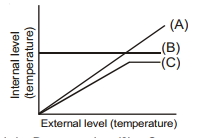
Below is the diagrammatic representation of the response of organisms against temperature. Find out the correct match.
A
$A-$plants,$B-$birds
B
$A-$birds,$B-$mammals
C
$C-$mammals,$B-$plants
D
$A-$birds,$B-$plants
Solution
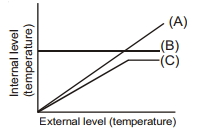
(A) $A =$ Conformers: Includes $99\%$ of animals and all plants,whose internal body temperature changes with the external environment.
$B =$ Regulators: Includes all birds and mammals,which maintain a constant internal body temperature regardless of external environmental changes.
$C =$ Partial regulators: Organisms that can regulate their internal environment only up to a certain limit of external environmental conditions.
$B =$ Regulators: Includes all birds and mammals,which maintain a constant internal body temperature regardless of external environmental changes.
$C =$ Partial regulators: Organisms that can regulate their internal environment only up to a certain limit of external environmental conditions.
0 likes
View Solution195
MediumMCQ
Smaller animals tend to lose body heat very fast as compared to larger animals because they have
A
Higher surface to volume ratio
B
Lower surface to volume ratio
C
Equal values of surface and volume
D
Very low $BMR$ (basal metabolic rate)
Solution
(A) Smaller animals have a higher surface area to volume ratio compared to larger animals. Since heat loss is a function of surface area,a larger surface area relative to body volume allows heat to escape from the body much more rapidly. Consequently,these animals must expend a lot of energy to generate body heat through metabolism.
0 likes
View Solution196
MediumMCQ
Match Column-$I$ with Column-$II$ and choose the correct option.
| Column-$I$ | Column-$II$ |
| $a.$ Aestivation | $(i)$ Over wintering |
| $b.$ Hibernation | $(ii)$ Over summer |
| $c.$ Diapause | $(iii)$ Suspended development in zooplanktons |
A
$a-(i), b-(ii), c-(iii)$
B
$a-(i), b-(iii), c-(ii)$
C
$a-(ii), b-(i), c-(iii)$
D
$a-(iii), b-(i), c-(ii)$
Solution
(C) Aestivation is a state of animal dormancy characterized by inactivity and a lowered metabolic rate that occurs in response to high temperatures and arid conditions, often referred to as 'over summer'.
Hibernation is a state of minimal activity and metabolic depression in endotherms, occurring in response to cold temperatures, often referred to as 'over wintering'.
Diapause is a physiological state of arrested development or suspended animation in many insects and zooplanktons, which allows them to survive unfavorable environmental conditions.
Therefore, the correct matching is: $a-(ii), b-(i), c-(iii)$.
Hibernation is a state of minimal activity and metabolic depression in endotherms, occurring in response to cold temperatures, often referred to as 'over wintering'.
Diapause is a physiological state of arrested development or suspended animation in many insects and zooplanktons, which allows them to survive unfavorable environmental conditions.
Therefore, the correct matching is: $a-(ii), b-(i), c-(iii)$.
0 likes
View Solution197
MediumMCQ
Thick cuticle,sunken and scotoactive stomata,$CAM$ photosynthesis,and conversion of leaves into spines are some of the important characters of
A
Desert plants
B
Hydrophytes
C
Xerophytes
D
More than one option is correct
Solution
(D) The mentioned characteristics are adaptations to minimize water loss in arid environments.
Thick cuticle and sunken stomata reduce transpiration.
Scotoactive stomata (opening at night) and $CAM$ photosynthesis are specific adaptations to conserve water in dry conditions.
Conversion of leaves into spines reduces the surface area for transpiration.
Both desert plants and xerophytes exhibit these adaptations,as xerophytes are plants adapted to survive in dry or desert conditions.
Therefore,both $A$ and $C$ are correct,making $D$ the right choice.
Thick cuticle and sunken stomata reduce transpiration.
Scotoactive stomata (opening at night) and $CAM$ photosynthesis are specific adaptations to conserve water in dry conditions.
Conversion of leaves into spines reduces the surface area for transpiration.
Both desert plants and xerophytes exhibit these adaptations,as xerophytes are plants adapted to survive in dry or desert conditions.
Therefore,both $A$ and $C$ are correct,making $D$ the right choice.
0 likes
View Solution198
EasyMCQ
Warm-blooded animals like mammals from colder climates generally have shorter ears and limbs. This is an explanation of:
A
$Jordan's$ rule
B
$Allen's$ rule
C
$Rensch's$ rule
D
$Bergmann's$ rule
Solution
(B) $Allen's$ rule states that mammals from colder climates generally have shorter ears and limbs to minimize heat loss from the body surface. This is an adaptation to conserve body heat in cold environments.
0 likes
View Solution199
MediumMCQ
Organisms occupying similar ecological niche but different geographical areas of distribution are called as
A
Edge species
B
Ecological equivalents
C
Ecoclines
D
Inquilines
Solution
(B) Organisms that occupy a similar ecological niche but are found in different geographical areas are known as ecological equivalents.
$1$. Edge species: The ecotone zone,which is the transition area between two communities,often supports a greater number of species and higher population density than either of the adjacent communities.
$2$. Ecological equivalents: These are organisms that occupy similar niches in different geographical regions,often showing convergent evolution.
$3$. Ecoclines: These represent a gradient of variations in ecotypes in relation to changes in ecological conditions across a geographical area.
$4$. Inquilines: These are organisms that habitually live within the nest,burrow,or dwelling of another species.
$1$. Edge species: The ecotone zone,which is the transition area between two communities,often supports a greater number of species and higher population density than either of the adjacent communities.
$2$. Ecological equivalents: These are organisms that occupy similar niches in different geographical regions,often showing convergent evolution.
$3$. Ecoclines: These represent a gradient of variations in ecotypes in relation to changes in ecological conditions across a geographical area.
$4$. Inquilines: These are organisms that habitually live within the nest,burrow,or dwelling of another species.
0 likes
View Solution200
EasyMCQ
The taiga region is also known as
A
Deciduous forest
B
Tropical rain forest
C
Northern conifer forest
D
Tropical savannah
Solution
(C) The taiga region,also known as the boreal forest,is characterized by its cold climate and is dominated by evergreen coniferous trees. Therefore,it is widely referred to as the Northern conifer forest.
0 likes
View SolutionOrganisms and Populations — Organism and its Environment · Frequently Asked Questions
1Are these Organisms and Populations questions useful for JEE and NEET?
Yes. All questions in this section are mapped to JEE Main and NEET exam patterns. Previous year questions from JEE Main, NEET, GUJCET and state-level exams are included with full solutions.
2Can I switch to Hindi or Gujarati for these questions?
Yes. Use the language tabs in the hero section or the sidebar to view the same questions and solutions in English, Hindi or Gujarati.
3How do I generate a question paper from this subtopic?
Use the Vedclass Exam Paper Generator — select the chapter and subtopic, set difficulty, and generate Sets A, B, C, D automatically. First 3 chapters of every subject are free.
Vedclass Products
For Students
Vedclass Test Series
Mock tests in real JEE/NEET style with performance analysis. 5-day free trial.
Start Free TrialFor Teachers
Exam Paper Generator
Generate Set A/B/C/D papers from this chapter in 2 minutes. 3 chapters free.
Try FreeFor Institutes
Online Exam Module
Live online exams with unlimited students, 360° analytics & white-label branding.
See DemoFor Teachers & Institutes
Generate a Organisms and Populations Exam Paper in 2 Minutes
Select subtopic & difficulty — Sets A, B, C, D auto-generated with No Repeat logic.
First 3 chapters of every subject are free — no payment required.