
A English
Organism and its Environment Questions in English
Class 12 Biology · Organisms and Populations · Organism and its Environment
264+
Questions
English
Language
100%
With Solutions
Showing 50 of 264 questions in English
101
MediumMCQ
Which one of the following is one of the characteristics of a biological community?
A
Stratification
B
Natality
C
Mortality
D
Sex ratio
Solution
(A) : The characteristics of a biological community include dominance,species diversity,trophic organization,stratification,dynamism,and stability.
Organisms are not uniformly distributed throughout a community; they usually occur in definite zones.
This spatial arrangement of populations is called stratification.
Structurally,a community may be divided horizontally into sub-communities,which constitutes zonation.
In contrast,natality,mortality,age structure,and sex ratio are the fundamental characteristics of a population,not a community.
Organisms are not uniformly distributed throughout a community; they usually occur in definite zones.
This spatial arrangement of populations is called stratification.
Structurally,a community may be divided horizontally into sub-communities,which constitutes zonation.
In contrast,natality,mortality,age structure,and sex ratio are the fundamental characteristics of a population,not a community.
0 likes
View Solution102
MediumMCQ
Consider the following four statements $(1-4)$ about certain desert animals such as kangaroo rat.
$(1)$ They have dark colour and high rate of reproduction and excrete solid urine.
$(2)$ They do not drink water,breathe at a slow rate to conserve water and have their body covered with thick hairs.
$(3)$ They feed on dry seeds and do not require drinking water.
$(4)$ They excrete very concentrated urine and do not use water to regulate body temperature.
Which two of the above statements for such animals are true?
$(1)$ They have dark colour and high rate of reproduction and excrete solid urine.
$(2)$ They do not drink water,breathe at a slow rate to conserve water and have their body covered with thick hairs.
$(3)$ They feed on dry seeds and do not require drinking water.
$(4)$ They excrete very concentrated urine and do not use water to regulate body temperature.
Which two of the above statements for such animals are true?
A
$3$ and $1$
B
$1$ and $2$
C
$3$ and $4$
D
$2$ and $3$
Solution
(C) The correct answer is $C$ ($3$ and $4$).
Kangaroo rat $(Dipodomys \ merriami)$ is a desert rodent that exhibits specific adaptations to survive in arid environments.
Statement $(3)$ is true: They feed on dry seeds and do not require drinking water as they obtain water from metabolic processes.
Statement $(4)$ is true: They excrete very concentrated urine to minimize water loss and do not use water (like sweating) to regulate body temperature.
Statement $(1)$ is incorrect because they do not excrete solid urine (they excrete concentrated urine).
Statement $(2)$ is incorrect because they do not breathe at a slow rate to conserve water; rather,they minimize water loss through physiological and behavioral adaptations like living in burrows.
Kangaroo rat $(Dipodomys \ merriami)$ is a desert rodent that exhibits specific adaptations to survive in arid environments.
Statement $(3)$ is true: They feed on dry seeds and do not require drinking water as they obtain water from metabolic processes.
Statement $(4)$ is true: They excrete very concentrated urine to minimize water loss and do not use water (like sweating) to regulate body temperature.
Statement $(1)$ is incorrect because they do not excrete solid urine (they excrete concentrated urine).
Statement $(2)$ is incorrect because they do not breathe at a slow rate to conserve water; rather,they minimize water loss through physiological and behavioral adaptations like living in burrows.
0 likes
View Solution103
MediumMCQ
Quercus species are the dominant component in
A
scrub forests
B
tropical rain forests
C
temperate deciduous forests
D
alpine forests
Solution
(C) $Quercus$ (oak) species are the dominant component in temperate deciduous forests.
Temperate broad-leaf (deciduous) forests experience warm summers and moderately cool winters with annual rainfall ranging from $100-250 \ cm$.
Dominant tree species in these forests include oak,elm,birch,maple,ash,chestnut,hickory,beech,poplar,and Magnolia.
In India,temperate broad-leaf forests are specifically dominated by various oak species such as $Quercus \ semecarpifolia$ (Brown oak of Himalayas),$Q. \ floribunda$ (Tilonaj oak),$Q. \ lanuginosa$ (Rianj oak),and $Q. \ leucotrichophora$ (Banj oak).
The fauna of these forests typically includes deer,foxes,beavers,wild cats,and raccoons.
Temperate broad-leaf (deciduous) forests experience warm summers and moderately cool winters with annual rainfall ranging from $100-250 \ cm$.
Dominant tree species in these forests include oak,elm,birch,maple,ash,chestnut,hickory,beech,poplar,and Magnolia.
In India,temperate broad-leaf forests are specifically dominated by various oak species such as $Quercus \ semecarpifolia$ (Brown oak of Himalayas),$Q. \ floribunda$ (Tilonaj oak),$Q. \ lanuginosa$ (Rianj oak),and $Q. \ leucotrichophora$ (Banj oak).
The fauna of these forests typically includes deer,foxes,beavers,wild cats,and raccoons.
0 likes
View Solution104
EasyMCQ
Most animals are tree dwellers in a
A
temperate deciduous forest
B
tropical rainforest
C
coniferous forest
D
thorn woodland
Solution
(B) : Tropical rainforests have a very dense plant cover. They also experience a large amount of precipitation,thus the forest floor is always damp. These conditions have led animals to adapt to arboreal (tree-dwelling) habitats. Most animals found there are tree dwellers because almost every space on the forest floor is occupied by dense vegetation.
0 likes
View Solution105
MediumMCQ
Organisms which can tolerate and thrive in a wide range of temperature are called .......... e.g. .........
A
Eurythermal,flying fox
B
Stenothermal,columba
C
Poikilothermal,lion
D
Eurythermal,cockroach
Solution
(D) Organisms that can tolerate and thrive in a wide range of temperatures are known as $Eurythermal$ organisms.
In contrast, organisms that are restricted to a narrow range of temperatures are called $Stenothermal$ organisms.
$Eurythermal$ organisms, such as the $cockroach$ $(Periplaneta \, americana)$, are capable of surviving in diverse temperature conditions.
Therefore, the correct option is $D$.
In contrast, organisms that are restricted to a narrow range of temperatures are called $Stenothermal$ organisms.
$Eurythermal$ organisms, such as the $cockroach$ $(Periplaneta \, americana)$, are capable of surviving in diverse temperature conditions.
Therefore, the correct option is $D$.
0 likes
View Solution106
MediumMCQ
Allen's rule applies to:
A
Tribes living in high altitudes.
B
Animals of colder climates.
C
Algae living in Antarctic water.
D
Desert lizards.
Solution
(B) Allen's rule states that mammals and birds living in colder climates generally have shorter ears and limbs to minimize heat loss from the body surface.
This is an adaptation to conserve body heat in cold environments.
Therefore,Allen's rule applies to animals of colder climates.
This is an adaptation to conserve body heat in cold environments.
Therefore,Allen's rule applies to animals of colder climates.
0 likes
View Solution107
MediumMCQ
In summer,when the outside temperature is higher than our body temperature,we sweat profusely. The resulting evaporative cooling,similar to what happens with a desert cooler in operation,brings down the body temperature. In winter,when the temperature is much lower than $37^{\circ}C$,we start to shiver,a kind of exercise which produces heat and raises the body temperature. These organisms are called:
A
Conformers
B
Suspended
C
Migration
D
Regulators
Solution
(D) Organisms that are able to maintain homeostasis by physiological (sometimes behavioral) means which ensure constant body temperature,constant osmotic concentration,etc.,are called Regulators.
Humans maintain a constant body temperature of $37^{\circ}C$. In summer,we sweat to cool down,and in winter,we shiver to produce heat.
This ability to regulate internal conditions despite changes in the external environment is a characteristic of Regulators.
Humans maintain a constant body temperature of $37^{\circ}C$. In summer,we sweat to cool down,and in winter,we shiver to produce heat.
This ability to regulate internal conditions despite changes in the external environment is a characteristic of Regulators.
0 likes
View Solution108
MediumMCQ
Many tribes live in the high altitude of the Himalayas. What physiological adaptation do they exhibit?
A
Less red blood cells,more white blood cells,more $Hb$
B
Higher red blood cells,more $Hb$
C
More platelets,more $Hb$
D
More white blood cells,more platelets
Solution
(B) At high altitudes,the atmospheric pressure is low,which results in low oxygen availability (hypoxia).
To compensate for this,the human body undergoes physiological adaptations.
The body increases the production of red blood cells $(RBCs)$ to enhance the oxygen-carrying capacity of the blood.
Additionally,the concentration of hemoglobin $(Hb)$ increases to bind more oxygen efficiently.
Therefore,people living at high altitudes typically have a higher count of red blood cells and higher levels of hemoglobin.
To compensate for this,the human body undergoes physiological adaptations.
The body increases the production of red blood cells $(RBCs)$ to enhance the oxygen-carrying capacity of the blood.
Additionally,the concentration of hemoglobin $(Hb)$ increases to bind more oxygen efficiently.
Therefore,people living at high altitudes typically have a higher count of red blood cells and higher levels of hemoglobin.
0 likes
View Solution109
MediumMCQ
Kangaroo rat is found in .........
A
Tundra
B
Desert
C
Grassland
D
Temperate forest
Solution
(B) The kangaroo rat is a desert-dwelling rodent. It has evolved specific physiological and behavioral adaptations to survive in arid environments with limited water availability. For instance,it can meet its water requirements through internal fat oxidation (metabolic water) and does not need to drink liquid water. Therefore,it is primarily found in desert ecosystems.
0 likes
View Solution110
MediumMCQ
In which area does the highest average rainfall occur?
A
Temperate forest
B
Grassland
C
Coniferous forest
D
Tropical forest
Solution
(D) The distribution of biomes is primarily determined by two major climatic factors: temperature and precipitation (rainfall).
Tropical forests,specifically tropical rainforests,are characterized by high temperatures and very high annual rainfall.
These regions receive the highest average annual precipitation compared to temperate forests,grasslands,and coniferous forests.
Therefore,tropical forests support the highest biodiversity due to these favorable climatic conditions.
Tropical forests,specifically tropical rainforests,are characterized by high temperatures and very high annual rainfall.
These regions receive the highest average annual precipitation compared to temperate forests,grasslands,and coniferous forests.
Therefore,tropical forests support the highest biodiversity due to these favorable climatic conditions.
0 likes
View Solution111
MediumMCQ
The organisms should try to maintain the constancy of its internal environment is a process called .......
A
Limited range
B
Homoeostasis
C
Topography
D
Diapause
Solution
(B) The process by which organisms maintain a relatively constant internal environment despite changes in the external environment is known as $Homoeostasis$. This mechanism allows organisms to keep their body temperature,osmotic concentration,and other physiological parameters within a stable range,which is essential for optimal metabolic activity.
0 likes
View Solution112
MediumMCQ
Adaptation found in Kangaroo rat is
A
Loss of more water
B
Do not store water
C
Possesses blubber
D
Concentrate its urine
Solution
(D) The Kangaroo rat is a desert-dwelling rodent that has evolved specific physiological adaptations to survive in arid environments with minimal water availability.
$1$. It does not need to drink water because it meets its water requirements through its internal fat oxidation (metabolic water).
$2$. To conserve water,it has the ability to concentrate its urine to a very high degree,thereby minimizing water loss through excretion.
$3$. Therefore,the most significant physiological adaptation among the given options is its ability to concentrate its urine.
$1$. It does not need to drink water because it meets its water requirements through its internal fat oxidation (metabolic water).
$2$. To conserve water,it has the ability to concentrate its urine to a very high degree,thereby minimizing water loss through excretion.
$3$. Therefore,the most significant physiological adaptation among the given options is its ability to concentrate its urine.
0 likes
View Solution113
MediumMCQ
Choose the incorrect sentence.
A
Many tribes live in the high altitude of Himalayas; they normally have a higher red blood cell count than people living in the plains.
B
At high altitude,we must have experienced what is called altitude sickness.
C
Archaebacteria live in hot springs where the temperature exceeds $100^{\circ}C$.
D
Mammals from colder climates generally have shorter ears and limbs. This is called Allen's rule.
Solution
(D) The incorrect statement is $D$.
According to Allen's rule,mammals from colder climates generally have shorter ears and limbs to minimize heat loss.
Option $A$ is correct because people living at high altitudes adapt by increasing their red blood cell count to compensate for low oxygen availability.
Option $B$ is correct as altitude sickness is a common physiological response to low atmospheric pressure at high altitudes.
Option $C$ is correct as some Archaebacteria are thermophiles capable of surviving in extreme temperatures exceeding $100^{\circ}C$.
According to Allen's rule,mammals from colder climates generally have shorter ears and limbs to minimize heat loss.
Option $A$ is correct because people living at high altitudes adapt by increasing their red blood cell count to compensate for low oxygen availability.
Option $B$ is correct as altitude sickness is a common physiological response to low atmospheric pressure at high altitudes.
Option $C$ is correct as some Archaebacteria are thermophiles capable of surviving in extreme temperatures exceeding $100^{\circ}C$.
0 likes
View Solution114
MediumMCQ
How many of the following pairs are correct regarding the thermal tolerance of organisms?
$(1)$ Aves - eurythermal
$(2)$ Mammals - stenothermal
$(3)$ Amphibia - stenothermal
$(4)$ Reptile - eurythermal
$(1)$ Aves - eurythermal
$(2)$ Mammals - stenothermal
$(3)$ Amphibia - stenothermal
$(4)$ Reptile - eurythermal
A
$0$
B
$1$
C
$2$
D
$3$
Solution
(A) Organisms that can tolerate and thrive in a wide range of temperatures are called eurythermal.
Organisms that are restricted to a narrow range of temperatures are called stenothermal.
$(1)$ Aves (birds) and $(2)$ Mammals are endotherms that maintain a constant body temperature and are generally considered eurythermal.
$(3)$ Amphibia and $(4)$ Reptiles are ectotherms and are generally considered stenothermal as they are restricted to narrower temperature ranges compared to endotherms.
Therefore,none of the given pairs are correctly matched based on standard biological classification.
Thus,the correct number of correct pairs is $0$.
Organisms that are restricted to a narrow range of temperatures are called stenothermal.
$(1)$ Aves (birds) and $(2)$ Mammals are endotherms that maintain a constant body temperature and are generally considered eurythermal.
$(3)$ Amphibia and $(4)$ Reptiles are ectotherms and are generally considered stenothermal as they are restricted to narrower temperature ranges compared to endotherms.
Therefore,none of the given pairs are correctly matched based on standard biological classification.
Thus,the correct number of correct pairs is $0$.
0 likes
View Solution115
MediumMCQ
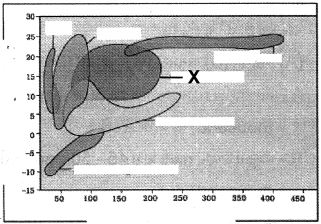
Identify $X$ in the given figure, which represents the biome distribution with respect to mean annual temperature and mean annual precipitation.
A
Coniferous forest
B
Grassland
C
Temperate forest
D
Desert
Solution
(C) The given figure is a standard biome distribution graph based on mean annual temperature and mean annual precipitation as provided in the $NCERT$ Biology textbook for Class $12$.
In this graph, the $X$-axis represents mean annual precipitation $(cm)$ and the $Y$-axis represents mean annual temperature $(^\circ C)$.
The biome labeled as $X$ occupies a region with moderate temperature and moderate precipitation.
According to the standard biome distribution diagram, this specific region corresponds to the 'Temperate forest'.
Therefore, the correct option is $C$.
In this graph, the $X$-axis represents mean annual precipitation $(cm)$ and the $Y$-axis represents mean annual temperature $(^\circ C)$.
The biome labeled as $X$ occupies a region with moderate temperature and moderate precipitation.
According to the standard biome distribution diagram, this specific region corresponds to the 'Temperate forest'.
Therefore, the correct option is $C$.
0 likes
View Solution116
EasyMCQ
Blubber is present in ...
A
Kangaroo rat
B
Camel
C
Seal
D
Plant
Solution
(C) Blubber is a thick layer of adipose tissue (fat) found under the skin of marine mammals such as whales,dolphins,and seals.
It acts as an insulator to prevent heat loss in cold aquatic environments,provides buoyancy,and serves as an energy reserve.
Among the given options,the $Seal$ is a marine mammal that possesses a thick layer of blubber.
It acts as an insulator to prevent heat loss in cold aquatic environments,provides buoyancy,and serves as an energy reserve.
Among the given options,the $Seal$ is a marine mammal that possesses a thick layer of blubber.
0 likes
View Solution117
MediumMCQ
Identify the organism based on the following characteristics:
- It has the ability to concentrate its urine.
- It meets its water requirements from internal fat oxidation.
- It is found in the American desert.
- It has the ability to concentrate its urine.
- It meets its water requirements from internal fat oxidation.
- It is found in the American desert.
A
Archaebacteria
B
Barnacles
C
Kangaroo rat
D
Seal
Solution
(C) The $Kangaroo \ rat$ (Dipodomys) is a classic example of an organism adapted to extreme desert conditions.
$1$. It has the ability to concentrate its urine to a very high degree,which minimizes water loss through excretion.
$2$. It does not need to drink water because it meets its water requirements through the metabolic oxidation of internal fat,where water is a byproduct.
$3$. It is native to the deserts of North America (American desert).
$1$. It has the ability to concentrate its urine to a very high degree,which minimizes water loss through excretion.
$2$. It does not need to drink water because it meets its water requirements through the metabolic oxidation of internal fat,where water is a byproduct.
$3$. It is native to the deserts of North America (American desert).
0 likes
View Solution118
MediumMCQ
In bacteria,fungi,and lower plants,various kinds of thick-walled spores are formed which help them to survive unfavourable conditions. This phenomenon can be called ...........
A
Suspend
B
Conform
C
Regulate
D
Migrate
Solution
(A) In organisms like bacteria,fungi,and various lower plants,the formation of thick-walled spores is a strategy to survive unfavourable environmental conditions.
This process allows the organism to reduce its metabolic activity to a minimum level,effectively entering a state of dormancy.
In the context of ecological adaptations,this strategy is classified as $Suspend$.
This process allows the organism to reduce its metabolic activity to a minimum level,effectively entering a state of dormancy.
In the context of ecological adaptations,this strategy is classified as $Suspend$.
0 likes
View Solution119
EasyMCQ
Penguins are found in .............. .
A
Australia
B
Antarctica
C
Africa
D
America
Solution
(B) Penguins are a group of aquatic flightless birds. They live almost exclusively in the Southern Hemisphere,with the largest populations found in Antarctica. They are highly adapted for life in the water,possessing flippers for swimming and a thick layer of blubber for insulation against the extreme cold of the Antarctic environment.
0 likes
View Solution120
MediumMCQ
Consider the following four statements regarding certain desert animals like the kangaroo rat:
$(a)$ They have a dark color,a high rate of reproduction,and excrete solid urine.
$(b)$ They do not drink water,breathe slowly to conserve water,and their body is covered by thick hair.
$(c)$ They use dry seeds as food and do not require drinking water.
$(d)$ They excrete very concentrated urine and do not use water to regulate body temperature.
Which two of the above statements are true for such animals?
$(a)$ They have a dark color,a high rate of reproduction,and excrete solid urine.
$(b)$ They do not drink water,breathe slowly to conserve water,and their body is covered by thick hair.
$(c)$ They use dry seeds as food and do not require drinking water.
$(d)$ They excrete very concentrated urine and do not use water to regulate body temperature.
Which two of the above statements are true for such animals?
A
$(c)$ and $(d)$
B
$(b)$ and $(c)$
C
$(c)$ and $(a)$
D
$(a)$ and $(b)$
Solution
(A) Kangaroo rats are well-adapted to desert environments.
Statement $(c)$ is true because they obtain metabolic water from the oxidation of dry seeds and do not need to drink liquid water.
Statement $(d)$ is true because they excrete highly concentrated urine to minimize water loss and do not rely on water for thermoregulation (like sweating),which helps them survive in arid conditions.
Statements $(a)$ and $(b)$ contain inaccuracies regarding their physiological adaptations (e.g.,they do not excrete 'solid' urine,and their breathing rate is not specifically described as 'slow' to conserve water in this context).
Therefore,the correct statements are $(c)$ and $(d)$.
Statement $(c)$ is true because they obtain metabolic water from the oxidation of dry seeds and do not need to drink liquid water.
Statement $(d)$ is true because they excrete highly concentrated urine to minimize water loss and do not rely on water for thermoregulation (like sweating),which helps them survive in arid conditions.
Statements $(a)$ and $(b)$ contain inaccuracies regarding their physiological adaptations (e.g.,they do not excrete 'solid' urine,and their breathing rate is not specifically described as 'slow' to conserve water in this context).
Therefore,the correct statements are $(c)$ and $(d)$.
0 likes
View Solution121
MediumMCQ
The rule which states that mammals from colder climates generally have shorter ears and limbs to minimize heat loss is known as:
A
Bergmann's rule
B
Jordan's rule
C
Gloger's rule
D
Allen's rule
Solution
(D) Allen's rule states that animals living in colder climates have shorter extremities (ears,tails,limbs) compared to those living in warmer climates.
This is an adaptation to minimize the surface area to volume ratio,thereby reducing heat loss from the body.
Bergmann's rule relates to body size,Gloger's rule relates to pigmentation,and Jordan's rule relates to the number of vertebrae in fish.
This is an adaptation to minimize the surface area to volume ratio,thereby reducing heat loss from the body.
Bergmann's rule relates to body size,Gloger's rule relates to pigmentation,and Jordan's rule relates to the number of vertebrae in fish.
0 likes
View Solution122
MediumMCQ
In ecology,what is referred to as a 'niche'?
A
The functional role of an organism in its environment.
B
The physical location where an organism lives.
C
The competitive ability of a species.
D
The center of origin of a species.
Solution
(A) In ecology,an ecological niche describes the functional role and position of a species within its environment. It includes how an organism uses the resources available in its habitat,its interactions with other species,and its specific requirements for survival and reproduction. While a habitat is the 'address' where an organism lives,the niche is its 'profession' or functional role.
0 likes
View Solution123
MediumMCQ
What is a foundation species?
A
$A$ species that makes up a very small proportion of the total biomass of the community but has a large impact on community structure and biodiversity.
B
$A$ common species that has a large biomass but has very little impact on community structure.
C
$A$ rare species that has very little impact on biomass and other species in the community.
D
$A$ dominant species that makes up a large proportion of the biomass and influences many other species.
Solution
(D) foundation species is a species that plays a major role in creating or maintaining a habitat that supports other species. These species often have a large biomass and significantly influence the community structure by providing physical habitat or resources. Therefore,option $D$ is the correct description of a foundation species.
0 likes
View Solution124
MediumMCQ
Which of the following pairs is mismatched?
A
Tundra - Permafrost
B
Savanna - Acacia
C
Prairie - Epiphytes
D
Coniferous forest - Evergreen trees
Solution
(C) The correct answer is $C$.
$A$. Tundra is characterized by $Permafrost$,which is a layer of soil that remains frozen throughout the year. This is a correct match.
$B$. Savanna biomes are dominated by grasses and scattered trees,with $Acacia$ being a characteristic tree genus. This is a correct match.
$C$. Prairie is a temperate grassland biome. $Epiphytes$ (plants that grow on other plants) are characteristic of tropical rainforests,not temperate grasslands. Therefore,this pair is mismatched.
$D$. Coniferous forests (taiga) are dominated by gymnosperms like pines and spruces,which are $Evergreen$ trees. This is a correct match.
$A$. Tundra is characterized by $Permafrost$,which is a layer of soil that remains frozen throughout the year. This is a correct match.
$B$. Savanna biomes are dominated by grasses and scattered trees,with $Acacia$ being a characteristic tree genus. This is a correct match.
$C$. Prairie is a temperate grassland biome. $Epiphytes$ (plants that grow on other plants) are characteristic of tropical rainforests,not temperate grasslands. Therefore,this pair is mismatched.
$D$. Coniferous forests (taiga) are dominated by gymnosperms like pines and spruces,which are $Evergreen$ trees. This is a correct match.
0 likes
View Solution125
EasyMCQ
Annual migration does not occur in the case of ............ .
A
Salmon
B
Siberian crane
C
Salamander
D
Arctic tern
Solution
(C) Migration is the movement of organisms from one region to another,usually on a seasonal basis,to find food,better climate,or for breeding purposes.
$A$. Salmon are anadromous fish that migrate from the ocean to freshwater rivers to spawn.
$B$. Siberian cranes are well-known migratory birds that travel long distances to escape harsh winters.
$C$. Salamanders are amphibians that typically remain within a specific habitat range and do not perform long-distance annual migrations.
$D$. Arctic terns are famous for having the longest migration of any animal,traveling from the Arctic to the Antarctic and back annually.
Therefore,the correct answer is Salamander.
$A$. Salmon are anadromous fish that migrate from the ocean to freshwater rivers to spawn.
$B$. Siberian cranes are well-known migratory birds that travel long distances to escape harsh winters.
$C$. Salamanders are amphibians that typically remain within a specific habitat range and do not perform long-distance annual migrations.
$D$. Arctic terns are famous for having the longest migration of any animal,traveling from the Arctic to the Antarctic and back annually.
Therefore,the correct answer is Salamander.
0 likes
View Solution126
MediumMCQ
Consider the following four statements $(a-d)$ regarding certain desert animals like the kangaroo rat:
$(a)$ They have a dark color and high rate of reproduction and excrete solid urine.
$(b)$ They do not drink water,breathe at a slow rate to conserve water,and their body is covered with thick hair.
$(c)$ They feed on dry seeds and do not require drinking water.
$(d)$ They excrete very concentrated urine and do not use water to regulate body temperature.
Which two of the above statements are true?
$(a)$ They have a dark color and high rate of reproduction and excrete solid urine.
$(b)$ They do not drink water,breathe at a slow rate to conserve water,and their body is covered with thick hair.
$(c)$ They feed on dry seeds and do not require drinking water.
$(d)$ They excrete very concentrated urine and do not use water to regulate body temperature.
Which two of the above statements are true?
A
$(c)$ and $(d)$
B
$(b)$ and $(c)$
C
$(c)$ and $(a)$
D
$(a)$ and $(b)$
Solution
(A) The kangaroo rat is a classic example of an organism adapted to desert conditions.
$(1)$ They feed on dry seeds,which provide metabolic water through oxidation,so they do not need to drink liquid water. Thus,statement $(c)$ is true.
$(2)$ To conserve water,they excrete highly concentrated urine and do not use water for evaporative cooling (sweating) to regulate body temperature. Thus,statement $(d)$ is true.
$(3)$ Statement $(a)$ is incorrect because they do not excrete solid urine; they excrete highly concentrated liquid urine.
$(4)$ Statement $(b)$ is incorrect because they do not necessarily have thick hair for water conservation in this context,and breathing rate is not the primary mechanism for water conservation compared to metabolic water production.
Therefore,statements $(c)$ and $(d)$ are correct.
$(1)$ They feed on dry seeds,which provide metabolic water through oxidation,so they do not need to drink liquid water. Thus,statement $(c)$ is true.
$(2)$ To conserve water,they excrete highly concentrated urine and do not use water for evaporative cooling (sweating) to regulate body temperature. Thus,statement $(d)$ is true.
$(3)$ Statement $(a)$ is incorrect because they do not excrete solid urine; they excrete highly concentrated liquid urine.
$(4)$ Statement $(b)$ is incorrect because they do not necessarily have thick hair for water conservation in this context,and breathing rate is not the primary mechanism for water conservation compared to metabolic water production.
Therefore,statements $(c)$ and $(d)$ are correct.
0 likes
View Solution127
MediumMCQ
Which of the following is a characteristic of a biological community?
A
Stratification
B
Birth rate
C
Death rate
D
Sex ratio
Solution
(A) biological community is an assemblage of populations of various species living in a particular area and interacting with each other.
$1$. Stratification is the vertical distribution of different species occupying different levels in a community (e.g.,trees,shrubs,and herbs in a forest).
$2$. Birth rate,death rate,and sex ratio are attributes of a population,not a community.
$1$. Stratification is the vertical distribution of different species occupying different levels in a community (e.g.,trees,shrubs,and herbs in a forest).
$2$. Birth rate,death rate,and sex ratio are attributes of a population,not a community.
0 likes
View Solution128
MediumMCQ
Consider the following four conditions $(i-iv)$ and select the pair that represents the adaptation of desert lizards to their environment.
$(i)$ Burrowing into the soil to escape high temperatures.
$(ii)$ Rapidly losing body heat during high temperatures.
$(iii)$ Basking in the sun and absorbing heat when the temperature is low.
$(iv)$ Insulating the body due to a thick layer of fat.
$(i)$ Burrowing into the soil to escape high temperatures.
$(ii)$ Rapidly losing body heat during high temperatures.
$(iii)$ Basking in the sun and absorbing heat when the temperature is low.
$(iv)$ Insulating the body due to a thick layer of fat.
A
$iii, iv$
B
$i, iii$
C
$ii, iv$
D
$i, ii$
Solution
(B) Desert lizards are ectotherms,meaning they cannot maintain a constant internal body temperature. They rely on behavioral adaptations to regulate their body temperature.
$(i)$ Burrowing into the soil helps them escape the intense heat of the desert during the day.
$(iii)$ Basking in the sun allows them to absorb heat when the ambient temperature is low,helping them maintain metabolic activity.
$(ii)$ and $(iv)$ are not typical behavioral adaptations for desert lizards; they do not have thick fat layers for insulation like mammals,and they do not rapidly lose heat during high temperatures as a primary survival strategy.
Therefore,the correct pair is $(i)$ and $(iii)$.
$(i)$ Burrowing into the soil helps them escape the intense heat of the desert during the day.
$(iii)$ Basking in the sun allows them to absorb heat when the ambient temperature is low,helping them maintain metabolic activity.
$(ii)$ and $(iv)$ are not typical behavioral adaptations for desert lizards; they do not have thick fat layers for insulation like mammals,and they do not rapidly lose heat during high temperatures as a primary survival strategy.
Therefore,the correct pair is $(i)$ and $(iii)$.
0 likes
View Solution129
MediumMCQ
What is the unit formed by the interactions of populations of various species in a given area called?
A
Population
B
Niche
C
Biotic community
D
Ecosystem
Solution
(C) biotic community is defined as an assemblage of populations of various species that live in a specific area and interact with one another.
- $A$ population consists of individuals of the same species.
- $A$ niche refers to the functional role of an organism in its environment.
- An ecosystem includes both the biotic community and the abiotic (physical) factors of the environment.
Therefore,the correct term for the interaction of populations of different species in a given area is a biotic community.
- $A$ population consists of individuals of the same species.
- $A$ niche refers to the functional role of an organism in its environment.
- An ecosystem includes both the biotic community and the abiotic (physical) factors of the environment.
Therefore,the correct term for the interaction of populations of different species in a given area is a biotic community.
0 likes
View Solution130
MediumMCQ
Small animals have a larger surface area relative to their volume,so they tend to lose body heat very fast when it is cold outside. Then they have to expend much energy to generate body heat through metabolism. This is the main reason why very small animals are rarely found in polar regions. Which of the following explains why small animals are more easily able to climb up a rock compared to large animals?
A
Small animals have a higher metabolic rate.
B
Small animals have a lower oxygen requirement rate.
C
Large animals have less muscle capacity compared to small animals.
D
It is easier to carry the weight of a small body.
Solution
(A) Small animals have a higher surface area to volume ratio,which leads to a higher metabolic rate per unit body weight. This high metabolic rate provides them with more energy relative to their body mass,allowing for greater agility and the ability to climb surfaces more easily compared to large animals,whose energy expenditure is focused on maintaining body mass and thermoregulation.
0 likes
View Solution131
EasyMCQ
The plants $Prosopis$ (Khejri),$Acacia$ (Babul),and $Capparis$ (Kair) are representative of which tropical biome?
A
Grasslands
B
Thorn forests
C
Deciduous forests
D
Evergreen forests
Solution
(B) $Prosopis$ (Khejri),$Acacia$ (Babul),and $Capparis$ (Kair) are xerophytic plants adapted to survive in arid and semi-arid regions.
These plants are characteristic of tropical thorn forests,where water availability is low and temperatures are high.
Therefore,they represent the tropical thorn forest biome.
These plants are characteristic of tropical thorn forests,where water availability is low and temperatures are high.
Therefore,they represent the tropical thorn forest biome.
0 likes
View Solution132
MediumMCQ
The genus $Quercus$ is a dominant component in:
A
Temperate deciduous forests
B
High mountain forests
C
Scrub forests
D
Tropical forests
Solution
(A) The genus $Quercus$ (commonly known as oak) is a characteristic and dominant tree genus found in temperate deciduous forests. These forests are typically found in regions with moderate climates where trees shed their leaves annually. $Quercus$ species are well-adapted to these environmental conditions,making them a primary component of the forest canopy in such biomes.
0 likes
View Solution133
MediumMCQ
$Niche$ is:
A
all the biological factors in the organism's environment
B
the functional role played by the organism where it lives
C
the range of temperature that the organism needs to live
D
the physical space where an organism lives
Solution
(B) $Niche$ refers to the specific functional role that an organism plays within its ecosystem. It encompasses how the organism interacts with both biotic and abiotic components of its environment,including its diet,reproductive habits,and how it utilizes resources. While a $Habitat$ refers to the physical place where an organism lives,a $Niche$ describes its 'profession' or functional status in the community.
0 likes
View Solution134
MediumMCQ
Assertion : Biotic community has higher position than population in ecological hierarchy.
Reason : Population of similar individuals remains isolated in the community.
Reason : Population of similar individuals remains isolated in the community.
A
If both Assertion and Reason are correct and the Reason is a correct explanation of the Assertion.
B
If both Assertion and Reason are correct but Reason is not a correct explanation of the Assertion.
C
If the Assertion is correct but Reason is incorrect.
D
If both the Assertion and Reason are incorrect.
Solution
(C) The ecological hierarchy is organized as: Individual $\rightarrow$ Population $\rightarrow$ Biotic Community $\rightarrow$ Ecosystem $\rightarrow$ Biome $\rightarrow$ Biosphere.
Therefore,the Assertion is correct because a biotic community consists of multiple populations of different species living together in a specific area,placing it at a higher level than a population.
The Reason is incorrect because populations within a biotic community are not isolated. They interact with each other through various ecological processes such as competition,predation,mutualism,and commensalism,forming a complex,interdependent network.
Therefore,the Assertion is correct because a biotic community consists of multiple populations of different species living together in a specific area,placing it at a higher level than a population.
The Reason is incorrect because populations within a biotic community are not isolated. They interact with each other through various ecological processes such as competition,predation,mutualism,and commensalism,forming a complex,interdependent network.
0 likes
View Solution135
MediumMCQ
$A$ plant species shows several morphological variations in response to altitudinal gradient. When grown under similar conditions of growth,the morphological variations disappear and all the variants have common morphology. What are these variants called?
A
Ecotypes
B
Ecophenes
C
Biotypes
D
Genotypes
Solution
(B) These variants are called ecophenes (or ecads).
Ecophenes are morphological variations within a species that are induced by environmental factors rather than genetic differences.
When these variants are grown under uniform environmental conditions,the morphological differences disappear,confirming that they are not genetically distinct.
This phenomenon is a classic example of phenotypic plasticity,where the same genotype produces different phenotypes in response to different environmental conditions such as altitude,temperature,or soil $pH$.
Ecophenes are morphological variations within a species that are induced by environmental factors rather than genetic differences.
When these variants are grown under uniform environmental conditions,the morphological differences disappear,confirming that they are not genetically distinct.
This phenomenon is a classic example of phenotypic plasticity,where the same genotype produces different phenotypes in response to different environmental conditions such as altitude,temperature,or soil $pH$.
0 likes
View Solution136
Medium
How is diapause different from hibernation?
Solution
(N/A) Diapause is a stage of suspended development used to cope with unfavourable conditions. Many species of zooplankton and insects exhibit diapause to survive adverse climatic conditions during their development.
Hibernation,or winter sleep,is a resting stage in which animals escape cold winters by hiding in their shelters. They enter a state of inactivity by slowing their metabolism to survive the winter season. This phenomenon is exhibited by animals such as bats,squirrels,and other rodents.
Hibernation,or winter sleep,is a resting stage in which animals escape cold winters by hiding in their shelters. They enter a state of inactivity by slowing their metabolism to survive the winter season. This phenomenon is exhibited by animals such as bats,squirrels,and other rodents.
0 likes
View Solution137
Medium
Define phenotypic adaptation. Give one example.
Solution
(N/A) Phenotypic adaptation refers to the physiological,morphological,or behavioral changes that occur in an organism's phenotype in response to environmental pressures or stressors. These adjustments help the organism survive and reproduce in its specific habitat.
Example: Desert plants,such as $Opuntia$,possess thick cuticles and sunken stomata on their leaf surfaces to minimize water loss through transpiration.
Example: Desert plants,such as $Opuntia$,possess thick cuticles and sunken stomata on their leaf surfaces to minimize water loss through transpiration.
0 likes
View Solution138
Difficult
Distinguish between the following:
$(a)$ Hibernation and Aestivation
$(b)$ Ectotherms and Endotherms
$(a)$ Hibernation and Aestivation
$(b)$ Ectotherms and Endotherms
Solution
(N/A) Hibernation and Aestivation
$(b)$ Ectotherms and Endotherms
| Hibernation | Aestivation |
|---|---|
| $1.$ Hibernation is a state of reduced metabolic activity in some organisms to escape cold winter conditions. | $1.$ Aestivation is a state of reduced metabolic activity in some organisms to escape desiccation due to heat in summers. |
| $2.$ Bears and squirrels inhabiting cold regions are examples of animals that hibernate during winters. | $2.$ Fishes and snails are examples of organisms that aestivate during summers. |
$(b)$ Ectotherms and Endotherms
| Ectotherms | Endotherms |
|---|---|
| $1.$ Ectotherms are cold-blooded animals. Their body temperature varies with their surroundings. | $1.$ Endotherms are warm-blooded animals. They maintain a constant body temperature. |
| $2.$ Fishes,amphibians,and reptiles are ectothermal animals. | $2.$ Birds and mammals are endothermal animals. |
0 likes
View Solution139
Medium
Give an example for:
$(a)$ An endothermic animal
$(b)$ An ectothermic animal
$(c)$ An organism of benthic zone
$(a)$ An endothermic animal
$(b)$ An ectothermic animal
$(c)$ An organism of benthic zone
Solution
(N/A) Endothermic animal: Birds (e.g.,crows,pigeons) and mammals (e.g.,humans,cows) are endothermic animals that maintain a constant body temperature.
$(b)$ Ectothermic animal: Fishes (e.g.,sharks),amphibians (e.g.,frogs),and reptiles (e.g.,snakes,lizards) are ectothermic animals whose body temperature changes with the ambient environment.
$(c)$ Organism of benthic zone: Benthic organisms live at the lowest level of a body of water. Examples include starfish,sea anemones,and certain decomposing bacteria.
$(b)$ Ectothermic animal: Fishes (e.g.,sharks),amphibians (e.g.,frogs),and reptiles (e.g.,snakes,lizards) are ectothermic animals whose body temperature changes with the ambient environment.
$(c)$ Organism of benthic zone: Benthic organisms live at the lowest level of a body of water. Examples include starfish,sea anemones,and certain decomposing bacteria.
0 likes
View Solution140
Easy
Provide information about the natural habitats of organisms.
Solution
(N/A) Ecology at the organismic level is essentially physiological ecology,which studies how different organisms are adapted to their environments in terms of survival and reproduction.
Regional and local variations within each biome lead to the formation of a wide variety of habitats. The major biomes of India are represented in the figure.
Life on Earth is not limited to just a few favorable habitats but also exists in extreme and harsh environments,such as the scorching Rajasthan desert,the perpetually rain-soaked forests of Meghalaya,deep ocean trenches,torrential streams,permafrost polar regions,high mountain tops,boiling thermal springs,and stinking compost pits.
Even our own intestines are a unique habitat for hundreds of species of microbes.
Regional and local variations within each biome lead to the formation of a wide variety of habitats. The major biomes of India are represented in the figure.
Life on Earth is not limited to just a few favorable habitats but also exists in extreme and harsh environments,such as the scorching Rajasthan desert,the perpetually rain-soaked forests of Meghalaya,deep ocean trenches,torrential streams,permafrost polar regions,high mountain tops,boiling thermal springs,and stinking compost pits.
Even our own intestines are a unique habitat for hundreds of species of microbes.
0 likes
View Solution141
Easy
What are the various possibilities seen in different organisms to achieve homeostasis? Discuss.
Solution
(N/A) $(i)$ Regulate: Some organisms are able to maintain homeostasis by physiological (sometimes behavioural) means which ensure constant body temperature,constant osmotic concentration,etc. All birds and mammals,and a very few lower vertebrate and invertebrate species are indeed capable of such regulation (thermoregulation and osmoregulation). Evolutionary biologists believe that the success of mammals is largely due to their ability to maintain a constant body temperature and thrive whether they live in Antarctica or in the Sahara Desert.
The mechanisms used by most mammals to regulate their body temperature are similar to the ones that we humans use. We maintain a constant body temperature of $37^o C$. In summer,when outside temperature is more than our body temperature,we sweat profusely. The resulting evaporative cooling,similar to what happens with a desert cooler in operation,brings down the body temperature. In winter,when the ambient temperature is much lower than $37^o C$,we start to shiver,a kind of exercise which produces heat and raises the body temperature. Plants,on the other hand,do not have such mechanisms to maintain internal temperatures.
$(ii)$ Conform: An overwhelming majority (about $99$ percent) of animals and nearly all plants cannot maintain a constant internal environment. Their body temperature changes with the ambient temperature. In aquatic animals,the osmotic concentration of the body fluids changes with that of the ambient air/water osmotic concentration. These animals and plants are simply conformers. Considering the benefits of a constant internal environment to the organism,we must ask why these conformers had not evolved to become regulators. Recall the human analogy we used above; how many people can really afford to 'air condition' themselves? Many simply 'sweat it out' and resign themselves to suboptimal performance in hot summer months. Thermoregulation is energetically expensive for many organisms. This is particularly true for small animals like shrews and humming birds. Heat loss or heat gain is a function of surface area. Since small animals have a larger surface area relative to their volume,they tend to lose body heat very fast when it is cold outside; then they have to expend much energy to generate body heat through metabolism. This is the main reason why very small animals are rarely found in polar regions. During the course of evolution,the costs and benefits of maintaining a constant internal environment are taken into consideration. Some species have evolved the ability to regulate,but only over a limited range of environmental conditions,beyond which they simply conform.
The mechanisms used by most mammals to regulate their body temperature are similar to the ones that we humans use. We maintain a constant body temperature of $37^o C$. In summer,when outside temperature is more than our body temperature,we sweat profusely. The resulting evaporative cooling,similar to what happens with a desert cooler in operation,brings down the body temperature. In winter,when the ambient temperature is much lower than $37^o C$,we start to shiver,a kind of exercise which produces heat and raises the body temperature. Plants,on the other hand,do not have such mechanisms to maintain internal temperatures.
$(ii)$ Conform: An overwhelming majority (about $99$ percent) of animals and nearly all plants cannot maintain a constant internal environment. Their body temperature changes with the ambient temperature. In aquatic animals,the osmotic concentration of the body fluids changes with that of the ambient air/water osmotic concentration. These animals and plants are simply conformers. Considering the benefits of a constant internal environment to the organism,we must ask why these conformers had not evolved to become regulators. Recall the human analogy we used above; how many people can really afford to 'air condition' themselves? Many simply 'sweat it out' and resign themselves to suboptimal performance in hot summer months. Thermoregulation is energetically expensive for many organisms. This is particularly true for small animals like shrews and humming birds. Heat loss or heat gain is a function of surface area. Since small animals have a larger surface area relative to their volume,they tend to lose body heat very fast when it is cold outside; then they have to expend much energy to generate body heat through metabolism. This is the main reason why very small animals are rarely found in polar regions. During the course of evolution,the costs and benefits of maintaining a constant internal environment are taken into consideration. Some species have evolved the ability to regulate,but only over a limited range of environmental conditions,beyond which they simply conform.
0 likes
View Solution142
Medium
What is adaptation? Explain with examples how various organisms show adaptations to cope with specific environmental conditions.
Solution
(N/A) Adaptation is any attribute of an organism (morphological,physiological,or behavioural) that enables the organism to survive and reproduce in its habitat. Many adaptations have evolved over a long evolutionary time and are genetically fixed.
$1$. Physiological Adaptation: In the absence of an external source of water,the kangaroo rat in North American deserts meets all its water requirements through its internal fat oxidation (where water is a byproduct). It also has the ability to concentrate its urine,so it uses minimal water to remove excretory products.
$2$. Morphological Adaptation: Many desert plants have a thick cuticle on their leaf surfaces and have their stomata arranged in deep pits to minimize water loss through transpiration. They also have a special photosynthetic pathway $(CAM)$ that enables their stomata to remain closed during daytime. Some desert plants like $Opuntia$ have no leaves—they are reduced to spines—and the photosynthetic function is taken over by the flattened stems.
$3$. Allen's Rule: Mammals from colder climates generally have shorter ears and limbs to minimize heat loss. This is known as Allen's Rule. In polar seas,aquatic mammals like seals have a thick layer of fat (blubber) below their skin that acts as an insulator and reduces loss of body heat.
$4$. Acclimatization: Some organisms possess physiological adaptations that allow them to respond quickly to a stressful situation. For example,when visiting high-altitude places $(> 3500 \ m)$,one may experience altitude sickness (nausea,fatigue,and heart palpitations). This occurs because at high altitudes,atmospheric pressure is low,and the body does not get enough oxygen. However,the body compensates for low oxygen availability by increasing red blood cell production,decreasing the binding affinity of hemoglobin,and increasing the breathing rate.
$1$. Physiological Adaptation: In the absence of an external source of water,the kangaroo rat in North American deserts meets all its water requirements through its internal fat oxidation (where water is a byproduct). It also has the ability to concentrate its urine,so it uses minimal water to remove excretory products.
$2$. Morphological Adaptation: Many desert plants have a thick cuticle on their leaf surfaces and have their stomata arranged in deep pits to minimize water loss through transpiration. They also have a special photosynthetic pathway $(CAM)$ that enables their stomata to remain closed during daytime. Some desert plants like $Opuntia$ have no leaves—they are reduced to spines—and the photosynthetic function is taken over by the flattened stems.
$3$. Allen's Rule: Mammals from colder climates generally have shorter ears and limbs to minimize heat loss. This is known as Allen's Rule. In polar seas,aquatic mammals like seals have a thick layer of fat (blubber) below their skin that acts as an insulator and reduces loss of body heat.
$4$. Acclimatization: Some organisms possess physiological adaptations that allow them to respond quickly to a stressful situation. For example,when visiting high-altitude places $(> 3500 \ m)$,one may experience altitude sickness (nausea,fatigue,and heart palpitations). This occurs because at high altitudes,atmospheric pressure is low,and the body does not get enough oxygen. However,the body compensates for low oxygen availability by increasing red blood cell production,decreasing the binding affinity of hemoglobin,and increasing the breathing rate.
0 likes
View Solution143
Medium
Explain the life history variations in organisms.
Solution
(N/A) Organisms evolve towards the most efficient reproductive strategy in the habitats they live in,to achieve maximum reproductive fitness,also called Darwinian fitness (high $r$ value).
Some organisms breed only once in their lifetime,such as Pacific salmon fish and bamboo,while others breed many times during their lifetime,such as most birds and mammals.
Some organisms produce a large number of small-sized offspring,such as oysters and pelagic fishes,while others produce a small number of large-sized offspring,such as birds and mammals.
Ecologists suggest that life history traits of organisms have evolved in relation to the constraints imposed by the abiotic and biotic components of the habitat in which they live.
The evolution of life history traits in different species is currently an important area of research being conducted by ecologists.
Some organisms breed only once in their lifetime,such as Pacific salmon fish and bamboo,while others breed many times during their lifetime,such as most birds and mammals.
Some organisms produce a large number of small-sized offspring,such as oysters and pelagic fishes,while others produce a small number of large-sized offspring,such as birds and mammals.
Ecologists suggest that life history traits of organisms have evolved in relation to the constraints imposed by the abiotic and biotic components of the habitat in which they live.
The evolution of life history traits in different species is currently an important area of research being conducted by ecologists.
0 likes
View Solution144
Easy
Give the differences between Hibernation and Aestivation.
Solution
(N/A) Hibernation and Aestivation are strategies used by organisms to survive unfavorable environmental conditions by entering a state of dormancy.
$1$. Hibernation (Winter Sleep): It is a state of metabolic depression in animals,characterized by low body temperature,slow breathing and heart rate,and low metabolic rate. It occurs during the winter season to escape extreme cold and food scarcity. Examples include bears,ground squirrels,and bats.
$2$. Aestivation (Summer Sleep): It is a state of animal dormancy,similar to hibernation but occurring during the summer season. It is a response to high temperatures and arid conditions (drought). It helps animals conserve water and energy. Examples include snails,earthworms,and some desert amphibians.
$1$. Hibernation (Winter Sleep): It is a state of metabolic depression in animals,characterized by low body temperature,slow breathing and heart rate,and low metabolic rate. It occurs during the winter season to escape extreme cold and food scarcity. Examples include bears,ground squirrels,and bats.
$2$. Aestivation (Summer Sleep): It is a state of animal dormancy,similar to hibernation but occurring during the summer season. It is a response to high temperatures and arid conditions (drought). It helps animals conserve water and energy. Examples include snails,earthworms,and some desert amphibians.
0 likes
View Solution145
Easy
Differentiate between Ectotherms and Endotherms.
Solution
(N/A) The differences between Ectotherms and Endotherms are as follows:
$1$. Definition: Ectotherms are organisms that rely on external environmental heat sources to regulate their body temperature,whereas Endotherms are organisms that generate their own internal metabolic heat to maintain a constant body temperature.
$2$. Metabolic Rate: Ectotherms have a lower metabolic rate compared to Endotherms.
$3$. Environmental Dependence: Ectotherms are highly dependent on the ambient temperature for their physiological activities,while Endotherms can remain active across a wider range of environmental temperatures.
$4$. Energy Requirement: Ectotherms require less food energy because they do not spend energy on thermoregulation,whereas Endotherms require a high amount of energy to maintain a constant body temperature.
$5$. Examples: Ectotherms include reptiles,amphibians,and most fish. Endotherms include birds and mammals.
$1$. Definition: Ectotherms are organisms that rely on external environmental heat sources to regulate their body temperature,whereas Endotherms are organisms that generate their own internal metabolic heat to maintain a constant body temperature.
$2$. Metabolic Rate: Ectotherms have a lower metabolic rate compared to Endotherms.
$3$. Environmental Dependence: Ectotherms are highly dependent on the ambient temperature for their physiological activities,while Endotherms can remain active across a wider range of environmental temperatures.
$4$. Energy Requirement: Ectotherms require less food energy because they do not spend energy on thermoregulation,whereas Endotherms require a high amount of energy to maintain a constant body temperature.
$5$. Examples: Ectotherms include reptiles,amphibians,and most fish. Endotherms include birds and mammals.
0 likes
View Solution146
EasyMCQ
Give scientific reasons: Mango trees do not grow in countries like Canada and Germany.
A
Low temperature in these countries is not suitable for mango growth.
B
High humidity is required for mango growth.
C
Soil pH is not suitable.
D
Lack of pollinators.
Solution
(A) Mango trees are tropical plants that require a warm climate to thrive.
Canada and Germany are located in temperate regions where the temperature often drops below freezing point during winter.
Mango trees are sensitive to frost and cannot survive in such low-temperature conditions.
Therefore,the climatic conditions in these countries are not suitable for the growth and survival of mango trees.
Canada and Germany are located in temperate regions where the temperature often drops below freezing point during winter.
Mango trees are sensitive to frost and cannot survive in such low-temperature conditions.
Therefore,the climatic conditions in these countries are not suitable for the growth and survival of mango trees.
0 likes
View Solution147
EasyMCQ
Give scientific reasons: Freshwater animals cannot survive for long in seawater.
A
They cannot tolerate high salt concentrations.
B
They undergo osmotic stress leading to dehydration.
C
They lack the mechanism for salt excretion.
D
All of the above.
Solution
(D) Freshwater animals are adapted to live in environments with low salt concentrations (hypotonic environment).
When placed in seawater,which is a hypertonic environment,they face a significant osmotic challenge.
Due to the high salt concentration in the surrounding seawater,water moves out of their body cells through the process of osmosis,leading to severe dehydration.
Additionally,these organisms lack the specialized physiological mechanisms (such as efficient salt-secreting glands) required to handle the high salinity of seawater,which leads to physiological failure and death.
When placed in seawater,which is a hypertonic environment,they face a significant osmotic challenge.
Due to the high salt concentration in the surrounding seawater,water moves out of their body cells through the process of osmosis,leading to severe dehydration.
Additionally,these organisms lack the specialized physiological mechanisms (such as efficient salt-secreting glands) required to handle the high salinity of seawater,which leads to physiological failure and death.
0 likes
View Solution148
MediumMCQ
Species that can tolerate a wide range of salinity are called $............$.
A
Stenohaline
B
Euryhaline
C
Eurythermal
D
Stenothermal
Solution
(B) Organisms that can tolerate a wide range of salinities are known as $Euryhaline$ species.
In contrast,organisms that are restricted to a narrow range of salinities are called $Stenohaline$ species.
Therefore,the correct term for species tolerating a wide range of salinity is $Euryhaline$.
In contrast,organisms that are restricted to a narrow range of salinities are called $Stenohaline$ species.
Therefore,the correct term for species tolerating a wide range of salinity is $Euryhaline$.
0 likes
View Solution149
Easy
What is homeostasis? Define aestivation.
Solution
(N/A) Homeostasis is the process by which organisms maintain a constant internal environment despite changes in external environmental conditions.
Aestivation is a state of dormancy or reduced activity characterized by a lowered metabolic rate,which occurs in certain animals as a physiological response to high temperatures and arid (dry) conditions.
Aestivation is a state of dormancy or reduced activity characterized by a lowered metabolic rate,which occurs in certain animals as a physiological response to high temperatures and arid (dry) conditions.
0 likes
View Solution150
Easy
What is diapause and what is its significance?
Solution
(N/A) Diapause is a stage of suspended development in certain organisms,particularly many zooplankton species in lakes and ponds,which occurs under unfavourable environmental conditions.
Its significance is that it enables these animals to survive and escape from harsh or unfavourable environmental situations until conditions become suitable again.
Its significance is that it enables these animals to survive and escape from harsh or unfavourable environmental situations until conditions become suitable again.
0 likes
View SolutionOrganisms and Populations — Organism and its Environment · Frequently Asked Questions
1Are these Organisms and Populations questions useful for JEE and NEET?
Yes. All questions in this section are mapped to JEE Main and NEET exam patterns. Previous year questions from JEE Main, NEET, GUJCET and state-level exams are included with full solutions.
2Can I switch to Hindi or Gujarati for these questions?
Yes. Use the language tabs in the hero section or the sidebar to view the same questions and solutions in English, Hindi or Gujarati.
3How do I generate a question paper from this subtopic?
Use the Vedclass Exam Paper Generator — select the chapter and subtopic, set difficulty, and generate Sets A, B, C, D automatically. First 3 chapters of every subject are free.
Vedclass Products
For Students
Vedclass Test Series
Mock tests in real JEE/NEET style with performance analysis. 5-day free trial.
Start Free TrialFor Teachers
Exam Paper Generator
Generate Set A/B/C/D papers from this chapter in 2 minutes. 3 chapters free.
Try FreeFor Institutes
Online Exam Module
Live online exams with unlimited students, 360° analytics & white-label branding.
See DemoFor Teachers & Institutes
Generate a Organisms and Populations Exam Paper in 2 Minutes
Select subtopic & difficulty — Sets A, B, C, D auto-generated with No Repeat logic.
First 3 chapters of every subject are free — no payment required.