
A English
Organism and its Environment Questions in English
Class 12 Biology · Organisms and Populations · Organism and its Environment
264+
Questions
English
Language
100%
With Solutions
Showing 50 of 264 questions in English
201
MediumMCQ
Read the following statements with respect to the features of biomes and select the correct option for tropical rain forests:
$a.$ Buttress roots
$b.$ Vines,lianas and epiphytes are abundant
$c.$ Highly leached soils
$d.$ Soil has high base content
$e.$ $30-40 \; m$ tall canopy structure with $2-3$ strata only
$a.$ Buttress roots
$b.$ Vines,lianas and epiphytes are abundant
$c.$ Highly leached soils
$d.$ Soil has high base content
$e.$ $30-40 \; m$ tall canopy structure with $2-3$ strata only
A
$a, b$ & $e$
B
$b, c$ & $d$
C
$a, b$ & $c$
D
$c, d$ & $e$
Solution
(C) Tropical rain forests are characterized by high rainfall and high temperatures,which lead to rapid decomposition and nutrient cycling.
$1$. Buttress roots $(a)$ are common in these forests to support large trees in shallow,nutrient-poor soil.
$2$. Vines,lianas,and epiphytes $(b)$ are abundant due to the competition for sunlight in the dense canopy.
$3$. The soils are highly leached $(c)$ because heavy rainfall washes away minerals,resulting in low base content.
$4$. Statement $(d)$ is incorrect as the soil is nutrient-poor.
$5$. Statement $(e)$ is incorrect because tropical rain forests typically have a complex structure with more than $3$ strata.
Therefore,the correct features are $a, b,$ and $c$.
$1$. Buttress roots $(a)$ are common in these forests to support large trees in shallow,nutrient-poor soil.
$2$. Vines,lianas,and epiphytes $(b)$ are abundant due to the competition for sunlight in the dense canopy.
$3$. The soils are highly leached $(c)$ because heavy rainfall washes away minerals,resulting in low base content.
$4$. Statement $(d)$ is incorrect as the soil is nutrient-poor.
$5$. Statement $(e)$ is incorrect because tropical rain forests typically have a complex structure with more than $3$ strata.
Therefore,the correct features are $a, b,$ and $c$.
0 likes
View Solution202
MediumMCQ
Nearly all plants and an overwhelming majority $(99\;\%)$ of animals are categorised as
A
Conformers - They can maintain a constant internal environment
B
Conformers - They cannot maintain a constant internal environment
C
Regulators - They can maintain a constant internal environment
D
Regulators - They cannot maintain a constant internal environment
Solution
(B) Organisms are classified into two groups based on their ability to maintain homeostasis: Regulators and Conformers.
Regulators are organisms that can maintain a constant internal environment (homeostasis) despite changes in the external environment,such as birds and mammals.
Conformers are organisms that cannot maintain a constant internal environment; their body temperature or osmotic concentration changes with the ambient conditions of the environment.
Nearly all plants and about $99\;\%$ of animals are conformers because they cannot maintain a constant internal environment.
Regulators are organisms that can maintain a constant internal environment (homeostasis) despite changes in the external environment,such as birds and mammals.
Conformers are organisms that cannot maintain a constant internal environment; their body temperature or osmotic concentration changes with the ambient conditions of the environment.
Nearly all plants and about $99\;\%$ of animals are conformers because they cannot maintain a constant internal environment.
0 likes
View Solution203
MediumMCQ
Altitude sickness,which includes nausea,fatigue,and heart palpitations,occurs due to:
A
High atmospheric pressure at high altitudes
B
Low atmospheric pressure at high altitude
C
High mountain height and high temperature
D
Heavy snowfall at high altitude and low temperature
Solution
(B) Altitude sickness occurs because,at high altitudes,the atmospheric pressure is low. Due to this low pressure,the partial pressure of oxygen $(PO_2)$ decreases,leading to hypoxia (lack of oxygen in the body tissues). The body compensates for this by increasing red blood cell production,increasing the breathing rate,and increasing the heart rate,which manifests as symptoms like nausea,fatigue,and heart palpitations.
0 likes
View Solution204
MediumMCQ
Select the correct statement with respect to adaptations.
A
Desert lizards bask in the sun and absorb heat when their body temperature drops below the comfort zone.
B
To stop experiencing altitude sickness,the body compensates for low oxygen availability by increasing the binding affinity of haemoglobin.
C
Mammals of colder climates generally have larger ears and limbs to minimise heat loss.
D
Many desert plants have a thin cuticle on their leaf surface and have their stomata arranged on the upper surface to minimise water loss.
Solution
(A) The correct statement is that desert lizards bask in the sun and absorb heat when their body temperature drops below the comfort zone. This is a behavioral adaptation for thermoregulation. Option $B$ is incorrect because the body compensates for low oxygen at high altitudes by decreasing the binding affinity of haemoglobin (Bohr effect) and increasing red blood cell production. Option $C$ is incorrect because mammals in colder climates follow Allen's Rule,which states they have shorter ears and limbs to minimise heat loss. Option $D$ is incorrect because desert plants have a thick,waxy cuticle and sunken stomata to minimise water loss.
0 likes
View Solution205
MediumMCQ
Select the incorrect statement with respect to ecotypes.
A
They are different from each other on the basis of morphological and physiological characters.
B
They are interfertile.
C
They are genetically similar.
D
There may be several ecotypes of the same organism.
Solution
(C) Ecotypes are populations of a species that are adapted to their specific local environments.
They exhibit differences in morphological and physiological traits due to these adaptations.
Crucially,ecotypes are genetically distinct from one another,although they remain members of the same species and are therefore interfertile.
Thus,the statement that they are genetically similar is incorrect.
They exhibit differences in morphological and physiological traits due to these adaptations.
Crucially,ecotypes are genetically distinct from one another,although they remain members of the same species and are therefore interfertile.
Thus,the statement that they are genetically similar is incorrect.
0 likes
View Solution206
MediumMCQ
$A$: Some organisms can maintain internal homeostasis by means of physiological processes and are called 'Regulators'.
$R$: 'Regulators' can maintain internal homeostasis only up to a limit of stressful conditions.
$R$: 'Regulators' can maintain internal homeostasis only up to a limit of stressful conditions.
A
Assertion and Reason both are correct and Reason is the correct explanation of Assertion.
B
Assertion and Reason both are correct but Reason is not the correct explanation of Assertion.
C
Assertion is correct,but Reason is incorrect.
D
Both Assertion and Reason are incorrect.
Solution
(A) Assertion $(A)$ is correct because regulators (like birds and mammals) maintain homeostasis through physiological processes like thermoregulation and osmoregulation.
Reason $(R)$ is also correct because the ability to maintain internal homeostasis is limited; beyond a certain threshold of environmental stress,these organisms cannot maintain their internal environment and may perish or need to migrate.
Reason $(R)$ is also correct because the ability to maintain internal homeostasis is limited; beyond a certain threshold of environmental stress,these organisms cannot maintain their internal environment and may perish or need to migrate.
0 likes
View Solution207
MediumMCQ
$A$: Antarctic fishes have blubber to withstand sub-zero temperatures.
$R$: Blubber are proteins which allow the freezing of body fluids.
$R$: Blubber are proteins which allow the freezing of body fluids.
A
Assertion and Reason both are correct and Reason is the correct explanation of Assertion.
B
Assertion and Reason both are correct but Reason is not the correct explanation of Assertion.
C
Assertion is correct,but Reason is incorrect.
D
Both Assertion and Reason are incorrect.
Solution
(D) The Assertion is incorrect because Antarctic fishes do not rely on blubber to withstand sub-zero temperatures; instead,they possess 'antifreeze' proteins in their body fluids.
Blubber is a layer of fat found in marine mammals like whales and seals,not in fishes.
The Reason is also incorrect because blubber is a lipid (fat) layer used for insulation,not a protein,and it does not allow freezing of body fluids; rather,antifreeze proteins prevent the freezing of body fluids.
Blubber is a layer of fat found in marine mammals like whales and seals,not in fishes.
The Reason is also incorrect because blubber is a lipid (fat) layer used for insulation,not a protein,and it does not allow freezing of body fluids; rather,antifreeze proteins prevent the freezing of body fluids.
0 likes
View Solution208
MediumMCQ
$A$: Shivering is an adaptation for low temperature.
$R$: Shivering warms up the body.
$R$: Shivering warms up the body.
A
Assertion and Reason both are correct and Reason is the correct explanation of Assertion.
B
Assertion and Reason both are correct but Reason is not the correct explanation of Assertion.
C
Assertion is correct,but Reason is incorrect.
D
Both Assertion and Reason are incorrect.
Solution
(A) Shivering is a physiological adaptation observed in endotherms (like mammals) when exposed to low environmental temperatures.
During shivering,the skeletal muscles undergo rapid,involuntary contractions.
These contractions consume energy in the form of $ATP$ and release heat as a byproduct,which helps to increase the body temperature and maintain homeostasis.
Therefore,shivering is an adaptation to cold,and it functions by warming up the body.
Thus,both the Assertion and the Reason are correct,and the Reason is the correct explanation of the Assertion.
During shivering,the skeletal muscles undergo rapid,involuntary contractions.
These contractions consume energy in the form of $ATP$ and release heat as a byproduct,which helps to increase the body temperature and maintain homeostasis.
Therefore,shivering is an adaptation to cold,and it functions by warming up the body.
Thus,both the Assertion and the Reason are correct,and the Reason is the correct explanation of the Assertion.
0 likes
View Solution209
EasyMCQ
$A$ group of two or more than two plant species is called as
A
Plant community
B
Animal ecosystem
C
Plant ecosystem
D
Ecological niche
Solution
(A) population consists of organisms of a particular species and has characteristics like natality,mortality,age structure,growth dynamics,etc.
When several populations of different species share a common habitat and its resources,they interact among themselves and develop into a biotic community.
Specifically,a group of two or more than two plant species living together in a particular area is referred to as a plant community.
Therefore,the correct option is $A$.
When several populations of different species share a common habitat and its resources,they interact among themselves and develop into a biotic community.
Specifically,a group of two or more than two plant species living together in a particular area is referred to as a plant community.
Therefore,the correct option is $A$.
0 likes
View Solution210
MediumMCQ
Niche is defined as the
A
Position of species in a community in relation to other species
B
Place where organism lives
C
Place where organism lives and performs its duty
D
Place where population perform their duties
Solution
(C) niche refers to the functional role of an organism within its ecosystem. It encompasses not only the physical space where the organism lives (its habitat) but also its interactions with biotic and abiotic factors,such as its diet,reproductive methods,and how it utilizes resources. Therefore,it is best described as the place where an organism lives and performs its specific ecological functions or duties.
0 likes
View Solution211
EasyMCQ
Sal and teak are dominant in
A
Tropical rain forest
B
Temperate broad leaf forest
C
Temperate needle leaf forest
D
Tropical deciduous forest
Solution
(D) The climate features of tropical deciduous forests include warm summers,cold winters,and moderate annual rainfall ranging from $75-100 \ cm$.
In India,these forests are characterized by the presence of economically important timber trees belonging to genera such as $Terminalia$,$Tectona$ (teak),$Dalbergia$ (sisham),$Shorea$ (sal),and $Acacia$.
Therefore,$Shorea$ (sal) and $Tectona$ (teak) are dominant species in tropical deciduous forests.
In India,these forests are characterized by the presence of economically important timber trees belonging to genera such as $Terminalia$,$Tectona$ (teak),$Dalbergia$ (sisham),$Shorea$ (sal),and $Acacia$.
Therefore,$Shorea$ (sal) and $Tectona$ (teak) are dominant species in tropical deciduous forests.
0 likes
View Solution212
MediumMCQ
The aquatic organism that can actively swim at will against the water current is
A
Neuston
B
Plankton
C
Nekton
D
Benthos
Solution
(C) Nekton are aquatic organisms that can actively swim at will against the water current. They live in both shallow and deep ocean waters. Most nekton feed on zooplankton,other nekton,or they scavenge for waste.
0 likes
View Solution213
MediumMCQ
Nektons are
A
Organisms that swim in water
B
Floating plants
C
Suspended lower plants
D
Animals associated with plants
Solution
(A) Nektons are aquatic organisms that are capable of swimming actively against water currents.
Examples include fish,whales,and squids.
Unlike planktons,which are passive drifters,nektons have the muscular strength to move independently through the water column.
Examples include fish,whales,and squids.
Unlike planktons,which are passive drifters,nektons have the muscular strength to move independently through the water column.
0 likes
View Solution214
EasyMCQ
Community is a group of independent and interacting population of
A
Different species
B
Same species
C
Same species in a specific area
D
Different species in a specific area
Solution
(D) biological community is defined as an assemblage of populations of various species living close enough together for potential interaction.
It consists of all the populations of different species that occupy a specific geographic area at a given time.
Therefore,a community is a group of independent and interacting populations of different species in a specific area.
It consists of all the populations of different species that occupy a specific geographic area at a given time.
Therefore,a community is a group of independent and interacting populations of different species in a specific area.
0 likes
View Solution215
MediumMCQ
Large woody vines are more commonly found in:
A
Mangroves
B
Tropical rainforests
C
Alpine forests
D
Temperate forests
Solution
(B) Large woody vines,also known as lianas,are most commonly found in tropical rainforests. These plants use trees to climb up to the canopy to reach sunlight. While some woody climbers exist in other biomes,their diversity and abundance are highest in tropical rainforests due to the intense competition for light and the favorable climatic conditions.
0 likes
View Solution216
EasyMCQ
At what height in the Himalayan region of our country are Taiga forests located?
A
At the height of $1000$ to $1500 \; m$
B
At the height of $2000$ to $3000 \; m$
C
At the height of $500$ to $1000 \; m$
D
At the height of $1000 \; m$ to $1200 \; m$
Solution
(A) Taiga forests,also known as northern coniferous forests,are typically found at higher altitudes.
In the context of the Himalayan region and the Nilgiri hills in India,these forests are generally distributed at an altitude ranging from $1000 \; m$ to $1500 \; m$ (approximately $5300 \; ft$ and above).
Therefore,the correct range is $1000$ to $1500 \; m$.
In the context of the Himalayan region and the Nilgiri hills in India,these forests are generally distributed at an altitude ranging from $1000 \; m$ to $1500 \; m$ (approximately $5300 \; ft$ and above).
Therefore,the correct range is $1000$ to $1500 \; m$.
0 likes
View Solution217
MediumMCQ
Eurythermal animals and plants are those which
A
Can tolerate only a small variation in temperature
B
Can tolerate large variation in temperature
C
Can not tolerate any change in temperature
D
Are affected by temperature
Solution
(B) Eurythermal organisms are those that can tolerate a wide range of temperatures. For example,humans are eurythermal. In contrast,stenothermal organisms are those that can tolerate only a narrow range of temperature fluctuations,such as frogs and many reptiles.
0 likes
View Solution218
MediumMCQ
$A$ population characteristic of a species susceptible to extinction is
A
Low trophic level in food chain
B
Inability to switch over to alternate food source
C
Wide range of distribution
D
Large population size
Solution
(B) Species that are highly specialized and have an inability to switch over to alternate food sources are more susceptible to extinction. If their primary food source declines,they cannot adapt,leading to a population collapse.
0 likes
View Solution219
Difficult
Definition / Explanation: Poikilotherms
Solution
(N/A) $\rightarrow$ Animals that do not maintain a constant body temperature and change their body temperature according to the surrounding environment are called poikilotherms or cold-blooded animals.
0 likes
View Solution220
Medium
Explain about adaptation in detail.
Solution
(A) Adaptation is any attribute of the organism (morphological,physiological,behavioural) that enables the organism to survive and reproduce in its habitat.
Many adaptations have evolved over a long evolutionary time and are genetically fixed.
For example,in the absence of an external source of water,the kangaroo rat in North American deserts is capable of meeting all its water requirements through its internal fat oxidation (in which water is a by-product).
Its urine is highly concentrated.
Many desert plants have a thick cuticle on their leaf surfaces and sunken stomata to minimize water loss through transpiration.
These plants have a special photosynthetic pathway $(CAM)$ in which stomata remain closed during the daytime.
In some plants like cactus $(Opuntia)$,leaves are transformed into spines,and photosynthesis is performed by the flattened stem.
Mammals from colder climates have shorter ears and limbs to minimize heat loss. This is called $Allen's$ $Rule$.
In polar seas,aquatic mammals like seals have a thick layer of fat called blubber below their skin,which acts as an insulator and reduces the loss of body heat.
Altitude sickness is observed at higher altitudes,including symptoms like nausea,fatigue,and heart palpitations due to low oxygen and atmospheric pressure. The body gradually gets acclimatized,and the person stops experiencing altitude sickness. This is a type of physiological adaptation.
$A$ number of marine invertebrates and fish live in temperatures always less than zero,and some live at great depths in the ocean where pressure is very high,through an array of biochemical adaptations.
Some organisms,like the desert lizard,lack the physiological ability that mammals have but deal with the high temperature of their habitat by behavioural means. They bask in the sun to absorb heat when their body temperature drops below the comfort zone,but move into the shade when the ambient temperature starts increasing.
Many adaptations have evolved over a long evolutionary time and are genetically fixed.
For example,in the absence of an external source of water,the kangaroo rat in North American deserts is capable of meeting all its water requirements through its internal fat oxidation (in which water is a by-product).
Its urine is highly concentrated.
Many desert plants have a thick cuticle on their leaf surfaces and sunken stomata to minimize water loss through transpiration.
These plants have a special photosynthetic pathway $(CAM)$ in which stomata remain closed during the daytime.
In some plants like cactus $(Opuntia)$,leaves are transformed into spines,and photosynthesis is performed by the flattened stem.
Mammals from colder climates have shorter ears and limbs to minimize heat loss. This is called $Allen's$ $Rule$.
In polar seas,aquatic mammals like seals have a thick layer of fat called blubber below their skin,which acts as an insulator and reduces the loss of body heat.
Altitude sickness is observed at higher altitudes,including symptoms like nausea,fatigue,and heart palpitations due to low oxygen and atmospheric pressure. The body gradually gets acclimatized,and the person stops experiencing altitude sickness. This is a type of physiological adaptation.
$A$ number of marine invertebrates and fish live in temperatures always less than zero,and some live at great depths in the ocean where pressure is very high,through an array of biochemical adaptations.
Some organisms,like the desert lizard,lack the physiological ability that mammals have but deal with the high temperature of their habitat by behavioural means. They bask in the sun to absorb heat when their body temperature drops below the comfort zone,but move into the shade when the ambient temperature starts increasing.
0 likes
View Solution221
Easy
Give scientific reasons: Thermoregulation is more effectively achieved in larger animals than in smaller ones.
Solution
(N/A) Larger animals,such as birds and mammals,have a smaller surface area relative to their volume compared to smaller animals. Since heat loss or heat gain is a function of surface area,smaller animals with a large surface area relative to their volume tend to lose body heat very fast when it is cold outside. Therefore,they have to expend much more energy to generate body heat through metabolism. In contrast,larger animals have a smaller surface area-to-volume ratio,which helps them conserve body heat more effectively.
0 likes
View Solution222
Medium
Match the columns:
| Column-$I$ | Column-$II$ |
|---|---|
| $(a)$ Bears | $(i)$ Diapause |
| $(b)$ Snails | $(ii)$ Hibernation |
| $(c)$ Zooplanktons | $(iii)$ Dormancy |
| $(d)$ Seeds | $(iv)$ Aestivation |
Solution
(A) The correct matches are as follows:
$(a)$ Bears undergo Hibernation to escape winter cold,so $(a - ii)$.
$(b)$ Snails undergo Aestivation to avoid summer heat and desiccation,so $(b - iv)$.
$(c)$ Zooplanktons in lakes and ponds enter a stage of suspended development known as Diapause under unfavourable conditions,so $(c - i)$.
$(d)$ Seeds remain in a state of Dormancy until favourable conditions return for germination,so $(d - iii)$.
Therefore,the correct sequence is $(a - ii, b - iv, c - i, d - iii)$.
$(a)$ Bears undergo Hibernation to escape winter cold,so $(a - ii)$.
$(b)$ Snails undergo Aestivation to avoid summer heat and desiccation,so $(b - iv)$.
$(c)$ Zooplanktons in lakes and ponds enter a stage of suspended development known as Diapause under unfavourable conditions,so $(c - i)$.
$(d)$ Seeds remain in a state of Dormancy until favourable conditions return for germination,so $(d - iii)$.
Therefore,the correct sequence is $(a - ii, b - iv, c - i, d - iii)$.
0 likes
View Solution223
Medium
Define/Explain: Ecological niche.
Solution
(N/A) An ecological niche refers to the functional role and position of an organism within its environment or habitat. It includes all the physical,chemical,and biological factors that a species needs to survive,stay healthy,and reproduce. It describes how an organism interacts with its environment,including its diet,shelter,and its role in the food web.
0 likes
View Solution224
Medium
Define/Explain: Ecotype.
Solution
(N/A) An ecotype is a genetically distinct geographic variety,population,or race within a species,which is genotypically adapted to specific environmental conditions. These variations are the result of natural selection acting on populations living in different habitats.
0 likes
View Solution225
DifficultMCQ
How many major biomes are there on Earth in terms of average annual temperature and precipitation?
A
$6$
B
$7$
C
$8$
D
$9$
Solution
(C) The major biomes of the Earth are determined by regional variations in average annual temperature and precipitation.
According to the $NCERT$ biology textbook,there are $8$ major biomes on Earth,which include Tropical rainforest,Temperate forest,Coniferous forest,Arctic and Alpine tundra,Grassland,Desert,Savanna,and Chaparral.
Therefore,the correct answer is $8$.
According to the $NCERT$ biology textbook,there are $8$ major biomes on Earth,which include Tropical rainforest,Temperate forest,Coniferous forest,Arctic and Alpine tundra,Grassland,Desert,Savanna,and Chaparral.
Therefore,the correct answer is $8$.
0 likes
View Solution226
MediumMCQ
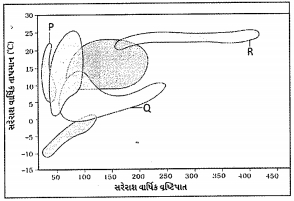
The biome distribution with respect to annual temperature and precipitation is given below. Identify the biomes $P, Q,$ and $R$.
$P \quad\quad Q \quad\quad R$
$P \quad\quad Q \quad\quad R$
A
Grassland $\quad$ Coniferous forest $\quad$ Temperate forest
B
Grassland $\quad$ Temperate forest $\quad$ Coniferous forest
C
Desert $\quad$ Coniferous forest $\quad$ Tropical forest
D
Arctic and Alpine tundra $\quad$ Desert $\quad$ Temperate forest
Solution
(A) Based on the standard biome distribution graph provided in the $NCERT$ textbook:
$1$. Biome $P$ corresponds to the Grassland,which is characterized by moderate temperature and low to moderate precipitation.
$2$. Biome $Q$ corresponds to the Coniferous forest,which is found in cooler regions with moderate precipitation.
$3$. Biome $R$ corresponds to the Temperate forest,which generally has higher precipitation levels compared to the others shown in this specific range.
Therefore,the correct sequence is Grassland,Coniferous forest,and Temperate forest.
$1$. Biome $P$ corresponds to the Grassland,which is characterized by moderate temperature and low to moderate precipitation.
$2$. Biome $Q$ corresponds to the Coniferous forest,which is found in cooler regions with moderate precipitation.
$3$. Biome $R$ corresponds to the Temperate forest,which generally has higher precipitation levels compared to the others shown in this specific range.
Therefore,the correct sequence is Grassland,Coniferous forest,and Temperate forest.
0 likes
View Solution227
MediumMCQ
Which of the following areas are used as habitats by organisms?
$I -$ Scorching deserts
$II -$ Rain-soaked rainforests
$III -$ Rushing streams
$IV -$ Deep ocean trenches
$V -$ Polar regions
$VI -$ High mountain tops
$VII -$ Thermal springs
$VIII -$ Stinking compost pits
$IX -$ Our intestine
$I -$ Scorching deserts
$II -$ Rain-soaked rainforests
$III -$ Rushing streams
$IV -$ Deep ocean trenches
$V -$ Polar regions
$VI -$ High mountain tops
$VII -$ Thermal springs
$VIII -$ Stinking compost pits
$IX -$ Our intestine
A
$IV, VI, VII, IX$
B
$I, II, III, V, VII$
C
$I, II, III, IV, V, VI, VII, VIII$
D
All of the above
Solution
(D) The biosphere is vast and diverse,encompassing an incredible range of environments where life exists.
Organisms are adapted to survive in extreme and varied conditions.
$I -$ Scorching deserts are inhabited by xerophytes and desert animals.
$II -$ Rain-soaked rainforests support high biodiversity.
$III -$ Rushing streams contain specialized aquatic life.
$IV -$ Deep ocean trenches are home to barophilic organisms.
$V -$ Polar regions support life adapted to freezing temperatures.
$VI -$ High mountain tops have specialized flora and fauna.
$VII -$ Thermal springs are inhabited by thermophilic bacteria.
$VIII -$ Stinking compost pits are rich in decomposers.
$IX -$ Our intestine serves as a habitat for gut microbiota.
Therefore,all the listed areas serve as habitats for various organisms.
Organisms are adapted to survive in extreme and varied conditions.
$I -$ Scorching deserts are inhabited by xerophytes and desert animals.
$II -$ Rain-soaked rainforests support high biodiversity.
$III -$ Rushing streams contain specialized aquatic life.
$IV -$ Deep ocean trenches are home to barophilic organisms.
$V -$ Polar regions support life adapted to freezing temperatures.
$VI -$ High mountain tops have specialized flora and fauna.
$VII -$ Thermal springs are inhabited by thermophilic bacteria.
$VIII -$ Stinking compost pits are rich in decomposers.
$IX -$ Our intestine serves as a habitat for gut microbiota.
Therefore,all the listed areas serve as habitats for various organisms.
0 likes
View Solution228
MediumMCQ
Mango trees do not grow in ........ .
A
Tropical countries like Canada and Germany
B
Temperate countries like Canada and Germany
C
Tropical regions of Africa
D
Tropical regions of South America
Solution
(B) Mango trees $(Mangifera \text{ } indica)$ are tropical plants that require a warm climate to grow and produce fruit.
Temperate countries like Canada and Germany experience very cold winters and have a climate that is not suitable for the growth of mango trees.
Therefore, mango trees cannot grow in temperate regions.
Temperate countries like Canada and Germany experience very cold winters and have a climate that is not suitable for the growth of mango trees.
Therefore, mango trees cannot grow in temperate regions.
0 likes
View Solution229
MediumMCQ
Where are tuna fish found in the ocean?
A
Polar latitudes
B
Temperate latitudes
C
Tropical latitudes
D
All of the above
Solution
(C) Tuna fish are highly migratory species that are primarily found in the tropical and subtropical waters of the world's oceans. They prefer warmer water temperatures,which are characteristic of tropical latitudes. Therefore,the correct answer is $C$.
0 likes
View Solution230
MediumMCQ
Organisms restricted to a narrow range of salinity are $- P$.
Organisms that tolerate a wide range of salinity are $- Q$.
Choose the correct option for $P$ and $Q$.
$P$ $Q$
Organisms that tolerate a wide range of salinity are $- Q$.
Choose the correct option for $P$ and $Q$.
$P$ $Q$
A
Euryhaline Stenohaline
B
Stenohaline Euryhaline
C
Eurythermal Stenothermal
D
Stenothermal Eurythermal
Solution
(B) $1$. Organisms that are restricted to a narrow range of salinity are called $Stenohaline$ organisms (e.g.,many freshwater fish).
$2$. Organisms that can tolerate a wide range of salinity are called $Euryhaline$ organisms (e.g.,salmon,molly).
$3$. Therefore,$P$ is $Stenohaline$ and $Q$ is $Euryhaline$.
$4$. The correct option is $B$.
$2$. Organisms that can tolerate a wide range of salinity are called $Euryhaline$ organisms (e.g.,salmon,molly).
$3$. Therefore,$P$ is $Stenohaline$ and $Q$ is $Euryhaline$.
$4$. The correct option is $B$.
0 likes
View Solution231
MediumMCQ
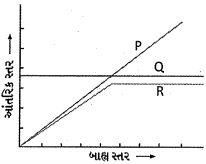
The following is a graphical representation of organismic response. Identify $P, Q$,and $R$.
$P \quad\quad Q \quad\quad R$
$P \quad\quad Q \quad\quad R$
A
Partial regulators $\quad$ Conformers $\quad$ Regulators
B
Regulators $\quad$ Conformers $\quad$ Partial regulators
C
Partial regulators $\quad$ Regulators $\quad$ Conformers
D
Conformers $\quad$ Regulators $\quad$ Partial regulators
Solution
(D) In the study of organismic responses to abiotic factors,organisms are classified based on their ability to maintain homeostasis:
$1$. $P$ represents Conformers: These organisms cannot maintain a constant internal environment. Their internal body temperature or osmotic concentration changes in direct proportion to the external environment.
$2$. $Q$ represents Regulators: These organisms are able to maintain homeostasis by physiological (sometimes behavioral) means which ensures constant body temperature,constant osmotic concentration,etc.,regardless of external environmental changes.
$3$. $R$ represents Partial regulators: These organisms are able to regulate but only up to a certain limit; beyond that limit,they conform to the external environment.
Therefore,the correct sequence is $P$ = Conformers,$Q$ = Regulators,$R$ = Partial regulators.
$1$. $P$ represents Conformers: These organisms cannot maintain a constant internal environment. Their internal body temperature or osmotic concentration changes in direct proportion to the external environment.
$2$. $Q$ represents Regulators: These organisms are able to maintain homeostasis by physiological (sometimes behavioral) means which ensures constant body temperature,constant osmotic concentration,etc.,regardless of external environmental changes.
$3$. $R$ represents Partial regulators: These organisms are able to regulate but only up to a certain limit; beyond that limit,they conform to the external environment.
Therefore,the correct sequence is $P$ = Conformers,$Q$ = Regulators,$R$ = Partial regulators.
0 likes
View Solution232
MediumMCQ
In lower organisms,the formation of thick-walled spores helps them to survive in unfavorable conditions. What is this process called?
A
Regulate
B
Conform
C
Migrate
D
Suspend
Solution
(D) Many lower organisms,such as bacteria,fungi,and various algae,develop thick-walled spores during unfavorable environmental conditions.
These spores allow the organisms to survive in a dormant state,resisting extreme temperatures,desiccation,and other stressors.
This strategy of temporarily pausing metabolic activities and growth to survive harsh conditions is known as 'Suspend'.
These spores allow the organisms to survive in a dormant state,resisting extreme temperatures,desiccation,and other stressors.
This strategy of temporarily pausing metabolic activities and growth to survive harsh conditions is known as 'Suspend'.
0 likes
View Solution233
MediumMCQ
When an organism moves away temporarily from a stressful habitat to a more hospitable area and returns when the stressful period is over,what is this process called?
A
Regulate
B
Conform
C
Migrate
D
Suspend
Solution
(C) The process where an organism moves away temporarily from a stressful habitat to a more hospitable area and returns when the stressful period is over is known as $Migration$. This is a common strategy used by many animals,especially birds,to escape harsh environmental conditions like extreme cold or lack of food.
0 likes
View Solution234
MediumMCQ
Small animals have a $......P.......$ surface area relative to their volume, so they lose body heat $.....Q.....$ when it is cold outside.
A
larger; faster
B
smaller; slower
C
larger; slower
D
smaller; faster
Solution
(A) Small animals have a larger surface area relative to their volume.
Since heat loss is a function of surface area, small animals tend to lose body heat much faster when it is cold outside compared to larger animals.
Therefore, the correct terms are $P = \text{larger}$ and $Q = \text{faster}$.
Since heat loss is a function of surface area, small animals tend to lose body heat much faster when it is cold outside compared to larger animals.
Therefore, the correct terms are $P = \text{larger}$ and $Q = \text{faster}$.
0 likes
View Solution235
MediumMCQ
The vast majority of animals and nearly all plants cannot maintain a constant internal environment. What is this called?
A
Regulate
B
Conform
C
Migrate
D
Suspend
Solution
(B) Organisms that cannot maintain a constant internal environment (homeostasis) despite changes in the external environment are known as conformers.
In these organisms,the internal body temperature or osmotic concentration changes in accordance with the ambient environmental conditions.
Since they do not regulate their internal state,they are termed as conformers.
In these organisms,the internal body temperature or osmotic concentration changes in accordance with the ambient environmental conditions.
Since they do not regulate their internal state,they are termed as conformers.
0 likes
View Solution236
MediumMCQ
Select the mismatched pair from the following.
A
Snails and fish - Aestivation
B
Zooplankton in lakes - Diapause
C
Bears - Aestivation
D
Bacteria,fungi,and lower plants - Thick-walled spores
Solution
(C) Organisms adopt various strategies to survive unfavorable conditions.
$A$. Snails and fish undergo aestivation to avoid heat-related problems,which is a correct pair.
$B$. Many zooplankton species in lakes and ponds enter a stage of suspended development known as diapause,which is a correct pair.
$C$. Bears undergo hibernation (winter sleep) to escape cold,not aestivation (summer sleep). Therefore,this is the mismatched pair.
$D$. Bacteria,fungi,and various lower plants produce thick-walled spores to survive unfavorable conditions,which is a correct pair.
$A$. Snails and fish undergo aestivation to avoid heat-related problems,which is a correct pair.
$B$. Many zooplankton species in lakes and ponds enter a stage of suspended development known as diapause,which is a correct pair.
$C$. Bears undergo hibernation (winter sleep) to escape cold,not aestivation (summer sleep). Therefore,this is the mismatched pair.
$D$. Bacteria,fungi,and various lower plants produce thick-walled spores to survive unfavorable conditions,which is a correct pair.
0 likes
View Solution237
MediumMCQ
$A$ person moves from Delhi to Shimla during the hot summer days. This is an example of which of the following?
A
Regulate
B
Conform
C
Migrate
D
Suspend
Solution
(C) Organisms respond to stressful environmental conditions in various ways.
Migration is a strategy where the organism moves away temporarily from the stressful habitat to a more hospitable area and returns when the stressful period is over.
In this case,the person is moving from a hot environment (Delhi) to a cooler environment (Shimla) to avoid the heat,which is a classic example of migration.
Migration is a strategy where the organism moves away temporarily from the stressful habitat to a more hospitable area and returns when the stressful period is over.
In this case,the person is moving from a hot environment (Delhi) to a cooler environment (Shimla) to avoid the heat,which is a classic example of migration.
0 likes
View Solution238
MediumMCQ
Select the correct option regarding adaptation.
A
Adaptations have evolved over a long evolutionary time.
B
They are genetically fixed.
C
They enable the organism to survive and reproduce in its habitat.
D
All of the above.
Solution
(D) Adaptation is an attribute of the organism (morphological,physiological,or behavioural) that enables the organism to survive and reproduce in its habitat.
Adaptations are the result of long-term evolutionary processes.
These traits are genetically fixed,meaning they are heritable and passed down through generations.
Therefore,all the given statements are correct.
Adaptations are the result of long-term evolutionary processes.
These traits are genetically fixed,meaning they are heritable and passed down through generations.
Therefore,all the given statements are correct.
0 likes
View Solution239
MediumMCQ
How does the kangaroo rat in North American deserts meet all its water requirements?
A
By excreting concentrated urine
B
By storing water in the intestine
C
Through internal fat oxidation
D
By storing water in the stomach
Solution
(C) The kangaroo rat $(Dipodomys)$ is a desert-dwelling rodent that survives without drinking liquid water.
It meets its water requirements through the following mechanisms:
$1$. It produces very concentrated urine to minimize water loss.
$2$. It obtains metabolic water as a byproduct of the oxidation of internal fat.
$3$. It has the ability to concentrate its urine to a very high degree.
Therefore,the primary source of its water is the metabolic water produced during the oxidation of internal fat.
It meets its water requirements through the following mechanisms:
$1$. It produces very concentrated urine to minimize water loss.
$2$. It obtains metabolic water as a byproduct of the oxidation of internal fat.
$3$. It has the ability to concentrate its urine to a very high degree.
Therefore,the primary source of its water is the metabolic water produced during the oxidation of internal fat.
0 likes
View Solution240
MediumMCQ
Mammals from colder climates generally have shorter ears and limbs to minimize heat loss. This is known as:
A
Von Humboldt's Rule
B
Paul Ehrlich's Rule
C
Allen's Rule
D
Darwin's Rule
Solution
(C) Allen's Rule states that animals adapted to cold climates have shorter limbs and body appendages (like ears, tails, and noses) compared to animals living in warmer climates.
This morphological adaptation helps in minimizing the surface area to volume ratio, thereby reducing heat loss from the body to the environment.
Therefore, the correct answer is $Allen's \text{ Rule}$.
This morphological adaptation helps in minimizing the surface area to volume ratio, thereby reducing heat loss from the body to the environment.
Therefore, the correct answer is $Allen's \text{ Rule}$.
0 likes
View Solution241
MediumMCQ
In which of the following is a thick layer of fat (blubber) found under the skin?
A
Kangaroo rat
B
Seals in polar seas
C
Humans
D
Desert lizards
Solution
(B) Organisms living in extremely cold environments,such as polar regions,require adaptations to maintain their body temperature.
Blubber is a thick layer of adipose tissue (fat) found under the skin of marine mammals like seals,whales,and walruses.
This layer acts as an insulator,preventing heat loss from the body to the cold surrounding water,thereby helping the animal maintain its internal body temperature (homeostasis).
Therefore,seals in polar seas possess this adaptation.
Blubber is a thick layer of adipose tissue (fat) found under the skin of marine mammals like seals,whales,and walruses.
This layer acts as an insulator,preventing heat loss from the body to the cold surrounding water,thereby helping the animal maintain its internal body temperature (homeostasis).
Therefore,seals in polar seas possess this adaptation.
0 likes
View Solution242
MediumMCQ
Life history traits of organisms have evolved in relation to the constraints imposed by which of the following?
A
Habitat
B
Biotic components
C
Abiotic components
D
All of the above
Solution
(D) Life history traits are the characteristics of an organism that influence its survival and reproduction. These traits,such as the timing of reproduction,number of offspring,and lifespan,have evolved in response to the environmental conditions in which the organism lives.
Organisms evolve these traits to maximize their fitness in their specific habitat.
Both biotic factors (such as competition,predation,and parasitism) and abiotic factors (such as temperature,water,light,and soil) impose constraints on the survival and reproductive success of organisms.
Therefore,life history traits are shaped by the combined influence of the habitat,biotic components,and abiotic components.
Organisms evolve these traits to maximize their fitness in their specific habitat.
Both biotic factors (such as competition,predation,and parasitism) and abiotic factors (such as temperature,water,light,and soil) impose constraints on the survival and reproductive success of organisms.
Therefore,life history traits are shaped by the combined influence of the habitat,biotic components,and abiotic components.
0 likes
View Solution243
EasyMCQ
$A$ physical place or set of environmental conditions around the organism to which it must adapt to survive and prosper is . . . . . . .
A
Niche
B
Habitat
C
Ecosystem
D
Biome
Solution
(B) $Habitat$ is defined as the physical place or the set of environmental conditions surrounding an organism to which it must adapt to survive,grow,and reproduce.
While a $Niche$ refers to the functional role and position of an organism within its environment,the $Habitat$ specifically refers to the physical location or address where the organism lives.
While a $Niche$ refers to the functional role and position of an organism within its environment,the $Habitat$ specifically refers to the physical location or address where the organism lives.
0 likes
View Solution244
EasyMCQ
When organisms change their location to escape unfavourable harsh environment,it is called . . . . . . .
A
hibernation
B
aestivation
C
vernalization
D
migration
Solution
(D) Migration is the phenomenon where organisms move away temporarily from a stressful habitat to a more hospitable area and return when the stressful period is over.
$1$. Hibernation is a state of inactivity and metabolic depression in endotherms during winter.
$2$. Aestivation is a state of animal dormancy in response to high temperatures and arid conditions.
$3$. Vernalization is the induction of a plant's flowering process by exposure to the prolonged cold of winter.
Therefore,the correct term for changing location to escape harsh environments is migration.
$1$. Hibernation is a state of inactivity and metabolic depression in endotherms during winter.
$2$. Aestivation is a state of animal dormancy in response to high temperatures and arid conditions.
$3$. Vernalization is the induction of a plant's flowering process by exposure to the prolonged cold of winter.
Therefore,the correct term for changing location to escape harsh environments is migration.
0 likes
View Solution245
EasyMCQ
Which of the following organisms can ensure constant body temperature and osmotic concentration by physiological and behavioural changes?
A
Arthropods and molluscs
B
Cartilaginous and bony fishes
C
Amphibians and reptiles
D
Birds and mammals
Solution
(D) The ability to maintain a constant internal environment despite varying external environmental conditions is known as homeostasis. All birds and mammals are regulators,meaning they can maintain homeostasis through physiological and behavioural changes,which ensure a constant body temperature,constant osmotic concentration,and other internal parameters.
0 likes
View Solution246
EasyMCQ
Match the following types of adaptations in Column-$I$ and Column-$II$.
| Column-$I$ | Column-$II$ |
| $i$. Morphological | $a$. Crassulacean Acid Metabolism |
| $ii$. Physiological | $b$. Migration of birds |
| $iii$. Behavioural | $c$. Leaves reduced to spines in Opuntia |
A
$i-c, ii-a, iii-b$
B
$i-a, ii-b, iii-c$
C
$i-c, ii-b, iii-a$
D
$i-b, ii-c, iii-a$
Solution
(A) $1$. Morphological adaptation: $Opuntia$ (a desert plant) shows morphological changes where leaves are reduced to spines to minimize water loss through transpiration.
$2$. Physiological adaptation: Desert plants exhibit a special photosynthetic pathway called Crassulacean Acid Metabolism $(CAM)$,which allows their stomata to remain closed during the daytime to minimize water loss.
$3$. Behavioural adaptation: Many organisms,such as birds,migrate to more favorable environments to escape stressful conditions,which is a behavioural response.
Therefore,the correct matching is $i-c, ii-a, iii-b$.
$2$. Physiological adaptation: Desert plants exhibit a special photosynthetic pathway called Crassulacean Acid Metabolism $(CAM)$,which allows their stomata to remain closed during the daytime to minimize water loss.
$3$. Behavioural adaptation: Many organisms,such as birds,migrate to more favorable environments to escape stressful conditions,which is a behavioural response.
Therefore,the correct matching is $i-c, ii-a, iii-b$.
0 likes
View Solution247
EasyMCQ
The moving away of an organism temporarily from the stressful habitat to a more hospitable area and return when stressful period is over is called . . . . . . .
A
dormancy
B
migration
C
hibernation
D
aestivation
Solution
(B) Migration is a behavioral adaptation where organisms move away temporarily from a stressful habitat to a more hospitable area and return when the stressful period is over.
For example,many birds undertake long-distance migrations during winter to avoid harsh climatic conditions.
Dormancy refers to a period of suspended development.
Hibernation is a strategy to escape time in winter (e.g.,bears).
Aestivation is a strategy to escape time in summer (e.g.,snails and fish).
For example,many birds undertake long-distance migrations during winter to avoid harsh climatic conditions.
Dormancy refers to a period of suspended development.
Hibernation is a strategy to escape time in winter (e.g.,bears).
Aestivation is a strategy to escape time in summer (e.g.,snails and fish).
0 likes
View Solution248
EasyMCQ
In colloquial language,habitat is a postal address while niche is the . . . . . . of the organism.
A
pin code
B
zip code
C
email address
D
profession
Solution
(D) habitat defines the physical space of an organism along with other living or non-living factors.
In contrast,a niche describes how that organism is linked with its physical and biological environment,including its functional role in the ecosystem.
Therefore,in colloquial language,a habitat is considered a postal address,while a niche is considered the profession of the organism.
In contrast,a niche describes how that organism is linked with its physical and biological environment,including its functional role in the ecosystem.
Therefore,in colloquial language,a habitat is considered a postal address,while a niche is considered the profession of the organism.
0 likes
View Solution249
EasyMCQ
Match the following in Column $I$ with the means adopted to tide over periods of unfavorable conditions in Column $II$.
| $i$. Birds | $c$. Migration |
| $ii$. Seeds | $a$. Dormancy |
| $iii$. Snails | $d$. Aestivation |
| $iv$. Polar bear | $b$. Hibernation |
A
$i-c, ii-a, iii-d, iv-b$
B
$i-a, ii-b, iii-c, iv-d$
C
$i-b, ii-c, iii-a, iv-d$
D
$i-c, ii-b, iii-a, iv-d$
Solution
(A) The correct matches are as follows:
$i$. Birds: Many birds migrate from cold regions to warmer regions to escape unfavorable conditions. Thus,$i-c$.
$ii$. Seeds: Seeds enter a state of dormancy to survive unfavorable environmental conditions. Thus,$ii-a$.
$iii$. Snails: Snails undergo aestivation (summer sleep) to avoid heat and desiccation. Thus,$iii-d$.
$iv$. Polar bear: Polar bears undergo hibernation (winter sleep) to escape the extreme cold of winter. Thus,$iv-b$.
Therefore,the correct sequence is $i-c, ii-a, iii-d, iv-b$.
$i$. Birds: Many birds migrate from cold regions to warmer regions to escape unfavorable conditions. Thus,$i-c$.
$ii$. Seeds: Seeds enter a state of dormancy to survive unfavorable environmental conditions. Thus,$ii-a$.
$iii$. Snails: Snails undergo aestivation (summer sleep) to avoid heat and desiccation. Thus,$iii-d$.
$iv$. Polar bear: Polar bears undergo hibernation (winter sleep) to escape the extreme cold of winter. Thus,$iv-b$.
Therefore,the correct sequence is $i-c, ii-a, iii-d, iv-b$.
0 likes
View Solution250
EasyMCQ
Given below are two statements:
Statement $I$: Stenohaline animals tolerate a wide range of salt concentration.
Statement $II$: Euryhaline animals are capable of handling a narrow range of salt concentration.
In the light of the above statements,choose the most appropriate answer from the options given below:
Statement $I$: Stenohaline animals tolerate a wide range of salt concentration.
Statement $II$: Euryhaline animals are capable of handling a narrow range of salt concentration.
In the light of the above statements,choose the most appropriate answer from the options given below:
A
Both statement $I$ and statement $II$ are correct.
B
Both statement $I$ and statement $II$ are incorrect.
C
Statement $I$ is correct but statement $II$ is incorrect.
D
Statement $I$ is incorrect but statement $II$ is correct.
Solution
(B) Stenohaline organisms are those that can tolerate only a narrow range of salt concentrations.
Euryhaline organisms are those that can tolerate a wide range of salt concentrations.
Therefore,Statement $I$ is incorrect because stenohaline animals do not tolerate a wide range.
Statement $II$ is incorrect because euryhaline animals do not handle only a narrow range; they handle a wide range.
Thus,both statements are incorrect.
Euryhaline organisms are those that can tolerate a wide range of salt concentrations.
Therefore,Statement $I$ is incorrect because stenohaline animals do not tolerate a wide range.
Statement $II$ is incorrect because euryhaline animals do not handle only a narrow range; they handle a wide range.
Thus,both statements are incorrect.
0 likes
View SolutionOrganisms and Populations — Organism and its Environment · Frequently Asked Questions
1Are these Organisms and Populations questions useful for JEE and NEET?
Yes. All questions in this section are mapped to JEE Main and NEET exam patterns. Previous year questions from JEE Main, NEET, GUJCET and state-level exams are included with full solutions.
2Can I switch to Hindi or Gujarati for these questions?
Yes. Use the language tabs in the hero section or the sidebar to view the same questions and solutions in English, Hindi or Gujarati.
3How do I generate a question paper from this subtopic?
Use the Vedclass Exam Paper Generator — select the chapter and subtopic, set difficulty, and generate Sets A, B, C, D automatically. First 3 chapters of every subject are free.
Vedclass Products
For Students
Vedclass Test Series
Mock tests in real JEE/NEET style with performance analysis. 5-day free trial.
Start Free TrialFor Teachers
Exam Paper Generator
Generate Set A/B/C/D papers from this chapter in 2 minutes. 3 chapters free.
Try FreeFor Institutes
Online Exam Module
Live online exams with unlimited students, 360° analytics & white-label branding.
See DemoFor Teachers & Institutes
Generate a Organisms and Populations Exam Paper in 2 Minutes
Select subtopic & difficulty — Sets A, B, C, D auto-generated with No Repeat logic.
First 3 chapters of every subject are free — no payment required.