
A English
Organism and its Environment Questions in English
Class 12 Biology · Organisms and Populations · Organism and its Environment
264+
Questions
English
Language
100%
With Solutions
Showing 14 of 264 questions in English
251
EasyMCQ
Given below are two statements.
Statement $I$: Habitat consists of numerous niches.
Statement $II$: Niche is an area where a species lives and prospers.
In the light of the above statements,choose the correct option.
Statement $I$: Habitat consists of numerous niches.
Statement $II$: Niche is an area where a species lives and prospers.
In the light of the above statements,choose the correct option.
A
Both statement $I$ and statement $II$ are correct.
B
Both statement $I$ and statement $II$ are incorrect.
C
Statement $I$ is correct but statement $II$ is incorrect.
D
Statement $I$ is incorrect but statement $II$ is correct.
Solution
(C) Statement $I$ is correct because a habitat is a physical place where an organism lives,and it can contain many different niches.
Statement $II$ is incorrect because a niche refers to the functional role and position of an organism in its environment,including its interactions with biotic and abiotic factors,not just the physical area where it lives. The definition provided in Statement $II$ actually describes a 'habitat'.
Statement $II$ is incorrect because a niche refers to the functional role and position of an organism in its environment,including its interactions with biotic and abiotic factors,not just the physical area where it lives. The definition provided in Statement $II$ actually describes a 'habitat'.
0 likes
View Solution252
EasyMCQ
Some animals can change their body temperature according to the ambient temperature,then they are simply . . . . . . .
A
immigrants
B
emigrants
C
conformers
D
suspensors
Solution
(C) Organisms that cannot maintain a constant internal body temperature and whose body temperature changes with the ambient temperature are known as $conformers$.
Approximately $99\%$ of animals and nearly all plants are conformers.
They are unable to maintain homeostasis through physiological means,so their internal environment fluctuates with the external environmental conditions.
Approximately $99\%$ of animals and nearly all plants are conformers.
They are unable to maintain homeostasis through physiological means,so their internal environment fluctuates with the external environmental conditions.
0 likes
View Solution253
EasyMCQ
Which one of the following is $NOT$ a characteristic of a habitat?
A
It is a physical space.
B
It is species specific.
C
It is affected by temperature,rainfall etc.
D
It consists of numerous niches.
Solution
(B) habitat is defined as the physical place or environment where an organism lives.
$1$. It is a physical space where an organism resides.
$2$. It is affected by abiotic factors like temperature,rainfall,and light.
$3$. $A$ single habitat can support numerous niches,as different species occupy different functional roles within the same physical space.
$4$. However,a habitat is $NOT$ species-specific; many different species can share the same habitat. In contrast,a 'niche' is species-specific,as it describes the functional role and requirements of a particular species.
$1$. It is a physical space where an organism resides.
$2$. It is affected by abiotic factors like temperature,rainfall,and light.
$3$. $A$ single habitat can support numerous niches,as different species occupy different functional roles within the same physical space.
$4$. However,a habitat is $NOT$ species-specific; many different species can share the same habitat. In contrast,a 'niche' is species-specific,as it describes the functional role and requirements of a particular species.
0 likes
View Solution254
EasyMCQ
Match the types of niche in Column-$I$ with their description in Column-$II$.
| $i$. Habitat niche | $a$. In the absence of competition in the habitat |
| $ii$. Trophic niche | $b$. Position of organism in the environmental gradient |
| $iii$. Multidimensional niche | $c$. Physical space occupied by an organism |
| $iv$. Fundamental niche | $d$. Level of organism in the food chain |
A
$i-a, ii-d, iii-c, iv-b$
B
$i-c, ii-d, iii-b, iv-a$
C
$i-a, ii-b, iii-c, iv-d$
D
$i-b, ii-c, iii-a, iv-d$
Solution
(B) The correct matches are as follows:
$i$. Habitat niche: It refers to the physical space occupied by an organism in its environment $(i-c)$.
$ii$. Trophic niche: It refers to the functional role or the level of an organism in the food chain $(ii-d)$.
$iii$. Multidimensional niche: It refers to the position of an organism in the environmental gradient,considering multiple factors $(iii-b)$.
$iv$. Fundamental niche: It is the entire set of conditions under which an animal (population,species) can survive and reproduce itself in the absence of competition $(iv-a)$.
Therefore,the correct matching is $i-c, ii-d, iii-b, iv-a$.
$i$. Habitat niche: It refers to the physical space occupied by an organism in its environment $(i-c)$.
$ii$. Trophic niche: It refers to the functional role or the level of an organism in the food chain $(ii-d)$.
$iii$. Multidimensional niche: It refers to the position of an organism in the environmental gradient,considering multiple factors $(iii-b)$.
$iv$. Fundamental niche: It is the entire set of conditions under which an animal (population,species) can survive and reproduce itself in the absence of competition $(iv-a)$.
Therefore,the correct matching is $i-c, ii-d, iii-b, iv-a$.
0 likes
View Solution255
EasyMCQ
How many of the following statements are correct about niche?
$i$. It denotes the functional role played by an organism.
$ii$. It deals with the flow of energy from one organism to another.
$iii$. As soon as a niche is left vacant,other organisms fill that position.
$iv$. The same niche is shared by two or more species.
$v$. Organisms living in the same habitat differ in their niches.
$i$. It denotes the functional role played by an organism.
$ii$. It deals with the flow of energy from one organism to another.
$iii$. As soon as a niche is left vacant,other organisms fill that position.
$iv$. The same niche is shared by two or more species.
$v$. Organisms living in the same habitat differ in their niches.
A
$i, ii, iii$ and $iv$ only
B
$i, ii, iii$ and $v$ only
C
$i, ii, iii$ only
D
$iii, iv, v$ only
Solution
(B) Statement $i$ is correct: $A$ niche describes the functional role and position of an organism in its environment.
Statement $ii$ is correct: Niche includes the energy flow and nutrient cycling associated with the organism.
Statement $iii$ is correct: If a niche becomes vacant,other organisms often adapt to fill that ecological role.
Statement $iv$ is incorrect: According to Gause's Competitive Exclusion Principle,no two species can occupy the same niche indefinitely in the same habitat.
Statement $v$ is correct: Organisms in the same habitat often have different niches to avoid direct competition.
Therefore,statements $i, ii, iii,$ and $v$ are correct.
Statement $ii$ is correct: Niche includes the energy flow and nutrient cycling associated with the organism.
Statement $iii$ is correct: If a niche becomes vacant,other organisms often adapt to fill that ecological role.
Statement $iv$ is incorrect: According to Gause's Competitive Exclusion Principle,no two species can occupy the same niche indefinitely in the same habitat.
Statement $v$ is correct: Organisms in the same habitat often have different niches to avoid direct competition.
Therefore,statements $i, ii, iii,$ and $v$ are correct.
0 likes
View Solution256
EasyMCQ
Match the following adaptations in Column $I$ with the respective organisms in Column $II$.
| Column $I$ | Column $II$ |
| $i$. Thick cuticle on leaf surface | $a$. Desert lizards |
| $ii$. Leaves reduced to spines | $b$. Archaebacteria |
| $iii$. Burrow into sand to escape from heat | $c$. Desert plants |
| $iv$. Hot springs | $d$. Opuntia |
A
$i-d, ii-c, iii-b, iv-a$
B
$i-c, ii-d, iii-b, iv-a$
C
$i-a, ii-b, iii-c, iv-d$
D
$i-c, ii-d, iii-a, iv-b$
Solution
(D) The correct matches are as follows:
$i$. Thick cuticle on leaf surface is an adaptation found in many desert plants to reduce transpiration.
$ii$. Leaves reduced to spines is a characteristic adaptation of $Opuntia$ (a desert plant) to minimize water loss.
$iii$. Desert lizards show behavioral adaptations like burrowing into sand to escape the intense heat of the desert.
$iv$. Archaebacteria are extremophiles that can survive in harsh conditions,such as hot springs.
Matching these:
$i-c$ (Thick cuticle - Desert plants)
$ii-d$ (Leaves reduced to spines - Opuntia)
$iii-a$ (Burrow into sand - Desert lizards)
$iv-b$ (Hot springs - Archaebacteria)
Therefore,the correct sequence is $i-c, ii-d, iii-a, iv-b$.
$i$. Thick cuticle on leaf surface is an adaptation found in many desert plants to reduce transpiration.
$ii$. Leaves reduced to spines is a characteristic adaptation of $Opuntia$ (a desert plant) to minimize water loss.
$iii$. Desert lizards show behavioral adaptations like burrowing into sand to escape the intense heat of the desert.
$iv$. Archaebacteria are extremophiles that can survive in harsh conditions,such as hot springs.
Matching these:
$i-c$ (Thick cuticle - Desert plants)
$ii-d$ (Leaves reduced to spines - Opuntia)
$iii-a$ (Burrow into sand - Desert lizards)
$iv-b$ (Hot springs - Archaebacteria)
Therefore,the correct sequence is $i-c, ii-d, iii-a, iv-b$.
0 likes
View Solution257
EasyMCQ
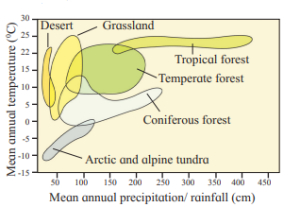
Based on the graph given below,identify the $INCORRECT$ statement.
A
The mean annual rainfall is maximum in tropical forest.
B
In arctic and alpine tundra,the mean annual temperature is usually below zero.
C
In tropical forest,the annual rainfall is more than the temperate forest but its mean annual temperature is less than temperate forest.
D
In deserts,the annual rainfall is less than grass land.
Solution
(C) By analyzing the provided graph of biome distribution:
$1$. Option $A$: The tropical forest region extends up to $450 \ cm$ of rainfall,which is the highest among all biomes shown. This statement is correct.
$2$. Option $B$: The arctic and alpine tundra region lies below the $0^{\circ}C$ mark on the y-axis. This statement is correct.
$3$. Option $C$: The tropical forest has higher rainfall than the temperate forest,but its mean annual temperature (ranging from $20^{\circ}C$ to $25^{\circ}C$) is higher than that of the temperate forest (ranging from $5^{\circ}C$ to $20^{\circ}C$). Therefore,the claim that its temperature is less than the temperate forest is incorrect.
$4$. Option $D$: The desert region is located at lower precipitation levels (mostly below $50 \ cm$) compared to the grassland region. This statement is correct.
Thus,the incorrect statement is $C$.
$1$. Option $A$: The tropical forest region extends up to $450 \ cm$ of rainfall,which is the highest among all biomes shown. This statement is correct.
$2$. Option $B$: The arctic and alpine tundra region lies below the $0^{\circ}C$ mark on the y-axis. This statement is correct.
$3$. Option $C$: The tropical forest has higher rainfall than the temperate forest,but its mean annual temperature (ranging from $20^{\circ}C$ to $25^{\circ}C$) is higher than that of the temperate forest (ranging from $5^{\circ}C$ to $20^{\circ}C$). Therefore,the claim that its temperature is less than the temperate forest is incorrect.
$4$. Option $D$: The desert region is located at lower precipitation levels (mostly below $50 \ cm$) compared to the grassland region. This statement is correct.
Thus,the incorrect statement is $C$.
0 likes
View Solution258
EasyMCQ
During stressful conditions,the animals which are simply 'Conformers' . . . . . . .
A
Go into a state of aestivation.
B
Change their body temperature according to the surrounding temperature.
C
Ensure constant body temperature.
D
Go into a state of hibernation.
Solution
(B) Conformers are organisms that cannot maintain a constant internal environment. Their body temperature or osmotic concentration changes in accordance with the ambient conditions of the surrounding environment. Unlike regulators,they do not possess the physiological mechanisms to maintain homeostasis during stressful conditions.
0 likes
View Solution259
EasyMCQ
If organisms are facing localized stressful conditions in their habitat for a period like winter,then they will . . . . . . to hospitable region.
A
Conform
B
Regulate
C
Migrate
D
Immigrate
Solution
(C) When organisms face temporary stressful environmental conditions,such as extreme cold during winter,they move away from their habitat to a more hospitable area to survive. This phenomenon is known as migration. After the stressful period ends,they return to their original habitat.
0 likes
View Solution260
EasyMCQ
Despite variations in external environment,organisms try to maintain constancy of its internal environment which is called . . . . . . .
A
Dormancy
B
Allen's rule
C
Homeostasis
D
Environmental gradient
Solution
(C) The process by which organisms maintain a relatively constant internal environment despite changes in the external environment is known as $Homeostasis$.
This mechanism allows organisms to function optimally by regulating factors such as body temperature,osmotic concentration,and pH levels.
$Dormancy$ refers to a period of suspended development or metabolic activity.
$Allen's rule$ relates to the body shape of mammals in colder climates.
$Environmental gradient$ refers to the gradual change in abiotic factors over a distance.
This mechanism allows organisms to function optimally by regulating factors such as body temperature,osmotic concentration,and pH levels.
$Dormancy$ refers to a period of suspended development or metabolic activity.
$Allen's rule$ relates to the body shape of mammals in colder climates.
$Environmental gradient$ refers to the gradual change in abiotic factors over a distance.
0 likes
View Solution261
EasyMCQ
In the ecological hierarchy,the basic unit is . . . . . . .
A
biome
B
community
C
individual organism
D
population
Solution
(C) The ecological hierarchy represents the levels of biological organization in an ecosystem.
$1$. The hierarchy starts with the individual organism,which is the basic unit of ecology.
$2$. $A$ group of individuals of the same species living in a specific area forms a population.
$3$. Different populations interacting in an area form a community.
$4$. Communities along with their abiotic environment form an ecosystem.
$5$. Large regional units characterized by specific climate and vegetation are known as biomes.
Therefore,the individual organism is the fundamental unit of the ecological hierarchy.
$1$. The hierarchy starts with the individual organism,which is the basic unit of ecology.
$2$. $A$ group of individuals of the same species living in a specific area forms a population.
$3$. Different populations interacting in an area form a community.
$4$. Communities along with their abiotic environment form an ecosystem.
$5$. Large regional units characterized by specific climate and vegetation are known as biomes.
Therefore,the individual organism is the fundamental unit of the ecological hierarchy.
0 likes
View Solution262
EasyMCQ
Which of these is/are considered the major biomes of the world?
A
Tundra and desert
B
Tropical rain forest and temperate forest
C
Coniferous forest and Grassland
D
All of the above
Solution
(D) The major biomes of the world are characterized by distinct climate patterns,vegetation,and animal life.
These include:
$1$. Tundra
$2$. Desert
$3$. Tropical rain forest
$4$. Temperate forest
$5$. Coniferous forest
$6$. Grassland
Since all the options listed (Tundra,desert,tropical rain forest,temperate forest,coniferous forest,and grassland) are recognized as major biomes,the correct answer is $D$.
These include:
$1$. Tundra
$2$. Desert
$3$. Tropical rain forest
$4$. Temperate forest
$5$. Coniferous forest
$6$. Grassland
Since all the options listed (Tundra,desert,tropical rain forest,temperate forest,coniferous forest,and grassland) are recognized as major biomes,the correct answer is $D$.
0 likes
View Solution263
EasyMCQ
The physical space occupied by the organism is called its . . . . . . niche.
A
Multidimensional
B
Trophic
C
Hypervolume
D
Spatial
Solution
(D) niche describes the functional role and position of an organism in its environment.
Specifically,the physical space or the habitat occupied by an organism is referred to as its $Spatial$ niche.
Other types of niches include the $Trophic$ niche (based on feeding habits) and the $Multidimensional$ or $Hypervolume$ niche (which considers all environmental factors and resources).
Specifically,the physical space or the habitat occupied by an organism is referred to as its $Spatial$ niche.
Other types of niches include the $Trophic$ niche (based on feeding habits) and the $Multidimensional$ or $Hypervolume$ niche (which considers all environmental factors and resources).
0 likes
View Solution264
EasyMCQ
Just as a person moves from Delhi to Shimla to escape the summer heat,where do thousands of migratory birds migrate from the extremely cold regions of Siberia and the North Pole?
A
Western Ghats
B
Meghalaya
C
Corbett National Park
D
Keoladeo National Park
Solution
(D) Thousands of migratory birds from the extremely cold regions of Siberia and the North Pole migrate to $Keoladeo$ $National$ $Park$ (formerly known as $Bharatpur$ $Bird$ $Sanctuary$) in $Rajasthan$,$India$,to escape the harsh winter conditions. This park provides a suitable habitat and food resources for these birds during the winter season.
0 likes
View SolutionOrganisms and Populations — Organism and its Environment · Frequently Asked Questions
1Are these Organisms and Populations questions useful for JEE and NEET?
Yes. All questions in this section are mapped to JEE Main and NEET exam patterns. Previous year questions from JEE Main, NEET, GUJCET and state-level exams are included with full solutions.
2Can I switch to Hindi or Gujarati for these questions?
Yes. Use the language tabs in the hero section or the sidebar to view the same questions and solutions in English, Hindi or Gujarati.
3How do I generate a question paper from this subtopic?
Use the Vedclass Exam Paper Generator — select the chapter and subtopic, set difficulty, and generate Sets A, B, C, D automatically. First 3 chapters of every subject are free.
Vedclass Products
For Students
Vedclass Test Series
Mock tests in real JEE/NEET style with performance analysis. 5-day free trial.
Start Free TrialFor Teachers
Exam Paper Generator
Generate Set A/B/C/D papers from this chapter in 2 minutes. 3 chapters free.
Try FreeFor Institutes
Online Exam Module
Live online exams with unlimited students, 360° analytics & white-label branding.
See DemoFor Teachers & Institutes
Generate a Organisms and Populations Exam Paper in 2 Minutes
Select subtopic & difficulty — Sets A, B, C, D auto-generated with No Repeat logic.
First 3 chapters of every subject are free — no payment required.