
A English
Mix Examples - Microbes in Human Welfare Questions in English
Class 12 Biology · Microbes in Human Welfare · Mix Examples - Microbes in Human Welfare
86+
Questions
English
Language
100%
With Solutions
Showing 36 of 86 questions in English
51
MediumMCQ
Choose the correct combination:
| Column-$I$ | Column-$II$ |
|---|---|
| $A$. Escherichia coli | $I$. Nif gene |
| $B$. Rhizobium melilotae | $II$. Digestive hydrocarbon of crude oil |
| $C$. Bacillus thuringiensis | $III$. Production of human insulin |
| $D$. Pseudomonas putida | $IV$. Biological control of fungal disease |
| $V$. Biodecomposed insecticide |
A
$A-III, B-I, C-V, D-IV$
B
$A-I, B-II, C-III, D-IV$
C
$A-II, B-I, C-III, D-IV$
D
$A-III, B-I, C-V, D-II$
Solution
(D) The correct matches are as follows:
$1$. $A$. Escherichia coli is widely used in biotechnology for the production of human insulin $(III)$.
$2$. $B$. Rhizobium melilotae is a nitrogen-fixing bacterium associated with the $Nif$ gene $(I)$.
$3$. $C$. Bacillus thuringiensis produces toxins used as a biological insecticide $(V)$.
$4$. $D$. Pseudomonas putida is known for its ability to degrade hydrocarbons in crude oil $(II)$.
Therefore,the correct combination is $A-III, B-I, C-V, D-II$.
$1$. $A$. Escherichia coli is widely used in biotechnology for the production of human insulin $(III)$.
$2$. $B$. Rhizobium melilotae is a nitrogen-fixing bacterium associated with the $Nif$ gene $(I)$.
$3$. $C$. Bacillus thuringiensis produces toxins used as a biological insecticide $(V)$.
$4$. $D$. Pseudomonas putida is known for its ability to degrade hydrocarbons in crude oil $(II)$.
Therefore,the correct combination is $A-III, B-I, C-V, D-II$.
0 likes
View Solution52
Easy
Microbes can be used to decrease the use of chemical fertilisers and pesticides. Explain how this can be accomplished.
Solution
(N/A) Microbes play an important role in organic farming,which is done without the use of chemical fertilizers and pesticides.
Bio-fertilizers are living organisms that help increase the fertility of soil. It involves the selection of beneficial microorganisms that improve plant growth by supplying plant nutrients.
Bio-fertilizers are applied to seeds,roots,or soil to mobilize the availability of nutrients,thereby enriching the soil with organic nutrients.
Many species of bacteria and cyanobacteria have the ability to fix free atmospheric nitrogen. $Rhizobium$ is a symbiotic bacterium found in the root nodules of leguminous plants. $Azospirillum$ and $Azotobacter$ are free-living nitrogen-fixing bacteria,whereas $Anabaena$,$Nostoc$,and $Oscillatoria$ are examples of nitrogen-fixing cyanobacteria.
Microbes can also act as bio-pesticides to control insect pests. An example is $Bacillus$ $thuringiensis$ $(Bt)$,which produces a toxin that kills insect pests. Dried bacterial spores are mixed in water and sprayed on crops. When larvae feed on these crops,the spores enter the gut,release toxins,and kill the larvae.
$Trichoderma$ are free-living fungi that live in the roots of higher plants and protect them from pathogens. Baculoviruses are also used as biological control agents against insects and other arthropods.
Bio-fertilizers are living organisms that help increase the fertility of soil. It involves the selection of beneficial microorganisms that improve plant growth by supplying plant nutrients.
Bio-fertilizers are applied to seeds,roots,or soil to mobilize the availability of nutrients,thereby enriching the soil with organic nutrients.
Many species of bacteria and cyanobacteria have the ability to fix free atmospheric nitrogen. $Rhizobium$ is a symbiotic bacterium found in the root nodules of leguminous plants. $Azospirillum$ and $Azotobacter$ are free-living nitrogen-fixing bacteria,whereas $Anabaena$,$Nostoc$,and $Oscillatoria$ are examples of nitrogen-fixing cyanobacteria.
Microbes can also act as bio-pesticides to control insect pests. An example is $Bacillus$ $thuringiensis$ $(Bt)$,which produces a toxin that kills insect pests. Dried bacterial spores are mixed in water and sprayed on crops. When larvae feed on these crops,the spores enter the gut,release toxins,and kill the larvae.
$Trichoderma$ are free-living fungi that live in the roots of higher plants and protect them from pathogens. Baculoviruses are also used as biological control agents against insects and other arthropods.
1 likes
View Solution53
Easy
Arrange the following in the decreasing order (most important first) of their importance,for the welfare of human society. Give reasons for your answer.
Biogas,Citric acid,Penicillin and Curd
Biogas,Citric acid,Penicillin and Curd
Solution
(A) The order of arrangement of products according to their decreasing importance is:
$Penicillin > Biogas > Citric acid > Curd$
$1$. $Penicillin$ is the most important product for the welfare of human society. It is an antibiotic used for controlling various bacterial diseases,which has saved countless lives.
$2$. The second most important product is $Biogas$. It is an eco-friendly,renewable source of energy that helps in waste management and reduces dependence on fossil fuels.
$3$. The next important product is $Citric acid$,which is widely used as a food preservative and flavoring agent in the food industry.
$4$. The least important product is $Curd$,a nutritious food item obtained by the action of $Lactobacillus$ bacteria on milk,which is beneficial for digestion but less critical for global health or energy needs compared to the others.
Hence,the products in the decreasing order of their importance are: $Penicillin > Biogas > Citric acid > Curd$.
$Penicillin > Biogas > Citric acid > Curd$
$1$. $Penicillin$ is the most important product for the welfare of human society. It is an antibiotic used for controlling various bacterial diseases,which has saved countless lives.
$2$. The second most important product is $Biogas$. It is an eco-friendly,renewable source of energy that helps in waste management and reduces dependence on fossil fuels.
$3$. The next important product is $Citric acid$,which is widely used as a food preservative and flavoring agent in the food industry.
$4$. The least important product is $Curd$,a nutritious food item obtained by the action of $Lactobacillus$ bacteria on milk,which is beneficial for digestion but less critical for global health or energy needs compared to the others.
Hence,the products in the decreasing order of their importance are: $Penicillin > Biogas > Citric acid > Curd$.
0 likes
View Solution54
EasyMCQ
Name the scientists who were credited for showing the role of Penicillin as an antibiotic.
A
Alexander Fleming
B
Ernest Chain and Howard Florey
C
Louis Pasteur and Robert Koch
D
Both $A$ and $B$
Solution
(D) Alexander Fleming discovered Penicillin,but its full potential as an effective antibiotic was established much later by Ernest Chain and Howard Florey.
This antibiotic was extensively used to treat American soldiers wounded in World War $II$.
Fleming,Chain,and Florey were jointly awarded the Nobel Prize in $1945$ for this discovery.
This antibiotic was extensively used to treat American soldiers wounded in World War $II$.
Fleming,Chain,and Florey were jointly awarded the Nobel Prize in $1945$ for this discovery.
0 likes
View Solution55
Easy
Match the columns:
| Column-$I$ | Column-$II$ |
| $(a)$ Mycorrhiza | $(1)$ Rhizobium |
| $(b)$ Bt | $(2)$ Nucleopolyhedrovirus |
| $(c)$ Root nodules | $(3)$ Phosphorus |
| $(d)$ Baculovirus | $(4)$ Bt-Cotton |
Solution
$(A)$ The correct matches are as follows:
$(a)$ Mycorrhiza is a symbiotic association between fungi and roots of higher plants, which helps in the absorption of $(3)$ Phosphorus.
$(b)$ Bt refers to Bacillus thuringiensis, which is used to create $(4)$ Bt-Cotton.
$(c)$ Root nodules are the site of nitrogen fixation in leguminous plants, formed by $(1)$ Rhizobium.
$(d)$ Baculovirus are pathogens that attack insects and other arthropods, specifically the genus $(2)$ Nucleopolyhedrovirus.
Therefore, the correct sequence is $(a-3, b-4, c-1, d-2)$.
$(a)$ Mycorrhiza is a symbiotic association between fungi and roots of higher plants, which helps in the absorption of $(3)$ Phosphorus.
$(b)$ Bt refers to Bacillus thuringiensis, which is used to create $(4)$ Bt-Cotton.
$(c)$ Root nodules are the site of nitrogen fixation in leguminous plants, formed by $(1)$ Rhizobium.
$(d)$ Baculovirus are pathogens that attack insects and other arthropods, specifically the genus $(2)$ Nucleopolyhedrovirus.
Therefore, the correct sequence is $(a-3, b-4, c-1, d-2)$.
0 likes
View Solution56
Easy
Match the columns:
| Column-$I$ | Column-$II$ |
|---|---|
| $(a)$ Ladybird | $(1)$ Methanobacterium |
| $(b)$ Mycorrhiza | $(2)$ Trichoderma |
| $(c)$ Biocontrol | $(3)$ Aphids |
| $(d)$ Biogas | $(4)$ Glomus |
Solution
(A) The correct matches are as follows:
$(a)$ Ladybird is a beetle used to control $(3)$ Aphids.
$(b)$ Mycorrhiza is a symbiotic association of fungi,such as $(4)$ Glomus,with plant roots.
$(c)$ Biocontrol agents include fungi like $(2)$ Trichoderma,which are used to treat plant diseases.
$(d)$ Biogas production involves methanogenic bacteria like $(1)$ Methanobacterium.
Therefore,the correct matching is $(a-3, b-4, c-2, d-1)$.
$(a)$ Ladybird is a beetle used to control $(3)$ Aphids.
$(b)$ Mycorrhiza is a symbiotic association of fungi,such as $(4)$ Glomus,with plant roots.
$(c)$ Biocontrol agents include fungi like $(2)$ Trichoderma,which are used to treat plant diseases.
$(d)$ Biogas production involves methanogenic bacteria like $(1)$ Methanobacterium.
Therefore,the correct matching is $(a-3, b-4, c-2, d-1)$.
0 likes
View Solution57
MediumMCQ
Select the odd one out.
A
Aspergillus niger
B
Trichoderma polysporum
C
Penicillium notatum
D
Clostridium butylicum
Solution
(C) The correct answer is $C$.
$Aspergillus niger$ is a fungus used for the production of citric acid.
$Trichoderma polysporum$ is a fungus used for the production of cyclosporin $A$.
$Clostridium butylicum$ is a bacterium used for the production of butyric acid.
$Penicillium notatum$ is a fungus used for the production of penicillin (an antibiotic),whereas the others are primarily used for the production of industrial chemicals or bioactive molecules. However,in the context of industrial microbiology,$Penicillium notatum$ is the odd one because it is the source of the first antibiotic,while the others are used for organic acids or immunosuppressants.
$Aspergillus niger$ is a fungus used for the production of citric acid.
$Trichoderma polysporum$ is a fungus used for the production of cyclosporin $A$.
$Clostridium butylicum$ is a bacterium used for the production of butyric acid.
$Penicillium notatum$ is a fungus used for the production of penicillin (an antibiotic),whereas the others are primarily used for the production of industrial chemicals or bioactive molecules. However,in the context of industrial microbiology,$Penicillium notatum$ is the odd one because it is the source of the first antibiotic,while the others are used for organic acids or immunosuppressants.
0 likes
View Solution58
MediumMCQ
Match the following columns:
| List-$I$ | List-$II$ |
| $(a)$ Bacteria | $(1)$ Saccharomyces cerevisiae |
| $(b)$ Mucor | $(2)$ $Bt$ cotton |
| $(c)$ Yeast | $(3)$ Penicillium notatum |
| $(d)$ Transgenic organism | $(4)$ Lactobacillus |
A
$a-4, b-3, c-2, d-1$
B
$a-4, b-3, c-1, d-2$
C
$a-3, b-4, c-1, d-2$
D
$a-4, b-2, c-3, d-1$
Solution
(B) The correct matching is as follows:
$(a)$ Bacteria: $Lactobacillus$ is a well-known bacterium used in the production of curd from milk.
$(b)$ Mucor: It is a type of fungus (mold) often found on decaying organic matter.
$(c)$ Yeast: $Saccharomyces$ $cerevisiae$ is commonly known as brewer's yeast or baker's yeast.
$(d)$ Transgenic organism: $Bt$ cotton is a genetically modified (transgenic) crop containing genes from the bacterium $Bacillus$ $thuringiensis$.
Therefore,the correct sequence is $a-4, b-3, c-1, d-2$.
$(a)$ Bacteria: $Lactobacillus$ is a well-known bacterium used in the production of curd from milk.
$(b)$ Mucor: It is a type of fungus (mold) often found on decaying organic matter.
$(c)$ Yeast: $Saccharomyces$ $cerevisiae$ is commonly known as brewer's yeast or baker's yeast.
$(d)$ Transgenic organism: $Bt$ cotton is a genetically modified (transgenic) crop containing genes from the bacterium $Bacillus$ $thuringiensis$.
Therefore,the correct sequence is $a-4, b-3, c-1, d-2$.
0 likes
View Solution59
MediumMCQ
Match the following columns:
| List-$I$ | List-$II$ |
| $(a)$ $LAB$ | $(1)$ Swiss cheese |
| $(b)$ Baker's yeast | $(2)$ Roquefort cheese |
| $(c)$ Propionibacterium sharmanii | $(3)$ Partial digestion of milk |
| $(d)$ Fungus | $(4)$ Bread |
A
$a-3, b-4, c-1, d-2$
B
$a-4, b-3, c-2, d-1$
C
$a-3, b-4, c-2, d-1$
D
$a-4, b-3, c-1, d-2$
Solution
(A) The correct matches are as follows:
$(a)$ $LAB$ (Lactic Acid Bacteria) is responsible for the partial digestion of milk proteins (coagulation), converting milk into curd. Thus, $a-3$.
$(b)$ Baker's yeast ($Saccharomyces$ $cerevisiae$) is used in the baking industry for the production of bread. Thus, $b-4$.
$(c)$ $Propionibacterium$ $sharmanii$ is used in the production of Swiss cheese, which is characterized by large holes due to the production of a large amount of $CO_2$. Thus, $c-1$.
$(d)$ The fungus $Penicillium$ $roqueforti$ is used to ripen Roquefort cheese. Thus, $d-2$.
Therefore, the correct sequence is $a-3, b-4, c-1, d-2$.
$(a)$ $LAB$ (Lactic Acid Bacteria) is responsible for the partial digestion of milk proteins (coagulation), converting milk into curd. Thus, $a-3$.
$(b)$ Baker's yeast ($Saccharomyces$ $cerevisiae$) is used in the baking industry for the production of bread. Thus, $b-4$.
$(c)$ $Propionibacterium$ $sharmanii$ is used in the production of Swiss cheese, which is characterized by large holes due to the production of a large amount of $CO_2$. Thus, $c-1$.
$(d)$ The fungus $Penicillium$ $roqueforti$ is used to ripen Roquefort cheese. Thus, $d-2$.
Therefore, the correct sequence is $a-3, b-4, c-1, d-2$.
0 likes
View Solution60
MediumMCQ
Match the following columns:
| Column-$I$ | Column-$II$ |
| $(a)$ Distillation | $(1)$ Rhizobium |
| $(b)$ Non-distillation | $(2)$ Azotobacter |
| $(c)$ Symbiotic | $(3)$ Beer and Wine |
| $(d)$ Free-living | $(4)$ Whisky,Brandy,Rum |
A
$a-3, b-4, c-2, d-1$
B
$a-4, b-3, c-1, d-2$
C
$a-2, b-4, c-1, d-3$
D
$a-3, b-4, c-1, d-2$
Solution
(B) The production of alcoholic beverages depends on the type of raw material used and the type of processing (distillation or non-distillation):
$1$. Distillation: Beverages like Whisky,Brandy,and Rum are produced by distillation of the fermented broth.
$2$. Non-distillation: Beverages like Beer and Wine are produced without distillation.
$3$. Symbiotic Nitrogen Fixers: Rhizobium is a well-known symbiotic nitrogen-fixing bacterium found in the root nodules of leguminous plants.
$4$. Free-living Nitrogen Fixers: Azotobacter is a free-living nitrogen-fixing bacterium found in the soil.
Matching the pairs:
$(a)$ Distillation - $(4)$ Whisky,Brandy,Rum
$(b)$ Non-distillation - $(3)$ Beer and Wine
$(c)$ Symbiotic - $(1)$ Rhizobium
$(d)$ Free-living - $(2)$ Azotobacter
Therefore,the correct sequence is $a-4, b-3, c-1, d-2$.
$1$. Distillation: Beverages like Whisky,Brandy,and Rum are produced by distillation of the fermented broth.
$2$. Non-distillation: Beverages like Beer and Wine are produced without distillation.
$3$. Symbiotic Nitrogen Fixers: Rhizobium is a well-known symbiotic nitrogen-fixing bacterium found in the root nodules of leguminous plants.
$4$. Free-living Nitrogen Fixers: Azotobacter is a free-living nitrogen-fixing bacterium found in the soil.
Matching the pairs:
$(a)$ Distillation - $(4)$ Whisky,Brandy,Rum
$(b)$ Non-distillation - $(3)$ Beer and Wine
$(c)$ Symbiotic - $(1)$ Rhizobium
$(d)$ Free-living - $(2)$ Azotobacter
Therefore,the correct sequence is $a-4, b-3, c-1, d-2$.
0 likes
View Solution61
MediumMCQ
Match the following columns:
| Column-$I$ | Column-$II$ |
| $(a)$ Flocs | $(1)$ Biocontrol agent |
| $(b)$ Methanobacterium | $(2)$ Biological treatment |
| $(c)$ Ladybird | $(3)$ Biofertilizer |
| $(d)$ Cyanobacteria | $(4)$ Biogas production |
A
$a-3, b-2, c-1, d-4$
B
$a-2, b-4, c-1, d-3$
C
$a-2, b-4, c-3, d-1$
D
$a-4, b-3, c-1, d-2$
Solution
(B) The correct matches are as follows:
$(a)$ Flocs are masses of bacteria associated with fungal filaments to form mesh-like structures,which are used in the biological treatment of sewage (secondary treatment).
$(b)$ Methanobacterium is an anaerobic bacterium that produces methane (biogas) during the digestion of organic waste.
$(c)$ Ladybird is a beetle used as a biocontrol agent to get rid of aphids.
$(d)$ Cyanobacteria (e.g.,Anabaena,Nostoc) are used as biofertilizers in paddy fields to fix atmospheric nitrogen.
Therefore,the correct matching is: $(a-2, b-4, c-1, d-3)$.
$(a)$ Flocs are masses of bacteria associated with fungal filaments to form mesh-like structures,which are used in the biological treatment of sewage (secondary treatment).
$(b)$ Methanobacterium is an anaerobic bacterium that produces methane (biogas) during the digestion of organic waste.
$(c)$ Ladybird is a beetle used as a biocontrol agent to get rid of aphids.
$(d)$ Cyanobacteria (e.g.,Anabaena,Nostoc) are used as biofertilizers in paddy fields to fix atmospheric nitrogen.
Therefore,the correct matching is: $(a-2, b-4, c-1, d-3)$.
0 likes
View Solution62
MediumMCQ
Select the correct statement.
A
$Aspergillus$ $niger$ is used in the production of butyric acid.
B
Streptokinase is used as a 'clot buster'.
C
In anaerobic sludge digesters,$CH_4$,$CO_2$,and $H_2$ gases are produced.
D
Aerobic bacteria grow in anaerobic sludge digesters.
Solution
(B) $1$. $Aspergillus$ $niger$ is a fungus used for the production of citric acid,not butyric acid. (Statement $A$ is incorrect).
$2$. Streptokinase,produced by the bacterium $Streptococcus$,is modified by genetic engineering and used as a 'clot buster' for removing clots from the blood vessels of patients who have undergone myocardial infarction. (Statement $B$ is correct).
$3$. During sewage treatment,anaerobic bacteria produce a mixture of gases such as $CH_4$,$CO_2$,and $H_2$ in the anaerobic sludge digester. (Statement $C$ is also correct).
$4$. Anaerobic bacteria,not aerobic bacteria,grow in anaerobic sludge digesters. (Statement $D$ is incorrect).
Note: In the context of standard biology questions,both $B$ and $C$ are factually correct. However,if a single choice is required,$B$ is often highlighted as a primary medical application.
$2$. Streptokinase,produced by the bacterium $Streptococcus$,is modified by genetic engineering and used as a 'clot buster' for removing clots from the blood vessels of patients who have undergone myocardial infarction. (Statement $B$ is correct).
$3$. During sewage treatment,anaerobic bacteria produce a mixture of gases such as $CH_4$,$CO_2$,and $H_2$ in the anaerobic sludge digester. (Statement $C$ is also correct).
$4$. Anaerobic bacteria,not aerobic bacteria,grow in anaerobic sludge digesters. (Statement $D$ is incorrect).
Note: In the context of standard biology questions,both $B$ and $C$ are factually correct. However,if a single choice is required,$B$ is often highlighted as a primary medical application.
0 likes
View Solution63
MediumMCQ
Which of the following statements is incorrect?
A
Municipal wastewater contains large amounts of organic matter and microbes.
B
Flocs are non-living.
C
In a biogas plant,the concrete tank is filled with a slurry of bio-organic waste and dung.
D
Methanogens perform anaerobic respiration in a biogas plant.
Solution
(B) The correct answer is $B$. Flocs are masses of bacteria associated with fungal filaments to form mesh-like structures. They are living entities,not non-living. Municipal wastewater is indeed rich in organic matter and microbes. Biogas plants utilize a concrete tank for the anaerobic digestion of organic waste and dung slurry. Methanogens are anaerobic bacteria that produce methane during the decomposition process in the biogas plant.
0 likes
View Solution64
MediumMCQ
Identify the correct statement.
A
Ladybird is a bacterium.
B
Antibiotics have greatly improved the treatment of diseases like plague,whooping cough,diphtheria,and leprosy.
C
Biogas plants produce $CH_4, CO_2,$ and $H_2S$.
D
Microbes are not required for biogas production.
Solution
(B) $1$. Ladybird is a beetle (insect),not a bacterium. So,option $A$ is incorrect.
$2$. Antibiotics have significantly improved the treatment of deadly diseases such as plague $(Black Death)$,whooping cough $(Kali Khansi)$,diphtheria,and leprosy $(Kusth Rog)$. So,option $B$ is correct.
$3$. Biogas plants produce a mixture of gases,primarily $CH_4$ (methane),$CO_2$ (carbon dioxide),and $H_2$ (hydrogen),not $H_2S$ as the primary component. While trace amounts may exist,the standard composition is $CH_4, CO_2,$ and $H_2$. Thus,option $C$ is technically less accurate than $B$.
$4$. Microbes (methanogens) are essential for biogas production. So,option $D$ is incorrect.
Therefore,the most accurate statement is $B$.
$2$. Antibiotics have significantly improved the treatment of deadly diseases such as plague $(Black Death)$,whooping cough $(Kali Khansi)$,diphtheria,and leprosy $(Kusth Rog)$. So,option $B$ is correct.
$3$. Biogas plants produce a mixture of gases,primarily $CH_4$ (methane),$CO_2$ (carbon dioxide),and $H_2$ (hydrogen),not $H_2S$ as the primary component. While trace amounts may exist,the standard composition is $CH_4, CO_2,$ and $H_2$. Thus,option $C$ is technically less accurate than $B$.
$4$. Microbes (methanogens) are essential for biogas production. So,option $D$ is incorrect.
Therefore,the most accurate statement is $B$.
0 likes
View Solution65
MediumMCQ
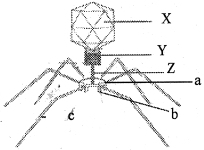
In the given figure,what do '$z$' and '$b$' represent respectively?
A
Collar and Tail fiber
B
Tail and Tail fiber
C
Head and Tail
D
Tail and Pin
Solution
(B) The given figure represents a bacteriophage.
In this structure:
$X$ represents the Head.
$Y$ represents the Collar.
$Z$ represents the Tail.
$a$ represents the Base plate.
$b$ represents the Tail fiber.
$c$ represents the Pin.
Therefore,'$z$' represents the Tail and '$b$' represents the Tail fiber.
In this structure:
$X$ represents the Head.
$Y$ represents the Collar.
$Z$ represents the Tail.
$a$ represents the Base plate.
$b$ represents the Tail fiber.
$c$ represents the Pin.
Therefore,'$z$' represents the Tail and '$b$' represents the Tail fiber.
0 likes
View Solution66
MediumMCQ
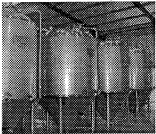
What is shown in the given figure?
A
Large flasks
B
Large beakers
C
Fermenters
D
Centrifuge
Solution
(C) The given figure shows large industrial-scale vessels used for the cultivation of microorganisms to produce various products like beverages,antibiotics,and enzymes. These vessels are known as fermenters (or bioreactors). They provide optimal growth conditions such as temperature,pH,substrate,salts,vitamins,and oxygen for the microbes.
0 likes
View Solution67
MediumMCQ
Identify the odd one out.
A
Protease
B
Pectinase
C
Statins
D
Streptokinase
Solution
(C) The correct answer is $C$ (Statins).
$Protease$, $Pectinase$, and $Streptokinase$ are all examples of enzymes produced by microbes that are used in industrial applications.
$Protease$ and $Pectinase$ are used in the clarification of bottled juices.
$Streptokinase$ is used as a 'clot buster' for removing clots from the blood vessels of patients who have undergone myocardial infarction.
$Statins$, on the other hand, are blood-cholesterol lowering agents, not enzymes. They are produced by the yeast $Monascus$ $purpureus$.
$Protease$, $Pectinase$, and $Streptokinase$ are all examples of enzymes produced by microbes that are used in industrial applications.
$Protease$ and $Pectinase$ are used in the clarification of bottled juices.
$Streptokinase$ is used as a 'clot buster' for removing clots from the blood vessels of patients who have undergone myocardial infarction.
$Statins$, on the other hand, are blood-cholesterol lowering agents, not enzymes. They are produced by the yeast $Monascus$ $purpureus$.
0 likes
View Solution68
EasyMCQ
Which one of the following pairs is wrongly matched?
A
Methanogens - Gobar gas
B
Yeast - Ethanol
C
Streptomycetes - Antibiotic
D
Coliforms - Vinegar
Solution
(D) The correct answer is $D$.
$A$. Methanogens are used in the production of biogas (Gobar gas) from organic waste.
$B$. Yeast $(Saccharomyces \text{ } cerevisiae)$ is used in the industrial production of ethanol through fermentation.
$C$. Streptomycetes are a group of bacteria known for producing various antibiotics.
$D$. Coliforms are a group of Gram-negative, non-spore-forming, rod-shaped bacteria that ferment lactose to produce gas. They are not used for vinegar production; vinegar is produced by $Acetobacter \text{ } aceti$.
$A$. Methanogens are used in the production of biogas (Gobar gas) from organic waste.
$B$. Yeast $(Saccharomyces \text{ } cerevisiae)$ is used in the industrial production of ethanol through fermentation.
$C$. Streptomycetes are a group of bacteria known for producing various antibiotics.
$D$. Coliforms are a group of Gram-negative, non-spore-forming, rod-shaped bacteria that ferment lactose to produce gas. They are not used for vinegar production; vinegar is produced by $Acetobacter \text{ } aceti$.
0 likes
View Solution69
MediumMCQ
Consider the following statements:
$I.$ Yeast used in making bread and beverages is a prokaryotic fungus.
$II.$ Streptokinase is produced by $Streptococcus$ and modified by genetic engineering is used as a clot buster.
$III.$ Lipases are added in detergent for removing only stains from laundry.
$IV.$ Pectinases are used in clearing fruit juices.
Which of the statements given above are correct?
$I.$ Yeast used in making bread and beverages is a prokaryotic fungus.
$II.$ Streptokinase is produced by $Streptococcus$ and modified by genetic engineering is used as a clot buster.
$III.$ Lipases are added in detergent for removing only stains from laundry.
$IV.$ Pectinases are used in clearing fruit juices.
Which of the statements given above are correct?
A
$I, II, III$ and $IV$
B
$I, II$ and $III$
C
$II, III$ and $IV$
D
$III$ and $IV$
Solution
(C) $I.$ Incorrect: Yeast is a eukaryotic fungus,not prokaryotic.
$II.$ Correct: Streptokinase is produced by $Streptococcus$ and modified by genetic engineering to act as a 'clot buster' for removing clots from the blood vessels of patients who have undergone myocardial infarction.
$III.$ Incorrect: Lipases are used to remove oily stains,not just any stains.
$IV.$ Correct: Pectinases and proteases are used to clarify bottled fruit juices.
Therefore,statements $II$ and $IV$ are correct.
$II.$ Correct: Streptokinase is produced by $Streptococcus$ and modified by genetic engineering to act as a 'clot buster' for removing clots from the blood vessels of patients who have undergone myocardial infarction.
$III.$ Incorrect: Lipases are used to remove oily stains,not just any stains.
$IV.$ Correct: Pectinases and proteases are used to clarify bottled fruit juices.
Therefore,statements $II$ and $IV$ are correct.
0 likes
View Solution70
MediumMCQ
Which one of the following is correct?
A
Herbicides kill plants mostly by blocking $PS-II$ (photolysis of water) and occasionally phloem transport.
B
Insecticides kill insects mostly through impairment of nerve conduction and sometimes through respiratory arrest.
C
Both $(a)$ and $(b)$.
D
None of the above.
Solution
(C) Herbicides are chemicals used to kill weeds and unwanted plants in cultivated land. They primarily act by blocking $PS-II$ (Photosystem-$II$),which inhibits the photolysis of water,and occasionally by disrupting phloem transport.
Insecticides are chemicals designed to destroy or kill insects. They typically function by impairing nerve conduction in the insect's nervous system or,in some cases,by causing respiratory arrest.
Since both statements $(a)$ and $(b)$ are scientifically accurate,the correct option is $(c)$.
Insecticides are chemicals designed to destroy or kill insects. They typically function by impairing nerve conduction in the insect's nervous system or,in some cases,by causing respiratory arrest.
Since both statements $(a)$ and $(b)$ are scientifically accurate,the correct option is $(c)$.
0 likes
View Solution71
MediumMCQ
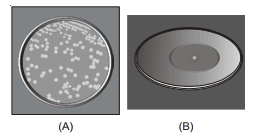
Identify the colonies labelled as $A$ and $B$.
A
$A-$Fungal; $B-$Bacterial
B
$A-$Bacterial; $B-$Fungal
C
$A-$Algal; $B-$Viral
D
$A-$Fungal; $B-$Algal
Solution
(B) In the given figure,$A$ represents bacterial colonies,which typically appear as small,distinct,and numerous spots on the agar surface.
$B$ represents a fungal colony,which typically appears as a larger,fuzzy,or filamentous growth on the culture medium.
$B$ represents a fungal colony,which typically appears as a larger,fuzzy,or filamentous growth on the culture medium.
0 likes
View Solution72
MediumMCQ
Dosa and Idli are fermented preparations of rice and black gram. The fermentation is done by:
A
Leuconostoc
B
Streptococcus
C
Saccharomyces
D
More than one option is correct
Solution
(D) The dough used for making Dosa and Idli is fermented by bacteria. Specifically,species of $Leuconostoc$ and $Streptococcus$ are responsible for this fermentation process. Since both $Leuconostoc$ and $Streptococcus$ are involved,the correct answer is 'More than one option is correct'.
0 likes
View Solution73
MediumMCQ
Read the following four statements $(A - D)$ and identify the two statements that contain mistakes:
$(A)$ Dough,which is used for making foods such as dosa and idli,is fermented by fungi and algae.
$(B)$ Toddy,a traditional drink of southern India,is made by fermenting sap from palms.
$(C)$ Large holes in 'Swiss cheese' are due to the production of a large amount of methane by $Propionibacterium$ $sharmanii$.
$(D)$ In our stomach,lactic acid bacteria play a very beneficial role in checking disease-causing microbes.
Which are the two statements having mistakes?
$(A)$ Dough,which is used for making foods such as dosa and idli,is fermented by fungi and algae.
$(B)$ Toddy,a traditional drink of southern India,is made by fermenting sap from palms.
$(C)$ Large holes in 'Swiss cheese' are due to the production of a large amount of methane by $Propionibacterium$ $sharmanii$.
$(D)$ In our stomach,lactic acid bacteria play a very beneficial role in checking disease-causing microbes.
Which are the two statements having mistakes?
A
Statements $(A)$ and $(C)$
B
Statements $(A)$ and $(B)$
C
Statements $(B)$ and $(C)$
D
Statements $(C)$ and $(D)$
Solution
(A) The statement is incorrect because the dough used for making dosa and idli is fermented by bacteria,not by fungi and algae.
$(B)$ The statement is correct; Toddy is a traditional drink made by fermenting sap from palms.
$(C)$ The statement is incorrect because the large holes in 'Swiss cheese' are caused by the production of a large amount of $CO_2$ by the bacterium $Propionibacterium$ $sharmanii$,not methane.
$(D)$ The statement is correct; Lactic acid bacteria $(LAB)$ present in our stomach/gut play a beneficial role in checking disease-causing microbes.
$(B)$ The statement is correct; Toddy is a traditional drink made by fermenting sap from palms.
$(C)$ The statement is incorrect because the large holes in 'Swiss cheese' are caused by the production of a large amount of $CO_2$ by the bacterium $Propionibacterium$ $sharmanii$,not methane.
$(D)$ The statement is correct; Lactic acid bacteria $(LAB)$ present in our stomach/gut play a beneficial role in checking disease-causing microbes.
0 likes
View Solution74
MediumMCQ
Mark the mismatched pair:
A
Dragonfly - Biocontrol agent
B
Oscillatoria - Increase alkalinity of soil
C
Anaerobic sludge digester - Biogas
D
$VAM$ - Biofertiliser
Solution
(B) The mismatched pair is $Oscillatoria - \text{Increase alkalinity of soil}$.
$Oscillatoria$ is a cyanobacterium that helps in the reclamation of alkaline soils by decreasing their alkalinity, not increasing it.
Dragonflies are effective biocontrol agents used to get rid of aphids and mosquitoes.
Anaerobic sludge digesters are used in sewage treatment plants to produce biogas.
$VAM$ (Vesicular-Arbuscular Mycorrhiza) acts as a biofertilizer by helping plants absorb phosphorus from the soil.
$Oscillatoria$ is a cyanobacterium that helps in the reclamation of alkaline soils by decreasing their alkalinity, not increasing it.
Dragonflies are effective biocontrol agents used to get rid of aphids and mosquitoes.
Anaerobic sludge digesters are used in sewage treatment plants to produce biogas.
$VAM$ (Vesicular-Arbuscular Mycorrhiza) acts as a biofertilizer by helping plants absorb phosphorus from the soil.
0 likes
View Solution75
EasyMCQ
Which of the following is not used for the disinfection of drinking water?
A
Phenyl
B
Chloramines
C
Chlorine
D
Ozone
Solution
(A) Disinfection is the process of removing or killing pathogenic microorganisms in water to make it safe for human consumption.
$Chlorine$,$Chloramines$,and $Ozone$ are widely used chemical disinfectants for treating drinking water.
$Phenyl$ (a phenolic compound) is primarily used as a household disinfectant for floors and surfaces,not for treating drinking water,as it is toxic and unsuitable for human consumption.
$Chlorine$,$Chloramines$,and $Ozone$ are widely used chemical disinfectants for treating drinking water.
$Phenyl$ (a phenolic compound) is primarily used as a household disinfectant for floors and surfaces,not for treating drinking water,as it is toxic and unsuitable for human consumption.
0 likes
View Solution76
EasyMCQ
What is the importance of bacteria?
A
They act as natural scavengers.
B
They are used in the fermentation process.
C
They are used to produce antibiotics.
D
All of the above.
Solution
(D) Bacteria play several crucial roles in nature and industry:
$1$. They act as natural scavengers by decomposing organic matter,which helps in nutrient recycling.
$2$. They are extensively used in the fermentation process for the production of various food items like curd,cheese,and vinegar.
$3$. The genus $Streptomyces$ contains many species that are used to produce a wide range of antibiotics,which are essential for treating bacterial infections.
$1$. They act as natural scavengers by decomposing organic matter,which helps in nutrient recycling.
$2$. They are extensively used in the fermentation process for the production of various food items like curd,cheese,and vinegar.
$3$. The genus $Streptomyces$ contains many species that are used to produce a wide range of antibiotics,which are essential for treating bacterial infections.
0 likes
View Solution77
MediumMCQ
Given below are two statements: one is labelled as Assertion $(A)$ and the other is labelled as Reason $(R)$ :
Assertion $(A)$ : $Spirulina$ is a microbe that can be used for reducing environmental pollution.
Reason $(R)$ : $Spirulina$ is a rich source of protein,carbohydrates,fats,minerals and vitamins.
In the light of the above statements,choose the most appropriate answer from the options given below:
Assertion $(A)$ : $Spirulina$ is a microbe that can be used for reducing environmental pollution.
Reason $(R)$ : $Spirulina$ is a rich source of protein,carbohydrates,fats,minerals and vitamins.
In the light of the above statements,choose the most appropriate answer from the options given below:
A
Both $(A)$ and $(R)$ are correct and $(R)$ is the correct explanation of $(A)$
B
Both $(A)$ and $(R)$ are correct but $(R)$ is not the correct explanation of $(A)$
C
$(A)$ is correct but $(R)$ is not correct
D
$(A)$ is not correct but $(R)$ is correct
Solution
(B) Assertion $(A)$ is correct because $Spirulina$ is a cyanobacterium (blue-green alga) that can be grown on wastewater to reduce pollution by absorbing nutrients and producing biomass.
Reason $(R)$ is also correct because $Spirulina$ is indeed a rich source of proteins,vitamins,minerals,and other nutrients,which makes it a popular single-cell protein $(SCP)$ source.
However,the nutritional value of $Spirulina$ (Reason) is not the reason why it is used to reduce environmental pollution (Assertion). The ability to reduce pollution is due to its metabolic activity and nutrient uptake capacity,not its nutritional composition.
Therefore,both statements are correct,but $(R)$ is not the correct explanation of $(A)$.
Reason $(R)$ is also correct because $Spirulina$ is indeed a rich source of proteins,vitamins,minerals,and other nutrients,which makes it a popular single-cell protein $(SCP)$ source.
However,the nutritional value of $Spirulina$ (Reason) is not the reason why it is used to reduce environmental pollution (Assertion). The ability to reduce pollution is due to its metabolic activity and nutrient uptake capacity,not its nutritional composition.
Therefore,both statements are correct,but $(R)$ is not the correct explanation of $(A)$.
0 likes
View Solution78
MediumMCQ
Match List-$I$ with List-$II$:
Choose the correct answer from the options given below:
| List-$I$ | List-$II$ |
| $A$. Clostridium butylicum | $1$. Ethanol |
| $B$. Saccharomyces cerevisiae | $II$. Streptokinase |
| $C$. Trichoderma polysporum | $III$. Butyric acid |
| $D$. Streptococcus sp. | $IV$. Cyclosporin-$A$ |
Choose the correct answer from the options given below:
A
$A-II, B-IV, C-III, D-I$
B
$A-III, B-I, C-IV, D-II$
C
$A-IV, B-I, C-III, D-II$
D
$A-III, B-I, C-II, D-IV$
Solution
(B) . Clostridium butylicum produces Butyric acid $(III)$.
$B$. Saccharomyces cerevisiae is used for the production of Ethanol $(I)$.
$C$. Trichoderma polysporum is the source of Cyclosporin-$A$ $(IV)$.
$D$. Streptococcus sp. produces Streptokinase $(II)$.
Therefore,the correct matching is $A-III, B-I, C-IV, D-II$.
$B$. Saccharomyces cerevisiae is used for the production of Ethanol $(I)$.
$C$. Trichoderma polysporum is the source of Cyclosporin-$A$ $(IV)$.
$D$. Streptococcus sp. produces Streptokinase $(II)$.
Therefore,the correct matching is $A-III, B-I, C-IV, D-II$.
0 likes
View Solution79
DifficultMCQ
Which of the following microbes is $\text{NOT}$ involved in the preparation of household products?
$A.$ Aspergillus niger
$B.$ Lactobacillus
$C.$ Trichoderma polysporum
$D.$ Saccharomyces cerevisiae
$E.$ Propionibacterium sharmanii
Choose the correct answer from the options given below:
$A.$ Aspergillus niger
$B.$ Lactobacillus
$C.$ Trichoderma polysporum
$D.$ Saccharomyces cerevisiae
$E.$ Propionibacterium sharmanii
Choose the correct answer from the options given below:
A
$A$ and $B$ only
B
$A$ and $C$ only
C
$C$ and $D$ only
D
$C$ and $E$ only
Solution
(B) The microbes involved in household products are:
$1$. $Lactobacillus$ (Lactic Acid Bacteria) is used to convert milk into curd.
$2$. $Saccharomyces$ $cerevisiae$ (Brewer's yeast) is used for making bread and dough.
$3$. $Propionibacterium$ $sharmanii$ is used to produce large holes in Swiss cheese.
The microbes $NOT$ involved in household products are:
$1$. $Aspergillus$ $niger$ is a fungus used for the industrial production of citric acid.
$2$. $Trichoderma$ $polysporum$ is a fungus used for the industrial production of Cyclosporin $A$ (an immunosuppressive agent).
Therefore,$A$ and $C$ are the microbes not involved in household products. The correct option is $B$.
$1$. $Lactobacillus$ (Lactic Acid Bacteria) is used to convert milk into curd.
$2$. $Saccharomyces$ $cerevisiae$ (Brewer's yeast) is used for making bread and dough.
$3$. $Propionibacterium$ $sharmanii$ is used to produce large holes in Swiss cheese.
The microbes $NOT$ involved in household products are:
$1$. $Aspergillus$ $niger$ is a fungus used for the industrial production of citric acid.
$2$. $Trichoderma$ $polysporum$ is a fungus used for the industrial production of Cyclosporin $A$ (an immunosuppressive agent).
Therefore,$A$ and $C$ are the microbes not involved in household products. The correct option is $B$.
0 likes
View Solution80
MediumMCQ
Which of the following is correctly matched?
A
Cyclosporins : Monascus purpureus
B
Statins : Trichoderma polysporum
C
Biogas : Methanogens
D
Butyric acid : Lactobacillus
Solution
(C) The correct match is $C$.
$1$. Cyclosporin-$A$ is produced by the fungus $Trichoderma polysporum$.
$2$. Statins are produced by the yeast $Monascus purpureus$.
$3$. Biogas is produced by $Methanogens$ (e.g., $Methanobacterium$) which grow anaerobically on cellulosic material.
$4$. Butyric acid is produced by the bacterium $Clostridium butylicum$, not $Lactobacillus$ (which produces lactic acid).
$1$. Cyclosporin-$A$ is produced by the fungus $Trichoderma polysporum$.
$2$. Statins are produced by the yeast $Monascus purpureus$.
$3$. Biogas is produced by $Methanogens$ (e.g., $Methanobacterium$) which grow anaerobically on cellulosic material.
$4$. Butyric acid is produced by the bacterium $Clostridium butylicum$, not $Lactobacillus$ (which produces lactic acid).
0 likes
View Solution81
MediumMCQ
Match List-$I$ with List-$II$ :
Choose the correct answer from the options given below :
| List-$I$ | List-$II$ |
| $(a)$ Streptococcus | $(i)$ Statin |
| $(b)$ Trichoderma | $(ii)$ Streptokinase |
| $(c)$ Monascus purpureus | $(iii)$ Cyclosporin $(A)$ |
| $(d)$ Penicillium notatum | $(iv)$ Antibiotics |
Choose the correct answer from the options given below :
A
$a-i, b-ii, c-iii, d-iv$
B
$a-i, b-ii, c-iv, d-iii$
C
$a-ii, b-iii, c-i, d-iv$
D
$a-ii, b-iii, c-iv, d-i$
Solution
$(C)$ The correct matches are as follows:
$(a)$ Streptococcus produces Streptokinase, which is used as a 'clot buster' for removing clots from the blood vessels of patients who have undergone myocardial infarction.
$(b)$ Trichoderma polysporum is a fungus used for the production of Cyclosporin $(A)$, which is used as an immunosuppressive agent in organ-transplant patients.
$(c)$ Monascus purpureus is a yeast used for the production of Statins, which act as blood-cholesterol lowering agents.
$(d)$ Penicillium notatum is a fungus used for the production of the first antibiotic, Penicillin.
Therefore, the correct matching is $(a-ii, b-iii, c-i, d-iv)$.
$(a)$ Streptococcus produces Streptokinase, which is used as a 'clot buster' for removing clots from the blood vessels of patients who have undergone myocardial infarction.
$(b)$ Trichoderma polysporum is a fungus used for the production of Cyclosporin $(A)$, which is used as an immunosuppressive agent in organ-transplant patients.
$(c)$ Monascus purpureus is a yeast used for the production of Statins, which act as blood-cholesterol lowering agents.
$(d)$ Penicillium notatum is a fungus used for the production of the first antibiotic, Penicillin.
Therefore, the correct matching is $(a-ii, b-iii, c-i, d-iv)$.
0 likes
View Solution82
MediumMCQ
Correctly match column $I$ with column $II$:
| Column $I$ | Column $II$ |
|---|---|
| $(A)$ Trichoderma species | $(i)$ Biofertilisers |
| $(B)$ Rhizobium | $(ii)$ Clot buster |
| $(C)$ Cyclosporin $A$ | $(iii)$ Biocontrol agents |
| $(D)$ Streptokinase | $(iv)$ Trichoderma polysporum |
A
$A-(i), B-(ii), C-(iii), D-(iv)$
B
$A-(iii), B-(ii), C-(iv), D-(i)$
C
$A-(iv), B-(iii), C-(ii), D-(i)$
D
$A-(iii), B-(i), C-(iv), D-(ii)$
Solution
(D) The correct matches are as follows:
$1$. $(A)$ Trichoderma species are used as $(iii)$ Biocontrol agents.
$2$. $(B)$ Rhizobium is a well-known $(i)$ Biofertiliser that fixes atmospheric nitrogen.
$3$. $(C)$ Cyclosporin $A$ is produced by the fungus $(iv)$ Trichoderma polysporum.
$4$. $(D)$ Streptokinase is an enzyme produced by Streptococcus bacteria,used as a $(ii)$ Clot buster for removing clots from the blood vessels of patients who have undergone myocardial infarction.
Therefore,the correct matching is $A-(iii), B-(i), C-(iv), D-(ii)$.
$1$. $(A)$ Trichoderma species are used as $(iii)$ Biocontrol agents.
$2$. $(B)$ Rhizobium is a well-known $(i)$ Biofertiliser that fixes atmospheric nitrogen.
$3$. $(C)$ Cyclosporin $A$ is produced by the fungus $(iv)$ Trichoderma polysporum.
$4$. $(D)$ Streptokinase is an enzyme produced by Streptococcus bacteria,used as a $(ii)$ Clot buster for removing clots from the blood vessels of patients who have undergone myocardial infarction.
Therefore,the correct matching is $A-(iii), B-(i), C-(iv), D-(ii)$.
0 likes
View Solution83
EasyMCQ
Which one of the following statements is correct:
$(i)$ Baculoviruses are excellent candidates for species-specific,narrow-spectrum insecticidal applications.
(ii) Bacillus thuringiensis is used to control butterfly caterpillars.
(iii) Ladybird is useful to get rid of mosquitoes.
(iv) Trichoderma fungus is used as a biocontrol agent for animal pathogens.
$(i)$ Baculoviruses are excellent candidates for species-specific,narrow-spectrum insecticidal applications.
(ii) Bacillus thuringiensis is used to control butterfly caterpillars.
(iii) Ladybird is useful to get rid of mosquitoes.
(iv) Trichoderma fungus is used as a biocontrol agent for animal pathogens.
A
only $(i)$,(iii) and (iv)
B
only $(i)$ and (ii)
C
only (ii) and (iv)
D
only (iii) and (iv)
Solution
(B) $(i)$ Baculoviruses are pathogens that attack insects and other arthropods. They are excellent candidates for species-specific,narrow-spectrum insecticidal applications because they do not harm plants,mammals,birds,fish,or even non-target insects.
(ii) Bacillus thuringiensis $(Bt)$ is a bacterium whose spores are used to control butterfly caterpillars.
(iii) Ladybird beetles are useful to get rid of aphids,not mosquitoes.
(iv) Trichoderma species are free-living fungi that are very common in the root ecosystems and are effective biocontrol agents of several plant pathogens,not animal pathogens.
Therefore,only statements $(i)$ and (ii) are correct.
(ii) Bacillus thuringiensis $(Bt)$ is a bacterium whose spores are used to control butterfly caterpillars.
(iii) Ladybird beetles are useful to get rid of aphids,not mosquitoes.
(iv) Trichoderma species are free-living fungi that are very common in the root ecosystems and are effective biocontrol agents of several plant pathogens,not animal pathogens.
Therefore,only statements $(i)$ and (ii) are correct.
0 likes
View Solution84
EasyMCQ
Match the following columns:
| Column-$I$ | Column-$II$ |
| $1$. $Propionibacterium$ $shermanii$ | $A$. Production of ethanol from fruit juice |
| $2$. $Saccharomyces$ $cerevisiae$ | $B$. Citric Acid |
| $3$. $Aspergillus$ $niger$ | $C$. 'Swiss Cheese' |
| $4$. $Trichoderma$ $polysporum$ | $D$. Immunosuppressive agent |
A
$(1-C), (2-B), (3-A), (4-D)$
B
$(1-A), (2-D), (3-C), (4-B)$
C
$(1-A), (2-B), (3-C), (4-D)$
D
$(1-C), (2-A), (3-B), (4-D)$
Solution
(D) The correct matches are as follows:
$1$. $Propionibacterium$ $shermanii$ is used in the production of 'Swiss Cheese' $(C)$.
$2$. $Saccharomyces$ $cerevisiae$ (Brewer's yeast) is used for the production of ethanol from fruit juices $(A)$.
$3$. $Aspergillus$ $niger$ is a fungus used for the commercial production of Citric Acid $(B)$.
$4$. $Trichoderma$ $polysporum$ is a fungus used to produce Cyclosporin $A$,which acts as an immunosuppressive agent $(D)$.
Therefore,the correct sequence is $(1-C), (2-A), (3-B), (4-D)$.
$1$. $Propionibacterium$ $shermanii$ is used in the production of 'Swiss Cheese' $(C)$.
$2$. $Saccharomyces$ $cerevisiae$ (Brewer's yeast) is used for the production of ethanol from fruit juices $(A)$.
$3$. $Aspergillus$ $niger$ is a fungus used for the commercial production of Citric Acid $(B)$.
$4$. $Trichoderma$ $polysporum$ is a fungus used to produce Cyclosporin $A$,which acts as an immunosuppressive agent $(D)$.
Therefore,the correct sequence is $(1-C), (2-A), (3-B), (4-D)$.
0 likes
View Solution85
EasyMCQ
Match the Column-$I$ with Column-$II$. Choose the correct option given below.
| Column-$I$ | Column-$II$ |
|---|---|
| $A$. Streptococcus | $(i)$ Free living nitrogen fixing bacteria |
| $B$. Penicillium | $(ii)$ Clot buster |
| $C$. Methanogens | $(iii)$ Source of antibiotic |
| $D$. Anabaena | $(iv)$ Biogas production |
A
$A-iv, B-iii, C-i, D-ii$
B
$A-iv, B-i, C-iii, D-ii$
C
$A-ii, B-iii, C-iv, D-i$
D
$A-ii, B-iv, C-iii, D-i$
Solution
(C) The correct matches are as follows:
$1$. $Streptococcus$ is used as a 'clot buster' because it produces streptokinase,which is used to remove clots from the blood vessels of patients who have undergone myocardial infarction $(A-ii)$.
$2$. $Penicillium$ is a fungus that serves as the source of the first antibiotic,penicillin $(B-iii)$.
$3$. $Methanogens$ are bacteria that grow anaerobically on cellulosic material and produce large amounts of methane,which is used in biogas production $(C-iv)$.
$4$. $Anabaena$ is a cyanobacterium that acts as a free-living nitrogen-fixing bacterium in the soil $(D-i)$.
Therefore,the correct sequence is $A-ii, B-iii, C-iv, D-i$.
$1$. $Streptococcus$ is used as a 'clot buster' because it produces streptokinase,which is used to remove clots from the blood vessels of patients who have undergone myocardial infarction $(A-ii)$.
$2$. $Penicillium$ is a fungus that serves as the source of the first antibiotic,penicillin $(B-iii)$.
$3$. $Methanogens$ are bacteria that grow anaerobically on cellulosic material and produce large amounts of methane,which is used in biogas production $(C-iv)$.
$4$. $Anabaena$ is a cyanobacterium that acts as a free-living nitrogen-fixing bacterium in the soil $(D-i)$.
Therefore,the correct sequence is $A-ii, B-iii, C-iv, D-i$.
0 likes
View Solution86
MediumMCQ
Match List-$I$ with List-$II$ :
| List-$I$ (Bioactive molecules) | List-$II$ (Importance) |
| $A$. Streptokinase | $I$. Immunosuppressive agent |
| $B$. Statins | $II$. Removal of clots from the blood vessels |
| $C$. Lipases | $III$. Blood cholesterol-lowering agent |
| $D$. Cyclosporin $A$ | $IV$. Detergent formulations |
A
$A-II, B-III, C-I, D-IV$
B
$A-III, B-II, C-IV, D-I$
C
$A-II, B-III, C-IV, D-I$
D
$A-IV, B-III, C-II, D-I$
Solution
(C) The correct matches are:
$A$. Streptokinase: Used for removal of clots from blood vessels $(II)$.
$B$. Statins: Act as blood cholesterol-lowering agents $(III)$.
$C$. Lipases: Used in detergent formulations $(IV)$.
$D$. Cyclosporin $A$: Used as an immunosuppressive agent $(I)$.
Thus,the correct sequence is $A-II, B-III, C-IV, D-I$.
$A$. Streptokinase: Used for removal of clots from blood vessels $(II)$.
$B$. Statins: Act as blood cholesterol-lowering agents $(III)$.
$C$. Lipases: Used in detergent formulations $(IV)$.
$D$. Cyclosporin $A$: Used as an immunosuppressive agent $(I)$.
Thus,the correct sequence is $A-II, B-III, C-IV, D-I$.
0 likes
View SolutionMicrobes in Human Welfare — Mix Examples - Microbes in Human Welfare · Frequently Asked Questions
1Are these Microbes in Human Welfare questions useful for JEE and NEET?
Yes. All questions in this section are mapped to JEE Main and NEET exam patterns. Previous year questions from JEE Main, NEET, GUJCET and state-level exams are included with full solutions.
2Can I switch to Hindi or Gujarati for these questions?
Yes. Use the language tabs in the hero section or the sidebar to view the same questions and solutions in English, Hindi or Gujarati.
3How do I generate a question paper from this subtopic?
Use the Vedclass Exam Paper Generator — select the chapter and subtopic, set difficulty, and generate Sets A, B, C, D automatically. First 3 chapters of every subject are free.
Vedclass Products
For Students
Vedclass Test Series
Mock tests in real JEE/NEET style with performance analysis. 5-day free trial.
Start Free TrialFor Teachers
Exam Paper Generator
Generate Set A/B/C/D papers from this chapter in 2 minutes. 3 chapters free.
Try FreeFor Institutes
Online Exam Module
Live online exams with unlimited students, 360° analytics & white-label branding.
See DemoFor Teachers & Institutes
Generate a Microbes in Human Welfare Exam Paper in 2 Minutes
Select subtopic & difficulty — Sets A, B, C, D auto-generated with No Repeat logic.
First 3 chapters of every subject are free — no payment required.