
A English
Gametogenesis Questions in English
Class 12 Biology · Human Reproduction · Gametogenesis
576+
Questions
English
Language
100%
With Solutions
Showing 47 of 576 questions in English
251
MediumMCQ
Which one of the following statements about human sperm is correct?
A
Acrosome has a conical pointed structure used for piercing and penetrating the egg,resulting in fertilisation.
B
The sperm lysins in the acrosome dissolve the egg envelope facilitating fertilisation.
C
Acrosome serves as a sensory structure leading the sperm towards the ovum.
D
Acrosome serves no particular function.
Solution
(B) The correct answer is $B$.
$Acrosome$ is a cap-like structure located at the anterior end of the sperm head.
It contains various hydrolytic enzymes,collectively known as sperm lysins.
During the process of fertilisation,these enzymes are released to dissolve the protective layers of the ovum (such as the $zona$ $pellucida$),which facilitates the entry of the sperm into the egg.
Failure of the acrosome reaction prevents the sperm from penetrating the egg,which is a common cause of male infertility.
$Acrosome$ is a cap-like structure located at the anterior end of the sperm head.
It contains various hydrolytic enzymes,collectively known as sperm lysins.
During the process of fertilisation,these enzymes are released to dissolve the protective layers of the ovum (such as the $zona$ $pellucida$),which facilitates the entry of the sperm into the egg.
Failure of the acrosome reaction prevents the sperm from penetrating the egg,which is a common cause of male infertility.
0 likes
View Solution252
MediumMCQ
The correct sequence of spermatogenetic stages leading to the formation of sperms in a mature human testis is
A
spermatogonia $\rightarrow$ spermatocyte $\rightarrow$ spermatid $\rightarrow$ sperms
B
spermatid $\rightarrow$ spermatocyte $\rightarrow$ spermatogonia $\rightarrow$ sperms
C
spermatogonia $\rightarrow$ spermatid $\rightarrow$ spermatocyte $\rightarrow$ sperms
D
spermatocyte $\rightarrow$ spermatogonia $\rightarrow$ spermatid $\rightarrow$ sperms
Solution
(A) The correct sequence is: $spermatogonia \rightarrow spermatocyte \rightarrow spermatid \rightarrow sperms$.
Spermatogenesis is the process of formation of haploid spermatozoa (sperms) from diploid spermatogonia inside the testes of the male.
At sexual maturity, the undifferentiated primordial germ cells divide by mitosis to produce a large number of spermatogonia.
Each spermatogonium grows into a larger primary spermatocyte.
The primary spermatocyte undergoes the first meiotic division (reductional division) to form two haploid secondary spermatocytes.
Each secondary spermatocyte undergoes the second meiotic division to form two haploid spermatids.
Finally, the transformation of spermatids into mature spermatozoa is called spermiogenesis.
Spermatogenesis is the process of formation of haploid spermatozoa (sperms) from diploid spermatogonia inside the testes of the male.
At sexual maturity, the undifferentiated primordial germ cells divide by mitosis to produce a large number of spermatogonia.
Each spermatogonium grows into a larger primary spermatocyte.
The primary spermatocyte undergoes the first meiotic division (reductional division) to form two haploid secondary spermatocytes.
Each secondary spermatocyte undergoes the second meiotic division to form two haploid spermatids.
Finally, the transformation of spermatids into mature spermatozoa is called spermiogenesis.
0 likes
View Solution253
MediumMCQ
In humans,at the end of the first meiotic division,the male germ cells differentiate into the
A
spermatids
B
spermatogonia
C
primary spermatocytes
D
secondary spermatocytes
Solution
(D) The correct answer is $D$.
During spermatogenesis,the $spermatogonia$ $(2n)$ undergo mitosis to increase in number.
Some $spermatogonia$ grow and differentiate into $primary$ $spermatocytes$ $(2n)$.
These $primary$ $spermatocytes$ undergo the first meiotic division $(Meiosis-I)$,which is a reductional division,to form two haploid $(n)$ cells known as $secondary$ $spermatocytes$.
Following this,the $secondary$ $spermatocytes$ undergo the second meiotic division $(Meiosis-II)$ to produce $spermatids$ $(n)$,which eventually differentiate into $spermatozoa$.
During spermatogenesis,the $spermatogonia$ $(2n)$ undergo mitosis to increase in number.
Some $spermatogonia$ grow and differentiate into $primary$ $spermatocytes$ $(2n)$.
These $primary$ $spermatocytes$ undergo the first meiotic division $(Meiosis-I)$,which is a reductional division,to form two haploid $(n)$ cells known as $secondary$ $spermatocytes$.
Following this,the $secondary$ $spermatocytes$ undergo the second meiotic division $(Meiosis-II)$ to produce $spermatids$ $(n)$,which eventually differentiate into $spermatozoa$.
0 likes
View Solution254
MediumMCQ
Which part of the ovary in mammals acts as an endocrine gland after ovulation?
A
Stroma
B
Germinal epithelium
C
Vitelline membrane
D
Graafian follicle
Solution
(D) The correct answer is $D$. After ovulation,the ruptured Graafian follicle transforms into a temporary endocrine gland known as the corpus luteum.
During the menstrual cycle,the Graafian follicle protects the developing oocyte. Upon ovulation,the secondary oocyte is released,and the remaining follicular cells (zona granulosa and theca cells) undergo luteinization to form the corpus luteum.
The corpus luteum secretes large amounts of progesterone,which is essential for maintaining the endometrium during pregnancy,and also produces some estrogen.
During the menstrual cycle,the Graafian follicle protects the developing oocyte. Upon ovulation,the secondary oocyte is released,and the remaining follicular cells (zona granulosa and theca cells) undergo luteinization to form the corpus luteum.
The corpus luteum secretes large amounts of progesterone,which is essential for maintaining the endometrium during pregnancy,and also produces some estrogen.
0 likes
View Solution255
EasyMCQ
Sertoli cells are regulated by the pituitary hormone known as
A
$LH$
B
$FSH$
C
$GH$
D
prolactin
Solution
(B) $(b) :$ Sertoli cells are located within the germinal epithelium of the seminiferous tubules.
These cells provide nourishment to the developing spermatozoa.
They facilitate the process of spermatogenesis by supporting the differentiation of spermatogonia into mature sperms.
These cells are primarily regulated by the Follicle Stimulating Hormone $(FSH)$,which is secreted by the anterior pituitary gland.
These cells provide nourishment to the developing spermatozoa.
They facilitate the process of spermatogenesis by supporting the differentiation of spermatogonia into mature sperms.
These cells are primarily regulated by the Follicle Stimulating Hormone $(FSH)$,which is secreted by the anterior pituitary gland.
0 likes
View Solution256
EasyMCQ
The production of offspring in humans by sexual reproduction includes the fusion of two gametes which are:
A
Diploid
B
Haploid
C
Either haploid or Diploid
D
Do not contain chromosomes
Solution
(B) Sexual reproduction involves the formation and fusion of gametes.
In humans,gametes (sperm and ovum) are produced through the process of meiosis.
Meiosis is a reductional division that reduces the chromosome number to half.
Therefore,human gametes are haploid $(n)$,containing $23$ chromosomes each.
Upon fertilization,the fusion of these two haploid gametes results in a diploid $(2n)$ zygote,which contains $46$ chromosomes.
In humans,gametes (sperm and ovum) are produced through the process of meiosis.
Meiosis is a reductional division that reduces the chromosome number to half.
Therefore,human gametes are haploid $(n)$,containing $23$ chromosomes each.
Upon fertilization,the fusion of these two haploid gametes results in a diploid $(2n)$ zygote,which contains $46$ chromosomes.
0 likes
View Solution257
MediumMCQ
When a male ejaculates sperms during coitus,for normal fertility,at least ....... percent of sperms must have normal shape and size,and at least ........... percent of them must show vigorous motility.
A
$40, 60$
B
$50, 50$
C
$60, 40$
D
$52, 48$
Solution
(C) For normal fertility,it is essential that at least $60\%$ of all sperms must have normal shape and size.
Furthermore,at least $40\%$ of them must show vigorous motility to successfully reach the ovum for fertilization.
Therefore,the correct values are $60$ and $40$ respectively.
Furthermore,at least $40\%$ of them must show vigorous motility to successfully reach the ovum for fertilization.
Therefore,the correct values are $60$ and $40$ respectively.
0 likes
View Solution258
MediumMCQ
Choose the false statement.
A
The seminal plasma along with the sperm constitutes the semen.
B
The nucleus in the sperm is diploid.
C
The human male ejaculates about $200$ to $300$ million sperms during a coitus.
D
$A$ plasma membrane envelopes the whole body of the sperm.
Solution
(B) The correct answer is $B$.
$1$. Seminal plasma along with sperms constitutes the semen. This is a true statement.
$2$. The nucleus in the sperm is haploid $(n)$,not diploid $(2n)$,because it is a gamete formed after meiosis. Thus,this statement is false.
$3$. During a single coitus,the human male ejaculates about $200$ to $300$ million sperms. This is a true statement.
$4$. The entire body of the sperm is enveloped by a plasma membrane. This is a true statement.
$1$. Seminal plasma along with sperms constitutes the semen. This is a true statement.
$2$. The nucleus in the sperm is haploid $(n)$,not diploid $(2n)$,because it is a gamete formed after meiosis. Thus,this statement is false.
$3$. During a single coitus,the human male ejaculates about $200$ to $300$ million sperms. This is a true statement.
$4$. The entire body of the sperm is enveloped by a plasma membrane. This is a true statement.
0 likes
View Solution259
EasyMCQ
The Graafian follicle ruptures to release the secondary oocyte (ovum) from the ovary by the process called.....
A
Menarche
B
Menopause
C
Ovulation
D
Implantation
Solution
(C) The process of releasing the secondary oocyte (ovum) from the mature Graafian follicle into the fallopian tube is known as $Ovulation$.
$Menarche$ refers to the onset of the first menstrual cycle at puberty.
$Menopause$ refers to the permanent cessation of the menstrual cycle.
$Implantation$ is the process where the blastocyst attaches to the uterine wall.
$Menarche$ refers to the onset of the first menstrual cycle at puberty.
$Menopause$ refers to the permanent cessation of the menstrual cycle.
$Implantation$ is the process where the blastocyst attaches to the uterine wall.
0 likes
View Solution260
MediumMCQ
Spermiogenesis is possible due to....
A
$PRL$
B
$ACTH$
C
$FSH$
D
$MSH$
Solution
(C) Spermiogenesis is the process of transformation of spermatids into mature spermatozoa. This process is primarily regulated by $FSH$ (Follicle Stimulating Hormone). $FSH$ acts on the Sertoli cells and stimulates the secretion of some factors which help in the process of spermiogenesis.
0 likes
View Solution261
MediumMCQ
Growth and maturation of Graafian follicle is controlled by ...........
A
$FSH-LH$
B
$FSH-ACTH$
C
$ACTH-LH$
D
$GH-ADH$
Solution
(A) The growth and maturation of the Graafian follicle in the ovary are primarily regulated by gonadotropins secreted by the anterior pituitary gland.
$FSH$ (Follicle Stimulating Hormone) stimulates the growth and development of ovarian follicles.
$LH$ (Luteinizing Hormone) is responsible for the final maturation of the Graafian follicle and triggers ovulation.
Therefore,the combined action of $FSH$ and $LH$ controls the growth and maturation of the Graafian follicle.
$FSH$ (Follicle Stimulating Hormone) stimulates the growth and development of ovarian follicles.
$LH$ (Luteinizing Hormone) is responsible for the final maturation of the Graafian follicle and triggers ovulation.
Therefore,the combined action of $FSH$ and $LH$ controls the growth and maturation of the Graafian follicle.
0 likes
View Solution262
EasyMCQ
Antrum is the cavity of
A
Ovary
B
Graafian follicle
C
Blastula
D
Gastrula
Solution
(B) The $Antrum$ is a fluid-filled cavity found within the $Graafian$ $follicle$ (the mature ovarian follicle). As the follicle matures,the follicular cells secrete fluid,which accumulates to form this central cavity,known as the $Antrum$.
0 likes
View Solution263
EasyMCQ
From where does spermatogenesis start?
A
Vasa deferentia
B
Epididymis
C
Seminiferous tubules
D
Penis
Solution
(C) Spermatogenesis is the process of the formation of sperms from immature germ cells.
This process occurs within the testes, specifically inside the $Seminiferous$ $\text{tubules}$.
The germinal epithelium lining the $Seminiferous$ $\text{tubules}$ contains spermatogonia, which undergo meiosis to produce spermatozoa.
Therefore, the correct site where spermatogenesis begins is the $Seminiferous$ $\text{tubules}$.
This process occurs within the testes, specifically inside the $Seminiferous$ $\text{tubules}$.
The germinal epithelium lining the $Seminiferous$ $\text{tubules}$ contains spermatogonia, which undergo meiosis to produce spermatozoa.
Therefore, the correct site where spermatogenesis begins is the $Seminiferous$ $\text{tubules}$.
0 likes
View Solution264
MediumMCQ
First polar body is produced during the formation of
A
Sperm
B
Secondary oocyte
C
Oogonium
D
Spermatocytes
Solution
(B) The process of oogenesis involves the formation of female gametes.
During the maturation of the primary oocyte,it undergoes the first meiotic division $(Meiosis-I)$.
This division is unequal,resulting in the formation of a large haploid cell called the secondary oocyte and a small haploid cell called the first polar body.
Therefore,the first polar body is produced during the formation of the secondary oocyte.
During the maturation of the primary oocyte,it undergoes the first meiotic division $(Meiosis-I)$.
This division is unequal,resulting in the formation of a large haploid cell called the secondary oocyte and a small haploid cell called the first polar body.
Therefore,the first polar body is produced during the formation of the secondary oocyte.
0 likes
View Solution265
MediumMCQ
What are the diploid cells in gametogenesis?
A
Spermatogonia and spermatids
B
Spermatogonia and primary spermatocytes
C
Spermatogonia and sperm
D
Primary spermatocytes and secondary spermatocytes
Solution
(B) In the process of spermatogenesis,the spermatogonia $(2n)$ undergo mitosis to increase their number. Some of these spermatogonia differentiate into primary spermatocytes $(2n)$. Both spermatogonia and primary spermatocytes are diploid $(2n)$. Secondary spermatocytes $(n)$,spermatids $(n)$,and sperm $(n)$ are haploid cells formed after meiotic divisions.
0 likes
View Solution266
EasyMCQ
The Graafian follicle ruptures to release the secondary oocyte (ovum) from the ovary by the process called:
A
Menarche
B
Ovulation
C
Menopause
D
Parturition
Solution
(B) The process of releasing the secondary oocyte (ovum) from the mature Graafian follicle into the fallopian tube is known as $Ovulation$.
$Menarche$ refers to the onset of the first menstrual cycle.
$Menopause$ refers to the cessation of the menstrual cycle.
$Parturition$ refers to the process of childbirth.
$Menarche$ refers to the onset of the first menstrual cycle.
$Menopause$ refers to the cessation of the menstrual cycle.
$Parturition$ refers to the process of childbirth.
0 likes
View Solution267
MediumMCQ
The function of mitochondria in sperm is
A
To control the movement of sperm
B
To provide energy for movement of sperm
C
To provide energy to nucleus
D
None of the above
Solution
(B) In the structure of a human sperm,the middle piece contains numerous mitochondria.
These mitochondria are arranged in a spiral pattern,often referred to as the $Nebelkern$.
The primary function of these mitochondria is to produce $ATP$ (adenosine triphosphate) through aerobic respiration.
This $ATP$ provides the necessary energy for the motility of the sperm tail,which is essential for the sperm to swim through the female reproductive tract to reach the ovum.
These mitochondria are arranged in a spiral pattern,often referred to as the $Nebelkern$.
The primary function of these mitochondria is to produce $ATP$ (adenosine triphosphate) through aerobic respiration.
This $ATP$ provides the necessary energy for the motility of the sperm tail,which is essential for the sperm to swim through the female reproductive tract to reach the ovum.
0 likes
View Solution268
EasyMCQ
What is the number of sperms present in a single ejaculation of semen?
A
$10,000$
B
$100,000 - 1,000,000$
C
$30 - 40$ million
D
$200 - 300$ million
Solution
(D) During a single ejaculation,a healthy human male releases approximately $200$ to $300$ million sperms.
For normal fertility,at least $60$ percent of sperms must have normal shape and size,and at least $40$ percent of them must show vigorous motility.
For normal fertility,at least $60$ percent of sperms must have normal shape and size,and at least $40$ percent of them must show vigorous motility.
0 likes
View Solution269
EasyMCQ
Sperms are released from the seminiferous tubules by the process called .....
A
Spermiogenesis
B
Spermiation
C
Oogenesis
D
None
Solution
(B) The process of release of sperms from the seminiferous tubules is known as $Spermiation$.
$Spermiogenesis$ is the process of transformation of spermatids into spermatozoa.
$Oogenesis$ is the process of formation of a mature female gamete.
Therefore,the correct option is $B$.
$Spermiogenesis$ is the process of transformation of spermatids into spermatozoa.
$Oogenesis$ is the process of formation of a mature female gamete.
Therefore,the correct option is $B$.
0 likes
View Solution270
MediumMCQ
The secondary spermatocytes undergo the second meiotic division to produce four equal,
A
Diploid spermatids
B
Haploid spermatids
C
Sertoli cells
D
None
Solution
(B) During spermatogenesis,the primary spermatocytes undergo the first meiotic division (meiosis-$I$) to form two haploid secondary spermatocytes.
These secondary spermatocytes then undergo the second meiotic division (meiosis-$II$),which is an equational division,to produce four equal,haploid spermatids.
Therefore,the correct answer is haploid spermatids.
These secondary spermatocytes then undergo the second meiotic division (meiosis-$II$),which is an equational division,to produce four equal,haploid spermatids.
Therefore,the correct answer is haploid spermatids.
0 likes
View Solution271
MediumMCQ
Number of chromosomes in the secondary oocyte stage in humans is:
A
$23$
B
$46$
C
$18$
D
$20$
Solution
(A) In human females,the primary oocyte undergoes meiosis-$I$ to form two unequal cells: a large haploid secondary oocyte and a small first polar body.
Although the primary oocyte is diploid $(2n = 46)$,the process of meiosis-$I$ is a reductional division.
Therefore,the secondary oocyte contains half the number of chromosomes compared to the primary oocyte.
Thus,the number of chromosomes in the secondary oocyte is $23$.
Although the primary oocyte is diploid $(2n = 46)$,the process of meiosis-$I$ is a reductional division.
Therefore,the secondary oocyte contains half the number of chromosomes compared to the primary oocyte.
Thus,the number of chromosomes in the secondary oocyte is $23$.
0 likes
View Solution272
MediumMCQ
Arrange in the correct sequence the structures formed during spermatogenesis:
$(a)$ Spermatogonia
$(b)$ Secondary spermatocyte
$(c)$ Primary spermatocyte
$(d)$ Spermatid
$(a)$ Spermatogonia
$(b)$ Secondary spermatocyte
$(c)$ Primary spermatocyte
$(d)$ Spermatid
A
$c-d-b-a$
B
$a-b-c-d$
C
$a-c-b-d$
D
$c-a-d-b$
Solution
(C) Spermatogenesis is the process of formation of spermatozoa from immature germ cells.
$1$. The process begins with the multiplication phase where Spermatogonia $(a)$ undergo mitosis.
$2$. These cells then grow to become Primary spermatocytes $(c)$.
$3$. Primary spermatocytes undergo Meiosis-$I$ to form two haploid Secondary spermatocytes $(b)$.
$4$. Secondary spermatocytes undergo Meiosis-$II$ to form Spermatids $(d)$.
Therefore,the correct sequence is $a \rightarrow c \rightarrow b \rightarrow d$.
$1$. The process begins with the multiplication phase where Spermatogonia $(a)$ undergo mitosis.
$2$. These cells then grow to become Primary spermatocytes $(c)$.
$3$. Primary spermatocytes undergo Meiosis-$I$ to form two haploid Secondary spermatocytes $(b)$.
$4$. Secondary spermatocytes undergo Meiosis-$II$ to form Spermatids $(d)$.
Therefore,the correct sequence is $a \rightarrow c \rightarrow b \rightarrow d$.
0 likes
View Solution273
MediumMCQ
In $Spermiogenesis$:
A
The middle and tail region of mature sperm are disintegrated.
B
The spermatids are transformed into mature sperm.
C
Spermatids are produced from secondary spermatocytes.
D
Secondary spermatocytes are produced from primary spermatocytes.
Solution
(B) $Spermiogenesis$ is the process of transformation of non-motile,spherical $spermatids$ into mature,motile $spermatozoa$ (sperm).
During this process,the $spermatid$ undergoes significant morphological changes,including the formation of the $acrosome$,condensation of the nucleus,and development of the flagellum.
Option $A$ is incorrect because the tail is formed,not disintegrated.
Option $C$ describes $spermiogenesis$ as the production of $spermatids$,which is actually the result of $spermiogenesis$ (the process is $spermiogenesis$,the result is $spermatozoa$).
Option $D$ refers to the process of $meiosis-II$.
During this process,the $spermatid$ undergoes significant morphological changes,including the formation of the $acrosome$,condensation of the nucleus,and development of the flagellum.
Option $A$ is incorrect because the tail is formed,not disintegrated.
Option $C$ describes $spermiogenesis$ as the production of $spermatids$,which is actually the result of $spermiogenesis$ (the process is $spermiogenesis$,the result is $spermatozoa$).
Option $D$ refers to the process of $meiosis-II$.
0 likes
View Solution274
MediumMCQ
Secondary oocyte is ..........
A
$n$
B
$2n$
C
$4n$
D
$3n$
Solution
(A) During oogenesis,the primary oocyte undergoes meiosis-$I$ to form two unequal cells: a large secondary oocyte and a small first polar body.
Since meiosis-$I$ is a reductional division,the chromosome number is halved.
Therefore,the primary oocyte $(2n)$ produces a secondary oocyte that is haploid $(n)$.
Since meiosis-$I$ is a reductional division,the chromosome number is halved.
Therefore,the primary oocyte $(2n)$ produces a secondary oocyte that is haploid $(n)$.
0 likes
View Solution275
MediumMCQ
Enzyme required for fertilization of sperm and ovum is located in the ......... of sperms.
A
Tail
B
Middle part
C
Acrosome
D
All correct
Solution
(C) The process of fertilization involves the penetration of the sperm into the ovum.
This process is facilitated by enzymes,such as hyaluronidase and acrosin,which are collectively known as sperm lysins.
These enzymes are stored in the acrosome,a cap-like structure present at the anterior end of the sperm head.
Therefore,the acrosome is essential for the sperm to penetrate the egg's protective layers (zona pellucida).
This process is facilitated by enzymes,such as hyaluronidase and acrosin,which are collectively known as sperm lysins.
These enzymes are stored in the acrosome,a cap-like structure present at the anterior end of the sperm head.
Therefore,the acrosome is essential for the sperm to penetrate the egg's protective layers (zona pellucida).
0 likes
View Solution276
EasyMCQ
How many chromosome numbers are present in primary spermatocytes of human?
A
$46$
B
$44$
C
$23$
D
$22$
Solution
(A) Primary spermatocytes are formed from spermatogonia through the process of mitosis during the growth phase of spermatogenesis.
Since spermatogonia are diploid $(2n)$ cells,they contain $46$ chromosomes.
Primary spermatocytes are also diploid $(2n)$ cells because they have not yet undergone meiosis.
Therefore,primary spermatocytes contain $46$ chromosomes.
Since spermatogonia are diploid $(2n)$ cells,they contain $46$ chromosomes.
Primary spermatocytes are also diploid $(2n)$ cells because they have not yet undergone meiosis.
Therefore,primary spermatocytes contain $46$ chromosomes.
0 likes
View Solution277
EasyMCQ
Sertoli cells are:
A
Present in ovary and secrete progesterone.
B
Present in the cortex of the adrenal gland and secrete adrenaline.
C
Present in seminiferous tubules and provide nutrition to the developing sperms.
D
Present in the pancreas and secrete cholecystokinin.
Solution
(C) Sertoli cells are specialized somatic cells found within the $seminiferous$ $\text{tubules}$ of the testes.
They play a crucial role in spermatogenesis by providing structural and nutritional support to the developing germ cells (spermatids/spermatozoa).
They also form the blood-testis barrier and secrete substances like androgen-binding protein $(ABP)$ and inhibin.
They play a crucial role in spermatogenesis by providing structural and nutritional support to the developing germ cells (spermatids/spermatozoa).
They also form the blood-testis barrier and secrete substances like androgen-binding protein $(ABP)$ and inhibin.
0 likes
View Solution278
MediumMCQ
Identify $A, B, C, D$ and $E$ in the given figure of a human sperm.
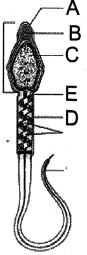
A
$A$ - Plasma membrane,$B$ - Acrosome,$C$ - Nucleus containing chromosomal material,$D$ - Middle piece,$E$ - Neck
B
$A$ - Acrosome,$B$ - Head,$C$ - Nucleus,$D$ - Neck,$E$ - Middle piece
C
$A$ - Head,$B$ - Acrosome,$C$ - Nucleus,$D$ - Middle piece,$E$ - Neck
D
$A$ - Plasma membrane,$B$ - Nucleus,$C$ - Acrosome,$D$ - Middle piece,$E$ - Neck
Solution
(A) Based on the structure of a human sperm:
$A$ points to the plasma membrane that envelops the entire body of the sperm.
$B$ points to the acrosome,which is a cap-like structure filled with enzymes that help in fertilization.
$C$ points to the nucleus,which contains the haploid chromosomal material.
$D$ points to the middle piece,which contains numerous mitochondria that provide energy for sperm motility.
$E$ points to the neck,which connects the head to the middle piece.
Therefore,the correct identification is $A$ - Plasma membrane,$B$ - Acrosome,$C$ - Nucleus containing chromosomal material,$D$ - Middle piece,$E$ - Neck.
$A$ points to the plasma membrane that envelops the entire body of the sperm.
$B$ points to the acrosome,which is a cap-like structure filled with enzymes that help in fertilization.
$C$ points to the nucleus,which contains the haploid chromosomal material.
$D$ points to the middle piece,which contains numerous mitochondria that provide energy for sperm motility.
$E$ points to the neck,which connects the head to the middle piece.
Therefore,the correct identification is $A$ - Plasma membrane,$B$ - Acrosome,$C$ - Nucleus containing chromosomal material,$D$ - Middle piece,$E$ - Neck.
0 likes
View Solution279
MediumMCQ
Spermatogonia undergo ....... to produce spermatozoa.
A
Mitosis
B
Meiosis
C
Dedifferentiation
D
None
Solution
(B) Spermatogenesis is the process of formation of spermatozoa from spermatogonia.
$1$. Spermatogonia $(2n)$ undergo repeated mitotic divisions to increase their number.
$2$. Some spermatogonia (primary spermatocytes) undergo meiosis ($I$ and $II$) to form haploid spermatids $(n)$.
$3$. These spermatids then undergo spermiogenesis (a process of differentiation) to transform into spermatozoa $(n)$.
Since the question asks for the process by which spermatogonia produce spermatozoa,meiosis is the critical reductional division involved in the formation of haploid gametes.
$1$. Spermatogonia $(2n)$ undergo repeated mitotic divisions to increase their number.
$2$. Some spermatogonia (primary spermatocytes) undergo meiosis ($I$ and $II$) to form haploid spermatids $(n)$.
$3$. These spermatids then undergo spermiogenesis (a process of differentiation) to transform into spermatozoa $(n)$.
Since the question asks for the process by which spermatogonia produce spermatozoa,meiosis is the critical reductional division involved in the formation of haploid gametes.
0 likes
View Solution280
MediumMCQ
$A$ - Spermatids are formed from secondary spermatocytes.
$R$ - The spermatids are transformed into spermatozoa by the process called spermiogenesis.
$R$ - The spermatids are transformed into spermatozoa by the process called spermiogenesis.
A
$A$ and $R$ are correct
B
$A$ and $R$ are incorrect
C
$A$ is correct,$R$ is incorrect
D
$A$ is incorrect,$R$ is correct
Solution
(A) $1$. During spermatogenesis,the primary spermatocyte undergoes meiosis-$I$ to form two haploid secondary spermatocytes.
$2$. Each secondary spermatocyte then undergoes meiosis-$II$ to form two spermatids. Thus,the statement $A$ is correct.
$3$. The transformation of non-motile spermatids into mature,motile spermatozoa is known as spermiogenesis. Thus,the statement $R$ is correct.
$4$. Since both statements are scientifically accurate,the correct option is $A$ and $R$ are correct.
$2$. Each secondary spermatocyte then undergoes meiosis-$II$ to form two spermatids. Thus,the statement $A$ is correct.
$3$. The transformation of non-motile spermatids into mature,motile spermatozoa is known as spermiogenesis. Thus,the statement $R$ is correct.
$4$. Since both statements are scientifically accurate,the correct option is $A$ and $R$ are correct.
0 likes
View Solution281
MediumMCQ
$A$ - Acrosome possesses mitochondria.
$R$ - Middle piece of sperm is filled with enzymes.
$R$ - Middle piece of sperm is filled with enzymes.
A
$A$ and $R$ are correct.
B
$A$ and $R$ are incorrect.
C
$A$ is correct,$R$ is incorrect.
D
$A$ is incorrect,$R$ is correct.
Solution
(B) - The acrosome is a cap-like structure present in the anterior part of the sperm head,which contains enzymes necessary for fertilization. It does not contain mitochondria. Therefore,statement $A$ is incorrect.
$R$ - The middle piece of the sperm is packed with numerous mitochondria,which provide energy for the motility of the sperm. It does not contain enzymes. Therefore,statement $R$ is also incorrect.
Thus,both $A$ and $R$ are incorrect.
$R$ - The middle piece of the sperm is packed with numerous mitochondria,which provide energy for the motility of the sperm. It does not contain enzymes. Therefore,statement $R$ is also incorrect.
Thus,both $A$ and $R$ are incorrect.
0 likes
View Solution282
MediumMCQ
$FSH$ acts on ........,which help in the process of spermiogenesis.
A
Spermatogonium
B
Spermatozoa
C
$A$ and $B$ both
D
Sertoli cell
Solution
(D) $FSH$ (Follicle Stimulating Hormone) acts on the $Sertoli$ cells in the testes.
These cells provide nourishment to the developing germ cells and secrete factors that facilitate the process of spermiogenesis,which is the transformation of spermatids into spermatozoa.
These cells provide nourishment to the developing germ cells and secrete factors that facilitate the process of spermiogenesis,which is the transformation of spermatids into spermatozoa.
0 likes
View Solution283
MediumMCQ
Which sequence is correct for oogenesis?
A
Oogonia $\rightarrow$ secondary oocyte $\rightarrow$ ovum
B
Oogonia $\rightarrow$ primary oocyte $\rightarrow$ ovum
C
Ovum $\rightarrow$ oogonia $\rightarrow$ secondary oocyte $\rightarrow$ primary oocyte
D
Oogonia $\rightarrow$ primary oocyte $\rightarrow$ secondary oocyte $\rightarrow$ ovum
Solution
(D) Oogenesis is the process of formation of a mature female gamete.
It begins with the multiplication phase where oogonia are formed.
These oogonia undergo differentiation to form primary oocytes.
The primary oocyte undergoes meiosis-$I$ to form a secondary oocyte and a first polar body.
The secondary oocyte then undergoes meiosis-$II$ to form an ovum and a second polar body.
Therefore,the correct sequence is: Oogonia $\rightarrow$ primary oocyte $\rightarrow$ secondary oocyte $\rightarrow$ ovum.
It begins with the multiplication phase where oogonia are formed.
These oogonia undergo differentiation to form primary oocytes.
The primary oocyte undergoes meiosis-$I$ to form a secondary oocyte and a first polar body.
The secondary oocyte then undergoes meiosis-$II$ to form an ovum and a second polar body.
Therefore,the correct sequence is: Oogonia $\rightarrow$ primary oocyte $\rightarrow$ secondary oocyte $\rightarrow$ ovum.
0 likes
View Solution284
MediumMCQ
Release of sperm from the seminiferous tubules is called
A
Spermatogenesis
B
Spermiation
C
Spermiogenesis
D
Oogenesis
Solution
(B) The process of releasing sperm from the seminiferous tubules into the lumen is known as $Spermiation$.
$Spermatogenesis$ is the overall process of formation of sperm from spermatogonia.
$Spermiogenesis$ is the transformation of spermatids into mature spermatozoa.
$Oogenesis$ is the process of formation of female gametes (ova) in the ovaries.
$Spermatogenesis$ is the overall process of formation of sperm from spermatogonia.
$Spermiogenesis$ is the transformation of spermatids into mature spermatozoa.
$Oogenesis$ is the process of formation of female gametes (ova) in the ovaries.
0 likes
View Solution285
MediumMCQ
Steroid hormone progesterone is secreted by the corpus luteum (a mass of cells in the ovary). Which of the following is correct for corpus luteum cells?
A
They have a large vacuole
B
They have more $SER$
C
They have more $RER$
D
They have a large amount of microvilli
Solution
(B) The corpus luteum is an endocrine structure in the ovary that secretes progesterone, which is a steroid hormone.
Steroid hormones are synthesized from cholesterol.
Cells that are specialized for the synthesis of steroid hormones require an extensive $Smooth \text{ } Endoplasmic \text{ } Reticulum$ $(SER)$ because the enzymes responsible for steroid biosynthesis are located within the $SER$ membrane.
Therefore, corpus luteum cells contain a high abundance of $SER$ to facilitate the production of progesterone.
Steroid hormones are synthesized from cholesterol.
Cells that are specialized for the synthesis of steroid hormones require an extensive $Smooth \text{ } Endoplasmic \text{ } Reticulum$ $(SER)$ because the enzymes responsible for steroid biosynthesis are located within the $SER$ membrane.
Therefore, corpus luteum cells contain a high abundance of $SER$ to facilitate the production of progesterone.
0 likes
View Solution286
MediumMCQ
Which pituitary hormone regulates the Sertoli cells?
A
$GH$
B
Prolactin
C
$LH$
D
$FSH$
Solution
(D) The pituitary gland secretes gonadotropins,which include $LH$ (Luteinizing Hormone) and $FSH$ (Follicle Stimulating Hormone).
$FSH$ acts on the Sertoli cells present in the testes.
It stimulates the secretion of some factors which help in the process of spermiogenesis.
Therefore,$FSH$ is the hormone responsible for the regulation of Sertoli cells.
$FSH$ acts on the Sertoli cells present in the testes.
It stimulates the secretion of some factors which help in the process of spermiogenesis.
Therefore,$FSH$ is the hormone responsible for the regulation of Sertoli cells.
0 likes
View Solution287
MediumMCQ
The ovum is released from the ovary in the ............. stage.
A
Secondary oocyte stage
B
Primary oocyte stage
C
Ootid stage
D
Mature ovum stage
Solution
(A) During oogenesis, the primary oocyte undergoes meiosis-$I$ to form a secondary oocyte and a first polar body. The secondary oocyte then begins meiosis-$II$ but gets arrested at the metaphase-$II$ stage. It is in this $Secondary$ oocyte stage that the ovum is released from the ovary during ovulation.
0 likes
View Solution288
MediumMCQ
How many spermatozoa are produced from a single secondary spermatocyte?
A
$4$
B
$8$
C
$2$
D
$1$
Solution
(C) During spermatogenesis,the primary spermatocyte undergoes meiosis-$I$ to form two haploid secondary spermatocytes.
Each secondary spermatocyte then undergoes meiosis-$II$ to produce two spermatids.
These spermatids eventually differentiate into spermatozoa.
Therefore,one secondary spermatocyte produces $2$ spermatozoa.
Each secondary spermatocyte then undergoes meiosis-$II$ to produce two spermatids.
These spermatids eventually differentiate into spermatozoa.
Therefore,one secondary spermatocyte produces $2$ spermatozoa.
0 likes
View Solution289
EasyMCQ
$A$ freshly released human ovum contains ...........
A
One $Y$ chromosome
B
Two $X$ chromosomes
C
One $X$ chromosome
D
Both $(A)$ and $(B)$
Solution
(C) In humans,the sex chromosome constitution of a female is $44 + XX$. During oogenesis,the primary oocyte undergoes meiosis to form a secondary oocyte and a polar body. The secondary oocyte is released during ovulation. Since the female has only $X$ chromosomes,the ovum produced after meiosis will always contain $22$ autosomes and one $X$ chromosome. Therefore,a freshly released human ovum contains one $X$ chromosome.
0 likes
View Solution290
MediumMCQ
When is the second polar body extruded from the oocyte nucleus?
A
After the entry of the sperm but before the completion of fertilization
B
After fertilization
C
Before the entry of the sperm
D
Without any relation to the entry of the sperm
Solution
(A) The secondary oocyte remains arrested in the metaphase-$II$ stage of meiosis-$II$. The entry of the sperm into the secondary oocyte triggers the completion of meiosis-$II$. This process results in the formation of a large haploid ovum (ootid) and a small second polar body. Therefore,the extrusion of the second polar body occurs after the entry of the sperm but before the fusion of the male and female pronuclei (completion of fertilization).
0 likes
View Solution291
MediumMCQ
The process of the acrosome in a sperm can be associated with which of the following?
A
Capacitation
B
Release of lysins
C
Entry of $Na^+$
D
Release of fertilizin
Solution
(B) The acrosome is a cap-like structure present on the anterior portion of the sperm head.
It is derived from the Golgi apparatus and contains hydrolytic enzymes,collectively known as sperm lysins (e.g.,hyaluronidase and acrosin).
During fertilization,the acrosome undergoes the acrosome reaction,which involves the release of these lysins.
These enzymes help the sperm to penetrate the protective layers of the ovum (zona pellucida and corona radiata),thereby facilitating fertilization.
It is derived from the Golgi apparatus and contains hydrolytic enzymes,collectively known as sperm lysins (e.g.,hyaluronidase and acrosin).
During fertilization,the acrosome undergoes the acrosome reaction,which involves the release of these lysins.
These enzymes help the sperm to penetrate the protective layers of the ovum (zona pellucida and corona radiata),thereby facilitating fertilization.
0 likes
View Solution292
EasyMCQ
The human egg is ...
A
Alecithal
B
Microlecithal
C
Mesolecithal
D
Polylecithal
Solution
(A) The human egg (ovum) is classified as $Alecithal$ or $Microlecithal$ because it contains a very negligible or almost no amount of yolk. Since the human embryo receives nutrition from the mother through the placenta,the egg does not require a large amount of stored yolk.
0 likes
View Solution293
EasyMCQ
After ovulation, the Graafian follicle transforms into which of the following?
A
Corpus luteum
B
Corpus callosum
C
Corpus albicans
D
Corpus atretica
Solution
(A) After the process of ovulation, the ruptured Graafian follicle undergoes a transformation process called luteinization.
Under the influence of Luteinizing Hormone $(LH)$, the remaining follicular cells (granulosa and theca cells) differentiate into a glandular structure known as the $Corpus$ luteum.
The $Corpus$ luteum acts as an endocrine gland and secretes large amounts of progesterone, which is essential for maintaining the endometrium during a potential pregnancy.
Under the influence of Luteinizing Hormone $(LH)$, the remaining follicular cells (granulosa and theca cells) differentiate into a glandular structure known as the $Corpus$ luteum.
The $Corpus$ luteum acts as an endocrine gland and secretes large amounts of progesterone, which is essential for maintaining the endometrium during a potential pregnancy.
0 likes
View Solution294
EasyMCQ
What does the middle piece of a human sperm contain?
A
Mitochondria and centriole
B
Mitochondria only
C
Centriole only
D
Nucleus and mitochondria
Solution
(B) The human sperm is composed of a head,neck,middle piece,and tail.
The middle piece contains numerous mitochondria,which are arranged in a spiral pattern (often called the $Nebelkern$).
These mitochondria provide the energy required for the movement of the tail,which facilitates sperm motility.
While the neck contains the proximal and distal centrioles,the middle piece is specifically characterized by the presence of mitochondria.
The middle piece contains numerous mitochondria,which are arranged in a spiral pattern (often called the $Nebelkern$).
These mitochondria provide the energy required for the movement of the tail,which facilitates sperm motility.
While the neck contains the proximal and distal centrioles,the middle piece is specifically characterized by the presence of mitochondria.
0 likes
View Solution295
EasyMCQ
After the first meiotic division,the primary spermatocyte differentiates into .........
A
Secondary spermatocyte
B
Primary spermatocyte
C
Spermatogonia
D
Spermatid
Solution
(A) The process of spermatogenesis involves several stages.
$1$. Spermatogonia $(2n)$ undergo mitosis to increase in number.
$2$. These cells then transform into primary spermatocytes $(2n)$.
$3$. The primary spermatocyte undergoes the first meiotic division (meiosis-$I$),which is a reductional division,resulting in the formation of two haploid $(n)$ cells known as secondary spermatocytes.
$4$. Therefore,after the first meiotic division,the primary spermatocyte differentiates into secondary spermatocytes.
$1$. Spermatogonia $(2n)$ undergo mitosis to increase in number.
$2$. These cells then transform into primary spermatocytes $(2n)$.
$3$. The primary spermatocyte undergoes the first meiotic division (meiosis-$I$),which is a reductional division,resulting in the formation of two haploid $(n)$ cells known as secondary spermatocytes.
$4$. Therefore,after the first meiotic division,the primary spermatocyte differentiates into secondary spermatocytes.
0 likes
View Solution296
MediumMCQ
Which of the following statements is correct regarding the human sperm?
A
The acrosome has a conical pointed structure used to pierce and enter the egg,resulting in fertilization.
B
The lysins of the sperm acrosome dissolve the egg envelopes and help in fertilization.
C
The acrosome acts as a sensory structure and guides the sperm towards the ovum.
D
The acrosome does not perform any specific function.
Solution
(B) The human sperm consists of a head,neck,middle piece,and tail. The head contains a haploid nucleus and is covered by a cap-like structure called the acrosome.
The acrosome is derived from the Golgi apparatus and contains hydrolytic enzymes collectively known as sperm lysins (e.g.,hyaluronidase).
These enzymes are responsible for dissolving the protective layers of the ovum (corona radiata and zona pellucida),thereby facilitating the entry of the sperm into the egg during the process of fertilization.
The acrosome is derived from the Golgi apparatus and contains hydrolytic enzymes collectively known as sperm lysins (e.g.,hyaluronidase).
These enzymes are responsible for dissolving the protective layers of the ovum (corona radiata and zona pellucida),thereby facilitating the entry of the sperm into the egg during the process of fertilization.
0 likes
View Solution297
MediumMCQ
Which of the following statements regarding the viability of human sperm is incorrect?
A
Sperm can remain viable for only $24$ hours.
B
Sperm viability depends on the $pH$ of the medium and they are more active in an alkaline medium.
C
The viability of sperm is determined by their motility.
D
Sperm must be concentrated in a thick suspension.
Solution
(D) The viability of human sperm is typically $24$ to $48$ hours in the female reproductive tract. Sperm are highly sensitive to the $pH$ of the environment; they are immobilized in acidic conditions and show increased motility in alkaline environments. Sperm viability is indeed assessed by their motility,as non-motile sperm are generally considered non-viable. The statement that sperm must be concentrated in a thick suspension is incorrect,as sperm are typically transported in a fluid medium (semen) and do not require a 'thick suspension' to maintain viability; in fact,high concentration without proper fluid volume can be detrimental.
0 likes
View SolutionHuman Reproduction — Gametogenesis · Frequently Asked Questions
1Are these Human Reproduction questions useful for JEE and NEET?
Yes. All questions in this section are mapped to JEE Main and NEET exam patterns. Previous year questions from JEE Main, NEET, GUJCET and state-level exams are included with full solutions.
2Can I switch to Hindi or Gujarati for these questions?
Yes. Use the language tabs in the hero section or the sidebar to view the same questions and solutions in English, Hindi or Gujarati.
3How do I generate a question paper from this subtopic?
Use the Vedclass Exam Paper Generator — select the chapter and subtopic, set difficulty, and generate Sets A, B, C, D automatically. First 3 chapters of every subject are free.
Vedclass Products
For Students
Vedclass Test Series
Mock tests in real JEE/NEET style with performance analysis. 5-day free trial.
Start Free TrialFor Teachers
Exam Paper Generator
Generate Set A/B/C/D papers from this chapter in 2 minutes. 3 chapters free.
Try FreeFor Institutes
Online Exam Module
Live online exams with unlimited students, 360° analytics & white-label branding.
See DemoFor Teachers & Institutes
Generate a Human Reproduction Exam Paper in 2 Minutes
Select subtopic & difficulty — Sets A, B, C, D auto-generated with No Repeat logic.
First 3 chapters of every subject are free — no payment required.