
A English
Gametogenesis Questions in English
Class 12 Biology · Human Reproduction · Gametogenesis
576+
Questions
English
Language
100%
With Solutions
Showing 26 of 576 questions in English
551
EasyMCQ
Which one of the following is released by the Graafian follicle at the time of ovulation?
A
Primary Oocyte
B
Ovum
C
First polar body
D
Secondary Oocyte
Solution
(D) During the process of ovulation,the Graafian follicle ruptures to release the female gamete. At this stage,the oocyte is arrested in the metaphase of meiosis-$II$ and is known as the secondary oocyte. The secondary oocyte is surrounded by the zona pellucida and corona radiata. Therefore,the correct answer is $D$.
0 likes
View Solution552
EasyMCQ
Zona pellucida is first observed in . . . . . . .
A
Tertiary follicle
B
Secondary follicle
C
Primary follicle
D
Graafian follicle
Solution
(B) The $Zona$ $pellucida$ is a glycoprotein layer surrounding the plasma membrane of an oocyte. It first appears during the development of the $Secondary$ $follicle$ stage, where it begins to form around the primary oocyte. By the time the follicle reaches the $Tertiary$ $follicle$ stage, the $Zona$ $pellucida$ is clearly defined and well-developed.
0 likes
View Solution553
EasyMCQ
$FSH$ hormone acts on the Sertoli cells and stimulates the secretion of some factors which help in the process of spermiogenesis.
A
$TSH$
B
$FSH$
C
$LH$
D
$PIF$
Solution
(B) The correct answer is $B$.
$FSH$ (Follicle Stimulating Hormone) is secreted by the anterior pituitary gland.
It acts on the Sertoli cells present in the seminiferous tubules of the testes.
Upon stimulation by $FSH$,Sertoli cells secrete various factors,including Androgen Binding Protein $(ABP)$,which concentrate testosterone locally and facilitate the process of spermiogenesis (the transformation of spermatids into spermatozoa).
$FSH$ (Follicle Stimulating Hormone) is secreted by the anterior pituitary gland.
It acts on the Sertoli cells present in the seminiferous tubules of the testes.
Upon stimulation by $FSH$,Sertoli cells secrete various factors,including Androgen Binding Protein $(ABP)$,which concentrate testosterone locally and facilitate the process of spermiogenesis (the transformation of spermatids into spermatozoa).
0 likes
View Solution554
EasyMCQ
For normal fertility in males,what percentage of sperms must have normal shape and size,and what percentage of sperms must show vigorous motility?
A
$X$ - at least $60\%$,$Y$ - at least $40\%$
B
$X$ - maximum $60\%$,$Y$ - minimum $40\%$
C
$X$ - at least $40\%$,$Y$ - at least $60\%$
D
$X$ - minimum $60\%$,$Y$ - maximum $40\%$
Solution
(A) For normal fertility,it is essential that at least $60\%$ of all sperms must have normal shape and size,and at least $40\%$ of them must show vigorous motility. This is a standard physiological requirement for successful fertilization in humans.
0 likes
View Solution555
EasyMCQ
Which one of the following is diploid?
A
Spermatid
B
Primary spermatocytes
C
Secondary spermatocytes
D
Spermatozoa
Solution
(B) In the process of spermatogenesis,the $2n$ (diploid) spermatogonia undergo mitosis to form primary spermatocytes,which are also $2n$ (diploid).
These primary spermatocytes then undergo meiosis $I$ to form secondary spermatocytes,which are $n$ (haploid).
Secondary spermatocytes undergo meiosis $II$ to form spermatids ($n$,haploid),which eventually differentiate into spermatozoa ($n$,haploid).
Therefore,only the primary spermatocytes are diploid $(2n)$.
These primary spermatocytes then undergo meiosis $I$ to form secondary spermatocytes,which are $n$ (haploid).
Secondary spermatocytes undergo meiosis $II$ to form spermatids ($n$,haploid),which eventually differentiate into spermatozoa ($n$,haploid).
Therefore,only the primary spermatocytes are diploid $(2n)$.
0 likes
View Solution556
EasyMCQ
Which of the following hormones is secreted in a high amount,causing ovulation in women?
A
Estrogen
B
Luteinizing Hormone $(LH)$
C
Follicle Stimulating Hormone $(FSH)$
D
Androgens
Solution
(B) The process of ovulation is triggered by a rapid surge in the secretion of Luteinizing Hormone $(LH)$ from the anterior pituitary gland. This phenomenon is known as the $LH$ surge. This surge occurs towards the middle of the menstrual cycle (around the $14^{th}$ day) and induces the rupture of the Graafian follicle,leading to the release of the secondary oocyte (ovum). Therefore,the correct option is $B$.
0 likes
View Solution557
EasyMCQ
After spermiogenesis,sperm head is embedded in . . . . . . .
A
Sertoli cells
B
Interstitial cells
C
Leydig cells
D
Corpus luteum
Solution
(A) After the process of spermiogenesis,the transformation of spermatids into spermatozoa occurs.
Following this,the sperm heads become embedded in the $Sertoli$ cells to receive nourishment.
Finally,they are released from the seminiferous tubules by the process called spermiation.
Following this,the sperm heads become embedded in the $Sertoli$ cells to receive nourishment.
Finally,they are released from the seminiferous tubules by the process called spermiation.
0 likes
View Solution558
EasyMCQ
Name the cells which provide nourishment to the spermatogonia.
A
Leydig's cells
B
Sertoli cells
C
Stem cells
D
Follicular epithelial cells
Solution
(B) Sertoli cells (also known as nurse cells) are specialized cells found within the seminiferous tubules of the testes. Their primary function is to provide structural and metabolic support,as well as nourishment,to the developing germ cells (spermatogonia) during the process of spermatogenesis.
0 likes
View Solution559
EasyMCQ
In the absence of an acrosome,the sperm . . . . . .
A
cannot penetrate the egg
B
cannot get energy
C
cannot get food
D
cannot swim
Solution
(A) The correct answer is $A$.
In the absence of an acrosome,the sperm cannot penetrate the egg.
The acrosome is a cap-like structure present at the tip of the sperm head.
It contains hydrolytic enzymes,such as hyaluronidase and acrosin,which are essential for digesting the protective layers of the ovum (zona pellucida and corona radiata).
Without these enzymes,the sperm is unable to penetrate the egg,and fertilization cannot occur.
In the absence of an acrosome,the sperm cannot penetrate the egg.
The acrosome is a cap-like structure present at the tip of the sperm head.
It contains hydrolytic enzymes,such as hyaluronidase and acrosin,which are essential for digesting the protective layers of the ovum (zona pellucida and corona radiata).
Without these enzymes,the sperm is unable to penetrate the egg,and fertilization cannot occur.
0 likes
View Solution560
EasyMCQ
With reference to human sperm,match the List-$I$ with List-$II$.
Choose the correct option from the following:
| List-$I$ | List-$II$ |
|---|---|
| $1$. Head | $s$. Contains haploid nucleus |
| $2$. Acrosome | $p$. Filled with enzymes |
| $3$. Middle piece | $q$. Contains mitochondria |
| $4$. Tail | $r$. Sperm motility |
Choose the correct option from the following:
A
$1-r, 2-q, 3-s, 4-p$
B
$1-s, 2-p, 3-q, 4-r$
C
$1-s, 2-r, 3-p, 4-q$
D
$1-q, 2-s, 3-r, 4-p$
Solution
(B) The correct match is $1-s, 2-p, 3-q, 4-r$.
$1$. Head $(s)$: The sperm head contains an elongated haploid nucleus.
$2$. Acrosome $(p)$: The anterior portion of the head is covered by a cap-like structure called the acrosome,which is filled with enzymes that help in the fertilization of the ovum.
$3$. Middle piece $(q)$: The middle piece possesses numerous mitochondria,which produce energy for the movement of the tail.
$4$. Tail $(r)$: The tail facilitates sperm motility,which is essential for fertilization.
$1$. Head $(s)$: The sperm head contains an elongated haploid nucleus.
$2$. Acrosome $(p)$: The anterior portion of the head is covered by a cap-like structure called the acrosome,which is filled with enzymes that help in the fertilization of the ovum.
$3$. Middle piece $(q)$: The middle piece possesses numerous mitochondria,which produce energy for the movement of the tail.
$4$. Tail $(r)$: The tail facilitates sperm motility,which is essential for fertilization.
0 likes
View Solution561
EasyMCQ
If two primary spermatocytes and two primary oocytes undergo meiosis simultaneously,what will be the ratio of spermatozoa and ova produced at the end of the gametogenesis?
A
$2$:$1$
B
$4$:$1$
C
$6$:$2$
D
$1$:$2$
Solution
(B) During spermatogenesis,one primary spermatocyte undergoes meiosis to produce $4$ functional spermatozoa.
Therefore,$2$ primary spermatocytes will produce $2 \times 4 = 8$ spermatozoa.
During oogenesis,one primary oocyte undergoes meiosis to produce only $1$ functional ovum (and $2-3$ polar bodies which degenerate).
Therefore,$2$ primary oocytes will produce $2 \times 1 = 2$ ova.
The ratio of spermatozoa to ova produced is $8:2$,which simplifies to $4:1$.
Therefore,$2$ primary spermatocytes will produce $2 \times 4 = 8$ spermatozoa.
During oogenesis,one primary oocyte undergoes meiosis to produce only $1$ functional ovum (and $2-3$ polar bodies which degenerate).
Therefore,$2$ primary oocytes will produce $2 \times 1 = 2$ ova.
The ratio of spermatozoa to ova produced is $8:2$,which simplifies to $4:1$.
0 likes
View Solution562
EasyMCQ
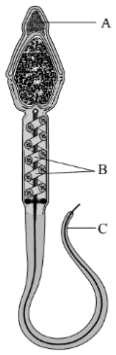
In the given diagram of human sperm,identify the functions of the labelled parts $A$,$B$ and $C$.
A
$A \rightarrow$ Helps in penetration of sperm into ovum,$B \rightarrow$ Helps in movement of sperm,$C \rightarrow$ provides energy for the movement of sperms into the female reproductive tract.
B
$A \rightarrow$ Helps in penetration of sperm into ovum,$B \rightarrow$ Provides energy for the movement of sperm,$C \rightarrow$ Helps in movement of sperm.
C
$A \rightarrow$ Helps in movement of sperm,$B \rightarrow$ Helps in penetration of sperm into ovum,$C \rightarrow$ provides energy for the movement of sperms.
D
$A \rightarrow$ Provides energy for the movement of sperm,$B \rightarrow$ Helps in movement of sperm,$C \rightarrow$ Helps in penetration of sperm into ovum.
Solution
(B) The correct answer is $(B)$.
$A$ represents the acrosome,which contains enzymes that help in the penetration of the sperm into the ovum.
$B$ represents the middle piece,which contains numerous mitochondria arranged in a spiral. These mitochondria provide the energy $(ATP)$ required for the movement of the sperm.
$C$ represents the tail,which facilitates the movement of the sperm through the female reproductive tract.
$A$ represents the acrosome,which contains enzymes that help in the penetration of the sperm into the ovum.
$B$ represents the middle piece,which contains numerous mitochondria arranged in a spiral. These mitochondria provide the energy $(ATP)$ required for the movement of the sperm.
$C$ represents the tail,which facilitates the movement of the sperm through the female reproductive tract.
0 likes
View Solution563
EasyMCQ
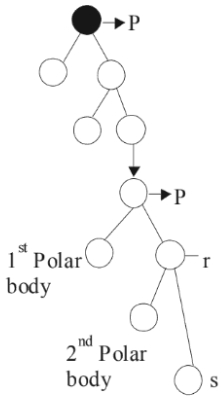
Identify the cells represented as $p$,$q$,$r$,and $s$ in the schematic representation of Oogenesis shown below and choose the correct option.
A
$p$ - Oogonia,$q$ - Primary oocyte,$r$ - Secondary oocyte,$s$ - Ovum
B
$p$ - Ovum,$q$ - Oogonia,$r$ - Primary oocyte,$s$ - Secondary oocyte
C
$p$ - Secondary oocyte,$q$ - Primary oocyte,$r$ - Ovum,$s$ - Oogonia
D
$p$ - Ovum,$q$ - Secondary oocyte,$r$ - Primary oocyte,$s$ - Ovum
Solution
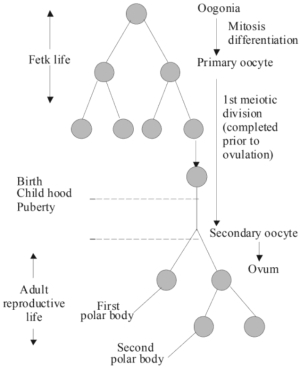
(A) The process of Oogenesis begins with the multiplication of Oogonia $(p)$ in the fetal ovary.
These Oogonia undergo differentiation to form Primary oocytes $(q)$.
The Primary oocyte completes the first meiotic division to form a large Secondary oocyte $(r)$ and a small first polar body.
The Secondary oocyte then undergoes the second meiotic division to form a large Ovum $(s)$ and a second polar body.
Therefore,the correct sequence is $p$ - Oogonia,$q$ - Primary oocyte,$r$ - Secondary oocyte,$s$ - Ovum.
These Oogonia undergo differentiation to form Primary oocytes $(q)$.
The Primary oocyte completes the first meiotic division to form a large Secondary oocyte $(r)$ and a small first polar body.
The Secondary oocyte then undergoes the second meiotic division to form a large Ovum $(s)$ and a second polar body.
Therefore,the correct sequence is $p$ - Oogonia,$q$ - Primary oocyte,$r$ - Secondary oocyte,$s$ - Ovum.
0 likes
View Solution564
EasyMCQ
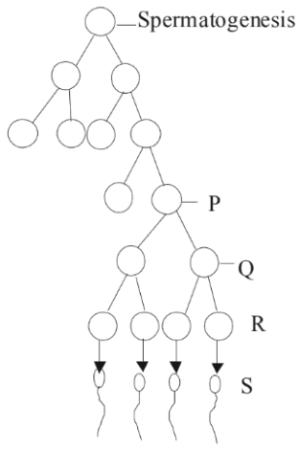
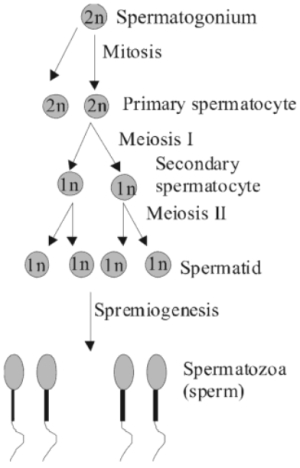
Identify the cells representing $P$,$Q$,$R$,and $S$ in the given schematic representation of spermatogenesis.
A
$P$ - Spermatozoa,$Q$ - Spermatids,$R$ - Secondary spermatocyte,$S$ - Primary spermatocyte
B
$P$ - Primary spermatocyte,$Q$ - Secondary spermatocyte,$R$ - Spermatids,$S$ - Spermatozoa
C
$P$ - Secondary spermatocyte,$Q$ - Spermatids,$R$ - Spermatozoa,$S$ - Primary spermatocyte
D
$P$ - Secondary spermatocyte,$Q$ - Primary spermatocyte,$R$ - Spermatozoa,$S$ - Spermatids
Solution
(B) In the process of spermatogenesis,the sequence of cell development is as follows:
$1$. $P$ represents the Primary spermatocyte,which undergoes Meiosis $I$ to form two haploid cells.
$2$. $Q$ represents the Secondary spermatocyte,which is the product of Meiosis $I$ and undergoes Meiosis $II$.
$3$. $R$ represents the Spermatids,which are the haploid cells formed after Meiosis $II$.
$4$. $S$ represents the Spermatozoa (sperm),which are formed from spermatids through the process of spermiogenesis.
Therefore,the correct sequence is $P$ - Primary spermatocyte,$Q$ - Secondary spermatocyte,$R$ - Spermatids,$S$ - Spermatozoa.
$1$. $P$ represents the Primary spermatocyte,which undergoes Meiosis $I$ to form two haploid cells.
$2$. $Q$ represents the Secondary spermatocyte,which is the product of Meiosis $I$ and undergoes Meiosis $II$.
$3$. $R$ represents the Spermatids,which are the haploid cells formed after Meiosis $II$.
$4$. $S$ represents the Spermatozoa (sperm),which are formed from spermatids through the process of spermiogenesis.
Therefore,the correct sequence is $P$ - Primary spermatocyte,$Q$ - Secondary spermatocyte,$R$ - Spermatids,$S$ - Spermatozoa.
0 likes
View Solution565
EasyMCQ
The process of conversion of non-motile spermatids into motile spermatozoa is called:
A
spermiogenesis
B
oogenesis
C
sporogenesis
D
spermatogenesis
Solution
(A) The correct answer is $A$ (spermiogenesis).
$1$. The process of transformation of non-motile spermatids into mature,motile spermatozoa is known as spermiogenesis.
$2$. This process represents the final stage of spermatogenesis,where the spermatids undergo structural changes to become functional sperm cells.
$3$. During this phase,the spermatid loses most of its cytoplasm,develops an acrosome,and forms a tail for motility.
$1$. The process of transformation of non-motile spermatids into mature,motile spermatozoa is known as spermiogenesis.
$2$. This process represents the final stage of spermatogenesis,where the spermatids undergo structural changes to become functional sperm cells.
$3$. During this phase,the spermatid loses most of its cytoplasm,develops an acrosome,and forms a tail for motility.
0 likes
View Solution566
EasyMCQ
In human females,the number of primary follicles left in each ovary at puberty is
A
$30,000-30,000$
B
$30,000-60,000$
C
$60,000-80,000$
D
$1,50,000-1,60,000$
Solution
(C) The correct answer is $C$.
During fetal development,millions of oogonia are formed in each fetal ovary.
However,no more oogonia are formed or added after birth.
Many of these primary follicles degenerate during the phase from birth to puberty.
As a result,at the time of puberty,only about $60,000-80,000$ primary follicles are left in each ovary.
During fetal development,millions of oogonia are formed in each fetal ovary.
However,no more oogonia are formed or added after birth.
Many of these primary follicles degenerate during the phase from birth to puberty.
As a result,at the time of puberty,only about $60,000-80,000$ primary follicles are left in each ovary.
0 likes
View Solution567
EasyMCQ
The hormone which acts on Sertoli cells and stimulates the process of spermiogenesis is
A
GnRH
B
androgen
C
$FSH$
D
$LH$
Solution
(C) The correct option is $C$.
$FSH$ (Follicle Stimulating Hormone) acts on the Sertoli cells of the testes.
It stimulates the secretion of some factors which help in the process of spermiogenesis,which is the transformation of spermatids into spermatozoa.
$FSH$ (Follicle Stimulating Hormone) acts on the Sertoli cells of the testes.
It stimulates the secretion of some factors which help in the process of spermiogenesis,which is the transformation of spermatids into spermatozoa.
0 likes
View Solution568
EasyMCQ
If $2n = 16$ in a primary spermatocyte which is in the metaphase of the first meiotic division,what shall be the total number of chromatids in each of the secondary spermatocytes?
A
$16$
B
$24$
C
$32$
D
$8$
Solution
(A) In a primary spermatocyte,the diploid number of chromosomes is $2n = 16$.
During the first meiotic division $(Meiosis-I)$,the homologous chromosomes separate,resulting in the formation of two secondary spermatocytes.
Each secondary spermatocyte receives $n = 8$ chromosomes.
Since each chromosome consists of $2$ sister chromatids,the total number of chromatids in each secondary spermatocyte is $8 \times 2 = 16$.
During the first meiotic division $(Meiosis-I)$,the homologous chromosomes separate,resulting in the formation of two secondary spermatocytes.
Each secondary spermatocyte receives $n = 8$ chromosomes.
Since each chromosome consists of $2$ sister chromatids,the total number of chromatids in each secondary spermatocyte is $8 \times 2 = 16$.
0 likes
View Solution569
EasyMCQ
Vitellogenesis occurs during the formation of
A
ootid in the Fallopian tube
B
secondary oocyte in the Fallopian tube
C
primary oocyte in the Graafian follicle
D
oogonial cell in the Graafian follicle
Solution
(C) primary oocyte in the Graafian follicle.
Vitellogenesis is the process of yolk formation and deposition.
It occurs in the primary oocyte within the Graafian follicle during oogenesis in the ovary.
This stage involves the accumulation of yolk,which includes proteins,fats,phospholipids,carbohydrates,and glycogen,all of which are essential for the development of the embryo.
Vitellogenesis is the process of yolk formation and deposition.
It occurs in the primary oocyte within the Graafian follicle during oogenesis in the ovary.
This stage involves the accumulation of yolk,which includes proteins,fats,phospholipids,carbohydrates,and glycogen,all of which are essential for the development of the embryo.
0 likes
View Solution570
EasyMCQ
Which of the following groups of cells in the male gonad represent haploid cells?
A
Germinal epithelial cells
B
Spermatogonial cells
C
Primary spermatocytes
D
Secondary spermatocytes
Solution
(D) In the process of spermatogenesis,the germinal epithelial cells $(2n)$ undergo mitosis to form spermatogonia $(2n)$.
These spermatogonia grow into primary spermatocytes $(2n)$.
Primary spermatocytes undergo the first meiotic division (meiosis-$I$) to form two secondary spermatocytes $(n)$.
Since secondary spermatocytes are formed after the first meiotic division,they are haploid $(n)$ cells.
Therefore,the correct option is $D$.
These spermatogonia grow into primary spermatocytes $(2n)$.
Primary spermatocytes undergo the first meiotic division (meiosis-$I$) to form two secondary spermatocytes $(n)$.
Since secondary spermatocytes are formed after the first meiotic division,they are haploid $(n)$ cells.
Therefore,the correct option is $D$.
0 likes
View Solution571
EasyMCQ
If a germ cell in a female gonad and a germ cell in a male gonad begin undergoing meiosis simultaneously,what will be the ratio of ova and sperms produced?
A
$1$:$2$
B
$1$:$1$
C
$2$:$1$
D
$1$:$4$
Solution
(D) In the process of gametogenesis,a single primary spermatocyte (male germ cell) undergoes meiosis to produce $4$ functional sperms.
Conversely,a single primary oocyte (female germ cell) undergoes meiosis to produce only $1$ functional ovum and $3$ non-functional polar bodies.
Therefore,the ratio of ova produced to sperms produced from one germ cell each is $1:4$.
Conversely,a single primary oocyte (female germ cell) undergoes meiosis to produce only $1$ functional ovum and $3$ non-functional polar bodies.
Therefore,the ratio of ova produced to sperms produced from one germ cell each is $1:4$.
0 likes
View Solution572
EasyMCQ
The nourishing cells in the seminiferous tubules are
A
follicular cells
B
leydig cells
C
sertoli cells
D
spermatogonial cells
Solution
(C) The correct answer is $C$.
Sertoli cells are specialized cells found within the seminiferous tubules of the testes.
Their primary function is to provide nourishment,structural support,and protection to the developing germ cells (spermatids) during the process of spermatogenesis.
Sertoli cells are specialized cells found within the seminiferous tubules of the testes.
Their primary function is to provide nourishment,structural support,and protection to the developing germ cells (spermatids) during the process of spermatogenesis.
0 likes
View Solution573
EasyMCQ
Which one of the following characters favours the process of normal spermatogenesis in human male?
A
Descent of testes into scrotum
B
Testes remain in the abdominal cavity
C
Infection by mumps virus during childhood
D
Increased scrotal temperature
Solution
(A) The correct answer is $A$.
$1$. The testes are the primary male reproductive organs responsible for the production of sperms and the secretion of male sex hormones.
$2$. The scrotum is a pouch of skin that holds the testes outside the abdominal cavity.
$3$. This external position is crucial because it maintains the temperature of the testes at $2-2.5^{\circ}C$ lower than the normal internal body temperature.
$4$. This lower temperature is essential for the process of normal spermatogenesis,as higher temperatures can inhibit sperm production.
$1$. The testes are the primary male reproductive organs responsible for the production of sperms and the secretion of male sex hormones.
$2$. The scrotum is a pouch of skin that holds the testes outside the abdominal cavity.
$3$. This external position is crucial because it maintains the temperature of the testes at $2-2.5^{\circ}C$ lower than the normal internal body temperature.
$4$. This lower temperature is essential for the process of normal spermatogenesis,as higher temperatures can inhibit sperm production.
0 likes
View Solution574
MediumMCQ
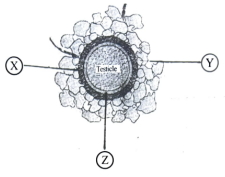
In the given diagram,choose the correct option for the labels $X$,$Y$,and $Z$.
A
$X$ - Zona pellucida,$Y$ - Corona radiata,$Z$ - Perivitelline space
B
$X$ - Zona pellucida,$Y$ - Perivitelline space,$Z$ - Corona radiata
C
$X$ - Corona radiata,$Y$ - Zona pellucida,$Z$ - Perivitelline space
D
$X$ - Perivitelline space,$Y$ - Corona radiata,$Z$ - Zona pellucida
Solution
(A) Based on the biological structure of an ovum (oocyte):
$1$. The outermost layer of follicular cells is the $Corona \text{ } radiata$ (labeled $Y$ in the diagram).
$2$. The thick,transparent glycoprotein layer surrounding the oocyte membrane is the $Zona \text{ } pellucida$ (labeled $X$ in the diagram).
$3$. The space between the $Zona \text{ } pellucida$ and the oocyte membrane is the $Perivitelline \text{ } space$ (labeled $Z$ in the diagram).
Therefore,the correct identification is $X$ - $Zona \text{ } pellucida$,$Y$ - $Corona \text{ } radiata$,$Z$ - $Perivitelline \text{ } space$.
$1$. The outermost layer of follicular cells is the $Corona \text{ } radiata$ (labeled $Y$ in the diagram).
$2$. The thick,transparent glycoprotein layer surrounding the oocyte membrane is the $Zona \text{ } pellucida$ (labeled $X$ in the diagram).
$3$. The space between the $Zona \text{ } pellucida$ and the oocyte membrane is the $Perivitelline \text{ } space$ (labeled $Z$ in the diagram).
Therefore,the correct identification is $X$ - $Zona \text{ } pellucida$,$Y$ - $Corona \text{ } radiata$,$Z$ - $Perivitelline \text{ } space$.
0 likes
View Solution575
MediumMCQ
Arrange the following cell layers/structures around the female gamete,from outer to inner side :
$A$. Zona pellucida
$B$. Perivitelline space
$C$. Corona radiata
$D$. Plasma membrane of ovum
$A$. Zona pellucida
$B$. Perivitelline space
$C$. Corona radiata
$D$. Plasma membrane of ovum
A
$D, B, A, C$
B
$A, C, B, D$
C
$C, A, D, B$
D
$C, A, B, D$
Solution
(D) The structures surrounding the ovum from the outside to the inside are as follows:
$1$. Corona radiata (outermost layer consisting of follicular cells).
$2$. Zona pellucida (a glycoprotein layer).
$3$. Perivitelline space (the space between the zona pellucida and the plasma membrane).
$4$. Plasma membrane of the ovum (innermost boundary).
Therefore,the correct sequence from outer to inner is $C, A, B, D$.
$1$. Corona radiata (outermost layer consisting of follicular cells).
$2$. Zona pellucida (a glycoprotein layer).
$3$. Perivitelline space (the space between the zona pellucida and the plasma membrane).
$4$. Plasma membrane of the ovum (innermost boundary).
Therefore,the correct sequence from outer to inner is $C, A, B, D$.
0 likes
View Solution576
MediumMCQ
Spermatogonia undergo a series of cell divisions to produce sperms. Select the correct statements from the following:
$A$. Spermatogonia always undergo meiotic cell division.
$B$. Primary spermatocytes divide mitotically to produce secondary spermatocytes.
$C$. Secondary spermatocytes,through their second meiotic division,produce spermatids.
$D$. Spermatids produce spermatozoa through mitosis.
$E$. Spermatids transform into spermatozoa by spermiogenesis.
Choose the correct answer from the options given below:
$A$. Spermatogonia always undergo meiotic cell division.
$B$. Primary spermatocytes divide mitotically to produce secondary spermatocytes.
$C$. Secondary spermatocytes,through their second meiotic division,produce spermatids.
$D$. Spermatids produce spermatozoa through mitosis.
$E$. Spermatids transform into spermatozoa by spermiogenesis.
Choose the correct answer from the options given below:
A
$(1)$ $A, C$ and $E$ only
B
$(2)$ $C$ and $E$ only
C
$(3)$ $A$ and $E$ only
D
$(4)$ $B, C$ and $D$ only
Solution
(B) is incorrect because spermatogonia initially undergo mitotic divisions to increase their population.
$B$ is incorrect because primary spermatocytes undergo meiosis $I$ to form secondary spermatocytes.
$C$ is correct because secondary spermatocytes undergo meiosis $II$ to produce haploid spermatids.
$D$ is incorrect because the transformation of spermatids into spermatozoa is a process of structural remodeling called spermiogenesis,not mitosis.
$E$ is correct because the process of transformation of spermatids into spermatozoa is known as spermiogenesis.
Therefore,the correct statements are $C$ and $E$.
$B$ is incorrect because primary spermatocytes undergo meiosis $I$ to form secondary spermatocytes.
$C$ is correct because secondary spermatocytes undergo meiosis $II$ to produce haploid spermatids.
$D$ is incorrect because the transformation of spermatids into spermatozoa is a process of structural remodeling called spermiogenesis,not mitosis.
$E$ is correct because the process of transformation of spermatids into spermatozoa is known as spermiogenesis.
Therefore,the correct statements are $C$ and $E$.
0 likes
View SolutionHuman Reproduction — Gametogenesis · Frequently Asked Questions
1Are these Human Reproduction questions useful for JEE and NEET?
Yes. All questions in this section are mapped to JEE Main and NEET exam patterns. Previous year questions from JEE Main, NEET, GUJCET and state-level exams are included with full solutions.
2Can I switch to Hindi or Gujarati for these questions?
Yes. Use the language tabs in the hero section or the sidebar to view the same questions and solutions in English, Hindi or Gujarati.
3How do I generate a question paper from this subtopic?
Use the Vedclass Exam Paper Generator — select the chapter and subtopic, set difficulty, and generate Sets A, B, C, D automatically. First 3 chapters of every subject are free.
Vedclass Products
For Students
Vedclass Test Series
Mock tests in real JEE/NEET style with performance analysis. 5-day free trial.
Start Free TrialFor Teachers
Exam Paper Generator
Generate Set A/B/C/D papers from this chapter in 2 minutes. 3 chapters free.
Try FreeFor Institutes
Online Exam Module
Live online exams with unlimited students, 360° analytics & white-label branding.
See DemoFor Teachers & Institutes
Generate a Human Reproduction Exam Paper in 2 Minutes
Select subtopic & difficulty — Sets A, B, C, D auto-generated with No Repeat logic.
First 3 chapters of every subject are free — no payment required.