
A English
Evidences of Evolution Questions in English
Class 12 Biology · Evolution · Evidences of Evolution
396+
Questions
English
Language
100%
With Solutions
Showing 45 of 396 questions in English
351
MediumMCQ
$A$: Sometimes,some babies are born with a small tail.
$R$: This is just a type of mutant variety.
$R$: This is just a type of mutant variety.
A
Assertion and Reason both are correct and Reason is the correct explanation of Assertion.
B
Assertion and Reason both are correct but Reason is not the correct explanation of Assertion.
C
Assertion is correct,but Reason is incorrect.
D
Both Assertion and Reason are incorrect.
Solution
(C) The presence of a small tail in some human babies is an example of $Atavism$.
$Atavism$ is the reappearance of an ancestral trait that had been lost during the course of evolution.
It is not a result of a simple mutation,but rather the expression of vestigial genes that are typically suppressed in modern humans.
Therefore,the Assertion is correct,but the Reason is incorrect.
$Atavism$ is the reappearance of an ancestral trait that had been lost during the course of evolution.
It is not a result of a simple mutation,but rather the expression of vestigial genes that are typically suppressed in modern humans.
Therefore,the Assertion is correct,but the Reason is incorrect.
0 likes
View Solution352
EasyMCQ
$A$: Muscles of external ears are fully developed in humans.
$R$: These muscles help in moving the ear pinna in humans.
$R$: These muscles help in moving the ear pinna in humans.
A
Assertion and Reason both are correct and Reason is the correct explanation of Assertion.
B
Assertion and Reason both are correct but Reason is not the correct explanation of Assertion.
C
Assertion is correct,but Reason is incorrect.
D
Both Assertion and Reason are incorrect.
Solution
(D) In humans,the muscles of the external ear (auricular muscles) are vestigial organs.
They are not fully developed and do not function to move the ear pinna as they do in many other mammals.
Therefore,both the Assertion and the Reason are incorrect.
They are not fully developed and do not function to move the ear pinna as they do in many other mammals.
Therefore,both the Assertion and the Reason are incorrect.
0 likes
View Solution353
MediumMCQ
What was the contribution of the scientist $Von \ Baer$ to the field of evolutionary biology?
A
Proposed the theory of natural selection.
B
Observed that embryos show common patterns before developing into adult forms.
C
Discovered the mechanism of mutation.
D
Proposed the law of use and disuse of organs.
Solution
(B) Karl Ernst von Baer observed that embryos of different species share common developmental patterns in their early stages,which later diverge to form adult structures. This observation provided significant evidence for common descent in evolutionary biology. He is often referred to as the father of embryology.
0 likes
View Solution354
MediumMCQ
Which of the following statements is not true?
A
Sweet potato and potato are an example of analogy.
B
Homology indicates common ancestry.
C
Flippers of penguins and dolphins are a pair of homologous organs.
D
Analogous structures are a result of convergent evolution.
Solution
(C) $1$. Homologous organs are those that have the same structural origin and developmental pattern but may perform different functions. They indicate common ancestry.
$2$. Analogous organs are those that perform similar functions but have different structural origins. They are a result of convergent evolution.
$3$. Sweet potato (root modification) and potato (stem modification) perform the same function of food storage but have different origins,making them analogous.
$4$. Flippers of penguins (birds) and dolphins (mammals) are analogous structures because they perform the same function (swimming) but have different anatomical structures. Therefore,the statement that they are homologous is incorrect.
$2$. Analogous organs are those that perform similar functions but have different structural origins. They are a result of convergent evolution.
$3$. Sweet potato (root modification) and potato (stem modification) perform the same function of food storage but have different origins,making them analogous.
$4$. Flippers of penguins (birds) and dolphins (mammals) are analogous structures because they perform the same function (swimming) but have different anatomical structures. Therefore,the statement that they are homologous is incorrect.
0 likes
View Solution355
EasyMCQ
Which of the following organs is vestigial in humans?
A
Vermiform appendix
B
Colon
C
Rectum
D
Caecum
Solution
(A) The $Vermiform$ $\text{appendix}$ is a narrow, worm-shaped tube that extends from the caecum of the large intestine.
In humans, it is considered a vestigial organ, meaning it has lost most or all of its original ancestral function through evolution.
While it may have played a role in the digestion of cellulose in our ancestors, it is now primarily associated with the immune system due to the presence of lymphoid tissue.
In humans, it is considered a vestigial organ, meaning it has lost most or all of its original ancestral function through evolution.
While it may have played a role in the digestion of cellulose in our ancestors, it is now primarily associated with the immune system due to the presence of lymphoid tissue.
0 likes
View Solution356
MediumMCQ
The embryological support for evolution was proposed by which scientist?
A
Karl Ernst von Baer
B
Ernst Haeckel
C
Charles Darwin
D
Alfred Wallace
Solution
(A) The embryological support for evolution was proposed by Karl Ernst von Baer. He observed that embryos of various vertebrates share common features during early stages of development,which suggests a common ancestry. Later,Ernst Haeckel proposed the 'Biogenetic Law' (ontogeny recapitulates phylogeny) based on these observations,but the foundational embryological evidence is attributed to von Baer.
0 likes
View Solution357
MediumMCQ
In the embryos of all vertebrates,including humans,a row of vestigial gill slits appears behind the head,but they function only in fish and not in other adult vertebrates. This observation was challenged by which scientist?
A
Karl Ernst von Baer
B
Ernst Haeckel
C
Charles Darwin
D
Alfred Wallace
Solution
(A) The observation that embryos of all vertebrates possess vestigial gill slits was used by $Ernst \ Haeckel$ to propose his 'Biogenetic Law' or 'Recapitulation Theory' $(Ontogeny \ repeats \ Phylogeny)$.
However,this idea was challenged by $Karl \ Ernst \ von \ Baer$. He noted that embryos do not pass through the adult stages of other animals; rather,they share common embryonic features that diverge as development progresses.
However,this idea was challenged by $Karl \ Ernst \ von \ Baer$. He noted that embryos do not pass through the adult stages of other animals; rather,they share common embryonic features that diverge as development progresses.
0 likes
View Solution358
MediumMCQ
Select the correct option for the forelimbs of whales, bats, cheetahs, and humans.
A
Divergent evolution, Analogous organs
B
Convergent evolution, Analogous organs
C
Convergent evolution, Homologous organs
D
Divergent evolution, Homologous organs
Solution
(D) The forelimbs of whales, bats, cheetahs, and humans possess the same structural plan (humerus, radius, ulna, carpals, metacarpals, and phalanges), which indicates a common ancestry. These are known as $Homologous$ $organs$. The development of these structures in different directions due to different needs is called $Divergent$ $evolution$.
0 likes
View Solution359
MediumMCQ
Homology indicates $..........$.
A
Different ancestors
B
Common ancestors
C
Different or common ancestors
D
None of these
Solution
(B) Homology refers to the similarity in the structural organization of organs in different organisms due to common ancestry.
These organs,known as homologous organs,perform different functions but share a similar anatomical structure and developmental origin.
For example,the forelimbs of whales,bats,cheetahs,and humans share the same structural plan (humerus,radius,ulna,carpals,metacarpals,and phalanges),which indicates that they evolved from a common ancestor.
These organs,known as homologous organs,perform different functions but share a similar anatomical structure and developmental origin.
For example,the forelimbs of whales,bats,cheetahs,and humans share the same structural plan (humerus,radius,ulna,carpals,metacarpals,and phalanges),which indicates that they evolved from a common ancestor.
0 likes
View Solution360
MediumMCQ
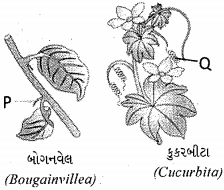
Select the correct option for the structures $P$ and $Q$ shown below.
A
Divergent evolution,Analogous organs
B
Convergent evolution,Analogous organs
C
Convergent evolution,Homologous organs
D
Divergent evolution,Homologous organs
Solution
(D) The structures $P$ (thorns of Bougainvillea) and $Q$ (tendrils of Cucurbita) are examples of homologous organs.
Homologous organs are those that have a similar anatomical origin and developmental pattern but perform different functions.
These structures arise from the same ancestral origin but evolve to perform different functions in different environments,which is a characteristic of divergent evolution.
Therefore,the correct option is Divergent evolution and Homologous organs.
Homologous organs are those that have a similar anatomical origin and developmental pattern but perform different functions.
These structures arise from the same ancestral origin but evolve to perform different functions in different environments,which is a characteristic of divergent evolution.
Therefore,the correct option is Divergent evolution and Homologous organs.
0 likes
View Solution361
MediumMCQ
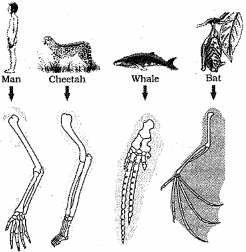
Select the appropriate option for the structures shown below.
A
Convergent evolution
B
Divergent evolution
C
Analogous organs
D
Both $A$ and $C$
Solution
(B) The image shows the forelimbs of a man,cheetah,whale,and bat. These structures have a similar anatomical plan (humerus,radius,ulna,carpals,metacarpals,and phalanges) but perform different functions (grasping,running,swimming,and flying). Such structures are called homologous organs. Homologous organs arise due to divergent evolution,where a common ancestor evolves into different species to adapt to different environments.
0 likes
View Solution362
DifficultMCQ
Identify the examples of Convergent Evolution and Divergent Evolution from the following list:
$I -$ Sweet potato (root) and Potato (stem)
$II -$ Forelimbs of Whale,Bat,Cheetah,and Human
$III -$ Thorn of Bougainvillea and Tendril of Cucurbita
$IV -$ Flippers of Penguins and Dolphins
$V -$ Wings of Butterfly and Wings of Bird
$VI -$ Eye of Octopus and Mammals
Select the correct sequence for Convergent Evolution and Divergent Evolution.
$I -$ Sweet potato (root) and Potato (stem)
$II -$ Forelimbs of Whale,Bat,Cheetah,and Human
$III -$ Thorn of Bougainvillea and Tendril of Cucurbita
$IV -$ Flippers of Penguins and Dolphins
$V -$ Wings of Butterfly and Wings of Bird
$VI -$ Eye of Octopus and Mammals
Select the correct sequence for Convergent Evolution and Divergent Evolution.
A
$I, IV, V, VI \quad \quad II, III$
B
$II, III \quad \quad I, IV, V, VI$
C
$I, II, III \quad \quad IV, V, VI$
D
$IV, V, VI \quad \quad I, II, III$
Solution
(A) Convergent evolution refers to the process where organisms not closely related independently evolve similar traits as a result of having to adapt to similar environments or ecological niches. Examples include:
$I -$ Sweet potato (root) and Potato (stem) (Analogous organs)
$IV -$ Flippers of Penguins and Dolphins (Analogous organs)
$V -$ Wings of Butterfly and Wings of Bird (Analogous organs)
$VI -$ Eye of Octopus and Mammals (Analogous organs)
Divergent evolution refers to the process where related species evolve different traits to adapt to different environments. Examples include:
$II -$ Forelimbs of Whale,Bat,Cheetah,and Human (Homologous organs)
$III -$ Thorn of Bougainvillea and Tendril of Cucurbita (Homologous organs)
Therefore,Convergent Evolution corresponds to $I, IV, V, VI$ and Divergent Evolution corresponds to $II, III$.
$I -$ Sweet potato (root) and Potato (stem) (Analogous organs)
$IV -$ Flippers of Penguins and Dolphins (Analogous organs)
$V -$ Wings of Butterfly and Wings of Bird (Analogous organs)
$VI -$ Eye of Octopus and Mammals (Analogous organs)
Divergent evolution refers to the process where related species evolve different traits to adapt to different environments. Examples include:
$II -$ Forelimbs of Whale,Bat,Cheetah,and Human (Homologous organs)
$III -$ Thorn of Bougainvillea and Tendril of Cucurbita (Homologous organs)
Therefore,Convergent Evolution corresponds to $I, IV, V, VI$ and Divergent Evolution corresponds to $II, III$.
0 likes
View Solution363
MediumMCQ
The functioning of proteins and genes in various organisms is $.....P.....$ which indicates that they share a $.....Q.....$ ancestor.
A
similar,different
B
different,different
C
similar,common
D
different,common
Solution
(C) The biochemical similarities,such as the functioning of proteins and genes across diverse organisms,provide strong evidence for evolution.
Since the fundamental molecular mechanisms (like $DNA$ replication,transcription,and translation) are conserved across different species,it indicates that these organisms share a common ancestor.
Therefore,the functioning is similar,and the ancestor is common.
Since the fundamental molecular mechanisms (like $DNA$ replication,transcription,and translation) are conserved across different species,it indicates that these organisms share a common ancestor.
Therefore,the functioning is similar,and the ancestor is common.
0 likes
View Solution364
MediumMCQ
In $1938$,a fish caught in .......... was thought to be extinct,but it was a Coelacanth.
A
South America
B
South Africa
C
North America
D
Europe
Solution
(B) The Coelacanth is a lobe-finned fish that was believed to have gone extinct millions of years ago.
In $1938$,a living specimen was caught off the coast of South Africa.
This discovery provided significant evidence for the evolution of fish into amphibians,as Coelacanths are considered ancestors of modern-day tetrapods.
In $1938$,a living specimen was caught off the coast of South Africa.
This discovery provided significant evidence for the evolution of fish into amphibians,as Coelacanths are considered ancestors of modern-day tetrapods.
0 likes
View Solution365
MediumMCQ
The flippers of the Penguins and Dolphins are an example of:
A
Natural selection
B
Convergent evolution
C
Divergent evolution
D
Adaptive radiation
Solution
(B) The correct answer is option $(B)$,because the flippers of the Penguins and Dolphins perform similar functions (swimming) but they are not anatomically similar structures. This is an example of analogous structures.
- Option $(A)$ is incorrect as natural selection is a mechanism of evolution,not a pattern of structural similarity.
- Option $(C)$ is incorrect as divergent evolution results in the formation of homologous structures,where organs share a common origin but perform different functions.
- Option $(D)$ is incorrect as adaptive radiation is the process of evolution of different species in a given geographical area starting from a single point and radiating to other areas.
- Option $(A)$ is incorrect as natural selection is a mechanism of evolution,not a pattern of structural similarity.
- Option $(C)$ is incorrect as divergent evolution results in the formation of homologous structures,where organs share a common origin but perform different functions.
- Option $(D)$ is incorrect as adaptive radiation is the process of evolution of different species in a given geographical area starting from a single point and radiating to other areas.
0 likes
View Solution366
MediumMCQ
Sweet potato and potato represent a certain type of evolution. Select the correct combination of terms to explain the evolution.
A
Analogy,convergent
B
Homology,divergent
C
Homology,convergent
D
Analogy,divergent
Solution
(A) Sweet potato is a root modification,while potato is a stem modification.
Both perform the same function of food storage,which indicates they are analogous structures.
Analogous structures are a result of convergent evolution,where different structures evolve to perform similar functions due to similar environmental pressures.
Both perform the same function of food storage,which indicates they are analogous structures.
Analogous structures are a result of convergent evolution,where different structures evolve to perform similar functions due to similar environmental pressures.
0 likes
View Solution367
MediumMCQ
Select the correct statement $-$
A
Analogous organs show divergent evolution
B
Homologous organs have different fundamental structure but common function
C
Thorn of Bougainvillea and tendril of Cucurbita are homologous structure
D
Wings of butterfly and birds are homologous to each other
Solution
(C) $1$. Homologous organs are those that share a common ancestral origin and fundamental structural plan but may perform different functions. This phenomenon is known as divergent evolution.
$2$. Thorn of $Bougainvillea$ and tendril of $Cucurbita$ are classic examples of homologous organs because both are modifications of axillary buds,sharing the same fundamental anatomical structure despite their different functions (protection vs. support).
$3$. Analogous organs (like wings of butterflies and birds) have similar functions but different evolutionary origins and anatomical structures,representing convergent evolution.
$4$. Therefore,option $C$ is the correct statement.
$2$. Thorn of $Bougainvillea$ and tendril of $Cucurbita$ are classic examples of homologous organs because both are modifications of axillary buds,sharing the same fundamental anatomical structure despite their different functions (protection vs. support).
$3$. Analogous organs (like wings of butterflies and birds) have similar functions but different evolutionary origins and anatomical structures,representing convergent evolution.
$4$. Therefore,option $C$ is the correct statement.
0 likes
View Solution368
MediumMCQ
The flippers of a Penguin and a Dolphin show $:-$
A
$a$ and $c$
B
$b$ and $d$
C
$a$ and $d$
D
$a, c$ and $d$
Solution
(C) The flippers of a Penguin (a bird) and a Dolphin (a mammal) are examples of analogous structures.
Analogous structures are those that perform similar functions but have different anatomical origins and developmental patterns.
This phenomenon is a result of convergent evolution,where unrelated organisms evolve similar traits to adapt to similar environmental pressures (in this case,swimming in water).
Therefore,the flippers of a Penguin and a Dolphin represent analogous structures and convergent evolution.
Analogous structures are those that perform similar functions but have different anatomical origins and developmental patterns.
This phenomenon is a result of convergent evolution,where unrelated organisms evolve similar traits to adapt to similar environmental pressures (in this case,swimming in water).
Therefore,the flippers of a Penguin and a Dolphin represent analogous structures and convergent evolution.
0 likes
View Solution369
EasyMCQ
The organs which have common origin but perform different functions are called as:
A
Analogous organs
B
Homologous organs
C
Atavistic organs
D
Vestigial organs
Solution
(B) Organs that share a common evolutionary origin and structural plan but have evolved to perform different functions due to adaptation to different environments are known as $Homologous$ $organs$.
These organs provide evidence for divergent evolution.
Examples include the forelimbs of humans, whales, bats, and cheetahs, which share the same basic bone structure but are used for different tasks like grasping, swimming, flying, and running.
These organs provide evidence for divergent evolution.
Examples include the forelimbs of humans, whales, bats, and cheetahs, which share the same basic bone structure but are used for different tasks like grasping, swimming, flying, and running.
0 likes
View Solution370
MediumMCQ
Which of the following is not an example of a homologous organ?
A
Wings of butterfly and of birds
B
Heart of vertebrates
C
Brain of vertebrates
D
Forelimbs of mammals
Solution
(A) Homologous organs are those that have the same structural origin and developmental plan but may perform different functions.
$A$. Wings of a butterfly (insect) and wings of birds are analogous organs. They perform the same function (flight) but have different evolutionary origins and structures (butterfly wings are membranous extensions,while bird wings are modified forelimbs).
$B$. The heart of vertebrates is homologous as it shares a common structural plan despite variations in complexity.
$C$. The brain of vertebrates is homologous as it follows a common developmental pattern.
$D$. The forelimbs of mammals (e.g.,whale,bat,cheetah,human) are classic examples of homologous organs as they share the same skeletal elements (humerus,radius,ulna,carpals,metacarpals,and phalanges) despite being adapted for different functions like swimming,flying,running,or grasping.
$A$. Wings of a butterfly (insect) and wings of birds are analogous organs. They perform the same function (flight) but have different evolutionary origins and structures (butterfly wings are membranous extensions,while bird wings are modified forelimbs).
$B$. The heart of vertebrates is homologous as it shares a common structural plan despite variations in complexity.
$C$. The brain of vertebrates is homologous as it follows a common developmental pattern.
$D$. The forelimbs of mammals (e.g.,whale,bat,cheetah,human) are classic examples of homologous organs as they share the same skeletal elements (humerus,radius,ulna,carpals,metacarpals,and phalanges) despite being adapted for different functions like swimming,flying,running,or grasping.
0 likes
View Solution371
MediumMCQ
How is the age of fossils calculated?
A
Using Dendrochronology
B
Radio-carbon dating
C
By counting the number of rock sediments
D
By using the Geological time scale
Solution
(B) The age of fossils is primarily determined using $Radio-carbon$ dating (also known as $Carbon-14$ dating).
This method measures the decay of the radioactive isotope $Carbon-14$ present in organic matter.
Since $Carbon-14$ decays at a known constant rate,scientists can calculate how long ago an organism died by comparing the remaining amount of $Carbon-14$ to the stable isotope $Carbon-12$.
This method measures the decay of the radioactive isotope $Carbon-14$ present in organic matter.
Since $Carbon-14$ decays at a known constant rate,scientists can calculate how long ago an organism died by comparing the remaining amount of $Carbon-14$ to the stable isotope $Carbon-12$.
0 likes
View Solution372
MediumMCQ
Find out the correct match from the following table $:-$
| Column-$I$ | Column-$II$ and Column-$III$ |
|---|---|
| $(i)$ Vertebrate brain | Analogous organ,Divergent evolution |
| $(ii)$ Vertebrate heart | Homologous organ,Divergent evolution |
| $(iii)$ Flipper of dolphin and penguin | Homologous organ,Divergent evolution |
A
$i$ only
B
$i$ and $ii$
C
$ii$ only
D
$i$ and $iii$
Solution
(C) $1$. Vertebrate brains and hearts are examples of homologous organs because they share a common structural plan and embryonic origin,despite performing similar functions. Homologous organs indicate divergent evolution.
$2$. In row $(i)$,the vertebrate brain is listed as an analogous organ,which is incorrect.
$3$. In row $(ii)$,the vertebrate heart is correctly identified as a homologous organ resulting from divergent evolution.
$4$. In row $(iii)$,the flipper of a dolphin and a penguin are analogous organs (convergent evolution),not homologous. Therefore,$(iii)$ is incorrect.
$5$. Thus,only $(ii)$ is the correct match.
$2$. In row $(i)$,the vertebrate brain is listed as an analogous organ,which is incorrect.
$3$. In row $(ii)$,the vertebrate heart is correctly identified as a homologous organ resulting from divergent evolution.
$4$. In row $(iii)$,the flipper of a dolphin and a penguin are analogous organs (convergent evolution),not homologous. Therefore,$(iii)$ is incorrect.
$5$. Thus,only $(ii)$ is the correct match.
0 likes
View Solution373
MediumMCQ
Which one of the following options gives one correct example each of convergent evolution and divergent evolution $:-$
A
Convergent evolution $\rightarrow$ Eyes of octopus and mammals,Divergent evolution $\rightarrow$ Bones of fore limbs of vertebrates
B
Convergent evolution $\rightarrow$ Thorns of Bougainvillia and tendrils of Cucurbita,Divergent evolution $\rightarrow$ Wings of butterflies and birds
C
Convergent evolution $\rightarrow$ Bones of fore limbs of vertebrates,Divergent evolution $\rightarrow$ Wings of butterfly and birds
D
Convergent evolution $\rightarrow$ Thorns of Bougainvillia and tendrils of Cucurbita,Divergent evolution $\rightarrow$ Eyes of Octopus and mammals
Solution
(A) Convergent evolution refers to the process where organisms not closely related independently evolve similar traits as a result of having to adapt to similar environments or ecological niches. An example is the eyes of octopus and mammals.
Divergent evolution refers to the process where related species evolve different traits due to different environmental pressures. Homologous structures,such as the bones of the forelimbs of vertebrates (whales,bats,cheetahs,and humans),are classic examples of divergent evolution because they share a common ancestral structure but have evolved to perform different functions.
Therefore,option $A$ is the correct choice.
Divergent evolution refers to the process where related species evolve different traits due to different environmental pressures. Homologous structures,such as the bones of the forelimbs of vertebrates (whales,bats,cheetahs,and humans),are classic examples of divergent evolution because they share a common ancestral structure but have evolved to perform different functions.
Therefore,option $A$ is the correct choice.
0 likes
View Solution374
EasyMCQ
Flippers of penguins and dolphins are an example of . . . . . . .
A
Convergent evolution
B
Industrial melanism
C
Natural selection
D
Adaptive radiation
Solution
(A) The flippers of penguins (birds) and dolphins (mammals) are structurally dissimilar but functionally similar,which means they are analogous organs.
Analogous organs arise due to convergent evolution,where different ancestral species evolve similar traits to adapt to similar environmental pressures or functions.
Analogous organs arise due to convergent evolution,where different ancestral species evolve similar traits to adapt to similar environmental pressures or functions.
0 likes
View Solution375
EasyMCQ
Reptilian character of $Archaeopteryx$ is . . . . . . .
A
Forelimb modified to wings
B
Skull bones completely fused
C
Jaws with homodont teeth
D
Hind limb with opposable first toe
Solution
(C) $Archaeopteryx$ is a well-known connecting link between reptiles and birds.
It exhibits characteristics of both groups.
$1$. Reptilian characters: Presence of teeth in jaws (homodont teeth),long tail,and claws on digits.
$2$. Avian characters: Forelimbs modified into wings,presence of feathers,and fused skull bones.
Therefore,the presence of homodont teeth in the jaws is a reptilian characteristic.
It exhibits characteristics of both groups.
$1$. Reptilian characters: Presence of teeth in jaws (homodont teeth),long tail,and claws on digits.
$2$. Avian characters: Forelimbs modified into wings,presence of feathers,and fused skull bones.
Therefore,the presence of homodont teeth in the jaws is a reptilian characteristic.
0 likes
View Solution376
EasyMCQ
$Archaeopteryx$ $lithographica$, a fossilized crow-sized toothed bird, was found in Jurassic rocks in . . . . . . .
A
Galapagos Islands
B
Germany
C
South Africa
D
Java and Peking
Solution
(B) $Archaeopteryx$ $lithographica$ is a famous fossil that serves as a connecting link between reptiles and birds.
It was discovered in the Solnhofen Limestone deposits of Bavaria, Germany.
These fossils date back to the Jurassic period, approximately $150$ million years ago.
It was discovered in the Solnhofen Limestone deposits of Bavaria, Germany.
These fossils date back to the Jurassic period, approximately $150$ million years ago.
0 likes
View Solution377
EasyMCQ
Which one of the following is $NOT$ an example of analogous organs?
A
Wings of insects and birds.
B
Eye of the octopus and mammals.
C
Flippers of penguins and dolphins.
D
Heart of all vertebrates.
Solution
(D) Analogous organs are those that perform similar functions but have different evolutionary origins and structural designs.
$A$,$B$,and $C$ represent analogous organs because they have evolved independently to perform similar functions (flight,vision,and swimming,respectively).
$D$ (Heart of all vertebrates) is an example of homologous organs,as they share a common ancestral structural plan despite variations in complexity.
$A$,$B$,and $C$ represent analogous organs because they have evolved independently to perform similar functions (flight,vision,and swimming,respectively).
$D$ (Heart of all vertebrates) is an example of homologous organs,as they share a common ancestral structural plan despite variations in complexity.
0 likes
View Solution378
EasyMCQ
Which one of the following organs has become vestigial in humans due to the consumption of cooked food over many years?
A
Wisdom tooth
B
Ileum
C
Jejunum
D
Vermiform appendix
Solution
(D) The $Vermiform$ appendix is a vestigial organ in humans. It is a narrow, worm-shaped tube that is a remnant of the cecum, which was functional in our herbivorous ancestors for the digestion of cellulose. Over time, as human dietary habits shifted toward cooked and easily digestible food, the need for a large cecum for cellulose digestion decreased, leading to the appendix becoming vestigial.
0 likes
View Solution379
EasyMCQ
Which of the following are analogous organs?
A
Forelimbs of horse and birds.
B
Brains in vertebrate animals.
C
Eye of octopus and of mammals.
D
Thorns of Bougainvillea and tendrils of Cucurbita.
Solution
(C) Analogous organs are those that perform similar functions but have different evolutionary origins and anatomical structures.
$(A)$ The forelimbs of horses and birds are homologous organs because they share a common ancestral skeletal structure.
$(B)$ The brains of vertebrate animals are homologous as they share a common basic plan.
$(C)$ The eyes of an octopus and of mammals are analogous organs. While they perform the same function (vision),they have evolved independently in different lineages,representing convergent evolution.
$(D)$ The thorns of Bougainvillea and tendrils of Cucurbita are homologous organs as both are modifications of axillary buds.
$(A)$ The forelimbs of horses and birds are homologous organs because they share a common ancestral skeletal structure.
$(B)$ The brains of vertebrate animals are homologous as they share a common basic plan.
$(C)$ The eyes of an octopus and of mammals are analogous organs. While they perform the same function (vision),they have evolved independently in different lineages,representing convergent evolution.
$(D)$ The thorns of Bougainvillea and tendrils of Cucurbita are homologous organs as both are modifications of axillary buds.
0 likes
View Solution380
EasyMCQ
Select homologous organs from the following.
A
Forelimbs of lizard and wings of birds
B
Wings of birds and insects
C
Wings of pterodactyl and insect
D
Vermiform appendix and sacrum in human
Solution
(A) Homologous organs are those that have a similar anatomical structure and common evolutionary origin,even if they perform different functions.
$A$. Forelimbs of a lizard and wings of a bird share a similar skeletal structure (humerus,radius,ulna,carpals,metacarpals,and phalanges),indicating a common ancestry. Thus,they are homologous.
$B$. Wings of birds and insects are analogous organs; they perform the same function (flight) but have different evolutionary origins and structures.
$C$. Wings of pterodactyls and insects are also analogous organs.
$D$. The vermiform appendix and sacrum are vestigial organs,not homologous organs.
$A$. Forelimbs of a lizard and wings of a bird share a similar skeletal structure (humerus,radius,ulna,carpals,metacarpals,and phalanges),indicating a common ancestry. Thus,they are homologous.
$B$. Wings of birds and insects are analogous organs; they perform the same function (flight) but have different evolutionary origins and structures.
$C$. Wings of pterodactyls and insects are also analogous organs.
$D$. The vermiform appendix and sacrum are vestigial organs,not homologous organs.
0 likes
View Solution381
EasyMCQ
Seymouria is a connecting link between . . . . . . .
A
Aves and mammals
B
Amphibians and Reptiles
C
Pisces and Amphibians
D
Reptiles and Aves
Solution
(B) $Seymouria$ is an extinct genus of small reptiliomorphs that lived during the early Permian period.
It exhibits characteristics of both amphibians and reptiles.
Because it possesses features intermediate between these two classes, it is considered a classic example of a connecting link between $Amphibians$ and $Reptiles$.
It exhibits characteristics of both amphibians and reptiles.
Because it possesses features intermediate between these two classes, it is considered a classic example of a connecting link between $Amphibians$ and $Reptiles$.
0 likes
View Solution382
EasyMCQ
$A$ pair of analogous organs is
A
Wing of bird and flipper of whale
B
Forelimbs of horse and man
C
Wing of bird and forelimb of horse
D
Wing of insect and wing of bird
Solution
(D) Analogous organs are those that perform similar functions and have a similar appearance but are not derived from common ancestral structures (i.e.,they have different developmental origins).
In the case of the wing of an insect and the wing of a bird,both structures are used for flight (similar function).
However,the wing of an insect is an extension of the exoskeleton (chitinous),while the wing of a bird is a modified forelimb with internal bony structures.
Therefore,they represent convergent evolution,making them analogous organs.
In the case of the wing of an insect and the wing of a bird,both structures are used for flight (similar function).
However,the wing of an insect is an extension of the exoskeleton (chitinous),while the wing of a bird is a modified forelimb with internal bony structures.
Therefore,they represent convergent evolution,making them analogous organs.
0 likes
View Solution383
EasyMCQ
Which one of the following is an example of analogy?
A
Sweet potato and Radish
B
Sweet potato and potato
C
Potato and Ginger
D
Ginger and turmeric
Solution
(B) Analogy refers to structures that have different anatomical origins but perform similar functions due to convergent evolution.
$1$. Sweet potato is a modified root,while potato is a modified stem.
$2$. Both perform the function of food storage.
$3$. Since they have different origins (root vs stem) but the same function (storage),they are considered analogous organs.
$4$. Other options like Potato and Ginger (both stems) or Sweet potato and Radish (both roots) represent homology.
$1$. Sweet potato is a modified root,while potato is a modified stem.
$2$. Both perform the function of food storage.
$3$. Since they have different origins (root vs stem) but the same function (storage),they are considered analogous organs.
$4$. Other options like Potato and Ginger (both stems) or Sweet potato and Radish (both roots) represent homology.
0 likes
View Solution384
EasyMCQ
Who stated that an embryo never passes through the adult stage of other animals?
A
Ernst Haeckel
B
Oparin
C
Lamarck
D
Karl Ernst von Baer
Solution
(D) The statement 'an embryo never passes through the adult stage of other animals' was proposed by $Karl \ Ernst \ von \ Baer$.
He is known as the father of modern embryology.
He observed that embryos of different vertebrates share common features in early stages but do not resemble the adult forms of their ancestors,which contradicted the recapitulation theory proposed by $Ernst \ Haeckel$.
He is known as the father of modern embryology.
He observed that embryos of different vertebrates share common features in early stages but do not resemble the adult forms of their ancestors,which contradicted the recapitulation theory proposed by $Ernst \ Haeckel$.
0 likes
View Solution385
EasyMCQ
Which is the correct example for divergent evolution?
A
Thorn of Bougainvillea and tendril of Cucurbita
B
Flippers of Penguins and Dolphins
C
Octopus and human eye
D
Sweet potato and potato
Solution
(A) Divergent evolution occurs when organisms with a common ancestor evolve different traits to adapt to different environments,resulting in homologous structures.
$1$. Thorn of Bougainvillea and tendril of Cucurbita are homologous structures because both are modified branches,representing divergent evolution.
$2$. Flippers of Penguins and Dolphins,Octopus and human eye,and Sweet potato and potato are examples of convergent evolution,where unrelated organisms evolve similar traits due to similar environmental pressures,resulting in analogous structures.
Therefore,the correct option is $A$.
$1$. Thorn of Bougainvillea and tendril of Cucurbita are homologous structures because both are modified branches,representing divergent evolution.
$2$. Flippers of Penguins and Dolphins,Octopus and human eye,and Sweet potato and potato are examples of convergent evolution,where unrelated organisms evolve similar traits due to similar environmental pressures,resulting in analogous structures.
Therefore,the correct option is $A$.
0 likes
View Solution386
EasyMCQ
Among the statements given below,which statement is correct on the basis of the observations of Ernst Haeckel?
A
Embryos never pass through the adult stages of other animals.
B
Certain features during the embryonic stage are common to all vertebrates but are absent in adults.
C
Similarities in proteins and genes performing a given function among diverse organisms.
D
Homologous structures are a result of convergent evolution.
Solution
(B) Ernst Haeckel proposed the theory of recapitulation,also known as the biogenetic law. His observations suggested that embryos of various vertebrates show certain common features during early development,such as pharyngeal gill slits,which are present in the embryonic stage but disappear or are modified in the adult stage. Therefore,option $B$ is the correct statement based on his observations.
0 likes
View Solution387
EasyMCQ
Which of the following examples show divergent evolution?
A
Flippers of penguins and dolphins
B
Eye of Octopus and Mammals
C
The root of sweet potatoes and the growth of potatoes
D
Hearts and brains of vertebrates
Solution
(D) Divergent evolution occurs when related species evolve different traits due to different environmental pressures,leading to homologous structures.
$A$. Flippers of penguins and dolphins are analogous structures (convergent evolution).
$B$. Eye of octopus and mammals are analogous structures (convergent evolution).
$C$. Sweet potato (root modification) and potato (stem modification) are analogous structures (convergent evolution).
$D$. Hearts and brains of vertebrates share a common ancestral plan but have evolved into different forms in various groups,representing homologous structures which are a result of divergent evolution.
$A$. Flippers of penguins and dolphins are analogous structures (convergent evolution).
$B$. Eye of octopus and mammals are analogous structures (convergent evolution).
$C$. Sweet potato (root modification) and potato (stem modification) are analogous structures (convergent evolution).
$D$. Hearts and brains of vertebrates share a common ancestral plan but have evolved into different forms in various groups,representing homologous structures which are a result of divergent evolution.
0 likes
View Solution388
EasyMCQ
Which type of evolution is shown by tendrils of Cucurbita and thorns of Bougainvillea?
A
Divergent
B
Convergent
C
Divergent and Convergent
D
Directional
Solution
(A) Tendrils of $Cucurbita$ and thorns of $Bougainvillea$ are classic examples of homologous organs.
Homologous organs are those that share a common anatomical structure and developmental origin but may perform different functions.
This phenomenon,where organisms with a common ancestor evolve different traits to adapt to different environments,is known as divergent evolution.
Therefore,the correct answer is $A$ (Divergent).
Homologous organs are those that share a common anatomical structure and developmental origin but may perform different functions.
This phenomenon,where organisms with a common ancestor evolve different traits to adapt to different environments,is known as divergent evolution.
Therefore,the correct answer is $A$ (Divergent).
0 likes
View Solution389
EasyMCQ
The bones of forelimbs have similar anatomical structure is . . . . . . .
A
Divergent evolution
B
Convergent evolution
C
Peripheral evolution
D
Radial evolution
Solution
(A) The similarity in the anatomical structure of the forelimbs of different mammals (like humans,whales,bats,and cheetahs) is an example of homologous organs.
These organs share a common ancestral origin but have evolved to perform different functions due to adaptation to different environments.
This process,where organisms with a common ancestor evolve different traits,is known as $Divergent$ $evolution$.
These organs share a common ancestral origin but have evolved to perform different functions due to adaptation to different environments.
This process,where organisms with a common ancestor evolve different traits,is known as $Divergent$ $evolution$.
0 likes
View Solution390
EasyMCQ
The ancestors of modern day frogs and salamanders are:
A
Icthyophis
B
jawless fish
C
Amphioxus
D
Coelacanth
Solution
(D) Coelacanth.
In $1938$,a fish caught in South Africa was identified as a Coelacanth,a species previously thought to be extinct.
These lobe-finned fish are considered the evolutionary precursors to the first amphibians that transitioned to living on both land and water.
Consequently,they are recognized as the ancestors of modern-day amphibians,such as frogs and salamanders.
In $1938$,a fish caught in South Africa was identified as a Coelacanth,a species previously thought to be extinct.
These lobe-finned fish are considered the evolutionary precursors to the first amphibians that transitioned to living on both land and water.
Consequently,they are recognized as the ancestors of modern-day amphibians,such as frogs and salamanders.
0 likes
View Solution391
EasyMCQ
Read the following statements:
Statement $I$: All vertebrates develop a row of vestigial gill slits during the embryonic stage.
Statement $II$: Embryos always pass through the adult stages of other animals.
Which of the following options is correct with reference to these statements?
Statement $I$: All vertebrates develop a row of vestigial gill slits during the embryonic stage.
Statement $II$: Embryos always pass through the adult stages of other animals.
Which of the following options is correct with reference to these statements?
A
Statement $I$ is correct, Statement $II$ is incorrect.
B
Statement $I$ is incorrect, Statement $II$ is correct.
C
Both Statements $I$ and $II$ are correct.
D
Both Statements $I$ and $II$ are incorrect.
Solution
(A) Statement $I$ is correct because all vertebrate embryos, including humans, exhibit pharyngeal gill slits at some stage of their development, which are considered vestigial in terrestrial vertebrates.
Statement $II$ is incorrect because the theory of recapitulation (von Baer's law) states that embryos do not pass through the adult stages of other animals; rather, they share common embryonic features that diverge as development progresses.
Statement $II$ is incorrect because the theory of recapitulation (von Baer's law) states that embryos do not pass through the adult stages of other animals; rather, they share common embryonic features that diverge as development progresses.
0 likes
View Solution392
EasyMCQ
In $Bougainvillea$ and $Cucurbita$,the axillary bud is modified into thorn and tendril respectively. This is an example of:
A
Co-evolution
B
Divergent evolution
C
Micro evolution
D
Convergent evolution
Solution
(B) $Bougainvillea$ and $Cucurbita$ exhibit homologous structures where the axillary bud is modified into a thorn (for protection) and a tendril (for support),respectively.
These structures share a common anatomical origin but perform different functions,which is a classic characteristic of homologous organs.
Homologous organs are the result of divergent evolution,where species with a common ancestor evolve different traits to adapt to different environmental pressures.
These structures share a common anatomical origin but perform different functions,which is a classic characteristic of homologous organs.
Homologous organs are the result of divergent evolution,where species with a common ancestor evolve different traits to adapt to different environmental pressures.
0 likes
View Solution393
EasyMCQ
Thorns of $Bougainvillea$ and tendrils of $Cucurbita$ are examples of:
A
adaptive radiation
B
convergent evolution
C
co-evolution
D
divergent evolution
Solution
(D) divergent evolution.
$Thorns$ of $Bougainvillea$ and $tendrils$ of $Cucurbita$ are modified branches and are $axillary$ in position.
This means $axillary$ branches in $Bougainvillea$ are modified into $thorns$ for protection from browsing animals, and in $Cucurbita$ into $tendrils$ for climbing.
These are called $homologous$ $organs$ and they are the result of $divergent$ $evolution$, i.e., they have a common ancestry but perform different functions.
$Thorns$ of $Bougainvillea$ and $tendrils$ of $Cucurbita$ are modified branches and are $axillary$ in position.
This means $axillary$ branches in $Bougainvillea$ are modified into $thorns$ for protection from browsing animals, and in $Cucurbita$ into $tendrils$ for climbing.
These are called $homologous$ $organs$ and they are the result of $divergent$ $evolution$, i.e., they have a common ancestry but perform different functions.
0 likes
View Solution394
EasyMCQ
The branch of biology that deals with the study of fossil animals is known as
A
parabiology
B
phylogeny
C
paleontology
D
parazoology
Solution
(C) The correct answer is $C$.
Paleontology is the branch of biology and geology that deals with the study of fossil animals and plants.
It focuses on the analysis of fossils to understand ancient life forms,their structure,and their evolutionary history.
Paleontology is the branch of biology and geology that deals with the study of fossil animals and plants.
It focuses on the analysis of fossils to understand ancient life forms,their structure,and their evolutionary history.
0 likes
View Solution395
MediumMCQ
Which of the following is not an example of convergent evolution?
A
$(1)$ Forelimbs of whales and bats
B
$(2)$ Flippers of penguins and dolphins
C
$(3)$ Eyes of octopuses and mammals
D
$(4)$ Wings of butterflies and birds
Solution
(A) Convergent evolution results in the development of analogous organs,which perform similar functions but have different evolutionary origins.
$(1)$ The forelimbs of whales and bats are homologous organs because they share a common ancestral structural plan (pentadactyl limb) but have adapted for different functions (swimming vs. flying). This is an example of divergent evolution.
$(2)$ Flippers of penguins and dolphins are analogous organs as they evolved independently for swimming.
$(3)$ Eyes of octopuses and mammals are analogous organs that evolved independently to perform the function of vision.
$(4)$ Wings of butterflies and birds are analogous organs that evolved independently for flight.
Therefore,the forelimbs of whales and bats represent divergent evolution,not convergent evolution.
$(1)$ The forelimbs of whales and bats are homologous organs because they share a common ancestral structural plan (pentadactyl limb) but have adapted for different functions (swimming vs. flying). This is an example of divergent evolution.
$(2)$ Flippers of penguins and dolphins are analogous organs as they evolved independently for swimming.
$(3)$ Eyes of octopuses and mammals are analogous organs that evolved independently to perform the function of vision.
$(4)$ Wings of butterflies and birds are analogous organs that evolved independently for flight.
Therefore,the forelimbs of whales and bats represent divergent evolution,not convergent evolution.
0 likes
View SolutionEvolution — Evidences of Evolution · Frequently Asked Questions
1Are these Evolution questions useful for JEE and NEET?
Yes. All questions in this section are mapped to JEE Main and NEET exam patterns. Previous year questions from JEE Main, NEET, GUJCET and state-level exams are included with full solutions.
2Can I switch to Hindi or Gujarati for these questions?
Yes. Use the language tabs in the hero section or the sidebar to view the same questions and solutions in English, Hindi or Gujarati.
3How do I generate a question paper from this subtopic?
Use the Vedclass Exam Paper Generator — select the chapter and subtopic, set difficulty, and generate Sets A, B, C, D automatically. First 3 chapters of every subject are free.
Vedclass Products
For Students
Vedclass Test Series
Mock tests in real JEE/NEET style with performance analysis. 5-day free trial.
Start Free TrialFor Teachers
Exam Paper Generator
Generate Set A/B/C/D papers from this chapter in 2 minutes. 3 chapters free.
Try FreeFor Institutes
Online Exam Module
Live online exams with unlimited students, 360° analytics & white-label branding.
See DemoFor Teachers & Institutes
Generate a Evolution Exam Paper in 2 Minutes
Select subtopic & difficulty — Sets A, B, C, D auto-generated with No Repeat logic.
First 3 chapters of every subject are free — no payment required.