
A English
Ecosystem–Structure and Function Questions in English
Class 12 Biology · Ecosystem · Ecosystem–Structure and Function
463+
Questions
English
Language
100%
With Solutions
Showing 50 of 463 questions in English
251
Easy
Explain the structure and functions of an ecosystem.
Solution
(N/A) The interaction of biotic and abiotic components results in a physical structure that is characteristic for each type of ecosystem.
Identification and enumeration of plant and animal species of an ecosystem provide its species composition.
Vertical distribution of different species occupying different levels is called stratification. For example,trees occupy the top vertical strata or layer of a forest,shrubs the second,and herbs and grasses occupy the bottom layers.
The components of the ecosystem function as a unit when considering the following aspects: $(i)$ Productivity,$(ii)$ Decomposition,$(iii)$ Energy flow,and $(iv)$ Nutrient cycling.
The ethos of an aquatic ecosystem can be understood by the example of a small pond.
This is a fairly self-sustainable unit and a simple example that explains the complex interactions that exist in an aquatic ecosystem.
$A$ pond is a shallow water body in which all the above-mentioned four basic components of an ecosystem are well exhibited.
The abiotic component is the water with all the dissolved inorganic and organic substances and the rich soil deposit at the bottom of the pond.
The solar input,the cycle of temperature,day length,and other climatic conditions regulate the rate of function of the entire pond.
The autotrophic components include the phytoplankton,some algae,and the floating,submerged,and marginal plants found at the edges.
The consumers are represented by the zooplankton,the free-swimming,and bottom-dwelling forms.
The decomposers are the fungi,bacteria,and flagellates,especially abundant at the bottom of the pond.
This system performs all the functions of any ecosystem and of the biosphere as a whole,i.e.,conversion of inorganic into organic material with the help of the radiant energy of the sun by the autotrophs; consumption of autotrophs by heterotrophs; decomposition and mineralization of the dead matter to release them back for reuse by the autotrophs. These events are repeated over and over again.
There is a unidirectional movement of energy towards the higher trophic levels and its dissipation and loss as heat to the environment.
Identification and enumeration of plant and animal species of an ecosystem provide its species composition.
Vertical distribution of different species occupying different levels is called stratification. For example,trees occupy the top vertical strata or layer of a forest,shrubs the second,and herbs and grasses occupy the bottom layers.
The components of the ecosystem function as a unit when considering the following aspects: $(i)$ Productivity,$(ii)$ Decomposition,$(iii)$ Energy flow,and $(iv)$ Nutrient cycling.
The ethos of an aquatic ecosystem can be understood by the example of a small pond.
This is a fairly self-sustainable unit and a simple example that explains the complex interactions that exist in an aquatic ecosystem.
$A$ pond is a shallow water body in which all the above-mentioned four basic components of an ecosystem are well exhibited.
The abiotic component is the water with all the dissolved inorganic and organic substances and the rich soil deposit at the bottom of the pond.
The solar input,the cycle of temperature,day length,and other climatic conditions regulate the rate of function of the entire pond.
The autotrophic components include the phytoplankton,some algae,and the floating,submerged,and marginal plants found at the edges.
The consumers are represented by the zooplankton,the free-swimming,and bottom-dwelling forms.
The decomposers are the fungi,bacteria,and flagellates,especially abundant at the bottom of the pond.
This system performs all the functions of any ecosystem and of the biosphere as a whole,i.e.,conversion of inorganic into organic material with the help of the radiant energy of the sun by the autotrophs; consumption of autotrophs by heterotrophs; decomposition and mineralization of the dead matter to release them back for reuse by the autotrophs. These events are repeated over and over again.
There is a unidirectional movement of energy towards the higher trophic levels and its dissipation and loss as heat to the environment.
0 likes
View Solution252
Medium
Give information about ecological succession.
Solution
(N/A) An important characteristic of all communities is that their composition and structure constantly change in response to the changing environmental conditions.
- This change is orderly and sequential,parallel with the changes in the physical environment.
- These changes lead finally to a community that is in near equilibrium with the environment and that is called a climax community.
The gradual and fairly predictable change in the species composition of a given area is called ecological succession.
During succession,some species colonise an area and their populations become more numerous,whereas populations of other species decline and even disappear.
$\Rightarrow$ The entire sequence of communities that successively change in a given area are called sere$(s)$.
- The individual transitional communities are termed seral stages or seral communities.
In the successive seral stages,there is a change in the diversity of species of organisms. This involves an increase in the number of species and organisms as well as an increase in the total biomass.
The present-day communities in the world have come to be because of succession that has occurred over millions of years since life started on Earth. Actually,succession and evolution were parallel processes at that time.
Succession is a process that starts where no living organisms are present; these could be areas where no living organisms ever existed,such as bare rock,or areas that somehow lost all the living organisms that existed there. The former is called primary succession,while the latter is termed secondary succession.
Examples of areas where primary succession occurs are newly cooled lava,bare rocks,or a newly created pond or reservoir.
Before a biotic community of diverse organisms can become established,there must be soil. Depending mostly on the climate,it takes natural processes several hundred to several thousand years to produce fertile soil on bare rock.
Secondary succession begins in areas where natural biotic communities have been destroyed,such as in abandoned farmlands,burned or cut forests,or lands that have been flooded. Since some soil or sediment is present,succession is faster than primary succession.
Description of ecological succession usually focuses on changes in vegetation. However,these vegetational changes in turn affect food and shelter for various types of animals. Thus,as succession proceeds,the numbers and types of animals and decomposers also change.
At any time during primary or secondary succession,natural or human-induced disturbances (like fire) can revert a particular seral stage of succession to an earlier stage. Also,such disturbances create new conditions that encourage some species and discourage or eliminate other species.
- This change is orderly and sequential,parallel with the changes in the physical environment.
- These changes lead finally to a community that is in near equilibrium with the environment and that is called a climax community.
The gradual and fairly predictable change in the species composition of a given area is called ecological succession.
During succession,some species colonise an area and their populations become more numerous,whereas populations of other species decline and even disappear.
$\Rightarrow$ The entire sequence of communities that successively change in a given area are called sere$(s)$.
- The individual transitional communities are termed seral stages or seral communities.
In the successive seral stages,there is a change in the diversity of species of organisms. This involves an increase in the number of species and organisms as well as an increase in the total biomass.
The present-day communities in the world have come to be because of succession that has occurred over millions of years since life started on Earth. Actually,succession and evolution were parallel processes at that time.
Succession is a process that starts where no living organisms are present; these could be areas where no living organisms ever existed,such as bare rock,or areas that somehow lost all the living organisms that existed there. The former is called primary succession,while the latter is termed secondary succession.
Examples of areas where primary succession occurs are newly cooled lava,bare rocks,or a newly created pond or reservoir.
Before a biotic community of diverse organisms can become established,there must be soil. Depending mostly on the climate,it takes natural processes several hundred to several thousand years to produce fertile soil on bare rock.
Secondary succession begins in areas where natural biotic communities have been destroyed,such as in abandoned farmlands,burned or cut forests,or lands that have been flooded. Since some soil or sediment is present,succession is faster than primary succession.
Description of ecological succession usually focuses on changes in vegetation. However,these vegetational changes in turn affect food and shelter for various types of animals. Thus,as succession proceeds,the numbers and types of animals and decomposers also change.
At any time during primary or secondary succession,natural or human-induced disturbances (like fire) can revert a particular seral stage of succession to an earlier stage. Also,such disturbances create new conditions that encourage some species and discourage or eliminate other species.
0 likes
View Solution253
Medium
Explain the succession of plants.
Solution
(N/A) Plant succession is the process by which the structure of a biological community evolves over time.
Based on the nature of the habitat,plant succession is categorized into two types: hydrarch and xerarch.
$1$. Hydrarch succession: This occurs in wet areas (like ponds or lakes),where the successional series progresses from a hydric (wet) environment to a mesic (medium water) condition.
$2$. Xerarch succession: This occurs in dry areas (like bare rock),where the series progresses from a xeric (dry) environment to a mesic condition.
Both types of succession ultimately lead to a stable climax community in mesic conditions,which are neither too dry nor too wet.
The first species to colonize a bare area are known as pioneer species.
Based on the nature of the habitat,plant succession is categorized into two types: hydrarch and xerarch.
$1$. Hydrarch succession: This occurs in wet areas (like ponds or lakes),where the successional series progresses from a hydric (wet) environment to a mesic (medium water) condition.
$2$. Xerarch succession: This occurs in dry areas (like bare rock),where the series progresses from a xeric (dry) environment to a mesic condition.
Both types of succession ultimately lead to a stable climax community in mesic conditions,which are neither too dry nor too wet.
The first species to colonize a bare area are known as pioneer species.
0 likes
View Solution254
Medium
Mention the types of nutrient cycling and explain them.
Solution
(A) Organisms require a constant supply of nutrients to grow,reproduce,and regulate various body functions.
The amount of nutrients,such as carbon,nitrogen,phosphorus,calcium,etc.,present in the soil at any given time is referred to as the $standing \ state$.
This amount varies in different kinds of ecosystems and also on a seasonal basis.
Nutrients are never lost from the ecosystem; rather,they are recycled time and again indefinitely. The movement of nutrient elements through the various components of an ecosystem is called $nutrient \ cycling$.
Another name for nutrient cycling is $biogeochemical \ cycles$ (bio = living organisms,geo = rocks,air,water).
Nutrient cycles are of two types: $(a)$ $gaseous$ $(b)$ $sedimentary$.
The reservoir for the $gaseous$ type of nutrient cycle (e.g.,nitrogen,carbon cycle) exists in the atmosphere,and for the $sedimentary$ cycle (e.g.,sulphur and phosphorus cycle),the reservoir is located in the Earth's crust.
Environmental factors,e.g.,soil,moisture,$pH$,and temperature,regulate the rate of release of nutrients into the atmosphere.
The function of the reservoir is to meet the deficit that occurs due to an imbalance in the rate of influx and efflux.
The amount of nutrients,such as carbon,nitrogen,phosphorus,calcium,etc.,present in the soil at any given time is referred to as the $standing \ state$.
This amount varies in different kinds of ecosystems and also on a seasonal basis.
Nutrients are never lost from the ecosystem; rather,they are recycled time and again indefinitely. The movement of nutrient elements through the various components of an ecosystem is called $nutrient \ cycling$.
Another name for nutrient cycling is $biogeochemical \ cycles$ (bio = living organisms,geo = rocks,air,water).
Nutrient cycles are of two types: $(a)$ $gaseous$ $(b)$ $sedimentary$.
The reservoir for the $gaseous$ type of nutrient cycle (e.g.,nitrogen,carbon cycle) exists in the atmosphere,and for the $sedimentary$ cycle (e.g.,sulphur and phosphorus cycle),the reservoir is located in the Earth's crust.
Environmental factors,e.g.,soil,moisture,$pH$,and temperature,regulate the rate of release of nutrients into the atmosphere.
The function of the reservoir is to meet the deficit that occurs due to an imbalance in the rate of influx and efflux.
0 likes
View Solution255
Medium
Explain the carbon cycle.
Solution
(N/A) Carbon constitutes $49\%$ of the dry weight of organisms and is second only to water in abundance.
If we look at the total quantity of global carbon,we find that $71\%$ of carbon is found dissolved in the oceans.
This oceanic reservoir regulates the amount of carbon dioxide in the atmosphere. The atmosphere contains only about $1\%$ of the total global carbon.
Fossil fuels also represent a significant reservoir of carbon.
- Carbon cycling occurs through the atmosphere,oceans,and through living and dead organisms.
According to one estimate,$4 \times 10^{13} \text{ kg}$ of carbon is fixed in the biosphere through photosynthesis annually.
$A$ considerable amount of carbon returns to the atmosphere as $CO_{2}$ through the respiratory activities of producers and consumers.
Decomposers also contribute substantially to the $CO_{2}$ pool by processing waste materials and dead organic matter from land or oceans.
Some amount of the fixed carbon is lost to sediments and removed from circulation.
Burning of wood,forest fires,combustion of organic matter,fossil fuels,and volcanic activity are additional sources for releasing $CO_{2}$ into the atmosphere.
If we look at the total quantity of global carbon,we find that $71\%$ of carbon is found dissolved in the oceans.
This oceanic reservoir regulates the amount of carbon dioxide in the atmosphere. The atmosphere contains only about $1\%$ of the total global carbon.
Fossil fuels also represent a significant reservoir of carbon.
- Carbon cycling occurs through the atmosphere,oceans,and through living and dead organisms.
According to one estimate,$4 \times 10^{13} \text{ kg}$ of carbon is fixed in the biosphere through photosynthesis annually.
$A$ considerable amount of carbon returns to the atmosphere as $CO_{2}$ through the respiratory activities of producers and consumers.
Decomposers also contribute substantially to the $CO_{2}$ pool by processing waste materials and dead organic matter from land or oceans.
Some amount of the fixed carbon is lost to sediments and removed from circulation.
Burning of wood,forest fires,combustion of organic matter,fossil fuels,and volcanic activity are additional sources for releasing $CO_{2}$ into the atmosphere.
0 likes
View Solution256
Medium
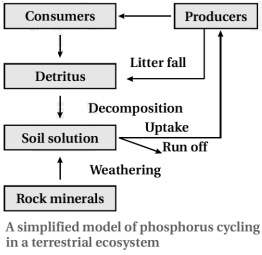
Explain the phosphorus cycle.
Solution
(N/A) Phosphorus is a major constituent of biological membranes,nucleic acids,and cellular energy transfer systems.
Many animals also need large quantities of this element to make shells,bones,and teeth.
The natural reservoir of phosphorus is rock,which contains phosphorus in the form of phosphates.
When rocks are weathered,minute amounts of these phosphates dissolve in the soil solution and are absorbed by the roots of the plants.
Herbivores and other animals obtain this element from plants. The waste products and the dead organisms are decomposed by phosphate-solubilizing bacteria,releasing phosphorus back into the soil.
Unlike the carbon cycle,there is no respiratory release of phosphorus into the atmosphere.
The other two major and important differences between the carbon and phosphorus cycles are: firstly,atmospheric inputs of phosphorus through rainfall are much smaller than carbon inputs,and secondly,gaseous exchanges of phosphorus between organisms and the environment are negligible.
Many animals also need large quantities of this element to make shells,bones,and teeth.
The natural reservoir of phosphorus is rock,which contains phosphorus in the form of phosphates.
When rocks are weathered,minute amounts of these phosphates dissolve in the soil solution and are absorbed by the roots of the plants.
Herbivores and other animals obtain this element from plants. The waste products and the dead organisms are decomposed by phosphate-solubilizing bacteria,releasing phosphorus back into the soil.
Unlike the carbon cycle,there is no respiratory release of phosphorus into the atmosphere.
The other two major and important differences between the carbon and phosphorus cycles are: firstly,atmospheric inputs of phosphorus through rainfall are much smaller than carbon inputs,and secondly,gaseous exchanges of phosphorus between organisms and the environment are negligible.
0 likes
View Solution257
Medium
List various ecological services.
Solution
(N/A) Healthy ecosystems are the foundation for a wide range of economic,environmental,and aesthetic goods and services.
The products of ecosystem processes are known as ecosystem services. For example,healthy forest ecosystems purify air and water,mitigate droughts and floods,cycle nutrients,generate fertile soils,provide wildlife habitat,maintain biodiversity,pollinate crops,provide storage sites for carbon,and also provide aesthetic,cultural,and spiritual values.
Robert Constanza and his colleagues have recently attempted to put price tags on nature's life-support services.
Researchers have estimated an average price tag of $US$ $33$ trillion a year for these fundamental ecosystem services,which are largely taken for granted because they are provided free of cost.
This is nearly twice the value of the global Gross National Product $(GNP)$,which is $US$ $18$ trillion.
Out of the total cost of various ecosystem services,soil formation accounts for about $50\%$ of the total,while the contributions of other services like recreation and nutrient cycling are less than $10\%$ each.
The cost of climate regulation and habitat for wildlife are about $6\%$ each.
The products of ecosystem processes are known as ecosystem services. For example,healthy forest ecosystems purify air and water,mitigate droughts and floods,cycle nutrients,generate fertile soils,provide wildlife habitat,maintain biodiversity,pollinate crops,provide storage sites for carbon,and also provide aesthetic,cultural,and spiritual values.
Robert Constanza and his colleagues have recently attempted to put price tags on nature's life-support services.
Researchers have estimated an average price tag of $US$ $33$ trillion a year for these fundamental ecosystem services,which are largely taken for granted because they are provided free of cost.
This is nearly twice the value of the global Gross National Product $(GNP)$,which is $US$ $18$ trillion.
Out of the total cost of various ecosystem services,soil formation accounts for about $50\%$ of the total,while the contributions of other services like recreation and nutrient cycling are less than $10\%$ each.
The cost of climate regulation and habitat for wildlife are about $6\%$ each.
0 likes
View Solution258
Medium
Give differences: Grazing food chain and Detritus food chain.
Solution
(N/A)
| Grazing Food Chain $(GFC)$ | Detritus Food Chain $(DFC)$ |
|---|---|
| $1$. It begins with producers (green plants) and moves to consumers. | $1$. It begins with dead organic matter (detritus). |
| $2$. It derives energy directly from the sun. | $2$. It derives energy from organic remains. |
| $3$. It is the major conduit for energy flow in an aquatic ecosystem. | $3$. It is the major conduit for energy flow in a terrestrial ecosystem. |
| $4$. It is usually larger in size. | $4$. It is usually smaller in size but plays a vital role in nutrient cycling. |
0 likes
View Solution259
Easy
Define the following terms:
$(i)$ Saprotrophs
$(ii)$ Trophic level
$(i)$ Saprotrophs
$(ii)$ Trophic level
Solution
(N/A) $(i)$ Saprotrophs: These are organisms that obtain their nutrition by decomposing dead remains or decaying organic matter.
$(ii)$ Trophic level: Based on the source of their nutrition or food,organisms occupy a specific position in a food chain,which is known as their trophic level.
$(ii)$ Trophic level: Based on the source of their nutrition or food,organisms occupy a specific position in a food chain,which is known as their trophic level.
0 likes
View Solution260
Easy
Define the following terms:
$(i)$ Sere
$(ii)$ Standing state
$(i)$ Sere
$(ii)$ Standing state
Solution
(N/A) $(i)$ Sere: The entire sequence of communities that successively change in a given area over a period of time is called a sere.
$(ii)$ Standing state: The amount of inorganic nutrients,such as carbon,nitrogen,phosphorus,calcium,etc.,present in the soil at any given time in an ecosystem is referred to as the standing state.
$(ii)$ Standing state: The amount of inorganic nutrients,such as carbon,nitrogen,phosphorus,calcium,etc.,present in the soil at any given time in an ecosystem is referred to as the standing state.
0 likes
View Solution261
EasyMCQ
Name an organism found as a secondary carnivore in an aquatic ecosystem.
A
Phytoplankton
B
Zooplankton
C
Small fish
D
Large fish
Solution
(D) In an aquatic ecosystem,the food chain can be represented as follows:
Producer (phytoplankton) $\rightarrow$ Primary consumer (zooplankton) $\rightarrow$ Primary carnivore (small fish and water bugs) $\rightarrow$ Secondary carnivore (large fish,birds like cranes and ducks).
Therefore,large fish and birds such as cranes and ducks occupy the position of secondary carnivores in an aquatic ecosystem.
Producer (phytoplankton) $\rightarrow$ Primary consumer (zooplankton) $\rightarrow$ Primary carnivore (small fish and water bugs) $\rightarrow$ Secondary carnivore (large fish,birds like cranes and ducks).
Therefore,large fish and birds such as cranes and ducks occupy the position of secondary carnivores in an aquatic ecosystem.
0 likes
View Solution262
MediumMCQ
Under what conditions would a particular stage in the process of succession revert back to an earlier stage?
A
During the climax community phase
B
Due to natural disasters like floods,fires,or human-induced disturbances
C
When the soil becomes nutrient-rich
D
During the pioneer species colonization
Solution
(B) Succession is a directional process,but it can be interrupted or reversed by disturbances. Natural disasters such as floods,fires,landslides,or human activities like deforestation and urbanization can destroy the existing community. This forces the ecosystem to revert to an earlier successional stage,a process known as secondary succession,where the area is recolonized by pioneer species.
0 likes
View Solution263
MediumMCQ
Arrange the following as observed in vertical stratification of a forest: Grass,Shrubby plants,Teak,Amaranths.
A
Grass,Amaranths,Shrubby plants,Teak
B
Teak,Shrubby plants,Amaranths,Grass
C
Amaranths,Grass,Shrubby plants,Teak
D
Grass,Shrubby plants,Amaranths,Teak
Solution
(A) Vertical stratification in a forest refers to the vertical distribution of different species occupying different levels.
Starting from the forest floor and moving upwards,the arrangement is as follows:
$1$. Grass (Ground layer)
$2$. Amaranths (Herbaceous layer)
$3$. Shrubby plants (Shrub layer)
$4$. Teak (Tree layer/Canopy)
Therefore,the correct order is: Grass $\rightarrow$ Amaranths $\rightarrow$ Shrubby plants $\rightarrow$ Teak.
Starting from the forest floor and moving upwards,the arrangement is as follows:
$1$. Grass (Ground layer)
$2$. Amaranths (Herbaceous layer)
$3$. Shrubby plants (Shrub layer)
$4$. Teak (Tree layer/Canopy)
Therefore,the correct order is: Grass $\rightarrow$ Amaranths $\rightarrow$ Shrubby plants $\rightarrow$ Teak.
0 likes
View Solution264
Medium
Name any two organisms which can occupy more than one trophic level in an ecosystem.
Solution
(N/A) In an ecosystem, an organism can occupy more than one trophic level simultaneously depending on its food source.
$1$. $Human$ $beings$: When humans eat plants (like vegetables or fruits), they act as primary consumers (second trophic level). When they eat animals (like fish or chicken), they act as secondary or tertiary consumers (third or fourth trophic level).
$2$. $Sparrows$: When sparrows eat seeds, fruits, or grains, they act as primary consumers (second trophic level). When they eat insects or worms, they act as secondary consumers (third trophic level).
$1$. $Human$ $beings$: When humans eat plants (like vegetables or fruits), they act as primary consumers (second trophic level). When they eat animals (like fish or chicken), they act as secondary or tertiary consumers (third or fourth trophic level).
$2$. $Sparrows$: When sparrows eat seeds, fruits, or grains, they act as primary consumers (second trophic level). When they eat insects or worms, they act as secondary consumers (third trophic level).
0 likes
View Solution265
MediumMCQ
In the North East region of India,during the process of jhum cultivation,forests are cleared by burning and left for regrowth after a year of cultivation. How would you explain the regrowth of forest in ecological terms?
A
Primary succession
B
Secondary succession
C
Deforestation
D
Nutrient cycling
Solution
(B) In the North East region of India,forests are cleared by burning during the process of jhum cultivation and are left for regrowth after a year.
In ecological terms,this process is described as $Secondary \ succession$.
Secondary succession occurs in areas where a natural community has been previously destroyed (e.g.,by fire or clearing) but the soil remains intact.
Since the soil is already present,seeds and spores that were suppressed or dormant in the soil germinate.
Additionally,seeds are dispersed into the area by wind,water,or animals,leading to the re-establishment of a new community of species in the forest.
In ecological terms,this process is described as $Secondary \ succession$.
Secondary succession occurs in areas where a natural community has been previously destroyed (e.g.,by fire or clearing) but the soil remains intact.
Since the soil is already present,seeds and spores that were suppressed or dormant in the soil germinate.
Additionally,seeds are dispersed into the area by wind,water,or animals,leading to the re-establishment of a new community of species in the forest.
0 likes
View Solution266
EasyMCQ
Among bryophytes,lichens,and ferns,which one is a pioneer species in a xeric succession?
A
Bryophytes
B
Lichens
C
Ferns
D
All of the above
Solution
(B) The species that first invade a bare area are called pioneer species. In a xeric succession (succession on bare rock),lichens are the pioneer species.
Lichens produce lichen acids and carbonic acid,which weather the surface of the rock and release essential minerals for growth.
As the rock weathers,soil particles accumulate,providing a suitable substrate for the subsequent growth of bryophytes and later pteridophytes (ferns like $Nephrolepis$).
Lichens produce lichen acids and carbonic acid,which weather the surface of the rock and release essential minerals for growth.
As the rock weathers,soil particles accumulate,providing a suitable substrate for the subsequent growth of bryophytes and later pteridophytes (ferns like $Nephrolepis$).
0 likes
View Solution267
Medium
Why are nutrient cycles in nature called biogeochemical cycles?
Solution
(N/A) Nutrient cycles are called biogeochemical cycles because they involve the movement of nutrients through both biotic (living) and abiotic (non-living) components of the ecosystem.
$1$. 'Bio' refers to the living organisms (biosphere) that utilize these nutrients.
$2$. 'Geo' refers to the earth's crust,air,and water (geosphere/atmosphere/hydrosphere) which act as reservoirs for these nutrients.
$3$. 'Chemical' refers to the chemical forms and processes (such as fixation,assimilation,and decomposition) that nutrients undergo as they circulate between the living and non-living components in a cyclic manner.
$1$. 'Bio' refers to the living organisms (biosphere) that utilize these nutrients.
$2$. 'Geo' refers to the earth's crust,air,and water (geosphere/atmosphere/hydrosphere) which act as reservoirs for these nutrients.
$3$. 'Chemical' refers to the chemical forms and processes (such as fixation,assimilation,and decomposition) that nutrients undergo as they circulate between the living and non-living components in a cyclic manner.
0 likes
View Solution268
Medium
Among the ecosystem services are control of floods and soil erosion. How is this achieved by the biotic components of the ecosystem?
Solution
(N/A) The biotic components of an ecosystem include living organisms such as plants and animals. Plants play a crucial role in controlling floods and soil erosion.
$1$. Soil Erosion Control: The root systems of plants bind soil particles together,which prevents the topsoil from being washed away by running water or blown away by wind.
$2$. Flood Control: Roots increase the porosity of the soil,which enhances the infiltration of water into the ground. This reduces surface runoff,thereby preventing floods.
$3$. Additional Benefits: By maintaining soil structure,plants also improve soil fertility and support biodiversity,which further stabilizes the ecosystem.
$1$. Soil Erosion Control: The root systems of plants bind soil particles together,which prevents the topsoil from being washed away by running water or blown away by wind.
$2$. Flood Control: Roots increase the porosity of the soil,which enhances the infiltration of water into the ground. This reduces surface runoff,thereby preventing floods.
$3$. Additional Benefits: By maintaining soil structure,plants also improve soil fertility and support biodiversity,which further stabilizes the ecosystem.
0 likes
View Solution269
MediumMCQ
Why do submerged plants receive weaker illumination than exposed floating plants in a lake?
A
Water absorbs light energy.
B
Submerged plants are in the dark zone.
C
Floating plants reflect light.
D
Water depth increases temperature.
Solution
(A) In a lake,light intensity decreases as it penetrates deeper into the water column. When light passes through water,a significant portion of the light energy is absorbed and scattered by the water molecules and suspended particles. Consequently,submerged plants,which are located at greater depths,receive significantly less light compared to floating plants that are exposed to direct sunlight at the surface.
0 likes
View Solution270
Medium
In a pond,we see plants which are free-floating; rooted-submerged; rooted-emergent; and rooted with floating leaves. Identify the type of plant for each of the following:
| Plant Name | Type |
| $(1)$ Hydrilla | .................... |
| $(2)$ Typha | .................... |
| $(3)$ Nymphaea | .................... |
| $(4)$ Lemna | .................... |
| $(5)$ Vallisneria | .................... |
Solution
(N/A) $(1)$ Hydrilla is a rooted-submerged hydrophyte.
$(2)$ Typha is a rooted-emergent hydrophyte.
$(3)$ Nymphaea is a rooted plant with floating leaves.
$(4)$ Lemna is a free-floating hydrophyte.
$(5)$ Vallisneria is a rooted-submerged hydrophyte.
$(2)$ Typha is a rooted-emergent hydrophyte.
$(3)$ Nymphaea is a rooted plant with floating leaves.
$(4)$ Lemna is a free-floating hydrophyte.
$(5)$ Vallisneria is a rooted-submerged hydrophyte.
0 likes
View Solution271
Medium
Give any two examples of xerarch succession.
Solution
(N/A) Xerarch succession refers to the process of ecological succession that begins in extremely dry or xeric environments. Two common examples include:
$1$. Succession on bare rock (Lithosere): This begins with the colonization of crustose lichens on bare rock surfaces,eventually leading to the formation of soil and the development of a climax community.
$2$. Succession on sand dunes (Psammosere): This occurs in sandy areas where water availability is very low,starting with pioneer species like grasses that stabilize the sand and facilitate the transition to more complex plant communities.
$1$. Succession on bare rock (Lithosere): This begins with the colonization of crustose lichens on bare rock surfaces,eventually leading to the formation of soil and the development of a climax community.
$2$. Succession on sand dunes (Psammosere): This occurs in sandy areas where water availability is very low,starting with pioneer species like grasses that stabilize the sand and facilitate the transition to more complex plant communities.
0 likes
View Solution272
Easy
Define self-sustainability in the context of an ecosystem.
Solution
(N/A) Self-sustainability in an ecosystem refers to the ability of a biological system to maintain its structure,function,and internal arrangement through its own independent processes and feedback mechanisms without external intervention. In such a system,natural ecological processes like nutrient cycling,energy flow,and population regulation occur autonomously,ensuring the long-term persistence and stability of the ecosystem.
0 likes
View Solution273
Medium
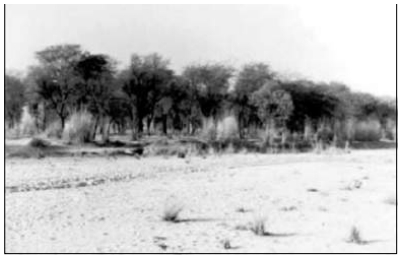
Given below is a figure of an ecosystem. Answer the following questions.
$(i)$ What type of ecosystem is shown in the figure?
$(ii)$ Name any plant that is characteristic of such an ecosystem.
$(i)$ What type of ecosystem is shown in the figure?
$(ii)$ Name any plant that is characteristic of such an ecosystem.
Solution
(N/A) $(i)$ The figure represents a tropical deciduous forest ecosystem.
$(ii)$ Plants characteristic of this ecosystem in India include Tectona (Teak),Dipterocarpus,Syzygium cumini (Jamun),Phyllanthus emblica (Gooseberry/Amla),Butea monosperma (Palash),Madhuca longifolia (Mahua),and Bombax ceiba (Semul).
$(ii)$ Plants characteristic of this ecosystem in India include Tectona (Teak),Dipterocarpus,Syzygium cumini (Jamun),Phyllanthus emblica (Gooseberry/Amla),Butea monosperma (Palash),Madhuca longifolia (Mahua),and Bombax ceiba (Semul).
0 likes
View Solution274
EasyMCQ
Is an aquarium a complete ecosystem?
A
Yes,it is a complete ecosystem.
B
No,it is an artificial ecosystem.
C
It is a natural ecosystem.
D
It is not an ecosystem at all.
Solution
(B) An aquarium is an example of an artificial or man-made ecosystem.
An ecosystem is considered complete if it possesses all necessary biotic and abiotic components to sustain life and cycle nutrients independently.
While an aquarium contains biotic components (plants,fish,microorganisms) and abiotic components (water,light,oxygen),it is not self-sustaining.
It requires constant human intervention,such as providing food,cleaning the water,and maintaining oxygen levels,to function properly.
Therefore,it is classified as an incomplete or artificial ecosystem.
An ecosystem is considered complete if it possesses all necessary biotic and abiotic components to sustain life and cycle nutrients independently.
While an aquarium contains biotic components (plants,fish,microorganisms) and abiotic components (water,light,oxygen),it is not self-sustaining.
It requires constant human intervention,such as providing food,cleaning the water,and maintaining oxygen levels,to function properly.
Therefore,it is classified as an incomplete or artificial ecosystem.
0 likes
View Solution275
Medium
Sometimes,due to biotic or abiotic factors,the climax community remains in a particular seral stage (pre-climax) without reaching the final climax. Do you agree with this statement? If yes,provide a suitable example.
Solution
(N/A) Yes,$I$ agree with this statement. Sometimes,due to the influence of biotic or abiotic factors,a community remains in a particular seral stage and does not reach the final climax community. This occurs because ecological succession is a dynamic process that can be interrupted or diverted by environmental pressures.
$1$. Abiotic factors: Natural calamities such as frequent fires,landslides,floods,or significant changes in soil composition can prevent a community from reaching its final climax stage.
$2$. Biotic factors: The presence of specific herbivores,pathogens,or invasive species can arrest succession at a pre-climax stage. For example,in certain grasslands,frequent grazing by herbivores prevents the succession from progressing to a forest climax,keeping the ecosystem in a grassland seral stage.
$1$. Abiotic factors: Natural calamities such as frequent fires,landslides,floods,or significant changes in soil composition can prevent a community from reaching its final climax stage.
$2$. Biotic factors: The presence of specific herbivores,pathogens,or invasive species can arrest succession at a pre-climax stage. For example,in certain grasslands,frequent grazing by herbivores prevents the succession from progressing to a forest climax,keeping the ecosystem in a grassland seral stage.
0 likes
View Solution276
Medium
What is an incomplete ecosystem? Explain with the help of a suitable example.
Solution
(N/A) An ecosystem is considered complete when it contains all necessary biotic and abiotic components that allow for self-sustenance,energy flow,and nutrient cycling.
An ecosystem is termed 'incomplete' if it lacks one or more essential components (such as producers,consumers,or decomposers) or if the abiotic factors are insufficient to support a self-sustaining biological community.
For example,the $profundal$ and $benthic$ zones of deep aquatic ecosystems are often considered incomplete.
In these zones,sunlight cannot penetrate,meaning photosynthesis cannot occur. Consequently,there are no primary producers $(autotrophs)$ present.
These zones depend entirely on the organic matter (detritus) falling from the upper $photic$ zones to support the heterotrophic organisms living there,making them dependent on external ecosystems for energy.
An ecosystem is termed 'incomplete' if it lacks one or more essential components (such as producers,consumers,or decomposers) or if the abiotic factors are insufficient to support a self-sustaining biological community.
For example,the $profundal$ and $benthic$ zones of deep aquatic ecosystems are often considered incomplete.
In these zones,sunlight cannot penetrate,meaning photosynthesis cannot occur. Consequently,there are no primary producers $(autotrophs)$ present.
These zones depend entirely on the organic matter (detritus) falling from the upper $photic$ zones to support the heterotrophic organisms living there,making them dependent on external ecosystems for energy.
0 likes
View Solution277
Medium
$A$ farmer harvests his crop and expresses his harvest in three different ways.
$(a)$ $I$ have harvested $10$ quintals of wheat.
$(b)$ $I$ have harvested $10$ quintals of wheat today in one acre of land.
$(c)$ $I$ have harvested $10$ quintals of wheat in one acre of land,$6$ months after sowing.
Do the above statements mean one and the same thing? If your answer is yes,give reasons. If your answer is 'no',explain the meaning of each expression.
$(a)$ $I$ have harvested $10$ quintals of wheat.
$(b)$ $I$ have harvested $10$ quintals of wheat today in one acre of land.
$(c)$ $I$ have harvested $10$ quintals of wheat in one acre of land,$6$ months after sowing.
Do the above statements mean one and the same thing? If your answer is yes,give reasons. If your answer is 'no',explain the meaning of each expression.
Solution
(D) No,the statements do not mean the same thing as they provide different levels of information regarding the harvest.
$(a)$ This statement only provides the total quantity of the yield ($10$ quintals of wheat) without specifying the area or the time taken.
$(b)$ This statement provides the total quantity ($10$ quintals) and the area of land ($1$ acre) used for cultivation,indicating the yield per unit area.
$(c)$ This statement provides the most complete information: the total quantity ($10$ quintals),the area ($1$ acre),and the duration of the crop cycle ($6$ months). This reflects the productivity of the artificial ecosystem (the crop field) over a specific time period,accounting for both biotic components (wheat plants) and abiotic factors (water,soil nutrients,sunlight,and air) managed by the farmer.
$(a)$ This statement only provides the total quantity of the yield ($10$ quintals of wheat) without specifying the area or the time taken.
$(b)$ This statement provides the total quantity ($10$ quintals) and the area of land ($1$ acre) used for cultivation,indicating the yield per unit area.
$(c)$ This statement provides the most complete information: the total quantity ($10$ quintals),the area ($1$ acre),and the duration of the crop cycle ($6$ months). This reflects the productivity of the artificial ecosystem (the crop field) over a specific time period,accounting for both biotic components (wheat plants) and abiotic factors (water,soil nutrients,sunlight,and air) managed by the farmer.
0 likes
View Solution278
Easy
Given below is a list of autotrophs and heterotrophs. With your knowledge about food chain,establish various linkages between the organisms on the principle of 'eating and being eaten'. What is this inter-linkage established known as?
Algae,hydrilla,grasshopper,rat,squirrel,crow,maize plant,deer,rabbit,lizard,wolf,snake,peacock,phytoplankton,crustaceans,whale,tiger,lion,sparrow,duck,crane,cockroach,spider,toad,fish,leopard,elephant,goat,nymphae,spirogyra.
Algae,hydrilla,grasshopper,rat,squirrel,crow,maize plant,deer,rabbit,lizard,wolf,snake,peacock,phytoplankton,crustaceans,whale,tiger,lion,sparrow,duck,crane,cockroach,spider,toad,fish,leopard,elephant,goat,nymphae,spirogyra.
Solution
(N/A) The natural interconnection of food chains containing producers,consumers,and decomposers in a complex,cross-linked network is called a food web.
$(i)$ Apex predators/High-level carnivores: Tiger,Lion,Leopard (Highest trophic level).
(ii) Secondary/Tertiary consumers: Spider,cockroach,lizard,wolf,snake,toad,fish,crane,peacock,crow,sparrow,duck,whale (Third/Fourth trophic level).
(iii) Primary consumers: Crustaceans,grasshopper,deer,rat,squirrel,rabbit,elephant,goat (Second trophic level).
(iv) Producers: Phytoplankton,algae,hydrilla,maize plant,nymphaea,spirogyra (First trophic level).
$(i)$ Apex predators/High-level carnivores: Tiger,Lion,Leopard (Highest trophic level).
(ii) Secondary/Tertiary consumers: Spider,cockroach,lizard,wolf,snake,toad,fish,crane,peacock,crow,sparrow,duck,whale (Third/Fourth trophic level).
(iii) Primary consumers: Crustaceans,grasshopper,deer,rat,squirrel,rabbit,elephant,goat (Second trophic level).
(iv) Producers: Phytoplankton,algae,hydrilla,maize plant,nymphaea,spirogyra (First trophic level).
0 likes
View Solution279
Easy
Give two examples of artificial or man-made ecosystems. List the salient features by which they differ from natural ecosystems.
Solution
(N/A) Two examples of artificial or man-made ecosystems are $1.$ Aquarium and $2.$ Crop fields (farm houses).
Salient features by which they differ from natural ecosystems:
$1.$ Maintenance: In artificial ecosystems,biotic and abiotic components are maintained artificially. For example,in an aquarium,oxygen supply,cleaning,and food are provided by humans,whereas in natural ecosystems,these processes occur naturally.
$2.$ Stability: Natural ecosystems are self-sustaining and stable,whereas artificial ecosystems are unstable and require constant human intervention for their survival.
$3.$ Diversity: Natural ecosystems typically possess high species diversity and complex food webs,while artificial ecosystems have low species diversity and simplified food chains.
$4.$ Ecological Services: Natural ecosystems provide essential ecological services like nutrient cycling,water purification,and climate regulation,which are largely absent or minimal in artificial ecosystems.
Salient features by which they differ from natural ecosystems:
$1.$ Maintenance: In artificial ecosystems,biotic and abiotic components are maintained artificially. For example,in an aquarium,oxygen supply,cleaning,and food are provided by humans,whereas in natural ecosystems,these processes occur naturally.
$2.$ Stability: Natural ecosystems are self-sustaining and stable,whereas artificial ecosystems are unstable and require constant human intervention for their survival.
$3.$ Diversity: Natural ecosystems typically possess high species diversity and complex food webs,while artificial ecosystems have low species diversity and simplified food chains.
$4.$ Ecological Services: Natural ecosystems provide essential ecological services like nutrient cycling,water purification,and climate regulation,which are largely absent or minimal in artificial ecosystems.
0 likes
View Solution280
Medium
What is a biogeochemical cycle? What is the role of the reservoir in a biogeochemical cycle? Give an example of a sedimentary cycle with a reservoir located in the Earth's crust.
Solution
(N/A) biogeochemical cycle is the movement of nutrients and other elements between biotic (living) and abiotic (non-living) components of the ecosystem.
The reservoir acts as a storage site for nutrients to meet the deficit which occurs due to an imbalance in the rate of influx and efflux. It ensures the continuous availability of essential nutrients for biological processes.
An example of a sedimentary cycle is the phosphorus cycle. In this cycle,the reservoir is the Earth's crust,specifically in the form of phosphate rocks.
The reservoir acts as a storage site for nutrients to meet the deficit which occurs due to an imbalance in the rate of influx and efflux. It ensures the continuous availability of essential nutrients for biological processes.
An example of a sedimentary cycle is the phosphorus cycle. In this cycle,the reservoir is the Earth's crust,specifically in the form of phosphate rocks.
0 likes
View Solution281
Medium
What will be the $P/R$ ratio of a climax community and a pioneer community? What explanation could you offer for the changes seen in the $P/R$ ratio of a pioneer community and the climax community?
Solution
(N/A) The $P/R$ ratio represents the ratio of Gross Primary Production $(P)$ to Total Community Respiration $(R)$.
$1$. In a pioneer community, the $P/R$ ratio is typically greater than $1$ $(P/R > 1)$. This is because pioneer species are characterized by rapid growth and colonization, leading to high primary production relative to the biomass present, which results in the accumulation of organic matter.
$2$. In a climax community, the $P/R$ ratio is approximately equal to $1$ $(P/R = 1)$. This indicates a state of metabolic equilibrium where the total energy produced through photosynthesis is balanced by the total energy consumed through respiration by all organisms in the ecosystem.
$1$. In a pioneer community, the $P/R$ ratio is typically greater than $1$ $(P/R > 1)$. This is because pioneer species are characterized by rapid growth and colonization, leading to high primary production relative to the biomass present, which results in the accumulation of organic matter.
$2$. In a climax community, the $P/R$ ratio is approximately equal to $1$ $(P/R = 1)$. This indicates a state of metabolic equilibrium where the total energy produced through photosynthesis is balanced by the total energy consumed through respiration by all organisms in the ecosystem.
| Pioneer Community | Climax Community |
| $P/R > 1$ (Production exceeds respiration). | $P/R = 1$ (Production equals respiration). |
| Organic matter accumulates in the ecosystem. | Organic matter is in a steady state. |
0 likes
View Solution282
Medium
Give differences between the carbon cycle and the phosphorus cycle.
Solution
(N/A) The differences between the carbon cycle and the phosphorus cycle are as follows:
$1$. Reservoir: The reservoir for the carbon cycle is the atmosphere and the ocean,whereas the reservoir for the phosphorus cycle is the Earth's crust (rocks).
$2$. Gaseous Exchange: The carbon cycle involves a significant gaseous phase,as carbon dioxide $(CO_2)$ is present in the atmosphere. In contrast,the phosphorus cycle is a sedimentary cycle and does not have a significant gaseous phase.
$3$. Rate of Cycling: The carbon cycle is relatively faster compared to the phosphorus cycle,which is a very slow process involving the weathering of rocks.
$1$. Reservoir: The reservoir for the carbon cycle is the atmosphere and the ocean,whereas the reservoir for the phosphorus cycle is the Earth's crust (rocks).
$2$. Gaseous Exchange: The carbon cycle involves a significant gaseous phase,as carbon dioxide $(CO_2)$ is present in the atmosphere. In contrast,the phosphorus cycle is a sedimentary cycle and does not have a significant gaseous phase.
$3$. Rate of Cycling: The carbon cycle is relatively faster compared to the phosphorus cycle,which is a very slow process involving the weathering of rocks.
0 likes
View Solution283
DifficultMCQ
What is an ecosystem service? List any four important ecosystem services provided by the natural ecosystems. Are you in favour or against levying a charge on the service provided by the ecosystem?
A
$N$/$A$
B
$N$/$A$
C
$N$/$A$
D
$N$/$A$
Solution
(N/A) The products of ecosystem processes are termed as ecosystem services.
Four important ecosystem services provided by natural ecosystems include:
$1$. Purification of air and water.
$2$. Mitigation of droughts and floods.
$3$. Nutrient cycling.
$4$. Generation of fertile soils.
Regarding the levying of a charge: Yes,it is reasonable to support the concept of putting a price tag on ecosystem services. Robert Constanza and his colleagues estimated the value of these fundamental life-support services at an average of $US$ $33$ trillion per year,which is nearly twice the global $GNP$ ($US$ $18$ trillion). Recognizing the economic value of these services helps in promoting their conservation and sustainable use.
Four important ecosystem services provided by natural ecosystems include:
$1$. Purification of air and water.
$2$. Mitigation of droughts and floods.
$3$. Nutrient cycling.
$4$. Generation of fertile soils.
Regarding the levying of a charge: Yes,it is reasonable to support the concept of putting a price tag on ecosystem services. Robert Constanza and his colleagues estimated the value of these fundamental life-support services at an average of $US$ $33$ trillion per year,which is nearly twice the global $GNP$ ($US$ $18$ trillion). Recognizing the economic value of these services helps in promoting their conservation and sustainable use.
0 likes
View Solution284
MediumMCQ
Which of the following is a man-made ecosystem?
A
Aquarium
B
Grassland
C
Desert
D
Forest
Solution
(A) An ecosystem is a functional unit of nature where living organisms interact among themselves and with the surrounding physical environment.
Ecosystems are broadly categorized into natural and man-made (artificial) ecosystems.
Natural ecosystems include forests,grasslands,and deserts,which operate by themselves without any significant human interference.
An aquarium is a man-made ecosystem because it is created and maintained by humans to simulate an aquatic environment for organisms.
Ecosystems are broadly categorized into natural and man-made (artificial) ecosystems.
Natural ecosystems include forests,grasslands,and deserts,which operate by themselves without any significant human interference.
An aquarium is a man-made ecosystem because it is created and maintained by humans to simulate an aquatic environment for organisms.
0 likes
View Solution285
MediumMCQ
An ecosystem is defined as ...
A
The interaction of biotic components with abiotic components
B
The interaction between animals and plants
C
The interaction between the Sun and the Earth powered by its energy
D
All of the above
Solution
(A) An ecosystem is a functional unit of nature where living organisms interact among themselves and also with the surrounding physical (abiotic) environment.
Therefore,it involves the interaction of biotic (living) components with abiotic (non-living) components.
While interactions between animals and plants (biotic-biotic) occur within an ecosystem,the fundamental definition of an ecosystem emphasizes the relationship between the biotic community and the abiotic environment.
Therefore,it involves the interaction of biotic (living) components with abiotic (non-living) components.
While interactions between animals and plants (biotic-biotic) occur within an ecosystem,the fundamental definition of an ecosystem emphasizes the relationship between the biotic community and the abiotic environment.
0 likes
View Solution286
MediumMCQ
The structural and functional unit of an ecosystem is....
A
Biotic and abiotic components
B
Biotic community
C
Food chain
D
Organisms found at different trophic levels
Solution
(A) An ecosystem is defined as the structural and functional unit of nature where living organisms interact among themselves and with the surrounding physical environment.
It consists of two main components: biotic (living) and abiotic (non-living) factors.
These components function as a unit through processes like energy flow and nutrient cycling.
Therefore,the ecosystem itself is the fundamental unit of structure and function in ecology.
It consists of two main components: biotic (living) and abiotic (non-living) factors.
These components function as a unit through processes like energy flow and nutrient cycling.
Therefore,the ecosystem itself is the fundamental unit of structure and function in ecology.
0 likes
View Solution287
MediumMCQ
What is meant by stratification in an ecosystem?
A
Lion at the top level in a terrestrial food chain
B
Planktons at the lower level in an aquatic food chain
C
Vertical distribution of different species occupying different levels in an ecosystem
D
All of the above
0 likes
View Solution288
MediumMCQ
In a pond ecosystem,zooplankton can be placed at which trophic level?
A
Producers
B
First trophic level
C
Primary consumers
D
Decomposers
Solution
(C) In a pond ecosystem,the food chain typically starts with phytoplankton,which act as producers ($1^{st}$ trophic level).
Zooplankton feed on phytoplankton,making them the primary consumers ($2^{nd}$ trophic level).
Therefore,zooplankton are classified as primary consumers.
Zooplankton feed on phytoplankton,making them the primary consumers ($2^{nd}$ trophic level).
Therefore,zooplankton are classified as primary consumers.
0 likes
View Solution289
MediumMCQ
Which of the following cannot be included in the functional aspects of an ecosystem?
A
Conversion of inorganic components into organic components by producers using radiant energy from the sun.
B
Conversion of dead organic matter into inorganic components by decomposers.
C
Consumption of autotrophs by heterotrophs.
D
Unidirectional flow of energy towards higher trophic levels and the dissipation of energy during this process.
Solution
(C) The functional aspects of an ecosystem include:
$1$. Productivity (conversion of radiant energy into organic matter by producers).
$2$. Decomposition (breakdown of dead organic matter into inorganic components by decomposers).
$3$. Energy flow (unidirectional transfer of energy to higher trophic levels with dissipation).
$4$. Nutrient cycling.
Option $C$ states 'Consumption of autotrophs by heterotrophs',which is a description of a feeding relationship (part of a food chain/web) but is not a fundamental functional process of the ecosystem itself in the same category as energy flow or nutrient cycling. Therefore,it is the least appropriate choice among the functional aspects.
$1$. Productivity (conversion of radiant energy into organic matter by producers).
$2$. Decomposition (breakdown of dead organic matter into inorganic components by decomposers).
$3$. Energy flow (unidirectional transfer of energy to higher trophic levels with dissipation).
$4$. Nutrient cycling.
Option $C$ states 'Consumption of autotrophs by heterotrophs',which is a description of a feeding relationship (part of a food chain/web) but is not a fundamental functional process of the ecosystem itself in the same category as energy flow or nutrient cycling. Therefore,it is the least appropriate choice among the functional aspects.
0 likes
View Solution290
MediumMCQ
What is the full form of $PAR$?
A
Photosynthetically Active Region
B
Partically Active Radiation
C
Photosynthetically Active Radiation
D
Partially Active Photosynthetic Region
Solution
(C) $PAR$ stands for Photosynthetically Active Radiation.
It refers to the spectral range of solar radiation from $400 \ nm$ to $700 \ nm$ that photosynthetic organisms are able to use in the process of photosynthesis.
It is a crucial component of solar energy that drives primary productivity in ecosystems.
It refers to the spectral range of solar radiation from $400 \ nm$ to $700 \ nm$ that photosynthetic organisms are able to use in the process of photosynthesis.
It is a crucial component of solar energy that drives primary productivity in ecosystems.
0 likes
View Solution291
MediumMCQ
What percentage of incident solar radiation is included in $PAR$ (Photosynthetically Active Radiation)?
A
$ < 50 \%$
B
$50 \%$
C
$ > 50 \%$
D
$100 \%$
Solution
(A) Photosynthetically Active Radiation $(PAR)$ refers to the spectral range of solar radiation from $400 \, nm$ to $700 \, nm$ that photosynthetic organisms are able to use in the process of photosynthesis.
Out of the total incident solar radiation reaching the Earth's surface, only less than $50 \%$ is $PAR$.
Therefore, the correct option is $A$.
Out of the total incident solar radiation reaching the Earth's surface, only less than $50 \%$ is $PAR$.
Therefore, the correct option is $A$.
0 likes
View Solution292
MediumMCQ
The structural and functional unit of ecology is ........
A
Food chain
B
Food web
C
Ecosystem
D
Organization of biotic and abiotic factors
Solution
(C) An $Ecosystem$ is defined as the structural and functional unit of nature or ecology. It consists of a community of living organisms (biotic factors) interacting with the non-living components (abiotic factors) of their environment. Through these interactions, energy flows and nutrients cycle within the system, maintaining its functional integrity.
0 likes
View Solution293
MediumMCQ
Which of the following is $NOT$ included in the functional aspects of an ecosystem?
A
Bidirectional flow of energy
B
Nutrient cycling
C
Formation of food chains or food webs
D
All of the above
Solution
(A) The functional aspects of an ecosystem include:
$1$. Productivity
$2$. Decomposition
$3$. Energy flow
$4$. Nutrient cycling
Energy flow in an ecosystem is always unidirectional (from producers to consumers),not bidirectional. Therefore,the statement 'Bidirectional flow of energy' is incorrect and not a functional aspect of an ecosystem.
$1$. Productivity
$2$. Decomposition
$3$. Energy flow
$4$. Nutrient cycling
Energy flow in an ecosystem is always unidirectional (from producers to consumers),not bidirectional. Therefore,the statement 'Bidirectional flow of energy' is incorrect and not a functional aspect of an ecosystem.
0 likes
View Solution294
MediumMCQ
Identify the organism that is not included among producers.
A
Phytoplankton
B
Woody plants
C
Zooplankton
D
All of the above
Solution
(C) Producers are organisms that synthesize their own food through photosynthesis. Phytoplankton and woody plants are photosynthetic organisms; therefore,they are classified as producers. Zooplankton are heterotrophic organisms that depend on other organisms (such as phytoplankton) for food; therefore,they are consumers and are not included among producers.
0 likes
View Solution295
MediumMCQ
Identify the organism included in the first trophic level of a food chain.
A
Green plants
B
Grasshopper
C
Rat
D
Snake
Solution
(A) In a food chain,the first trophic level is always occupied by producers,which are autotrophic organisms capable of synthesizing their own food through photosynthesis.
Green plants are the primary producers in most terrestrial ecosystems.
Therefore,green plants represent the first trophic level,while grasshoppers (primary consumers),rats (secondary consumers),and snakes (tertiary consumers) occupy subsequent trophic levels.
Green plants are the primary producers in most terrestrial ecosystems.
Therefore,green plants represent the first trophic level,while grasshoppers (primary consumers),rats (secondary consumers),and snakes (tertiary consumers) occupy subsequent trophic levels.
0 likes
View Solution296
MediumMCQ
The detritus food chain begins with which of the following?
A
Dead organic matter
B
Decomposers
C
Producers
D
Consumers
Solution
(A) The detritus food chain $(DFC)$ begins with dead organic matter.
It is made up of decomposers which are heterotrophic organisms,mainly fungi and bacteria.
These organisms meet their energy and nutrient requirements by degrading dead organic matter or detritus.
Therefore,the correct option is $A$.
It is made up of decomposers which are heterotrophic organisms,mainly fungi and bacteria.
These organisms meet their energy and nutrient requirements by degrading dead organic matter or detritus.
Therefore,the correct option is $A$.
0 likes
View Solution297
MediumMCQ
Which of the following organisms are included in the second trophic level?
A
Primary consumers
B
Primary producers
C
Carnivores
D
Top carnivores
Solution
(A) In an ecosystem,the trophic levels are organized based on the source of nutrition.
$1$. The first trophic level consists of primary producers (autotrophs like plants) that produce their own food.
$2$. The second trophic level consists of primary consumers (herbivores) that feed directly on the primary producers.
$3$. Therefore,primary consumers occupy the second trophic level.
$1$. The first trophic level consists of primary producers (autotrophs like plants) that produce their own food.
$2$. The second trophic level consists of primary consumers (herbivores) that feed directly on the primary producers.
$3$. Therefore,primary consumers occupy the second trophic level.
0 likes
View Solution298
MediumMCQ
Into how many trophic levels can the detritus food chain be divided?
A
Three
B
Four
C
Both $A$ and $B$
D
Trophic levels are not formed
Solution
(D) The detritus food chain $(DFC)$ begins with dead organic matter.
It is made up of decomposers which are heterotrophic organisms,mainly fungi and bacteria.
These organisms meet their energy and nutrient requirements by degrading dead organic matter or detritus.
These are also known as saprotrophs $(SAP)$.
In a detritus food chain,the energy flow is based on the decomposition of organic matter,and it does not follow the typical trophic level structure $(T_1, T_2, T_3, T_4)$ seen in grazing food chains because the decomposers act on the detritus at various stages of decay.
It is made up of decomposers which are heterotrophic organisms,mainly fungi and bacteria.
These organisms meet their energy and nutrient requirements by degrading dead organic matter or detritus.
These are also known as saprotrophs $(SAP)$.
In a detritus food chain,the energy flow is based on the decomposition of organic matter,and it does not follow the typical trophic level structure $(T_1, T_2, T_3, T_4)$ seen in grazing food chains because the decomposers act on the detritus at various stages of decay.
0 likes
View Solution299
MediumMCQ
What percentage of incident solar radiation is converted into gross primary productivity by producers in an ecosystem?
A
$1 \%$
B
$10 \%$
C
$90 \%$
D
Cannot be determined
Solution
(A) In an ecosystem,producers (plants) capture solar energy to perform photosynthesis.
Out of the total incident solar radiation reaching the Earth's surface,only about $1 \%$ is captured by producers and converted into chemical energy through the process of photosynthesis,which is known as Gross Primary Productivity $(GPP)$.
The remaining energy is either reflected or absorbed as heat.
Therefore,the correct percentage is $1 \%$.
Out of the total incident solar radiation reaching the Earth's surface,only about $1 \%$ is captured by producers and converted into chemical energy through the process of photosynthesis,which is known as Gross Primary Productivity $(GPP)$.
The remaining energy is either reflected or absorbed as heat.
Therefore,the correct percentage is $1 \%$.
0 likes
View Solution300
MediumMCQ
$A$ $Climax$ community is defined as ...
A
$A$ community that can adapt to the environment.
B
$A$ community that is in equilibrium with the environment.
C
$A$ community that changes its structure and composition with changing conditions.
D
All of the above.
Solution
(D) $Climax$ community represents the final, stable stage of ecological succession in a given ecosystem.
It is characterized by being in a state of equilibrium with the prevailing climate and environmental conditions.
Because it is stable, it maintains its structure and composition over a long period unless disturbed by external factors.
Therefore, it encompasses the ability to adapt, maintain equilibrium, and persist through environmental changes, making all the given options correct.
It is characterized by being in a state of equilibrium with the prevailing climate and environmental conditions.
Because it is stable, it maintains its structure and composition over a long period unless disturbed by external factors.
Therefore, it encompasses the ability to adapt, maintain equilibrium, and persist through environmental changes, making all the given options correct.
0 likes
View SolutionEcosystem — Ecosystem–Structure and Function · Frequently Asked Questions
1Are these Ecosystem questions useful for JEE and NEET?
Yes. All questions in this section are mapped to JEE Main and NEET exam patterns. Previous year questions from JEE Main, NEET, GUJCET and state-level exams are included with full solutions.
2Can I switch to Hindi or Gujarati for these questions?
Yes. Use the language tabs in the hero section or the sidebar to view the same questions and solutions in English, Hindi or Gujarati.
3How do I generate a question paper from this subtopic?
Use the Vedclass Exam Paper Generator — select the chapter and subtopic, set difficulty, and generate Sets A, B, C, D automatically. First 3 chapters of every subject are free.
Vedclass Products
For Students
Vedclass Test Series
Mock tests in real JEE/NEET style with performance analysis. 5-day free trial.
Start Free TrialFor Teachers
Exam Paper Generator
Generate Set A/B/C/D papers from this chapter in 2 minutes. 3 chapters free.
Try FreeFor Institutes
Online Exam Module
Live online exams with unlimited students, 360° analytics & white-label branding.
See DemoFor Teachers & Institutes
Generate a Ecosystem Exam Paper in 2 Minutes
Select subtopic & difficulty — Sets A, B, C, D auto-generated with No Repeat logic.
First 3 chapters of every subject are free — no payment required.