
A English
Ecosystem–Structure and Function Questions in English
Class 12 Biology · Ecosystem · Ecosystem–Structure and Function
463+
Questions
English
Language
100%
With Solutions
Showing 50 of 463 questions in English
201
MediumMCQ
Which of the following ecosystems does not rely on the Sun as its primary source of energy?
A
Forest
B
Desert
C
Deep sea-hydrothermal ecosystem
D
Epilimnion
Solution
(C) In most ecosystems,the Sun is the primary source of energy for all producers (plants,algae,and cyanobacteria) to perform photosynthesis.
However,in deep sea-hydrothermal vent ecosystems,sunlight cannot penetrate the water column.
In these environments,chemosynthetic bacteria derive energy from the oxidation of inorganic chemicals (like hydrogen sulfide) released from hydrothermal vents.
Therefore,these ecosystems are independent of solar energy.
However,in deep sea-hydrothermal vent ecosystems,sunlight cannot penetrate the water column.
In these environments,chemosynthetic bacteria derive energy from the oxidation of inorganic chemicals (like hydrogen sulfide) released from hydrothermal vents.
Therefore,these ecosystems are independent of solar energy.
0 likes
View Solution202
MediumMCQ
Climax community means....
A
The community that is in near equilibrium with the environment.
B
The gradual and fairly predictable change in the species composition of a given area.
C
The entire sequence of communities that successively change in a given area.
D
The species that invade a bare area.
Solution
(A) In ecological succession,the process starts with pioneer species and proceeds through various seral stages. The final stage of succession is known as the climax community. This community is stable,mature,and in near equilibrium with the environment of that area. Therefore,option $A$ is the correct definition.
0 likes
View Solution203
EasyMCQ
The natural reservoir of phosphorus is
A
Detergent
B
$NADP$
C
Rock
D
All given
Solution
(C) The natural reservoir of phosphorus is rock,which contains phosphorus in the form of phosphates.
When rocks are weathered,minute amounts of these phosphates dissolve in soil solution and are absorbed by the roots of the plants.
Unlike the carbon cycle,there is no significant respiratory release of phosphorus into the atmosphere.
Therefore,the correct option is $C$.
When rocks are weathered,minute amounts of these phosphates dissolve in soil solution and are absorbed by the roots of the plants.
Unlike the carbon cycle,there is no significant respiratory release of phosphorus into the atmosphere.
Therefore,the correct option is $C$.
0 likes
View Solution204
EasyMCQ
In ecosystem services,soil formation accounts for about.....
A
$50\%$
B
Less than $10\%$
C
$70\%$
D
$6\%$
Solution
(A) Robert Costanza and his colleagues have put very price tags on nature's life-support services. According to their estimates,the global ecosystem services are worth $33$ trillion $US$ dollars a year. Out of the total cost of various ecosystem services,the soil formation accounts for about $50\%$ of the total value. Other services like recreation and nutrient cycling account for less than $10\%$ each.
0 likes
View Solution205
EasyMCQ
How many percent of the total global carbon is found dissolved in the oceans (in $\%$)?
A
$49$
B
$1$
C
$71$
D
$90$
Solution
(C) The total quantity of global carbon is distributed across various reservoirs.
According to the $NCERT$ textbook,approximately $71\%$ of the total global carbon is found dissolved in the oceans.
The remaining carbon is present in the atmosphere,terrestrial ecosystems,and fossil fuels.
Therefore,the correct option is $C$.
According to the $NCERT$ textbook,approximately $71\%$ of the total global carbon is found dissolved in the oceans.
The remaining carbon is present in the atmosphere,terrestrial ecosystems,and fossil fuels.
Therefore,the correct option is $C$.
0 likes
View Solution206
MediumMCQ
Herbivores are.....
A
Primary producer
B
Primary carnivore
C
Secondary consumer
D
Primary consumer
Solution
(D) In an ecosystem,the energy flow follows a specific trophic structure.
$1$. Primary producers (autotrophs) are organisms like plants that produce their own food.
$2$. Primary consumers (herbivores) are organisms that feed directly on primary producers.
$3$. Secondary consumers (primary carnivores) are organisms that feed on primary consumers.
Since herbivores consume plants (primary producers) directly,they are classified as primary consumers.
$1$. Primary producers (autotrophs) are organisms like plants that produce their own food.
$2$. Primary consumers (herbivores) are organisms that feed directly on primary producers.
$3$. Secondary consumers (primary carnivores) are organisms that feed on primary consumers.
Since herbivores consume plants (primary producers) directly,they are classified as primary consumers.
0 likes
View Solution207
EasyMCQ
Plants capture only....... percent of the $PAR$ (Photosynthetically Active Radiation).
A
$50$
B
$65$
C
$2-10$
D
$4-20$
Solution
(C) The $PAR$ (Photosynthetically Active Radiation) constitutes less than $50\%$ of the total incident solar radiation.
Plants capture only $2-10\%$ of the $PAR$ to perform photosynthesis and synthesize organic food.
Therefore,the correct option is $C$.
Plants capture only $2-10\%$ of the $PAR$ to perform photosynthesis and synthesize organic food.
Therefore,the correct option is $C$.
0 likes
View Solution208
MediumMCQ
How many types of food chains are there in an ecosystem?
A
$1$
B
$2$
C
$3$
D
$4$
Solution
(B) In an ecosystem,there are primarily $2$ types of food chains:
$1$. Grazing Food Chain $(GFC)$: This food chain starts with producers (green plants) and moves to herbivores and then to carnivores.
$2$. Detritus Food Chain $(DFC)$: This food chain begins with dead organic matter (detritus) and is decomposed by decomposers (fungi and bacteria).
$1$. Grazing Food Chain $(GFC)$: This food chain starts with producers (green plants) and moves to herbivores and then to carnivores.
$2$. Detritus Food Chain $(DFC)$: This food chain begins with dead organic matter (detritus) and is decomposed by decomposers (fungi and bacteria).
0 likes
View Solution209
MediumMCQ
Vertical distribution of different species occupying different levels is called..........
A
Stratification
B
Productivity
C
$GPP$
D
$NPP$
Solution
(A) The vertical distribution of different species occupying different levels in an ecosystem is known as $Stratification$.
For example,trees occupy the top vertical strata or layer of a forest,shrubs the second,and herbs and grasses occupy the bottom layers.
For example,trees occupy the top vertical strata or layer of a forest,shrubs the second,and herbs and grasses occupy the bottom layers.
0 likes
View Solution210
MediumMCQ
Plants capture only ................. percent of $PAR$ (Photosynthetically Active Radiation).
A
$2-10$
B
$10-12$
C
$15-20$
D
$1-2$
Solution
(A) The $PAR$ (Photosynthetically Active Radiation) constitutes less than $50$ percent of the total incident solar radiation.
Plants are capable of capturing only $2-10$ percent of this $PAR$ to perform photosynthesis.
This captured energy sustains the entire ecosystem.
Plants are capable of capturing only $2-10$ percent of this $PAR$ to perform photosynthesis.
This captured energy sustains the entire ecosystem.
0 likes
View Solution211
EasyMCQ
Examples of areas where primary succession occurs:
A
Newly cooled lava
B
Bare rock
C
Newly created reservoir
D
All correct
Solution
(D) Primary succession occurs in areas where no living organisms ever existed.
Examples of such areas include newly cooled lava,bare rock,and newly created ponds or reservoirs.
Since all the given options represent environments where life is starting from scratch without any pre-existing soil or organic matter,they are all correct examples of primary succession.
Examples of such areas include newly cooled lava,bare rock,and newly created ponds or reservoirs.
Since all the given options represent environments where life is starting from scratch without any pre-existing soil or organic matter,they are all correct examples of primary succession.
0 likes
View Solution212
MediumMCQ
Identify $Y$ and $Z$ from the given figure representing the carbon cycle.
A
$Y=$ Coal,$Z=CO_2$ in water
B
$Y=$ Plankton,$Z=$ Limestone and dolomite
C
$Y=$ Decay organisms,$Z=$ Organic sediments
D
$Y=$ Oil and gas,$Z=$ Respiration
Solution
(B) In the standard representation of the global carbon cycle,carbon is stored in various reservoirs.
$Y$ represents the biological remains of marine organisms,specifically $Plankton$,which settle on the ocean floor.
Over millions of years,these organic remains undergo geological processes to form $Z$,which consists of $Limestone$ and $dolomite$ (calcium and magnesium carbonates).
Therefore,the correct identification is $Y=$ Plankton and $Z=$ Limestone and dolomite.
$Y$ represents the biological remains of marine organisms,specifically $Plankton$,which settle on the ocean floor.
Over millions of years,these organic remains undergo geological processes to form $Z$,which consists of $Limestone$ and $dolomite$ (calcium and magnesium carbonates).
Therefore,the correct identification is $Y=$ Plankton and $Z=$ Limestone and dolomite.
0 likes
View Solution213
EasyMCQ
Which of the following is a true example of a sedimentary cycle?
A
Nitrogen and sulphur cycle
B
Phosphorus and sulphur cycle
C
Carbon and phosphorous cycle
D
Nitrogen and carbon cycle
Solution
(B) Biogeochemical cycles are broadly classified into two types: Gaseous cycles and Sedimentary cycles.
$1$. Gaseous cycles: The reservoir for these elements is the atmosphere or hydrosphere (e.g.,Nitrogen,Carbon,Oxygen cycles).
$2$. Sedimentary cycles: The reservoir for these elements is the Earth's crust (lithosphere). These elements are released from rocks through weathering and are typically less mobile than gaseous elements.
Examples of sedimentary cycles include the Phosphorus cycle and the Sulphur cycle.
Therefore,the correct option is $B$.
$1$. Gaseous cycles: The reservoir for these elements is the atmosphere or hydrosphere (e.g.,Nitrogen,Carbon,Oxygen cycles).
$2$. Sedimentary cycles: The reservoir for these elements is the Earth's crust (lithosphere). These elements are released from rocks through weathering and are typically less mobile than gaseous elements.
Examples of sedimentary cycles include the Phosphorus cycle and the Sulphur cycle.
Therefore,the correct option is $B$.
0 likes
View Solution214
MediumMCQ
$A$- Grasshopper is included in primary consumer.
$R$- Fishes and birds are included in top carnivore.
$R$- Fishes and birds are included in top carnivore.
A
$A$ and $R$ both are correct.
B
$A$ and $R$ both are incorrect.
C
$A$ is correct,$R$ is incorrect.
D
$A$ is incorrect,$R$ is correct.
Solution
(C) : Grasshoppers are herbivores that feed directly on green plants (producers),therefore they are classified as primary consumers. This statement is correct.
$R$: Fishes and birds occupy various trophic levels depending on their diet. While some may be top carnivores,many are primary or secondary consumers. Therefore,the statement that they are included in top carnivores as a general rule is incorrect. Thus,$A$ is correct and $R$ is incorrect.
$R$: Fishes and birds occupy various trophic levels depending on their diet. While some may be top carnivores,many are primary or secondary consumers. Therefore,the statement that they are included in top carnivores as a general rule is incorrect. Thus,$A$ is correct and $R$ is incorrect.
0 likes
View Solution215
EasyMCQ
$A$ - $80\%$ of total global carbon is dissolved in the oceans.
$R$ - The dry weight of organisms consists of $49\%$ carbon.
$R$ - The dry weight of organisms consists of $49\%$ carbon.
A
$A$ and $R$ both are correct.
B
$A$ and $R$ both are incorrect.
C
$A$ is correct,$R$ is incorrect.
D
$A$ is incorrect,$R$ is correct.
Solution
(D) Assertion $(A)$: The statement is incorrect. According to the $NCERT$ textbook,$71\%$ of the total global carbon is dissolved in the oceans,not $80\%$.
Reason $(R)$: The statement is correct. Carbon constitutes $49\%$ of the dry weight of organisms and is the second most abundant element in living organisms after oxygen.
Reason $(R)$: The statement is correct. Carbon constitutes $49\%$ of the dry weight of organisms and is the second most abundant element in living organisms after oxygen.
0 likes
View Solution216
MediumMCQ
The function of the reservoir in a nutrient cycle is to:
A
Increase the amount of carbon
B
Meet the deficit of nutrients
C
Decompose organic components
D
Increase the amount of decomposers
Solution
(B) In a nutrient cycle,the reservoir acts as a storage pool for nutrients.
Its primary function is to maintain the balance of nutrients in the ecosystem by releasing them when there is a deficit in the cycling pool (the biotic and abiotic components actively involved in the cycle).
For example,in the phosphorus cycle,the Earth's crust acts as the reservoir,releasing phosphorus through weathering to meet the needs of living organisms when the available supply is low.
Its primary function is to maintain the balance of nutrients in the ecosystem by releasing them when there is a deficit in the cycling pool (the biotic and abiotic components actively involved in the cycle).
For example,in the phosphorus cycle,the Earth's crust acts as the reservoir,releasing phosphorus through weathering to meet the needs of living organisms when the available supply is low.
0 likes
View Solution217
EasyMCQ
The total quantity of global carbon is distributed such that $1\%$ is carbon in the atmosphere and $71\%$ is carbon dissolved in the oceans.
A
$50\%, 50\%$
B
$71\%, 1\%$
C
$70\%, 30\%$
D
$1\%, 71\%$
Solution
(D) According to the $NCERT$ textbook on Ecosystems,carbon cycling occurs through the atmosphere,ocean,and through living and dead organisms.
Approximately $71\%$ of the total global carbon is found dissolved in the oceans.
The atmospheric reservoir contains only about $1\%$ of the total global carbon.
Therefore,the correct distribution is $1\%$ in the atmosphere and $71\%$ in the oceans.
Approximately $71\%$ of the total global carbon is found dissolved in the oceans.
The atmospheric reservoir contains only about $1\%$ of the total global carbon.
Therefore,the correct distribution is $1\%$ in the atmosphere and $71\%$ in the oceans.
0 likes
View Solution218
EasyMCQ
What proportion of the total solar radiation is received as $PAR$?
A
Approximately $70\%$
B
Approximately $60\%$
C
Less than $50\%$
D
More than $80\%$
Solution
(C) $PAR$ stands for Photosynthetically Active Radiation.
It represents the spectral range of solar radiation from $400 \ nm$ to $700 \ nm$ that photosynthetic organisms are able to use in the process of photosynthesis.
While the total solar radiation reaching the Earth's surface is significant,only a portion of it falls within this specific wavelength range.
Scientific studies indicate that less than $50\%$ of the total incident solar radiation is $PAR$.
It represents the spectral range of solar radiation from $400 \ nm$ to $700 \ nm$ that photosynthetic organisms are able to use in the process of photosynthesis.
While the total solar radiation reaching the Earth's surface is significant,only a portion of it falls within this specific wavelength range.
Scientific studies indicate that less than $50\%$ of the total incident solar radiation is $PAR$.
0 likes
View Solution219
MediumMCQ
What are the foundation species in an ecosystem?
A
Those that are present in the highest numbers.
B
Those that are very frequently found.
C
Those that possess a massive biomass.
D
Those that contribute significantly to the properties of the ecosystem.
Solution
(D) Foundation species are organisms that play a major role in creating,modifying,or maintaining the physical structure of an ecosystem. By doing so,they significantly influence the environmental conditions and the availability of resources for other species,thereby contributing to the overall properties and stability of the ecosystem. Examples include corals in coral reefs or trees in a forest.
0 likes
View Solution220
MediumMCQ
What does the upper layer of a marine aquatic ecosystem contain?
A
Phytoplankton
B
Zooplankton
C
Both $A$ and $B$
D
Benthos
Solution
(C) In a marine aquatic ecosystem,the upper layer is known as the photic zone or euphotic zone,where sunlight can penetrate.
This region supports primary productivity through photosynthesis.
Phytoplankton (microscopic algae) are the primary producers found in this layer.
Zooplankton (microscopic animals) feed on these phytoplankton and are also abundant in the upper layers.
Therefore,both phytoplankton and zooplankton are characteristic of the upper layer of a marine ecosystem.
This region supports primary productivity through photosynthesis.
Phytoplankton (microscopic algae) are the primary producers found in this layer.
Zooplankton (microscopic animals) feed on these phytoplankton and are also abundant in the upper layers.
Therefore,both phytoplankton and zooplankton are characteristic of the upper layer of a marine ecosystem.
0 likes
View Solution221
MediumMCQ
The food chain in which microorganisms break down the food produced by primary producers is known as:
A
Parasitic food chain
B
Detritus food chain
C
Consumer food chain
D
Predatory food chain
Solution
(B) The food chain that begins with dead organic matter and involves microorganisms (decomposers) breaking down this matter is called the $Detritus$ $food$ $chain$ $(DFC)$.
In this chain,the primary source of energy is dead organic matter (detritus) rather than living producers.
Microorganisms like bacteria and fungi act as decomposers,breaking down the complex organic compounds into simpler inorganic substances.
Therefore,the correct option is $B$.
In this chain,the primary source of energy is dead organic matter (detritus) rather than living producers.
Microorganisms like bacteria and fungi act as decomposers,breaking down the complex organic compounds into simpler inorganic substances.
Therefore,the correct option is $B$.
0 likes
View Solution222
EasyMCQ
Where does the bulk of $CO_2$ fixation occur?
A
Cereal crops
B
Oceans
C
Tropical rainforests
D
Temperate forests
Solution
(B) The bulk of $CO_2$ fixation on Earth occurs in the oceans. Although terrestrial ecosystems like tropical rainforests are highly productive,the vast surface area of the oceans,combined with the photosynthetic activity of phytoplankton,accounts for approximately $40\%$ of the total global carbon fixation.
0 likes
View Solution223
MediumMCQ
Which is the second most important trophic level in a pond ecosystem?
A
Zooplankton
B
Phytoplankton
C
Benthos
D
Neuston
Solution
(A) In a pond ecosystem,the trophic levels are organized based on energy flow.
$1$. The first trophic level consists of producers,which are the $Phytoplankton$.
$2$. The second trophic level consists of primary consumers,which feed on the producers. In a pond,$Zooplankton$ act as the primary consumers.
$3$. Therefore,$Zooplankton$ represent the second trophic level,making them the second most important level in terms of energy transfer from producers to higher consumers.
$1$. The first trophic level consists of producers,which are the $Phytoplankton$.
$2$. The second trophic level consists of primary consumers,which feed on the producers. In a pond,$Zooplankton$ act as the primary consumers.
$3$. Therefore,$Zooplankton$ represent the second trophic level,making them the second most important level in terms of energy transfer from producers to higher consumers.
0 likes
View Solution224
EasyMCQ
Which of the following pairs represents sedimentary types of biogeochemical cycles?
A
Oxygen and Nitrogen
B
Phosphorus and Sulfur
C
Phosphorus and Nitrogen
D
Phosphorus and Carbon dioxide
Solution
(B) Biogeochemical cycles are broadly classified into two types: Gaseous cycles and Sedimentary cycles.
$1$. Gaseous cycles: The reservoir for these elements is the atmosphere or hydrosphere (e.g.,Nitrogen,Oxygen,Carbon).
$2$. Sedimentary cycles: The reservoir for these elements is the Earth's crust (lithosphere). Phosphorus and Sulfur are classic examples of sedimentary cycles because their primary reservoir is rock/soil.
$1$. Gaseous cycles: The reservoir for these elements is the atmosphere or hydrosphere (e.g.,Nitrogen,Oxygen,Carbon).
$2$. Sedimentary cycles: The reservoir for these elements is the Earth's crust (lithosphere). Phosphorus and Sulfur are classic examples of sedimentary cycles because their primary reservoir is rock/soil.
0 likes
View Solution225
MediumMCQ
What does primary succession indicate in the development of a community?
A
$A$ completely cleared crop field
B
$A$ forest cleared after a destructive fire
C
$A$ pond filled with fresh water after a dry spell
D
$A$ recently exposed habitat with no previous record of vegetation
Solution
(D) Primary succession is the process of ecological succession that occurs in an area where no community previously existed.
This includes environments such as newly cooled lava,bare rock,or sand dunes where soil formation has not yet occurred.
In contrast,secondary succession occurs in areas where a pre-existing community has been destroyed (e.g.,after a fire or flood),as the soil is already present.
This includes environments such as newly cooled lava,bare rock,or sand dunes where soil formation has not yet occurred.
In contrast,secondary succession occurs in areas where a pre-existing community has been destroyed (e.g.,after a fire or flood),as the soil is already present.
0 likes
View Solution226
MediumMCQ
In an ecosystem,primary consumers are ..............
A
Carnivores
B
Omnivores
C
Detritivores
D
Herbivores
Solution
(D) In an ecosystem,the flow of energy starts from producers (plants).
Primary consumers are organisms that feed directly on producers.
Since producers are plants,organisms that eat plants are known as herbivores.
Therefore,primary consumers are herbivores.
Primary consumers are organisms that feed directly on producers.
Since producers are plants,organisms that eat plants are known as herbivores.
Therefore,primary consumers are herbivores.
0 likes
View Solution227
MediumMCQ
The climax community is ultimately determined by which of the following?
A
Climate
B
Rocks
C
Soil organisms
D
Available nutrient pool
Solution
(A) In ecological succession,the climax community represents the final,stable stage of an ecosystem that remains relatively unchanged unless disturbed.
While factors like soil type,nutrient availability,and biotic interactions influence the rate of succession,the ultimate nature and composition of the climax community are primarily determined by the regional climate (temperature and precipitation patterns).
Thus,climate is the most significant factor that dictates the potential vegetation of a climax community.
While factors like soil type,nutrient availability,and biotic interactions influence the rate of succession,the ultimate nature and composition of the climax community are primarily determined by the regional climate (temperature and precipitation patterns).
Thus,climate is the most significant factor that dictates the potential vegetation of a climax community.
0 likes
View Solution228
DifficultMCQ
Which of the following has the largest biomass of autotrophs in the world's oceans?
A
Benthic brown algae,coastal red algae,and diatoms
B
Benthic diatoms and marine viruses
C
Sea grasses and slime molds
D
Free-floating microscopic algae,cyanobacteria,and nanoplankton
Solution
(D) In the world's oceans,the primary producers (autotrophs) are predominantly microscopic organisms.
Although large seaweeds exist,the vast majority of the biomass of autotrophs is contributed by free-floating microscopic algae,cyanobacteria,and nanoplankton,which form the base of the marine food web.
These organisms are collectively known as phytoplankton.
Therefore,the correct option is $D$.
Although large seaweeds exist,the vast majority of the biomass of autotrophs is contributed by free-floating microscopic algae,cyanobacteria,and nanoplankton,which form the base of the marine food web.
These organisms are collectively known as phytoplankton.
Therefore,the correct option is $D$.
0 likes
View Solution229
EasyMCQ
Bamboo plants grow in a forest. What will be their trophic level?
A
First trophic level $(T_1)$
B
Second trophic level $(T_2)$
C
Third trophic level $(T_3)$
D
Fourth trophic level $(T_4)$
Solution
(A) In an ecosystem,the trophic level is determined by the position an organism occupies in a food chain.
Bamboo is a plant,which is a producer.
Producers are autotrophs that synthesize their own food through photosynthesis.
In any food chain,producers always occupy the first trophic level $(T_1)$.
Therefore,bamboo plants belong to the first trophic level $(T_1)$.
Bamboo is a plant,which is a producer.
Producers are autotrophs that synthesize their own food through photosynthesis.
In any food chain,producers always occupy the first trophic level $(T_1)$.
Therefore,bamboo plants belong to the first trophic level $(T_1)$.
0 likes
View Solution230
MediumMCQ
Which activities or effects should be stopped to ensure the restoration of a rapidly degraded ecosystem after some time?
A
Low stability and high resilience
B
High stability and low resilience
C
Low stability and low resilience
D
High stability and high resilience
Solution
(D) To ensure the restoration of a degraded ecosystem, it is essential to reduce the factors that cause instability and promote resilience.
An ecosystem that is highly stable and highly resilient is better equipped to recover from disturbances.
Stability refers to the ability of an ecosystem to remain unchanged despite disturbances, while resilience refers to the capacity of an ecosystem to recover after a disturbance.
Therefore, to restore an ecosystem, we must aim for $High \text{ stability}$ and $High \text{ resilience}$ by stopping activities that degrade these properties.
An ecosystem that is highly stable and highly resilient is better equipped to recover from disturbances.
Stability refers to the ability of an ecosystem to remain unchanged despite disturbances, while resilience refers to the capacity of an ecosystem to recover after a disturbance.
Therefore, to restore an ecosystem, we must aim for $High \text{ stability}$ and $High \text{ resilience}$ by stopping activities that degrade these properties.
0 likes
View Solution231
EasyMCQ
Where is $70\%$ of the total global carbon found?
A
Grasslands
B
Agro-ecosystems
C
Oceans
D
Forests
Solution
(C) The global carbon cycle involves the movement of carbon between the atmosphere,biosphere,and oceans.
Oceans act as the largest reservoir of carbon in the biosphere.
Approximately $70\%$ of the total global carbon is dissolved in the oceans.
Therefore,the correct option is $C$.
Oceans act as the largest reservoir of carbon in the biosphere.
Approximately $70\%$ of the total global carbon is dissolved in the oceans.
Therefore,the correct option is $C$.
0 likes
View Solution232
EasyMCQ
What proportion of total solar radiation is received as $PAR$ (Photosynthetically Active Radiation)?
A
Approximately $70\%$
B
Approximately $60\%$
C
Less than $50\%$
D
More than $80\%$
Solution
(C) Photosynthetically Active Radiation $(PAR)$ is the spectral range of solar radiation from $400 \ nm$ to $700 \ nm$ that photosynthetic organisms are able to use in the process of photosynthesis.
Plants capture only a small portion of the total solar radiation reaching the Earth's surface.
Out of the total solar radiation,less than $50\%$ is $PAR$.
Even out of this $PAR$,plants capture only $2-10\%$ to perform photosynthesis.
Plants capture only a small portion of the total solar radiation reaching the Earth's surface.
Out of the total solar radiation,less than $50\%$ is $PAR$.
Even out of this $PAR$,plants capture only $2-10\%$ to perform photosynthesis.
0 likes
View Solution233
EasyMCQ
The mass of living material at a particular trophic level at a particular time is called .......
A
Standing crop
B
Detritus
C
Humus
D
Standing state
Solution
(A) The mass of living material (biomass) present at a particular trophic level at a particular time is known as the $Standing \ crop$.
It is measured as the mass of living organisms (biomass) or the number in a unit area.
$Standing \ state$ refers to the amount of inorganic nutrients present in the soil at a given time,not the living biomass.
It is measured as the mass of living organisms (biomass) or the number in a unit area.
$Standing \ state$ refers to the amount of inorganic nutrients present in the soil at a given time,not the living biomass.
0 likes
View Solution234
MediumMCQ
Which of the following statements is correct for secondary succession?
A
It begins on bare rocks.
B
It occurs in areas where deforestation has occurred.
C
It follows primary succession.
D
It is similar to primary succession except that it is faster.
Solution
(B) Secondary succession is the process of ecological succession that occurs in areas where a previously existing community has been cleared or destroyed by natural or human-induced disturbances,such as deforestation,fire,or floods.
Unlike primary succession,which begins on bare,lifeless areas (like bare rocks or cooled lava) where soil is absent,secondary succession occurs in areas where soil is already present and may contain seeds or spores.
Because the soil is already formed and nutrient-rich,secondary succession proceeds much faster than primary succession.
Unlike primary succession,which begins on bare,lifeless areas (like bare rocks or cooled lava) where soil is absent,secondary succession occurs in areas where soil is already present and may contain seeds or spores.
Because the soil is already formed and nutrient-rich,secondary succession proceeds much faster than primary succession.
0 likes
View Solution235
MediumMCQ
Which plant species typically occupies the second stage of hydrarch succession?
A
Azolla
B
Trapa
C
Salix
D
Vallisneria
Solution
(D) Hydrarch succession (succession in water) proceeds through several stages:
$1$. Phytoplankton stage
$2$. Rooted submerged stage (e.g.,$Vallisneria$,$Hydrilla$)
$3$. Rooted floating angiosperm stage (e.g.,$Nymphaea$,$Trapa$)
$4$. Free-floating plant stage (e.g.,$Azolla$,$Pistia$)
$5$. Reed-swamp stage
$6$. Marsh-meadow stage
$7$. Scrub stage
$8$. Forest stage
Therefore,the second stage,which is the rooted submerged stage,is represented by plants like $Vallisneria$.
$1$. Phytoplankton stage
$2$. Rooted submerged stage (e.g.,$Vallisneria$,$Hydrilla$)
$3$. Rooted floating angiosperm stage (e.g.,$Nymphaea$,$Trapa$)
$4$. Free-floating plant stage (e.g.,$Azolla$,$Pistia$)
$5$. Reed-swamp stage
$6$. Marsh-meadow stage
$7$. Scrub stage
$8$. Forest stage
Therefore,the second stage,which is the rooted submerged stage,is represented by plants like $Vallisneria$.
0 likes
View Solution236
EasyMCQ
What is the natural reservoir of phosphorus?
A
Fossils
B
Sea water
C
Animal bones
D
Rocks
Solution
(D) The natural reservoir of phosphorus is rocks. Phosphorus is a major constituent of biological membranes,nucleic acids,and cellular energy transfer systems. Many animals also need large quantities of this element to make shells,bones,and teeth. The natural reservoir of phosphorus is rock,which contains phosphorus in the form of phosphates. When rocks are weathered,minute amounts of these phosphates dissolve in soil solution and are absorbed by the roots of the plants.
0 likes
View Solution237
MediumMCQ
During ecological succession,which of the following statements is correct?
A
The final stable community is called the primary community.
B
There is a gradual and predictable change in the species composition of a given area.
C
The establishment of a new biotic community in the initial stages is very rapid.
D
The number and types of animals remain constant throughout the process.
Solution
(B) Ecological succession is the gradual and predictable change in the species composition of a given area.
It leads to the establishment of a stable community that is in equilibrium with the environment,known as the climax community.
Primary succession occurs in areas where no living organisms ever existed,and it is a very slow process.
Therefore,option $B$ is the correct statement.
It leads to the establishment of a stable community that is in equilibrium with the environment,known as the climax community.
Primary succession occurs in areas where no living organisms ever existed,and it is a very slow process.
Therefore,option $B$ is the correct statement.
0 likes
View Solution238
EasyMCQ
Which of the following pairs correctly represents the Gaseous and Sedimentary nutrient cycles?
A
Gaseous and Sedimentary nutrient cycles - Sulfur and Phosphorus,Carbon and Nitrogen
B
Gaseous and Sedimentary nutrient cycles - Carbon and Nitrogen,Sulfur and Phosphorus
C
Gaseous and Sedimentary nutrient cycles - Carbon and Sulfur,Nitrogen and Phosphorus
D
Gaseous and Sedimentary nutrient cycles - Nitrogen and Sulfur,Carbon and Phosphorus
Solution
(B) Nutrient cycles are broadly classified into two types: Gaseous and Sedimentary.
$1$. Gaseous cycles: The reservoir for these nutrients exists in the atmosphere. Examples include $Carbon$ and $Nitrogen$ cycles.
$2$. Sedimentary cycles: The reservoir for these nutrients is located in the Earth's crust (rocks/soil). Examples include $Sulfur$ and $Phosphorus$ cycles.
Therefore,the correct pairing is Gaseous ($Carbon$ and $Nitrogen$) and Sedimentary ($Sulfur$ and $Phosphorus$).
$1$. Gaseous cycles: The reservoir for these nutrients exists in the atmosphere. Examples include $Carbon$ and $Nitrogen$ cycles.
$2$. Sedimentary cycles: The reservoir for these nutrients is located in the Earth's crust (rocks/soil). Examples include $Sulfur$ and $Phosphorus$ cycles.
Therefore,the correct pairing is Gaseous ($Carbon$ and $Nitrogen$) and Sedimentary ($Sulfur$ and $Phosphorus$).
0 likes
View Solution239
MediumMCQ
What are the primary producers in deep-sea hydrothermal vent ecosystems?
A
Blue-green algae
B
Deep-sea corals
C
Green algae
D
Chemosynthetic bacteria
Solution
(D) In deep-sea hydrothermal vent ecosystems, sunlight cannot penetrate the water, making photosynthesis impossible.
Instead, the primary producers are $Chemosynthetic$ bacteria.
These bacteria derive energy from the oxidation of inorganic chemicals, such as hydrogen sulfide $(H_2S)$, which are released from the hydrothermal vents.
This process is known as chemosynthesis, which forms the base of the food chain in these extreme environments.
Instead, the primary producers are $Chemosynthetic$ bacteria.
These bacteria derive energy from the oxidation of inorganic chemicals, such as hydrogen sulfide $(H_2S)$, which are released from the hydrothermal vents.
This process is known as chemosynthesis, which forms the base of the food chain in these extreme environments.
0 likes
View Solution240
MediumMCQ
Which of the following is a characteristic feature of an agro-ecosystem?
A
Low genetic diversity
B
Absence of weeds
C
Ecological succession
D
Absence of soil organisms
Solution
(A) An agro-ecosystem is a human-managed ecosystem designed for agricultural production.
$1$. Unlike natural ecosystems,agro-ecosystems are characterized by low genetic diversity because they typically involve monoculture (growing a single crop species).
$2$. They are not characterized by ecological succession,as they are maintained in an early successional stage by human intervention.
$3$. Weeds and soil organisms are present in agro-ecosystems,though their populations may be managed or altered.
Therefore,the most distinct feature among the options is low genetic diversity.
$1$. Unlike natural ecosystems,agro-ecosystems are characterized by low genetic diversity because they typically involve monoculture (growing a single crop species).
$2$. They are not characterized by ecological succession,as they are maintained in an early successional stage by human intervention.
$3$. Weeds and soil organisms are present in agro-ecosystems,though their populations may be managed or altered.
Therefore,the most distinct feature among the options is low genetic diversity.
0 likes
View Solution241
MediumMCQ
In which of the following are plants arranged in vertical layers based on their height?
A
Tropical savannas
B
Tropical rain forests
C
Grasslands
D
Temperate forests
Solution
(B) In $Tropical \text{ rain forests}$, the vegetation is highly stratified due to intense competition for sunlight. Plants are arranged in distinct vertical layers based on their height, which include the emergent layer, canopy layer, understory, and forest floor. This vertical stratification allows different species to coexist by utilizing light at different levels.
0 likes
View Solution242
MediumMCQ
Which ecosystem has the highest biomass?
A
Forest ecosystem
B
Grassland ecosystem
C
Pond ecosystem
D
Lake ecosystem
Solution
(A) The biomass of an ecosystem refers to the total mass of living organisms in a given area at a specific time.
Forest ecosystems,particularly tropical rainforests,contain massive amounts of vegetation (trees,shrubs,and plants) which contribute to a very high standing crop biomass compared to aquatic ecosystems like ponds or lakes,or terrestrial grasslands.
Therefore,the forest ecosystem has the highest biomass among the given options.
Forest ecosystems,particularly tropical rainforests,contain massive amounts of vegetation (trees,shrubs,and plants) which contribute to a very high standing crop biomass compared to aquatic ecosystems like ponds or lakes,or terrestrial grasslands.
Therefore,the forest ecosystem has the highest biomass among the given options.
0 likes
View Solution243
MediumMCQ
An ecosystem,such as an aquarium,is self-sustaining if it involves the interaction between organisms,a flow of energy,and the presence of
A
equal numbers of plants and animals
B
more animals than plants
C
materials cycles
D
pioneer organisms
Solution
(C) For an ecosystem to be self-sustaining,it must maintain a balance where essential nutrients and materials such as oxygen,carbon dioxide,water,and nitrogen are continuously recycled between the biotic components (organisms) and the abiotic environment. This process of nutrient cycling ensures that resources are not depleted,allowing the ecosystem to function independently.
0 likes
View Solution244
EasyMCQ
How much portion of the Photosynthetically Active Radiation $(PAR)$ is captured by the plants (in $2-10\%$)?
A
$5$
B
$7$
C
$8$
D
$2$
Solution
(D) The main source of energy for an ecosystem is the radiant energy or light energy derived from the sun.
$50\%$ of the total solar radiation that falls on Earth is Photosynthetically Active Radiation $(PAR)$.
The light energy is converted into chemical energy in the form of sugar by photosynthesis.
The chemical equation is: $6H_2O + 6CO_2 + \text{Light} \to C_6H_{12}O_6 + 6O_2$.
Plants utilize only $2-10\%$ of the incident $PAR$ for the process of photosynthesis.
$50\%$ of the total solar radiation that falls on Earth is Photosynthetically Active Radiation $(PAR)$.
The light energy is converted into chemical energy in the form of sugar by photosynthesis.
The chemical equation is: $6H_2O + 6CO_2 + \text{Light} \to C_6H_{12}O_6 + 6O_2$.
Plants utilize only $2-10\%$ of the incident $PAR$ for the process of photosynthesis.
0 likes
View Solution245
EasyMCQ
Which one of the following has the largest population in a food chain?
A
Primary consumers
B
Producer
C
Secondary consumers
D
Decomposers
Solution
(B) In a typical food chain,the number of organisms decreases as we move from the producer level to the higher trophic levels (consumers).
Producers (plants) occupy the first trophic level and are present in the highest number to support the energy requirements of the entire ecosystem.
While decomposers (bacteria and fungi) are numerous,they are generally considered to exist outside the linear structure of a standard food chain.
Therefore,among the components of a food chain,producers have the largest population.
Producers (plants) occupy the first trophic level and are present in the highest number to support the energy requirements of the entire ecosystem.
While decomposers (bacteria and fungi) are numerous,they are generally considered to exist outside the linear structure of a standard food chain.
Therefore,among the components of a food chain,producers have the largest population.
0 likes
View Solution246
EasyMCQ
The second trophic level in a lake is
A
Phytoplankton
B
Benthos
C
Zooplankton
D
Fishes
Solution
(C) Zooplankton.
Zooplankton are primary consumers in aquatic food chains that feed upon phytoplankton.
Therefore,they occupy the second trophic level in a lake ecosystem.
Zooplankton are primary consumers in aquatic food chains that feed upon phytoplankton.
Therefore,they occupy the second trophic level in a lake ecosystem.
0 likes
View Solution247
EasyMCQ
What is the percentage of photosynthetically active radiation $(PAR)$ in the incident solar radiation?
A
$50 \%$
B
$100 \%$
C
$1-5 \%$
D
$2-10 \%$
Solution
(A) The total incident solar radiation consists of various wavelengths of light.
Photosynthetically active radiation,commonly known as $PAR$,represents the spectral range of solar radiation from $400 \ nm$ to $700 \ nm$ that photosynthetic organisms are able to use in the process of photosynthesis.
Out of the total incident solar radiation reaching the Earth's surface,approximately $50 \%$ constitutes $PAR$.
Photosynthetically active radiation,commonly known as $PAR$,represents the spectral range of solar radiation from $400 \ nm$ to $700 \ nm$ that photosynthetic organisms are able to use in the process of photosynthesis.
Out of the total incident solar radiation reaching the Earth's surface,approximately $50 \%$ constitutes $PAR$.
0 likes
View Solution248
Easy
Describe the components of an ecosystem.
Solution
(N/A) An ecosystem is defined as an interacting unit that includes both the biological community as well as the non-living components of an area. The living and the non-living components of an ecosystem interact amongst themselves and function as a unit,which is evident during the processes of nutrient cycling,energy flow,decomposition,and productivity.
The two main components of an ecosystem are:
$1$. Biotic component: This includes the living organisms within an ecosystem,such as producers,consumers,and decomposers.
- Producers: These are autotrophs (e.g.,plants and algae) that synthesize their own food using sunlight via photosynthesis.
- Consumers: These are heterotrophs that depend on producers directly or indirectly for food (e.g.,primary,secondary,and tertiary consumers).
- Decomposers: These include microorganisms like bacteria and fungi that obtain nutrients by breaking down dead organic matter.
$2$. Abiotic component: These are the non-living physical and chemical factors of an ecosystem,such as light,temperature,water,soil,air,and inorganic nutrients.
The two main components of an ecosystem are:
$1$. Biotic component: This includes the living organisms within an ecosystem,such as producers,consumers,and decomposers.
- Producers: These are autotrophs (e.g.,plants and algae) that synthesize their own food using sunlight via photosynthesis.
- Consumers: These are heterotrophs that depend on producers directly or indirectly for food (e.g.,primary,secondary,and tertiary consumers).
- Decomposers: These include microorganisms like bacteria and fungi that obtain nutrients by breaking down dead organic matter.
$2$. Abiotic component: These are the non-living physical and chemical factors of an ecosystem,such as light,temperature,water,soil,air,and inorganic nutrients.
0 likes
View Solution249
Medium
Write important features of a sedimentary cycle in an ecosystem.
Solution
(N/A) Sedimentary cycles have their reservoirs in the Earth's crust or rocks.
Nutrient elements are found in the sediments of the Earth.
Elements such as sulphur,phosphorus,potassium,and calcium have sedimentary cycles.
Sedimentary cycles are very slow.
They take a long time to complete their circulation and are considered as less perfect cycles.
This is because during recycling,nutrient elements may get locked in the reservoir pool,thereby taking a very long time to come out and continue circulation.
Thus,it usually goes out of circulation for a long time.
Nutrient elements are found in the sediments of the Earth.
Elements such as sulphur,phosphorus,potassium,and calcium have sedimentary cycles.
Sedimentary cycles are very slow.
They take a long time to complete their circulation and are considered as less perfect cycles.
This is because during recycling,nutrient elements may get locked in the reservoir pool,thereby taking a very long time to come out and continue circulation.
Thus,it usually goes out of circulation for a long time.
0 likes
View Solution250
Medium
Outline the salient features of carbon cycling in an ecosystem.
Solution
(N/A) The carbon cycle is an important gaseous cycle which has its reservoir pool in the atmosphere. All living organisms contain carbon as a major body constituent. Carbon is a fundamental element found in all living forms. All biomolecules such as carbohydrates,lipids,and proteins required for life processes are made of carbon. Carbon is incorporated into living forms through a fundamental process called 'photosynthesis'. Photosynthesis uses sunlight and atmospheric carbon dioxide to produce a carbon compound called 'glucose'. This glucose molecule is utilized by other living organisms. Thus,atmospheric carbon is incorporated in living forms. Now,it is necessary to recycle this absorbed carbon dioxide back into the atmosphere to complete the cycle. There are various processes by which carbon is recycled back into the atmosphere in the form of carbon dioxide gas. The process of respiration breaks down glucose molecules to produce carbon dioxide gas. The process of decomposition also releases carbon dioxide from dead bodies of plants and animals into the atmosphere. Combustion of fuels,industrialization,deforestation,volcanic eruptions,and forest fires act as other major sources of carbon dioxide.
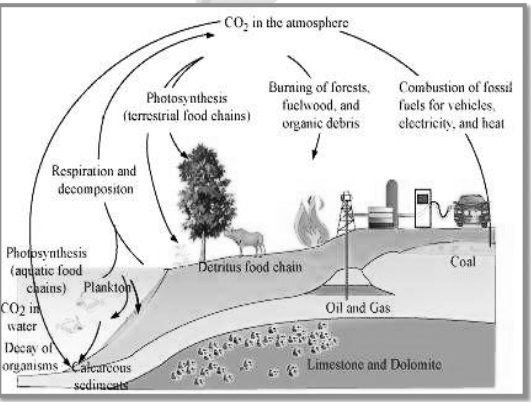
0 likes
View SolutionEcosystem — Ecosystem–Structure and Function · Frequently Asked Questions
1Are these Ecosystem questions useful for JEE and NEET?
Yes. All questions in this section are mapped to JEE Main and NEET exam patterns. Previous year questions from JEE Main, NEET, GUJCET and state-level exams are included with full solutions.
2Can I switch to Hindi or Gujarati for these questions?
Yes. Use the language tabs in the hero section or the sidebar to view the same questions and solutions in English, Hindi or Gujarati.
3How do I generate a question paper from this subtopic?
Use the Vedclass Exam Paper Generator — select the chapter and subtopic, set difficulty, and generate Sets A, B, C, D automatically. First 3 chapters of every subject are free.
Vedclass Products
For Students
Vedclass Test Series
Mock tests in real JEE/NEET style with performance analysis. 5-day free trial.
Start Free TrialFor Teachers
Exam Paper Generator
Generate Set A/B/C/D papers from this chapter in 2 minutes. 3 chapters free.
Try FreeFor Institutes
Online Exam Module
Live online exams with unlimited students, 360° analytics & white-label branding.
See DemoFor Teachers & Institutes
Generate a Ecosystem Exam Paper in 2 Minutes
Select subtopic & difficulty — Sets A, B, C, D auto-generated with No Repeat logic.
First 3 chapters of every subject are free — no payment required.