
A English
Ecosystem–Structure and Function Questions in English
Class 12 Biology · Ecosystem · Ecosystem–Structure and Function
463+
Questions
English
Language
100%
With Solutions
Showing 50 of 463 questions in English
351
EasyMCQ
Primary succession is the development of communities on
A
Cleared forest area
B
Previously unoccupied sites
C
Fresh harvested crop field
D
Pond filled after a dry season
Solution
(B) Primary succession refers to the process of ecological succession that occurs in areas where no living organisms have previously existed. These are barren,soilless,and uninhabited regions,such as newly cooled lava,bare rock surfaces,sand dunes,or newly created ponds and reservoirs. Since there is no pre-existing soil or organic matter,the process starts with the formation of soil by pioneer species.
0 likes
View Solution352
EasyMCQ
Which ones are the reservoirs of sulphur and carbon cycles respectively?
A
Atmosphere and consumers
B
Earth crust and atmosphere
C
Earth crust and producer
D
Atmosphere and predator
Solution
(B) The sulphur cycle is a sedimentary cycle,meaning its primary reservoir is the earth's crust,where sulphur is found in rocks and minerals.
In contrast,the carbon cycle is a gaseous cycle,and its primary reservoir is the atmosphere,which contains carbon in the form of carbon dioxide $(CO_2)$.
In contrast,the carbon cycle is a gaseous cycle,and its primary reservoir is the atmosphere,which contains carbon in the form of carbon dioxide $(CO_2)$.
0 likes
View Solution353
EasyMCQ
The reservoir for the sedimentary cycle exists in
A
Earth crust
B
Organic sediments
C
Calcareous sediments
D
Limestone
Solution
(A) In a sedimentary cycle,the elements are circulated through the Earth's crust.
The main reservoirs for these cycles are soil and rocks.
Examples of sedimentary cycles include the sulphur cycle and the phosphorus cycle.
Therefore,the Earth's crust acts as the primary reservoir for these nutrients.
The main reservoirs for these cycles are soil and rocks.
Examples of sedimentary cycles include the sulphur cycle and the phosphorus cycle.
Therefore,the Earth's crust acts as the primary reservoir for these nutrients.
0 likes
View Solution354
MediumMCQ
Choose the area which will take minimum time for succession.
A
Newly created reservoir
B
Bare rock
C
Buried or cut forest
D
Newly cooled lava
Solution
(C) Succession is the process of change in the species structure of an ecological community over time.
Secondary succession occurs in areas where life existed previously but was destroyed (e.g.,abandoned farm lands,burned or cut forests).
In a buried or cut forest,the soil is already present,rich in humus,and often contains seeds,spores,or underground stems (rhizomes).
Because the soil and nutrients are already available,the process of colonization and community development is much faster compared to primary succession on bare rock or newly cooled lava,which requires soil formation first.
Secondary succession occurs in areas where life existed previously but was destroyed (e.g.,abandoned farm lands,burned or cut forests).
In a buried or cut forest,the soil is already present,rich in humus,and often contains seeds,spores,or underground stems (rhizomes).
Because the soil and nutrients are already available,the process of colonization and community development is much faster compared to primary succession on bare rock or newly cooled lava,which requires soil formation first.
0 likes
View Solution355
MediumMCQ
The term 'homeostasis' in an ecosystem refers to
A
Feedback mechanism
B
Self regulatory mechanism
C
Influence of production
D
State of equilibrium
Solution
(D) Homeostasis,also known as the state of equilibrium or the balance of nature,is maintained in an ecosystem through various control mechanisms. These include the carrying capacity of the environment,self-regulation,and feedback systems that ensure the stability of the ecosystem.
0 likes
View Solution356
EasyMCQ
The individual transitional communities in ecological succession are termed as
A
Climax community
B
Pioneer community
C
Seral communities
D
Single community
Solution
(C) In ecological succession,the entire sequence of communities that successively change in a given area is called a sere. The individual transitional communities that appear during this process are known as seral communities or seral stages.
0 likes
View Solution357
MediumMCQ
The organisms,which attack dead animals are
A
First link of the food chain
B
Second link of the food chain
C
Third link of the food chain
D
No Position in the Food Chain
Solution
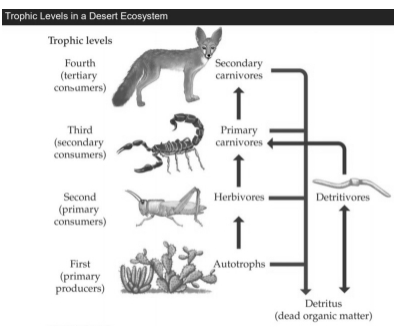
(B) Organisms that feed on dead organic matter are known as decomposers or detritivores.
In a Detritus Food Chain $(DFC)$,the dead organic matter (detritus) acts as the $1^{st}$ trophic level.
The organisms that feed on this detritus (detritivores) occupy the $2^{nd}$ trophic level.
Decomposers are heterotrophic organisms,primarily bacteria and fungi,that break down complex organic matter into simple inorganic substances through the secretion of extracellular enzymes.
They play a crucial role in nutrient cycling within the ecosystem.
In a Detritus Food Chain $(DFC)$,the dead organic matter (detritus) acts as the $1^{st}$ trophic level.
The organisms that feed on this detritus (detritivores) occupy the $2^{nd}$ trophic level.
Decomposers are heterotrophic organisms,primarily bacteria and fungi,that break down complex organic matter into simple inorganic substances through the secretion of extracellular enzymes.
They play a crucial role in nutrient cycling within the ecosystem.
0 likes
View Solution358
MediumMCQ
What are autotrophs?
A
Make their own food
B
Are the base of the food chain
C
Are primary producers
D
All of the above
Solution
(D) Autotrophs are organisms that can synthesize their own organic food from inorganic raw materials using energy from sunlight or chemical reactions.
They serve as the primary producers in an ecosystem.
They occupy the first trophic level and form the base of the food chain.
Therefore,all the given statements are correct.
They serve as the primary producers in an ecosystem.
They occupy the first trophic level and form the base of the food chain.
Therefore,all the given statements are correct.
0 likes
View Solution359
MediumMCQ
The primary consumers in a pond ecosystem are
A
Phytoplankton
B
Zooplankton
C
Fishes
D
Bacteria
Solution
(B) In a pond ecosystem,the producers are phytoplankton.
Primary consumers are organisms that feed directly on producers.
Zooplankton,such as small crustaceans (water fleas,Cyclops),are herbivores that feed on phytoplankton.
Therefore,zooplankton act as the primary consumers in a pond ecosystem.
Other examples of primary consumers in this ecosystem include mosquito larvae,tadpoles,snails,and certain small fish.
Primary consumers are organisms that feed directly on producers.
Zooplankton,such as small crustaceans (water fleas,Cyclops),are herbivores that feed on phytoplankton.
Therefore,zooplankton act as the primary consumers in a pond ecosystem.
Other examples of primary consumers in this ecosystem include mosquito larvae,tadpoles,snails,and certain small fish.
0 likes
View Solution360
MediumMCQ
The two components of an ecosystem are
A
Plants and animals
B
Weeds,trees,animals and man
C
Energy flow and mineral cycling
D
Biotic and abiotic
Solution
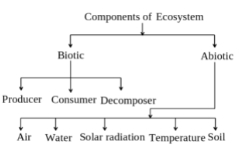
(D) The components of an ecosystem are broadly classified into two main categories:
$1$. Biotic components: These include all living organisms within the ecosystem,such as producers (plants),consumers (animals),and decomposers (microorganisms).
$2$. Abiotic components: These include all non-living physical and chemical factors that influence the ecosystem,such as air,water,soil,solar radiation,and temperature.
$1$. Biotic components: These include all living organisms within the ecosystem,such as producers (plants),consumers (animals),and decomposers (microorganisms).
$2$. Abiotic components: These include all non-living physical and chemical factors that influence the ecosystem,such as air,water,soil,solar radiation,and temperature.
0 likes
View Solution361
MediumMCQ
In a pond ecosystem,benthos means
A
Primary consumers in the depth of a pond
B
Virus
C
Zooplankton on the water surface
D
Bacteria
Solution
(A) Benthos are organisms that live at the bottom of a water body,such as a lake or pond.
In the context of a pond ecosystem,these organisms often function as primary consumers or decomposers residing in the deep benthic zone.
In the context of a pond ecosystem,these organisms often function as primary consumers or decomposers residing in the deep benthic zone.
0 likes
View Solution362
MediumMCQ
In the following,which of these pairs represents the same ecological group?
A
Trophic level-$I$ and herbivores
B
Primary consumers and herbivores
C
Primary carnivores and trophic level-$II$
D
Secondary consumer and herbivores
Solution
(B) In an ecosystem,the trophic structure is organized as follows:
$1$. Producers occupy Trophic level-$I$.
$2$. Herbivores are organisms that feed directly on producers,thus they are Primary consumers and occupy Trophic level-$II$.
$3$. Primary carnivores feed on herbivores,thus they are Secondary consumers and occupy Trophic level-$III$.
$4$. Secondary carnivores (or top carnivores) occupy Trophic level-$IV$ or higher.
Therefore,'Primary consumers' and 'herbivores' refer to the same ecological group.
$1$. Producers occupy Trophic level-$I$.
$2$. Herbivores are organisms that feed directly on producers,thus they are Primary consumers and occupy Trophic level-$II$.
$3$. Primary carnivores feed on herbivores,thus they are Secondary consumers and occupy Trophic level-$III$.
$4$. Secondary carnivores (or top carnivores) occupy Trophic level-$IV$ or higher.
Therefore,'Primary consumers' and 'herbivores' refer to the same ecological group.
0 likes
View Solution363
MediumMCQ
Out of the following biogeochemical cycles, which ones are gaseous?
$I.$ Sulphur
$II.$ Phosphorus
$III.$ Nitrogen
$IV.$ Carbon
Choose the correct option.
$I.$ Sulphur
$II.$ Phosphorus
$III.$ Nitrogen
$IV.$ Carbon
Choose the correct option.
A
$Only \; I$
B
$Only \; II$
C
$Only \; IV$
D
$III \; and \; IV$
Solution
(D) Biogeochemical cycles are broadly classified into two types: gaseous and sedimentary.
$1.$ Gaseous cycles: The reservoir for these elements is the atmosphere or hydrosphere. Examples include the nitrogen cycle $(III)$ and the carbon cycle $(IV)$.
$2.$ Sedimentary cycles: The reservoir for these elements is the Earth's crust (soil and rocks). Examples include the sulphur cycle $(I)$ and the phosphorus cycle $(II)$.
Therefore, nitrogen and carbon cycles are gaseous cycles.
$1.$ Gaseous cycles: The reservoir for these elements is the atmosphere or hydrosphere. Examples include the nitrogen cycle $(III)$ and the carbon cycle $(IV)$.
$2.$ Sedimentary cycles: The reservoir for these elements is the Earth's crust (soil and rocks). Examples include the sulphur cycle $(I)$ and the phosphorus cycle $(II)$.
Therefore, nitrogen and carbon cycles are gaseous cycles.
0 likes
View Solution364
EasyMCQ
Lichen is the pioneer vegetation on which succession?
A
Hydrosere
B
Lithosere
C
Psammosere
D
Xerosere
Solution
(B) Lithosere is a type of xerosere that begins on bare rock surfaces.
The initial substratum lacks water and organic matter,containing only minerals in an unweathered state.
Lichens are the pioneer species that colonize these bare rocks,initiating the process of primary succession.
The initial substratum lacks water and organic matter,containing only minerals in an unweathered state.
Lichens are the pioneer species that colonize these bare rocks,initiating the process of primary succession.
0 likes
View Solution365
MediumMCQ
Which of the following is the logical sequence of primary succession in water?
A
$Small \ phytoplanktons \rightarrow Free-floating \ angiosperms \rightarrow Rooted \ hydrophytes \rightarrow Grasses \rightarrow Sedges \rightarrow Trees$
B
$Free-floating \ angiosperms \rightarrow Small \ phytoplanktons \rightarrow Rooted \ hydrophytes \rightarrow Grasses \rightarrow Sedges \rightarrow Trees$
C
$Small \ phytoplanktons \rightarrow Sedges \rightarrow Free-floating \ angiosperms \rightarrow Rooted \ hydrophytes \rightarrow Grasses \rightarrow Trees$
D
$Small \ phytoplanktons \rightarrow Sedges \rightarrow Grasses \rightarrow Free-floating \ angiosperms \rightarrow Rooted \ hydrophytes \rightarrow Trees$
Solution
(A) Primary succession in water,also known as hydrarch succession,follows a specific sequence of stages:
$1$. Phytoplankton stage: The pioneer species are small phytoplanktons.
$2$. Submerged plant stage: Rooted submerged hydrophytes appear.
$3$. Submerged free-floating plant stage: Free-floating angiosperms appear.
$4$. Reed-swamp stage: Plants like sedges and grasses appear.
$5$. Marsh-meadow stage: The area becomes more terrestrial.
$6$. Scrub and Forest stage: Finally,trees dominate the area.
Therefore,the correct sequence is: $Small \ phytoplanktons \rightarrow Rooted \ hydrophytes \rightarrow Free-floating \ angiosperms \rightarrow Sedges \rightarrow Grasses \rightarrow Trees$. Note: Option $A$ is the closest logical progression provided in the choices,though standard $NCERT$ sequences often list rooted hydrophytes before free-floating stages depending on the specific depth and conditions.
$1$. Phytoplankton stage: The pioneer species are small phytoplanktons.
$2$. Submerged plant stage: Rooted submerged hydrophytes appear.
$3$. Submerged free-floating plant stage: Free-floating angiosperms appear.
$4$. Reed-swamp stage: Plants like sedges and grasses appear.
$5$. Marsh-meadow stage: The area becomes more terrestrial.
$6$. Scrub and Forest stage: Finally,trees dominate the area.
Therefore,the correct sequence is: $Small \ phytoplanktons \rightarrow Rooted \ hydrophytes \rightarrow Free-floating \ angiosperms \rightarrow Sedges \rightarrow Grasses \rightarrow Trees$. Note: Option $A$ is the closest logical progression provided in the choices,though standard $NCERT$ sequences often list rooted hydrophytes before free-floating stages depending on the specific depth and conditions.
0 likes
View Solution366
MediumMCQ
Which one of the following is one of the characteristics of an ecosystem structure?
A
Stratification
B
Natality
C
Mortality
D
Sex ratio
Solution
(A) The structure of an ecosystem is characterized by the organization of its biotic and abiotic components.
Key features of ecosystem structure include:
$1$. Species composition: Identification and enumeration of plant and animal species.
$2$. Stratification: The vertical distribution of different species occupying different levels.
$3$. Energy flow,nutrient cycling,and primary production.
Natality,mortality,and sex ratio are characteristics of a population,not an ecosystem structure.
Therefore,stratification is the correct answer.
Key features of ecosystem structure include:
$1$. Species composition: Identification and enumeration of plant and animal species.
$2$. Stratification: The vertical distribution of different species occupying different levels.
$3$. Energy flow,nutrient cycling,and primary production.
Natality,mortality,and sex ratio are characteristics of a population,not an ecosystem structure.
Therefore,stratification is the correct answer.
0 likes
View Solution367
EasyMCQ
Another name for nutrient cycling is
A
Gaseous cycle
B
Sedimentary cycle
C
Biogeochemical cycle
D
Carbon cycle
Solution
(C) Another name for nutrient cycling is the biogeochemical cycle.
The movement of nutrient elements through various components (abiotic and biotic) of an ecosystem is known as nutrient cycling or the biogeochemical cycle.
The movement of nutrient elements through various components (abiotic and biotic) of an ecosystem is known as nutrient cycling or the biogeochemical cycle.
0 likes
View Solution368
MediumMCQ
An ecosystem,which can be easily damaged but can recover after some time if the damaging effect stops,will be having
A
Low stability and high resilience
B
High stability and low resilience
C
Low stability and low resilience
D
High stability and high resilience
Solution
(A) Stability is the ability of an ecosystem to resist change or remain in its original state despite unfavourable factors.
Resilience is the capacity of an ecosystem to recover or regain its original structure and function after being disturbed or damaged.
Since the ecosystem is easily damaged,it has low stability.
Since it can recover after the damaging effect stops,it has high resilience.
Therefore,the correct answer is low stability and high resilience.
Resilience is the capacity of an ecosystem to recover or regain its original structure and function after being disturbed or damaged.
Since the ecosystem is easily damaged,it has low stability.
Since it can recover after the damaging effect stops,it has high resilience.
Therefore,the correct answer is low stability and high resilience.
0 likes
View Solution369
MediumMCQ
In a pond ecosystem,diatoms represent
A
Producers
B
Primary consumer
C
Secondary consumer
D
Tertiary consumer
Solution
(A) In a pond ecosystem,producers include phytoplankton (e.g.,diatoms,Chlorella,Spirogyra,Chlamydomonas,etc.),free-floating macrophytes (e.g.,Lemna,Azolla),suspended macrophytes (e.g.,Utricularia,Hydrilla),submerged plants (Vallisneria),floating-leaved plants (e.g.,Nelumbo),and emergent plants (Sagittaria),etc.
Since diatoms are photosynthetic organisms that convert solar energy into chemical energy,they function as producers in the aquatic food chain.
Since diatoms are photosynthetic organisms that convert solar energy into chemical energy,they function as producers in the aquatic food chain.
0 likes
View Solution370
MediumMCQ
Identify the plant belonging to the reed-swamp stage in hydrarch succession.
A
Juncus
B
Sagittaria
C
Salix
D
Trapa
Solution
(B) Hydrarch succession,or hydrosere,is the process by which a pond ecosystem gradually transitions into a terrestrial community.
In the reed-swamp stage,the water body becomes shallow (approximately $0.3-1.0 \ m$ deep),allowing amphibious plants to thrive.
$Sagittaria$ is a characteristic plant of the reed-swamp stage.
$Juncus$ is associated with the sedge-meadow stage.
$Salix$ represents the woodland stage.
$Trapa$ is found in the rooted-floating stage.
In the reed-swamp stage,the water body becomes shallow (approximately $0.3-1.0 \ m$ deep),allowing amphibious plants to thrive.
$Sagittaria$ is a characteristic plant of the reed-swamp stage.
$Juncus$ is associated with the sedge-meadow stage.
$Salix$ represents the woodland stage.
$Trapa$ is found in the rooted-floating stage.
0 likes
View Solution371
MediumMCQ
In a lake,phytoplankton grow abundantly in
A
Littoral zone
B
Limnetic zone
C
Profundal zone
D
Benthic region
Solution
(B) In a lake,the ecosystem is divided into zones such as the littoral zone,limnetic zone,and profundal zone.
In the $Limnetic$ zone,which is the open water area away from the shore,light penetration is sufficient for photosynthesis.
The primary producers in this zone are mainly phytoplanktonic algae,such as diatoms,green algae,and blue-green algae.
In contrast,the $Profundal$ zone is the deep,dark region where light is insufficient for photosynthesis,and organisms here depend on organic matter falling from the upper zones.
In the $Limnetic$ zone,which is the open water area away from the shore,light penetration is sufficient for photosynthesis.
The primary producers in this zone are mainly phytoplanktonic algae,such as diatoms,green algae,and blue-green algae.
In contrast,the $Profundal$ zone is the deep,dark region where light is insufficient for photosynthesis,and organisms here depend on organic matter falling from the upper zones.
0 likes
View Solution372
MediumMCQ
Stratification occurs in
A
Desert
B
Tropical forest
C
Deciduous forest
D
Tundra
Solution
(B) Stratification refers to the vertical distribution of different species occupying different levels in an ecosystem.
In a forest ecosystem,particularly in tropical rainforests,stratification is highly complex and well-defined.
It typically consists of five vertical layers: the subterranean layer,the forest floor,the herbaceous layer,the shrub layer,and the tree canopy layer.
In a forest ecosystem,particularly in tropical rainforests,stratification is highly complex and well-defined.
It typically consists of five vertical layers: the subterranean layer,the forest floor,the herbaceous layer,the shrub layer,and the tree canopy layer.
0 likes
View Solution373
MediumMCQ
Which of the following groups is an absolutely essential functional component of the ecosystem?
A
Producers
B
Producers and herbivores
C
Producers and detritivores
D
Detritivores
Solution
(C) An ecosystem is composed of biotic (living) and abiotic (non-living) components. The biotic component includes producers,consumers,and detritivores. Producers are essential for energy fixation (photosynthesis),while detritivores are essential for nutrient cycling and decomposition. Therefore,producers and detritivores are considered the absolutely essential functional components of the ecosystem.
0 likes
View Solution374
MediumMCQ
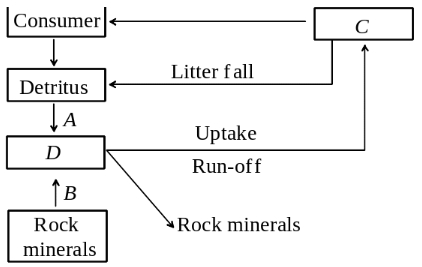
$A$ simplified model of phosphorus cycling in a terrestrial ecosystem is given below. Identify $A, B, C$ and $D$.
A
$A-$Weathering,$B-$Decomposition,$C-$Consumer,$D-$Soil
B
$A-$Decomposition,$B-$Weathering,$C-$Producer,$D-$Soil
C
$A-$Weathering,$B-$Decomposition,$C-$Decomposer,$D-$Soil
D
$A-$Decomposition,$B-$Decomposer,$C-$Weathering,$D-$Soil
Solution
(B) In the phosphorus cycle of a terrestrial ecosystem:
$1$. $A$ represents the process of Decomposition,where organic matter (detritus) is broken down into inorganic nutrients.
$2$. $B$ represents the process of Weathering,which releases phosphorus from rock minerals into the soil.
$3$. $C$ represents Producers (plants),which take up phosphorus from the soil.
$4$. $D$ represents the Soil solution,which acts as the reservoir for inorganic phosphorus.
Therefore,the correct identification is $A-$Decomposition,$B-$Weathering,$C-$Producer,$D-$Soil.
$1$. $A$ represents the process of Decomposition,where organic matter (detritus) is broken down into inorganic nutrients.
$2$. $B$ represents the process of Weathering,which releases phosphorus from rock minerals into the soil.
$3$. $C$ represents Producers (plants),which take up phosphorus from the soil.
$4$. $D$ represents the Soil solution,which acts as the reservoir for inorganic phosphorus.
Therefore,the correct identification is $A-$Decomposition,$B-$Weathering,$C-$Producer,$D-$Soil.
0 likes
View Solution375
MediumMCQ
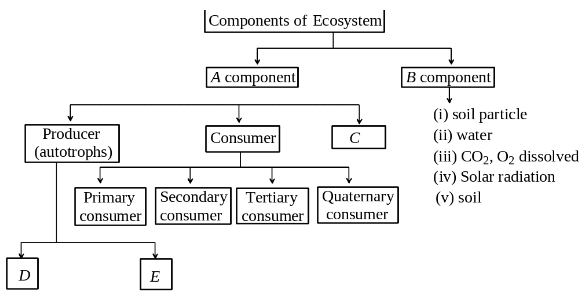
Study the diagram carefully and fill in the blanks. Choose the correct option for $A, B, C, D$ and $E$.
A
$A-$Biotic,$B-$Abiotic,$C-$Decomposers,$D-$Photoautotrophs,$E-$Chemoautotrophs
B
$A-$Physical,$B-$Chemical,$C-$Phytoplanktons,$D-$Plants,$E-$Parasites
C
$A-$Biotic,$B-$Abiotic,$C-$Decomposers,$D-$Autotrophs,$E-$Mixotrophs
D
$A-$Physical,$B-$Chemical,$C-$Bacteria and Fungi,$D-$Autotrophs,$E-$Heterotrophs
Solution
(A) The components of an ecosystem are broadly classified into two categories: Biotic and Abiotic components.
$1$. $A$ represents the Biotic component,which includes living organisms like producers,consumers,and decomposers $(C)$.
$2$. $B$ represents the Abiotic component,which includes non-living factors like soil,water,gases,and solar radiation.
$3$. Producers (autotrophs) are further classified based on their energy source into $D$ (Photoautotrophs) and $E$ (Chemoautotrophs).
Therefore,the correct sequence is $A-$Biotic,$B-$Abiotic,$C-$Decomposers,$D-$Photoautotrophs,$E-$Chemoautotrophs.
$1$. $A$ represents the Biotic component,which includes living organisms like producers,consumers,and decomposers $(C)$.
$2$. $B$ represents the Abiotic component,which includes non-living factors like soil,water,gases,and solar radiation.
$3$. Producers (autotrophs) are further classified based on their energy source into $D$ (Photoautotrophs) and $E$ (Chemoautotrophs).
Therefore,the correct sequence is $A-$Biotic,$B-$Abiotic,$C-$Decomposers,$D-$Photoautotrophs,$E-$Chemoautotrophs.
0 likes
View Solution376
MediumMCQ
Stratification is more pronounced in
A
Tropical rainforest
B
Deciduous forest
C
Temperate forest
D
Tropical savannah
Solution
(A) Stratification refers to the vertical distribution of different species occupying different levels in an ecosystem.
It is most pronounced in tropical rainforests due to the high diversity of plant species and their varying heights,which create distinct layers such as the emergent layer,canopy,understory,and forest floor.
This vertical layering allows for the efficient utilization of light and resources among different organisms.
It is most pronounced in tropical rainforests due to the high diversity of plant species and their varying heights,which create distinct layers such as the emergent layer,canopy,understory,and forest floor.
This vertical layering allows for the efficient utilization of light and resources among different organisms.
0 likes
View Solution377
MediumMCQ
What is the reason behind the deficit rising in a nutrient reservoir?
A
Due to imbalance in the rate of influx
B
Due to imbalance in the rate of efflux
C
Due to imbalance in the rate of influx and efflux
D
None of the above
Solution
(C) The nutrient reservoir acts as a buffer in the ecosystem.
It meets the deficit that arises due to an imbalance in the rate of influx (input) and efflux (output) of nutrients within the system.
It meets the deficit that arises due to an imbalance in the rate of influx (input) and efflux (output) of nutrients within the system.
0 likes
View Solution378
MediumMCQ
Which of the following represents the largest man-made ecosystem?
A
Zoo
B
Garden
C
Aquarium
D
Agroecosystem
Solution
(D) An agroecosystem is a man-made ecosystem that covers vast areas of land globally for agricultural purposes.
It is the largest man-made ecosystem because it involves extensive land use for crop production,livestock,and associated management practices.
Unlike zoos,gardens,or aquariums,which are small-scale and localized,agroecosystems span millions of hectares worldwide.
It is the largest man-made ecosystem because it involves extensive land use for crop production,livestock,and associated management practices.
Unlike zoos,gardens,or aquariums,which are small-scale and localized,agroecosystems span millions of hectares worldwide.
0 likes
View Solution379
EasyMCQ
What percentage of $PAR$ can be captured by plants?
A
$1-5\;\%$
B
$2-10\;\%$
C
$20\;\%$
D
$50\;\%$
Solution
(B) Plants capture only $2-10\;\%$ of $PAR$ (Photosynthetically Active Radiation) for the synthesis of organic matter. This corresponds to approximately $1-5\;\%$ of the total incident solar radiation.
0 likes
View Solution380
MediumMCQ
Choose the incorrect option with respect to the amount of living material present in different trophic levels at a given time.
A
Can be measured as number
B
Is equivalent to standing crop
C
Is always represented as dry weight only
D
Expressed both as biomass and number
Solution
(C) The amount of living material present in different trophic levels at a given time is known as the standing crop.
It is measured as the mass of living organisms (biomass) or the number of organisms in a unit area.
It is not always represented as dry weight only; it can be measured as fresh weight or number as well.
Therefore,the statement that it is 'always represented as dry weight only' is incorrect.
It is measured as the mass of living organisms (biomass) or the number of organisms in a unit area.
It is not always represented as dry weight only; it can be measured as fresh weight or number as well.
Therefore,the statement that it is 'always represented as dry weight only' is incorrect.
0 likes
View Solution381
EasyMCQ
Choose the odd one out with respect to the functional aspects of an ecosystem.
A
Energy flow
B
Decomposition
C
Species composition
D
Nutrient cycling
Solution
(C) The functional aspects of an ecosystem include energy flow,decomposition,and nutrient cycling. Species composition is a structural aspect of an ecosystem,not a functional one.
0 likes
View Solution382
EasyMCQ
Ecological succession is . . . . . . and . . . . . . change in species composition.
A
Orderly and sequential
B
Unpredictable and orderly
C
Gradual and unsequential
D
Sequential and disorderly
Solution
(A) Ecological succession is defined as the gradual and predictable change in the species composition of a given area. It is an orderly and sequential process that leads to the development of a stable climax community.
0 likes
View Solution383
EasyMCQ
Choose the incorrect option for the cost distribution of ecosystem services.
A
Soil formation - $50\%$
B
Nutrient cycling - $10\%$
C
Climate regulation - $6\%$
D
Habitat for wildlife - $6\%$
Solution
(B) According to Robert Costanza's estimates for ecosystem services,the cost distribution is as follows: Soil formation accounts for approximately $50\%$ of the total value. Nutrient cycling accounts for less than $10\%$ (approximately $6\%$),while Climate regulation and Habitat for wildlife each account for approximately $6\%$. Therefore,the statement that Nutrient cycling accounts for $10\%$ is incorrect as it is less than $10\%$.
0 likes
View Solution384
MediumMCQ
Choose the correct change during ecological succession.
A
Total biomass decreases
B
Decomposers also change
C
Low degree of diversity
D
Humus content decreases
Solution
(B) Ecological succession is a gradual and predictable change in the species composition of a given area. During this process,as the community structure evolves from pioneer species to a climax community,the physical and biological environment changes significantly. This includes changes in the types and diversity of decomposers present in the ecosystem,as they adapt to the changing availability of organic matter and nutrient cycling requirements at different seral stages.
0 likes
View Solution385
MediumMCQ
To make the study of global ecosystem easier,it is broadly divided into how many basic categories?
A
Three
B
Two
C
Four
D
Five
Solution
(B) The global ecosystem is broadly divided into $2$ basic categories to facilitate its study:
$(i)$ Terrestrial ecosystem: Includes forests,grasslands,and deserts.
$(ii)$ Aquatic ecosystem: Includes ponds,lakes,wetlands,rivers,and oceans.
$(i)$ Terrestrial ecosystem: Includes forests,grasslands,and deserts.
$(ii)$ Aquatic ecosystem: Includes ponds,lakes,wetlands,rivers,and oceans.
0 likes
View Solution386
MediumMCQ
Which of the following trophic levels are occupied by a sparrow?
A
Primary consumer,primary producer
B
Secondary consumer,top carnivore
C
Primary producer,secondary producer
D
Primary consumer,secondary consumer
Solution
(D) sparrow acts as a primary consumer when it feeds on seeds,grains,or fruits,as it directly consumes plant products.
It acts as a secondary consumer when it feeds on insects or small worms,which are primary consumers.
Therefore,a sparrow occupies both the primary consumer and secondary consumer trophic levels depending on its diet.
It acts as a secondary consumer when it feeds on insects or small worms,which are primary consumers.
Therefore,a sparrow occupies both the primary consumer and secondary consumer trophic levels depending on its diet.
0 likes
View Solution387
MediumMCQ
Initial seral stages in ecological succession:
A
Possess low diversity
B
Have higher biomass
C
Are more numerous in secondary succession
D
Show maximum niche specialization
Solution
(A) In ecological succession,the initial seral stages (pioneer communities) are characterized by simple food webs,low species diversity,and low biomass compared to the climax community. As succession progresses,diversity and biomass increase,and niche specialization becomes more pronounced.
0 likes
View Solution388
EasyMCQ
Choose the odd one out with respect to the gaseous cycle.
A
Carbon
B
Hydrogen
C
Nitrogen
D
Phosphorus
Solution
(D) Biogeochemical cycles are broadly classified into two types: gaseous cycles and sedimentary cycles.
In gaseous cycles,the reservoir for the element is the atmosphere or hydrosphere (e.g.,Carbon,Nitrogen,Hydrogen,Oxygen).
In sedimentary cycles,the reservoir for the element is the Earth's crust (e.g.,Phosphorus,Sulfur).
Therefore,Phosphorus is the odd one out as it represents a sedimentary cycle.
In gaseous cycles,the reservoir for the element is the atmosphere or hydrosphere (e.g.,Carbon,Nitrogen,Hydrogen,Oxygen).
In sedimentary cycles,the reservoir for the element is the Earth's crust (e.g.,Phosphorus,Sulfur).
Therefore,Phosphorus is the odd one out as it represents a sedimentary cycle.
0 likes
View Solution389
MediumMCQ
The area where succession can take several thousand years to reach a climax community is:
A
Burnt and cut forest
B
Sand dunes
C
Flooded land
D
Abandoned farm lands
Solution
(B) Ecological succession is the process of change in the species structure of an ecological community over time.
Primary succession occurs in areas where no living organisms previously existed,such as bare rock or sand dunes.
Because these areas lack soil and organic matter,the process of soil formation and colonization by pioneer species is extremely slow.
Consequently,it can take several thousand years for primary succession on sand dunes to reach a stable climax community.
In contrast,secondary succession (as seen in burnt forests,flooded lands,or abandoned farmlands) occurs much faster because soil and some organic matter are already present.
Primary succession occurs in areas where no living organisms previously existed,such as bare rock or sand dunes.
Because these areas lack soil and organic matter,the process of soil formation and colonization by pioneer species is extremely slow.
Consequently,it can take several thousand years for primary succession on sand dunes to reach a stable climax community.
In contrast,secondary succession (as seen in burnt forests,flooded lands,or abandoned farmlands) occurs much faster because soil and some organic matter are already present.
0 likes
View Solution390
MediumMCQ
Choose the correct sequence of transitional communities in Xerarch succession.
A
Mosses $\rightarrow$ Lichens $\rightarrow$ Grasses
B
Bryophytes $\rightarrow$ Forest $\rightarrow$ Shrubs
C
Bryophytes $\rightarrow$ Herbs $\rightarrow$ Shrubs
D
Lichens $\rightarrow$ Mosses $\rightarrow$ Herbs
Solution
(C) In Xerarch succession (succession on bare rock),the sequence of communities is as follows:
$1$. Pioneer species: Lichens.
$2$. Transitional communities: Mosses $\rightarrow$ Herbs $\rightarrow$ Shrubs.
$3$. Climax community: Forest.
Therefore,the correct sequence of transitional communities is Bryophytes (Mosses) $\rightarrow$ Herbs $\rightarrow$ Shrubs.
$1$. Pioneer species: Lichens.
$2$. Transitional communities: Mosses $\rightarrow$ Herbs $\rightarrow$ Shrubs.
$3$. Climax community: Forest.
Therefore,the correct sequence of transitional communities is Bryophytes (Mosses) $\rightarrow$ Herbs $\rightarrow$ Shrubs.
0 likes
View Solution391
MediumMCQ
Which of the following is not true regarding an ecosystem?
A
Self-sufficient unit
B
Cyclic exchange of materials between living beings and the environment
C
Only requirement is input of energy
D
Characterized by a major vegetation type
Solution
(D) An ecosystem is a functional unit of nature where living organisms interact among themselves and with the surrounding physical environment.
It is considered a self-sufficient unit.
It involves the cyclic exchange of materials between living beings and the environment.
It requires a continuous input of energy (usually solar energy) to maintain its structure and function.
However,an ecosystem is not characterized solely by a 'major' vegetation type; it can be characterized by both minor and major vegetation types depending on the scale and complexity of the ecosystem.
It is considered a self-sufficient unit.
It involves the cyclic exchange of materials between living beings and the environment.
It requires a continuous input of energy (usually solar energy) to maintain its structure and function.
However,an ecosystem is not characterized solely by a 'major' vegetation type; it can be characterized by both minor and major vegetation types depending on the scale and complexity of the ecosystem.
0 likes
View Solution392
MediumMCQ
An ecosystem contains
A
Green plants and animals
B
Green plants and decomposers
C
Green plants,animals,decomposers and abiotic environment
D
Producers and consumers
Solution
(C) An ecosystem is a functional unit of nature where living organisms interact among themselves and with the surrounding physical environment. It consists of both biotic components (producers,consumers,and decomposers) and abiotic components (inorganic substances,organic compounds,and climatic factors).
0 likes
View Solution393
MediumMCQ
Which of the following are artificial aquatic ecosystems?
A
Large dams and reservoirs
B
Lakes and canals
C
Fishery tanks and Aquaria
D
All of these
Solution
(D) Artificial aquatic ecosystems are those created or maintained by human intervention.
$1$. Large dams and reservoirs are constructed by humans for water storage and power generation.
$2$. Canals are man-made waterways.
$3$. Fishery tanks and aquaria are specifically designed and maintained by humans for aquatic life.
Therefore,all the options listed are examples of artificial aquatic ecosystems.
$1$. Large dams and reservoirs are constructed by humans for water storage and power generation.
$2$. Canals are man-made waterways.
$3$. Fishery tanks and aquaria are specifically designed and maintained by humans for aquatic life.
Therefore,all the options listed are examples of artificial aquatic ecosystems.
0 likes
View Solution394
MediumMCQ
Which of the following is not a structural aspect of an ecosystem?
A
Productivity
B
Species composition
C
Diversity
D
Life cycle
Solution
(A) An ecosystem is characterized by both structural and functional aspects.
Structural aspects include species composition,stratification,and diversity.
Functional aspects include productivity,decomposition,energy flow,and nutrient cycling.
Therefore,productivity is a functional aspect,not a structural one.
Structural aspects include species composition,stratification,and diversity.
Functional aspects include productivity,decomposition,energy flow,and nutrient cycling.
Therefore,productivity is a functional aspect,not a structural one.
0 likes
View Solution395
MediumMCQ
Which of the following is a functional aspect of an ecosystem?
A
Species composition
B
Inorganic nutrients
C
Homeostasis
D
Topography
Solution
(C) The functional aspects of an ecosystem include energy flow,nutrient cycling,and homeostasis. Homeostasis refers to the ability of an ecosystem to maintain a stable internal environment despite external changes. Species composition,inorganic nutrients,and topography are considered structural aspects of an ecosystem.
0 likes
View Solution396
MediumMCQ
Stratification is well developed in
A
Tropical rain forests
B
Grasslands
C
Alpine vegetations
D
Temperate forests
Solution
(A) Stratification refers to the vertical distribution of different species occupying different levels in an ecosystem.
Tropical rain forests exhibit the most complex and well-developed stratification due to high biodiversity,abundant rainfall,and favorable temperatures,which allow for distinct layers such as the emergent layer,canopy,understory,and forest floor.
Therefore,the correct option is $A$.
Tropical rain forests exhibit the most complex and well-developed stratification due to high biodiversity,abundant rainfall,and favorable temperatures,which allow for distinct layers such as the emergent layer,canopy,understory,and forest floor.
Therefore,the correct option is $A$.
0 likes
View Solution397
MediumMCQ
Which of the following are called key industry animals?
A
Autotrophs
B
Decomposers
C
Herbivores
D
Top carnivores
Solution
(C) Key industry animals are those organisms that convert plant matter into animal biomass.
Since herbivores consume producers (plants) and serve as the primary source of energy for higher trophic levels,they are referred to as key industry animals.
Since herbivores consume producers (plants) and serve as the primary source of energy for higher trophic levels,they are referred to as key industry animals.
0 likes
View Solution398
MediumMCQ
The respiratory loss of producers,herbivores,and carnivores are respectively:
A
$10\%, 20\%, 30\%$
B
$20\%, 30\%, 60\%$
C
$20\%, 40\%, 80\%$
D
Always $10\%$
Solution
(B) In an ecosystem,energy is lost at each trophic level due to respiration.
For producers,the respiratory loss is approximately $20\%$.
For herbivores,the respiratory loss is approximately $30\%$.
For carnivores,the respiratory loss is approximately $60\%$.
Therefore,the correct sequence is $20\%, 30\%, 60\%$.
For producers,the respiratory loss is approximately $20\%$.
For herbivores,the respiratory loss is approximately $30\%$.
For carnivores,the respiratory loss is approximately $60\%$.
Therefore,the correct sequence is $20\%, 30\%, 60\%$.
0 likes
View Solution399
MediumMCQ
Earth is a/an
A
Open system
B
Closed system
C
Both $(a)$ and $(b)$
D
None of these
Solution
(C) Earth is considered an open system regarding energy because it receives solar radiation and radiates heat back into space.
However,it is considered a closed system regarding matter because the amount of matter (elements) on Earth remains essentially constant,with negligible exchange with outer space.
However,it is considered a closed system regarding matter because the amount of matter (elements) on Earth remains essentially constant,with negligible exchange with outer space.
0 likes
View Solution400
MediumMCQ
Choose the correct identification for the given stage of succession and the stage by which it is followed,respectively.
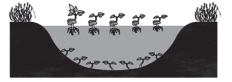
A
Marsh-meadow,Reed-swamp
B
Submerged free-floating,Reed-swamp
C
Submerged plant,Scrub stage
D
Phytoplankton,Marsh-meadow
Solution
(B) The provided image illustrates the 'submerged free-floating plant' stage of hydrarch succession.
In the sequence of hydrarch succession,the submerged free-floating plant stage is followed by the 'reed-swamp' stage,where emergent plants like Typha and Sagittaria begin to dominate.
In the sequence of hydrarch succession,the submerged free-floating plant stage is followed by the 'reed-swamp' stage,where emergent plants like Typha and Sagittaria begin to dominate.
0 likes
View SolutionEcosystem — Ecosystem–Structure and Function · Frequently Asked Questions
1Are these Ecosystem questions useful for JEE and NEET?
Yes. All questions in this section are mapped to JEE Main and NEET exam patterns. Previous year questions from JEE Main, NEET, GUJCET and state-level exams are included with full solutions.
2Can I switch to Hindi or Gujarati for these questions?
Yes. Use the language tabs in the hero section or the sidebar to view the same questions and solutions in English, Hindi or Gujarati.
3How do I generate a question paper from this subtopic?
Use the Vedclass Exam Paper Generator — select the chapter and subtopic, set difficulty, and generate Sets A, B, C, D automatically. First 3 chapters of every subject are free.
Vedclass Products
For Students
Vedclass Test Series
Mock tests in real JEE/NEET style with performance analysis. 5-day free trial.
Start Free TrialFor Teachers
Exam Paper Generator
Generate Set A/B/C/D papers from this chapter in 2 minutes. 3 chapters free.
Try FreeFor Institutes
Online Exam Module
Live online exams with unlimited students, 360° analytics & white-label branding.
See DemoFor Teachers & Institutes
Generate a Ecosystem Exam Paper in 2 Minutes
Select subtopic & difficulty — Sets A, B, C, D auto-generated with No Repeat logic.
First 3 chapters of every subject are free — no payment required.