
A English
Tools of recombinant DNA technology Questions in English
Class 12 Biology · Biotechnology Principals and Process · Tools of recombinant DNA technology
564+
Questions
English
Language
100%
With Solutions
Showing 14 of 564 questions in English
551
EasyMCQ
From which bacterium is the restriction endonuclease $Sal I$ isolated?
A
Escherichia coli
B
Streptococcus aureus
C
Haemophilus influenzae
D
Streptomyces albus
Solution
(D) The correct answer is $D$.
Restriction enzymes are named based on the genus and species of the bacterium from which they are isolated.
The first letter of the genus is written in capital letters,followed by the first two letters of the species name.
For $Sal I$,'$S$' comes from the genus $Streptomyces$ and '$al$' comes from the species $albus$.
Therefore,$Sal I$ is isolated from $Streptomyces albus$.
Restriction enzymes are named based on the genus and species of the bacterium from which they are isolated.
The first letter of the genus is written in capital letters,followed by the first two letters of the species name.
For $Sal I$,'$S$' comes from the genus $Streptomyces$ and '$al$' comes from the species $albus$.
Therefore,$Sal I$ is isolated from $Streptomyces albus$.
0 likes
View Solution552
EasyMCQ
Restriction endonucleases are isolated from some bacteria. Their role in bacteria is
A
defence against virus
B
synthesis of proteins
C
act as genetic material
D
help in reproduction
Solution
(A) The correct answer is $A$.
Restriction endonucleases are enzymes produced by bacteria as a defense mechanism against bacteriophages (viruses that infect bacteria).
These enzymes recognize specific $DNA$ sequences and cleave the viral $DNA$,thereby preventing the infection and replication of the virus within the bacterial cell.
Restriction endonucleases are enzymes produced by bacteria as a defense mechanism against bacteriophages (viruses that infect bacteria).
These enzymes recognize specific $DNA$ sequences and cleave the viral $DNA$,thereby preventing the infection and replication of the virus within the bacterial cell.
0 likes
View Solution553
EasyMCQ
Which one of the following statements is not correct about a plasmid?
A
It is a circular $DNA$.
B
It has antibiotic resistance genes.
C
It has the ability of autonomous replication.
D
Its $DNA$ is as long as chromosomal $DNA$.
Solution
(D) The correct answer is $D$.
Plasmids are small,circular,double-stranded $DNA$ molecules that are distinct from a cell's chromosomal $DNA$.
They are found primarily in bacteria and are much smaller in size compared to the chromosomal $DNA$ of the host cell.
Therefore,the statement that plasmid $DNA$ is as long as chromosomal $DNA$ is incorrect.
Plasmids are small,circular,double-stranded $DNA$ molecules that are distinct from a cell's chromosomal $DNA$.
They are found primarily in bacteria and are much smaller in size compared to the chromosomal $DNA$ of the host cell.
Therefore,the statement that plasmid $DNA$ is as long as chromosomal $DNA$ is incorrect.
0 likes
View Solution554
EasyMCQ
Most suitable method of introducing alien $DNA$ into a plant cell is
A
biolistics
B
microinjection
C
lipofection
D
heat shock method
Solution
(A) The correct answer is $A$.
Biolistics,also known as the gene gun method,is the most suitable technique for introducing foreign $DNA$ into plant cells.
In this method,cells are bombarded with high-velocity micro-particles of gold or tungsten coated with $DNA$.
Microinjection is typically used for animal cells,lipofection is used for animal cells,and the heat shock method is primarily used for bacterial transformation.
Biolistics,also known as the gene gun method,is the most suitable technique for introducing foreign $DNA$ into plant cells.
In this method,cells are bombarded with high-velocity micro-particles of gold or tungsten coated with $DNA$.
Microinjection is typically used for animal cells,lipofection is used for animal cells,and the heat shock method is primarily used for bacterial transformation.
0 likes
View Solution555
EasyMCQ
Which vector can clone a small fragment of $DNA$?
A
Plasmid
B
Bacterial artificial chromosome
C
Cosmid
D
Yeast artificial chromosome
Solution
(A) Plasmid.
Plasmids are extra-chromosomal,self-replicating,circular,$dsDNA$ molecules.
Plasmid vectors are typically used to clone small $DNA$ fragments,usually ranging from $100$ to $1000$ $bp$.
Plasmids are extra-chromosomal,self-replicating,circular,$dsDNA$ molecules.
Plasmid vectors are typically used to clone small $DNA$ fragments,usually ranging from $100$ to $1000$ $bp$.
0 likes
View Solution556
EasyMCQ
Identify the $DNA$ segment which is not a palindromic sequence.
A
$5$' $GGATCC$ $3$'
$3$' $GGTACC$ $5$'
$3$' $GGTACC$ $5$'
B
$5$' $GAATTC$ $3$'
$3$' $CTTAAG$ $5$'
$3$' $CTTAAG$ $5$'
C
$5$' $GCGGCCGC$ $3$'
$3$' $CGCCGGCG$ $5$'
$3$' $CGCCGGCG$ $5$'
D
$5$' $CCCGGG$ $3$'
$3$' $GGGCCC$ $5$'
$3$' $GGGCCC$ $5$'
Solution
(A) palindromic $DNA$ sequence is a sequence of base pairs that reads the same when the orientation of reading is the same,i.e.,$5'$ to $3'$ on both strands.
Let's analyze the options:
$A$: $5'-GGATCC-3'$ and $3'-GGTACC-5'$. The complementary strand of $5'-GGATCC-3'$ is $3'-CCTAGG-5'$. Since $3'-GGTACC-5'$ does not match $3'-CCTAGG-5'$,this is not a palindrome.
$B$: $5'-GAATTC-3'$ and $3'-CTTAAG-5'$. This is a palindrome (EcoRI site).
$C$: $5'-GCGGCCGC-3'$ and $3'-CGCCGGCG-5'$. This is a palindrome (NotI site).
$D$: $5'-CCCGGG-3'$ and $3'-GGGCCC-5'$. This is a palindrome (SmaI site).
Therefore,option $A$ is the correct answer.
Let's analyze the options:
$A$: $5'-GGATCC-3'$ and $3'-GGTACC-5'$. The complementary strand of $5'-GGATCC-3'$ is $3'-CCTAGG-5'$. Since $3'-GGTACC-5'$ does not match $3'-CCTAGG-5'$,this is not a palindrome.
$B$: $5'-GAATTC-3'$ and $3'-CTTAAG-5'$. This is a palindrome (EcoRI site).
$C$: $5'-GCGGCCGC-3'$ and $3'-CGCCGGCG-5'$. This is a palindrome (NotI site).
$D$: $5'-CCCGGG-3'$ and $3'-GGGCCC-5'$. This is a palindrome (SmaI site).
Therefore,option $A$ is the correct answer.
0 likes
View Solution557
EasyMCQ
Identify the desirable characteristics for a plasmid used in $rDNA$ technology from the following.
$A$. Ability to multiply and express outside the host in a bioreactor.
$B$. $A$ highly active promoter
$C$. $A$ site at which replication can be initiated
$D$. One or more identifiable marker genes
$E$. One or more unique restriction sites.
$A$. Ability to multiply and express outside the host in a bioreactor.
$B$. $A$ highly active promoter
$C$. $A$ site at which replication can be initiated
$D$. One or more identifiable marker genes
$E$. One or more unique restriction sites.
A
$A, C, D$ and $E$ only
B
$B, C$ and $D$ only
C
$C, D$ and $E$ only
D
$B, C$ and $E$ only
Solution
(C) The desirable characteristics for a cloning vector (plasmid) are:
$1$. Origin of replication $(ori)$: $A$ site at which replication can be initiated $(C)$.
$2$. Selectable markers: One or more identifiable marker genes $(D)$ to identify and eliminate non-transformants.
$3$. Cloning sites: One or more unique restriction sites $(E)$ for the insertion of foreign $DNA$.
Therefore,the correct characteristics are $C, D,$ and $E$. Option $A$ is incorrect because plasmids must replicate inside the host cell. Option $B$ is a feature of expression vectors,not necessarily cloning vectors.
$1$. Origin of replication $(ori)$: $A$ site at which replication can be initiated $(C)$.
$2$. Selectable markers: One or more identifiable marker genes $(D)$ to identify and eliminate non-transformants.
$3$. Cloning sites: One or more unique restriction sites $(E)$ for the insertion of foreign $DNA$.
Therefore,the correct characteristics are $C, D,$ and $E$. Option $A$ is incorrect because plasmids must replicate inside the host cell. Option $B$ is a feature of expression vectors,not necessarily cloning vectors.
0 likes
View Solution558
EasyMCQ
EcoRI is
A
used to join two $DNA$ fragments
B
a restriction enzyme
C
the abbreviation for bacterium Escherichia coli
D
a plasmid
Solution
(B) $EcoRI$ is a restriction endonuclease enzyme that cuts $DNA$ between $G$ and $A$ in the base sequence $5'-GAATTC-3'$.
0 likes
View Solution559
EasyMCQ
$EcoRI$ cleaves the $DNA$ strands to produce
A
blunt ends
B
sticky ends
C
satellite ends
D
ori replication end
Solution
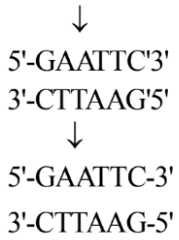
(B) $EcoRI$ is a restriction enzyme isolated from the bacterium $Escherichia$ $coli$. It cuts $DNA$ at the palindromic sequence $5'-GAATTC-3'$,specifically between the $G$ and $A$ on each strand. This staggered cleavage produces single-stranded overhangs known as sticky ends,which facilitate the joining of $DNA$ fragments.
0 likes
View Solution560
EasyMCQ
The enzymes which are absolutely necessary for recombinant $DNA$ technology are
A
restriction endonucleases and topoisomerases
B
endonucleases and polymerases
C
restriction endonucleases and ligases
D
peptidases and ligases
Solution
(C) restriction endonucleases and ligases.
The enzymes absolutely necessary for recombinant $DNA$ technology are restriction endonucleases and ligases.
$1$. Restriction endonucleases act as molecular scissors that cut $DNA$ at specific recognition sequences.
$2$. Ligases act as molecular glue that joins $DNA$ fragments together to form recombinant $DNA$ molecules.
$3$. Topoisomerases are involved in relieving $DNA$ supercoiling but are not the primary tools for recombination.
$4$. Polymerases are used for $DNA$ amplification $(PCR)$ but are distinct from the cutting and joining enzymes required for basic recombinant construction.
$5$. Peptidases are enzymes that break down proteins and have no role in $DNA$ manipulation.
The enzymes absolutely necessary for recombinant $DNA$ technology are restriction endonucleases and ligases.
$1$. Restriction endonucleases act as molecular scissors that cut $DNA$ at specific recognition sequences.
$2$. Ligases act as molecular glue that joins $DNA$ fragments together to form recombinant $DNA$ molecules.
$3$. Topoisomerases are involved in relieving $DNA$ supercoiling but are not the primary tools for recombination.
$4$. Polymerases are used for $DNA$ amplification $(PCR)$ but are distinct from the cutting and joining enzymes required for basic recombinant construction.
$5$. Peptidases are enzymes that break down proteins and have no role in $DNA$ manipulation.
0 likes
View Solution561
EasyMCQ
What is the correct nomenclature for restriction enzyme-$I$,obtained from $Bacillus$ $amyloliquefaciens$ $H$?
A
Bam $IH$
B
Baam $HI$
C
Bac $HI$
D
Bam $HI$
Solution
(D) The convention for naming restriction enzymes involves using the first letter of the genus and the first two letters of the species of the prokaryotic cell.
Thus,$Bacillus$ $amyloliquefaciens$ gives '$Bam$'.
The strain is indicated by the following letter ('$H$'),and the Roman numeral indicates the order of discovery.
Therefore,it is named $Bam$ $HI$.
Thus,$Bacillus$ $amyloliquefaciens$ gives '$Bam$'.
The strain is indicated by the following letter ('$H$'),and the Roman numeral indicates the order of discovery.
Therefore,it is named $Bam$ $HI$.
0 likes
View Solution562
EasyMCQ
Enzyme used for the extension process in the $PCR$ method.
A
$DNA$ Ligase
B
$DNA$ Helicase
C
Restriction Endonuclease
D
Taq polymerase
Solution
(D) In the $PCR$ (Polymerase Chain Reaction) method,$Taq$ polymerase is the heat-stable $DNA$ polymerase enzyme used in the extension phase to synthesize $DNA$ strands. It is derived from the bacterium $Thermus$ $aquaticus$ and can withstand the high temperatures required for denaturing $DNA$.
0 likes
View Solution563
MediumMCQ
Which of the following statements are not true regarding restriction endonucleases?
$A$. They are called molecular scissors.
$B$. These are the enzymes responsible for restricting the growth of bacteriophages in $E. coli$.
$C$. They cut the $DNA$ only at the centre of the palindromic sites.
$D$. They remove nucleotides only from the ends of $DNA$ fragments.
$E$. They recognise specific palindromic base-pair sequences.
Choose the answer from the options given below:
$A$. They are called molecular scissors.
$B$. These are the enzymes responsible for restricting the growth of bacteriophages in $E. coli$.
$C$. They cut the $DNA$ only at the centre of the palindromic sites.
$D$. They remove nucleotides only from the ends of $DNA$ fragments.
$E$. They recognise specific palindromic base-pair sequences.
Choose the answer from the options given below:
A
$(1)$ $C$ and $D$ only
B
$(2)$ $A$ and $E$ only
C
$(3)$ $D$ and $E$ only
D
$(4)$ $A$ and $B$ only
Solution
(A) Statement $A$ is true: Restriction endonucleases are known as molecular scissors.
Statement $B$ is true: They were discovered in $E. coli$ as a mechanism to restrict bacteriophage growth.
Statement $C$ is false: Restriction enzymes do not always cut at the exact center of palindromic sites; they often create staggered cuts.
Statement $D$ is false: Restriction endonucleases cut $DNA$ at specific internal positions,whereas exonucleases remove nucleotides from the ends.
Statement $E$ is true: They recognize specific palindromic sequences.
Therefore,statements $C$ and $D$ are not true.
Statement $B$ is true: They were discovered in $E. coli$ as a mechanism to restrict bacteriophage growth.
Statement $C$ is false: Restriction enzymes do not always cut at the exact center of palindromic sites; they often create staggered cuts.
Statement $D$ is false: Restriction endonucleases cut $DNA$ at specific internal positions,whereas exonucleases remove nucleotides from the ends.
Statement $E$ is true: They recognize specific palindromic sequences.
Therefore,statements $C$ and $D$ are not true.
0 likes
View Solution564
MediumMCQ
Insertion of a foreign $DNA$ at $BamHI$ site in an $E. coli$ cloning vector $pBR322$ results in the loss of antibiotic resistance towards :
A
$A$. Ampicillin and tetracycline
B
$B$. Ampicillin
C
$C$. Tetracycline
D
$D$. Gentamycin
Solution
(C) The cloning vector $pBR322$ contains two antibiotic resistance genes: one for ampicillin $(amp^R)$ and one for tetracycline $(tet^R)$.
In $pBR322$,the $BamHI$ restriction site is specifically located within the tetracycline resistance $(tet^R)$ gene.
When a foreign $DNA$ fragment is inserted at the $BamHI$ site,it disrupts the coding sequence of the $tet^R$ gene.
As a result,the bacteria containing this recombinant plasmid lose their ability to survive in the presence of tetracycline,a phenomenon known as insertional inactivation.
In $pBR322$,the $BamHI$ restriction site is specifically located within the tetracycline resistance $(tet^R)$ gene.
When a foreign $DNA$ fragment is inserted at the $BamHI$ site,it disrupts the coding sequence of the $tet^R$ gene.
As a result,the bacteria containing this recombinant plasmid lose their ability to survive in the presence of tetracycline,a phenomenon known as insertional inactivation.
0 likes
View SolutionBiotechnology Principals and Process — Tools of recombinant DNA technology · Frequently Asked Questions
1Are these Biotechnology Principals and Process questions useful for JEE and NEET?
Yes. All questions in this section are mapped to JEE Main and NEET exam patterns. Previous year questions from JEE Main, NEET, GUJCET and state-level exams are included with full solutions.
2Can I switch to Hindi or Gujarati for these questions?
Yes. Use the language tabs in the hero section or the sidebar to view the same questions and solutions in English, Hindi or Gujarati.
3How do I generate a question paper from this subtopic?
Use the Vedclass Exam Paper Generator — select the chapter and subtopic, set difficulty, and generate Sets A, B, C, D automatically. First 3 chapters of every subject are free.
Vedclass Products
For Students
Vedclass Test Series
Mock tests in real JEE/NEET style with performance analysis. 5-day free trial.
Start Free TrialFor Teachers
Exam Paper Generator
Generate Set A/B/C/D papers from this chapter in 2 minutes. 3 chapters free.
Try FreeFor Institutes
Online Exam Module
Live online exams with unlimited students, 360° analytics & white-label branding.
See DemoFor Teachers & Institutes
Generate a Biotechnology Principals and Process Exam Paper in 2 Minutes
Select subtopic & difficulty — Sets A, B, C, D auto-generated with No Repeat logic.
First 3 chapters of every subject are free — no payment required.